







Abstract
Over the past 15 years, there has been a growing interest and investment in ‘character’ education across the UK political landscape. Alongside the activities of central government, character education has been promoted by a range of non-government actors in the UK and beyond, including philanthropic foundations, think tanks, education entrepreneurs, and academics. It is the presence of these actors and their relationship to, and influence on, UK government policy that we examine in this article. Investigating character education from a perspective of policy formation and influence, we trace the key policy actors who have contributed to the adoption of character education in the UK, and their international connections, identifying the resources, activities and relationships through which they have achieved policy influence. A central and original contribution of this article is in identifying the financial and ideological influence of US Christian neoconservative philanthropic foundation the John Templeton Foundation on social science research and policy in the UK. Our analysis identifies academics in the UK and US who, through considerable John Templeton Foundation funding, have provided an evidence base that authorises character education as a policy solution. We also locate ‘policy entrepreneurs’ as key nodal actors, whose social capital and elite membership helps to lubricate network relations and facilitate policy influence. Finally, we consider the motivations and vested interests of policy actors, including the John Templeton Foundation’s particular model of philanthropy, and conclude that the character education agenda is underpinned by a set of ideas that promote a free-market, individualistic and socially conservative worldview.
Keywords
Introduction
Over the past 15 years, there has been a growing interest and investment in ‘character’ education across the UK political landscape (Bull and Allen, 2018). Alongside the activities of central government, character education has been promoted by a range of non-government actors in the UK and beyond, including philanthropic foundations, think tanks, education entrepreneurs, and academics. It is the presence of these actors and their relationship to, and influence on, the UK government’s education policy that we examine in this article.
Investigating character education from a perspective of policy formation and influence is important for two reasons. First, existing critiques of character education describe how it serves a broadly conservative neoliberal political agenda, obscuring structural conditions through a focus on individual behaviour as a solution to educational and social ‘problems’ (see Bull and Allen, 2018). Considering how these policy framings come into being and from where is therefore valuable. Second, the policy traction of character education raises important questions about contemporary democracy: namely, how is education policy is being constituted, by whom, and to what effects?
Scholarship within the sociology of education and critical policy studies has identified new landscapes of education policy making and governance (e.g. Ball, 2008, 2016; Ball and Junemann, 2012; Mundy et al., 2016). Pertinent to this paper is the elucidation of how the ‘territory of influence’ (Mackenzie and Lucio, 2005 in Ball, 2012: 8) over the education policy process and delivery of educational provision has expanded and mutated. Against a backdrop of neoliberalism, globalisation and public sector reform, an array of non-state actors have come to occupy what was previously the domain of traditional public sector actors (such as central government or local authorities). These actors – including businesses, social enterprises, charities and philanthropists – have increasingly taken on a role in diagnosing and addressing the ‘problems’ of government, and participating in policy formation and education provision.
Drawing on this work, we critically analyse the key policy actors who have played a role in raising the profile of character education in the UK, in building consensus around it, and activating change in policy and provision. Thus, rather than starting with policy texts themselves and critically analysing their assumptions, omissions and effects (see Burman, this issue), we take the appearance of character education in government policy as the end point in our story. Our starting point is to ask: how did this set of ideas come to be adopted as a thinkable policy agenda?
Methodology: a network ethnography of character education
In this article, we examine the key policy actors evident within and around the character education agenda. We identify these as comprising a character education network; a social, ‘discursive and epistemic community’ (Ball, 2012: 49) whereby members bring into play a set of shared (though not wholly coherent) truth claims regarding the nature of educational and social problems and the role that character can play in solving these.
Using Ball and Junemann’s (2012) method of ‘network ethnography’, we trace and make visible the interconnections between actors within the character education community. This is not simply a task of describing who comprises the network. More importantly, we attend to the activities of actors and the nature of relations between them that ‘provide opportunities for influence on the policy process’ (Ball and Junemann, 2012: 17). Our analysis thus considers the ‘whos’, ‘wheres’ ‘hows’ of character education policy: Who has been influential in shaping the government’s engagement with and investment in character education, and in facilitating its implementation? How are certain ideas about character education disseminated and legitimated through the ‘work of social relations and exchanges within these policy networks’ (Ball and Junemann, 2012: 1–2)? Where are these connections being made, and where are policy ideas exchanged and legitimised? In addition, we attend to the ‘whys’ of this network, considering the motivations and incentives of key actors within this policy community.
Central to our analysis is a concern with how discourses of character education proliferate through the activities of network members, and how this ‘work’ helps to naturalise, legitimate and institutionalise character education as a policy solution. In particular, our analyses has involved ‘following the money’, identifying the significant role of philanthropic giving in facilitating character education advocacy in the UK, and tracing the actors and groups that are brought together by this funding. This method led us to the US, in particular to the John Templeton Foundation (JTF) which has invested millions of pounds into character education in the UK, and to an interest in the models of philanthropy that this entails (McGoey, 2015; Mayer, 2016).
On a practical level, the research involved conducting extensive Internet searches, beginning with key policy documents, events, and organisations associated with character education in the UK. From these, we identified individuals who appeared to do significant ‘joining up’ work between network members, and traced further documents (e.g. reports, articles) and forms of collaboration between network members (e.g. board membership). We also examined the financial accounts of network members, including filing Freedom of Information requests where required. These searches were not straightforward, and the lack of transparency regarding the relationships between network members is an important aspect of how the policy community sustains and naturalises its influence.
Findings: tracing the network
The network map (Figure 1) provides a visual diagram of some of the key policy actors associated with the development and implementation of character education in the UK. It is not possible to provide an exhaustive visual representation of this policy community. However, this map outlines its key members and their interconnections.
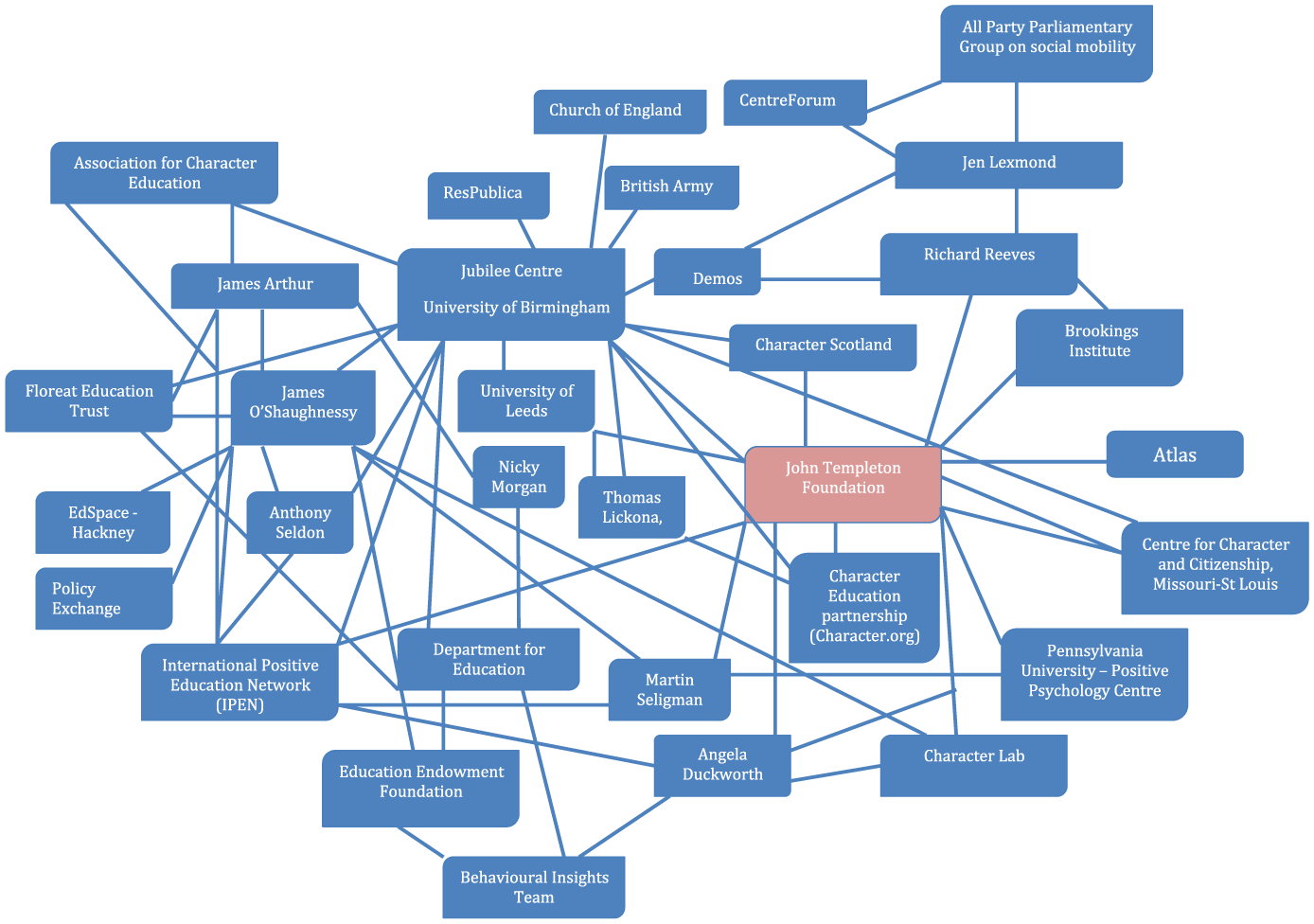
Character education network map.
The diverse array of individuals and organisations that feature is illustrative of the kinds of non-state actors who have come to characterise the ‘methods and practices’ (Junemann et al., 2016: 538) of education policy and delivery in other areas. These include philanthropic foundations, think tanks, social enterprise, policy entrepreneurs, and universities. We also see the global nature of these policy communities, as they extend beyond the boundaries of the nation state. Our analysis begins at the centre of our map with the philanthropic organisation, the JTF.
‘Follow the money’: the JTF, philanthropy and character education
Policy networks require resources to ensure that their policy discourses and visions capture the attention of policymakers and ministers. As Ball (2012) reminds us ‘ideas are made powerful and influential by money, effective relationships and action on the ground’ (p. 61). Later in this paper, we examine the relationships between network members, and the social capital that lubricates these. In this section, we examine the role played by private philanthropy in the character education policy agenda in the UK.
Our network ethnography reveals that much of the evidence in support of character education in the UK comes from university research centres that have received significant funding from the US-based Christian neoconservative JTF. JTF was established in 1987 by the ‘self-made’ billionaire Sir John Templeton, and by 2008 was endowed with US$1.5 billion (The Economist, 2008). Born in Tennessee, Templeton was a devout Presbyterian and made his money on the stock market. John Templeton died in 2008. His son, Jack Templeton, took over as President of the Templeton Foundation in 2006, later succeeded by Heather Jill Templeton, in 2015.
JTF’s main funding streams are oriented around what it calls ‘the big questions’; such as how science can support a religious worldview; ‘exceptional cognitive talent and genius’; ‘individual freedom and free markets’; genetics; ‘voluntary family planning’; and ‘character virtue and development’ (John Templeton Foundation, 2017c). While ostensibly nonpartisan, the JTF has ploughed considerable funding into projects aligned with right-wing agendas. The Templetons were major donors to the Republican Party (Ehrenreich, 2009) and the anti-gay rights body, the National Organisation of Marriage (Commission on Governmental Ethics and Election Practices, 2014). The JTF has funded free market think tanks and research institutes including the Cato Institute and Atlas Economic Research Foundation, both of which have become significant players within global education networks (Ball, 2012). The JTF also has funded other free market education enthusiasts such as Professor James Tooley (Ball, 2012; John Templeton Foundation, 2017b). Labelled ‘the high priest of privatised education’ (Wilby, 2013), Tooley was awarded the Templeton Prize for ‘Promoting Liberty in Free-Market Solutions to Poverty’. The JTF have also funded media projects, including CapX. Founded by the Centre for Policy Studies (a UK think tank established by Margaret Thatcher to promote individual liberty, the free market and a small state), CapX is an online news platform which seeks to ‘show how popular capitalism can work to the benefit of all’ (CapX, 2017).
These connections are not surprising. A vocal advocate of free enterprise, competition and limited government, Templeton believed that the ‘principles of capitalism can, and do, benefit the poor’ (in Ehrenreich, 2009: 168). Templeton was influenced by the philosophy of Adam Smith, Friedrich von Hayek and Milton Friedman – figures central to the development of neoliberal economic theory and policy regimes (Davies, 2016). This worldview is not only promoted through the JTF’s grant-giving but also through books published by The Templeton Press, including those by Templeton himself. The Templeton Plan: 21 Steps to Success and Happiness (Templeton and Ellison, 2013) includes chapters entitled ‘Creating your own luck’ and ‘Finding the positive in every negative’. As we show, Templeton’s philosophy that ‘when you rule your mind, you rule your world’ threads through the research funded by the JTF, not least that on character.
The JTF’s funding practices have already generated considerable scepticism in the US, namely in regards to its investment in the positive psychology movement (Ehrenreich, 2009) and in scientific research (Rosenau, 2011; Waldrop, 2011). By comparison, the influence of the JTF in the UK has received very little scrutiny. Although its funding of UK science research has been criticised for cronyism, pro-religious bias and links to free-market organisations that oppose action on climate change (Bains, 2011; Coyne, 2011), the role of JTF in UK social science research and policy has thus far been neglected. An original contribution of this article is therefore exposing and interrogating the JTF’s significance for education research, policy and provision in the UK.
We consider the philanthropic model embodied by the JTF later in this paper. In the next two sections, we illustrate how the JTF’s funding for research has played a significant role in the legitimation and development of character education policy within the UK.
Academics and ‘knowledge hubs’: evidencing and authorising character education
Although the JTF has funded a range of academic institutions, we focus on two of the main academic recipients of JTF funding under its ‘character virtue and development’ programme, whose research has been cited by ministers and government publications in support of character education policy in the UK. These are the Positive Psychology Centre (PPC) at the University of Pennsylvania in the US and the Jubilee Centre for Character and Virtues at the University of Birmingham, UK. 1
The PPC was created in 2003 to ‘promote research, training, education, and the dissemination of Positive Psychology, resilience and grit’ (PPC, 2017). It has received numerous grants from the JTF totalling several million dollars (Seligman and Schulman, 2015, 2016). The PPC’s Director is Professor Martin Seligman, a prolific and somewhat controversial figure. Seligman is regarded as the founder of the discipline of positive psychology, a movement ‘dedicated to the programmatic ‘unlearning’ of helplessness’ (Davies, 2016: 165; see also Ehrenreich, 2009). Another prominent and influential academic based at PPC is Angela Duckworth. Duckworth’s research on ‘grit’, defined as ‘the tendency to sustain interest in and effort towards very long-term goals’ (Duckworth et al., 2007), has been published in academic articles and a best-selling book (Duckworth, 2016). Duckworth is creator of the ‘Grit Scale’, a 10-question test to identify traits that predict ‘success’, 2 which she argues can be used for ‘research and self-reflection’ (Duckworth, 2017). Seligman and Duckworth’s emphasis on improving life outcomes through cultivating positive thinking and ‘grit’ (and insistence that these are related) has clear synergies with the Templeton philosophy. These ideas have contributed towards an evidence base for character education policy and provision in the US and UK. Duckworth is also one of the founders of ‘Character Lab’, a non-profit organisation funded by the JTF to facilitate character development in US schools. In the UK, Duckworth’s research is frequently cited in policy texts on character, including those published by the Government’s Behavioural Insights Team (formally known as the ‘Nudge Unit’) (Gandy et al., 2016), the All Party Parliamentary Group on Social Mobility’s report (Paterson et al., 2014), and evidence reviews funded by government (e.g. Gutman and Schoon, 2013) (see Burman, this issue, for a critique of how this evidence is used).
The Jubilee Centre for Character and Virtues (University of Birmingham) was officially launched on 16 May 2012 in the House of Lords by Jack Templeton. The Centre is described as ‘a pioneering interdisciplinary research centre focussing on character, virtues and values in the interest of human flourishing’ and a ‘leading informant on policy and practice in this area’ (Jubilee Centre, 2017a). Its model of character education foregrounds morality, emphasising ‘moral virtues’ ‘that will be recognised and embraced by representatives of all cultures and religions’ such as courage, compassion, gratitude and humility. These are complemented by ‘performance virtues’ such as resilience, determination, confidence and teamwork (Jubilee Centre, 2017b: 3–5). As of June 2017, it had received in excess of £16 million of JTF funding, comprising over 98% of its grant income. 3
The Centre is directed by Professor James Arthur. It employs a team of researchers and hosts teaching fellows, honorary fellows and a distinguished professors programme of international academics, many of whom feature elsewhere within the network. Arthur has advised the UK government on curriculum development; is chair of the Society for Educational Studies, an academic research association with its own journal; and in January 2018 received an OBE for his services to character education. In short, Arthur holds positions of power across academia, policy and practice. As well as being awarded numerous JTF grants, in his book on policy entrepreneurship in education he describes himself as an ‘adviser’ to the JTF, having been connected with them since 2002 (Arthur, 2018: 121). Through financial support from the JTF, bolstered by institutional prestige and patronage by prolific academics, the Centre has become the main university-led knowledge hub for character education in the UK, and we argue that its activity has enabled discourses of character education to gain considerable ‘space and legitimacy’ (Ball, 2012: 6).
Indeed, the Centre is engaged in an array of activities that promote character education among policy, practice and academic communities, including hosting annual conferences, publishing books and articles, and holding events in conjunction with organisations such as the Church of England and British and US armies. The Centre – and most notably Arthur – has links to government departments and ministers including Nicky Morgan, Secretary of State for Education from 2014–2016, who herself has been so taken by the character education agenda she has written a book on it (Bull and Allen, 2018; Morgan, 2017). Arthur sat on the judging panel for the Department for Education’s (DfE) 2015 Character Awards and the Centre was itself awarded £201,895 from the government towards developing teaching materials and methods for character education (Department for Education, 2015). This influence on government policymaking is frequently celebrated through the Centre’s publications, as seen in this quote: Character education has become an explicit aim of the Department for Education, which is now investing millions of pounds in promoting it in schools. The Jubilee Centre has been a major influence on this development with the Secretary of State for Education inviting me to roundtable talks with her about character before announcing the government’s character initiatives. Indeed, she later visited the University of Birmingham and, in a speech given here, generously praised the work of the Centre as an influence on her. The language used by the Centre is increasingly being adopted and echoed in numerous speeches by policy makers and academics. (Arthur et al., 2015: 4)
As well as informing policy, the Centre publishes teaching resources and delivers degrees and online courses for teachers, and its bespoke programme for character education is delivered to pupils attending the University of Birmingham School. The Centre boasts vast global connections and research collaborations. A key figure in its US network is academic Thomas Lickona, a prominent advocate for character education. A developmental psychologist, Lickona (1996) has published widely on character, including the ‘Eleven Principles of Effective Character Education’. Lickona is transparent about his socially conservative political and religious position; in his keynote address to the Jubilee Centre in 2014. Lickona (2014) discussed ‘character-based sex education’ arguing for ‘abstinence education as a natural ally of the character education movement’ (p. 9).
This section has detailed how the JTF has channelled significant amounts of money into academic research in the US and UK. Higher education has been an important site for legitimating character education as a policy solution by providing it with a (social) scientific ‘evidence’ base. In the next section, we examine how JTF funding for third sector organisations has enabled the dissemination of this evidence base.
Third sector organisations: influencing knowledge dissemination
As well as investing millions into academic research for character education, research into the JTF’s grant-giving shows that it has also provided funding to support the activity of third sector organisations. Many of these involve the key academic actors, discussed above, in varying capacities as co-founders or advisers. In this section, we argue that by investing in spaces outside of academia, JTF funding helps to ‘extend the flow of ideas and multiply positions from which to speak and create the appearance of widening acceptance’ (Ball, 2012: 50). Importantly, the links between these groups and the JTF are often unclear, and this opacity helps to give the impression of broad and organically generated support for character education across a range of actors.
US-based advocacy organisations receiving funding from the JTF include the Character Education Partnership, a US-based online resource centre for educators. Its educational materials draw on the work of Lickona, who also sits on their Advisory Council. Another is Character Lab, established with a US$2.5 million grant from the JTF to support and implement evidence-based character development in US schools. Its founders include Angela Duckworth and David Levin, co-founder of the US KIPP charter schools. Advocacy organisations in the UK include Character Scotland. Its website gives the impression that it is a grassroots organisation, describing itself as ‘an educational charity formed by a group of academics, educationalists, entrepreneurs and parents for the purpose of promoting the development of character in young people and intentional character education in schools’, with an explicit aim of influencing policy (Character Scotland, 2017). However, in his book, James Arthur describes Character Scotland as ‘created and established’ by the Jubilee Centre, with Arthur (2018) himself as Chair (p. 113). In addition, Character Scotland has received over £1million from the JTF (John Templeton Foundation, 2017b). The contrast between these narratives of Character Scotland’s creation shows a sleight of hand in which the influence of the Jubilee Centre, and the JTF, is partially obscured.
Sometimes the links to the JTF are even less transparent. For example, UK centre left think tank Demos has been advocating character in a series of reports since 2009 (see below). A 2015 report entitled ‘Character Nation’ (Birdwell et al., 2015) was produced by Demos and supported by the Jubilee Centre. The think tank’s annual reports indicate that it received over £40,000 from the Jubilee Centre (Demos, 2015). Given the Jubilee Centre’s activities are funded in large part through JTF grants, it seems reasonable to conclude that Demos’ recent work on character has been enabled by the JTF, albeit indirectly. We can see the obfuscation of the JTF and Jubilee Centre’s influence elsewhere. The Association for Character Education (ACE), established in 2016, is the subject association for character education. It positions itself as a non-partisan organisation that is ‘run by teachers for teachers’, giving the impression of a practitioner-driven body. However, in his book, Arthur (2018) describes how the Jubilee Centre established ACE in order to ‘build grassroots support for character education’ (p. 144).
This analysis raises questions as to the genesis and independence of these groups. The presence of key policy actors with links to the JTF on the boards of these organisation, as well as the funding they have received from the JTF, provides opportunities for the JTF, via the Jubilee Centre, to inform the policy agenda around character education. This does not mean of course that the JTF’s ideas are being automatically and straightforwardly adopted by the ACE and Character Scotland. Rather, our intention is to illuminate the generative set of relations between key policy actors that have been enabled in large part by the philanthropic activity of the JTF.
Policy entrepreneurs: spanning boundaries and lubricating networks
So far we have argued that character education is being developed and promoted by a range of (connected) sites and actors including higher education and third sector organisations. We have argued that the activities of these actors have been made possible by philanthropic organisation the JTF either directly or indirectly. In this section, we turn to the role of policy entrepreneurs who, as ‘boundary spanners’, play a central role in networked forms of governance (Ball and Junemann, 2012; Williams, 2002: 113). These ‘nodal actors’ build trusting relationships with different parties and manage these interconnections by influencing, negotiating and brokering (Williams, 2002: 116–117). In particular, their effectiveness lies in the ability to move across different sites – policy, business, third sector and academia – mobilising (and generating) social capital in order to achieve policy influence.
Enter stage right Baron James O’Shaughnessy. O’Shaughnessy is ideally positioned to take up the role of ‘boundary spanner’. Erstwhile director of policy to the former Conservative Prime Minister David Cameron, and former deputy director of the centre right think tank Policy Exchange, O’Shaughnessy was made a Conservative peer in 2015. He was a key figure in drafting the 2010 Conservative manifesto, and in his work at Policy Exchange and elsewhere he has advocated for market-based education reforms including the expansion of sponsored academy schools and ‘payment by results’ through private sector involvement in ‘failing’ schools (O’Shaughnessy, 2013). He runs education consultancy Mayforth Consultancy, and consults for communications firm Portland PR. According to transparency website Powerbase, Portland has numerous clients pushing for education reforms that benefit their corporate interests, such as Google, Apple, and the New Schools Network, a charity set up to drive the growth of free schools in England (Powerbase, 2017). The JTF and O’Shaughnessy appear to share the belief that the logics of capitalism can provide solutions to societal problems, not least within the sphere of education.
O’Shaughnessy is active in third sector and statutory education networks, for example, through establishing EdSpace which purports to bring together a ‘powerful network of over 500 education innovators’. 4 Here, we find another character education policy entrepreneur, Jen Lexmond, co-author of two of Demos’ reports on character education, and the All-Party Parliamentary Group on Social Mobility’s Manifesto on character education (Lexmond and Grist, 2011; Lexmond and Reeves, 2009; Paterson et al., 2014). O’Shaughnessy also runs the Floreat Academy chain of schools which was awarded £124,002 from the DfE in 2015 towards developing a character virtue development programme (Department for Education, 2015).
There are numerous links between O’Shaughnessy and other network members, visible in Figure 1. Unravelling some of these connections helps demonstrate the social relations through which ideas about character have gained such policy traction and legitimation. Beginning with the Jubilee Centre, O’Shaughnessy sits on its board and holds an honorary senior research fellowship. He also delivered a keynote at the first ACE conference hosted by the Jubilee Centre. Arthur is on the board of Floreat Academy chain, and The Jubilee Centre was commissioned to evaluate Floreat’s DfE-funded character virtue development programme. We see here a highly generative set of relations between O’Shaughnessy and the Jubilee Centre.
O’Shaughnessy is not only connected to the Jubilee Centre, but also the PPC, thus bridging the two key research centres into which JTF has channelled its funding. O’Shaughnessy is reportedly an advisor to Character Lab, co-founded by Duckworth (Powerbase, 2016). However, a key site in which the ‘sinews’ (Ball, 2012: 49) of the character education network are visible is the International Positive Education Network (IPEN). IPEN was founded by James O’Shaughnessy and Martin Seligman. It aims to connect ‘teachers, parents, academics, students, schools, colleges, universities, charities, companies and governments to promote positive education’ and ‘persuade policymakers to change their policy frameworks so that practitioners are encouraged to educate for character and well-being’ (International Positive Education Network, 2017). IPEN’s membership and activities are highly revealing of O’Shaughnessy’s role as a central nodal actor joining up network members. The names listed on IPEN’s website as executive team and advisory board members include Seligman and Duckworth, the Jubilee Centre’s James Arthur and deputy director Kristján Kristjánsson, and Christopher Stawski, who was until 2016 Vice President or Strategic Programme Initiatives at the JTF.
IPEN’s President is another key policy entrepreneur, Anthony Seldon, a political biographer and historical advisor to Number 10. He is also a former Master of Wellington College, a leading private school (attended by O’Shaughnessy) which co-hosted IPEN’s 2013 summit along with 10 Downing Street and the Jubilee Centre. Seldon is a vocal advocate for character education, arguing that the state sector should learn from private schools how to teach soft skills such as grit and resilience (Gurbey-Read, 2015). Most recently, he has advocated teaching positive psychology and character in higher education (Seldon and Martin, 2017; for a critical commentary see Allen and Bull, 2017). Perhaps reflective of O’Shaughnessy and Seldon’s influence, the 2016 Education White Paper states that ‘leading state and independent schools already demonstrate a concerted focus on instilling […] character traits throughout school life’ (Department for Education, 2016: 95). Seldon is also an Honorary Professor at The Jubilee Centre.
O’Shaughnessy and Seldon are true ‘movers and shakers’ (Williams, 2002) with proximity to power and influence. Both men move with ease between business, government, academia and education delivery. They also, through their immersion within these fields of influence, amass a considerable number of contacts and political connections that can be usefully drawn upon in their advocacy work. These actors perform essential bridging work, O’Shaughnessy in particular, joining up public and private/state and non-state organisations. Their role powerfully illustrates how social capital operates as a key ‘resource(s) that actors bring into play’ (Ball and Junemann, 2012: 4) within these networks. Both their ability to ‘network’, and the connections they amass in the process, facilitate the network’s purchase on the policy process. In sum, they both constitute and lubricate the social relations of the network.
Indeed, policy networks are dense and sociable, involving relationships of trust, and it is through these that certain policy discourses are reiterated and legitimated. As Ball and Junemann (2012) state, these relations ‘structure, constrain and enable the circulation of ideas and give “institutional force” to policy utterances, ensuring what can count as “sensible” policy and limiting the possibilities of policy’ (p. 11). We see this vividly in the character education community, as the same set of actors reappear across different spaces (both physical and virtual). Network members sit on the same boards, attend and speak at each others’ events, provide consultancy for each other, and commission each others’ work. These activities help to stabilise discourses of character education (and positive psychology) as a commonsense policy solution and translate these into actionable practice (Ball, 2012).
Having discussed the hows, whos and wheres of this network, in the rest of this article, we consider why these actors might be invested in character education. This is not an easy task. While Ball (2008) states of policy networks, ‘forms of exchange are often unclear … perhaps it is […] better to accept that motives for participation are contradictory and mixed’ (pp. 752–753), we contend that it is important to at least attempt to trace such motives in order to identify the interests that have contributed to putting character education on the policy map. In the analysis that follows, we explore the possible motivations that network members ‘bring to bear on the policy process’ (Ball, 2008: 751), beginning with the JTF.
In whose interests? Disentangling the ‘whys’ of the character education network
In their analysis of private philanthropic interventions in education, Ball and Junemann (2012) describe a ‘new philanthropy’ model, stating that ‘what is ‘new’ in ‘new philanthropy’ is the direct relation of ‘giving’ to ‘outcomes’ and the direct involvement of givers in policy communities (p. 49). In this model, ‘business interests, philanthropy and the public service are tightly intertwined’ and ‘actors’ are linked socially and commercially (Ball and Junemann, 2012: 36). Such practices have been described elsewhere as ‘philanthrocapitalism’ (Bishop and Green, 2010). In a blistering critique of the Bill and Melinda Gates Foundation, Linsey McGoey (2015) refutes claims that this profit-seeking, business-like model of ‘new philanthropy’ is entirely distinct from that of 19th-century industrialists like Rockefeller and Carnegie. She shows how their philanthropic activity was deeply entangled with the pursuit of commercial gain and/or political leverage. What is new among modern philanthropists however, according to McGoey (2015), is that it is ‘no longer necessary to “disguise” or minimise self-interest’ (p. 20).
In respect to character education, the activities of the JTF do not immediately fit this profit-seeking mould of ‘new’ philanthropy. There is no direct integration of the research they fund with any commercial enterprises owned by the JTF (as far as we can tell), and the JTF are not directly involved in policy delivery. As such, the foundation’s interest in character education does not appear to be motivated primarily by financial motives. However, the JTF’s explicitly pro-market philosophy does bring the foundation closely into line with Gates and other philanthropists old and new. Furthermore, one need only look at other areas of JTF’s funding portfolio to see the potential financial rewards that could be reaped by both JTF and its affiliated partners and grantees through its support for, and investment in, more libertarian, free market, education regimes.
Pertinent here is the JTF’s close affiliation with free-market organisations like the Cato Institute and Atlas Economic Research Foundation, and its investment in programmes that promote values of enterprise and the free market in education. Here, the synergies between the JTF and enthusiastic market reformer James O’Shaughnessy become evident. Indeed O’Shaughnessy provides an insight into the lucrative business opportunities that arise out of the government’s interest in character education. For example, as well as receiving almost £125,000 from the DfE’s character awards for his Floreat Academy Chain, the Floreat Academies Trust paid O’Shaughnessy £61,734 for consultancy work as Director of Mayforth Consultancy. In addition, the parent company Floreat Education Trust paid £25,175 in rental payments to O’Shaughnessy’s other company Edventures. 5 Mayforth Consultancy also won a contract of £10,000 for providing consultancy services to a project on developing disadvantaged pupils’ resilience and motivation, itself funded by a £687,000 grant from the Education Endowment Foundation (EEF). 6 The EEF is an educational charity founded by venture philanthropist, Sir Peter Lampl. Funded in part through a substantial £125 million grant from the government’s Department for Education, it has become one of the government’s key ‘What Works’ centres for education policy (Gillies et al., 2017). It has distributed grants totalling millions of pounds to projects focused on character and positive life outcomes, including the evidence review by Gutman and Schoon (2013) mentioned earlier.
Investment in character education not only offers lucrative financial opportunities for some network actors such as O’Shaughnessy. It also provides opportunities to activate longer-term transformations in society that can indirectly bring about financial and other benefits; namely through advocating free-market ideas and values. It is here that a somewhat different model of philanthropy might be more usefully applied to the role and motivations of JTF in funding the character education agenda.
In her book outlining the role of ‘dark money’ in funding libertarian free-market ideology (2016), New York Times journalist Jane Mayer describes how private foundations ‘created a new philanthropic form’ called ‘movement philanthropy’ (Stein in Mayer, 2016: ch. 3, para. 8). Beginning in the 1970s, this would become a ‘battle of ideas’ as Friedrich Hayek reputedly described it, or a movement to ‘destroy the prevalent statist paradigm’ according to Charles Koch, founder of one of America’s largest neoconservative philanthropic trusts (Mayer, 2016: introduction, para. 6). Rather than directly influencing politics, this movement works through spreading ideas by establishing think tanks, student societies, academic posts, and funding private institutes within prestigious universities where, according to Mayer (2016), donors exercise influence over hiring decisions (ch. 1, sec.5, para.13–14).
Mayer details how enormous amounts of money have been channelled into US higher education via such trusts, establishing entire disciplines and research centres. Mayer reports how one philanthropic trust, the John M. Olin Foundation, had by 2005 spent ‘about half of its total assets of $370 million bankrolling the promotion of free-market ideology and other conservative ideas on the country’s campuses [and] in doing so, moulded and credentialed a whole new generation of conservative graduates and professors’ (ch. 3, para. 7). According to Mayer, this strategy, referred to as creating ‘beachheads’ or ‘conservative cells’ at influential higher education institutions, is designed explicitly to disguise its ideological aims and appear neutral, functioning by adding new voices to debate – albeit powerfully resourced new voices (ch. 3, sec. 4, para. 9–12). This activity is not limited to higher education. For example, Mayer identifies how the billionaire Koch brothers set up a non-profit organisation called the Young Entrepreneurs Academy through which they have poured millions of dollars into teaching high school students how to be entrepreneurs and run their own business (ch. 14, sec. 2, para. 17). More recently, the Koch Foundation has funded research into wellbeing, which Mayer describes as a strategy to convince voters that economic libertarians are well-intentioned (ch. 14, sec. 2).
While Mayer does not discuss the JTF in her book, the history she relays provides helpful contextualisation for the JTF’s investment in character education as one part of a larger ‘battle of ideas’ being played out in education in which philanthropic foundations are deeply entangled. While familiar in US higher education, this model appears to be less common in the UK. The philanthropy of the JTF does, however, involve investing in different disciplinary paths to those of the foundations and trusts that Mayer describes. Specifically, rather than directly supporting free-market economists within higher education as many libertarian philanthropists have done, the JTF has funded other academic disciplines whose ideas are aligned to the JTF philosophy including the positive psychology movement. As we began to describe above, the ideas propounded through positive psychology have provided intellectual fodder for character education policy in the UK. In a searing critique, Ehrenreich (2009) argues that the JTF have sought to provide a ‘scientific undergirding for positive thinking’ (p. 167) in the US through pumping money into the discipline of positive psychology, notably the work of Seligman. As a discipline which ‘attends almost solely to the changes a person can make internally by adjusting his or her own outlook’ (Ehrenreich, 2009: 171), Ehrenreich points to the similarities between positive psychology and Templeton’s ‘mind over matter’ philosophy. Like positive psychology, character education – with its emphasis on individuals’ capacities for gratitude and persistence – can be seen to valorise a model of entrepreneurial, responsible, individualised selfhood demanded by neoliberal capitalism (see also Gill and Orgad, 2018). As Brooks (2013) notes in her analysis of the Coalition government’s policy in this area, the ‘desired character’ of ‘the ideal Coalition subject’ is made clear; s/he is ‘independent and autonomous […] and relishes competition’ (p. 327).
Yet character education offers a further angle that positive psychology does not. Interviewed about the JTF’s approach to philanthropy in 2006, Jack Templeton (2006) discussed the importance of morality to capitalism, stating that ‘to have a successful free enterprise system, a strong moral framework must exist in the marketplace’. This position draws attention to the Victorian legacy of character education as forming part of a wider political project whereby in order to counteract the ‘amoral’ market, a ‘moralising’ form of government was needed which educated citizens to develop character and self-control (Joyce, 2003: 114, 117–118; see also Taylor, 2018). Seen in this light, and borrowing from Ehrenreich (2009), we argue that the JTF’s investment in character education might be understood as an attempt to offer a social-scientific ‘undergirding’ for this model of moral capitalism. Rather than directly promulgating this viewpoint, the JTF funds universities and third sector organisations – what Jack Templeton (2006) describes as ‘outsource platforms’ – to do this work. Just as they fund media outlets like CapX to promote the universal benefits of the free market, these higher education and third sector ‘outsource platforms’ disseminate the Templeton worldview at a distance. In this way, the JTF closely resembles Mayer’s model of ‘movement philanthropy’.
Marrying social conservatism and social justice through character education
Other actors in the network also appear to have ideological motivations, but from a slightly different strand of social conservatism and liberalism; one that posits families and authoritarian parenting as the solution to social problems. The 2011 English riots are a frequent reference point in discourses about the importance of character. For example, footage of the riots forms the opening sequence to a promotional documentary produced by the Jubilee Centre (2015). Writing in the Birmingham Post in 2011, the Jubilee Centre’s Director James Arthur, argued that the riots reveal a ‘moral rot’ that stems from ‘an ethic of individualism and consumerism’, the consequence of ‘the disintegration of traditional morality’ including a ‘move away from its Judeo-Christian foundations’. A key solution, Arthur suggests, is to ‘return real authority to parents and teachers’ and reintroduce morals through ‘an aggressive programme of character education’.
This positioning of character fits neatly with the dominant conceptual framing of the riots by Conservative politicians as a moral crisis blighting ‘Broken Britain’, resulting from ‘“bad individual choice”, an absence of moral judgment [and] poor parenting’ (Tyler, 2013) rather than from escalating inequalities unleashed by neoliberal austerity. As Clarke and Newman (2012) argue, this discourse of demoralisation has a long history and includes theories of the underclass. As they warn, ‘this obsession always turns on questions of morality, moral character and the possibilities of moral rescue or reformation’ (Clarke and Newman, 2012: 311). Arthur’s statements make explicit the conservative Christian content of the morality that is embedded within the Jubilee Centre’s definition of character.
From this evidence, it would be possible to see character education as a predominantly socially conservative venture. In fact, it has gained support from figures aligned with a more politically liberal outlook. As we discussed above, Demos has been involved in a range of activities in this area, with connections to the Jubilee Centre since 2015. However, their work on character precedes this. Demos helped put character education on the political agenda with their 2009 report ‘Building Character’, authored by then-director of Demos, Richard Reeves, and Jen Lexmond who we discussed above (Lexmond and Reeves, 2009). An edited volume followed in 2011 which includes chapters by James Arthur as well as Anthony Seldon, who echoes Arthur’s religious perspective on character education by linking it to Christianity. Reeves left Demos in 2010, and until 2012 was Director of Strategy to Nick Clegg, then Deputy Prime Minister. He now works at the Brookings Institute in the US where he was awarded a grant by the JTF on character and opportunity, which we return to shortly (Lexmond and Grist, 2011). On the surface, Reeves appears to come from a more politically centrist position than those discussed above; his more recent critique of ‘opportunity hoarding’ among America’s upper middle class was covered enthusiastically by The Observer (Reeves, 2017). Yet, a closer examination of his work on character reveals an ideological continuity between Reeves and the policy actors above.
In his work, Reeves argues that ‘disparities in the development of ‘character strengths’ are both a cause and consequence of inequality’ (Reeves, 2014). He cites evidence suggesting that children from low-income families perform badly on measures of character strengths such as drive and prudence (Reeves et al., 2014), and frequently draws on work by Duckworth, Seligman and Lickona (see also Reeves and Halikias, 2017). Notably, Reeves argues that one of the main routes towards developing character, and thus addressing inequality, is a ‘stable’ family life (located within the institution of marriage) and ‘tough love’ styles of parenting (Reeves and Halikias, 2017: 16). This echoes his Demos report that states that low-income households ‘face more difficulty in incubating [the] character capabilities’ that make a ‘vital contribution to life chances, mobility and opportunity’ (Lexmond and Reeves, 2009: 57).
Reeves’ language of ‘tough love’ parenting as an incubator of ‘good’ character traits is resonant of the emphasis on a ‘return to authority’ made by Arthur above, and calls for authoritative parenting found in other Jubilee Centre publications. 7 These statements must be located in a wider context in which family and parenting (and specifically mothers) have increasingly been positioned as both the cause of national problems and key sites for intervention (Gillies et al., 2017). They also illuminate a longer history, as Nick Taylor (2018) outlines, of locating ‘reasons for poverty and unemployment’ in the habits, dispositions, and parenting practices of working-class people. Here, we see how the character becomes deployed within this agenda, so that parenting styles rather than structural factors become the focus of policy solutions and diagnoses. As Jensen (in press) writes, ‘the usefully vague terminology of “character” can be deployed to evade discussion of the profound social divisions and injustices that shape the opportunities (or lack thereof) and resources open to differently positioned families’.
Read in this light, the description of Reeves’ JTF grant is equally revealing: To what extent do character virtues influence an individual’s capability to take control of his or her life trajectory as a means to foster their opportunities and prosperity? The normative assumption underlying the project is this: A meritocratic society has to create not only opportunities, but also people who can seize them. (John Templeton Foundation, 2017a)
While couched in the language of social justice, this take on character is far from progressive. Character is presented as a set of dispositions required for success that can be ‘taught’ either through the right kind of education system or through parenting interventions (targeted at working-class parents). Thus, it is not systemic structural inequalities that block the full realisation of ‘meritocracy’, nor the unequal transmission of opportunities built within systems of class privilege. Rather, what is foregrounded is an individual’s capacity to ‘seize’ opportunities and ‘take control’. The resonances between this position and Templeton’s philosophy are clear. Despite using language aligned with the Left, Reeves shares with other character education advocates a belief that solutions to inequality are located in changing the mind-set and moral behaviour of individuals rather than in wider structural transformations. In sum, character education is positioned as the answer over and above ameliorating inequality and poverty.
Conclusion
In this article, we have critically examined character education from the perspective of policy formation and influence. A key contribution we have made is identifying the financial and ideological influence of US philanthropic foundation, the JTF, on research and policy directions in the UK. We have highlighted how millions of pounds from the JTF has been directed into higher education to provide an evidence base for character education, and into third-sector organisations dedicated to the promotion and implementation of character education. These organisations often have connections to other network members including academic JTF grantees and policy entrepreneurs whose social capital lubricates network relations and facilitates policy influence. Although the work of these actors is not always or exclusively dependent upon the JTF, without this funding it seems unlikely that character education would have gained the traction it did. In other words, while these advocates for character education come to the policymaking sphere with already-existing stocks of capital, credibility and influence, these are made more effective through the support of the JTF.
Network ethnography is an imperfect method. Policy networks are only partially visible and as such it is hard to identify the exact nature of these connections, or pin down the incentives driving the involvement of network members (Ball and Junemann, 2012). Attempting to represent networks visually, as we do here, inevitably flattens and fixes them in ways that do not do justice to their messy, complex and dynamic nature. Furthermore, ‘networks do not tell us everything we need to know about policy and the policy process’ (Ball, 2008: 748). Enactments of policy ‘on the ground’ are unpredictable (Braun et al., 2010), and our analysis cannot tell us how the character education agenda is interpreted or translated by those working within schools (Morrin, 2018). Researching how schools implement character education policy, or critically analysing the teaching materials produced by the actors discussed here might, for example, might reveal how the agenda could be used to teach students critical thinking skills for questioning the logics of neoliberal capitalism. However, it has been argued that the potential for character education to work in the pursuit of social justice is yet to be fully realised (Walsh, 2017).
Despite these limitations, investigating policy networks provides illuminating and valuable insights into how character education has come into being as thinkable and ‘common sense’ policy agenda. This exercise in network mapping is especially important because it raises questions about contemporary policy regimes; namely who is informing policy and how. As Ball and Junemann (2012) argue, there are questions around whether these kinds of policy networks lead to more democratic forms of governance by opening up policy-making to diverse voices, or a ‘democratic deficit’ as ‘the processes of policy and governance become more dispersed and more opaque’ (p. 7). Our analysis suggests that, in this particular policy area, a narrow group of individuals are informing research, policy and provision. Notably, the key actors are white men; individuals who can mobilise their capital and privilege to shape the political agenda. We would conclude that the character education agenda is representative of a ‘democratic deficit’ in policy formation, one where ‘wealth and particular social and moral capitals offer privileged access to influence and control’ (Ball and Junemann, 2012: 142). The influence of the JTF in the development of this agenda, specifically through its financial investment in higher education, is a cause for concern. As research funding for universities becomes ever more competitive, philanthropic foundations have become valuable multi-million pound revenue streams (Mayer, 2016). Given the paternalistic approach of most foundations – including the embrace of ‘invitation-only’ policies favouring a ‘trusted pool’ of applicants, and making demands on how grantees spend their money (McGoey, 2015) – this poses serious questions about academic freedom.
Policy processes are highly uncertain. Despite the investment and advocacy that we have described here, character education is no longer being pursued as strongly as it previously was (George, 2017; see also Bull and Allen, 2018). However, the character education policy community discussed here succeeded in putting it on the political agenda and into classrooms, and significant resource continues to be invested in its promotion and delivery. In December 2017, the Jubilee Centre embarked on a new project, Transformative Britain, which extends their work on character from education to other policy areas. Supported by a £4.25 million grant from the JTF, the project proposes to explore aspects of character in the context of professions, education, spirituality/religion, & teacher training. Combined, the projects provide an unprecedented opportunity to impact on the academic, public, and policy discourse on character and virtue in the UK, with substantial academic and practical outputs that go beyond anything achieved so far. (John Templeton Foundation, 2017d)
While the government’s support for character education may be uncertain (at least for the time being), these policy actors, not least the JTF, will continue to require on-going scrutiny for their role in shaping education policy directions and academic research.
Footnotes
Acknowledgements
We would like to thank the two anonymous peer reviewers, and Steve Roberts, for their helpful and encouraging comments on this article.
Funding
The author(s) received no financial support for the research, authorship, and/or publication of this article.