







Abstract
Scholars disagree on whether rising gender equality undermines family life (by eroding the traditional specialization of roles) or, conversely, renews it once men’s involvement in unpaid care catches up with women’s employment. Building on the ‘two-stage gender revolution’ perspective, this article distinguishes equality in the public sphere from equality in the domestic sphere and asks how different combinations of the two relate to perceived costs of parenthood. A hierarchical cluster analysis yields three regimes: ‘symmetric roles’ (Nordic countries), ‘women second shift’ (France, Belgium, Portugal, Austria), and ‘traditional arrangements’ (Ireland, Germany, Great Britain, Switzerland, Netherlands). I then relate regimes to items capturing the perceived costs of parenthood (financial burden, loss of freedom, career limits). Results show a clear inverted-U relationship: among cohabiting parents, perceived costs are highest in the women second shift regime, while both the symmetric and traditional regimes exhibit lower perceived costs. The findings update earlier evidence linking equality to family pessimism by showing that where the second gender revolution (shared care) has advanced, parents report lower perceived constraints associated with having children, whereas stalled domestic change amplifies perceived costs.
Introduction
Are egalitarian gender norms associated with more positive views of family life and parenthood? In the most egalitarian contexts, does ‘the family’ and being a parent appear more desirable? Equal parents, happier parents?
The question may seem surprising. After all, as gender equality rose, fertility fell – as if equality itself had nudged people away from having children. Indeed, since the 1950s in Western countries, women’s entry into paid work has gone hand in hand with a marked decline in fertility. Standard economic theory reads this as the loss of the traditional model’s advantage: when couples specialize (male breadwinner/female homemaker), household utility – and thus marital stability and openness to children – is maximized; once women take paid jobs, that efficiency edge fades. A second approach, the Second Demographic Transition, tells a related story: with access to employment, and especially among the highly educated, women embraced more individualistic goals and self-realization, which pulled against the altruistic demands of motherhood and helped drive fertility down in the late 20th century. In both accounts, the first phase of the gender revolution yields less positive attitudes toward children and parenthood. Equal parents, unhappy parents, then?
Since the 2000s, however, some countries show a different pattern. In the Nordic countries, unions have stabilized and fertility has recovered. The usual explanation is that the gender revolution has reached a more mature stage there. Unlike other Western countries that equalized one-sidedly (women’s place in the public sphere, especially employment), the Nordics aligned family policy with gender-equality policy and brought men into the domestic sphere. This ‘second gender revolution’ – via incentives for men’s parental and domestic involvement – eased constraints on women’s careers and rebalanced couples’ arrangements at home. The result, many argue, is more ‘rewarding family relations’ (Goldscheider et al., 2015) and a ‘pervasive trust’ within families (Esping-Andersen, 2009). Both stable unions and parenthood remain attractive, prompting talk of a ‘return of the family’.
The relationship between gender equality and attitudes toward family life is thus debated. At stake is what we mean by gender equality. Accounts of family decline typically measure the first revolution only: women’s access to extra-domestic activities. ‘Return of the family’ arguments add the domestic side and assess partners’ relative involvement in unpaid and parental work. Gender-regime typologies have long mapped countries by women’s emancipation. However, in doing so, they often proxy equality with female labor-market integration alone. That captures distance from maternalism yet misses countries that pair high female employment with a still-unequal division of unpaid work, that is, places that completed the first transition but stalled in the second. What views of family and parenthood prevail where equalization is incomplete? And, conversely, do countries with extensive equality – symmetry in both paid and unpaid roles – show stronger attachment to parenthood?
This article addresses these questions for Europe using the ISSP 2012 ‘Family and Changing Gender Roles IV’.
Analytically, the article proceeds in three steps. First, I construct an empirical typology of gender regimes by clustering countries on indicators capturing gender inequality in paid work, the division of unpaid work, and work–family articulation among cohabiting parents (Figures 1 to 3). Second, I relate this typology to three items measuring perceived costs of parenthood (financial burden, loss of freedom, career constraints) among parents (Table 1; Figures 4 and 5). Third, I interpret the regime pattern in light of cross-regime expectations toward women’s paid and unpaid roles (Figure 6). I conclude by contextualizing the findings in relation to the various family policy models across Europe.

Gender gap in weekly paid work time (Men – Women, hours).
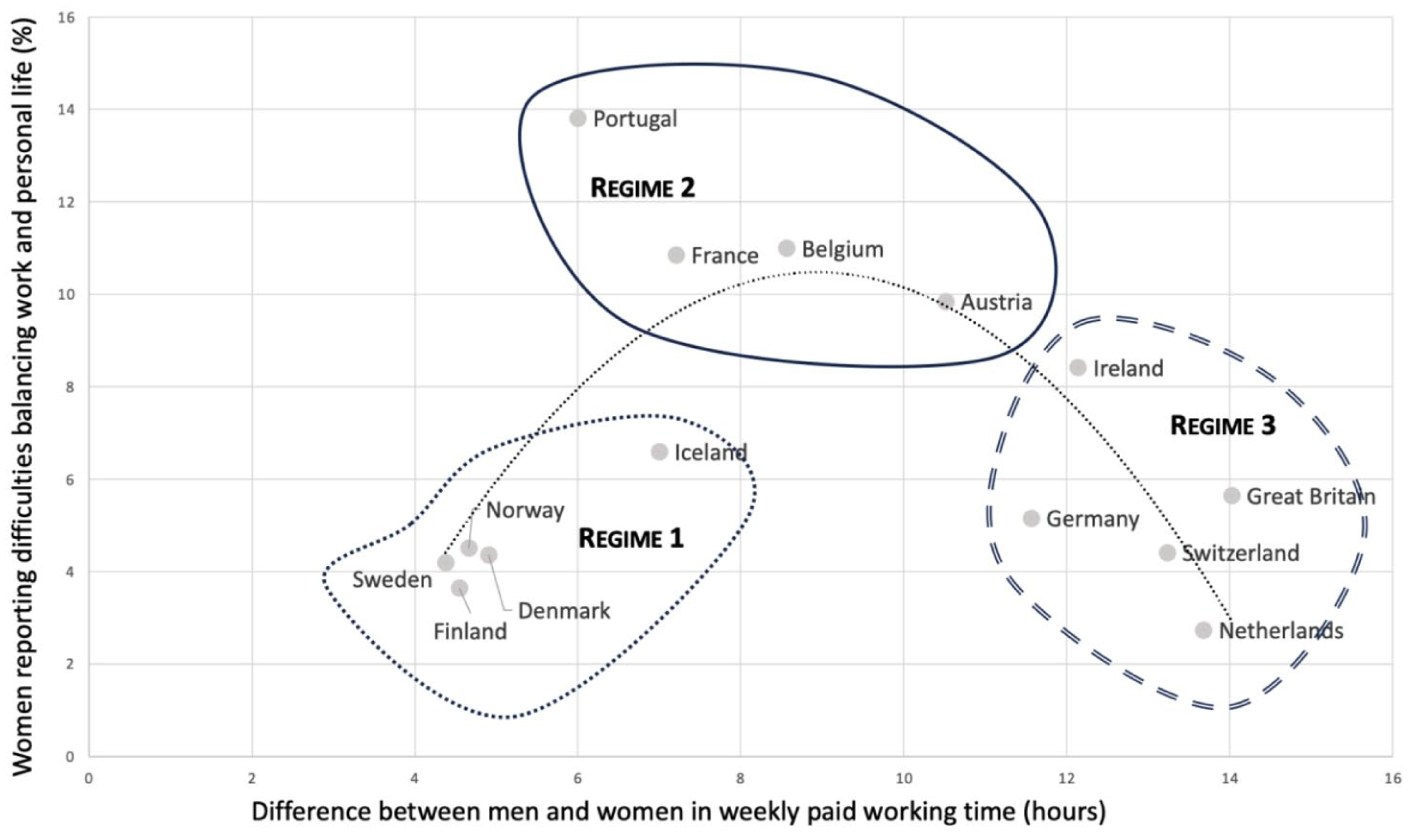
Three gender regimes.
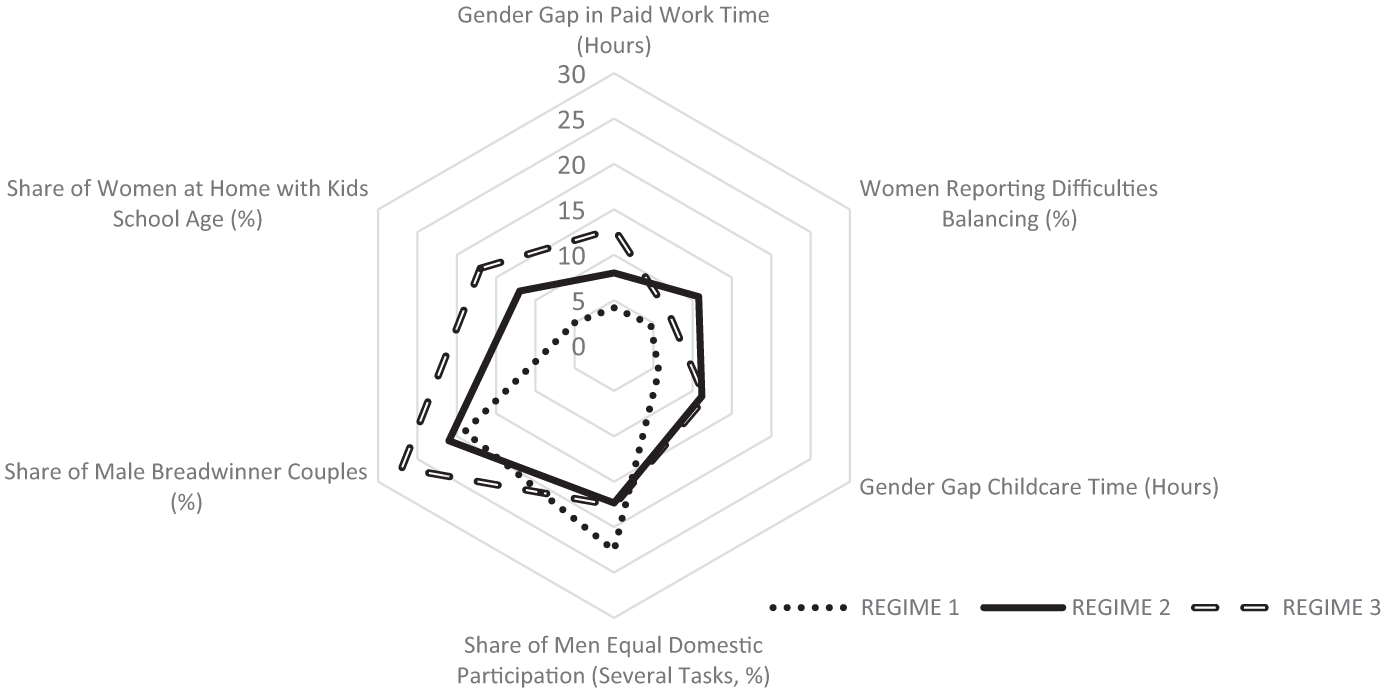
Cluster positions across the full set of gender-equality variables.
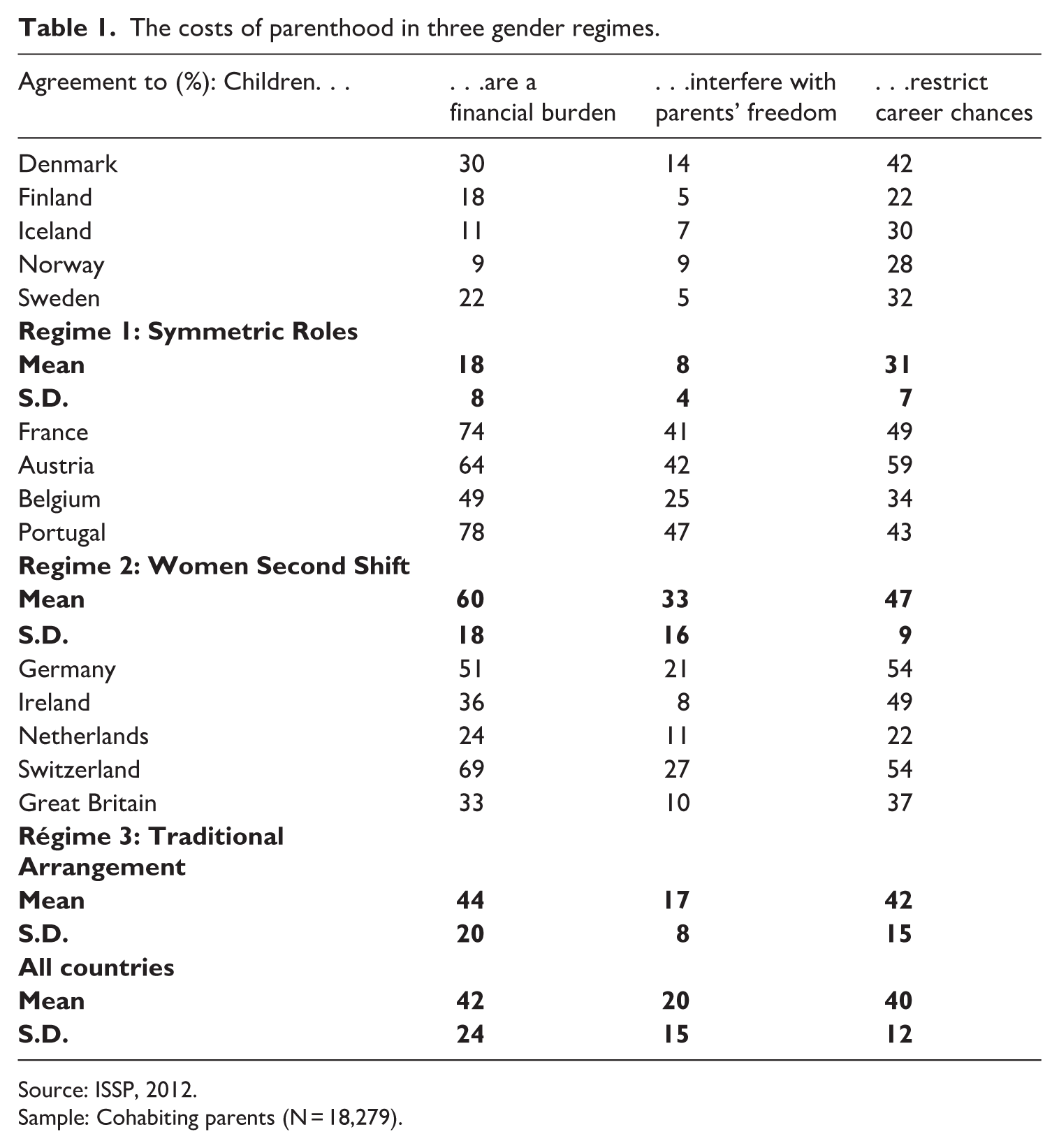
The costs of parenthood in three gender regimes.
Source: ISSP, 2012.
Sample: Cohabiting parents (N = 18,279).
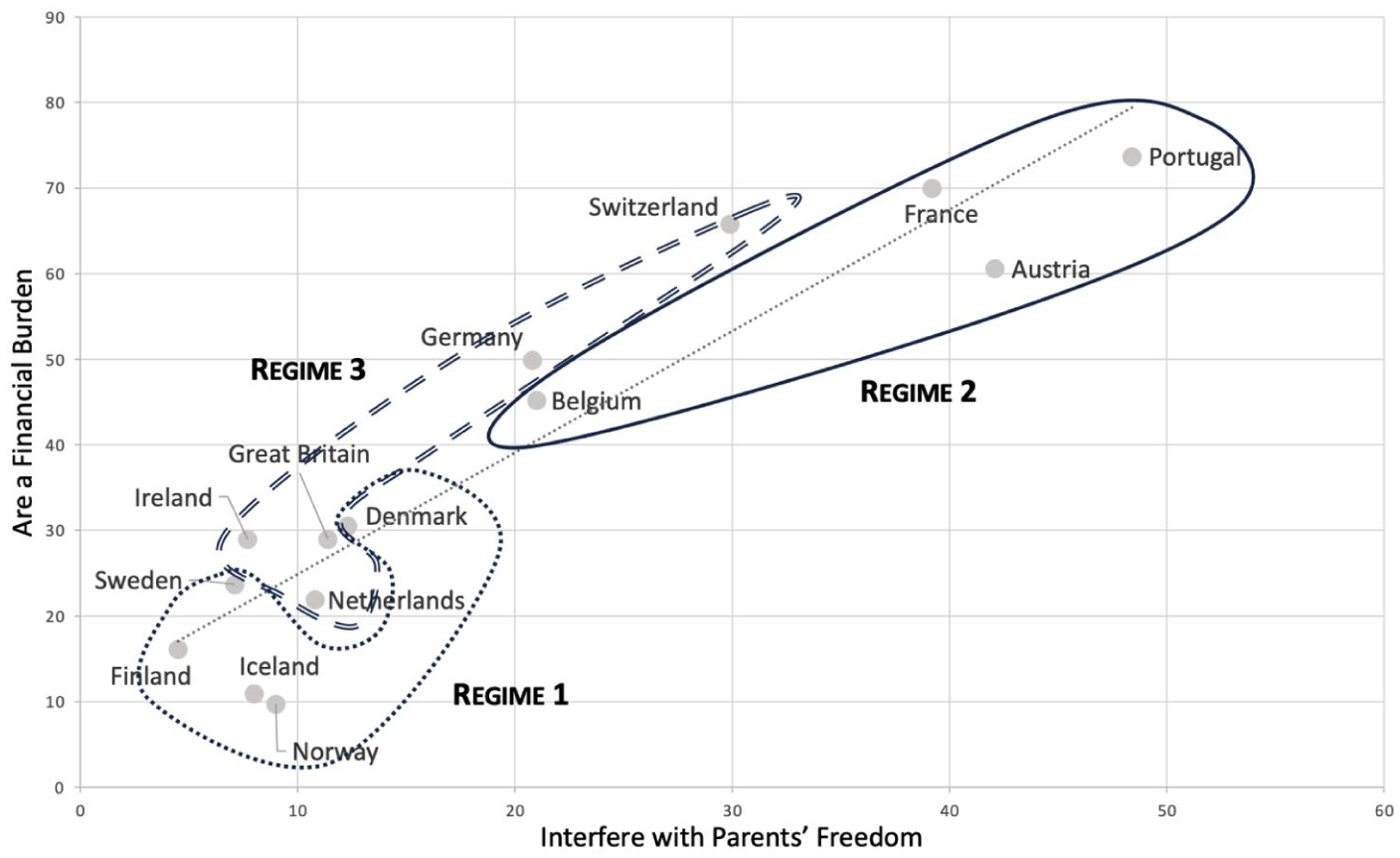
The costs of parenthood – country scatterplot.
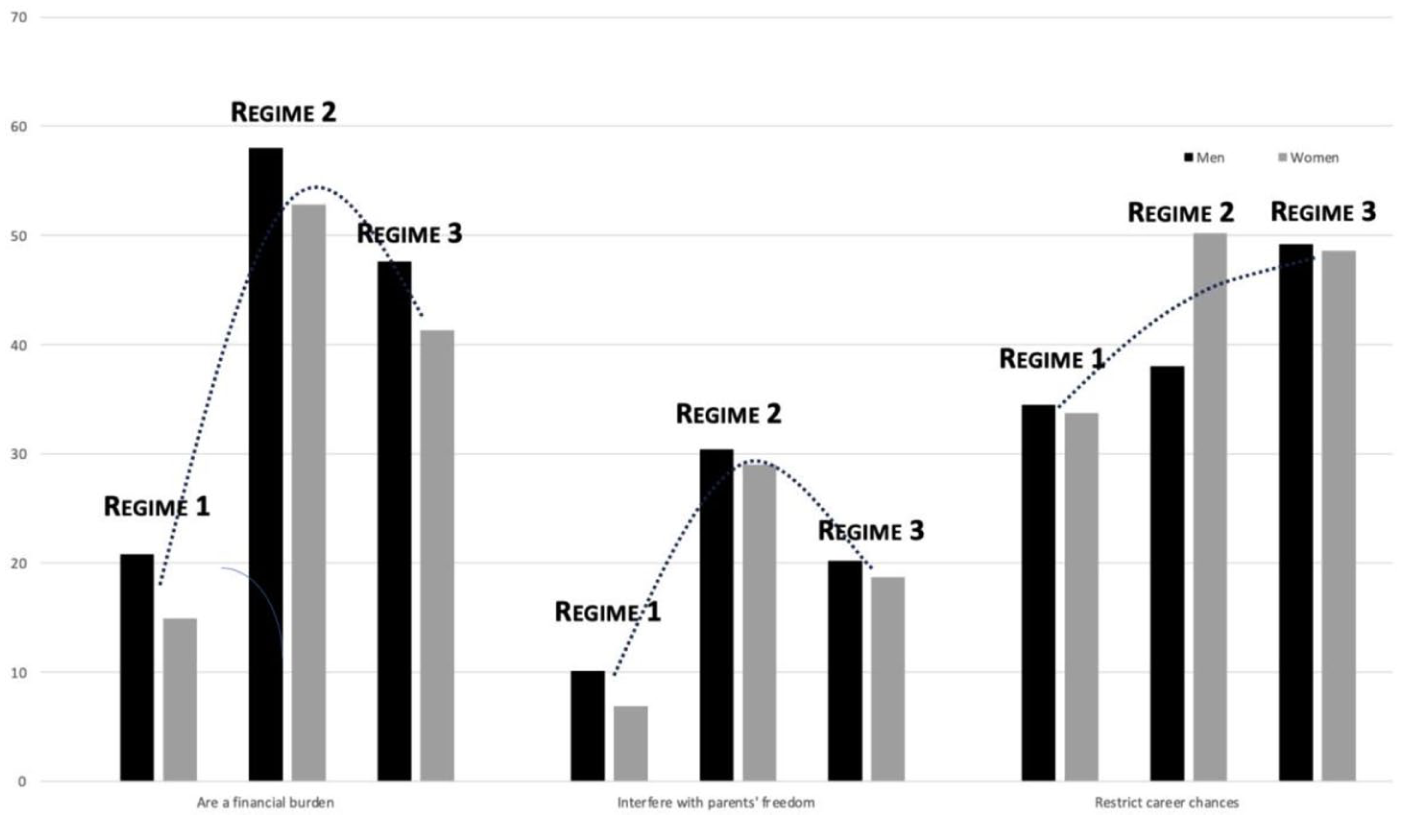
Parental pessimism among women and men.
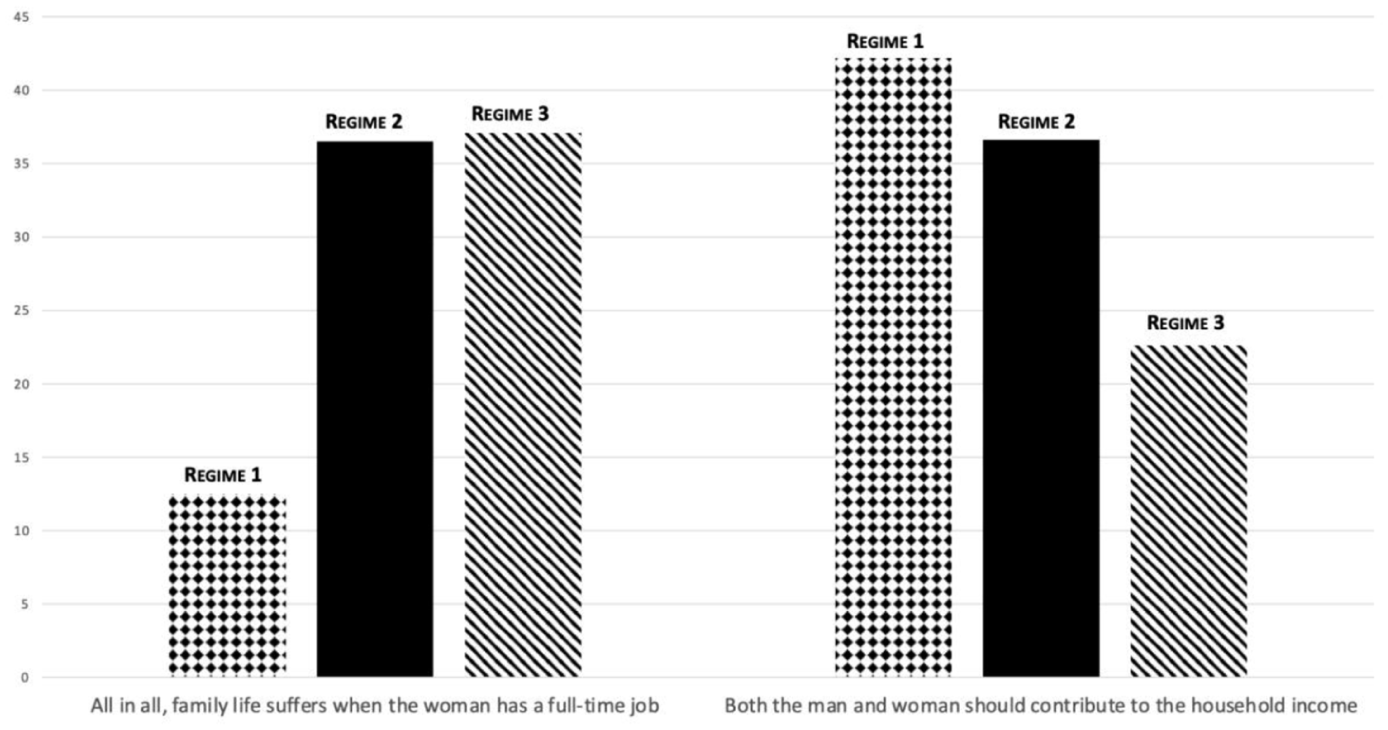
Agreement with statements about women’s roles, by gender regime.
A brief note on timing and measurement is warranted: ISSP 2012 is the only cross-national dataset that includes the full battery used here to measure perceived costs of parenthood (financial burden, loss of freedom, career constraints). Because this battery is not replicated in ISSP 2022, the analysis cannot be updated with identical outcomes and should be read as a mid-2010s benchmark.
Gender regimes in Europe
To characterize countries by the nature and level of gender inequalities, it is useful to draw on work that identifies ‘models’ or ‘gender regimes’, that is, ideal-typical constructions of how gender relations are organized (Walby, 2004). As Weberian ideal types, the regimes are heuristic constructs that accentuate dominant configurations of paid work, unpaid work, and work–family articulation. They do not imply that all individuals or households within a country conform to the regime, nor that countries are internally homogeneous or stable across the life course. A typology of gender regimes makes it possible to objectify systems of gender inequality accross countries and to identify the fault lines that separate them.
The bias of gender-regime typologies
Since the 1990s, scholars building on Esping-Andersen’s welfare-regime approach (Esping-Andersen, 1990) have developed family policy typologies to ‘gender’ welfare analysis and correct the treatment of the family as a residual category (Neyer, 2021; Orloff, 1993). Most classify countries using women’s labor-market integration and childcare coverage, which capture public-sphere equality but say little about men’s participation in unpaid work and thus about domestic inequality (see Pfau-Effinger, 2005).
This blind spot generates paradoxes: France, for example, often clusters near the Nordics in regime classifications, yet comparative time-use studies show substantially more unequal domestic divisions than in Nordic countries (Pailhé et al., 2021). A parallel literature shows why this matters: if women’s employment rises without a proportional increase in men’s unpaid work, gender roles do not fundamentally change (Hochschild, 1989).
Hence the idea of a gender revolution that is ‘stalled’ (England, 2010), ‘incomplete’ (Esping-Andersen and Billari, 2015), or even ‘locked’ (Delès, 2022). This justifies jointly considering professional equality and domestic equality when measuring gender equality. Conceptually, several ideal-typical scenarios follow: (1) an extensive-equality scenario, where dual emancipation has run its course and gender gaps are small both in the labor market and at home; (2) a frustrated-equality scenario, where professional equality is achieved but at the price of women’s dual burden; (3) a conservative scenario marked by traditionally gendered divisions in both domains.
Classical typologies, by focusing on professional equality, are effectively blind to scenario (2), frustrated equality. They tend to distribute countries along a continuum of professional equality, without distinguishing national situations that are structurally organized around women’s double day. For these reasons, an alternative typology of gender regimes is needed – one based on a different measure of gender equality that captures both the allocation of paid work and the division of couples’ domestic work.
Three gender regimes
To this end, I use data from the ISSP 2012 ‘Gender Roles’ module, focusing on 14 Western European countries. The advantage is to compare countries that are relatively similar in terms of economic development, yet markedly different in social, family, and gender policies – a premise already emphasized by Esping-Andersen in constructing his welfare-state typology. Across these 14 countries, I restrict the analysis to cohabiting parents. This restriction is substantively appropriate given the outcome measures used here (perceived costs of parenthood), but it also has implications for inference. Entry into parenthood is selective and shaped by structural constraints that vary across countries (e.g. labor-market insecurity or difficulties in economic stabilization). Cross-national differences in perceived parental costs may therefore partly reflect selection into parenthood: in some contexts, individuals most constrained may postpone or forgo childbearing, so the observed parent sample may be positively selected. That said, robustness checks on the full sample – including respondents without children – suggest that the main cross-national ordering of regimes is not specific to parents only.
If we reason in the usual way, countries can be placed along a continuum of gender equality, understood as equality between women and men in participation in paid work (Figure 1).
A more in-depth analysis, however, reveals different logics of inequality. A hierarchical cluster analysis based on six gender-equality variables (two for professional-sphere equality, two for domestic-sphere equality, and two for work–family articulation) yields three groups of countries according to their statistical proximity on these indicators. Figure 2 plots countries in a space defined by the two most structuring variables.
Juxtaposing these two figures shows the value of considering both professional and domestic dimensions of gender inequality. Doing so ‘decouples’ countries that are relatively advanced in professional equality but whose domestic arrangements still disadvantage women. Countries close to one another in Figure 1 (Norway, Sweden, Portugal, Iceland, France) appear much farther apart in Figure 2. The latter suggests that cross-national differences are not merely differences of level (more or less female employment, more or less distance from maternalism) but differences in the nature of inequalities. Gender inequalities appear as combinations across professional and domestic dimensions, bringing into view distinct normative configurations.
Once the clusters are distinguished, the next step is to describe the logics of gender inequality that govern them, thereby characterizing them as different gender regimes. Figure 3 is instructive in this regard.
Regime 1 systematically shows the lowest figures (with the exception of the variable ‘equal men’s involvement’, at the bottom of the graph), indicating a high level of gender equality across all dimensions. These countries – namely the Nordic ones (Sweden, Finland, Denmark, Norway, Iceland) – embody a dual-earner/dual-carer model in which gender roles tend toward symmetry and the traditional separation of spheres fades. I term this the symmetric-roles regime.
Regime 3 comprises Ireland, Germany, Great Britain, Switzerland, and the Netherlands. For different reasons (religious heritage, liberal philosophy, a male-breadwinner-oriented welfare state), the traditional model of gender-role allocation (male breadwinner/female homemaker) persists: women’s employment is secondary and they perform the bulk of unpaid work. Interestingly, women’s reported difficulties in balancing work and family life are, on average, comparatively low here – close to the level observed in Regime 1. The traditional arrangement thus seems socially more ‘functional’, and typical of this gender regime.
Regime 2 – Portugal, France, Belgium, and Austria – displays levels of professional gender equality very close to those in Regime 1: the share of ‘male-breadwinner’ couples and the male–female gap in working time are similar. However, on variables capturing the division of domestic labor, Regime 2 is as unequal as, or even more unequal than, Regime 3. When children reach school age, women leave paid work in proportions comparable to those in Regime 3. What sharply distinguishes Regime 2 is the proportion of women who report difficulties in reconciling family and professional commitments – a result to be understood in light of women’s combined burden of paid work and primary responsibility for domestic labor. I therefore label this the women’s double-day regime.
And how they relate to parenting attitudes
To test the ‘return of the family’ hypothesis – that extensive gender equality fosters a more optimistic view of family life – I examine the link between the gender regime just defined and parenting attitudes.
Gender regimes and the ‘costs’ of parenthood: an inverted U-shape
I use items on views of children and parenthood, focusing on those that assess the ‘costs’ of parenthood, which seem less vulnerable to social desirability bias than items on benefits. Table 1 presents, by country and cluster, mean responses on three ‘cost’ variables ( ‘Children are a financial burden on their parents’; ‘Having children interferes too much with the freedom of parents’; ‘Having children restricts the employment and career chances of one or both parents’.)
The figures carried by the regimes differ markedly, indicating strong heterogeneity across regimes, while within-regime standard deviations are relatively small, indicating homogeneity among countries within a regime. This validates the idea of a gender-regime effect on representations of parenthood – a result confirmed by multilevel regression analyses not reproduced here.
Table 1 shows that perceptions of the costs of parenthood are clearly most pronounced in the women’s double-day regime, while countries in both the more egalitarian (symmetric roles) and the more inegalitarian (traditional arrangements) regimes display lower parental pessimism. In matters of gender equality and representations of parenthood, there is thus a kind of inverted U-curve – echoing the well-documented relationship between gender equality and fertility (Esping-Andersen and Billari, 2015; Torr and Short, 2004). The traditional arrangement assigns distinct parental and professional roles to men and women and appears ‘functional’ where traditional gender norms dominate. Conversely, in the Nordic countries, role interchangeability equips individuals to handle the compatibility of family and work constraints. Both regimes therefore produce comparatively low levels of parental pessimism.
By contrast, the women’s double-day regime is associated with higher levels of parental pessimism. Recall that this regime is characterized by women’s primary responsibility for domestic and parental tasks despite high female labor-market participation. Qualitative research on the ‘second shift’ documents the strains borne by women in these double-day situations, helping to explain heightened parental pessimism.
A more visual inspection confirms this layout: in the lower-left quadrant, with moderate pessimism, are the Nordic countries; in the upper-right quadrant, the most pessimistic countries belong to the women’s double-day regime. Finally, countries in the traditional-arrangements regime occupy an intermediate position, generally above the regression line: their pessimism appears to stem more from material causes (financial cost) than from ‘philosophical’ ones (individual freedom).
These results confirm an intuition derived from the ‘return of the family’ theory: a second gender revolution is underway, though unevenly advanced across gender regimes. Where traditional inequalities prevail, and where the gender revolution has reached a mature stage, perceived costs of parenthood are lower. In the intermediate stage – where the revolution stalls due to persistent domestic inequalities – parenthood is experienced as more constrained.
Sharper women–men differences in Regime 2
Finally, I disaggregate responses by regime and by respondent gender:
Figure 5 first illustrates the inverted U-shaped relationship for the first two items. It also clarifies the ‘sex effect’ in reported parental pessimism. On the ‘freedom’ and ‘financial burden’ items, men consistently report higher levels. Because parental responsibilities are traditionally assigned to women, their individual acceptance of that role may be greater, which could explain lower claims to ‘freedom’. Concern about financial burden also remains more of a ‘male’ affair, reflecting the legacy of the male-provider model.
More importantly, the sex effect varies by regime. The most salient finding appears in the histogram for women in Regime 2 on the ‘limits career possibilities’ item: in the other regimes, the sex effect on this variable is not significant. This may indicate that women’s sensitivity to equity is sharpened precisely where professional-sphere equality and domestic-sphere equality are decoupled, as in Regime 2.
But this is not only about perceptions of justice. It also shows how social expectations for women vary across regimes. The specificity of Regime 2 is to demand women’s full involvement in both spheres. The next figure illustrates cross-regime differences:
Figure 6 clarifies the normative mechanism behind the regime differences documented above. It captures social expectations toward women along two dimensions – domestic commitment and financial/professional participation – and shows that these expectations combine very differently across regimes. In the symmetric-roles regime, high expectations of women’s labor-market attachment are paired with comparatively egalitarian expectations regarding men’s domestic involvement, making the dual-earner/dual-carer model socially coherent. In the traditional-arrangements regime, expectations are more consistent with specialization, which may reduce the perceived tension between paid work and caregiving roles. By contrast, the women’s double-day regime stands out for its dual demand: respondents endorse high expectations that women contribute fully in the professional sphere while also remaining strongly responsible for the family sphere. This normative configuration helps to interpret why parental pessimism peaks in Regime 2 (Table 1; Figure 4) and why the gender gap is especially pronounced there on the ‘restricts career chances’ item (Figure 5): where professional-sphere equality and domestic-sphere equality are decoupled, the perceived career penalty of children becomes particularly salient for women.
Conclusion
We can contextualize our findings by comparing family policies across regimes. In the ‘double emancipation’ regime, Nordic countries paired early advances in gender equality with strong support for parenting, grounded in a dual ideal of gender equality and the child’s best interests. Sweden’s earnings-related parental leave, introduced in the 1970s, grants parents 480 days to share, with a non-transferable quota for each parent (‘use it or lose it’). By incentivizing fathers’ uptake and sustaining parental involvement in early care, this design links gender equality (at work and at home) to lower perceived costs – and a more positive experience – of parenthood. As Caitlyn Collins notes, Swedish fathers often frame parenting as a right rather than a duty. These policies help explain the association we observe between gender equality (at work and at home) and positive valuation of parenthood.
The ‘separation of spheres’ regime, where parental specialization is common, includes liberal and conservative variants. Traditional gender-role arrangements arguably reduce friction between paid work and family life and lessen negative views of children or parenting. Classic comparative analyses, following Jane Lewis, highlight a strong ‘male breadwinner’ model. In its liberal form, as in the United Kingdom, policy is minimalist and targets child poverty without challenging traditional roles. In its conservative form, as in Germany, leave structures – despite clear changes – continue to reinforce conventional roles. Important expansions in collective childcare are underway and may weaken the traditional model, but our data do not capture those recent shifts. Future tests of the argument will require either newly fielded items or other cross-national sources that include equivalent measures of parental pessimism, unfortunately unavailable in ISSP 2022. Overall, this traditional regime is less homogeneous than ‘double emancipation’: policies are more residual than coherent, and countries like Germany and the United Kingdom are often placed in different regimes in the literature.
At the apex of an inverted U-shaped curve lie countries of the ‘unfinished gender revolution’, where high female employment coexists with persistent domestic inequality and elevated parental pessimism. Here, the first phase of the gender revolution – women’s entry into paid work – has clearly advanced. But, unlike in the Nordics, ambitious egalitarian policies have not catalyzed the second phase, in which men assume their share of domestic labor. The revolution has stalled midstream. This apparently transitional state is in fact structural: studies document the stability of domestic inequalities, notably in France. France retains legacies of a postwar family policy model premised on male employment. The clearest example is the continued use of the spousal and family quotient in taxation, whereas the Nordics shifted early to individual taxation. The French system’s ambivalence lies in encouraging women not to exit the labor market after birth while leaving them as primary parents and default domestic workers. Fathers face weak incentives to participate actively, and their involvement has grown surprisingly little over the long run compared with other developed countries. The result is ‘normative confusion’: egalitarian aspirations collide with enduring traditional policies, producing a more constrained, pessimistic relationship to parenthood.
These patterns suggest the inertia of social models. Welfare states built around male employment struggle to integrate transformed gender roles, especially at home. Nordic parental-leave reforms appear pivotal for engaging fathers in care and housework, recomposing family values, and elevating parenthood. By contrast, more liberal approaches to the domestic sphere (i.e. policies that do not implement change in the domestic sphere) reproduce inherited conjugal bargains, household negotiations, financial trade-offs, opportunity-cost calculations around leave, and appeals to ‘maternal instincts’ and children’s ‘natural needs’. In that framework, being a parent is coded as an added constraint on top of the first workday, especially for women.
Finally, Europe’s wide variation in parental pessimism invites scrutiny of how societies imagine childhood and education. Democratic educational styles prevalent in the Nordics have struggled to take root in other countries. Sweden banned physical and ‘educational’ violence in the late 1970s; France, for example, prohibited ‘ordinary educational violence’ only in 2019. That France shows the highest parental pessimism should prompt a re-examination of its childrearing norms and the social regard for children and parenting. Where parenthood is invisible or devalued, it is harder to make it desirable to the men whom gender-equality policies aim to mobilize. From this perspective, perhaps it is the lack of valorization of parenthood that makes it an obstacle to gender equality. In a certain sense, it is then possible to reverse the article’s implicit causality (gender equality produces positive representations of parenthood) and pose the mirror question: doesn’t the social recognition of parenthood create favorable conditions for gender equality? Happy parents, equal parents?
Footnotes
Data availability statement

Funding
The authors disclosed receipt of the following financial support for the research, authorship, and/or publication of this article: This research has been funded by the Institut Universitaire de France.
Ethical statement
Ethical approval was not required in this study