







Abstract
Proponents of Processing Instruction (VanPatten, 2005) claim that learners benefit most when presented with both referential and affective structured input activities. Following a classic pretest–posttest design, the present study investigates the role of these two types of activities on the learning of the Spanish subjunctive. Groups differed only with respect to the types of activities completed during practice: (1) affective activities only, (2) referential activities only, or (3) referential activities followed by affective activities. All groups showed a significant improvement in performance on recognition and interpretation tasks, suggesting that both types of activities, either in isolation or combined, may be equally beneficial to learners. All practice conditions experienced a decline in performance over the span of two weeks, but delayed posttest scores were still significantly higher than pretest scores, indicating that some of the gains from instruction were maintained over time. Additionally, in the case of interpretation items, results revealed that the two groups that engaged in affective activities were able to better maintain learning gains over the span of two weeks than the group that completed only referential activities. Findings are discussed in relation to the role of task-essentialness in structured input practice.
Keywords
I Introduction
The primary goal of Processing Instruction (PI) is to increase L2 learners’ intake by pushing them to make appropriate form–meaning connections. To this end, two types of structured input (SI) activities are implemented as part of PI to help learners better process input: referential activities, with only one right answer, and affective activities, with more than one correct answer possible. Both types of SI activities encourage form–meaning mappings, but they differ in the extent to which they require the learner to attend to form. While referential activities force the learners to rely on the target form to complete the task, affective activities are claimed to reinforce the form–meaning connections established during referential activities by helping the learners relate to the target forms in a more personal and meaningful way (Farley, 2005; VanPatten, 2005; Wong, 2004). Proponents of PI claim that learners benefit most when presented with both types of activities, especially when the pedagogical sequence consists of referential activities followed by affective activities.
Even though the effectiveness of SI activities, compared to other instructional methods, has been the focus of numerous investigations (Benati, 2005; Farley, 2001a, 2001b; Marsden, 2006; Morgan-Short & Wood-Bowden, 2006; VanPatten & Cadierno, 1993), no empirical studies have examined the relative effects of referential and affective activities on grammar acquisition. Thus, it is impossible to ascertain whether learners do, in fact, benefit most from the combination of these two types of tasks. If referential activities promote conscious attention to form and affective activities serve as ‘implicit reinforcement’ (Marsden, 2006, p. 524), it could be hypothesized that providing the learner with both types of SI activities would be more likely to promote language acquisition, as PI advocates maintain. Nonetheless, considering that affective activities do not force learners to make form–meaning connections, it is reasonable to question whether affective SI activities are beneficial or even necessary.
Thus, the purpose of the present study is to evaluate the effects of referential and affective activities, either in isolation or in combination with one another, on the learning of a particular grammatical structure; in this case, the Spanish subjunctive with adverbial clauses of time. Instruction and practice were based on the tenets of PI and computer-delivered via Blackboard. Groups differed only with respect to the types of activities provided: (1) affective activities only, (2) referential activities only, or (3) referential activities followed by affective activities. In all three groups the number of tokens of the target structure was equal. Learning outcomes were measured by an immediate posttest and a two-week delayed posttest.
II Background
1 Processing Instruction
PI is a grammar instruction approach based on VanPatten’s model of Input Processing (VanPatten, 2002; 2005). A central notion of Input Processing is that learners have limited processing capacity, which leads them to selectively allocate their attentional resources to certain linguistic data from the input. Consequently, learners tend to rely on certain psycholinguistic strategies to process input, which VanPatten has outlined as a series of principles. For instance, one processing strategy that is germane to the present study is the Preference for Nonredundancy: ‘Learners are more likely to process nonredundant meaningful grammatical forms before they process redundant meaningful forms’ (VanPatten, 2005, p. 268). The subjunctive morphology on the verb in the dependent clause is redundant for the learners because the same meaning can be retrieved elsewhere in the sentence: the notion of ‘irrealis’ is also conveyed by the verb in the main clause. Another processing strategy that may affect the acquisition of subjunctive is what VanPatten refers to as the Sentence Location Principle: ‘Learners tend to process items in sentence initial position before those in final position and those in medial position’ (VanPatten, 2005, p. 269). Since the subjunctive appears almost exclusively in subordinate clauses (in medial position), learners are likely to overlook it.
Thus, PI aims to increase the likelihood that L2 learners will attend to form in the input by altering those undesirable processing strategies in favor of more optimal ones. To that end, learners are provided with explicit information about the target structure and ‘are informed about a particular processing strategy that may negatively affect their picking up of the form’ (VanPatten, 2005, p. 273). This instruction is followed by Structured Input (SI) activities, in which
input is manipulated in particular ways so that learners become dependent on form and structure to get meaning and/or to privilege the form or structure in the input so that learners have a better chance of attending to it. (VanPatten, 2005, p. 273)
2 Types of structured input activities
SI activities can be classified as either referential or affective. Referential SI activities have only one correct answer, and they typically consist of asking the learner to choose between two dichotomous interpretations, such as present versus past, feminine versus masculine, singular versus plural, etc. Given that learners must rely on the target form in order to successfully complete the task, the purpose of these activities is to draw the learners’ attention to form and help them establish the appropriate form–meaning connections. An example of a referential activity from this study is given in (1).
(1) María thinks she is a good student, but her Spanish TA begs to differ. Click on ‘Audio’ to hear the second half of María’s statements about her behavior in class, then choose the phrase that best begins each one (option A or B). a. Participo poco cuando … ‘I participate little when … ’ b. Voy a participar poco cuando … ‘I’m going to participate little when … ’ Audio transcript: trabaje en grupo I-work-subj. in a-group
In the example above, learners must rely on the subjunctive ending -e in order to determine that the phrase refers to a future event; thus, (b) is the only correct answer.
In contrast, affective activities have more than one correct answer possible, since learners are usually asked to indicate an opinion or belief. The purpose of affective activities is to reinforce the form–meaning connections while learners ‘are engaged in processing information about the real world’ (VanPatten, 2005, p. 274). The following example illustrates an affective activity included in the present study:
(2) María clearly isn’t an ideal student, but what about you? You will hear the second half of a statement. Choose the phrase that best begins each statement according to what might apply to you and your relationship with your instructor (option A or B). a. Voy a ser respetuoso cuando … ‘I’m going to be respectful when …’ b. Voy a ser muy directo cuando … ‘I’m going to be very direct when …’ Audio transcript: conteste un email del profesor I answer-subj. an email from my professor
In this case, learners are not required to rely on the subjunctive ending to complete the activity, given that all options refer to future events and are grammatically correct. While these activities do not guarantee that learners will attend to form, they still provide ‘a healthy dose of SI’ in a meaningful context (Farley, 2005, p. 87).
3 Theoretical underpinnings of referential and affective activities
From a theoretical standpoint, the use of referential activities has sound support. Within the framework of the Noticing Hypothesis (Schmidt, 2001), referential activities could be considered pivotal in promoting acquisition, as they are specifically designed to promote noticing of form, which is necessary for learning to take place. While noticing does not guarantee acquisition, it is the necessary first step for intake to be derived from input. On the other hand, affective activities do not force learners to notice forms in the input: in fact, learners might direct their attention solely to meaning in order to carry out the task.
Within the framework of task-based SLA, referential activities meet all the criteria for effective grammar tasks, as outlined by Loschky and Bley-Vroman (1993). First, structural accuracy is essential to meaning, given that learners must rely on the target form to complete the task. In other words, referential activities are prime examples of task-essential practice: ‘it is impossible to succeed unless the grammatical knowledge is attended to’ (Loschky & Bley-Vroman, 1993, p. 138). Second, when completing referential activities, learners receive feedback on accuracy, thus allowing learners to confirm or reject interlanguage hypotheses on the target structure. Both task-essentialness and corrective feedback are thought to be facilitative of L2 development (Loschky & Bley-Vroman, 1993; Tomasello & Herron, 1989). In contrast, affective activities lack task-essentialness, as it is possible to complete the task without attending to the target structure, nor are they conducive to hypothesis testing, given that there are no right or wrong answers, and the feedback provided is meaning-based.
Nonetheless, the notion of combining both referential and affective activities may still be in line with both Schmidt’s and Bley-Vroman’s claims. First, it is possible for learners to attend to form during affective SI activities, especially after their awareness has been heightened by both EI and referential SI activities. In fact, affective activities are thought to serve as reinforcement after learners have begun noticing the forms in the referential activities (Farley, 2005). Second, affective SI activities serve as positive evidence, which may still aid in hypothesis testing if the learner assumes that ‘a lack of positive evidence is prima facie negative evidence’ (Bley-Vroman, 2006, p. 355). For instance, in the present study, the subjunctive was never used in constructions that referred to habitual events; thus, learners could have correctly deduced that using the subjunctive to refer to habitual events is ungrammatical.
Then again, considering that the use of referential activities alone has been shown to promote learning gains (Collentine, 1998; Fernandez, 2008), it remains unclear to what extent learners benefit from the meaningful (implicit) reinforcement or positive evidence that affective activities offer. The present study aims to tease apart the relative benefits of referential and affective SI activities on grammar learning, and empirically test the claim made by PI proponents that learners benefit most from the combination of both types of Structured Input activities.
4 Previous research on Processing Instruction
Extensive research has been conducted on the effectiveness of PI and its components. Initially, PI was compared to traditional instruction (TI), operationalized as paradigmatic information followed by a progression of output-based mechanical and communicative activities. In their now classic study, VanPatten and Cadierno (1993) addressed the question of whether altering the learners’ processing strategies through PI had a greater effect than TI on their developmental system. They focused on a structure often misinterpreted by learners of Spanish as a foreign language: preverbal direct object pronouns. Their results showed that participants in the PI group outperformed the TI and control groups for interpretation, but revealed no differences between PI and TI for sentence-level production. In a replication study using the Spanish preterit, Cadierno (1995) obtained the same results as VanPatten and Cadierno (1993). Likewise, Cheng (2002) demonstrated the beneficial effects of PI on the interpretation and production of the Spanish copulas ser and estar, and VanPatten and Wong (2004) found an advantage for PI over TI with the French causative.
One exception to this trend was a study by Cheng (2004), in which no differences were found between the PI and TI groups on their use of the Spanish copula estar: both instructional groups outperformed the control group in a composition task. The author attributed the lack of differences between PI and TI to the fact that her operationalization of TI differed from previous PI studies in that it included ‘substantially more meaningful exercises’ (Cheng, 2004, p. 138), highlighting the beneficial role of practice that focuses on meaning in addition to form. Collentine’s (1998) study on the Spanish subjunctive also revealed no significant differences between PI and TI on either interpretation or production of the target structure. However, VanPatten (2002) pointed out that Collentine (1998) did not authentically operationalize PI, given that practice lacked affective SI activities, and the items in the referential activities were semantically ‘heavy’ and thus strained the learners’ processing capacities (p. 784). While it is likely that the ‘heaviness’ of the items affected the performance of the PI group, the question of whether the combination of referential and affective activities may have been more beneficial to learners than only referential activities still persists.
Studies comparing PI to TI have been criticized on the basis that the explicit instruction provided to each group was fundamentally different: the PI group received additional information on a particular processing strategy, while the TI group did not. Subsequent research by VanPatten and Oikkenon (1996) addressed this concern by exploring the role of explicit information (EI). The study used the same target structure and assessment tasks as VanPatten and Cadierno (1993). Participants were randomly assigned to one of three groups: one receiving EI only, one doing SI activities only, and one receiving EI followed by SI practice. The results showed no improvement for the EI only group, while both treatment conditions doing SI activities, with or without EI, improved significantly. The researchers concluded that EI was not as important as providing meaningful practice that forced learners to change their processing strategies. Similar findings were reported for negation of avoir in French (Wong, 2004) and future tense in Italian (Benati, 2004). Moreover, a computer-assisted study by Sanz and Morgan-Short (2004) showed that neither EI nor explicit metalinguistic feedback had a differential effect on learning outcomes, suggesting that practice by means of structured input activities was sufficient to improve learners’ ability to process preverbal direct object pronouns. The authors concluded that positive evidence:
when presented in a manner in which learners crucially process the form in order to get the meaning, leads to form–function–meaning mapping and is therefore a successful means of promoting processing for language learning. (Sanz & Morgan-Short, 2004, p. 72; emphasis in original)
Considering that referential activities, unlike affective activities, force learners to process form in the manner that Sanz and Morgan-Short (2004) allude to, the question that inevitably arises is whether engaging in referential activities only would lead to greater learning gains than engaging in both referential and affective activities, as PI proponents would claim.
While most studies investigating the role of EI in PI have suggested that it might not play as big a role as meaningful practice, studies on the Spanish subjunctive have indicated that EI may indeed be beneficial, if not necessary, to improve learners’ mood selection abilities (Farley, 2004; Fernandez, 2008). In fact, Fernandez (2008) found that referential activities alone were enough to improve the learners’ ability to process preverbal direct object pronouns, as suggested by Sanz and Morgan-Short (2004), but they were not sufficient in the case of subjunctive. The group that had not received EI had significantly lower accuracy rates and slower reaction times when selecting between indicative and subjunctive. Fernandez’s (2008) findings suggest that task-essentialness may not be sufficient in the case of a complex and opaque structure like the subjunctive (see also Farley, 2004).
Even though the majority of studies on PI have incorporated the use of both referential and affective activities (Benati, 2004, 2005; Farley, 2001a, 2001b, 2004; Marsden, 2006; Morgan-Short & Wood-Bowden, 2006; Sanz & Morgan-Short, 2004; VanPatten & Cadierno, 1993; VanPatten & Oikkenon, 1996), a few studies have operationalized practice as referential activities alone (Collentine, 1998; Fernandez, 2008), and yet treatment groups showed significant improvement in all cases. Therefore, a closer examination of the differential effects of referential and affective activities is called for. As VanPatten (2002) pointed out, ‘although all published guidelines for PI materials, since 1993, discuss using both referential and affective activities, […] the roles of each within PI need to be investigated’ (p. 784).
Marsden (2006) attempted to shed some light on this issue in a classroom-based study comparing
the referential activity component of PI (where attention to form and meaning is necessary) to input-based activities that operationalized the alternative (i.e. that integrated attention to form and meaning is not required for SLA). (p. 508; emphasis in original)
PI was operationalized as explicit instruction followed by referential and affective activities, while Enriched Input (EnI) consisted of explicit instruction followed by activities that did not require learners to attend to form. A relatively small sample of 27 high school learners completed the first experiment (14 in the PI group and 13 in the EnI group). The target forms were regular present tense inflections in French, and present tense of avoir as used in passé composé. A battery of oral and written comprehension and production tasks were administered as posttests with a delay of one week and 14–16 weeks. Results showed that the PI group outperformed the EnI group in all measures, and learning gains were maintained over a period of 14–16 weeks. However, the heterogeneity of targeted structures not only went against PI’s guideline to present one thing at a time, but also created some confounding that the author acknowledges: it is difficult to say if there were differential learning gains of inflections for person and number, as well as for the regular present tense inflections as opposed to the perfective use of avoir.
Identical materials and assessment measures were used in a second experiment comparing PI (n = 15), EnI (n = 14), and a control group (n = 30) that did not receive any instructional treatment. These learners had higher scores on the pretest, so it could be assumed that their level of proficiency was slightly higher. Results showed an advantage for the PI group on comprehension measures, while the EnI group performed as poorly as the control group. This led Marsden (2006) to suggest that explicit information did not have a differential effect on learning outcomes, given that both experimental groups received the same instruction. While this conclusion may be partially true, it overlooks one important advantage of the PI group over the EnI group: explicit feedback. Learners in the PI group received metalinguistic explanations for some of the items, in which case, the amount of explicit information available to each group was not equal.
In regards to referential and affective activities, Marsden (2006) claimed that her study offered some insights on the two types of SI activities, even though it was not the goal of her investigation. The author considered the EnI activities to be fundamentally similar to affective SI activities; however, some crucial differences are worth noting. First, EnI activities were not structured with the learners’ processing strategies in mind: the lexical item that made the verb inflection redundant was presented in the same sentence, whereas in SI activities the input was manipulated in a way that the conjugated verb appeared in utterance-initial position, without a subject or temporal adverb. Another advantage of affective SI activities over EnI activities was that learners in the PI group received reminders to notice the target form, while students in the EnI group did not. Even though a reminder to look or listen out for a verb form does not imply that learners will notice or process it, it may increase the chance that they will.
In light of these differences in treatment conditions, any conclusions as to the roles of referential and affective activities based on Marsden’s (2006) data should be made with caution. The results suggest that structured input, presented as either referential or affective activities, may be in itself sufficient to alter processing strategies. However, any differential effects of referential and affective activities cannot be inferred from Marsden’s (2006) study, given that the PI group did both referential and affective activities. The author suggested that the ‘combination of referential and affective PI activities helped the learners to make gains in all measures’ (p. 544), but considering that neither type of SI activities was successfully isolated, it is difficult to determine whether gains were due to the combination of referential and affective activities or to one type of SI activities in particular. The question that arises, then, is whether a group completing both referential and affective SI activities would outperform a group doing either referential activities or affective activities only.
III Research questions
The overarching goal of the present investigation is to determine whether learners benefit most from the combination of both types of SI activities, as claimed by PI proponents. Specifically, this study will be guided by the following research questions:
1a. What leads to most improvement in performance on sentence-level tasks involving the recognition of the Spanish subjunctive: explicit instruction followed by only referential SI activities, only affective SI activities, or a combination of both?
1b. Is this effect maintained over time?
2a. What leads to most improvement in performance on sentence-level tasks involving the interpretation of the Spanish subjunctive: explicit instruction followed by only referential SI activities, only affective SI activities, or a combination of both?
2b. Is this effect maintained over time?
This study focuses on multiple-choice sentence-level tasks, as previous research on PI has done to measure comprehension abilities. Specifically, two different types of comprehension tasks are used: recognition of when subjunctive should be employed, and interpretation of the use of subjunctive. Interpretation tasks have been a staple of PI research since they can directly capture whether processing strategies have been successfully altered (e.g. learners no longer ignore redundant forms but rather process them to interpret sentences correctly). Most research on PI has complemented interpretation data with production data. For practical reasons, this study employed a recognition task instead, whose format mimics that of controlled sentence-level production, except that learners are provided with options rather than being asked to produce the form. Examples of recognition and interpretation items are provided in (5) and (1) respectively.
It is hypothesized that, if the claim made by PI proponents is correct, the group completing both referential and affective SI activities will outperform all other groups on all measures. Furthermore, it is also hypothesized that the group doing referential SI activities only will exhibit greater learning gains than the group doing affective SI activities only, due to the task-essentialness of referential activities.
IV Method
1 Participants
Participants were 103 undergraduate students at a large Midwestern university in the USA enrolled in one of two fourth-semester Spanish courses: ‘Introduction to Spanish grammar’ and ‘Spanish in the professions’. During the data collection period, the use of the subjunctive with adverbial clauses was not formally presented in either of the courses. To control for any prior knowledge of the target structure, only participants who scored less than chance, 33%, on both the recognition and interpretation items on the pretest were included in the final sample. Even though each pretest item had 6 possible choices, half of which were semantically logical, chance was determined based on the probability of selecting the only choice that was both semantically and morphologically correct out of the 3 that were possible matches based on meaning. A more detailed description of the pretest is provided in the following section.
All participants were monolingually-raised native speakers of English, late learners of Spanish as a foreign language (average age of first exposure was 13), with normal vision and hearing. They had less than one semester of immersion in a Spanish-speaking country, and less than 2 semesters of other foreign language study, thus ensuring no knowledge of subjunctive in other languages. This information was gathered through a language background questionnaire administered prior to the treatment session.
Participants were randomly assigned to one of three treatment conditions:
RA (n = 31): Practice consisted of 24 items of referential SI activities followed by 24 items of affective SI activities.
REF (n = 42): Practice consisted of 48 items of referential SI activities only.
AFF (n = 30): Practice consisted of 48 items of affective SI activities only.
All groups received the same computer-delivered instruction on the target form before practice. Feedback during practice was provided every 6 items in an item-by-item format. In other words, after submitting the answers for 6 items of practice, students would click on ‘View Submission’ and see the feedback corresponding to each of those items. For referential activities, feedback consisted of only a ‘That’s right!’ or ‘Not quite’ answer. Participants were not provided with any explanations nor models. Since each practice item had only two possible answers, it was assumed that the learners would be able to conclude that if the option selected was not correct, the other one would be the right answer. In the case of affective activities, feedback consisted of an affective response that might resemble what a teacher would say in class in response to a student’s opinion or belief: ‘How interesting!’ or ‘That’s what I thought’.
2 Target structure
The target structure in this study is the use of the Spanish subjunctive in adverbial clauses of time. This structure was chosen because of its complexity for native speakers of English learning Spanish as a foreign language (cf. Farley 2001a, 2001b, 2004; Fernandez, 2008), and because its redundancy, utterance-medial location, and low communicative value make it a perfect candidate for a study employing PI. While the use of subjunctive in noun clauses and adjectival clauses has been the target of previous PI research (Collentine, 1998; Farley 2001a, 2001b, 2004; Fernandez, 2008), its use with adverbial clauses of time has not yet been investigated. Furthermore, this study focuses on first person singular, whereas previous studies have looked at the acquisition of third person singular. The reason for choosing first person singular is twofold. On a practical level, the use of first person singular can easily be incorporated into affective activities. On a methodological level, it avoids the possible confusion of indicative and subjunctive verb paradigms: the verbal inflection -o can only be associated with the indicative, while the ending -e for first person singular can only indicate subjunctive mood. The endings for the other forms of the paradigm, on the other hand, tend to be more confusing for learners because the affixes of -AR verbs in present indicative are those of -ER and -IR verbs in present subjunctive, and vice versa.
The rule to determine if the verb in the subordinate clause should be in indicative or subjunctive may be summarized as follows: if the action of the subordinate clause is a future-time event, the subjunctive is used, as in (3); otherwise, indicative is used, as in (4).
(3) Voy a participar mucho cuando trabaje en grupo. ‘I’m going to participate a lot when I work-subj. in a group.’ (4) Participo mucho cuando trabajo en grupo. ‘I participate a lot when I work-ind. in a group.’
There are several conjunctions of time that can introduce subordinate clauses. In the present study, only the most commonly used one was included: cuando (‘when’). Selecting a conjunction of time that fourth-semester learners are already familiar with – as opposed to hasta que (‘until’) or en cuanto (‘as soon as’) – reduces the processing load and ensures that attentional resources are not depleted by new lexical items but can instead be used to process the subordinate verb morphology in the sentence.
3 Treatment materials
All treatment materials were designed following the tenets of PI (VanPatten, 2002, 2005). First, all participants received nonparadigmatic information in English about how the subjunctive is formed, where it is located within a sentence, and when it is used in adverbial clauses of time (see Appendix 1). The information was nonparadigmatic because only the conjugation of -AR verbs in first person singular was presented, and all information was accompanied by examples in Spanish. Subsequently, all participants were warned about a particular processing strategy that might negatively affect their acquisition of the target form, which in the case of the subjunctive mood is the Preference for Nonredundancy: ‘Learners are more likely to process nonredundant meaningful grammatical forms before they process redundant meaningful forms’ (VanPatten, 2005, p. 268). As was previously explained, the subjunctive is redundant to the learners because the same meaning can be retrieved elsewhere in the sentence. In addition, learners were warned not to utilize future tense in place of subjunctive in the subordinate clause, given that it would be ungrammatical in Spanish, despite the fact that the action implies a future intent.
Practice consisted of SI activities designed according to VanPatten’s (2005) guidelines:
Present one thing at a time.
Keep meaning in focus.
Use both written and oral input.
Have the learner do something with the input.
Keep the learner’s processing strategies in mind.
The processing strategy taken into account was the Sentence Location Principle: ‘Learners tend to process items in sentence initial position before those in final position and those in medial position’ (VanPatten, 2005, p. 269). When creating the activities, the main clause was separated from the subordinate clause, and the verb in the subordinate clause was always placed at the beginning of each item, so that it would be the first word read on the screen or heard in the audio. This ensured that the verbs in subjunctive would be in utterance-initial position, and that the verb in the main clause would ‘no longer take precedence for processing over the subjunctive verb endings’ (Farley, 2005, p. 47).
During the recognition tasks, participants heard the first half of a sentence and were asked to select the phrase that best completed it. The audio portion contained the main clause and the conjunction of time. In the case of referential activities, the choices on the screen were two subordinate clauses, one containing a verb in present indicative and the other in present subjunctive. Thus, learners were forced to process the verb in the subordinate clause in order to successfully complete the task. An example of a referential recognition item is provided below.
(5) Unlike María, Ana is a really good student. Click on ‘Audio’ to hear the first half of Ana’s statements about her relationship with her instructor, and then choose the phrase that best completes each one (option A or B). a. … necesito ayuda. ‘… I need-ind. help’ b. … necesite ayuda. ‘… I need-subj. help’ Audio transcript: Voy a contactar al profesor cuando … ‘I’m going to contact the professor when’
In the case of the affective activities, on the other hand, both subordinate clauses on the screen were grammatically correct but differed in terms of meaning, requiring learners to choose based solely on what might apply to them. For instance, the affective equivalent of the referential item in (5) above would be:
(6) Are you the ideal student of Spanish? Click on ‘Audio’ to hear the second half of a statement. Choose the phrase that best completes each statement according to what might apply to you and your relationship with your instructor (option A or B). a. … necesite ayuda. ‘… I need-subj. help’ b. … necesite crédito extra. ‘… I need-subj. extra credit’ Audio transcript: Voy a contactar al profesor cuando … ‘I’m going to contact the professor when’
In the interpretation tasks, participants listened to the second half of a sentence and were asked to select the phrase that best started it. The audio portion included the subordinate clause only, while the choices on the screen were of two main clauses and the conjunction of time. In the case of referential activities, one choice consisted of a habitual event, containing a verb in present tense, and the other was a future event, containing a verb in the periphrastic future. As with the recognition tasks, both choices in the affective activities were grammatically correct (e.g. both contained a verb in the periphrastic future if the subordinate verb was in subjunctive), and learners were asked to select the option that best applied to themselves. Examples of referential and affective interpretation items were provided in (1) and (2) above.
All participants completed a total of 48 practice items presented to all the groups in 8 sets of 6 items, with 12 interpretation items presented after every 12 recognition items. In the case of the RA group, the first 24 items were referential activities, while the last 24 items were implemented as affective activities. To ensure that all verbs were presented in indicative and subjunctive with the same frequency and in both written and oral modalities, verbs that needed to be in subjunctive in the recognition task appeared in indicative in the interpretation task, and vice versa, thus eliminating the possibility that practice could favor one over another. Vocabulary in the tasks included high-frequency words that fourth-semester students are likely to recognize (e.g. dormir ‘to sleep’, tarea ‘homework’), as well as cognates. In the case of a few lexical items that tend to be infrequent in textbooks and are not cognates, glosses were provided (e.g. extrañar ‘to miss’, orgulloso ‘proud’).
4 Assessment materials
The pretest and posttests consisted of 80 multiple-choice items, which included 20 recognition items (12 requiring subjunctive and 8 requiring indicative), 20 interpretation items (12 future-event actions and 8 habitual actions), and 20 distracters on aspectual and temporal differences in Spanish. Items requiring the use of indicative were included to control for overextension of the subjunctive as a consequence of the instructional treatment. Due to time constraints, new exemplars were not included in the posttests, which were already considerable in length.
Each item consisted of a sentence in Spanish with a blank where a phrase had been omitted, followed by six possible choices: three were semantically appropriate and, out of those, only one was grammatically correct. The three choices that made sense differed in terms of their mood or tense: one in present subjunctive, one in present indicative, and one in future, which was the right answer for 12 of the interpretation items. A sample recognition item and a sample interpretation item are provided in (7) and (8), respectively. Options are presented in order here, but were randomized during the experiment.
(7) Voy a saludar al profesor en español cuando ______ ‘I’m going to greet the professor in Spanish when ______’ a. entro en el salón de clase. ‘I enter-ind. the classroom’ b. entre en el salón de clase. ‘I enter-subj. the classroom’ c. voy a entrar en el salón de clase. ‘I’m going to enter the classroom’ d. miro películas sin subtítulos. ‘I watch-ind. movies without subtitles’ e. mire películas sin subtítulos. ‘I watch-subj. movies without subtitles’ f. voy a mirar películas sin subtítulos. ‘I’m going to watch movies without subtitles’ (8) (yo) ______ cuando conteste un email del profesor. ‘______ when I answer-subj. an email from my professor’ a. Soy respetuoso ‘I am-ind. respectful’ b. Sea respetuoso ‘I am-subj. respectful’ c. Voy a ser respetuoso ‘I am going to be respectful’ d. Memorizo la definición ‘I memorize-ind. the definition’ e. Memorice la definición ‘I memorize-subj. the definition’ f. Voy a memorizar la definición ‘I’m going to memorize the definition’
The reliabilities of the recognition and interpretation items were assessed by means of Cronbach alpha and are preported in Table 1. The low reliability scores for the pretest items can be attributed to the limited range of scores, given that all learners selected to participate in this study had little or no prior knowledge of the target structure.
Reliability figures for all tests (Cronbach alpha)

V Procedure
This study followed a classic pretest–posttest design. In the first session, participants completed the language background questionnaire and the pretest online. One week later, qualifying participants returned to the computer lab and were granted access to the Blackboard site where materials had been uploaded. All participants were familiar with Blackboard, which is used campus-wide. The treatment and posttests were administered individually: EI was presented in a Learning Module, allowing participants to advance at their own pace; recognition and interpretation SI tasks were delivered as 8 quizzes of 6 items each, in which questions appeared one at a time and could not be revisited. The immediate posttest was administered online after the practice session. Two weeks later, participants returned to the lab to take the delayed posttest and complete a short debriefing questionnaire to ensure they had not had exposure to the target structure outside of the experimental treatment. In the pretest and posttests, questions appeared in randomized order one at a time and could not be skipped or revisited.
VI Results
The pretest and posttests were scored as follows: 1 point for each right answer (grammatically correct and semantically appropriate), and 0 points for incorrect answers. The total scores for learners in each treatment condition were analysed using SPSS 17, and the alpha level was set at .05. First, one-way ANOVAs were performed on the recognition and interpretation pretest scores to ensure all groups had comparable knowledge at the onset of the study. There were no statistical differences between groups on either recognition, F(2, 102) = .611, p = .545, or interpretation, F(2, 102) = .392, p = .677. Mean scores and standard deviations for all assessments and groups are summarized in Table 1. The following sections discuss the results of inferential statistics used to answer each research question.
Descriptive statistics for all groups and tests: Mean scores (SD)
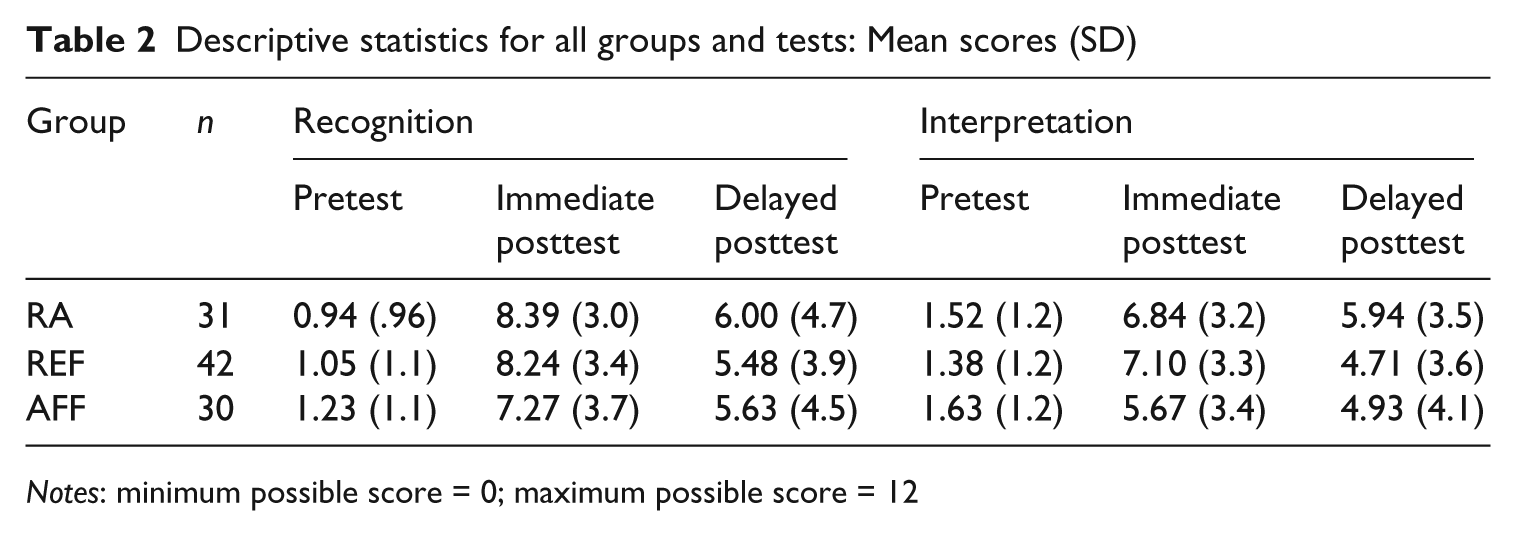
Notes: minimum possible score = 0; maximum possible score = 12
1 Research question 1a: Immediate improvement on recognition items
To find out whether the type of structured input activities had an immediate effect on the learners’ ability to recognize the use of subjunctive, pretest and immediate posttest scores were analysed using a repeated measures ANOVA, with Time (pretest, immediate posttest) as the within-subjects factor and Group (RA, REF, AFF) as the between-subjects factor. Mauchly’s test indicated that the assumption of sphericity had been violated (chi-square = .00, p < .0001), therefore a Huynh–Feldt correction was applied (epsilon = 1.0). The results revealed a significant effect for Time, F(1, 100) = 344.21, p < .0001, but no significant effect for Group, F(2,100) = .62, p = .54, and no significant interaction between Time and Group, F(2, 100) = 1.274, p = .284, suggesting that all groups, regardless of the type of structured input practice, made equally significant gains from pretest to immediate posttest in their ability to recognize the use of subjunctive, as seen in Figure 1. Large effect sizes (measured by Cohen’s d) were observed from the pretest to the immediate posttest for all groups (dRA = 3.34, dREF = 2.85, dAFF = 2.21), indicating that the gains were not only statistically significant but also large in magnitude.
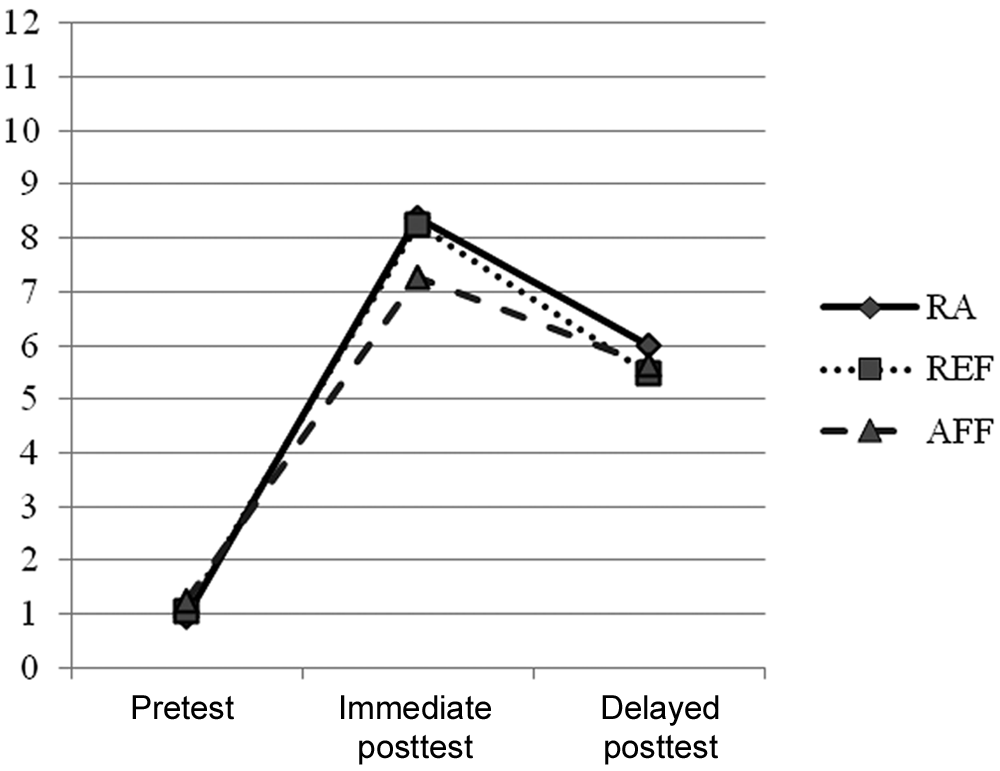
Group mean scores: Recognition items
2 Research question 1b: Sustained learning gains on recognition items
To establish whether learning gains were equally maintained by all groups, immediate and delayed posttest scores were analysed using a repeated measures ANOVA, with Time (immediate posttest, delayed posttest) as the within-subjects factor and Group (RA, REF, AFF) as the between-subjects factor. There was a significant effect for Time, F(1, 100) = 38.229, p < .0001, but no significant effect for Group, F(2,100) = .364, p = .696, and no significant interaction between Time and Group, F(2, 100) = .835, p = .437. These results indicate that while all groups experienced a significant decline over the span of two weeks, the type of practice did not have a differential effect. Furthermore, a repeated measures ANOVA, with Time (pretest, delayed posttest) as the within-subjects factor, revealed a significant effect for Time, F(1, 100) = 98.077, p < .0001, but no significant effect for Group, F(2,100) = .103, p = .902, and no significant interaction between Time and Group, F(2, 100) = .207, p = .813, indicating that, despite the decline since the time of the immediate posttest, delayed posttest scores were still significantly higher than pretest scores for all treatment groups. This was further confirmed by the fact that effect sizes were larger from the pretest to the delayed posttest (dRA = 1.5, dREF = 1.55, dAFF = 1.34) than from the immediate to the delayed posttest (dRA = −.61, dREF = −.75, dAFF = −.40).
3 Research question 2a: Immediate improvement on interpretation items
Similar analyses to those conducted on recognition scores were performed on interpretation scores. A repeated measures ANOVA, with Time (pretest, immediate posttest) as the within-subjects factor and Group (RA, REF, AFF) as the between-subjects factor, revealed a significant effect for Time, F(1, 100) = 211.99, p < .0001, but no significant effect for Group, F(2, 100) = 1.06, p = .351, and no significant interaction between Time and Group, F(2, 100) = 2.15, p = .122, indicating that all practice conditions brought about immediate learning gains that were equally significant. As was the case for the recognition items, large effect sizes were observed on the interpretation items from the pretest to the immediate posttest for all groups (dRA = 2.2, dREF = 2.3, dAFF = 1.58).
4 Research question 2b: Sustained learning gains on interpretation items
A repeated measures ANOVA, with Time (immediate posttest, delayed posttest) as the within-subjects factor and Group (RA, REF, AFF) as the between-subjects factor, showed that there was a significant effect for Time, F(1, 100) = 21.58, p < .0001, as well as a significant interaction between Time and Group F(2, 100) = 3.65, p = .029, but no significant effect for Group, F(2, 100) = .882, p = .417. These results indicate that while all practice groups experienced a significant decline from the immediate posttest to the delayed posttest, the RA and AFF groups exhibited a smaller decline than the REF group, as seen in Figure 2 below. Differences in effect sizes confirmed this finding: while the effect sizes for the RA and the AFF groups were small (dRA = −.27, dAFF = −.19), a medium to large effect size was observed for the REF group (dREF = −.69). Still, delayed posttest scores were significantly higher than pretest scores for all treatment groups, as shown by a repeated measures ANOVA, with Time (pretest, delayed posttest) as the within-subjects factor: a significant effect for Time, F(1, 100) = 92.881, p < .0001, but no significant effect for Group, F(2,100) = 1.06, p = .351, and no significant interaction between Time and Group, F(2, 100) = .892, p = .413. Furthermore, effect sizes were larger from the pretest to the delayed posttest (dRA = 1.69, dREF = 1.24, dAFF = 1.09) than from the immediate to the delayed posttest.
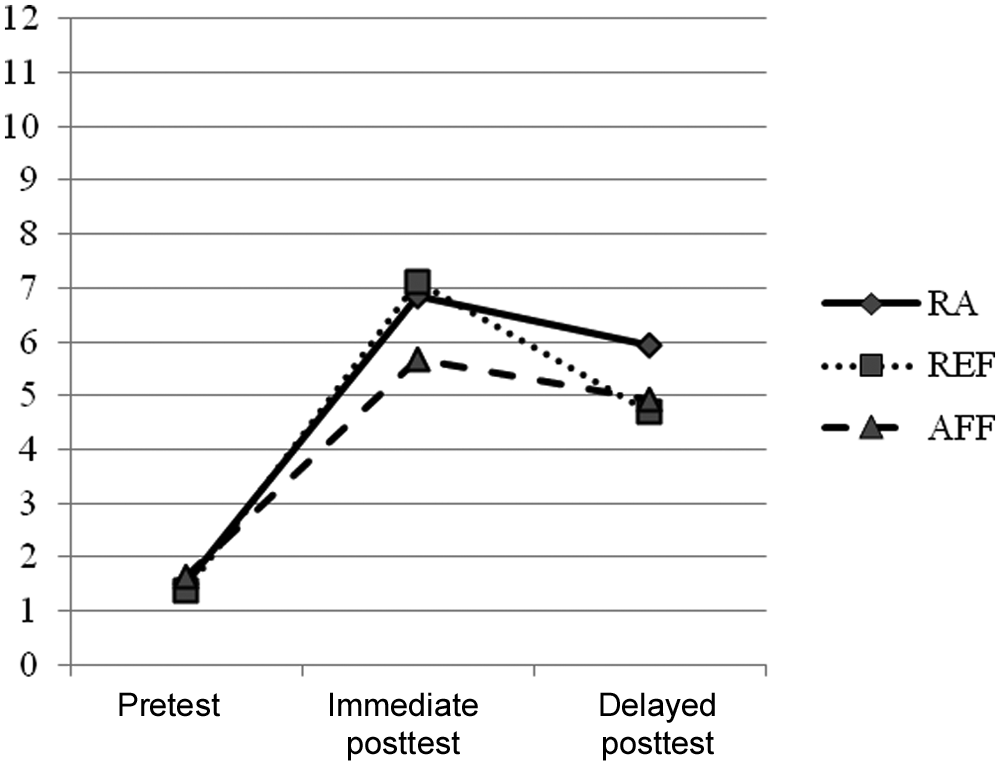
Group mean scores: Interpretation items
5 Overextension of subjunctive
To ensure that participants were not employing a test-taking strategy by selecting the subjunctive choice for all adverbial clauses of time as a result of instruction, recognition items where indicative was required were coded for ungrammatical uses of the subjunctive. That is, those items received a score of 1 if the subjunctive had been selected, and 0 for all other responses. A repeated measures ANOVA, with Time (pretest, immediate posttest, delayed posttest) as the within-subjects factor and Group (RA, REF, AFF) as the between-subjects factor, was performed on tallied scores. There was no significant effect for Time, F(1,100) = 2.712, p = .075, no significant effect for Group, F(2,100) = .339, p = .713, and no significant interaction between Time and Group, F(2,100) = .976, p = .416. These results confirm that learners were no more likely to use the subjunctive in inappropriate (indicative) contexts after the instruction than they were beforehand. Conversely, they were significantly more likely to use the subjunctive in appropriate contexts after the instruction than prior to it.
6 Summary of results
All groups showed a statistically comparable improvement in performance on both recognition and interpretation tasks, suggesting that when amount of practice is controlled for, both types of SI activities, either in isolation or combined, appear to be equally beneficial to learners. All practice conditions experienced a decline in performance over the span of two weeks, but delayed posttest scores were still significantly higher than pretest scores, indicating that some of the gains from instruction were maintained over time. Additionally, in the case of interpretation items, results revealed that the two groups that engaged in affective SI activities (RA and AFF) were able to better maintain learning gains over the span of two weeks than the group that completed only referential SI activities (REF).
VII Discussion
The present study aimed to empirically test the claim made by PI proponents that learners benefit most from the combination of both referential and affective SI activities during practice. The results indicated, however, that type of practice did not have a differential effect on performance. It would appear that explicit information followed by structured input containing referential activities, affective activities, or a combination of the two was sufficient to promote successful recognition and interpretation of the target structure, since there were no significant differences between any of the groups at the time of the posttest. Thus, the overall implication of the present study is that even when practice does not require learners to attend to form in any way, they may still manage to establish the appropriate form–meaning connections, as evidenced by a significant improvement in performance.
Taking into consideration that the target form was the subjunctive, perhaps the most likely explanation for the lack of differences between groups is that all groups received the same amount and type of explicit information. Considering that previous research on PI has suggested that EI may have a differential effect on the acquisition of subjunctive (Farley, 2004; Fernandez, 2008), it is possible that the provision of explicit grammatical instruction on when subjunctive is used in adverbial clauses might have been enough for the learners to be able to associate the subjunctive with future intent, regardless of practice. Future studies should include a [–practice] control group to address the possibility that EI on the uses of subjunctive is sufficient to lead to an improvement in performance.
Another possible explanation for the results is the fact that all conditions received the same amount of SI during practice. Even though affective activities lack task-essentialness because they do not force the learners to process form to complete the task, they still serve as a ‘healthy dose of SI’ (Farley, 2005, p. 87). Manipulating the input with the learners’ processing strategies in mind might have been enough to draw their attention to the target form, especially after their awareness had been heightened by explicit instruction. These findings partially diverge from what Sanz and Morgan-Short (2004) concluded regarding the importance of task-essentialness over explicit information in practice. If task-essentialness had been the most important factor that contributed to learning in this study, the REF and RA groups should have outperformed the AFF group. While it cannot be denied that the task-essentialness of referential activities was beneficial to learners, the results of the present study suggest that explicit instruction followed by SI practice, regardless of its task-essentialness, brought about improved performance in comprehension tasks.
Moreover, while Sanz and Morgan-Short (2004) assumed that some type of corrective feedback was necessary, a noteworthy implication of the present findings is that the provision of implicit feedback during the referential activities was not categorically more beneficial for learners to make the appropriate form–meaning connections, given that the group that did not receive any feedback on form (AFF) showed comparable learning gains to the groups that did (RA and REF). In fact, the two groups that engaged in affective activities, which lacked task-essentialness and feedback, were more successful at maintaining learning gains over a period of two weeks on interpretation items. The positive evidence provided by affective SI activities appears to have been as beneficial to learners as the negative evidence that the corrective feedback of referential activities may supply. Undoubtedly, the roles of task-essentialness and feedback in PI need to be further explored.
VIII Limitations and directions for further research
This investigation has contributed to the line of research on PI by examining two components that had not been empirically studied before: referential and affective activities. Comparing the effectiveness of these two types of SI activities may also have implications for computer assisted language learning (CALL) in terms of research design, as well as pedagogical implementation of online activities. However, this study is limited in that it only considered comprehension tasks. Future studies should investigate whether different types of SI activities have an effect on production skills. On a related note, the instruments used in this study tapped exclusively on the learners’ explicit knowledge and, as such, they cannot demonstrate that the instruction had an effect on interlanguage restructuring. Subsequent research should also include measures of implicit language knowledge by means of timed tasks or spontaneous production.
Furthermore, repetition effects might have affected the results, given that posttest measures only included old exemplars. It would be pertinent for future studies not only to include a control group that only completes the tests, but also incorporate new exemplars in the posttests in order to determine whether the type of SI activities has a differential effect on learners’ ability to generalize to new instances.
Footnotes
Appendix 1
Acknowledgements
My deepest gratitude is to Professor Melissa Bowles for her continuous support and guidance with this and all of my projects. I would also like to thank the students of fourth-semester Spanish for their participation, and the audience members at the 2009 Second Language Research Forum (SLRF) for their comments on an earlier version of this article. This research received no specific grant from any funding agency in the public, commercial, or not-for-profit sectors.