







Abstract
There is a shortage of second/foreign language (S/FL) teachers in many parts of the world, and the rates of attrition are cause for alarm in North America. Canadian and US teachers’ (N = 323) were administered the Self-Directed Search vocational interest inventory and the Coping in Stressful Situations scale. Results from this quantitative study confirmed the vocational profile of an efficacious second/foreign language teacher and revealed significant differences in coping styles between those teachers with and without the vocational profile. Additionally, data analysis indicated that the Social, Artistic, and Enterprising profile is directly related to teacher longevity in the profession. The research has implications for the recruitment and retention of S/FL teachers at a time of critical need.
I Introduction
When the Soviet Union launched Sputnik I in 1957, governments swiftly responded with new political, military, technological, and scientific developments. Among those in the USA was the signing of the National Defense Education Act a year later by President Eisenhower as a means to provide funds to foster not only more science and engineering education in the United States of America, but also foreign language education (Flattau et al., 2006). While US Presidents, along with other world leaders and researchers, have been calling attention to the need for more foreign language teachers for decades (Boe & Gilford, 1992; Haggstrom et al., 1988; Ray, 1978; Swanson, 2008), there are few active initiatives aimed directly at increasing the number of language instructors (Swanson, 2010a).
Research indicates that language teaching positions (e.g. foreign language, English as a second language, heritage language) are the most difficult to hire for, well above special education, math, and science (Murphy et al., 2003). Consensus regarding the causes of this shortage has not been achieved. Some state that there is an imbalanced distribution of teachers (AAEE, 2006; EFA Global Monitoring, 2009; Voke, 2002) while others find a surplus of certified teachers who actively choose not to teach (Darling-Hammond, 2001; Ingersoll, 2001). Regardless, there is a shortage of foreign language teachers at a time of critical need (AAEE, 2009), and the problem is not specific only to the US.
II Review of the literature
1 Known factors
Researchers throughout the world are reporting shortages of teachers, and professional attrition appears to be one of the key variables. In Australia, 18% of the teachers, particularly women, depart the profession in the first five years of teaching (Stoel & Thant, 2002) while 30% of Canadian teachers quit in the first five years (Fédération Canadienne, 2004). The attrition rate in the United Kingdom is worse where approximately 44% of the new teachers leave teaching in the first three years. Karsenti et al. (2008) find that attrition in these countries was a growing trend from 1995 to 2000 and that it can be reasonably assumed that ‘the rates are higher today’ (p. 12). With respect to the USA, Barry A. Farber, a professor of education and psychology at Columbia University in New York, was quoted noting that ‘the number of new teachers who leave the profession has hovered around 50% for decades’ (Lambert, 2006, p. 1). Additionally, for those who enter teaching through an alternative route (e.g. emergency certification), the attrition rate can be as high as 60% (Darling-Hammond et al., 2001). If teachers in all content areas are evenly dispersed in this projection, the shortage of language teachers in these nations is alarming.
Specific to language teachers, there is a paucity of research citing foreign language (FL) teacher attrition and the only studies citing FL teachers specifically were in the southeastern part of the USA. Konanc (1996) reported that in North Carolina, the attrition rate after two years of service was higher (22%) than with teachers in other content areas (15%–18%). By content area, FL teachers had the highest rate of attrition after the second year (21%), the fifth year (38%), the tenth year (49%), and the fifteenth year (57%). She noted that males and high school FL teachers were more likely to leave the profession. In Georgia, the FL teacher attrition rate was lower (11%) than the rate in North Carolina; however, the FL teacher attrition rate remains higher than the rate of attrition for other content areas in the state (Georgia Professional Standards Commission, 2006).
In addition to attrition, the fact that teacher retirements, student enrollments, federal legislation, and perceptual factors play a role in the shortage will be discussed. The USA appears to be on the verge of a retirement tsunami where more than half of America’s teachers are baby boomers, eligible to enter retirement soon (Der Bedrosian, 2009). While recent tough economic times might slow the retirement rate temporarily, eventually these individuals will retire and school districts will be challenged to find a large number of language educators to fill these positions.
While a high number of teacher retirements and language teacher attrition have been noted as associative factors of the FL teacher shortage, Nielson (2001) finds that the shortage has been affected by increased student enrollments. From a national standpoint, enrollments in public school modern FL courses (French, German, and Spanish) and in collegiate FL courses have been steadily increasing (Draper & Hicks, 2002; Furman et al., 2007). However, regardless of the level, the number of language teachers is not increasing rapidly enough to accommodate such growth. And from a K–12 perspective, recent legislation has been cited as a contributory factor to the teacher shortage.
Since the enactment of No Child Left Behind (2001), its ‘highly qualified’ criteria have made it increasingly more difficult to remain as a teacher or even become one. This requirement is controversial for several reasons because FL teachers who were once licensed to teach in their respective states may discover they are not ‘highly qualified’. Additionally, No Child Left Behind narrowed the curriculum by decreasing the number of elective courses students can take (Glisan, 2005) and prioritized instruction in math, science, and reading. Such precedence has increased the funding in these areas while decreasing available funds for other core but untested areas such as FL. Such preference can make FL programs more vulnerable to reduction or elimination, especially at the elementary school level.
Such a devaluation of the language teaching profession adds to the already negative perception of teaching. Frequently, teaching has been portrayed as being a dead-end job with perceived low status, low salaries, high stress, and poor working conditions (Boles, 2000; Towse et al., 2002). Teachers battle with issues of isolation, a lack of mentoring in the first few years, and a deficit of support by administrators (Metropolitan Life Insurance Company, 2001; Weld, 1998). Insensitivity from administrators and supervisors, dealing with unreasonable and unconcerned parents, public criticism, and a demanding workload help create stress-related problems that lead to teacher burnout (Gold, 1996). While occupational perceptions can play a significant role in one’s decision to enter or leave a profession, this degrading perception holds the potential to dampen not only the spirits of in-service educators but also those who may consider teaching as a career. Clearly, these factors help explain the current teacher shortage; however, the review of the literature revealed that there is a dearth of active initiatives to identify and recruit prospective language teachers. Primarily, recruitment strategies include hosting career fairs, attempting to identify qualities of the ‘best, brightest, and most talented new staff’ (Scheetz, 1995, p. 10) and inviting FL students to state FL teacher meetings (Spencer, 2003).
2 Two additional factors: Vocational interests and coping skills
The researcher posits that (1) correspondence of a person’s vocational interests to the work environment and (2) teachers’ coping skills play additional roles in the FL teacher shortage. Teaching, much like other occupations, is ‘one of those rare jobs in which one’s work is wrapped up in one’s personality’ (Royal Bank Newsletter, 2000). The choice of one’s occupation is an expressive act that reflects a person’s knowledge, ability, motivation, and personality (Holland, 1997). Occupations represent a way of life: an environment, rather than a set of isolated work functions or skills. Holland (1997) posits that the more similar an individual’s abilities, interests, and competencies are to the occupational environment, the more vocational stability and satisfaction will be realized. Conversely, the more conflicting one’s abilities, interests, and competencies are to the workplace environment, the more vocational instability and dissatisfaction will result. Holland posits that people seek out environments that provide them with the opportunities to use their talents and share their values and attitudes with others who are similar to them. Research indicates that conflict between the teachers’ expectations and reality is the primary reason for work stress and burnout (Yong & Yue, 2007).
Additionally, one’s ability to cope with the stressors and complications appear to influence one’s decision to enter or leave an occupation. The task of choosing what lifework to pursue can become challenging and a person’s self-evaluated capabilities influence a wide range of career options, the amount of interest shown in them, and the vocational pathways that are pursued (Betz & Hackett, 1986; Lent & Hackett, 1987). Early adulthood is when people have to learn to cope with many new demands that arise from career choice, and a solid sense of self-efficacy is an important contributor to the attainment of occupational success. While it is one thing to select a career, it is another thing to do well and advance in it. Bandura (1994) suggests that psychosocial skills contribute more heavily to career success than do occupational technical skills. An individual’s development of coping capabilities and skills in managing one’s motivation, emotional states and thought processes increases perceived self-regulatory efficacy (Bandura, 1994). That is, the higher the sense of self-regulatory efficacy, the better the occupational functioning. Conversely, the lower the sense of self-regulatory efficacy, the worse the occupational functioning becomes. Therefore, it seems worthwhile to investigate the compatibility of a person’s vocational interests with the work environment.
3 Theoretical notions
a The congruence of interests and the workplace environment
Holland (1997), the leading theorist in careers and vocational choice, suggests that people can be characterized by their resemblance to six personality types: Realistic (R), Investigative (I), Artistic (A), Social (S), Enterprising (E), and Conventional (C). Holland’s theory does not presuppose that a person is just one type or that there are only six types of people in the world. Rather, he asserts that any person could be described as having interests associated with each of the six types in a descending order of preference. Such an assertion allows different personality patterns to emerge. The more closely a person resembles a particular type, the more likely he or she is to exhibit the personal traits and behaviors associated with that type.
Just like the six personality types, environments in which people work and live can be categorized using the same classification. Hypothetically, for job satisfaction to occur, an individual’s interests should match the workplace environment’s requirements of interests, skills, and competencies. To demonstrate the relationship among the six categories graphically, Holland uses a hexagonal model (Figure 1) for both the workplace environment and a person’s interests where opposite points on the hexagon indicate opposing interests and environments.
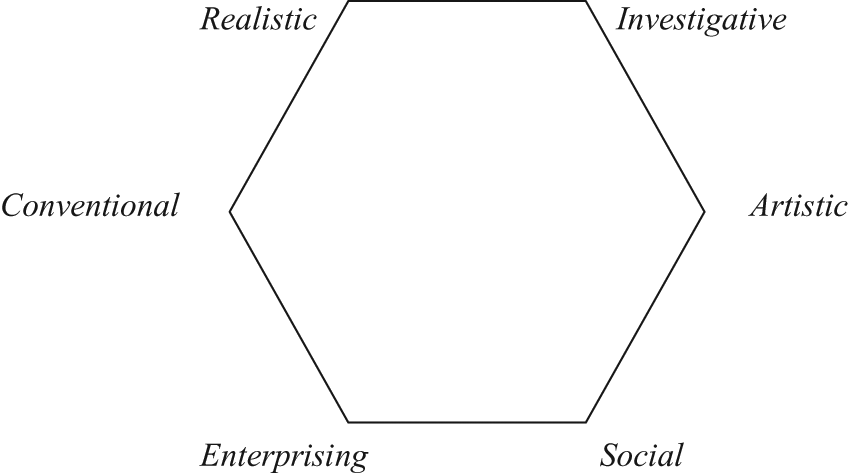
Holland hexagon (Holland, 1997)
In addition to these notions, several elements need to be considered: differentiation, consistency, and congruence. Some people and environments are more clearly defined than others according to Holland (1997). Therefore, a differentiation of about eight points between a person’s first and second highest scale scores on the Self-Directed Search (SDS) inventory when determining a vocational profile (also known as ‘Holland code’) indicates that the person more closely resembles a single personality type (Holland et al., 1994) and is not one who might bear a resemblance to many types. The same can be said for environments.
Consistency speaks to degree of relatedness among the personality types or among the environmental models. To determine the consistency of a person’s interests or environment, one focuses on the two highest scale scores and their relation on the hexagonal model. If a person’s profile domains are found to be adjacent to one another on the hexagonal model, the person’s vocational preference is more predictable and stable. For example, a person with the two highest scale scores of Realistic and Investigative (adjacent) is considered consistent, whereas a person with the two highest scale scores of Realistic and Social (opposite) is least consistent.
The final element, congruence, deals with the match between an individual’s interest and the workplace environment. For example, Social types flourish in social environments because such an environment provides the opportunities and rewards a Social type needs. Incongruence takes place when the personality type works in an environment that provides opportunities and rewards foreign to that type’s preference and abilities. Thus, if a person’s Holland code is highly differentiated, consistent, and congruent with the workplace environment, the more stable the vocational profile. The more stable the profile, the more likely the individual is to experience success vocationally.
Holland theorizes that people search for environments that are compatible with their personality orientations so that they can express their predominant traits, pursue their interests, and receive rewards for their abilities and competencies. In short, career choice represents an attempt to express one’s personality orientation in a workplace environment that embraces the individual’s competencies, abilities, and interests. If disparity exists between the individual’s interests and the workplace, professional instability can lead to abandoning teaching as a career. Gottfredson and Holland (1996) assign a high level of complexity for teaching. That is, the demands placed on teachers to interact among the stakeholders and the environment are challenging.
Holland tested his theory frequently and in a large-scale study of college freshmen’s vocational aspirations, Holland found that a small number of people (n = 134) expressed interest in becoming a FL teacher. Results indicated that these individuals had a Social, Artistic, and Enterprising profile (Holland, 1966), but no further study was conducted to see if these individuals ever entered or remained in the language teaching profession. Testing this finding with in-service educators, the researcher administered the SDS to a sample of FL teachers (n = 80) and reported the same Holland code: Social, Artistic, and Enterprising (Swanson, 2008). Additionally, the researcher correlated the sample’s scores on the SDS to a respected teacher efficacy instrument (Tschannen-Moran & Woolfolk Hoy, 2001). Only the Social, Artistic, and Enterprising domains were directly related to one’s teaching efficacy and longevity in the profession (Swanson, 2008). Such a finding supports Gottfredson’s (2002) notion that what Holland (1997) called ‘self-beliefs’ as measured by the SDS Competencies and Self-Estimates scales correspond to what Bandura called self-efficacy expectations.
b Self-efficacy
Self-efficacy — ‘people’s judgments of their capabilities to organize and execute courses of action required to attain designated types of performances’ (Bandura, 1986, p. 391), is grounded in social cognitive theory (Bandura, 1997), which is based in a view of human agency in which people are agents proactively engaged in their own development and can make things happen by their actions. Among other personal factors, individuals have self-beliefs that enable them to exercise a degree of control over their thoughts, feelings, and actions. That is, ‘what people think, believe, and feel affects how they behave’ (Bandura, 1986, p. 25). Bandura, the leading theorist in the field, suggests that the beliefs that individuals have about themselves are crucial elements in the exercise of control and personal agency. Individuals are viewed both as products and as producers of their own environments and of their social systems. When analysing the operation of human agency in this interactional causal structure, social cognitive theory accords a central role to cognitive, vicarious, self-reflective, and self-regulatory processes.
Bandura finds that among the mechanisms of personal agency, none is more central or pervasive than people’s beliefs about their capabilities to exercise control over events that affect their lives. Self-efficacy beliefs function as an important set of proximal determinants of human motivation, affect, and action (Bandura, 1986). Self-efficacy is different from other conceptions of self, such as self-concept, self-worth, and self-esteem; it is specific to a particular task (Tschannen-Moran et al., 1998). Self-efficacy is a future-oriented belief about the degree of competence an individual expects he or she will exert in a given situation. These beliefs effect a person’s thought patterns and emotions that facilitate courses of action in which people expend substantial effort in the pursuit of goals, continue when confronted with adversity, rebound from temporary setbacks, and exercise some control over events that affect their lives (Bandura, 1997).
Research suggests that a solid sense of self-efficacy is an integral factor in the attainment of further competencies and success. Bandura (1994) finds that people who enter adulthood poorly equipped with skills and plagued by self-doubts might discover many aspects of their adult life stressful and depressing, especially where careers are concerned. Occupationally, brisk changes, such as redefining job descriptions, in the workplace prompt improved problem-solving skills and resilient self-efficacy to cope effectively with new demands. During professional preparatory phases, a person’s perceived self-efficacy can in part determine how well the individual can develop the basic cognitive, self-management and interpersonal skills on which careers are based. Such beliefs concerning one’s capability are influential determinants of the occupational pathways that people select and their success or subsequent lack of success vocationally.
Of the four sources of self-efficacy, mastery experiences are the most effective way to boost self-efficacy (Bandura, 1997). Such experiences build a robust belief in one’s efficacy while failures tend to undermine it. Furthermore, perceptions that one is mastering the task at hand are much more influential in building a greater sense of efficacy than vicarious experiences (modeling), social persuasion, or any physiological response. For educators, their beliefs and abilities interact with their actions and with how they perceive and relate to their environment. Research on teacher self efficacy – one’s beliefs in one’s ability to have a positive effect on student learning (Ashton, 1985) – has shown to be a significant factor that influences teachers’ level of satisfaction (Tschannen-Moran & Woolfolk Hoy, 2001) and their choice to remain in or leave the profession (Glickman & Tamashiro, 1982; Swanson, 2010b). Teacher efficacy is cyclical in nature. That is, a proficient performance creates a new mastery experience, which provides new information that is processed to shape future efficacy beliefs. Greater efficacy leads to greater effort and persistence, which leads to better performance, which in turn leads to greater efficacy. The opposite is also true. Lower efficacy leads to less effort and giving up easily, which leads to poor teaching outcomes, which produce decreased efficacy (Tschannen-Moran et al., 1998).
Teaching has been generally recognized as a stressful occupation (Johnson et al., 2005; Travers & Cooper, 1993), and those who believe that they are inefficacious in coping with their environmental demands tend to become preoccupied with their personal deficiencies and perceive potential difficulties as more daunting than they really are (Meichenbaum, 1993). Such self-perceptions can impair professional performance by diverting attention from how to solve a problem and cause one to worry about failing professionally. Research shows that long-term stress and anxiety unavoidably diminish teachers’ enthusiasm, lower their physical fitness, affect their mental health, and result in professional burnout (Schaufeli et al., 1993; Yong & Yue, 2007). However, those who have a stronger sense of efficacy coping with environmental demands deploy their attention and effort to the demands of the situation and are spurred to greater effort by obstacles (Bandura, 1982).
Research investigating perceived self-efficacy and vocational interests includes gender differences for self-efficacy on Holland scales (Lenox & Subich, 1994), college students’ perceived self-efficacy with respect to occupations representing Holland’s six domains (Lapan et al., 1989), and prediction of college majors by using Holland interest themes and general confidence themes (Betz et al., 1996). However, there is a dearth of research investigating the link between teachers’ vocational interests and self-efficacy perceptions in order to offset the teacher shortage, especially in the area of second language education. The research questions guiding this study are:
What is the interest profile for language teachers?
How do people with the Holland code for a language teacher cope with stress as compared with those who do not have the same Holland code?
How is the Holland personality profile related to one’s longevity in the language teaching profession?
III Rationale for the study
For decades accepted paradigms have viewed stress as a person/environment interaction (McGrath, 1976; Pithers & Soden, 1999), and researchers concerned specifically with job stress consider the lack of person/environment congruence to be important (Borg et al., 1991; Caplan, 1987; Harrison, 1978). Additionally, the researcher believes that the teaching of languages, regardless of purpose (e.g. foreign language, second language), geographical location, and educational context (i.e. rural vs. urban), shares similar tasks, goals, objectives, and challenges. While the extent of the challenges might be considerable, the researcher argues that language teachers face comparable professional situations and, therefore, can be collectively grouped as second/foreign language (S/FL) teachers for the purposes of this study.
IV Methods
Working from the premise that people differ in their ability to cope successfully with complex environmental demands, and that occupational, educational, and other environments differ in the complexity of the demands they make on those who inhabit them, the researcher implemented the use of two distinct research instruments.
1 Instruments
a SDS
Holland designed the Self-Directed Search Form R (Holland, 1994) to help adolescents and adults make career and education choices that are aligned with their interests and abilities. The SDS is a commercial instrument and has been tested in hundreds of published studies that offer support to the notion that people who choose or are employed in certain occupations display the hypothesized personality traits (Holland, 1997). The SDS has been tested since its inception in 1985 with a variety of groups to verify its integrity, especially in terms of gender and ethnic biases. When investigating possible differences between gender and various ethnic groups, the SDS Form R has been found to be consistent with the theoretical predictions (Benninger & Walsh, 1980; Holland et al., 1994). Furthermore, its validity and reliability have been examined and found to be outstanding (for specific information, see Holland et al., 1994).
Form R is composed of the aforementioned six subscales that measure a person’s interests and is easy to take (approximately 10–20 minutes) and score. An individual marks if he/she likes/dislikes certain activities and has or does not have certain competencies. It also includes a self-estimate of different skills. In order to determine a person’s Holland code, an individual totals the number of items for each of the six domains. For example, to find one’s Realistic score, add all of the Realistic items marked ‘Like’ or ‘Yes’ for Activities, Competencies, and Occupations sections as well as the two numbers circled for Realistic in the Self-Estimates section. A person’s Holland code is determined by rank ordering the totals for the six subscales from the highest (50 maximum) to the lowest (0 minimum). Holland (1997) recommends working only with the first three highest-ranked domains for smaller studies because extremely large samples are needed for empirical studies using all six classifications. Additionally, Holland recommends that individuals ‘rearrange the code letters in all possible ways to explore occupations under those three letter codes’ (Holland et al., 1994, p. 268) to enhance the congruency between interests and the workplace environment.
b Coping in stressful situations
Endler and Parker’s (1990) Coping in Stressful Situation (CISS) is a commercial instrument consisting of 48 self-reported items that ask respondents to indicate how much they engage in various coping activities during a stressful situation. Participants answer using a Likert scale ranging from 1 (Not at all) to 5 (Very much). The CISS consists of three 16-item scales assessing task-oriented (Task scale), emotion-oriented (Emotion scale), and avoidance-oriented (Avoidance scale) coping. The Avoidance scale also can be divided into separate Distraction (8 items) and Social (5 items) scales.
Task-oriented coping takes place when an individual who is stressed engages in a task intended to reduce or remove the stressor(s). Such coping can be seen as proactive coping in that it is positivistic, forward-looking or future-oriented and multidimensional. Conversely, emotion-oriented coping occurs when people feeling stressed react emotionally to stressors (e.g. crying, acting sad, or becoming worried). Avoidance-oriented coping takes two distinct forms, distraction and social diversion. Both involve ignoring the stressor and not resolving the problem. Avoidance is categorized as nonproductive coping in that the stressed individual ignores the stressor(s) and does nothing to resolve the causal problem(s). Research suggests that nonproductive coping can be harmful because it leads to dysfunctional life (Mundia, 2010). For more information on the psychometric properties, the construct validity of the two instruments, and the items for each inventory, see Holland et al. (1994) and Endler and Parker (1999).
2 Sample
Of the 410 language teachers in the USA and Canada who agreed via email to take both the SDS and CISS, 323 returned completed surveys. Participants were from 42 states and 11 provinces. The majority of the participants were female (80%) and Caucasian Spanish teachers with government entity approved teaching credentials (e.g. certificates, licenses) (82%). Age ranged from 21 to 68 years of age (M = 44), and the individuals had an average of 17 years teaching languages in public and private schools. Three-quarters reported having studied abroad for an average of 11 months with an equal division between having a bachelor’s degree and a graduate degree (48%). The sample’s demographics accurately represent national teacher demographics for both countries and developed nations globally. Research shows that the majority of public school teachers are Caucasian females with an average age of approximately 42 years holding a graduate degree at least at the master’s level (Coopersmith, 2009; Education in Canada, 2000; Latham et al., 1999; Rampell, 2009).
3 Procedure
Following Institutional Review Board approval, the researcher requested research assistance from various language learning entities (e.g. presidents of language teacher associations, language coordinators, national language learning organizations). The researcher requested that a Call for Research Participation be placed on their listservs. Volunteers received the CISS and SDS along with a demographic sheet. This form asked participants for information regarding, among other things gender, ethnicity, time teaching languages, plans for the next academic year, and open-ended comments. Data collection ended in June 2010. The researcher exported the CISS data into SPSS 17.0 and then entered and aligned each participant’s SDS data manually into the dataset as each participant’s data were returned.
V Results
The researcher first calculated the reliability coefficients for each instrument, and similar coefficients to those reported by the CISS creators (Endler & Parker, 1994) were found for the 48-item instrument (.88) and its subscales: Task (.87), Emotion (.91), Avoidance (.86), Distraction (.86), and Social Diversion (.76). The reliability coefficients for the six subscales of the SDS were also similar to those reported by Holland et al. (1994): Realistic (.91), Investigative (.87), Artistic (.91), Social (.88), Enterprising (.89), and Conventional (.89). Such coefficients are found to be satisfactory for research purposes (Henson, 2001).
To answer the first question regarding the interest profile as determined by the Holland code, the researcher calculated measures of central tendency for each of the six subscales. Table 1 shows that the sample’s Holland code was Social, Artistic, and Enterprising. These results confirm those of previous studies using the SDS, which have consistently classified teachers in the Social domain. Holland posits that Social types perceive themselves as having teaching ability, social skills, and an understanding of others. Further, they use social beliefs and competencies to ‘solve problems at work or in other settings’ (Holland, 1997, p. 25). Also according to theory, the characteristics that define Social individuals’ are similar to those that define Artistic people: imaginative, intuitive, and expressive. And Enterprising individuals’ characteristics are more related to Social types because Enterprising people tend to strive to become influential in public affairs by exhibiting characteristics such as adventuresome assertive, extroverted, and optimistic. The combination of these three types began to define FL teachers’ vocational interests.
Means and standard deviations for sample profile

Next, the stability of the profile was juxtaposed to theory. According to Holland et al. (1994), a differentiation of eight points between the scores on the two highest scales, of a total of 50 points, increases the stability of the interest profile. The almost eight point mean difference (7.93) between the highest and second highest scale score indicated a highly differentiated interest profile. The mean difference between the second (Artistic) and third (Enterprising) domains was slightly more than two points less (2.32). The overall sample’s mean differentiation from highest to lowest scale score of 16.26 points indicated a clearly defined and differentiated personality profile.
Noting the position of the two highest scale scores on the hexagonal model (Figure 1) indicates that the two are adjacent to one another, which suggests the vocational preference is more predictable and stable (Holland, 1997). Using the theoretical knowledge of examining only the highest three scale scores for smaller sample sizes, the sample’s personality profile domains (Social, Artistic, Enterprising) were positioned in an adjacent orientation, indicating that these individuals are more predictable in terms of vocational preference. Therefore, language teachers’ capabilities, knowledge, training, abilities, vocational values, and beliefs are supported in this educational environment. Moreover, this profile is consistent with Holland’s code for a ‘secondary school teacher (subject not specified)’ (Gottfredson & Holland, 1996, p. 201). Last, the personality profile was congruent with the workplace because previous research characterized schools as highly social environments (Holland, 1997). Results from this study confirm those of previous studies using the SDS, which have consistently classified teachers in the Social domain (Holland, 1966; Swanson, 2008).
Next, the researcher examined the data for gender differences. The Holland code for female participants, Social (M = 34.15, SD = 7.75), Artistic (M = 25.28, SD = 10.79), and Enterprising (M = 24.45, SD = 10.75), was a more highly differentiated and stable profile than that of the male participants who had a Social (M = 33.16, SD = 7.25), Realistic (M = 29.64, SD = 12.42), and Artistic (M = 29.01, SD = 10.09) profile. Noting such differences between the genders, an analysis of variance (ANOVA) was conducted to evaluate the relationship between the six subscales for gender differences after having verified that the data met the statistical assumptions necessary to conduct such tests. Only the Realistic subscale showed a significant difference for gender. The ANOVA for the Realistic scale was significant, F(1,317) = 54.74, p < .001, η2 = .41.
Next, the researcher examined the individual participants’ Holland codes. Thirty-six percent of the sample had the S-A-E Holland code. Then, because Holland recommends rearranging the code letters in all possible ways using those three letter codes to help enhance the congruency between interests and the workplace environment (Holland et al., 1994), the researcher inspected the participants’ Holland codes again and found that of the total, 63% of the sample had Holland codes with the S-A-E in various arrangements (i.e. A-S-E, S-E-A, and so forth). As the researcher checked participants’ Holland codes, only three of the participants did not have the Social domain in their top three highest scale scores. Afterward, the researcher looked at the highest two domain scores and found that 89% of the sample had the Social domain as either their first or second highest scale score, suggesting that this group is composed of highly social individuals.
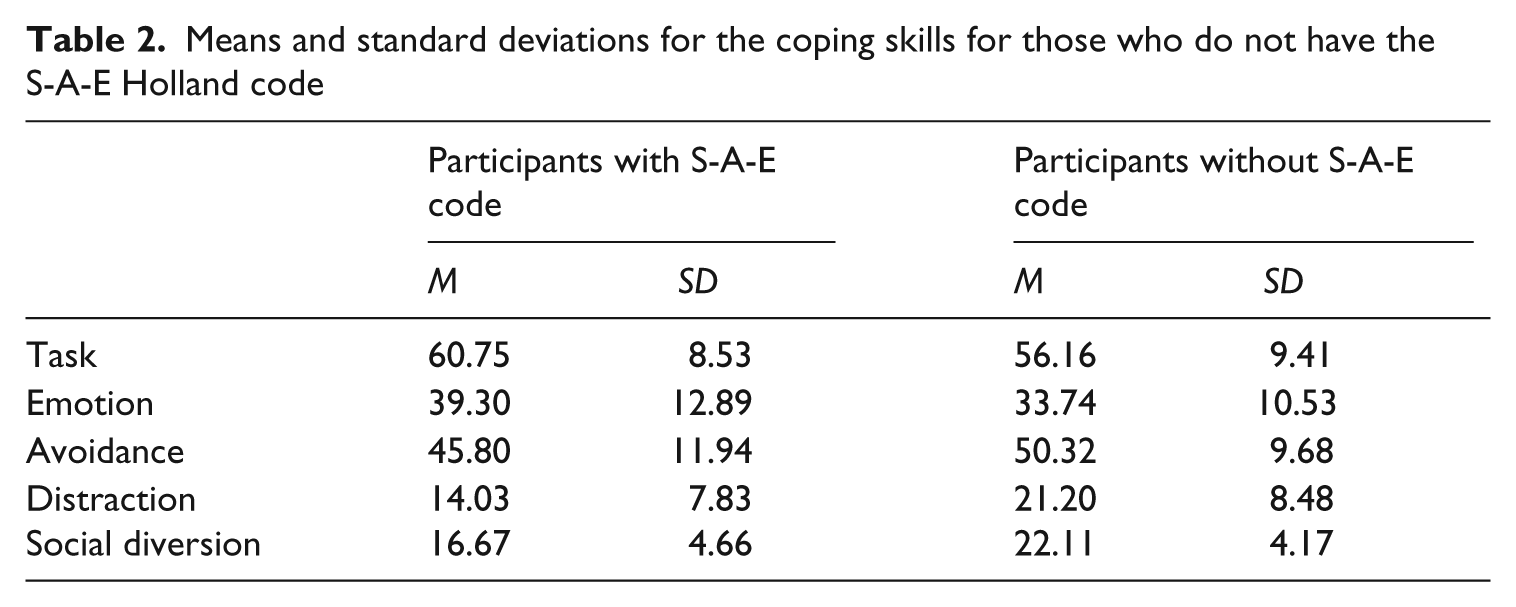
Next, the researcher turned to answering the second research question and compared the coping skills on the CISS for those individuals who have the Holland code for a language teacher (S-A-E) and those who do not. To do so, descriptive statistics were calculated. Table 2 shows that those with the S-A-E Holland code had higher scores for task- and emotion-oriented coping scales than those who did not have the S-A-E profile. Also, those with the S-A-E Holland code had lower scores on the avoidance-oriented coping scale as well as its two subscales, indicating that those with the S-A-E Holland code choose to cope proactively in stressful situations instead of coping by avoiding the problem in various manners.
Means and standard deviations for the coping skills for those who do not have the S-A-E Holland code
Finally, the researcher sought to answer the final research question about the relationship between the S-A-E Holland personality profile and how it is related to language teacher longevity in the teaching profession. Using the number of years the participants reported having taught languages and their professional plans for the next school year (i.e. remain in the profession, retire, or quit), the researcher examined the participants’ Holland codes for those reported to be remaining as a language teacher and for those who declared that they would be leaving the profession.
As categorized as stayers and leavers by the National Center for Education Statistics (2002), the stayers either had the S-A-E Holland code, an iteration of it, or a high Social score in the highest two scale scores. However, the leavers (n = 12) did not. The leavers, constituting 4% of the total sample, were predominately novice Caucasian female educators (n = 8) with less than six years in the profession (n = 11) with high scores in the Realistic (n = 10), Conventional (n = 9), and Investigative (n = 6) domains, indicating an incongruent personality profile compared with the stayers. The majority of the leavers were Spanish and French teachers (n = 10) and several were working under provisional certification (n = 3). While their Holland codes were incongruent with the workplace environment, their profiles lacked differentiation and consistency. The retirees resembled the stayers having the S-A-E Holland code, an iteration of it, or a high Social score in the highest two scale scores.
Upon inspection of the leavers’ final comments on the survey, the researcher noted that these individuals appeared to be struggling as language teachers. A 57-year-old female novice French instructor (Holland code = R-S-A) stated that while ‘I am fairly successful at everything I do. I can’t believe I’m failing at this [teaching].’ Another novice French teacher (Holland code = C-I-R) noted, ‘I need to find a new profession. The administration is not appreciative of the job I do.’ However, one of the stayers, a veteran Spanish teacher with an E-S-C Holland code remarked, ‘I’m not happy with this job but I’ll make it work because it’s good for my family.’
VI Discussion
The overall Holland code established for this sample (Social, Artistic, Enterprising) is consistent with Holland’s code established earlier with a sample of students indicating vocational preference through career aspirations (Holland, 1966) and with a sample of in-service foreign language teachers (Swanson, 2008). Further, the stability of the profile, as posited theoretically, revealed that the sample’s collective profile was highly differentiated. According to theory (Holland, 1997), a differentiation of eight points for the highest two subscales – on a scale from zero to 50 – increases the stability of the interest profile. For this group of educators, the mean differentiation between the first and second subscale was 7.93, indicating a strong differentiated profile. Additionally, total differentiation for the six domains was a mean of 16.26 points, suggesting a strong overall differentiated profile.
Although the means for the second (Artistic) and third (Enterprising) domain subscales were separated by slightly more than two points (2.32), the Social, Artistic, Enterprising classification is considered a reliable Holland code because profile patterns compiled from adjacent points on the hexagon are most consistent (Holland, 1997). Lastly, congruency exists between the workplace and the participants in this study, a central tenet to Holland’s theory (1997). Teachers work in schools, which tend to be clearly defined as social environments (Holland, 1997). Therefore, congruency exists between the personality profile and the workplace, which according to theory increases the likelihood of vocational stability and satisfaction (Holland, 1997).
Holland proposes that ‘people search for environments that will let them exercise their skills and abilities, express their attitudes and values, and take on agreeable problems and roles’ (p. 4). Data from this study indicate that the individuals who choose to remain in the profession (a Social environment) have developed highly social interests, abilities, competencies, whereas those who opt to leave teaching do not. Complementing highly social interests and abilities, it is reasonable to argue that these people remain as language teachers because they tend to feel supported and sufficiently rewarded by the environment. However, the leavers’ vocational personalities were highly Realistic and Conventional as defined by theory, suggesting an incongruent person/environment fit. Holland (1997) characterizes these types as conforming, inflexible, materialistic, dogmatic, and unimaginative and he suggests they should work in an environment that rewards them with goods, money, and power. Perhaps it is equally reasonable to presume that these people tend not to feel supported in schools’ social environment, in particular by administrators for some of the leavers, which is supported in the literature (Metropolitan Life Insurance Company, 2001; Weld, 1998).
In addition to working in an environment that does not support these individuals, part of the discomfort that leads to professional attrition may be related to their sense of efficacy and their ability or inability to cope in stressful situations. The data indicated that the stayers, who had the Holland profile for S/FL teachers, had higher scores on the task- and emotion-oriented coping scales than the leavers, who had higher scores on the avoidance scales. And, Gottfredson states that what Holland (1997) called self-beliefs – as measured by the SDS Competencies and Self-Estimates scales – correspond to what Bandura called self-efficacy expectations. Previous research on language teachers has shown that only the Social, Artistic, and Enterprising domains were directly related to their sense of efficacy and their perseverance in the profession (Swanson, 2008).
Such findings support Gottfredson’s (2002) notion because it is reasonable to presume that the stayers have developed a greater sense of self-efficacy in the profession and the environment in which they work. By having social interests and a Holland code that is congruent with the workplace, the stayers have experienced success early in their careers as S/FL teachers, have undoubtedly been confronted with adversity, have rebounded from temporary setbacks in performance, and believe that they can have some control over events that affect their lives. Conversely, the leavers have not fully developed the coping skills necessary to manage their motivation, emotional states, and thought processes, which leads to a decreased sense of efficacy, which is supported by theory (Bandura, 1997).
Tschannen-Moran et al. (1998) posit that proficient performances create new mastery experiences, which provide new information that is processed to shape future efficacy beliefs. For the stayers, their greater sense of efficacy has led to greater effort and persistence, which has led to better performance, which in turn has led to greater efficacy. Unfortunately, for the leavers, a decreased sense of efficacy may have led to less effort and a tendency to give up easily, which has led to poor teaching outcomes, which produced a decreased sense of efficacy (Tschannen-Moran et al., 1998). Perhaps the lack of person/environment fit triggers long-term stress and anxiety, which have been found to diminish teachers’ enthusiasm and result in professional burnout (Schaufeli et al., 1993; Yong & Yue, 2007).
Therefore, it is vital that teacher preparation faculty strive to co-construct a strong perception of self-efficacy in pre-service educators as early as possible during initial teacher preparatory phases. Of the four sources of self-efficacy, it is important to remember that pre-service educators need not only learn about teaching languages, but they also need to experience success early actually teaching the language (i.e. mastery experiences). S/FL teachers need to be in classrooms early in their preparation, working with students, learning to master the art of language teaching while being faced with real impediments to learning. Massive S/FL teacher induction and community support operations along with increased funding and altered administrative structures need to be implemented. Such changes can help support novice educators by placing them in guarded co-teaching environments with quality veteran S/FL teachers, for which the veterans receive extra pay. By working side-by-side with a veteran teacher, novices can be inducted into the workplace environment and learn to navigate the profession by juxtaposing their interests and coping skills to the workplace and its demands. By doing so, these individuals’ self-efficacy can be enhanced. They will continue to develop the basic cognitive, self-management and interpersonal skills on which careers are based (Bandura, 1994) and be successful in the profession by coping with stress in a positive, healthy manner. Such a combination is important because they may choose to remain in the classroom for years.
The present study has further implications for teacher preparation programs. The SDS could be used efficiently in the initial stages of teacher preparation programs to help counsel pre-service educators about person/environment interaction and foster an understanding of the social nature of schools. Working collaboratively with university careers centers, pre-service educators could take the SDS and receive vocational guidance to steer individuals toward career success. Such a recommendation is not meant to be used as a restrictive measure to limit entry into teacher preparation programs for only those with the S-A-E profile or an iteration of it. Rather it is meant as a means to help individuals find and experience vocational success early and often in their lives.
Additionally, the SDS could be used as a teacher recruitment tool. It was developed to help both adolescents and adults make career and education choices that are aligned with their interests and abilities. Recent research shows that adolescent vocational interests as determined by the SDS surge between ages 15 and 16 (Swanson, 2009). By administering it to secondary students in S/FL language courses, future teachers can be identified and inducted into the profession earlier than ever through collaboration with postsecondary faculty to offer these students opportunities to learn more about the profession.
While this research has highlighted the significance of the person/environment fit, it is not without its limitations. The data were self-reported from a large number of S/FL educators, and while efforts were made to include S/FL teachers from the USA and Canada, it is unclear if some of the participants understood the survey questions as intended. Additionally, self-reported data leaves researchers without a mechanism to determine the accuracy of the respondents’ answers to the surveys. Furthermore, individuals who were not registered as S/FL organizations’ listserv participants may not have had the opportunity to participate. Nevertheless, efforts were made to invite every S/FL teacher who registered to be a listserv member to participate in the study.
However, questions still remain. It would be informative to know more about the specific coping strategies both the leavers and the stayers implement in stressful scenarios (e.g. dealing with unruly students, dialoguing with parents, etc.) while working in schools. Additionally, more information is needed to know how the choice of the three coping styles either helps to build or erodes one’s sense of efficacy as a language teacher. Also, knowing more about the sequence of events that take place as S/FL teachers decide to quit the profession would be beneficial. Finally, do S/FL teachers differ from teachers in other content area specialties in terms of vocational interests, self-efficacy, and coping skills?
Teacher attrition rates are staggering and it is time to confront the issue in a proactive, task-oriented manner. Simply noting an existing problem and not addressing it will neither reduce nor eliminate the shortage many countries are currently experiencing. The researcher calls for more research to help recruit and retain more quality S/FL language instructors who can find professional success and joy in the classroom for years to come.
Footnotes
Acknowledgements
This research would not be possible without the assistance of so many great people associated with superb language learning organizations in the USA and Canada to broadcast the research call to language professionals.