







Abstract
The assessment of second language (L2) pragmatic competence typically involves questionnaires, such as discourse completion tasks. This article describes a novel approach to using questionnaires to assess L2 metapragmatic capacities while simultaneously promoting their development: engaging learners in cooperative interaction as they complete the task. Following dynamic assessment principles, cooperative interaction reveals both fully formed and emerging competencies (i.e. zone of proximal development) while at the same time furthering their continued growth. This study draws on data collected during a concept-based pedagogical enrichment program in which US university students of French were learning the concepts of social distance and power hierarchies as illustrated by the second-person pronouns tu and vous ‘you’. We present a case study of one learner, Nikki, to show how support provided by a tutor around one questionnaire item (i.e. choosing tu or vous in an ambiguous situation) both assessed and promoted her developing conceptual knowledge about the dynamics of interpersonal relationships and how these are indexed through language.
Keywords
I Introduction
Questionnaire-type data elicitation techniques – e.g. discourse completion tasks (DCTs; Blum-Kulka, 1982) – are ubiquitous in second language (L2) pragmatics research as alternatives to collecting naturally occurring data (e.g. natural conversation). Reasons for this are many (Byon, 2006; Ellis, 1994; Lyuh, 1992; Yamashita, 2008). Questionnaire-type tasks such as DCTs enable researchers:
to control for sociosituational factors;
to collect large amounts of data in a short period of time;
to explore normative conventions of language use; and
to investigate the types of pragmatic strategies (reportedly) used by participants, so that:
statistical tests can be used to infer generalizable patterns of language use and development.
However, DCTs and other types of questionnaires have been critiqued for not reflecting actual language use (Golato, 2003; Hartfold & Bardovi-Harlig, 1992; Rintell & Mitchell, 1989; Yamashita, 2008). Responses to open-ended questionnaires can be overly formal and more verbose than naturally occurring data. Multiple-choice questionnaires require participants to select responses from among the available options, which facilitates analysis by standardizing possible responses, but may also lead participants to select responses that they would not have provided otherwise. In addition, participants may provide responses to both open-ended and multiple choice questionnaires in situations where they might in fact normally remain silent or engage in other forms of action in unmonitored settings.
Our goal in the present article is neither to defend nor to critique questionnaire-type data elicitation techniques as they are traditionally conceived; we certainly understand both their advantages and disadvantages for research into L2 pragmatics. What we propose is an alternative approach to administering and interpreting the results of questionnaire-type tasks that – while partially converging with the goals of traditional questionnaire-based pragmatics research (e.g. evaluating learners’ pragmatic competence) – is ultimately concerned with a different set of research and pedagogical objectives; namely, how cooperative appropriateness judgment questionnaires (AJQs) can be used to assess learners’ metapragmatic knowledge while simultaneously promoting their continued growth. Our perspective, grounded in Vygotsky’s sociocultural theory (SCT) of mind (Vygotsky, 1978, 1986; for L2 research, see Lantolf & Thorne, 2006), focuses primarily on the processes involved in the dialogic construction of AJQ responses, and how this type of cooperative interaction introduced during the course of an assessment task can ultimately lead to opportunities for development.
To be sure, we do not wish to suggest that performance during a cooperative AJQ is equivalent to learners’ actions in actual language use. However, the cooperative interactions that unfold during the completion of AJQs are revealing of learners’ orientations to social-interactive contexts and the meanings created by the language forms they choose. This perspective finds support in the general pragmatics literature as well. Golato (2003) notes that we should not dismiss DCTs (and other questionnaire-type instruments) altogether, nor should we privilege one form of data collection over all others. Instead, we must acknowledge what it is that each data collection technique actually reveals.
DCTs are in a crucial sense metapragmatic in that they explicitly require participants not to conversationally interact, but to articulate what they believe would be situationally appropriate responses within possible, yet imaginary, interactional settings … This suggests that the DCT is a valid instrument for measuring not pragmatic action, but symbolic action [italics added]. (p. 92)
Within our sociocultural perspective, and within the actual context of the broader research program of which this study is a part (van Compernolle, 2012, forthcoming), such symbolic action has significance for learners’ orienting basis for material pragmatic action. Metapragmatic awareness, mediated by concepts and developed through cooperation with an expert-mediator, can serve an orienting, or planning, function prior to the execution of pragmatic action in noneducational social-interactive contexts.
II Assessing and promoting metapragmatic knowledge
The present article explores a methodology for assessing and enhancing learners’ metapragmatic awareness of variation in French language use. ‘Metapragmatic awareness’ is defined as knowledge of the social meaning of variable second language forms, how they mark different aspects of social contexts or personal identities, and how they reference broader language ideologies. 1 Metapragmatic awareness is ‘a crucial force behind the meaning-generating capacity of language in use’ (Verschueren, 2002, p. 439). As a case in point, we take learners’ awareness of address forms, or the ‘T/V system’ (tu versus vous in French) (Brown & Gilman, 1960). In European languages, the T/V system is a significant resource for the expression of meanings about relationships between interactants, the context of interactions, and the speakers’ real or desired social identity and standing. The use of these forms is, however, complex and dynamic as well as inherently ambiguous; it presents a case where metapragmatic awareness necessarily intersects with broader understanding of social norms and the presentation of self.
As acknowledged above, the broader pragmatics literature exhibits a clear preference for the study of language performance: what speakers do, and not what they think they do. In her primer on the topic for language teachers, for example, LoCastro (2012) emphasizes the importance of data collection in ‘real world, everyday contexts’ where speakers are ‘unaware of how they are speaking’ and ‘their choices of language are subconscious’ (p. 10). Self-report data may be informative, but only when they are used to establish contrasts between performance and preference.
As researchers began to expand the purview of Interlanguage Pragmatics beyond language use and into language development, interest in awareness grew. Schmidt (1993), for example, assigned a clear role to consciousness in the learning of pragmatics through his ‘noticing hypothesis’ (p. 20). ‘Noticing’ for Schmidt involves attention to linguistic forms, meanings and features of the context, and is necessary for the learning of pragmatics. In the computational model of second language acquisition espoused by Schmidt at the time, however, ‘noticing’ remained independent of ‘understanding’ in which a learner comprehends a ‘general principle, rule, or pattern’ (Schmidt, 1993, p. 20). The concept of ‘noticing’ did however launch efforts to discover what it is that learners do in fact notice. These efforts include a celebrated and oft-replicated study by Bardovi-Harlig and Dörnyei (1998) using videotaped scenarios to determine whether learning and teaching context (ESL versus EFL) influenced the perceived gravity of grammatical as opposed to pragmatic errors. The results demonstrated that EFL students and teachers perceived grammatical errors as more serious than pragmatic gaffes, while the ESL students, who enjoyed more opportunities to notice the pragmatic dimensions of language use, showed the opposite pattern.
As research on the development of second language pragmatics progressed, ‘understanding’ began to take on greater significance in the literature through models distinguishing pragmalinguistic resources from sociopragmatic awareness. Kasper and Rose (2001), for example, described pragmalinguistics as involving resources for conveying communicative acts or relational meanings, such as routines, or forms used to intensify or soften communicative acts. Sociopragmatics, on the other hand, involves the social perceptions underlying the interpretation and performance of communicative action. Recognition of the sociopragmatic dimension of second language performance, which is about ‘proper social behavior’, raised new questions: ‘it is one thing to teach people what functions bits of language serve, but it is entirely different to teach people how to behave “properly”’ (Kasper & Rose, 2001, p. 3).
Similarly, if communication has a sociopragmatic dimension, learners face choices in cases where pragmalinguistic forms may vary. In the evaluation of research based on performance data alone, how can researchers determine which underlying perceptions shaped these choices? If a learner chooses not to behave ‘properly’ ‘spontaneous speech production contains no clues relating to the intentionality behind violations of “appropriate” behavior’ (Dewaele, 2008, p. 246). Moreover, the choices that learners face are closely tied to issues of identity, and, as Kasper and Schmidt have noted, this phenomenon suggests that insight may be gathered through ethnographic or introspective methods: It would be a mistake to view developmental issues in ILP [interlanguage pragmatics] in purely cognitive terms because the strategies for linguistic action are so closely tied to self identity and social identity … This suggests that it may be fruitful to place greater reliance on introspective and ethnographic methods in future studies, especially as these may focus on critical incidents (both psychological and social) … (Kasper & Schmidt, 1996, p. 165)
The value of combining a focus on performance with introspective data is illustrated, for example, in the work of Shardakova (2005) on Americans learning to apologize in Russian. Shardakova gathered performance data using a standard DCT with five groups: native speakers of Russian, and students with advanced and intermediate proficiency with and without a sojourn in Russia. Crucially, in addition to completing the DCT the participants also evaluated the scenarios in terms of the gravity of the offence and social distance and power differentials implied in their description. American students rated offenses involving strangers as most severe, whereas Russians assigned the greatest severity to situations involving power, such as speaking to a hierarchical superior. Shardakova’s findings reveal that advanced proficiency developed in a domestic immersion program may increase learners’ control of pragmalinguistic resources for apologizing. However, only those students who had studied in Russia were able to interpret the situations in the way that Russians typically do, and then choose whether or not to behave in a corresponding manner.
Another impetus for the inclusion of introspective data is the fact that many learners may in fact generally prefer to behave ‘properly’ in academic contexts where research is carried out. That is, they avoid the display of informal variants or colloquial forms even if they know these forms. The Language Awareness Interview (LAI) involving learners of French (Kinginger, 2008; Kinginger & Farrell, 2004) was partially inspired by from the findings of Dewaele and Regan (2001) showing that the use of colloquial language is quite rare in learner discourse. Following the work of Coveney (1998), whose Intuitions Elicitation Test has shown that undergraduate veterans of study abroad in France had developed clear awareness of one sociolinguistic variable (the linguistic constraints on the variable omission of ne), the LAI was designed to investigate aspects of study abroad participants’ sociolinguistic competence that may or may not be elucidated in performance data. The LAI included sections evaluating the learners’ understanding of colloquial words and phrases, their awareness of register in the selection of speech acts for leave-taking, and two sections devoted to the T/V system: a series of hypothetical situations involving choice of tu versus vous, and role plays illustrating formal versus informal situations.
As reported in Kinginger (2008), the LAI was administered as a pre- and post-assessment to a cohort of 23 American students who studied abroad in France for one semester. The findings revealed that these students developed significantly greater ability to identify and contextualize colloquial language use, and that they became better able to appreciate the levels of formality associated with particular speech acts. In addition, the role plays showed a significant shift toward appropriate uses of address forms in formal and informal contexts. Most interesting in the context of the present article, however, are the findings related to address form choice. The imaginary scenarios on the LAI included both relatively straightforward (e.g. greeting a classmate, being interviewed for a babysitting job) and relatively ambiguous situations (e.g. a service encounter involving a person one’s own age). In the most straightforward and formal situation (the job interview) the students demonstrated and maintained absolute unanimity in calling for the use of vous. In the straightforward informal situation (greeting someone met at a party) they developed near-unanimity in suggesting the appropriateness of tu. However, in the most ambiguous situation, involving a service encounter with an age-peer, their certainty about address form choice decreased. This latter finding suggests that the study abroad experience had enhanced the students’ appreciation of the complexity of address forms, a sign of development given the inherent ambiguity of the T/V system: learners and native speakers alike have been compared to acrobats on a ‘sociolinguistic tightrope’ (Dewaele, 2004), and research has demonstrated that the perceived difficulty of the T/V system increases with proficiency (Dewaele & Planchenault, 2006).
In reviewing qualitative data from case studies of individual participants in the same study, Kinginger and Farrell (2004) also suggest that the study abroad experience may allow advanced learners to grasp some aspects of the relationship between address form use and identity. One such learner, Benjamin, had been housed in the home of a baron and baroness, had spent weekends at the family château, and had been invited to nightly dinners involving ‘philosophical conversations’ (p. 35). In the LAI, Benjamin demonstrated his ability to name the conventions associated with address form use in general, but noted that his personal preference would be to flout these conventions in informal situations in order to display politeness through the use of vous. Benjamin’s awareness of his right to choose among sociolinguistic variants was interpreted as signaling a particularly high level of achievement and as representing a little-known aspect of advanced language proficiency.
The current project builds on prior methodologies for the study of sociopragmatic awareness by embedding them within a Vygotskian dialectical approach to assessment and development. Rather than merely examining how students respond to situations of varying ambiguity, here that ambiguity serves as point of departure for expansion of the student’s conceptual knowledge in dialogic interaction with an expert mediator, simultaneously assessing and promoting metapragmatic awareness.
III Theoretical framework
The fundamental concept within SCT is that higher forms of mental activity (e.g. intentional attention, voluntary memory, logical thought and problem-solving) are mediated by culturally constructed artifacts (i.e. mediational means). Culturally constructed artifacts include physical tools (e.g. hammers, calculators, computers), sign systems (e.g. language), concepts, and so forth. The human mind, for Vygotsky (1978), emerges from the unity of biologically specified cognitive abilities and the internalization of culturally constructed mediational means. The integration of mediational means in cognitive activity effectively reorganizes and reshapes biologically endowed cognitive processes into specifically human psychological functions. In short, ‘biology provides the necessary functions and culture empowers humans to intentionally regulate these functions “from the outside” (Vygotsky, 1997, p. 55)’ (Lantolf, 2006, p. 70). This indirect (i.e. mediated) relationship with the world is basic to all higher forms of human action.
In what follows, we sketch out two themes within SCT related to mediation and social interaction that have informed the present study. First, we discuss Vygotsky’s analysis of verbal protocols and their relation to task performance. Second, we describe an interactive approach to assessment based on Vygotsky’s (1978) proposal for a zone of proximal development (ZPD) known as dynamic assessment (DA).
1 From verbal protocols to cooperative dialogue
Vygotsky (1986) attributed great importance to language as a tool that had evolved not only to mediate interpersonal communicative activity but also as an artifact used to regulate psychological functioning. As Lantolf (2003) points out, Vygotsky argued that children first engage in ‘social speech’, but that this speech is eventually internalized to function ‘intrapsychologically’. Thus, in adults, inner (nonvocalized) speech, though derived from social (communicative) speech, serves to mediate internal cognitive activity. However, this inner speech may be reexternalized in the face of a cognitively demanding task as a way of distancing oneself from the activity in progress in order to gain perspective on one’s performance and, in essence, to talk oneself through an especially difficult problem much in the way that an adult may guide a child’s performance through spoken interaction (see Frawley, 1997). This Vygotsky (1986) referred to as ‘private speech’, which, in contrast to social speech, is produced for the self rather than another person.
Private speech produced during assessment tasks can reveal important aspects of thinking processes. However, because private speech is spontaneous and usually only emerges when one encounters problems in performance (Lantolf & Yáñez-Prieto, 2003), thinking processes often can only be inferred through the outcomes of performance. Eliciting on-line think-aloud protocols has therefore emerged as one of the favored qualitative methods for gaining insights into thinking processes not revealed by performance alone (see Bowles, 2010). Although Vygotsky (1997) recognized that elicited verbal protocols provide insights into thinking beyond what is inferable from performance, he argued that they do not simply reflect internal processes but rather impact upon them. 2 This, for Vygotsky, is the dialectical relationship between thinking and speaking (Vygotsky, 1986): internal thought and speech production each dynamically exert an influence on the other in a real-time dialectic. As a result, task performance and think-aloud protocols are integrated into a single, qualitatively different form of activity. In L2 research, Swain and colleagues have documented in great detail how eliciting on-line verbal protocols (or what they refer to as ‘languaging’) leads to development (e.g. Swain, Lapkin, Knouzi, Suzuki, & Brooks, 2009).
The recognition that eliciting think-aloud protocols fundamentally changes the activity in progress led Vygotsky to advocate going beyond eliciting monologic verbal protocols to include interaction with and intervention from the researcher. This follows from Vygotsky’s (1978) genetic law of development, which holds that all higher forms of psychological functioning appear first between people (‘interpsychological functioning’) and only later within the individual (internalization) (see also Wertsch, 1985). Vygotsky reasoned that the most effective way to understand higher-order mental functioning was to study its origins, its ‘genesis’, that is ‘the very process by which higher forms are established’ (1978, p. 64). By involving the researcher as a cooperative interactant to support individuals attempting tasks beyond their current (independent) abilities through hints, prompts, leading questions, feedback, and so on, Vygotsky effectively sought to set in motion the very developmental processes he wished to understand.
The result of such cooperative interaction is the dual evaluation of an individual’s (or group’s) actual developmental level, as evidenced by independent performance, and those abilities that are in the process of formation and are possible only with assistance from an adult or more competent cooperative partner. This is what Vygotsky (1978) referred to as the zone of proximal Development (ZPD). By engaging individuals in their ZPD (i.e. intervening to support them in tasks beyond their independent abilities), it is possible both to observe still-maturing abilities and to promote their continued growth. Approaches to such assessments were later developed under the label dynamic assessment (DA).
2 Dynamic assessment
Vygotsky (1978) argued that assessments that accounted only for independent functioning were limited to a small range of fully formed abilities, which, because they were past-oriented (i.e. aimed at assessing already-completed development), could reveal very little about the future developmental potential of the individual. Assessments of the ZPD, however, were argued to provide insight into individuals’ futures because they aim to uncover a much wider range of abilities in the process of developing. In addition, as mentioned above, evaluations of the ZPD also fundamentally entail promoting the continued development of emerging abilities. In this way, DA articulates with Vygotsky’s argument that the key to understanding higher forms of psychological functions is to observe them in the process of formation rather than describing them only once they have fully matured.
Much of the DA work in general education has focused on special needs populations who perform poorly on traditional measures of intelligence (Haywood & Lidz, 2007). Such work involves helping learners through extracurricular enrichment programs aimed at providing them with extensive mediated learning opportunities not available in traditional school settings. In L2 research, DA has been predominately used as the basis for organizing one-on-one and whole-group interactions with the aim of diagnosing language-related problems and, in turn, promoting L2 development through intervention (Poehner, 2007, 2008). Lantolf and Poehner (2004) identify two basic approaches to L2 DA: ‘interactionist DA’, in which the mediator is free to pursue problems as they arise during a task through dialogic mediation, and ‘interventionist DA’, in which forms of mediation (e.g. hints, prompts) are planned and possibly scripted beforehand. In what follows, we focus our discussion on interactionist DA as this was the approach adopted in the present study.
Because DA is concerned with supporting individuals’ participation in tasks beyond their independent competence (i.e. their ZPD), it integrates both assessment and instruction as a single activity. Poehner and Lantolf (2010) refer to this as Vygotsky’s ‘teaching-assessment dialectic’. In this regard, DA is not simply an assessment that incorporates elements of teaching, but one in which instructional intervention is itself the means by which evaluations of learners’ ZPDs are achieved. Put another way, diagnoses/assessments of learner abilities result from their responsiveness to the amount and quality of mediation (i.e. instructional intervention) provided by the assessor. Individuals requiring very little or implicit forms of mediation are understood to be closer to independent functioning than those requiring frequent, extensive, and more explicit forms of assistance.
Performances resulting from dynamically administered assessments therefore necessarily reflect interpsychological functioning and so cannot be attributed exclusively to the learner, but rather to the cooperative efforts between mediator (assessor) and learner. This, of course, raises the issue of how to establish the validity of evaluations arising from DA interactions. Poehner (2011) notes that because DA intends to reveal the ZPD – which implies cooperative interaction rather than independent competence – validity must be established in terms of the effectiveness of DA interactions in profiling learners’ emerging abilities (ZPD) and promoting their continued development. Recall that assessments of the ZPD entail the amount and quality of mediation required. In addition, they take into account learners’ responsiveness to mediation as well as their verbal reports explaining performance both at the micro (moment-to-moment) and macro (over the course of a task or several tasks) level (see Poehner, 2011). Thus, validity in DA ultimately centers on the degree to which cooperation in the ZPD both reveals emerging abilities and progressively helps learners move toward independent functioning.
IV The study
1 Context of the research
The present article is part of larger research program exploring a Vygotskian approach to L2 instructional pragmatics (van Compernolle, 2012, forthcoming) in which sociopragmatic concepts – meanings – serve as the minimal unit of instruction. Traditional approaches to instructional pragmatics (see Taguchi, 2011) typically center on the teaching of pragmalinguistic forms, and then guiding learners to map those forms onto sociopragmatic conventions. The current study reverses this orientation by introducing sociopragmatic meanings (concepts) first, and then guiding learners to consider how such concepts as self-presentation, social distance, and power play out in actual discourse. In short, forms are taught to illustrate how meanings are created through language. This approach to pedagogy derives from Galperin’s (1989, 1992) model of systemic-theoretical, or concept-based, instruction as it has been recently extended to L2 education (e.g. Negueruela, 2003, 2008).
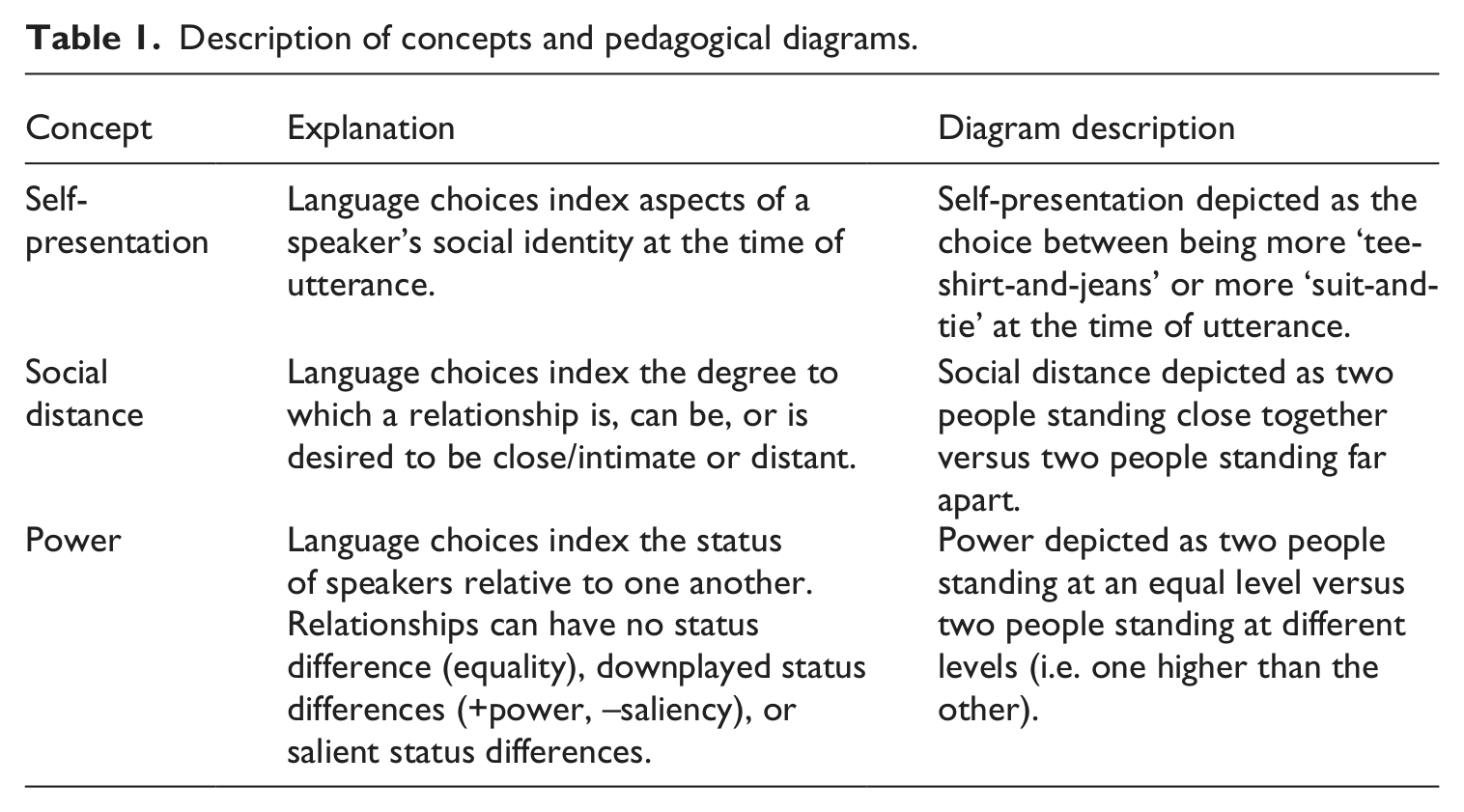
The study involved a six-week pedagogical enrichment program in which eight intermediate-level US university learners of French met weekly with a teacher for one-on-one tutoring sessions. The enrichment program included concept-based pedagogical materials (i.e. written concept explanations and pedagogical diagrams), and verbalization, problem-solving (AJQs; see below) and spoken-interactive tasks. Instruction centered on the concepts of self-presentation, social distance, and power hierarchies. Pedagogical diagrams depicted the concepts and served as tools for learners to use to solve problems and to plan communicative performance. Table 1 includes descriptions of the concepts, and Figures 1 and 2 show the diagrams used for social distance and power.
Description of concepts and pedagogical diagrams.
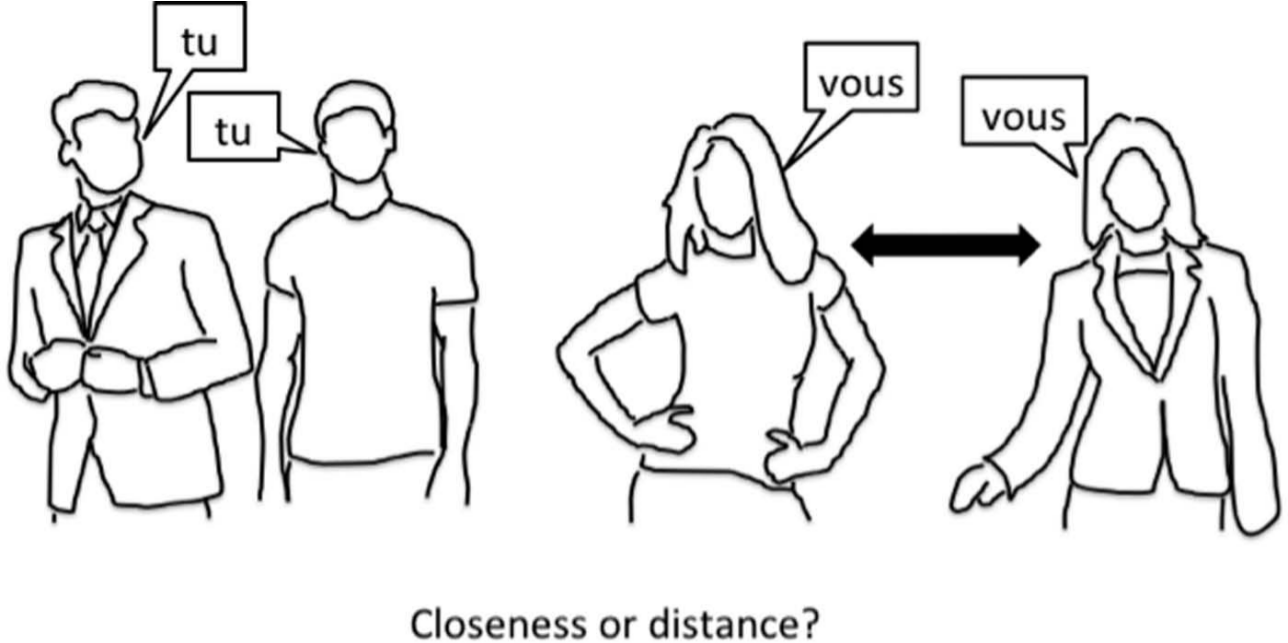
Pedagogical diagram depicting social distance.
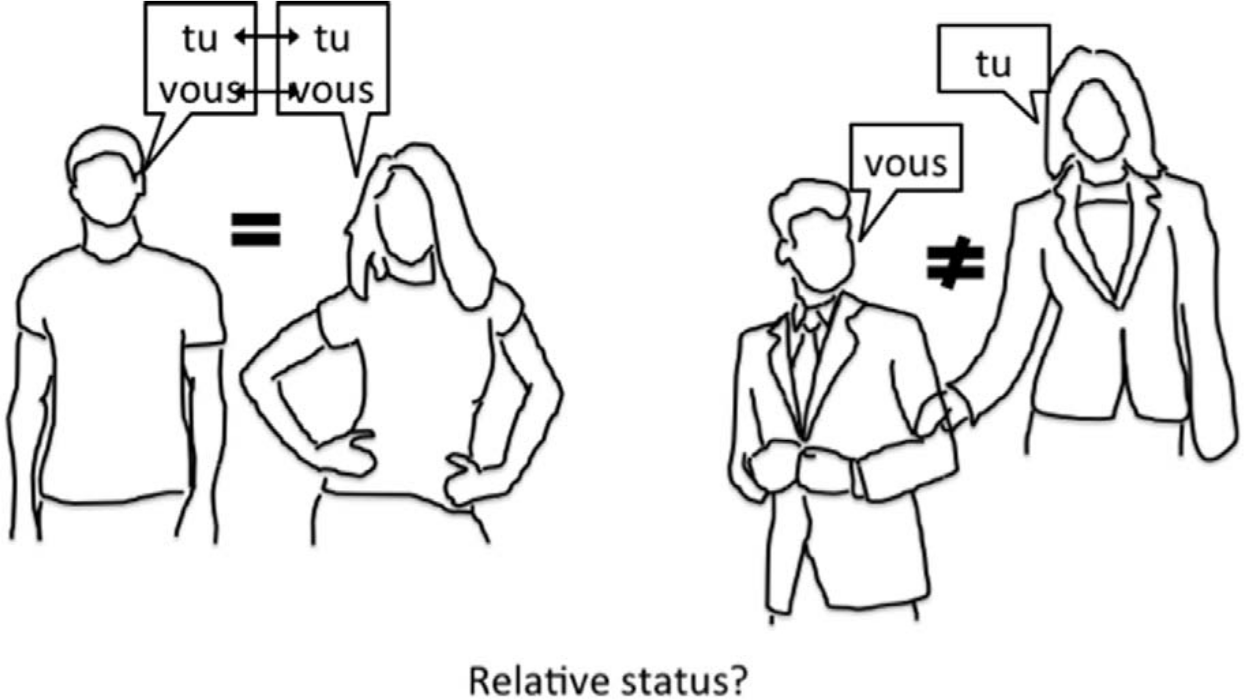
Pedagogical diagram depicting relative status/power.
As noted above, although concepts serve as the basis of instruction, linguistic forms are taught in order to illustrate how the concepts play out in concrete communicative activity. In this article, we focus on the French second-person pronouns tu and vous. These pronouns illustrated the concepts described in Table 1 as follows:
self-presentation: tu = tee-shirt-and-jeans; vous = suit-and-tie
social distance: tu = closeness; vous = distance
power: equal = reciprocal tu; downplayed difference = reciprocal vous; salient difference = asymmetrical tu–vous relationship (i.e. one party calling the other tu and receiving vous in return)
We elaborate on the pragmatics of tu/vous (henceforth, T/V) choice in the following section.
2 Pragmatics of French T/V choice
The French T/V system indexes a broad array of potential social meanings. By ‘potential’, we wish to emphasize the variation in, and inherent ambiguity of, interpreting the act of calling someone T or V. Neither pronoun has fixed or stable meanings. Rather, there is a constellation of meaning potentials that may be variably activated from context to context, from speaker to speaker, from community to community, and so forth. As a simple case in point, even the most seemingly basic meaning of T and V, second-personness, is not fixed: both pronouns are also available for use as third-person indefinite pronouns, as in quand tu vas à Paris, tu manges bien (‘when you go [~one goes] to Paris, you eat [~one eats] well’) (Williams & van Compernolle, 2009). Such is also the case with social meaning potentials, including interpretations of politeness, respect, appropriateness, and so on.
The indexical nature of the French T/V system means that any use of T or V can point to aspects of one’s social identity, qualities of social relationships, contextual factors, and supralocal ideologies at the time of utterance (Morford, 1997; Mühlhäusler & Harré, 1990; Silverstein, 2003). Van Compernolle (2011), drawing on Silverstein’s (2003) concept of the orders of indexicality, outlines three levels, or orders, of T/V indexical meanings (Table 2). First-order indexicalities include conventionalized patterns of use. Second-order indexicalities relate to emergent, socially meaningful associative links between linguistic forms and conventionalized patterns. Third-order indexicalities, in turn, entail associations between second-order indexicalities and some other supralocal ideological schema.
Indexical meaning potentials of T/V choice.
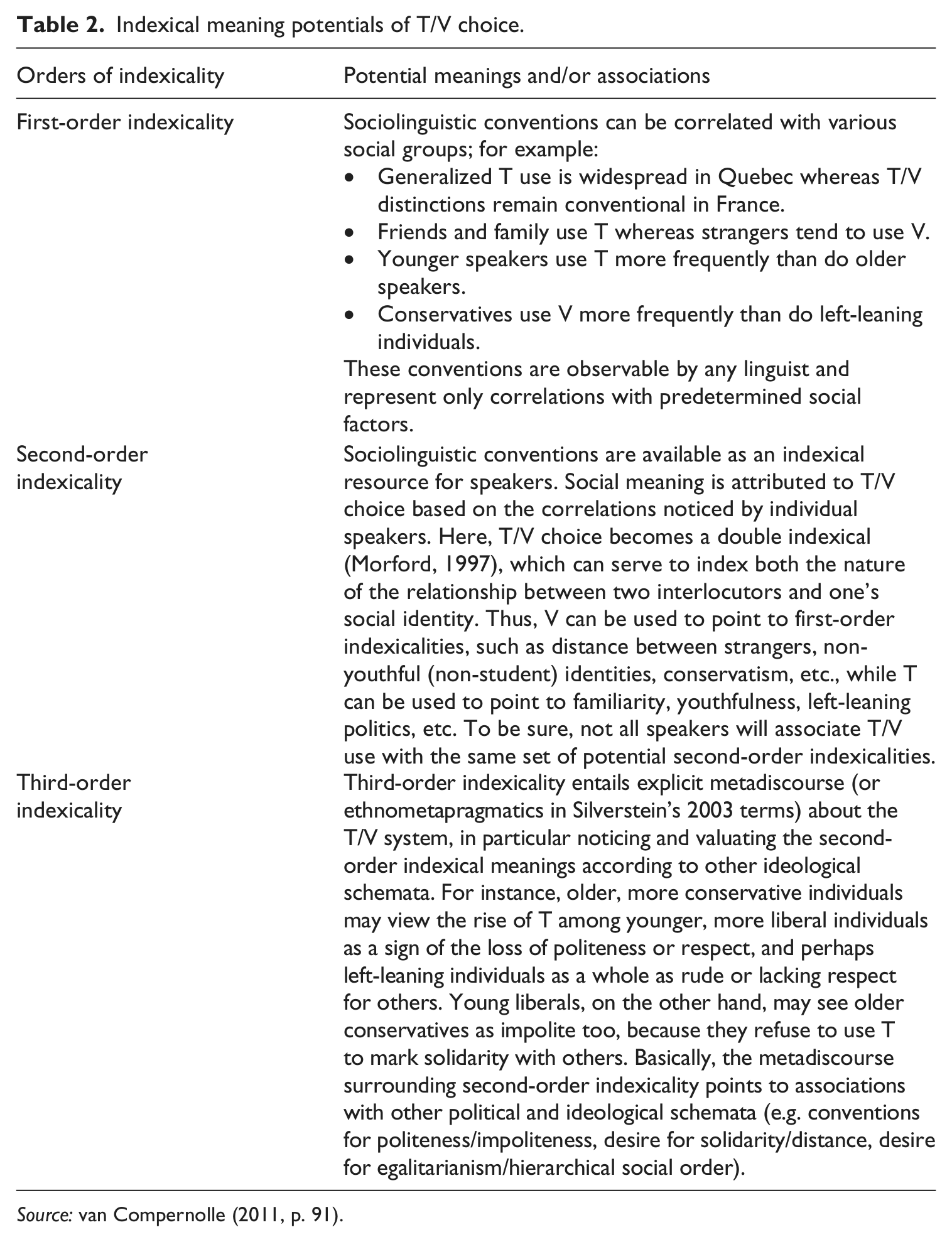
Source: van Compernolle (2011, p. 91).
Learners of French have difficulties disambiguating the indexical meaning potentials of the T/V system (Belz & Kinginger, 2002; Dewaele, 2004; Kinginger, 2008; van Compernolle, 2010). This is due, in large part at least, to the fact that pedagogical materials often present T/V choice as a simplistic informal/formal dichotomy and/or in terms of lists of rules of thumb, such as ‘use T with friends’ and ‘use V with strangers’. While these typical pedagogical treatments of the T/V system certainly reflect some of the first-order indexicalities noted in Table 1, they are not systematic, nor do they provide learners with a meaning-based framework for selecting one or the other of these pronouns (i.e. second- and third-order indexicalities). The concept-based pedagogical enrichment program described above sought to give learners insight into the meaning-based system of French pragmatics in general and in relation to T/V choice in particular. Cooperative AJQs, the focus of the present article, played a crucial role in pushing learners to consider, and reflect upon, potential indexical meanings as they related to the concepts of self-presentation, social distance, and power.
3 Specific use of appropriateness judgment questionnaires (AJQs)
AJQs were designed to unite assessment and instruction as a single, unified activity. Each AJQ included five situations representing a variety of social-interactive contexts (e.g. peer interactions, service encounters, employee–employer interactions) in which learners were asked to select appropriate pragmatic forms (e.g. T or V) and to explain their choices. As noted earlier, DA principles were followed in the administration of AJQs, meaning that learners did not simply verbally report their response processes, but were engaged by the tutor in order to push them to perform beyond their current abilities, thereby setting the stage for further growth. The pedagogical diagrams developed for the study were made available to learners as tools to plan and carry out their actions. In this way, the diagrams were not merely imagistic depictions of the concepts learners were appropriating, but instead they had psychological status as learners responded to AJQ items.
4 Data
In this article, we present a single case analysis of one learner’s, Nikki (a pseudonym), videorecorded interaction with the tutor (~4.5 min) in which she was attempting to choose between T and V for the following AJQ situation: You’re at the grocery store looking for some cheese for a small dinner party you’re having with some friends. Unfortunately, you don’t see the cheese you wanted. You decide to ask the clerk, a young woman in her mid twenties.
The situation is rather ambiguous, especially for learners with little to no experience in service encounters: although the addressee is a near-peer (a factor conventionally favoring T), she is also a stranger and a store clerk (both factors conventionally favoring V). Nikki’s case is illustrative of the function of cooperative AJQs in the study. In addition, it is revealing of the way in which cooperative interaction around AJQ items, focused on using concepts, can push learners to forge their own personally significant meaning–form relationships. The focal item in the present article was the fourth AJQ item (out of five on the questionnaire) presented during the second session of the enrichment program, which immediately followed the introduction of the concept-based materials. 3 The analysis of this single case allows us to provide a detailed account of the process by which Nikki developed during an assessment task within the constraints of a journal article, which would not be feasible if a greater number of learners and/or AJQ items were considered here.
V Data analysis
Our analysis focuses on the microgenesis of a synthetic concept as a tool for Nikki’s thinking; namely, that one can create ‘distant–equal’ relationships through the use of reciprocal vous (i.e. both persons calling each other vous). The cooperative interaction around the AJQ item described above pushed Nikki to consider the various meanings (concepts) that can be indexed through the choice of tu versus vous, and to forge her own personally significant understanding of meaning-form relationships.
1 Confronting sociopragmatic ambiguity and the initial response
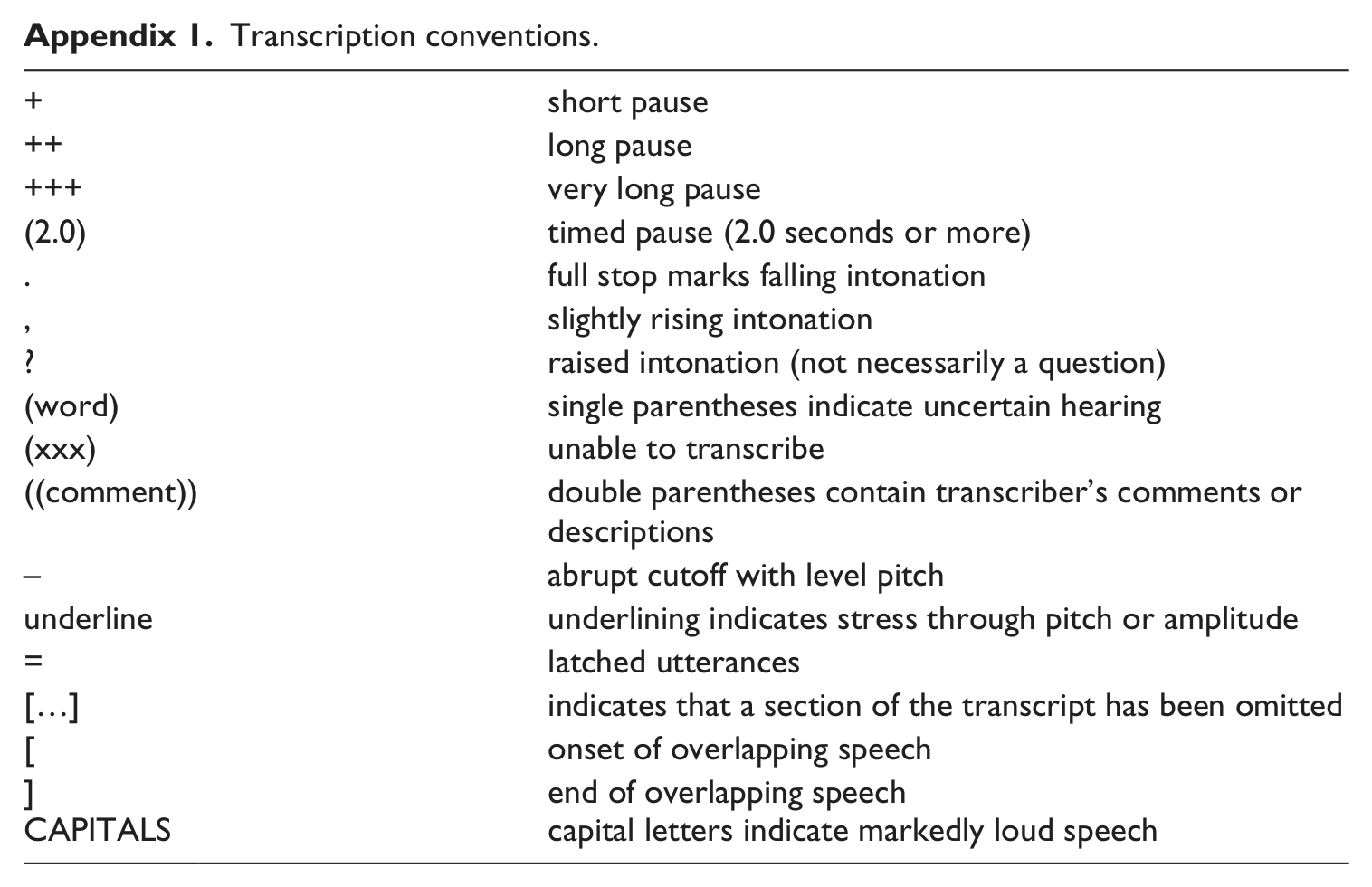
Excerpt 1 displays the opening of the episode (item 4 on the AJQ). As the data show, Nikki had difficulty deciding which pronoun to use because of the ambiguity of the situation and the hypothetical relationship between the sales clerk and herself, as evidenced by the hesitations and long pauses in line 2 following her reading of the situation. (Transcription conventions are provided in Appendix 1.)
Excerpt 1. 1 Tutor: umm okay. the fourth one? 2 Nikki: ((reads situation aloud)) um (3.5) I would? ++ use (4.0) 3 Tutor: hmm. 4 Nikki: ((laughs)) 5 Tutor: what are you thinking.=what’s the- what’s giving you problems. 6 don’t think about the forms now. just think about the situation. 7 Nikki: because it’s- + um + someone + first off. that you don’t know. 8 but, she’s in her mid twenties, so she’s someone, + who’s like. 9 your age, and + she doesn’t necessarily have power over you? 10 like. but. you’re still + you’re asking her for + help. 11 Tutor: mhm, 12 Nikki: I guess. so- 13 Tutor: well, but then also think- remember that it’s not always that 14 other people have power over you. 15 Nikki: ah that you have (it)= 16 Tutor: =ah.= 17 Nikki: =yeah.
The tutor moved to assist Nikki starting in line 5. First, he prompted her to articulate the sources of difficulty (line 5) and, second, he attempted to orient her away from the forms themselves to consider the qualities of the situation (line 6). This is an important aspect of the interaction since the goal of the concept-based instructional program was to assist learners in mapping concepts (i.e. meanings related to identity, social relationships, and social-interactive settings) onto forms. In response, Nikki identified the ambiguity, or conflict, presented in the situation, namely that the sales clerk was ‘someone + first off. that you don’t know’ (line 7) but that at the same time the clerk was a (near) peer and someone who would not have power over her (line 8). Interestingly, Nikki also commented that she was asking the sales clerk for help. This orientation to power likely reflects the fact that in most French textbooks, learners are positioned as having less power than their native speaker interlocutors (van Compernolle, 2010) and, as such, should avoid potentially offending native speakers by defaulting to the vous of respect. The tutor’s contribution in line 13, then, helped Nikki to reconsider the concept of power. His statement ‘it’s not always that other people have power over you.’ (lines 13–14) was completed by Nikki in line 15, where she demonstrated a new understanding that she, too, could have power over someone else.
However, Nikki still had difficulty deciding what she would do in this situation, and, as shown in excerpt 2, she was still unable to articulate a response to the problem (lines 18–23). In line 24, then, the tutor provided assistance, orienting Nikki to the concepts presented in the materials (i.e. self-presentation, social distance, power). In response, Nikki offered her first answer: that she would use tu with the store clerk.
Excerpt 2. 18 Tutor: so think about- what’s the relationship. 19 Nikki: because she’s a grocery store clerk. I’m the- like. obviously ( ) 20 Tutor: you’re the customer. 21 Nikki: yeah. +++ so + 22 Tutor: so think, + this is a tricky one. right, 23 Nikki: yeah. 24 Tutor: so think about all these things. you’ve got tee shirt and jeans, 25 you’ve got closeness or distance, you’ve got power stuff, 26 and there’s no right answer. right? but it’s + you kind of have to 27 figure out. which one is more important. than the other ones. 28 Nikki: alright. + I think I would use ++ tu.
An important aspect of the design of the cooperative AJQs is that tutor–learner interactions were not supposed to end with the provision of a response. Instead, the tutor prompted learners to explain and defend their choices as a means of evaluating their reasoning. In Nikki’s case, her answer – tu – would typically be seen as sociopragmatically inappropriate according to the sociolinguistic conventions of European French. 4 However, as shown in excerpt 3, rather than telling Nikki that her answer was correct/appropriate or incorrect/inappropriate, the tutor pursued an explanation of her performance.
Excerpt 3. 28 Nikki: alright. + I think I would use ++ tu. 29 Tutor: uhhuh, why. 30 Nikki: because um (4.0) ((picks up and flips through diagrams)) 31 um ++ ((looking at diagram 2)) it’s + a tee shirt and jeans, 32 relationship, more than a suit and tie? and it doesn’t- 33 I’m not- + um + like necessarily saying ((turns to diagram 3)) 34 I’m not saying I want a close relationship, with + the store clerk? 35 Tutor: mm. 36 Nikki: but like- + 37 Tutor: but you are. if you’re using tu. 38 Nikki: yeah. 39 Tutor: or you could. at least= 40 Nikki: =yeah.= 41 Tutor: =that’s a possible interpretation.= 42 Nikki: =yeah. + but. + 43 Tutor: what’s another possible interpretation. if you think about 44 this fourth diagram. ((pointing to diagram 4)) 45 Nikki: that I’m showing (that) I have power over her. because ++ 46 (you know.) I’m the customer, and ++ she should + be ++ 47 um + (like) helping me? 48 Tutor: mhm 49 (4.0) 50 Nikki: yeah. so I would use + tu?
As Nikki began to formulate an explanation (line 30), she paused and turned to the pedagogical diagrams provided to her. This is important because her answer – tu – was given without specific reference to the concepts but she consulted them as a means of justifying her conceptual choice. Referencing diagram 2 (line 31), Nikki explained that the situation is more ‘tee-shirt-and-jeans’ (informal self-presentation, tu). Then, as she turned to diagram 3 (social distance), she argued that she was not, however, trying to create a close relationship (lines 33–34). At this point, Nikki was orienting to the concept of self-presentation as the primary meaning she was trying to convey. However, the tutor prompted her to consider that, by using tu, she could also be indexing closeness in the relationship (lines 37–41). Then, pointing to diagram 4 (power hierarchies), he instructed Nikki to think about another possible interpretation of her use of tu (lines 43–44). In response, she recognized that by using tu, she could also be indexing a power hierarchy by initiating an asymmetrical tu/vous relationship (i.e. where she uses tu but receives vous in return, which is depicted in the diagram). Despite this, Nikki did not revise her original choice, once again opting for the use of tu.
2 Microgenetic development
It is important to reiterate that the goal of these interactions was not simply to guide learners to a predetermined ‘right’ answer. Instead, cooperative interaction served to simultaneously assess the quality of learners’ conceptual knowledge and to promote its continued development. Therefore, although Nikki’s choice of tu did not adhere to sociopragmatic conventions, the reason for continuing to pursue an explanation for the choice was not intended to make her change her mind; instead, the goal was to help her to articulate a coherent justification for her choice based on the concepts. Excerpt 4 displays the culmination of the cooperative interaction, which results in the microgenesis of a qualitatively new concept: distant–equal social relationships.
Excerpt 4. 50 Nikki: yeah. so I would use + tu? 51 Tutor: you would use tu? ++ to show, (2.0) 52 Nikki: uhh, ((laughs)) (4.0) uh 53 Tutor: think about this specifically. ((pointing to diagram 4)) 54 (2.0) the 55 (3.5) 56 Nikki: I would use ++ wait. + ugh. + like I 57 want to show that I have 58 I w- + I’d use
59 Tutor: okay, 60 Nikki: cuz +++ I 61 Tutor: mhm, 62 Nikki: cuz I 63 so I’m like 64 Tutor: okay, 65 Nikki: but + and I don’t want to show that I have 66 over the person, but ++ so I wanna (3.5) use ++ 67 I think we should use 68 to show that like ++ it’s an equal relationship. but 69 distance equal? 70 Tutor: =
In line 51, the tutor once again prompted Nikki to explain her choice of tu. He produced a leading incomplete utterance with slightly rising intonation designed to elicit a completing utterance/explanation on the part of Nikki. However, she was still unable to defend her choice (line 52). Again, the tutor pointed to diagram 4 (power), specifically the image depicting two unequal people using tu and vous asymmetrically (lines 53–54). After a long pause and some hesitation (lines 55–56), Nikki explained that she did not want to show that she had power over the store clerk, and this time changed her answer to vous. Importantly, the tutor still did not confirm or disconfirm the appropriateness of this choice, but instead offered a continuer with slightly rising intonation (line 59). In response, Nikki initiated her explanation that she did not want a close relationship, but instead wanted to distance herself from the store clerk (lines 60–63). In addition, she then mentioned that she did not want to demonstrate power over the clerk (lines 65–66). This was crucial to what follows because it provided evidence that Nikki was beginning to operate with two of the conceptual meanings that map onto tu/vous choice: creating social distance (through vous) and downplaying power hierarchies (through symmetrical tu–tu or vous–vous use). In line 67, Nikki decided that she and the clerk should use symmetrical vous (i.e. each calling the other vous), a critical step in recognizing the interactional, interpersonal nature of tu/vous relationships. In turn, she justified her choice in terms of a synthesis of social distance and power, namely the concept of ‘distant–equal’ social relationships (lines 68–69). A symmetrical vous relationship was chosen by Nikki in order to create social distance but also, in her thinking, to downplay her relative power in the customer–employee interaction. This exchange was important for two reasons. First, it clearly demonstrated a coherent, conceptual (i.e. meaning-based) orientation to tu/vous choice rather than one based on unsystematic rules-of-thumb. Second, it provided evidence of the microgenesis of a new and personally significant concept through which Nikki could think.
VI Conclusion
In this article, we have illustrated a particular use of a questionnaire-type task for assessing, and promoting, metapragmatic development. Based on Vygotsky’s concept of zone of proximal development, we have proposed that cooperative interaction – in which the assessor not only observes, but also intervenes in learner response processes – can lead to development within an assessment task. The analysis presented above documented the microgenesis of the concept of distant–equal relationships in Nikki’s thinking. This qualitatively new concept emerged as she attempted to choose between tu and vous on an ambiguous AJQ item in cooperation with the tutor.
Part of the tutor’s responsibility was to re-orient Nikki’s attention to the concepts and how they related to one another as a means of solving the problem. In addition, the tutor mediated Nikki’s performance through relatively implicit means, such as eliciting an explanation of a particular response or asking her to consider the consequences of a choice in relation to a specific concept. In other words, Nikki was simultaneously positioned to contribute maximally to the task and pushed to perform and/or explain her performance beyond her current independent abilities with support from the tutor, which are important dimensions of co-constructing a ZPD. As the analysis has shown, the result was that Nikki herself began to identify the ambiguities and conflicts (i.e. they were not explicitly pointed out by the tutor) and developed her own solution to the problem: the concept of distant–equal relationships.
Nikki’s case illustrates the importance of ambiguous AJQ items in the development of conceptual knowledge in the larger study, as presented elsewhere (van Compernolle, 2012, forthcoming). On the one hand, they served as clear examples of why everyday functional knowledge and/or textbook-style rules of thumb (e.g. ‘use tu with people your own age’) were insufficient, which led the participants to recognize the benefit of the systematic concepts they were appropriating. On the other hand, ambiguity pushed learners to perform beyond their current independent abilities to consider not only the concepts as such but how they interrelated and, by extension, the circumstances in which the demands of one may outweigh the demands of another (e.g. in Nikki’s case, the demands of creating a distant–equal relationship through the use of vous outweighed her desire to present herself as ‘tee-shirt-and-jeans’ through the use of tu). In this way, ambiguous AJQ items were not simply exercises in applying a particular concept to a specific situation, but more importantly they functioned to catalyse the formation of new, personally significant types of conceptual knowledge.
To be sure, we are not proposing the approach illustrated above as the only way to assess and promote metapragmatic development in the ZPD. There are certainly other formats that may articulate better with the purposes and goals of other researchers, educators, and language programs. For instance, computerized dynamic assessment (Poehner & Lantolf, this issue), in which assessment tasks are delivered in an online format with pre-scripted, standardized forms of support, is a promising avenue of research. Although computerized dynamic assessment is less sensitive to individual learners’ ZPDs than the approach illustrated here, it is able to accommodate large numbers of learners in a relatively less labor-intensive way. Ultimately, decisions regarding the format and administration of ZPD-based assessment task must take into account the goals of the assessment and issues related to logistical and time constraints. Future research comparing different approaches to assessing and promoting L2 pragmatic knowledge will certainly provide further insights.
Footnotes
Appendix
Transcription conventions.
| + | short pause |
| ++ | long pause |
| +++ | very long pause |
| (2.0) | timed pause (2.0 seconds or more) |
| . | full stop marks falling intonation |
| , | slightly rising intonation |
| ? | raised intonation (not necessarily a question) |
| (word) | single parentheses indicate uncertain hearing |
| (xxx) | unable to transcribe |
| ((comment)) | double parentheses contain transcriber’s comments or descriptions |
| – | abrupt cutoff with level pitch |
| underline | underlining indicates stress through pitch or amplitude |
| = | latched utterances |
| […] | indicates that a section of the transcript has been omitted |
| [ | onset of overlapping speech |
| ] | end of overlapping speech |
| CAPITALS | capital letters indicate markedly loud speech |
Funding
This research was funded by a Gil Watz Dissertation Grant awarded to Rémi A van Compernolle through the College of Liberal Arts and the Center for Language Acquisition at The Pennsylvania State University.