







Abstract
Imagery training has been shown to improve reading comprehension. Recent research has also shown that the quality of visual mental imagery used is important for reading comprehension. A review of literature shows that there has been relatively little detailed research on the quality of imagery used by learners, especially in the case of students learning English as a foreign language (EFL). This study was designed to examine the influence of image quality on reading comprehension in EFL students, comparing the effects of training in the use of a focused, constrained imagery relative to that of a more standard form of visual mental imagery training. The study also examined the impact of individual differences such as gender, ability to make images, working memory capacity, and motivational beliefs on the training outcome. The findings provide evidence that constrained imagery strategy training helped EFL learners improve reading comprehension. Female participants showed higher comprehension performance than males. Other individual difference variables did not emerge as having a significant impact on change in reading comprehension performance over time.
I Introduction
Visual mental imagery, sometimes referred to as ‘visualizing’ or ‘seeing in the mind’s eye’, has been shown to play a very important role in both learning and memory. The ability to process visual information in the absence of an external visual stimulus has been seen as one of the key elements in cognitive activity (Anderson, 2010). The role of visual mental imagery has understandably attracted the interest of researchers interested in how people comprehend written text and the use of the findings of that research have been of interest for the teaching of reading comprehension. In their review of this research in 2000, the US National Reading Panel reported that mental imagery and keyword strategies were among the strategies for which there was ‘a firm scientific basis for concluding that they improve comprehension in normal readers’ (National Reading Panel, 2000, p. 4–42). Some research has also focused on how visual imagery can influence the reading comprehension behaviour of students studying English as a foreign language (EFL). It is this latter area that is the subject of this article in which there is a particular focus on the quality of the visual imagery that EFL students develop during reading.
Visual imagery involves a form of elaborative processing in which a reader generates additional material that relates to the topic of the text, and such elaborations can improve text comprehension (Murray & Burke, 2003). The role of imagery in cognitive processing was central to the dual coding theory (Paivio, 1986). This theory assumes that knowledge is represented and processed with two independent but interconnected coding systems: The verbal system and the imagery system. The two systems are coordinated and connected by the associative and referential links that function as a vehicle for all processing and memory structures and enable the verbal and nonverbal systems to function either independently or in an integrated way (Sadoski & Paivio, 2007). The dual coding theory provides a detailed account of decoding in dual-coding terms and its relationship to comprehension, forming a strong theoretical basis for research investigating the role of visual mental imagery use in reading comprehension (Sadoski, McTigue, & Paivio, 2012).
Empirical research supporting the dual coding representation position showed that visual mental imagery functioned as an elaborative mediator for helping students in reading comprehension (Johnson-Glenberg, 2000; Joffe, Cain, & Maric, 2007). The study by Sadoski and Willson (2006) implemented large-scale ongoing imagery intervention beyond the laboratory and individual classroom and showed further evidence that the dual coding principles can be applied to teach reading comprehension in effective ways.
Though visual mental imagery training has been shown to facilitate reading comprehension in many studies, other research has shown an inconsistent effect of imagery training on comprehension in some situations (Moore & Kirby, 1988; Oakhill & Patel, 1991; Peters, Levin, McGivern, & Pressley, 1985).
McCallum and Moore (1999) hypothesized that the inconsistency in the pattern of findings related to the effects of imagery training might be associated with a failure to distinguish the types or the qualities of imagery that participants generated while reading. The quality of imagery has been the subject of discussion for some time. Atkinson and Raugh (1975), in one of the early papers concerned with the use of the keyword method for foreign language learning, used imageability ratings to choose suitable keywords that would be likely to set-up effective links between the keyword and the target word. In related research, Beaton, Gruneberg, Hyde, Shufflebottom & Sykes (2005) used memorability ratings of keyword images by an independent panel to identify high quality images, which were associated with superior recall.
In their consideration of the quality of imagery, McCallum and Moore (1999) discussed quality of imagery in terms of images that were constrained or not constrained. In their account, a constrained image was one where the ‘image had to be constrained to the meaning of the text, and fully capture the idea expressed’ (p. 27), a view that could be seen as a refinement of the criteria set out for effective keywords by Atkinson and Raugh (1975). For example, a constrained image for the sentence ‘Plants become food for plant-eating animals such as small crustaceans, and some kinds of beetles’ should include elements of food, plants, an animal such as beetle or crustacean, and elements that indicate the eating or being eaten relationship between these elements (McCallum & Moore, 1999, p. 27). ‘If any elements that defined the constrained image was missing or distorted in such a way as to obscure the meaning, such an image was defined as a nonconstrained image’ (McCallum & Moore, 1999, p. 28). Their examination of their findings suggested that constrained visual mental imagery was consistently associated with increased capacity to abstract the main ideas from a text.
On this basis McCallum and Moore (1999) argued that nonconstrained visual mental imagery might not help comprehension. Their findings raised the question for us of whether it would be possible to train students to constrain their imagery so that it provided a greater benefit for their reading comprehension, and this led to consideration of the nature of the elaborative processes of which imagery forms one type.
1 The precision of elaboration
As noted above, visual mental imagery use in reading involves elaborative processing of the presented text. Even though the idea of distinguishing the quality of visual mental imagery generated during reading was first proposed by McCallum and Moore at the end of the 1990s, the idea of distinguishing the quality of elaboration was discussed much earlier.
In 1978, Stein, Morris and Bransford designed an experiment to argue against Craik and Tulving’s perspective that the ‘degree of elaborateness will increase with sentence complexity’ (Craik & Tulving, 1975, p. 284). The findings of their experiment showed that effective elaboration seemed to depend on the quality rather than quantity of the information expressed (Stein, Morris, & Bransford, 1978). In related research Stein and Bransford (1979) further explored the constraints that determine the effectiveness of participant-generated elaborations and experimenter-provided elaborations on sentence recall. Their results showed that the use of congruous information to elaborate the target information could either facilitate or debilitate recall and concluded that elaborations enhance recall only when they clarified precisely the importance of the target concept in the study context.
Evidence on the importance of the constraining nature or the quality of visual mental imagery was also found by researchers in a series of experiments investigating the role of visual mental imagery in deductive reasoning (Knauff & May, 2006), which is an aspect frequently involved in comprehension processes. The results suggest that mental images containing irrelevant visual details can impede the process of reasoning.
Anderson (2005) proposed that it was the ‘constraining’ nature of an elaboration that was critical in determining its influence on retention. He proposed that the critical factor for a precise elaboration was not who generates the elaborations but whether the elaboration ‘constrains’ the material to be recalled, in the sense that it focused attention on the relationships among the critical elements of the target material (Anderson, 2005, p. 194). In later work Anderson (2010, p. 167) suggested that this process of constraining enabled a learner to more effectively activate their idiosyncratic knowledge associated with a retention target. This line of reasoning about the importance of the quality of elaborations provided a key impetus for the current study on the impact of training in use of constrained imagery elaborations relative to that of a more standard form of visual mental imagery training.
2 Visual mental imagery use in ESL or EFL reading
Compared with the considerable body of research conducted on the use of visual mental imagery among English native speakers, research related to the effect of explicit teaching of the strategy on ESL or EFL reading comprehension has rarely been documented. A search of previous research relating to the topic identified few studies, some of which found that learners experienced similar visual mental imagery and affect while reading in either their first language or in their second or foreign language (Krasny & Sadoski, 2008; Steffensen, Goetz, & Cheng, 1999). Although the research base is very small, these studies of learners reading in a non-native language suggest that an effective visual mental imagery strategy for readers reading in their first language may also be an effective strategy for readers reading in their second or foreign language.
Evidence from Padron and Waxman’s study (1988) showed that ‘imagining or picturing the story in your mind’ was one of the most frequently cited reading strategies by young ESL learners and was positively related to reading achievement. There is also evidence that skilled EFL readers differ from their less-skilled counterparts in that they use more strategies of various categories (Gan, Humphreys, & Hamp-Lyons, 2004; Tsai, Ernst, & Talley, 2010), and that reading strategies can be taught to learners learning a second or foreign language and teaching them enhances comprehension (Macaro & Erler, 2008; Zhang, 2008).
Given the important role that reading strategies play in second or foreign language reading, it is predicted that the instruction of an effective visual mental imagery strategy that focuses on high quality imagery would benefit the reading comprehension of learners of a second or foreign language.
3 Individual differences in visual mental imagery
A number of studies have suggested that people differ in their abilities in using visual mental imagery (Kaufman, 2007; Richardson, 1994). However, this difference has been typically represented as a general and undifferentiated skill in most available research investigating visual mental imagery use in reading. In 1984, Kosslyn et al. proposed a computational theory of visual mental imagery representation that suggested that visual mental imagery ability is not an undifferentiated general skill, but rather is an ability that is composed of relatively distinct sub-abilities involving image generation, image inspection, image transformation, and image maintenance (Kosslyn, Brunn, Cave, & Wallach, 1984). Their model explains individual differences in visual mental imagery ability in terms of differences in performing these component sub-abilities.
a Ability to make images
This theoretical advance in modelling individual difference in visual mental imagery has been taken into account by researchers in developing research instruments. One of these has been the Ability to Make Images questionnaire (AMI) (Wyra, Lawson, & Hungi, 2007). Compared with Marks’ Vividness of Visual Imagery Questionnaire (VVIQ) (1973), which is not created on the basis of a theoretical analysis of imagery ability and places vividness of imagery in a dominant position of influence, AMI is more directly influenced by Kosslyn’s analysis and assesses imagery ability as a set of subskills.
The AMI questionnaire contains three sections: The first section consists of two items measuring quality of visual mental imagery; the second section consists of five items measuring frequency of visual mental imagery, and the last section consists of three items measuring individuals’ perceptions of themselves as imagers. Wyra et al. (2007) showed a stronger relationship between scores on AMI and word–meaning recall performance than for scores on VVIQ and such recall.
These findings suggest that there is a good basis in theory and in practice for predicting that, in addition to the quality of imagery, the frequency of imagery use and individuals’ perceptions of themselves as imagers are important aspects of people’s imagery ability and therefore should also be sources of influence for imagery use in reading. Thus, the AMI questionnaire that takes these aspects into consideration was used in this study to assess individual differences in ability to make images.
b Working memory capacity
The image maintenance system in Kosslyn’s neurologically plausible model and the work of Baddeley (2007), Andrade (2001), and Baddeley and Andrade (2000) also point to the role of working memory in imagery processes.
Individual differences in working memory have been found to affect the experience of vividness of visual mental imagery (Baddeley & Andrade, 2000). Studies designed on the basis of the multi-component model of working memory (Baddeley, 2007) investigating binding of information in visual working memory and those in the field of neuroscience both showed evidence that the general attentional system is also important to the inhibition of superfluous information irrelevant to the task so as to maintain visual binding from distraction. This suggests that information represented in working memory would be affected not only by the ability to keep information active but also by preventing irrelevant and competing information from interfering with active memory (Ueno, Mate, Allen, Hitch, & Baddeley, 2011). This implies that the effect of the constraining processes referred to earlier may also be associated with working memory capacity (Vogel, McCollough, & Machizawa, 2005).
Given its impact on the perceived quality of visual mental imagery and its relation with comprehension (Conway & Engle, 1994), individual differences in working memory capacity need to be taken into account as a source of influence in the current study that investigates the effect of visual mental imagery use in reading.
c Motivation
Research has shown that reading motivation is particularly predictive of reading competence (Baker & Wigfield, 1999; Wang & Guthrie, 2004) and may contribute to greater cognitive engagement in using cognitive and metacognitive strategies (Anmarkrud & Bråten, 2009; Cox & Guthrie, 2001). This suggests that the motivational state should be considered in studies investigating the use of cognitive and metacognitive strategies. The goal of the present study was to investigate the effective use of visual mental imagery strategy in reading. Hence, the effect of participants’ pretraining motivational beliefs in predicting the training outcome was considered.
II The present study
The literature review suggests that theoretical discussions on the role of visual mental imagery use in reading have prompted extensive studies investigating the application of visual mental imagery strategy in reading. A key issue that has emerged more recently has been the quality of the imagery generated by learners. This raises the issue of whether EFL learners can be encouraged to develop constrained, high quality, imagery that will be associated with improved reading comprehension. There have also been theoretical developments in modelling individual differences in visual mental imagery ability. A review of literature in this domain suggests that individual differences such as ability to make images, working memory capacity, and motivational beliefs may become important influences on reading comprehension performance in relation to the visual mental imagery training. Therefore, the purpose of the present study was to investigate the effect of visual mental imagery training on EFL reading comprehension performance and to further assess the relative impact of individual differences on the training outcome. Accordingly the following research questions were addressed:
What is the effect of constrained visual mental imagery training relative to that of a more standard form of visual mental imagery training on the reading comprehension performance of Chinese EFL Learners?
Is any effect of strategy training on the reading comprehension performance influenced by gender, ability to make images, working memory capacity, and motivational beliefs?
III Method
1 Participants and procedure
A sample of 98 second-year college English-major students from a university in Qingdao, China was selected to participate in the study. They came from across the nation and had backgrounds that were typical of the variety of the EFL population in Chinese universities. Of the 98 participants, 15 were males and 83 were females. Three males and two females dropped out during the experiment. As a result, data used in this study came from 93 participants.
For test calibration purposes all reading comprehension measurements used in this study were completed by a separate sample of 210 second-year college English-major students gathered from three similar universities, including the one from which the main sample was drawn. This exercise was carried out to evaluate the equivalency of the instruments used on all pretraining and posttraining test occasions.
The participants were randomly allocated to one of three groups: a control group, a nonconstrained imagery group and a constrained imagery group. The control group participants received a training session organized as a regular EFL class for which the focus was reading comprehension. The nonconstrained imagery group participants received a training session in which they were explicitly taught to use visual mental imagery as a reading strategy, using instructions that followed a commonly used imagery strategy training format. The constrained imagery group participants received a training session in which they were taught to use visual mental imagery with additional guidance to form constrained images to facilitate reading comprehension. 1 During the training, the constrained imagery group participants were, first, given the definition of a visual mental imagery. Then the concept of a constrained imagery (Knauff & May, 2006; McCallum & Moore, 1999) was presented and examples on using the constrained imagery strategy were given to them. After that, the participants did exercises on using the strategy. Finally, the experimenter discussed with the participants about the quality of the images they made.
The training session for all groups lasted for about one hour. This duration of the strategy training was similar to that used in other imagery training studies (e.g. McDaniel, Pressley, & Dunay, 1987; Wang & Thomas, 1995; Wyra et al., 2007).
The study was completed over a four-week period. In Week 1, the researcher met with potential participants and the recruited volunteers signed ethics consent forms. Later, on another occasion in that week, all participants were assembled to complete the Motivated Strategies for Learning Questionnaire (MSLQ; Pintrich, Smith, Garcia, & Mckeachie, 1993). After that, the nonconstrained imagery and the constrained imagery group participants were instructed to complete the AMI questionnaire (Ability to Make Images questionnaire). The control group participants were not included in this activity to avoid the threat that some participants in this group might be induced by the AMI questionnaire to use a visual mental imagery strategy during the study.
In Week 2, control group participants undertook the three-day experiment. On Day 1, they took a working memory test and the pretraining reading comprehension test (Pretraining Test). On Day 3, they attended a one-hour ‘training’ session in which they received traditional text-based methods of instruction on the basis of reading and completing workbook activities. After that, participants did the posttraining reading comprehension Test 1 (Posttraining Test 1). On Day 5, participants did the posttraining reading comprehension Test 2 (Posttraining Test 2). They then completed the AMI questionnaire.
In Week 3, the measurement instruments and training session were conducted for the nonconstrained imagery group following the same procedure as for the control group, except for scheduling of the AMI questionnaire. Prior to the posttraining reading comprehension tests, the nonconstrained imagery group participants were briefly reminded to use the imagery strategy. These reminders were given to increase the likelihood that the reading comprehension processing of these participants would involve use of visual mental imagery.
In Week 4, the measurement instruments and training session were conducted for the constrained imagery group participants following the same procedure as for the nonconstrained imagery group. Experimental activities for the constrained imagery group participants and the nonconstrained imagery group participants differed only in the nature of the visual mental imagery strategy training.
The sequential and staggered arrangement of training and data collection for the three groups was designed to minimize possible contamination of the treatment among participants from the different groups.
2 Instruments
a The ability to make images questionnaire
The Ability to Make Images (AMI) questionnaire, described above, was used to measure self-rated ability to make images. Reliability analysis showed that AMI has a Cronbach’s alpha value of .89 and all items showed high item-total correlations (Wyra et al., 2007).
b The motivated strategies for learning questionnaire
The Motivated Strategies for Learning Questionnaire (MSLQ), based on a general social-cognitive view of motivation and learning strategies, is a self-report, Likert-scaled instrument designed to assess students’ motivational orientation and their use of learning strategies for a college course (Garcia & Pintrich, 1996). The motivation scales consist of 31 items, which are of particular interest in the present study, are based on a model of motivation that features three general motivational constructs: expectancy, value and affect. Scale reliabilities for MSLQ were robust: Confirmatory factor analyses indicated good factor structure (Pintrich et al., 1993).
Because the AMI and the MSLQ questionnaire were originally designed for participants of English-speaking background, principal components analysis was used to confirm that the conceptualization of the original constructs in the instruments was also appropriate for this particular group of participants and that the constructs measured what they purported to measure (Fraenkel & Wallen, 2000). Principal components analysis of data from the MSLQ questionnaire and the AMI questionnaire resulted in one-factor solutions for both instruments representing pretraining self-efficacy motivation information and participants’ self-rated ability to make images. The factor scores for both instruments were used in subsequent statistical analyses.
c The working memory test
The line drawings probe times task (Kosslyn, Van Kleeck, & Kirby, 1990) was chosen for this study to measure working memory capacity for three main reasons. First, this task involves working memory resources (Andrade, 2001) and reflects the theoretical advance in modelling individual differences in visual mental imagery. Second, the task involves the formation and the use of visual mental imagery while reading, which is not a feature of all measures of working memory. Finally the task had been used in visual imagery research by Kosslyn’s group.
Participants were asked to hold information in memory without using any external assistance. They were first asked to remember a sequence of compass directions shown on a computer screen (e.g. North, North-west, West …) and construct an image of the pathway for the sequence by connecting 3 cm line segments end-to-end. The original working memory task used by Kosslyn et al. (1990) recorded participants’ decisions and the time to decide whether the end point is above the starting point. More accurate decisions along with faster response time were taken as indicating better performance. In the current study, a modified version of the working memory task was used. After participants made the decision about the end point of the sequence, they were asked to provide a drawing of the pathway for each of the 20 sequences in the task.
The arrangement of the two tasks was to avoid the possibility that guessing might mask participants’ real working memory performance if they were just required to make a speeded judgement. The Partial-Credit Unit scoring system (PCU) that expresses the mean proportion of elements that are recalled correctly in working memory tasks was used to score the participants’ drawings (Conway, Kane, Bunting, et al., 2005).
d The comprehension texts
Nine passages were chosen from the Massachusetts Comprehensive Assessment System (MCAS) English Language Arts test. Three test items followed each passage. The nine passages and related items were organized into three tests for the Pretraining Test, Posttraining Test 1, and Posttraining Test 2. Each test consisted of three passages and nine test items: Each passage was followed by its related three test items of different difficulty level.
The three tests were first administered to the calibration sample to evaluate the equivalency of these tests. Test equivalency was established based on information about test reliability (Cronbach’s alpha), Standard Deviations, Standard Error of Measurement (SEM), high and low scores, and based on the results of comparison of means using the nonparametric Friedman Test (Bolli, Pelliccia, & Hardcastle, 2007). Statistics showed that the three tests used in this study on pretraining and posttraining occasions were of the same difficulty level.
3 The hierarchical linear model
The data used in this study have a two-level structure, with the three observations of individuals’ reading comprehension being nested within individuals, while other characteristics, such as gender and ability to make images, are between-individual characteristics. Because of this structure, hierarchical linear modelling (Bryk & Raudenbush, 1992) was used to analyse the influence of time, visual mental imagery training and individual difference variables including gender, working memory capacity, ability to make images, and pretraining self-efficacy motivation on participants’ reading comprehension performance.
The conceptual two-level model of reading comprehension performance representing change over time as influenced by visual mental imagery training and individual difference variables is illustrated in Figure 1. The model illustrates that Level 2 individual difference variables including treatment, gender, ability to make images, working memory and pretraining self-efficacy may either directly influence Level 1 reading comprehension performance, or may influence reading comprehension performance by interacting with the Level 1 TIME variable.
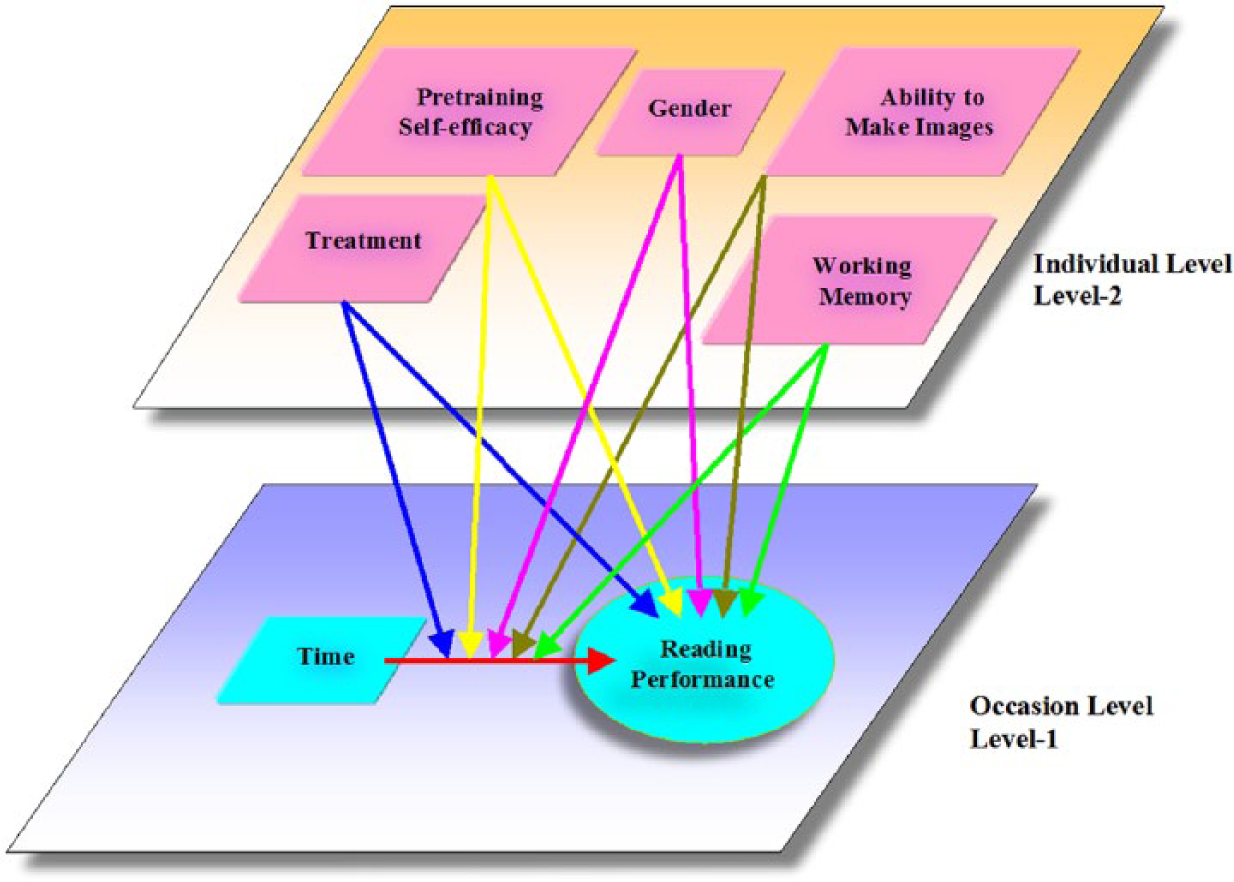
The conceptual two-level model.
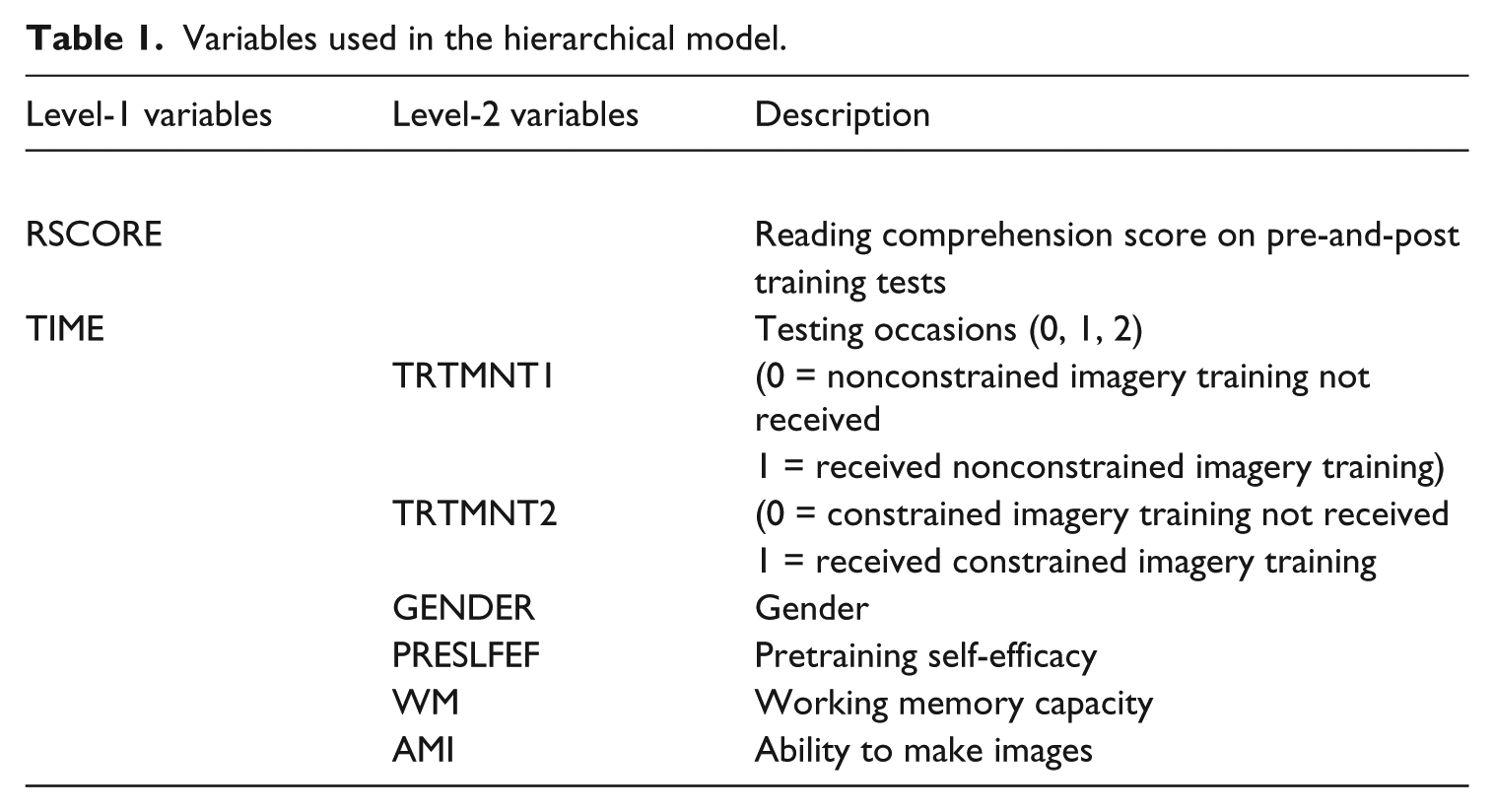
The Level 1 variable TIME representing testing occasion took on the three values of 0 (Pretraining Test), 1 (Posttraining Test 1), and 2 (Posttraining Test 2). The treatment condition (control, nonconstrained and constrained imagery training) was dummy coded into two variables TRTMNT1 representing nonconstrained imagery training and TRTMNT2 representing constrained imagery training to indicate the estimated impact of the nonconstrained and the constrained imagery training. Therefore, the control condition was coded with a 0 on both TRTMNT1 and TRTMNT2, making this a reference category in the model. Variables modelled at each level are shown in Table 1.
Variables used in the hierarchical model.
In this study, the predictors were entered based on a combined consideration of both the background theory and the guide offered by the HLM program’s exploratory analysis. The final two-level model reported below was achieved through a four-stage model building process beginning with the null model.
The null model indicated that the percentage of variance that was available to be explained at Level 1 was 0.516, indicating that approximately 52% of the variance in reading comprehension performance could be attributed to occasion level differences, that is, an effect of time. Consequently, the proportion of variance that was available to be explained at Level 2 was 0.484. Hence, the remaining 48% of the variance could be attributed to student level differences. The deviance estimate of the null model was 1741.95750. Since
In a penultimate two-level model, testing occasion (TIME) was modelled as the Level 1 predictor. Gender (GENDER) was modelled as a predictor of the intercept. Treatment conditions (TRTMNT1 and TRTMNT2), ability to make images (AMI), working memory capacity (WM), and pretraining self-efficacy (PRESLFEF) were modelled as predictors of the slope with respect to time. The treatment conditions (TRTMNT1 and TRTMNT2) were identified as significant predictors of the slope of the occasion variable. None of the other individual level variables emerged as significant predictors of the time slope for the participants’ reading comprehension performance and they were removed leaving the final model that is summarized in Equation 1.
Level 1 model:



In this parsimonious model, at Level 2, the Level 1 intercept was predicted by GENDER, with a random error term (
IV Results
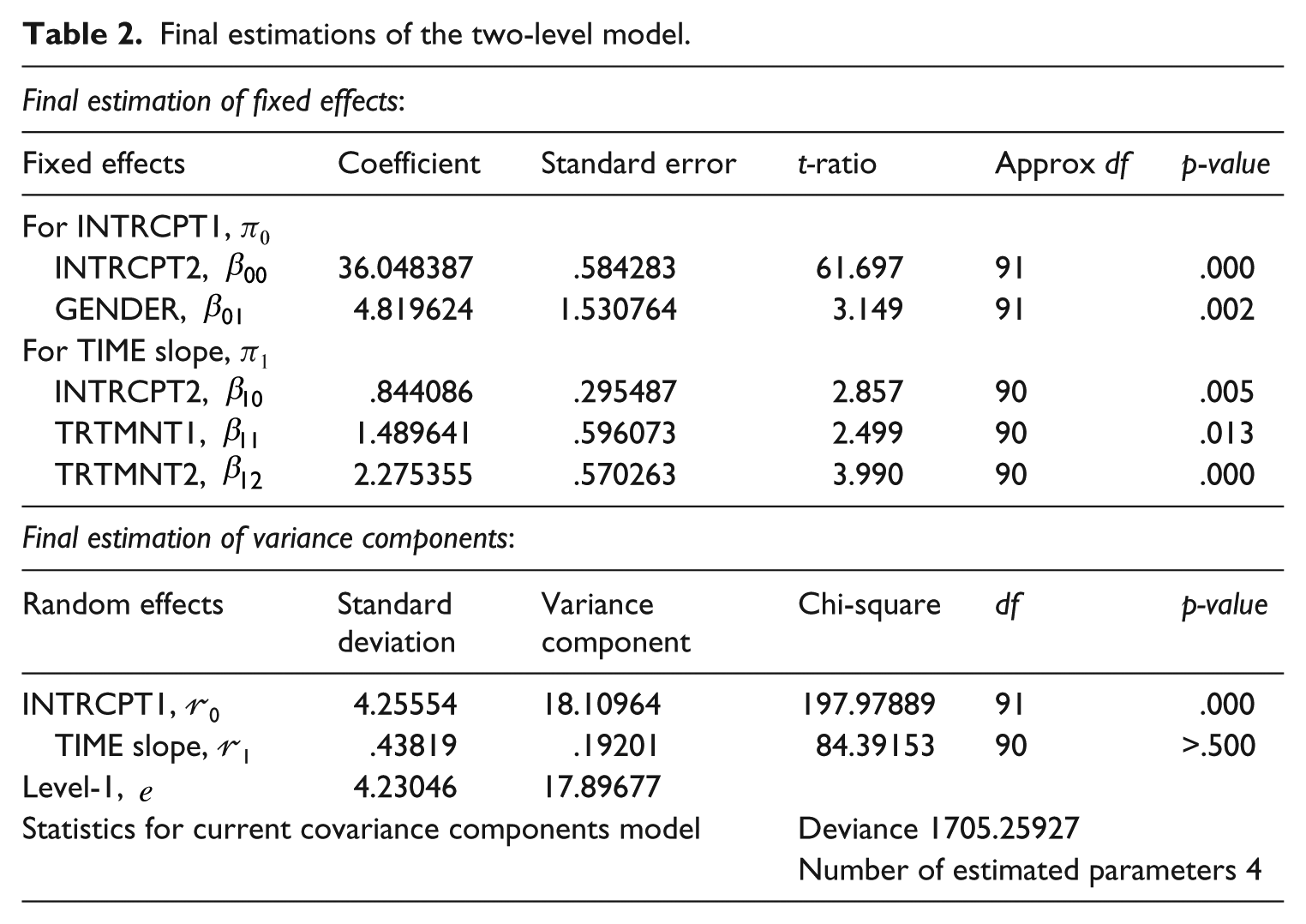
The results of the final two-level model are shown in Table 2.
Final estimations of the two-level model.
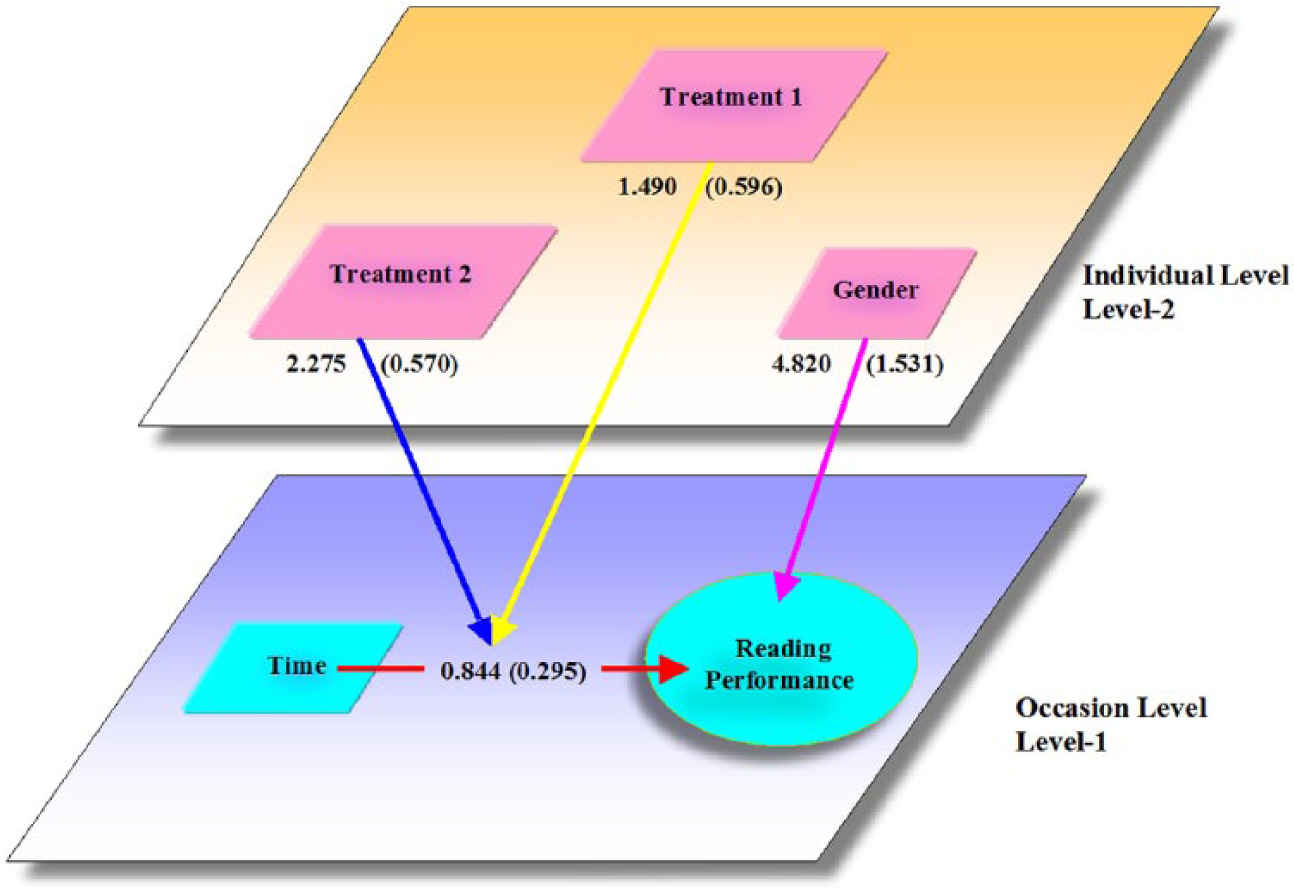
A diagrammatic representation of the final two-level model showing the estimated regression coefficients and standard error associated with each significant effect is shown in Figure 2. Summarizing the effects in the above results, the multilevel equation (Equation 2) for the final model is obtained by substituting the Level 2 expressions into the Level 1 expressions in Equation 1. This representation of the model shows the cross-level interaction effects (treatment by time) more clearly than Equation 1 does.
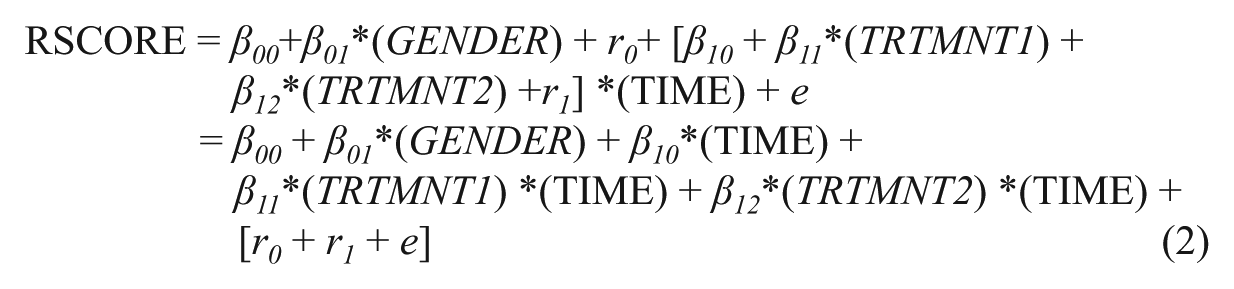
The final two-level model.
The final multilevel model showed that participants’ reading comprehension performance was a function of TIME and GENDER and of two cross-level interaction effects, the interactions between time and the two treatment conditions. At the occasion level, TIME (testing occasion) was the only predictor modelled and was found to influence reading comprehension directly.
At the occasion level (Level 1), the regression coefficient for TIME on reading comprehension was positive and statistically significant (b = .844, p = .005) (see Table 2). That is, at each successive occasion, the reading comprehension increased on average by
GENDER was the only variable at the between-individual level (Level 2) of the model that had a significant direct effect on reading comprehension performance. Other individual variables, including WM, AMI, and PRESLFEF that are identified in the literature as being important, and showed large
The regression coefficient relating GENDER to reading comprehension performance was positive and statistically significant (b = 4.820, p = .002) (see Table 2). Since males were coded as ‘GENDER = 1’ and females as ‘GENDER = 2’, the regression parameter 4.820 indicates that females, on average, out-performed males on reading comprehension by 4.820 units. There was no interaction between GENDER and TIME, indicating that there was no significant difference in the rate of growth in reading comprehension performance between males and females.
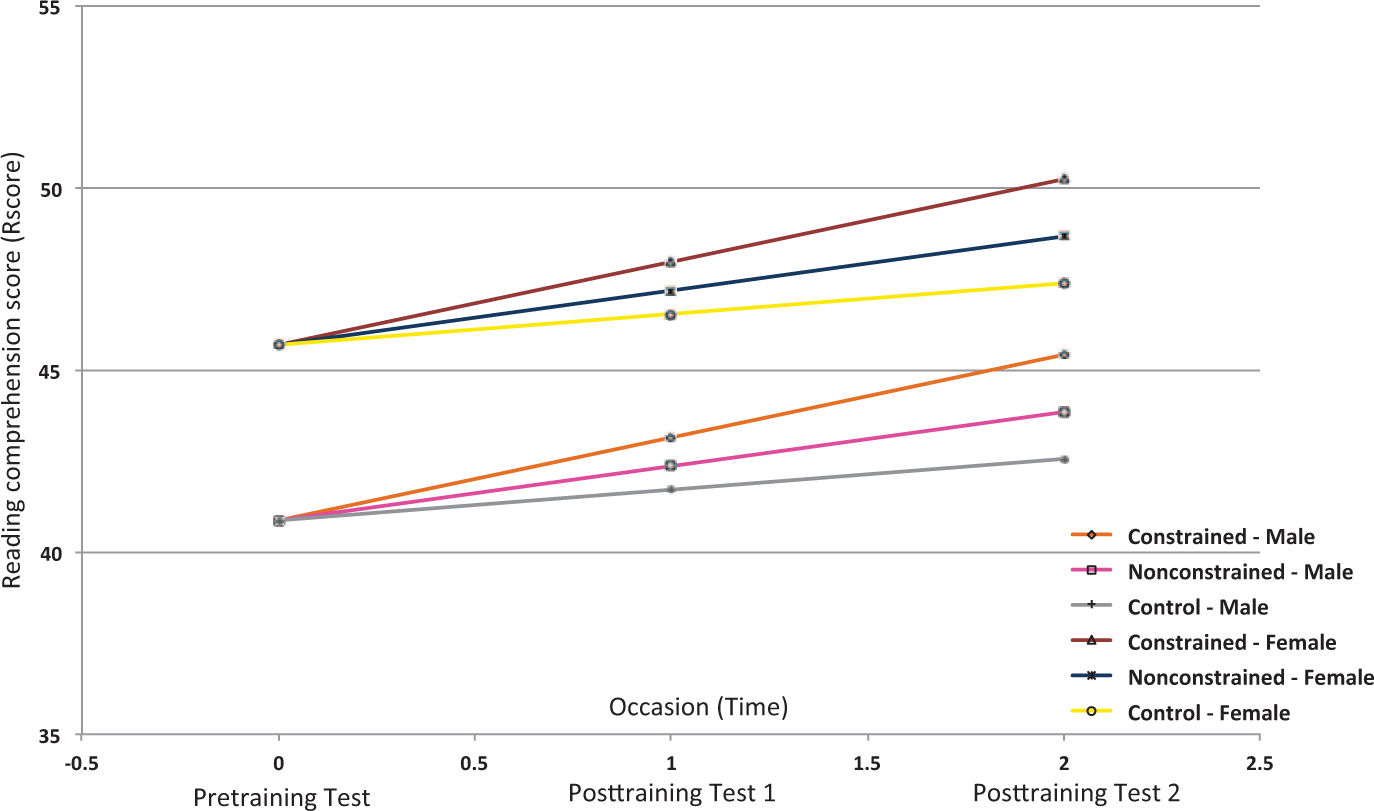
Significant cross-level interaction effects between treatment conditions (TRTMNT1 and TRTMNT2) and testing occasion (TIME) on reading comprehension performance (RSCORE) were found (see Figure 2 and Equation 2). For all participants, reading comprehension (RSCORE
A diagrammatic representation showing the impact of treatment in combination with time on reading performance is shown in Figure 3.
The impact of treatment and time interaction effect on reading performance.
V Discussion
The significant influence of constrained visual mental imagery training on EFL reading comprehension performance in this study is of both theoretical and practical importance. The initial theoretical proposition that an effective elaboration needs to constrain the features of the to-be-remembered information has been supported. The constrained imagery treatment exerted an influence beyond that of the standard imagery treatment. Practically the findings in this project provide one model of how imagery strategy instruction can be designed to facilitate elaboration effects more powerful than provided by standard imagery training. The findings here reinforce the important role of imagery in comprehension and provide more precise information about how students can generate effective elaborations during their EFL reading.
The predicted influence of the individual difference variables remains to be further investigated in more refined research. Although the rationale for making these predictions remains solid, the design of the individual indicators for these variables must therefore come under greater scrutiny.
The results of the hierarchical linear modelling analysis revealed that females out-performed males prior to any treatment, and that their performance advantage was sustained but did not increase over time. This is consistent with many other studies (e.g. Statistics Canada and OECD, 2005). All groups, including the control, improved their reading comprehension over time. The modelling also indicated that treatment interacted with time. Participants who received the imagery training with additional guidance to form constrained images made the most improvement in their reading comprehension performance. The performance gap between the groups increased over time.
The findings of this study are important in several ways. First, the findings suggest that teaching the visual mental imagery strategy together with explicit instructions to make constrained images leads to more powerful comprehension of text than nonconstrained imagery training or no imagery training. This result supports the arguments made by McCallum and Moore (1999) and by Anderson (2005) about how the process of visual imagery elaboration can be focused to generate additional benefit for the learner.
When viewed within the framework of network models of memory that represent knowledge in some form of a connected node-link structure, the process of constraining may be seen as having the effect of leading to the development of a structure that refines the node-link network. This is seen here to be applicable to models such as Anderson’s ACT_R model (Anderson & Bower, 1973; Anderson, Bothell, Douglas, Lebiere, & Qin, 2004), or to connectionist models (McClelland, 1988). Seen this way the instructions in the constrained imagery condition encourage the establishment of a structure that incorporates more precise representation of the key concepts (nodes) and the appropriate relationships (links) among these nodes.
Second, by incorporating an operationalization of the process of constraining an image into the research design, this study points to important implications for consideration of the importance of the quality of images for the effective use of the strategy in reading comprehension more generally.
The focus on the constraining process provides guidance for EFL teachers about how to help students to consider the concepts and relationships that best represent the meaning of the relevant sections of the text. Within a class session it is suggested that an explicit discussion structured around the process of generating a constrained image would provide very useful guidance for students’ understanding of the conceptual relations underlying the text they are reading. Such a discussion could also include explicit instruction in the generation of constrained images so that knowledge of constraining became part of the students’ repertoire of reading comprehension strategies. The lack of effects of the individual difference variables is difficult to explain, though there are certain features of each that could be given consideration in future research.
There is a possibility that the extra component of the working memory task introduced in the current project changed the nature of the working memory task. The original working memory task was scored based on the participants’ judgment about whether the endpoint of the pathway was above or below the start point. In the current study, the participants were also asked to draw the pathway, and the accuracy of their drawing on each trial was taken as the indicator of their working memory capacity. This extra component was introduced to ensure that the task was a test of memory and could not be completed through some other strategy such as subtle finger tracing. It is possible that this extra component of the task changed the nature of the working memory task. This is an issue that needs to be examined in further research.
Although there is in general, as indicated in the review of literature, a strong correlation between working memory performance and reading comprehension performance, there is also a concern that the nature of this relationship needs to be considered in more detail. A more recent examination of the research literature has identified some reports where researchers have noted different relationships between comprehension performance and different types of working memory tests: broad span tests that were either verbal, or numerical, or visuo-spatial. This literature suggests that the correlations for visual-spatial working memory tasks may be lower than that for verbal or numerical working memory tasks (Carretti, Borella, Cornoldi, & De Beni, 2009; Seigneuric, Ehrlich, Oakhill, & Yuill, 2000). In this case it could be that the nature of the relationship between the processing demands of reading comprehension and visual imagery tasks needs to be examined further.
As was the case with working memory, self-efficacy did not emerge as a significant predictor of comprehension performance. However previous research has consistently demonstrated that reading self-efficacy is a significant predictor of reading performance either directly or by influencing effort and persistence (Solheim, 2011; Wigfield & Guthrie, 1997). According to Pajares (1996), studies that report a lack of relationship between self-efficacy and performance often suffer from problems either in domain specificity or correspondence. In other words, when efficacy beliefs are globally assessed or do not correspond with the specific task with which they are compared, their predictive value is diminished. The likelihood of this specificity effect being influential here seems low, though it cannot be discounted. In this study, the participants might have made judgments about their general beliefs about their capabilities for English learning and performance without the specific reading task in mind. As a result, their report might not correspond with their self-efficacy beliefs for reading comprehension performance. This remains an issue for further research.
A possible solution to the assumed specificity effect might be to, in further research, assess the dimensions of reading motivation by Wigfield and Guthrie’s (1997) Motivation for Reading Questionnaire (MRQ), which has recently been frequently used to measure the dimensions of the specific reading motivation (Schiefele, Schaffner, Möller, & Wigfield, 2012). However, Watkins and Coffey (2004) argued that there is a lack of support for the proposed factor structure of the MRQ, which pointed to the need for reaching a consensus on the definition of reading comprehension and for specifying the status of self-efficacy as either a precondition or an inherent component of reading motivation (Schiefele, Schaffner, Möller, & Wigfield, 2012).
Two reasons for the relatively low degree of influence of the ability to make images need to be considered and followed up. The predicted stronger level of influence of this variable was based on the findings of Wyra et al. (2007) that showed a significant relationship between AMI and word-meaning recall performance. One possibility is that the different nature of the criterion tasks in that study and in the current study is associated with the differences in findings. In Wyra et al.’s study the performance of interest was word-meaning recall, which is quite specific, while in the current study the criterion was reading comprehension, which tends to be less specific. However, both types of tasks do involve the establishment of specific associations between elements of a memory representation and so would seem to be likely to show similar effects.
Another possible explanation for this result is that the visual mental imagery training might have contributed to improved ability to make images among the participants, especially the participants who reported low ability to make images. Thus, self-reported ability to make images before the training program becomes less reflective of the participants’ ability to make images while engaging in reading comprehension tasks after the training. However, this account would need to be tested by re-administering the AMI questionnaire after the training.
The consideration of the individual difference variables points to areas of further investigation. A useful direction is for a prolonged study. The current study collected data on three occasions. This limits the model to a linear one, but growth in reading comprehension may not be linear. A longer period of study with a longer series of measurements would enable more precise examination of the growth trajectory. Indeed it may reach a ceiling or even decay after explicit training and prompting to use the constrained imagery elaboration strategy.
Finally it is important to acknowledge the limitations of the current study. First, the sample size of the study was modest with relatively few males. Thus, although gender was controlled, further research should consider much larger groups with similar numbers of male and female participants. Second, the duration of the strategy instruction was around only one hour. This may have an impact on its effectiveness especially among participants in the constrained imagery group. Future research may assess the influence of the intensity and duration of the treatment on reading comprehension. Third, reading comprehension was observed on three occasions. This limits the models of its development to linear ones. With additional observations, more complex growth trajectories can be modelled, including those that test ceiling effects and decay in performance. Finally, the MSLQ questionnaire and the AMI questionnaire were about global attitudes on English learning and performance and about generalized self-report on the quality of images, the frequency of imagining, and imagining performance. Future research should consider modifications to the design of both instruments to investigate whether more powerful levels of influence of these variables can be found.
Footnotes
Acknowledgements
We thank Dr Helen Askell-Williams for her helpful comments about an earlier version of this article. We also thank Dr Katherine Dix for her technical assistance with the data processing.
Declaration of Conflicting Interest
The authors declare that there is no conflict of interest.
Funding
This research received no specific grant from any funding agency in the public, commercial, or not-for-profit sectors.