







Abstract
Within the field of education, reflective practice has become a very popular concept within teacher education and development programs. The general consensus is that teachers who are encouraged to engage in reflective practice can gain new insight of their practice. There have been similar developments in the field of teaching English to speakers of other languages (TESOL), where the allure of reflective practice seems to have also been embraced as an important educational paradigm that should be supported in teacher education and development programs. However, we really do not know what research has been conducted on the practices that encourage TESOL teachers to participate in reflective practice. This article presents a review of recent research that has been published in academic journals over the past five years (2009–2014) on the practices that encourage TESOL teachers to reflect.
Keywords
I Introduction
The concept of reflective practice has proliferated over the last decade in many professions such as medicine, law, business and education. Within the field of education, reflective practice has become a very popular concept within teacher education and development programs, and perhaps its main appeal, according to Loughran (2000, p. 33), is that it ‘rings true for most people as something useful [to practice]’. Indeed, as McLaughlin (1999, p. 9) has remarked, ‘Who would want to champion the unreflective practitioner?’ The general consensus is that teachers who are encouraged to engage in reflective practice can gain new insight of their practice. There have been similar developments in the field of teaching English to speakers of other languages (TESOL), where the allure of reflective practice seems to have also been embraced as an important educational paradigm that should be supported in teacher education and development programs. However, we really do not know what research has been conducted on the practices that encourage TESOL teachers to participate in reflective practice. So, when I was invited to undertake a review of recent research on steps to encourage TESOL teachers to engage in reflective practice, I was ecstatic because I fully agree with Akbari (2007, p. 205) when he noted: ‘It is good to reflect, but reflection itself also requires reflection.’ Thus, using the Latin meaning of the term ‘reflection’, or ‘reflectere’, which means ‘to bend back’ (Valli, 1997, p. 67), I attempt to ‘bend back’ over the research that has been published in academic journals over the past five years (2009–2014) on the practices that encourage TESOL teachers to reflect.
Although my own interest in the concept of reflective practice is long standing (e.g. Farrell, 1999a, 1999b, 2001, 2004, 2006, 2007), from the very start of this review, I was immediately faced with the formidable challenge of coming up with a methodology that would coherently present and analyse the vastness of the literature (116 studies) I encountered. So, as I began to undertake this somewhat daunting challenge, I began to reflect deeply on my understanding of what it means to encourage teachers to engage in reflective practice, given that the concept is still ‘ill-defined, and … used rather loosely to embrace a wide range of concepts and strategies’ (Hatton & Smith, 1995, p. 33). In the end, I decided to use my own recently developed ‘framework for reflecting on practice’ because it is both a ‘reflective’ and a ‘reflexive’ approach to reflective practice (Farrell, 2015). As Thompson and Pascal (2012, p. 320) have noted, the former incorporates the more ‘traditional notion of reflection as an analytical process’ and the latter, reflexive approach emphasizes ‘the mirroring of practice, and thereby undertaking a self-analysis.’ The framework is also a response to a recent widely cited criticism of the narrowness of many of the approaches used to encourage reflective practice (regardless of the field of study) that have often viewed reflection and reflective practice solely as a one-dimensional, intellectual exercise, while overlooking the inner life of teachers where reflection can not only lead to awareness of teaching practices but also self-awareness for a more holistic view of reflection and reflective practice (Akbari, 2007; Erlandson, 2006; Thompson & Pascal, 2012). Within the field of TESOL, Akbari (2007, p. 201) has also (correctly) cautioned that, when reflection becomes a solely intellectual exercise, reduced to a set of techniques and ‘gets done’ (Mann & Walsh, 2013, p. 293), it leads to ‘a real loss of reflective spirit’ and a ‘disregard for teacher personality.’
II A framework for reviewing studies on reflective practice
The framework I use to report on the studies in this review encompasses a holistic approach to reflective practice that focuses not only on the intellectual, cognitive and meta-cognitive aspects of our work, but also the spiritual, moral and emotional non-cognitive aspects of reflection that acknowledges the inner life of teachers; thus, I define reflective practice as: ‘a cognitive process accompanied by a set of attitudes in which teachers systematically collect data about their practice, and, while engaging in dialogue with others, use the data to make informed decisions about their practice both inside and outside the classroom’ (Farrell, 2015, p. 123).
The framework has five different stages/levels of reflection: philosophy; principles; theory; practice; and beyond practice. Throughout the reflective process, teachers are encouraged not only to describe but also to examine and challenge embedded assumptions at each level, so that they can use the framework as a lens through which they can view their professional (and even personal) worlds, and what has shaped their professional lives as they become more aware of their philosophy, principles, theories, practices and how these impact issues inside and beyond practice.
Philosophy: Philosophy, the first stage/level of the framework, can be considered to be a window to the roots of a teacher’s practice, because having a philosophy of practice means that each observable behavior has a reason that guides it even if the teacher does not articulate this reason. This first stage of reflection within the framework examines the ‘teacher-as-person’ and suggests that professional practice, both inside and outside the classroom, is invariably guided by a teacher’s basic philosophy and that this philosophy has been developed since birth. Thus, in order to be able to reflect on our basic philosophy we need to obtain self-knowledge, and we can access this by exploring, examining and reflecting on our background – from where we have evolved – such as our heritage, ethnicity, religion, socioeconomic background, and family and personal values that have combined to influence who we are as language teachers. As such, teachers talk or write about their own lives and how they think their past experiences may have shaped the construction and development of their basic philosophy of practice.
Principles: Principles, the second stage/level of the framework for reflecting on practice, include reflections on teachers’ assumptions, beliefs, and conceptions of teaching and learning. Assumptions generally refer to what we think is true but we do not have proof of as they have not been demonstrated yet; however, we accept them as true for the time being. Assumptions are thus sometimes difficult to articulate for a teacher. Beliefs, in contrast, are somewhat easier to state, and there is a general acceptance of a proposition; in other words, it is accepted to be true by the individual who holds it. Conceptions are more of an overall organizing framework for both assumptions and beliefs and they can mediate our response to situations involving both. All three are really part of a single system, and thus difficult to separate because they overlap a lot; although I treat them separately in the framework, I see them as three points along the same continuum of meaning related to our principles. Teachers’ practices and their instructional decisions are often formulated and implemented (for the most part subconsciously) on the basis of their underlying assumptions, beliefs and conceptions because these are the driving force (along with philosophy reflected on at stage/level one) behind many of their classroom actions. One of the many means that teachers have at their disposal when accessing their principles (assumptions, beliefs and conceptions) is by exploring and examining the various images, metaphors and maxims of teaching and learning.
Theory: Following on from reflecting on our principles, we are now ready to reflect on our theory, the third stage/level of the framework. Theory explores and examines the different choices a teacher makes about particular skills taught (or they think should be taught) or, in other words, how to put their theories into practice. Influenced by their reflections on their philosophy, and their principles, teachers can now actively begin to construct their theory of practice. Theory in this stage/level means that teachers consider the type of lessons they want to deliver on a yearly, monthly or daily basis. All language teachers have theories, both ‘official’ theories we learn in teacher education courses and ‘unofficial’ theories we gain with teaching experience. However, not all teachers may be fully aware of these theories, and especially their ‘unofficial’ theories that are sometimes called ‘theories-in-use’. Reflections at this stage/level in the framework include considering all aspects of a teacher’s planning (e.g. forward, central and backward planning; see below), and the different activities and methods teachers that choose (or may want to choose) as they attempt to put theory into practice. As they reflect on their approaches and methods at this level, teachers will also reflect on the specific teaching techniques they choose to use (or may want to choose) in their lessons, and if these are (or should be) consistent with their approaches and methods they have chosen or will choose. In order to reflect on these, they will need to describe specific classroom techniques, activities and routines that they are using or intend to use when carrying out their lessons. Another means of accessing our theory is to explore and examine critical incidents (any unplanned or unanticipated event that occurs during a classroom lesson, and is clearly remembered) because they can be a guide to a teacher’s theory-building.
Practice: Up to now, the framework has emphasized reflecting on philosophy, principles and theory, or the ‘hidden’ aspect of teaching. If we think of all of the whole teaching process as an iceberg, we cannot see the part of the iceberg that is beneath the surface of the water (the ‘hidden’ aspect) that is much larger than the visible part on the top. All we can see is the top of the iceberg, or 10% of the whole iceberg, and in teaching this constitutes our practice, the fourth stage/level of reflection in the framework. Thus, we are now ready to reflect on the more visible behaviors of what we do as teachers, our practice, and what actually happens in the classroom. Reflecting on practice begins with an examination of our observable actions while we are teaching as well as our students’ reactions (or non-reactions) during our lessons. Of course, such reflections are directly related to and influenced by our reflections of our theory at the previous level and our principles and philosophy. At this stage/level in the framework, teachers can reflect while they are teaching a lesson (reflection-in-action), after they teach a lesson (reflection-on-action) or before they teach a lesson (reflection-for-action). When teachers engage in reflection-in-action they attempt to consciously stand back while they are teaching as they monitor and adjust to various circumstances that are happening within the lesson. When teachers engage in reflection-on-action they are examining what happened in a lesson after the event has taken place, and this is a more delayed type of reflection than the former. When teachers engage in reflection-for-action they are attempting to reflect before anything has taken place and anticipate what may happen and try to account for this before they conduct the lesson.
Beyond practice: The final stage/level of the framework entails teachers reflecting beyond practice. This fifth stage/level of the framework takes on a sociocultural dimension to teaching and learning, which Johnson (2009, p. 2) points out is ‘not simply a matter of enculturation or even appropriation of existing sociocultural resources and practices, but the reconstruction and transformation of those resources and practices in ways that are responsive to both individual and local needs.’ This is called critical reflection and entails exploring and examining the moral, political and social issues that impact a teacher’s practice both inside and outside the classroom. Critical reflection moves the teacher beyond practice and links practice more closely to the broader sociopolitical as well as affective/moral issues that impact practice. Such a critical focus on reflections also includes teachers examining the moral aspect of practice and the moral values and judgments that impact practice.
The framework can be navigated in many different ways; for example, in a theory-into-(beyond) practice application, a (beyond) practice-into-theory application, or a single stage application. The framework is descriptive rather than prescriptive (which is very appropriate for this appraisal of research studies), describes different aspects of reflection that are not linear in approach and can be distinguished and differentiated analytically, thus breaking away from many other approaches and models of reflective practice that assume a sequential, consecutive and linear mode of reflective thinking (e.g. Kolb, 1984; Korthagen, 2010; Rodgers, 2002).
III Selection of studies (sampling)
I confined the selection of studies to recent research reports in international journals of the last 5 years (2009–2014) to ensure the sample represented current work within a strict time frame. My search included many of (but not limited to) the following domains (key words):
general terms: reflect, reflection, critical reflection, collaborative reflection reflective practice,. reflective practitioner, reflective teaching, teacher development, teaching practice, L2 teacher reflection, teacher reflection, language teacher, second language teacher education, teacher education, teaching English as a foreign language, teaching English to speakers of other languages, TEFL, TESL, TESOL, English-language teaching, classroom practice, and combinations of all of these;
more specific terms related to practice (I can only provide a sample because of space restrictions): identity (teacher, professional), teacher development/support group, action research, analysing cases, critical incidents, classroom communication/observation, critical friend, peer coach/mentor, peer observation, teacher belief/practice, teacher journals, reflective writing, self-monitoring/reflection, teacher metaphors, teacher narratives, and combinations of all of these.
The resources and database I used were: ERIC, LLBA, MLA International Bibliography, Sociological Abstracts, Education Research Complete and other internet collections on the Web. I also screened 58 academic journals (all peer reviewed), including Applied Linguistics, Applied Linguistics Review, Canadian Journal of Applied Linguistics, Canadian Modern Language Review, ELT Journal, Journal of Teacher Education, Language Teaching, Language Teaching Research, Modern Language Journal, Reflective Practice, RELC Journal, System, Teaching and Teacher Education, TESOL Quarterly, TESOL Journal. Note that this review does not cover books or book chapters on reflective practice in TESOL.
IV The review
1 Overview
Table 1 lists 116 studies, published between 2009 and 2014, related to TESOL teachers engaging in reflective practice. The studies are organized and coded into the following different fields: study and year of publication, objective of the study according to the framework I used (see above), reflective tools, sample of teachers covered, and context (or location). The order of presentation of each study in Table 1 follows the order of the objectives in the framework that were used for the analysis starting with philosophy and then various combinations that were used with philosophy followed by principles and its various combinations and theory and its various combinations. Within each category, the studies are listed in descending order of year of publication.
Overview of reflective practice studies (2009–2014) in TESOL.
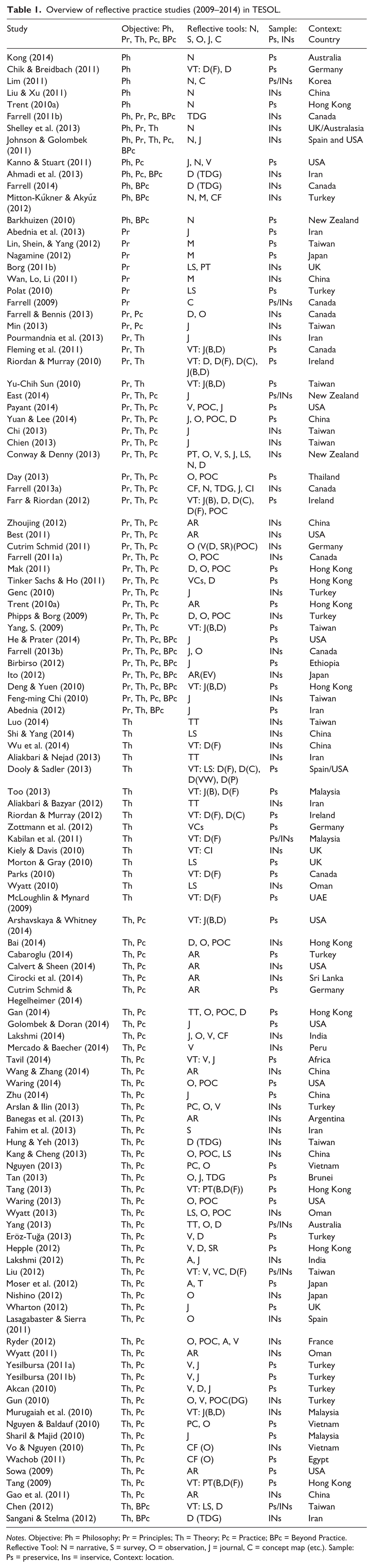
Notes. Objective: Ph = Philosophy; Pr = Principles; Th = Theory; Pc = Practice; BPc = Beyond Practice. Reflective Tool: N = narrative, S = survey, O = observation, J = journal, C = concept map (etc.). Sample: Ps = preservice, Ins = inservice, Context: location.
Table 1 shows an increase in the number of studies in TESOL related to reflective practice from only 6 studies in 2009 to 23 in 2014, possibly suggesting a growing interest in research related to encouraging TESOL teachers to engage in reflective practice. Six of the studies included appeared in Language Teaching Research (LTR), on average one per year. LTR is no outlier among the applied linguistics journals in this regard. For example, TESOL Quarterly featured just 2 of the studies sampled, but System featured 11 of them. It is worth recalling that my sampling is confined to the field of TESOL. Inclusion of studies in which teachers of other languages than English were encouraged to engage in reflective practice could reveal more pronounced differences between journals such as these.
In the sections that follow I discuss in some detail the body of research under each objective from the framework (philosophy, principles, theory, practice, and beyond practice). Unfortunately, because of space limitations I cannot possibly do justice to all 116 studies listed in the table above.
2 Grouped by objectives
Using the framework outlined above as a way of categorizing the studies, 5 studies focused on reflecting on philosophy, 7 on principles, and 15 on theory. Most studies embraced a combination of objectives:
theory and practice with 47 studies;
principles and theory with 4 studies;
principles, theory and practice with 19 studies; and
the combination of principles, theory, practice and beyond practice with 6 studies.
The purpose of my categorization of studies is to indicate the studies’ scope in terms of reflection stimulated by the given intervention. As with most categorization efforts, there must be borderline cases where links with particular objectives were left implicit or hinted at only vaguely by authors.
a Philosophy
When teachers were encouraged to reflect (solely) on philosophy, teacher identity has often been found to be an important issue. Most of the studies used exploration of personal histories to facilitate reflection on teacher identities’ origin, formation and development (Lim, 2011; Trent, 2010b). In other studies, preservice teachers were encouraged to reflect on their identity formation and development using narratives. For example, Trent (2010b, p. 912) encouraged preservice teachers to reflect on how their identities were constructed and the importance of context (in this case Hong Kong), with the idea of ‘raising trainee teachers’ awareness of the multidimensional social universe in which teacher identities are constructed.’ The influence of context on identity construction and development was also outlined in a case study by Kong (2014) that explored the lived experiences and identity construction of a Vietnamese preservice teacher while studying in Australia and how the teacher changed some aspects of her identity as she adapted to that context. However, as she became more aware of who she was and who she wanted to be as a teacher, these intense reflections on her identity led her to realize that she wanted to maintain other aspects of her identity that she brought with her from Vietnam; as Kong (2014, p. 89) noted: ‘She was aware of the challenges that she would face when she returned to Vietnam and reflected on ways to incorporate her own ideas within those constraints.’ Continuing the idea of the possibility of a gap developing between teacher identity expectations versus reality, Liu and Xu (2011), using a process they call ‘restorying’ to encourage reflection, reported on how one beginning teacher became aware of a gap between what she was expected to become (i.e. ‘designated teacher identity’) and how she identified herself (i.e. ‘actual teacher identity’). Being encouraged to become more aware of the possibility of shifting identities helped the teacher to close the gap between her ‘designated’ and ‘actual’ identities. As Liu and Xu (2011, p. 596) observed: ‘identity is not static and fixed but negotiated and shifting … it is evident that her experience of identity shifting has indeed helped shape her professional life.’
b Principles
When encouraged to reflect (solely) on principles, most of the 7 studies reviewed reported heightened awareness of both preservice and inservice teachers’ assumptions, values and beliefs about teaching and learning. For example, Lin, Shein and Yang (2012) noted that, when preservice teachers were encouraged to explore their beliefs of teaching and learning through metaphor analysis, many reported feeling liberated. The metaphor analysis ‘provided them with an opportunity to reflect on their roles as EFL teachers, to solidify their views of teaching and learning, and to liberate their thinking by distancing themselves, to a certain extent, from their everyday experiences’ (2012, p. 196). Polat (2010) also encouraged preservice teachers to articulate and reflect on their beliefs to see if this new level of awareness would lead to any re-evaluation of their appropriateness when it comes to materials development. When encouraged to reflect in such a manner: ‘the participants altered some of their beliefs about the effectiveness of teacher-made materials compared to commercial and authentic materials’ (2010, p. 203).
When encouraged to articulate and reflect on their beliefs, inservice teachers have also reported some revaluations as a result of the greater awareness. Borg (2011a, p. 378), for example, found that in many cases inservice teachers ‘progressed from an initial stage of limited awareness of their beliefs to feeling quite strongly that they were aware of and could articulate key beliefs underpinning their work.’ The process of reflection included coursework, teaching practice and feedback, and reflective writing. Borg (2011b, p. 378) reported that for many teachers such reflections resulted in their beliefs being ‘strengthened and extended … and they can learn how to put their beliefs into practice and also develop links between their beliefs and theory.’ Wan, Low, and Li (2011) also found that, when inservice teachers were encouraged to reflect through metaphor analysis, they would modify their metaphors if these did not match their newly articulated beliefs.
c Theory
There were 15 studies focusing on steps that encourage teachers to reflect (solely) on theory. Using collaborative lesson planning conferences to encourage reflection on theory, Morton and Gray (2010) found that preservice teachers were able to build knowledge and repertoires of instruction. Taking such reflections further with the use of online discussions for lesson planning, McLoughlin and Mynard (2009) noted that such a reflective medium with prompts from the instructor not only produced evidence of higher-order thinking with greater length and complexity of ideas discussed as compared to their regular face-to-face class discussions, but also allowed the preservice teachers more time to reflect, and reduced speaking anxiety. Zottmann, Goeze, Frank, Zentner, Fischer, and Schrader (2012) used a computer-supported case-based learning approach to encourage such reflections and discovered that, in particular, digital video cases promoted development of analytical skills of preservice teachers, especially when there was some kind of instructional support. When using both blogs and online forums to encourage reflection on theory, Too (2013), however, cautioned that although both allowed for reflection to take place, this was not at the highest or transformational level, possibly because the teachers preferred to use these communication modes for social rather than cognitive functions (for similar conclusions, see also Parks, 2010; Riordan & Murray, 2012).
Generally, when inservice teachers were encouraged to reflect on their theories, they gained a better understanding of their public and personal theories (Wyatt, 2010). More specifically, positive outcomes were generated when inservice teachers took part in lesson-planning conferences (Luo, 2014; Shi & Yang, 2014). For example, Shi and Yang (2014, p. 138) examined the reflections of inservice teachers while reflecting in collective lesson-planning conferences for a writing course and discovered that participants [in collaboration with others] were not only able to develop a shared understanding of lesson planning and by negotiating ‘their own views, make meanings applicable to new circumstances, to enlist the collaboration of others, [and] to make sense of events’, but were also able to get a better understanding of the links between their own theories and practices. Luo (2014) also reported the positive effects of collaborative lesson planning but also noted the usefulness of adding lesson study to help strengthen the connection between theory and practice. Although both Aliakbari and Bazyar (2012) and Aliakbari and Nejad (2013) reported advantages for inservice teachers of team teaching (where two teachers plan and teach the same class), they also noted that such a reflective process could be confusing for some students. In another cautionary message, Kiely and Davis (2010) reported that reflections on theory may influence but not necessarily improve overall teaching practices.
d Principles and theory
The first combination in the review consists of principles and theory with the fewest number of studies (four) cited. Riordan and Murray (2010, p. 181) found that the use of interactive online discussion forums and chat ‘potentially facilitates reflection and supports problem solving.’ They found evidence of reflective language in both chat and online discussion forums, but argue that the latter have the advantage that they allow for more time to reflect. Fleming, Bangou, and Fellus (2012, p. 49) used online blogs to encourage preservice teachers to ‘develop their opinions about second-language education’ and reported that the preservice teachers were able to ‘transform their pedagogical beliefs and theories about second-language education.’ Taking the idea of online reflections further, Yu-Chih Sun (2010) used reflective cyber communities (or ‘blogospheres’) with preservice teachers. This ‘allowed students to participate actively as knowledgeable, reflective, creative, and critical members in cyber communities’ (2010, p. 380).
e Theory and practice
Studies in which TESOL teachers’ reflection on theory and practice are stimulated are the most frequent in the sample, with a total of 47 out of 116 studies. Many studies have found that preservice teachers benefit from some kind of feedback or guidance from a supervisor (usually in a practicum setting) while reflecting in pre- and post-observation conferences or in peer groups. For example, Waring (2013, p. 114) reported that feedback in post-observational conferences
can function as triggers for teacher reflections … the teacher engages a range of reflective talk such as articulating an independent analysis of her success, reconsidering a pedagogical practice, or relating her difficult endeavors in effectuating a certain behavioral change.
Using video-recorded lessons in post-observation sessions, Eröz-Tuğa’s (2013) noted that, although participants became more aware of classroom teaching, they were reluctant to reflect critically on their own teaching and that of their peers. In order to trigger more critical reflection in such post-observation conferences, Waring (2014, p. 116) suggested that the supervisor take a ‘solution-attentive approach’ rather than a ‘cause-attentive approach’, because the latter can put the preservice teacher on the defensive rather than fostering a real understanding of the issue.
Other studies have complemented this use of video recordings as prompts for post-observation reflection by forms of peer group discussion and/or feedback from critical friends. Although peers may be reluctant at first to give (and receive) critical feedback, they often eventually come to value the interactions and discussions (e.g. Hepple, 2012; Nguyen, 2013; Wachob, 2011). After becoming more familiar with and trusting of the other group members, participants may express their feelings openly about all aspects of their teaching because ‘the group provides a high level of psychosocial support’ (Nguyen, 2013, p. 40).
The usefulness of classroom observations and feedback has also been noted. Kang and Cheng (2013, p. 182), for example, report that ‘Thanks to the reflection on alternative ways of teaching, [the teacher was] empowered to expand her pedagogical choices … changes in cognition led to changes in behavior and changes in behavior led to changes in cognition.’ In Bai’s (2014) case study, discussions aided by a facilitator enabled two inservice teachers to develop their own personal theories of teaching writing and to become more confident in their ability to teach writing. However, Lasagabaster and Sierra’s (2011, p. 454) caution that, although some inservice teachers who had observed a fellow teacher assessed it positively because ‘it enhanced awareness’ and allowed comparison of ideas, some others ‘didn’t want to be negative or critical of the other teacher’. In addition, in terms of the affective component of classroom observations, Lasagabaster and Sierra (2011, p. 456) further reported that ‘The most frequent reactions from those averse to being watched were uneasiness, distrust, insecurity and anxiety about having an observer in class with them.’ It is clearly crucial to take into account teachers’ feelings about being observed and about giving and receiving feedback on teaching.
Additional ways of stimulating inservice teachers’ reflection on theory and practice are the use of teacher study groups (Hung & Yeh, 2013) and critical friends (Lakshmi, 2014; Vo & Nguyen, 2010). For example, Hung and Yeh (2013) looked at the reflections of inservice teachers in bi-weekly group meetings with the help of a facilitator and reported that the group discussions enabled the teachers to share their practical knowledge with each other, co-design various teaching activities and engage in self-appraisal of their classroom teaching: the teachers ‘gradually gained autonomy over their learning and made efforts to integrate what they learned [about theory/practice connections] into their own classrooms’ (2013, p. 163). However, Hung & Yeh (2013, p. 163) also maintain that some kind of stimulus must be provided by an experienced facilitator ‘in engaging teachers [no matter how experienced] in the learning process and bringing about changes in their beliefs and classroom practices.’ Such stimulation in post-observation discussions, according to Lakshmi (2014, p. 202), can be obtained from critical friends who can promote greater awareness and deeper reflections, where teachers construct ‘their own explanations of teaching derived from their own practices.’ As a result of such discussions with the critical friend, teachers can become more ‘critical of their own habitual practices’ and may ‘try out alternative ideas in their classrooms’ (2014, p. 201–202). Vo and Nguyen’s (2010) study also highlighted the use of critical friend discussions, although their inservice participants were initially hesitant to offer any criticism to others in the group for fear of offending them. This reluctance diminished, however, as they became more trusting of each other. In the end, the teachers felt that the critical friends group created ‘opportunities to exchange professional ideas, opportunities to learn from colleagues’ and ‘the development of good work relationships and a professional community’ (Vo & Nguyen, 2010, p. 210)
f Principles, theory and practice
Nineteen studies (9 involving preservice and 10 involving inservice teachers) are about moves to encourage teachers to reflect on the combination of principles, theory and practice. Yuan and Lee (2014) found that when preservice teachers are encouraged to reflect in post-observation discussions with peers, this can not only heighten their awareness of these three areas but also lead to changes in each, as the teachers ‘experimented with different teaching approaches’ (2014, p. 10). Tinker Sachs and Ho (2011) added video accompanied with interviews of the teachers who were taped as prompts in post-observation discussions. This helped their preservice teachers to ‘apply their theories and reflect on the soundness of their own beliefs and practices in clear and explicit ways.’ (2011, p. 274).
Some of these studies also used some form of online forums, chats and/or blogs (e.g. Farr & Riordan, 2012; Yang, 2009). For example, Yang (2009) used blogs to encourage reflection in post-observation discussions and discovered that, although there was high and interactive participation among the preservice teachers, overall their reflections tended to be more descriptive than critical in nature, mainly because they feared offending others and damaging friendships. Yang (2009) again noted the importance of facilitator (in this case the teacher educator) intervention in order to stimulate critical reflection. Farr and Riordan (2012) also noted the different degrees of reflection when using online chats and discussions forums to encourage reflection in post-observation discussions. In their study, discussion forums were found to have comparatively low interactivity and little reflection while online chats were highly interactive and more reflective.
Positive results were also reported when inservice teachers were prompted to reflect on how principles, theory and practice are interconnected (e.g. Chien, 2013; Conway & Denny, 2013; Farrell, 2013a; Genc, 2010; Phipps & Borg, 2009; Zhoujing, 2012). For example, Genc (2010, p. 407) found that writing helped inservice teachers to reflect on ‘problems related to lesson planning, the teaching/learning process, interaction, classroom management, and assessment’. As a result of such reflective writing, the teachers ‘felt empowered and autonomous in their classroom practices when they implemented self-initiated pedagogical options’ (2010, p. 407). Farrell (2013a) used critical incidents to encourage such reflections, because he noted that they can help inservice teachers become aware of possible conflict owing to any discrepancies between principles, theory and practice. Conway and Denny (2013) found teaching portfolios a beneficial means of encouraging inservice teachers to reflect, while Zhoujing (2012, p. 25) discovered that action research was effective for teachers to ‘reexamine their assumptions’ and to challenge their ‘own routine of thinking’ as well as change ‘their teaching practices.’ Phipps and Borg (2009) reported that post-observation discussions helped the teachers to gain more awareness of the tensions between principles, theory and practice related to grammar teaching especially when prompted to attempt alternative classroom practices. As Phipps and Borg (2009, p. 386) noted for one female practicing teacher especially:
It would seem that a crucial factor in enabling her to change her own classroom practice was the awareness of the tension between her stated beliefs and actual practices that was created through the post-lesson discussion of her work. Subsequently trying out alternative practices and subsequently experiencing their benefits first-hand had a powerful influence on her decision to use more group-work in her grammar teaching.
g Principles, theory, practice and beyond practice
This final combination of objectives is discerned in six of the 116 studies, evenly divided between preservice and inservice teachers. These differ from the previous category by taking reflection outside the classroom and the school. Birbirso (2012, p. 862), for example, examined conditions preservice teachers faced that were constraining their reflective learning on the practicum and so encouraged the teachers to reflect on these constraints in a journal to stimulate what they call ‘effective reflection.’ As a result of writing, the teachers were not only able to reflect on their own assumptions, beliefs, and theories and how they could use this information to improve their practice, but also beyond practice on ‘wider school practices and issues and how they relate to classroom behaviors, actions and interactions’ (2012, p. 865). He and Prater (2014) also examined the effectiveness of such writing, and added that it may be necessary to give guidance in the form of scaffolding if the teachers are to maintain a critical stance to their practice. Deng and Yuen (2010, p. 450) also used writing, but they encouraged the preservice teachers to write in blogs as a ‘channel for interaction and the exchange of social support.’ They reported that writing in such blogs enabled preservice teachers ‘to capture, externalize, and inspect their feelings and thoughts’ (2010, p. 450). Feng-ming Chi (2010) concurs that the act of writing can help inservice teachers reflect on their ‘thoughts, beliefs and experiences’ and how these ‘guided their practice’, thus ‘functioning as a vehicle to enable them to better understand the underlying assumptions of their teaching.’ Moreover, it can help teachers critically reflect on ‘deeper issues beyond practice, such as social issues, inequitable relationships and generated roles’, thus enhancing ‘their critical thinking as both teachers and learners.’ (2010, p. 180). In a similar mode of encouraging reflection through writing Farrell (2013, p. 470) noted that the experienced ESL teacher in his cases study began to ‘unpack any emotional baggage be it personal or professional and get beyond it’, so that she could critically reflect on all aspects of her work both inside and outside the classroom.
3 Other considerations
a Reflective tools
In terms of the main reflective tools used (with some overlap) to encourage and facilitate reflection, discussion (including teacher discussion groups and post-observation conferences) was the most frequently used in this body of research (40 studies), followed by journal writing (29 studies); this was closely followed by classroom observations (self, peer, etc.; 27 studies), and then video analysis (16 studies), followed by action research (12 studies), narrative (11 studies) and lesson study (10 studies). Instruments used in only five or fewer of the studies include: cases, portfolio, team teaching, peer coaching, and critical friend/incident transcript reflections. No fewer than 50 of the studies reviewed here also make use of some kind of combination of online formats for reflection such as blogs, podcasts, chats, and forum discussions.
b Participants
The 116 studies were nearly evenly divided between preservice teachers (55 studies) and inservice teachers (54 studies), with 7 studies having both preservice and inservice teachers as participants.
c Setting
Table 1 also shows that nearly half of all the studies reviewed were from Asian contexts (including India and Sri Lanka), followed by less than a quarter conducted in Europe and North America and then far fewer in the Middle East, Australia and New Zealand, and very few conducted in South America and Africa.
d Context
In addition, most studies reviewed were in some manner connected to university or college programs such as undergraduate, graduate or language school programs, with only a few studies located within language schools, or primary, elementary or secondary school settings.
V Appraisal
In this section I give an appraisal of the studies through the framework in which they were presented above. In terms of reflection objectives, overall results suggest a positive impact of encouraging preservice and inservice TESOL teachers to reflect on their work, be it solely on their philosophy, principles, theory, practice and beyond practice, and/or their various combinations. For example, when teachers were encouraged to reflect on their philosophy (mostly through accessing their personal histories) most studies reported that teachers can better understand their teacher identity origins, formation and development. When teachers were encouraged to reflect on principles (mostly through metaphor analysis and reflective writing), most (but not all) studies reviewed reported that, as teachers became more aware of their assumptions, values and beliefs about teaching and learning, they became better able to make re-evaluations, modifications or complete changes to these. When teachers were encouraged to reflect on theory (mostly through lesson planning) the studies reported that preservice teachers were able to build repertoires and knowledge of instruction while inservice teachers benefited most from accessing their theory though collective and collaborative lesson-planning conferences.
When teachers reflected on the various combinations of the framework, the most frequently cited (40% of all studies reviewed) were the combination of theory and practice. When preservice teachers were encouraged to reflect on this combination, the results indicated that some kind of feedback during pre- and post-observation conferences in groups of some form (e.g. with or without video recordings of the lessons) can facilitate such reflections. When inservice teachers are encouraged to reflect on this combination, results indicate that although most teachers report an overall positive impact of observations because they lead to enhanced awareness of theory and practice connections, they also noted the potential adverse reactions to being observed by others. Thus, other forms of post-observation feedback that many studies on inservice teachers – such as the use of teacher groups, teacher study groups or critical friends – may not only stimulate reflection on theory/practice connections but also alleviate some of the misgivings about being observed.
Other combinations of reflection included explorations of principles, theory and practice, which added more detail on connections between assumptions, beliefs, and lesson planning and their relation to classroom practices. Similar to the previous combination of reflections on theory and practice was the importance of post-observation conferences but with a majority of these conducted through some kind of online mode of reflection such as forums, chats and blogs. Indeed, when inservice teachers were encouraged to reflect specifically on the connection between beliefs, theory and practice, the teachers reported not only an increased awareness of the complex connection within this combination but also the possibility of discrepancy between all three. Although few studies resulted in reflection beyond practice as in the combination of principles, theory, practice and beyond practice, of those that did, most noted that both preservice and inservice teachers were not only able to reflect on their own assumptions, beliefs, and theories and how they could use this information to improve their practice, but also beyond practice and how these are all connected to wider school and social issues. These results suggest then that, when TESOL teachers are encouraged to reflect on their work, the focus tends to be on more practical and immediate issues related to their classroom practices, but not much beyond practice.
In terms of reflection tools used to encourage and facilitate reflective practice, results from the review revealed that discussion of some form was most popular. This is an interesting finding because it is counter to a recent criticism cited by Mann and Walsh (2013, pp. 292–293) when they said that research on reflective practice is often ‘dominated by written forms of reflection at the expense of potentially more beneficial spoken forms’. Indeed, the findings from this review do not support such claims, and if we include the use of online discussions to facilitate refection (many of which, as Riordan & Murray (2010) pointed out, share resemblance to spoken discourse), we have an even more dominant presence of discussion as tool for encouraging and facilitating reflective practice in TESOL. Writing is still a very popular reflective tool used in all types of framework objectives (e.g. see especially the theory and practice combination above), and especially by preservice teachers. That writing is used a lot by preservice teachers is probably because they do not have a choice as it may be a required mode of reflection used in many teacher education programs, as a visible record of reflection possibly for the purposes of assessment. However, it is the noticeable and increasing use of many online formats to facilitate and encourage reflective practice that is most revealing from this review (especially for the combination for principles and theory outlined above) as this has not received much attention in many current discussions of reflective practice in TESOL. Perhaps the results of this review that highlight the growing use of some form of online reflection tools within TESOL warrants further attention by second language teacher educators and developers so that we can become more aware of how to promote these more effectively to encourage reflective practice.
The results of the review also reveal that the 116 studies are nearly evenly divided among both preservice and inservice teachers and with nearly half of all studies conducted in Asian settings. In addition, most of the studies conducted to encourage TESOL teachers to reflect had some connection to university contexts. That half of the studies were conducted with inservice teachers is an encouraging finding, because, as Borg (2011a, p. 220) put it: ‘the literature is insufficiently grounded in the realities that language teachers work in, and a closer empirical analysis of these realities is required before reflective practice can become a viable global strategy for LTE (especially in inservice contexts).’ The results of this review indicate welcome advances in the exploration of inservice teachers’ reflections on the realities of their teaching world. That nearly half of all the studies reviewed were from Asian contexts (including India and Sri Lanka) suggests a particularly strong interest in encouraging TESOL teachers to engage in reflective practice in this region. The smaller number of studies from European and North American settings, where reflective practice was greatly encouraged in the 1980s–1990s), may suggest somewhat of a waning interest.
In terms of the context of the studies reviewed, the results suggest that not many studies are conducted outside various university programs, and one may wonder what impact this has on the reflection processes in terms of the reflective objectives teachers are encouraged to reflect on as well as the reflective tools they are exposed to. Thus, based on these results we must ask the question of how context (in this case mostly university type programs) frames the reflective practice process and how this provides or impedes opportunities for both preservice teachers and inservice teachers to reflect. For example, because most studies covered in this review were conducted in some kind of university context, we can wonder what reflective practices have been encouraged or adapted within these contexts where teacher educators pursue an intellectual approach to reflective practice in a ‘one size fits all’ approach, while ignoring the inner life of teachers. As the results of the various reflective objectives in this review point out, not all TESOL teachers (preservice and inservice) are the same and each have unique personal histories (see philosophy above); they also have many different assumptions, values and beliefs (see principles above), as well as different experiences related to teaching (see theory, practice and beyond practice above) that may be different to those of their teacher educators and developers. So, when encouraging TESOL teachers to engage in reflective practice, we must be on guard also against trying to ‘control’ such reflections in these contexts because they may be fake (Hobbs, 2007). I believe that the framework I used as a lens to present the research outlined in this review can facilitate educators to encourage TESOL teachers to reflect on all aspects of their practice because it is grounded in the belief that teachers are ‘whole persons and teaching is multi-dimensional (moral, ethical, aesthetic, nuanced, and complex)’ (Klein, 2008, p. 112).
Finally, some scholars in TESOL have wondered if engaging in reflective practice will ‘improve the quality of teaching’ (Borg, 2011a, p. 220), and if reflection will result in ‘better teacher performance’ (Akbari, 2007, p. 198). These are difficult questions to answer, because, when one says ‘improved quality’ or ‘better performance’ for teaching, we assume that there must be a base line of what good quality or performance is in order to make judgments about any improvements. I believe that teachers will not be able to ‘improve’ their teaching unless they are aware of what that teaching entails or what it is they actually do (not what they ‘think’ they do) in and beyond their classrooms. The results of this review indicate that most TESOL teachers who engage in reflection become more aware of their practice. Perhaps this greater level of awareness may lead to an ‘improved’ or ‘better’ teaching, especially if the reflections lead to some definite conclusions that have direct implications for a teacher’s classroom practices. However, some of the studies reviewed in this article have shown that more awareness as reflecting on philosophy, principles, theory, practice, and beyond practice can also lead to an affirmation of current practices or no outward changes in teaching behaviors (e.g. Farrell, 2013b), but this, too, can result in an overall better ‘quality’ of teaching.
VI Conclusions
In this article I have reviewed research (116 studies) in which TESOL teachers were encouraged to reflect on their work published over five years (2009–2014) in academic journals. I have presented these studies through the lens of a holistic framework that I have recently developed (Farrell, 2015) in an effort to provide a clearer means of how the literature can be understood. Overall, the research indicates that both preservice and inservice teachers are interested in, and feel they benefit from, reflecting on various aspects of their practice. In addition, the positive impact reported in most of these studies on the increased level of awareness that is generated from such reflections seems to provide further opportunities and motivation for TESOL teachers to further explore, and in some instances even challenge, their current approaches to their practice, especially when they note any tensions between their philosophy, principles, theory and practice both inside and outside the language classroom. I should point out that I have purposely avoided reviewing the different definitions (although not all studies gave definitions of reflective practice) of reflective practice, not only because of space restrictions but also because I wanted to bring into clearer focus the literature on the practices that encourage TESOL teachers to engage in reflective practice. This can be considered a limitation for the present review but also the basis for another article, related to how the various authors defined reflection and reflective practice. Rather, in this review I have attempted to present an appraisal of the recent research contributions of educators that have encouraged TESOL teachers to engage in reflective practice.
Footnotes
Declaration of conflicting interests
The author(s) declared no potential conflicts of interest with respect to the research, authorship, and/or publication of this article.
Funding
The author(s) received no financial support for the research, authorship, and/or publication of this article.