







Abstract
Despite the preponderance of theoretical and empirical evidence that suggests the use of pair/group work to promote second language learning, it is still unclear who can best form high performance groups. Should students be allowed to choose their working partners, or should teachers themselves assign students to pairs? This study set out to compare the nature of student-selected and teacher-assigned pairs while they were engaged in collaborative writing. All learner talk was audio recorded, transcribed and analysed for the quantity, type and resolution of language related episodes (LREs) as well as the patterns of dyadic interaction. Furthermore, the study examined the texts produced using both quantitative and qualitative measures. Our findings suggest that the teacher-assigned pairs generated significantly more LREs than the student-selected pairs, while there was no significant difference in the patterns of interaction between the two pairing methods. Meanwhile, the qualitative analysis of learner talk revealed a considerable amount of off-task behavior among the members of student-selected pairs. Moreover, as far as the outcome of pair work (collaborative writing) was concerned, the teacher-assigned pairs noticeably outperformed the student-selected pairs on measures of fluency and accuracy. Also, they produced significantly better texts in terms of organization, grammar and vocabulary.
Keywords
I Introduction
The use of pairs and small groups has been increasingly prevalent in recent years. This is largely due to a wider acceptance of leading theories of second language learning, which have acknowledged the role played by interaction to promote learning. From a sociocultural point of view, learning is a socially mediated process and face-to-face interaction with either experts or peers can provide students with abundant opportunities for ‘languaging’ (talk which focuses on the construction of linguistic knowledge) and ‘scaffolding’ (Swain, Kinnear & Steinman, 2011). According to Vygotsky (1978), the founder of sociocultural theory, during the process of interaction which is inherent in pair/group work, knowledge is co-constructed and facilitated through scaffolding. That is, when students who are working together on a task confront a linguistic problem, they can pool their knowledge of language to solve it. From a cognitive perspective, interaction provides learners with meaningful input. It also gives learners opportunities to experiment through production and to obtain feedback, thereby facilitating second language development (Gass & Mackey, 2007; Long, 1996).
Furthermore, the literature has shown quite convincingly the learning gains obtained through peer interaction in the classroom. Harmer (2007) highlights the benefits of group interaction in promoting (1) language use opportunities, (2) positive interdependence and (3) individual accountability. However, one should not become too complacent about the recent prevalence of interaction across the curriculum. Socioculturalists warn against considering pair/group interaction as a kind of pedagogical panacea. As Clark and Clark (2008, p. 106) put it, it is ‘the kind of behaviors and relationships [italics added] exhibited by the participants when working together to complete the task that determines the quality of the learning process’. Askew (2000), in particular, regards equality, sharing, collaboration and reciprocity as the key characteristics of high quality dialogues, and Storch (2002) categorizes such behavior as a collaborative relationship.
Accordingly, a number of theorists as well as researchers have endeavored to investigate the crucial variables that may moderate the potential of peer interaction for learning. The two factors that have received the most research attention are task type and second language (L2) proficiency grouping (Alegría de la Colina & García Mayo, 2007; Kim & McDonough, 2008; Leeser, 2004; Storch & Aldosari, 2013; Storch & Wigglesworth, 2007; Watanabe & Swain, 2007). However, one of the concerns that teachers may have about the use of pair work is who can best pair students. The literature suggests that pairs can be either teacher-assigned or student/self-selected. But, how do students and teachers make that selection? A number of studies (Basta, 2011; Chapman, Meuter, Toy, & Write, 2006; Mitchell et al., 2004) indicate that whenever students have a free choice of group members, they prefer to work with their friends with whom they feel more relaxed. Teachers, however, form pairs either at random or based on certain criteria including personality traits, academic heterogeneity/homogeneity and so forth (Harmer, 2007).
The available research has mostly investigated the issue using small groups rather than pairs. Nevertheless, the results may be revealing. Several studies (Bacon, Stewart, & Silver, 1999; Hilton & Philips, 2008; Mitchell et al., 2004; Russell, 2010) have examined how the choice of group member selection may affect group dynamics. In a survey of best and worst group experiences by Bacon et al. (1999), students reported high degrees of cooperativeness, goal commitment and the feeling of group member’s indispensability as the major benefits of self-selection.
Hilton and Philips (2008) also compared student-selected and instructor-assigned grouping in terms of group input, process and outcome. As far as input was concerned, the analysis of the participants’ written journals showed that the perceived initial similarity among the student-selected group members led them to be more comfortable with each other from the outset. Results further revealed that the student-selected groups benefited from a better group process and outcome than the instructor-assigned ones. In other words, the participants in the self-selected condition reported that they enjoyed a greater degree of participation, more workload sharing and more supportive behavior. As well, the members of this pairing method perceived that they produced works of higher quality.
Russell (2010) conducted a small-scale survey to investigate students’ perceptions of effective working groups. The results showed a strong tendency among students to form friendship-based self-selected groups, which they regard as conducive to ease of communication. This, they said, also enabled them both to enjoy and to complete the task. Similarly, Myers (2011) found that self-selected groups exhibited higher degrees of perceived commitment, trust, and relational satisfaction.
However, the use of self-selection as a grouping method has not received strong support in the literature. Mitchell et al. (2004) investigated how the choice of group membership influences students’ preferences for choosing their group mates. Comparison of students’ attitude toward group member selection both before (pre-test) and after group work (post-test) showed that the attitude of self-selected groups negatively changed from pretest to posttest. When asked about this shift in attitude, many students pointed to the realization of the difference between a ‘good friend’ and a ‘good group member’. They complained that the self-selected groups (which consisted of friends) suffered from a debilitative tendency to talk about unrelated matters rather than to work on the task.
In a similar vein, Chapman et al.’s (2006) survey indicated that although the students who were allowed to select their own group mates were better able to communicate together, were more enthusiastic about group work, and were more interested in their group members, they were less task-oriented than the students of teacher-assigned grouping. This is highly significant given that any moment in learning environments which is spent off-task influences the quality of learning (Baker, Corbett, Koedinger & Wagner, 2004; Goodman, 1990; Karweit & Slavin, 1981; Lee, Kelly & Nyre, 1999; McKinney, Mason, Perkerson & Clifford, 1975).
Furthermore, a limited number of studies (Mahenthiran & Rouse, 2000; Mushtaq, Murteza, Rashid, & Khalid, 2012) have examined how group formation method may influence the outcome of group work. The studies by Mahenthiran and Rouse (2000) and Mushtaq et al. (2012) concluded that regardless of group members’ academic ability, when students were paired with their friends, they obtained higher project grades than otherwise.
On the other hand, having the experience of working with various learning groups, Fiechtner and Davis (1992) as well as Oakley, Felder, Brent, and Elhajj (2004) warn that self-selection leads to the formation of academically homogeneous groups. This, they believe, influences one of the major benefits of group work, namely peer teaching and, accordingly, puts the product of group work at risk.
In sum, the existing studies have, on the one hand, examined the effect of group formation method on the outcome of group work (without considering group process). On the other hand, whether and how the choice of pair/group formation method influences the nature of pair/group interaction has not been sufficiently explored. In other words, the prior studies based their conclusions on students’ perceptions of their group dynamics rather than on a close inspection of their relationship.
At this point, it also needs to be noted that the above-cited studies were conducted outside the second language classroom (they were carried out in fields such as management and accounting). Given this, second language use did not concern them. However, one of the key benefits associated with peer interaction in the language classroom is that it provides learners with ample opportunities for languaging (Swain et al., 2011). This is particularly significant in a context of English as a foreign language (EFL) since the classroom may be the sole place in which students are afforded the opportunity to practice using the L2 (Brown, 2001; Harmer, 2007).
Therefore, a number of researchers have investigated the nature of languaging and the factors that may affect it. As mentioned earlier, proficiency grouping and task type have been among the most prevalent variables which received considerable attention. Language related episodes (LREs) have been employed by these studies to operationalize languaging. LREs are instances of self or peer deliberations on language use when learners explicitly attend to the meaning of linguistic items, choice of grammatical forms, spelling and pronunciation (Swain & Lapkin, 2001).
One of the early studies to consider the impact of proficiency pairing on deliberations on language use was conducted by Leeser (2004). Leeser’s study compared pairs of similar proficiency (high–high and low–low L2 pairs) and mixed proficiency (high–low pairs). The results indicated that the high–high pairs generated the greatest number of LREs, followed by the high–low and low–low pairs. The study also showed that the low–low pairs suffered from the highest proportion of unresolved LREs suggesting that pairs of low proficiency did not benefit from languaging. A later study by Storch and Aldosari (2013) led to the same conclusion. Moreover, Kim and McDonough (2008) as well as Watanabe and Swain (2007) suggested that when students were paired with more proficient interlocutors, they produced more LREs.
Since LREs are said to represent language learning in progress (Gass & Mackey, 2007; Kim, 2008; Leeser, 2004; Mackey, 2012; Swain & Lapkin, 2001), a number of studies attempted to confirm the claim by examining the outcome of collaborative writing. In classroom-based research, Storch (2005) compared the writing of 18 pairs and five individuals using both quantitative and qualitative measures. The study found that the texts produced by pairs were shorter but more accurate and more syntactically complex. As well, pairs wrote texts of higher quality in terms of structure and focus. However, due to the small scale nature of the study, the difference did not prove to be significant. In a similar vein, Wigglesworth and Storch’s (2009) large scale study used an experimental design to examine the differences between individually and collaboratively produced texts employing the same quantitative measures. The results revealed no significant difference between the writings of pairs and individuals in relation to fluency and complexity. However, the texts produced by pairs proved to be significantly more accurate than those produced individually. Wigglesworth and Storch attributed these findings to the focus on language use that collaboration provided the learners (since the analysis of learner talk showed that the pairs generated a significantly larger number of correctly resolved LREs).
Shehadeh’s (2011) longitudinal study of beginner English as a foreign language (EFL), learners further compared texts produced by individuals and pairs over a period of 16 weeks. The writings were assessed qualitatively using a holistic rubric. The analysis of the written productions showed that collaboration positively influenced content, organization and vocabulary. However, unlike the prior works by Storch (2005) and Wigglesworth and Storch (2009), Shehadeh found no difference between the writings of pairs and individuals in terms of grammatical accuracy. This, he speculated, may be due to the fact that, contrary to these previous studies, participants in his study were of relatively low L2 proficiency.
Another classroom-based study was conducted by Fernández Dobao (2012), who extended previous works by including small groups. She made a comparison between texts generated by individuals, pairs and small groups. As with prior studies, the texts were assessed based on three measures of fluency, accuracy and complexity. The study demonstrated that the texts produced by groups were the most accurate, followed by pairs and individuals. However, there were no differences between groups, pairs and individuals in terms of complexity. As far as fluency was concerned, individuals wrote the longest texts. Based on an analysis of the pair talk, Fernández Dobao attributed this finding regarding accuracy to the greater focus on language use in the pair and group work condition, as did Wigglesworth and Storch (2009). In a subsequent study, Basterrechea & García Mayo (2013) investigated, among other issues, the relationship between the quantity and quality (i.e. whether the LREs were correctly resolved) of LREs and the learners’ written text reconstruction. The study, which examined the production of the present tense marker -s, reported a positive correlation between the number and resolution of LREs involving the grammatical feature and the correct use of the feature in written tasks.
Furthermore, a number of researchers have examined the possible impacts of task type on deliberation on language use (Abadikhah, 2011; Alegría de la Colina & García Mayo, 2007; Niu, 2009). For example, in a study of low-proficiency L2 learners in an EFL setting, Alegría de la Colina and García Mayo (2007) compared three task types including jigsaw, text reconstruction and dictogloss. They concluded that although all collaborative tasks drew learners’ attention to language, the more structured task (i.e. text reconstruction) elicited more LREs than the other types. However, the researchers highlighted that many of these LREs were resolved incorrectly, implying that these task types may not be appropriate for low-proficiency L2 learners. Nassaji and Tian’s (2010) study of low–intermediate language learners also showed an effect of task type. The study revealed that editing tasks were more effective than cloze tasks in promoting negotiation and learning.
To date, no rigorous empirical study has been done in L2 research to investigate how the choice of pair formation method (student-selected vs. teacher-assigned) may influence pair work. This study sought to take a close look at the nature of student-selected versus teacher-assigned pairs through an in-depth analysis of learner talk while working on the task. Particularly, it attempted to investigate what effect pair formation method has not only on the quantity and quality of LREs, but also on the patterns of interaction. The study further examined whether and to what extent pair formation method influences the outcome of pair work (i.e. written production). Specifically, the study addressed the following questions:
Does pair formation method (student-selected vs. teacher-assigned) influence the quantity, type and quality of LREs produced?
Does pair formation method (student-selected vs. teacher-assigned) influence the patterns of dyadic interaction?
Does pair formation method (student-selected vs. teacher-assigned) influence the fluency, accuracy and complexity of the written texts produced?
Does pair formation method (student-selected vs. teacher-assigned) influence the quality of the written texts produced?
II Method
1 Participants
Forty students from two parallel classes (class A = 20, class B = 20) of an EFL institute in Iran agreed to participate in this study. They were all female and their age ranged from 20 to 26. They had been studying English for an average of four years with classes of four hours per week (starting at an average age of 19). At the time of conducting this study, the participants shared the same teacher and were all at intermediate level of proficiency, according to Oxford Placement Test (Allan, 2004) taken by the institute. Besides, they were informed about the general purpose of the study and were assured that all the information would be kept confidential.
The two classes were randomly assigned to student-selected and teacher-assigned pairing conditions. While in the former the students were allowed to choose their own working partners, in the latter it was the teacher who randomly assigned them into pairs. Based on similar previous studies, it was hypothesized that pre-existing friendship is the major criterion upon which students rely for self-selection. After pairing was done, all the participants in the student-selected method were asked to explain their criteria for selecting pair members (see Appendix 1). Not surprisingly, all of them mentioned that friendship was the sole criterion for choosing their pair members.
As far as the teacher-assigned method was concerned, the teacher made sure not to put friends into a pair. At this point, it needs to be noted that the study was carried out at the beginning of the academic year and it was the first time that the teacher started teaching the two classes. Given this, she did not have sufficient information to pair students in a different way (e.g. personality trait). Moreover, given that all the participants in the study were intermediate EFL learners, the two members of each pair were at the same level of L2 proficiency.
2 Data
The students were required to collaboratively write a composition in the classroom (see Appendix 2). The assigned topics concerned two key factors currently affecting the lives of Iranian people (so that it would be both concrete and challenging for the students). The time allowed to complete the task was 30 minutes (following the amount of time allotted for collaborative writing in similar prior studies, such as Storch and Aldosari, 2013). All the learner talk was audio taped and transcribed verbatim for the analysis. Since the study involved a total of 20 pairs who spent 30 minutes on collaborative writing, 10 hours of learner talk were transcribed and later coded. The transcriptions served as the main source of data for the study.
3 Data analysis
Drawing on the work of Swain and Lapkin (2001), the data was initially analysed for language related episodes (LREs). LREs were originally defined as ‘any part of the dialogue in which students talk about the language they are producing, question their language use, or other-correct or self-correct’ (Swain, 1998, p. 70).
Then, we classified LREs into form-based, lexis-based and mechanics-based categories. Those instances of language that dealt with grammatical form were coded as F-LREs, those dealing with word choice and meaning as L-LREs, and those concerning spelling and punctuation as M-LREs. Finally, based on the work of Leeser (2004), LREs were categorized for the quality of their resolution as resolved correctly, incorrectly or left unresolved.
To illustrate the types of LREs as well as the quality of resolution, two examples from the data are given below. Excerpt 1 contains an L-LRE dealing with word choice. In this case, Sara offers an alternative word (turn 2) and then Mina considers her suggestion (turn 3). Sara further gives her reason (turn 4) which Mina accepts and repeats. So, this LRE was correctly resolved.
Excerpt 1: L-LRE: 1 Mina: Many scientists say that smoking hurts our health 2 Sara: Yeah, scientists assert that smoking hurts our health 3 Mina: Say that? Assert that? 4 Sara: You know … Um … assert is more academic 5 Mina: I see … okay, many scientists assert that …
Excerpt 2 provides an example of an F-LRE. Here, the two participants dispute the preposition of a verb. Narjes suggests an alternative preposition and Maryam explains that both of them seem possible (turn 8). However, Narjes resists her partner’s view and they fail to reach consensus on the issue they debate about (an unresolved LRE).
Excerpt 2: F-LRE. 6 Maryam: I’m always concerned for the … 7 Narjes: you are concerned about … 8 Maryam: There is no difference between concerned about and concerned for … Both are true. 9 Narjes: Um … Concerned for? I don’t know.
However, not all learner talk was related to language use. In other words, there were segments of interaction when learners engaged in talk unrelated to the task at hand. Such behavior fits into Baker’s (2007, p. 1059) definition of off-task behavior, which is described as any behavior ‘where a student completely disengages from the learning environment and task to engage in an unrelated behavior’. He further explains that it can take various forms including conversation with classmates about unrelated subjects, dealing with materials rather than learning materials and the like. Accordingly, we called these segments of interaction Off-task Episodes, and these are quite different from Roberson’s (2014) concept of Off-topic Episodes. What distinguishes off-task episodes from off-topic ones is the primary function they serve. That is, off-task episodes, as found in the data, concerned those sections of learner talk which were by no means related to the designated pair task. During these episodes, the students digressed from the main subject and talked about personal matters such as how they spend the weekend, how they feel about their courses, teachers, classmates and the like (personal function). However, off-topic episodes, as discussed by Roberson, concerned talk often happening at the beginning of the interaction in which the students exchanged ideas about how to accomplish the activity at hand. Excerpt 3 illustrates a conversation whose participants engage in off-task talk.
Excerpt 3: Off-task episodes. 10 Sahar: Next week … we are going on a trip 11 Fatemeh: Really? Great … I wish too … Where? 12 Sahar: Shiraz … I love Shiraz … very much. 13 Fatemeh: That’s great. Two years ago, I went to Shiraz with my family. 14 Sahar: Where did you visit? 15 Fatemeh: Everywhere, all the historical places of the city … Eram Garden, the shrine of Sa’di, Hafez … was very interesting
After identifying both the language related and off-task episodes, a t-test was run to examine whether there was any significant difference between the two pairing conditions (student-selected and teacher-assigned) in this regard.
a Patterns of dyadic interaction
The data was further analysed for the patterns of interaction. To this end, we draw on Storch’s (2002) four patterns of interaction – collaborative, expert/novice, dominant/dominant and dominant/passive – which are characterized by Damon and Phelps’s (1989) notions of equality and mutuality. Equality concerns ‘the degree of control or authority over a task’, and mutuality refers to ‘the level of engagement with each other’s contribution’ (Storch, 2002, p. 127). Storch and Aldosari (2013, p. 37) describe the features of these patterns as follows.
Collaborative pattern refers to those types of interaction in which participants exhibit high degrees of equality and mutuality. In other words, in such pairs members equally contribute to the task and engage with each other’s contribution. Dominant–dominant pairs enjoy a high degree of equality but suffer from a low degree of mutuality. That is, although both members contribute to the work at hand, they tend to resist each other’s views and suggestions. In dominant–passive pairs, one learner takes control of the task while the other remains subservient and the level of engagement is also low. In an expert–novice pair, one participant is the major contributor to the work. However, unlike the authoritative stance taken by the dominant member of the dominant–passive pattern, the so-called expert avoids imposing his suggestions and instead encourages the other (the so-called novice) to take part in the activity.
To ensure reliability in coding for patterns of interaction, we calculated inter-rater reliability. To this end, three independent raters (including the researcher) coded five transcripts, which were selected randomly. There was some disagreement over two transcripts. Then, we re-analysed the patterns on which disagreement arose using the coding scheme (see Appendix 3). Finally, we reached consensus regarding all the patterns.
Each transcript of the learner talk was assigned a pattern of interaction. To make this designation, the pattern of interaction needed to be present in at least 75% of the episodes. For instance, if 80% of the episodes were coded as dominant–passive, 11% as expert–novice, and 11% as collaborative, the transcript would be coded as dominant–passive. In the following part we illustrate three patterns which were found in the data: collaborative, dominant–passive and dominant–dominant.
Excerpt 4, in which Sanaz and Zeinab are discussing the impact of smoking on health, represents a collaborative relationship. As the episode shows, the pair engages in brainstorming, in which various ideas are generated (e.g. turns 18, 19, 21, 22). That is, both members are equally contributing to the activity (high equality). Moreover, the two participants accept (e.g. turns 17–20, 22) and further expand each other’s views (e.g. turns 19, 22) until they reach consensus about what to include in the paragraph. Such behavior indicates another aspect of collaborative pattern, namely mutuality.
Excerpt 4: Collaborative. 16 Sanaz: Well, We know smoking harms our health. But … Um … Um 17 Zeinab: Yeah, it harms … it harms … our body 18 Sanaz: Okay. First about body … It damages our lung 19 Zeinab: Yeah, It causes lung cancer. It also makes teeth … um … yellow 20 Sanaz: lung, teeth, Um … And … Um … 21 Zeinab: smoking leads to … Um … addiction. Smoker can’t … can never stop it. 22 Sanaz: Okay. Lung, teeth and even mouth … mouth cancer is new.
Excerpt 5 provides a clear example of a dominant–passive pattern in which Mahsa takes control of the task (e.g. turns 23, 25, 27) while Arezu contributes a little (e.g. turns 24, 26, 28). Arezu’s talk is limited to three words expressing agreement with her partner’s view (i.e. low equality). Besides, Mahsa positions herself as the authority and makes no effort to involve her partner in completing the activity (i.e. low mutuality).
Excerpt 5: Dominant–passive. 23 Mahsa: Well … Internet … we can use it to find information … almost about everything. You know, teachers often ask us to do research … and internet can help us a lot. I use it very much. 24 Arezu: Yes 25 Mahsa: Through internet we can take part in social networks … facebook … twitter … I love it. 26 Arezu: Exactly 27 Mahsa: But there are disadvantages too … it takes our time very much … especially during exams 28 Arezu: Yeah
Excerpt 6 contains a dominant–dominant interaction in which the members discuss the choice of a word. In this episode, both participants, Parisa and Nazi, equally take part in the task, however each one insists on her own view and resists the other’s suggestions (e.g. turns 31, 34, 35). This pair, thus, shows high equality but low mutuality that characterizes the dominant–dominant pattern.
Excerpt 6: Dominant–dominant. 29 Parisa: Looking at the surface of laptop for hours … the light … harms eyes 30 Nazi: Oh … why you say surface? … it is monitor 31 Parisa: No … No … move on 32 Nazi: How do you know? Have you checked? 33 Parisa: I know it. All know it 34 Nazi: But … I can’t accept it 35 Parisa: it is … is surface … not monitor
b Writings
Furthermore, the produced texts were analysed using both quantitative and qualitative measures. Quantitative assessment included three measures of fluency, accuracy and complexity. These measures are so significant that Lu (2011) maintains ‘a full picture of language development in L2 writing can only be obtained by engaging fluency, accuracy, and complexity measures’ (p. 38). The present study followed Wigglesworth and Storch (2009) to operationalize the constructs of fluency, accuracy and complexity. Drawing on their work, fluency was measured in terms of the average number of words, T-units and clauses per text and accuracy was assessed using the number of error-free T-units as well as error-free clauses. In this study, errors concerned word choice, verb tense, subject-verb agreement, errors in use of articles and prepositions. With respect to complexity, two measures were used: the proportion of dependent clauses to all clauses and proportion of clauses to T-units (Wigglesworth & Storch, 2009).
As indicated above, the three measures used for the analysis of the written productions were sufficiently distinct. Given this, a series of one-way ANOVAs (rather than MANOVA) was conducted to examine how paring method may influence the produced texts.
As mentioned earlier, the texts were further assessed qualitatively. Following a similar previous study by Shehadeh (2011), we employed a writing scale which was originally developed by Jacobs et al. (1981) and adapted by Hedgcock and Lefkowitz (1992) to rate the writings. The rubric measures five categories of writing including content, organization, grammar, vocabulary and mechanics on a zero to 100 point scale (see Appendix 4).
Reliability is one of the key criteria on which the effectiveness of a rubric depends. To ensure reliability in scoring, two individual raters (including the researcher and a writing teacher) evaluated all the texts using the rubric. They both held a master’s degree in foreign language education and had experiences of teaching EFL for more than three years. Cronbach’s alpha was employed to calculate inter-rater reliability. Cronbach’s alpha measures intra-class correlation and is regarded to be an indicator of internal consistency (Mackey & Gass, 2005). Correlation coefficient for scores given by the two raters was 0.86. Following the guidelines of Brown, Glasswell and Harland (2004), a reliability index of 0.70 proves to be sufficient for structured rubrics. After analysing all the texts using the rubric, a MANOVA was run to find the effect of pairing method on the quality of writings.
III Results
1 Language related episodes and off-task episodes
Table 1 summarizes the number, type and resolution of LREs that emerged from the data. As the table shows, regarding the number of LREs generated there was a big difference between the two pairing conditions (teacher-assigned pairs = 99 episodes, student-selected pairs = 73 episodes). Regardless of pairing method, the largest proportion of LREs concerned grammatical form (54.65% of all LREs), followed by lexical items (40.69% of all LREs) and mechanics (4.06% of all LREs). Moreover, most of the episodes (74% of episodes in the teacher-assigned pairs and 72% of episodes in the student-selected pairs) were resolved correctly, while a few (7% of all LREs) were left unresolved.
Number, type and resolution of language related episodes (LREs).
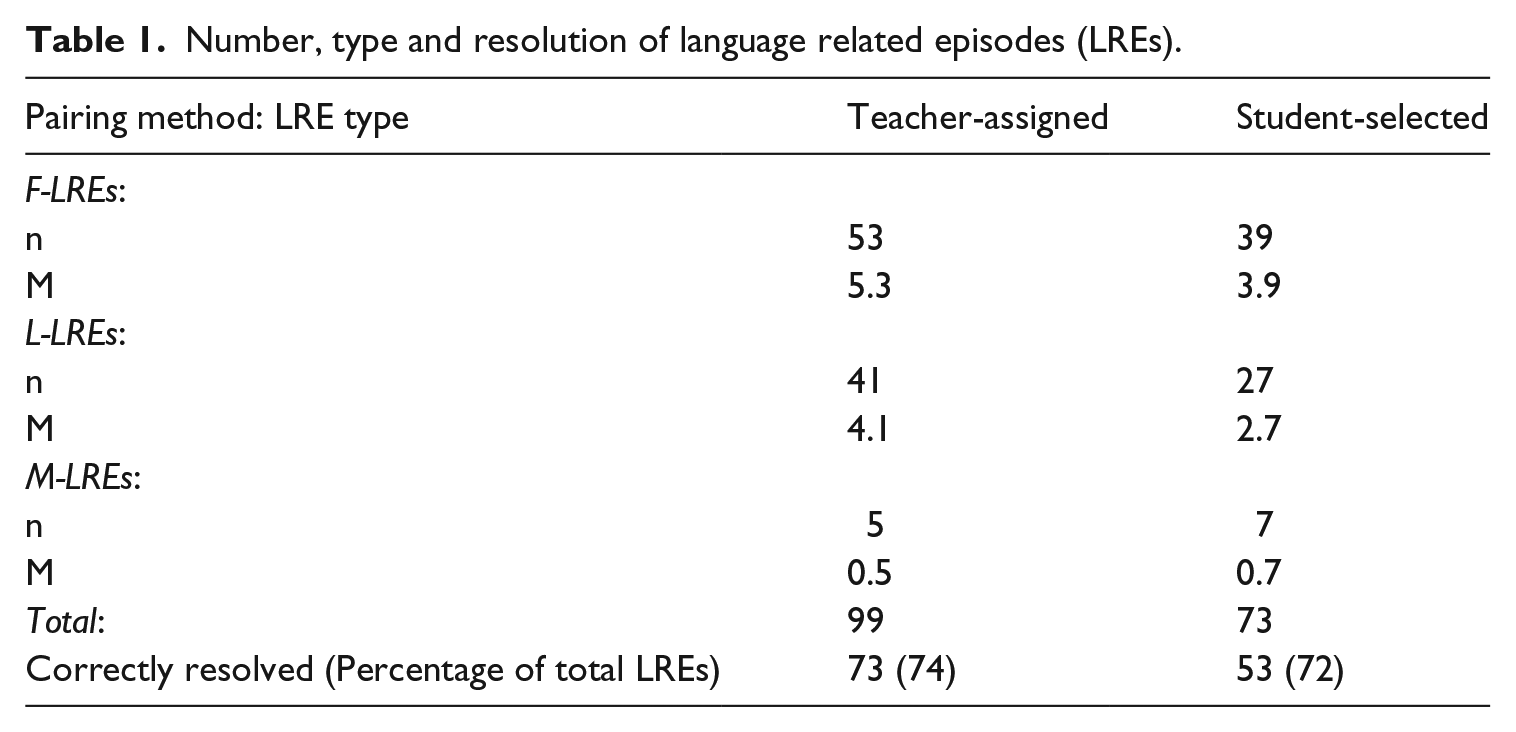
As shown in Table 2, the result of the t-test further revealed that the difference between the student-selected and teacher-assigned pairs was statistically significant. Pairing conditions clearly had an effect on the amount of LREs produced. According to the result, the teacher-assigned pairs produced a significantly larger amount of LREs.
Language related episodes (LREs).

However, as to the off-task episodes, a different picture was observed in the two pairing methods. According to Table 3, there was a huge difference between mean score of the student-selected and teacher-assigned pairs in terms of the number of episodes in which the students digressed from the main task (off-task episodes). In fact, the analysis of the talk of the teacher-assigned pairs revealed only one case of such digression. In short, the student-selected pairs suffered from off-task behavior as they generated a substantially larger number of off-task episodes.
Off-task episodes.

2 Patterns of dyadic interaction
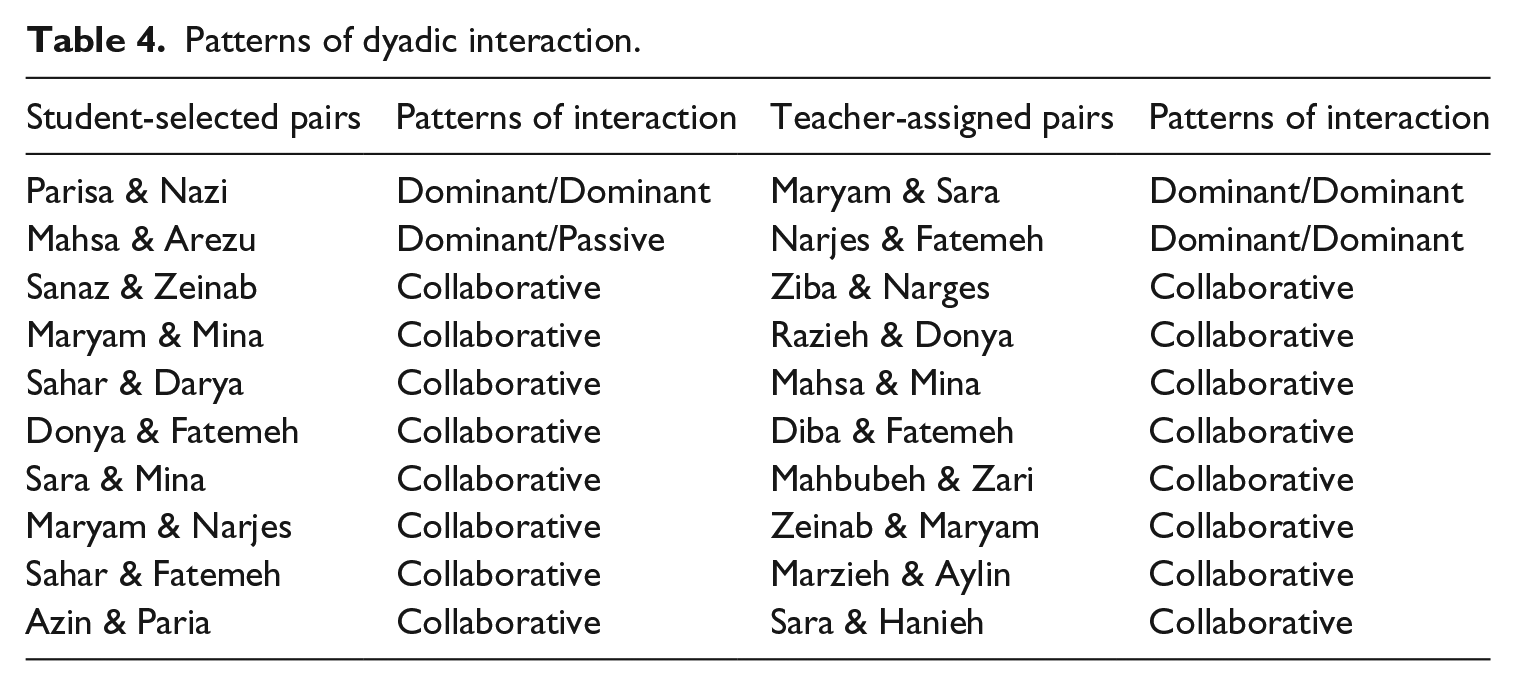
Three patterns of interaction emerged from the data: collaborative, dominant/dominant, and dominant/passive. Table 4 displays that the majority of pairs exhibited a collaborative relationship. As far as the student-selected pairing was concerned, one pair showed a dominant/dominant pattern and another one a dominant/passive pattern. Regarding the teacher-assigned pairs, two pairs formed a dominant–dominant relationship.
Patterns of dyadic interaction.
3 Writings
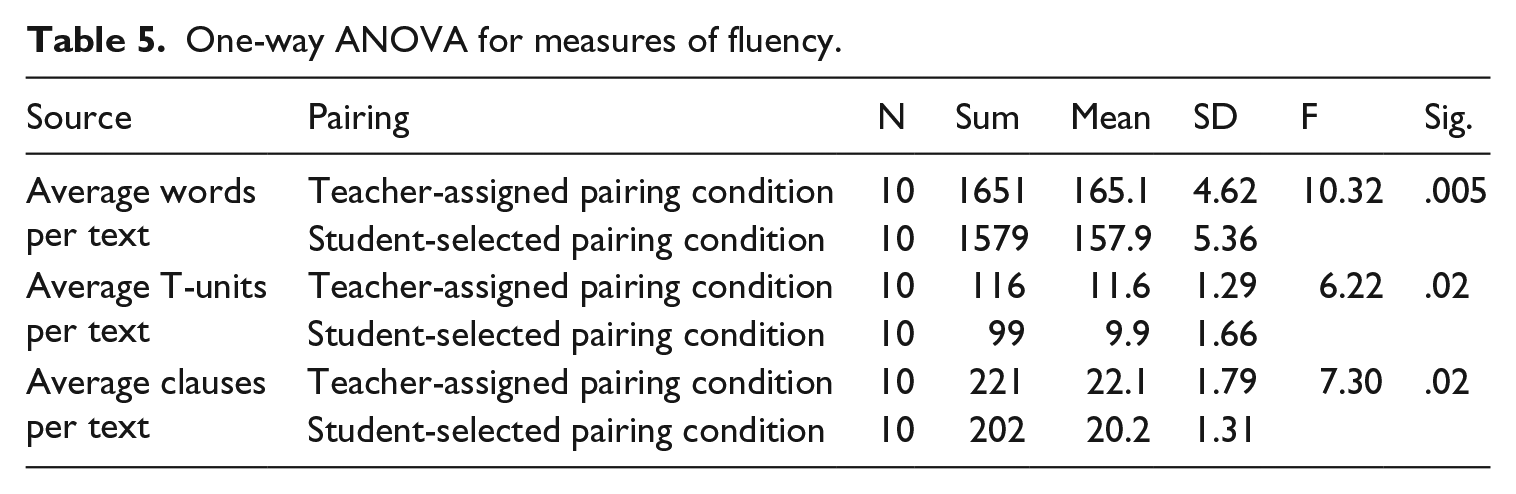
As indicated earlier, three aspects of language use were examined to see how the participants in the two pairing conditions (student-selected and teacher-assigned) performed the writing task. As can be seen in Table 5, the teacher-assigned pairing method led to higher means regarding all the measures of fluency (the average number of words, T-units and clauses per text). The results of one-way ANOVA also revealed that the difference between the groups was statistically significant (words per text: F = 10.32, df 1, 18, p = 0.005; T-units per text F = 6.29, df 1, 18, p = 0.02; clauses per texts F = 7.30, df 1, 18, p = 0.01). Thus, the teacher-assigned pairs produced more fluent texts than the student-selected pairs.
One-way ANOVA for measures of fluency.
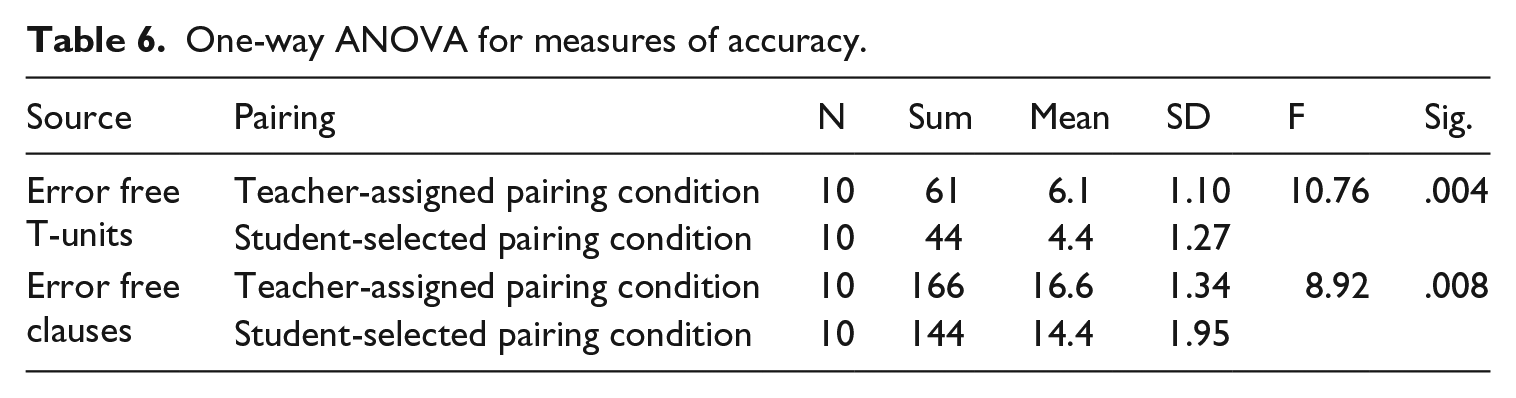
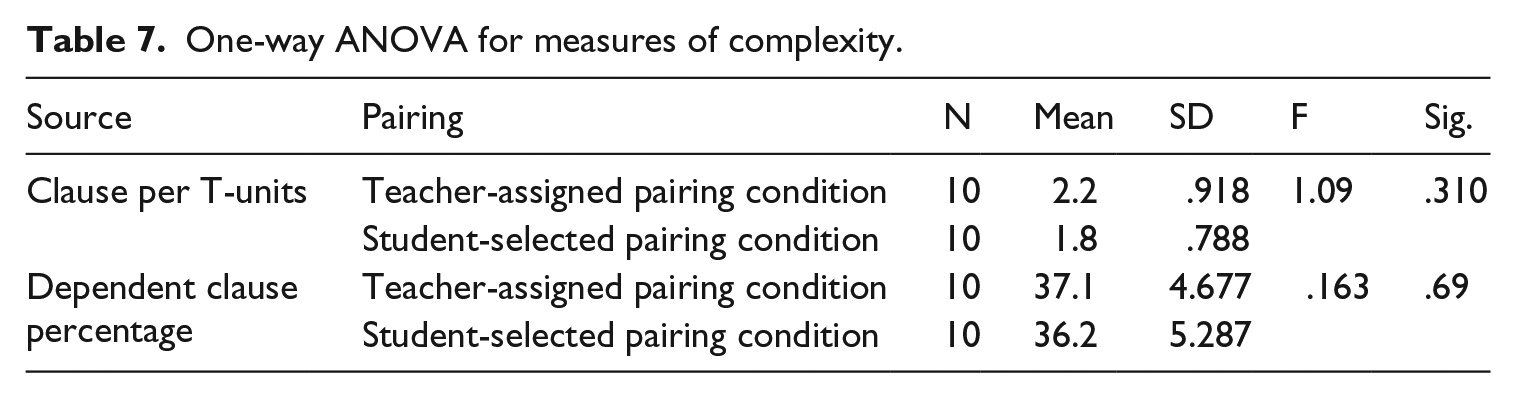
A similar trend was obtained with the two measures of accuracy, namely error free T-units and error free clauses. Table 6 shows that the teacher-assigned pairs significantly outperformed the student-selected pairs on both measures of accuracy (error free T-units: F = 10.76, df 1, 18, p = .004; error free clauses: F = 8.92, df 1, 18, p = 0.008). However, as to complexity, a different picture was observed in the data. Results, as shown in Table 7, revealed no significant difference between the two pairing conditions regarding the complexity measures (ratio of clauses to T-units: F = 1.09, df 1, 18, p = 0.31; percentage of dependent clauses: F = 0.163, df 1, 18, p = 0.69). Overall, these findings indicate that teacher-assigned pairing condition resulted in more accurate and fluent performance than student-selected one.
One-way ANOVA for measures of accuracy.
One-way ANOVA for measures of complexity.
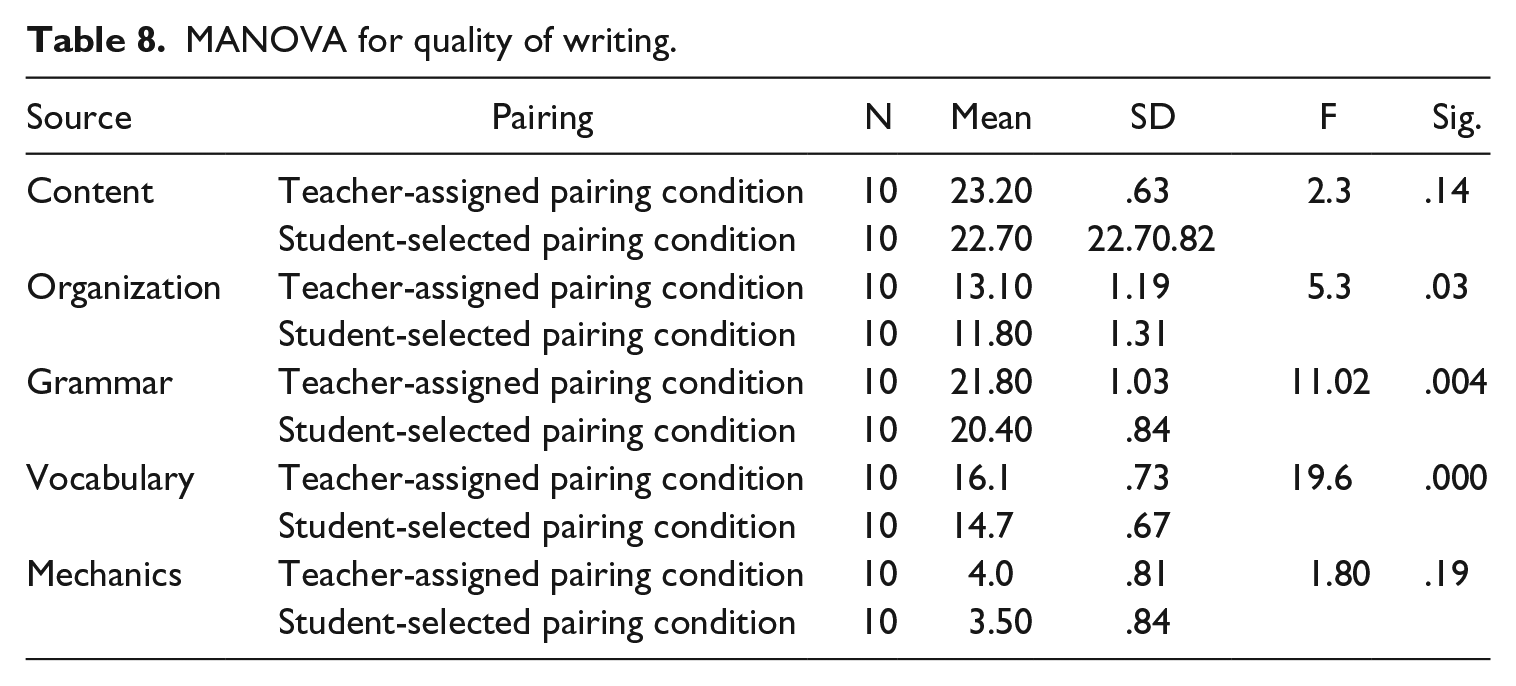
Moreover, the texts were assessed using a rubric to examine the quality of writings produced by the students of the two pairing methods. As shown in Table 8, the results of MANOVA revealed that the teacher-assigned pairs significantly outperformed the student-selected ones in terms of organization, grammar and vocabulary (organization: F = 5.33, df 1, 18, p = 0.03; grammar: F = 11.02, df 1, 18, p = 0.004; vocabulary: F = 19.60, df 1, 18, p = 0.00). This suggests that the teacher-assigned pairs wrote texts of higher quality.
MANOVA for quality of writing.
IV Discussion
The purpose of this study was to investigate how pairing method, namely student-selected and teacher-assigned, may influence the nature of peer interaction (in terms of the number and type of LREs), the patterns of dyadic interaction as well as the outcome of pair work.
In line with prior research (Basta, 2011; Chapman et al., 2006; Mitchell et al., 2004), this study indicated that pre-existing friendship was the sole criterion upon which the students relied to choose their pair members. One of the significant themes which emerged from the learner talk was that the student-selected pairs engaged in conversations that were by no means related to the completion of task at hand (which we referred to as off-task episodes). The completely personal nature of these topics led us to conclude that it was the friendship factor among the student-selected pair members which contributed to off-task behavior. Thus, this study enriches findings derived from quantitative questionnaire responses suggesting that student-selected pairs are less task-oriented than teacher-assigned ones (Chapman et al., 2006 & Mitchel et al., 2004). Additionally, this result appears to support Cooper’s (2005) as well as Price’s (2006) contention that self-selected groups cannot manage time efficiently since they tend to spend a considerable amount of time talking about unrelated topics (i.e. off-task behavior).
Results further indicated that there was a greater focus on language use in the teacher-assigned pairs than in the student-selected ones. This was evident in the statistically significant difference in the number of produced LREs between the two pairing conditions. Thus, this study furthered previous research on the nature of peer interaction by finding that pre-existing relationship and in particular friendship in the student-selected pairs strongly influences the amount of deliberation and focus on language use. This is particularly important given the fact that in an EFL context, the classroom may be the only place in which students are provided with the opportunity to practice using the L2. Moreover, since several studies regard LREs as a representation of L2 learning in progress (Basturkmen, Loewen, & Ellis, 2002; Gass & Mackey, 2007; Kim, 2008; Leeser, 2004; Mackey, 2012; Williams, 2001) and off-task behavior (given that it predominates) as representing fewer learning opportunities (Baker et al., 2004; Goodman, 1990; Karweit & Slavin, 1981; Lee et al., 1999; McKinney et al., 1975), this could suggest that the teacher-assigned pairs benefited more from working together than the student-selected pairs.
In keeping with previous studies (Fernández Dobao, 2012; Storch & Wigglesworth, 2007; Wigglesworth & Storch, 2009), the analysis of data also revealed that although both pairing methods generated a considerable percentage of grammatical and lexical LREs, mechanical LREs were quite rare. It seems likely that the students worked jointly to produce lexically and grammatically correct texts, but most of decisions about mechanics (i.e. spelling and punctuation) were made by the individual student who took responsibility for writing the final version of the text. Thus, this study, as did that of Fernández Dobao (2012), suggests that peer collaboration influences grammar and vocabulary but not mechanics. This is in line with the conclusion reached by Keck, Iberri-Shea, Tracy-Ventura and Wa-Mbaleka’s (2006) meta-analysis that interaction is effective for both lexis and morphosyntax. Moreover, this finding gives further support to Long’s (1996, p. 414) argument that ‘feedback obtained through negotiation work or elsewhere may be facilitative of L2 development, at least for vocabulary, morphology and language specific syntax’.
As to the patterns of interaction, the study found no particular difference between the two pairing conditions: both groups predominantly exhibited a collaborative relationship. This finding contrasts with prior research (Bacon et al., 1999; Hilton & Philips, 2008; Mushtaq et al., 2012; Russell, 2010) which suggested that student-selected pairing condition leads to better collaboration than teacher-assigned pairing. There are two possible explanations as to this discrepancy in findings. The first refers to the instruments used by these studies to examine the nature of peer interaction. In other words, their results are simply based on what students reported in written journals, questionnaires or interviews rather than on a close examination of their interaction (i.e. the failure to demonstrate validity). The second possible explanation lies in the friendship-based nature of relationship in the student-selected pairs which may have positively influenced students’ perception of their group dynamics (Chapman et al., 2006; Hilton & Philips, 2008). Thus, from a methodological perspective, the use of audio-recording of peer-peer interactions in this study enabled us to pursue what was actually going on while the pairs were trying to write the composition. One point that needs to be mentioned here is that some of the students in the teacher-assigned pairs might have had some familiarity with each other due to participating in similar previous courses and this might have partly contributed to the collaborative interaction among them.
It should be further noted that regardless of pairing condition, all the participants in the study were at the same proficiency level. This study corroborated the work by Storch and Aldosari (2013) concluding that students who shared the same proficiency predominantly exhibited a collaborative relationship.
Regarding the outcome of pair work, the texts produced were analysed using both quantitative and qualitative measures. The analysis of the written productions revealed that the teacher-assigned pairs significantly outperformed the student-selected ones on measures of fluency and accuracy, but not complexity. As to the quality of writings, the results also demonstrated that the teacher-assigned pairs wrote texts of significantly better quality in relation to organization, grammar and vocabulary. This finding contradicts prior research by Mushtaq et al. (2012) and Mahenthiran and Rouse (2000) which reported a better outcome (i.e. higher grade) for student-selected groups. However, in Mushtaq et al.’s study the quality of outcome was self-assessed by the students through a questionnaire rather than by an analysis of the outcome and may lack sufficient validity. Mahenthiran and Rouse further concluded that student-selection led to higher project grades. Nevertheless, only 20% of the total grade was assigned to the quality of group activity while the remaining 80% concerned group dynamics. It is not evident whether the reported higher project scores were due to higher task grades or better group dynamics. So, the results of these studies should be interpreted with caution.
Moreover, these findings, as did those of Basterrechea and García Mayo (2013), Fernández Dobao (2012) as well as Wigglesworth and Storch (2009), may indicate that it was the greater focus on language use in the teacher-assigned pairs (as they generated a significantly larger number of correctly resolved LREs ) which resulted in the production of more accurate and better texts.
This study furthers previous research indicating that when pairing students it is crucial to consider, among other issues, the kind of pre-existing relationship which may exist between students. Thus, the findings lend support to Philp, Adams and Iwashita (2014, p. 201) highlighting that ‘pair/group participants and their prior experiences together’ (in this case pre-existing friendship) may influence the nature of peer interaction (in this study, pre-existing friendship in the student-selected dyads led to considerable off-task behavior) and consequently moderate the potential of peer interaction for L2 learning.
Overall, the results suggest that simply putting students into pairs does not guarantee a successful pair work. It is necessary for teachers to ponder about pair composition before employing pair activities. It seems that pre-existing friendship among student-selected pair members would distract them from the main task (as evidenced by off-task episodes) and further influence the outcome of pair work.
Finally, it ought also to be noted that the participants in the current study only involved female L2 learners. A number of prior studies have reported that gender impacts on the quantity and quality of LREs as well as first language use (Azkarai, 2015a, 2015b; Azkarai & García Mayo, 2012; Ross-Feldman, 2007). It may be the case that gender influences issues such as off-task behavior. An open issue for further research, therefore, is how the gender of students may affect the nature of interaction in student-selected and teacher-assigned pairing condition.
Footnotes
Appendix 1
Appendix 2
Funding
This research received no specific grant from any funding agency in the public, commercial, or not-for-profit sectors.