







Abstract
Research has shown that tasks provide second language (L2) learners with many opportunities to learn the L2. Task repetition has been claimed to benefit L2 learning since familiarity with procedure and/or content gives learners the chance to focus on more specific aspects of language. Most research on task repetition has focused on adult populations, but child learners are an under-researched group. The same goes for first language (L1) use during L2 interaction, which has been mainly studied among adult L2 learners whereas little is known about L1 use among child L2 learners interacting while they complete communicative tasks. This study explores to what extent and for which purposes children in an English as a foreign language (EFL) setting use their shared L1 (Spanish). Furthermore it also considers how task repetition (exact vs. procedural task repetition) influences their L1 use. Forty-two EFL learners worked in pairs while they completed a spot-the-difference task twice. Our findings showed a significant decrease in L1 use when learners repeated the task in the two conditions but a minor effect of task repetition on the functions the L1 served.
I Introduction
Tasks provide second language (L2) learners with many opportunities to interact, to receive and give information, and to produce output collaboratively (García Mayo, 2007; Storch, 2009; Swain & Lapkin, 1998, 2000, 2001). Research focusing on task-based interaction has shown the positive effects of task repetition (exact vs. procedural task repetition) for L2 performance and learning (Bygate, 2001; Kim & Tracy-Ventura, 2013; Mackey, Kanganas & Oliver, 2007; Shintani, 2012, 2014). However, sometimes L2 teachers in foreign language settings are reluctant to let their students work in pairs or small groups because they feel they are going to make use of their shared first language (L1) (Tognini & Oliver, 2012). Although a balanced use of the L1, that is, one in which the teacher strategically uses it to facilitate interaction in the classroom, has been shown to have positive effects for subsequent L2 learning (Alegría de la Colina & García Mayo, 2009; Azkarai & García Mayo, 2015; DiCamilla & Antón, 2012; Scott & de la Fuente, 2008; Storch & Aldosari, 2010; Swain & Lapkin, 2000; Tognini & Oliver, 2012), most studies that have explored what role the L1 plays have mainly focused on adult populations, and research with children is notably scarce (Butler, 2015; Shintani, 2012, 2014; Tognini & Oliver, 2012). Research on child interaction in English as a second language (ESL) was limited until pioneering work by Oliver (1995, 1998). In her research she reported that, although children’s interaction led to language learning, they employed fewer language learning strategies (especially fewer comprehension checks) than adults and they received less feedback. Most interaction studies have focused on adult and child populations in ESL, whereas English as a foreign language (EFL) settings have been under-researched (Shehadeh & Coombe, 2012; for a review, see García Mayo & Alcón Soler, 2013) and especially child EFL settings. More research on young foreign language learners is in order as the number of programs introducing foreign languages in school settings earlier in life is on the rise (Enever, 2011; Nikolov & Mihaljević Djigunović, 2011) and teachers and stakeholders need to have information about the children’s learning processes in order to provide them with the best learning conditions (García Mayo, forthcoming). As Butler (2015) points out, research in this area can potentially contribute not only to theory-building in child second language acquisition but also to research methodologies and policy-making.
The goal of the present study is to fill this gap by assessing the extent to which child foreign language learners use their L1 when they complete a communicative task and whether or not task repetition has any impact on L1 use and the functions it serves.
II Task repetition effects in child task-based interaction
Task repetition (henceforth, TR) has been shown to be beneficial both for adults and children. The main claim in the second language acquisition (SLA) literature (Bygate, 2001, 2006; Samuda & Bygate, 2008) is that repeating a task offers learners the possibility of focusing their attention on meaning the first time the task is performed and on focus-on-form (FonF) processes upon TR. Thus, TR becomes a favorable context for learning. From a pedagogical perspective, teachers would probably welcome information about which type of repetition, namely exact TR (ETR; same content and procedure) or procedural TR (PTR; same procedure, different content) (Patanasorn, 2010) might have an impact on their learners’ developing interlanguage.
Research with adults and high-school students has shown that, overall, when learners are familiar with a task, their opportunities to focus on the form of the message increase (Hawkes, 2012). In addition, they negotiate for meaning more often (Plough & Gass, 1993), the syntactic complexity of their output is promoted (Kim & Tracy-Ventura, 2013), and L2 grammatical accuracy, complexity and fluency are also improved (Ahmadian & Tavakoli, 2011; Bygate, 2001; Gass, Mackey, Alvarez-Torres, & Fernández-García, 1999).
Research on the effects of TR on children’s output is scarce, although a few researchers have focused on this topic. For example, Mackey et al. (2007) explored whether there were differences in the use of interactional feedback on the basis of learners’ familiarity with the procedure and content of the task. Participants in their study were 7 to 8 year-old ESL children who worked in pairs on different communicative tasks. The authors manipulated the children’s familiarity with the procedure and content of the communicative tasks, and analysed their negotiation of meaning strategies during interaction. Their findings showed that when the content and the procedure of the task were unfamiliar, the learners generated more clarification requests and confirmation checks and they also provided more corrective feedback. With familiar content and procedure, the opportunities to use feedback were more frequent.
Pinter (2007) studied the interaction of two 10-year-old Hungarian boys while they completed a spot-the-difference task. She reported that by repeating the task the children’s confidence increased and they made less use of their shared L1. More recently, Shintani (2012, 2014) explored the interactions between a teacher and a group of 6-year-old Japanese EFL beginner learners when they performed an input-based task nine times during five weeks. Shintani’s findings showed that the teacher modified her input as learners’ comprehension improved over time and that learners completed the task more easily due to TR. They also learnt the targeted words, and their negotiation and language play increased as they were familiar with the task, which contributed to their motivation. Shintani reported that L1 use as metatalk (to explain task purpose and procedure) decreased over time, but within-task L1 use (to perform the task) remained the same as it contributed to task completion. A few studies have focused on the impact of TR on complexity, accuracy and fluency (CAF) measures of learner performance. Furthermore, several studies (Bret Blasco, 2014; García Mayo, Imaz Agirre & Azkarai, forthcoming; Kim & Tracy-Ventura, 2013; Sample & Michel, 2014) have reported some benefits in at least one of the CAF measures in EFL settings as well. García Mayo and Imaz Agirre (forthcoming) have reported that TR had no significant impact on children’s negotiation of meaning strategies but, however, it did have a positive effect on the dyad’s collaborative patterns.
However, none of the studies referred to above has carried out a detailed analysis of the potential impact of different types of TR (ETR vs. PTR) on L1 use and the functions it serves. The use of the L1 in the second/foreign language classroom has always been a controversial issue, and research on the topic has gained importance over the last decades (Antón & DiCamilla, 1998; Azkarai & García Mayo, 2015; Storch & Aldosari, 2010; Swain & Lapkin, 2000; Villamil & de Guerrero, 1996). Some of the studies that have focused on L1 use and functions in L2 task-based interaction are reviewed in the next section.
III L1 use in task-based interaction
As mentioned above, research on L2 task-based interaction has shown that a balanced L1 use might have positive effects on subsequent L2 learning. Some researchers even claim that L1 use is necessary to make sure that learners understand task instructions (Nikolov & Mihaljević Djigunović, 2011). In foreign language settings, learners do not have many opportunities to practice their target language outside and inside the classroom as is the case in L2 settings (García Mayo & García Lecumberri, 2003; Muñoz, 2006). In most EFL settings, unlike in ESL contexts, learners are usually exposed to the target language for about 2–5 hours per week, and they have little access to native speaker teachers and/or opportunities to practice the language outside the classroom.
Research on L1 use by adult EFL learners during task-based interaction has focused on L1 use as well as on the functions the L1 serves. These studies have shown that, overall, EFL learners do not make an excessive use of their L1 (under 20% in Azkarai & García Mayo, 2015, and in Storch & Aldosari, 2010). With regard to the functions the L1 serves, research in EFL settings has shown that learners employ their L1 mainly with a metacognitive function, for metatalk, phatics – expressions such as ‘mmm, yeah, ok’ – and for vocabulary searches, although these functions might vary depending on the task that learners are carrying out (see Alegría de la Colina & García Mayo, 2009; Azkarai & García Mayo, 2015; Storch & Aldosari, 2010). The different functions the L1 serves help learners clarify different aspects of task procedure, keep interest in the task and formulate their goals (Alley, 2005; Antón & DiCamilla, 1998; Brooks & Donato, 1994). Using the L1 has also been claimed to reduce cognitive overload while completing form-focused grammar tasks (Scott & de la Fuente, 2008). In general, as Moore (2013: 243) points out ‘the studies are consistent in their findings that the L1 is used for constructive socio-cognitive purposes related to about-task, on-task and off-task negotiations, which are hypothesized to be conductive to second language learning.’
However, research on L1 use in task-based interaction among children is scarce. Tognini and Oliver (2012) analysed the way English primary school children learning Italian and French in Australia used their L1. The researchers recorded five complete lessons in each of the two schools that participated in the study and focused on the L1 use that occurred in teacher–learner interaction and peer–peer interaction. Their findings showed that in peer–peer interactions learners employed their L1 to scaffold their production and to manage the task. In addition, learners seemed to employ their L1 more in meaning-focused exchanges than form-focused exchanges. Tognini and Oliver (2012) concluded that these learners employed their L1 mainly for negotiation of meaning and interpersonal exchanges.
As mentioned above, Pinter (2007) and Shintani (2012, 2014) also considered L1 use by Japanese EFL children during their L2 performance, specifically focusing on the effects of TR on L1 use. Pinter (2007), Tognini and Oliver (2012) and Shintani (2012, 2014) have shed some light on how children use their L1 in foreign language settings but their studies did not detail L1 functions as is usually the case in studies with adult populations (Azkarai & García Mayo, 2015; Storch & Aldosari, 2010). Furthermore, Pinter only analysed L1 use by two children, Shintani (2012, 2014) mainly focused on teacher–peer interactions, and Tognini and Oliver (2012) considered students learning French and Italian as a foreign language but did not analyse whether the learners’ L1 use decreased over time. None of these studies considered the effects of two types of TR conditions on L1 use and the function it served.
IV The present study
This study explores L1 use among Spanish EFL children during task-based interaction. Specifically, it examines whether exact task repetition (ETR) and procedural task repetition (PTR) play a role on the use and functions the L1 serves. Our research questions are the following:
To what extent and for which purposes do these EFL learners employ their L1 during L2 task-based interaction?
Are there any ETR or PTR effects on L1 use and the functions the L1 serves?
1 Hypotheses
On the basis of previous research on L1 use and TR we have entertained the following hypotheses:
These children will not make an excessive use of their L1 (Azkarai & García Mayo, 2015; Storch & Aldosari, 2010; Swain & Lapkin, 2000). The L1 will serve different purposes and will help them move the task along.
L1 use will decrease over time due to TR (Pinter, 2007; Shintani, 2012, 2014). No studies so far have explored the potential of two different types of TR but we hypothesize that the decrease in L1 use will be more significant in ETR (same content, same procedure) than in PTR (same procedure, different content) as in the latter the children might not be familiar with some lexical items. We also hypothesize that L1 functions will also change in the TR conditions.
2 Participants
The participants of this study were 42 Spanish EFL learners attending the same school in a major Spanish city. They were in 4th primary grade (9–10 years old) and had started learning English at the age of 4 (mean age: 4.18), with 5 hours of instruction in English per week. In order to assess their English level, participants completed the Cambridge Young Learners of English Starters Test. The average score was 17.32 out of 25 total points.
3 Procedure and materials
Participants were asked to work in pairs on a spot-the-difference task, which have been claimed to promote collaborative work because both participants hold part of the information they need in order to complete it (Pica, Kang, & Sauro, 2006). All participants were familiar with this task, as they had previously worked on similar ones at school, and those used in this study were agreed upon by their teachers. They were divided into group A and B and completed the task at two different testing times: at time 1 (T1) all participants completed the same task, ‘the cowboy task’. This task included a picture of a cowboy in a desert surrounded by different items, such as a snake, a vulture, a cactus or a palm tree. These items and the cowboy’s clothes differed and learners had to guess what those differences were. The only element that distinguished the task completed by 3rd and 4th year learners was the number of differences in each drawing: five differences for the former and eight differences for the latter. At T2, three months later, the children in group A completed exactly the same task that they had done at T1 (ETR condition), and those in group B were asked to complete another spot-the-difference task with a different content (PTR condition): this time there was a boy lying on the grass and surrounded by a butterfly, a bird, a stone and some other elements. There was also a control group (24 participants) that conducted a completely different task at T2, namely a guessing game task also in pairs. We will not report findings from this group as it will be beyond the scope of this article.
The researchers told the children that they should complete the task in English but said nothing about the possibility of using their shared L1 in order to avoid interference with their natural interactional processes. The researchers were not involved in the interaction unless they noticed that the children were stuck with the task. Consider example 1 below with María and Pedro (all names are pseudonyms), students in the ETR condition group at T1. Both seem to be running out of ideas of questions to ask about the items appearing in the task. In turns 5 and 6 the researcher makes a couple of suggestions so that they can focus on the colors of the clothes that the cowboy is wearing:
Example 1: ETR condition group, T1
1 María: there is a star?
2 Pedro: no.
3 er have they got a a chaqueta [jacket]?
4 María: er yes.
5 Researcher: what about the colors of what the cowboy is wearing?
6 the colors of the clothes?
7 María: the colors is the trousers blue?
8 Pedro: yes.
9 the cowboys is the chaqueta [jacket] red?
10 María: no.
11 the cowboys is a a hat yellow?
12 Pedro: no.
4 Data codification
The oral interactions of all the dyads were transcribed verbatim using CLAN/CHILDES (McWhinney, 2000). All utterances were codified as c-units (see Foster, Tonkyn & Wigglesworth, 2000; Loban, 1966), and each c-unit containing any instance of L1 was identified for subsequent analysis (henceforth, L1 c-units). An independent researcher also analysed all the oral interactions transcribed. Different rounds of coding resulted in an agreement of 96%. The remaining 4% of the utterances were considered again by the two researchers and a final agreement of 100% was reached. Finally, the different functions the L1 served were classified into eight categories: clarification request, confirmation check, lack of knowledge, phatics, repetitions, metacognitive talk, appeal for help and borrowing. In what follows we describe each category with examples from our current database.
Clarification requests are used by the listener when he or she needs to clarify what the speaker has said (Oliver, 2002, p. 103). In example 2 below Diego and Carmen, students in the ETR condition, work together in the task at T2. They are talking about the clouds that appear in their pictures, and in turn 3 Diego is not sure about what Carmen has said in turn 2 and asks her to clarify (¿qué has dicho? [what did you say?]). In turn 4 she repeats what she has just said (‘two clouds, I have two clouds’), but Diego does not know what she is referring to and he asks her again for a clarification in turn 5. Carmen repeats the same in Spanish (turn 6), so Diego is able to finally understand. In this case, Carmen employs Spanish as a borrowing function.
Example 2: ETR condition group, T2
1 Diego: two clouds.
2 Carmen: no está. [there isn’t.]
3 Diego: ¿qué has dicho? [what did you say?]
4 Carmen: two clouds, I have two clouds.
5 Diego: ¿qué es eso? [what is that?]
6 Carmen: dos nubes. [two clouds.]
7 Diego: vale. [ok.]
Confirmation checks are used by the listener when he or she needs to confirm that he or she has understood what the speaker said (Oliver, 2002, p. 103). Example 3 below shows Álvaro and Tomás, who worked in the ETR condition at T2. Álvaro asks Tomás about the head of the cowboy, referring to the hat that he is wearing. Tomás wants to confirm with him that he actually refers to the hat (turn 2). He receives no answer from Álvaro, but both go on with the task and ask about another item that the cowboy is wearing (a belt). In turn 4, this c-unit was coded as metacognitive talk, as Álvaro is using his L1 to organize the task (Alegría de la Colina & García Mayo, 2009, p. 330) and turn 6 was coded as an appeal for help (Muñoz, 2007) because Tomás uses his L1 to ask for a word he does not know how to say in English:
Example 3: ETR condition group, T2
1 Álvaro: have you, have you a head in the cowboy?
2 Tomás: ¿sombrero? [hat?]
3 yes.
4 Álvaro: te toca. [it’s your turn.]
5 Tomás: have you.
6 ¿sabes cómo se decía cinturón? [do you know how to say belt?]
7 Álvaro: no.
When participants fell back on their L1 to express that they did not know what their partners were asking, the function was coded as lack of knowledge, as in turn 2 in example 4 below, where Luis and Isabel, students in the PTR condition, complete the task at T2. Luis is looking for the English word for ‘grass’ and asks Isabel how to say it in English (appeal for help). She replies that she does not know, and then Luis uses the Spanish word for ‘grass’, which we have coded as a borrowing (Muñoz, 2007) as the child uses his L1 to replace a word in English:
Example 4: PTR condition group, T2
1 Luis: ¿cómo se dice hierba? [how do you say grass?]
2 Isabel: no sé. [I don’t know.]
3 Luis: green hierba [grass]?
4 Isabel: yes.
Phatics are words that express sociability (‘yeah’, ‘ok’, ‘so’) rather than specific meaning (Azkarai & García Mayo, 2015). Consider example 5, where David uses his L1 to ask Mateo how to say ‘vest’ in English. Instead of saying ‘How do you say chaleco in English?’ he formulates the whole sentence in Spanish. In turn 2 Mateo answers that he does not know (lack of knowledge) and David resorts to his L1 again with a phatic function (turn 3):
Example 5: ETR condition group, T1
1 David: ¿cómo se dice chaleco? [how do you say vest?]
2 Mateo: er, no sé. [I don’t know.]
3 David: pues, [so,] you have the cowboy er you have a a jacket?
4 Mateo: yes.
Repetitions were those expressions when participants repeated in their L1 something they wanted to clarify when they felt their partners did not understand something in English. Example 6 below shows two students in the PTR condition at T1 working together. Cristina repeats a word in Spanish (piedra) to clarify what she wants to say (‘a rock’).
Example 6: PTR condition group, T1
1 Cristina: are you a rock?
2 Alejandro: er?
3 Cristina: a rock, piedra. [rock.]
4 Alejandro: yes.
5 Data analysis
The amount of L1 employed was calculated considering the total number of L1 c-units to the total number of c-units produced by each dyad, at each testing time and in the two repetition conditions. The codification of the functions the L1 served was made also considering each L1 c-unit. For example, example 5 above shows an L1 c-unit representing an appeal for help (¿cómo se dice chaleco? [how do you say vest?]), an instance of lack of knowledge (er, no sé [I don’t know]), and a phatic (pues [so]). Each of these c-units was coded according to the L1 function they served. In order to analyse potential significant differences between T1 and T2 in the two repetition conditions (ETR and PTR), we conducted a bilateral two sample binomial test for independent samples (α = 0.05). This test was conducted because we compared the different proportions of L1 c-units and functions the L1 served to the total number of c-units produced by each dyad at both testing times. Effect size was calculated by Cohen’s d (Cohen, 1998).
V Findings
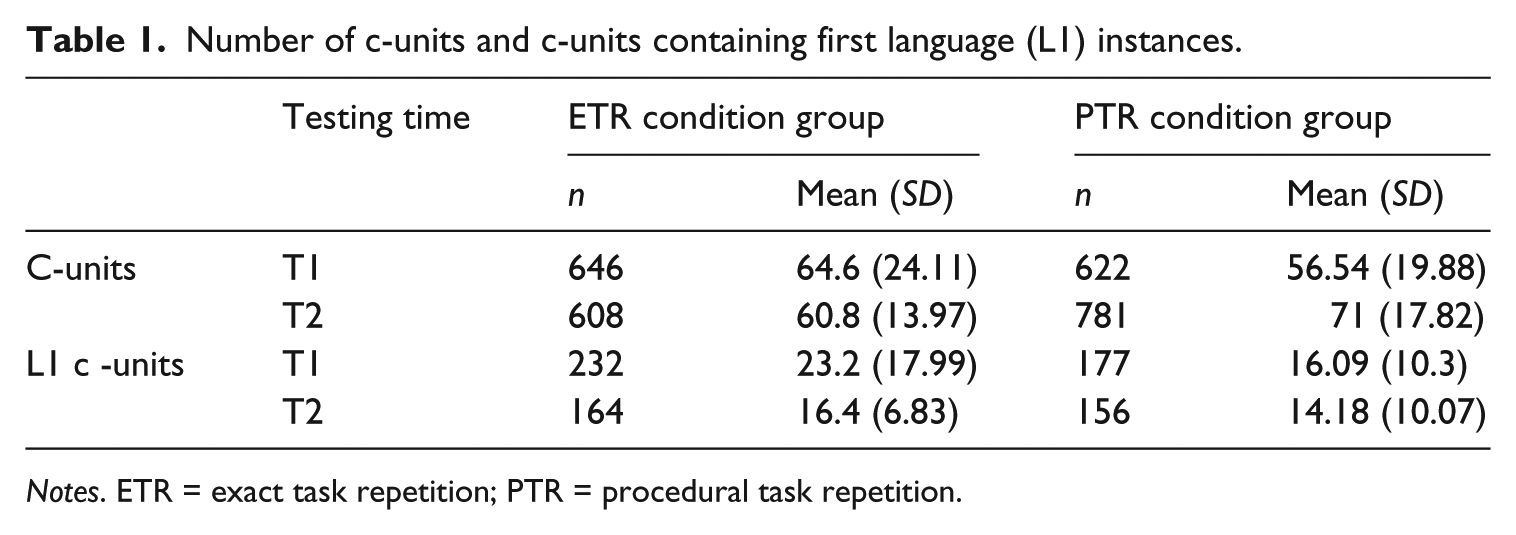
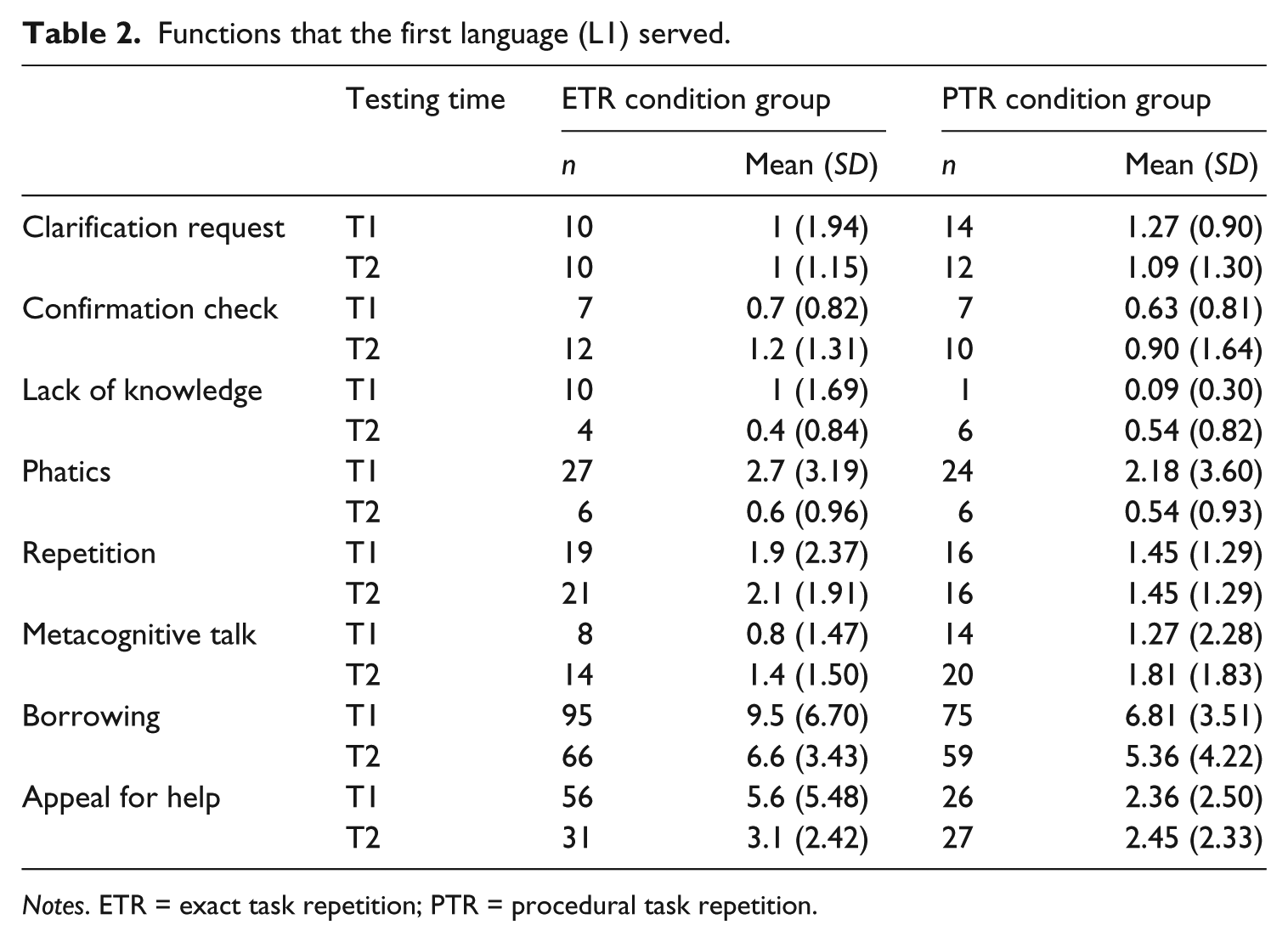
This section reports the findings following the order of the research questions posited above. The first research question focused on children’s L1 use and the purposes it served. Table 1 and Table 2 below display the details at both testing times and in the two different TR conditions (ETR and PTR).
Number of c-units and c-units containing first language (L1) instances.
Notes. ETR = exact task repetition; PTR = procedural task repetition.
Functions that the first language (L1) served.
Notes. ETR = exact task repetition; PTR = procedural task repetition.
These children employed their L1 in less than 36% of the total number of c-units they produced. Specifically, the findings showed that the ETR group employed their L1 at T1 more than at T2, and more than the PTR group at T1 and at T2 (ETR at T1: 232 L1 c-units corresponding to 35.91% of their total number of c-units). At T1, 28.46% of the total c-units were L1 c-units in the PTR group (177 L1 c-units). At T2 26.97% of the total c-units were L1 c-units in the ETR group (164 L1 c-units). The L1 was used the least by the PTR group at T2 (156 L1 c-units corresponding to 19.97% of their total number of c-units).
The analysis of the L1 functions showed that all learners employed their L1 mainly for borrowings and appeals for help at both testing times. These two functions were followed by the use of the L1 with a phatic function mainly at T1. At T1 the L1 was least used for confirmation checks in the ETR group and to express lack of knowledge in the PTR group. At T2 the least common function the L1 served in both groups was lack of knowledge, and phatics in the PTR group.
The second research question focused on the effects of TR, both ETR and PTR, on L1 use and the functions it served. The findings showed that the two groups employed their L1 significantly more at T1 than at T2. In the ETR group the percentage of L1 use decreased from 35.91% to 26.97% (z = 3.40, p = 0.0006, d = 0.49) and in the PTR the decrease was also similar from 28.46% to 19.97% (z = 3.70, p = 0.0002, d = 0.18). Significant differences were also found from T1 to T2 in the two groups on the functions the L1 served. The ETR group employed the L1 for confirmation checks and metacognitive talk significantly more at T2 than at T1 (z = 1.97, p = 0.04, d = 0.45; z = 2.17, p = 0.02, d = 0.4, respectively), but at T1 this group employed their L1 for phatics significantly more than at T2 (z = 2.82, p = 0.004, d = 0.89). The PTR group employed the L1 to indicate lack of knowledge significantly more at T2 than at T1 (z = 2.08, p = 0.03, d = 0.72), but significantly more for phatics at T1 than at T2 (z = 3.08, p = 0.002, d = 0.62).
The results also showed that the ETR group employed the L1 significantly more than the PTR group at both testing times (T1: z = 2.83, p = 0.004, d = 0.48; T2: z = 3.07, p = 0.002, d = 0.25). Also, at T1 the ETR group employed the L1 to indicate lack of knowledge and to appeal for help significantly more than the PTR group (z = 2.31, p = 0.02, d = 0.74; z = 2.36, p = 0.01, d = 0.76 respectively), but the PTR group used the L1 for metacognitive talk significantly more than the ETR group (z = 1.98, p = 0.04, d = 0.24). At T2 no differences were found regarding L1 functions.
VI Discussion
This section discusses the findings on the basis of the data reported on above. The findings are organized in two sections: the first details how frequent L1 use is in the oral interaction of young learners and the purposes the L1 served, the second assesses how different TR conditions, namely ETR and PTR affect L1 use and its functions.
1 Main findings on L1 use and functions in young EFL learners
In line with our hypothesis, and previous studies focusing on L1 use by adults (Azkarai & García Mayo, 2015; Storch & Aldosari, 2010; Swain & Lapkin, 2000), these children did not make an excessive use of their shared L1 (below 36%). However, when considering research in EFL settings, these children employed their L1 more frequently than adults, who employed it less than 20% (Azkarai & García Mayo, 2015; Storch & Aldosari, 2010). The differences found in the overall amount of L1 used by these children and previous research carried out with adult EFL learners might be due not only to their age but also to their proficiency in the foreign language. Adult EFL learners in studies considering L1 use had an intermediate proficiency in the target language, whereas children in the present study were all beginners. The former group might not have had such a strong need to fall back on their L1 as these young learners, particularly with regard to appeals for help and borrowings. Moreover, children differ from adults in their levels of social development, as well as in their relationships with other peers (Philp, Oliver & Mackey, 2008). Thus, whereas teenagers and adults could have felt more pressure to use their L2 and avoid L1 use in interaction, 9–10-year-old children felt more at ease and did not mind falling back on their L1 as long as the task was completed.
The L1 served a variety of purposes for these children. They used it mostly as an appeal for help and for borrowings at both testing times and in the two TR conditions. These two functions are clearly connected to avoid breakdowns in communication and to make language meaningful. The children ask for words they don’t know in English and/or use Spanish words as borrowings so that the communicative flow is not interrupted because of their gaps in knowledge. In line with what has been reported for EFL adults (Alegría de la Colina & García Mayo, 2009; Azkarai & García Mayo, 2015; Storch & Aldosari, 2010), these children also used their L1 with a phatic function or for metacognitive talk, to move the task along, again to avoid communicative breakdowns. To a much lesser extent, the L1 was used for some negotiation of meaning strategies (Long, 1996) such as clarification requests and confirmation checks, this time to repair communicative breakdowns whenever they occurred. However, no strategies such as comprehension checks were used to prevent those communicative breakdowns. The lack of this specific strategy can be linked to the observation already made by Oliver (1998, p. 377) regarding the egocentric nature of children in this age range when they mainly care about their own needs when completing communicative tasks rather than worrying about whether or not their partner has understood.
In summary, in line with previous research carried out with EFL adult learners (Alegría de la Colina & García Mayo, 2009; Azkarai & García Mayo, 2015; Storch & Aldosari, 2010), these EFL children used their shared L1 to a limited extent during L2 task-based interaction. The purposes for which they fell back on their L1 were also similar to those found in previous research with adults, namely, appeals for help, borrowings, metacognitive talk and phatics.
2 Task repetition effects on L1 use and L1 functions
In line with Pinter (2007) and Shintani (2012, 2014), L1 use decreased at T2 both in the ETR and the PTR conditions. This finding suggests that as learners become familiar with the task at T2 their need to fall back on their L1 decreases. Consider examples 7 and 8 below. In example 7 the researcher considers that Roberto and Daniel are making an excessive use of their shared L1 and encourages them to use more English (turn 6). In turn 7 it seems that Daniel tries to use English, even though he starts the sentence in Spanish but, after a silence, which might indicate that he was trying to think how to say what he wanted to say in English, he requests a clarification in Spanish (turn 8):
Example 7: ETR condition group, T1
1 Roberto: ¿no hay palmera o que no lo sabes? [there is no palm tree, or you don’t know?]
2 Daniel: no. [no.]
3 Roberto: ¿no hay palmera o no lo sabes? [there is no palm tree, or you don’t know?]
4 Daniel: no hay. [there isn’t.]
5 Roberto: ah, gracias. [oh, thanks.]
6 Researcher: English boys, you have to use English.
7 Daniel: tiene [does it] (…).
8 ¿o sea, sabes cómo se dice estrella? [I mean, do you know how to say star?]
9 Roberto: no. [no.]
10 Daniel: pues espera [then wait] (…)
In example 8 the same learners are working in the task, but this time at T2 in the ETR condition. In this case, Daniel makes reference to the word ‘star’ (in turn 2), and although at the beginning he employs Spanish in the same utterance, he also refers to the word in English. Moreover, Roberto in this case helps him and formulates the question that he thinks Daniel is trying to produce (‘it is star yellow?’ in turn 3):
Example 8: ETR condition group, T2
1 Daniel: er.
2 si tiene forma de estrella [whether it has the shape of a star], star.
3 Roberto: it is star yellow?
4 Daniel: no.
5 Roberto: it is a (…), it is a palm?
However, although L1 use decreased at both testing times upon task repetition, we had predicted a larger decrease in the ETR condition than in the PTR condition, and this was not the case. The decrease in L1 use was almost the same in the two groups, which suggests that completing a task in an ETR or a PTR condition does not seem to affect the decrease in L1 use from T1 to T2. The findings also showed that the ETR group employed their L1 significantly more than the PTR group at both testing times.
Finally, and in line with our prediction, a few differences were found regarding the decrease in the functions the L1 served at the two testing times and in the two TR conditions. Learners who worked in the ETR condition employed their L1 more frequently with a phatic function at T1 and for confirmation checks and metacognitive talk at T2, to repair communication breakdowns and to move the task along, respectively. In the case of the PTR group, they also employed their L1 with a phatic function at T1 and to indicate lack of knowledge at T2, which makes sense considering that these young learners were familiar with the task procedure but not with the task content and, therefore, had more doubts about it that they tried to solve by falling back on their L1. This finding is similar to what Kim (2013) reported regarding the production of language-related episodes (LREs) (Swain & Lapkin, 1998). In her study, those learners who participated in a PTR group produced significantly more LREs than those in an ETR group, probably due to the unfamiliar task content.
In most occasions learners employed phatics to show frustration when they were not able to produce a lexical item in English. These expressions could have been more frequent at T1 because participants faced the task for the first time. Consider example 9 with learners in the PTR condition. Raúl is struggling to find out how to say ‘snake’ in English, and in the first 3 utterances he expresses his frustration in Spanish through phatics. He finally asks Pablo in Spanish about the word ‘snake’ although he does not have the answer:
Example 9: PR condition group, T2
1 Raúl: mmm … ¡ay! [oh!]
2 er … ¡ay, jolin! [oh, damn!]
3 ¡ay no! [oh, no!]
4 Pablo do you know er …?
5 ¿cómo se dice serpiente? [how do you say snake?]
6 Pablo: no.
These young learners showed interest in completing the task by using confirmation checks and clarification requests as they tried to make sure the message was completely understood. Specifically, there is a significant increase in the use of confirmation checks at T2 in both TR conditions. In the case of metacognitive talk, there is also a significant increase in the use of the L1 with this function in both TR conditions at T2. The learners fell back on the L1 mostly to organize turn-taking, as can be seen in example 3 above where Álvaro asks Tomas about the cowboy’s hat and Tomás replies that his cowboy also has a hat. Álvaro immediately tells Tomás that it is his turn to continue with the task. At T1 they were still struggling to figure out how they should proceed with the task, that is, whether one of them had to first describe all the items in the picture at once, and then the partner will do the same, or whether they should refer to just one item and then wait for the partner to respond. At T2 learners were already familiar with the task procedure and took the initiative more easily to assign turns to each other. Overall, TR seemed beneficial for this group of learners, although probably those in the ETR group showed more engagement by increasing their use of confirmation checks and metacognitive talk at T2.
VII Conclusions
The goal of this study was to assess the extent to which child foreign language learners use their L1 when they complete a communicative task and whether or not repeating that task would have an impact on L1 use and the functions it served. The analysis of the oral interaction of 42 9–10-year-old Spanish EFL learners while performing a spot-the-difference task at two testing times has shown that the children did not make an excessive use of their shared L1. They fell back on their L1 mainly when they appealed for help or when they used borrowings, thus preventing communicative breakdowns. They also used their L1 with a metacognitive function, that is, to plan and organize the task so that it moved along without abrupt interruptions. Furthermore, repeating a task, whether in an ETR or a PTR condition, decreased L1 use and seemed to increase the children’s engagement especially of those in the ETR group.
Nevertheless, these findings should be considered with caution as our study only used a single task, namely, a spot-the-difference task. As has been shown in previous research with adults (Azkarai & García Mayo, 2015), task modality may trigger different L1 use. Therefore, more research should be carried out with a variety of tasks to assess the extent to which task modality influences L1 use and functions. In addition, we have only focused on the functions the L1 served, and have not considered the extent to which these learners employed their L2 for the same purposes. This would have provided us with a broader picture of how these children use the two languages during task-based interaction. Finally, future studies should consider children from age ranges that are further apart to determine whether age has a role to play in how a shared L1 is used when completing communicative tasks.
Footnotes
Funding
The author(s) disclosed receipt of the following financial support for the research, authorship, and/or publication of this article: This study was supported by the Spanish Ministry of Economy and Competitiveness - MINECO (Reference: FFI 2012-32212), by the Basque Government (Language and Speech. Reference: IT-311-10), and the University of the Basque Country, UPV/EHU (Reference: UFI11/06). The first author also acknowledges the post-doctoral grant awarded by the Basque Government (Reference: POS_2013_1_98).