







Abstract
Offered as a conceptual and programmatic piece, this article suggests that, due to its explicit educational orientation, the domain of instructed second language acquisition (ISLA) is challenged to align theoretical choices, research preferences, and educational practices in the interest of improving instructed L2 learning. It addresses the current disjuncture by proposing the constructs of ‘development’ along with ‘curricular thinking’, particularly when they are informed by complexity theory, in order to accomplish three interrelated goals: first, to specify a given educational context in a manner that allows for principled inquiry into how instructed L2 learning evolves in that setting; second, to affirm and operationalize its longitudinal trajectory in a traceable and actionable manner; and, third, to embed the situated and contingent forms of ‘doing teaching’ and ‘doing learning’ within a framework that gives them meaning, value, and significance for long-term development. The article discusses core issues arising from such an approach and briefly exemplifies it with curriculum development in a collegiate foreign language (FL) department. It concludes with a consideration of benefits for ISLA.
I Introduction
For all its diversity, instructed second language acquisition (ISLA) is concerned with how instruction affects second or foreign learning. Because the typical environment for instruction is that created by formal educational systems, ISLA is tasked with considering whether and how that setting – in its educational, administrative, and potent sociopolitical dimensions – affects the phenomenon of interest. Two alternatives can serve as broad-brush descriptors for how the field might respond to that challenge:
Is that educational context understood as ontologically and epistemologically non-negotiable; in other words, is it essential to instructed L2 learning and therefore requires that the dynamics of its complex social reality be incorporated right from the start? or
Do insights gained in other settings, such as naturalistic learning or experimental lab settings, generalize into educational contexts so as to facilitate understanding instructed L2 learning?
By framing the issue in this, perhaps, overly dichotomous fashion, I intend to signal that, to a considerable extent, ISLA has taken the latter route. To be sure, the preponderance of its research draws its data from classrooms rather than from experiments set up in a lab-like environment and is therefore designated as ‘classroom-based research’. However, using the classroom as a physical location for inquiry differs profoundly from conducting inquiry with an explicit recognition of the complex ecology of teaching and learning practices in classrooms. The latter mode of inquiry would interpret these components as themselves multiply interrelated within subsystems that, in turn, reside within the complex multi-layered reality of comprehensive educational systems. Furthermore, how those mutually interdependent and inextricably intertwined aspects motivate particular momentary choices and actions by teachers and learners would be understood as being embedded in a ‘present past’ and a yet to be realized but ‘already present possible future’ in light of the unmistakable reality of an extended educational history.
This article reflects my belief that significant developments over the last two to three decades point to the opportunity of making a conceptual shift that will put the instructional context back into ISLA. Not only does this seem possible from a theoretical, empirical, and practical standpoint; more important, it is necessary if ISLA is to accept its ethical responsibilities at a time of extraordinary levels of multilingualism and multiculturalism in the age of globalization, migration, and ever-expanding technological capacities (Douglas Fir Group, 2016).
I will explore this potential and need by taking an explicitly long-term developmental view that is embedded in educational settings. I do so by foregrounding two overriding consequences: First, such a shift means adopting a whole program and educational systems perspective rather than one focused on individual courses or individual pedagogical interventions. Inherently, such a view must consider ways of incorporating time and timing, pace and pacing, foregrounding and backgrounding of a considerable variety of instructional practices in a particular educational setting. It follows that, if we wish to understand in sophisticated and substantive ways the changing configurations that shape the teaching–learning context, we will need a stronger prism than the call for ‘longitudinal studies’ or the appeal to the dynamic and non-linear nature of language development. Second, it requires re-evaluating the near-exclusive focus on pedagogy that has characterized ISLA research and practice. This is so because teachers’ pedagogical decision-making – as we have come to appreciate in light of the remarkably diverse learners in our classrooms – must be allowed to be highly situational and not driven by procrustean notions of ‘best methods’, which is not the same thing as unmotivated, much less idiosyncratic teaching. Curricular thinking begins to acknowledge this probabilistic and yet agentive space for teachers’ pedagogical work that, at the same time, embraces an overall trajectory toward socially valued goals (for a related discussion, see Larsen-Freeman & Freeman, 2008).
In short, I propose the construct of curriculum as a way of fostering a contexualized, situated, and dynamic understanding of educational practice embedded in an encompassing language educational vision for an entire program, itself subject to changeable policies. Put another way, we must learn to understand the system of language, and instructed learning itself, as a complex and dynamic social reality that unfolds variably but not randomly over time rather than as one that is able to make simple cause-and-effect predictions on the basis of the artificial control of isolable variables as much of research suggests.
When Larsen-Freeman (1997) introduced the possibility that applied linguistics might benefit from complex systems thinking, she used ‘dynamic, complex, nonlinear, chaotic, unpredictable, sensitive to initial conditions, open, self-organizing, feedback sensitive, and adaptive’ (p. 142) as descriptors for language and language learning. Since then, those terms have become common parlance in the field. Yet, their deeper implications for ISLA await deeper exploration. This article is intended to contribute to such a necessary discussion.
II Positioning instructed language learning in research and pedagogy
In order to make the case that curricular thinking, even if largely unfamiliar, might offer a substantive way of foregrounding the educational core of ISLA, some background is necessary. I provide it by first focusing on the complicated history of the research–practice interface in ISLA and then considering the nature of long-standing discontinuities and tensions between these two areas.
1 The burdened research–practice interface
It is common knowledge that the research–practice interface is a one-way street with a slope of intellectual merit from the researcher as producer of knowledge to the practitioner as consumer of that knowledge. But the fraught relationship is insufficiently captured if one merely bemoans this hierarchy or attempts to soften its impact by affirming the central role of teachers. Rather, what is required is a clear-eyed search for its underlying causes. I locate them in the fact that the teaching–learning dyad occurs in an inherently complex education enterprise whose very nature renders core assumptions that dominate ISLA research and practices as unsuited to understanding it.
Such critiques are hardly new; they have in some fashion been offered by individual scholars throughout the history of applied linguistics (e.g. Firth & Wagner, 1997, and its extensive follow-up; Kramsch, 2015; Larsen-Freeman, 1990; Pennycook, 1990; Widdowson, 2000). However, in the end the profession has preferred to preoccupy itself with a variety of diversionary side skirmishes in order to explain (away) the disconnect between research and teaching practice, among them (1) a purported lack of the persuasiveness and authority, relevance, and accessibility of research (for an excellent discussion, see Kennedy, 1997); (2) the relative immaturity of the field, which results in a dearth of pertinent evidence (Tarone, Swain, & Fathman, 1976); (3) the unfortunate development, over time, of two ‘distinct and separate natures of the Discourses of SLA and LP [language pedagogy]’ (Ellis, 1997, p. 88) that ought to be overcome by a more pronounced ‘social symmetry’ (Ellis, 1997, p. 86); and (4), finally, and considerably more pessimistic in tone, Han’s (2007) observation that pedagogical implications for SLA research all too often are ‘pretentious’, putting into question the intellectual integrity and seriousness of the much heralded research–practice interface.
2 Affirming the educational context of classroom practices
It is, perhaps, fitting that this intellectual – and not merely practice-oriented – disconnect has been critiqued particularly trenchantly from a perspective that has a pronounced research presence as well as a strong educational focus: task-based language teaching (TBLT). At the time of its inception in the 1980s a call for action arose from a perceived insufficiency of largely form-oriented classroom practices (see Van den Branden, Bygate, & Norris, 2009). Several decades later, Norris (2015) offered an encompassing retrospective of the underpinnings of TBLT research and educational practice. Specifically, he notes a fundamental misalignment between the interests, conduct, and findings of research on one side and the ‘real needs of real educators to do real educational good in real program contexts’ (p. 27) when he characterizes such research as: driven primarily by (a) theoretical concerns and (b) epistemological-methodological affinities rather than (c) educational practices and attendant situated realities. One reason so many studies focus on discrete, decontextualized phenomena has to do with how we conceive of research in the first place. Research of this sort is a theoretical endeavor, first and foremost, intended to shed light on robust if typically very ‘small’ truths, to either generate or test very specific hypotheses or other aspects of theory, and to enable generalization on the basis of control, or focus, or adherence to methodological strictures of corresponding scientific paradigms. What research of this sort – probably the prevailing ‘sort’ in applied linguistics – is not really designed to do is help us understand educationally what works, when, where, how, and why; inform curriculum, syllabus, and course design; inform teacher development and improve pedagogic practice; or more generally, illuminate the ‘big picture’ of TBLT as a holistic, programmatic undertaking. (p. 39)
There is much evidence for applying that kind of critique to ISLA-oriented research in general, for seemingly having lost its ‘instructional soul’, perhaps even its ethical dimension of assuming certain social responsibilities (see Ortega, 2005) toward facilitating a viable multilingualism for individuals and societies.
III Steps toward recovering the ‘instructed context’ of ISLA
Looking forward, I suggest that a viable ISLA will require positive answers to three interrelated questions:
First, can the ISLA field draw on intellectual resources that might be persuasive for theoreticians, researchers, and educators alike in order to facilitate the necessary shift?
Second, do those intellectual resources have sufficiently strong and enduring links to the workings of educational systems? and:
Third, are they suited to guiding instructed learning over extended time periods in a manner that benefits language learners as emergent, competent multiple language users and can their approach engage and be persuasive to a larger public?
1 Seeking suitable intellectual resources: Making ‘development’ a core construct for instructed learning
With regard to the first and foundational step, I propose ‘development’ as a construct that is suited to understanding instructed learning as being shaped by the educational settings in which it occurs. Specifically, its preferred use over the earlier terms ‘learning/acquisition’ (see, for example, Larsen-Freeman, 2015a) signals the dynamic, emergent, and nonlinear quality of learning another language; it recognizes the highly contextualized, individual, and variable nature of L2 learning; it highlights the active role of the learner in the discernment of patterns and their cognitive categorization under the impact of language usage in social contexts; and it affirms the open-endedness of the system of meaning-making that we call language and our ways of using it.
Those qualities are now increasingly foregrounded in several theoretical frameworks, among them chaos/complexity theory (see, for example, Larsen-Freeman, 2011, 2015a, 2015b, 2016, 2017), dynamic systems theory (de Bot, Lowie, & Verspoor, 2007), usage-based approaches (Cadierno & Eskildsen, 2015, especially the concluding chapter by Ortega, 2015), and sociocultural theory (Lantolf, 2006). While their appropriateness, descriptive and explanatory usefulness, and epistemological merits for understanding instructed learning and development remain topics of debate (see, for example, Cook, 2008; Hulstijn, Young, & Ortega, 2014; King & Mackey, 2016; Ortega, 2013; The Douglas Fir Group, 2016), it can fairly be said that they have moved from being alternative approaches (see Atkinson, 2011) to offering the possibility of a shared conceptual space within which the educational context is taken seriously (see, for example, contributions in Eskildsen & Majlesi, 2018). Appropriating Elman’s (2003) succinct wording, for ISLA ‘it’s about time’. In other words, in addition to the many variables that theory and research have identified as affecting the process of instructed learning, ‘the times’ themselves must be understood ‘as a source of interactions’ (Cronbach, 1975, p. 120), a realization that leads Lemke (2002) to propose a ‘multiple-timescale system view of development’ (p. 71). If that is the case, then our ritual incantations regarding the need for longitudinal studies must be given an intellectual justification beyond research-methodological considerations (e.g. Ortega & Byrnes, 2008; Ortega & Iberri-Shea, 2005) by foregrounding an ontological and epistemological engagement with the complex variability of language learning in instructed contexts along the axis of time. One can expect a theoretically and empirically grounded incorporation of time as it works in educational contexts to profoundly affect ISLA both as a field of inquiry and as a field of practice.
But instructed development is also about space or place, the real space where education is enacted and the conceptual space that we imagine for understanding that real space. With regard to the construction of a conceptual space, Cronbach (1975), one of the most prominent educational researchers, long ago noted the dangers of an approach that aligned itself too uncritically with reductionist sciences and their defining interest in control and prediction via generalization: The goal of our work … is not to amass generalizations atop which a theoretical tower can someday be erected … The special task of the social scientist in each generation is to pin down the contemporary facts. Beyond that, he shares with the humanistic scholar and the artist in the effort to gain insight into contemporary relationships, and to realign the culture’s view of man with present realities. To know man is no mean aspiration. (p. 126)
And he adds that ‘it is not even faintly surprising that we get contradictory conclusions from experiments taking only two or three factors into account’ (p. 120), a characteristic that describes by far the bulk of SLA research as the recent plethora of meta-analyses of diverse research (and practice) foci has demonstrated with disturbing frequency. In other words, both our conceptual and our real educational space need to be thoroughly reinterpreted –they need to be complexified.
2 Creating strong links to educational systems: The potential of curricular thinking
Taken together, ‘long-term development’ as an epistemic meeting place for theoreticians, researchers, and educators alike facilitates a second step, that of finding educationally viable links to the workings of educational systems. As already indicated, I consider the construct of curriculum to be one way of addressing that critical need, especially when viewed within a complexity theory framework.
In making that recommendation, I am aware that the construct of curriculum is likely to evoke mixed reactions. As a general term it is often incorrectly used to refer to a single course, which is an administrative entity, or to a ‘syllabus’, which focuses on the kinds of instructional activities that one envisions within a course. As a semi-technical term, it is typically relegated to the margins due to its association with self-serving bureaucratic conduct that mandates from the top down; is significantly under-theorized by being placed into a simplistic means–ends calculus; and reduced to ‘how-to’ status and inflexible, proceduralized educational goals, a danger that is heightened by narrow needs analysis approaches to curriculum construction. All told, it is downgraded as a mere ‘educational’ activity that can make no claims to being an intellectually meritorious form of engagement.
So, why choose curriculum for the crucial task of making the educational context ontologically and epistemologically central to ISLA? A preliminary answer is that it offers the possibility of incorporating time and development into understanding instructed learning in ways that pedagogy, heretofore the preferred focus, cannot because of its inherent, locally motivated variability. Pedagogy is enacted by individual teachers in individual classrooms with particular learners with regard to particular aspects of learning the language. Therefore, as a construct, it is too fine-grained to provide a suitable conceptual environment for enabling us, in Norris’s wording, to ‘understand educationally what works, when, where, how, and why’. By contrast, a curriculum lays out a well-reasoned developmental trajectory, which makes it possible to understand the many variant manifestations that realized it not in an isolated – and, therefore, uninterpretable – way, but in relation to their ultimate value which can be discerned only with a longitudinal perspective and, at least initially, retrospectively rather than prospective-predictively. In short, a curriculum can provide the kind of stabilizing yet flexible environment that ISLA researchers and educators need for substantive developmentally oriented inquiry, multidimensional understanding, and reflexive, contextualized action toward certain social goals, most importantly, competent individual and societal multilingualism.
As is often the case, a closer look at our field finds that similar lines of reasoning have already been expressed. I refer to two, roughly 40 years apart: work by the British curriculum specialist Stenhouse, which addresses it as a general educational construct, and insights offered by the Dutch educational researchers, van Geert and Steenbeek, who take a complexity theory perspective.
a Exploring curricular thinking for ISLA
In his introduction to curriculum research and development, Stenhouse (1975) offered this description: A curriculum is an attempt to communicate the essential principles and features of an educational proposal in such a form that it is open to critical scrutiny and capable of effective translation into practice … a curriculum is first imagined as a possibility, then the subject of experiment. It involves both content and method, and in its widest application takes account of the problem of implementation in the institutions of the educational system. (pp. 4, 5)
Later in his reflections he re-emphasizes the critical and, at the same time, fragile status of curriculum development: ‘All suggestions about curriculum are conditional suggestions and the conditions need to be spelt out’ (p. 127). That stipulation invites a closer look at Stenhouse’s curricular thinking. Central is the educators’ role in laying out, in the form of a proposal, how they envision their particular learners to develop over the extended instructional sequence that their program offers. Intimately related to that point is both the contextual and the provisional nature of the resulting proposal, an approach that eschews simple causalities between pedagogies and learning just as it rejects the notion of one-size-fits-all curricula that can simply be transported from one instructional setting to the next. Finally, Stenhouse asserts the value of the framing rather than the determining qualities of a curricular statement. On the one hand, it anticipates the likelihood for revisions; on the other hand, it values the existence of an educator-created and agreed upon developmental trajectory – not a fixed blueprint – that expresses their educational philosophy and experiential knowledge for how they envision long-term learning toward the educational goals they have identified as valued and valid in their setting.
b Adopting a complexity theory lens for curricular thinking
Nearly four decades later, the core interests and procedural realities of educational systems laid out by Stenhouse receive exciting new intellectual heft and focused questioning within the framework of complexity theory. Particularly insightful discussions have been pursued by philosophers of education and social theorists (e.g. Byrne & Callaghan, 2014; the contributions in Mason, 2008, especially Kuhn, Morrison, and Radford; also Davis & Sumara, 2006; Osberg & Biesta, 2010) and, not unsurprisingly, by teacher educators (e.g. Cochran-Smith et al., 2014). From among them, I have chosen an article by van Geert and Steenbeek (2014) that focuses on the dynamic interplay between educational practice, policy, and research and grapples with agency and goal orientation in a complex systems environment. The authors make this important observation: For agents, participating in a complex system such as education, it is important that they can reduce the epistemic complexity of the system, in order to allow them to understand the system, to accomplish their goals and to evaluate the results of their activities. We argue that understanding, accomplishing and evaluation requires the creation of simplex systems, which are praxis-based forms of representing complexity. (p. 22; author’s emphasis)
While the authors’ focus is on researchers, they note that educators, too, seek ‘ “agency”, “understanding” and “accomplishing” ’ certain goals. One way to allow for that possibility is through the introduction of the notion of ‘simplex’ systems, understood as an embedded complex dynamic system: a connected whole of beliefs, representations, values, emotions, habits, practices and material tools that serves as a simplifying representation of the overarching complex system in which a person participates and that organizes the participants’ actions. (p. 23; emphasis in original)
3 Understanding what works educationally
And that brings us to the third previously identified requirement that must be fulfilled for ISLA to make the desired ‘educational turn’: the need for a construct that makes such learning tractable and understandable and, on that basis, enables all stakeholders to be accountable and also to be held accountable. That possibility opens up when we see ‘curriculum’ as such a praxis-oriented simplex system. It begins with the educational context and not with the interests of the theoreticians and the research enterprise. In other words, if ISLA as a field is to be able to take its instructional context seriously and not as an optional add-on, both sides are centrally implicated in determining the consequences of such a move for their respective praxes.
IV Curriculum development as mandate and aspiration for ISLA
As the previous discussion has implied, curricular thinking has been more the exception than a well-honed practice in ISLA. Few are the instances for deliberate engagement with the intellectually and practically challenging task of laying out the aspirations and goals of entire programs as against individual pedagogical interventions or particular ‘educational projects’. As a result, the decision by educators in a language program to engage in comprehensive curriculum development for its entire program will face the reality of a lack of appropriate models (but for recent efforts, see the reports in Norris et al., 2009).
Indeed, that was the conclusion reached by the faculty in my home department, the German Department at Georgetown University (GUGD), a PhD granting literary cultural studies department, when, in 1997, it decided to undertake a stem to stern curriculum renewal project. Its overall educational aim was to explore the extent to which the department’s undergraduate program might be laid out in such a fashion as to enable students to attain advanced literacies in German even if they had no prior exposure to German, in other words, started as ‘rank beginners’ at the college level, an increasingly frequent reality in many collegiate programs. Furthermore, as a humanities department in the liberal arts tradition, the program aspired to enabling its students to work, in a differentiated way, with complex oral and written texts of all types, including literary texts, whose content addresses diverse sociocultural and political developments in the German-speaking area, roughly over the last 200 years. Possible texts would therefore span different historical eras and require the ability to interpret and analyse them for their underlying meanings on the basis of considerable cultural background knowledge and using a variety of theoretical perspectives.
As the faculty embarked on that project, recommendations that were available for consideration were nearly exclusively framed by an oral-interactive communicative language teaching paradigm and its pedagogies, both of which were wholly insufficient for the program’s educational interests. Furthermore, they were strongly pitched toward the ACTFL Proficiency guidelines, which themselves had largely adopted K–12 education as their primary area of interest. Where the proficiency and later the Standards movement reached into higher education, they had failed to address, much less overcome, the debilitating split between communicatively oriented language courses at the lower level (usually the first 3–4 semesters) and content-oriented upper level courses with their considerable demands for second language literacy (see, among many other publications, Byrnes 2012) as college programs required them if they wanted to claim academic merit. In other words, none had addressed the crucial issue of developing an articulated program that had some reasonable chance of enabling students to attain advanced ability levels that might approximate the literate behaviors of the academy by integrating language and content learning from the beginning of the program to its conclusion.
1 Toward a curricular proposal in a collegiate FL program
It is thus not surprising that the faculty’s curriculum development effort – most expansively described in Byrnes, Maxim, and Norris (2010), but also in a host of other publications 1 – largely relied on the internal expertise that seasoned educators could bring to the task, on their dedication to student learning, and on a tradition of open communication and collaboration. Early on, the GUGD was also fortunate to receive guidance from the TBLT researcher and assessment specialist John Norris.
But the faculty’s real conceptual breakthrough for the creation of an integrated and extended curriculum occurred in two important stages: first, its encounter with diverse ways of offering content-based instruction, especially through a genre-based approach and, second, and considerably more persuasive than the rhetoric- and ESL-oriented incorporation of genre, its growing awareness of the comprehensively theorized and explicitly language-oriented approach to genre that is available in systemic functional linguistics (SFL). Within that rich theoretical literature inspired by Halliday’s work (the most recent and 4th edition of its foundational publication dates from 2014), a faculty that is almost exclusively German literary cultural studies specialists and not applied linguists, found particularly persuasive and accessible SFL’s education-friendly treatment of genre of the so-called Sydney school (for a brief overview, see Martin, 2009; for extended treatments, see particularly Christie, 2012; Coffin, 2006; Coffin & Donohue, 2014; Martin & Rose, 2003/07; 2005; Schleppegrell, 2004; Schleppegrell & Colombi, 2002). With continued and highly targeted faculty development activities regarding issues of teaching, learning, and assessment that arose in the new genre-inspired curricular context, faculty over by now 20 years of engagement have continued to find the desired intellectual-educational merit that an articulated curriculum of their own devising created; the necessary flexibility for highly situated pedagogical decision-making that all educators require; the enticement to continue efforts to adjust and improve the curriculum; the benefits of collaboratively reached and well-sustained student learning successes; and a sense of sophisticated expertise and competence about instructed learning that supports all stakeholders in the program, including most especially its ever-rotating student cohorts (see, for example, Byrnes, 2002; Byrnes et al., 2010; Pfeiffer & Byrnes, 2009).
2 Proposing a curriculum as ‘imagined possibility’
Here, I can provide only a birds-eye view of the GUGD curriculum, but urge interested readers to consult the extensive literature that has described it in terms of particular aspects and research derived from it (see note 1). Spread over the typical four years of undergraduate studies, the curriculum progresses along five curricular levels. It adopts a strong textual focus, with particular emphasis on reading and writing, supported by class discussion and listening activities. Throughout the curriculum, the chosen texts function as carriers that model well how content is realized through language. The program’s content learning goals are such that cultural content is learned along with language; that cultural content knowledge always involves multiple perspectives by diverse cultural actors; and that learners are expected to develop a reflective stance toward the content they are learning. In turn, the link to language learning is explicated through an understanding of genre as SFL has provided it (see particularly Ryshina-Pankova & Byrnes, 2013). The program’s literacy focus is a deliberate choice to enhance language development by its adult learners. This does not short change the other modalities. On the contrary, formal assessment of learners’ speaking abilities shows them considerably exceeding the results of US collegiate learning of German (Norris & Pfeiffer, 2003). Table 1 provides an overview of the curricular progression in terms of its major text types.
Curricular progression for the integrated genre-based and task-oriented curriculum in the German Department at Georgetown University (GUGD).
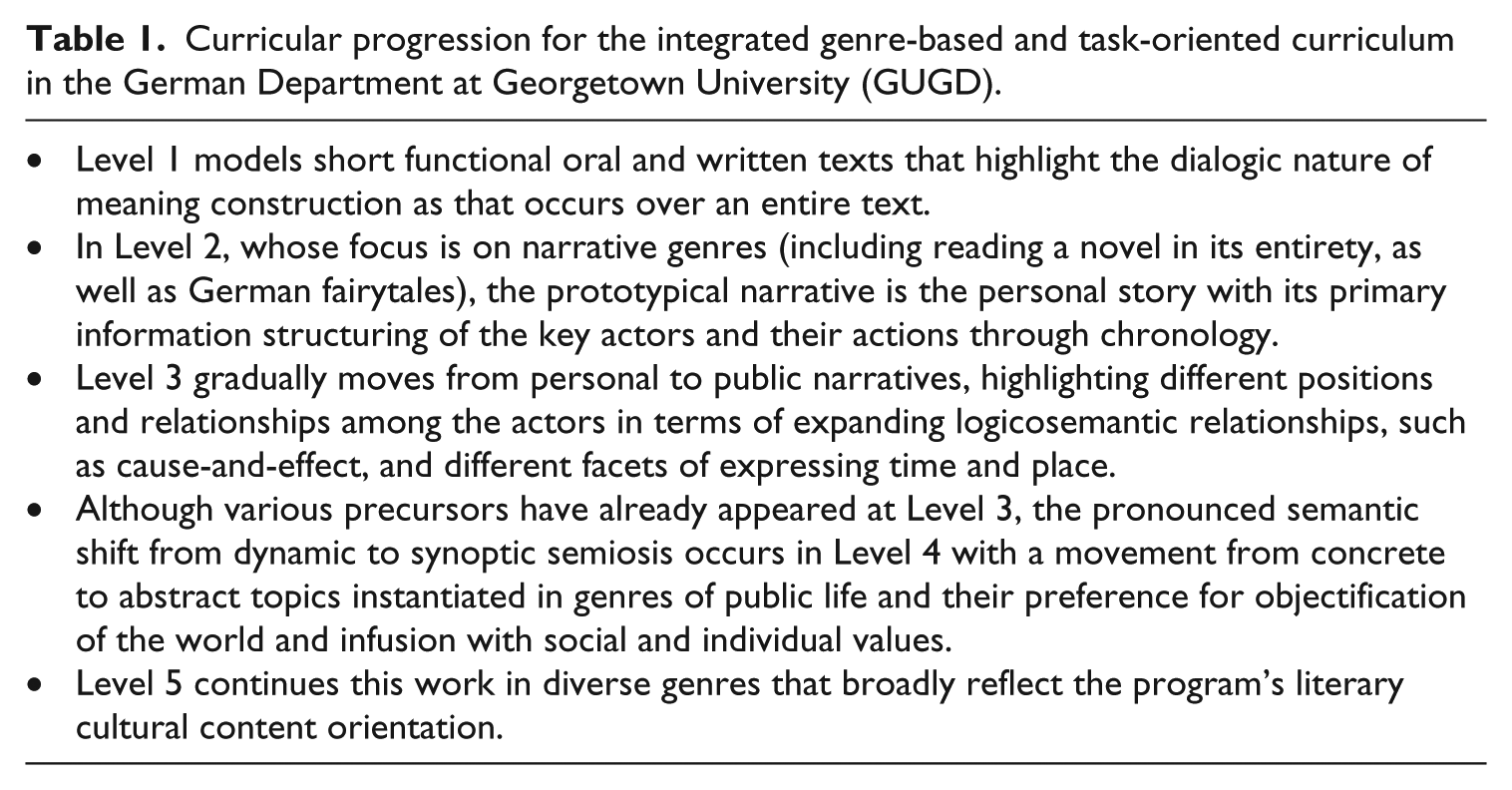
Another way of describing the curriculum is in terms of three extended and overlapping genre families:
narrative genres, which move from a simple chronology to an increasingly complex chronology, while also shifting from personal narratives and personal actors to increasingly public narratives with public, institutional, even abstract actors (Levels I–III);
explaining genres, which include both factorial and consequential explanations that require expanded cultural knowledge and locate diverse personal and societal issues in time and space, as realities and potentialities, through nuanced treatment and careful author positioning (Levels III–IV); and
genres in the arguing family, most especially exposition, discussion, and textual interpretation (Levels IV–V).
The latter two comprise tasks that are particularly likely to occur in academic and institutional contexts (Byrnes, 2009; Byrnes et al., 2010). Each of these macro genres families tends to be realized by certain major lexicogrammatical preferences or typicalities, and it is their genre-appropriate realization in students’ language use that undergirds the curriculum’s potential to enable students to reach ability levels that are characteristic of academic forms of literacy.
Beyond the existence of the curriculum itself, unusual in US higher education FL departments, why does this matter? It matters because the program’s major developmental patterns have repeated themselves over and over again for the last 20 years of the curriculum’s existence, from one changing learner cohort to the next. Seen from that perspective, the carefully spelled out curricular framework provides continued opportunities for a form of replication that avoids some of the shortcomings that are otherwise attributed to such research (see the discussion in Porte & Richards, 2012). In other words, there is good reason to point to the curriculum’s overall progression in terms of genre as a critically important contributor to students’ considerable accomplishments in instructed learning in the short instructional time that is available to them.
Additional corroboration of the effects of curricular thinking comes from comparing the GUGD data with regard to writing with the only published research regarding syntactic development of collegiate learners of German, a 1976 study by Cooper (Cooper, 1976). Importantly, that investigation of the writing data of 10 learners across the four years of undergraduate study took place in a context that did not have an articulated curriculum. A comparison of the development of syntactic abilities in writing under the two conditions shows that, in terms of the general measure of syntactic complexity, such as mean length of T-unit (MLTU), GUGD students’ writing performances fared consistently higher than the students in Cooper’s study and with increasing differences. In fact, GUGD level IV students after about 310 hours of instruction (typically at the end of their second and into their third undergraduate year) produced syntax more complex than the graduate students in Cooper’s study. Interestingly, in terms of clause length (mean length of clause, or MLC), the GUGD students began with much shorter clauses (despite the longer overall T-Units), but MLC measures surpassed those of students in Cooper’s study by level IV. Both studies revealed similar degrees of increase in phrasal elaboration from III to IV, once again pointing to the importance of clause lengthening, as opposed to subordination, as the basis for more advanced syntactic complexity development. Turning to subordination as captured in clauses per T-unit (CTU) measures, similar patterns of increase and then decrease at very advanced levels were observed in both studies, though the leveling or decrease appeared at the graduate student level for Cooper but it is clearly evident at level IV for GUGD students. Most likely, this finding reflects the explicit adoption of a public discourse orientation at an earlier point than is often the case in other programs. In other words, phrasal elaboration, which includes nominalization with all its opportunities for pre- and postnominal noun-phrase expansion, assumes a central role in syntactic structures at the more advanced levels that the GUGD curriculum seeks to foster (for extended discussion, see Byrnes et al., 2010).
To be clear, other programs may set forth different educational goals and devise different curricular progressions. What is claimed here is no more and no less than, given this kind of educational setting with these kinds of well spelled-out contextual characteristics and teachers’ beliefs and actions within them, these are educational outcomes that one can reasonably expect. Far from being a rather ‘squishy’ and non-generalizable outcome, it is, in fact eminently researchable in terms of educationally relevant questions and rich with educationally consequential implications (see, for example, Norris, 2016). As Rihoux and Ragin (2004) observe, policy researchers are ‘often more interested in different kinds of cases and their different fates than they are in the extent of the net causal effect of a variable across a large encompassing population of observations. After all, a common goal of social policy is to make decisive interventions, not to move average levels or rates up or down by some miniscule fraction’ (p. 8).
V Outlook: Assessing the promise of curricular thinking
Let me summarize my argument by expanding further on the possible benefits of curricular thinking from three different vantage points.
1 Boosting nascent dynamics in the field
Perhaps the most important contribution that a curricular orientation could make is to bolster and substantiate with evidence a developmental inflection in our thinking about instructed language learning. As previously stated, the professional literature already includes deliberations that differentiate acquisition from learning and from development, referencing different theoretical reasons for doing so (de Bot et al., 2007; Lantolf, 2006; Larsen-Freeman, 2015a, 2017). What I am here proposing is at once simpler and also more encompassing. Curricular thinking would ‘force’ developmental thinking by shifting attention away from interpreting the individual instance of a particular learner performance as, for example, accurate or inaccurate, simple or complex, halting or fluent, appropriate or inappropriate in and of itself, by positioning it in a larger trajectory of ‘semiotic capacities that were’ and ‘semiotic capacities yet to come’. In other words, it would imbue a given learner performance with an interpretive depth that foregrounds its quality of being forever emergent toward a different – hopefully expanded – repertoire of meaning-making resources.
The second point is the crucial need to find well-grounded and multiperspectival evidence in instructed L2 development for some of the most exciting claims being made in contemporary theorizing. Among these are such notions as (1) language as a complex adaptive system (Beckner et al., 2009) with its interest in the interaction of multiple agents understood as ‘current and past interactions together feed[ing] forward into future behavior’ (p. 2); (2) soft-assembly and co-adaptation in social context, which eventually result in stable patterns (Larsen-Freeman, 2011); (3) retroduction and interpretation that recognize the nonlinearity of development instead of simple causalities (Byrne, 2011; Dörnyei, 2014); (4) proposed connected growers and attractor states of dynamic systems theory, along with the notion that, at certain times, a relatively small influence can cause major systemic changes (the butterfly effect) (de Bot, Lowie, & Verspoor, 2007); (5) and perhaps particularly challenging for the emphasis on long-term development, the notion of a self-organizing system brought in from the natural sciences (see, among others, de Bot, 2008; Larsen-Freeman, 2015b). To become much more than buzzwords, these constructs need to be enlivened by data from real learning environments that have to be more than just longitudinal in the sense of duration, but longitudinal in the sense of deliberately seeking to enhance, over long stretches, learners’ capacity for meaning-making.
Finally, I believe we need to revisit notions of competing processing for form and meaning. At present, the interrelationships among complexity, accuracy, and fluency (CAF) are built on assumptions about the particular challenges of simultaneously processing form and meaning, expressed in terms of limitations. Despite enormous research efforts, findings remain conflicted. A curriculum that was explicitly meaning-oriented from the beginning and progressed to advanced ability levels might be able to reconceptualize the dominant privileging of what is ultimately a mechanistic metaphor of limited processing space. It remains to be seen whether the human capacity for language-based semiosis, as it can be observed in adult instructed learning, might be better served by other theoretical frameworks (e.g. the proposal for an organic approach in Norris & Ortega, 2009). That does not dispute the finding that language processing will run up against memory limitations; but it questions whether a simplistic zero sum game – either form or meaning – is the best way to tell the story of advanced adult instructed language learning (Byrnes, 2018).
2 Addressing vexing problems
The second perspective is an extension of the first, but brings three long-standing vexing issues into view. The first is the need to find ways of significantly boosting the interpretability of our research findings. Here, much emphasis has been placed on improving research methodology in our field: by assuring better training, by creating more sophisticated assessment tools and statistical analyses, and by fostering greater transparency and accessibility in the research enterprise. But, increasingly, assessment specialists (e.g. Norris, 2016; Plonsky, 2013; Purpura, 2004) quite pointedly remind us that the real issue is how to interpret those findings, an ability that is not exhausted by statistical statements of significance or even effect sizes, but typically requires careful inclusion of pertinent contextual information. Beyond fostering research hygiene, as it were, the real issue is this: If educational and social consequences are to be established and subsequently acted upon, contextual information from within the system itself is pivotal for ‘effects beyond effect sizes’. A curricular approach, particularly one that is informed by complexity theory, will never provide exhaustive information. A complexity theory perspective has thoroughly disabused us of such a notion; on that basis, working within a curricular framework should be able to provide considerably more useable and useful information that can inform educational decision-making than research has thus far been able to offer (Norris, 2015; Norris & Manchόn, 2012).
A second vexing problem is that ISLA as a field has nearly no evidence for what should be considered reasonable learning outcomes for instructed learning. The only estimates on that topic – and these continue to be reiterated – draw on data from the Defense Language Institute, which has provided ranges for the number of instructional hours required for students to attain certain proficiency levels on the Defense Language Institute Test Batteries. If the intention is to support grounded action for substantive language educational policy-making, such limited information is unacceptable. By contrast, if it were possible to examine how language learning actually takes place within a range of well-specified curricular contexts in different educational settings, with different learner groups for different languages, the field could begin to understand which interacting variables as these arise from the chosen curricular framework are likely to lead to what kind of learning. Such an approach would be all the more insightful if it proceeded from the assumption that in favorable educational contexts, such as those created by a well-considered curriculum, learners can indeed attain advanced levels of ability levels.
Akin to that concern, though distinct in an era when we have rejected native speaker norms (e.g. Cook, 2008; Ortega, 2013), is the question of what counts as success in instructed learning and why, and how we would know that? Among the many pernicious consequences of a lack of curricular thinking has been that we have either avoided the question entirely or have resorted to dubious assumptions about instructed learning as essentially a deficitary undertaking where the safest bet is to have low expectations: an ethically and morally indefensible position on the part of an entire field (Ortega, 2005).
3 Opening up new avenues
With regard to the third perspective – that curricular thinking might open up entirely new avenues for conceptualizing ISLA – perhaps the most exciting prospect is that of adopting a functional theory of language. Indeed, I find it difficult to do substantive curricular work that responds to the imperatives of any instructed language learning, but particularly language learning in higher education, without the textually oriented meaning focus of functional theories (Byrnes, 2014, 2015, 2017, 2018). More specifically, preference should be given to a natural functional theory (for discussion, see Martin, 1991) like SFL (Halliday, 2014) because it establishes principled connections between social contexts of language use and the lexicogrammatical resources that are likely to be used (Ryshina-Pankova, 2016). Linked to that is the fact that functional grammars are pitched toward textual meaning-making, thereby reinstating the fundamentally social-semiotic quality of language.
Equally invigorating for ISLA is the possibility that a curriculum-specified educational environment can provide an opportune setting for replication studies (Porte & Richards, 2012). A key epistemological objection to the idea of replication has been the argument that no situation will ever be identical. But since exact identity cannot possibly be a requirement, a carefully spelled out curricular framework within which waves of student cohorts studied year after year with certain measurable learning outcomes begins to fulfill the deeper intentions of replication, namely to trace the ‘why’ of learning outcomes under specifiable conditions. Given that a longitudinal trajectory is part and parcel of curricular thinking, there is every reason to anticipate exciting findings about instructed learning.
As my final point regarding the benefits of curricular thinking I turn to the original occasion for this article, a plenary presentation at the Second Language Research Forum (SLRF) 2016 at Teachers College, Columbia University, USA, an institution that is centrally concerned with the education of future teachers. I am convinced that engaging in the kind of curricular thinking that I have outlined can reposition – empower if you will – teachers throughout their professional lives. As Prabhu (1990) worded matters in the midst of the search for best methods, teachers are looking for an ever-enhanced sense of plausibility with regard to their own ‘personal conceptualisation of how their teaching leads to desired learning – with a notion of causation that has a measure of credibility for them’ (p. 172). Extensive engagement with a curriculum is one way to keep this sense alive and growing, a form of intellectual-emotional engagement that is crucial for what he terms the ‘occurrence of “real” teaching’ (p. 175) that is so crucial to success in learning.
Perhaps the following observation by Shulman (2007) provides a suitable summary of the potential benefits of curricular thinking for all language professionals and ISLA as a field of inquiry: The current quest for accountability creates a precious opportunity for educators to tell the full range of stories about learning and teaching. Counting and recounting can only be pursued together. Counting without narrative is meaningless. Narrative without counting is suspicious. We now have an opportunity to employ the many indicators of learning that we can count for the most important stories we have to tell. (p. 25)
It strikes me as fortuitous that Shulman’s and Cronbach’s respective assessments point to the potential of curricular thinking as an opportunity to provide an inspiring narrative of what ISLA is all about and why it matters in the contemporary world.
Footnotes
Acknowledgements
This article is an extensively revised version of a plenary talk delivered at the Second Language Research Forum, Teachers College, Columbia University, 22–25 September, 2016.
Funding
This research received no specific grant from any funding agency in the public, commercial, or not-for-profit sectors.