







Abstract
This study examined the impact of learner proficiency on the occurrence and resolution of language-related episodes (LREs) in rehearsal of interactive speaking tasks and on the subsequent use of language items from LREs during performance of the same tasks in front of the class. Forty-eight learners from six intact English as a foreign language (EFL) classes at a Vietnamese high school were divided into three proficiency groups, each consisting of eight dyads. Group 1 was higher proficiency (HH) dyads; Group 2 consisted of mixed proficiency dyads (HL) and Group 3 was lower proficiency (LL) dyads. All the pairs rehearsed and then consecutively performed a problem-solving task and a debate task in two separate classroom lessons. The total data included 48 rehearsals and 48 corresponding performances collected during normal classroom hours. The results show that, overall, LL dyads encountered more language problems (more LREs) in rehearsal than HH dyads and they were less likely to resolve them successfully. However, they were able to use a majority of the correct resolutions in the performance as well as their higher proficiency counterparts. The lower proficiency learners were also found to employ memorizing and local rehearsing strategies to retain ideas and language items as they rehearsed for the upcoming performance. These findings have pedagogical implications for teaching and learning through tasks in EFL contexts and beyond.
I Introduction
Task-based language learning and teaching (TBLT) grounds learning in tasks (Bygate, 2016), that is, in meaning-focused activities where learners use their language resources to work towards a non-linguistic task outcome (Ellis, 2009a). The meaning-focused nature of tasks has led some teachers and theorists to be concerned about whether learners adequately attend to language form during task-based interaction, especially in contexts of English as a foreign language (EFL) where students share a first language (L1; e.g. McDonough, 2004). Concerns have also been raised about whether learners might successfully complete a given task without ‘pressurizing’ their language use (e.g. Seedhouse, 1999). In fact, for learning through tasks to be effective, learners need to be ‘pushed’ to communicate for learning (Bygate & Samuda, 2009). In other words, it is important that learners attend to language form when doing tasks.
To address these concerns, research has investigated how task design features and task conditions can be used to push learners to attend to language form (see Skehan, 2016). Regarding the latter, pre-task planning has been shown to improve different aspects of language production such as complexity, accuracy and fluency (CAF) (e.g. Ellis, 2009b). The assumption underlying pre-task planning is that because learners have limited attentional capacity (Skehan, 1998), under the stress of communication when meaning and form are in competition for attention (VanPatten, 1990), they will necessarily prioritize meaning over form. Conversely, if learners have the chance to plan what they want to say, they are likely to have more attentional resources available during the actual task performance to attend to how to formulate and articulate the intended message (Ellis, 2005). This draws on Levelt’s (1989) model of speech production, which identifies three main stages in speech production: conceptualization, formulation and articulation. Conceptualization entails preparing the message to be said, which then involves deciding on the communicative goal, and carrying out macro planning and micro-planning to form a ‘pre-verbal message.’ This pre-verbal message is then sent to the formulator which then accesses and retrieves appropriate lexical items for encoding. Next, the ‘planned’ or ‘internal’ speech is converted into overt speech in the final stage of articulation. In other words, pre-task planning facilitates attention to the latter stages of speech, since attentional strains on conceptualization, have been reduced through pre-task planning.
Task repetition (TR), another task condition, has been increasingly researched for the way it, like pre-task planning, allows learners to balance the competing demands of attention to meaning and form (Bygate, 2016, 2018; Bygate & Samuda, 2005). In a repeated performance, learners are less likely to be preoccupied with formulating the message, and similarly, language forms which were used in rehearsal are likely to be more readily available, cognitively speaking. Put another way, switching attention from conceptualization to formulation facilitates access and retrieval of appropriate lexical items, and grammar encoding (Skehan, 2016). In Bygate and Samuda’s (2005) words, ‘part of the work of conceptualization, formulation and articulation carried out on the first occasion is kept in the learners’ memory store and can be reused on the second occasion’ (p. 29).
In addition, adding a public element to a repeated task performance is hypothesized to further encourage attention to language form. Willis (1996) recommends building a public report into the task cycle, that is, reporting the outcome of the task in public so as to push learners to plan and rehearse for it. Skehan (1998), in contrast, treats public performance as a post-task activity, the anticipation of which pushes learners to attend to form in the main task performance. As Skehan and Foster (1997) argue, this main task performance, ‘although unmonitored, will be seen as a rehearsal for the later (public) performance where display and correctness of language assume greater importance’ (p. 189, italics added). Skehan and Foster (1997) examined this claim in a study involving 40 students of English as a second language (ESL) doing three tasks (a personal task, a narrative task and a decision-making task) in two conditions: one with ‘foreknowledge’ of a public performance and one without. They found that anticipation of an upcoming public performance promoted more accurate performance, but the findings reached significance only for the decision-making task. Clearly public performance is worthy of further empirical investigation.
It is of note that Skehan and Foster (1997) only investigated the impact of anticipated public performance on language production in the main task performance. They did not track how language was used from rehearsal to public performance. Furthermore, no research of which we are aware has investigated interactive public performance as a form of TR (cf. Donato, 1994; Truong & Storch, 2007), and how language items learners attend to in interactive rehearsal (first performance) are transferred to interactive public performance. This is the focus of the current study.
At the Vietnamese high school where the larger research project (Nguyen, 2013) of which the present study is a part was conducted, the teachers typically put students into pairs and groups to do the tasks and followed this up with performance by selected pairs or groups of learners in front of the class. The terms ‘rehearsal’ and ‘performance’ are used because they captured the teachers’ and students’ orientation and intent as observed in the lessons and explained in the interviews (Nguyen, 2013). Faced with many contextual constraints such as a shared first language, an absence of an oral component in high stakes exams, limited opportunities to use the target language outside classrooms, the teachers resorted to public performance to push students to use English and to engage more fully in the set tasks. Public performance in the current study is a form of identical task repetition, which differs from other TR studies in that students knew they could be asked to repeat the task in public. It differs from public report in Willis’s (1996) framework in that learners repeated the task publically in pairs rather than reporting task outcomes. It overlaps with pre-task planning in that in rehearsal students can plan and resource their anticipated performance.
1 TR studies and learner attention to language form
Research on TR has shown that when learners repeat tasks they tend to pay more attention to language form. For example, Bygate’s (1996) seminal work shows that when learners repeated the same story telling tasks, their performance was more accurate and more fluent. His subsequent studies (Bygate, 2001; Bygate & Samuda, 2005) further point to the benefits of TR on accuracy. According to Bygate and Samuda (2005), ‘repeated encounters do not involve the learner in doing the ‘same’ thing, but rather working differently on the same material’ (p. 67). Further research has shown that in repeated performances of the same tasks, learners pay more attention to syntactic coding (Fukuta, 2016), or take up more of the form-focused corrections received from teachers on their previous performances (Hawkes, 2012). Van de Guchte, Braaksma, Rijlaarsdam and Bimmel (2016) found that learners performed better on the target language structures when repeating similar tasks. Findings from Sample and Michel (2015) also point to the benefits of TR. Specifically, when young EFL learners (9 years old) repeated tasks a third time, the trade-offs between measures of CAF on a second repetition were no longer evident. The studies reviewed here have largely focused on general measures of CAF, and are product-oriented in nature. An analysis of CAF alone does not clearly show whether learners actually attend to language form (e.g. Fukuta, 2016). This suggests a need for better ways of capturing learners’ attention to form. A process–product perspective allows us to track episodes in which learners attend to form and then use these forms in repeated performances. These episodes can refer to negotiation of meaning, responses to feedback, or language-related episodes (LREs). Swain (1998) defined an LRE as ‘any part of a dialogue in which students talk about the language they are producing, question their language use, or other- or self-correct’ (p. 70). LREs are important because they capture learning in progress (Swain, 2001).
García Mayo, and Imaz Agirre (2016) examined how TR affects attention to form operationalized as negotiation of meaning and pair dynamics. They found no significant effects of TR on the frequency of negotiation of meaning strategies although learners showed more collaborative behaviors in the repeated tasks. Mackey, Kanganas and Oliver (2007) found that when learners repeated the task with either the same content or the similar procedure they tended to attend to and incorporate feedback into their oral repeated task performance whereas in unfamiliar tasks they used more clarification requests and confirmation checks.
Working with Korean middle school EFL learners, Kim (2013) investigated the effects of TR on learner attention to form by means of LREs. She found that when performing information-exchange tasks, learners in a TR treatment generated significantly fewer LREs than those in a procedural repetition treatment. In a follow-up study with an added element of task complexity, Kim and Payant (2014) found again that procedural repetition generated significantly more LREs than task repetition. These studies typically compare the performance of learners in experimental and comparison groups. Less common are studies which track uptake of items from a first to subsequent repeat performances. Three studies which do take this approach are Bitchener (2004), Donato (1994) and Truong and Storch (2007).
Bitchener (2004) investigated negotiation of meaning by 15 dyads of pre-intermediate ESL learners at a New Zealand university, doing an information gap and a decision-making task. He found that the students correctly used around 70% and 62% of the negotiated language items in immediate and delayed repeated task performances (with a different partner). Donato (1994) examined the effect of pre-task planning (a kind of rehearsal) on individual oral presentations by a group of French ESL learners. He found that in these presentations one week later, the learners correctly used 24 out of 32 language items (75%) that they had successfully resolved during the previous one-hour planning session. In a similar study, Truong and Storch (2007) found that during group pre-task planning, Vietnamese EFL university students were primarily concerned with preparing content and so very few LREs occurred (only 14). In the subsequent individual presentations 20 minutes later, only a few of the items targeted in these LREs were taken up (from 1–4 out of 14 LREs for each group). A number of factors may account for the mixed findings in these two latter studies, including the small sample size, the time given for pre-task planning and type of presentation (delayed/intermediate). Another factor likely to affect how learners attend to language form is proficiency (see Philp, Walter, & Basturkmen, 2010), which is addressed in the following section.
2 LREs and learner proficiency
Learner proficiency is largely an overlooked variable in TR research to date, although some research suggests that pre-task planning may have a ceiling effect at a certain level of proficiency (e.g. Ortega, 2005). Research into the effects of proficiency on the extent to which learners attend to language form, though still limited, has shown mixed effects. Kowal and Swain (1997), for example, found that in pair work the less proficient learner was often dominated and ignored by the more proficient learner, while in Yule and Macdonald’s (1990) study, when lower proficiency learners were assigned a dominant role (e.g. sending information), they tended to negotiate meanings more and successfully solve linguistic problems. Similarly, in a recent study with Vietnamese EFL learners by Dao and McDonough (2017), lower proficiency learners when acting as information holders discussed more LREs and were more engaged in task interaction than when they worked as information receivers.
Also with a focus on mixed proficiency dyads, Watanabe and Swain (2007), in a laboratory-based study involving a multiple-stage writing task, found higher occurrences of LREs when core students interacted with higher rather than lower proficiency interlocutors, and higher overall learning gains for the core-high pairs (63%) than the core-low pairs (50%). However, the more collaborative pairs produced more LREs and scored higher on the post-test written task irrespective of proficiency. Clearly, collaborative orientation is an important variable (Choi & Iwashita, 2016; Fernández Dobao, 2012; Storch, 2001).
A stronger effect of proficiency has been found in research with different proficiency pairings. Kim and McDonough (2008) investigated the task-based interaction by 24 university learners of Korean as a second language performing dictogloss tasks. They found that students who collaborated with advanced interlocutors produced more LREs (both lexical and grammatical) than those who collaborated with intermediate counterparts, although the difference was significant only for lexical LREs. Students also correctly solved significantly more LREs when working with an advanced rather than intermediate level interlocutor. Leeser (2004) found similar results with 21 dyads of adult Spanish learners carrying out a dictogloss task in their regular content-based classroom hours; that is, higher overall dyad proficiency was associated with more LREs and greater success with LRE resolutions. This echoes findings by Storch and Aldosari (2013), in a study of EFL learners in Saudi Arabia writing a short composition in pairs. They found that when two higher proficiency interlocutors worked together, they generated more LREs than mixed proficiency pairs and pairs with both lower proficiency learners, but regardless of proficiency, LREs were primarily focused on lexis. Similarly, Williams (1999, 2001), showed that higher proficiency ESL learners doing communication tasks not only discussed more LREs but also achieved higher scores in a tailored post-test. These studies indicate that pairing higher proficiency learners with other higher proficiency interlocutors seem to be most useful. In contrast, in a recent study with an IELTS graph writing task (Niu, Jiang, & Deng, 2018), Chinese EFL dyads with lower proficiency discussed more LREs than higher proficiency learners. However, in line with the above research, they were less successful at resolving their language issues.
Overall, research suggests that although proficiency has a consistent effect on how students resolve their LREs (with higher proficiency dyads being more successful), its impact on the frequency of LREs and subsequent learning outcomes has been inconclusive. Of note is that these studies have mainly used collaborative writing tasks (Dao & McDonough, 2017; Kim & McDonough, 2008; Leeser, 2004; Niu et al., 2018; Storch, 2001; Storch & Aldosari, 2013; Watanabe & Swain, 2007) or a wide range of activities (Williams, 1999, 2001). Other studies that address proficiency in the context of oral communicative tasks have largely been descriptive in nature (Choi & Iwashita, 2016; Fernández Dobao, 2012; Kowal & Swain, 1997; Yule & Macdonald, 1990). As mentioned earlier, no research has investigated the effects of proficiency in communicative oral tasks on the occurrences of LREs and transfer of LRE-related items from task rehearsal to subsequent interactive performance in EFL contexts (cf. Donato,1994; Truong & Storch, 2007).
Although tailor-made post-tests have been commonly used in LRE research and have the advantage of reflecting closely the content of LREs (Swain, 2005), they typically involve discrete language items and unlimited response time, thus presenting a mismatch between the nature of test items and LREs that occur in the context of communicative tasks (e.g. Adams, 2007; Loewen, 2007; Nassaji, 2010). Yet, research that has attempted to track learning in subsequent spontaneous speech has found that only a small proportion of LRE-focused items were taken up in later class activities (e.g. Loewen, 2007; Williams, 2001). Loewen (2007) explained that ‘a lack of use of the targeted forms does not necessarily indicate an inability to use those forms; it may simply be that learners had no occasion to use them’ (p.114). Although it is difficult to elicit the target forms in non-obligatory contexts, the above findings, together with findings from TR research that task repetition effects are not transferred to new tasks (Bygate, 2001; Gass, Mackey, Alvarez-Torres, & Fernández-García, 1999), suggest that subsequent performance of the same task may better motivate internalization than performance of unrelated tasks. The current research investigated how public performance of the same task might also provide a context through which LREs provide a rich ‘occasion for learning’ (Swain, 1998) or a ‘source of learning’ (Swain, 2001; Swain & Watanabe, 2013) (also see Storch, 2002a, 2002b; Storch & Wigglesworth, 2007; Yang, 2016 for LRE-related learning through individual writing performance). The research sought to answer the following research questions:
Did dyad proficiency affect the occurrence and resolution of LREs in task rehearsal?
Did dyad proficiency affect the extent to which language items focussed on in LREs in rehearsal were used in performance?
II Methodology
1 Student participants
Consent was obtained from all participants and ethics approval was granted by the Victoria University of Wellington Human Ethics Committee before data collection began. Twenty four dyads of Grade 11 non-English-major Vietnamese students from six intact classes in a high school in Vietnam and their respective English teachers participated in this research on a voluntary basis. Twenty eight students were female and 20 were male. All students were 16 years old. At the time of data collection, they had been learning English as a compulsory subject at school for 5 years (since grade 6). Most of these students went to extra after-school English classes, as is common in urban schools in Vietnam. They were roughly at B1 level on the Common European Framework of Reference (CEFR) for languages, but their proficiency level varied from upper A2 to B2 in our judgment and as confirmed by the teachers.
Proficiency has been operationalized differently across studies. Particularly regarding LRE studies, the proficiency level of participants has been identified by course or class levels (Nassaji, 2010; Williams, 1999, 2001), and by student higher or lower proficiency in relation to each other in the same class, by means of TOEFL tests (Dao & McDonough, 2017; Watanabe & Swain, 2007), placement exam scores (Kim & McDonough, 2008) or teachers’ ratings (Leeser, 2004). Leeser (2004) pointed out that using the teacher’s ratings to pair students ‘realistically reflects how L2 instructors may organize learner pairs according to proficiency’ (p.75). However, he posits that ‘future research could use a variety of more ‘objective’ or standardized proficiency measures, in addition to instructors’ ratings, to obtain a more ‘concrete’ evaluation of learners’ proficiency’( p.75). In the current study, the learners’ scores from school English assessments were used in combination with the teachers’ evaluation (also see Niu et al., 2018; Storch & Aldosari, 2013). The higher proficiency learners were students who scored from 9.0−10.0 (and rated excellent according to the school system) for the English performance in the previous semester and their lower proficiency learners from 6.5 to 7.9 (and rated quite good). In addition to this school assessment, the teachers were further asked to rate the students as having higher or lower proficiency in relation to each other in terms of their oral ability. The volunteer students with both low scores and low teacher ratings were designated as lower proficiency (L) and those with both high scores and high teacher ratings as higher proficiency (H). These higher and lower proficiency learners in each class were randomly paired to form HH, HL, and LL dyads (i.e. higher proficiency dyads, mixed proficiency dyads and lower proficiency dyads). The mean score for the higher proficiency learners (n = 24) and lower proficiency learners (n = 24) in the present paper, based on the English performance in the previous semester was 9.4 (SD = .24; min = 9; max = 9.8) and 7.5 (SD = .32; min = 6.9; max = 7.9), respectively. An independent t-test (its assumptions were met) was conducted on the English score data and confirmed that the higher proficiency learners had a higher proficiency level than their lower proficiency counterparts (t(46) = −23.093, p < .001). Students were not informed of their interlocutor’s proficiency. It should be noted that low proficiency learners and high proficiency learners in the present study are lower and higher in proficiency in relation to each other.
Although the number of dyads varied from class to class, the total number of dyads (8) was the same for each proficiency group, thus assuring equal samples, which facilitated greater reliability of statistical comparisons between proficiency groups (Larson-Hall, 2010). In the current study it was not possible to control for gender due to the availability of volunteer students in each intact class. The total distribution of gender in each proficiency group was almost similar: (HH: 4 female–female dyads, 2 male–male dyads, and 2 male–female dyads; HL: 3 female–female dyads, 2 male–male dyads, and 3 male–female dyads; LL: 3 female–female dyads, 2 male–male dyads, and 3 male–female dyads).
2 The tasks
Students carried out two tasks – a problem-solving task and a debate task – a week apart in their normal classroom hours. For each task they first had 15 minutes to do the task (rehearsal) and then performed it publically in dyads (performance).The problem-solving task required students to reach agreement on one of five given solutions to a problem. The debate task required students to argue for different viewpoints (see Appendix 1). Both tasks were on the topic of volunteer work, the theme of the textbook unit the classes were working on. Both were created by the researchers drawing on the teachers’ classroom practices and task preferences in Phase 1 of the larger research project (Nguyen, 2013). As the teachers commonly adapted or replaced textbook tasks (Nguyen, Newton & Crabbe, 2018), introducing these new tasks was not likely to attract attention from the students.
3 Procedures
For each task, the teachers who taught the six classes spent around five minutes introducing the task. They all followed the same procedure in which they explained the task instructions and briefly explained some of the words in the task input. Students were then given fifteen minutes to rehearse the task. They were allowed to take notes but, as was the usual practice, these notes were not used during the task performance. During the rehearsal, the teachers circulated around the class as usual.
After the rehearsal time was up, all the students were required to stop talking. Because it was possible that learners might rehearse silently in their head while listening to other performances, the order of the targeted dyads being called for the performance in each class was controlled for proficiency so that the combined data for each proficiency group (HH, HL, LL) included performances that went first, second, third, and so forth.
4 Data analysis
a The data set
For each task, the problem-solving task or the debate task, there were 24 rehearsals and 24 corresponding performances, totaling 48 rehearsals and 48 corresponding performances for both tasks. The rehearsal transcripts totaled 720 minutes (48 × 15 minutes). The performance transcripts in total lasted 179.2 minutes: 86.4 minutes for the problem-solving task (M = 3.6 minutes; SD = 1.21) and 92.8 minutes for the debate task (M = 3.9 minutes; SD = 1.43).
b Coding LREs in task rehearsal
The rehearsal transcripts were coded for LREs as defined above. Where one linguistic point was discussed multiple times in the rehearsal, it was coded only once, i.e. one LRE. This also included instances where students initiated an LRE and then dropped it to move on with other communication, and then revisited it later. In other words, the LRE boundary was measured by linguistic items discussed whether in L1, L2 or both. However, if different aspects of one language item such as word meaning, pronunciation, or spelling were discussed, they were coded as separate LREs. The occurrences of LREs per dyad were counted. During rehearsal, the 49 instances where students made requests of the teacher about the words that they did not know were excluded from analysis.
c Linguistic focus of LREs
The current study used the definitions of lexical and grammatical LREs, adopted by McDonough and Sunitham (2009) and also by Leeser (2004) and Williams (1999).
d Lexical LREs
In this study, ‘lexical LREs were defined as LREs in which learners talk about or seek the meaning, spelling, or pronunciation of lexical items’ (McDonough & Sunitham, 2009, p. 239). Example 1 is a lexical LRE. The 8 spelling LREs in the data, though coded, were not included in the analysis because the focus was on oral performance.
Example 1 (The problem-solving task: LL-11f) S1: khuyến khích là chi?
(how to say encourage?)
S2: huh? S1: khuyến khích là chi? (how to say encourage?) S2: encourage S1: encourage? S2: encourage (.) khuyến khích (.) cổ động a để họ chăm học (encourage (.) motivate (them) to study hard)
e Grammatical LREs
In this study, following McDonough and Sunitham (2009), grammatical LREs were defined as LREs where dyads discussed aspects of L2 morphology or syntax. These involved the use of tenses, verb forms, verb-subject agreement, passives, word order, comparatives, pronouns, determiners or other function words (see also García Mayo, 2002). Example 2 is one such grammatical LRE where S1 questions her language use, whether ‘they are poor’ or ‘they poor’ is appropriate. S2 provides an answer ‘they are poor’, with a meta-linguistic explanation that poor is an adjective, not a verb.
Example 2 (The problem-solving task: HL-11d) S1: Ê, they are poor hay they poor thôi hè? (Hey, they are poor or just they poor?) S2: Er they are poor. Poor nớ tính từ mà, phải có động từ! (That poor is an adjective, it needs a verb!) S1: They are poor. They are poor.
f Coding resolutions of LREs in task rehearsal
Following other researchers (Kim & McDonough, 2008; Leeser, 2004; McDonough & Sunitham, 2009; Swain, 1998; Watanabe & Swain, 2007), the resolutions of LREs were coded into three types: (1) correctly resolved, (2) incorrectly resolved and (3) unresolved. If many language solutions were proposed during an LRE, the final solution was counted. As the frequency of LREs differed between proficiency groups, LRE resolutions were calculated as the proportion score defined by Kim and McDonough (2008, p. 193) as the ‘number of LREs in each resolution category divided by the total number of LREs’. Like the frequency of LREs, the LRE resolutions per dyad were counted.
A correctly resolved LRE was one where ‘the problem or question was solved correctly either by one learner’s self-correction, either by one learner answering or correcting the other (other-correction)’ (Leeser, 2004, p. 65). Example 2 above is an example of correctly solved LREs.
Incorrectly resolved LREs were coded as LREs ‘in which the learners incorrectly self-repaired, other-repaired, answered a question, or found a solution’ (McDonough & Sunitham, 2009, p. 240). Example 3 illustrates an incorrectly solved LRE, where S2 talks herself into using ‘richer’ instead of ‘rich people’ and no correction is provided.
Example 3 (The debate task: LL-11b) S1: because (.) S2: because rich people have er (.) have a lot of money er (.) richer người giàu đừng dùng rich people nữa … (richer means rich people, no need to use rich people) S1: OK. What else?
Unsolved LREs were LREs ‘which neither learner could solve the problem nor knew the answer to the question’ (Kim & McDonough, 2008, p. 189). In Example 4, S1 explicitly seeks the English word ‘depressed’, but S2 says he does not know and the language problem is not solved.
Example 4 (The problem-solving task: HH-11f) S1: trầm cảm là răng? (How to say ‘depressed’?) S2: từ nớ chịu a nà! (That word – I give up!)
g Coding transfer of knowledge in public performance
In this study, we use similar procedures of tracing transfer of knowledge (ToK) to Storch (2002b). Specifically, LREs were identified as ‘opportunities for learning’ or ‘sources of learning’ (Swain, 2001) and the language items discussed in such LREs as ‘potential tracers’ (Storch, 2002b, p. 314) to trace ToK in task performance. As mentioned above, if a language item was discussed several times during the rehearsal, it was coded as one LRE, and thus one ‘potential tracer’ only. Where these potential tracers were used in the public performance, they were coded as ‘matched items’ (Truong & Storch, 2007) or instances suggesting ToK (Storch, 2002b). ToK is used here to refer to instances where linguistic information introduced in an LRE in rehearsal is subsequently used in performance. This process–product approach has been widely used in research on written tasks (Brooks & Swain, 2009; Storch, 2002b; Storch & Wigglesworth, 2010; Swain & Lapkin, 2001; Watanabe & Swain, 2007) and in a few studies on interactive speaking (e.g. Donato, 1994; Truong & Storch, 2007).
Coding ToK in task performance was an iterative process of reading, re-reading and identifying the matched items and labeling them. Instances of language items targeted in LREs that were not used at all in any way in the performance were coded as no ToK, whether they were correctly solved, incorrectly solved or unsolved in the rehearsal. None of the unsolved LREs were used in task performance. ToK was coded in relation to how LREs were resolved in rehearsal and taken up in task performance: successful ToK, unsuccessful ToK and incorrect ToK, each of which is described below.
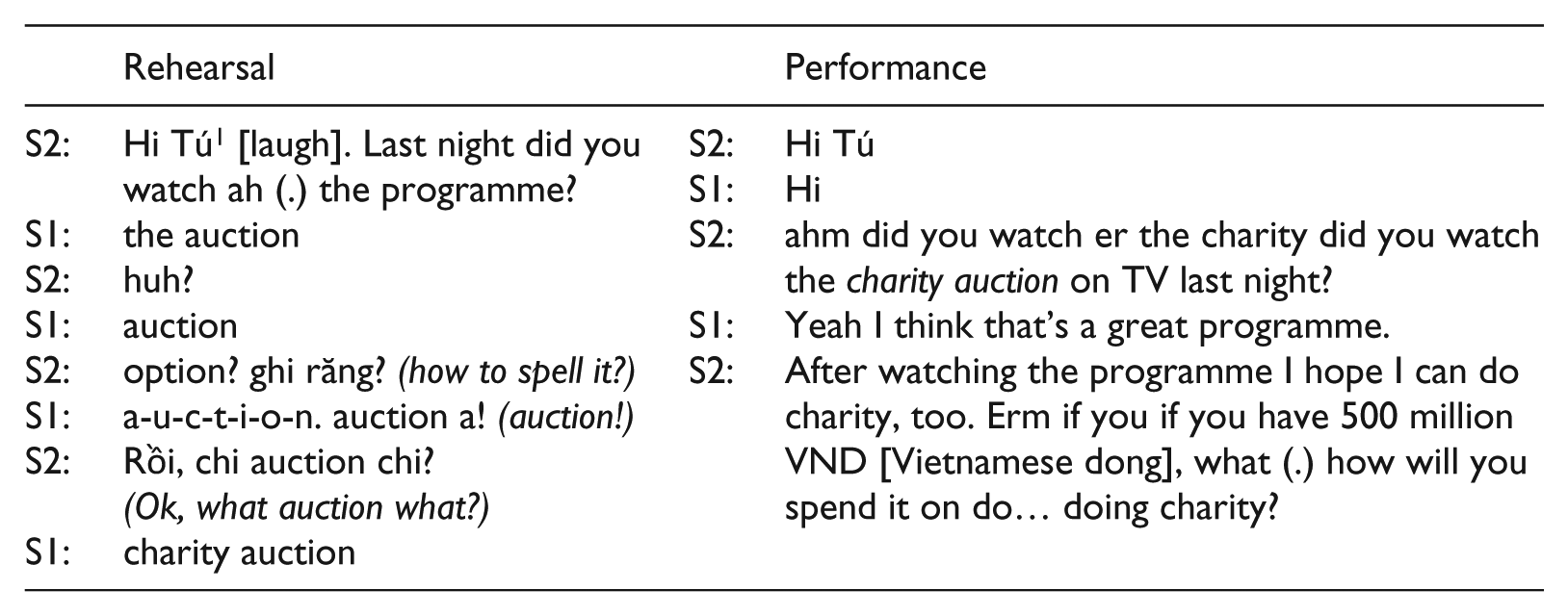
Successful ToK was coded as correct use in task performance of language items focussed on in LREs in rehearsal as seen in Example 5. Here, the language solution ‘charity auction’ is correctly solved, and used correctly in task performance, and thus ToK is successful.
Example 5 (The problem-solving task: HL-11c)
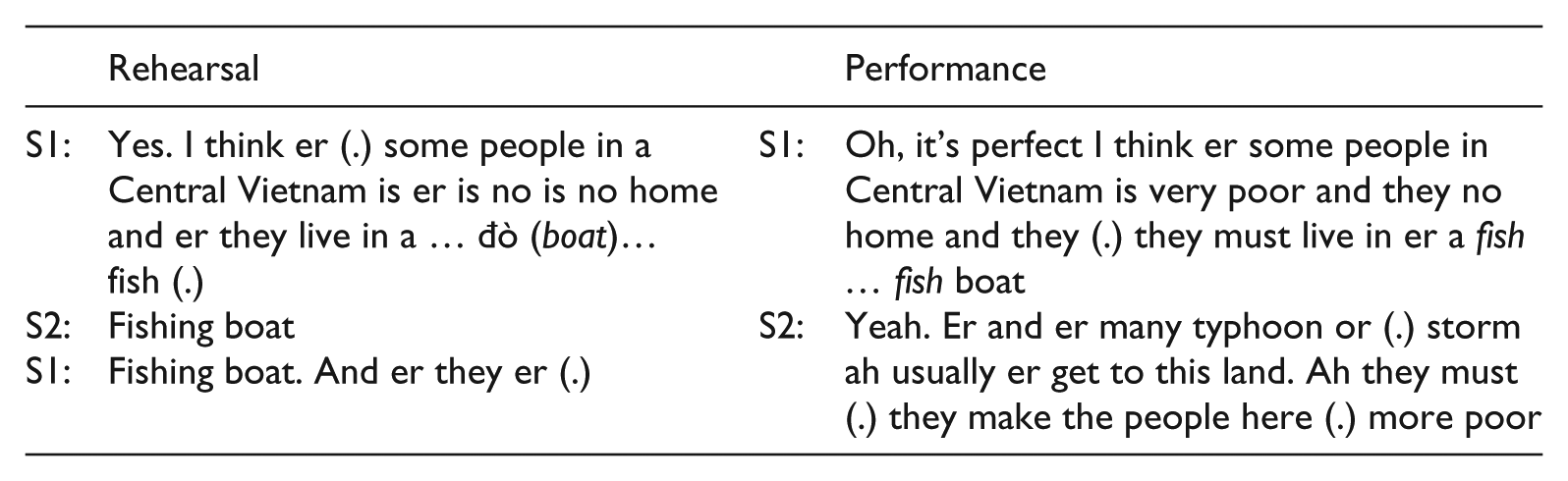
Unsuccessful ToK: If a correct language resolution arrived at in task rehearsal was used incorrectly in task performance it was coded as unsuccessful ToK. Example 6 is one such instance where the correct solution ‘fishing boat’ in the rehearsal gets used incorrectly in the performance, ‘fish … fish boat’.
Example 6 (The problem-solving task: LL-11e)
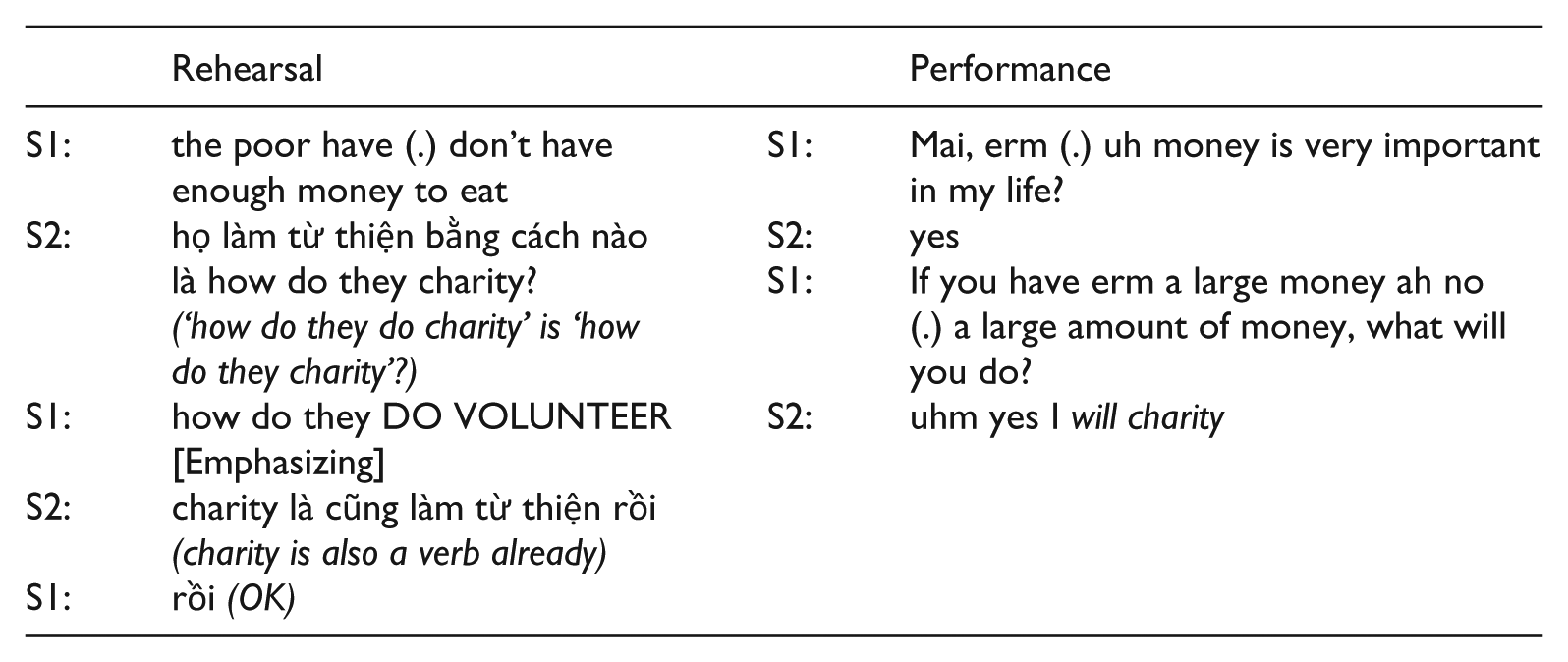
Incorrect ToK: If an incorrect resolution found in the rehearsal was taken up in the performance in its incorrect form it was coded as incorrect ToK. Example 7 illustrates incorrect ToK in which the incorrect information that ‘charity’ is a verb is established in the rehearsal and carried to the performance.
Example 7 (The debate task: LL-11b)
5 Inter-coder reliability
The first author and another trained Vietnamese EFL teacher independently identified LREs randomly from 50% of the rehearsal data. The percentage agreement was 91%. All disagreements were resolved through discussion. The main researcher then identified LREs in the remaining data. In total there were 648 LREs identified. Inter-coder reliability checking was then carried out by the main researcher and this second coder on a subset of the data consisting of 18 randomly selected rehearsals and 18 corresponding performances (18/48 transcripts: 38% of the data), six from each of the proficiency groups. The selected sample totaled 214 LREs. In order to prevent coding towards expectations (Révész, 2012), the second coder was ‘blinded’ about the proficiency of the learners. Inter-coder reliability scores were calculated for coding LRE focus, LRE resolutions, and ToK using both percentage agreement and Cohen’s kappa co-efficient (κ). Overall, the percentage agreement was from 94% to 95%, with κ from 0.77 to 0.89, showing satisfactory reliability (see Table 1).
Reliability results.
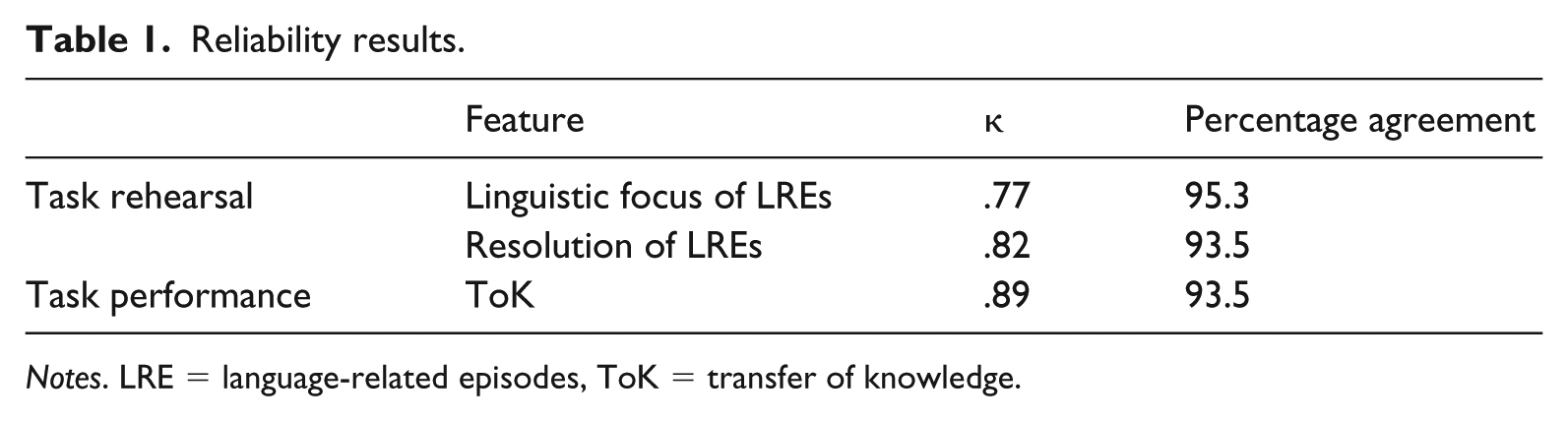
Notes. LRE = language-related episodes, ToK = transfer of knowledge.
III Results
1 Proficiency and occurrence and resolution of LREs in task rehearsal
The first research question addresses whether learner proficiency affected the occurrences and resolution types of LREs in task rehearsal.
a Occurrence of LREs
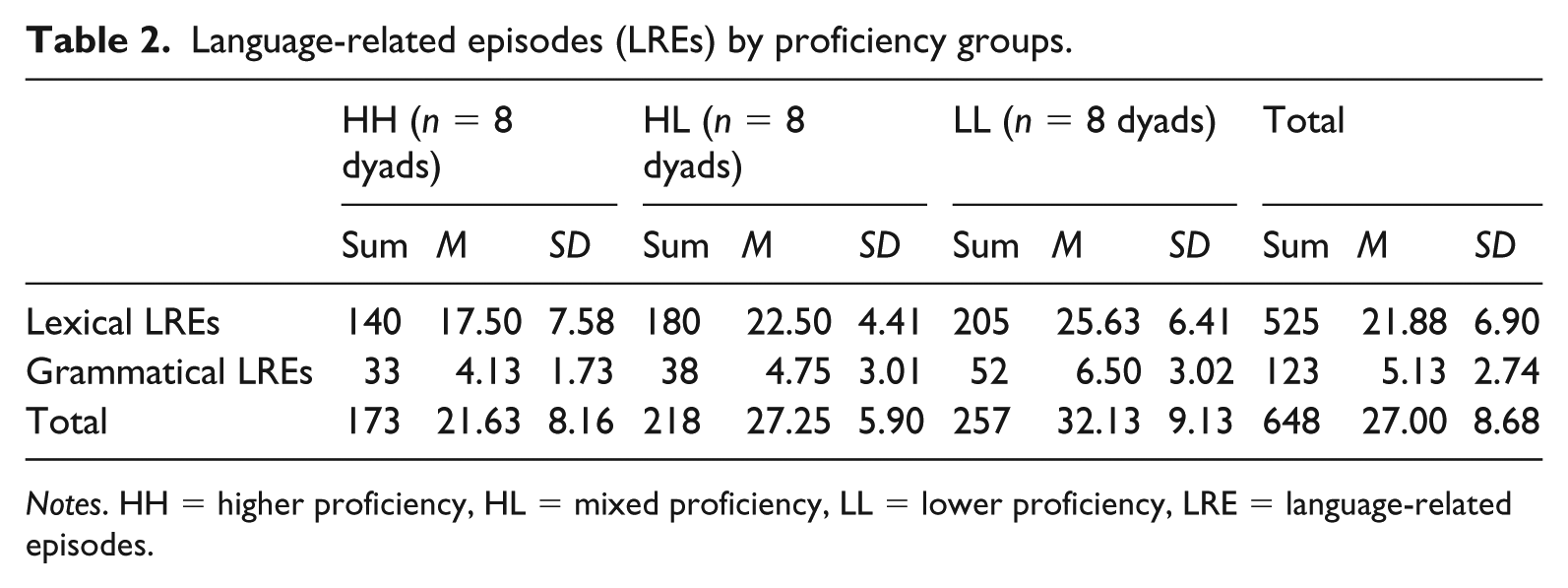
Table 2 shows the number of lexical and grammatical LREs by proficiency groups. As seen from this table, more LREs were produced by lower proficiency dyads (LL and HL). A lexical focus is predominant in LREs for all proficiency groups. In order to test the significance of these trends, a mixed ANOVA test was used, with linguistic focus (with two levels: the lexical vs. grammatical LREs) as a within-subject variable and proficiency pairing as one between-subjects variable (with three levels: HH, HL, LL). All the assumptions of the mixed ANOVA (normality, homogeneity of variances, and sphericity) were checked before analysis. Regarding Sphericity, the repeated measures variable in the current study had only two levels (lexical vs. grammatical), so the assumptions of Sphericity using Mauchly’s test were not a concern (Field, 2005; Larson-Hall, 2010). Given the data samples were small, the Skewness-z score tests of normality were used (Field, 2005, p.139). They showed that the assumptions of normality were met for all the data (LREs, lexical LREs, grammatical LREs for each proficiency group; all the z scores were below 1.96). The Levene tests also showed that all the three proficiency groups have similar variances. The alpha level was conventionally set at .05. The percentage variance effect sizes indexed by partial eta squared (ηp²) values and observed power were also reported. ηρ² values of .01, .06, and .14 are considered small, medium (Larson-Hall, 2010). Where there was a statistically significant main effect of proficiency, Tukey HSD post hoc analysis was further reported to see the difference between dyad groups. The Tukey HSD was elected because the sample sizes are equal and group variances are similar (Field, 2005, p.375).
Language-related episodes (LREs) by proficiency groups.
Notes. HH = higher proficiency, HL = mixed proficiency, LL = lower proficiency, LRE = language-related episodes.
The mixed ANOVA results showed a significant main effect of linguistic focus, F(1, 21) = 215.472, p < .001, ηρ² = .91, observed power = 1.00, indicating that learners paid central attention to vocabulary when discussing their language problems. Dyads discussed, on average, 21.88 lexical LREs (SD = 6.90) and 5.13 grammatical LREs (SD = 2.74). There was also a significant main effect of proficiency, F(2, 21) = 3.589, p = . 046, ηρ² = .26. Tukey HSD post-hoc analysis revealed that the LL dyads generated significantly more LREs than the HH (p = .036), but the difference between the HH and HL and between the HL and LL was not statistically significant (p = .342 and p = .442, respectively). In other words, the effects of the lowest proficiency prevailed. The interaction effects between linguistic focus and proficiency were not statistically significant, F(2,21) = 2.308, = ηρ² = .18, p = .124. This suggests that preference for lexical LREs rather than grammatical LREs was consistent across proficiency groups.
b Resolution of LREs
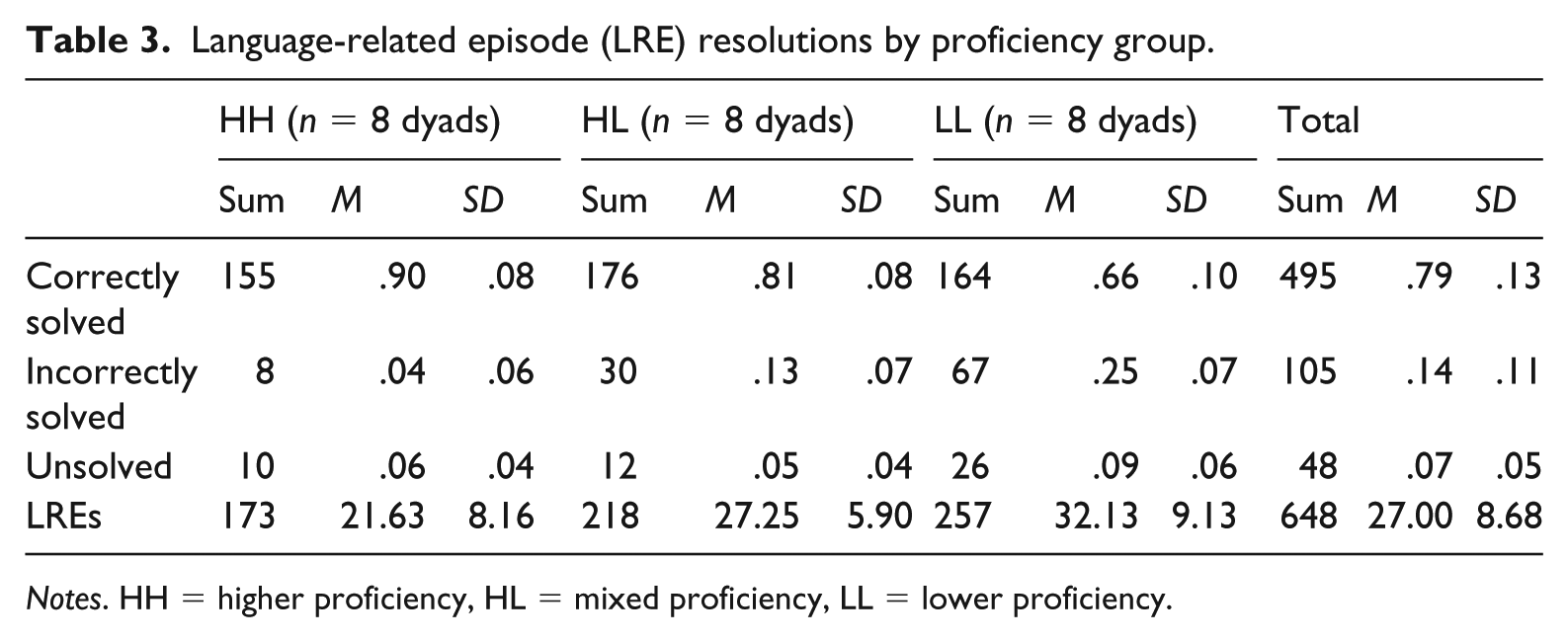
Regarding whether proficiency affected how LREs were resolved, the results are shown in Table 3. The learners working collaboratively in rehearsal were largely successful at resolving their LREs. All proficiency groups correctly resolved the majority of their LREs. To see whether proficiency had an impact on how LREs were resolved, a series of one-way ANOVA tests with proficiency pairing (HH, HL, LL) as a between-subjects variable, were conducted on each type of LRE resolution as a dependent variable. All the assumptions of one-way ANOVAs (normality of data and homogeneity of variances, etc.) were checked and met before analysis. Regarding the measure of correctly solved LREs, the results showed a significant main effect of proficiency, F(2, 21) = 15.677, p < .001. This was a large effect size (ηρ² = .60). Tukey HSD post-hoc analysis showed that both the HH and the HL correctly solved a significantly higher proportion of LREs than the LL dyads (p < .001 and p = .009, respectively). There was no statistically significant difference between the HH and the HL groups (p = .082), though the trend was towards significance.
Language-related episode (LRE) resolutions by proficiency group.
Notes. HH = higher proficiency, HL = mixed proficiency, LL = lower proficiency.
For the incorrectly solved LREs, there was also a significant main effect of proficiency, F(2, 21) = 16.679, p < .001, with a very large effect size (ηρ² = .61). Tukey HSD post-hoc analysis showed all dyad groups differed statistically from one another. Specifically, there was a statistically significant difference between the HH and the LL groups (p < .001), between the HL and the LL (p = .011), and between the HH and the HL (p = .048). Overall, the LL group had the greatest proportion of incorrect resolutions, followed by the HL and then the HH.
As far as unsolved LREs are concerned, the main effect of proficiency was not statistically significant, F(2, 21) = .878, p = .430, indicating that leaving LREs unsolved was not influenced by whether the dyads were HH, HL, or LL. Given the small data samples, the findings need to be interpreted with care.
In short, the learners were able to correctly resolve a majority of language issues they encountered during task rehearsal. However, success at resolving LREs was influenced by dyad proficiency, with higher proficiency dyads being more successful.
1.1.1 Linguistic focus of LREs and LRE resolution in task rehearsal
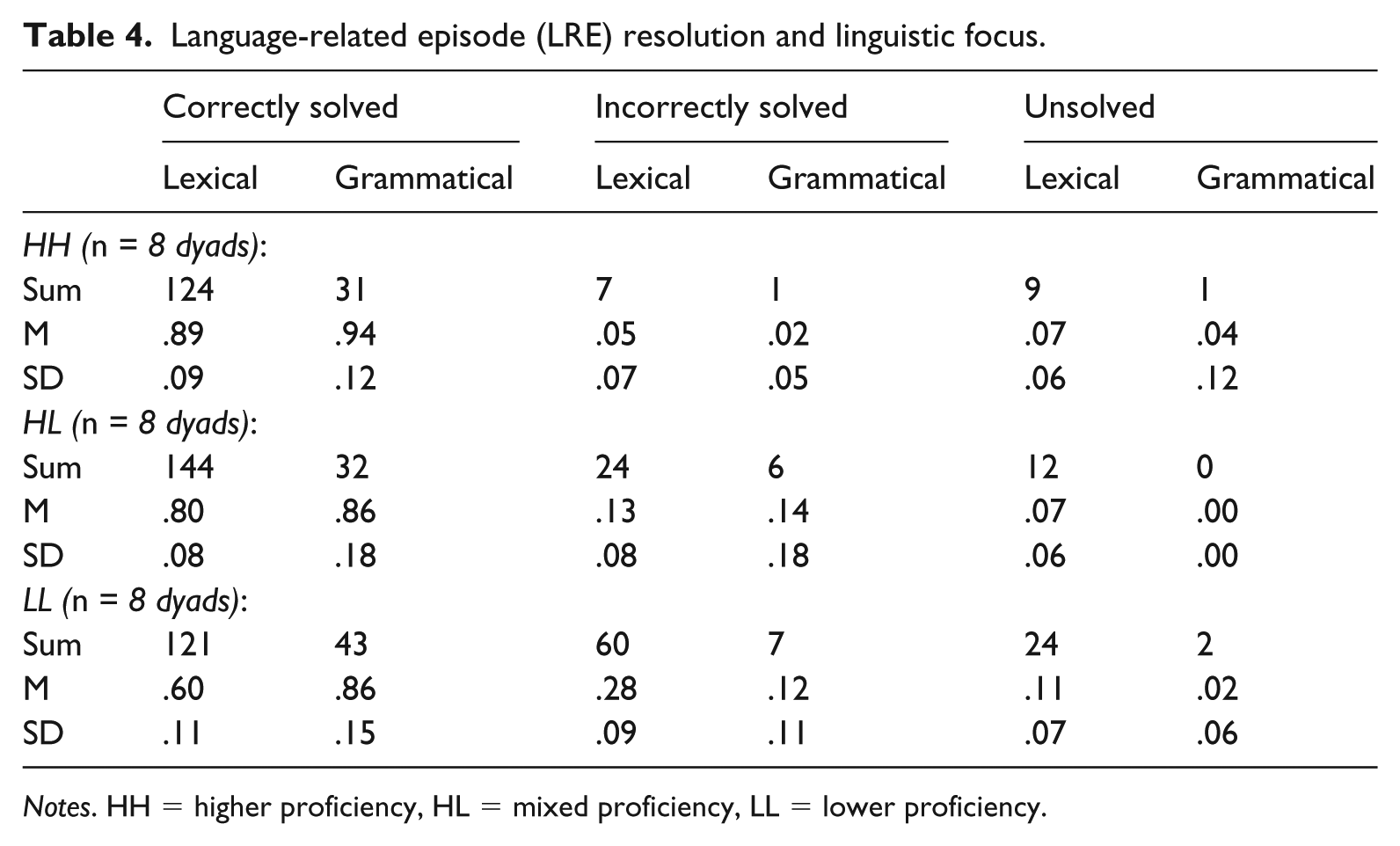
The study also investigated whether learners resolved lexical and grammatical LREs differently. The proportion of lexical or grammatical LREs being correctly solved, incorrectly solved or unsolved was calculated out of the total lexical or grammatical LREs. Lexical and grammatical resolutions across proficiency levels are shown in Table 4.
Language-related episode (LRE) resolution and linguistic focus.
Notes. HH = higher proficiency, HL = mixed proficiency, LL = lower proficiency.
As Table 4 shows, learners resolved a large majority of their lexical and grammatical issues correctly, but were more successful at resolving grammatical than lexical problems, especially the LL dyads. A greater proportion of lexical than grammatical LREs were left unsolved for all dyad groups and learners tended to incorrectly resolve a greater proportion of lexical than grammatical issues. Statistical analysis was conducted only for the correct resolutions, because the data on incorrect and unsolved resolutions were limited when split into lexical and grammatical focus. Individual paired samples t-tests or non-parametric Wilcoxon Signed Ranks tests as appropriate showed that the difference between the proportions of lexical and grammatical LREs being correctly solved was not significant for the HH group (Z = −1.153, p = .249, r = .06) and for the HL, t(7) = −1.027, p = . 339, r = .36. However, the LL dyads correctly resolved a significantly greater proportion of grammatical (M = .86, SD = .15) than lexical LREs (M = .60, SD = .11) LREs, t(7) = −5.276, p = .001, r = .89. These results suggest that while the HH and HL dyads were able to correctly solve lexical and grammatical LREs equally well, the LL did significantly better when the focus was on grammar.
2 Proficiency and ToK from rehearsal to performance
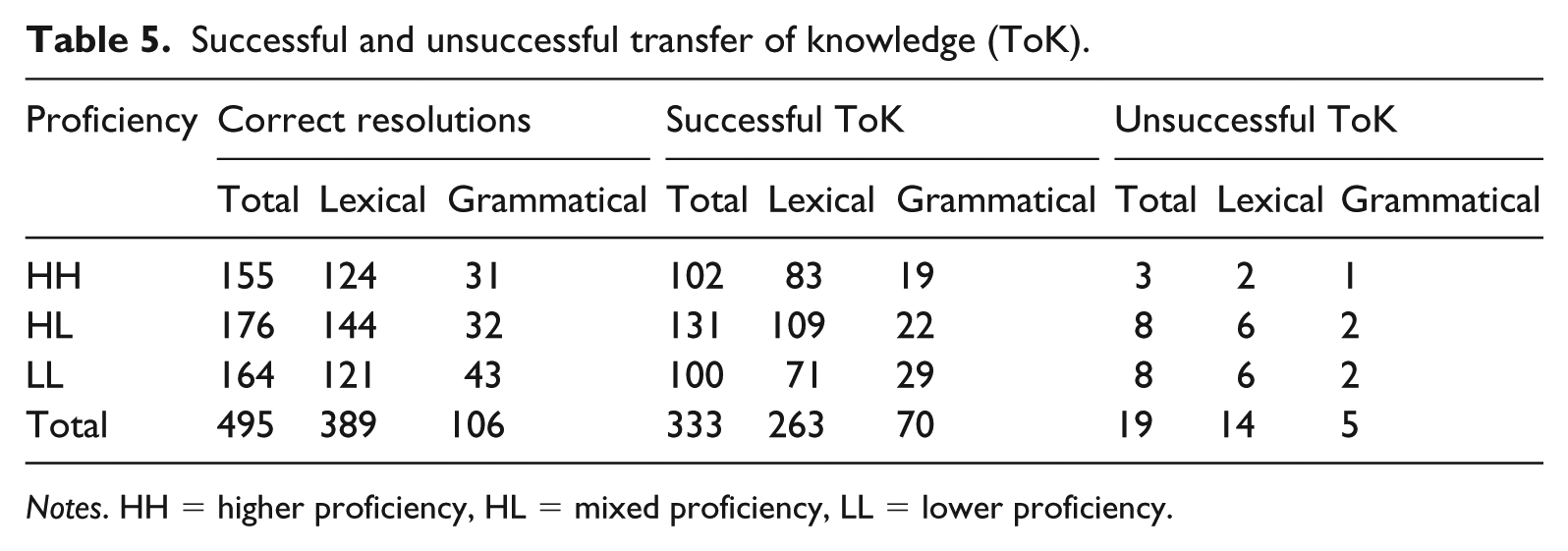
The second research question asks whether proficiency affected the transfer of LRE-specific language items from rehearsal to performance. None of the language items in LREs that students failed to resolve in rehearsal was used in performance. Table 5 shows the number of instances of successful and unsuccessful ToK, that is, instances of successful and unsuccessful use of correct resolutions in task performance. Table 6 shows incorrect ToK, that is, transfer of incorrect LRE resolutions from rehearsal to performance.
Successful and unsuccessful transfer of knowledge (ToK).
Notes. HH = higher proficiency, HL = mixed proficiency, LL = lower proficiency.
Incorrect transfer of knowledge (ToK).
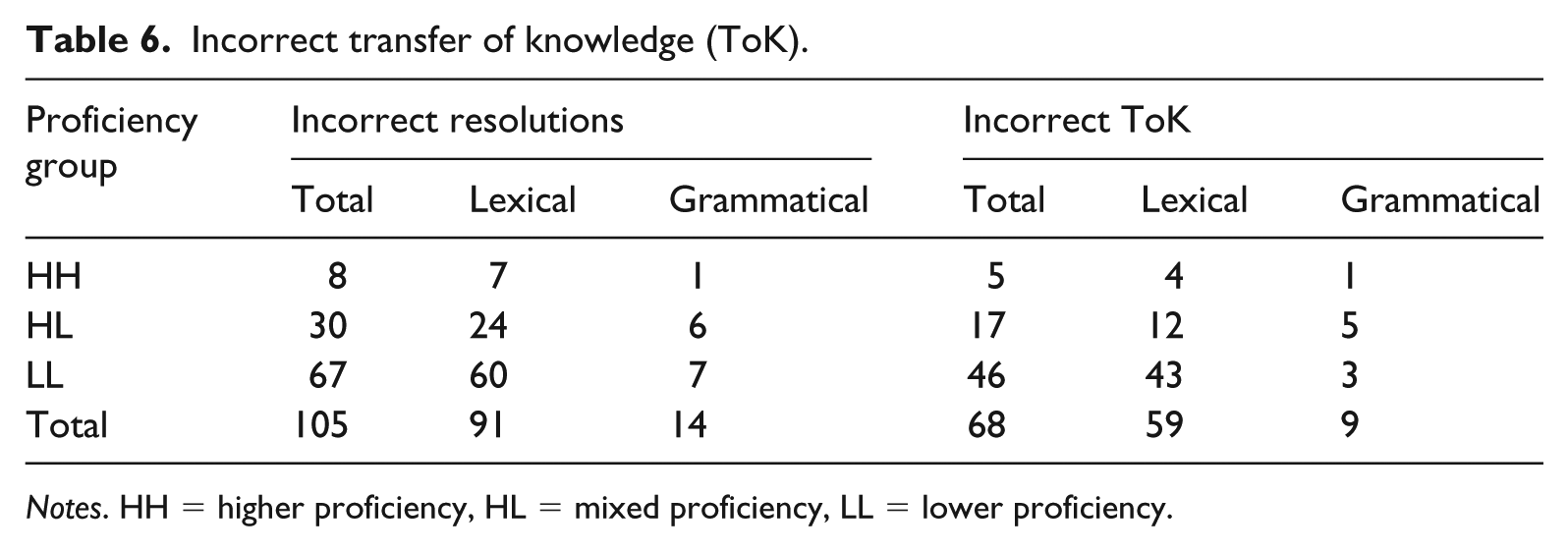
Notes. HH = higher proficiency, HL = mixed proficiency, LL = lower proficiency.
As can be seen from Table 5, unsuccessful ToK was infrequent with 19 out of the 495 correctly solved LREs (3.9%) being used incorrectly in task performance. This further confirms that once the learners correctly resolved their language problems in the rehearsal, a majority (67%: 333/495) of these correct language resolutions were adopted in task performance: 61% (100/164) for the LL dyads, 66% (102/155) for the HH, and 74% (131/176) for the HL. A majority of both lexical and grammatical items were transferred successfully to the performance. For the HH and the HL dyads, ToK of lexical items (67%: 83/124 and 76%: 109/144, respectively) seems higher than that of grammatical items (61%: 19/31 and 69%: 22/32), whereas the LL dyads tend to retain more correct grammatical than lexical items (67%: 29/43 vs. 59%: 71/121) in the performance.
As Table 6 shows, incorrectly solved LREs in this study made up 16% (105/648 LREs). Of these, 65% (68/105) led to incorrect use in task performance, with lower proficiency dyads having greater percentages of incorrect ToK: 63% (5/8) for the HH, 57% (17/30) for the HL, and 69% (46/67) for the LL. The LL dyads had a higher percentage of incorrect ToK of incorrect lexical than grammatical resolutions (72%: 43/60 vs. 43%: 3/7). The opposite was true for the HH and HL dyads.
Due to the limited data on grammatical resolutions and corresponding ToK, statistical analysis were conducted for the total ToK only. The Chi-squared results showed the HL dyads were more likely to retain correct language resolutions in task performance than the LL dyads, χ2 (1) = 7.057, p = .010. However, there were no significant differences between the LL and HH, χ2 (1) = .801, p = .416, and the HL and HH, χ2 (1) = 2.942, p = .092, indicating that once the lower proficiency dyads (LL) were able to correctly solve their language problems, they were able to use them in their performance equally as well as higher proficiency dyads (HH). With regards to the measure of incorrect ToK, the Chi-squared results revealed no significant difference between the three proficiency groups, χ2 (2) = 1.325, p = .516, suggesting that once students came up with incorrect resolutions to their language problems in rehearsal, irrespective of their proficiency, they carried a large majority of them to the performance.
IV Discussion
The study set out to examine whether learner proficiency had an impact on the frequency of LREs, how they were resolved in task rehearsal and the subsequent use of LRE-specific items in task performance. The results showed that when lower proficiency learners worked together, they discussed significantly more LREs than higher proficiency learners. This broadly corroborates Niu et al.’s (2018) findings with an IELTS graph writing task, and Nassaji’s (2010) study, in which his ESL beginner class initiated more focus on form than intermediate and advanced classes, although the context here was teacher-learner interaction. However, the result strikingly contrasts with other studies (Kim & McDonough, 2008; Leeser, 2004; Storch & Aldosari, 2013; Watanabe & Swain, 2007; Williams, 1999) which found more LREs with higher proficiency learners. One possible explanation for these contradictory findings is the different nature of the tasks used. For example, Williams’s (1999) study covered a wide range of activities from meaning-focussed to form-focussed activities and in Nassaji’s (2010) study meaning-focused activities were used. In all the other studies, dictogloss activities or writing tasks were used.
Research (e.g. Adams & Ross-Feldman, 2008; García Mayo &Azkarai, 2016; Kuiken & Vedder, 2012) has shown that task modality has an impact on the extent to which learners attend to language form. The tasks used in the current study were oral open-ended tasks (though one is more open than the other) requiring learners to make their own meanings. That lower proficiency dyads discussed more LREs suggests they had noticed greater ‘holes’ or ‘gaps’ to fill or at least had more difficulty in finding resources to express their meanings. In other words, these lower proficiency dyads were more ‘pushed’ to carry out the same tasks than more proficient dyads, indicating their ‘problematicity’ (Long, 2007) or their real need to ‘talk about what they need to talk about’ (Swain, 1998, p.73, original italics). It was unsurprising that a preference for attending to lexical items was consistent for all proficiency groups, given the highly meaning-focused and open-ended nature of the two tasks used in this study. This echoes findings from other research focusing on learner-learner interaction (e.g. Bitchener, 2004; Fernández Dobao, 2012; Fuji & Mackey, 2009; Niu et al, 2018).
The results also showed that although learners were able to correctly resolve a large majority of their language problems, lower proficiency dyads were less successful, confirming findings of previous studies (Kim & McDonough, 2008; Leeser, 2004; Niu et al., 2018; Watanabe & Swain, 2007). It is hardly surprising that the LL dyads did not resolve their language problems as well as the other more proficient dyads (HH, HL), given their more limited linguistic resources. That they were more successful with grammatical problems corroborates prior research which investigated low proficiency learners. For example, McDonough and Sunitham (2009) found low proficiency students at an EFL Thai university tended to solve correctly more grammatical LREs than lexical LREs. Iwashita (2001), though examining tasks from a different angle (negotiation of meaning and modified output) argued that syntactic items were within the learners’ knowledge and thus, more ‘manageable.’ In the current data, the grammatical problems typically involved familiar grammatical items that they had declarative knowledge. In contrast, lexical problems could involve any target lexical items that learners wanted to use to express their intended meanings.
The finding that the HL dyads were more likely to correctly resolve LREs successfully and retain the correct resolutions in performance is rather more interesting. In the HL dyads, the higher proficiency learner typically took the expert role, providing solutions to language issues their lower proficiency peer encountered (Example 8), or responding to the peer’s error (Example 9).
Example 8 (The problem-solving task: HL-11a) L: có thể … có thể tạo điều kiện… ê tạo điều kiện là gì mi? (can … can facilitate … hey, how to say ‘facilitate’?) H: facilitate L: tạo điều kiện (facilitate) H: facilitate L: facilitate Example 9 (The problem-solving task: HL-11a) L: have you (.) have you (.) răng hè (how to say) (.) have you done volunteer work? H: have you EVER L: have you ever done volunteer work?
In fact, a closer analysis of the data in the HL dyad shows that it was the higher level learner who significantly resolved more language problems (136) than the lower proficiency peer (40) while the latter initiated more LREs (133 vs. 85) (see Table 7).
Language-related episodes (LREs), resolutions and transfer of knowledge (ToK) for mixed-proficiency (HL) dyad members.
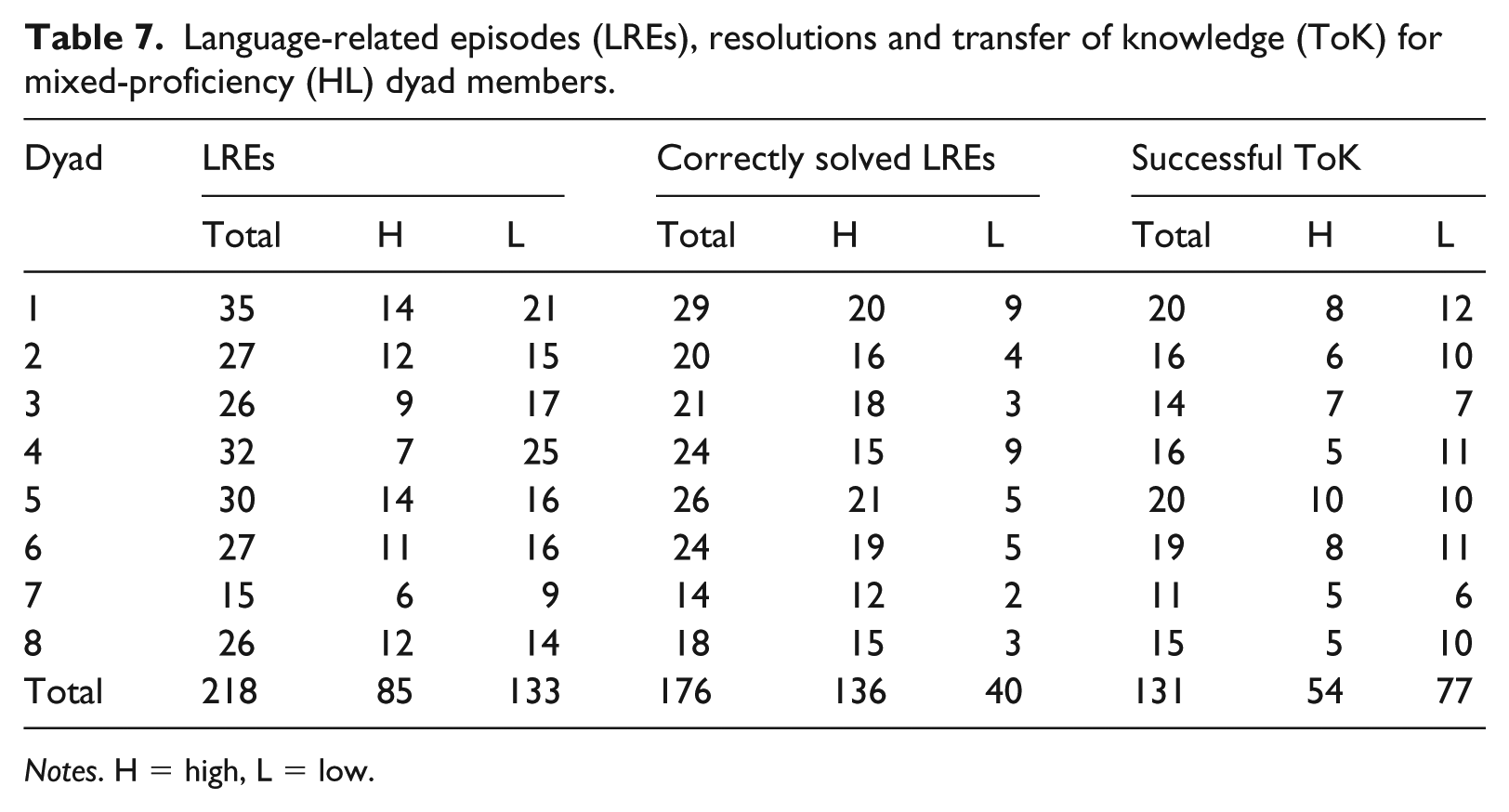
Notes. H = high, L = low.
Yet it was the lower proficiency learner who demonstrated more ToK in task performance (77 vs. 54). In contrast, when two higher proficiency learners or two lower proficiency learners worked together, there was not so much difference between dyad members in terms of LREs, LRE resolutions or ToK (see Table 8 and Table 9).
Language-related episodes (LREs), resolutions and transfer of knowledge (ToK) for lower-proficiency (LL) dyad members.
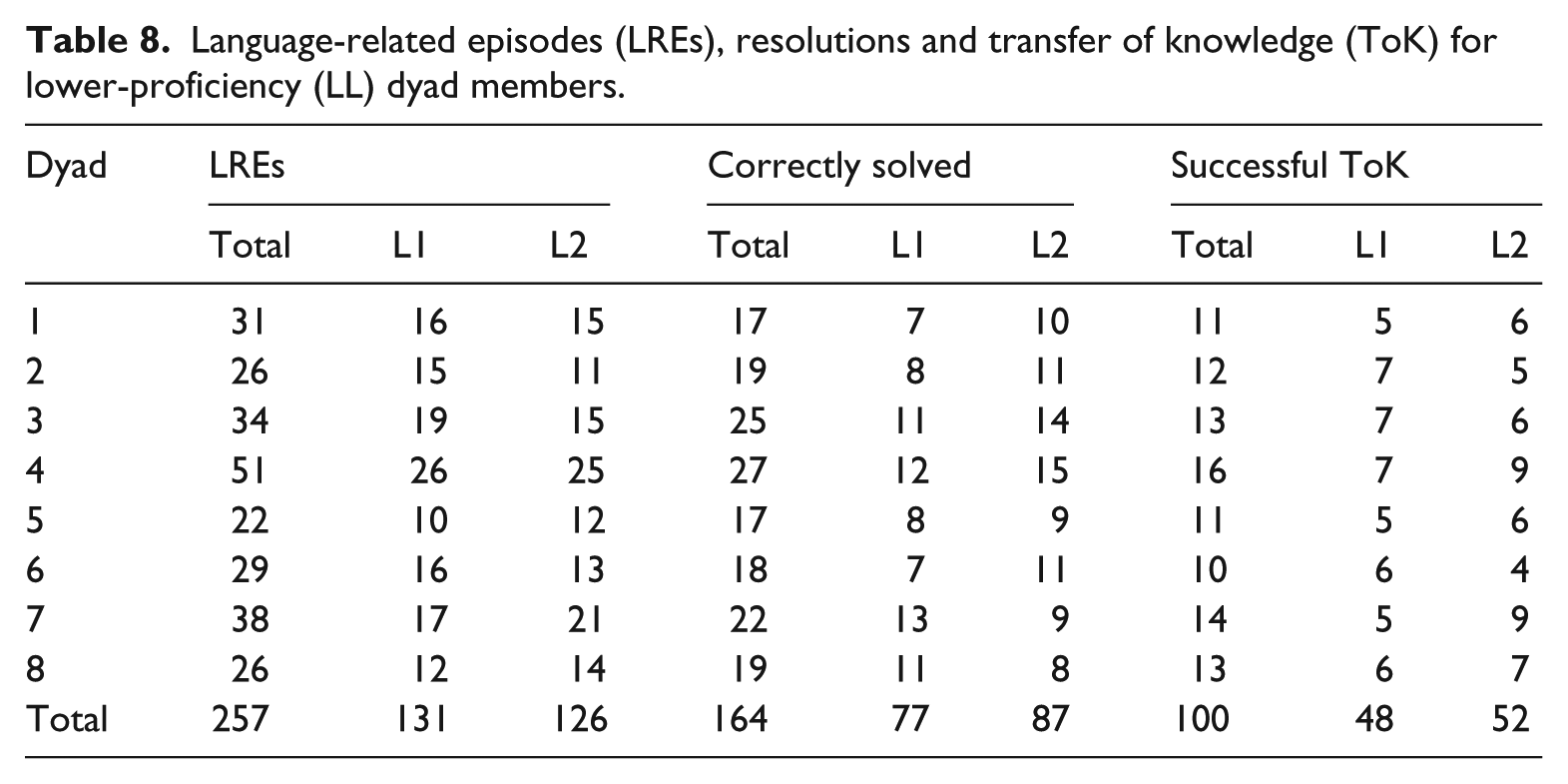
Language-related episodes (LREs), resolutions and transfer of knowledge (ToK) for higher-proficiency (HH) dyad members.

This suggests that the learning outcome for lower proficiency learners may depend on the availability of expertise. The higher proficiency learner responded to appeals for assistance from the lower proficiency interlocutor, or provided correction/assistance. In either case, the lower proficiency learner benefited because he or she needed the language item to convey meanings. This does not necessarily mean that the higher proficiency learners in the HL did not benefit as much from interaction; the benefits to these higher proficiency learners are likely to include increased confidence and fluency gains through accessing and activating their language resources to resolve language problems the dyads faced (see Ohta, 2001; Van Lier, 1996).
It is particularly intriguin that proficiency played a lesser role in ToK in performance than in LREs in rehearsal. That is to say, there were minor differences between the proportion of LRE-focused items used in the public performance by the lower proficiency learners (in either LL or HL dyads) and by the HH dyads. This contrasts with previous research which found more learning gains for higher proficiency learners (Watanabe & Swain, 2007; Williams, 2001). One explanation is in the strategies that the lower proficiency learners in the current study employed to prepare for their impending performance. These included deliberate memorization, as in Examples 10−11, and overt local rehearsal at phrase/sentence levels (Examples 12−13) which were more typical of the low proficiency learners’ rehearsal discourse.
Example 10 (The debate task: LL-11e) L1: Cố gắng nhớ, mi làm đừng có quên.
(Try to remember, don’t forget.)
L2: OK. Ê lại, có nhiều từ tau không nhớ. (OK. Hey again, there are many words I can’t remember.) Example 11 (The problem-solving task: HL-11c) H: Rứa là vô rồi đó! (Good, we can lead into the conversation already!) L: Tau sợ tau quên.
(I’m afraid I will forget.)
H: Quên đồ rứa nữa à? [cười] (That involves forgetting (and remembering) for you?) [laugh] L: Ừ, dể quên lắm mi ơi. Tau phải nhớ mấy từ ni. (Yeah, very easy to forget. I have to remember these words.)
These excerpts show the lower proficiency learners made a deliberate effort to memorize the ideas, words or phrases they had discussed in preparation for the performance, thus promoting ToK. Storch and Wigglesworth (2010) also found that learners improved their post-test scores because they memorized the feedback information.
In this context, the teachers did not guide what students had to do in their 15-minute private task performance or rehearsal (see task instructions in Appendix 1). Rather they circulated around and responded to students’ questions as needed. In rehearsal, students planned what they were going to say, how they were going to say it and rehearsed actual utterances. Some went straight into doing the task (rehearsal) earlier than others and some rehearsed more than others. Memorizing strategies that lower proficiency learners used further confirm that attention to form is learner-driven (Ortega, 2005) and prompted by learners’ own needs (Swain, 1998 ) in response to the demand of the tasks in question, and especially, the impending public performance. As noted earlier, public performance was widely used in these EFL high school classrooms and was valued by teachers and students alike, thus providing even more impetus for students to invest in constructing their performance.
Example 12 (The problem-solving task: HL-11e) L: Oh, oh, yes (.) Er I think er I think it’s very perfect (.) Er H: Perfect rồi còn very chi nữa mi! (Perfect already, no very!) L: I think it’s perfect … It’s perfect … It’s perfect …[Repeating to herself] Example 13 (The problem-solving task-LL-11c) L1: (…) Hỏi why đi để bạn trả lời. (Ask why and I’ll answer.) L2: Hey? L1: Hỏi why đi để bạn trả lời. (Ask why and I’ll answer.) L2: Why? L1: Eh er in central Vietnam, there is (.) there are many floods ah specia Hue, (…), bơ nớ trả lời (then you continue).
Overall, that all dyad groups used a majority of the LRE-specific items (from 61% to 74%) in the performance was encouraging, and broadly comparable with learning measured by means of tailor-made post-tests, from 59% to 80% of the LRE-focused items (Adams, 2007; Eckerth, 2008; Kim, 2008; La Pierre, 1994, cited in Swain, M. 2001; Swain, 2001.), from 62% to 70% in repeated tasks (e.g. Bitchener, 2004) and subsequent individual presentation, 75% (Donato,1994), though in the latter study learners had intensive, one-hour group pre-task planning. However, the result contrasts with findings by Truong and Storch (2007), who found not only low incidences of LREs but also a lower ToK percentage of 7.1% (1/14) to 28.6% (4/14) of the language items focussed on in LREs in a previous 20-minute group planning session. Performance in pairs in the present study, which differs from the individual presentations in Truong and Storch’s and Donato’s studies, may have accounted for greater occurrences of LREs and associated ToK. This suggests that interactive public performance might provide good incentives for retention of LRE-focused information, given research has shown that retention was very low in spontaneous speech (Williams, 2001; Loewen, 2007) or when there were no post-task activities (McDonough, & Sunitham, 2009). The second time the learners re-engaged with the task, in public performance, the language items attended to in task rehearsal might have become readily available for use, because the learners were no longer preoccupied with what they were to say, thus freeing up attention focus on how to say it (Bygate, 2001, 2018; Ellis, 2009a; Skehan, 2016), hence facilitating ToK. But this was also true of transfer of incorrect LRE resolutions. Does this mean that collaborative dialogue might bring about ‘wrong’ learning (Swain, 1998) or ‘mis-learning’ (Adams, 2007)? While uptake of incorrect peer feedback might simply indicate performance errors under the pressure of making meanings to be conveyed publicly, the incorrect forms may enter their interlanguage without awareness of these forms being non-target-like, leading to fossilization. In this regard, teacher assistance during rehearsal and feedback after performance, would be useful, especially when dyads with limited L2 resources work together. The evidence of ToK in task performance is clearly only a step in the learning process that culminates in the integration and automatization of the targeted items. Extended opportunities for language use and analysis are needed (see DeKeyser, 2007) to promote re-structuring and reorganization of the language system (Skehan, 1998).
V Conclusions
The study has shown that impending public performance pushed learners to resource the upcoming performance. Task rehearsal allowed learners at different proficiency levels to adopt a focus on form and to rehearse in ways appropriate to their particular needs. The LREs produced by learners at different proficiency levels revealed the particular demands the tasks made of stronger and weaker learners. This raises the question for teachers of how best to arrange dyads. On the one hand, the LL dyads worked effectively and appropriately to navigate the task and supported each other well. On the other hand, they were more likely to resolve their language problems incorrectly. Being aware of this, teachers may need to provide support for such learners. This may take the shape of being available during rehearsal or providing follow-up feedback after the performance. The findings show that pairing learners of mixed proficiency levels is also useful provided that the more proficient student understands the value of assisting the less able peer (also see Kowal & Swain, 1997; Watanabe & Swain, 2007; Yule & Macdonald, 1990), so that he or she maintains his or her collaboration throughout rehearsal.
The frequency of LREs in the current data shows how the tasks pushed learners to mobilize and search for lexical items (including lexical phrases) to convey their intended meanings. These LREs show a wide range of vocabulary being discussed, and stand in stark contrast to the ‘impoverished’ and ‘minimalized’ interaction that Seedhouse (1999), among others, have argued is typical of task-based interaction. The learners also reflected on each other’s use of grammatical items, though to a smaller extent. The findings contrast with doubts raised about the value of tasks in EFL contexts (see Lai, 2015).
The study has several limitations. First, it only revealed short-term learning within the space of a single lesson. ToK may have been the result of short-term memory under the pressure of a public performance. Further, the memorizing strategies that lower proficiency learners employed to serve the immediate performance might have confounded the effect of proficiency. Future studies could additionally integrate delayed public performance (without learners being aware of this) or delayed task repetition with different partners (e.g. Bitchener, 2004; Bygate, 2001) to trace longer-term learning. Second, the present study only demonstrated ToK by the interlocutors who signalled a need for the language items (they asked for assistance, received feedback, carried out self-searches, or self-corrected), because the data indicated that it was those learners who took up the items in the performance, it did not provide a means of measuring learning for both dyad members. It would be useful if future studies could use a combination of ToK and LRE-specific post-test items administered to both dyad members. Third, the current research did not incorporate a control group (e.g. task repetition without public performance). It therefore remains unclear whether ToK in performance was due to the public nature of performance or simply from task repetition. Forth, in the present research, we categorized LREs broadly into lexical and grammatical LREs. Categorizing LREs in this way has also been common in previous research (e.g. Kim & McDonough, 2008; McDonough & Sunitham, 2009; Swain & Lapkin, 2001; Williams, 1999, 2001). However, this broad categorization may fail to capture how learners attended to different aspects of grammar and lexis. Future studies may consider using more detailed categorization of LREs (see Storch, 2008) in order to investigate whether different lexical and grammatical features yield differential levels of ToK in performance. Finally, the research was conducted at a leading high school in Vietnam which is not representative of other schools in the country. Despite these limitations we believe the study makes a valuable contribution to a ‘researched pedagogy’ of tasks (Bygate, 2016; Bygate, Samuda, & Van Den Branden, 2018) through its grounding in real classrooms and in teachers’ actual teaching practice.
Footnotes
Appendix 1
Acknowledgements
The authors would like to thank the Vietnamese teachers and students who participated in this research, and the anonymous reviewers for their valuable feedback that helped strengthen the paper. Any remaining errors are ours.
Declaration of Conflicting Interest
The author(s) declared no potential conflicts of interest with respect to the research, authorship, and/or publication of this article.
Funding
The author(s) received no financial support for the research, authorship, and/or publication of this article.
