







Abstract
While previous research has investigated the effectiveness of various second language (L2) writing instructional approaches upon students’ writing performance, whether and how the instructional approaches relate to students’ writing motivation and engagement remains largely unexplored. This study used the adapted Motivation and Engagement Scale for University/College students and investigated how the three L2 writing instructional approaches (i.e. product-, process-, and genre-oriented) were associated with L2 students’ writing motivation and engagement. A sample of 1,190 students from 35 universities in China participated in the study. Results show that the product-oriented approach induced both adaptive and maladaptive motivation and engagement whereas the process-oriented approach led to student engagement in writing with limited impact on motivation. The genre-oriented approach emerged as the one that best promoted students’ adaptive motivation and engagement in L2 writing. The findings shed light on the motivational potentials of various L2 writing pedagogies and provided insights for how students’ writing motivation and engagement can be promoted with relevant L2 writing instructional approaches.
Keywords
I Introduction
Second language (L2) writing instructional approaches have received persisting interest in educational research and policy contexts around the world (Hyland & Hyland, 2019). Such interest is evident in the significant changes to L2 writing pedagogies over the past decades, with paradigmatic shifts away from product-oriented approach towards those of process- and genre-oriented (Hyland, 2007; Lee & Wong, 2014). Accordingly, a large body of literature around the effectiveness of various instructional approaches upon students’ writing performance and proficiencies have been gradually building up (Ai-Hroub, Shami & Evans, 2019; Badger & White, 2000; Chen & Su, 2012; Firkins, Forey & Sengupta, 2007; Myskow & Gordon, 2010). However, little attention has been paid to how L2 students experience the instructional approaches in practice, and particularly how different L2 writing instructional approaches may be associated with their writing motivation and engagement.
According to Lamb (2017), language teaching processes are closely associated with student learning motivation and achievement, echoing Dörnyei & Ushioda’s (2011) conceptualization of the role of teachers’ language instructional behaviors in motivating students to learn. Nevertheless, motivation is not only context-bound, but also domain-specific and accordingly, learning to write may differ from motivation to learn other language skills (Lee, Yu & Liu, 2018). Indeed, Hyland (2003) argues that ‘learning to write in a second language is one of the most challenging aspects of second language learning’ (p. xiii). Hence, it is crucial to examine the relationship between language teaching and student motivation in specific domains such as L2 writing. Nevertheless, while there is no lack of studies exploring students’ beliefs and perceptions of L2 instructional practices such as teacher feedback (Hu & Lam, 2010; Lo & Hyland, 2007), much overlooked in the literature is whether and how various L2 writing instructional approaches cater for L2 students’ motivational and engagement process in writing. Given the increasing importance of L2 writing for university students and their future achievement, more knowledge is needed regarding the association between L2 writing instructional approaches and students’ writing motivation and engagement so as to better inform motivation-and-engagement-conducive L2 writing pedagogies.
With the adapted Motivation and Engagement Scale for University/College Students (MES-UC; Martin, 2007, 2008, 2012), the present study explores Chinese undergraduate English-majored students’ experiences of L2 writing instructional approaches, focusing on the associations between various forms of L2 writing instructional approaches and these English-as-a-foreign-language (EFL) students’ writing motivation and engagement. Adopting a large-scale design, the present study contributes to the international theoretical and pedagogical discussions around L2 writing instruction and the promotion of students’ writing motivation and engagement across different educational contexts.
II Literature review
1 L2 writing instructional approaches
The past decades have witnessed the emergence of three major approaches to L2 writing instruction: the product-, process-, and genre-oriented approaches. The product-oriented writing instruction was grounded in audiolingualism in the 1960s (Raimes, 1991). Pincas (1982) described the product approach as being concerned over linguistic knowledge, highlighting the accurate use of vocabulary and grammar. In product-oriented instruction, writing normally goes through four stages: familiarization, controlled writing practice, guided writing, and free writing (Badger & White, 2000). Learners are expected to first familiarize themselves with the features of certain texts, followed by learners practicing the skills or intimating the input they received until they are capable of producing their own texts.
The process-oriented approach arose as a reaction against the product-oriented approach (Raimes, 1991; Susser, 1994). Awareness and intervention are the two pillars of this pedagogy (Kostelnick, 1989). Instead of emphasizing language forms and its right use, process approach focuses on cultivating students’ awareness that writing is a process by nature, which may include choosing vocabulary, considering audience and deciding on formats. The second important tenet of the process approach is intervention. Different from the product approach in which teachers correct students’ mistakes or ‘repair the damage’ (Flower & Hayes, 1981, p. 55), process writing teachers help students think through and organize their ideas before writing and revise afterwards (Applebee, 1986). This may include brainstorming, free writing, small-group discussion, teacher/student meetings, peer reviewing, and etc. Researchers suggest that the process writing approach is more an attitude than a program (Susser, 1994). It aims to provide a positive, encouraging, and collaborative environment within which students can work through their composing processes (Silva, 1990).
The process-oriented approach has been highly influential as an L2 writing pedagogy since the late 20th century. It had a major impact on the ways researchers and practitioners conceptualize and teach writing. It changed people’s understanding of L2 writing, not narrowly as product models, but as complex composing processes (Badger & White, 2000). The process-oriented approach has also received some criticism, especially from more socially-oriented views of writing (Hyland, 2003). Its opponents argue that the process-oriented approach emphasizes writer’s individualism but lacks considerations of the forces beyond individuals, which suggest the purposes of writing and relationships among people. Thereby, researchers (Hyland, 2007; Lee & Wong, 2014) have argued that the process-oriented approach fails to formulate a theory explaining how language works in human interactions and how meanings are socially constructed.
In contrast to a writer-dominated process approach, the genre-oriented approach is more reader-oriented, assuming language teaching as a kind of socialization into the target community (Horowitz, 1986, p. 789). The genre-oriented approach gives explicit and systematic explanations of the way that language functions in different social contexts. It sees ways of writing as purposeful, socially situated responses to particular contexts and communities. More specifically, factors such as register, style, lexis and other features are assumed to reflect the various personal and institutional purposes of writers. Teachers who adopt this writing approach ground their courses in the contexts in which students write and support learners to grasp the knowledge of target genre and command the explicit grammar of language choices (Hyland, 2007). Considering the impact of the genre-oriented approach on writing theory development, Hyland (2003, p. 26) posited that it shifts writing instruction from ‘the implicit and exploratory to a conscious manipulation of language and choice’.
2 L2 writing motivation and engagement
In L2 research, there is a growing understanding of the dynamic nature of student motivation and engagement as variables in individual’s development given the number of published studies during the past decade (Boo, Dörnyei, & Ryan, 2015; Waninge, Dörnyei, & De Bot, 2014). However, this research strand mainly takes place in the field of second language acquisition (SLA) with a looser connection to actual classroom practices. Furthermore, while motivation and engagement have been identified as essential elements of successful language acquisition and could be subject to the impact of other internal factors related to the individual learner, such as attitudes and interest (Dörnyei, 2003, 2005), there is a scarcity of studies concerning the influence of teacher classroom instructions as one of the external factors on student L2 motivation and engagement.
With regarding to L2 writing motivation and engagement, existing research has focused on the impact of individual’s motivation and engagement on writing performance and, more specifically, in feedback situations (e.g. Yu et al., 2019; Yu, Jiang & Zhou, 2020). For instance, Zheng and Yu (2018) have adopted a tripartite framework that takes student engagement with writing feedback as comprising of behavioral, affective and cognitive dimensions. Their study shows although students may be affectively engaged with feedback on their writing, their behavioral engagement may be quite low due to possible failures to comprehend feedback cognitively. In a similar vein with research in SLA, the L2 writing research tends to emphasize the influence of individuals’ internal factors, revealing how L2 motivation and engagement could be attributed to students’ attitudes, beliefs, proficiency, learning experiences, vice versa (Han & Hyland, 2015; Zhang & Hyland, 2018; Zheng & Yu, 2018). Although implications can be drawn from such research in terms of how teachers could tailor their instructional approaches to foster L2 students’ writing motivation and engagement, little is known about how a variation in the instructional approaches could relate to student motivation and engagement that are conducive to students’ writing development.
3 Impact of L2 writing instructional approaches upon writing motivation and engagement
Despite some scholars (e.g. Kormos, 2012; Lee et al., 2018) have argued that students’ motivation to write in an L2 is influenced by both sociocultural factors and instructional practice, research on the impact of the three major L2 writing instructional approaches upon students’ writing motivation and engagement remains scanty, with only a few exceptions. In terms of the product-oriented approach, a study by Lee et al. (2018) hinted that, for Chinese L2 student writers, teachers’ instructional practices that take writing as product with comprehensive and unfocused feedback tend to demotivate students from writing as students may find it overwhelming to tackle the feedback. As for the process-oriented approach, Graham and Sandmel’s (2011) meta-analysis of the process approach to writing instruction in first language (L1) K-12 contexts reveals no statistically significant improvements in students’ motivation. Lee’s (2017) research in Korean EFL university contexts has similar results. In Lee’s (2017) study, students were encouraged to produce multiple drafts of writing through self, peer, and teacher reviews. The results showed a somewhat higher level of motivation, with no statistically significant difference at the level of p = .05. Lee (2017) attributed the little increase in motivation to Korean students’ unfamiliarity with and lack of confidence in self and peer review that were involved in the process-oriented instruction.
Research on the motivational dimension of the genre-based approach in L2 contexts, however, seems to yield more positive results. For instance, in an English club at a local Hong Kong school, Firkins et al. (2007) introduced a genre-oriented and activity-based pedagogical approach to lower proficiency EFL learners and they noted that ‘students engaged with each text in the context of the activity, making it both motivating and relevant’ (p. 349). Yet it should be noted that the motivational power may derive from the activity-based approach that supported the genre-based approach, though this was not specified in their study. Nevertheless, in Han and Hiver’s (2018) investigation of motivational changes for middle school language learners in South Korea within the classroom ecology of genre-based writing, they noted that students’ motivation to writing was enhanced because the genre-based L2 writing instruction appeared to empower them to improve writing skills by ‘increasing their overall control of the target genre [and] to support students’ increased independence as writers’ (p. 55). However, this finding has to be understood in the participatory action research context of their study, within which the genre-based L2 writing instruction was introduced to the students as a transformative practice conducted by the researcher as the instructor. Thus, their findings may be a result of the novelty effect, which may not exist in the naturalistic classroom settings.
To date, no research, to the best of our knowledge, has examined and compared the influences of the product-, process-, and genre-oriented L2 writing instructional approaches upon students’ writing motivation and engagement in naturalistic classroom settings. It should also be noted that the construct of motivation in previous studies has been conceptualized differently in isolation of engagement and the methods used to evaluate it also differed from one study to another. Given the recent curricular changes and reform such as the release of the New National Curriculum Standard for English by the Ministry of Education in China, new teaching approaches and methodologies such as the process- and genre-oriented approaches may have been increasingly adopted in L2 writing classes, especially those in EFL contexts (Chen & Su, 2012; Yu & Lee, 2016). These instructional changes have made it difficult to examine product-, process-, and genre-oriented L2 writing instructional approaches as isolated curricular components, which may not represent what occurs in the naturalistic classroom settings. To address the research gaps, the current study used a validated L2 writing instructional scale and a comprehensive L2 writing motivation and engagement scale, to address the following research question: What are the associations between the three L2 writing instructional approaches and student writing motivation and engagement?
III Method
1 Participants and procedures
The data used in the current study are part of a large-scale national survey aiming to investigate L2 student motivation and engagement in the Chinese teaching contexts (Yu et al., 2019; Yu, Jiang & Zhou, 2020). A stratified multi-stage sampling method was used to draw a sample of English-majored college students from 31 provinces, autonomous regions, and municipalities in the Chinese mainland. Universities/colleges were selected using a stratified sampling method from different geographic locations (i.e. northeast, east and central region, west, and south) out of the 31 provinces and also based on colleges’ profession (i.e. comprehensive colleges, colleges of foreign languages, colleges of polytechnics, and teachers’ colleges) and colleges’ prestige (key colleges, the 211/985 National Key Universities; and regular colleges, universities/colleges other than the key universities). College English teachers from 49 colleges were contacted to help administrate the introduction of the study and the online survey. This study was approved by the institutional review board at [to be blinded] University.
Thirty-eight students were removed out of the 1,228 students from 39 colleges, who completed the online survey, either due to a similar pattern of response or limited numbers (i.e. less than 5) of responses from a given college (Meade & Craig, 2012; Raudenbush & Bryk, 2002). Finally, 1,190 responses from 35 colleges constituted the final sample, yielding a valid response rate of 96.91%. The final sample did not differ from the original sample of 1,228 students on major demographic variables (ps < .05). All of the participants had attended English writing courses, including but not limited to English Writing, Advanced English Writing, Academic Writing, Business English Writing, and Thesis Writing. Among these participants, 232 were freshmen, 562 sophomore, 184 junior, and 176 senior students.
One thousand and seventy-eight students (90.6%) were females and their mean age was 20.21 years old (SD = 1.35). In terms of colleges’ profession, 496 students were from comprehensive colleges (i.e. a variety of disciplinary programs are available), 419 from normal colleges (i.e. teacher education), 164 from colleges of foreign language studies (i.e. the programs focus on teaching and research on foreign languages), and 111 from polytechnic colleges (i.e. the programs specialized in scientific and technical subjects), respectively. Among them, 306 students (25.71%) were from key colleges and the rest was from regular colleges. Three hundred and fifty students were from northeastern China, 406 from eastern, 121 from western and central, and 313 from southern.
2 Instruments/measures
L2 writing instructional approaches were assessed using the 20-item L2 writing instructional approach scale. This scale includes three dimensions, including the product-oriented approach (5 items, ‘My teacher asked us to write only one draft’), the process-oriented approach (7 items, ‘My teacher encouraged us to revise and re-draft our writing multiple times’), and the genre- oriented approach (8 items, ‘Our teacher would analyse the structure of a sample text of a given genre’). For each item, students rated on a 7-point Likert-scale ranging from 1 (strongly disagree) to 7 (strongly agree). This scale has been shown as a valid and reliable instrument in the current sample: χ2 = 1257.277, df = 160, RMSEA = .076 with 90% CI (.072, .080), CFI = .930, SRMR = .060. Cronbach’s α coefficients were .793 for the product-oriented approach, .900 for the process-oriented approach, and .900 for the genre-oriented approach.
Moreover, students’ L2 writing motivation and engagement were assessed using the 44-item adapted English Writing Motivation and Engagement Scale (EW-MES-UC) for University/College Students (Martin, 2012). In terms of the relevance of the content for our participants, this scale was revised to specifically refer to English writing. Students rated the items on a 7-point Likert-type scale from 1 (strongly disagree) to 7 (strongly agree), with higher values indicating higher degrees of motivation and engagement. This scale includes 11 first-order factors, which belongs to 4 second-order factors. Specifically, the 11 factors included self-belief, valuing, learning focus, planning, task management, persistence, anxiety, failure avoidance, uncertain control, self-sabotage, and disengagement. Sample items include ‘If I try hard, I believe I can do my English writing work well’ (self-belief), ‘I am able to use some of the things I learn in English writing in other parts of my life’ (valuing), ‘I feel very pleased with myself when I do well at English writing by working hard’ (learning focus), ‘I get it clear in my head what I’m going to do when I sit down to study’ (planning), ‘When I study, I usually organize my study area to help me study best’ (task management), ‘If I can’t understand my English writing work at first, I keep going over it until I do’ (persistence), ‘I worry about failing exams and assignments’ (anxiety), ‘Often the main reason I learn English writing is because I don’t want people to think bad things about me’ (failure avoidance), ‘When I don’t do so well at English writing I’m often unsure how to avoid that happening again’ (uncertain control), ‘I sometimes don’t study very hard before exams so I have an excuse if I don’t do so well’ (self-sabotage), and ‘I’m pretty much given up being interested in English writing’ (disengagement). Moreover, self-belief, valuing, and learning focus are the indicators for adaptive motivation; planning, task management, and persistence for adaptive engagement; anxiety, failure avoidance, and uncertain control for maladaptive motivation; and self-sabotage and disengagement for maladaptive engagement.
This scale has been widely used to assess college students’ general motivation and engagement (Lin & Huang, 2017; Yin & Wang, 2016), and college students’ English and English writing motivation and engagement, suggesting a satisfactory domain specificity (Green et al., 2007; Yu et al., 2019). Moreover, previous studies have provided validity checks for this scale in the Chinese college contexts (Yu et al., 2019; Yin, 2018; Yin & Wang, 2016).
The 11 factor structure has been shown as the best fit model for this scale in the current sample: χ2 = 3153.705, df = 825; RMSEA = .049 with 90% CI (.047, .051); CFI = .901; SRMR = .054 (Yu et al., 2019). Cronbach’s α coefficients for the 11 first-order factors were .83 (self-belief), .73 (valuing), .73 (learning focus), .68 (planning), .69 (task management), .78 (persistence), .74 (anxiety), .85 (failure avoidance), .81 (uncertain control), .75 (self-sabotage), and .81 (disengagement).
The two scales were first translated into simplified Chinese. Then, we consulted two experts on L2 English writing, 5 college English teachers, and also 1 expert on educational methodology. Finally, we piloted these instruments on 4 Chinese college students to check the face validity. Minor adjustments to wording/formatting were made accordingly.
3 Data analytic approach
Hypotheses were tested using structural equation modeling (Byrne, 2013) via Mplus Mplus 7.4 (Muthén & Muthén, 2015). As depicted in Figure 1, we conducted a model in which the three L2 writing instructional approaches were simultaneously specified as exogenous variables predicting the 11 dimensions of student motivation and engagement. A series of covariates, including colleges’ prestige, colleges’ profession, region, gender, and grade were controlled for in analyses as exogenous variables predicting outcomes and also correlating with both predictors and mediators.
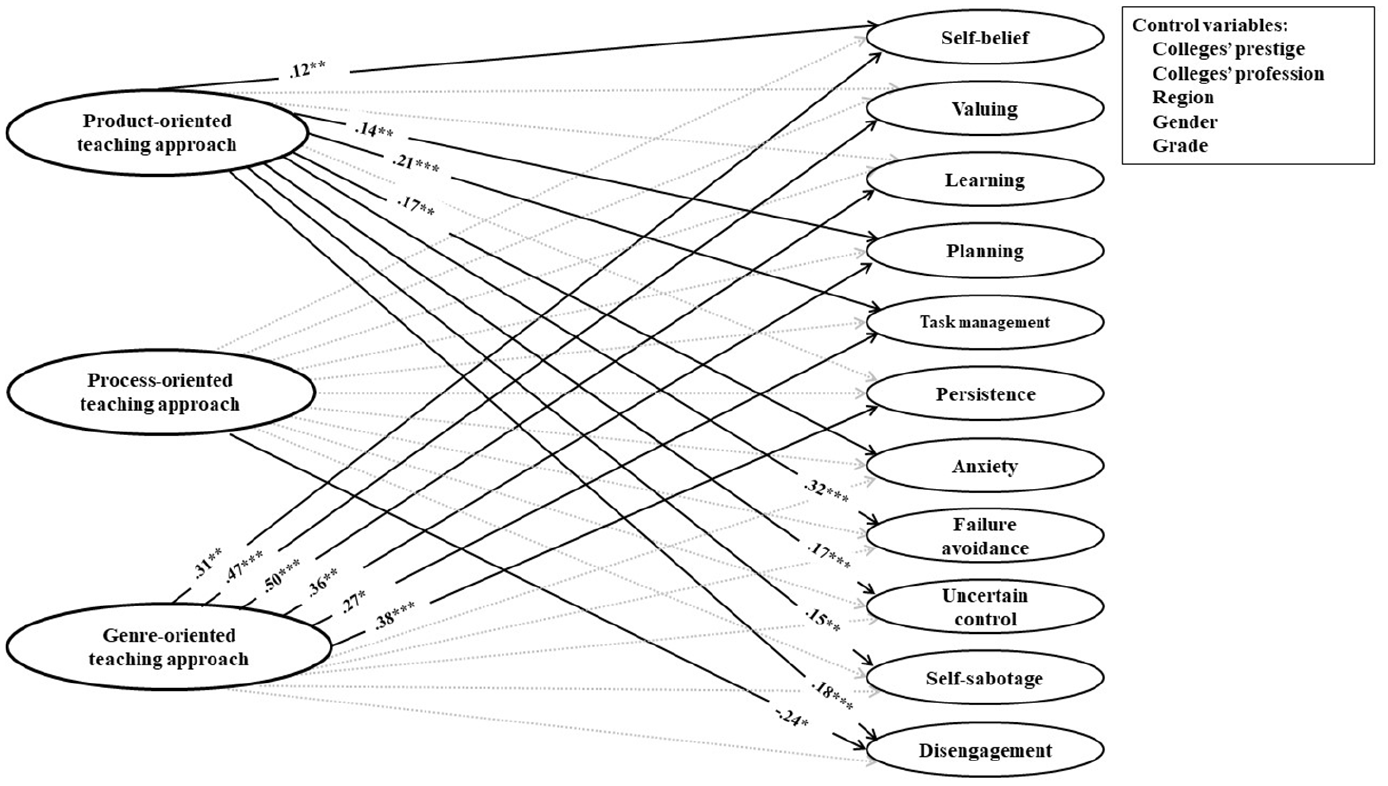
The associations between teaching approaches and students’ motivation and engagement.
We evaluated model adequacy using various indices: the Chi-Square statistic (χ2), the comparative fit index (CFI > .90), the root-mean-square error of approximation (RMSEA < .08), and the standardized root-mean-square residual (SRMR < .08). However, when the sample size is large, a significant χ2 should be expected for most models (Byrne, 2013). Missing values were handled via the full-information maximum likelihood method (FIML; Acock, 2005). Given the hierarchical structure of our data (i.e. the clustering of students within colleges), we used the TYPE = COMPLEX command in Mplus to take into account the nested structure and adjust the standard error accordingly (Muthén & Muthén, 2015).
IV Results
In Tables 1 and 2, we reported the descriptive statistics and the bivariate correlations among study variables and between key study variables and covariates. The model (Figure 1) demonstrated a good fit to the data: χ2 = 6,157.194, df = 2,077, p < .001, RMSEA = .041 with 90% CI (.039, .042), CFI = .900, SRMR = .049. Results are displayed in Table 3. Controlling for the covariates, the product-oriented teaching approach was associated positively with not only adaptive motivation and engagement (β = .12, p = .007 for self-belief, β = .14, p = .003 for planning, and β = .21, p < .001 for task management), but also with maladaptive motivation and engagement (β = .17, p = .001 for anxiety, β = .32, p < .001 for failure avoidance, β = .17, p < .001 for uncertain control, β = .15, p = .003 for self-sabotage, and β = .18, p < .001 for disengagement).
The descriptive statistics for the key study variables.
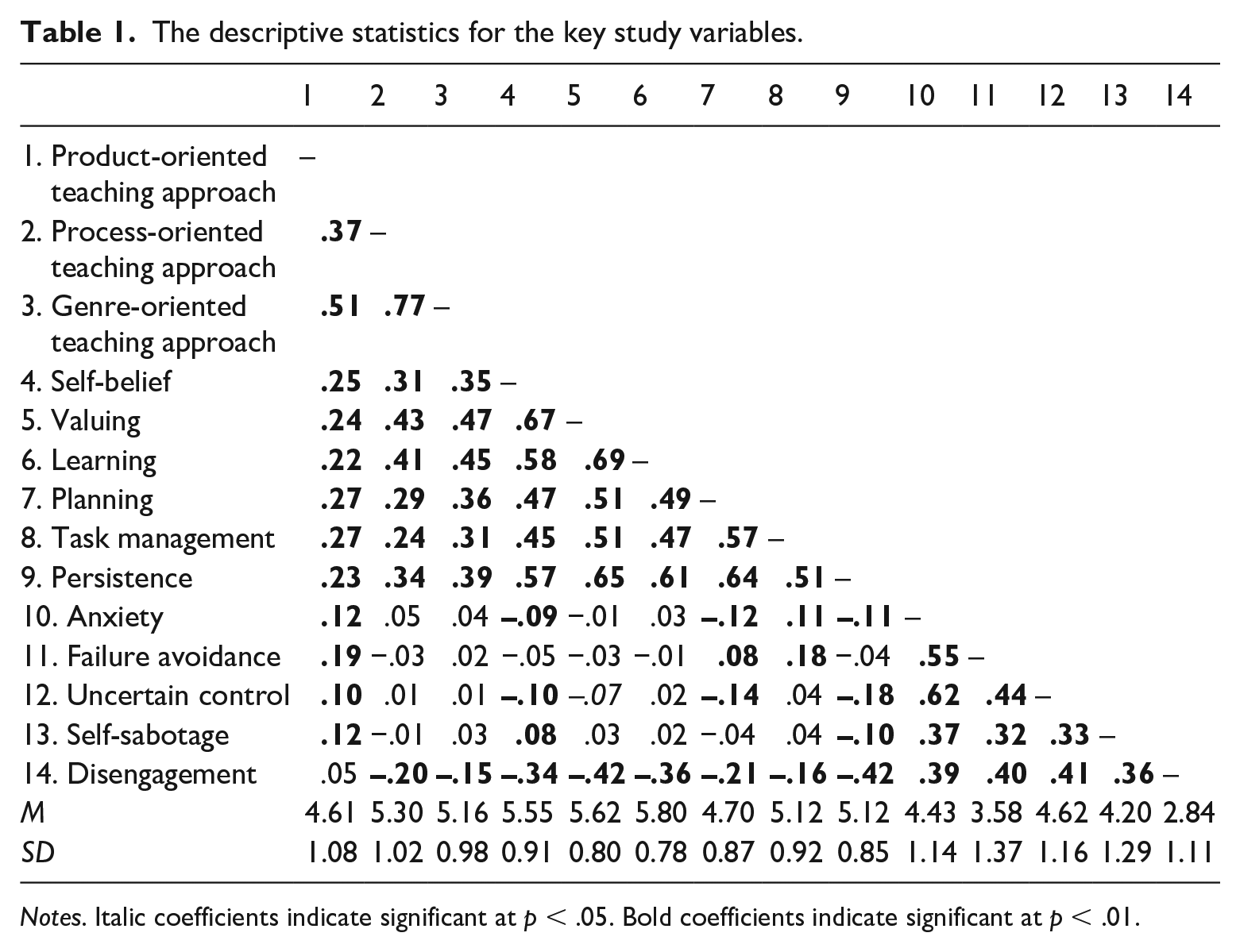
Notes. Italic coefficients indicate significant at p < .05. Bold coefficients indicate significant at p < .01.
The correlations between the three teaching approaches and students’ motivation and engagement.
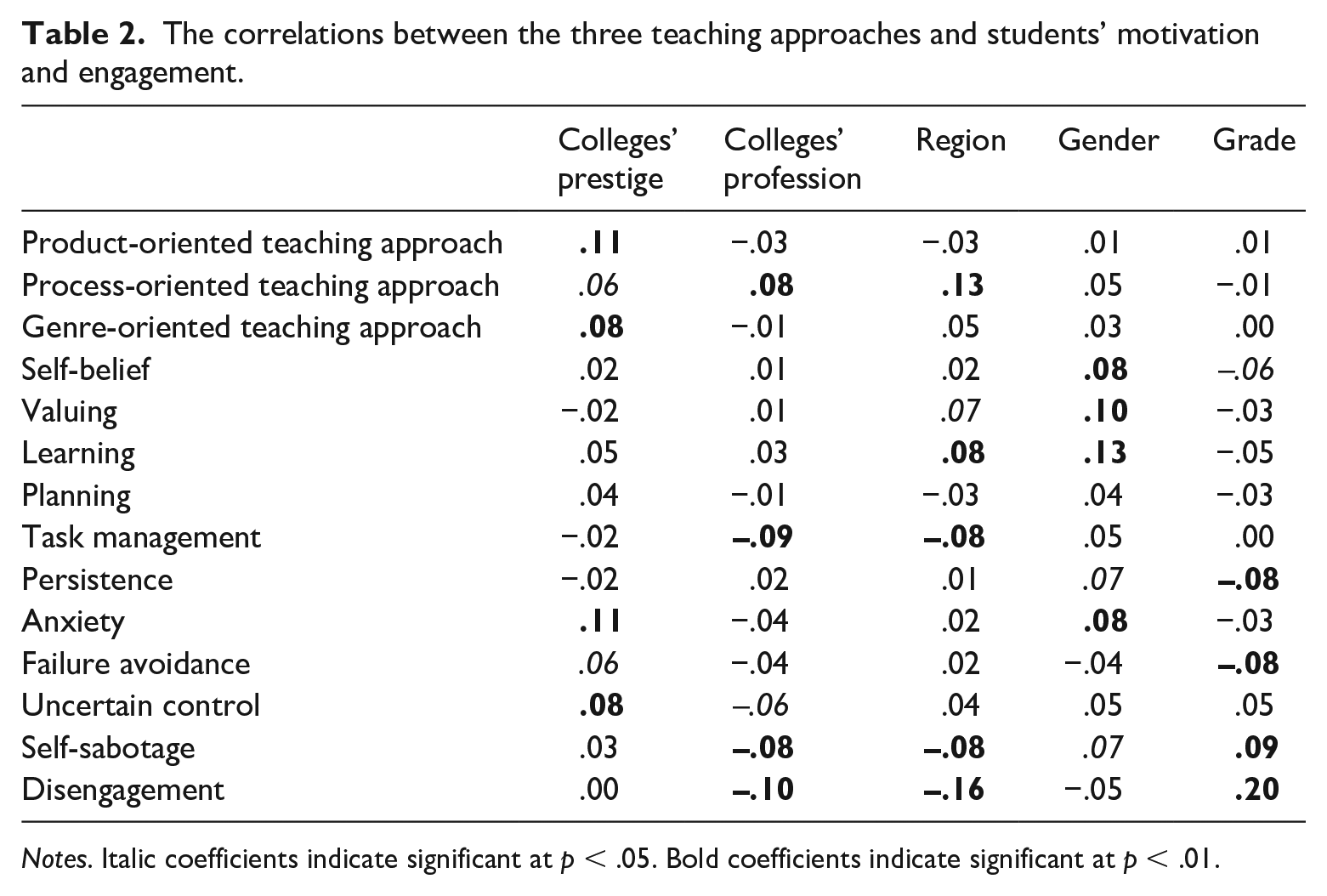
Notes. Italic coefficients indicate significant at p < .05. Bold coefficients indicate significant at p < .01.
The coefficients for associations between teaching approaches and student motivation and engagement based on structure equation modeling.
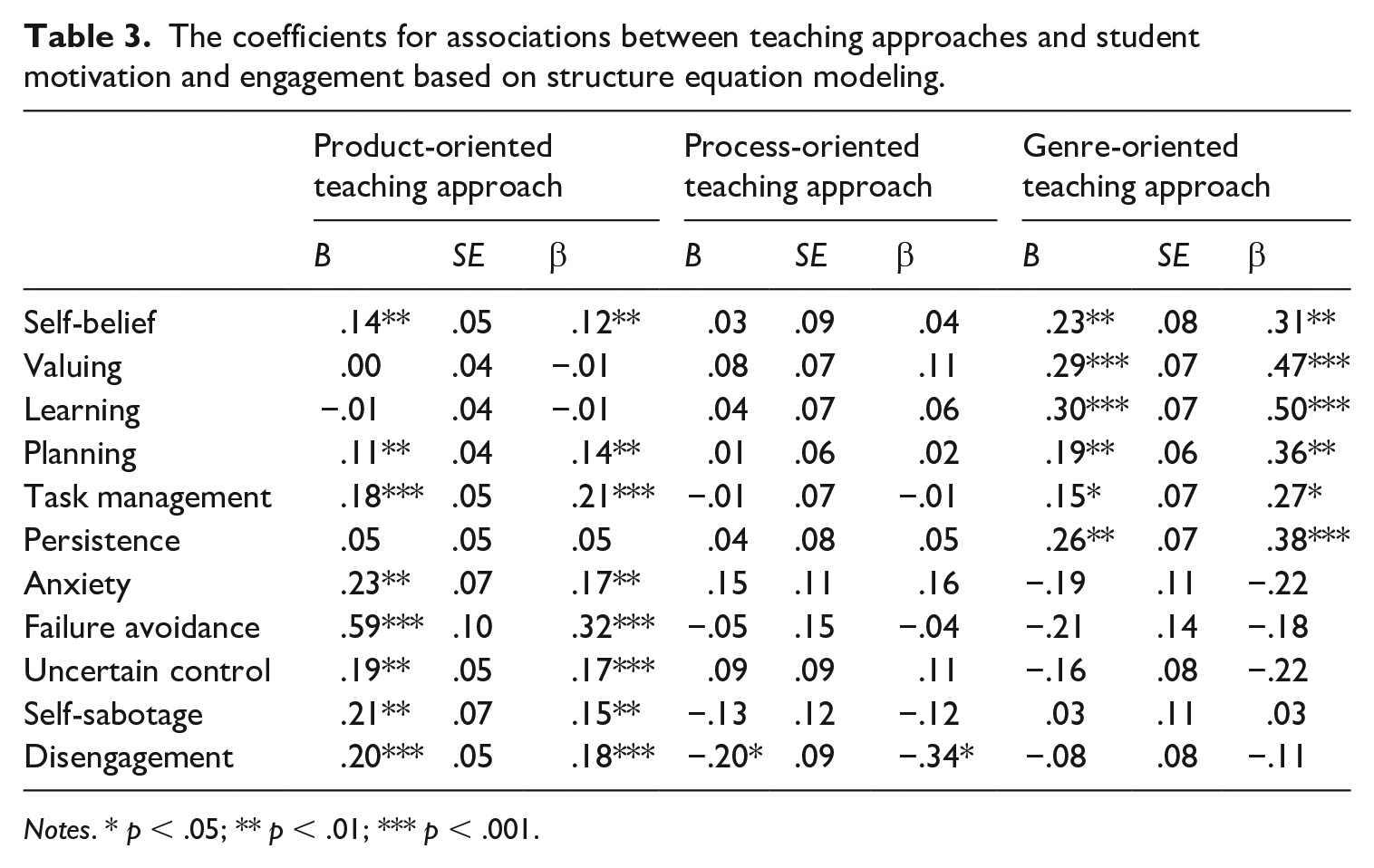
Notes. * p < .05; ** p < .01; *** p < .001.
The process-oriented teaching approach was only associated negatively with disengagement (β = .07, p = .009). The genre-oriented teaching approach was associated positively with all the indicators of adaptive motivation and engagement (β = .31, p = .004 for self-belief, β = .47, p < .001 for valuing, β = .50, p < .001 for learning, β = .36, p = .002 for planning, β = .27, p = .030 for task management, and β = .38, p < .001 for persistence).
Overall, the product-oriented teaching approach seems to be a double-edged sword, contributing to both adaptive and maladaptive motivation and engagement whereas the process-oriented teaching approach impeded disengagement. The genre-oriented teaching approach emerged as the best to promote L2 writers’ adaptive motivation and engagement.
V Discussion
This study is the first of its kind in L2 writing education to investigate the associations between different L2 writing instruction approaches and students’ motivational and engagement processes. Different from previous research (Lee & Wong, 2014; Lee et al., 2018) that takes product-oriented approach as demotivating, our analyses revealed that teaching writing as product can be both motivating and demotivating for students to engage in L2 writing. As the findings show, the product-oriented approach had positive correlations with self-belief, planning, and task management, with positive correlations with anxiety, failure avoidance, uncertain control, self-sabotage, and disengagement. While it is unsurprising to note that the product-oriented approach could be demotivating because it may provoke negative feelings such as anxiety, uncertain control, and self-sabotage (Lee et al., 2018), its role in enhancing the adaptive motivation and engagement is a novel finding. One possible interpretation may be related to Chinese EFL contexts, within which the product-oriented approach had become a normalized routine and students who had been socialized into such a routine discourse learned to plan and manage their writing task with a strong self-belief. Another possible explanation may be related to the high-stakes testing culture (Carless, 2011), which may better align with the instructional practices that take writing as product. For those exam-oriented EFL student writers, the product-oriented approach may then appear motivating as it could better match their conceived model of success in L2 writing.
As for the process-oriented instructional approach, our findings show that it was related negatively to disengagement in L2 writing and this means that it facilitated student engagement in L2 writing. Behaviorally, it is understandable that students’ engagement with writing would increase with multiple drafts opportunities facilitated by self- and peer-feedback, although other aspects of student engagement (e.g. cognitive, emotional) remain to be further explored. Despite an increase in students’ engagement in L2 writing, our analysis also shows that students had little increase in their writing motivation with the process-oriented instructional approach, echoing what Lee (2017) and Graham and Sandmel (2011) had reported. This finding suggests that multiple drafts with self- or peer-reviews might have increased student engagement, but with limited impact on their writing motivation. There may be two reasons. The first one may be related to the nature of the L2 writing curricula in Chinese universities, which are normally centralized with a rigid syllabus that could make multiple-drafting a heavy burden to not only teachers, but also students. Thus, student writers may easily become demotivated when they are asked to complete a number of assignments with multiple drafts without being given enough time (Lee, 2017). The second reason goes to the impact of teachers’ usually comprehensive and unfocused feedback practice (Lee, 2019) and to students’ lack of confidence and trust in self- and peer-feedback (Lee, 2017; Yu & Hu, 2017). In the Confucianism-influenced Chinese contexts, it is the teachers who are normally regarded as a source of knowledge rather than the students (Luk, 2012). This interpretation suggests that the motivating power of the process-oriented approach to L2 writing could be shaped by cultural factors. It also reinforces a need for the training of self- and peer-feedback (Hyland & Hyland, 2019) before these are implemented in practice so as to build up students’ competence and confidence in these feedback activities when they are engaged with the process-oriented instructional approach.
Aligning with Han and Hivers (2018), our analysis echoes the positive impact of the genre-oriented approach upon students’ writing motivation and engagement. As manifested by the result, this approach was correlated positively with all the six indicators of adaptive motivation and engagement, with no associations with any of the maladaptive indicators. This finding suggests that adopting a genre-oriented instructional approach may have played a positive role in reducing learners’ anxiety and negative feeling of uncertain control and self-sabotage, and in avoiding failure avoidance behaviors. The result is particularly encouraging giving the negative associations of the product-oriented approach with these indicators, indicating a possible supplementary role to be played by the genre-oriented approach. Moreover, a genre-oriented approach may have provided students with explicit structure for writing when drafting and planning. This may then result in students’ confidence building through direct mastery experiences with an enhanced self-belief in their capacity and abilities for writing (Han & Hivers, 2018; Hyland, 2007).
VI Limitations and future directions
This study contributes to our understanding of how the three major approaches to L2 writing instruction can be effective in enhancing students’ writing motivation and engagement. With empirical evidence pertaining to the prominent roles of genre-, product-, and process-oriented approaches in shaping writing motivation and engagement, this study raises significant implications regarding the synthesis of various forms of instructional approaches for more motivation and engagement in L2 writing. Nevertheless, this study is not without limitations. First, although a randomly self-selected sample across various university settings had been identified in China, this study may not reveal a full picture of all the associations between writing instructional approaches and students’ motivation and engagement. As we had more female participants in the study, future study could also recruit more male respondents so as to achieve a more gender-balanced view. Second, the current study factored three major instructional approaches into the L2 writing instructional scale, leaving other emerging and innovative approaches such as the design approach not considered given the limits of time and space. Future studies are warranted to incorporate more instructional approaches so as to get closer to students’ experiences of L2 writing in practice. Then, given the self-reported nature of the survey data, the measure of classroom instructional approaches and students’ motivation and engagement may involve response biases. Future investigations may make use of qualitative observational and interview research to corroborate the statistical results.
Despite the limitations, this study illustrated and compared how three major L2 writing instructional approaches, i.e. product-, process-, and genre-oriented, related to students’ writing motivation and engagement and has several implications for L2 writing practice and research. First, there is a pressing need for the teachers and researchers to be aware of the utility of the genre-oriented approach to L2 writing instruction that leads to the most desired outcomes in students’ writing motivation and engagement. This requires teachers to be familiar with not only the pedagogical sequences and tasks that are required by the genre-oriented approach, but also to be aware of students’ personal information in relation to their writing anxiety and self-beliefs. With such information, teachers could reduce students’ anxiety and boost their self-beliefs by giving them genre-based experiences of obtaining mastery of L2 writing. Second, in light of the high-stakes testing culture in the Confucian contexts, product-oriented approach may be used to evoke students’ instrumental motivation to write for scores and tests, as the findings manifest. Yet teachers should be aware that such instrumental motivation may not last long as it cannot automatically reduce students’ negative arousals, including the feeling of anxiety, uncertain control and self-sabotage. Given that the current study shows that the product-oriented approach was correlated with all the five indicators of maladaptive motivation and engagement, it is advised that teachers should use the approach with caution.
Third, although the findings of the current study showed that the process-oriented approach was negatively related with student motivation, it is not the intention of the study to discourage teachers from using the approach. At least, as the findings show, this approach has the potential to enhance student engagement with writing, willingly or unwillingly. Nevertheless, the study is against with hasty use of the process-oriented approach without proper training and scaffold to students, who may either lack the knowledge or the necessary trust to do self- and peer-feedback during the process. It should also be noted that while multiple drafts encourage revisions, such practice should be implemented with reference to students’ study-load, given the packed and centralized nature of curricula and syllabus in most Chinese universities. Otherwise, it is possible for the process-oriented approach to bring in unintended burden to students who may find it difficult to engage with more practices of writing with robust motivation. Overall, to improve students’ writing motivation and engagement, L2 writing instructors and researchers should try to enhance the adaptive motivation and engagement and to lower their maladaptive motivation and engagement (Yu et al., 2019). For these to occur in L2 writing classes, we argue that no single instructional approach to L2 writing can fulfill the function. Instead, there is a need for teachers to be selective according to situational needs and to be creative in hybridizing the instructional approach by incorporating all the possible approaches in their pedagogic repertoire. For instance, writing teachers may integrate all the three approaches at different stages in their teaching and assign meaningful writing tasks with carefully designed scaffolding activities so as to reduce students’ anxiety, to stimulate engagement and to enhance persistence (Yu & Lee, 2016). Writing teachers can also guide students to reflect on the different aspects of their individual writing motivation and engagement by engaging students with more self-regulated writing activities. Future research may build on the findings of the current study across other sociocultural contexts by exploring similar questions in various language writing contexts.
Footnotes
Funding
The author(s) disclosed receipt of the following financial support for the research, authorship, and/or publication of this article: This work was supported by Specialized Subsidy Scheme for Macao Higher Education Institutions in the Area of Research in Humanities and Social Sciences 2020 (HSS-UMAC-2020-08).
