







Abstract
Today, the Common European Framework of Reference (2009), and with it the action-based approach, underlies English Language Teaching (ELT) curricula throughout Europe. However, actual teaching practices are likely to vary according to factors such as the educational level and supra-national differences, including legal guidelines and the level of extramural English, i.e. out-of-school use of English (Sundqvist, 2009). Those factors presumably influence the role of grammar teaching in foreign language classrooms, which has been the subject of continuous debate (see Graus & Coppen, 2016; Thornbury, 1999; Ur, 2011). Such potential differences in teacher-reported ELT practices across Europe have not yet been investigated in instructed second language acquisition research. Therefore, the present study aims to compare the type of instruction in lower vs. upper secondary school in Sweden, Austria, and France, countries ranking differently in the EF Proficiency index (Education First, 2019). 615 secondary English teachers across the three countries filled in an online questionnaire designed to assess their use of planned vs. incidental form focus, implicit vs. explicit, and inductive vs. deductive instruction (Ellis, 2001a, 2009; Long, 1991). Results seem to indicate that (1) in lower secondary, Swedish teachers teach less explicitly than teachers in Austria and France; (2) Sweden provides ELT that is more implicit-fluency-based than does Austria and France; (3) incidental (rather than planned) grammar teaching is more dominant in upper than in lower secondary across countries and in Sweden and France as compared to Austria; and (4) French teachers differ from the other groups in their application of more inductive rather than deductive instruction. We argue that both the educational level and a country’s language policies and ideologies – and consequently also the extent to which they encourage use and exposure to extramural English – may be determining factors in the type of instruction applied in ELT.
Keywords
I Introduction
‘Europe excels in English’ (Education First, 2019). According to the EF Proficiency Index (Education First, 2019), 1 Europe has the highest proficiency of English across the world. As claimed by the same index, this is certainly in part due to policies such as Erasmus+, the world’s largest mobility program for students and teachers funded by the European Union. In the same vein, factors such as the recreational use of the language and the nature of instruction can also be expected to play a significant role in L2 English attainment.
Through online access to social media, games, series and films, music, and news, extramural English – i.e. out-of-class English (Sundqvist, 2009) – is on a constant rise throughout Europe. Such apparent supranational similarities can also be found in English classrooms. In the 1960s and 1970s, dissatisfaction with structured, grammar-centered methods in the practice of language teaching and the urgent need to facilitate communication within European countries gave rise to the development of the communicative approach (Richards & Rodgers, 2014). Slowly, the core principles of communicative language teaching, i.e. communication, authenticity, context, and learner-centeredness, were adopted, resulting in the birth of the Common European Framework of Reference (henceforth CEFR; Council of Europe, 2009). This framework led to the action-oriented approach, according to which language learners are social agents, performing tasks strategically in a social context and using their own competences in order to achieve a desired result. Today, the CEFR and the action-based approach in language teaching underlie second and foreign language curricula applied in English as a foreign language (henceforth EFL) classrooms throughout Europe (Council of Europe, 2009).
Despite this common ground in English Language Teaching (henceforth ELT) throughout Europe (Goullier, 2007; Piccardo, 2014), actual teaching practices are likely to vary widely across teachers, school types, educational levels, and countries. In particular, the role of grammar teaching in foreign language instruction has been continuously debated (see, for instance, Ur, 2011). While a common conception of grammar is ‘the way language manipulates and combines words (or bits of words) in order to form longer units of meaning’ (Ur, 1991, p. 4), the nature of its instruction can be multifold. The definition of grammar teaching provided by Ellis (2006) accounts for such variety, including ‘any instructional technique that draws learners’ attention to some specific grammatical form in such a way that it helps them either to understand it metalinguistically and/or process it in comprehension and/or production so that they can internalize it’ (2006, p. 84). The effectiveness of different approaches in foreign language teaching remains a controversial matter in Second Language Acquisition research (Graus & Coppen, 2016) and, more specifically, in its subfield of Instructed Second Language Acquisition (henceforth ISLA; Loewen & Sato, 2017). So far, we know of no research that has investigated differences in teacher-reported EFL grammar teaching practices across levels of education and/or countries. Ultimately, a cross-national comparison of teaching practices could help shed light on why the populations’ average English proficiencies differ. Therefore, the present study aims to compare and contrast teachers’ self-reported nature of lower and upper secondary education English instruction in Sweden, Austria, and France, ranking 2nd, 6th, and 23rd of the 32 European countries evaluated in the EF Proficiency Index (Education First, 2019).
II Definition of main concepts
In the current study, the nature of English instruction was conceptualized based on meaning-based vs. form-based instruction (Long, 1988, 1991), implicit vs. explicit, and inductive vs. deductive instruction (Ellis, 2001a, 2001b, 2002, 2016). Although these concepts are prone to overly simplify ELT practices and alternative classifications of ISLA exist (see, for instance, Loewen & Sato, 2018; Spada, 2011), the large body of research available on it proved instrumental in conducting the study. This section serves the definition of those (overlapping) concepts and the discussion of previous research on their effectiveness in promoting learning.
1 Focus on meaning, form and formS
Focus on meaning precludes any attention to linguistic forms. It postulates that an L2 is successfully learned incidentally, i.e. unintentionally, and implicitly, without awareness of form (Long & Robinson, 1998). In contrast, focus-on-formS precludes attention to meaning and advocates the systematic teaching of grammatical features, so that both students and the teacher identify the activities’ purpose as being the promotion of form-based knowledge (Ellis, 2001b). Focus-on-form, on the other hand, combines form-based instruction and meaningful input (Doughty & Williams, 1998; Spada, 1997). Rather than isolated forms, the focus lies on form-meaning mappings, including lexical, grammatical, and pragmalinguistic features (Ellis, 2016). While instruction is generally meaning-focused, the teacher and/or student(s) shift attention to a linguistic feature when comprehension or production problems occur (Long & Robinson, 1998). Whereas planned focus-on-form can be compared to focus-on-formS, since in both cases the objective of the teaching sequence is primarily form rather than communication, incidental focus-on-form is not planned in advance to a teaching sequence but occurs when necessary (Ellis, 2001b).
Although grammar learning can take place under purely meaning-focused conditions, such as when sentences containing particular morphosyntactic structures are memorized (e.g. Brooks & Kempe, 2013; Cleary & Langley, 2007; Reber, 1967; Rebuschat et al., 2015; Robinson, 2005; Williams, 1999, 2005), focus-on-form appears to benefit learning (e.g. Doughty & Varela, 1998; Hirakawa et al., 2019; Lightbown & Spada, 1990; Loewen, 2005; Lyster, 2004; Muranoi, 2000).
2 Implicit vs. explicit instruction
Another commonly used framework to categorize approaches in grammar teaching (e.g. Doughty & Varela, 1998; Hirakawa et al., 2019; Lightbown & Spada, 1990; Loewen, 2005; Lyster, 2004; Muranoi, 2000) is the implicit-explicit dichotomy. Implicit instruction seeks to make learners infer underlying rules without being aware of the process, i.e. while they are focusing on something else. Ellis (2009) distinguishes between direct intervention, where learners are exposed to enriched input, containing a high density of target features, and indirect intervention, where input is not modified in such a way and students simply learn through communicative tasks. While the latter approach is comparable to meaning-based instruction, direct intervention arguably fits into any of the three categories, focus-on-meaning, -form, or -formS. Explicit instruction typically relies on the rule-based explanation of grammatical features in- or excluding metalinguistic terminology and can be perceived as part of focus-on-form and focus-on-formS. Debates are still ongoing as to which approach, implicit or explicit instruction, proves more supportive in L2 learning. Focus-on-form, both explicit, i.e. in the form of explicit explanation of grammar features (e.g. Alanen, 1995; Lightbown & Spada, 1993), and implicit, such as enriched input (e.g. VanPatten, 1989; VanPatten & Cadierno, 1993), appears to positively impact learning.
3 Inductive vs. deductive instruction
A final key distinction in the type of instruction is inductive vs. deductive instruction, two options within explicit instruction (Ellis, 2009, p. 17). In the inductive approach, learners discover rules by themselves (Hedge, 2008), which is a principle rooted in consciousness-raising tasks (Sharwood Smith, 1981). Consciousness-raising is claimed to make learners aware of certain features through increasing their salience: ‘The basic idea is to give students sufficient examples so that they can work out the grammatical rule that is operating’ (Hedge, 2008, p. 163). In the deductive approach, a rule is first presented to the learner, and in turn practiced and produced (PPP, e.g. Ellis, 2001b; Hedge, 2008). This technique builds on the strong interface position (DeKeyser, 1998; Sharwood Smith, 1981), suggesting that through practice, explicit knowledge is proceduralized and in turn more easily accessed in fluent language use.
III English in Sweden, Austria, and France
In order to familiarize the reader with the status of English in the three learning environments investigated in the present study, this section will look at (1) the populations’ English proficiencies, (2) the nature of English instruction according to national legal guidelines and previous research, and (3) the everyday presence of the language in society.
1 The populations’ English proficiency
Sweden, Austria, and France all have an official language other than English, i.e. Swedish, German, and French respectively. Nevertheless, especially the Swedish population excels in English and ranks second in the EF Proficiency Index (Education First, 2019) that considers 100 countries. In Austria, English proficiency is somewhat lower, ranking eighth worldwide and sixth among the 33 participating European countries. Further down the list, France reaches the 23rd position within Europe and the 31st position worldwide (Education First, 2019). The different average proficiency levels seem to be reflected in the objectives stated in the national curricula. Upon finishing secondary school, students are required to have reached the level of B2.2 in Sweden (Skolverket, 2017), B2 in Austria (BBWF, 2014, 2017), and, in France, B2 for English learned as a first foreign language and B1 for English learned as a second foreign language (MEN, 2010). However, a survey comparing European countries showed that while 82% of Swedish students reached B1–B2 in their first foreign language, only 14% did so in France (European Commission, 2012).
The three countries can also be described in terms of achievement according to the four skills. In the national exam of 2019 (Skolverket, 2019a), 9th graders across Sweden (n = 97,468) scored highest on speaking, followed by listening and reading, and writing (for an overview of grades, see Table 1). In an international comparison issued by the Swedish National Agency for Education (Skolverket, 2002), 9th graders (n = 1,431) were most successful in listening and reading tasks, and less so in writing and accuracy. In Austria, in a nationwide evaluation of 8th graders (n = 7,600; BIFIE, 2020), participants scored highest on listening, followed by reading, and writing. No information could be obtained for upper secondary school students in Austria and Sweden. In France, the National Center of Education System Evaluation (CNESCO, 2019) reports that Primary and Middle School students appear to be stronger in the receptive skills listening and reading than in speaking, in which 75% of grade 9 students struggle to make themselves understood and to produce accurate language (n = 4,000). Likewise, writing is described to pose severe problems. This is in line with the international report (Bonnet, 2004; Skolverket, 2002), in which French 9th graders (n = 1,135) scored lowest on writing and highest on reading, followed by accuracy, and listening. In the French High School leaving exam of 2018, students (n = 688,096) performed best on speaking, followed by listening, and reading/writing (the latter two forming a single global grade) (Manoïlov, 2019).
Illustration of grades and school types, ELT onset, and ELT intensity in the three countries, by age a in years.
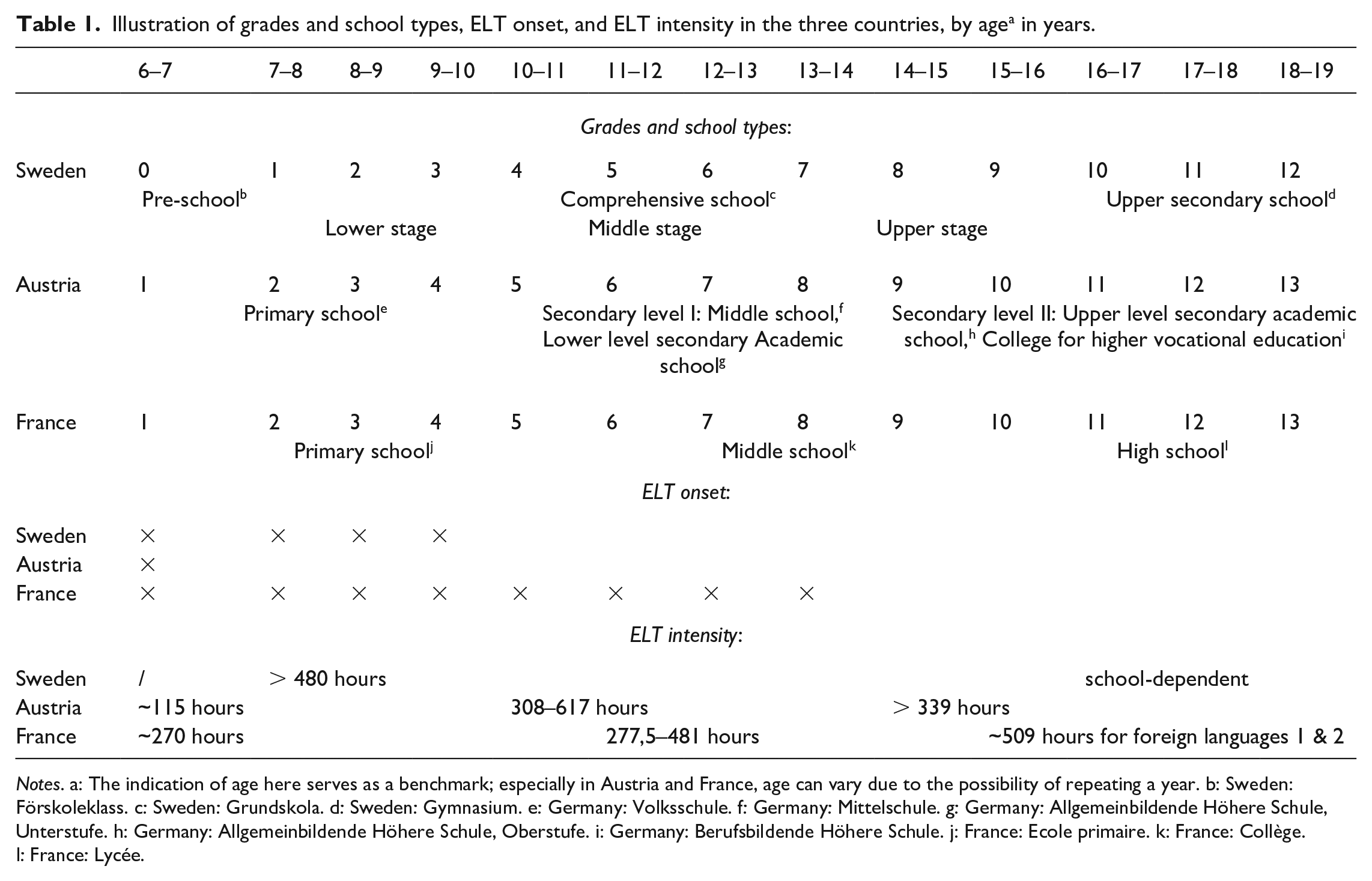
Notes. a: The indication of age here serves as a benchmark; especially in Austria and France, age can vary due to the possibility of repeating a year. b: Sweden: Förskoleklass. c: Sweden: Grundskola. d: Sweden: Gymnasium. e: Germany: Volksschule. f: Germany: Mittelschule. g: Germany: Allgemeinbildende Höhere Schule, Unterstufe. h: Germany: Allgemeinbildende Höhere Schule, Oberstufe. i: Germany: Berufsbildende Höhere Schule. j: France: Ecole primaire. k: France: Collège. l: France: Lycée.
2 English instruction
A comparison of the three countries in terms of the nature of English instruction from an external perspective – including teacher qualifications, the ELT curriculum and previous research on teacher beliefs and practices – shows both differences and similarities. In Sweden and Austria, student teachers of English for students in grades 1–6 and 1–8 respectively need to complete at least a Bachelor’s degree, and a Master’s degree for higher level students. Besides English, at least one additional subject is studied (BBWF, 2018; Lärarförbundet, 2016). In contrast, Middle and High School English teachers in France need a master’s degree and do not teach an additional subject (NMEY, 2019a). In light of teacher education, a comparison of the three countries in terms of EFL didactic courses and the perspective they convey on grammar teaching would yield valuable information. Yet, this is beyond the scope of the study, as course content is likely to differ across (and within) educational institutions within one country.
English instruction usually starts in Sweden in grade 1 at the age of 7 years (Qvist, 2017) and at the latest in grade 3 at age 9 (Skolverket, 2017), in Austria in grade 1 at age 6–7 (ÖSZ, 2014), and in France at the latest in grade 8 at age 13 (NMEY, 2019b). Regarding the intensity of instruction, Swedish students must receive a minimum of 480 hours of English across grades in comprehensive school (Skolverket, 2019b). While ELT is obligatory in Swedish secondary school, its extent varies across programs. In Austria, students receive about 115 hours until grade 4 (BBWF, 2012) and are taught 308–617 hours of English across grades in lower secondary school. In upper secondary school, students receive a minimum of about 339 hours of English (BBWF, 2018, 2020). French pupils receive 270 hours 2 of English instruction in primary school and, depending on whether they picked English as a first or second foreign language, 277.5–481 hours 2 in Middle School. While up to 2018, students were taught 259 hours 2 of English in High School, the new curriculum foresees about 5092 hours in total for foreign languages 1 and 2 (NMEY, 2019b).
The national curricula of English instruction in all three countries are based on the CEFR (Council of Europe, 2009) and put the communicative and action-oriented language competence as a primary goal of instruction (BBWF, 2014; BBWF, 2018, 2020; MEN, 2016, 2018a, 2018b; Skolverket, 2017). In terms of linguistic form, the Swedish curriculum (Skolverket, 2017) states that in order to achieve more complexity and precision in language, the communicative competence integrates mastery of linguistic form, including grammar. With regards to the teaching of forms according to different educational levels, the Swedish curriculum exemplifies that spelling and pronunciation can be dealt with in grades 4–6 and grammatical structures and syntax in grades 7–9. However, it lists no such specifications for upper secondary school (Skolverket, 2017), potentially suggesting that grammar teaching is more characteristic of the lower instructional level. According to the Austrian curricula of Secondary Academic School and Middle School (BBWF, 2018, 2020), grammar should primarily be taught in context, implicitly and inductively, and, if possible, through chunks rather than rules. It is the functional aspect of grammar that needs to be foregrounded, and grammar should not be tested in isolation. In contrast, the curriculum of Colleges for Higher Vocational Education (e.g. BBWF, 2014) – an upper secondary school form – stipulates that grammatical inaccuracy is subordinate unless it causes communication breakdown. The French Middle School curriculum (MEN, 2016) does not indicate how grammar should be taught but lists the target grammatical features. The High School curriculum (MEN, 2018a, 2018b) conveys a more incidental approach in that it lacks such a list but states that – similar to Sweden – the role of grammar is to allow the learner to introduce complexity and perfection in their language use. Alluding to the inductive approach – as done in the case of Austria – learners should discover grammatical features in documents by themselves, appropriate them for their own needs, and use them repeatedly. This way, by understanding the mechanisms of the language, the student is said to become more autonomous (MEN, 2018a, 2018b).
In sum, across the three countries, the curricula of lower secondary education seem to be geared towards (systematic) grammar teaching more than the ones for higher second education. Besides the factor of educational level, Austria and France provide more detailed guidelines as to what grammar instruction should look like, when compared to the overall greater leeway of the Swedish curriculum. Albeit inconspicuous, this divergence might be an indicator of a different role attributed to grammar teaching. While in Sweden the type of instruction was found to be widely fluency-based with little explicit grammar instruction (Schurz, 2018), no such information appears to exist on Austria and France, making the nature of the present study very much exploratory. A divergence in the type of instruction emerging in the three countries might be in part due to different ideologies and language policies implying varying amounts of extramural English (henceforth EE) that students make use of in the respective countries, with extensive EE potentially obviating the need for formal, grammar-based instruction in (the first years of) ELT.
It is worth noting here that theoretical and methodological principles, and with it national curricula, only partially relate to actual teaching practices (Breen et al., 2001; Nishimuro & Borg, 2013). Another aspect that may shape didactic choices is teacher cognition, i.e. ‘what teachers know, believe and think’ (Borg, 2003, p. 81). Teacher beliefs can be constructed through factors unrelated to national curricula, such as their teaching (Skott, 2015) or learning experiences (Holt-Reynolds, 1992), and may influence teaching practices even more than does teacher training (Kagan, 1992; Richardson, 1996). A recent study on the beliefs of lower and upper secondary English teachers in Austria (n = 112) on the type of instruction found that they seem to be strongly in favor of form-focused (rather than meaning-focused) teaching and to have a slight preference for focus-on-formS (rather than focus-on-form) and the inductive (rather than deductive) approach (Wegscheider, 2019). In a small-scale study on lower secondary English teachers in Sweden (n = 39), teachers indicated to find grammar teaching important and necessary and to prefer implicit over explicit grammar teaching (Petersson, 2016). Unfortunately, no data could be found on teacher cognition on ELT in the French context. However, although teachers’ core beliefs about language learning and teaching are likely to be reflected in teaching practices, factors such as learner preferences and engagement in class activities, classroom management (Basturkmen et al., 2004; McKay, 2003; Phipps & Borg, 2009; Sato & Oyanedel, 2019), time constraints (Farrell & Lim, 2005), conflicting beliefs (Sato & Oyanedel, 2019), as well as language policies and ideologies of the given country (Duff & Uchida, 1997; Sargent, 2006) may lead teachers to deviate from what they believe to be good practice.
3 The everyday presence of English
Similar to varying proficiency levels, substantial differences can be found in the countries’ language policies and daily exposure to English. From the 1960s onwards, the Swedish government did not aim to restrict the English influence on the Swedish language (Bolton & Meierkord, 2013; Sundqvist, 2020). Only few films, series, and TV programs are available in Swedish, promoting young children’s exposure to the sounds of the English language (Sundin, 2000), with the use of English becoming even more intense in teenage years (Swedish Media Council, 2017). According to Olsson and Sylvén (2015), 15–19 year-old teenagers use English on average for at least 5 hours a day. For two decades or longer, code-switching to English with the use of single-word utterances and phrases has been frequent in informal settings (Andersson, 2013; Sundin, 2000), and, according to certain linguists (Gunnarsson, 2001), the phenomenon of diglossia is likely to emerge.
Conversely, in Austria, movie theatres, TV, and online streaming services broadcast most foreign films and series dubbed in German language (Media Consulting Group, 2009). Nevertheless, the recreational use of English of adolescents is increasing drastically. In an ongoing PhD study by Schwarz (2016), 15–16 year-olds are found to use English 4 hours and 7 minutes a day on average. Moreover, English words and expressions are frequently encountered in the Viennese public sphere (Soukup, 2016) and tertiary educational institutions have taken contingent ‘Englishization’ agendas (Smit & Schwarz, 2019), as visible in English-medium instruction and access to student exchange programs.
Very much in contrast to Austria and especially Sweden, preserving the official language is a priority in France (Education First, 2019). For instance, the Toubon Loi (1994) protects the use of French and restricts the use of English in advertisement, workplaces, etc., and the Académie Française is the institution responsible for creating French neologies, thereby minimizing the import of English terms. Most shows on TV are dubbed in French and only a very small percentage of cinemas broadcast foreign movies in both subtitled and dubbed versions (3.5% for European films and 2.3% for American films). Nevertheless, 91% of Middle School final year students report listening to English songs often or very often, 50% being exposed to English on the internet or in video games often or very often, and 34% watching TV shows, movies or series in English with French subtitles at least once a week (CNESCO, 2019).
IV Methodology
1 Research questions and hypotheses
The present study’s objective was to compare the type of ELT grammar instruction in Swedish, Austrian, and French lower and upper secondary education. More specifically, we used teacher self-reports to evaluate how English teachers from these three countries differ in the extent to which they report resorting to:
explicit grammar teaching (RQ1),
implicit fluency-based grammar teaching (RQ2),
planned vs. incidental grammar teaching (RQ3), and
inductive vs. deductive grammar teaching (RQ4).
In accordance with the research questions, eight hypotheses (H1–8) were formulated. Although the national curricula of all three countries advise teachers to apply an action-oriented approach, we expected French and Austrian teachers to adopt a more explicit (H1), less implicit fluency-based (H2), and more planned (H3) and deductive (H4) – rather than implicit, fluency-based, incidental, and inductive – approach than Swedish teachers. These hypotheses were based on the facts that in Sweden, (1) the use of English outside the classroom starts in early childhood and becomes particularly high in teenage years, and (2) a natural, meaning-based approach seems to be applied in ELT. In Austria and France, in contrast, the level of EE is somewhat lower and English is mostly first learned formally in school (see Sections III.2 and III.3). With respect to the difference between lower and upper secondary, we expected ELT on the lower level3 to be more explicit (H5), less implicit fluency-based (H6), and more planned (H7) and deductive (H8) than on the upper level.3 These hypotheses arose from the fact that the curricula of the three countries appear to provide level-dependent recommendations in terms of grammar teaching (see Section III.2). Moreover, grammar is often still very much focused on in ELT and conceived as the basis in constructing linguistic knowledge (see Borg, 2006; Ortega, 2008; Thornbury, 1999). It appears that often, instruction becomes more communicative once this introductory stage has been passed – a progression reflected in teacher cognition (e.g. Sato & Oyanedel, 2019; Uysal & Bardakci, 2014).
2 Research design
Data for the present study was collected in July 2019 by means of a web-based survey designed and conducted at www.soscisurvey.de. It consisted of 23 items and a five-point Likert-type scale encompassing the answer options strongly agree, agree, neither agree nor disagree, disagree, and strongly disagree. Before participants responded to those items, they were asked to give consent and indicate their country of residence and the level of education at which they currently taught. In order to minimize social desirability bias (Dörnyei, 2017), participants were instructed to respond according to their actual practices, rather than beliefs or ideas about what might be considered ‘good’ instruction. The questionnaire underwent ethical vetting at the ethics board of the University of Vienna.
3 Participants
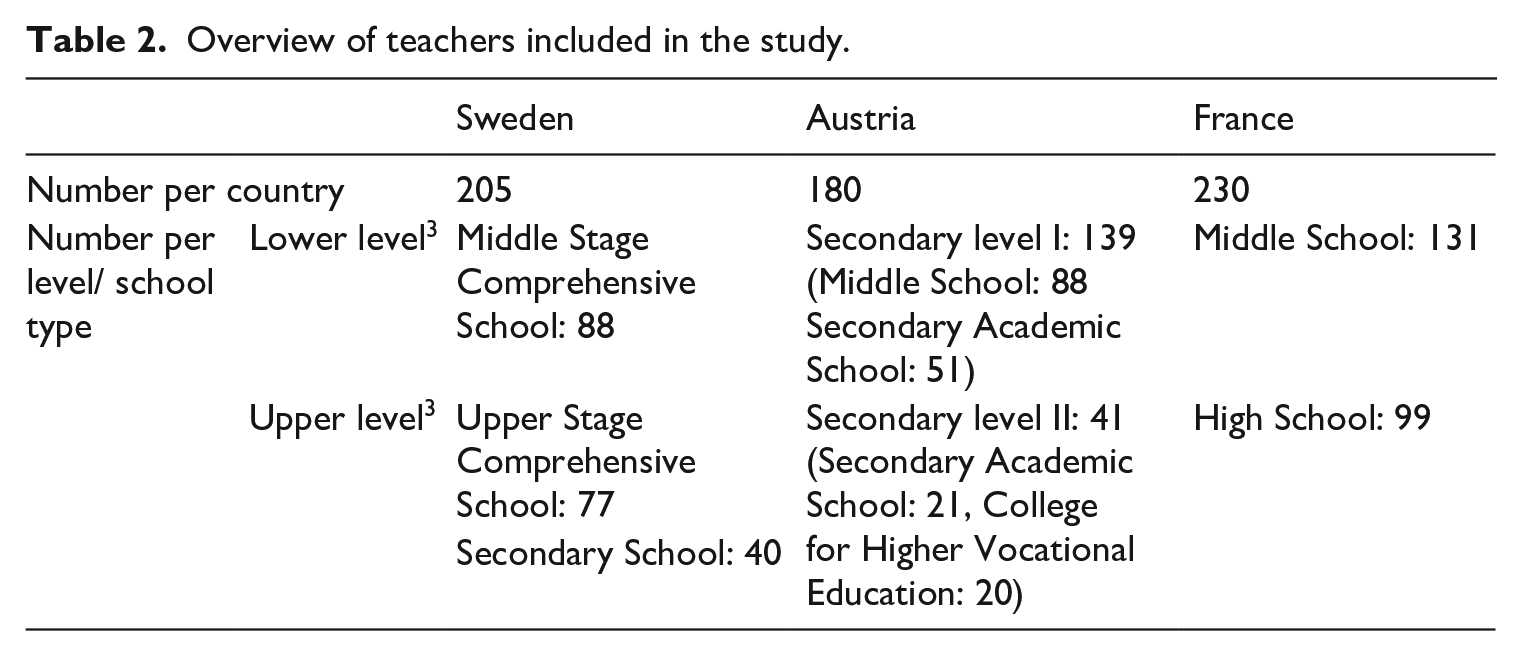
A total of 764 English teachers across the three countries Austria, France, and Sweden took part in the study. They were recruited via social media and the respective national education directories. Data from 149 participants were not included in the analysis, resulting in a sample size of n = 615. Reasons for exclusion were missing responses exceeding the threshold level set at 69%, respondents teaching at primary level education, which was not targeted in the study, less than 25 seconds spent per set of 7–8 items appearing per page, and conspicuous, jocular answers to the open-response questions. Thus, data collected from 205, 180, and 230 English teachers from Sweden, Austria, and France respectively were considered in this study. For practicality reasons, only teachers of students at the age of 10–19 years were considered and in turn categorized as teachers of lower or upper secondary level 3 (see Table 2).
Overview of teachers included in the study.
4 Target constructs
Since it is impossible to investigate all subtypes of form-focused vs. meaning-focused instruction, only specific constructs were captured. In the operationalization and illustration of the target constructs, we drew on Graus and Coppen’s (2016) model of the typology of L2 instruction and adapted it to the needs and purposes of this study (see Figure 1). The meaning-focused approach was conceptualized as implicit fluency-based instruction, with grammatical features occurring in meaningful input and fluency-based, communicative tasks. Thus, implicit instruction was operationalized as an integral part of meaning-focused instruction (see the dotted arrow in Figure 1), targeting primarily indirect rather than direct intervention (see Section II.2). Form-focused instruction was conceptualized as both incidental focus-on-form (FonF), happening in reaction to learner errors or mistakes, and planned focus-on-formS (FonFs), occurring more systematically. Explicit instruction, which here integrated the teaching of metalinguistic terminology, was further classified as inductive instruction vs. deductive instruction. We conceptualize the listed concepts as entangled rather than distinct, and as forming a continuum, ranging from meaning-focused to form-focused instruction (see Graus & Coppen, 2016; Loewen & Sato, 2017).
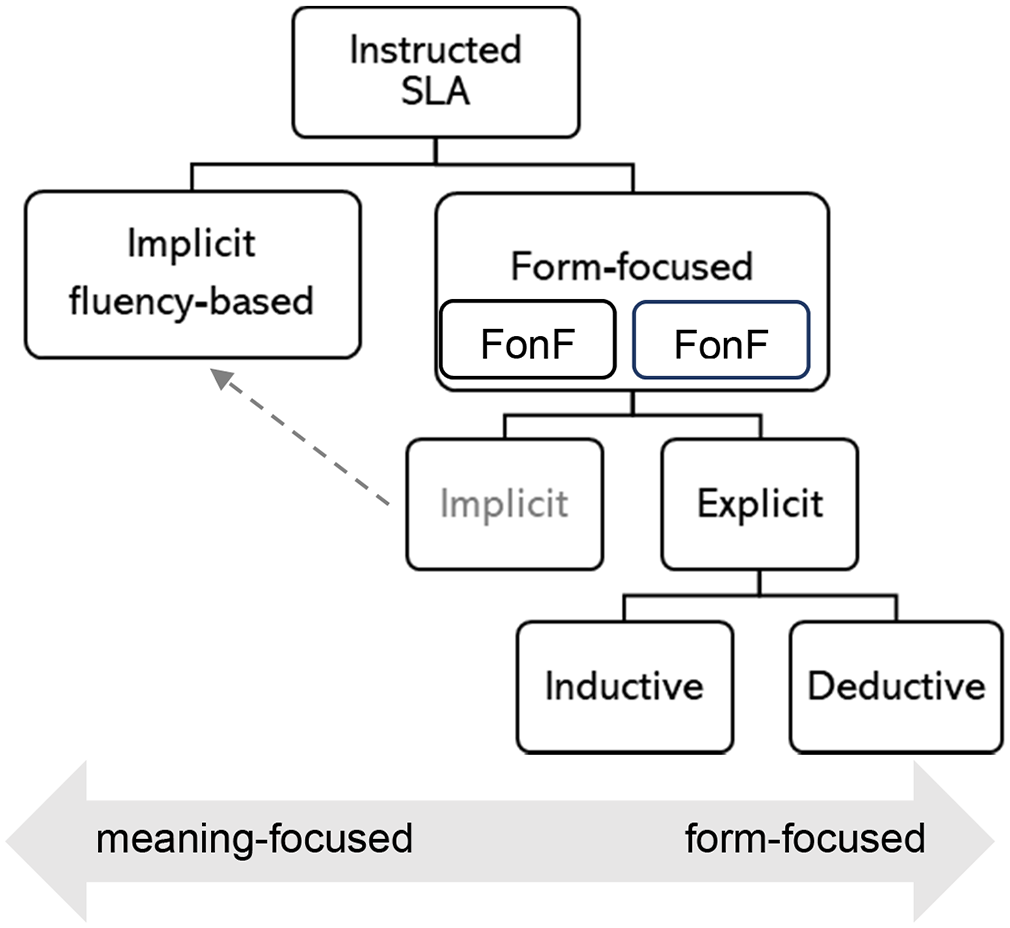
A typology of L2 instruction.
5 Instrument development
The items used in the survey were formulated based on the constructs listed in Section IV.4. Although this was done by drawing on Graus & Coppen (2016), the items used in their study were formulated as belief statements rather than as statements of reported practice (e.g. ‘When teaching grammar, a teacher must discuss explicit grammar rules’) and in Dutch. Given that the items – geared to assess the target constructs – had never been used as such before, they were piloted on English teachers in Austria and Sweden (n = 50) and substantially revised with three expert teacher educators. Items for which not the full spectrum of possible responses was used were reformulated or excluded, and new items were added.
6 Data analysis
First, we conducted an exploratory factor analysis to assess the accuracy with which our questionnaire items measured the targeted constructs. Then, we performed a two-way factorial ANOVA, followed by post-hoc analysis with Tukey (and Games-Howell for violations against variances) and t-tests for within-country and across-level differences.
V Results
1 Exploratory factor analysis
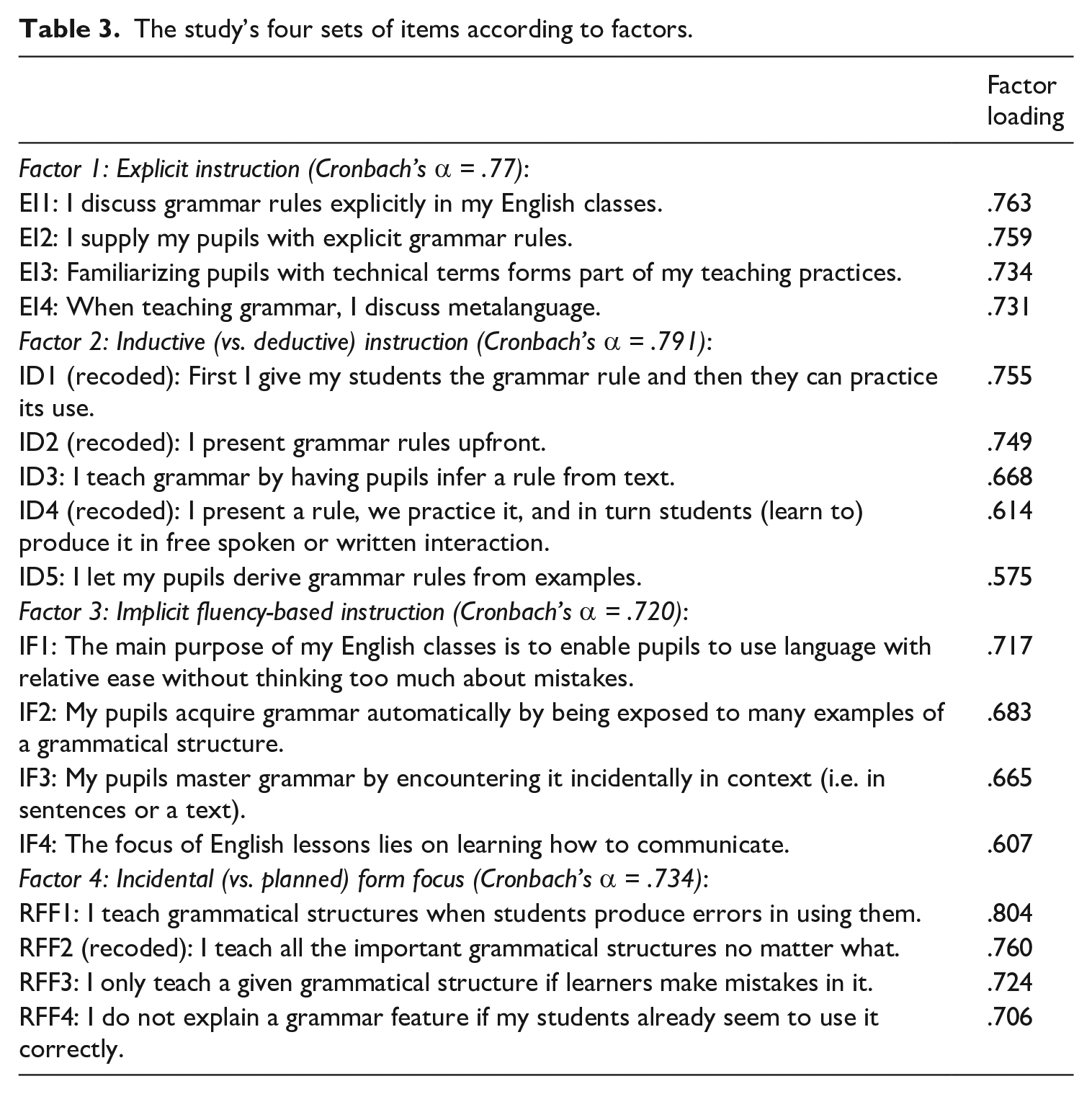
We performed an exploratory factor analysis on the data using SPSS Statistics 25. The principal component analysis with Oblimin rotation – selected due to the overlapping constructs – and Eigenvalue of one criterion suggested the extraction of four factors, as identified through application of the elbow criterion. The factor loading of each item and the factors’ Cronbach’s Alpha are presented in Table 3. As shown in Table 3, the obtained factors accurately reflected explicit instruction, inductive (vs. deductive) instruction, implicit fluency-based instruction and incidental (vs. planned) form focus.
The study’s four sets of items according to factors.
2 Explicit instruction
A two-way factorial ANOVA revealed an interaction between levels of instruction and countries, F(2, 615) = 3.386, p = .034, with a small effect size, partial eta squared = .011. Tukey post-hoc showed that in lower secondary education, there was a significant difference between Austria and Sweden (p < .001) and France and Sweden (p < .001), with Swedish teachers (M = 3.62, SD = 0.62) having reported to teach less explicitly than Austrian (M = 3.92, SD = 0.68) and French teachers (M = 3.95, SD = 0.64). There was no significant difference between Austrian and French teachers, p = .711. In upper secondary education, Tukey post-hoc showed no significant differences between the countries, Austria and France (p = .073), Austria and Sweden (p = .132), and France and Sweden (p = .994). The interaction, as further looked at in a t-test, consisted in a significant difference in the extent of adopting explicit instruction across levels only in France, t(228) = 2.905, p = .004: in lower secondary (M = 3.96, SD = 0.65), self-reported instruction appeared to be more explicit than in upper secondary (M = 3.72, SD = 0.60).
Thus, lower-level teachers in Austria and France appear to provide students with more explicit learning conditions than in Sweden, allowing us to confirm H1 only for lower secondary school. In France, teachers claimed to incorporate more explicit teaching at the lower level than they do in upper secondary. H5 thus could be confirmed only for France.
3 Implicit fluency-based instruction
Considering implicit fluency-based instruction, the two-way factorial ANOVA showed no significant interaction between country and level (p = .854) and no significant difference between levels (p = .314), but a significant difference between countries, F(2, 615) = 15.294, p < .001. A medium effect size, partial eta squared = .05. Games-Howell post-hoc revealed a significant difference between Austrian and Swedish teachers (p < .001) and French and Swedish teachers (p < .001), the latter (M = 4.2, SD = 0.52) having reported to teach more implicit fluency-based than Austrian (M = 3.89, SD = 0.56) and French teachers (M = 3.89, SD = 0.61). Austrian and French teachers did not differ significantly, p = .952.
Hence, while Sweden seems to be the country providing the most implicit fluency-based instruction, Austria and France are somewhat similar in the extent to which they reported to adopt this approach. H2 thus could be confirmed and H6, targeting the across-level difference, rejected.
4 Planned vs. incidental instruction
In terms of planned vs. incidental instruction, a two-way factorial ANOVA showed no significant interaction between levels of instruction and countries, p = .550. However, a significant difference was found between (1) countries, F(2, 592) = 14.591, p < .001, with a close to medium effect size (partial eta squared = .047), and (2) levels, F(1, 592) = 35.112, p < .001, also with a medium effect size (partial eta squared = .057). First, Tukey post-hoc revealed a significant difference between Swedish and Austrian teachers (p < .001) and French and Austrian teachers (p < .001), the latter (M = 2.55, SD = 1.01) having reported to teach grammar less incidentally, i.e. more systematically and planned, than Swedish (M = 3.15, SD = 1.22) and French teachers (M = 3.22, SD = 1.09). Swedish and French teachers did not differ significantly, p = .785. Secondly, upper secondary teachers reported to teach more incidentally (M = 3.40, SD = .77) than lower secondary teachers (M = 3.25, SD = .77) across countries.
In sum, Austrian teachers seemingly apply planned grammar instruction to a greater extent than Swedish and French teachers. Hence, H3 could only be confirmed for Sweden vs. Austria but not for Sweden vs. France. Across countries, teachers indicated to resort more to incidental teaching in upper than in lower secondary school, which allows us to confirm H7.
5 Inductive vs. deductive instruction
Lastly, with regards to inductive vs. deductive instruction, a two-way factorial ANOVA revealed a significant interaction between levels and countries, F(2, 615) = 3.113, p = .045, and a small effect size, partial eta squared = .011. Tukey post-hoc revealed a significant difference between Austrian and French teachers (p < .001) and Swedish and French teachers (p < .001), the latter (M = 3.77, SD = 0.67) having reported to teach more inductively than Austrian (M = 3.06, SD = 0.74) and Swedish teachers (M = 2.95, SD = 0.60). No significant difference appeared between Austrian and Swedish teachers, p = .294. The interaction consisted in French teachers applying a more inductive approach in lower (M = 3.86, SD = .65), as compared to upper secondary (M = 3.65, SD = .69), t(240) = 2.329, p = .021. In Sweden (p = .308) and Austria (p = .613), no such difference across levels was found.
Hence, teachers in France seem to apply a more inductive approach for both lower and upper level classes than teachers in Austria and Sweden. H4 therefore had to be rejected. Further, teachers in France reported a more deductive approach in upper as compared to lower secondary, which makes us reject H8.
VI Discussion
Despite the Swedish, Austrian, and French national curricula all advising teachers of English to adopt the communicative action-oriented approach and to approximate the students’ level to B2 across years of secondary school (BBWF, 2018, 2020; MEN, 2016, 2018a, 2018b; Skolverket, 2017), this study shows that self-reported teaching approaches seem to differ across countries and educational levels.
In terms of explicit teaching, Austrian and French lower secondary teachers appear to adopt a more explicit approach than Swedish teachers. As for Sweden, this finding goes hand in hand with the respective teachers having reported to teach more implicit fluency-based than Austrian and French teachers, which holds true across levels. This seems to be in line with a small-scale study conducted with lower secondary English teachers in Sweden (n = 39), where the latter showed a strong tendency towards implicit rather than explicit grammar teaching (Petersson, 2016). Nevertheless, teachers in the same survey also seemed to express the belief that explicit grammar instruction can foster language learning (Petersson, 2016). Depicting the Swedish case, Olsson (2012) affirms that English instruction is different from teaching other foreign languages, which is in part due to EE promoting fluency and vocabulary acquisition usually already prior to instruction (see also Sundqvist, 2020). In a report of the Swedish National Agency for Education issued almost two decades ago, it is stated that English is one of those subjects where learning out-of-school is strongest as compared to other subjects (Skolverket, 2004). This early exposure to English and its omnipresence in the life of (young) Swedes may explain the more implicit, fluency-based approach of Swedish teachers, mimicking and upholding the naturalistic setting in which Swedes grow up learning English spontaneously. However, Swedish students’ high levels of recreational English have recently surfaced as an issue in reports on ELT in Sweden (see Sundqvist, 2020). The dominant out-of-school English finds itself – in the eyes of learners – somewhat in opposition to English in school, which is perceived by many students as boring, inauthentic, and unchallenging (Skolverket, 2011; Sundqvist & Olin-Scheller, 2013).
In comparison to Sweden, EE is less extensive in Austria and France (see Section III.2; e.g. CNESCO, 2019; Media Consulting Group, 2009). This potentially explains why teachers in Austria and France reported to resort to explicit instruction more often than in Sweden. Since students start ELT with little previous knowledge in English, the idea of renouncing to grammar teaching might appear to be a far-fetched one in the eyes of many teachers. This seems to be mirrored in a teacher cognition study (Wegscheider, 2019) reporting that secondary English teachers in Austria (n = 112) indicated to be strongly in favor of form-focused (rather than meaning-focused) teaching. Whereas ELT in Austria was found to remain relatively explicit across levels, in France, teachers declared to teach more explicitly at lower as compared to upper levels. Thus, French teachers seem to build grammatical foundations first, i.e. in lower secondary, and become significantly less explicit afterwards. As mentioned in Section III.2, this approach of ‘grammar-first’ could reflect the belief that a more implicit, fluency-based approach requires a minimal level of proficiency in the target language. Grammar, together with vocabulary, is often seen as a major building block that is explicitly taught prior to installing a more communicative focus (see Ortega, 2008; Sato & Oyanedel, 2019; Thornbury, 1999; Uysal & Bardakci, 2014). This traditional approach in ELT somewhat runs counter to the dogma of communicative language teaching that communicative tasks should already form part of the very first stages of acquisition (Richards & Rodgers, 2014). Another underlying reason for supplying explicit instruction (first) can be the attempt to counteract error fossilization in ‘pick it up as you go along’ learning (Thornbury, 1999). Thus, overall, the expected differences across levels became apparent only for explicit teaching in France, but not for implicit fluency-based teaching and the other countries. One possible explanation is that pedagogic principles entrenched in a country’s ideopolitical beliefs (and potentially vehiculated via factors such as teacher education or course books) may lead teachers to resort to similar teaching practices across levels. However, this deserves further investigation.
In terms of planned vs. incidental focus on form, teachers from the Swedish and French contexts indicated most strongly that they only teach grammar when necessary, i.e. in reaction to mistakes. In contrast, teachers in Austria seem to teach grammar more systematically. The latter approach is reflected in Wegscheider (2019), in which secondary English teachers indicated to have a slight preference for focus-on-formS over focus-on-form. The results for the French context are more surprising, at least for lower educational levels, given that the curriculum for French Middle School seems to endorse a rather systematic approach of grammar teaching by listing the grammatical features to be taught (MEN, 2016). The Swedish curriculum (Skolverket, 2016, 2018), in contrast, gives great leeway to teachers, depicting an incidental focus-on-form more clearly (see Section III.2). As expected, in all three countries, reactive teaching was reported to be more dominant with upper level classes. This finding again could mirror what seems to be a common approach in language teaching, in which, once morphosyntactic and lexical foundations have been laid, the focus lies more heavily on communication, addressing grammar only when necessary (see above). Such a progression in ELT also appears to be conveyed by the respective national educational guidelines of the three countries, with the Swedish curriculum suggesting grammar teaching primarily for levels 7–9, the Austrian curriculum of Colleges of Higher Vocational Education promoting a highly communicative focus (with the Secondary Academic School curriculum, however, not distinguishing between the two levels), and the French Middle School curriculum recommending teaching a predefined list of features (see Section III.2).
Regarding the preferred approach applied in explicit teaching, deductive or inductive, Austria and Sweden are comparable in that they reported to apply deductive grammar instruction to a greater extent than France. Nevertheless, they still find themselves on the more inductive end of the spectrum. French teachers agreed most strongly to use inductive instruction in their teaching, especially for lower level classes. The finding about the apparent tendency toward inductive teaching coincides with the Austrian teacher cognition study by Wegscheider (2019), and is reflected in the Austrian (BBWF, 2017; BBWF, 2018) and, even more emphatically so, the French curricula (see Section III.3; MEN, 2018a, 2018b). A possible explanation for the reported strong inductive approach in France (especially in lower secondary) could be that in ELT contexts where explicit teaching is genuinely more common, more playful, student-centered methods could sometimes be implemented in order to introduce method variation and maximize learning outcome. Thus, rather than proceeding by the PPP approach (see Section II.3; Hedge, 2008), students can be asked to discover grammatical features in context and induce the underlying rule themselves. However, this speculation somewhat contradicts the finding of the Swedish and Austrian contexts having reported to be similarly inductive/deductive, suggesting that other factors, such as different focuses in teacher education and training or course books might be at play. In terms of the educational level, the consistency of inductiveness in teaching across levels in Sweden and Austria coincides with the respective curricula, which do not suggest that a level-dependent difference should be made. In contrast, while French teachers reported resorting to the inductive approach more with lower level classes, only the curriculum for French High school mentions this approach (see Section III.2). Clearly, didactic choices are not only contingent on what is stipulated by the curriculum, but may also hinge on factors such as teacher education and course book content.
In sum, the following pattern emerges. Participants from Sweden, the country ranking second worldwide in terms of English proficiency (Education First, 2019), reported to teach grammar preferably only when needed, and when doing so, Swedish teachers indicated to provide the least explicit, most fluency-based approach in EFL grammar teaching. In Austria and France, ranking 6th and 23rd across Europe (Education First, 2019), ELT was claimed to be more explicit and less implicit-fluency based. Overall, participating teachers from all countries self-reported to teach more reactively at higher levels. Thus, in terms of this concept the factor of educational level played the most significant role. French (lower secondary) teachers declared to apply inductive teaching of grammatical structures most, followed by Austria and Sweden.
Although the type of instruction certainly impacts attainment, establishing a direct link between reported ELT practices and the countries’ proficiency levels would be a premature conclusion. Rather, the different approaches applied in teaching are likely to reflect different ideologies and language policies – and consequently also varying levels of EE – in the respective geographical context. Such ideopolitical differences are not only reflected in the respective curricula, but perhaps also in teacher education and course books, which, unfortunately, could not be explored in this study. Thus, while form-based teaching is supplied in each of the three countries, its extent and nature arguably differs according to the amount of implicit input available in the given learning environment. Nevertheless, with EE being on a constant rise also in countries such as Austria and France, it remains opaque to what extent teaching practices in secondary schools are actually adapted to the needs of today’s students (rather than reflecting the teachers’ own experiences as a student (Borg, 2006)). While EE has long been a reality in Sweden (Bolton & Meierkord, 2013; Sundqvist, 2020), with teachers being well aware of the need to adapt their teaching based on it, the strong presence of English in (teenagers’) everyday life is a fairly recent phenomenon in Austria, France, and many other countries.
VII Limitations
Quite naturally (albeit deceivingly), this study does not allow to elect a best teaching approach. A number of factors in addition to the type of instruction certainly can influence L2 attainment, including EE, hours of instruction, class size and learner motivation. Another major factor that is at stake here certainly is the learners’ L1, with French learners most likely requiring a greater effort than Swedish and Austrian students given the linguistic distance between their first and second language. Thus, clearly, no causal relationship between a country’s level of proficiency and the type of instruction can be expected.
Secondly, the present study might not be fully representative of each country and each level of education. The sample was not randomized but based on self-selection, and unfortunately, no demographical data, nor information on where and when participants underwent teaching education was obtained. It should also not go unnoticed that for Sweden and Austria, only 41 and 40 upper secondary teachers respectively could be recruited.
Finally, while the model of L2 instruction provided in Figure 1 seems to neatly illustrate the hierarchical relationships between approaches and methods in ELT, it is a simplification of concepts, which, in reality, cannot be demarcated as clearly from one another. Rather, in ELT practices, concepts will be found to overlap and form a continuum of teaching styles, ranging from a meaning-based classroom to one that focuses on formS (see Spada, 2011). In addition, self-reported teacher beliefs, especially if purely quantitative, are prone to give a too simplistic picture, illustrating the teachers’ ideal classroom rather than actual teaching practices (Basturkmen et al., 2004; see also social desirability bias in Dörnyei, 2017; Phipps & Borg, 2009).
VIII Conclusions
Even if the CEFR and the action-based approach were adopted in EFL classrooms throughout Europe in 2009, this study shows that disparities between ELT practices across Sweden, France and Austria subsist. While Sweden appears to provide the most implicit fluency-based approach, French and Austrian teachers indicated to cover grammar more explicitly. Systematic, planned grammar teaching seems to be more dominant in lower than in upper secondary school across countries and in Austria as compared to Sweden and France. Teachers from all countries, but especially France, demonstrated a marked preference for inductive, rather than deductive, teaching. Parallels to fairly recent teacher cognition studies could be found for the Swedish and Austrian contexts (Petersson, 2016; Wegscheider, 2019). In line with our prediction, teachers from all three countries reported teaching grammar more reactively in the case of upper secondary education. In contrast, only reports from French teachers coincide with our prediction that grammar teaching would be more explicit for lower level classes, and in none of the countries teachers reported adopting a more inductive approach in upper secondary school.
Such differences in ELT practices may explain why not all of Europe excels equally in English, with proficiency stretching from 1st (Netherlands) to 85th position (Aserbaidschan), and with Sweden ranking 2nd, Austria 8th and France 23rd (Education First, 2019). However, the reported differences might as well be more directly related to the extent of English usage in everyday life. Swedish students apparently master English earlier than students from the other two countries, perhaps allowing teachers to rely more heavily on implicit teaching strategies in the ELT classrooms, resembling the out-of-school use of English students are used to. On the one hand, such contextual factors could imply that no generalizable conclusions can be drawn from one learning environment to another (Ur, 2011); on the other hand, with EE being on a constant rise globally, this could point to the importance of adapting teaching practices accordingly by integrating references to EE in curricula of both teacher education and ELT, which is, as of yet, not the case in Austria and France.
To further examine ELT practices across Europe, more research is needed. For instance, a replication of this study with ELT teachers from countries where language policies and ideologies foster EE (similar to Sweden) but the L1 is non-Germanic (similar to French), such as Finland, is desirable. In order to more safely interpret the findings, the collected data should ideally be supplemented with classroom observations or interviews. Other research could aim at examining which grammatical features are prone to be acquired through EE, and in what way (if at all) they are dealt with in ELT as compared to structures that are not as easily picked up naturally.
