







Abstract
This study investigates the effect of personal investment in the form of learner-generated content (LGC) on the lexical recall of beginning-level learners of Chinese. The study employed a 2 × 2 repeated-measures design with content at two levels – teacher-generated content or TGC, and learner-generated content or LGC – and time at two levels (immediate, delayed). Quantitative results were triangulated with qualitative thematic analyses of follow-up interviews. The study was conducted at an Australian university and aimed to identify a way of modifying current intentional vocabulary learning activities to increase learner investment in the learning process and improve retention. Participants completed two versions of a picture description activity that was commonly used to introduce and practice new vocabulary in the program. The first version (TGC) was based on a picture that Chinese teachers chose to illustrate ten words learners did not know and that were pedagogic targets. The second (LGC) was based on pictures that learners selected as being personally meaningful and that illustrated ten words that they did not know in Chinese but wanted to learn. Findings revealed significant differences in recall for LGC words over TGC words on both immediate and delayed post-tests, and a significant interaction between content and time, demonstrating a faster rate of decay in memory for TGC words than LGC words. Follow-up interviews indicated that LGC words were more meaningful to learners in terms of relevance, interest, emotional value and associations with world knowledge. Results are discussed in terms of how LGC vocabulary activities might be used in second language (L2) courses.
Keywords
I Introduction
Current Chinese as a foreign language (CFL) practices in Australia, like many other English-speaking countries, are not producing the levels of attainment needed for CFL learners to interact and work with Chinese counterparts (Orton, 2016a). Furthermore, the inability of current CFL practices to engage learners has been identified as a key factor in decreasing enrolment at the advanced levels (Orton, 2008; Zhang & Gong, 2014). One factor contributing to this problem is a lack of innovative and accessible CFL instructional materials (Chen, 2016; Orton, 2016b). The present study examines how current CFL instructional practices might be modified to increase learner investment in the learning process and improve retention of new language.
Part of the problem in CFL instruction is likely to be related to identity and motivation, or the affective dimension of second language acquisition (SLA). In comparison to the cognitive dimension of SLA, the affective dimension is under-researched (Swain, 2013). Dörnyei (2009, 2019) has also stressed the need to incorporate psychological perspectives on basic aspects of human life (how humans think, feel and behave) into SLA theory and research. Norton (2018), for example, argues that language learning is not only a matter of whether learners can understand and be understood by processing second language (L2) input and output effectively, but whether they can command the attention of listeners and be respected. Norton argues that the affordances that learners are given to position themselves in classrooms and validate the knowledge and experiences that they bring to the classroom are critical to developing this capacity to command attention and earn respect. The present study focuses on the role of personal investment in instructional content in understanding, remembering and acquiring new lexical items.
II Personal investment
Personal Investment Theory (PIT) (Maehr, 1984) is a framework developed in general education for understanding the role that learners’ affective responses to instructional content can play in the learning process. Maehr argues that relatively fixed factors relating to previous experiences and socio-cultural values as well as more independent factors that are within teachers’ direct control (information provided, expectations established, instructional activities) function to determine the meaning that classroom content has for learners. ‘Meaning’ is a technical construct for Maehr that is the product of four factors working individually and in combination during the learning process - namely, (1) learners’ sense of competence, (2) their perceived behavioural options, (3) their standards of success, and (4) their goal orientation (i.e. whether they are motivated to do tasks well, develop social solidarity with their classmates, compete with their classmates, or achieve some extrinsic end such as a test score). PIT is consistent with Norton’s (2013) work on investment in SLA. Maehr’s notion of meaning and the factors that impact it are critical in understanding how learners frame and reframe their relationships with others in the classroom community (Norton, 2013, p. 4) and exercise agency (Norton, 2018, p. 39).
According to Maehr (1984), the meaning that instructional content has for learners will, in turn, determine the ‘personal investment’ that they make in the learning process. Personal investment consists of the voluntary allocation of time, talents, and energy to learning. Finally, personal investment will have direct effects on three aspects of learners’ performance: (1) learners’ direction, or their decision to allocate attention to completing assigned activities rather than something else, (2) learners’ persistence, or their willingness to work on instructional activities for longer periods of time, and (3) learners’ continued motivation, or their willingness to revisit specific activities in subsequent lessons. Similarly, Darvin and Norton (2015) argue that the linguistic, cultural and personal capital that learners possess create affordances for improved learning in the L2 classroom. The present study operationalizes and tests these claims regarding the impact of investment on SLA.
Lambert (1998, 2002, 2004, 2017; Lambert & Minn, 2007; Lambert & Zhang, 2019; Lambert et al., 2017) has adapted PIT for research in L2 performance and acquisition and proposes learner-generated content (LGC) as a one means of operationalizing PIT in L2 instructional design. Darvin and Norton’s (2015) proposal for digital storytelling achieves a similar end with multimodal narratives. However, LGC has the advantage of being applicable across a range of receptive and productive tasks that are used in L2 instructional design. The impact of tasks that involve descriptive, instructional, narrative and argumentative discourse have been documented (see Lambert, 2004; for examples, see Lambert & Zhang, 2019). According to Lambert (Ellis, Skehan, Shintani & Lambert, 2020, Chapter 6; Lambert & Zhang, 2019), LGC involves configuring tasks to allow learners to choose the content on which they operate and tailor that content to the specific classroom context. To achieve this end, Lambert argues that instructional activities should be configured to operate on content that is: (1) directly related to learners’ own ideas, talents or previous experience so that it is meaningful and broadly connected and integrated into existing knowledge; (2) something learners want to talk about in the specific classroom context in which they are working so that they are comfortable and motivated to discuss it; and (3) something that learners think the specific interlocutors they are working with in the classroom situation will be interested in hearing about so that it is relevant and socially-appropriate. These criteria help to ensure both a personally invested (Maehr, 1984) and agentive (Norton, 2013) role for learners in the classroom that is comparable to the role that one would expect in life outside of the classroom.
In contrast, teacher-generated content (TGC) typically consists of what teachers (or materials writers) identify as appropriate for a given group or population of learners. Such content may be derived from a needs analysis (Long, 2015; Robinson, 2011) or based on teachers’ intuitions of what will be of interest to a population of learners (Ellis, 2003; Prabhu, 1987). TGC serves a critical role within the L2 curriculum in introducing new content and language. However, when instruction is based exclusively on TGC, the learning process can lack the affective dimension that makes instructional content personally meaningful to learners and improves their disposition toward it (see Ellis et al., 2020, Chapter 6). As Norton (2018) argues, language learning benefits when communication provides opportunities to exercise agency and to be believed and respected through language use (2018, p. 39). In line with Norton’s position, LGC might be expected to expand learners’ goal orientation to include social solidarity and engender the social and emotional needs that motivate the types of pragmatic language use that manifest recognition and respect in classroom discourse (Lambert & Zhang, 2019). LGC might also be argued to increase the range of identities available to learners by affording them the opportunity to better position themselves within the social space of the L2 classroom (Norton, 2018). LGC can position learners as equals in classrooms which are otherwise frequently dominated by teachers, materials, and outspoken peers. LGC thus provides a means of recognizing the capital learners bring to the classroom, validating that knowledge, and shaping interactional dynamics (Lambert et al., 2017; Norton, 2018).
Initial research on the effects of LGC on L2 performance has found positive effects on both engagement in language use (Lambert et al., 2017) and the use of pragma-linguistic devices (Lambert & Zhang, 2019) with intermediate and advanced learners of English as a Foreign Language (EFL) and Chinese as a Foreign Language (CFL). Lambert et al. (2017) found that narrative tasks based on LGC as opposed to parallel tasks based on TGC content resulted in more engagement in language use, including number of words produced, time on task, elaborative clauses, negotiation of meaning, and affiliative backchannels. Lambert and Zhang (2019) confirmed the effects for LGC observed by Lambert et al. (2017) across discourse genres (instruction, narrative, opinion) and with learners of distinct target languages (English, Chinese). In addition, Lambert and Zhang (2019) document differences in the quality of learners’ interaction in terms of interpersonal pragmatic meanings created in conjunction with LGC as opposed to TGC. The present study further expands this line of research by considering the impact of LGC on memory for new vocabulary. Furthermore, the study considers how LGC can be incorporated into instructional activities for low-proficiency L2 learners who have little or no productive L2 skills and who probably constitute the majority of L2 learners worldwide (Adams & Newton, 2009).
III Personal investment and memory
Depth of processing theories (Craik & Tulving, 1975) have played an important role in theories of L2 vocabulary instruction (e.g. Hulstijn & Laufer, 2001). In brief, it is argued that acquisition is facilitated by activities which encourage learners to focus on the deeper semantic meanings and associations between target words rather than the surface form and structural properties of those words. However, more recent research has investigated whether encouraging learners to process words structurally or semantically leads to better recall (Barcroft, 2002; Deconinck, Boers & Eyckmans, 2017; Trofimovich, 2008), and it has generally been found that both structure and meaning are important, and that allowing learners to process target words as they choose rather than requiring them to focus on either the meaning or form of the words tends to produce the best results for recall (Deconinck et al., 2017). As Nation (2001) points out, word learning is incremental and fully acquiring the many facets of word knowledge requires frequent spaced exposure to words in meaningful contexts, including a focus on orthography, morphology, prosody, semantics, and pragmatics (Hulstijn, 2001) as well as grammatical function and syntax (Webb, 2007). The present study considers the impact of learner investment in the form of LGC on establishing initial form-meaning correspondences with beginning-level L2 learners.
Studies of the characteristics of different lexical items have also identified features of words such as their frequency, meaningfulness, imageability and concreteness (Paivio, 1969; Paivio, Yuille & Smythe, 1966) that research on L2 lexical acquisition has shown to play a role in recall (Deconinck et al., 2017; De Groot & Keijzer, 2000). However, research has also shown that these variables may be at least partially subjective and vary between individuals (e.g. McDougall & Pfeifer, 2013). This points to the possibility that providing learners with occasional opportunities to choose target words that are tailored to their individual backgrounds and personal experiences may provide an expedient pedagogic solution to optimizing the learnability of new words in L2 instruction.
Empirical research also provides evidence that the emotional valence of stimuli impacts lexical processing and recall (Blackett et al., 2017) and that this transfers across lexis representing different parts of speech at different levels of abstraction (Siakaluk et al., 2016). The research on emotional valence and L2 recall also suggests that emotional prompts, as opposed to neutral prompts, are related to better recall for target words (Kairudin et al., 2012; Kanagawa, 2016), and that positive emotional prompts (happy, love) generate a larger network of lexical associations (e.g. father, mother, friend, dog, cat, family, etc.) than negative emotional prompts (sad, hate) which generate fewer associations (e.g. bullying, exam, cry) (Jiménez Catalán & Dewaele, 2017). If learners are asked to identify LGC words associated with positive personal experiences, these words, on the whole, might activate a broader range of associations with their world knowledge, making them more meaningful to learners at the individual level in terms of both semantic associations and emotional valence. Although this may not be case for every word chosen by learners, LGC word sets might be expected to be more meaningful generally than TGC word sets chosen by teachers or material designers for an entire class or program based on learners’ perceived interests or future needs. The present study will investigate if this is the case and why learners remember and do not remember both LGC and TGC words.
IV The study
This study investigates beginning-level Chinese learners’ memory for lexis supplied by teachers and for lexis supplied by learners on an anticipated recall test immediately following a training session as well as on an unanticipated iteration of the same test two weeks later. The study was conducted by researchers who were teaching Chinese as a Foreign Language (CFL) at the university in Australia where the study was conducted (the second and third authors). It aimed to identify a way of modifying current intentional vocabulary learning activities to increase learner investment in the learning process and improve retention. Participants completed two versions of a picture description activity that the teachers frequently used to introduce and practice target vocabulary in their classes. The same activity is commonly used to introduce new vocabulary in CFL instructional materials (Missingham, 1992; Zhang, Li & Moore, 2015). The TGC version of the activity was based on a picture which the Chinese teachers chose that illustrated ten target words their students did not know in Chinese, and that they wanted them to learn. The LGC versions were based on pictures that each participant chose as being personally meaningful to them and that illustrated ten words that they did not know in Chinese but wanted to learn.
The research questions addressed in the study were:
Do beginning CFL learners have higher recall for LGC words than for TGC words?
Is their memory for LGC words more stable over time than their memory for TGC words?
Why did learners remember the words that they did in the respective conditions?
V Methods
1 Design
The study employed a 2 × 2 repeated-measures design. The first factor was content at two levels (TGC, LGC), and the second was time at two levels (immediate, delayed). The dependent measure was the number of words recalled. The results of the quantitative analysis were triangulated with thematic analyses of follow-up interviews.
2 Participants
Participants were 17 beginning-level undergraduate CFL learners enrolled in Chinese classes at the university at which the study was conducted in Australia. Based on the effect sizes involved in the comparisons (see Results, Quantitative below), 17 participants was an appropriate sample size, providing adequate statistical power for null hypothesis testing (β=.98) at the α=.05 level without overpowering the study (Cohen, 1988). All 17 participants were Australian first language (L1) speakers of English from backgrounds including Anglo-Saxon, East Asian, Southeast Asian and Indian. They were all enrolled in beginning-level undergraduate classes in Chinese as a Foreign Language at the university: 14 were in first-year Chinese, and three were in second-year Chinese. Participants ranged in age from 19 to 29 (M=23.12, SD=4.09). Ten were male, and seven were female. All 17 participants were assessed by teachers in the program as being at the A1 level on the Common European Frame of Reference (CEFR). In other words, they could understand and use everyday expressions and basic phrases aimed at satisfaction of concrete needs. In terms oral interaction, they were largely limited to unanalysed chunks of language (how are you, I don’t understand, please speak slowly) and some slot and frame structures (how do you say. . ., this is a. . .). All participants would have been very challenged to complete even basic oral tasks such as introducing themselves and discussing personal details in Chinese. They would also have had difficulty in interacting with even patient interlocutors in Chinese. All participants had learned to use the pinyin notation system to write Chinese words phonetically using the Roman alphabet.
3 Materials
Picture description activities were used to elicit the data for the study. The second author identified a series of objects in photos orally by pointing to them in the picture, simultaneously pointing to the printed English translation of the word, and using a fixed expression (这张照片有. . . ‘This picture has. . .’) followed by each targeted lexical item in Chinese. Learners responded to these statements in four ways during training and testing (see Procedures below).
For the TGC words, the second and third authors, who were teachers in the program, chose a picture on the theme of family. It represented a Chinese family standing in front of their family home. The grandparents sat in the foreground with their children and grandchildren behind them (Appendix 1). The picture illustrated ten target lexical items that the teachers deemed to be appropriate targets for the program, that had not been taught in class, and that were unlikely to have been encountered outside of class (see Table 1).
Words in the teacher-generated content (TGC) words set and a typical learner-generated content (LGC) word set.
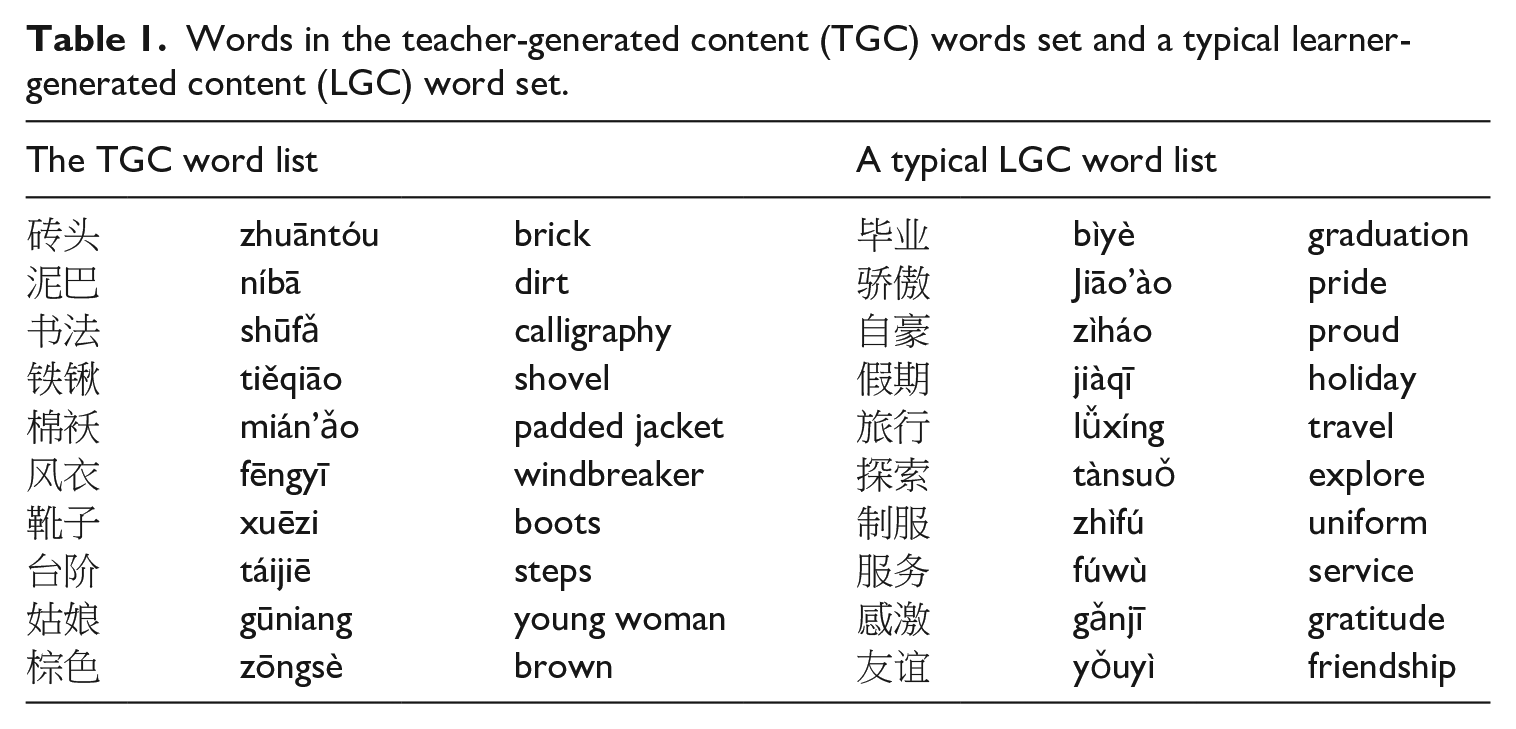
For the LGC words, participants were asked to choose personal photos that were meaningful to them and that they were comfortable sharing. They were also asked to make a list of ten things in the photos in English that (1) made the photos meaningful to them, (2) they did not know how to say in Chinese, and (3) they wanted to learn how to say in Chinese (see Table 1 and Appendix 2, for examples). To be generally comparable to the theme of the TGC photo, they were asked to choose photos of people that they cared about deeply or events that had taken place on a holiday or other occasions that were very important to them. They were also instructed not to look the words up in Chinese or preview them in any way before the session. As the goal was for learners to generate words that genuinely met the three criteria of the assignment rather than picking words at random, they chose as many photos as necessary to identify the ten words. Of the 17 participants in the study, 15 chose three pictures to identify their words, and two chose two pictures to identify them. All LGC words in the study were associated with events involving family or friends at school, weddings or while travelling.
4 Procedures
Participants were sampled from three beginning-level Chinese classes taught by three different instructors but based on the same materials. Announcements were made in beginning-level classes that participants were needed for a research project on learning Chinese vocabulary. Students were told that participation required a 30-minute one-on-one vocabulary practice session with a lecturer in the program and that they would receive a gift voucher for their time.
Data was collected from participants individually in a meeting room on campus. The session involved training and testing each learner on 20 lexical items as described below. Participants received the same three training activities for the 10 LGC and the 10 TGC items followed by a recall test. The training activities were carefully controlled so that the exact same type and amount of exposure and processing was provided for each word in both conditions as described below. The LGC and TGC words were trained separately, and the order in which they were presented was alternated for each participant to distribute performance effects evenly across conditions.
At the beginning of each session, participants were asked to explain the pictures and words that they had chosen in English to confirm that they were related to events that were personally meaningful to them. Participants were also asked if they had any idea of how to communicate these ideas in Chinese to confirm that the words were unknown. All responded negatively. After the treatment, when participants had been exposed to the Chinese words in both conditions, they were asked if they had ever heard any of the words prior to the treatment session to confirm that all 20 words were new to them. Again, all responded negatively.
Two weeks later, participants were asked to attend a follow-up session to discuss their results, and were told that they would receive another gift voucher for their time. On arrival, each participant was given a surprise repeat of the same test from the first session as described below. Participants were then provided with the marked tests and interviewed on why they could or could not remember the words that they did in each condition. The interviews were audio recorded for subsequent analysis. At the end of the session, the learners were asked whether they had reviewed or been exposed to any of the words between the two sessions. All answered negatively.
a Training activities
At the beginning of the training sessions, the second author, who was also a teacher in the program, first reviewed the two Chinese structures that would be used in the session and provided some practice items using words that learners were familiar with from class. The purpose was to familiarize them with the four item formats that would be used and ensure that they could parse the target lexical items. The two structures were, 这张照片有 . . . (‘This picture has. . .’) and the corresponding negative, 这张照片没有 . . . (‘This picture does not have. . .’). Both structures had been taught in class when similar picture description activities had been used to introduce new words.
The first training activity was receptive and required participants to listen and write down the words. Participants saw the relevant picture(s) for each condition (TGC or LGC) and the list of target words in English side by side (for examples, see Appendices 1–2). They had a pen and a blank piece of paper. For each lexical item on the list, the teacher-researcher pointed simultaneously to the printed English word and the corresponding object in the picture and said in Chinese, 这张照片有. . . (‘This picture has . . .’) followed by the target word in Chinese and a pause for the participant to write it down. After this training activity, participants’ written notes were collected.
The second training activity was also receptive and required them to process the words within syntactic structures in order to answer true-false questions. Participants again saw the relevant picture(s) and the list of target words in English side by side. They had a pen and a piece of paper with item numbers and the words ‘true’ and ‘false’ next to each. The teacher-researcher again went down the English word list in order, pointing to each word in English and making a positive or negative statement about the adjacent picture in Chinese using one of the fixed structures (这张照片有 . . . ‘This picture has. . .’, 这张照片没有 . . . ‘This picture does not have. . .’). Participants heard each statement once and responded by circling true or false.
The third training activity was again receptive and required participants to answer multiple-choice questions. Participants once again saw the relevant picture(s) and the list of target words in English side by side. They had a pen and a piece of paper with item numbers and three letters next to each (A, B, C). The teacher-researcher again went down the English word list in order, pointing simultaneously to each word in English and the corresponding object in the picture(s) and produced three statements for each object. One contained the target item and two contained distractors. The distractors were controlled for length in syllables. The TGC distracters were prepared in advanced, and the LGC distractors were chosen on the spot based on a prepared word bank of suitable one, two, three and four syllable words. The distractors in both conditions were words that had not been covered in class and that were rare enough that participants would not know them. The three statements used the same fixed structure (这张照片有 . . . ‘This picture has. . .’) followed by a lexical item. Participants listened and circled the letter of statement that contained the correct Chinese word for item indicated.
b Recall test
The test then required productive recall of the words trained and consisted of oral fill-in the blank items. Participants saw the relevant picture(s) and list of target words in English side by side. The teacher-researcher went down the list, pointing simultaneously to each English word and the corresponding object in the picture. As she did this, she prompted the test-taker for the Chinese word by supplying the fixed phrase 这张照片有 . . . (‘This picture has. . .’) followed by a pause for participants to supply the word orally. If participants remembered the entire word, they were given one point for the item. If they remembered at least one of the syllables, corresponding to one of the Chinese characters, they were given half a point. If they could not recall the syllables corresponding to any of the characters, they were given zero points for the item. Errors in tones were not considered in marking responses. Two native speakers of Chinese independently marked all participant responses and agreed on the marks assigned to learners for all test items.
5 Analysis
Lexical recall scores for both conditions and on both the immediate and delayed post-tests were screened for normality by dividing skew and kurtosis statistics by the respective standard errors. The resulting z-scores for the distributions revealed that the recall scores for the LGC tests (immediate, delayed) were normal but that the scores for the TGC tests (immediate, delayed) were positively skewed. This was due to large numbers of relatively low scores in this condition together with one or more students who scored higher than most. Square root transformation was applied to the scores in all four distributions. Following transformation, all four score sets were approximately normally distributed with skew and kurtosis z-scores between -1.38 and +1.28. A 2 × 2 repeated-measures analysis was then used to test the null hypotheses that there were no statistically significant differences in lexical recall between the two conditions (TGC, LGC) or between the two test times (immediate, delayed) and that there was no significant interaction between these two factors. The analysis was conducted using the GLM in SPSS25 for Windows.
Students’ comments during the interview on why they remembered certain words and not others in each condition were transcribed. Each learner made between 20 and 25 comments on their performance during the interview. In total, the interview data set consisted of 390 comments. These comments were transferred to an Excel spreadsheet and coded into categories based on the themes that emerged from the data following the six-phase thematic analysis procedures of Braun and Clarke (2008). Two of the researchers coded 50% of the data set independently. They then met, compared their responses and resolved any differences. One researcher coded the remaining data.
VI Results
1 Quantitative: Lexical recall
Table 2 provides descriptive statistics for participants’ recall across conditions (TGC, LGC) and time (immediate, delayed) based on means of their untransformed scores.
Untransformed means across conditions and test times.
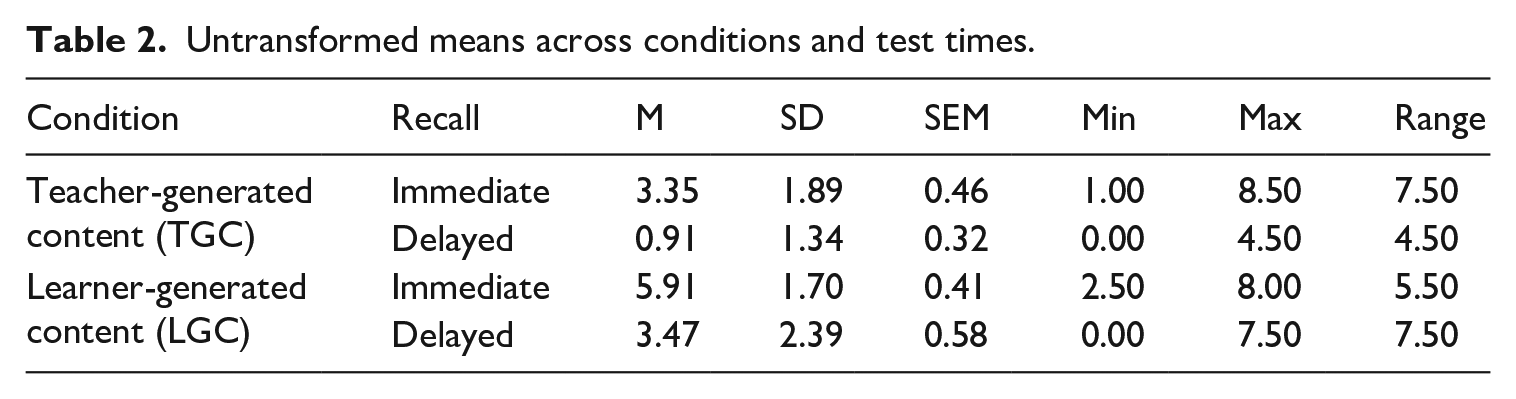
Recall of LGC words was substantially higher than recall of TGC words on both the immediate post-test (LGC=5.91/10; TGC=3.35/10) and the delayed post-test (LGC=3.47/10; TGC=0.91/10). Although there was considerable decay in learners’ recall in both conditions between the immediate and delayed tests, the mean for LGC words on the delayed post-test (3.47/10) was still slightly higher than the mean for TGC words on the immediate post-test (3.35/10).
Using Pillai’s trace, a significant main effect and large effect size were found for content (TGC, LGC) on recall, F (1, 16) = 49.536, p = .000, ηp2 = 0.756. Post-hoc two-way paired-samples t-tests indicated that the difference between conditions was significant on both the immediate post-test, T (16) = 4.333, p = .001, d = 1.46, and the delayed post-test, T(16) = 7.711, p = .000, d = 1.47. LGC words were thus recalled better than TGC words.
Pillai’s trace also revealed a significant main effect and large effect size for time on recall (immediate, delayed), F (1, 16) = 40.999, p = .000, ηp2 = 0.719. Post-hoc two-way paired-samples t-tests again indicated that this decay was significant for both the LGC words, T (16) = 5.448, p = .000, d = 1.17, and the TGC words, T (16) = 5.995, p = .000, d = 1.81. There was thus a significant decay in recall between the immediate post-tests and the delayed post-tests in both conditions.
Finally, Pillai’s trace revealed a significant interaction between content and time, F (1, 16) = 9.142, p = .008, ηp2 = 0.364. Participants’ performance between the immediate and delayed post-tests was thus dependent on whether TGC words or LGC words were being recalled.
Figure 1 provides an illustration of the magnitude of the mean differences in recall of the TGC and LGC words on the immediate and delayed post-tests. Learners recalled more LGC words than TGC words on the immediate post-tests (p = .001, d = 1.46) and the delayed post-tests (p = .000, d = 1.47). Furthermore, although learners’ memory decayed between the immediate and delayed tests for the LGC words (p = .000, d = 1.17) and the TGC words (p = .000, d = 1.81), the rate of decay was not as great for LGC words as TGC words (p = .008, ηp2 = 0.364). As Figure 1 illustrates, the slope of decay for TGC words was steeper than it was for LGC words, and this difference was statistically significant (p = .008, ηp2= 0.364), indicating that participants’ memory was more stable over time for LGC words than for TGC words. In addition, the 95% confidence intervals represented by the error bars in Figure 1 show less variation in immediate recall for LGC words than for TGC words on the immediate post-test. This difference had dissipated on the delayed post-test where both conditions showed greater variation than on the immediate post-test with little difference between them.
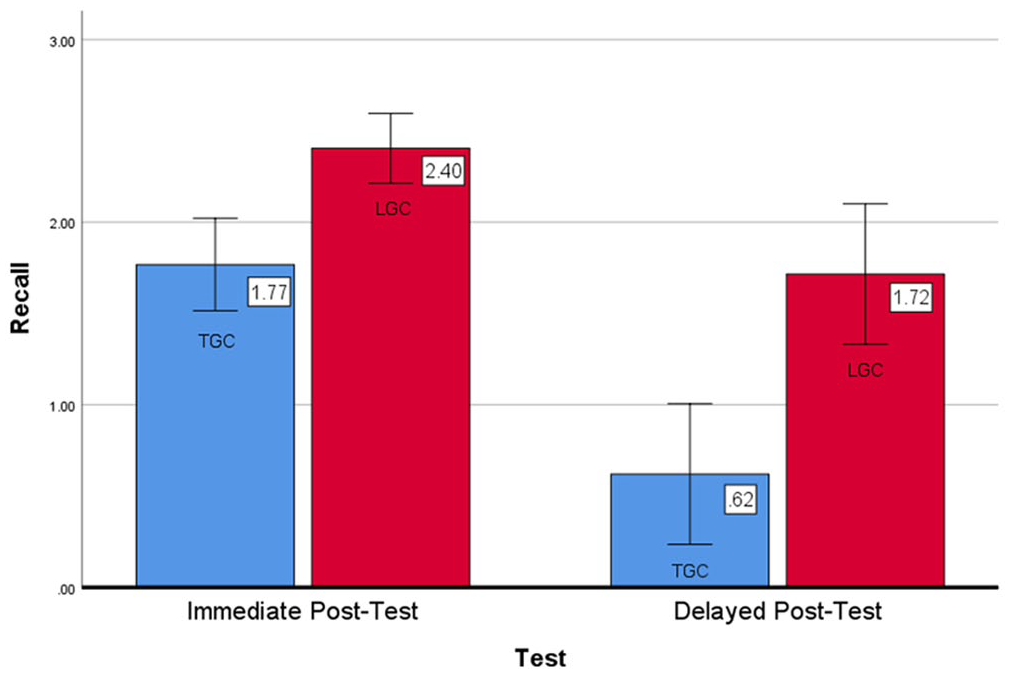
Condition and test effects.
2 Qualitative: Factors impacting effective recall
A key question that arises in conjunction with the quantitative results is why participants remembered the LGC words better than the TGC words. In order to partially answer this question, learners were interviewed after the delayed post-test on why they or did and did not remember the words in each condition. Four themes emerged from the thematic analysis of the interviews (see Table 3).
Factors impacting recall of learner-generated content (LGC) and teacher-generated content (TGC) words.
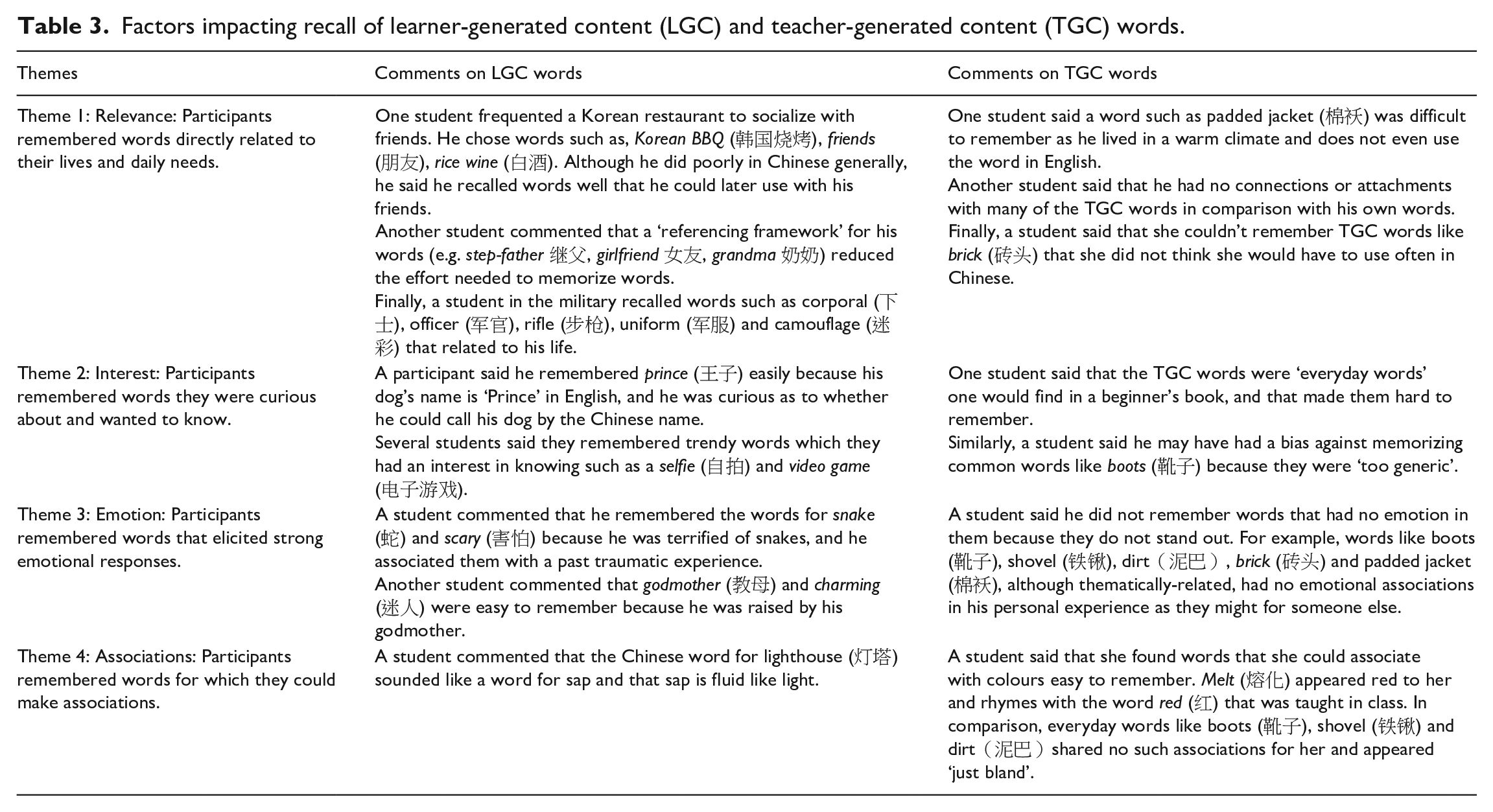
The comments in Table 3 suggest the memorability of words is determined at least partially by individual differences between learners – namely, what they found to have relevance, interest, emotion valence, and associations with their own world knowledge. In other words, the memorability of words is likely to be a product of the form and meaning of words together with the background and experiences that learners bring with them to the classroom.
VII Discussion
This study investigated the effect that personal investment in the form of LGC had on the lexical recall of beginning-level undergraduate learners of Chinese as a Foreign Language at an Australian University.
Research Question 1 asked whether LGC would result in better recall than TGC, and it can be answered affirmatively. The results of the study reveal that learners had significantly higher recall for LGC words than for TGC words on both the immediate and the delayed post-tests (see Figure 1).
Research Question 2 then asked whether memory for LGC words would be more stable over time than memory for TGC words, and it can also be answered affirmatively. The results suggest that memory for lexis decayed significantly in both conditions, but that the rate of decay was significantly greater for TGC words than for LGC words (see Figure 1).
The study thus provides a means of operationalizing learner investment for L2 research and pedagogy and expands the scope of research on the role of learner investment in SLA. Norton (2018) stresses the need to provide learners with opportunities to exercise agency to promote L2 learning (2018, p. 39). Lambert and Zhang (2019) arrive at a similar conclusion, demonstrating how typical pedagogic tasks resulted in the use of language that included a pragmatic dimension related to learners’ identities when based on LGC as opposed to TGC. Lambert and Zhang (2019) also illustrate how LGC provided a basis for agency on the part of learners, allowing them to position themselves personally within the social space of the L2 classroom. The present study adds to previous research by both Norton and Lambert by showing how agency can be fostered even with beginning-level learners when completing intentional vocabulary learning exercises. The results of the present study demonstrate that LGC provides a means of tapping into the ‘capital’ that learners possess (Darvin & Norton, 2015). Furthermore, to our knowledge, the present study is the first to investigate the impact of LGC on L2 learning as opposed to L2 performance. Previous empirical studies have shown positive effects for LGC on engagement in language use (Lambert et al., 2017) and the use of pragmatic devices (Lambert & Zhang, 2019). The results of the present study provide empirical support for claims advanced in Lambert (2017) and Ellis et al. (2020, Chapter 6) that pedagogic activities based on LGC might positively impact learners’ memory for new language.
Research Question 3 then asked why learners did or did not remember words in the respective conditions. Thematic analysis of follow-up interview data revealed that participants remembered words that had relevance, interest, emotional valence, and a range of associations for them (see Table 3). The memorability of words thus appears to have been a product of the features of the words in interaction with learners’ individual backgrounds. The study thus points to the importance of learners’ individual differences for lexical learning and the potential role of the capital that learners bring to the classroom (Darvin & Norton, 2015). The qualitative results in the present study also add support to the conclusions of Jiménez Catalán and Dewaele (2017) that positive emotional prompts associated with meaningful personal experiences generate larger networks of associations (see Table 3).
In addition, the study supports Maehr’s (1984) notion that ‘meaning’ is a key intervening variable in learning. Maehr argues that the personal experiences learners bring to the classroom are an important determinant of the meaning that instructional content will have for them, and consequently their willingness to invest their time, talent and energies into learning it. The comments in Table 3 reveal that learners were not only more invested in the words that they recalled, but that they were often more motivated to put forth the effort required to remember them. In fact, it is possible that meaning in Maehr’s sense was the primary factor in recall in the present study. Occasionally incorporating LGC words into a course could provide an expedient pedagogic device for tailoring lexis to learners’ backgrounds in addition to its function of generating learner involvement in classroom content. LGC provides one means of operationalizing learner investment and investigating its impact on the learning process. If other pedagogic means of creating meaningful classroom content are identified, however, similar results for recall might be obtained.
The present study applies a psychological theory regarding the affective dimension of learning to instructed SLA, demonstrating how affective processes associated with relevance, interest, emotion valence and associations with current knowledge might impact learners’ ability to make, store and recall form-meaning connections for new L2 lexis. As Dörnyei (2019) points out, principles are required for integrating explicit and implicit learning in conjunction with the language that learners comprehend and use in the L2 classroom. The approach to LGC in the present study might be argued to help learners in initially making explicit form-meaning connections and setting implicit acquisition of deeper knowledge of lexical items in train (Nation, 2001, p. 27; Webb, 2013). The study thus provides a means of systematically incorporating the psychology of the language learner into materials design (Dörnyei, 2019, p. 38).
LGC may also improve the quality of learners’ attention when meeting words and allow them to elaborate on knowledge of the word beyond its immediate context (Nation, 2015), making connections between new lexical items and previous experiences in long-term memory (see Table 3). Nation (2015) argues that, when guessing from context, learners draw on a range of clues, including their knowledge of the world. Learners’ investment in LGC words might result in increased learning both through an improved basis for guessing and more attention devoted to guessing during both practice and testing. Furthermore, the relevance associated with LGC may increase the likelihood of subsequent use of the target words which is critical for the ongoing development of different aspects of vocabulary knowledge (Nation, 2015).
Research on vocabulary acquisition suggests that the acquisition of lexical items represents a gradual accumulation of different knowledge related to the form, the meaning, and the use of target lexical items (Nation, 2001, p. 27). The present study focused on learners’ ability to associate form and meaning. This is an important initial step for beginners as it increases the likelihood that words will be understood when encountered and used when the opportunity presents itself. As Webb (2013) argues, strengthening the link between form and meaning is a logical place to start with word learning as other forms of word knowledge can build on this initial base.
Based on Nation’s (2001, p. 27) typology of word knowledge, learners in the present study were introduced to how the target words sound (receptive) and to a lesser degree how they are pronounced (productive). They were also introduced to the meanings that the word forms signal (receptive) and to a lesser degree the forms that can be used to express desired meanings (productive). In terms of both the form and meaning dimensions, receptive knowledge (during training) preceded productive knowledge (during testing). Only limited receptive exposure was given to the use of the words in positive and negative statements. Future work on word forms would include encountering the words in the written mode to master what the words look like in Chinese characters and how they are written. It would also include recognizing different forms of the words and how they can be used to express meanings. Likewise, future work on word meanings would focus on the range of meanings that the words can take, the words that are typically associated with them, and words that can substitute for them. Finally, future work would broaden the range of patterns in which the words could be used, develop knowledge of words that typically pattern with them, and sensitize learners to when and where they are used.
1 Pedagogic implications
The periodic incorporation of LGC words into a variety of task types, including description, instruction, narration, opinion (see Lambert & Zhang, for examples), may provide an expedient means of incorporating students’ past and present lives into the learning process and thus ‘legitimize learners’ cultural capital - their prior knowledge and experience’ (Norton, 2018, p. 248). The use of digital narratives as discussed by Darvin and Norton (2015), might achieve similar ends with multimodal narrative discourse.
LGC requires content selected by learners themselves that is (1) based on real experiences, (2) they want to share, and (3) they feel those they are working with in class will be interested in hearing (Ellis et al., 2020, Chapter 6; Lambert & Zhang, 2019). At the beginning level, picture descriptions like the ones used in the present study might be incorporated into classroom work. A lesson might begin with a teacher-fronted activity in which the teacher first describes key items in a picture that she has chosen in order to present and practice new vocabulary with the whole class. This stage of the lesson could model the supporting language structures and activities that learners will subsequently use to present and practice LGC words with one another. In a second stage, students could be asked to complete the same activity in pairs based on their own pictures and words which might have been submitted as homework and the either translated or at least checked by the teacher for accuracy.
As learners gain mastery over the form and meaning of LGC words, these words might be incorporated into different tasks and exercises across the syllabus to provide spaced repetition at progressive intervals so that the words are not forgotten (Nation, 2001). By varying the focus of each activity, knowledge of the words can be deepened. For example, the words which learners are exposed to receptively might subsequently be incorporated into activities where they prepare simple written summaries and anecdotes which are submitted as homework and checked by the teacher or read by peers. After such preparation, learners might move to simple oral anecdotes in pair work tasks in the classroom. Constraints on the performance of these tasks might include progressive time pressure to push processing speed and develop lexical access. However, a key facet of LGC is the intrinsic interest that it engenders, so teachers might be careful not to overload LGC activities with pedagogic constraints that interfere with their enjoyment.
Learners should also be made aware of the goals of fully learning the form, meaning and use of new words (Nation, 2001, p. 27). As learners move from receptive to productive use of the aural and written form of LGC words, they might be encouraged to think of a variety of activities to focus on different contexts and ways in which the words are used. Such activities might involve the use of learning journals, dictionary and concordance searches, periodic quizzes, and goal tracking to chart progress. Over the course of a term, for example, learners might be encouraged to develop explicit supplementary activities such as matching, cloze, synonym search, and analysis of word parts (Nation, 2005) to quiz themselves and track their progress. Periodic quizzes on the different facets of form, meaning and use (for example items, see Webb, 2013) can serve important developmental functions in terms of both coverage and motivation. Focal points for these activities would include form and meaning connections, spoken and written forms, word parts, associations, collocations, grammatical functions, and other concepts and referents (Nation, 2001). Finally, learners might also be introduced to learning strategies such as (1) guessing from context using clues such as part of speech, affixes, immediate context, wider context and background knowledge, (2) learning from word cards by trying to remember before flipping, spaced repetition, changing order, mnemonic tricks, receptive and productive practice, and (3) dictionary use for receptive and productive word information (Nation, 2015). These learning strategies might be incorporated in LGC writing activities for peer reading and discussion. Although LGC materials may not result in words that are the most frequent, the present study reveals that these words may be the more memorable. Incorporating sequences of LGC exercises within the L2 syllabus might thus provide a means of providing repetition of less frequent vocabulary that is directly relevant to learners’ lives.
Perhaps the primary concern in deciding how to incorporate LGC into a L2 course, however, will be environmental constraints. In most contexts, established curricula and specific learning goals will limit the amount of freedom that teachers have to experiment with innovations to improve engagement and learning. In many contexts, teachers may be hard pressed to cover fixed content required to prepare learners for tests that are essential to their future in the educational context. The best advice might thus be to adopt a heuristic approach that is consistent with the core principles of vocabulary learning outlined in this section and that fits the needs of teachers’ contexts.
2 Limitations and future research
Like much research on L2 pedagogy, this study investigates differences between conditions that represent conglomerations of variables. As the study aimed to find an expedient way of modifying current vocabulary exercises through comparing teacher and learner supplied content, allowing teachers and learners to choose the materials was important to the external validity of the results. The words that resulted from the respective sources tended to differ in their meaningfulness to learners in terms of relevance, interest, emotional valence, and associations with existing knowledge. However, several other differences emerged between the materials that learners and teachers supplied that may have impacted learning in the two conditions. Further research is needed which aims at internal validity in order to identify the specific factors that impact memorability within the respective conditions and the extent to which these factors are dependent on the individual differences that learners bring to the classroom. Achieving this will most likely involve forgoing the comparison of LGC with current TGC practices. Rather the focus might be on comparing LGC with research-generated content (RGC). RGC words could be carefully matched to the LGC words learners’ supply on indices of meaningfulness, imageability, concreteness, frequency and other relevant features. Using words that are carefully matched on such features in the respective conditions would illuminate whether, and to what extent, the words in the LGC condition, being connected to specific learners’ background and experiences, impact memory. In other words, a well-designed study of LGC and RGC might provide valuable insight into the specific role of individual differences in the learnability of new words. However, in addition to carefully matching the words in the respective conditions, such a study would also attempt to match the materials through which these words are cued to learners, ensuring that the respective conditions are equal in terms of topics (e.g. school, work, holidays, family, travel, hobbies) and thematic organization (e.g. the number of related and unrelated words they contain). It would also employ the same number of pictures in each condition with a comparable number of objects in each. In this way, the impact of factors in the visual input would not impact the cognitive burden associated with learning in the respective conditions.
The present study was also limited to intentional learning activities as these are the activities that are typically used in CFL instruction in the context in which the study was conducted as well as in many published instructional materials (Missingham, 1992; Zhang, Li & Moore, 2015). Future research will be needed on incidental vocabulary learning. As Schmitt (2008) points out, both intentional and incidental learning are important in effective L2 vocabulary instruction.
Finally, the present study was limited to beginning-level learners who used pinyin phonetic notation for the Chinese words that they were learning. If participants had been proficient enough to read the Chinese characters for the words that they were learning, this would have introduced a rich range of additional associations that might impact the memorability of the target words. The impact of knowledge of the visual form of words on both intentional and incidental learning of new vocabulary is an important area for future CFL research.
Footnotes
Appendix
Acknowledgements
The authors would like to thank the anonymous reviewers of the article who provided insights that pushed the study in new and important directions that are represented throughout the paper. Without the contributions of the these reviewers, the study would have been very different than it is in its present form.
Funding
This project was funded by a 2018 Category 1 Seeding Grant from the Faculty of Humanities, Curtin University. Additional funding was provided by 2018-2019 Research Innovation Support Program (RISP) Grants from the School of Education, Curtin University.
