







Abstract
This classroom-based, quasi-experimental study explored the impact of metacognitive instruction designed to promote young learners’ (1) willingness to communicate (WTC), (2) participation in communicative activities, and (3) metacognitive knowledge of oral communication. Forty-four Grade 3 students (8–9 years old) from two intact classes participated in the study. The learners in Class A (n = 23) engaged in a series of activities designed to increase their metacognition in relation to WTC, while Class B (n = 21) served as the control. Three outcome measures were explored in the pre-post design: (1) WTC questionnaire; (2) second language (L2) production during group work; and (3) empty WTC pyramids that the participants drew before and after the intervention. In addition, post-intervention interviews were conducted to understand the learners’ metacognitive knowledge of oral communication. The results showed that the intervention did not have an observable impact on the learners’ WTC. However, their metacognitive knowledge of oral communication was heightened after the intervention. The behavioral data showed that the experimental participants produced the target language more and that group members started to share turns more evenly. The study concludes that metacognitive instruction can be a useful pedagogical tool to improve L2 learners’ metacognition as well as classroom participations patterns, even with young learners whose metacognition can be obscure or inaccurate.
Keywords
I Introduction
Willingness to communicate (WTC) is a learner psychology (LP) construct with considerable theoretical and pedagogical relevance. On the one hand, researchers continue to examine second language (L2) WTC’s relations with other LP constructs, such as personality, anxiety, motivation, and emotions (Dewaele, 2019; Elahi Shirvan et al., 2019; Lee & Lee, 2019; Peng, 2019; Reid & Trofimovich, 2018). On the other hand, based on a pedagogical concern related to silent learners in the classroom, research has explored the nature of classroom WTC and how it can be enhanced. As this pedagogical concern tends to be raised in foreign language contexts, much research has been conducted in contexts of English as a foreign language (EFL), such as Japan (Yashima et al., 2018), China (Peng, 2019), South Korea (Lee et al., 2019), Taiwan (Chen et al., 2019), Yemen (Al-Murtadha, 2019), Iran (Khajavy et al., 2018), and Poland (Pawlak et al., 2016). Although research of trait-like/state-like and outside/inside-classroom WTC is abundant, intervention studies are still scarce, leaving L2 teachers with an important question: What can a teacher do for their students to participate more in communicative activities? Answering this question would benefit both teachers, who are struggling with silent learners, and learners, who are missing out on opportunities for L2 learning through engagement in meaningful practice. While acknowledging that being silent during communicative activities does not necessarily mean that the learner is not learning (see Fernández Dobao, 2016), the current study was conducted based on a premise that meaningful L2 production facilitates L2 learning and answers teachers’ concerns (Sato & McDonough, 2019).
In accordance with one of the objectives of instructed second language acquisition (ISLA) research – to conduct pedagogically relevant experimental studies (DeKeyser & Prieto-Botana, 2019; Loewen, 2020; Sato & Csizér, 2021; Sato & Loewen, 2019) – the current study tested the impact of metacognitive instruction (MI) on WTC and metacognition of oral communication. MI is a type of instruction designed to enhance cognitive processes and products of different types of learning (Dinsmore et al., 2008). By helping learners plan, self-monitor, and self-evaluate their learning processes and products, MI ultimately contributes to self-regulated learning (Veenman et al., 2006; Zhang & Zhang, 2019). MI has been widely examined in the fields of educational and cognitive psychology and shown to positively impact on the learning outcomes of different skills (see reviews and meta-analyses in de Bruin & van Gog, 2012; Donker et al., 2014; Kleitman & Narciss, 2019). Albeit to a limited extent, L2 research has also explored the impact of MI on different learning aspects such as listening comprehension (Bozorgian & Alamdari, 2018), reading comprehension (Teng, 2020), and speaking skills (Sato & Loewen, 2018). In addition, MI has been found to improve L2 learners’ strategic behaviors such as peer reviews for writing (Bui & Kong, 2019) and collaborative interaction (Sato, 2020). Adding to this body of research, the current study explored MI’s impacts on WTC and examined metacognitive knowledge of oral communication.
While the majority of WTC studies have inferred L2 learners’ learning behaviors based on self-reported questionnaire results, the current study investigated their actual behaviors during classroom interaction. Importantly, actual language use is an outcome of WTC; that is, as MacIntyre et al. (1998) originally defined it, WTC ‘represents the probability that a learner will use the language in authentic interaction with another individual, given the opportunity’ (p. 558; emphasis added). However, from the practitioners’ perspective, pedagogical technique ideally impacts on their students’ classroom behaviors, not their self-reported attitudes. Hence, drawing on SLA theory (i.e. skill acquisition theory), the amount of L2 production during communicative interaction was examined in the current study.
II Literature review
The construct of WTC was originally proposed as a personality trait and connected to other constructs such as introversion and self-esteem (Burgoon, 1976). WTC as the intention to initiate communication in one’s first language (L1) was thought to be a stable individual difference over time and across situations (McCroskey & Baer, 1985). MacIntyre and colleagues adapted this trait-like WTC to account for communication behaviors in the L2 (MacIntyre & Charos, 1996) and proposed a model explaining antecedents of L2 WTC (MacIntyre et al., 1998). This model, often referred to as the pyramid model, includes various trait-like (e.g. motivation, anxiety, self-confidence) and state-like (e.g. group cohesion and topical familiarity) variables that enable L2 learners to use the L2 for communicative purposes. Along with the model, MacIntyre et al. (1998) defined L2 WTC as ‘a readiness to enter into discourse at a particular time with a specific person or persons, using a L2’ (p. 547). Since MacIntyre et al.’s conceptualization, the interrelations among the variables have been extensively tested (see Elahi Shirvan et al., 2019). Recent research points to the role that state-like (situated or situational) WTC plays in determining L2 WTC, especially in the classroom context (Yashima et al., 2018).
Unlike L1 WTC and outside-classroom L2 WTC, classroom L2 WTC is mediated by multiple factors that are unique to instructed L2 learning. For instance, Peng and Woodrow (2010) operationalized classroom environment to include teacher support, student cohesiveness, and task orientation. Classroom environment was found to predict L2 WTC of Chinese EFL learners. A similar pattern was found by Khajavy et al. (2018) with Iranian EFL learners. MacIntyre et al. (2011) focused on adolescent learners (12–14 years old) in the context of French immersion in Canada. The participants (N = 100) were asked to describe situations in which they were most or least willing to communicate. Qualitative analyses of the learners’ diary entries showed that WTC and unWTC can occur in the same situation. For instance, the learners reported that they were willing to communicate with their peers only when they had control over the information (e.g. a secret club). Borrowing a micro-perspective of WTC, Mystkowska-Wiertelak and Pawlak (2017) showed that three groups of learners followed different patterns of WTC over time, suggesting that WTC is situation specific and fluctuates over time (see also Kang, 2005). Peng’s (2019) structural equation modeling, based on 2,058 questionnaire responses from Chinese EFL learners, included multiple classroom-specific variables. Among them, teachers’ gestures and spatial position (i.e. how physically close the teacher is during teaching) related to WTC. Classroom environment – teacher support, student cohesiveness, and task orientation – also predicted WTC. Clearly, classroom WTC is dynamic and influenced by a host of psychological and contextual variables (see also Dewaele, 2019; Zhang et al., 2018). At the same time, its dynamic nature implies that classroom WTC, at least the situational variables within it, may be altered by L2 instruction and the teacher.
While much research has suggested that the higher WTC, the more participation in classroom activities, studies examining learners’ actual behaviors have traditionally been limited. Cao and Philp (2006) observed learners’ classroom behaviors (e.g. volunteering an answer and presenting their own opinions in class) and found that, among other factors, group size and interlocutor familiarity affected the frequency of self-initiated communication. Cao (2014) conducted a longitudinal study in which six university-level learners of English as a second language (ESL) were observed and interviewed over five months. The analysis showed that individual characteristics (e.g. emotions and personality), classroom environmental conditions (e.g. task type and teacher), and linguistic factors (i.e. proficiency and L1) interdependently facilitated or inhibited the emergence of WTC, as well as learners’ participation patterns during classroom activities.
Among a few studies that explored a pedagogical intervnetion designed to increase WTC is Yashima et al. (2018). In the study conducted in a Japanese EFL class, the traditional initiation–response–feedback (IRF) pattern, which often creates teacher-centered discourses, was avoided. The recoding of the discussion tasks revealed that the frequency of self-initiated turns gradually increased over the course of 12 lessons, albeit with a considerable variation among the students. Yashima et al. concluded that the intervention succeeded in increasing learner participation ‘by lifting teacher control and leaving the responsibility to participate to learners’ (p. 132). Indeed, Yashima et al.’s study suggests the importance of autonomy in enhancing L2 learners’ participation in classroom activities (see also Peng, 2020). In another study, Al-Murtadha (2019) examined the impact of visualization technique on WTC of Yemeni EFL learners. During the six-week intervention, the high-school level learners were guided to visualize their possible future selves and take actions for their short- and long-term goals. The results showed that the WTC scores of the experimental group were significantly higher than those of the control group, albeit with a small effect size (η p 2 = .03). In sum, the literature indicates that: (1) classroom WTC is dynamic and susceptible to classroom environment, (2) learner autonomy (or self-regulation) might be key for increasing learner participation, and (3) WTC may be enhanced by L2 instruction. The current study, therefore, used MI as the pedagogical intervention.
1 Metacognitive instruction
Originally proposed by Flavell (1976), metacognition refers to ‘active monitoring and consequent regulation and orchestration of these processes’ (p. 232). Simply put, metacognition is a type of knowledge that allows one to think about thinking. Consequently, metacognition provides a cognitive support for learning content knowledge. Wenden (1987) applied the construct to L2 research and suggested that L2 instructors should not only teach the language itself but also provide learners with guidance in ‘improving and expanding their knowledge about learning’ (Wenden, 1998, p. 531). According to Flavell’s (1976) original conceptualization, metacognitive knowledge consists of three types of knowledge: (1) person knowledge (the knowledge a person has about him/herself and others as cognitive processors); (2) task knowledge (the knowledge a person has about the information and resources needed to undertake a task); and (3) strategy knowledge (knowledge regarding the strategies which are likely to be effective in achieving goals and undertaking tasks). Taking group work as an example, a L2 learner may realize that the objective of group work is to use the target language for communicative purposes (task knowledge) and their peers can be a useful learning resource (person knowledge). The learner may learn techniques and expressions to initiate and participate in communication, in order to successfully complete the task (strategy knowledge). The regulation of metacognitive knowledge entails a set of activities such as planning, self-monitoring, and self-evaluating, together leading to self-regulated learning.
In the field of L2 research, the majority of MI studies have targeted listening comprehension skills (see, for a review, Goh, 2018). For instance, in Vandergrift and Tafaghodtari’s (2010) experiment, university-level L2 learners of French were instructed to predict the types of information they would hear before actual listening. Then, they were told to verify their predictions during listening. Results showed that the experimental learners not only outperformed the control group in listening comprehension, but also exhibited heightened awareness of their learning processes. In Teng’s (2020) study, Grade 5 EFL learners in Hong Kong received MI which targeted reading skills. After the intervention, the experimental learners showed heightened metacognitive awareness and increased their reading performance. With Chilean adolescent EFL learners, Sato’s (2020) MI targeted collaborative interaction and measured comprehensibility of learners’ oral production as the outcome variable. The results showed that the experimental learners increased their use of collaborative strategies and improved their comprehensibility.
MI may impact on another component of metacognition: metacognitive experience. Metacognitive experience involves conscious, affective experiences related to selves, tasks, goals, and strategies, as a person engages in cognitive activities. Metacognitive experiences interact with metacognitive knowledge ‘by adding to it, deleting from it, or revising it’ (Flavell, 1979, p. 908). Hence, in the context of ISLA, the teacher plays a pivotal role not only by explicitly teaching metacognitive strategies but also by enhancing learners’ metacognitive experiences. Successful MI, then, provides learners with metacognitive experiences that ‘they need so that they can revise their metacognitive knowledge for better metacognitive knowledge’ (Zhang & Zhang, 2019, p. 9). Seemingly, metacognitive experiences are affected by classroom environment which has been found to be a significant predictor of classroom WTC.
2 The current study
The current study attempted to address several gaps relating to WTC, metacognition, and ISLA. First, despite the significance of classroom WTC for L2 learning and teaching, intervention studies targeting WTC have been limited. Second, WTC research has largely relied on questionnaire results, while the current study examined learners’ actual behaviors during communicative tasks. Third, both WTC and metacognition research have traditionally focused on university-level learners, at least in the field of L2 teaching and learning. Instead, the current study focused on young learners (8–9 years old) to explore the nature of their WTC and metacognition. Finally, to our knowledge, no studies have explored the impact of MI on WTC.
We considered metacognition to be theoretically aligned with WTC. This is because the situational and motivational antecedents of WTC are closely linked to self-regulated learning. For instance, L2 linguistic self-confidence and risk-taking have been found to be associated with L2 WTC (Pyun et al., 2014). A change in those factors may be achieved by heightening the learner’s metacognitive knowledge of oral communication. Less L2 speaking anxiety – also found to explain L2 WTC (Denies et al., 2015) – is another potential outcome, if learners increase their person knowledge and appreciate that they can collaborate with each other to complete a group task. Also, the contextual factors that affect WTC (e.g. task type, teacher, and classroom environment) might be altered if MI were to succeed in creating metacognitive experiences conducive to the development of metacognitive knowledge. With young L2 learners, the current study explored the impact of MI on WTC (henceforth, MIWTC) in relation to three variables: (1) WTC, (2) communication behaviors, and (3) metacognitive knowledge of oral communication.
III Methods
1 Context and participants
The current study was conducted in the Chilean EFL context. In this context, as is the case with many other EFL contexts, English education struggles to raise learners’ general proficiency levels, primarily due to the traditional teaching methods (including teacher-centered classes and grammar-translation approaches) delivered in the learners’ L1 (Sato & Oyanedel, 2019). To counter this, there has been a surge in the number of bilingual education programs at the primary and secondary levels, in order to increase opportunities for students to be exposed to authentic input and to engage in meaningful communication in the L2 (Barahona, 2016). The current study was conducted at one of those private bilingual schools. The school partially implemented content-based language teaching (see Lyster, 2017). In addition to the instructional hours of English (nine classes per week) being longer than required by the national curriculum, science classes were taught in English from Grade 1 through Grade 7.
From the school, two intact Grade 3 (8–9 years old) classes participated in the study (N = 44). We chose young learners given the scant L2 WTC research on this population. The classes were assigned to an experimental group (n = 23) and a control group (n = 21). They all spoke Spanish as their L1. They had received content-based instruction since kindergarten and the school aimed to help the students reach C1 (Common European Framework of Reference for Languages: 2001) at the end of Grade 8. At the time of the data collection, the English classes for Grade 3 focused on a unit in the textbook called Lend a hand and students were learning issues related to ethical values.
2 Materials
The materials included one intervention package and four data collection instruments. The intervention material was designed to increase participants’ WTC, participation in group work, and metacognitive knowledge of oral communication. In examining the impact of the intervention, the first two data collection instruments elicited Layer II (behavioral intention) and Layer I (communication behavior) of MacIntyre et al.’s (1998) WTC model. The third and fourth instruments were designed to understand participants’ metacognitive knowledge of oral communication.
a Metacognitive instruction on WTC (MIWTC)
MIWTC consisted of four stages implemented in each of the four weeks of the intervention period (Table 1). Each stage of MIWTC was delivered over two classes every week, totaling 6 hours of intervention (45 minutes/class × 2 classes/week × 4 week). In order to tease out the impact of MI, the control group received the same activities, without the metacognitive components.
Structure, objectives, and activities of Metacognitive Instruction on Willingness to Communicate (MIWTC).

Stage 1 (awareness-raising) focused on raising participants’ metacognitive knowledge of oral communication in general, as well as the concept of WTC. In this stage, we conceptually borrowed MacIntyre et al.’s (1998) pyramid, hoping that the shape of a pyramid would facilitate the young learners’ understanding of WTC. Our objective was to help them understand (1) using the L2 is important, and (2) there are multiple layers and setups that support their L2 use. Teaching each trait-like and state-like factor affecting WTC was not the objective of the use of a pyramid. In Session 1, in a group task, the learners filled out an empty version of MacIntyre et al.’s (1998) pyramid. In this pyramid, only Layer I was filled with a statement of ‘I use English!’ Each layer was connected with ladders so that the young learners understood that the pyramid started from the bottom layer and they needed to fill in each layer to reach the top layer (see Figure 3 below). The teacher presented the empty pyramid as a game to reach the top layer. She asked the students to think about setups that they believed to help use English more. First, learners filled out the pyramid individually. Second, another empty pyramid was distributed, this time to each group, and the learners shared their own pyramids, working on reaching a consensus in filling out the group’s pyramid. The pyramids that the groups drew were used as the pre-test as well.
In Session 2, the teacher showed a pyramid in which each layer was filled. The information in each layer was informed by situational influences in MacIntyre et al.’s (1998) pyramid. The teacher, who was familiar with WTC theoretically (the second author), explained the construct of WTC, by adjusting the information for the 3rd graders. From the bottom layer, the pyramid stated: ‘Classroom language is English’; ‘We use English in class with my classmates and teacher’; ‘My English is good and I want to use it’; ‘English is useful to complete tasks’; and ‘I want to initiate and participate in conversations’. While explaining the pyramid, the teacher gave multiple examples for each layer which connected the constructs and participants’ daily lives. The control group was given the empty pyramids as well, for the purposes of data collection. However, the control group did not receive an explanation of the WTC pyramid or engage in any discussion of WTC.
Stage 2 (strategy-training) focused on strategy knowledge – a component of metacognitive knowledge – of oral communication. It is important to reiterate here that strategy knowledge differs from learning strategies. In the current intervention, the participants were trained to use conversation strategies which is a type of learning strategies. However, the primary target was strategy knowledge in that the learners’ awareness of the discourse functions and usefulness of the conversation strategies was enhanced, as opposed to simply helping them acquire the conversation strategies themselves. In Session 3, the students received a list of ten conversation strategies for initiating and participating in conversations. The list included: ‘Can I say something?’; ‘Sorry to interrupt but . . .’; ‘I don’t understand what you said’; and ‘Let me think . . .’ After the teacher explained each strategy, the students discussed other ways of politely initiating and/or interrupting conversation in the group. Then, in order for them to practice the strategies, the teacher read out a story and the students were invited to interrupt the teacher to ask questions and share their opinions. Afterwards, the students were given another text and engaged in the same read-out activity in pairs. In the following session (Session 4), the teacher first reminded the students of the strategies by going over the list again. Then, students worked on an information-gap task. In the task, two pairs formed a group and each pair was given a set of pictures depicting good deeds and bad deeds, as per the syllabus of the class. The pairs asked questions to each other to understand the different pictures that they were holding. The teacher worked their way around the class while reminding students of the strategies. The control group engaged in the same information-gap task; however, they did not receive the instruction focusing on the strategies.
Stage 3 (self-monitoring) narrowed down metacognition to self-monitoring. In Session 5, the students were given a list of the strategies, but this time with a blank space in which to evaluate their uses. In the checklist, the strategies were listed with space to ‘yes’ or ‘no’ next to each of them. First, the teacher chose a student to talk about their weekend. During the story telling, the teacher used the strategies to participate in the conversation, by asking clarification questions and adding her own stories. With the checklist in hand, other students evaluated how the teacher used the strategies. The same activity was repeated with three more students. In Session 6, students were divided into groups of three. While one of them told their personal stories, and another used the strategies, the third student filled out the checklist. Afterwards, the monitoring student reported back to the group on which strategies were used effectively. Finally, the group discussed how to improve the quantity and quality (e.g. politeness) of the strategy use. They took turns so that every student took the role of story-teller, strategy-user, and monitor. The students in the control group also engaged in the story-telling activities both with the teacher and their groups. However, they were not informed of the strategies or reminded of any elements of oral communication.
Stage 4 (self-evaluation) wrapped up MIWTC by helping the students reflect on what they had learned. In Session 7, students were given a survey sheet in which the strategies were listed with space next to each of them. The instructions in the sheet stated, for example, ‘Find three classmates who ALWAYS used the strategy #2’ and ‘Find three classmates who NEVER used the strategy #4.’ Students walked around the classroom, comparing their answers to those of their classmates. The teacher engaged with all the students to encourage discussion as to why certain strategies were not used, and how to increase their use. In the final session (Session 8), the teacher returned the empty pyramid that the students completed in Session 1. In groups, students were guided to discuss the pyramids that they had filled out approximately a month earlier. Subsequently, each group received a new empty pyramid (the post-test) and filled it out one more time. The control group also received a whole-class survey activity that was not centered around the strategy use, and filled out the empty pyramid in the last session.
b WTC questionnaire: Layer II
The current study focused on oral communication in the foreign language classroom and consequently the questionnaire included only those items deemed relevant to this. Although we acknowledge a sample size issue, we thought a questionnaire would be a useful tool to explore some generalizable findings. Among several available questionnaires (e.g. Cao, 2014; Peng, 2019; Yashima et al., 2018), we used MacIntyre et al.’s (2001) and Peng and Woodrow’s (2010) as the base sources. This was because their questionnaires focused on classroom WTC and included items pertaining ‘speaking’ specifically. Among the four skill areas (speaking, comprehension, reading, and writing) related to the classroom WTC in MacIntyre et al. (2001), we focused on speaking. A few modifications were made to the items and the questionnaire format, in order to adjust the instrument for young learners (8–9 years old). First, the content was made more appropriate for the participants. For instance, an item asking about communication with ‘a stranger’ was switched with ‘a classmate’. For an item related to playing a game in the target language, as an example, Monopoly was changed to Fortnite, a computer game popular among the participants at the time of the data collection. Second, to facilitate participants’ understanding of the Likert scale, pictorial representations (i.e. smiley faces) were used for expressing degree of agreement (see Reynolds & Johnson, 2011). Participants were instructed to circle a number in relation to the range from a happy (agree) to an unhappy (disagree) face.
The questionnaire was then translated into the participants’ L1 (Spanish) by the researchers, who consulted with three English-Spanish bilingual teachers who were also teaching Grade 3 English classes at the school. After a few adjustments, the questionnaire was distributed to another class (n = 25) from the same grade that was not part of the study. Some wording was changed after this process. The resulting questionnaire contained 11 items with a 6-point Likert (1 = strongly disagree; 6 = strongly agree). The questionnaire and its English translation can be found in Appendices A and B in the supplemental material. The reliability, measured by Cronbach’s α showed acceptable consistencies both at the pre- (α = .83) and post-tests (α = .82).
c Group work: Layer I
Communication behavior in the WTC model was operationalized as the learners’ L2 production and engagement levels during group work. First, in groups of 3–4 students, the students read a fable from the textbook that they were using for the class. They then engaged in discussion using the questions prepared by the researchers. For instance, for the pre-test, they read an Aesop’s fable called ‘The lion and the mouse’ and discussed questions such as: ‘Why is it so important that the mouse arrives on time at her house?’ and ‘Which character do you like more and why?’ Two similar but different communicative activities (different fables with adjusted questions) were developed for the pre- and post-tests. The participants worked in the same group for the pre- and post-tests. The tasks took 15 minutes for experimental and control groups at the two testing times. The interactions were audio-recorded.
d WTC pyramids and interviews
Two instruments were used to elicit participants’ metacognitive knowledge of oral communication. The first instrument was an empty pyramid (see Figure 3 below). The purpose was to explore how learners understood oral communication in English. It was thought that the shape of a pyramid the top of which states ‘I use English!’ would elicit young learners’ understanding as to what affects their L2 use: metacognitive knowledge of oral communication. It is important to emphasize that our purpose was not to collect the learners’ WTC data (which was done by the WTC questionnaire). The learners worked in the same groups as those for group work. The empty pyramid was distributed before and after the intervention (after the questionnaire at both times) and the participants were given 15 minutes to complete it. In total, there were 110 empty layers (5 layers × 22 pyramids) for further analyses. Despite the potential impact of the material on the learners’ metacognitive knowledge, it was distributed to the control group as well, in order to investigate the intervention’s impact.
The second instrument for eliciting the participants’ metacognitive knowledge of oral communication was semi-structured interviews conducted a day after the post-questionnaire. Based on the results of the post-WTC questionnaire of the experimental group, the four students with the lowest scores and another four with the highest scores (n = 8) were interviewed by the researchers. The eight learners were invited to the second author’s office separately. During the semi-structured interviews conducted in the learners’ L1, they were asked to elaborate on a set of prepared prompts. The prompts focused on two main areas: understanding of oral communication in English, and WTC. The prompts included: ‘In what situations did you feel most willing to communicate?’; ‘Do you think communicating in English is important?’; and ‘Can you explain the pyramid in your own words?’ Each interview took around 15 minutes, yielding approximately two hours of recorded interview data.
3 Procedure
The data collection was carried out over a course of six weeks. In the first week, the participants signed the consent forms (along with their parental consents) and completed the pre-tests, including the WTC questionnaire and group work. From weeks two to five, the teacher (the second author) implemented MIWTC and the control group received the same activities without the metacognitive components. At the beginning of the intervention period, the participants filled out the empty pyramid (as they were used as an intervention material for the MIWTC group). In the last week, the participants completed the post-pyramid, answered the post-questionnaire, and engaged in the post-group work. Afterwards, the researchers interviewed the eight students from the experimental group.
4 Data analysis
a WTC-behavioral intention
First, a t-test was run for the pre-test scores in order to ensure the comparability of the two groups. The analysis did not detect a significant difference between the groups: t(42) = 1.16, p = .252. Second, in order to examine the effects of the intervention on learners’ behavioral intention, an analysis of covariance (ANCOVA) was performed (see Keselman et al., 1998). Normality tests were conducted on four distributions (2 groups × 2 testing times) and none of them violated the assumption (the Shapiro–Wilk scores ranged from .311 to .857). Other assumptions, including the regression of slopes and homogeneity of variance, were met. The alpha level was set at .05. The reported effect sizes and 95% confidence intervals around the effect sizes are based on the pre-post test comparisons.
b WTC-communication behavior
The audio-recorded data was first transcribed by a research assistant and verified by another research assistant. Following Dörnyei and Kormos (2000), the analysis focused on the following four indices: (1) the number of words in English; (2) the number of words in Spanish; (3) the number of turns in English; and (4) the number of turns in Spanish. Based on skill acquisition theory (DeKeyser, 2017), we considered that the overall amount of L2 production would be indicative of meaningful practice. The number of turns was taken to indicate the different levels of learners’ engagement with the task. In counting the number of words and turns, expressions of the affirmative or the negative – yes or no – were not included, partly because the English and Spanish negatives were often undistinguishable.
Normality tests were conducted on 16 distributions (4 indices × 2 groups × 2 testing times) and 14 of them violated the assumption (the Shapiro–Wilk scores ranged from .000 to .002). Based on the normality violations, Wilcoxon signed-rank tests were conducted for the four indices separately. However, the number of English words (p = .243) and turns (p = .212) of the experimental group at the time of the post-test were found to be normally distributed.
c Metacognitive knowledge of oral communication
The data from the 22 empty pyramids from both groups at the two testing times, and the interviews with the eight learners, were analysed qualitatively. The analysis drew on some of the principles of grounded theory (Corbin & Strauss, 2015). First, we identified recurring themes in each pyramid and interview transcript. Second, the themes that emerged were explored again in the other comments to increase the validity of the coding. Finally, using the emerged themes, a research assistant independently coded approximately 20% of the data. The reliability, measured by Cohen’s kappa, reached .94 for the pyramid and .98 for the interview data. Disagreed coding was resolved between the authors.
IV Results
1 WTC-behavioral intention
Table 2 shows the results of the WTC questionnaire and Figure 1 depicts the results graphically. The descriptive statistics suggest that the intervention had a minimal impact on participants’ WTC. The means, standard deviations, and ranges of both the experimental and the control group changed minimally over time, which is reflected in the small effect sizes. Accordingly, the ANCOVA did not yield a statistical significance: F(1, 41) = .826, p = .369, η p 2 = .020.
Stated-WTC (willingness to communicate) scores of experimental (n = 23) and control (n = 21) groups.

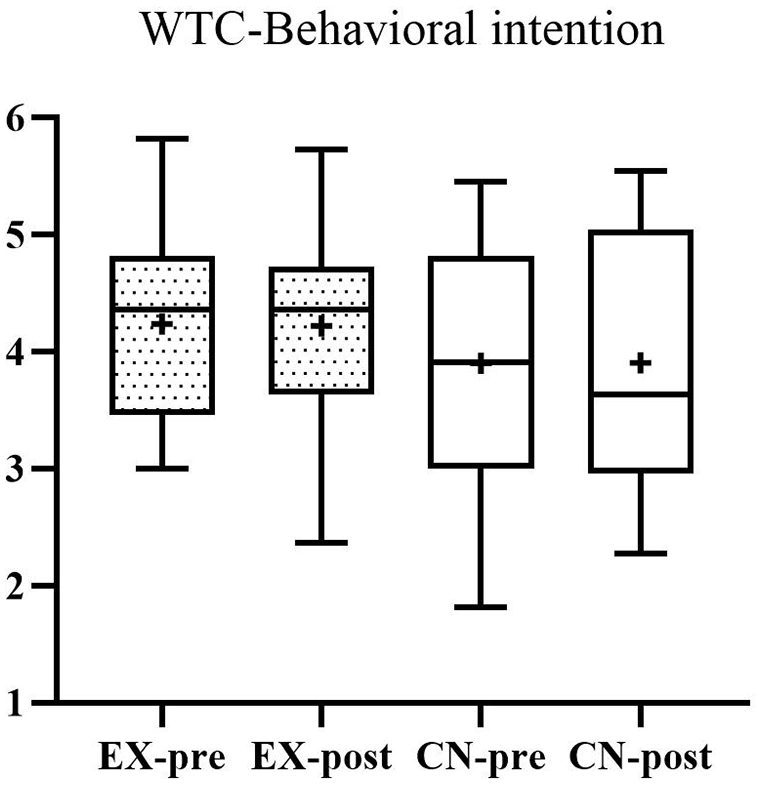
Pre-post results of WTC questionnaire.
2 WTC-communication behavior
Table 3 summarizes the results of language use during group work. Figure 2 shows the patterns of the focused indices of the two groups over time. The results descriptively show that there were wide variations in both groups at both testing times (standard deviations and ranges). Simply, some learners spoke more than others and some learners did not speak at all. However, at the time of the post-test, every learner in the experimental group participated in the group work in the target language, as shown in the numbers of English words per minute (range = 1.29–25.41) and turns per minute (range = 0.65–2.82). Also, the smaller standard deviations suggest that the experimental learners’ language use was more equally spread among the group members. This is also evident in the disappearance of outliers over time (Figure 2). In other words, while some learners spoke much more than others at the time of the pre-test, they contributed to the activity more equally at the time of the post-test.
Actual-WTC (willingness to communicate) results of experimental (n = 23) and control (n = 21) groups.

Note. a, b denote comparisons with significant differences. The scores represent per-minute frequencies.
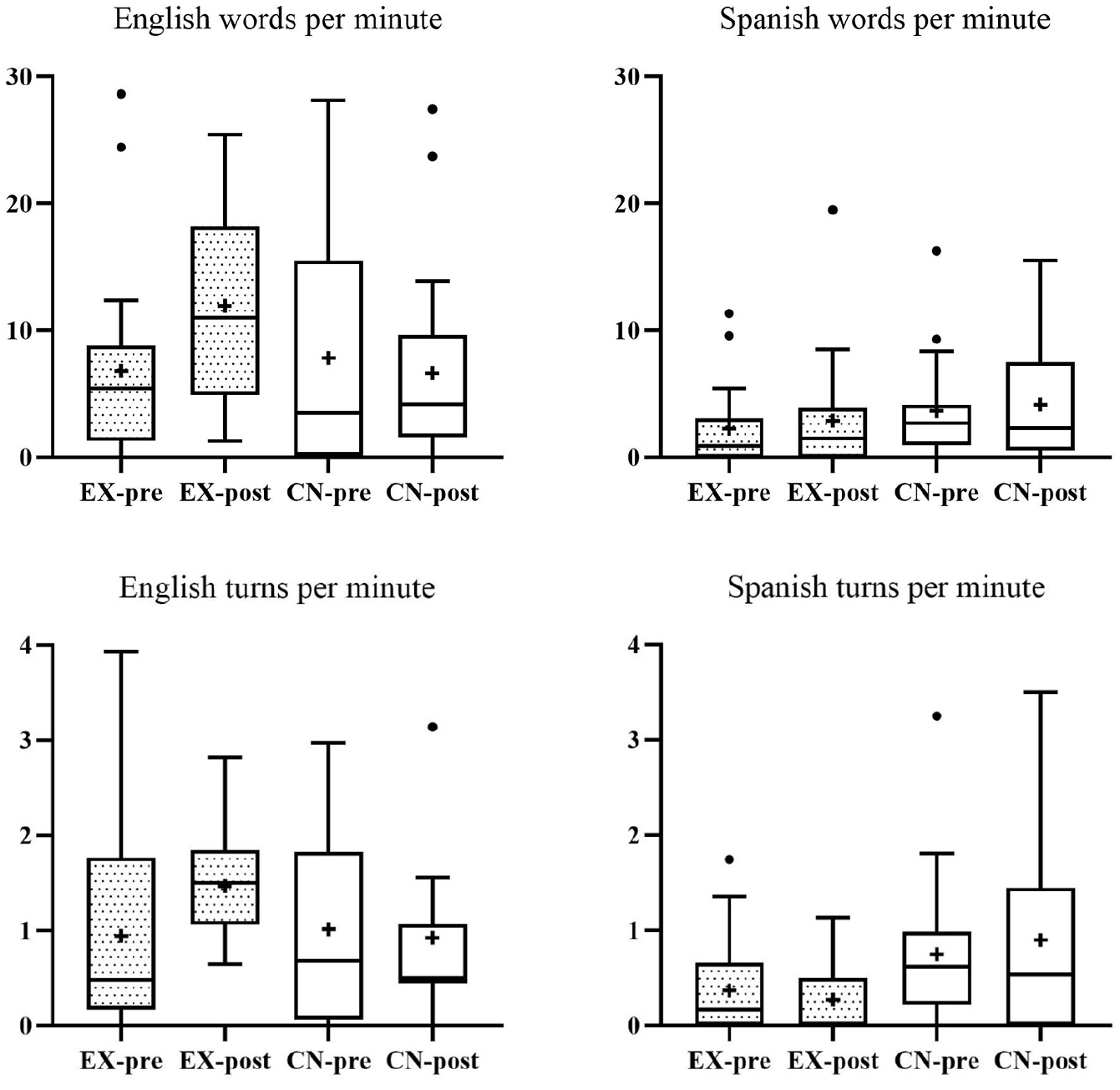
Pre-post results of communication behavior during group work.
The inferential statistics support the overall tendencies in the descriptive statistics. Of the eight pre-post comparisons (4 indices × 2 groups), two yielded statistically significant differences: the numbers of English words (Z = −2.55, p = .011) and turns (Z = −2.03, p = .042) of the MIWTC group. The results of the other non-significant comparisons were: the number of Spanish words of the experimental group (Z = −0.19, p = .852); the number of Spanish turns of the experimental group (Z = −0.83, p = .408); the number of English words of the control group (Z = −0.72, p = .469); the number of Spanish words of the control group (Z = −0.12, p = .904); the number of English turns of the control group (Z < 0.00, p = 1.000); and the number of Spanish turns of the control group (Z = −0.68, p = .500).
3 Metacognitive knowledge of oral communication
The qualitative analysis of the empty pyramids before and after the interventions yielded four categories: English classes; speaking in English; games; and, going abroad. Although the empty pyramids were used to elicit the participants’ metacognitive knowledge of oral communication, the results show some resemblances to the theoretical WTC model by MacIntyre et al.’s (1998). English classes, which was coded 8 times, related to references to the use of English in the classroom. For instance, one group wrote ‘you have English classes’ for the bottom layer (social and individual context in McIntyre et al.’s model). Speaking in English included statements concerning speaking specifically, an example being: ‘speak in English during the holidays’. The majority of these examples (14/19) were found in either Layer IV (motivational propensities) or V (affective-cognitive context). Games included mention of games, such as ‘play videogames in English’, and ‘put the PS4 in English’. This category was identified the most (11 out of 15) in Layer III (situated antecedents). The final category was going abroad. This included phrases such as ‘go to USA’ and ‘go to another country and talk to people’. The category was coded most frequently (6/8) from either Layer II or III.
Comparison between the pre-post tests suggested that the experimental group increased the metacognitive knowledge of oral communication. First, the information included in the pyramid became more specific and complex, while in the pre-pyramids, the information was rather simplistic. One group wrote in the pre-pyramid: ‘read in English’ and ‘speak in English’. However, the same group wrote in the post-pyramid ‘speak English with my family members’ and ‘go to computer lab’. Second, the hierarchy of the information became more orderly. Figure 3 is the post-pyramid of a group in the experimental group. The bottom layer – ‘you have English classes’ – seems to provide ‘the interaction of two factors: the society and the individual’ (MacIntyre et al., 1998, p. 555). For the young learners in a foreign language context, it is understandable that English classes are the society in which they communicate using the target language. As the layers go up, the concepts become more specific (‘play a game in English’) and include communicative contexts (‘to talk in English with another person’). These appear to correspond to MacIntyre et al.’s accounts for Layers III, IV, and V, related to the situational and motivational factors. The learners might have believed that communicating in their group in the classroom, and/or the group they belong to in online games, is a step towards reaching the top layer of the pyramid. Theoretically, it makes sense that some antecedents in the WTC pyramid correspond to the nature of metacognition. It is interesting that videogames inspired their intergroup motivation. Such a tendency supports recent findings on the impact of online videogames on L2 motivation (Butler, 2017). In Layer II, this group wrote ‘you go to USA’, which perhaps implies their ‘affiliation (integrative) motive’ (MacIntyre et al., 1998, p. 548). Those types of changes over time, or hierarchical orders, were not observed from the comparison between the control group’s pre- and post-pyramids.
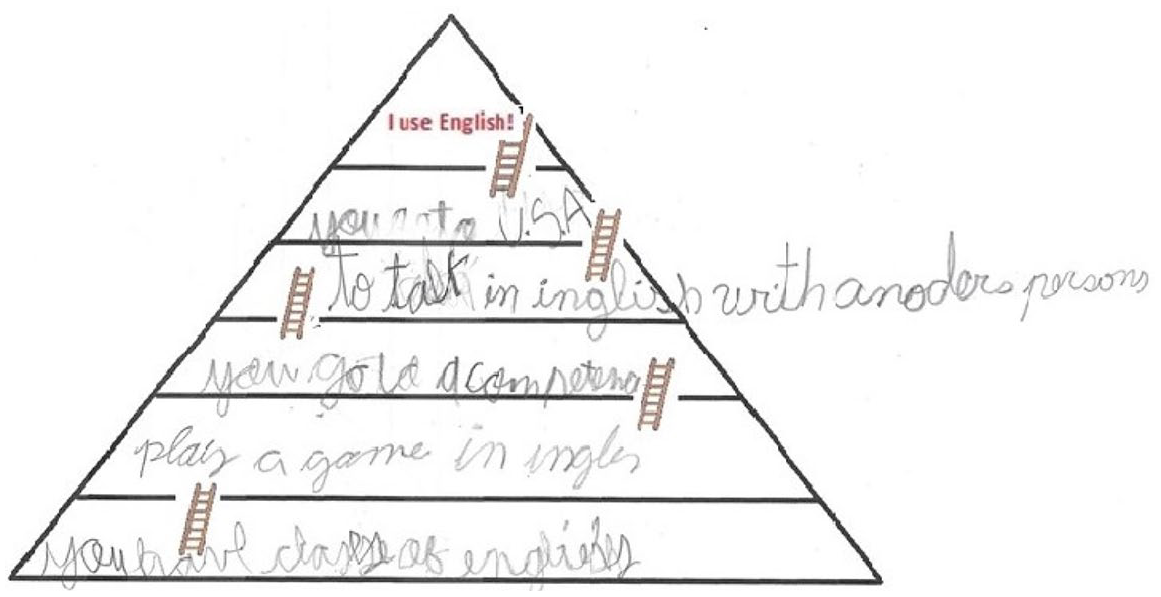
The post-pyramid drawn by a group in the experimental group. From the bottom layer, it says: ‘you have English classes’; ‘play a game in English’; ‘you go to a computer’; ‘to talk in English with another person’; and ‘you go to USA’. The pyramid is an empty version of MacIntyre et al.’s (1998) heuristic model of WTC.
Two codes emerged from the interview data were: (1) use of English, and (2) group work and L2 learning. Use of English (f = 25) related to comments on the future use of English for various occasions, such as speaking English in an English-speaking country (f = 10). One learner said: Para mí es muy importante hablar inglés porque así puedo comunicarme con otra gente en otros países, por ejemplo, Estados Unidos, Inglaterra, y muchos más (‘It is very important for me to speak English because I can communicate with other people in other countries, such as USA, England, and more’). Another frequently cited theme within use of English was using English for computer games (f = 6). A learner stated: Voy a cambiar mis juegos a inglés (‘I will change my games to English’). Group work and L2 learning (f = 20) concerned the participants’ perceptions of group work. In referring to the group tasks, one learner said: Porque trabajamos en grupo, porque era más entretenido que hacer clases normales y porque uno podía dar su opinión al grupo y ver si podían ocuparla (‘Because we worked in group, because it was more fun rather than having normal classes and because one can give his opinions to the group and see if they would use it’). Overall, their comments were positive. Although we interviewed learners with higher and lower WTC questionnaire scores, we did not find distinct patterns based on the degrees of WTC.
4 Summary of the results
The pre-post comparison of the WTC questionnaire scores (Layer II) showed a marginal group difference. Neither group changed their scores over time. Examination of communication behavior (Layer I) showed that the MIWTC group increased the numbers of words and turns in English. Also, after the intervention, target language use was observed more equally among the MIWTC participants. As for metacognitive knowledge of oral communication, qualitative analyses of the pyramids suggested that the experimental participants increased the specificity and complexity of their knowledge. Finally, the interview data showed that the participants’ metacognitive knowledge was largely anchored in use of English and group work and L2 learning.
V Discussion
1 Young L2 Learners’ WTC and Metacognition
Unlike previous studies showing a positive outcome of pedagogical interventions on WTC (e.g. Al-Murtadha, 2019; Munezane, 2015), the current study did not find an observable difference, either over time or across groups, in the WTC questionnaire data. First, it is important to reiterate that in Al-Murtadha’s (2019) visualization study, the effect size of the comparison between the experimental and control groups was marginal (η p 2 = .03). In Munezane’s (2015) study, the group that received visualiation-only did not outperform the control group (p = .372) with an overall impact of the intervention being small (η p 2 = .02). Those studies suggest that WTC may be a type of learner psychology that is difficult to be altered. Possibly, it is a construct that is more trait-like than state-like. Second, while those studies used visualization and goal-setting techniques with high-school and university-level learners, the current study tested MI with young learners.
The first interpretation of the null effect of MI on WTC is that visualization is more attuned to tapping into the antecedents of WTC (e.g. motivation) than MI designed to enhance learners’ overall awareness of their own learning processes. It is possible that although the pyramid activities (Stage 1 of MIWTC) might have increased the understanding of L2 use (metacognitive knowledge that we will discuss later), this knowledge was not transferred to an increase in motivational propensities for using the L2. It is also possible that strategy training (Stage 2 of MIWTC) might not have tapped into any affective or contextual factors that facilitate WTC. The learners might have perceived the strategies as merely conversation strategies for clarifying and confirming their classmates’ messages; consequently, the intervention did not change their intergroup attitudes. The second interpretation is that young learners’ cognitive and emotional immaturity prevented the intervention from changing their WTC. That is, despite their behavioral changes, which will be discussed later, they failed to internalize the changes and/or report them in a questionnaire. After all, self-reports of any kind may require meta-level thinking and 8–9 years old may be too young an age at which to accurately express emotions in a questionnaire. Indeed, the majority of WTC questionnaires have been verified by previous research with adolescent and adult learners. Issues related to self-report measures for children have long been addressed in different research fields (see Cremeens et al., 2006). This methodological issue is a more likely explanation for the null finding, given the other findings including the increase in metacognitive knowledge and improvement of communication behaviors.
To counter this potential methodological issue, the current study conducted post-intervention interviews and used pre-post empty pyramids to elicit the young learners’ introspective data of metacognitive knowledge of oral communication. The analyses showed some support for the idea that their metacognitive knowledge became more sophisticated after receiving MIWTC. It seems that the learners started to recognize the classroom as a community in which they willingly use the target language. Also, they may have come to perceive English as a useful tool to communicate with the teacher and classmates. This, in turn, may have helped them visualize their future use of English in the context of, for instance, going abroad. It is interesting that the young learners in the current study cited computer games as related to their understanding of oral communication. Note that in the online videogames that the learners played (outside the class) involved communication in English with other players. The results partially support Lee and Lee’s (2019) finding that virtual intercultural experiences, entailing L2 learners’ engagement in digital contexts, were associated with classroom WTC. Young L2 learners in the current world spend a significant amount of time on gaming in the L2, and such an environment seems to have a direct impact on their metacognition of oral communication (see Butler, 2017).
Overall, the results suggest that WTC and metacognitive knowledge are different constructs with some overlapping factors. On the one hand, WTC, which can be influenced by affective and social factors, did not change due to metacognitive instruction. On the other hand, metacognition, which provides cognitive support for learning, was affected by metacognitive instruction.
2 Metacognition, classroom WTC, and communication behavior
We examined communication behaviors as one of the outcome variables due to their direct impact on L2 learning. The results suggested that MIWTC had a medium yet observable impact on the amount of L2 production (d = 0.70) during group work. That is, the learners in the experimental group started to speak more due to the intervention. This is an encouraging finding given that the fundamental concern related to WTC, of both researchers and teachers, is silent learners in the classroom. We can also argue that MIWTC facilitated the young learners’ participation in group work, by raising their awareness of oral communication, increasing their strategy knowledge, and helping them (self-)evaluate their L2 learning processes. In terms of the discrepancy between the self-reported WTC and the actual L2 use, we resort to our interpretation related to the age of the learners who might have been too young to accurately report their perceptions.
Perhaps a more interesting finding is the change in participation patterns of turn-taking. After the intervention, the learners started to take and share more turns, suggesting that their interactions became more collaborative. Also, only in the post-group work did every student who received MIWTC take turns during the task. This finding might be due to increased metacognition entailing metacognitive knowledge and metacognitive experiences. During MIWTC, the learners were repeatedly explained the roles that the teacher and their classmates play in helping learn English (i.e. person knowledge). Their awareness of specific strategies to initiate and participate in communication (i.e. strategy knowledge) has also been raised. In addition, the pyramid and interview data showed that their perceptions of communicative interactions were altered (i.e. task knowledge). It may be the case that the students put their heightened metacognitive knowledge into practice, by actively engaging in group work. Also, the teacher emphasized the importance of the classroom as a ‘society’ in which to collaboratively learn English. For instance, because of the age of learners, we paid special attention to politeness when interrupting their classmates’ speeches. Those efforts embedded in MIWTC may have affected the learners’ metacognitive experiences, making them feel less anxious and more collaborative during communicative activities.
VI Conclusions and limitations
In this classroom-based study, MI, designed to alter young L2 learners’ ‘predisposition toward verbal behavior’ (Mortensen et al., 1977, p. 147), had a positive impact on their (1) metacognitive knowledge of oral communication, (2) the amount of L2 production, and (3) participation patterns, but not on their WTC. In exploring theoretical and practical questions, the study combined theoretical and methodological frameworks from LP and ISLA research. We call for more studies with interdisciplinary approaches, to advance researchers’ theoretical understanding of a given issue and to help practitioners devise pedagogical techniques/materials designed to solve classroom issues.
The study has several methodological limitations. First, the intervention was relatively short. A change in WTC might have been possible if MIWTC were delivered for a longer period of time. Second, the study’s population (young L2 learners) differed from those in previous WTC research, which might have resulted in the questionnaire’s validity issue. Other introspective methods (e.g. think-aloud and stimulated recalls) might have tapped into the young learners’ WTC more accurately. Third, classroom behavior was narrowly operationalized as the number of words and turns. Clearly, those indices are only part of classroom behavior, and do not capture the dynamic nature of classroom L2 learning. Future research must investigate more behavioral variables both quantitatively and qualitatively. The behavioral variables could include language-related episodes, complexity-accuracy-fluency measures, social relationships between learners, etc. that have been found to be associated with L2 learning. Finally, our interdisciplinary endeavor might have some drawbacks. For instance, the lack of a causal link between self-reported WTC and actual L2 production (see Fishbein & Ajzen, 1977) might be due to incompatibility between data collection tools from two research fields (i.e. a questionnaire and classroom observation).
VII Pedagogical implications
With the data collected in intact classrooms, in which learners engaged in activities embedded in regular classes taught by the class teacher, the study carries high ecological validity (see Bronfenbrenner, 1979). First, teachers can foster their students’ third-person point of view on their own learning behaviors in the classroom. Being able to plan, self-monitor, and self-evaluate their learning processes and products may lead not only to their increased positive psychology, but also to active participation in communicative activities. Second, in addition to monitoring the ways in which students engage in activities, teachers can be aware of the impact that the overall classroom environment has on the students’ psychology. Third, when delivering MI, we recommend that teachers be aware of the difference between L2 knowledge and metacognitive knowledge, and monitor those types of knowledge separately. For instance, being able to use specific learning strategies does not guarantee that the learner has metacognitive knowledge. Also, raising more hands may indicate students’ heightened metacognitive knowledge of oral communication and/or WTC, but this behavior itself does not lead to the development or consolidation of L2 knowledge. Finally, adjusting the metacognitive materials to the needs and interests of a specific group of learners may be crucial. In the current study, videogames played an important role in fostering the young learners’ metacognitive knowledge and improving their engagement with each other, and with the task. If the materials were not engaging, they might not have incurred motivational propensities that substantiate both WTC and metacognition. MI may be applied to any types of L2 skills and we hope that teachers try it out in their own creative ways.
Supplemental Material
sj-pdf-1-ltr-10.1177_13621688211004639 – Supplemental material for Metacognitive instruction with young learners: A case of willingness to communicate, L2 use, and metacognition of oral communication
Supplemental material, sj-pdf-1-ltr-10.1177_13621688211004639 for Metacognitive instruction with young learners: A case of willingness to communicate, L2 use, and metacognition of oral communication by Masatoshi Sato and Claudia Dussuel Lam in Language Teaching Research
Footnotes
Funding
The author(s) disclosed receipt of the following financial support for the research, authorship, and/or publication of this article: This work was supported by the Comisión Nacional de Investigación Científica y Tecnológica (CONICYT: the Ministry of Education of Chile) under the Fondo National de Desarrollo Científico y Tecnólogico (FONDECYT: 1181533), as well as the PIA (CIE160009) received from the CONICYT, awarded to the first author.

Supplemental material
Supplemental material for this article is available online.
References
Supplementary Material
Please find the following supplemental material available below.
For Open Access articles published under a Creative Commons License, all supplemental material carries the same license as the article it is associated with.
For non-Open Access articles published, all supplemental material carries a non-exclusive license, and permission requests for re-use of supplemental material or any part of supplemental material shall be sent directly to the copyright owner as specified in the copyright notice associated with the article.
