







Abstract
This article reports on a mixed methods study that examined the effect of reference of comparison (self-referential vs. normative) and regulatory focus (promotion-focused vs. prevention-focused) on willingness to communicate (WTC) among learners of English as a foreign language (EFL). One hundred female English learners were randomly assigned to the self-referential, normative, prevention, promotion, and control feedback groups. They received different types of feedback for 15 sessions. The students were tested for their WTC, anxiety and communication competence before and after the intervention. The results of MANOVA and paired samples comparisons indicated that self-referential, normative, and promotion feedback positively improved WTC and communication competence and decreased anxiety. However, prevention feedback decreased WTC and communication competence and increased anxiety. Follow-up interview data indicated that feedback influenced WTC by providing learning checks or affecting learners’ self-confidence, reducing anxiety, fostering motivation, and decreasing peer pressure. Finally, it was suggested that teachers should mainly present feedback to emphasize task accomplishments and growth and to inform the students about their progress over time.
I Introduction
MacIntyre, Dörnyei, Clément, and Noels (1998) have reported that willingness to communicate is a major reason for learners’ reticence and talkativeness in the classroom context. Additionally, second language (L2) willingness to communicate (WTC) is reported to correlate with a higher amount of L2 communication (Clément, Baker, & MacIntyre, 2003) and actively seeking L2 communication opportunities (Kang, 2005). Over the past two decades, a substantial bulk of research has been published on different psychological, contextual, and linguistic factors exerting influences on L2 WTC (Cao, 2014; Khajavy, MacIntyre, & Barabadi, 2018; MacIntyre, Burns, & Jessome, 2011; Pawlak, Mystkowska-Wiertelak, & Bielak, 2016; Peng, 2012, 2019; Yashima et al., 2018; Zarrinabadi, 2014; Zarrinabadi, Ketabi, & Tavakoli, 2019). While much is published on different classroom factors influencing L2 WTC, few studies, to date, have examined the role of teachers’ affective feedback in learners’ WTC. This study argues that feedback related to reference of comparison and regulatory focus could influence learners’ WTC and anxiety (Horwitz et al., 1986). As such, the present study investigates the effectiveness of the reference of comparison (self-referential vs. normative) and regulatory focus (promotion vs. prevention) on improving WTC among learners of English as a foreign language (EFL). This study is significant in that it directs teachers’ attention to the effects of their behavioral feedback on learners’ WTC and elaborates on how teachers’ non-linguistic feedback influences anxiety and competence in the L2.
1 Willingness to communicate
Willingness to communicate (WTC) was first examined in the setting of first language (L1) communication as one’s tendency to take part in conversation when given a choice (McCroskey & Richmond, 1990). In fact, in this view, WTC was considered as a trait-like propensity which was relatively constant across various communication settings with different type of receivers (McCroskey & Richmond, 1990). Later, the concept was introduced into the L2 context by MacIntyre et al. (1998) as ‘a readiness to communicate in L2 with a specific person or persons at a particular time’ (p.547). They proposed a pyramid-shaped heuristic model of WTC to explain the impact of both situational and individual factors on learners’ WTC. MacIntyre et al. (1998) noted that L2 WTC was affected by stable and enduring influences including motivational propensities, affective-cognitive context, and social-individual context, and immediate and transient situational variables, namely communication behavior, behavioral intention, and situated antecedents.
Scholars investigating the effect of individual differences on WTC reported that various factors such as self-confidence (Baker & MacIntyre, 2003; Peng & Woodrow, 2010; Yashima, 2002), communication apprehension, perceived competence (MacIntyre, 1994; MacIntyre, Baker, Clément, & Donovon, 2003), pronunciation anxiety (Baran-Łucarz, 2014), international posture (Ghonsooly, Khajavy, & Asadpour, 2012; Yashima, 2002), immersion experience (MacIntyre et al., 2003), proficiency level (Fernández-García & Fonseca-Mora, 2019), motivation (MacIntyre, Baker, Clément, & Conrod, 2001; Hashimoto, 2002), and gender and age (MacIntyre et al., 2002) influenced learners’ L2 WTC. Moreover, the qualitative studies investigating L2 WTC reported that contextual variables such as topic (Cao & Philip, 2006; Kang, 2005), interlocutors (Cao, 2011; Kang, 2005), type of task (Cao, 2011; Cao & Philip, 2006), the pattern of interaction (Cao & Philip, 2006), social support from friends (MacIntyre et al., 2001), communication situation (Zhang, Beckman, & Beckman, 2019), frequency and quality of L2 contact (Clément et al., 2003), language mindsets (Zarrinabadi, Lou, & Shirzad, 2021), students’ experience and their personality (Freiermuth & Ito, 2020) affected students’ L2 WTC.
An interesting line of inquiry has been to examine the role of teacher on learners’ WTC. These studies have shown that factors such as error correction (Zarrinabadi, 2014), interaction with native-speaking English teachers (Freiermuth & Ito, 2020), teacher’s implicit and explicit corrective feedback (Tavakoli & Zarrinabadi, 2018), teacher’s wait time (Zarrinabadi, 2014), teachers’ attitudes (Wen & Clément, 2003), teacher’s involvement and immediacy (Wen & Clément, 2003), and teachers’ support (Lee & Ng, 2009; MacIntyre et al., 2011) exerted an influence on L2 WTC. In a related study, Tavakoli and Zarrinabadi (2018) found that delayed error correction facilitated learners’ WTC. Moreover, Zarrinabadi (2014) reported that explicit corrective feedback positively influenced WTC by lowering anxiety and enhancing perceived competence. Previous studies, however, have not mentioned how teachers’ feedback related to the reference of comparison (self-referential vs. normative) and regulatory focus (prevention-focused vs. promotion-focused) can influence learners’ WTC.
2 Feedback
Feedback is one of the assessment variables that provide evaluation information on learners’ performance in different ways (Shin et al., 2017). According to Hattie and Timperley (2007, p. 81), feedback refers to the ‘information given to the learners by an agent with respect to one’s understanding and performance’. As Winne and Butler (1994, p. 5740) note, this information might be in the form of ‘meta-cognitive knowledge, domain knowledge, cognitive tactics and strategies, or beliefs about self and tasks’. Yorke (2003) stated that, in addition to feedback content, knowing about the psychology of giving and receiving feedback is crucial to learners’ learning and achievement. Additionally, feedback is a fundamental element in learners’ behavior and motivation inside the classroom and provides learners with some opportunities to learn and persuades them to attain their goals (Bangert-Drowns, Kulik, Kulik, & Morgan, 1991; Sansone, 1989). Furthermore, a number of significant meta-analyses have shown that feedback is crucial to learners’ achievement and learning (Black & William, 1998; Hattie, Biggs & Purdie, 1996; Hattie & Jaeger, 1998). In this study, the effects of four types of feedback on WTC have been studied. These feedback types are explained in detail in the following subsections.
a Self-referential vs. normative feedback
Pekrun et al. (2014), in their anticipated feedback on the achievement goals model, note that the type of feedback students receive influences their definition of competence and achievement goals. Within their model, they define two types of anticipated feedback: self-referential and normative. According to Pekrun et al. (2014), self-referential feedback is a type of feedback in which ‘competence is defined in terms of the improvement of a student’s present performance over his or her past performance’, while normative feedback is the feedback in which ‘competence is defined relative to other students’ performance’ (p. 117). Self-referential feedback focuses on one’s maximum possible gains (Shin et al., 2017). A teacher presenting self-referential feedback would use feedback sentences such as ‘Compared to last month, you have made progress and your speaking ability is much better.’ In fact, this type of feedback is an intrapersonal feedback comparing individual outcomes or progress over time. By contrast, normative feedback is a kind of feedback that compares a learner’s outcome or progress with that of others (Butler, 2000; Elliot & McGregor, 2001). A teacher giving normative feedback would possibly use comments such as ‘You answered this question correctly just like other students in the class.’
Several experimental studies have investigated the impact of the references of comparison feedback on adopting various achievement goals (Butler, 2006; Pekrun et al., 2014; Steele-Johnson et al., 2008). These studies show that if feedback contains information on each learner’s progress, learners mostly tend to adopt mastery-approach goals. And if it contains information on a learner’s progress to that of others, they mostly tend to adopt both performance-avoidance and performance-approach goals (Elliot & McGregor, 2001; Shin et al., 2017). Specifically, Pekrun et al. (2014) reported that self-referential feedback had positive effects on learners’ enjoyment and positive feelings and exerted negative effects on anger. They also found that normative feedback positively influenced hope and pride and reduced learners’ anxiety and hopelessness. Pekrun et al. (2014) concluded that these two types of feedback improved positive feelings and decreased negative emotions in the classroom. Based on this, we hypothesized that both normative and self-referential feedback would possibly influence the students’ WTC and decrease learners’ anxiety.
b Promotion-focused vs. prevention-focused feedback
Based on Higgins’s conceptualization of regulatory focus theory (Higgins, 1998), two types of feedback have been proposed: promotion and prevention feedback. The promotion-focused feedback emphasizes on accomplishment and growth and aims at approaching desired end states (Crowe & Higgins, 1997). This type of feedback pushes the students toward achieving something new. A teacher presenting promotion-focused feedback would possibly use comments such as ‘This is great. Try this way and you will can speak fluently in three months’ or ‘Use higher level vocabulary and grammar when speaking in English.’ In promotion-focused feedback, learners have approach motivation for gaining positive outcomes (Shin et al., 2017). By contrast, prevention-focused feedback focuses on obligations and duties and relates to avoiding undesired end states (Higgins, 1998; Keller, 2006). This type of feedback aims to help the students maintain their performance level. For prevention-focused feedback, learners are more likely to have avoidance motivation for avoiding negative outcomes (Shin et al., 2017). A teacher who uses prevention-focused feedback would possibly use phrases like ‘Try to keep your grammatical accuracy when speaking’ or ‘You were always careful about pronunciation! Be careful now.’
Several empirical studies have investigated how promotion and prevention-focused feedback affect various behavior and motivation (Förster et al., 2001; Förster, Higgins, & Idson, 1998; Shah et al., 1998). The result of these studies revealed that, in a promotion-focused system, learners would rather gain new achievements. In contrast, in a prevention-focused system, they would rather protect their current gains against losses (Förster et al., 2001; Förster et al., 1998; Molden & Miele, 2008; Molden et al., 2008). Shah and his colleagues (1998) noted that undergraduate learners in a promotion-focused system tended to believe they had the features of their perfect or ideal person. In contrast, in a prevention-focused system, the learners believed that they had the features of the type of person whom they believed it was their obligation or duty to be. This reveals that focusing on desired end states results in an individual’s inclination to demonstrate the approach motivational system, while focusing on obligations and duties results in an individual’s inclination to exhibit the avoidance motivational system (Shin et al., 2017). In addition, the study by Elliot and his colleagues (2001) on the relation between achievement goals and individuals’ needs indirectly revealed that promotion-focused feedback focusing on success and including approaching desired end states improved learners’ approach-valenced motivation such as performance-approach goals and mastery-approach goals. While prevention-focused feedback focusing on failure and including avoiding undesired end states will result in learners’ avoidance-valenced motivation such as performance-avoidance goals (Higgins, 1998). In relation to L2 motivation, particularly L2 Motivational Self System (Dörnyei, 2005), prevention-focused feedback tends to promote learners’ L2 ought-to self in that it focuses on the attributes and qualities that the learner should possess to avoid possible negative outcomes, whereas promotion-focused feedback fosters learners’ ideal L2 self in that it facilitates moving toward one’s perfect and ideal person (Shah et al., 1998). In this study, we hypothesized that promotion feedback would facilitate WTC while prevention feedback would decrease it.
Based on the above review of literature, the following research questions was posited:
Research question 1: How do self-referential feedback and normative feedback influence WTC among EFL learners?
Research question 2: How do promotion-focused feedback and prevention-focused feedback influence WTC among EFL learners?
II Material and methods
1 Design of the study
The current study utilized an explanatory sequential mixed methods design comprising two separate stages (Creswell, Plano Clark, Guttmann, & Hanson, 2003; Tashakkori & Teddlie, 1998) which aimed to investigate the effect of the reference of comparison (self-referential vs. normative) and regulatory focus (promotion-focused vs. prevention-focused) feedback on EFL learners’ WTC. The authors first utilized a quantitative design in which Likert-type data from self-report questionnaires were gathered and analysed. In this phase, feedback was given to learners’ oral production in one of four experimental conditions and the participants were evaluated for their level of L2 WTC. Later, in-depth clarifications were needed to assist in explaining and elaborating on the quantitative results gained in the first phase (Creswell & Plano Clark, 2017). To this end, the authors gathered and analysed qualitative follow-up data second in sequence. They planned and utilized the qualitative research questions and implemented the qualitative phase. In this phase of the study, the semi-structured interview data were collected and then analysed to help explain and interpret the statistical results (Creswell et al., 2003). Figure 1 represents a diagram of the explanatory sequential design steps of the study.
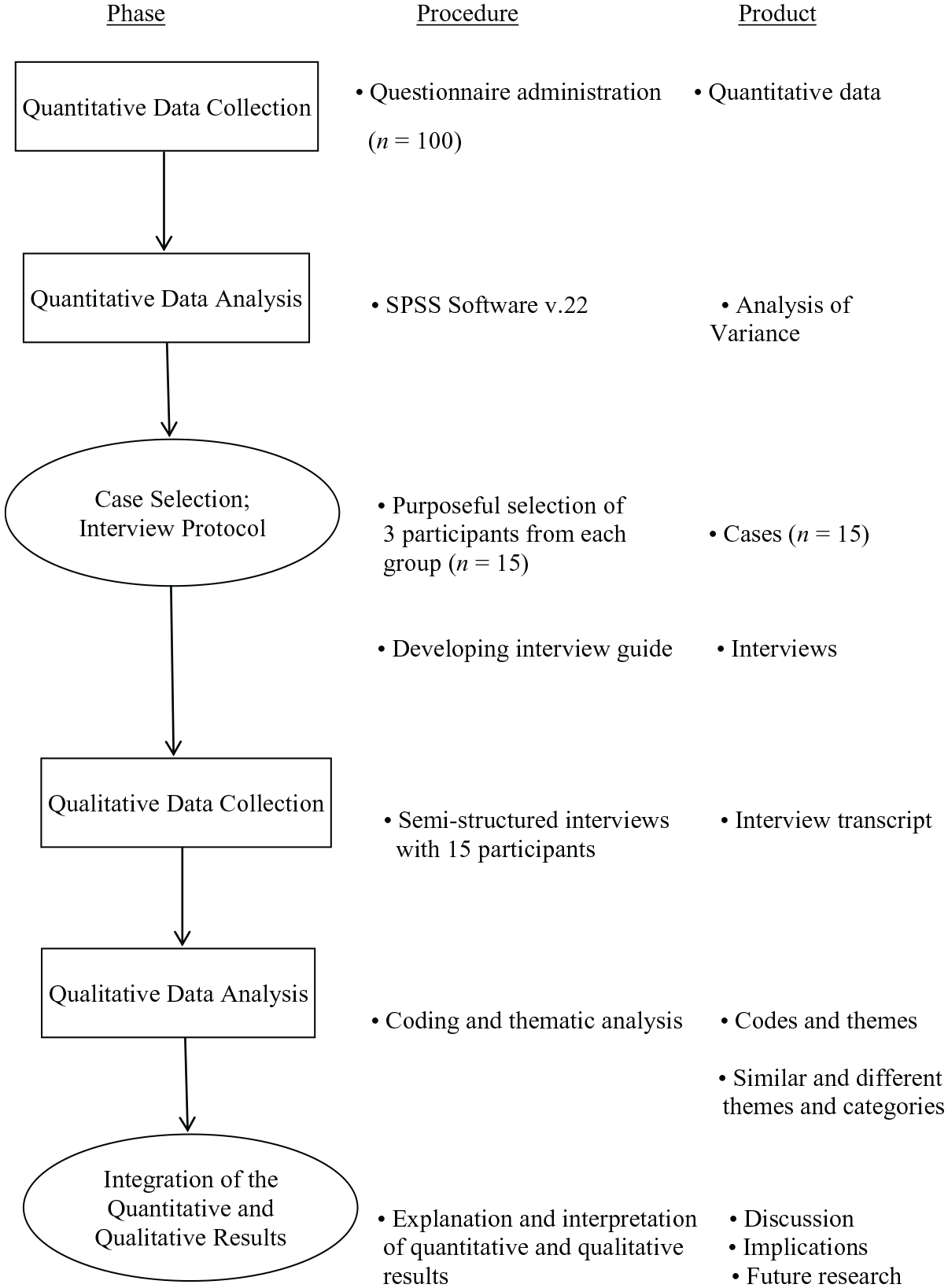
A diagram of the explanatory sequential mixed methods design steps.
2 Participants
The data were collected in a women language institute in a city in central Iran. The participants of this study were 100 intermediate English language learners. All participants were female Persian speakers, and their ages varied from 13 to 16 years old (M = 13.5). They studied English for about 1–4 years (M = 16 months). The participants were classified as intermediate proficiency level language learners based on the results of the Oxford Placement Test. Five intact classes were randomly selected and assigned to self-referential (n = 20), normative (n = 20), promotion-focused (n = 20), prevention-focused (n = 20), and no feedback (n = 20) groups. Based on the institute’s regulations, the maximum class size was 20. This is why N or all experimental and control groups was 20. The groups were all identical except for the type of feedback they received. All of the classes studied the same localized English course book. The learners were instructed in listening, speaking, reading, and writing skills. Classroom teaching included various learning activities such as role play activities and oral representation in dialogues. The classes were held twice a week, and each session lasted for 105 minutes. Moreover, the same non-native female teacher taught all groups. Participation in this study was voluntary, and written informed consents were obtained from the learners and their parents prior to the study.
III The experiment
To evaluate the effectiveness of the reference of comparison and regulatory focus in enhancing learners’ L2 WTC, experimental and control groups were determined. In doing so, four experimental groups were assigned, namely: Group 1 (self-referential), Group 2 (normative), Group 3 (promotion-focused), Group 4 (prevention-focused), and Group 5 (a control group). Two of the classes received reference of comparison, i.e. self-referential and normative feedback. Moreover, two classes received regulatory focus, i.e. promotion-focused and prevention-focused. There was a control group that received no particular type of feedback. The treatments were given for 15 sessions. The pre-test was administered at the first session of the class, the students were asked to fill in the scales on WTC, perceived competence, and communication anxiety. The experiment started in the second session and ended in the 17th session. In the 17th session, the posttest was administered, and the students were asked to fill the same scales again.
To provide the reference of comparison of feedback, language activity of each student was compared either with her prior performance (i.e. self-referential feedback) or other students’ performance (i.e. normative feedback). Specially, for the students in the self-referential condition, the feedback focused on comparing their current performance with their prior performance in the previous session. Also, the students in the normative feedback condition received feedback that compared their successful performance with that of others. To evaluate the effect of regulatory focus of feedback for the students in the promotion-focused condition, teacher’s feedback focused on their success and accomplishments when they said and used correct linguistic items during the class. Moreover, learners in the prevention condition received feedback focusing on indicating that a mistake has occurred and to prevent and protect them from failure when what they used and said was incorrect. No feedback was given to this group when their language use was correct (Shin et al., 2017). Table 1 presents the examples of different types of feedback used in the classroom. It should be noted that the teacher’s feedback was given to learners’ grammatical, lexical and oral performance in the classroom.
Examples of different types of feedback.

1 Quantitative phase of the study
Before and after the experimentation, the students were asked to fill in the scales on WTC, perceived competence, and communication anxiety respectively. Each scale is described in detail below.
a Willingness to communicate scale
The WTC scale developed by Peng and Woodrow (2010) (adapted from Weaver, 2005) was utilized to measure students’ L2 WTC in certain classroom settings by using 10 items (e.g. ‘willing to role play in various situations in English in front of the class’) on a 7-point Likert scale ranging from 1 (definitely not willing) to 7 (definitely willing). This scale was selected because the items are written to measure WTC inside the classroom. The reliability estimates of the scale in the current study were .81 and .79 for pretest and posttest, respectively.
b Perceived competence scale
To measure perceived competence, the participants were asked to answer six items (e.g. ‘being able to introduce myself in English to the students in class without preparation’) from Peng and Woodrow (2010) on a scale ranging from 0% to 100%. In fact, for each statement, the participants were asked to choose the percentage of the time they felt they were able to speak in the L2. The reliability estimates of the scale in the current study were .84 and .89 for pretest and posttest, respectively.
c Communication anxiety scale
Participants’ communication anxiety was measured by the scale by Khajavy et al. (2016). The participants were asked to answer ten items (e.g. ‘I feel ashamed to answer the questions in class voluntarily’) on a 7-point Likert scale ranging from 1 (completely disagree) to 7 (completely agree). The items in this scale measured the extent to which the participants experienced the feeling of anxiety in different communication settings inside the classroom. The scale reliability was .75 for pretest and .78 for the pretest.
The data were gathered in paper and pencil format in April, 2019. The pretest was conducted to see whether the participants were homogeneous and no prior difference existed between groups in terms of WTC, perceived competence, and anxiety before the study. Additionally, the learners were provided with a posttest at the end of the experiment with the aim of assessing their L2 WTC.
2 Qualitative phase of the study
The numeric, quantitative data of this piece of research did not show how the reference of comparison feedback (self-referential vs. normative) and regulatory focus of feedback (promotion-focused vs. prevention-focused) affected EFL learners’ WTC. Therefore, the authors collected follow-up qualitative data to assist the explanation and elaboration on the quantitative results obtained in the first phase of the study.
a Qualitative data collection
Fifteen students were randomly selected from the experimental and control groups (3 from each group) by the authors to take part in this phase of the study. Random selection was performed by putting the name of all students of each class in a pot and drawing three names from the pot. This resulted in 15 selections for all groups. The authors utilized semi-structured interviews as a qualitative data collection tool (see Appendix 1). The main goal of this phase was to assist in explaining and elaborating deeply on the results of the statistical analyses (Creswell et al., 2003). The aim of this phase was to explore the participants’ views and stories related to the teacher’s feedback strategy. In the interviews, the first author asked the learners to talk about their feelings toward speaking in the class and the reasons behind them (the interviewer was not their teacher). Moreover, the author asked the learners some in-depth questions whenever they pointed to error correction or teacher’s behavior. The interviews were performed and audio-recorded by the first author. The interviews were from 10 to 30 minutes. Furthermore, upon the participants’ request, the author conducted the interviews at the language institute. The interviews were within 24 hours after the final course session so as the increase the accuracy of students’ recall of their feelings.
b Qualitative data analysis
Grounded theory analysis was used to analyse the interview data (Urquhart, 2012). The qualitative data analysis included several steps. The interviews were transcribed verbatim by using Microsoft Word 2019. Later, they were all translated into English and printed on A4-sized papers for further analysis by the first author. The researcher then started to read and re-read transcripts on the papers so that she could find the relevant piece of information for answering the research questions of the study. Qualitative content analysis was used to find the key themes and categories. The first researcher tried to immerse herself in the data by reading and re-reading the transcripts. Then, in the second round of analysis, the researcher read the transcripts and highlighted some areas of students’ narratives. Additionally, some annotations and labels were used on the margins of the papers. The related codes and excerpts were then grouped together to form the key categories in the data. Also, a colleague familiar with qualitative research was asked to code the data. An inter-rater reliability of Cohen’s Kappa = .89 was found. Moreover, to ensure that the interpretations are not based on researchers’ perspectives and any possible bias, the results were read to the participants in some informal interview sessions. Finally, the report was given to a researcher familiar with qualitative and mixed-methods research to perform an external audit. This resulted in some suggestions and revision related to language and reporting style for the qualitative phase. The authors used pseudonyms for the participants when writing the qualitative results report.
IV Results
1 Results of the quantitative phase
One-way MANOVAs were used to compare groups. Before that, the assumptions for MANOVA were checked. The data were checked for normality: perceived competence (Kurtosis: .136, skewness: –.576), WTC (Kurtosis: .089, skewness: .246), and anxiety (Kurtosis: –.23, skewness: –.879). Also, WTC was correlated with anxiety (r = –.34, p < .01) and competence (r = .42, p < .01) in the pretest and the posttest: anxiety (r = –75, p < .01) and competence (r = .88, p < .01). Anxiety and perceived competence were correlated to each other in the pretest (r = –.39, p < .01) and posttest (r = –.739, p < .01). The assumption of multicollinearity was also met as all variance inflation factor (VIFs) were smaller around 1.2. The results of one-way MANOVA for the pretest showed that there were no differences between groups in terms of their anxiety, WTC, and perceived competence F (12, 246) = .961, p = .487; Wilks’ Λ = 0.886, partial η2 = .040.
After the interventions were given, the participants were again checked for WTC, perceived competence, and anxiety. The results of one-way MANOVA for the posttest indicated that there was a statistically meaningful difference in WTC, perceived competence, and anxiety based on the feedback group, F (12, 246) = 18.58, p < .000; Wilks’ Λ = 0.182, partial η2 = .434. Additionally, the analysis of between participants effects showed that feedback had a statistically significant impact on WTC (F (4, 95) = 60.68; p < .001; partial η2 = .719) perceived competence (F (4, 95) = 39.43; p < .001; partial η2 = .624), and anxiety scores (F (4, 95) = 54.98; p < .001; partial η2 = .698). All the effect sizes for the obtained results were large (Cohen, 2013).
In order to understand how groups were different in terms of their WTC, perceived competence, and anxiety, post hoc comparisons using the Tukey test were calculated. The results showed that the mean WTC score for the promotion condition was significantly different from the self-referential (p < .001), prevention (p < .001), and control group (p < .001) conditions. However, the mean WTC scores for the promotion and normative groups were not significantly different (p = .378). Also, the normative group outperformed self-referential (p < .003), prevention (p < .001), and control groups (p < .001) conditions. The self-referential feedback group mean WTC score was significantly higher than those of the prevention (p < .001) and control groups (p < .001). Interestingly, the results revealed that mean WTC scores for control group were significantly higher than prevention group (p < .001) (see Table 2).
Means and standard deviations for four conditions.

Notes. n for each group = 20. Main effect: *** < .001, ** < .01, and * < .05. Values for ηp2: Small (.02), medium (.13) and large (.26).
In regards to anxiety, the results of Tukey post hoc comparisons showed that that the prevention condition group was significantly more anxious than other three normative (p < .0001), promotion (p < .0001), and self-referential condition (p < .0001) but not from the control group (p = .068). Moreover, the self-referential group was more anxious than the normative (p < .017) and promotion (p < .008) conditions but significantly lower than the prevention (p < .001) and control conditions (p < .001). Mean anxiety sores for the promotion group were not significantly higher than the normative group (p = .599). Finally, mean anxiety score for the control group was significantly higher than the normative, promotion and self-referential conditions at p < .001.
In addition, the post hoc comparisons for mean perceived competence scores showed that the normative group outperformed the prevention (p < .001) and control groups (p < .001) but had no significant difference from the self-referential (p = .127) and promotion (p = .712) conditions. Additionally, mean communicative competence score for the self-referential condition was significantly higher than the prevention (p < .001), lower than that of the promotion (p < .004) group and not different from control condition (p = .062). Mean communicative competence score for the promotion condition was significantly different from all groups (p < .001) but not normative (p = .712). The results showed that mean communicative competence scores for the prevention group were significantly lower than other groups at p < .001.
Finally, as in Table 3, the paired samples comparisons between pretest and posttest scores for each group showed that normative, self-referential, and promotion feedback developed in terms of WTC and competence and their anxiety decreased over time. However, the prevention group experienced a decline in WTC and competence and an increase in their anxiety. Interestingly, the control group data revealed a significant development in WTC, a significant decline in terms of competence, and no change for anxiety. Cohen’s d showed that majority of effect sizes were large, with only medium effect sizes for WTC of self-referential group and anxiety for prevention group.
The results of paired samples t-test.

Notes. n for each group = 20. Values for Cohen’s d (Cohen, 2013): Small (.2), medium (.5) and large (.8). WTC = willingness to communicate.
The results of the quantitative analysis showed that normative, self-referential, and promotion conditions significantly improved the participants’ WTC and communication competence and decreased anxiety. However, the findings revealed that prevention feedback decreased WTC and communication competence and enhanced anxiety. Finally, the findings for control condition decreased WTC, increased communication competence, and created no change in anxiety.
2 Results of qualitative phase
Follow-up interview data were gathered to explain the quantitative results. During the interviews, all 14 participants, except for one in the control group, referred to teacher feedback.
Quantitative data showed that self-referential feedback positively influenced learners’ WTC. The qualitative data analysis showed that self-referential feedback created regular checks on performance, which enhanced learners’ communicative competence. The participants mentioned that phrases like ‘you have improved’ or ‘you tried hard and your English became better’ worked as indications on their ‘progress over time’ and created some regular checks with which they could determine their language development. As a participant commented: When the teacher told me that ‘practice makes perfect’, I understood that my English became better. Such comments made me believe that my English has really become better. (Iman, self-referential group)
In turn, this improved perceived communication competence resulted in lower anxiety and higher WTC. As when the students perceived themselves more competent than before, they ‘took part in classroom activities with no stress and anxiety’ and ‘made attempts to find situations to show that their English has really improved’. Such attempts led to more classroom participation and engagement in classroom tasks and activities.
The qualitative data analysis also showed that normative feedback influenced WTC in several ways. The participants mentioned that they perceived less anxiety in the class as they ‘felt safe in the class’ and they ‘weren’t anxious and afraid of talking and even attending the class’. Moreover, they believed that teacher’s use of phrases like ‘you are wonderful like your classmates’ reduced peer pressure because they no longer compared themselves with others. As one of them commented: The teacher created a friendly atmosphere in the class. I thought we are performing together. I thought I’m as good as others so I wasn’t afraid of talking in front of others. (Roja, normative group)
As in the excerpt, reduced peer pressure decreased anxiety to talk in the classroom. In addition, the data analysis showed that having a frame of reference increased students’ perceived communication competence and WTC. The teacher’s feedback made the students believe that they performed as well as others in the class. The participants mentioned that they thought their English improved and they had English ability comparable to others. As they noted teacher’s feedback presented ‘some evidence for acceptability of participation and English improvement’ and ‘encouraged cooperation and collaboration in the class’ (Najla, normative group).
As for the feedback on regulatory focus, analysing the interviews indicated that promotion increased the sense of feeling of security among the participants which led to lower anxiety. One of the participants mentioned that she was more willing to talk in this class because she felt secure and not anxious. As she commented: I really enjoyed our class because I felt secure. We were not anxious and stressed at all and I couldn’t wait to come to class on Sundays and Tuesdays. I really liked talking in this class. (Mina, promotion group)
It seems that this has been the reason for increased communication competence as the participants believed that this lower anxiety has helped them ‘learn in a stress-free environment’ and ‘learn vocabulary and structures more efficiently’. Besides, heightened teacher support was more in the promotion condition. The participants mentioned that their teacher knew ‘how to behave with their students’, ‘always used nice words’ and ‘helped the students whenever they needed’. Finally, promotion feedback increased the students’ motivation. Teacher’s feedback increased students’ interest in learning English so they became more willing to talk in the classroom. This can be found in the following excerpt: Words like excellent, great, fantastic, very good that I received from my teacher really impressed me. They totally made me motivated to practice English more. I talked more in the class and participated in class as much as I could. (Mahshad, promotion group)
All in all, it seems that the promotion feedback influenced the participants’ WTC by lowering their anxiety, providing indications on teacher support, and enhancing motivation in the L2, which, as in the above example, led to more classroom participation.
Additionally, qualitative content analysis showed that the prevention feedback negatively influenced WTC by decreasing communication competence and increasing anxiety. The participants in this group mentioned that the teacher’s comments on their participation made them feel that ‘their English is not good’ which, in turn, created ‘doubt and stress about speaking in future sessions’. The participants commented that whenever they received comments such as ‘no, that’s not correct’, they became anxious about speaking in future sessions. As one of the participants referred to teacher’s feedback strategy and commented that ‘a student cannot talk in class when teacher’s feedback creates more fear about speaking and leaves her in doubt about her English ability.’ In sum, it seemed that prevention feedback influenced WTC negatively by creating negative evaluations about one’s language ability and enhancing stress and anxiety about using L2.
The results of the control group were complicated. While the participants in this group mentioned that they ‘learned some good points about grammar, vocabulary and different language skills’, they mentioned that their motivation for language learning reduced over the semester. They mentioned that they did not find anything special that increased their motivation and interest. Interestingly, they mentioned that they were more willing to talk in class in the first three or four sessions but they gradually became less willing as there was ‘no encouragement or motivation’ and ‘the class was like previous semesters’. They also noted that they were anxious about speaking during the semester and they had the same feelings in the semester. As one of them commented: I am still afraid of talking in the class. Like previous semesters. For me, self-confidence is the most important factor when I want to talk. I did not improve in terms of self-confidence in this semester. I thought I might improve but I didn’t so I remained silent or even more silent in the class. (Shadi, control group)
It seems that the participants in this group experienced a decline in WTC because their stress and anxiety persisted over the semester. The participants were higher in WTC in the beginning because they were ‘more motivated and had energy’ but this motivation and energy ‘decreased over time’ and led to the significant difference in the paired comparison for the group.
V Discussion
The results showed that feedback related to the reference of comparison created positive changes in learners’ WTC. Normative feedback significantly improved WTC and competence and lowered anxiety. Normative feedback compared the learners’ good performance with that of the others and the teacher expressed positive remarks when she deemed the learners’ performance satisfactory. This seems to have created an external reference of comparison for the students. The students used the teacher’s positive remarks as a source of evidence to compare their performance with that of classmates. As the follow-up data showed, this resulted in reduced peer pressure which decreased anxiety and increased competence and WTC. Moreover, comparing one’s performance with others created a standard against which the learners could rate their perceived competence. In other words, when they received teacher’s positive feedback about their performance, they perceived their performance as well as others in the class; therefore, they perceived themselves higher in competence at the end. On the other hand, self-referential feedback influenced learners’ WTC by affecting their competence. This type of feedback provided some progress checks for the students. The presence of these progress checks improved learners’ competence and made them engage more in classroom activities (i.e. higher WTC). This finding is in line with the findings of Muir and Dörnyei (2013) who reported that existence of progress checks led to higher motivation and participation.
Furthermore, the results of the study indicated that promotion and prevention feedback influenced learners’ WTC differentially. While the promotion feedback increased WTC and competence and decreased anxiety, prevention feedback decreased WTC and competence and increased anxiety. A plausible explanation might be that those who received promotion feedback strived toward gaining positive outcomes (i.e. different linguistic items) and avoided the absence of positive linguistic items. As such, those who received promotion feedback probably focused on gaining linguistic knowledge and improving their language knowledge by engaging in classroom activities. In order to improve their English, these learners probably took more risks about classroom interaction (lower anxiety) and participated in classroom language learning activities more which resulted in higher WTC and competence. Moreover, as the qualitative data showed, promotion feedback lowered learners’ anxiety and increased their competences which are two strong antecedents of L2 self-confidence (MacIntyre et al., 1998). It seems that promotion feedback heightened learners’ L2 self-confidence which in turn led to higher WTC. Moreover, the qualitative data showed that promotion feedback increased motivation and perceived teacher support, which have been reported as two positive predictors of WTC (MacIntyre et al., 1998; Tavakoli and Zarrinabadi (2018). In contrast, prevention feedback probably made the students focus on losses they might have if they engage in classroom activities. As such, such learners strive toward avoiding making errors which makes them worried about making mistakes in the classroom, which might be the reason for increased anxiety. As it was found in the qualitative phase, the prevention feedback learners received made them doubt their language ability, which might have led to lower competence. All in all, it seems that prevention feedback negatively influenced learners’ WTC by affecting increasing their anxiety and decreasing their competence (i.e. decreasing their L2 self-confidence).
Comparing the groups showed that normative and promotion feedback created more positive changes than other three conditions. This may be due to the fact that these two feedback types provide clearer indications on learners’ success than other feedback types (Johnson, Johnson, & Roseth, 2012; Shin et al., 2017). After normative and promotion, self-referential feedback is the type that provided more indications on students’ success. Interestingly, the control group had better scores than the prevention condition. This might be due to the fact that in the prevention condition the teacher provided feedback on unsuccessful performance, which seemed to create unfavorable results even in comparison to providing no feedback (Johnson et al., 2012; Shin et al., 2017).
VI Conclusions
This study examined the effect of feedback on regulatory focus (prevention vs. promotion) and reference of comparison (normative and self-referential) on EFL learners’ WTC, anxiety and communication competence. The results showed that the promotion feedback increased WTC and communication competence and decreased anxiety, while the prevention feedback negatively influenced WTC and communication competence and increased anxiety. Moreover, both normative and self-referential feedback enhanced WTC and communication competence and reduced anxiety. The results confirm previous research that that teacher’s feedback creates significant effects on anxiety (Horwitz et al., 1986) and learners’ willingness to engage in classroom activities (Zarrinabadi, 2014). It was found that feedback that compares performance over time or with that of others can positively affect WTC. Also, teacher’s feedback focusing on one’s success and accomplishment enhances WTC. However, it was found that providing feedback that an error/mistake has happened decreases WTC.
This study has some limitations. First, the study is limited to the gender of the participants. The authors believe that studies including both male and female language learners are needed before generalizing the findings of the study. Moreover, this study is limited to the context of the study and the institution in which it was conducted. Studies in other educational and cultural contexts need to be done before drawing any generalizations. Finally, while prevention feedback normally does not present any negative feedback, it makes the learner avoid making mistakes, and, as a result, lowered WTC. To compensate for this, we as teachers should use other types of feedback.
This study has some implications for language teachers as well as researchers in the field. It is recommended that language teachers should be careful about the ways in which they react to students’ performance in the classroom. Teachers who wish to increase classroom participation can compare students’ performance with their previous performance and inform them about any possible development or give indications on how they perform in comparison to other classmates. Generally, the findings suggest that teachers should frequently remind language learners of their successful performance rather than of their unsuccessful performance. It is suggested that they use normative feedback when the student’s performance is as good as the others. Also, teachers can increase engagement in activities by providing feedback that focuses on learners’ accomplishment and successful performance. Besides, future research in the field will examine how other types of feedback such as corrective and affirming feedback about past classroom behavior and performance influence WTC, communication competence, and anxiety. Moreover, it will be interesting to investigate how negative feedforward (behavior or mistakes that should be avoided in future) and positive feedforward (behaviors that improve performance in future) affect learners’ willingness to talk in L2. Finally, we hope that the study provides some hints on how teachers’ feedback can be presented to decrease students’ anxiety and increase their WTC in L2 classrooms.
Footnotes
Appendix 1
Funding
The author(s) disclosed receipt of the following financial support for the research, authorship, and/or publication of this article: Brunilda Pali disclosed that this work was supported by the Research Foundation - Flanders (FWO) Project ‘Restorative utopias in dystopian times: The shaping of restorative justice in the European penal systems and policies’ [grant number 12T5919N].
The author(s) received no financial support for the research, authorship, and/or publication of this article.
