







Abstract
One of the underrepresented aspects of pragmatic competence development is perceiving and responding to impoliteness acts. The present study reports on a quantitative and qualitative investigation of two international English language teaching (ELT) textbook series published by Oxford and Cambridge University Press; it focuses on the books highly popular among a thriving representative sample of learners of English as a foreign language (EFL) across four language proficiency levels and explores their coverage and treatment of impoliteness acts and their responses. Drawing on stringent models and taxonomies, the findings reveal that this unpleasant side of language is ignored and misrepresented in the textbooks, particularly at lower proficiency levels. We draw on our own and others’ previous incivility studies and argue for the inclusion of impoliteness especially from earlier stages of language learning owing to its saliency in authentic interactions. The study concludes with implications and suggestions for language learners, instructors, textbook writers, and researchers.
Keywords
I Introduction
Becoming effective, cooperative communicators in a second language is a primary concern of language learners and their teachers, which, in turn, underscores the necessity of developing their pragmatic competence besides the linguistic ability (Blum-Kulka, House, & Kasper, 1989; Haugh, 2007; Hinkel, 2014; Kasper & Blum-Kulka, 1993; Pavlenko, 2002). Several studies have accentuated that if language learners fail to produce pragmatically appropriate language, they might be known as uncooperative, or even rude interlocutors (Bardovi-Harlig, 1996; Boxer & Pickering, 1995; Crandall & Basturkmen, 2004; Eslami-Rasekh, 2005; Grant & Starks, 2001; Thomas, 1983).
One of the (neglected) components of pragmatic competence is producing and perceiving (im)politeness in second or foreign language contexts (Felix-Brasdefer & Mugford, 2017). Features of (im)politeness, similar to other pragmatic features, are believed to be teachable, and language learners need to learn (im)politeness aspects of the target language from beginning levels of language proficiency in both EFL (English as a foreign language) and ESL (English as a second language) classrooms and contexts (Felix-Brasdefer & Mugford, 2017) in order to learn how to deal with uncomfortable situations and express themselves as they wish (House, 2015; Mugford, 2008). A case in point is Wijayanto, Prasetyarini, and Hikmat’s (2017) study which indicated that without obtaining proper pragmatic instruction, language learners tend to issue impoliteness. Therefore, it is suggested that teaching (im)politeness should be introduced into the language learning curricula (Rieger, 2015) to be practiced in the safe environment of a classroom (Mugford, 2008).
However, teaching impoliteness is usually overlooked or intentionally avoided in language teaching contexts. For instance, ‘English language teaching,’ Mugford (2008) contends, ‘tends to deal with the pleasanter side of second language interaction such as making friends, relating experiences, and expressing likes/dislikes while ignoring such everyday communicative realities as rudeness, disrespect, and impoliteness’ (p. 375). Such a disregard could eventually bear on language learners’ pragmatic competence development. For example, the majority of linguistically proficient Iranian language learners in Khatib and Lotfi’s (2015) study failed to properly recognize the relationship between power and impoliteness, probably, due to insufficient instruction in [or exposure to] this domain.
A fundamental issue in learning and teaching (im)politeness is ‘the role of exposure to pragmatic input in the FL classroom’ (Felix-Brasdefer & Mugford, 2017, p. 491). There is now ample consensus among many researchers of second language acquisition (SLA) that (quality) input should be an integral component of effective language instruction (e.g. Ellis, 2005; Kumaravadivelu, 2006; LoCastro, 2013); no doubt, one of the most important sources of input in many language learning and teaching contexts continues to be the English language teaching (ELT) textbook (Chan, 2019; Harwood, 2010; Hutchinson & Torres, 1994; Limberg, 2016; Richards, 2001; Sheldon, 1988). While the literature abounds with examples of studies which have explored manifestations of politeness in ELT materials (e.g. Limberg, 2016; Meihami & Khanlarzadeh, 2015; Purwanto & Soeriatmadji, 2013; Zamanian, Ghaiedi Karimi, & Kashkouli, 2015), there appears to be little concern with the actualization (and teaching) of impoliteness phenomena in ELT textbooks.
Notwithstanding several compelling reasons for inclusion of (instructional dimensions of) impoliteness accounts in the ELT curriculum (to be discussed in Section III below), not many studies have investigated (the quality and quantity of) impoliteness strategies and their responses in the textbooks (as staple components of almost all ELT programs). As one step toward bridging this gap, the present study is designed to explore the extent to which the users of internationally published ELT textbooks are exposed to impoliteness acts across different proficiency levels (with a particular focus on earlier ones); additionally, the study intends to uncover whether the materials provide any (explicit and/or implicit) instructions about impoliteness phenomena (and how to respond to incivility acts).
Actually, it is the very same research objectives and the methodology adopted to address the ensuing research questions (see end of Section III and Section IV below) which can set this study apart from similar language materials inquiries (even those focusing on pragmatic competence development). While it might be no news that language learning textbooks are hardly recognized as champions of pragmatic instruction, this article aims to be among the few investigations which intend to cast a different light on the (under-)representation of impoliteness (as an under-researched aspect of pragmatics) in the popular language teaching textbooks. Additionally, it will provide the opportunity to draw upon the emerging impoliteness scholarship, and, subsequently, check the adequacy of the recent impoliteness theories, models, and frameworks (touched upon in the next sections) for materials evaluation/development purposes. It is hoped that our findings about the current state of incivility manifestation, instruction, and/or awareness-raising through language learning materials – particularly textbooks – can be a point of departure in convincing all parties involved in language education enterprise to take a fresh look at the content of their materials with an eye for inclusion of more pragmatic aspects.
II Approaches to impoliteness
Although the field of impoliteness studies has seen a rapid development, there is no extensive consensus over its key points (Culpeper & Hardaker, 2017). A glance at the literature concerning impoliteness theories reveals that a generally accepted definition of impoliteness is still sought after (Blitvich, 2010a; Culpeper, 2011; Khazraie & Talebzadeh, 2020; Locher & Bousfield, 2008). Culpeper (2011) explains how this inconsistency in the definition of impoliteness has to do with its dependency on the situation. From among the various theoretical accounts in the field of impoliteness studies, the present study used the definition which takes the strategic impoliteness (to be explained in this subsection; for a more comprehensive treatment see Khazraie & Talebzadeh, 2020) into account.
While classical politeness theorists assume that politeness accounts can be applicable to impoliteness (see Culpeper, Bousfield & Wichmann, 2003), it is argued that impoliteness is not a mere failure at politeness (Beebe, 1995; Lakoff, 1989). Conversely, Khazraie and Talebzadeh (2020, p. 48) draw on Lakoff (1989), Beebe (1995), Tracy and Tracy (1998), among others, to characterize impoliteness as being systematic, instrumental (i.e. referring to ‘rudeness intended to achieve a goal’; Beebe, 1995, p. 156), purposefully offensive, and intentionally gratuitous. It should be also noted that Austin (1990), Lachenicht (1980), and Culpeper (1996) who developed several impoliteness frameworks were among the scholars inspired by Brown and Levinson’s politeness model (1987) as well as their 1970’s conceptualizations of politeness phenomena.
In particular, in 1996 Culpeper proposed a taxonomy of impoliteness strategies which deals with face attack instead of face enhancement (Culpeper et al., 2003, p. 1554). Culpeper’s original model has been revised several times by scholars such as Blitvich, 2010b; Bousfield, 2008; Culpeper, 2005; Culpeper et al., 2003; Kienpointner, 2008; and Lorenzo-Dus, Blitvich, and Bou-Franch, 2011. As noted by Khazraie and Talebzadeh (2020), this well-established and logical taxonomy (attested by Bousfield, 2008; Dynel, 2015) has been adopted in a number of academic studies including Blitvich, 2010a, 2018; Bou-Franch and Blitvich, 2014; Cashman, 2006; Dobs and Blitvich, 2013; Neurauter-Kessels, 2011; and Shum and Lee, 2013. Culpeper’s (1996) original model of impoliteness had two key concepts: Super-strategies (on-record and off-record) which are ‘means of attacking face’ (p. 356); and output strategies which are ‘means of satisfying the strategic ends of super-strategies’ (p. 357) (see also Khazraie & Talebzadeh, 2020; for the revised model, see Appendix 1).
In response to impoliteness strategies (see the figure in Appendix 2), the recipient and/or witness of the face attack ‘may deny the opposition, corroborate the opposition, or react to the opposition, . . . with a denial of the opposition, s/he may present a compromise or counter’ (Dobs & Blitvich, 2013, p. 128; see also Khazraie & Talebzadeh, 2020; Talebzadeh & Khazraie, under review). Participants can counter the face attack offensively or defensively. Offensive strategies refer to impoliteness strategies which are applied to ‘counter face attack with face attack’, while defensive strategies ‘primarily defend one’s own face, or champion that of a third party’ (Bousfield, 2007, p. 2199). The taxonomy of defensive strategies is proposed by Bousfield (2007) and revised by Khazraie and Talebzadeh (2020; see also Talebzadeh & Khazraie, under review; Table 2 and Appendix 3). According to Dobs and Blitvich (2013), the discoursal roles which participants take through the conflicts are as follows: the initiator (the producer of the impoliteness act for the first time in an interaction), recipient (the addressee), and witness (the participant who witnesses a face threatening act in a polylogal conflict).
Culpeper et al. (2003) have found the combination of impoliteness strategies to be a norm in discourse. They argue that multiple strategies result in ‘amplifying or boosting the force of the challenge’ (Culpeper et al., 2003, p. 1561). They explain about two ways of combining strategies which are not mutually exclusive: repetition and combination with other strategies. Given the fact that ‘discourse is not built out of one-shot strategies contained in single turns’ (Culpeper & Hardaker, 2017, p. 212), exploring manifestations of impoliteness in discourse entails investigating how interlocutors respond to the triggering of impoliteness act (Bousfield, 2007; Culpeper & Hardaker, 2017; Culpeper et al., 2003). Participants’ responses to impoliteness have been investigated previously (e.g. Bou-Franch & Blitvich, 2014; Bousfield, 2007; Culpeper et al., 2003; Dobs & Blitvich, 2013). As we have argued (Khazraie & Talebzadeh, 2020, p. 49), the model which is used in the present study is the one proposed by Dobs and Blitvich (2013) because it takes polylogal (i.e. involving more than two participants) interactions into account while it also ‘incorporates the response options available to face-threat witnesses’ (Dobs & Blitvich, 2013, p. 112) in face-to-face interactions.
A useful categorization of impoliteness in discourse is by Kienpointner (1997) who identifies two types of ‘intergroup’ impoliteness: in-group impoliteness and out-group impoliteness (p. 276). In-group impoliteness happens when the initiator of the impoliteness acts attacks someone’s face who is present; in other words, the recipient of the face attack is present; out-group impoliteness happens when the recipient is not present. When coding our data, instances of out-group impoliteness act were coded as backbiting, while the in-group impoliteness acts were coded as non-backbiting (not only for the ease of coding/nomination but also because of the impression a witness to the identified incivility or questionable acts could get from the analysed out-group encounters found in our dataset).
Impoliteness should not necessarily be interpreted in negative terms, though (Blitvich, 2012). According to Leech (1983) mock impoliteness – or banter – is believed to strengthen social intimacy. Actually, ‘[i]n order to show solidarity with h [hearer],’ Leech (1983) explains, the speaker would ‘say something which is (i) obviously untrue, and (ii) obviously impolite to h [hearer]’ (p. 144), yet it ‘serves to strengthen social bonds between the producer and intended recipient’ (Bousfield, 2008, p. 136). According to Culpeper (2011), ‘[mock impoliteness cases] involve at least in part a joking or humorous contextual frame that, theoretically, could promote an interpretation of mock impoliteness’ (p. 213). Appreciating this distinction, in this study, the focus is mainly on genuine impoliteness acts rather than mock impoliteness acts.
III Background, textbooks and incivility
1 Textbooks as sources of (linguistic) input in language learning and teaching
There are different viewpoints regarding the usefulness of textbooks in the field of language learning and teaching. Sheldon (1988) addressed textbooks as the ‘visible heart’ (p. 237) and ‘route map’ (p. 238) of any ELT program. He explains that textbooks are seen as ‘valid, labour-saving tools’ (p. 237). Hutchinson and Torres (1994), along with Sheldon (1988), maintain that what textbooks do in such a ‘complex and messy matter’ as education is to ‘create a degree of order within potential chaos’ and satisfy ‘the range of needs that emerge from the classroom and its wider context’ (Hutchinson & Torres, 1994, p. 327). Richards (2001) further argues that language learners receive much of their language input from textbooks.
There are, generally, both conceivable advantages and disadvantages attributable to textbooks. Richards (2001) highlights numerous upsides of textbooks as: they provide structure and a syllabus for a program; they help standardize instruction; they maintain quality; they provide a variety of learning resources; they are efficient; they can provide effective language models and input; they can train teachers; and they are visually appealing. On the other hand, he underlines some potential negative effects as follows: they may contain inauthentic language; they may distort content; they may not reflect students’ needs; and they can deskill teachers (Richards, 2001). Sheldon (1988) also mentions that ‘ELT books are frequently seen as poor compromise between what is educationally desirable on the one hand and financially viable on the other’ (p. 237).
It is claimed that, despite the important role of textbooks in language education, the artificial nature of many textbooks does not mirror authentic language (Bardovi-Harlig, 2001; Grant & Starks, 2001; Vellenga, 2004; Wong, 2002). King (2002), for instance, asserts that textbook-oriented teaching lacks ‘realistic situations and exposure to the living language’ (p. 510). With reference to the gap between authentic and textbook language, Gilmore (2007) contends that despite a plethora of long-standing research emphasizing that [many] textbooks do not reflect the real language, change has been occurring quite slowly.
In the realm of teaching pragmatics, in particular, the language textbooks do not seem to function properly. While these materials are expected to contain adequate pragmatic information and offer viable instruction, it is argued that most of the textbooks have failed to provide opportunities for language learners to develop their pragmatic competence (Bardovi-Harlig, 2001; Grant & Starks, 2001; Jalilifar & Mostatabi, 2015; Vellenga, 2004; Wong, 2002). One of the neglected components of pragmatic competence development concerns impoliteness aspects of the language in EFL or ESL contexts particularly as far as their manifestations in the learning and teaching materials and textbooks is concerned. Consequently, we will elaborate on impoliteness teaching and learning before concluding Section III.
2 Impoliteness instruction and ELT textbooks
Negotiating such an unpleasant aspect of language as impoliteness will be doubly challenging when it comes to a foreign language (Mugford, 2012). Moreover, teaching impoliteness seems ludicrous (Pizziconi, 2015) and, as observed by Mugford (2008, p. 375), ‘even mere talk about impoliteness as a possible topic in EFL classrooms often causes surprise and consternation among teachers.’ Nonetheless, as soon as EFL learners face the actual language in use, they may encounter ‘different interactional patterns and practices’ which are likely to contain impoliteness (Mugford, 2013, p. 101). All in all, it is contended that if L2 users do not receive proper instructions in the field of impoliteness, they ‘may not be able to develop their own resources and this may lead to a sense of overall frustration with the L2 as L2 users are not able to express themselves appropriately in difficult situations’ (Mugford, 2008, p. 383).
As for teachability of impoliteness, Felix-Brasdefer and Mugford (2017) maintain that, ‘features of impolite behaviour are teachable’ (p. 496). They further reiterate that ‘previous studies point to the need to teach impoliteness in the classroom from beginner levels’ because at these levels ‘students may pay more attention to perceived acts of impoliteness and this may be a much more productive route towards dealing with (im)politeness in the EFL classrooms’ (Felix-Brasdefer & Mugford, 2017, p. 496). Along the same lines, Pizziconi (2015) points to the general agreement on ‘the necessity of explicit metapragmatic instruction in matters of (im)politeness that makes salient to learners linguistic devices and overarching cultural values’ (p. 127).
It appears that the extant incivility research has primarily addressed three fundamental issues as far as learning and teaching (im)politeness is concerned: the effectiveness of instruction to maximize learning; the role of exposure of pragmatic input in the FL classroom; and raising sociopragmatic awareness (Felix-Brasdefer & Mugford, 2017). However, there is surprisingly little published data on exploring manifestations of impoliteness strategies in English language teaching textbooks. For example, despite the title of the research carried out by Zamanian et al. (2015), with its bracketed (im) before politeness, impoliteness was not discussed in their study. Drawing on Brown and Levinson’s (1987) theory of politeness, they only compared politeness strategies existing/utilized in Top Notch and Iran Language Institute (ILI) textbook series, while exploring impoliteness strategies appears to have been overlooked altogether.
One of the few incivility surveys is the comprehensive study carried out by Pizziconi (2015) aimed to investigate the conceptualization of (im)politeness in the Common European Framework of Reference for languages (CEFR). By referring to the CEFR’s descriptive categories for general and communicative competences, she was critical of the fact that ‘the CEFR categorizes ‘sociolinguistic competence’ as a formulaic, indeed conventional, rather than pragmatic, strategic, or emergent type of knowledge’ (Pizziconi, 2015, p. 131). Pizziconi (2015) concludes that insufficient space is devoted by CEFR ‘to the description of impoliteness, which is characterized negatively, as ‘[a] deliberate flouting of politeness conventions’, as evident in bluntness, frankness; expressing contempt, dislike; strong complaint and reprimand; venting anger, impatience; or asserting superiority’ (p. 134). She, however, notes that: defining impoliteness as a ‘flouting of politeness conventions’ is no doubt suitable to the inspiration of a pedagogical framework aiming at training intercultural understanding, and prioritizing collaborative rather than confrontational language use, but it is nevertheless reductive . . . It also falls short of recommending teachers/learners to consider that (a) teaching politeness is not possible without teaching impoliteness and that (b) familiarity with cultural insensitivities . . . can actually promote learners’ overall competence. (Pizziconi, 2015, p. 134)
Wajnryb (1996 as cited in Gilmore, 2007) seems to be one of the very few studies which have actually investigated pragmatic features in two popular ELT textbooks; it found that face threatening acts gained little consideration, and the books scarcely provide opportunities for practicing face work. Given the paucity of studies devoted to the treatment of incivility in commercial language textbooks, the focus of our investigation is on an under-researched aspect of the relationship between language learning/teaching and incivility, namely, the (quantity and quality of) exposure to and teaching of impoliteness phenomena as one category of the pragmatic input presented in popular commercial ELT textbooks.
To pursue the aims of the study, the following research questions were designed:
How are impoliteness acts and their responses (re-)presented in ELT textbooks popular among English language learners (and teachers) in Iran?
Are there any significant differences in manifestations of impoliteness acts and their responses between the different textbook series and across their different levels of proficiency?
Do the ELT textbooks draw the learners’ attention explicitly or implicitly towards the instances of presented impoliteness acts? If so, how and to what extent?
IV Methodology
1 Design of the study
Due to the fact that there are various theoretical accounts in the field of (im)politeness studies, what determines the theoretical structure of the research is the purpose of the study and research questions as well as the nature of data (Haugh & Watanabe, 2017). Since the corpus of the present study was almost sizeable (i.e. 1,961 minutes), and the study aimed to identify the general direction in which impoliteness acts were presented, it was decided to adopt second order impoliteness theoretical structure to fulfill the purpose of the study. Second order (im)politeness theory takes the term (im)politeness as ‘theoretical concepts in a top-down model to refer to forms of social behavior’ (Locher & Watts, 2005, p. 15) while first order (impoliteness) theory highlights that (im)politeness is not inherent in utterances; thus, the hearer perception is a contributing factor. In other words, the first order view is a data-driven, bottom-up approach (Locher & Watts, 2005) (for more discussion, see also Khazraie & Talebzadeh, 2020).
A quantitative-qualitative approach was adopted to analyse popular ELT textbooks which were taught to (or studied by) Iranian learners (and teachers) of English in terms of impoliteness strategies and their responses. In order to get a precise understanding of impoliteness presented in the probed datasets, the analysis was carried out at macro and micro levels qualitatively and quantitatively.
2 Dataset
It is worth mentioning that this article reports part of an extensive materials analysis project for which popular authentic and simplified sources of input were identified through a survey. According to more than 250 Iranian language learners (and four experienced language teachers and applied linguistics experts), American English File (Latham-Koenig, Oxenden, Seligson & Boyle, 2013), and Interchange (Richards, Hull & Proctor, 2017) were identified as the two most frequently used ELT textbooks from among a comprehensive corpus of more than 20 recent popular textbook series; the series are published by two renowned international publishers of ELT textbooks, i.e. Oxford University Press, and Cambridge University Press, respectively (Hadley, 2014), and are widely used by the majority of private language institutions in Iran (Khazraie & Talebzadeh, under review). Due to the multilayered, multi-stage nature of the original project requiring manual qualitative and quantitative analysis of a very large corpus, no more than two textbook series could be included for the textbook analysis stage.
The primary materials for this study comprised all the audio files of the conversations and activities of the student books (and the relevant parts from teacher’s manuals), at their four stated levels of language proficiency: one, two, three, and starter. Based on information in the textbooks and the publishers’ websites, these levels cover A1–B1 levels of language proficiency according to the CEFR and correspond to beginners to upper-intermediate levels. The whole running time of the dataset consisted of a total of 1,961 minutes for the audio files of the selected textbooks. Total running time for audio files for American English File series was 1,171 minutes; and for Interchange series, it was 790 minutes. Total running time for audio files to four proficiency levels were as follows: starter level: 478 minutes; level 1: 488 minutes; level 2: 501 minutes; and level 3: 489 minutes.
3 Frameworks
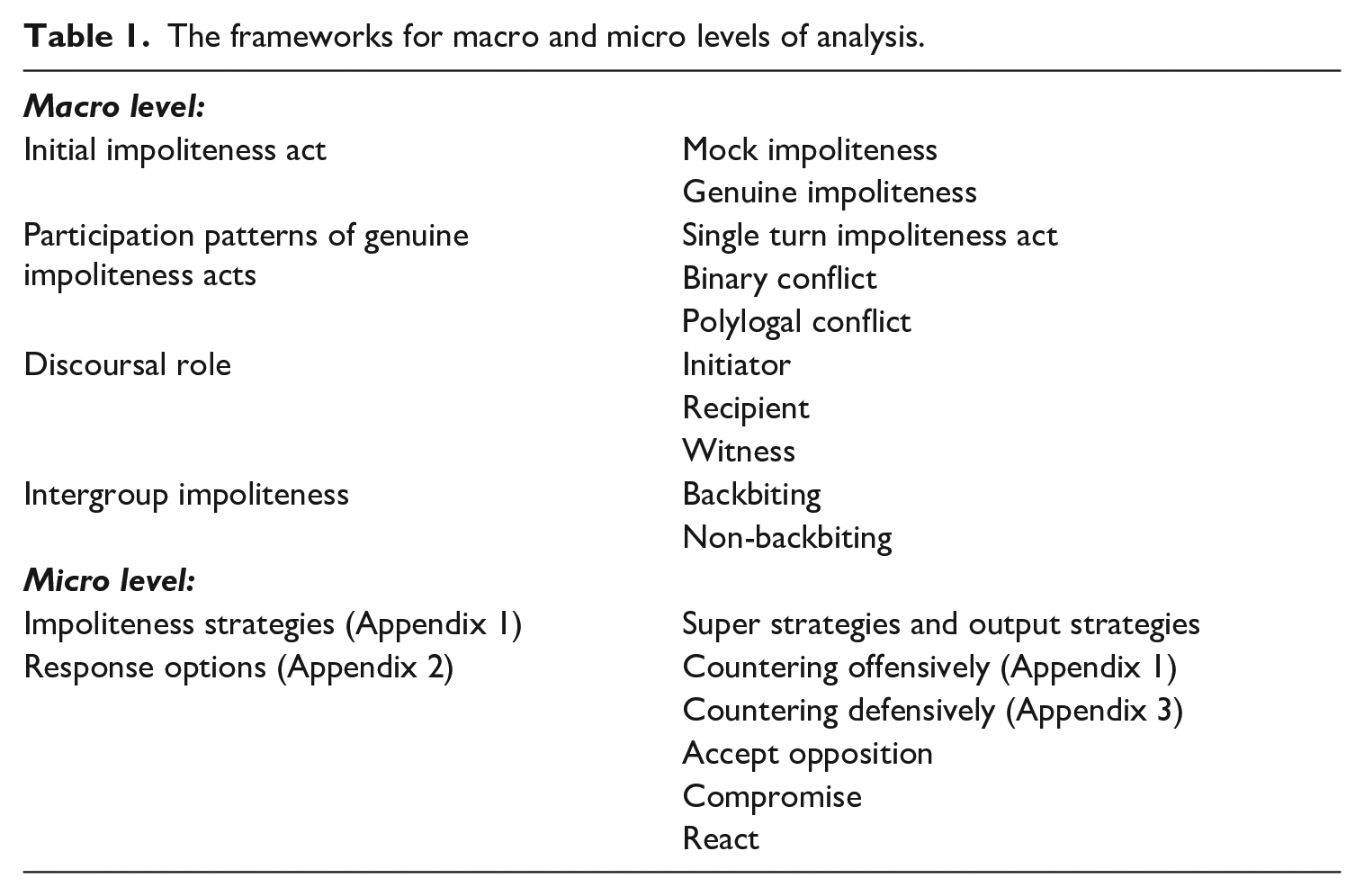
As mentioned previously, in order to have a more precise understanding of how impoliteness is presented in the probed datasets, the corpus was analysed at macro and micro levels. The frameworks for macro-level analysis included: initial impoliteness acts (mock impoliteness, and genuine impoliteness); participation pattern (single-shot impoliteness acts, binary conflicts, and polylogal conflicts); discoursal roles (initiator, recipient, witness); and intergroup impoliteness (backbiting vs. non-backbiting) (For more information and instances, see Tables 1 and 2, Appendices 1 through 3, and Section 5.III below). The frameworks for micro-level analysis included: taxonomy of impoliteness strategies (Culpeper’s 1996 revised model) (Appendix 1), participants’ response options (Dobs & Blitvich, 2013) (Appendix 2), and defensive-counter strategies (Bousfield, 2007) which is adapted/revised by Khazraie (2019) and Khazraie and Talebzadeh (2020) (Appendix 3). Table 1 outlines the frameworks applied in this study.
The frameworks for macro and micro levels of analysis.
Instances of offensive strategies and responses to them.
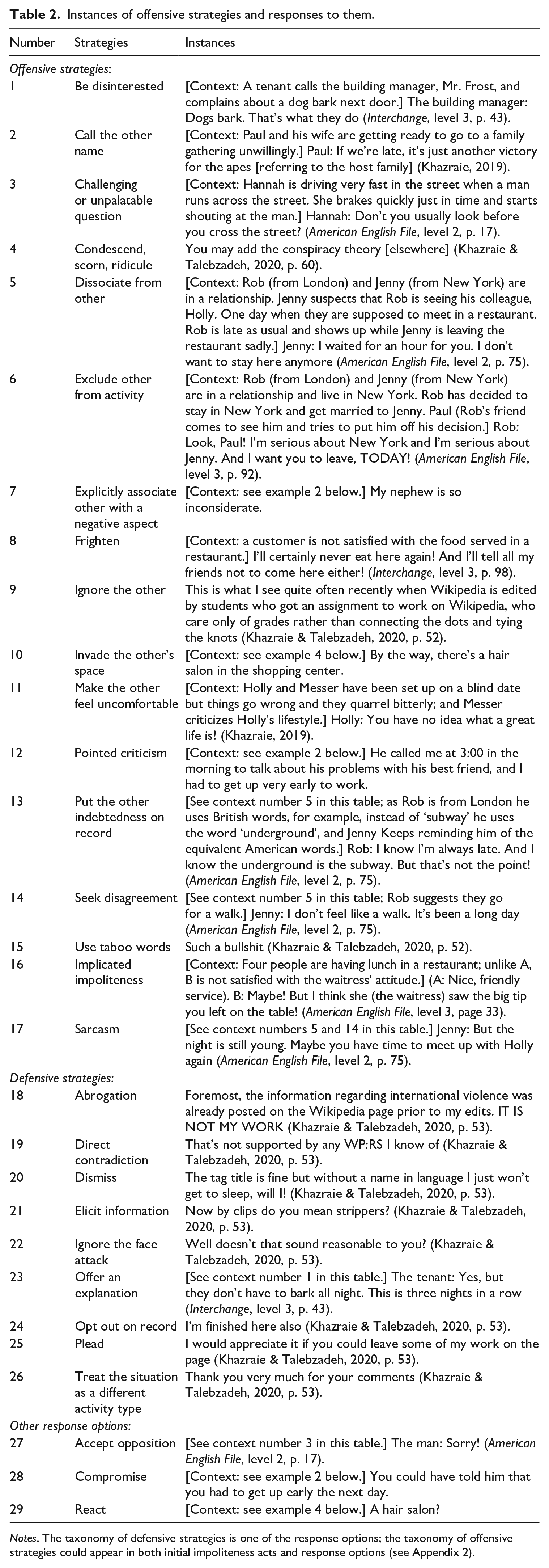
Notes. The taxonomy of defensive strategies is one of the response options; the taxonomy of offensive strategies could appear in both initial impoliteness acts and response options (see Appendix 2).
4 Procedure
After the data selection phase, to adopt the appropriate analytical frameworks, a pilot study on 10 percent of the data was conducted; there were also several discussion sessions to reach a consensus on adopting and/or adapting the frameworks best fitted to our data. Then, the analysis was conducted at macro and micro levels (see Table 1) qualitatively and quantitatively.
First, the audio files of the textbooks along with the audio scripts available in the teacher’s books were utilized, and conversations through which impoliteness occurred were identified and coded manually through several rounds of rigorous discussion and analysis by both researchers. In order to ascertain that all traces of teaching and presenting impoliteness are identified and analysed properly, the researchers used all multimodal means including textual, visual/pictorial, and aural contents of student books and their teacher guides. Then, the pertinent sections were scrutinized in order to check whether or not there was any explicit or implicit teaching of offensive acts, either in the student’s or teacher’s books.
The macro-level analysis was carried out first. To begin this process, initial impoliteness acts were identified, then possible initial mock impoliteness acts (see Example 1 below) were distinguished from genuine impoliteness acts. Afterwards, each identified initial genuine offending situation was followed until the impoliteness which was communicated reached either a stand-off or a withdrawal point (Bousfield, 2008). Following the macro-level investigation, a micro level analysis was done based on the frameworks. Subsequently, the whole process was double-checked one more time for the sake of consistency in the analysis.
Additionally, to check the consistency of the analyses, 20 percent of the overall data were randomly selected and coded by one of the researchers asynchronously with a time interval of one month. Furthermore, 10 percent of the whole data was analysed by both researchers separately. The results of intra-coder and inter-coder tests statistically confirmed rather high overall agreement indices (i.e. around 90 per cent). One explanation for such satisfactorily high reliability levels can be our holding multiple coding/discussion sessions prior to and during the analysis stage (not to mention simultaneous engagement with similar data) particularly when there were problematic cases. In particular, iterative rounds of analysis and discussion were required to determine what the dominant strategy was (e.g. in case a strategy seemed to be either embedded in another strategy and discerning them was almost impossible, then the most salient strategy was included in the coding), whether a particular instance was mock or genuine impoliteness, or whether a utilized strategy was offensive or defensive in nature.
Finally, the frequencies of impoliteness acts and response options were calculated and tabulated. The raw frequencies were normalized to 1,000 minutes in order to make the datasets of various lengths comparable (Biber, Douglas, Conrad & Reppen, 1998). To provide quantitative evidence for the significance of the observed differences in the data, chi-square tests were conducted at the 0.05 level by the IBM SPSS statistical package (version 24). In order to get a better insight of the micro analysis items, instances of the strategies (either realized in the current study dataset or taken from similar studies by Khazraie, 2019; Khazraie & Talebzadeh, 2020; Khazraie & Talebzadeh, under review; Talebzadeh & Khazraie, under review) are presented in Table 2.
V Findings
In this section, the macro- and micro-analysis findings are reported in detail, in order to address the first two research questions which inquired about the way incivility acts and their responses are represented in the popular ELT textbooks and the possible qualitative and quantitative differences between the two series and across their four proficiency levels. The existence of (or lack thereof) any explicit and/or implicit instruction or consciousness-raising about impoliteness (and how to respond to it), as our third research question, are reported, too. Furthermore, four extensive examples are introduced to illustrate the realization of the impoliteness acts and their responses in the examined textbooks.
1 Macro-level analysis
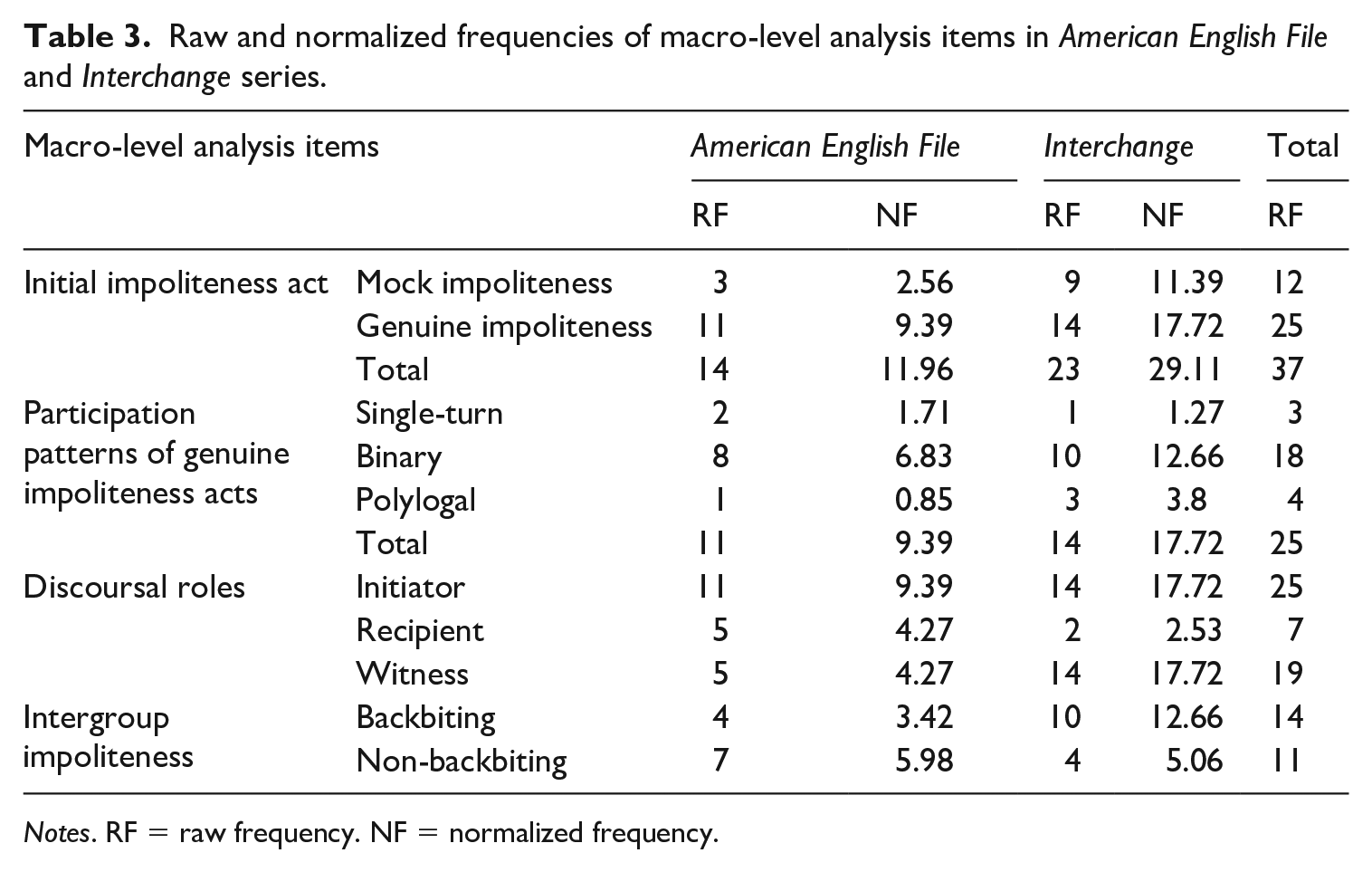
A total of 37 initial impoliteness acts were identified in the conversations presented in different sections in the audio files of the American English File and Interchange series. The quantities of macro-level analysis items are presented in Table 3 in detail.
Raw and normalized frequencies of macro-level analysis items in American English File and Interchange series.
Notes. RF = raw frequency. NF = normalized frequency.
According to Table 3 (total column), initial impoliteness acts occurred 37 times among which 12 (32.4 %) cases were mock impoliteness and 25 (67.6 %) cases were initial genuine impoliteness acts. The proportion of genuine impoliteness acts was greater than that of mock impoliteness acts. To check whether the difference was significant, a one-way Chi-square test was applied (on NFs), and the result confirmed a statistically significant difference (x2(1) = 4.57, p = .033). From among genuine impoliteness acts, 3 (12%) initial acts did not receive any response, which were coded as single-turn impoliteness acts, while 22 cases received different types of responses and turned into conflicts. Out of 22 conflicts, presented in the textbooks, 18 (82%) conflicts were binary, and only 4 (18%) conflicts were polylogal. A one-way Chi-square test showed a significant difference in the occurrence of different participation patterns (x2(2) = 13.52, p = .001). Apart from initiators (25 cases) who started the conflicts, the macro analysis of the textbooks also revealed that the discoursal roles such as recipients and witnesses appeared in the hostile interactions 7 and 19 times, respectively. The one-way Chi-square test showed a significant difference in manifestations of different types of discoursal roles at 0.05 level (x2(2) = 11.32, p = .003). Regarding intergroup impoliteness, 14 cases were backbiting, and 11 cases were identified to be non-backbiting; in other words, each type occupied almost 50 percent of the total initial genuine impoliteness acts.
According to Table 3, the proportion of genuine impoliteness acts, in both series of the textbooks, was greater than mock impoliteness acts. It can be seen that Interchange series presented more initial impoliteness acts than American English File series (29.11 and 11.96 respectively). In the same way the frequency of genuine impoliteness acts in Interchange series (17.72) outnumbered those of American English File series (9.39). The Yate’s correction test (Hatch & Lazaraton, 1991) was applied manually to find out any significant difference between the occurrence of genuine and mock impoliteness in the textbooks. The result of the test, however, did not show any significant difference. Concerning participation pattern, Table 3 demonstrates that the most prevalent pattern was the binary conflict in both series of the textbooks. As shown in Table 3, polylogal conflicts outnumbered single-turn impoliteness act in Interchange series (3.8 and 1.27 respectively); on the contrary, in American English File series single-turn impoliteness act appeared more frequently than polylogal conflict (1.71 and 0.85 respectively). The differences in the proportion of participation pattern between the two investigated textbooks cannot be examined statistically through the Chi-square tests because the assumption of the test was not met (Hatch & Lazaraton, 1991).
Similarly, for discoursal roles – although the assumptions of the statistical test were not met and hence not run – some notable differences were observed in manifestations of different discoursal roles. It can be seen immediately from Table 3 that apart from the initiator role which seemed to be the dominant role in both series, the role of witness appeared to be more frequent than recipient in Interchange series. However, in American English File series both witness and recipient roles received the same amount of attention. All in all, the distribution of discoursal roles did not seem to follow the same pattern in the investigated textbooks. Regarding intergroup impoliteness, the case of backbiting took place more frequently in Interchange series than American English File series (approximately 70% and 35% respectively) which is consistent with the prevalence of witness role in the former series.
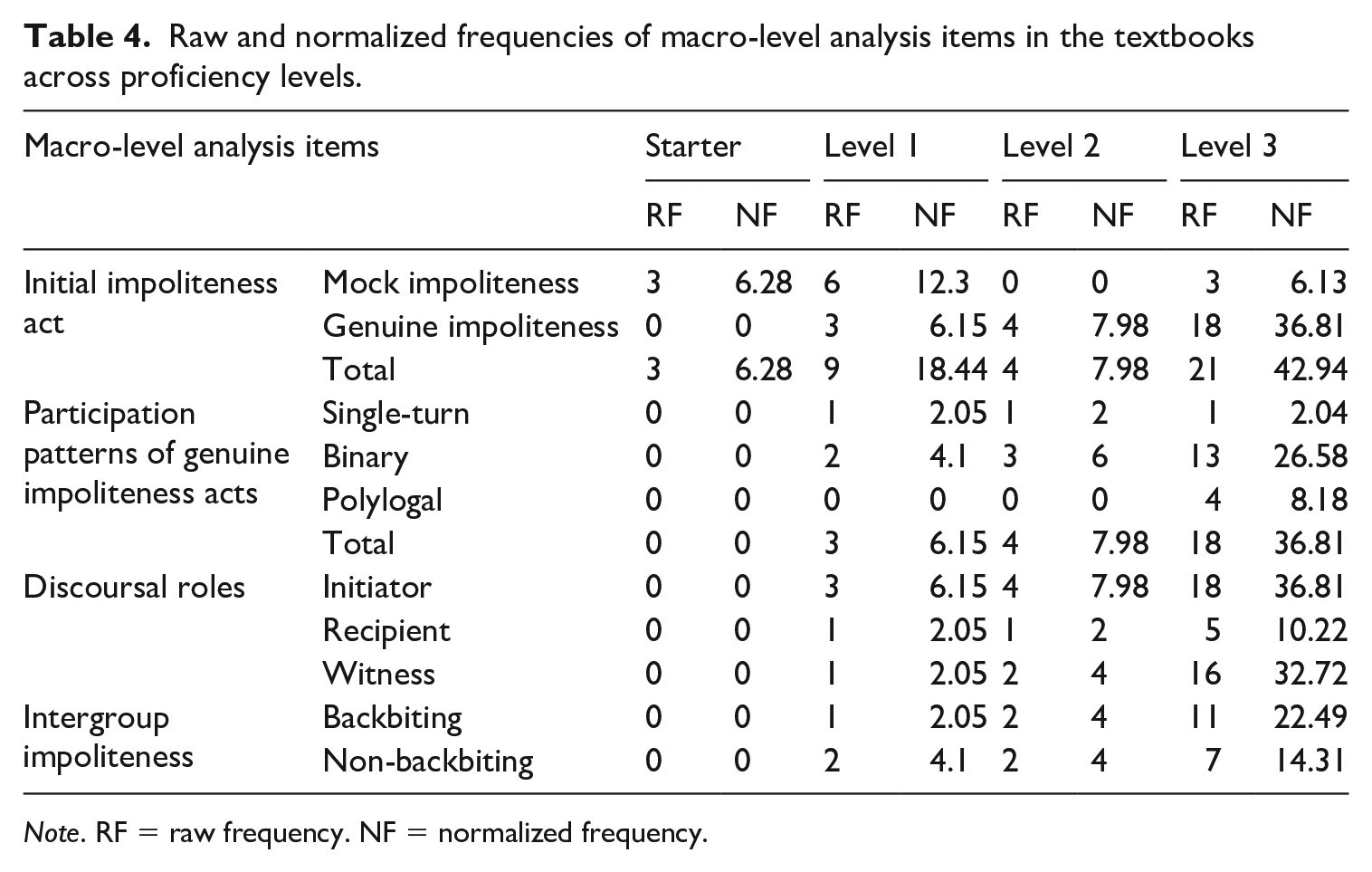
Incivility manifestations in the textbooks were also compared across their four proficiency levels, and the results of macro-level analysis are presented in Table 3. Table 4 highlights that the impoliteness phenomena were more frequently dealt with in level 3 compared with other proficiency levels, in general. From among four levels of proficiency, level 3 presented the most cases of initial impoliteness acts (21 cases), and consequently the most cases of initial genuine impoliteness acts were presented at this level (18 cases). However, the level at which the greatest number of mock impoliteness occurred was level 2 (6 cases). It is worth noting that apart from a few mock impoliteness acts, no genuine initial impoliteness act was presented at starter level textbooks. In contrast, level 2 contained no mock impoliteness. At level 1, mock impoliteness appeared more frequently than genuine impoliteness; conversely, at level 3 genuine impoliteness was more frequent than mock impoliteness acts. In order to check whether there was a significant difference in occurrence of different types of triggering impoliteness acts (i.e. mock vs. genuine) across the levels a two-way Chi-square test was conducted, and the result of the test confirmed a significant difference (x2(3) = 32.89, p < .001).
Raw and normalized frequencies of macro-level analysis items in the textbooks across proficiency levels.
Note. RF = raw frequency. NF = normalized frequency.
As for participation pattern, Table 4 shows that the most prevalent pattern was the binary conflict at all three levels. It should be noted that there is no report of the participation pattern at starter level because no genuine impoliteness was presented at this level of proficiency. As shown in Table 4, polylogal conflict was only presented at level 3, and binary conflict outnumbered single-turn impoliteness act at all three levels. The table does not show a noticeable difference in occurrence of single-turn impoliteness acts across levels while the difference in occurrence of binary conflict seems to be considerable, yet the difference is not statistically significant (Hatch & Lazaraton, 1991). Similarly, for discoursal roles, the assumption of the test was not met (Table 4); however, differences were observed in manifestations of different discoursal roles. It can be seen that level 3 contained the most frequent discoursal roles in comparison to its counterparts. It was found that the role of recipient was not as frequent as initiator and witness, in general. Concerning intergroup impoliteness, Table 4 shows that the ratio of backbiting to non-backbiting phenomena was above 20 percent at all levels of proficiency (except for the starter level featuring no instances). At level 1 the ratio was below 40 percent while at level two it appeared to be above 40 percent. At level 3 textbooks, though, the ratio of backbiting to non-backbiting even went above 60 percent.
2 Micro-level analysis
A total of 57 genuine impoliteness strategies (both initial genuine impoliteness acts and offensive responses to them) were determined in the whole dataset in the total running time of 1,961 minutes (i.e. learners are exposed to almost one impoliteness act every 35 minutes). The findings indicated that impoliteness strategies outnumbered defensive strategies, accept opposition, compromise, and react significantly at .05 level (x2(4) = 109.77, p < .001). Regarding impoliteness super-strategies, 93 percent of them were on-record impoliteness, and 7 percent were off-record (Figure 1); it means that on-record impoliteness strategies significantly outnumbered off-record impoliteness strategies (x2(1) = 42.12, p < .001). The most frequent impoliteness output strategy was pointed criticism (18 cases), followed by explicitly associate other with a negative aspect (13 cases), while the highest frequency of defensive strategies belonged to offer an explanation (8 cases).
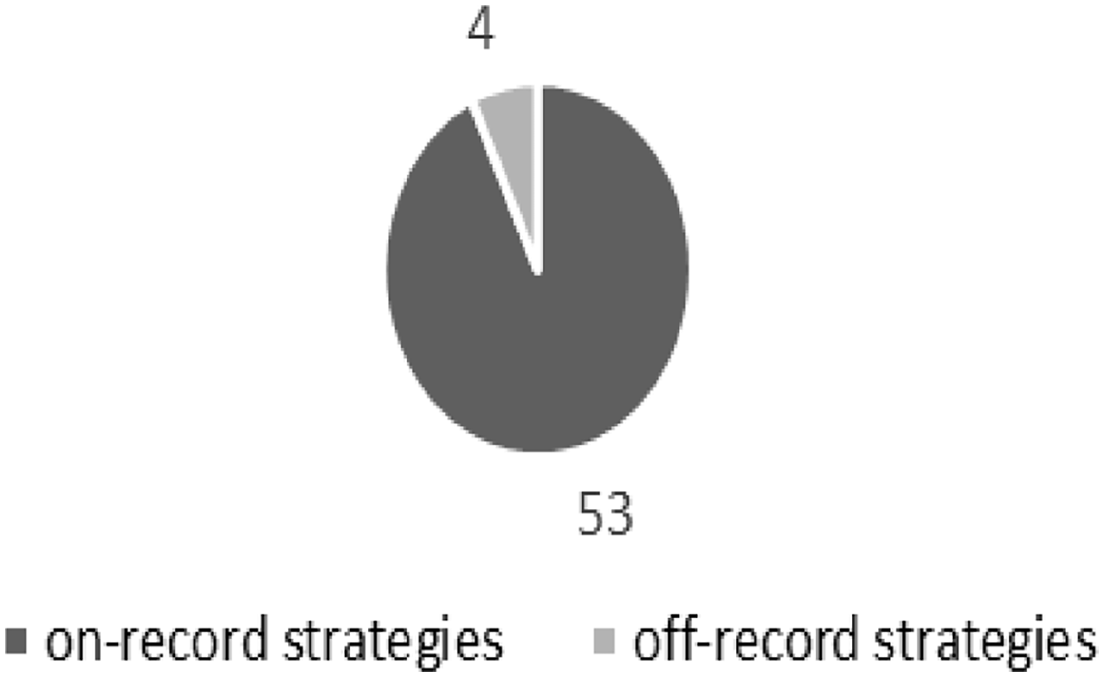
The proportion of impoliteness super-strategies in the textbooks.
Findings also showed that impoliteness strategies were presented in Interchange more frequently than American English File book series while ‘defensive strategies’ and accept opposition (which are among response options to impoliteness) in American English File took place more frequently than in Interchange series. A total of 21 and 36 (normalized frequency: 17.93, 45.57) impoliteness output strategies were identified in American English File and Interchange series, respectively (Figure 2). Figure 3 illustrates the frequency of the identified impoliteness offensive strategies in detail. On the other hand, the only defensive strategies presented in Interchange series were offer an explanation (2 cases) and elicit information (1 case) (Figure 4).
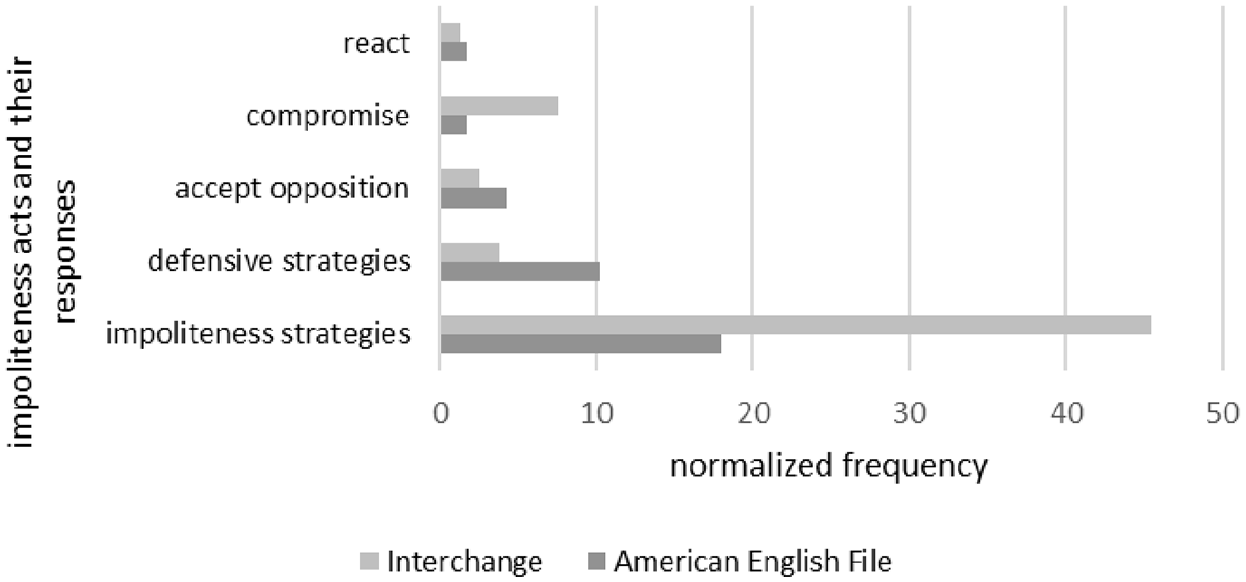
The proportion of impoliteness strategies and their responses in American English File vs. Interchange series.
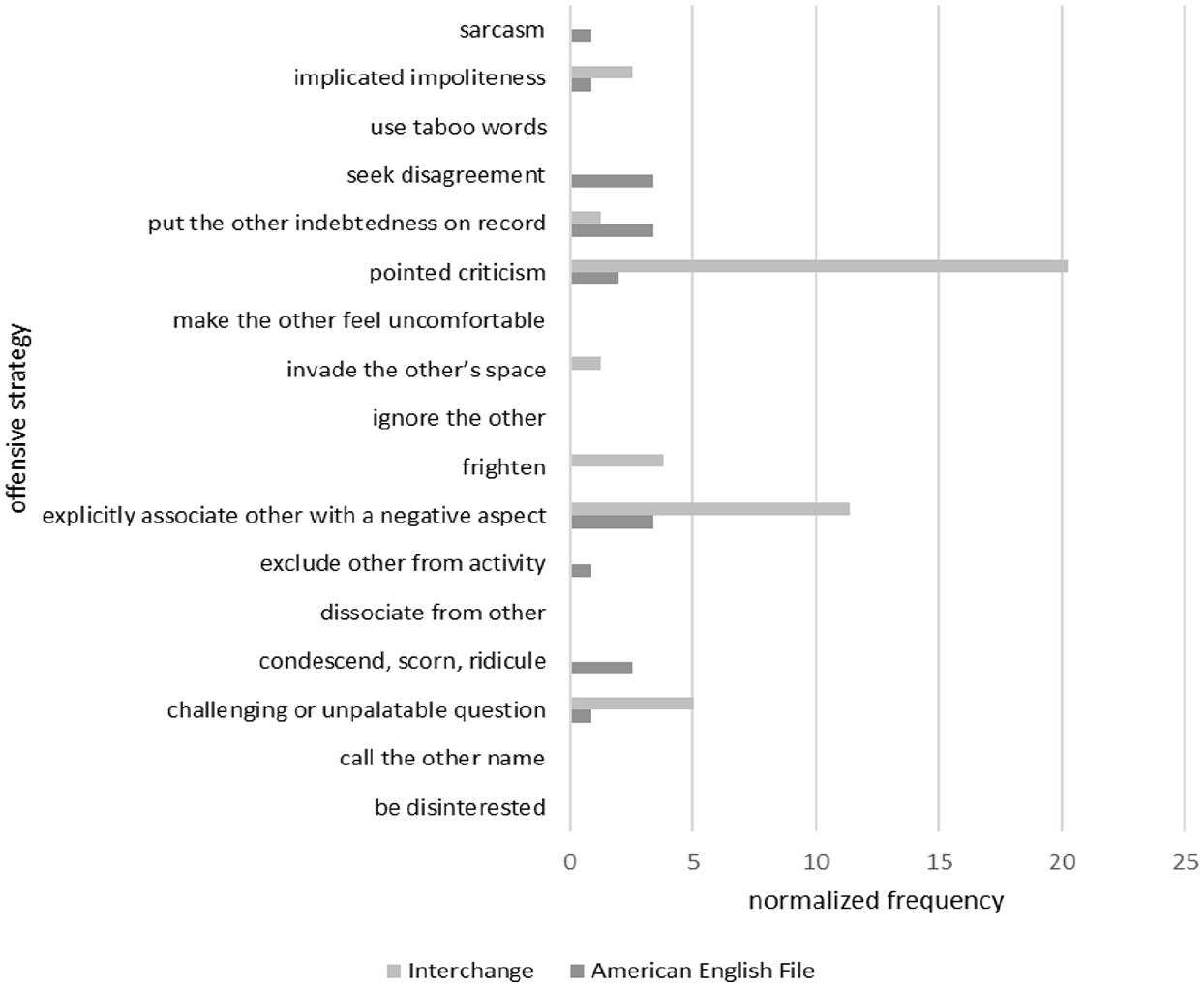
The proportion of impoliteness output strategies in American English File and Interchange series.
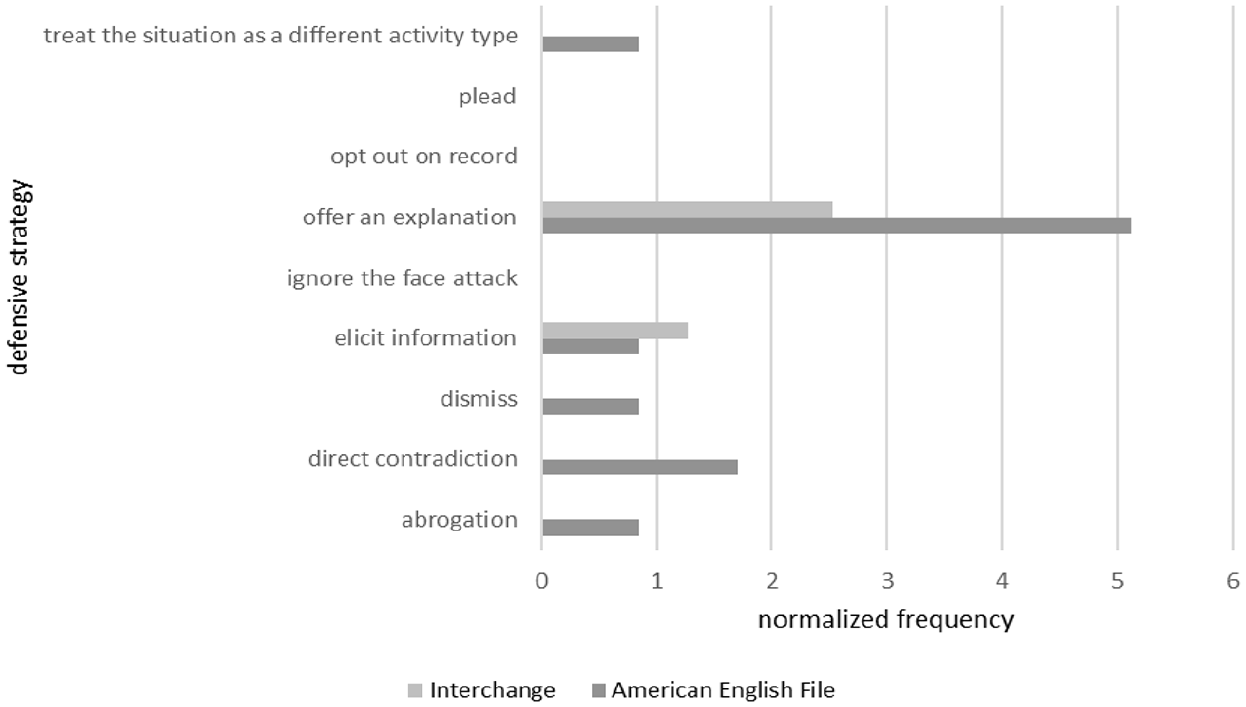
The proportion of defensive strategies in American English file vs. Interchange series.
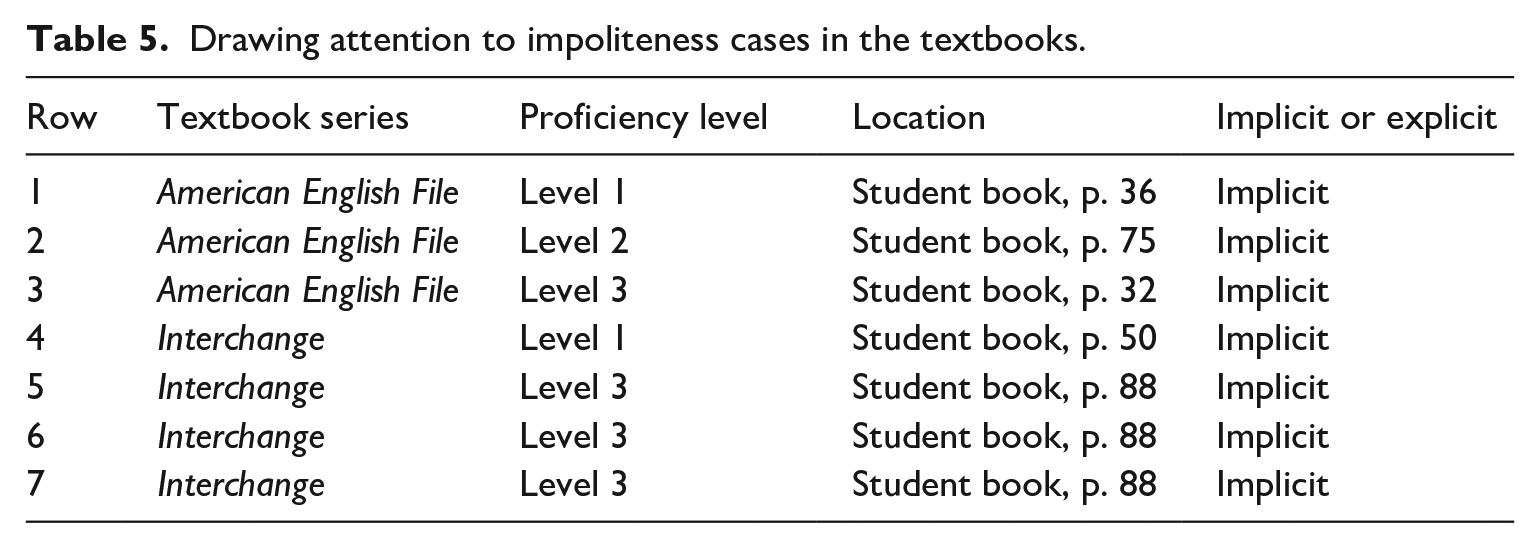
It was also detected that incivility phenomena were more frequently dealt with at level 3 textbooks compared with other proficiency levels, and no impoliteness act was presented at starter level (Figure 5). The most frequent impoliteness output strategy presented at level 3 was pointed criticism (Figure 6). Defensive strategies only appeared at level 3, except for the case of offer an explanation which appeared three times at level 2 (Figure 7). With regards to our third research question, our analyses also revealed that among 57 impoliteness acts which were identified in the textbooks, just 7 cases drew the learners’ attention implicitly towards the instances of presented impoliteness acts, and no cases dealt with instruction towards impoliteness acts explicitly (Table 5).
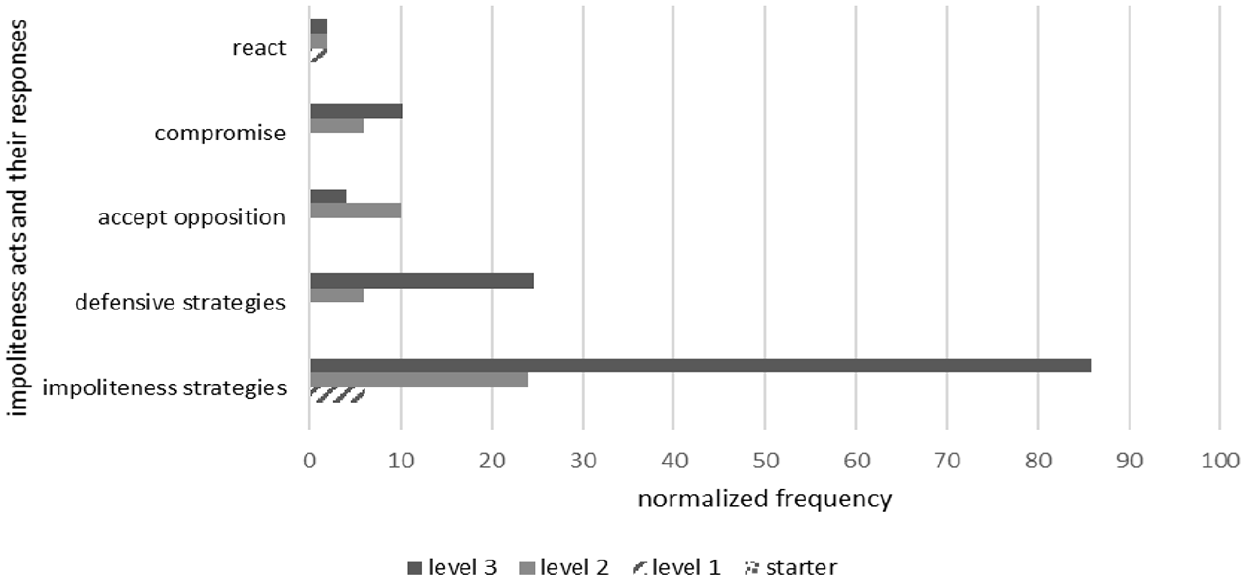
The proportion of impoliteness acts and their responses in the textbooks across proficiency levels
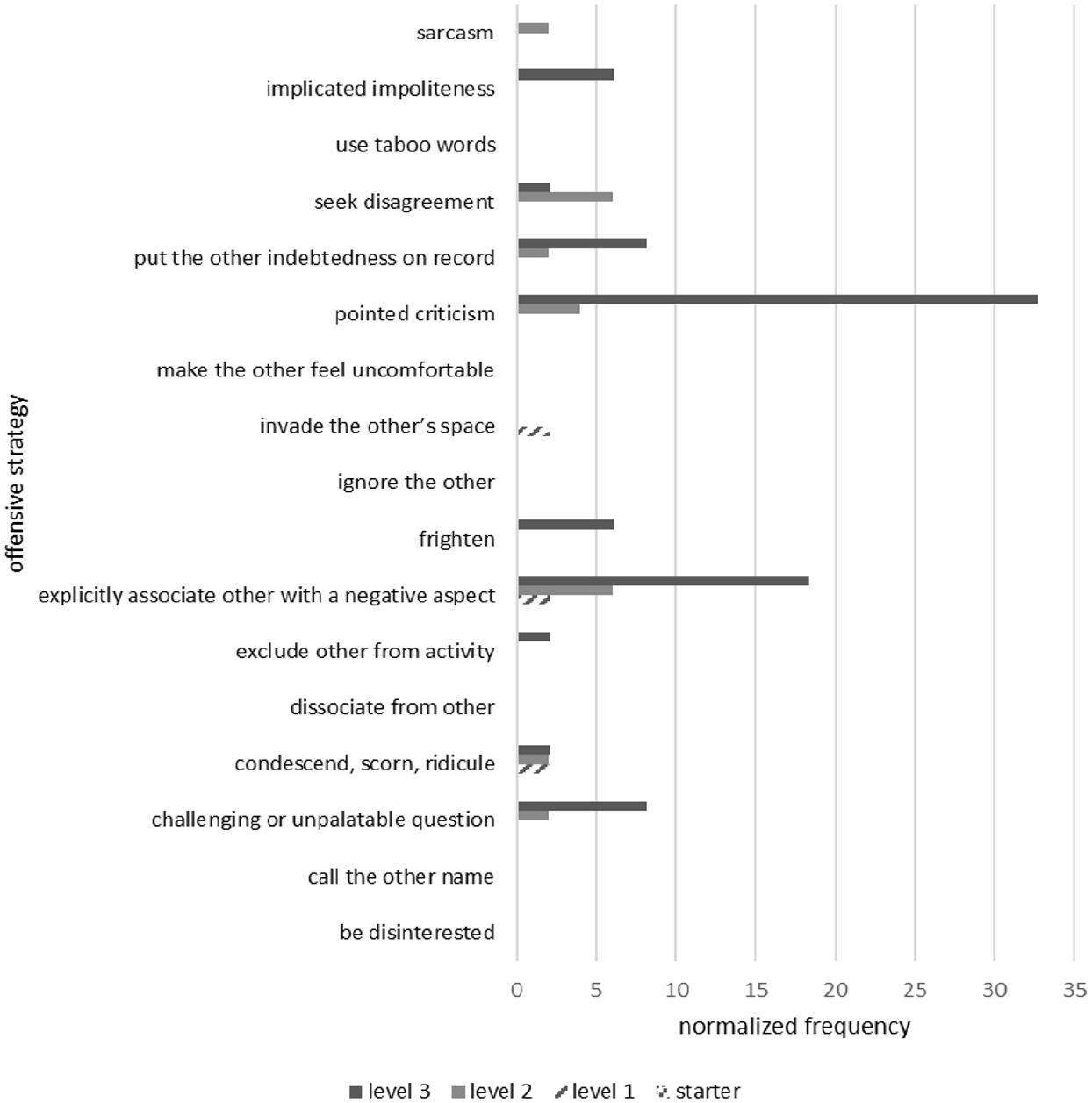
The proportion of impoliteness output strategies in the textbooks across proficiency levels
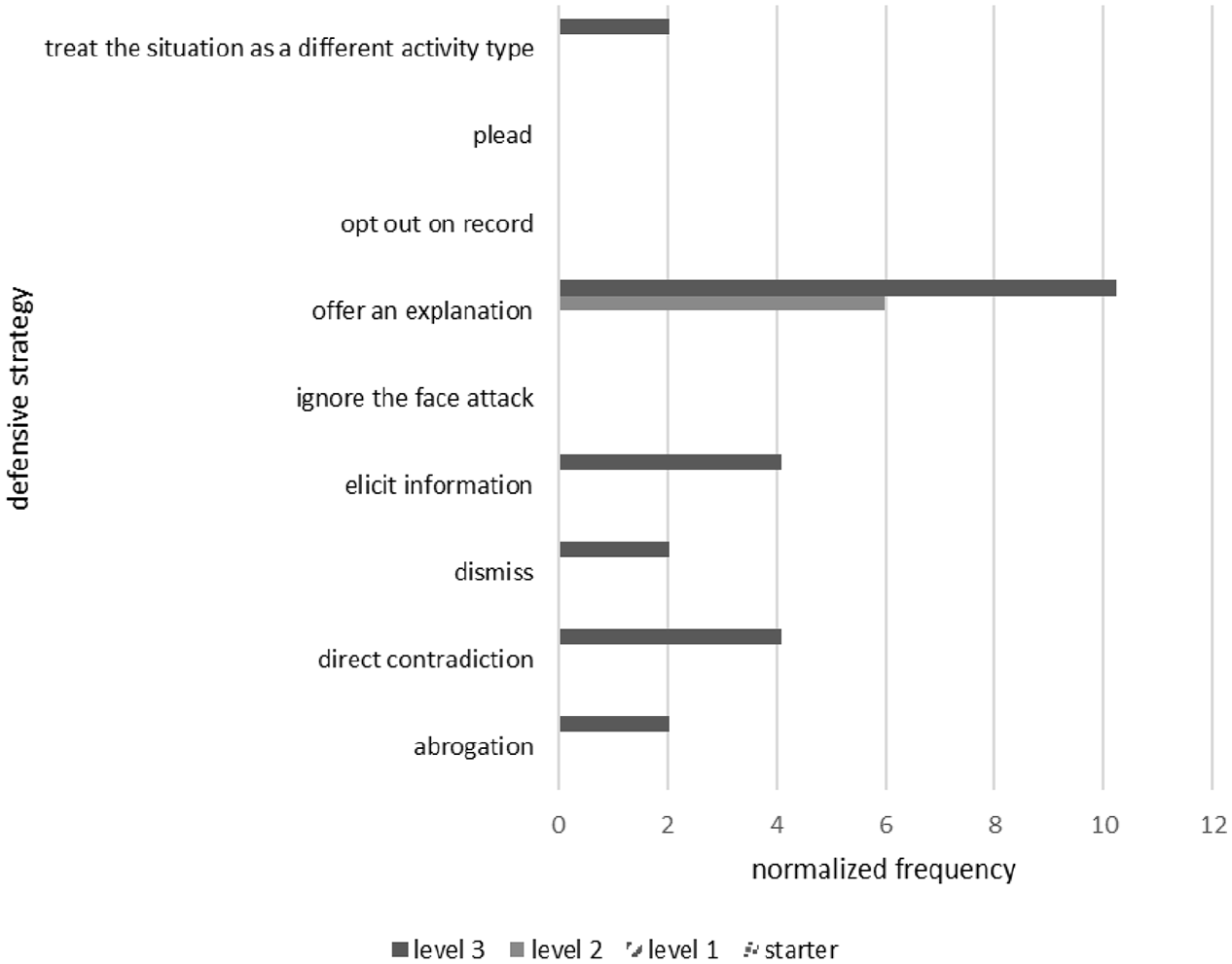
The proportion of defensive strategies in the textbooks across proficiency levels
Drawing attention to impoliteness cases in the textbooks.
3 Illustrative examples
The following examples illustrate how the analysed impoliteness acts and responses to them were presented in the textbooks. Plus, we highlight whether there are any explicit and/or implicit instruction or awareness-raising about the identified incivility cases in the textbook (or the accompanying teacher’s manual). Given the space considerations, we have included the instances which could best exemplify a wider range of offensive output strategies and responses to them, which are indicated with italics in the text (for more examples, see Table 2 above).
Example 1
A couple, Madison and Zachary, are looking at their family photos while talking about them. Zachary expresses that their kids are cute.
She’s so cute. And now we have two kids. Who would have guessed?
Yeah. We’re just lucky that they look like me.
(Interchange, level 1, unit 16, page 107)
The first example shows how participants use mock impoliteness. Although investigating the manifestations of mock impoliteness is not the main focus of the present study, instances of this kind were studied to distinguish between genuine and mock impoliteness acts. In the last turn, Madison implicitly conveys the message that her husband is not very handsome when she says: ‘we’re just lucky that they look like me’. However, her utterance which is accompanied with a chuckle shows she does not mean it to be offensive. Therefore, this case can be identified as mock impoliteness. In this section, students are expected to listen to the audio file and take note of the changes. Neither the content and pictures presented in the student book nor the teacher’s manual in this section refers to this (mock) impoliteness case. The students, for instance, could have been encouraged to discuss their personal experiences and inferences based on the exchange, offer alternatives to respond in similar situations, and even notice how a potentially insulting situation/proposition can be manipulated humorously.
Example 2
a person is complaining about her nephew. Two people provide responses to the complaints.
My nephew is so inconsiderate. He called me at 3:00 in the morning to talk about his problems with his best friend, and I had to get up very early to work. I was really mad.
You could have told him that you had to get up early the next day.
Your nephew is always doing that. You shouldn’t have answered his call.
(Interchange, level 3, unit 13, page 88)
In turn 1, the initiator first associates a negative aspect to her nephew by saying: ‘my nephew is so inconsiderate’, then criticizes him (i.e. he called me at 3:00 in the morning . . .) while he is absent; therefore, this case can be considered as backbiting. In turn 2, witness 1 proposes a compromise by suggesting a hypothetical solution. However, witness 2 exacerbates the situation while using pointed criticism by saying: ‘your nephew is always doing that’ which is an offensive strategy. In this section, students are supposed to listen to the audio file and check the response they think is best for each problem. This task can raise students’ awareness of different responses to an impoliteness act implicitly; however, there is no indication that points to the impolite nature of interaction either in the book or the teacher’s manual.
Example 3
Justin has an audition for an American TV show where two judges vote for participants’ performance.
(sings)
In a word . . . ‘terrible!’
Justin, you have a very pretty face, but I’m sorry, you can’t sing!
(American English File, level 1, unit 5, page 36)
In the second turn, judge 1 directs an impoliteness act when he says: ‘terrible’; he uses condescend, scorn, ridicule which is an offensive strategy. Although judge 2 agrees with judge 1 about Justin’s performance (i.e. ‘I’m sorry, you can’t sing!’), she tries to mitigate the impoliteness that judge 1 has issued using a gentle tone and complimenting him on his face (otherwise, the comment could have been taken as implicated impoliteness). The case of mitigation is scarce in the datasets explored in this study, although it abounds in other contexts (Khazraie & Talebzadeh, 2020).
Notwithstanding this particular example which appears to resemble some talent shows as a genre (Lorenzo-Dus, Bou-Franch, & Blitvich, 2013), there were almost no adequate instances in the corpus, with a pedagogical orientation, which could simulate authentic exchanges (in terms of the quality and quantity of macro- and micro-features including the number of turns, types of dominant incivility strategies, and possible response options) as elucidated in more authentic contexts (for examples, see Dobs & Blitvich, 2013; Khazraie, 2019; Khazraie & Talebzadeh, 2020; Talebzadeh & Khazraie, under review). In this section, for instance, the students are supposed to listen to the audio file and match the sentences. However, neither the content and pictures presented in the student book nor those in the teacher’s manual draws attention, one way or another, to such acts of impoliteness and their potential for being face threatening (and/or how they can be avoided or reacted to).
Example 4
Greg, a young man with rather long dark hair, who has just moved in to a new neighborhood, introduces himself to Mrs. Cook, his older neighbor, and is asking her about places such as a grocery store and laundromat. In the 7th turn, Greg thanks her for the information and the conversation closes so:
By the way, there’s a hair salon in the shopping center.
A hair salon?
(Interchange, level 1, unit 8, page 50)
In turn 8, Mrs. Cook, says: ‘By the way, there’s a hair salon in the shopping center’, and in this way she invades Greg’s space (an offensive strategy) because he has not asked about a hair salon. In response, Greg reacts with a question when he says: ‘a hair salon?’ using a rising intonation which indicates that he is puzzled by her utterance.
There is no reference to this impoliteness act in the student book. In teacher’s manual (p. 50), the teachers are guided to ask students: ‘What other place does Mrs. Cook suggest? Why?’, and the possible answers to these questions provided in the teacher’s book are ‘she suggests a hair salon because Greg needs a haircut’. As one of the few instances of drawing the learners’ attention to the questionable act, the students are guided to notice Mrs. Cook’s utterance and its implication; however, there is no hint that points to the (potentially) impolite nature of the utterance and how Greg could/should have reacted. Again, it is unlike instances of authentic interaction found in other impoliteness studies (Khazraie, 2019; Khazraie & Talebzadeh, 2020; Dobs & Blitvich, 2013).
VI Discussion
Three major issues (formulated in terms of three research questions) were addressed in this study. First, we wanted to characterize the breadth and depth of impoliteness acts and their responses as (re-)presented in international ELT textbooks, popular among English language learners (and teachers) in Iran. Moreover, we wanted to explore if there were quantitative and qualitative differences between the two popular language teaching series and across their four proficiency levels in terms of incivility. Finally, the textbooks’ explicit or implicit instructional treatment of impoliteness phenomena was scrutinized. Concerning the breadth and depth of impoliteness acts and their responses (the first research question), the results of our detailed macro- and micro-analysis generally revealed that the quality and quantity of impoliteness instances and responses to them in both textbooks were not by any means comparable to more authentic interactions; in other words, the number of initial impoliteness and response items (Table 3 and Table 4) are really low compared to those found in the studies of real-life, online, and dramatic discourse (e.g. Bou-Franch & Blitvich, 2014; Bousfield, 2007, 2008; Culpeper, Iganski, & Sweiry, 2017; Dynel, 2013, 2016; Khazraie & Talebzadeh, 2020; Limberg, 2008; Talebzadeh & Khazraie, under review;) especially considering the rather substantial length of the examined books and audio files. While there are some minor differences between the two textbook series (Table 3), their macro-analysis features including the number of interactional turns, conflict participants, discoursal roles, and intergroup impoliteness do not by any means reflect those of other diverse discourses; particularly, the latter’s interactions are predominantly polylogues characterized by several interactional turns as well as reiterative moves of offensive strategies followed by defensive strategies (compare with Arroyo, 2013; Blitvich, 2010b; Bou-Franch & Blitvich, 2014; Bousfield, 2007, 2008; Culpeper et al., 2017; Dobs & Blitvich, 2013; Khazraie & Talebzadeh, 2020; Talebzadeh & Khazraie, under review). Contrary to the common practice in the textbooks’ dataset, in our study of incivility in an online community of practice (Khazraie & Talebzadeh, 2020), we found that impoliteness resources were common among the community members, were responded to by either the recipient and/or the witness(es) in more than 60 percent of the cases of initial impoliteness, were distributed across 2 to 13 turns of interaction, were escalated yet not usually left unresolved, and were used with a much wider variety in strategy type across the board.
Moreover, the cases of mock impoliteness and backbiting were comparatively over-represented in the textbooks, and the absence of recipients of impoliteness acts (just 7 cases compared with 25 initiators and 19 witnesses) in several interactions (especially in Interchange series), coupled with considerable number of (unresolved conflicts in) single-turn and binary incivility acts, could render the materials less authentic and probably even less reliable as perfect models of language use. Surprisingly, there were more instances of back-biting at higher level books (Table 4) while the students are believed to be better prepared to appreciate instances of real-life-like conflict and conflict resolution ( Ahmadi & Heiydari Soureshjani, 2011). Inauthentic materials, nevertheless, can cause problems for language learners, one instance being their failure in communicating effectively with native (and proficient international) speakers and/or being judged as uncooperative interlocutors (Bardovi-Harlig, 1996; Crandall & Basturkmen, 2004).
As underlined by micro-level analysis results, the number of genuine impoliteness and response strategies was really low (just 57 cases), but with a pattern similar to other incivility studies in terms of on-record vs. off-record strategies (e.g. Khazraie & Talebzadeh, 2020; Lorenzo-Dus et al., 2011, 2013). Of course, due to the meager number of identified cases, the type of salient offensive and defensive strategies cannot be reliably compared with the data of more authentic interactions from other studies inasmuch as many of the possible impoliteness acts and response strategies are not realized at all in the examined textbook corpus. While some strategies prevalent in other genres and studies (e.g. pointed criticism and explicitly associate other with a negative aspect) were among the most frequent strategies in our dataset (e.g. Figures 3, 4 and 6), the majority of offensive or defensive strategies that are more dominant in other studies (such as condescend, scorn, ridicule; sarcasm; and use taboo words) are under-represented (if represented at all) in the textbooks (compare with Arroyo, 2013; Khazraie & Talebzadeh, 2020; Lorenzo-Dus, 2009; Lorenzo-Dus et al., 2011; Talebzadeh & Khazraie, under review). This observation, of course, can be explained in light of the special genre under study (i.e. language textbooks, with their diverse audience, hence being more conservative) in line with the recommendation by materials development experts to avoid highly controversial content (e.g. Harwood, 2010).
Regarding the second research question (about the comparison of the two series of the textbooks and their differences across levels of proficiency), it should be noted that the two series were not identical in offsetting authentic interactions (e.g. Figures 2 through 7). While Interchange series shared considerably more instances of offensive impoliteness strategies (i.e. condescend, scorn, ridicule; pointed criticism; explicitly associate other with a negative aspect and even challenging or unpalatable question) with several of the studies (cited in the previous paragraph), defensive strategies and accept opposition were more prevalent and real-life like in the American English File series. We also found that Interchange series presented more impoliteness acts than American English File series; conversely, American English File series provided more varied responses to impoliteness acts than Interchange series. Based on the findings of the analysis at both macro and micro levels, it might be contended that the features of impoliteness acts were not dealt with evenly and appropriately across proficiency levels, and that level 3 textbooks included the most impoliteness examples identified in the dataset (see Table 4 and Figure 7). In general, there appears to be a move toward inclusion of more impoliteness resources in higher level books which could have made significant differences should our corpus have included textbook series with more advanced books in their package.
Furthermore, regarding the third research question, despite abundant evidence supporting the usefulness of (explicit) teaching of impoliteness features of language (e.g. Mugford, 2008; Pizziconi, 2015), we found that the investigated textbooks not only failed to provide explicit instructions of the impoliteness issues, but also they hardly ever drew learners’ attention even implicitly to the meager instances of impoliteness issues included in the textbooks (just 7 cases out of 57 genuine impoliteness acts identified in the textbooks, see also Table 5). All in all, these results are disappointing as far as impoliteness representation and instruction are concerned.
Of course, in spite of the justifications (discussed below) for the inclusion of impoliteness resources and instances in educational contexts and materials (across proficiency levels), there are some arguments to the contrary, too. For instance, less than half of the teachers participating in Mugford’s (2008) survey argued that ‘L2 users should not engage in impolite practices,’ while other teachers who were against its instruction contended that ‘it was not their job to teach impoliteness, it was too difficult, or teaching impoliteness promotes conflict’ (p. 380). The Iranian and non-Iranian ELT experts, teachers, (as well as learners) responding to Ahmadi and Heydari Soureshjani’s (2011) questionnaire generally acknowledged that ‘it is necessary for language learners to have knowledge and consciousness about’ both politeness and impoliteness (p. 21); however, considering the concerns of teachers (and experts) with classroom management and the possibility of ‘chaos and disorder in the class’ (Ahmadi & Heydari Soureshjani, 2011, p. 1280), the authors questioned justifiability and ethicality of its explicit and direct teaching, at least ‘[i]n an Iranian context due to the specific cultural and religious conditions’ particularly in lower proficiency levels (p. 1281).
Such understandable reservations and concerns, nevertheless, might be overshadowed by the compelling counter-arguments (some of which noted previously) for the urgency and necessity of learning and teaching impoliteness. Firstly, the literature has accentuated that pragmatic features are teachable and that students need to receive instructions to develop their pragmatic competence and be aware (and in control) of their pragmatic behavior; otherwise, they might pass as uncooperative or even tactless interlocutors (Pizziconi, 2015). In fact, Mugford (2008) suggested that the language learners should be granted ‘the right to be rude if they want to, as long as they are aware of the consequences of their actions’ (p. 375). Furthermore, it is asserted that in the face of rude behavior the ‘learners need to be given the opportunity to react . . . according to the sociocultural norms of the target culture’ (Felix-Brasdefer & Mugford, 2017, p. 496). Secondly, developing pragmatic competence is expected to take place more efficiently through (explicit) instructions in the classrooms; otherwise, it is highly unlikely that learners learn different aspects of pragmatics comprehensively (Bardovi-Harlig, 2001). Third, like all pragmatic features, impoliteness features are teachable and should be taught to language learners; otherwise, learners may feel frustrated with L2 learning because they will not be able to express themselves in difficult situations (Mugford, 2008). Fourth, the literature emphasizes that not only do learners need to receive instructions about impoliteness features, but also the instructions should be started at the beginning levels of language learning; in fact, at these levels, learners pay more attention to impoliteness acts (Felix-Brasdefer & Mugford, 2017). As pointed out by Pizziconi (2015) ‘qualifying proficiency levels in terms of an ability to act ‘appropriately’ or ‘effectively’ says nothing of course about the parameters for appropriateness or effectiveness’ (p. 137).
VII Conclusions and implications
Motivated by the paucity of studies which investigate the realization and instruction of an underexplored component of pragmatic competence – namely, impoliteness in language teaching materials – this study which set out to address three issues can conclude as follows. First, it could highlight the deficiencies of the textbooks in adequately (re-)presenting impoliteness instances and responses to them quantitively and qualitatively (particularly if compared with more authentic sources). Secondly, notwithstanding some differences between the two international ELT textbook series in their realization of incivility strategies and responding to them, they shared more in common as far as impoliteness underrepresentation (especially in lower proficiency levels) is concerned. Then, both textbooks barely attempted to either explicitly or implicitly draw the learners’ attention to (or instruct them about) the scant instances of impoliteness. All in all, in spite of the impoliteness resources’ integral role in sociopragmatic competence of the learners, our findings and the ensuing discussion can bring us to the conclusion that such textbooks do not seem to function adequately as far as teaching this aspect of pragmatics is concerned. In fact, if not adapted aptly, the textbooks could fail to equip the learners with the linguistic means to efficiently handle difficult situations they may encounter in the real world.
Considering this deficit (i.e. proper instruction towards impoliteness) in the ELT textbooks, language learners and instructors need to modify them or resort to other sources of input as supplementary materials. Of course, as Pizziconi (2015) argues, it draws heavily on the willingness of the teachers, too. The results of extant studies (e.g. Ahmadi & Heydari Soureshjani, 2011; Mugford, 2008) appear to accentuate persistence of the unwillingness on the part of a group of teachers, and some practitioners/experts believe that the learning (and not even the teaching) of incivility resources should be conveniently achieved through ‘implicit learning and self-instruction’ (Ahmadi & Heydari Soureshjani, p. 1280). As a result, it seems that a prerequisite to their adequate inclusion is raising the teachers’ awareness about the value of such resources and the necessity of their instruction. Then, another preliminary move in teaching impoliteness acts could include more metapragmatic awareness (on the part of the teachers and learners) towards the impoliteness acts (already) presented in the ELT textbooks. Providing and practicing more varied options (and responses) in the face of face-threatening acts can also make a difference (for example, through judicious selection and introduction of authentic audio and video clips, movies and TV series, communicative games, and role plays).
Such attempts can be complemented using results of pertinent studies which propose hierarchies of the force or (in)appropriateness of impoliteness acts and their responses as well as different communicative applications of incivility (for instance a distinction between genuine and mock impoliteness) in a variety of situations. Additionally, textbook writers and publishers are invited to pay more attention to introducing impoliteness acts and strategically responding to them in the textbooks particularly at lower levels of language proficiency.
Notwithstanding the in-depth analysis of the textbook series in our dataset, we had to limit the report of the findings to some selected aspects of the phenomena; plus, given our constraints restricting the number of analysed textbooks, we invite caution in drawing hasty generalizations just based on the current findings. Indeed, more studies such as ours (Khazraie, 2019; Khazraie & Talebzadeh, 2020; Khazraie & Talebzadeh, under review; Talebzadeh & Khazraie, under review, and the current article) or that of Dobs and Blitvich (2013), among others, which can shed better light on the nature and frequency of impoliteness as a reality of everyday life and an integral component of communicative competence seem to be needed. It should be noted that for many stake-holders, who object to implicit or explicit treatment of impoliteness in ELT contexts and materials, impoliteness and rudeness appear to be synonymous and in contrast with politeness (e.g. the participants of Ahmadi & Heydari Soureshjani, 2011 and even Mugford, 2008); nevertheless, as illustrated in the extensive models and instances of this study, impoliteness is a strategic resource and can be realized differently (and not necessarily through socially and culturally oversensitive output strategies such as rudeness, taboo, or swear words). It is hoped that further pedagogically-oriented, (comparative) incivility studies which draw on rigorous recent, comprehensive accounts (like the ones adopted in this study) can better highlight the long-standing gaps in the literature; additionally, they may even convince the pessimistic stake holders (including learners, their families, teachers, applied linguistics, policy makers, and curriculum and materials developers) to appreciate the legitimacy of the judicious inclusion, representation, and instruction of impoliteness resources at all curricular levels of language education (including materials preparation and evaluation).
Footnotes
Appendix 1
Taxonomy of impoliteness (super- and output-) strategies, proposed by Culpeper (1996) and revised over time by different researchers.
Appendix 2
Participants’ response options.
Appendix 3
Defensive strategies.
Sources. Proposed by Bousfield (2007) and revised by Khazraie and Talebzadeh (2020). The following explanations of items are mainly from Bousfield (2007, pp. 2200–2211).
Acknowledgements
We would like to extend our thanks to the LTR editors-in-chief and the three anonymous reviewers for their insightful suggestions and comments on the earlier versions of this paper. Prof. Esmat Babaii, Kharazmi University, should be also appreciated for her meaningful feedback and support during the overarching project.
Declaration of conflicting interests
The authors declared the following potential conflicts of interest with respect to the research, authorship, and/or publication of this article: The current article reports partial findings of a series of (comparative, ongoing) studies on the relevance of impoliteness phenomena for language learners and different discourse community members. In cases of limited inevitable overlaps with their own published and under review articles), the authors have done their best to appropriately cite such pertinet sources (including this paper).
Funding
The author(s) received no financial support for the research, authorship, and/or publication of this article.
