







Abstract
As one type of the most extensively used sentences, English questions are must-learn grammatical structures for learners of English as a foreign language (EFL). However, it is commonly seen that English learners across proficiency levels produce ungrammatical English questions. To determine the source of learners’ erroneous production, we conducted a written test to collect hands-on data of four types of English questions produced by 81 Chinese EFL preliminary learners. Learners’ achievement scores showed that learners from both higher and lower proficiency groups had similar difficulty producing questions. The statistics also showed morphosyntactic inconsistencies in learners’ production were congregating on auxiliaries’ choice and tense variation. Cross-linguistic transfer from first language (L1) in English question acquisition for Chinese EFL learners was measured against the three dimensions of Jarvis’ (2000) methodological model. Influence from learners’ L1 was found to be related to preliminary learners’ morphosyntactic inconsistencies. The findings suggest that practitioners in an EFL context should raise learners’ grammatical consciousness, and design production-oriented tasks, to improve learners’ morphosyntactic accuracy in English question formation.
I Introduction
As one of the most typical sentence structures, English questions have been a primary learning target for learners of English as a foreign language (EFL). Question formation is, as generally regarded, not of great difficulty for learners; however, learners, whether from the typologically far more different first language (L1) family as Chinese or Korean, or from other European languages that share some similarity such as Portuguese and Spanish, displayed problems in English question production (Cowan, 2008, pp. 78–81). Extensive research has been done on English questions, studying the developmental sequence of question formation for learners of English as a second language (Ellis, R. 1984; Eskildsen, 2015; Spada & Lightbown, 1999), focusing on the acquisition of certain question types (Guasti, Branchini, & Arosio, 2012; McDonough & Mackey, 2008; Zhu & Wu, 2011), or studying errors learners made in certain types of question (Lee, 2016; Pozzan, 2011). However, there is a dearth of in-depth research in the acquisition of English questions by secondary school learners in China’s EFL context, despite the fact that the English question is one of the most frequently used structures in communication and one of the four basic sentence structures (statement, question, imperative and exclamation) to learn according to curriculum criteria (the 2017 version; Ministry of Education of the People’s Republic of China, 2017) for preliminary Chinese EFL learners. To gain a clear view of why learners have problems in question formation and to what extent it might be related to cross-linguistic transfer from L1, the present study did a typological analysis of learners’ basic errors in 4 typical types of English questions. As specified by Richards & Reppen (2014), learners’ errors in using a specific grammatical structure can be a useful source for teaching, and class activities can be designed around a collection of typical learner errors. This study also provides practical pedagogical implications for class practitioners in EFL contexts.
In this article, we intend to further the research on question formation by (1) providing a fine-grained analysis of error distribution and error classification with hands-on data from EFL secondary school learners; (2) discussing how cross-linguistic transfer influence learners’ acquisition of English questions; and (3) offering pedagogical implications.
II Research concepts and foundation
1 Error classification
To better understand the foreign language learning process, we need to investigate what constitutes learner production problems, i.e. to study learner errors. The classic error analysis (EA) model goes as follows: collection of learner language, identification of errors, description of errors, explanation of errors, and evaluation of errors (Ellis, R., 2017; Corder, 1975). Given the criticism on EA studies, variables such as learner proficiency level, learners’ L1, language learning experience, medium of language sample, and the production discourse (Ellis, R., 2017, p. 47) are considered when collecting learner language for EA in this study. As Corder (1975, p. 205) puts it, an adequate linguistic explanation is needed to account for the nature of errors produced in any particular learning context. To assign errors to the corresponding linguistic domain is the beginning of a satisfactory classification and learner language production evaluation. However, there are no unanimous criteria for the classification of errors. For example, Bardovi-Harlig & Bofman (1989) divided errors into syntactic, morphological, or lexical-idiomatic classes; Corder (1975) classified errors by assigning them to levels of language; Lennon (1991) identified errors in terms of ‘domain’ and ‘extent’; Thewissen (2013) categorized errors in 7 hierarchical linguistic levels. As the present study focuses on English question formation based on given statement sentences, learners’ competence to operate verb phrases to form questions is tested. Thus, errors in verb phrases are to be analysed, which falls into the domain of grammatical errors according to Thewissen’s (2013, p. 81) classification, described as ‘errors that break the general rules of English grammar’. Therefore, the classification criterion in this study is adapted from Thewissen’s grammatical EA framework.
Learner errors were first filtered with the criterion of obligatory occasions. The obligatory occasion refers to a test item for checking whether learners succeed in supplying or fail to supply the required morpheme to form a specific structure (Dulay & Burt, 1973, p. 254). Learners’ performance was measured on three kinds of conditions: supplying the required structure, failing by supplying none, or failing by producing an incorrect one (Brown, 1973, p. 255; Dulay & Burt, 1973). In the present study, learner production was classified into: (1a) correct questions, (1b) questions with auxiliary errors, (1c) sentences without creating an obligatory context (for example, producing the wrong type of questions), or production failure (learners left the answer blank).
When learners are required to form a Y/N question (yes/no question) with the given statement ‘She went to school yesterday’ learners may produce: (1) a. A correct question: Did she go to school yesterday? b. A question with auxiliary error: * Did she went to school yesterday? * Does she go to school yesterday? * Does she went to school yesterday? c. A question without creating the obligatory context: * When/Why she went to school yesterday? (no production)
Questions with auxiliary errors produced by learners were sub-categorized with annotation. Annotations of errors were created partially referring to Thewissen (2013), who followed the 2008 version of Louvain Error Tagging Manual. Thewissen’s tagging of errors is hierarchical, in the sense that it divides errors into main domains and their subordinate categories. Since the errors we analysed are in the domain of grammatical errors and errors with the obligatory context of questions mostly revolve around auxiliaries, we marked them as GAUX (grammatical errors of auxiliaries), and further subcategorized them as GAUXC: grammatical mistakes in the choice of auxiliaries, GAUXO: grammatical mistakes in the word order of auxiliaries, etc. The categorization of auxiliary errors is specified in Table 1.
Seven error tags used in the study.
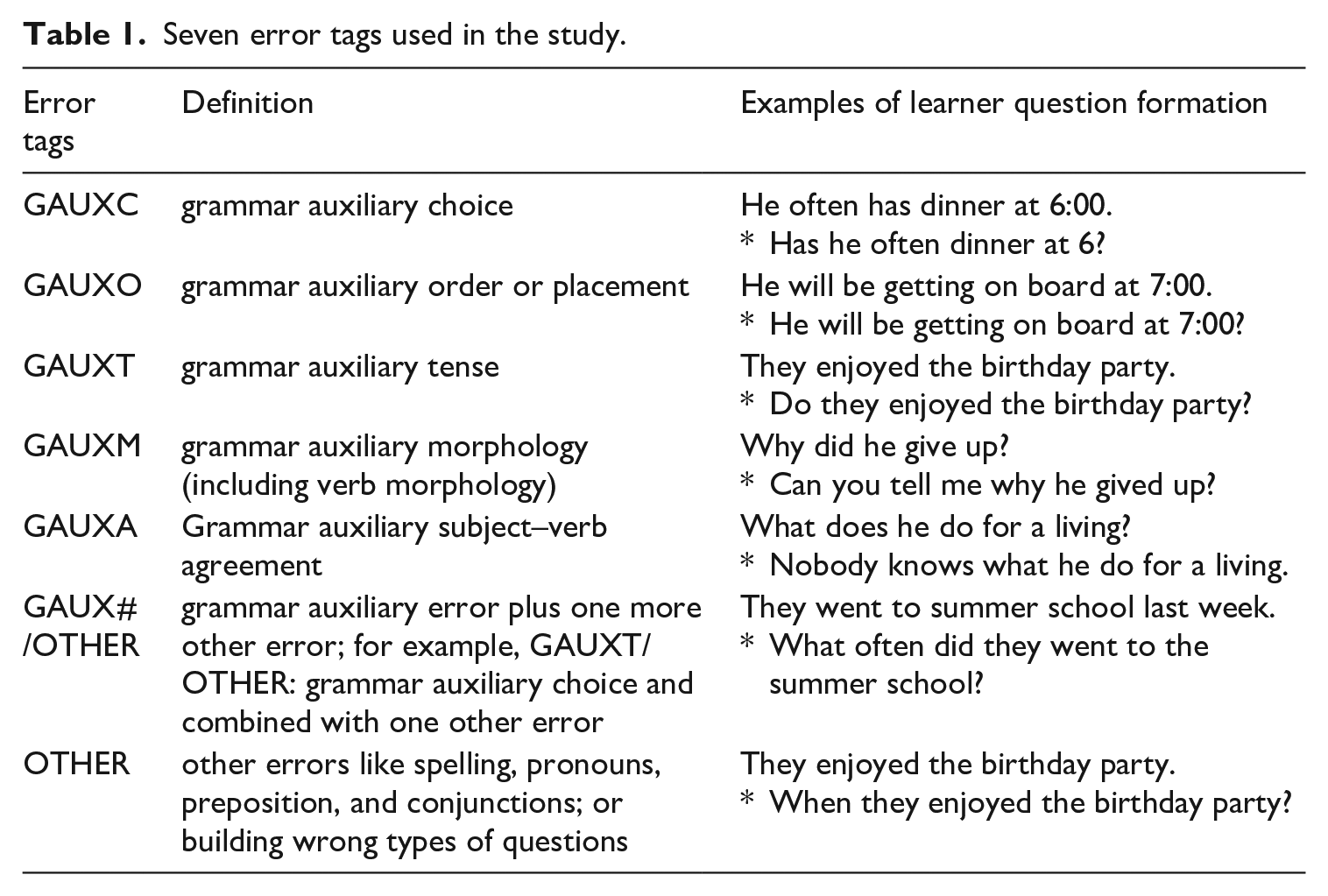
Exhaustive annotation of errors in 4 types of questions produced by 81 participants was done manually by the researchers. As shown in Table 1, the auxiliary grammatical errors we annotated include errors in auxiliary choice, marked as GAUXC, errors in tense: GAUXT, errors in subject-verb agreement: GAUXA, errors in order or placement of auxiliaries: GAUXO; errors in morphological errors: GAUXM, and mixed errors: GAUX#/OTHER. Errors were annotated as mixed errors, when two errors appeared in the sentence, with one being an auxiliary error. The mark # in GAUX#/OTHER refers to one of the specific auxiliary grammar errors on the list, which may be GAUXC/OTHER, GAUXO/OTHER, GAUXT/OTHER, GAUXM/OTHER, and GAUXA/OTHER. All errors other than those on verb or auxiliary were tagged as ‘OTHER’ (as described in Table 1). OTHER refers to errors that are not related to auxiliaries (pronouns, preposition, conjunctions, etc.)
2 L1 transfer
For learners who learn an additional language other than their mother tongue, either in a foreign language (FL) classroom setting or in a semi-natural second language (L2) communicative context, the influence of their L1 cannot be ignored. As shown in the research of methodological issues in L1 transfer by Jarvis (2000), the L1 influence may fluctuate as learners progress in their L2 proficiency. Ellis, R. (2017, p. 393) also pointed out that L1 transfer does not always appear in a linear way; some errors appearing at initial developmental stages may continue to manifest at advanced stages. In the course of L2 learning, L1 transfer can be triggered or retarded at certain points of the developmental axis, which exerts an unavoidable influence in acquiring a new language. Therefore, for a study investigating the learning process difficulty, it is imperative to include L1 transfer as an influential variable.
Based on established research in L1 transfer (Corder, 1975; Gass, 1979; among many others), Jarvis (2000) constructed his L1 transfer research model by focusing on both learners’ dynamic interlanguage performance in development and L1 background. L1 exerted influence on learning an L2 if learners displayed:
‘intra-L1-group homogeneity’ in learners’ IL [interlanguage] performance;
‘intra-L1-group congruity’ between learners’ L1 and IL performance; and
‘inter-L1-group heterogeneity’ in learners’ IL performance.
The three potential effects from Jarvis’(2000, p. 253) methodological framework of identifying L1 influence effects were adopted to analyse L1 transfer in this study to be able to evaluate the influence of L1 transfer on English question formation.
Hypothesis 1: The intra-L1-group homogeneity hypothesis assumes that learners who speak the same L1 behave uniformly when using the L2 (Jarvis, 2000, p. 254). Regarding question formation in this study, learners from an identical L1 background (Chinese) are supposed to show a similar degree of difficulty in formulating the four types of questions under investigation. Their errors are similar across different proficiency levels and language exposure.
Hypothesis 2: The hypothesis of intra-L1-group congruity between learners’ L1 and IL performance refers to the learners’ use of a specific L2 feature paralleling their use of the corresponding L1 feature (Jarvis, 2000, p. 255). This study hypothesized that learners’ errors in questions parallel the corresponding feature of the same type of question in Chinese.
Hypothesis 3: The Inter-L1-group Heterogeneity Hypothesis proposes that comparable groups of learners from different L1 backgrounds differ from one another in their IL performance (Jarvis, 2000, p. 254). In the present study, we hypothesized equivalent-level English learners from two different L1s (Chinese and Spanish) display distinct degrees of difficulty building the four types of questions, and there are differences in errors they produced in English questions.
III Methodology
This study aims to explore what errors young Chinese learners of English may produce in forming English questions and to find out, to what extent, the influence of cross-linguistic transfer underlies their morphosyntactic inconsistency. The study follows a quasi-experimental design, with participants randomly chosen by class from two schools. The data were analysed to demonstrate specific morphosyntactic inconsistency in English question formation for Chinese secondary school learners; thereafter, the underlying influence of cross-linguistic transfer on their accuracy was discussed. In addition, to support Jarvis’ (2000) third hypothesis, we collected data from Spanish learners (see the discussion and specific methodology below).
1 Research questions
What are typical errors in English questions produced by preliminary Chinese EFL learners?
How does cross-linguistic transfer from learners’ L1 influence their production of English questions?
2 Participants
The empirical study was conducted with 81 participants from two secondary schools in southwest China: a foreign language specialized secondary school (FLS School) and a rural public secondary school (RPS School). The FLS school represents the highest English teaching level in secondary schools in China, widely recognized for its high quality and specialization in foreign language teaching. The RPS school stands for the widely spread rural town secondary schools, in which English teaching does not seem adequate for creating a resourceful foreign language learning context.
3 Written tests
The written tests were conducted in a 40-minute self-study session in the classroom, with their English teacher supervising the test. The test paper was designed to test learners’ production into building 5 categories of English questions, namely, Y/N questions, Wh-questions, Tag questions, Embedded questions, and Choice questions (see Appendix 1). 1 Eighty-one students’ test results were analysed.
4 Test material
The test paper was reviewed by two coordinators of the junior secondary school English teaching groups and two teachers with more than 15 years of secondary school English teaching. They confirmed that test items conformed to the criteria for the test of their teaching syllabus used nationwide.
IV Results
1 Written tests
Table 2 shows the test results of the two groups of learners. The different proficiency level is shown in the mean scores, 34.447 for the higher proficiency FLS group and 16.294 for the lower proficiency RPS group, respectively. The result of Standard Deviation (SD) is 4.1536 for the FLS group and 7.8837 for the RPS group, which indicates that the within-group difference in the lower-proficiency RPS group is much larger than that of the FLS group.
Descriptive statistics of written test results.
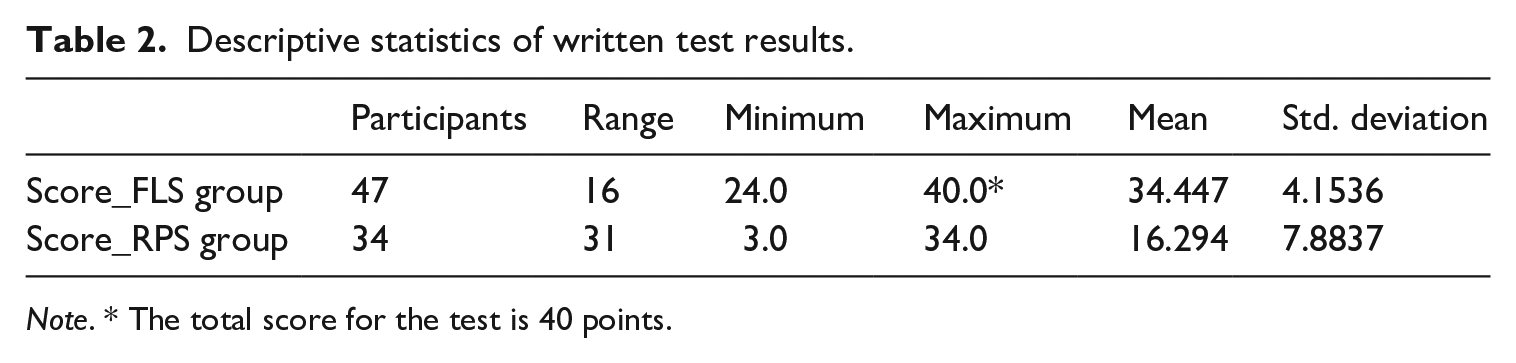
Note. * The total score for the test is 40 points.
2 Accuracy ranking of the four types of questions
Figure 1 shows the ranking of the accuracy rate in building 4 types of English questions for students from both schools. The accuracy rate was calculated for each type of question based on the mean scores participants got in the written test (Figure 1). The test results displayed two extremes of English proficiency at the same English learning stage. The FLS school group got a mean score of 9.9, 9.3, 8, and 7.3 for accurate production in Y/N questions, Tag-questions, WH-questions, and Embedded WH-questions respectively, while the RPS school group got mean scores of 6.8, 4, 2.9, and 2.6. The results showed a huge difference in accuracy in building questions for the two groups. However, the key finding is that they displayed the same gradient of accuracy when considering the type of question as a variable: Y/N questions > Tag questions > WH-questions > Embedded questions.
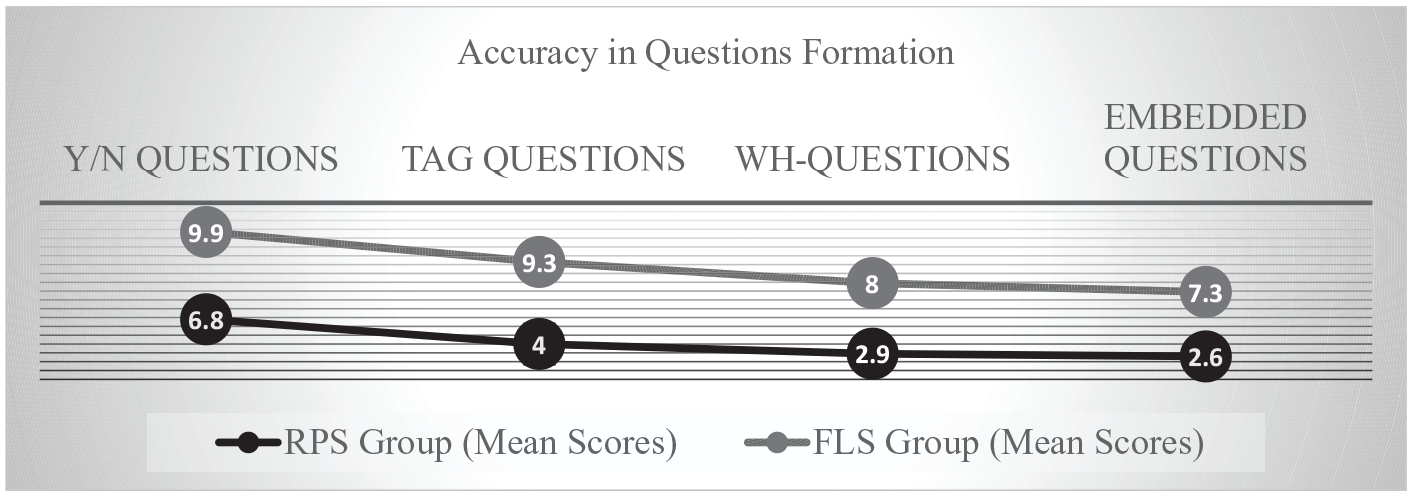
Ranking of accuracy in questions formation.
3 Error distribution
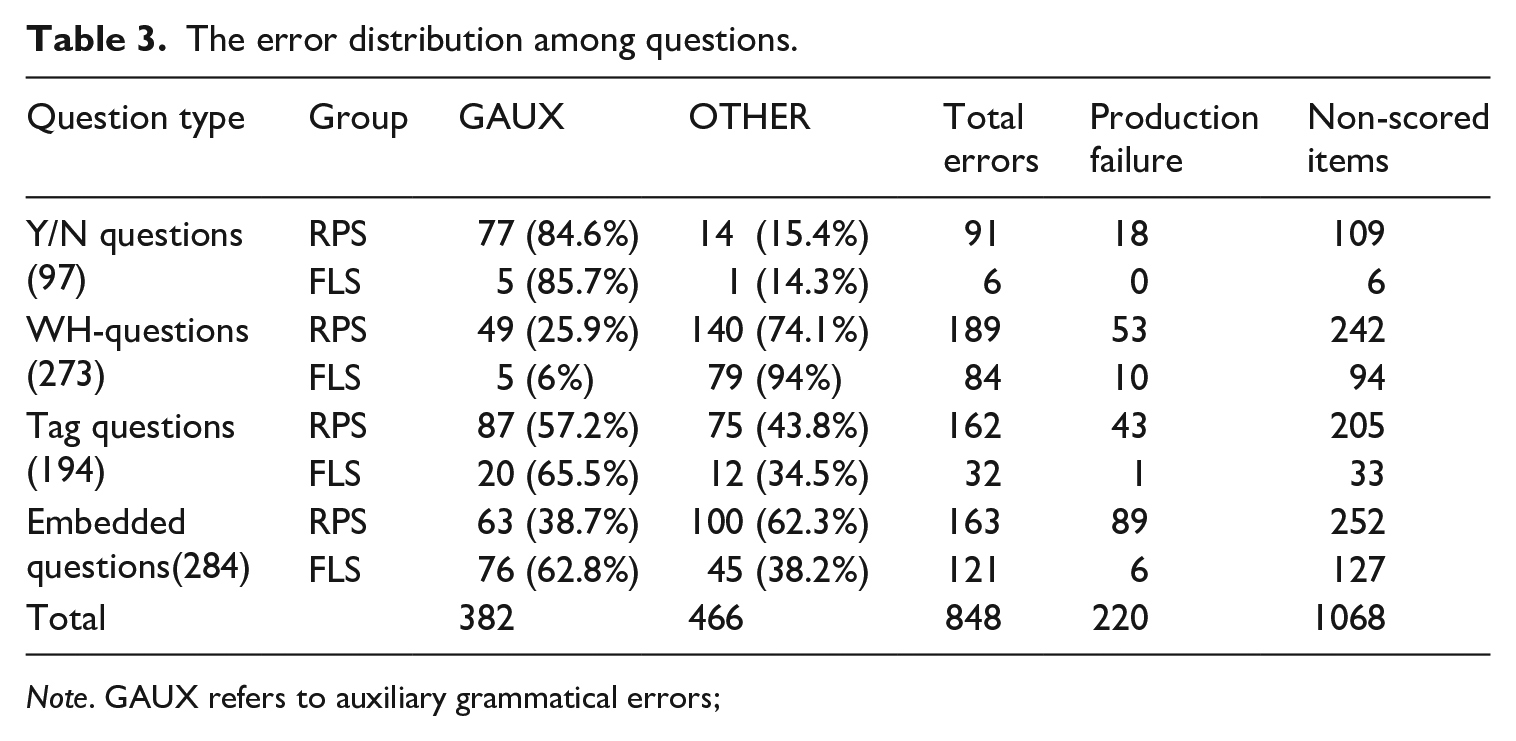
There are altogether 848 erroneous questions collected from participants. Among these erroneous questions, 97 errors were from Y/N questions, 273 from WH-questions, 194 from tag questions, and 284 from embedded questions. The number of erroneous questions indicates the learning complexity of different types of questions for participants. Table 3 shows how errors were distributed in each of the 4 kinds of questions produced by the two groups of learners. Learner errors were first divided into auxiliary errors and other types of errors.
The error distribution among questions.
Note. GAUX refers to auxiliary grammatical errors;
The total number of errors includes auxiliary errors and other types of errors. The number of unfilled items was listed in a separate column named production failure. The ratio of errors in auxiliaries shows that learners have difficulty in correctly using auxiliaries. The errors in forming Y/N questions cluster around auxiliaries for both groups, with a high percentage of 84.6% and 85.7%. Errors in embedded-questions for FLS group and tag questions also revolve around auxiliaries by showing a proportion of over 50%. Errors shown in embedded questions for the RPS group deviate a bit from the other 3 types of questions, as they display only 38.7%, the only one lower than 50%. However, the low ratio of GAUX errors in embedded WH-questions displayed by the RPS group did not indicate that they have few problems in producing embedded WH-questions. On the contrary, RPS learners showed greater difficulty in producing embedded WH-questions because they produced as many as 100 errors that are categorized as OTHER besides 63 GAUX errors, and they failed in producing 89 embedded questions among the total number of 340 questions required in the test. The GAUX errors in embedded WH-questions produced by the FLS group were 76 among the total 121 errors, which showed that learners at higher proficiency level still had problems in using auxiliaries, despite generally performing better in embedded WH-question production.
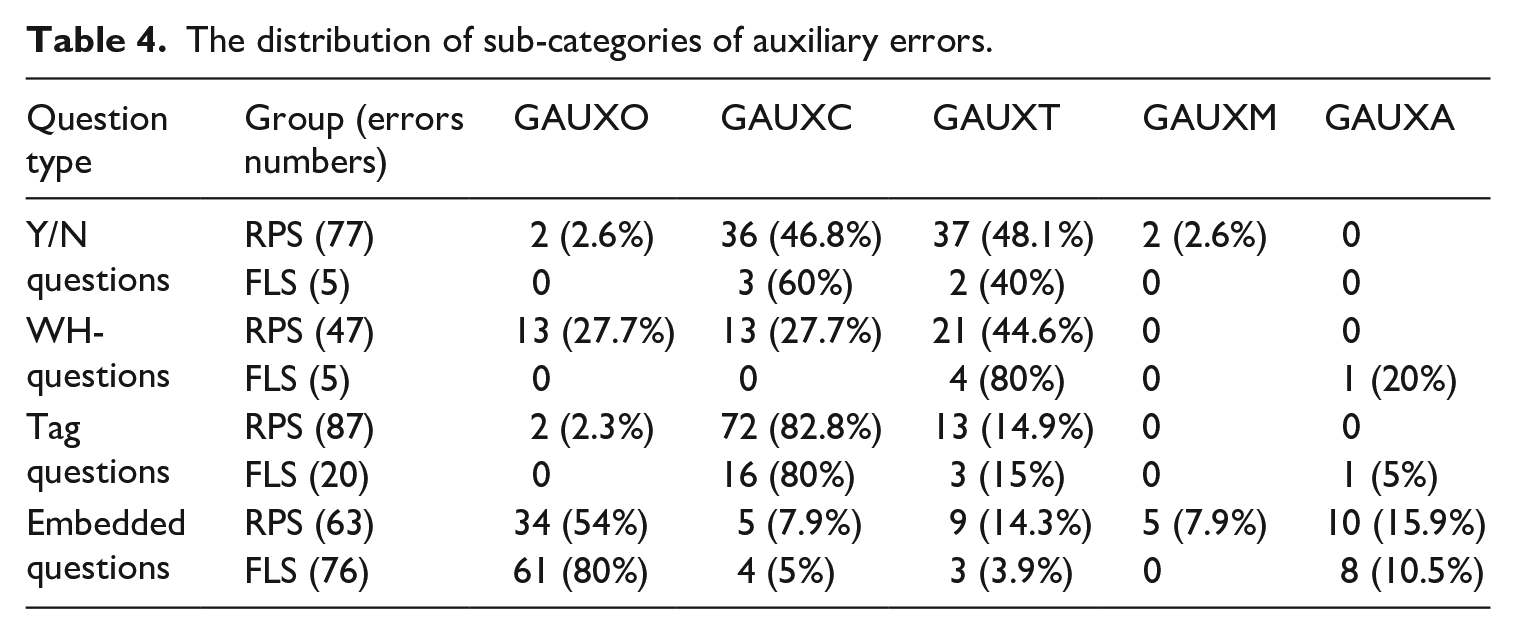
The morphosyntactic errors in using auxiliaries was studied with a more elaborate sub-categorization (Table 4). Both groups of learners had about 50% of their errors in choices of auxiliary (GAUXC) and tense of auxiliary (GAUXT), which showed that learners had more difficulty in auxiliary choice and morphological variation concerning tense than the order of auxiliary and subject–verb agreement.
The distribution of sub-categories of auxiliary errors.
V Discussion
The present study analysed errors in the written production of English questions regarding Chinese EFL learners at two different proficiency levels. To be specific, the study investigated (1) the common errors committed by the higher-proficiency group and the lower-proficiency group and the specific sub-categorization; (2) the cross-linguistic transfer exerted on English question formation for preliminary Chinese EFL learners. To clarify these issues, we ranked the accuracy of learners’ production in terms of 4 types of questions and classified learner errors into 7 sub-categories. As hypothesized, learners from different proficiency levels shared similar characteristics in question formation. First, the written performance scores clearly showed the same contour in accuracy ranking in the four types of questions. Second, the errors unanimously clustered around auxiliaries despite a sharp contrast in accuracy between groups. These results provided further support for the influence of L1 syntactic features exerted on L2 question formation in preliminary EFL learners. Thereafter, we analysed in what aspects learners’ L1 affects their formation of English questions. The following sections discuss these issues in detail.
1 Distribution of auxiliary errors
The auxiliary errors in English question formation are extensively found in different EFL learners: Spanish-speaking learners of English (Eskildsen, 2015; Pozzan, 2011); Chinese learners who speak Cantonese (Lee, 2016); Thai learners of English (McDonough & Kim, 2009); Canadian L1-French learners (Spada & Lightbown, 1999), among others. In McDonough & Kim (2009), auxiliary errors such as auxiliary omission and noninversion are found in WH-questions produced by Thai university undergraduate students. The present study results found similar problems in Chinese EFL learners, with auxiliary omission classified in the category of GAUXC, and noninversion of auxiliary in GAUXO. This study shows that preliminary learners have difficulty choosing correct auxiliaries and dealing with the inflectional variation of tense in making questions. The results in this study also correspond to Lee’s (2016) finding that learners produce errors in WH-questions that required do support and inflectional changes in verbs. However, little research has been done to further explore the exact errors in auxiliaries and why EFL learners so frequently make those auxiliary errors. The sub-categorization of learners’ errors on auxiliaries in this study aims to locate the precise problems and determine the source of those difficulties for different EFL learners.
In the present study, with elaborate sub-categorization of auxiliary errors, we found that extensive auxiliary errors in auxiliary choice (GAUXC) and tense of auxiliary (GAUXT) appeared in learners’ production of Y/N questions, WH-questions, and Tag questions, plus errors in auxiliary order produced in embedded questions (see Table 4). The reasons for error congregation may be attributed to the interaction of the influence of cross-linguistic transfer, learners’ grammatical consciousness, and other factors such as the developmental stage, learners’ learning characteristics, or the ontological features of English proper. In what follows, we focus our discussion on the influence of cross-linguistic transfer.
2 Cross-linguistic influence and English question formation
In our study, we focus on L1 influence, since we assume such L1 influence to exist, to different degrees, in the whole foreign language learning process, much of which is weakened or eliminated, because of the form-focused instruction (FFI) class teaching or as the learners’ language proficiency develops. For example, in our study, learners constructed many questions like * What is the boy received?, * When does he will come?, or * Did/Do they enjoyed the party last night? In these sentences, learners displayed that in their question production they were aware of the requirement to use an auxiliary before the subject to form questions. However, learners cannot use auxiliaries correctly because in their FL developmental stage, the complex morphological variation on verbs, which they never faced in their L1, still constitutes a difficulty for them. As learners’ proficiency improves, their grammatical awareness on correctly using auxiliaries counteracts the negative L1 influence on auxiliary use, and auxiliary errors gradually disappear in their written production.
A number of previous research also offered evidence on the pervasive L1 influence in different aspects of English acquisition by non-native speakers (e.g. the acquisition of generic meaning with English articles for Spanish and Korean speakers, (Ionin & Montrul, 2010); English lexical reference of Finnish-speaking and Swedish-speaking Finns learners of English, (Jarvis, 2000); English question acquisition and developmental sequence for L1-French L2-English learners, (Spada & Lightbown, 1999); or the acquisition of English relative clauses for nine different L1 learners, (Gass, 1979) among others).
In the present research, we studied errors produced by learners in written form to see how cross-linguistic transfer may impact Chinese EFL learners’ acquisition of English questions. Two major differences between Chinese and English questions are considered in the present study. The first one is the word order of question formation in the two languages. In Chinese questions, word order is quite stable concerning subject–verb sequence, so that Chinese is a so-called WH-in-situ language, while in English, question formation involves movement of the auxiliary to initial position. The second difference is the function of the auxiliary in question formation. English largely relies on an operation of auxiliaries to form questions, while in Chinese, there is no auxiliary, and Chinese questions are formed by adding a particle (ma, ba, or ne) or null-particle at the end of the sentence.
In the following section, we discuss the extent to which the difference in word order and function of auxiliary exert an L1 influence on learners’ English question formation in the framework of intra-L1-homogeneity, L1-IL congruity and Inter-L1-Group Heterogeneity hypotheses.
3 The intra-L1-group homogeneity in question production
The accuracy ranking results of learners’ production of English questions from the two groups provide a piece of evidence that L1 influence must constitute one factor for the learning difficulty of English questions, for learners displayed traces of L1 influence in their errors. As stated in hypothesis 1, learners with the same L1 background display similar performance in producing a specific structure in question. In this study, learners from two groups of learners with highly different proficiency displayed intra-L1-group homogeneity in three aspects: (1) the same ranking of accuracy regarding question type as a variable; (2) congregation of errors in auxiliary choice and tense; (3) high frequency of word order errors in embedded questions.
As shown in Figure 2, learners display a highly identical contour of accuracy rate among the types of questions under investigation, which, to some extent, lend support to the intra-L1-group homogeneity. The contrast in learners’ test scores indicates that language proficiency does not constitute a variable in determining the ranking of difficulty of the 4 types of questions. Learners are learning English in an EFL context and their exposure to English is mainly in the classroom context. The same L1 background, to a large extent, must explain the identical accuracy ranking, as learners built the same prior L1 knowledge of question formation, which conforms with concepts that marked difference between L1 and L2 constitutes the acquisition difficulty in the Marked Differential Hypothesis proposed by Eckman (1985).
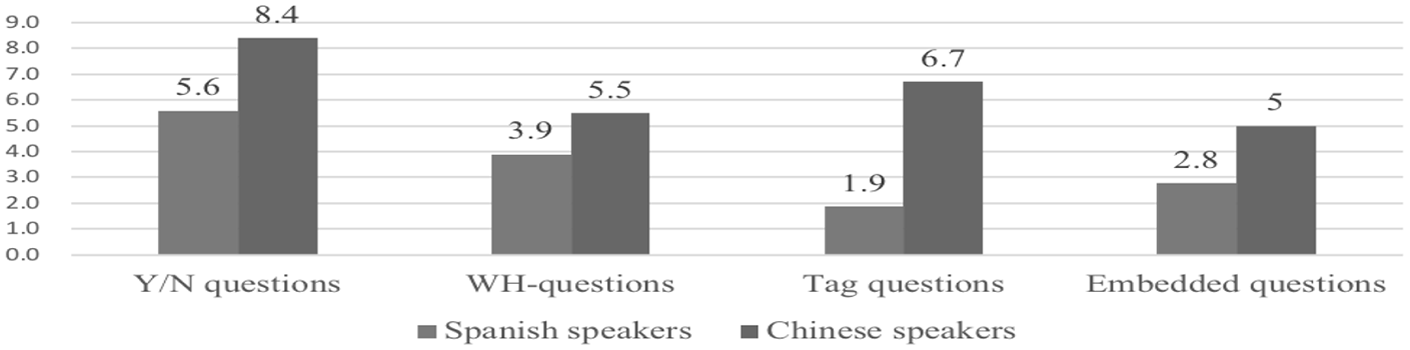
Accuracy ranking in questions formation for Chinese and Spanish learners of English.
Learners from both groups show homogeneous distribution of errors: low incidence in word order errors and congregation of errors in auxiliary choice and tense. From the data shown in Table 4, we can see that learners from both groups do not exhibit many problems in the word order in Y/N questions, WH-questions, and tag questions, which is different from the word order problems shown by participants of L1-French L2-English learners discussed in Spada (1999). In the present study, our participants’ errors in the three types of questions unanimously congregate on auxiliary choice (GAUXC) and tense of auxiliary (GAUXT). Errors in forming English questions are shown with L1-specific homogeneity in Cowan (2008, pp. 78–80). Cowan (2008, p. 78) illustrated that problems in question formation existed among learners of different L1: No do-support and non-inversion errors in Y/N questions by Portuguese and Arabic learners who only added intonation or question markers in a way similar to their L1 question formation; learners from L1 like Romance languages and Farsi formed WH-questions by placing a WH-word before a declarative and inverting the whole content verb before the subject in the way of questions formation of their L1. In the present study, learner errors are mainly on choice and tense variation, since there are neither auxiliaries nor inflectional affixes to mark tense in Chinese question formation. Learners’ L1 influence can be one important reason to explain their homogeneous distribution of errors in auxiliary choice and tense.
In embedded questions, learners exhibit a high percentage of word order errors. Contrary to the rule of auxiliary fronting in forming typical questions as Y/N questions, WH-questions, and tag questions, primary learners, both higher and lower level groups, show problems in non-inversion of auxiliary in embedded WH-questions. It seems learners from both groups unanimously displayed overapplication of the auxiliary-fronting rule in forming embedded WH-questions. Since participants are required to form embedded WH-questions with given direct questions, they need to put the word order of embedded questions back to declarative form. We must consider another possible reason for the high frequency of errors in embedded questions, as an effect of the test method used (transformation of direct questions into embedded questions). If it were for the latter, we might speculate that in spontaneous production of embedded questions in spoken form, learners would produce fewer word order errors because of the positive transfer from the corresponding L1 (Chinese) word order of subject–verb sequence.
4 L1-IL congruity in question production
Learners’ L1-IL congruity is shown in the use of auxiliaries. English questions are formed by moving auxiliaries in front of the subject, and Chinese questions are formed by adding particles such as ma or ba (Zhu & Wu, 2011). The results in Table 4 show that over 90% of learner errors (for both groups) in Y/N questions and Tag questions, and about 75% in WH-questions lie in GAUXC (choice of auxiliary) and GAUXT (tense of auxiliary). L1 transfer effects were not discerned in the L1–L2 word order difference. The strongly marked structural difference in word order is likely to help learners notice the L1–L2 difference and use the correct form when building questions. However, the high percentage of errors in auxiliary choice and inflectional changes in tense in both groups suggests that learners’ interlanguage production bears features of their L1 structure.
Declarative sentence: (2) a. She went to school yesterday Ta zuotian shangxue le. ‘She yesterday went to school.’ b. * Did she went to school yesterday? Ta zuotian shangxue le ma? ‘She yesterday went to school?’
There is no auxiliary in questions in Chinese, while in English, an auxiliary is a must in questions. Besides, Chinese questions are formed by only adding a particle ma, ba, or ne or null-particle at the end of a declarative sentence/statement, whereas English question formation involves movement of auxiliaries and necessary inflectional changes on the content verb. As stated in the previous section, the markedness of L1–L2 structure differences enhances learners’ alertness of using an auxiliary in front of the subject to form the question. As shown in the example sentence (1-b), learners correctly add a did at the beginning of the question, but they fail to make the inflectional changes on the word went. In Chinese, there are no inflectional changes, which are quite common in English verbs. In (1-b), learners’ errors show the traces of Chinese question formation of not making any changes on the content verb went. Especially for low proficiency preliminary learners, extracting the auxiliary from the content verb which bears the person, number or tense features and then fronting the auxiliary to form questions proves to be a demanding task. The high-frequency morphosyntactic inconsistency of overusing auxiliary (* Did they enjoyed yesterday?) indicates that learners may perform well in inserting the auxiliary in initial position, but not removing the tense-marker carried on the content verb, i.e. not extracting the inflectional features in the verb and fronting them merged on a host auxiliary.
About 50% of auxiliary errors in Y/N questions (in the category GAUXC in Table 4) are on auxiliaries’ choice. Erroneous questions such as * Does she is a teacher? and * Do you have got your new book? frequently appear in lower-level learners’ production, which shows that low proficient primary learners cannot exactly locate and extract the verb’s inflectional features from given declarative sentences. They simply learned the grammar rule of adding an auxiliary at the beginning to form a question, failing to choose the correct auxiliary required in a given sentence and relate it to the verb’s inflectional features. The reason for learners’ inertia in extracting the auxiliary can be traced back to their L1 language influence. It seems that the lack of morphological variation in Chinese has a cost on learners, in that it takes much longer for them to acquire the inflectional changes in English (Hawkins & Liszka, 2003; Lee, 2016). Chinese learners’ difficulty of acquiring languages with complex morphology, such as Spanish (Dowens, & et al.; 2011), also lends support for the L1 language influence.
5 The inter-L1-group heterogeneity in question formation
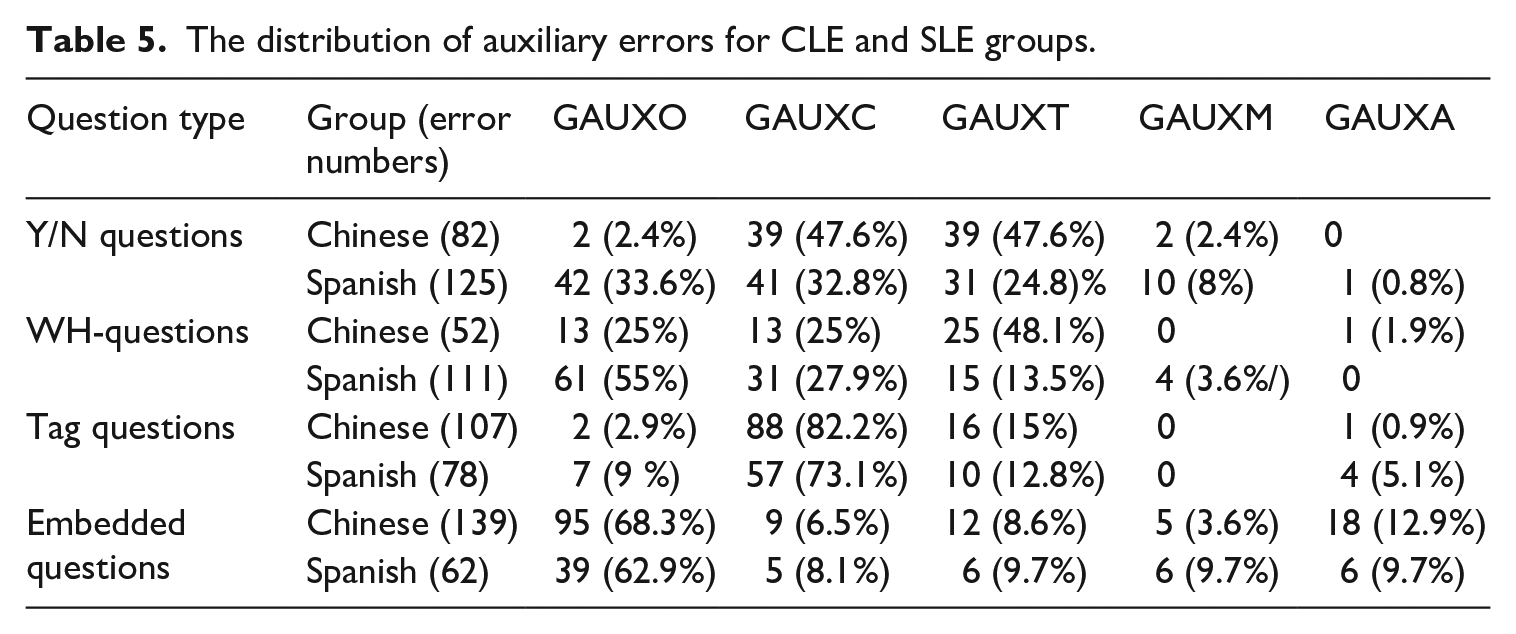
In order to check whether there is an inter-L1-group heterogeneity in question formation, we had to incorporate data from a different L1 group of learners. Thus, we recruited a group of sixty-two Spanish learners of English of ESO (Educación Secundaria Obligatoria) grade-4 from three Spanish secondary schools (roughly equivalent to the Chinese secondary learners of this study) to do the same test, among which fifty-two results were valid. 2 The test results showed a significant difference between Chinese learners and Spanish learners in the acquisition of questions in both the ranking of accuracy in forming four types of questions (as shown in Figure 2) and the most prominent errors they made (Table 5).
The distribution of auxiliary errors for CLE and SLE groups.
The accuracy ranking of the four types of questions under investigation for Spanish learners of English is Y/N questions > WH-questions > Embedded questions > Tag questions. The accuracy ranking indicates Y/N questions are the easiest for them, followed by WH-questions and embedded questions, and Tag questions are the most difficult for them. As shown in Figure 2, the accuracy ranking for Chinese learners of English is Y/N questions > Tag questions > WH-questions > Embedded questions. Chinese learners of English and Spanish learners of English showed different accuracy rankings of questions, indicating that the ranking of accuracy is not due to the nature of questions per se, but rather, L1 influence may be one of the essential factors.
There is a remarkable difference in the distribution of the most prominent GAUX errors produced by Chinese learners and Spanish learners. As we discussed in the previous section, Chinese learners produced extensive GAUXC and GAUXT errors. Unlike their Chinese counterparts, Spanish learners of English produced sizable GAUXO errors, which means that they had more difficulty concerning word order other than the choice of auxiliary and tense variation. The highest error rates for the Spanish group are in the order of auxiliary, in Y/N questions, WH-questions, and embedded questions, which are 33.6%, 55%, and 62.9%, respectively (as shown in Table 5).
Even more interesting, the GAUXO errors produced by the Spanish group show substantial differences from those by the Chinese group. The GAUXO errors from the Spanish group are characterized by moving the whole verb in front of the subject (e.g. She went to school yesterday. – * Went she to school yesterday?), which are not produced by Chinese learners at all. The unique GAUXO errors Spanish speakers produced showed similar structures in their L1 Spanish questions, as shown in examples (3) and (4).
(3) The target question: What did the boy receive? a. Spanish learners: ¿Qué recibió el niño? * What received the boy? b. Chinese learners: Nage Nanhaier shoudaole shenme? * The boy received what? (4) The target question: Did they enjoy the party? a. Spanish learners: ¿Disfrutaron [past tense, third person plural] la fiesta? Enjoyed [past tense, third person plural] the party? * Enjoyed they the party?
3
b. Chinese learners: Tamen xihuan wanhui ma? They enjoyed the party particle-ma? * They enjoyed the party?
In forming questions ‘The boy received
However, our study explores the L1 influence in question formation at the preliminary English learning stage. Most of the L1 transfer phenomena discussed here will gradually disappear in learners’ written production as they advance in their English proficiency. However, whether some L1 influence is persistent, or at least implicitly residual, remains unknown. Therefore, further studies on advanced EFL learners’ implicit knowledge and spontaneous oral production in this respect is necessary for elucidating the issue.
6 Explicit grammatical knowledge and English learning in EFL contexts
Explicit knowledge is conscious, declarative, accessible in controlled processing, allowing learners to exploit it as a ‘tool’ when they confront difficulty in performing language tasks (Ellis, R., 2009). In an EFL context, learners’ explicit grammar weighs much in facilitating learners’ acquisition. First, explicit knowledge provides learners with scaffoldings that help them to produce target structures. EFL learners rely more on explicit grammar knowledge in constructing new target structures than English learners with sufficient target language contexts. In the review of grammar teaching, Nassaji & Fotos (2004, p. 127) pointed out that it is significant to consider grammar as a necessary component of language instruction in the L2 classroom. In the present study, teachers from the two Chinese schools also confirmed that they adopted an FFI approach and emphasized that grammar knowledge instruction is an indispensable part of their English teaching. Second, explicit grammatical knowledge plays a significant role in improving learners’ language accuracy. Grammar instruction contributes effectively for learners to attain the accuracy of the target language structure (Nassaji & Fotos, 2004; Nassaji & Swain, 2000). In EFL contexts, learners utilize explicit grammatical knowledge to measure whether their own language output conforms to the target language. Learners also resort to their grammatical knowledge to monitor their language production and ensure their language production accuracy. Third, explicit knowledge facilitates learners to acquire automatized or implicit knowledge of the target structure. Even though researchers did not reach an agreement on whether there is a direct interface between explicit knowledge & implicit knowledge (see, amongst others, Ellis, N.C., 2005; Ellis, R., 2005; Krashen, 1981; Suzuki & DeKeyser, 2017; Zhang, 2015), it is widely accepted that explicit knowledge facilitates learners’ acquisition of implicit knowledge (Ellis, R., 2009). Therefore, the role of explicit grammar knowledge in improving language quality for learners in an EFL context should not be ignored.
a Pedagogical implications
We have proved the validity of Jarvis’ (2000) hypotheses, the intra-L1 group homogeneity, IL-L1 congruency and inter-L1 group heterogeneity in question formation. This indicates that cross-linguistic influence from learners’ L1 constitutes a problem for Chinese preliminary EFL learners. The morphosyntactic inconsistency in learners’ production, on the one hand, stems from the discrepancy of Chinese and English question formation, and on the other hand, it also results from lacking enough facilitative language context for learners to use and practice their language skills, which seems to favor a stronger influence from learners’ L1. To reduce the impact of cross-linguistic influence sourced from L1–L2 differences, raising learners’ consciousness of the structure, and providing learners with adequate context to produce what they have learned is significant in teaching practice.
b Consciousness-raising (CR) tasks
In the EFL context, explicit grammar instruction is an important link in language classes. To raise learners’ consciousness of grammar helps to promote learners’ acquisition of the target structure. For both teenagers and adult learners, understanding how target language rules work underlying their production is an important part of their learning process (Scheffler & Cinciała, 2011). CR helps learners understand a specific grammatical feature and develop learners’ production of a grammatical form (Ellis, R., 2002; Fotos, 2002).
From questions produced by learners, we can infer that learners have built some grammar knowledge, but their awareness may not be consolidated enough to help them produce accurate structures. According to Chan (2004), L1 factors likely affect target language acquisition as learners’ incomplete target language knowledge may trigger language transfer, and learners’ use of target structures reflects aids from their L1 knowledge. As explicit awareness of grammatical form contributes to learner production and helps them progress through interlanguage development (Ambridge, Rowland & Gummery, 2020; Larsen-Freeman, 2015), it is important to include CR tasks in the class design of English questions instruction. CR tasks promote learners’ acquisition in that CR involves processes of implicit knowledge acquisition: noticing, comparing, and integrating. Noticing and comparing are directly attended in the CR tasks, while integration is constrained by learners’ developmental stage (Ellis, R., 2002). For EFL learners at the preliminary level, noticing helps them to become aware of the target linguistic feature presented in the input, which may otherwise be ignored (Ellis, R., 2002). In comparing linguistic features they noticed with their present mental grammar formed in their L1 knowledge, learners become aware of the difference between L1 and L2. As long as learners build up explicit grammar knowledge and reach their developmental stage, they reach the integrating process, in which they incorporate the new knowledge into their present mental grammar and thus acquire the target structure.
c Production-Oriented Approach
As learners lack a natural context to practice and produce, an appropriate approach that suits EFL learners to promote their production helps mitigate the problem. The Production-Oriented Approach (POA) proposed by Wen (2016) is tailored for Chinese EFL learners. The POA, which fully considered the Chinese EFL context, has been practiced in tertiary classroom instruction in China and proved to improve the quality of learner’s language production. As Wen (2016) suggested, POA might also work for learners from primary and secondary teaching contexts if effectively implemented.
The POA comprises three stages of instruction, which are motivating, enabling, and assessing:
Motivating activities are designed based on the output-driven hypothesis. In this stage, learners are motivated to finish a productive activity, and they understand what is needed to fulfill the task (Wen, 2016). The motivating activities will help learners maintain initiative to conduct enabling activities, which ensure the success of their production.
Wen (2016) suggested the core of the enabling phase is teachers’ carefully selecting material pertinent to the assigned task, which can then be used as enablers in order to help learners gain scaffolding to approach their own zone of proximal development. Learners are also encouraged to selectively learn what they need to fulfill their productive activity. Considering the smaller volume of L2 language knowledge and learning capacity of preliminary learners in secondary school, we suggest a modified version of POA that brings CR tasks into the essential stage of enabling.
In the assessing activity, learners’ language products are presented and evaluated, which can be in written or oral form. The assessing phase exists in the enabling stage when learners are consciously working on language inputs or in presenting specific language products.
d An integrated design of POA and CR tasks
The POA is initially designed for adult learners at the university stage. In this study, we suggest a modified version of POA by adding CR tasks in the second phase to take into account learning characteristics of preliminary EFL learners. Based on the key hypotheses and the theoretical foundation of CR tasks and POA, we present an integrated version of POA and CR tasks, as shown in Table 6.
Phases and tasks of an integrated version of Production-Oriented Approach (POA) and Consciousness-raising (CR) tasks.
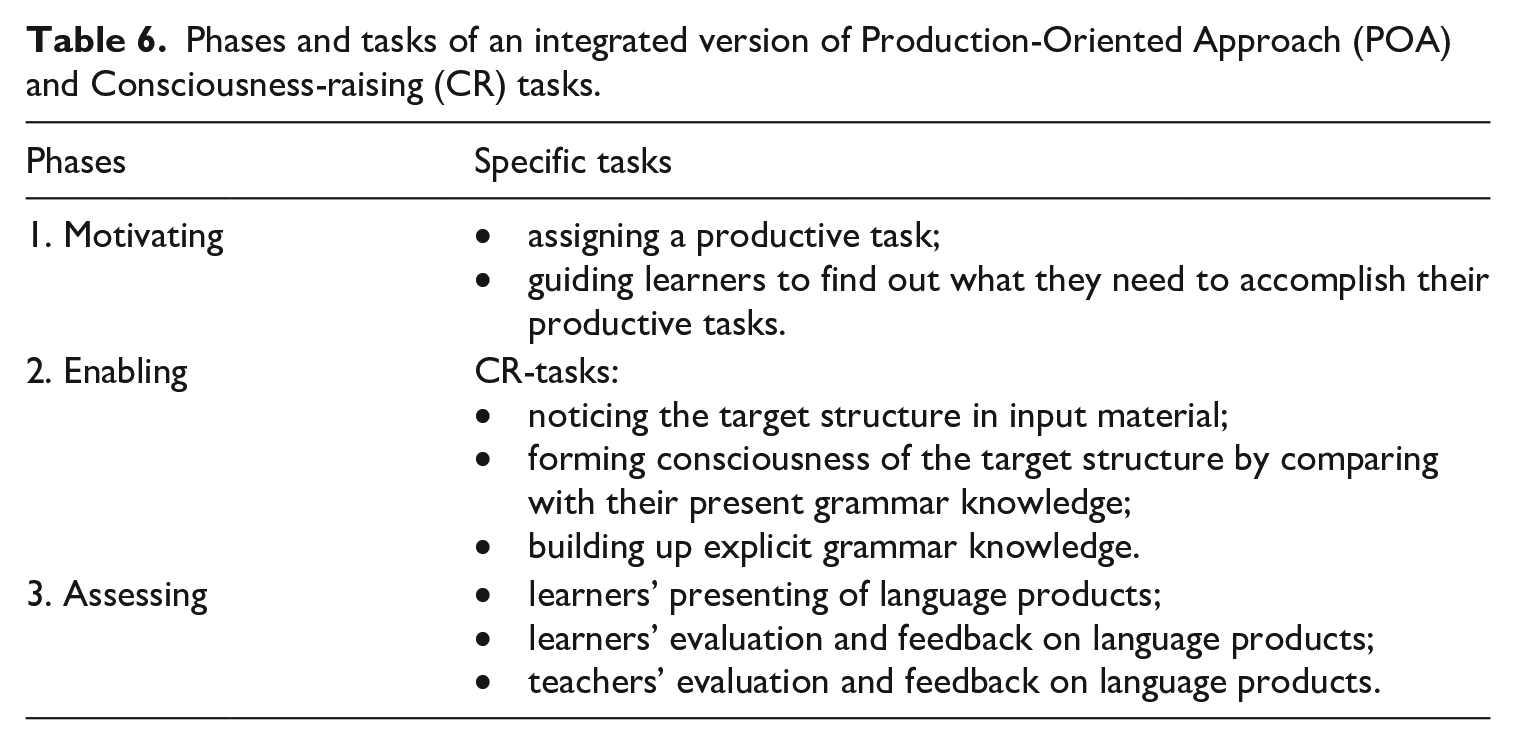
The integrated version of POA follows Wen’s (2016) three phases of motivating, enabling, and assessing. In EFL contexts, the scarcity of natural communicative context requires more on the teachers’ choice of effective teaching approach and design of meaningful tasks. For preliminary EFL learners, introducing visual incentives (for example, picture cues, or video cues) into productive activities in the motivating phase can help elicit learners’ question production. Meanwhile, a clear instruction of tasks in the first phase is key for subsequent successful productions. The enabling phase for preliminary EFL learners is different from the original POA in virtue of learners’ inadequacy of fulfilling demanding tasks for tertiary learners. The CR-tasks for enabling learners to accomplish productive activities requires teachers to help learners to ‘focus on a known source of difficulty [and to enable learners to discover the rule’ (Ellis, R., 2002). Raising learners’ consciousness of target structures offers them scaffoldings to accomplish the assigned productive activities. In the assessing phase, teacher’s feedback and learners’ peer feedback on language products serves as ‘auto-input’ to enhance learners’ acquisition of target structures.
VI Conclusions
In this study, we used the written test to measure learners’ ability to form four typical types of questions correctly. Their performance was analysed on the accuracy ranking of the four types of questions and a fine-grained sub-categorization of learners’ errors. Analysis of learners’ morphosyntactic inconsistency was conducted to elaborate on the exact source of errors learners produced, and L1 transfer was discussed to tackle their learning difficulty at a preliminary learning stage. Overall, this study showed that: (1) preliminary Chinese EFL learners have great difficulty in choice and morphological variation of auxiliaries in English question formation; (2) learners from the same L1 displayed similar problems in forming English questions, independent from their proficiency level; (3) cross-linguistic influence plays an important role in learning difficulty of English question formation for EFL learners at the preliminary stage. We have provided further support for Jarvis’ (2000) three hypotheses for identifying L1 influence effects, on the basis of linguistic data from Chinese learners, with additional support from Spanish learners verifying the inter-L1-group heterogeneity.
Therefore, teachers in the EFL context should take full consideration of the L1 influence in designing teaching tasks. On the basis of the specific problems raised by the structure of English questions for Chinese learners, this study further provides general pedagogical implications in how to deal with difficulties in learning a foreign language structure for EFL learners, how to provide effective input, and how to promote learners’ production of high-quality language.
The findings reported in this study raise questions for further study. First, whether the errors appeared in the preliminary EFL stage will completely vanish, or any specific errors persist as learners gain high English proficiency. Second, further studies are needed to find out whether EFL learners can gain native-like accuracy in English question formation. Studies should be conducted in varied EFL contexts to tackle whether learners from distinct L1 differ in their difficulty in English question formation, which may provide further evidence of how L1 influences the acquisition of the L2 language structure. The findings also suggest that the degree of consciousness of grammatical knowledge can be an important variable that affects learners’ accuracy in forming English questions.
Footnotes
Appendix 1
Written test of question formation
疑问句测试 (40 minutes: 40分钟)
School 学校: _______________________ Grade&Class 年级班级: _____________
Name 姓名: ________________________ Gender 性别: _____ Age 年龄: ______
Acknowledgements
We wish to express our most heartfelt gratitude to the schools that participated in our study, in Sichuan Province, and in Tarragona, most especially to the teachers and English learners. We are also indebted to two anonymous reviewers for their valuable comments and critical observations, which helped us improve the paper. We are grateful to the audiences of the Linguistic and English Language Postgraduate Conference 2021 held by Edinburgh University & The 3rd New Trends in Foreign Language Teaching Conference 2021 held by Granada University, where we presented part of this study. Needless to say, we are responsible for any remaining shortcomings of this study.
Funding
The author(s) disclosed receipt of the following financial support for the research, authorship, and/or publication of this article: This research was supported by the Youth Research Program of the first author from Sichuan International Studies University (No. sisu201643). The second author acknowledges funding from the Serra Húnter Program (Catalan Government), the 2017 SGR 165 Research Group on Language and Linguistics, ROLLING (AGAUR), and the URV Program for Fostering Research.
