







Abstract
Focusing on the relationship between linguistic, cognitive, socioemotional factors in writing English for academic purposes (EAP), this study investigated whether topic familiarity as an important cognitive factor of task complexity influences different levels of emotionality and linguistic complexity in EAP writing and whether there are relationships between emotionality and linguistic complexity. To do so, 64 international graduate learners enrolled in EAP writing courses participated in the present study. Each wrote on familiar and unfamiliar topics determined via a questionnaire at the onset of the study. Their writings were then measured for textual emotionality and linguistic complexity using automatic assessment tools. Results showed that EAP writings differed systematically in terms of both emotionality and linguistic complexity due to the influence of topic familiarity. Unfamiliar topics led to writing performance with a significantly higher level of emotional negativity and significantly lower linguistic complexity levels as compared to familiar topics. A follow-up correlation analysis also revealed significant relationships between emotionality and linguistic complexity measures, indicating complex interactions between linguistic and socioemotional factors. Implications of these findings are discussed relative to deploying writing topics with varied levels of cognitive complexity for encouraging classroom engagement and improving L2 learners’ writing performance by effective task sequencing.
I Introduction
Topic familiarity (TF), recently construed as an internal factor of task readiness, is commonly defined as one’s prior content knowledge about a specific topic (Bui, 2014) which can affect different constructs of linguistic production. Topic familiarity is of paramount importance for second language (L2) writing assessment and pedagogy due to its pivotal role in the degree of cognitive complexity of a task (Robinson, 2011) or the difficulty level of a task (Skehan, 2014). However, most L2 empirical studies on topic familiarity have been concerned with the speaking modality, whereas very few studies have explored its effects on the quality of linguistic production in the writing modality. Since the writing process includes a set of unique characteristics which can possibly impact the interplay between the cognitive complexity of tasks and the quality of linguistic features (Yang & Kim, 2020), it is worthwhile uncovering how the complexity, accuracy, and fluency (CAF) of L2 written production and, in particular, the controversial constructs of linguistic complexity (Norris & Ortega, 2009) are affected by variation in topic familiarity. In addition, no empirical explorations to date have been conducted to probe the relationship between topic familiarity as a cognitive factor and emotionality as a social-emotional factor in L2 writing. Textual emotionality (the emotional positivity, emotional negativity, and overall textual sentiment) seems to be potentially prone to mediation by instructional factors such as topic familiarity. Thus, an empirical investigation into L2 learner emotions while writing about familiar and unfamiliar topics is warranted to reveal how variations in topic familiarity would evoke different emotions in L2 learners. Our empirical exploration about the effect of topic familiarity on linguistic complexity as well as textual emotionality in a context of English for academic purposes (EAP) would provide important implications for EAP writing teachers and language practitioners on how to improve L2 students’ writing quality, particularly focusing on linguistic complexity and affective responses in writing, by designing tasks with varied levels of cognitive complexity and optimally sequencing them in lesson planning.
II Review of literature
1 Research on the role of topic familiarity in L2 writing
As pointed out by Bui (2014), one’s familiarity with various aspects of a learning task, hence task-internal readiness as compared with task-external readiness such as pre-task planning, can be viewed as one’s a) declarative knowledge learned as subject knowledge (content/topic familiarity), b) procedural knowledge about a skill which cannot be verbalized (procedural familiarity), and c) schematic knowledge about a certain space (e.g. a campus map), process (e.g. a general idea of going to a restaurant), or idea structure, which relies much on common sense, can be verbalized, but may not concern the details. These various types of familiarity inherently but implicitly prepare learners for different kinds of L2 learning tasks, which make an interesting contrast to explicit preparedness offered through task conditions (e.g. different kinds of planning and rehearsal). Bui (2014) argued that there is a need to differentiate overt planning opportunities (task-external readiness) from familiarity (task-internal readiness) though both offer task-preparedness. TF (topic familiarity) in Dochy and Alexander’s (1995) conceptual map of topical (prior) knowledge was described as subject-matter knowledge, domain-specific knowledge, and discipline knowledge, which may be acquired through formal instruction or informal channels such as life, work, and study (i.e. experiential knowledge). The advantages of having TF lie in one’s meaningful inferences and principled understanding of input materials during the learning process. Prior research has well documented the facilitative effects of TF in L2 listening (e.g. Schmidt-Rinehart, 1994) and reading (e.g. Leeser, 2007). However, TF has only begun to attract attention in L2 production task research recently (such as Bui & Huang, 2018, for L2 speaking tasks, and Yang & Kim, 2020, for L2 writing tasks) given its relevance to improving student linguistic performance, emotional responses, and validity and fairness in L2 assessment.
One early study in the field of L2 writing by Tedick (1990) found that L2 graduate students (N = 105) performed significantly better in terms of holistic measures, length, and T-unit and error-free T-unit indices when they wrote on a topic pertaining to their field of studies than on a general topic which they had less familiarity about. He and Shi (2012) also involved writing on a general (familiar) knowledge topic (university studies) and a specialized (unfamiliar) topic (federal politics). Results showed that students across three proficiency levels performed significantly better on the general (more familiar) topic than they did on the specific (less familiar) one in terms of length, content, organization, and development of ideas. Students also produced more language errors and less frequent use of academic words on the specific topic. Similarly, Yu (2010) showed significantly lower lexical diversity among adult L2 English writers when they wrote on less familiar topics as compared to a more familiar topic. However, Lee (2008) found that students’ performances were not statistically different on the two different tests or across the prompts chosen on the FS EAP writing test.
Three recent studies (McDonough & Crawford, 2020; Yang & Kim, 2020; Yoon, 2017) investigated the relationship between TF and linguistic complexity, and the first one even touched upon learner perceptions. McDonough and Crawford (2020) found that L2 writing artifacts with personal experience had higher ratings, greater subordination and more target verb forms, although no differences in accuracy were detected. The participants felt that the familiar topic helped activate their linguistic knowledge in writing and created a positive correlation between their perceptions and text features. Yang and Kim (2020) had a between-group design with 123 Chinese EFL college students, with 61 writing on a familiar topic and 62 writing on a less familiar topic. The measurement involved lexical complexity, syntactic complexity, accuracy, and fluency. The results revealed that the students produced essays with significantly lower lexical complexity for the less familiar topic than for the familiar topic, while the performance areas of accuracy, fluency, and syntactic complexity were not affected by the degree of familiarity. Yoon (2017) also found strong topic effects on the majority of complexity measures (i.e. more complex language in a topic more relevant to writers’ experiences).
The above review of prior literature showed that, though topic familiarity exerts a positive influence on general L2 writing performance as predicted by Bui’s (2014) task-readiness framework, disagreement exists as to whether topic familiarity could enhance linguistic complexity. Yoon (2017) and McDonough and Crawford (2020) found strong TF effects on syntactic complexity, but Yu (2010) and Yang and Kim (2020) only found an effect on lexical complexity but not syntactic (both syntactic and lexical complexity) complexity. This study aimed to further investigate the effects of TF on linguistic complexity (both).
2 Insights from research on the textual emotional dimension of L2 writing
Cognitive psychology has generally agreed that emotion is an essential part of human cognition (Dewaele, 2005; Harris, Gleason, & Ayçiçegi, 2006). As Han and Hyland (2019) argued, emotion as an elusive construct involves cognitive, affective, motivational, expressive, and physiological processes and components (Prior, 2016). In a series of articles, Pekrun (2014) and Pekrun, Elliot, and Maier (2009) have associated emotion with academic settings and conceptualized academic emotion along two dimensions: valence and activation. Valence is the pleasure-displeasure dimension of emotion. In contrast, activation refers to the physiologically arousing-relaxing dimension of emotion (Pekrun et al., 2009). The two dimensions are intertwined, and their combination may exert different influences on learning. For example, positive/negative valances + activation/deactivation would increase or reduce students’ motivation, anxiety, and efforts. Learning with optimal emotion (Richards, 2020) and learning for proper expression of emotion as an essential part of sociocultural competence in an L2 (Dewaele, 2005) are equally important. While the former has gained much attention in SLA, the latter issue remains under-explored.
Language use per se is an emotionally charged process, which is particularly challenging for second language learners who may lack either language skills (Belcher & Hirvela, 2005) or motivation to learn in the target language (Dörnyei, 2005). Harris, Ayçiçegi and Gleason (2003) found that learners reacted much more strongly to taboo words in the L2 than in their L1. Dewaele and Pavlenko (2002) showed that the L2 learners group used significantly fewer emotion words than the native speaker group performing similar tasks. This finding was in line with Schrauf (2000) in which the recall of emotional events in the L1 is more vivid and intense than that in the L2. All this points to the importance of the linguistic expression of emotion in an L2 as part of one’s communicative competence, which was, unfortunately, less touched upon in prior literature.
As one of the most important and most researched areas in SLA, academic writing is also emotionally laden and prone to influences of emotional factors on different linguistic areas, such as lexical and morphosyntactic versus pragmatic planning (Clachar, 1999), syntactic and content structure (Kean, Glynn, & Britton, 1987). Clachar (1999) found that an emotional topic could orient students’ attention to the lower, lexico-morpho-syntactic level of discourse processing during their planning and actual writing processes; it could also lead them to focus on the higher pragmatic and textual levels during revision. In addition, Clachar (1999) discovered that there were significant differences between emotional and non-emotional composition. Non-emotional composition induced a higher proportion of planning activities in pragmatic aspects as well as in textual formation than emotional composition did. The L2 participants needed less time to process lexico-morpho-syntactic information in emotional composition. In a corpus-based study, Wang (2020) found that Chinese EFL learners, in general, wrote with a positive style. When they were provided with positive writing prompts, they had higher emotional scores in their written responses. He further examined the relationship between syntactic complexity and textual emotionality. The results showed that the highest complexity scores were achieved when the textual emotion was neutral, while both positive and negative emotions during writing were associated with a lower score in the indices of mean length of clause and coordinate phrases per clause. However, prior research seems to have focused much on the learners’ emotional states; little attention was paid to textual emotionality and its relationship with task characteristics such as topic familiarity.
There has been a range of instruments for assessing emotional states, including qualitative clinical discourse analysis, standardized scales, behavioural observation, and neurophysiological correlates (for a review, see Wang, 2020). A slightly different measurement relevant to L2 writing is sentiment analysis, a text-based emotion detection tool. Sentiment analysis is used to detect and quantify the emotional information in the text in terms of sentiment polarity (positive, neutral, or negative). For details, please refer to Section III.
3 Research on linguistic complexity in L2 writing
Michel (2017) distinguishes between developmental, cognitive, and linguistic complexity, among which linguistic complexity is the most common measurable dimension in assessing L2 performance. Housen and Kuiken (2009) define linguistic complexity as the size, elaborateness, richness, and diversity of the learner’s linguistic L2 system. Linguistic complexity can be further divided into lexical and syntactic complexity. Syntactic complexity is typically measured as the length of a unit (e.g. a clause, C-Unit or AS-unit) or the ratio of subordination (Norris & Ortega, 2009), but no valid and reliable indices have yet been established. Lexical complexity is commonly examined in a range of lexical indices, including lexical diversity, lexical density, and lexical sophistication (Bui, 2019). As pointed out by Yang and Kim (2018), prior research along this line focused mainly on speaking tasks, leaving writing performance for different task features under-researched. Byrnes and Manchón (2014) called for more L2 writing studies on the cognitive complexity of tasks to further explore the relationships between cognitive complexity, linguistic complexity, and writing quality.
While prior research has primarily relied on the manual calculation of linguistic complexity measures, an increasing number of studies employs automatic and probably more standardized tools for such a purpose. For example, Lu and colleagues (Lu, 2017; Lu & Ai, 2015) carried out a series of studies, with the help of automatized rating algorithms developing a consistent framework of fourteen indices for measuring syntactic complexity specific for L2 writing (for details of the 12 measured borrowed in this study, see Table 2 below). As summarized in Wang (2020), the fourteen indices measure syntactic complexity in five linguistic dimensions: (1) length of production unit, (2) amount of subordination, (3) amount of coordination, (4) degree of phrasal sophistication, and (5) overall sentence complexity. These dimensions are important in terms of L2 learners’ written performance, especially in the academic writing genre in which a high degree of formality is required, and a higher level of linguistic complexity is necessitated.
Although there is a promising increase of the interest in linguistic complexity in L2 writing, there is very little research that has explored how topic familiarity impacts linguistic complexity and textual emotionality and how linguistic complexity interacts with textual emotionality in L2 writing. The current research aims to provide a good opportunity to look into these fresh perspectives, which may bring together cognitive (topic familiarity), linguistic (complexity) and social-emotional (emotionality) competence in L2 writing in an EAP academic context. To do so, the following research questions are raised to guide the present study:
Research question 1: Does topic familiarity affect emotionality in L2 writing? If so, how?
Research question 2: Does topic familiarity affect linguistic complexity in L2 writing? If so, how?
Research question 3: What are the relationships between emotionality and linguistic complexity in L2 writing?
III Methodology
1 Participants
Sixty-four students (33 men and 31 women) at a large U.S. university voluntarily participated in this study. They were enrolled in EAP writing courses designed for international doctoral students majoring at a business school and an engineering school. The EAP courses were taught by two different instructors who followed a modular curriculum (Ellis, 2018) and used similar teaching materials. The age range of participants of students was between 22 and 25 years old (M = 23.9, SD = .83), and the length of their L2 learning ranged from 6 to 15 years (M = 9.5, SD = 2.03). The students in two different majors were closely similar in terms of the number of writing courses (M = 6.00; SD = 1.58). They had lived in an English-speaking country for approximately two years. The students who participated in the present study came from different first language (L1) backgrounds. More than a third of students were Chinese (39%), and a smaller percentage of students were Spanish (12.5%), Portuguese (9.4%), Iranian (6.25%), Indian (4.7%), and other (28.15%). Their proficiency level in English was determined based on their scores in TOEFL iBT ranged from 94 to 109 out of 120. In addition, the students took the university writing proficiency exam, and their scores fell between 7 and 8 out of 9. Based on their proficiency results, they were considered to be fairly homogeneous and placed into the upper-intermediate proficiency level (B2) according to the Common European Framework of Reference (CEFR).
2 Materials
In the present study, the selection of familiar and unfamiliar tasks for each major was made based on two different sets of questionnaires designed for the purpose of this study. Each questionnaire comprised two sections. The first section included items examining participants’ degree of familiarity with different topics. Their responses to the items were gleaned on a five-point Likert scale, with ‘1’ indicating Totally Ignorant or Know Nothing and ‘5’ indicating Very Familiar. The second section of the questionnaire assessed the participants’ demographic information such as their age, gender, the length of L2 learning, L1 background, and major of study. Based on students’ ratings, two different writing tasks (one familiar and one unfamiliar) were selected and administered to students from business and engineering majors.
3 Procedures
Upon receiving the International Review Board approval from the university, we contacted the instructors of EAP writing courses and requested their cooperation. Before starting the data collection process, we had a meeting with the instructors to explain the purpose and procedures of the study. In Week 5 of the semester, we visited both EAP writing classes and invited students to participate in the study. Students were informed that their participation would be voluntary, and they could withdraw from the research study for any reason without penalty. In addition, they were assured of the confidentiality and anonymity of their data. Afterwards, they were asked to carefully read the consent form and sign it. When the students began to complete the questionnaires, we asked the instructors to leave the classrooms to offset any possible effects on the students’ responses to the items. The students spent nearly 20 minutes filling out the questionnaires. After examining the students’ responses to the items and selecting the familiar and unfamiliar topics for each major, we randomly assigned the first writing tasks to the students to perform during class time. In the following class meeting, they were allocated the second writing tasks to perform. The order of the familiar and unfamiliar tasks was counterbalanced to eliminate any practice effects. No guidance or instruction was provided at the time of writing. Only scratch notes were given to the students to jot down as needed. Before embarking on writing, the students were also asked to produce at least 250 words for each essay to make our analyses more reliable and meaningful. The whole process of our data collection was completed in three class meetings at one-day intervals.
4 Sentiment analysis and emotionality scores
Sentiment Analysis is also called ‘emotion AI’, a natural language processing tool for identifying, extracting, and quantifying emotional properties from an electronic text based on validated psychometric regularities and a computational linguistic modelling technique. It is a tool widely used in computer and language sciences to assess the affective properties of electronic discourses, e.g. analysing product or service review, assessing voter preferences, and forecasting financial markets (Feldman, 2013). In medical research, Sentiment Analysis has been used to assist in evaluating patient health status, medical conditions, and treatments (Denecke & Deng, 2015). In the present study, we assessed the emotional status of L2 writers as reflected in their written products by calculating three emotionality scores, namely, Positivity, Negativity, and Sentiment (see Table 1), with the help of the R package Sentiment Analysis (Feuerriegel & Proellochs, 2018). The Positivity score and the Negativity score were computed according to the Quantitative Discourse Analysis Package (QDAP) dictionary (Rinker, 2020), which specifies the emotional polarity (positive or negative) and the valence of the English lexical items that are emotionally charged. The Sentiment score is calculated by subtracting the Negativity score from the Positivity score, and it represents the general emotional color of the whole text.
Descriptions of the textual emotionality scores.
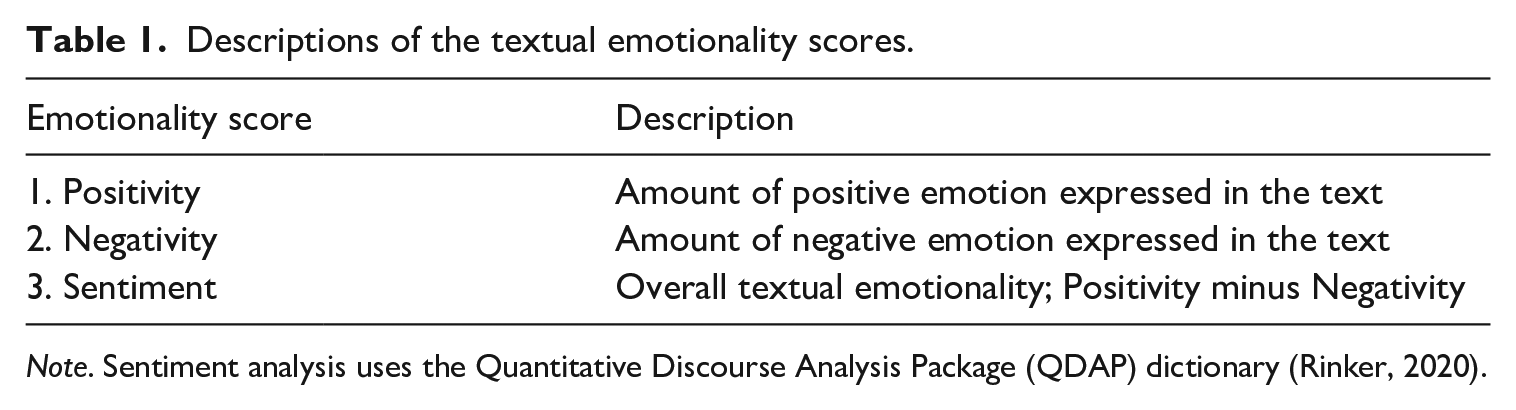
Note. Sentiment analysis uses the Quantitative Discourse Analysis Package (QDAP) dictionary (Rinker, 2020).
5 Automatic linguistic complexity measures
In the present study, we assessed the linguistic complexity levels of the L2 writings using the automatic analyser TAASSC (Kyle, 2016), which offers a graphical interface and computes multiple linguistic complexity measures in a batch mode. Although TAASSC originally defines and calculates more than 300 different indices, we avoided analysing all of them but aimed at selecting measures that could best capture writing qualities in different linguistic dimensions. Constraining the number of indices in the analysis can reduce the potential inflation of a Type-I error and enable us to examine the quantitative patterns in more detail. Following previous studies (Abdi Tabari, 2017; Bulté & Housen, 2014; Yoon, 2017), we conceptualized linguistic complexity as a multifaceted construct that could be assessed with multiple measures tapping into different linguistic dimensions such as lexical, phrasal, and clausal dimensions. It should also be acknowledged that individual studies can differ in the exact selection of complexity variables reflecting the specific question of interest in different studies.
In this study, we gave special importance to covering linguistic complexity measures that represent sophistication levels of different parts of speech (POS) categories and their corresponding grammatical functions, e.g. nouns, verbs, adjectives, adverbs, etc. This treatment enabled us to examine whether different POS categories were differentially sensitive to the effect of topic familiarity in L2 writing, whilst measures typically using collapsed categories (e.g. content vs. functional words) cannot reveal differences in this regard. In particular, for the purpose of this study, we selected a set of twelve TAASSC (Kyle, 2016) complexity measures tapping into three linguistic dimensions, including:
Morpholexical complexity, four measures: average lemma frequency (LemFrq), lemma type-to-token ratio (LemTTR), average lemma construction frequency (LConFrq), and lemma construction type-to-token ratio (LConTTR);
Nominal phrasal complexity, four measures: adjectival modifiers per nominal (Amod/N), verbal modifiers per nominal, (Vmod/N), nominal dependents per nominal (Ndep/N), and possessives per nominal (Poss/N);
Clausal level complexity, four measures: mean length of clause (MLC), auxiliaries per clause (Aux/C), adverbial clauses per clause (AdvC/C), and prepositions per clause (Prep/C) (see Table 2).
Linguistic complexity measures in TAASSC (Kyle, 2016).
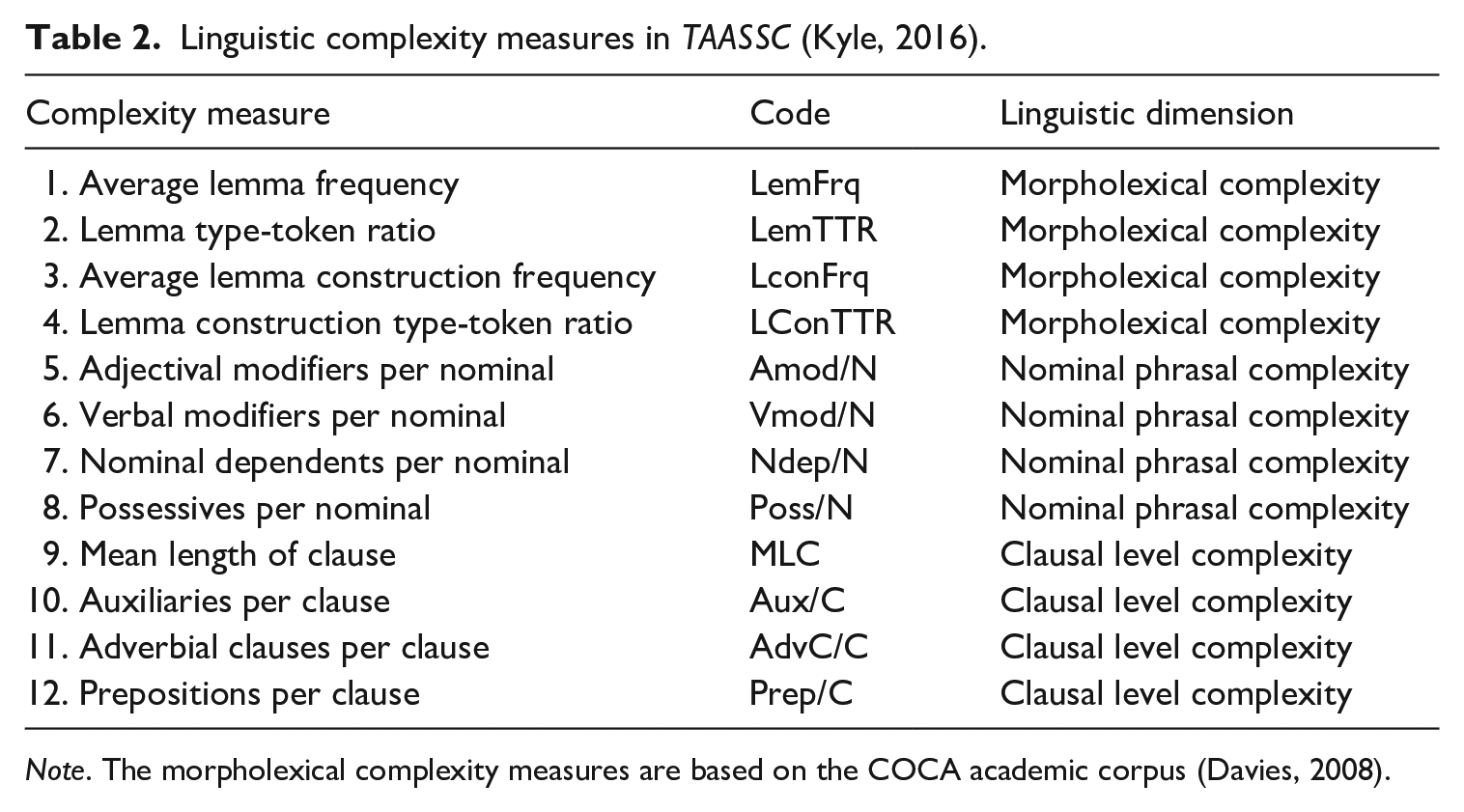
Note. The morpholexical complexity measures are based on the COCA academic corpus (Davies, 2008).
6 Data analysis
After calculating the emotionality scores and the linguistic complexity measures, we examined whether the student essays would differ in terms of these variables by building a series of linear mixed-effects models (LMM’s) and carried out Wald Chi-squared tests which are the default tests for analysing deviance in LMM’s to check whether the topic familiarity effect reached the significance level. In our study, topic familiarity was set as the only fixed factor, whilst participant number and their major (business or engineering) were accounted for as two random factors. We also used LMM’s rather than traditional ANOVA models with repeated measures in this study because LMM’s are more robust and make fewer assumptions about the internal data structure, e.g. compound symmetry and sphericity (Magezi, 2015). Additionally, LMM’s are useful for examining a within-participant research design (Magezi, 2015). Furthermore, we used the lmerTest package to build the LMM’s and the Car package to perform the Chi-squared tests. To estimate the effect size for the main effect of topic familiarity, we used the MuMIn package to calculate the conditional R2, which is the counterpart of eta-squared in traditional ANOVA models.
For the linguistic complexity measures, we also analysed the topic familiarity effect at the dimensional level (morpholexical, nominal phrasal, and clausal complexity) using a series of MANOVA tests, which can examine multiple dependent variables at one time. Additionally, we investigated the correlations between three emotionality scores, and twelve linguistic complexity measures using a series of Spearman’s rho correlation tests, which are more conservative than parametric correlations (e.g. Pearson’s r correlation) and do not assume normality of the data distribution. Where multiple tests were carried out, we interpreted the p-values according to both the conventional benchmark (α = .05) and a more conservative cut-off point via Bonferroni’s method, i.e. α = .05/N, where N referred to the number of independent tests.
IV Results
The descriptive and inferential statistics for the emotionality scores for the two familiarity topics are summarized in Table 3. We found a significant main effect of topic familiarity for both Negativity, χ2(1) = 16.76, p < .001, R2 = .073, and Sentiment, χ2(1) = 5.924, p = .015, R2 = .027. As for Negativity, the score was higher for the L2 essays written on the unfamiliar topic (M = .064, SD = .027) than those written on the familiar topic (M = .049, SD = .024). The Sentiment score was higher for the familiar topic (M = .152, SD = .058) than the unfamiliar topic (M = .132, SD = .050). The Positivity score, however, did not show a significant difference between the two groups, χ2(1) = .574, p = .449, R2 = .001.
Topic familiarity effects on emotionality scores as revealed in linear mixed-effects models (LMMs).
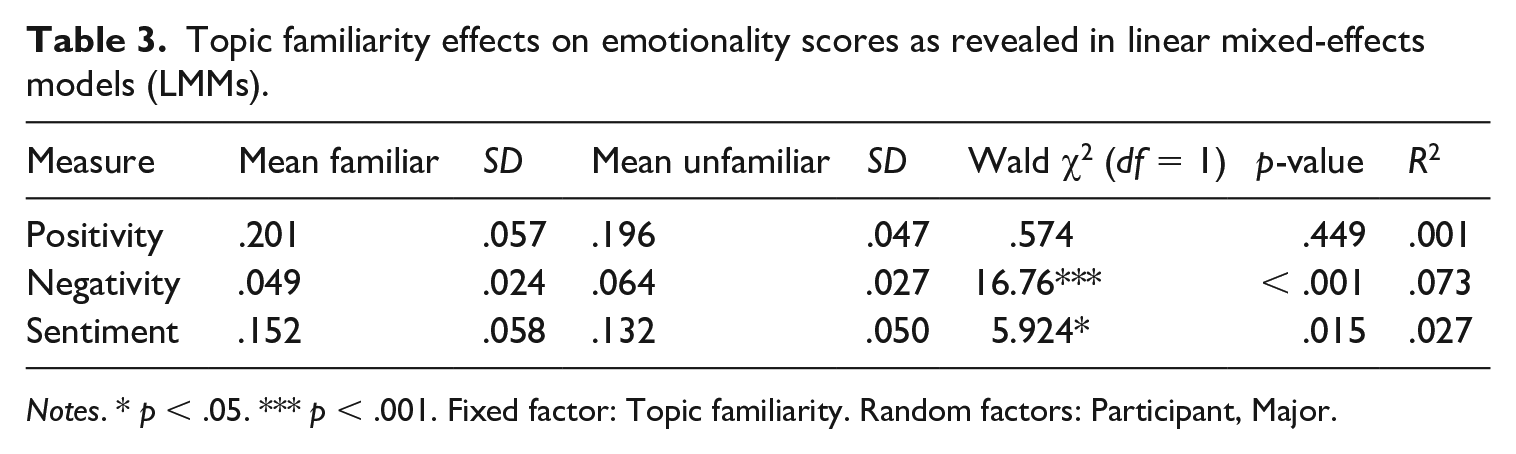
Notes. * p < .05. *** p < .001. Fixed factor: Topic familiarity. Random factors: Participant, Major.
For the linguistic complexity measures, we first checked the effect of topic familiarity at the level of linguistic dimension, i.e. morpholexical complexity, nominal phrasal complexity, and clausal level complexity, using a series of MANOVA tests, and the results are summarized in Table 4. We found a significant effect of topic familiarity for nominal phrasal complexity (four measures), F(1, 126) = 4.683, Wilk’s A = .868, p = .001, clausal level complexity (four measures), F(1, 126) = 2.509, Wilk’s A = .925, p = .045, and when all measures pooled together (twelve measures), F(1, 126) = 3.206, Wilk’s A = .749, p < .001. When we applied the Bonferroni correction, the α level became .05/4 or .0125, the clausal level complexity was only marginally significant (p = .045). As for morpholexical complexity (four measures), there was no significant effect of topic familiarity, F(1, 126) = 1.151, Wilk’s A = .964, p = .336.
MANOVA results for linguistic complexity dimensions in different topic familiarity conditions.
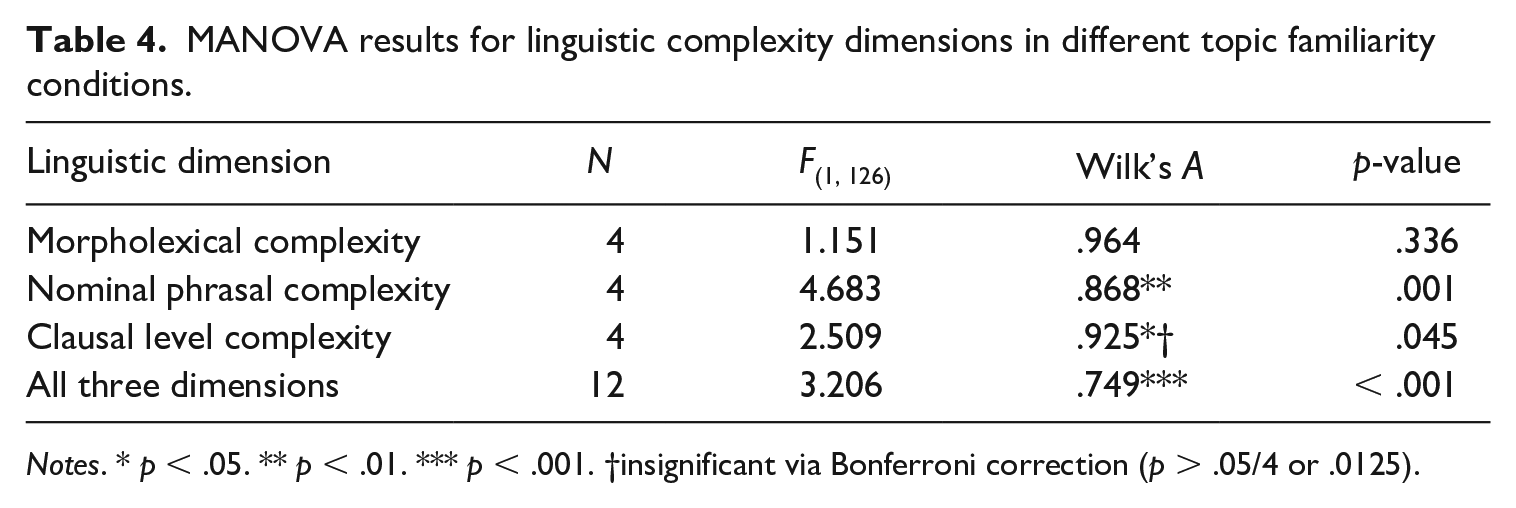
Notes. * p < .05. ** p < .01. *** p < .001. †insignificant via Bonferroni correction (p > .05/4 or .0125).
Next, we examined the topic familiarity effect on each linguistic complexity measure using LMM’s, which account for both the fixed factor (topic familiarity) and random factors (participant and major), and the results are summarized in Table 5. We found five out of twelve measures that showed a significant main effect between the familiar and unfamiliar topics, namely, LemFrq, χ2(1) = 4.223, p = .040, R2 = .031, Ndep/N, χ2(1) = 5.247, p = .022, R2 = .023, Poss/N, χ2(1) = 15.634, p < .001, R2 = .094, MLC, χ2(1) = 8.096, p = .004, R2 = .045, and Prep/C, χ2(1) = 11.514, p < .001, R2 = .053. When we applied the Bonferroni correction, the α level dropped to .05/12 or .0042, and the topic familiarity effect on LemFrq and Ndep/N became only marginally significant. No other linguistic complexity measures showed a significant effect. In particular, LemFrq was lower for the familiar topics (M = 254,176, SD = 90,332) than the unfamiliar topics (M = 287,759, SD = 96,868). Ndep/N was higher for the familiar topics (M = .130, SD = .029) than the unfamiliar topics (M = .108, SD = .029). Poss/N was higher for the familiar topics (M = .081, SD = .048) than the unfamiliar topics (M = .053, SD = .038). MLC was longer for the familiar topics (M = 12.172, SD = .2.247) than the unfamiliar topics (M = 11.256, SD = 1.976). Prep/C, again, was higher for the familiar topics (M = .394, SD = .110) than the unfamiliar topics (M = .341 SD = .114). To summarize, the linguistic complexity level was higher for the familiar topics than the unfamiliar topics in three measures.
Summary of topic familiarity effect on linguistic complexity measures as revealed in linear mixed-effects models (LMMs).
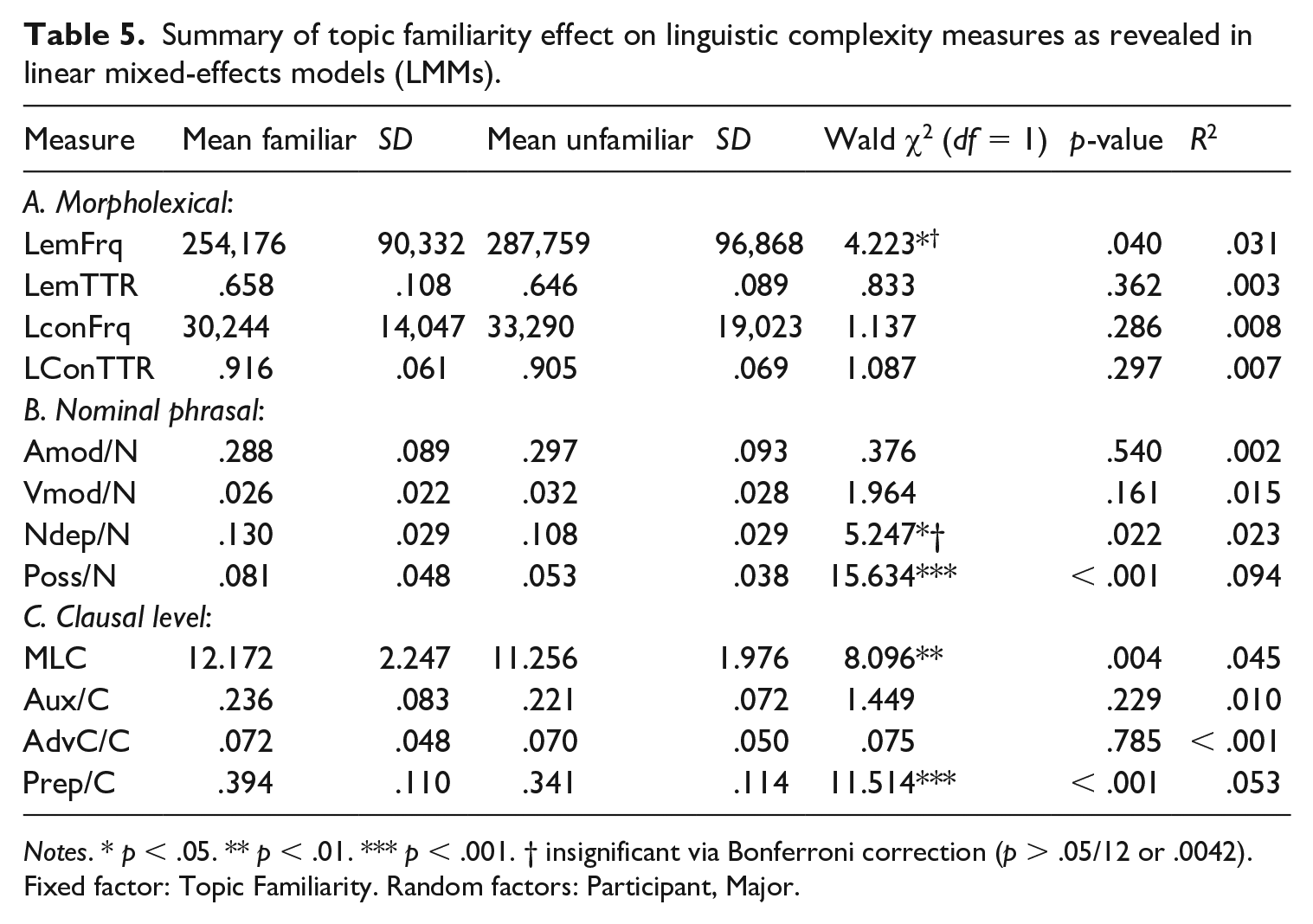
Notes. * p < .05. ** p < .01. *** p < .001. † insignificant via Bonferroni correction (p > .05/12 or .0042). Fixed factor: Topic Familiarity. Random factors: Participant, Major.
As the last step of the analysis, we examined the correlational patterns between the three emotionality scores and the twelve linguistic complexity measures using a series of Spearman’s rho analysis (see Table 6). We found that Positivity was significantly correlated with LemTTR, rho = –.244, p = .006, and Ndep/N, rho = –.350, p < .001. As for Negativity, it was significantly correlated with LemTTR, rho = –.250, p = .004, Ndep/N, rho = –.410, p < .001, MLC, rho = –.252, p = .004, and Prep/C, rho = –.233, p = .011. All the significant correlations had a negative sign, indicating that more complex linguistic usage was linked to a more emotionally neutral style in L2 writing. Since we carried out thirty-six tests here, the Bonferroni adjustment of α level became particularly strict (α = .05/36 or .0014). When this correction was applied, only the correlations between Ndep/N and Positivity, and between Ndep/N and Negativity were considered significant (p < .001).
Spearman’s rho correlations between emotionality scores and linguistic complexity measures.
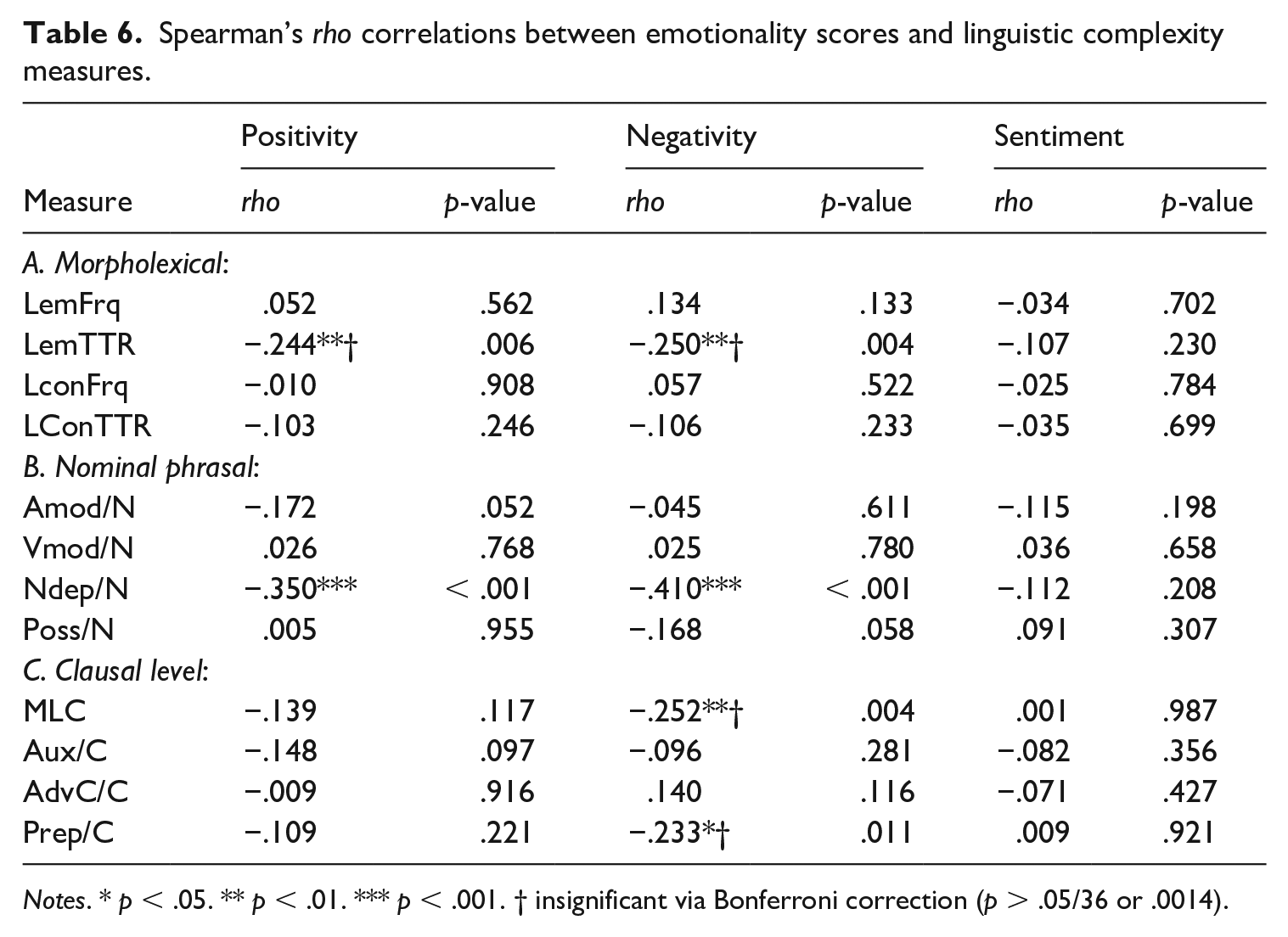
Notes. * p < .05. ** p < .01. *** p < .001. † insignificant via Bonferroni correction (p > .05/36 or .0014).
V Discussion
1 Effects of topic familiarity on textual emotionality in L2 writing
Prior research focused much on general writing quality or specific linguistic attributes of L2 writing; affective aspects, such as textual emotionality, remain under-explored. Our first research question tries to provide clues as to how topics with different degrees of familiarity to the writer affect L2 textual emotionality. The results showed that, when writing on a more familiar topic, adult L2 learners achieved higher textual sentiment with significantly lower emotional negativity in their academic writing. However, TF did not significantly raise emotional positivity in their texts. These findings further enriched our understanding of the task-readiness framework (Bui, 2014) in terms of how task-internal readiness (topic familiarity included) influences L2 writers’ emotional state and attitude towards the writing prompt and, potentially, the writing outcomes.
First of all, topic familiarity appears to reduce the negative response among L2 writers but increase their psychological preparedness in composing an academic text at the tertiary level. Prior research found that topic familiarity provides positive task-preparedness for better fluency (Bui, 2014) and lexical (Bui, 2019) performance as well as better task engagement (Qiu & Lo, 2017) in L2 speaking tasks. These findings point to the facilitative influences and positive emotional states among L2 learners induced by TF. This study further shows its effect on L2 academic writing tasks. TF as task-internal readiness seems to equip learners with a sense of security as they are more knowledgeable about the topic and could produce a text of more elaborate and accurate content. They would probably lower their negative emotional states such as stress and anxiety, which leads to lower negativity scores in writing and a generally more positive textual sentiment.
Secondly, while lessening emotional negativity, TF does not seem to evoke emotional perturbation in L2 academic writing as it exerts no direct influence on positivity scores in textual emotionality. Clachar (1999) observed that L2 writers had much more lexical and morphosyntactic planning activities on the emotional topics, suggesting that both highly positive and negative emotions would have inhibitive effects on L2 writing performance. Wang’s (2020) study also discovered both negative and positive emotions could put an extra cognitive load on L2 composing processes, and a neutral emotional state would be the optimal mode. This research further suggests that TF does not excessively increase emotional positivity but rather keeps a balanced emotional state, as shown in the unaffected positivity scores from texts of different familiarity levels. Again, it may be indicative of TF as a desirable task-readiness condition for L2 writers similar to that for L2 speakers.
2 Effects of topic familiarity on linguistic complexity in L2 writing
When writing on a more familiar topic, adult L2 learners in this study produced significantly higher linguistic complexity in general, as shown in the overall MANOVA results in Table 4. At the level of detail, they wrote longer clauses (MLC) with a higher level of possessives per nominal phrase (Poss/N) and prepositions per clause (Prep/C). They also showed a trend in higher Nominal dependents per nominal (Ndep/N) though statistical significance disappeared after the Bonferroni adjustment. All in all, there seems to be a positive link between TF and linguistic (especially phrasal and clausal) complexity in L2 academic writing. This finding shows interesting contrast with prior L2 speaking task research and could shed light on the multifaceted nature of complexity as well as L2 writing.
Linguistic complexity can result from higher cognitive demands from the task (Robinson, 2001) or an adventurous inclination to experiment with a new language (Bui & Huang, 2018). Prior research on task-readiness revealed that TF as a task-internal readiness factor significantly raised oral fluency and (slight) accuracy (Bui, 2014) and lexical density and sophistication (Bui, 2019) but not syntactic complexity (Bui, 2014) in L2 speaking tasks. A familiar topic is a less demanding task in terms of cognitive load; thus, it is less likely to bring up syntactic complexity in L2 speaking tasks. In contrast, this study seems to suggest the opposite that TF is linked to higher (nominal) phrasal complexity and clausal complexity but much less on lexical complexity. Such happening should be attributed to the modality of language use (writing vs. speaking). Though a familiar topic may impose less cognitive demand on L2 writers, the writing process is nevertheless much lenient in a time constraint as compared with the oral production conditions. Then, it allows them time and potentially a psychological state (see Section V.1) to experiment with more advanced language. In writing, students are allowed relatively sufficient time to plan the content. With prior knowledge, L2 writers can spend less time generating the ideas and allocating more attentional resources to writing longer and more sophisticated sentences typical among doctoral students, such as those in this study. Then, a need for higher linguistic formality in academic writing as compared with speaking further pushes writers to produce linguistically more complex sentences.
In addition, linguistic complexity is associated with the technicality required of the speaking/writing prompts in the different studies. Bui’s (2014, 2019) studies employed speaking tasks related to highly technical subject matters (biological virus vs. computer viruses) that required specialized L2 lexicon, which lead to higher lexical complexity. However, the topics in the current study exploited topic familiarity with less implication on technical terminology, hence less impact on lexical performance. Students in this research seemed to be able to complete writing on these business or engineering topics with a general vocabulary given their cognitive maturity and life experience. Hence, little effect of TF on lexical complexity observed.
3 Relationships between emotionality and linguistic complexity in L2 writing
Our findings revealed that there was a negative correlation between emotionality scores and linguistic complexity measures in L2 writing. Emotional positivity and negativity were both negatively correlated with lexical diversity (LemTTR) and the use of dependent nominals (Ndep/N), while the negativity score was also negatively correlated with phrase length (MLC) and preposition use (Prep/C). These findings consistently suggest that the intensity of textual emotion had a negative effect on linguistic complexity in L2 writing, in line with previous research (Abdi Tabari & Wang, 2021; Wang, 2020). In addition, the findings corroborate Clachar’s (1999) finding that emotionally charged writing prompts raised the cognitive load of the task and pushed writers to allocate more cognitive effort to the planning at the grammatical level. Thus, it can be inferred that the currently found negative correlation might be a result of extra linguistic processing. Since L2 learners usually handle linguistic processing in a serial manner due to the limited capacity of attentional resources (Skehan, 1998, 2014), they might have difficulty focusing on different aspects of their linguistic production and improving all aspects of their production (CALF) simultaneously. As a result, the complexity of linguistic production did not foster as the cognitive load of the tasks increased. In other words, when L2 learners were trying to keep error rates at a reasonably low level (accuracy) and produce the minimum number of words (fluency), the additional semantic, emotional demands of expression seemed to weaken production in other complexity dimensions of the text. The other reason for this negative correlation between textual emotionality and linguistic complexity might be attributed to the fact that sophisticated expression of precise emotions requires a repertoire of ‘non-core’ vocabulary, which is emotionally infused and intensified (Unsworth & Mills, 2020) such that L2 learners often need additional training to master the use of these lexical resources to package and unpackage emotional messages they want to convey in their writing.
Finally, the negativity score was more robustly associated with linguistic complexity indicators than the positivity and sentiment scores, which may explain why negative emotions such as stress and anxiety have received much attention in the literature (e.g. Clachar, 1999; Dewey, Belnap, & Steffen, 2018; Gregersen, MacIntyre, & Olsen, 2017), but the role of positive emotions, in contrast, lacks support from empirical research in large. As some advocates of positive psychology argued, positive emotions should promote learning effectiveness and engagement rather than undermine learning performance (Dewaele, Chen, Padilla, & Lake, 2019; MacIntyre, Gregersen, & Mercer, 2019). Nevertheless, our findings rejected this hypothesis and revealed that positive writing emotions were accompanied by a reduction in linguistic complexity in writing. Since expressing positive emotions seems to increase students’ cognitive load and induce negative effects on their writing quality, a ‘neutral’ state of mind might be optimal for L2 writing (Wang, 2020). Additionally, we should acknowledge the fact that the content-based emotionality measure is partially determined by the topic prompt itself, such that prompts with negative connotations often lead writers to use corresponding words that reflect the nature of the topic. Thus, a positive classroom climate that is emotionally supportive for the improvement of learning does not necessarily help L2 learners write with an optimistic tone.
VI Conclusions, implications, and limitations
This research investigated the effects of topic familiarity on the under-explored construct of textual emotionality and the controversial construct of linguistic complexity in an L2 EAP writing context. In general, the findings suggested that topic familiarity was linked to higher overall textual sentiment and lower negativity, and overall linguistic complexity, in particular, nominal phrasal complexity and clausal complexity, in L2 academic writing. Also, we found that both positivity and negativity scores in textual emotionality were negatively correlated with linguistic complexity, which is indicative of the inhibitive effect of emotional perturbation in L2 writing.
These findings provide pedagogical implications for EAP classrooms. First of all, the provision of topics with different degrees of familiarity to L2 EAP writers may foster different levels of task-readiness that could impact their writing performance. The teacher could provide L2 writers, especially those with less confidence in L2 writing, a familiar topic to reduce negative emotionality and increase general textual sentiment in the writing process, hence probably higher task engagement (Qiu & Lo, 2017). In addition, allowing learners to compose on familiar topics helps them experiment with more advanced language, as evidenced by the higher complexity scores. Secondly, our results point to a preference for a neutral state of emotion in L2 writing. It could be argued that academic writing often concerns controversial topics that are emotionally charged. However, for the purpose of linguistic skill enhancement, especially among those with less experience in EAP, the teacher could initially consider offering L2 learners neutral topics as these topics appear to be more conducive to writing performance in terms of linguistic complexity, which characterizes the genre of academic discourse. Thirdly, this research may offer clues as to how writing tasks could be optimally sequenced in terms of cognitive complexity in EAP. It would be desirable if writing tasks could be arranged along with the ‘familiar + emotionally neutral topics’, ‘familiar + emotionally charged topics’, ‘unfamiliar + emotionally neutral topics’, and finally the ‘unfamiliar + emotionally intensive topics’ continuum. Such a task sequence is consistent with Bui’s task-readiness framework that prepares learners for L2 academic writing from both the cognitive and socio-emotional perspectives.
This study has two potential limitations. The emotionality in L2 writing was estimated using a text-based sentiment analysis, which assumed the correspondence between the emotions reflected from the vocabularies in the text, and the emotions experienced by the L2 learners while composing. We call for further investigations into the robustness of this association which may reveal valuable insights for interpreting the sentiment scores in similar settings. Regardless, sentiment analysis still enjoys its merit of providing an easily accessible, fast, and objective measure of textual emotion. Furthermore, given the scope of the study, we did not explore all the aspects of writing quality other than linguistic complexity (e.g. accuracy and fluency were not addressed by our analysis). Thus, we cannot rule out the possibility that the emotion-lexicon link found in the present study could be mediated by other aspects of writing quality. To address this issue, further research is warranted to explore whether the interplay between emotion and lexis would change when accuracy indices and process-based fluency indices are employed. Notwithstanding the limitations, given a few promising results, this study has made major pedagogical contributions to the study of linguistic, cognitive, and socioemotional factors in the EAP field.
