







Abstract
The present study presents an instructional procedure developed in an attempt to enhance incidental learning through graded readers in class, the Multiple Incidental Exposures (MIE) procedure, and compares it to a more common procedure involving reading and doing the exercises, which is referred to as Traditional Explicit Practice (TEP). Participants were 44 Catalan/Spanish students (aged 10–11 years) taking the fifth course of primary education in a school in Catalonia. Participants belonged to two intact classes that were randomly assigned a condition: MIE group (n = 23, n = 15 males, n = 8 females) and the TEP group (n = 21, n = 12 males, n = 9 females). The MIE group was first told the story by their teacher, then read and listened to the graded readers twice (first collectively and later on individually), to be followed by a True/False activity and a jigsaw reading task. The TEP group read and listened to the story collectively once and then performed a series of traditional explicit exercises very similar in format to those included at the end of the graded reader. Participants were administered a vocabulary test, a grammar test and a perception of pronunciation test following a pre- post-test design. A questionnaire on the participants’ attitudes was also administered on the post-test. The results show that while the TEP procedure is more effective for grammar learning, the MIE and TEP procedures are equally effective in terms of vocabulary and pronunciation. In terms of enjoyment and perception of learning, both groups showed comparable results.
Keywords
I Introduction
Children can be exposed to second language (L2) input and learn the language without intention to learn or awareness of learning, via a wide range of materials. While some of these materials, such as songs, computer games and movies, are often used informally outside the classroom, a number of materials and activities, including graded readers, picture books and storytelling, lend themselves well to classroom use. Implicit learning 1 is an important language-learning mechanism for children, especially in first-language acquisition. Nagy and Anderson (1984) suggest that most first language (L1) vocabulary is learned incidentally through exposure, and report that children in grades 6–9 encounter between 3,000 and 4,000 new words every year through reading. Implicit learning also plays an important role in L2 learning in countries where the L2 is used extensively, or when children have frequent informal access to the L2 over extended periods of time. By creating opportunities for incidental language learning (Long, 2020), an internal process is activated in the mind of the learner that results in implicit knowledge without raising learning to the level of conscious awareness.
When the access of L2 learners (including children) to the L2 is more restricted, both young L2 learners’ practitioners (Hestetræet, 2019) and SLA vocabulary experts (Nation, 2013) agree that it is still important to complement direct explicit instruction with exposure to rich input and whole-language activities. Nevertheless, incidental learning may be slower and less efficient (Reynolds, 2014), thus the need to find ways to enhance the learning potential of input. With that aim in mind, Long (2020) advocates both elaborated and modified elaborated input as the most efficient types of input even if he acknowledges manipulating texts (by including intentional redundancy or redundancy plus some control over sentence length respectively) is something difficult and time-consuming.
With a similar aim in mind, an instructional procedure was developed in the present study in an attempt to enhance opportunities for mainly incidental learning through children’s graded readers. In certain contexts graded readers are often used following a rather traditional approach in which reading is often followed by a series of exercises at the end of the book. In contrast, our motivation in the present study was to examine a different approach to using graded readers in the classroom following a primarily meaning-focused approach.
The novel procedure, called Multiple Incidental Exposures (MIE), was conceived with primary-school children in mind, a population that has been somewhat neglected in the L2 reading literature. It integrates existing pedagogical reading practices and includes a sequence of input-based tasks that get students to read texts multiple times and perform activities requiring no or minimal production in the target language. The MIE instructional scheme can be easily implemented by teachers and differs from merely getting students to read texts repeatedly because it represents a novel combination of bimodal input and input-based tasks. Our main goal was to compare the relative effectiveness of the MIE procedure with a primarily form-focused approach referred to as Traditional Explicit Practice (TEP) involving fewer exposures to language items and requiring learners to draw on a combination of both implicit and explicit knowledge. We wondered whether the MIE approach would be comparable to the more traditional approach basically consisting of reading followed by doing written exercises. Another goal was to observe students’ perceptions of the MIE procedure and to examine whether children would get tired of being exposed to the same graded readers multiple times.
II Literature review
1 Incidental learning and the young learner
When language learning happens unintentionally, or without awareness on the part of the learner (Ellis, 2009) it is a slow non-generalizable learning mechanism. Nevertheless, it plays an important role, since it develops mental representations that can be accessed quickly and efficiently, without occupying attentional resources. Implicit or unconscious learning is a particularly fundamental learning mechanism for young language learners who are exposed to spoken L2 input in their daily lives (in family life, at school or in the community). Outside these rich-input contexts, learning without awareness plays a much lesser role, since it requires years of massive amounts of input and interaction (Muñoz, 2006). Still, it seems to play an important role for young learners who, despite not living in a country where the L2 is used, have frequent contact with the L2 through informal exposure.
In the case of English (L2), the effect of informal exposure can be easily observed in children who live in countries where the L2 is not formally introduced until the latter years of primary school. Such is the case in Flanders, where English instruction starts at the age of 12 but where 44% of the 11-year-olds in a study by Kuppens (2010) reported watching English-language TV without subtitles. The long-term benefits of informal exposure to English in Flanders was also evidenced in a study by De Wilde and Eyckmans (2017), in which a significant proportion of the 11-year-old children in the study were able to perform tasks normally expected upon completion of the second year of secondary education. Similar evidence of implicit learning capacity has been observed in even younger children. For example, in Muñoz, Cadierno and Casas (2018), seven-year-old Danish students who were just beginning formal English instruction were able to recognize as many English words as their Spanish counterparts, who had been learning English at school for three years. This was due to the Danish children’s much higher level of out-of-school contact with English. Similarly, Lefever (2010) tested a group of eight-year-old Icelandic children with no prior English instruction and found that many could participate in simple conversations, something their parents attributed to exposure through various media.
From the above-mentioned studies, we can conclude that the cumulative effects of implicit learning mechanisms become evident after regular, prolonged informal exposure to English. However, because in foreign language contexts target-language exposure is quite limited (Pinter, 2011), middle and upper primary school language teachers tend to combine meaning-focused approaches with varying amounts of form-focused practice, thus relying on both implicit and explicit knowledge. A number of studies in immersion classrooms have also suggested that explicit instruction can be beneficial for children (see, for example, Kim et al., 2015). Children’s capacity for intentional learning has also been tested in an experimental study (Lichtman, 2016) in which children and adults were trained to learn an artificial mini-language under implicit and explicit training conditions. The results showed that children (as well as adults) developed greater awareness of the structures of the mini-language under the explicit condition. The efficacy of grammar practice for young learners has also been demonstrated in a series of ecologically valid studies within input-poor foreign language classrooms (Kasprowicz & Marsden, 2018; Kasprowicz, Marsden, & Sephton, 2019; Marsden & Chen, 2011). Thus, the little evidence available involving children seems to indicate that young L2 learners can benefit from explicit grammar instruction, even if important individual differences seem to exist at this early age. Other classroom-based studies with children, however, have also provided evidence of young learners’ capacity for incidental learning in the context of both teacher-led communicative activities (Shintani, 2012; Shintani & Ellis, 2014) and pair and group work (Collins & White, 2019). Examination of the language-related episodes produced by the 11- and 12-year-olds in Collins and White indicates that students tend to spontaneously focus mainly on vocabulary, and less on grammar and pronunciation.
In the context of reading, explicit instruction in vocabulary learning has generally proven to be more efficient than reading only, in both experimental and classroom-based studies with university-level students (Laufer, 2003; Paribakht & Wesche, 1997). In a classroom-based study with secondary-school students (Min, 2008), those who practised various vocabulary exercises after reading selected texts (intentional learning condition) demonstrated significantly more knowledge of the target vocabulary than those students who read the same texts plus a number of additional thematically related texts (incidental learning condition). In spite of the effectiveness of intentional vocabulary learning, there are limits as to the time available in class for vocabulary practice. This is one of the reasons why vocabulary experts such as Schmitt (2010) advocate its combination with incidental meaning-focused activities. This recommendation also applies to young learners, who have a range of materials and activities at their disposal that lend themselves well to incidental vocabulary learning, such as graded readers, picture books, oral storytelling and reader’s theatre. It is, however, possible that L2 young learners do not benefit as much as older learners from extensive exposure to instructional materials. This would explain the results of a year-long study by Tragant, Muñoz and Spada (2016) in which a group of 10- and 11-year-olds in Spain who had spent 60% of their English as a foreign language (EFL) instruction time in a reading-while-listening (RWL) programme made similar overall progress to a comparison group who had received only teacher-led instruction and did not do any extensive reading. Moreover, no significant differences were observed in an earlier study involving a number of tests designed to assess a group of primary school students’ achievement in a longitudinal comprehension-based programme in Canada (Lightbown, 1992). Two recent meta-analyses on incidental vocabulary word learning from input revealed that children are outperformed by university learners (de Vos, Scriefers, Novard, & Lemhöfer, 2018), and that they also benefit less than older learners from repeated encounters with L2 words (Uchihara, Webb, & Yanagisawa, 2019). Even though the young learner samples in these reviews were very small, the findings seem to indicate that young L2 learners’ limited metacognition and awareness, as well as their lower proficiency level, may prevent them from spontaneously learning vocabulary while engaging in meaning-focused activities. The present study is an attempt to enhance incidental learning among young learners by developing and evaluating an instructional procedure to be used with children’s graded readers that increases exposure to grammatical and lexical items and measures the learning of vocabulary, pronunciation and grammar. Evaluation will involve a comparison with a traditional approach to graded readers, which enhances a more explicit type of learning.
2 The Multiple Incidental Exposures (MIE) procedure
The ‘Multiple Incidental Exposures’ procedure, which was developed for the present study, draws on research into the effects of repetition on vocabulary learning. It is meaning-focused and integrates elements of two pedagogical practices related to reading: RWL and repeated reading. The research basis of MIE will be outlined in this section and the full MIE procedure described in Section III.3.a.
MIE promotes ‘RWL’, with students being exposed to these two input modalities simultaneously at various stages of the instructional procedure. ‘RWL’, sometimes referred to as ‘assisted reading’ in the literature, has been shown to contribute to gains in listening comprehension (Kartal & Simsek, 2017), reading comprehension and fluency (Chang & Millett, 2015) and L2 pronunciation (Trofimovich, Lightbown, Halter, & Song, 2009), in addition to incidental vocabulary learning (Tragant, Llanes, & Pinyana, 2019). RWL may be especially appropriate for young beginner learners. They have shown a strong preference for this reading mode (Tragant & Vallbona, 2018; Tragant et al., 2016) and the phonological support may guide them in segmentation of the written text, thus strengthening the still-weak connections between oral and written forms. In Tragant et al. (2016) pronunciation gains were slightly higher in the reading-while-listening group than in the comparison group, but differences were non-significant and the sample was very small. In Trofimovich et al. (2009) pronunciation results were initially better in the reading-while-listening group, but they were no longer superior beyond the beginner levels. The present study thus examines the pronunciation effects of reading-while-listening with a larger sample of young learners at a basic user stage of language proficiency (CEFR, 2001).
MIE also includes an element of repetition that overlaps with the instructional practice of ‘repeated reading’, an academic practice consisting of reading the same passage several times silently or aloud. Even though repeated reading was developed as a remedial approach for L1 reading, research has also shown that it can be an effective procedure for secondary and university L2 learners (see, for example, Chang & Millett, 2013; Gorsuch & Taguchi, 2008; Liu & Todd, 2016; Webb & Chang, 2012), and Webb and Nation (2017) refer to it as one of the ways of increasing repetition in the context of vocabulary learning. According to information processing theory (Han & Chen, 2010), the redundancy involved in repeated reading leads to an increase in familiarity with the text, which may help accurate and fluent decoding of words. When repeated reading is supported by audio, the reading practice also facilitates word decoding, segmentation of written text and ultimately comprehension. In MIE, children are exposed to the text as many as five times through a combination of full and partial repetitions of the text. The repetition element in MIE may free up the cognitive space young learners need to focus on more formal aspects of the input such as grammar, vocabulary or pronunciation, since they need to devote less attention to comprehension after the first few readings of the text.
In the above-cited research on repeated reading, which was carried out with secondary and university students, texts were read as many as five to seven times, sometimes in laboratory-based studies. In the case of the present classroom-based study with younger learners, simple successive readings of the same text were discarded because children are likely to lose interest (Nichols, Rupley, & Rasinski, 2008), and because some resistance to repeated RWL has been observed in previous classroom-based interventions. In the case of Tragant et al.’s (2016) year-long study, some students grew tired of rereading graded readers a second time towards the last weeks of the intervention. In the case of Tragant and Vallbona’s (2018) study, resistance to a second reading on the part of a few students was detected earlier and could be attributed to the fact the reading materials were non-fiction graded readers. Instead, the MIE procedure is meant to combat this resistance through ‘masked’ repetition by exposing students to a cycle of meaning-focused tasks. According to Ellis and Shintani (2014) these tasks were unfocused (no predesigned focus on specific language features) and input-based (no or minimal production requirements), and they involved exposure to the same text on multiple occasions in multiple input modalities and classroom configuration arrangements. In order to find out how successful the MIE procedure was in keeping learners engaged, the present study includes the examination of students’ perceptions as one of its goals.
Finally, the MIE procedure is also supported by research on the effects of repetition on incidental vocabulary learning. In the case of older school-aged learners and adults, the literature reports that students need 8–10 encounters to learn the meaning of words at the receptive level (Schmitt, 2010). Younger learners may also benefit from repeated encounters of words, although little research has been conducted so far (Serrano & Pellicer-Sánchez, 2016; Uchihara et al., 2019). The effect of multiple encounters of target items on the learning of grammar and pronunciation is an area that remains to be explored and, together with vocabulary, will also be the goal of the present study.
III Method
The MIE procedure was developed in an attempt to enhance incidental learning in children’s graded readers and was evaluated in the present study in terms of vocabulary and grammar learning, as well as perception of pronunciation, a less well-researched dimension of language learning. Students’ perceptions of this novel teaching procedure were also explored. With these objectives in mind, two intact groups read the same two graded readers. One group followed the MIE procedure, which involved exposure to the texts multiple times under different input modes (listening, reading and RWL) and repeated encounters with target words in context. The other group (the comparison group) followed a traditional procedure that involved RWL to the texts once, followed by some explicit vocabulary and grammar practice (henceforth referred to as the TEP procedure, which stands for ‘Traditional Explicit Practice’). The type of practice in the TEP procedure is similar to the focus-on-forms exercises often included in many published graded readers and textbooks (see Section III.3.b below). Neither of the two groups underwent any explicit pronunciation practice. So, while the TEP group was supposed to derive learning mostly from written activities designed to encourage learners to pay attention to linguistic forms, the MIE group was expected to derive learning from repeated exposure to oral and written input in the context of meaning-focused activities. The research questions that guided the present study were:
Research question 1: Do students in the Multiple Incidental Exposures (MIE) group learn as much vocabulary as students in the Traditional Explicit Practice (TEP) group? Research question 1.1: Are vocabulary gains (if any) maintained three weeks after the test? Hypothesis 1: On the one hand, it was expected that participants in the MIE group would outperform participants in the TEP group because the MIE approach involved greater exposure to the L2 target words. However, previous research shows that incidental learning is slower and less efficient. Since we could not anticipate which of the two groups would show greater L2 vocabulary development, the null hypothesis was adopted. The null hypothesis was also adopted for the long-term effects of these two approaches given that the duration of the treatment was very short.
Research question 2: Do students in the MIE group learn as much grammar as students in the TEP group? Hypothesis 2: Again, the null hypothesis was adopted here for the reasons mentioned in Hypothesis 1.
Research question 3: Do students in the MIE group outperform those in the TEP group with respect to perception of L2 pronunciation? Research question 3.1: Are participants able to acquire the pronunciation of the words they were exposed to? Research question 3.2: Are participants able to apply that phonological knowledge (if any) to new items? Hypothesis 3: Given that participants in the MIE group received oral input three times more than the TEP group (storytelling by the teacher, collective RWL and individual RWL) and the only oral input the TEP group received was the collective RWL, it was expected that participants in the MIE group would outperform those in the TEP group in terms of perception of L2 pronunciation.
Research question 4: What are the students’ levels of engagement and perceptions towards the MIE and TEP approaches to graded readers? Hypothesis 4: Given that students were not used to the RWL and previous research shows that participants enjoy this type of input, it was speculated that participants in the MIE condition would report more positive attitudes than their TEP counterparts.
To summarize, with respect to research questions 1 and 2 on vocabulary and grammar learning, the group that received more implicit exposure (MIE group) was compared to the group that received more explicit practice (TEP group). In research question 3, regarding children’s perception of pronunciation, the MIE and TEP groups received different amounts of oral input.
1 Participants
Forty-four Catalan/Spanish students (aged 10–11 years) in their fifth year of primary education at a semi-private school in Catalonia participated in the present study, after informed consent had been obtained from the board of directors. Participants belonged to two intact classes that were randomly assigned a condition (MIE group n = 23: n = 15 males, n = 8 females; TEP n = 21: n = 12 males, n = 9 females). These students attended 2 hours of English (L2) classes per week and 3 hours of CLIL (content and language integrated learning) classes per week (2 hours of science and 1 hour of arts and crafts). Regarding CLIL classes, participants dealt with different types of texts, namely descriptions, cause-effect explanations, comparisons and very short stories. As for the type of vocabulary in CLIL classes, these were the topics that participants studied throughout the course: Human body, living things, biodiversity, food chain, 5 kingdoms, and cell and plants. Concerning grammar, primary students in this school start learning the past tense in 5th grade, usually in the second term. However, both in CLIL and English classes they are exposed to some past structures before. The past tense verbs students work on during 5th grade are was/were, and the regular simple past of some common verbs. At the time of the study, the participants had received approximately 710 hours of instruction in English and, based on the English teacher’s opinion and on the level established by the Catalan curriculum for English as a foreign language, most had a proficiency level equivalent to CEFR level A1. The class teacher was originally supposed to carry out the intervention, but she had to take sick leave unexpectedly and was replaced by the first author of this article. It must also be pointed out that none of the students in this study had previous experience of reading graded readers; their reading practice was mostly restricted to the short texts in their course book, which were related to the topics of each unit.
2 Graded readers
When planning the intervention, the students’ regular English teacher was asked to choose two children’s graded readers from a range of four titles previously selected by the researchers based on the students’ level of English and their tastes. She chose Uncle Jack and the Meerkats and Uncle Jack and the Emperor Penguins, two adventure stories that contain some environmental themes. The two graded readers, which were part of the same collection and written by the same author (Cadwallader, 2009, 2011), were A1.1 level and contained 300 headwords each, with approximately 83% of the words included in the K1 list, according to the lextutor webpage (www.lextutor.ca). These two graded readers were unrelated to the topics covered in the English and Science classes, and they were chosen because, based on the teacher’s opinion, they best suited the level and the likes of the students.
3 Design and procedure
This study featured a three-phase (pre-test, post-test and delayed post-test) design. Prior to the pre-test, the teacher carried out two class sessions with participants of the MIE group so that students could familiarize themselves with the tools and materials. The study started two weeks after these practice sessions. First, participants were administered the pre-test, which consisted of a vocabulary, grammar and pronunciation test (see Section III.4). A week after the pre-tests, the intervention started and lasted 4 hours in total, distributed into four 1-hour sessions (two non-consecutive sessions per book and week). The week after the intervention finished, participants were administered the post-test. A delayed post-test was administered three weeks after the post-test, but for vocabulary only due to time constraints. All tests were administered collectively during class time and the pre- and post-tests were each completed within 1 hour (the tests instructions and activities were in English for both groups).
a MIE instructional procedure
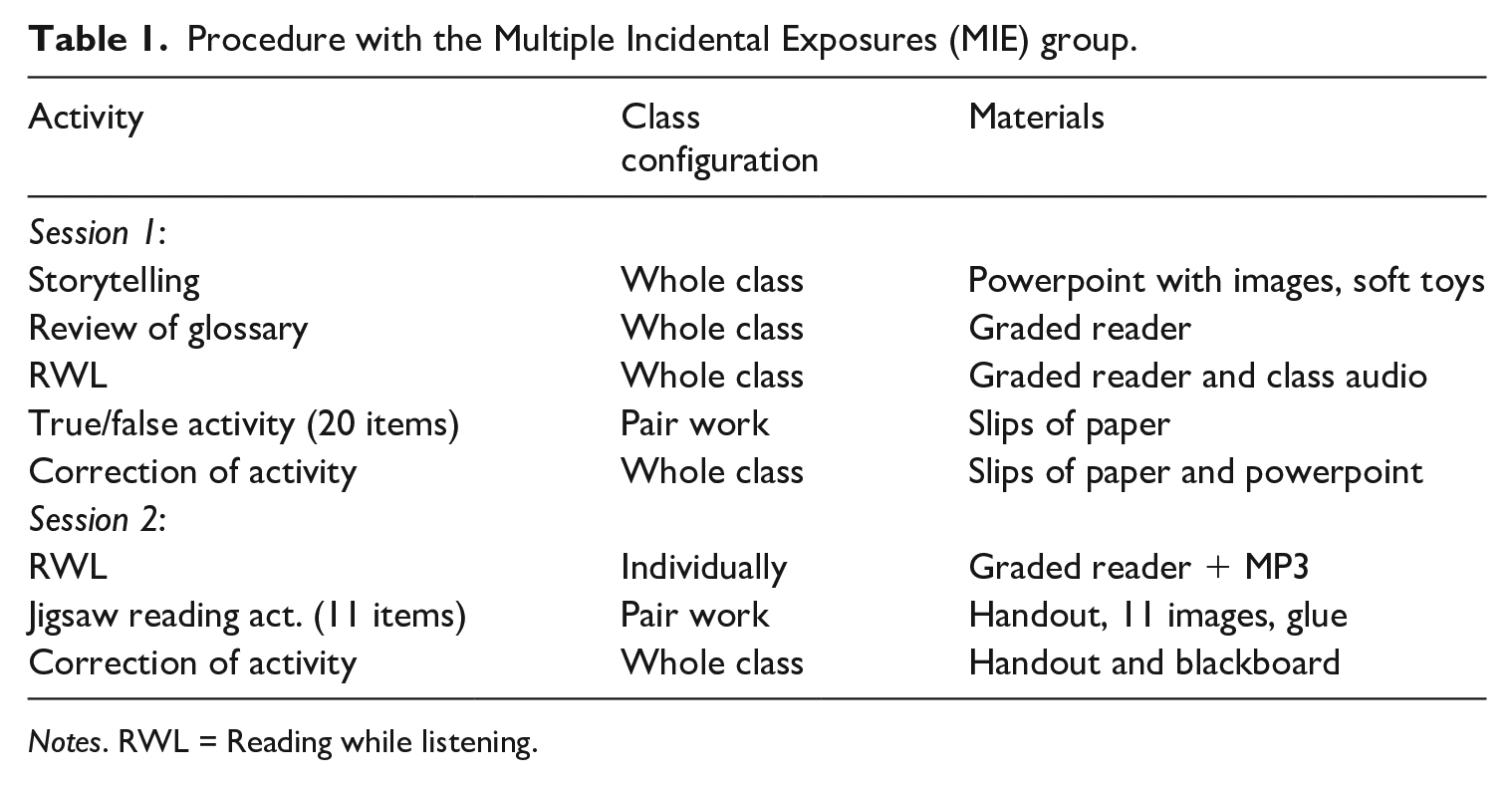
The intervention for the participants in the MIE group involved two graded readers, and the same procedure was followed for both. During the first session (1 hour), the teacher-researcher told the story using a PowerPoint presentation that featured most of the images from the graded reader (but no text) and two stuffed animals (a meerkat and a penguin) to introduce the main characters. To ensure that students were following the story, the teacher-researcher asked questions during the session (e.g. ‘What do you think will happen next?’, ‘What colour is Uncle Jack’s blanket?’ and ‘Who looked in the gym?’); these questions did not directly involve any of the target items. After the storytelling session, a copy of the graded readers was distributed to each learner and together they went over the picture dictionary included in the graded reader, which a comprised 18 words each. This was followed by students collectively RWL to the graded reader. Next, a true or false activity with 20 sentences was conducted. Learners were asked to work in pairs to identify the false sentences and correct them. The session finished after the correct answers were reviewed with the teacher-researcher.
The second session (1 hour) started with the students reading the full book again while listening, this time as an individual activity (participants were each provided with an MP3 recorder). This was followed by a jigsaw reading activity, which was completed in pairs. The activity comprised 11 paragraphs about the story, and each paragraph included a question (see Figure 1).

Example of a paragraph in the jigsaw reading activity.
Additionally, participants were given a set of images depicting each of the paragraphs in this activity and were asked to glue the images alongside the corresponding paragraph. The session finished after the teacher had gone over the questions and illustrations. The following table summarizes the MIE procedure where we can see the input-based nature of the activities, which involved mainly listening to the teacher (storytelling), reading the graded reader silently (while listening) and input-based tasks (T/F and jigsaw activities). See Table 1.
Procedure with the Multiple Incidental Exposures (MIE) group.
Notes. RWL = Reading while listening.
b TEP instructional procedure
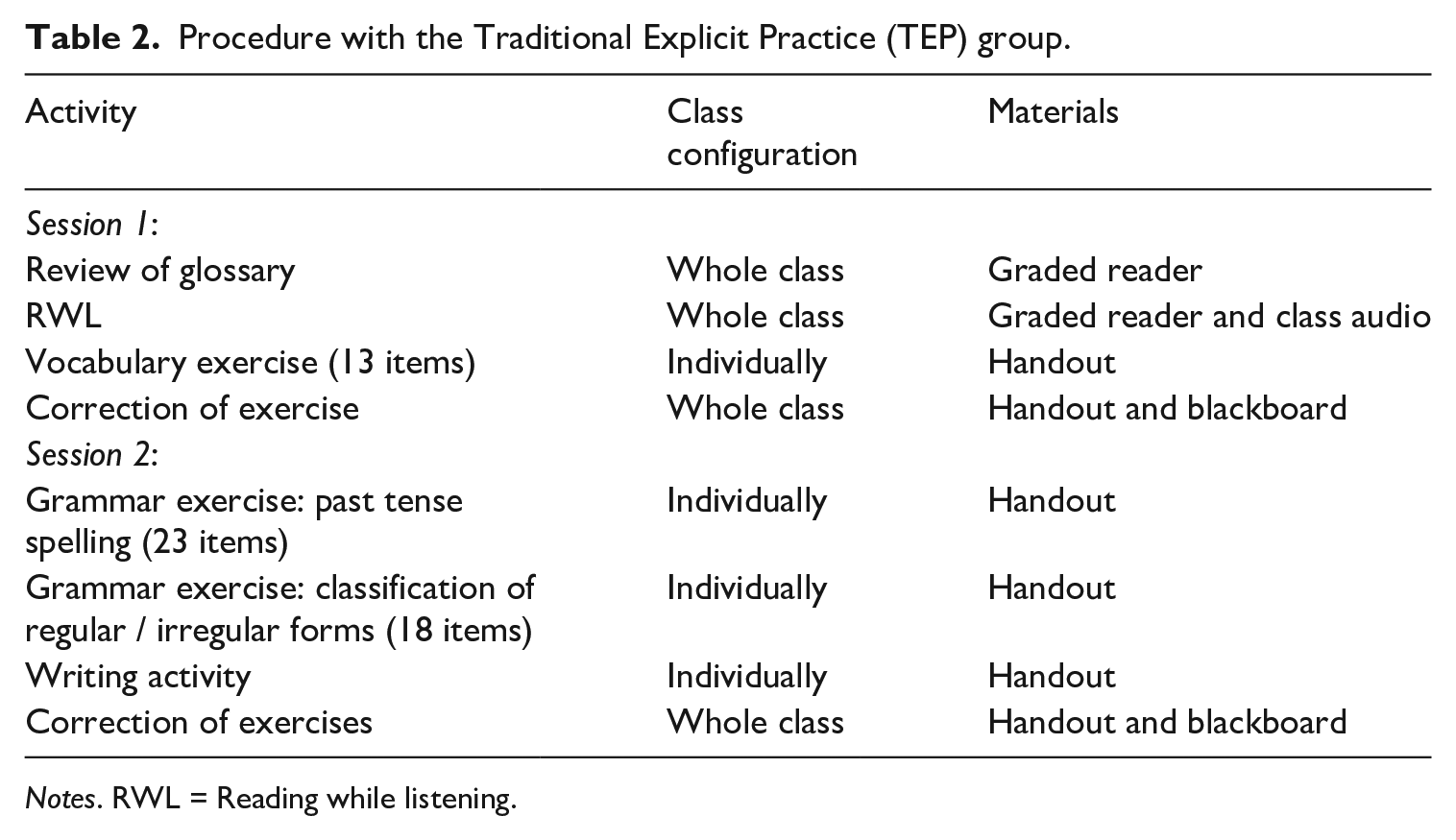
Participants in the TEP group used the same two graded readers as the MIE group and also spent two sessions on each book. During the first session (1 hour), a copy of the graded reader was distributed to each learner, and the teacher and students went over the vocabulary picture dictionary included in the book together. Next, the teacher-researcher showed them the corresponding stuffed animal (a meerkat and a penguin) and told them that they were about to read a story featuring the animal. Then, students took part in a collective RWL to the book. The rest of this first session and the second session then focused on written exercises carried out on an individual basis. In the first session, learners undertook a vocabulary exercise in which they had to choose the correct word from a pool of 12 items to complete sentences. The sentences did not make reference to the stories, but the target words had appeared in the graded readers. Figure 2 provides an example of one of the items (‘nets’).

Example of the vocabulary exercise for the Traditional Explicit Practice (TEP) group.
The second session (1 hour) started with two grammar exercises. The first grammar exercise was about verbs with scrambled spelling, which students had to rewrite correctly (13 items). In the second grammar exercise, students were asked to classify the past tense verb forms from the previous exercise into regular and irregular forms (18 items). Both the vocabulary and the grammar exercises were corrected in class. In the following and final activity, learners were asked to write a different ending for the story (students were given five empty lines to change the ending). The format of these exercises was inspired by the exercises included at the end of the graded readers. There was no pronunciation exercise. See Table 2.
Procedure with the Traditional Explicit Practice (TEP) group.
Notes. RWL = Reading while listening.
4 Tools and target words
a Vocabulary, grammar and perception of pronunciation tests
Three tests focusing on vocabulary, grammar and pronunciation recognition were designed to be used as pre- and post-tests. The vocabulary test consisted of a bilingual matching test (Webb & Chang, 2015), which comprised 25 target words or expressions that appeared in one of the two graded readers. Participants were presented with 25 target words and 30 possible translations (one for each target word plus five distractors). Out of the 25 target words included in the vocabulary test, 12 were concrete nouns (e.g. ‘cage’), five were verbs (e.g. ‘forget’), three were adjectives (e.g. ‘muddy’), three were prepositions (e.g. ‘below’) and two were adverbs (e.g. ‘loudly’). It should be noted that 10 of the target words included in the vocabulary test also appeared in the glossary of the books. The criteria used to select the target items was that the English teacher believed that the students would not know the meaning of these words in the pre-test. Words with different levels of frequencies were included (see Appendices 1 and 2). The internal consistency of the vocabulary test was calculated and the Cronbach’s alpha was α = .812, which shows the test was reliable.
The grammar test consisted of a multiple-choice test with 20 sentences that focused on the simple past tense and asked students to select the correct answer from three possible options. These three options included the correct answer (e.g. ‘ran’ or ‘pointed’), an incorrect answer (e.g. ‘runned’ or ‘point’) and an ‘I don’t know’ option. Out of the 20 verbs, 11 targeted irregular verbs (e.g. ‘bought’ or ‘swam’) and nine targeted regular verbs (e.g. ‘pointed’ or ‘asked’). None of these appeared in the glossary. The English teacher had introduced the past tense to the students soon before the intervention started. The criterion used to choose these verbs was that the English teacher thought that the students would not know the past tense of these verbs. Verbs with different frequency levels were included as shown in Appendices 1 and 2. The internal consistency for the grammar test was α = .704.
What the vocabulary and grammar test had in common was that they were discrete-point tests and they both included target items that participants encountered in the books and also in the materials. The frequencies with which these items were encountered differed according to the instruction procedure in the MIE and TEP groups were exposed to.
Finally, the pronunciation test included 45 words that were pronounced by a Standard Southern British speaker. Fifteen of these words were extracted from the graded readers (target words) (four of the words appeared in the glossary of the books), whereas the remaining 30 words contained the same vowel sounds included in the 15 target words (non-target words). For example, the word ‘funny’ appeared in the book, whereas ‘sunny’ and ‘bunny’ did not but were included in the test. The speaker was asked to read the words while mispronouncing some of them to reflect typical Catalan/Spanish learner errors. Since there is a vowel sound-spelling correspondence in Catalan and Spanish, the word ‘mud’, for instance, is typically mispronounced as /mʊd/ instead of /mʌd/. Participants could see the list of words they would hear, and were given three possibilities when asked whether the word they heard was pronounced accurately (‘yes’, ‘no’, or ‘I don’t know’). The reason for including words that did not appear in the graded reader was to find out whether participants had been able to acquire the pronunciation of the specific words that they were exposed to in the texts and whether they were also able to apply that phonological knowledge to new items. Participants heard the words once only. The internal reliability for the perception of pronunciation test was α = .764.
b Questionnaire
Participants were administered a questionnaire at the end of the intervention. This questionnaire, which was the same for the two groups, asked learners about the English language in general (whether students like it, whether they take extracurricular classes, etc.), about the reading sessions with the graded readers (whether they liked them, whether they preferred to learn English through these materials or through textbooks), about reading in Catalan or Spanish (amount of reading in their first language, etc.) and finally about their family (language/s used at home, etc.). This questionnaire was adapted from a previous one which was successfully administered to students of similar ages (Tragant & Vallbona, 2018).
5 Exposure to input in MIE and TEP groups
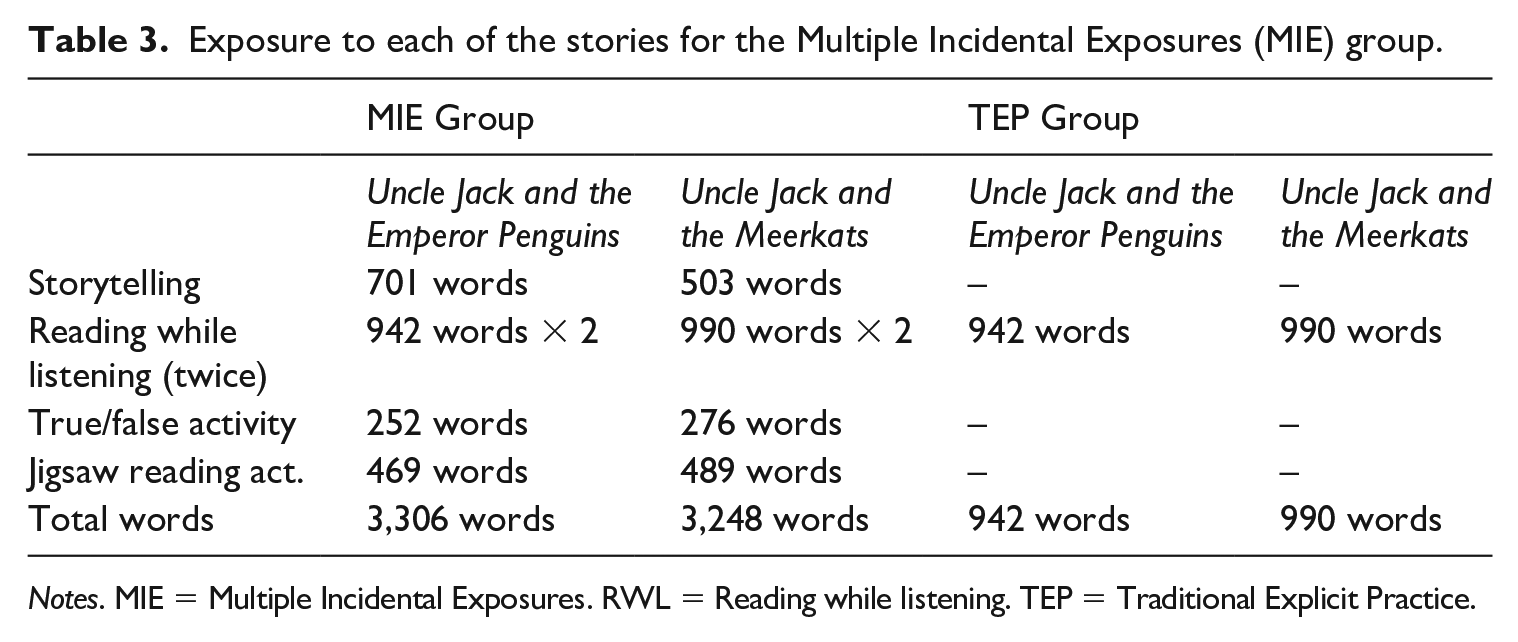
In this study, both the MIE and the TEP groups devoted the same amount of time to the same two graded readers (4 hours in total). However, the focus of the activities and the level of exposure to the story differed considerably. The MIE group was exposed to the story in full twice (through RWL) and partially three times (through storytelling and the true/false and jigsaw reading activities), and activities were designed to allow students to mainly focus on comprehension. By contrast, the TEP group was exposed to the full story once only and spent the rest of class time doing the exercises designed specifically to allow students to learn the vocabulary in the story and the past tense forms. By the end of the second session, students in the MIE condition were exposed to more than 3,000 words per title (see Table 3) and the oral text three times, while those in the TEP group were exposed to fewer than 1,000 words and heard the oral text once only. Even if language learning in the MIE group may not have been purely incidental (like the TEP group, they also went over the picture dictionary), it was designed to be less deliberate than in the TEP group.
Exposure to each of the stories for the Multiple Incidental Exposures (MIE) group.
Notes. MIE = Multiple Incidental Exposures. RWL = Reading while listening. TEP = Traditional Explicit Practice.
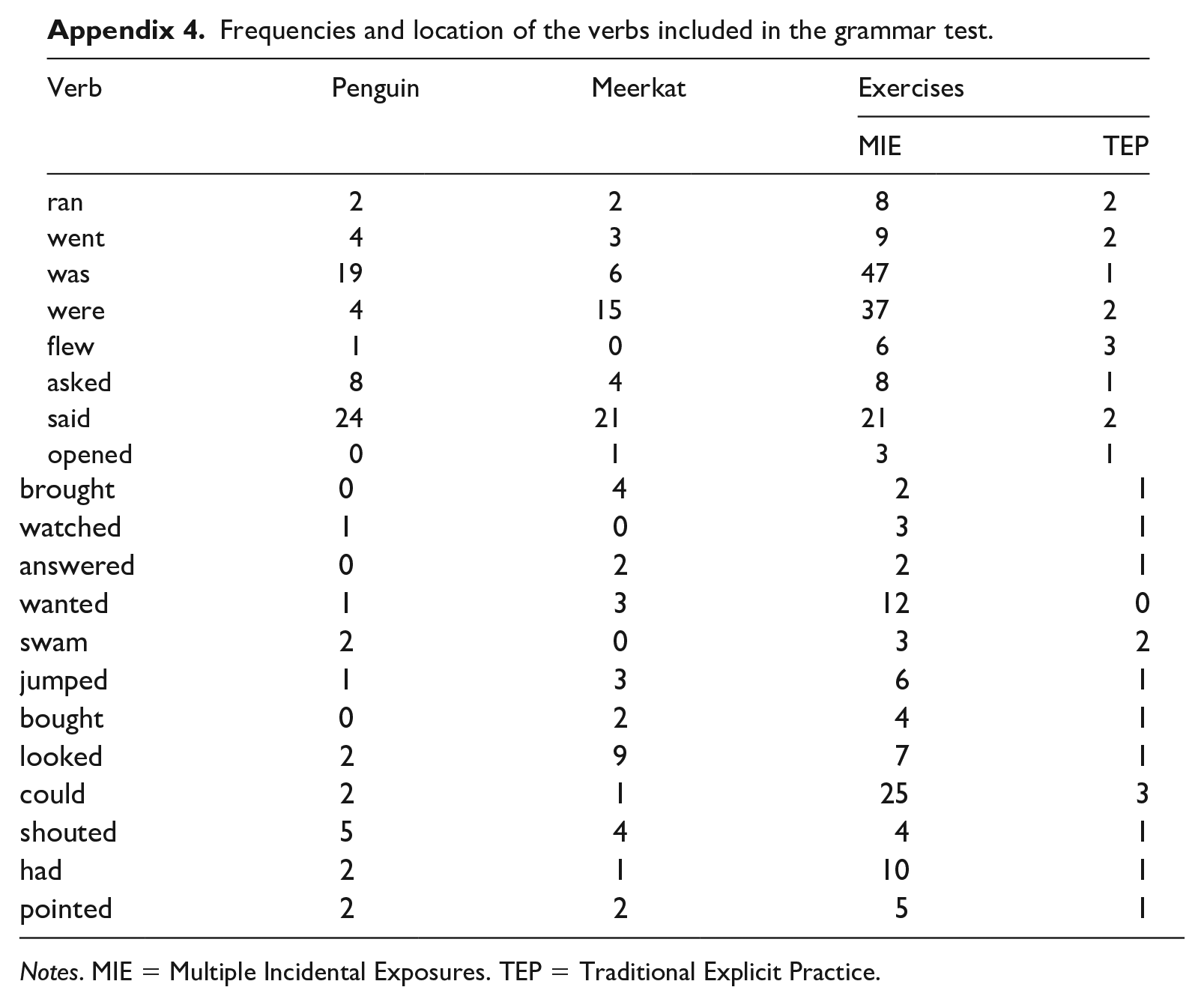
The level of exposure to the target L2 words also differed between the two groups. To illustrate this, Appendices 1 and 2 provide the total number of times students were exposed to the target words in this study, including both the text of the story and the activities and exercises completed by students during the sessions. While learners in the MIE group were exposed to a word like ‘hole’ nine times (four times when RWL, twice during storytelling and three times in the true/false and jigsaw activities), those in the TEP group encountered the word a total of three times (twice though RWL and once in the vocabulary activity). Appendices 3 and 4 provide information on the frequencies and location of the target words of the vocabulary and grammar test. Finally, it must be mentioned that each group was presented all the target words corresponding to the first book by the end of the first session and the same was true for the second book at the end of the third session (sessions 1 and 2 were devoted to the first book and sessions 3 and 4 to the second book).
6 Scoring and analysis
Prior to the statistical analysis, the data from the tests were corrected according to the following scoring criteria. For each of the tests, one point was given if the answer was correct and zero points were given if the answer was incorrect or if students selected the ‘I don’t know’ option. Statistical analysis involved a linear mixed model (LMM) with repeated measures, with ‘Group’ (MIE vs. TEP) as the independent variable and the results of the tests in vocabulary, grammar and pronunciation as the dependent variables. To check the comparability of the two groups, the pre-test vocabulary, grammar and pronunciation scores were compared and no significant differences were found (see Section IV).
IV Results
1 Vocabulary
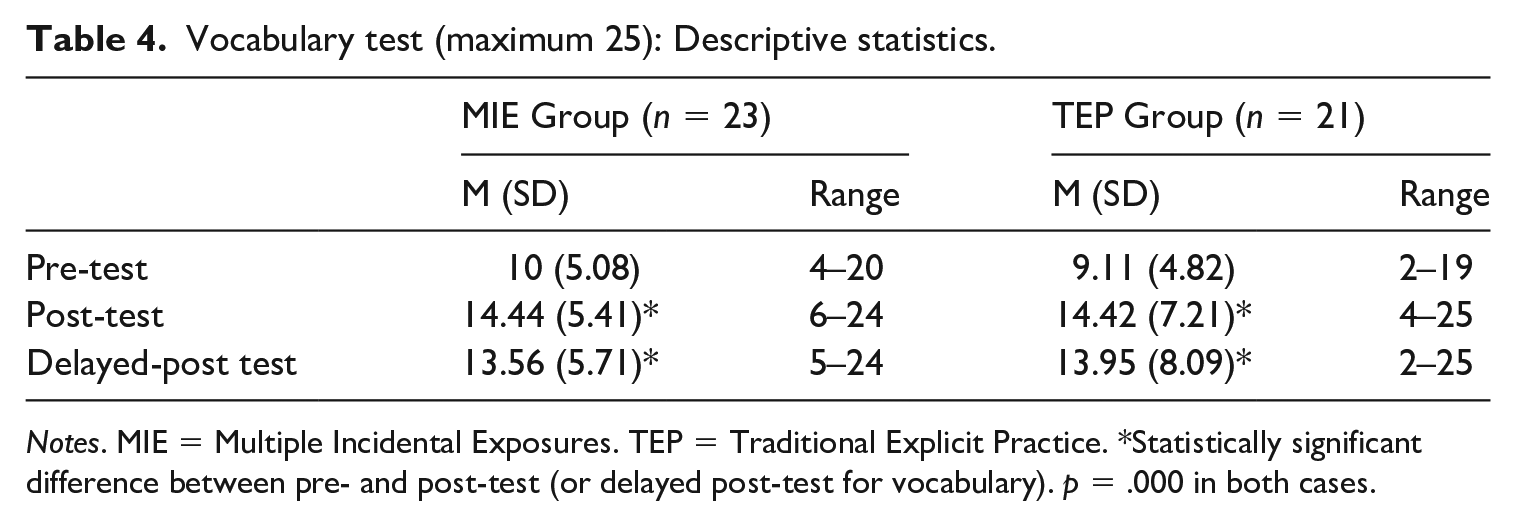
A linear mixed model (LMM) with repeated measures was used to analyse differences between groups, ‘time’ and their interaction. The descriptive statistics in Table 4 show that both groups improved their scores on the vocabulary test from the pre-test to the post-test. The difference between the pre- and post-test was significant for both groups: MIE (t(119) = −4.087, p = .000) and for the TEP group (t(119) = −5.190, p = .000). More specifically, participants in the TEP group improved their vocabulary knowledge significantly from the pre- to the delayed post-test (t(119) = −4.837, p = .000). The same was true for participants in the MIE group, who improved their vocabulary knowledge significantly from the pre- to the delayed post-test (t(116) = −3.433, p = .000). The interaction between Time*Group was not significant (F(2,119) = 0.620, p = 0.540).
Vocabulary test (maximum 25): Descriptive statistics.
Notes. MIE = Multiple Incidental Exposures. TEP = Traditional Explicit Practice. *Statistically significant difference between pre- and post-test (or delayed post-test for vocabulary). p = .000 in both cases.
2 Grammar: Past tense
Regarding the acquisition of the past tense (Research question 2), Table 5 shows that even though both groups improved on this measure, the TEP group experienced greater gains than the MIE group.
Past tense test (maximum 20): Descriptive statistics.
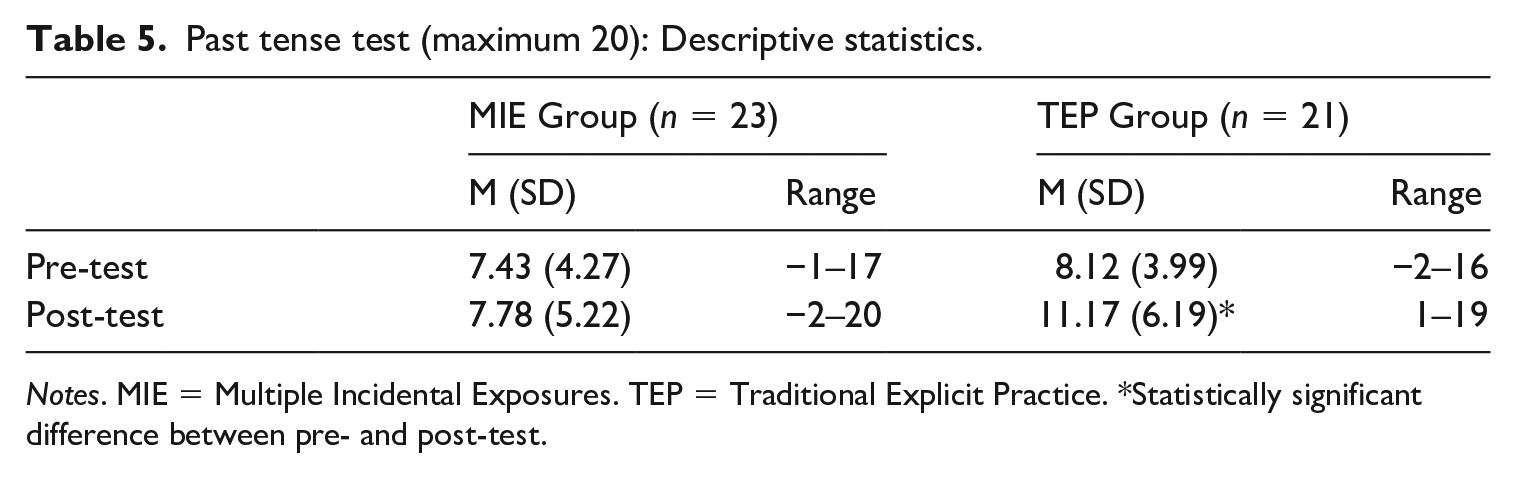
Notes. MIE = Multiple Incidental Exposures. TEP = Traditional Explicit Practice. *Statistically significant difference between pre- and post-test.
The results of the LMM with repeated measures test revealed that there was no statistically significant difference in the scores of the past tense test between the two groups (F(1, 84) = 2,192, p = .142), but ‘time’ was indeed significant (F(1, 84) = 7,690, p = .007).The interaction group*time was also significant (F(1, 84) = 4,862, p = .030); the TEP group improved their knowledge of the past tense significantly from the pre- to the post-test (t(84) = −3,443, p = .027), whereas the MIE group did not (t(84) = −0.455, p = .0650).
3 Pronunciation
The descriptive statistics in Table 6 indicate that both groups improved their perception of pronunciation, but this improvement was higher for participants in the MIE group (1 participant from the MIE group and 3 participants from the TEP group did not answer the test, this is why the number of participants reported in Table 6 is slightly different from the one reported in Tables 4 and 5).
Pronunciation test (maximum 45): Descriptive statistics.
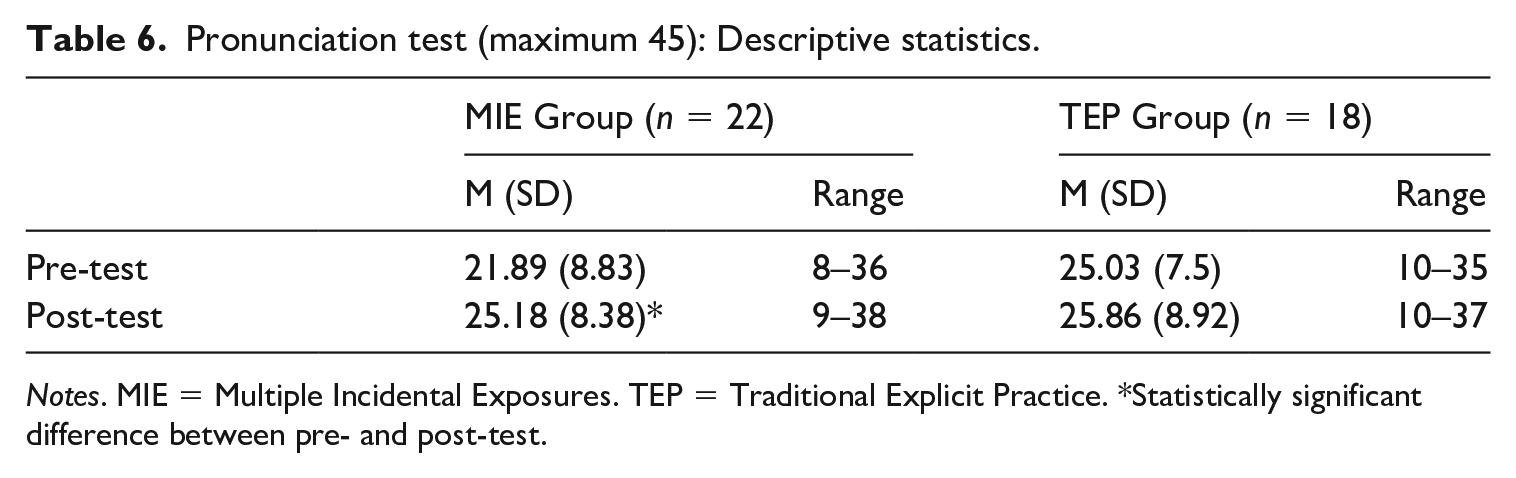
Notes. MIE = Multiple Incidental Exposures. TEP = Traditional Explicit Practice. *Statistically significant difference between pre- and post-test.
The results of the LMM with repeated measures test revealed that there were no statistically significant differences in terms of perception of pronunciation between groups (F(1, 80) = 0.407, p = .526) and the interaction group*time was not significant either (F(1, 80) = 2,324, p = .131). However, ‘time’ was again significant (F(1, 80) = 6,274, p = .014), and as Table 6 yields, participants in the two groups scored higher in the post-test.
Research question 3.1 and Research question 3.2 asked whether participants were able to acquire the pronunciation of the specific words that they were exposed to in the graded readers and if they were also able to apply that phonological knowledge to new items, respectively. In order to answer these questions, a repeated measures linear regression model was run with ‘gains’ as the dependent variable, and ‘target’ (whether students were exposed to the word or not in class), ‘group’ (TEP vs. MIE) and their interaction as independent variables. It was found that ‘group’ was approaching significance (F(1, 76) = 3, 548, p = .063) and that ‘target’ was not significant (F(1, 76) = 0, 608, p = .438). The interaction between both variables (target*group) was indeed significant (F(1, 76) = 6, 040, p = .016). Namely, it was found that in terms of target words appearing in the graded readers, no significant differences were found between the two groups (F(1, 76) = 0, 197, p = .658), whereas this difference was significant for non-target words (F(1, 76) = 9, 452, p = .003) in favour of the MIE group. Therefore, Hypothesis 3, which anticipated that the students in the MIE group would outperform those in the TEP group, was only partially confirmed.
4 Student engagement and perceptions
For the purposes of the present study, only the items in the questionnaire regarding the materials and methodology used will be reported and discussed. It should also be noted that two students (one from each group) failed to fill in the questionnaire and a few students did not complete all items; however, these items that were not completed did not affect the questions reported here. As shown in Table 7, the students in the two groups liked the two books they read, most of them ‘a lot’, and also enjoyed the sessions to a similar extent, irrespective of the procedure followed. Perceptions of learning were also encouraging and similar for the two groups. Many of the students from the MIE group who preferred the Uncle Jack sessions over classes with their textbook mentioned that it was fun (n = 12), with four saying that it was ‘a fun way to learn’ and that ‘you learn and enjoy at the same time’. A few students from the TEP group also mentioned this ludic element, but a higher number of students than in the MIE group said they had learned vocabulary (6 from the TEP group vs. 2 from the MIE group) or mentioned that they liked the stories or adventures (4 vs. 0 in the TEP and MIE groups, respectively).
Learners’ perceptions.
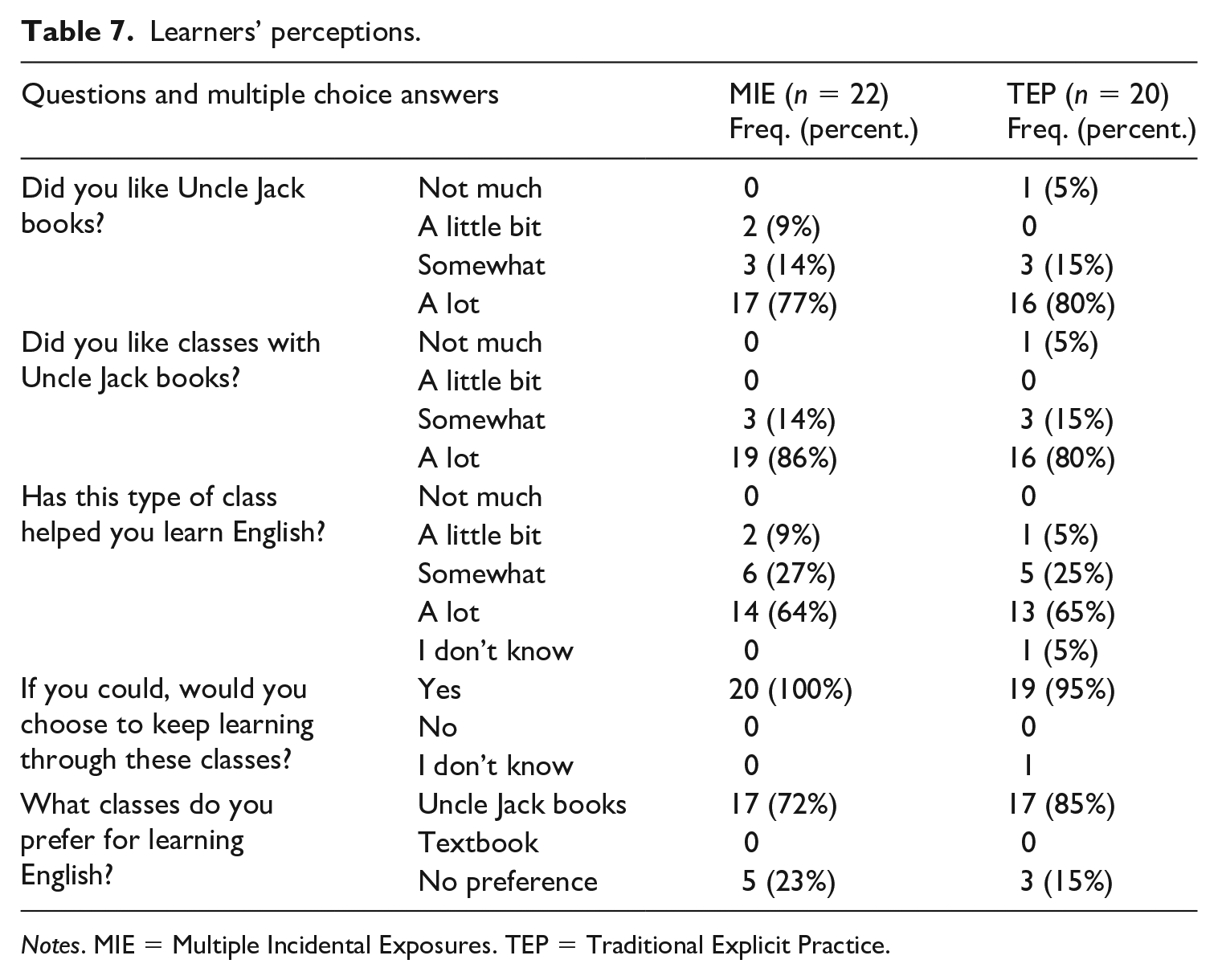
Notes. MIE = Multiple Incidental Exposures. TEP = Traditional Explicit Practice.
Regarding their reported level of engagement (see Table 8), students in the two groups made similarly good use of class time, and their attention levels while reading and listening were high for the majority of students. The only difference between the two groups was that students in the TEP group evaluated the activities more positively than those in the MIE group. Hence, Hypothesis 4, which predicted that participants in the MIE group would show more positive answers towards learning and materials than their TEP counterparts was rejected because both groups showed similar levels of engagement and enjoyment.
Learners’ engagement during Uncle Jack sessions.
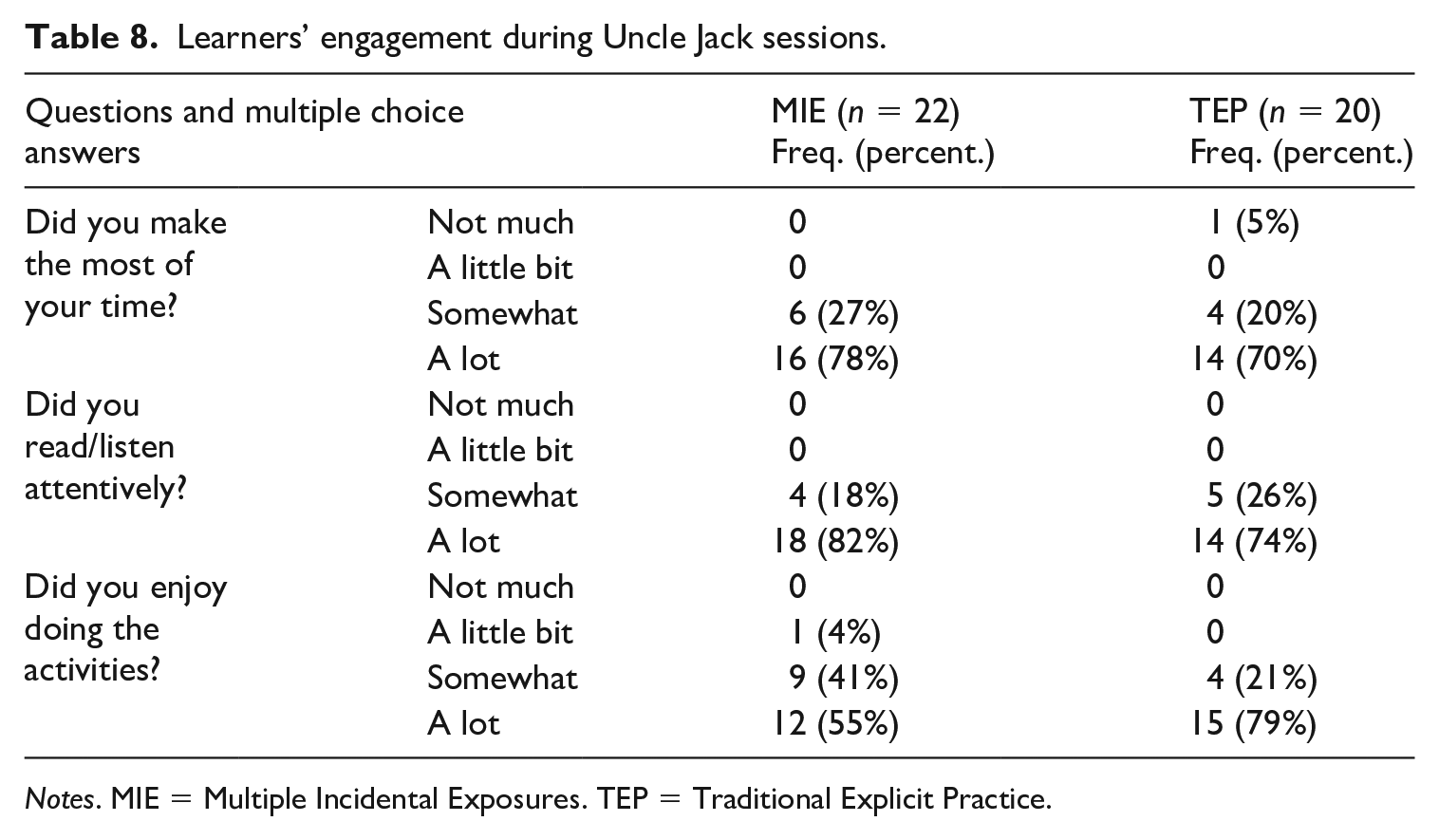
Notes. MIE = Multiple Incidental Exposures. TEP = Traditional Explicit Practice.
V Discussion
1 L2 development (Research questions 1, 2 and 3)
The first research question asked whether students in the Multiple Incidental Exposures (MIE) group would learn as much vocabulary as those in the Traditional Explicit Practice (TEP) group. The answer was yes, since participants in both conditions improved their vocabulary knowledge significantly from the pre- to the post-test. Results from the delayed post-test revealed that the gains made by the MIE group were as robust as those made by the TEP group. These results echo those of previous studies which have shown that both intentional and incidental conditions lead to L2 vocabulary gains (Barcroft, 2009; Sok & Han, 2020). The improvement in vocabulary among the participants in the TEP group may have been due to the more explicit nature of the instruction, as supported by a large number of studies that highlight the benefits of explicit L2 learning (Nassaji, 2017; Norris & Ortega, 2000), especially when it comes to L2 vocabulary learning (Barcroft, 2009). As claimed by Schmitt (2008, p. 341), ‘intentional vocabulary learning . . . almost always leads to greater and faster gains, with a better chance of retention and of reaching productive levels of mastery.’ The fact that the MIE approach yielded similar vocabulary learning and retention rates means that the procedure was just as effective as explicit teaching, and indicates that L2 vocabulary learning can be enhanced through an instructional approach that promotes incidental learning. This finding could be attributed to the fact that participants in the MIE group were exposed to the stories repeatedly. This repetition maximized exposure to the L2 and increased the frequency of word encounters. Thus, this study shows that children can benefit from repeated exposure to the text and multiple word encounters, in a similar way to older learners (de Vos et al., 2018; Uchihara et al., 2019), in spite of their limited metacognition. Given that when students find unknown words in a text they try to infer their meaning from context (Pellicer-Sánchez, Conklin, & Vilkaite, 2020), it is possible that this fact had promoted L2 vocabulary learning among participants in the MIE group and this would partially explain why the vocabulary learning among MIE learners was comparable to that of the TEP learners. According to Webb and Nation (2017), verbatim repetition (repeatedly encountering the word in exactly the same context) strengthens vocabulary learning to a larger extent than reading similar texts. So the advantage of being exposed to the target words repeatedly in the same contexts in the MIE group seems to have equalled the advantage of a more explicit approach to vocabulary learning in the TEP group. Another fact that could explain vocabulary learning by the MIE group is the type of activities participants were asked to do. Since MIE included two pair work activities (True or False and Jigsaw) which contained some of the target words, it is possible that these activities rendered learners the possibility to negotiate forms, meaning and use, so this may have made vocabulary more salient and consequently it may have led to learning. Conversely, participants in the TEP group did not have a chance for this type of negotiation since they were asked to do the fill in the gaps exercises individually.
The second research question asked whether students in the MIE group would be able learn as much grammar as the TEP group. The answer was no, since participants in the TEP group improved their scores in the past tense test significantly between the pre-test and the post-test, whereas participants in the MIE group did not. This supports existing evidence that shows an advantage for explicit grammar learning over incidental learning on the part of older learners and immersion classrooms (Norris & Ortega, 2000; Spada & Tomita, 2010). Although participants in the TEP group were exposed to the story only once, they completed several explicit exercises on verbal tenses. Such exercises may lead students to notice, the importance of which has been demonstrated in classroom settings (Loewen, 2005; Uggen, 2012). The fact that participants in the MIE group did not improve significantly could be explained by their lower level of awareness of this grammatical feature. It is possible that, if the intervention had been longer, students would have been more likely to notice the past forms in the long run, since incidental learning is, by its very nature, a slow process (Hulstijn, 2013). However, it is remarkable that being exposed to the target features in full twice and partially three times was not enough to reach a similar amount of learning of the past tense to that of the TEP group, who had only been exposed to the full story once.
The third research question regarding perception of pronunciation asked whether students in the MIE group, who had been exposed to the stories three times, would be able to outperform those in the TEP group, who had been exposed to the stories only once. Additionally, it asked whether there would be any difference between groups in learning the pronunciation of target words and non-target words. The LMM with repeated measures showed that there were similar changes in the pronunciation scores over time for the two groups. These results seem to indicate that a longer intervention or greater oral exposure would be needed for beneficial effects on L2 phonological learning to show. Other studies that have shown the advantages of RWL consisted of longer-term reading programmes (Tragant et al., 2016; Trofimovich et al., 2009). Since none of the groups received any phonetic instruction nor practice, any phonological acquisition was incidental, and previous research suggests that participants with more advanced L2 levels may take more advantage of learning in such conditions, whereas participants with a low L2 level tend to benefit more from pronunciation instruction (Derwing & Munro, 2005).
However, participants in the MIE group were able to apply the pronunciation patterns acquired during the treatment to non-target words, whereas those in the TEP group did not. As Trofimovich et al. (2009, p. 613) claimed, ‘comprehension exposure without any pressure to speak (at least early on in learning), thus appears to accelerate the development of listening comprehension.’ Moreover, previous research claims that language learners become familiarized with the regularities they perceive in the language and consequently apply them based on the regularities they perceived (Pierrehumbert, 2003). Given that the MIE program consisted of comprehension exposure without any pressure to speak and participants were at an initial stage of learning, it can be speculated that participants in the MIE group improved their listening comprehension more than their TEP counterparts (although listening comprehension was not measured in the present study), and that this improvement may have been reflected in the perception of pronunciation of non-target words. Since MIE participants were orally exposed to the books three times more than their TEP counterparts, it is plausible to think that MIE participants became more familiarized with the phonological regularities of the language than TEP participants; also, reading a word while listening to its pronunciation may help learners match an oral word with its orthographic correspondence, thus MIE participants may have taken advantage of this. This finding is in line with previous studies that have found that participants are able to generalize knowledge of trained words to new words and even new talkers; that is to say, perceptual learning of L2 sounds generalizes to new instances of the same sound (Logan, Lively & Pisoni, 1991; Thomson, 2018).
On the whole, the results concerning L2 development show that, in the case of grammar learning, the TEP procedure proved to be more effective than the MIE procedure. However, as far as word meaning is concerned, the MIE procedure that involved repeated exposure and repeated word encounters was as effective as the TEP procedure. With respect to pronunciation, we found that there were no differences between groups in terms of general perception of pronunciation, but MIE learners applied the phonological knowledge acquired during the treatment to non-target words and TEP learners did not. We hypothesize that the MIE procedure would need to be followed for an extended period of time for all its benefits to show; given that accurate speech perception is required for accurate speech production (Flege, 1995; Wode, 1996) and for non-target words the MIE group did significantly better than the TEP group, maybe this would have resulted in better speech production by the MIE group; further research should try to address this gap by including a test of speech production. It would be interesting that a follow-up study that compared a MIE group with a control group that received explicit pronunciation instruction was conducted.
2 Student perceptions (Research question 4)
The results of the questionnaire indicate that students expressed comparably positive perceptions and high levels of engagement towards the MIE and TEP instructional procedures. These similar findings indicate that through ‘masked’ repetition learners were as engaged and motivated as participants in the control group, who were doing exercises with ‘new’ material. The comparable findings may also be explained by the popularity of the books themselves and the appealing nature of graded readers as the basis for classroom instruction, regardless of the instructional procedure followed. This, combined with the fact that reading books or graded readers in English (let alone with audio support) was a novel experience for the learners in the two groups, may have resulted in students’ perceptions of both procedures as equally enjoyable. Moreover, the fact that the teacher-researcher who carried out the two instructional procedures was not their regular teacher may have had an equally positive effect on the two groups under study.
VI Teaching implications and conclusions
This study set out to explore the efficacy of two different teaching modes through graded readers, one more incidental in nature and involving multiple repetitions of the stories in the graded readers (MIE), and the other more explicit in nature and involving one-time exposure to the graded readers (TEP). While it was found that that explicit practice does help children when it comes to grammar learning, both instructional procedures were comparable in terms of vocabulary and perception of pronunciation learning. Thus, it can be concluded that implicit learning can be enhanced through textual repetition.
As far as teaching implications go, the study has highlighted the potential of children’s graded readers as a teaching resource to promote both incidental and intentional learning. Students also seem to cope well with the lengthy activities that involved rich input in the case of the MIE procedure, as well as with the written exercises involving many items in the case of the TEP procedure. Additionally, the study provided evidence that students can pick up vocabulary and incidentally perceive pronunciation from a graded reader by going over the text through the MIE procedure, which students found engaging. The combination of reading with storytelling and RWL probably prevented students from feeling bored by the repeated exposure of the MIE approach. It is therefore advisable for teachers to actually use the audio files that accompany most graded readers in combination with storytelling as a complement to silent reading. RWL is a versatile activity, since it can be implemented in class collectively or individually with headphones, or even given as homework. With respect to grammar, given that the MIE procedure did not result in grammar learning, we would suggest that an element of language awareness (e.g. input enhancement) or text-based focus-on-form practice be included in the MIE procedure.
The study presented a number of limitations, including the number of participants in each condition and the fact that we focused only on three very specific areas of the L2. Moreover, the intervention in the present study was conducted over a very short period of time. Another possible limitation is the fact that one of the authors was the teacher of both groups, and since she knew the hypotheses of the study, her intervention might have influenced the results. However, since it was a very controlled experiment, there was little margin for bias, since she focused on doing the exercises that had been designed for both conditions. In fact, using one of the researchers as a teacher presented a good opportunity to observe the students’ behaviour and engagement and hear their comments. Another limitation of the present study is that our measurement tools were form-focused, whereas the MIE approach was meaning-focused. Hence, further research should try to include some meaning-focused tasks in order to measure L2 development. Finally, there are some factors (i.e., whether target words appeared in the gloss or did not or the frequency of the target words in the graded readers) that are beyond the scope of this article but are likely to have had an impact on language learning, which would be interesting to examine in future studies.
In any case, the present study represents a valuable contribution to the field of SLA, given that it included a relatively underexplored population of L2 learners using children’s graded readers. Despite its limitations, the study helped fill a gap in the field of L2 classroom-based research, since it involved the development of a new teaching procedure for school-aged children based on repetition that proved as efficient as a traditional explicit teaching method in terms of vocabulary learning. Building multiple reading activities around the same text also provide students with a chance to maximize exposure to input without sacrificing engagement. In summary, graded readers can be used in a different way and, in so doing, can promote incidental learning in the classroom.
Footnotes
Appendix
Frequencies and location of the verbs included in the grammar test.
| Verb | Penguin | Meerkat | Exercises | |
|---|---|---|---|---|
| MIE | TEP | |||
| ran | 2 | 2 | 8 | 2 |
| went | 4 | 3 | 9 | 2 |
| was | 19 | 6 | 47 | 1 |
| were | 4 | 15 | 37 | 2 |
| flew | 1 | 0 | 6 | 3 |
| asked | 8 | 4 | 8 | 1 |
| said | 24 | 21 | 21 | 2 |
| opened | 0 | 1 | 3 | 1 |
| brought | 0 | 4 | 2 | 1 |
| watched | 1 | 0 | 3 | 1 |
| answered | 0 | 2 | 2 | 1 |
| wanted | 1 | 3 | 12 | 0 |
| swam | 2 | 0 | 3 | 2 |
| jumped | 1 | 3 | 6 | 1 |
| bought | 0 | 2 | 4 | 1 |
| looked | 2 | 9 | 7 | 1 |
| could | 2 | 1 | 25 | 3 |
| shouted | 5 | 4 | 4 | 1 |
| had | 2 | 1 | 10 | 1 |
| pointed | 2 | 2 | 5 | 1 |
Notes. MIE = Multiple Incidental Exposures. TEP = Traditional Explicit Practice.
Acknowledgements
We would like to thank the reviewers of this manuscript, whose comments were key for improving it. We would also like to thank Judith Borràs for her invaluable help.
Funding
This research was supported by grants 2017SGR1522 (first author) and FFI2016-80576-P and PID2019-110536GB-I00 (second author).
