







Abstract
Collaborative writing (CW) involves two or more students writing a single text together. Previous studies mainly focused on students’ cognitive engagement in CW and investigated their attention to various language-related problems during task interaction. However, little CW research to date has considered that engagement in language-related discussions can manifest from three dimensions: cognitive, social, and affective. Focusing on the multidimensional characteristics of engagement, this study investigated how Russian learners’ social and affective reactions influence their focus on language use while they completed a CW task. Drawing on Svalberg’s framework of engagement with language to identify the three dimensions of engagement, I conducted a mixed-method approach towards analysing the audio-recorded collaborative dialogues by three student pairs (n = 6), along with a qualitative analysis of their responses to a five-point Likert scale questionnaire. The analyses showed that when learners were interactive and viewed the activity as useful, they noticed many linguistic problems and elaborated on them. In contrast, when learners demonstrated social disengagement and perceived disadvantages from CW, they were likely to withdraw their attention from resolving the language issues they encountered. These findings indicate the complex and dynamic nature of task engagement. They can provide second language (L2) teachers with an in-depth understanding of how to fully engage students in instructional activities to better foster their L2 learning.
I Introduction
Collaborative writing (CW) is a writing activity involving two or more students interacting with each other in all stages of the writing process to produce a single text together (Storch, 2013). This activity is considered as an effective way of promoting second language (L2) writing as students are encouraged to exchange knowledge and solve problems together (Storch, 2018). Many studies have investigated collaborative dialogues between peers with a focus on the amount of attention that students devote to discussing and managing linguistic problems such as grammar, vocabulary choice, and syntax as they write together (e.g. Dobao, 2012; Storch, 2007; Swain, 2000; Zeng & Takatsuka, 2009). This examination of collaborative dialogues concentrates on students’ cognitive process of how L2 use is noticed, reasoned, and solved jointly (Cumming, 1990; Swain & Lapkin, 1995). However, the growing awareness of the social and cultural contexts in which language learning takes place has challenged a simple focus on the cognitive process because students’ cognition can be influenced by the context in which they are engaged when using the target language (Firth & Wagner, 2007; Lantolf, 2000). Regarding CW, the awareness of contexts has underlined the socially distributed and situated nature of collaborative dialogue. This calls for further research to examine the social contexts of collaborative work, in particular how students’ joint attention to L2 use is created and invoked through interaction.
Many researchers have suggested that students’ awareness of language use emerges from a dynamic and complex interaction, which depends on how they are socially and affectively engaged in an activity (e.g. Mercer, 2004; Philp & Duchesne, 2016; Svalberg, 2018). To capture such dynamics and complexities, Svalberg (2009) proposed an analytical framework to identify students’ engagement in language-related problems, which is referred to as engagement with language (EWL). The framework incorporates three dimensions of engagement–cognitive, social, and affective–and presents the ways in which these dimensions can manifest in collaborative exercises or tasks. In CW, these three dimensions of engagement have not been jointly examined yet, and their investigation will contribute to a better understanding of how students interact with one another to process language issues during CW.
By adapting the EWL framework, the current study investigated students’ engagement in the CW activity where they wrote a short essay in pairs. This study refers to the cognitive dimension of engagement as learners’ heightened attention to the construction of their language knowledge; sees the social dimension as the way learners socially interact and support each other to manage language difficulties; and regards the affective dimension as learners’ self-reported feelings about the task participation, along with their emotional reactions during language-related discussions, such as enjoyment, praise, and frustration. Specifically, learners’ attention to L2 use is examined in relation to how they socially and affectively interact with each other during a CW task. By contextualizing learners’ cognitive engagement with language items in its situated social and affective context, the study contributes to L2 pedagogy by providing L2 teachers with a better knowledge of how to fully engage students in instructional activities to better foster their L2 learning.
1 Engagement with language (EWL)
Svalberg’s interest in the EWL framework was triggered by the potential roles of learner variables such as learning strategies and motivation in L2 learning (Svalberg, 2018). In this regard, the EWL is similar to the concept of engagement in language use (ELU) proposed by Lambert, Philp, and Nakamura (2017) concerning learners’ investment in a task-based interaction. However, the difference between EWL and ELU lies in the focus of the investigation of learner engagement. Unlike ELU, which is concerned with how students use L2 as a vehicle to complete a task, EWL mainly focuses on learners’ responses to questions about linguistic problems such as grammar, vocabulary, and syntax (Svalberg, 2018).
The EWL framework is a construct containing cognitive, social, and affective engagement, and its significant characteristic is that the three engagement dimensions are interdependent, interrelated, and interacting (Svalberg, 2018). Specifically, in Svalberg’s (2009) view, the social and affective dimensions may drive cognitive engagement. This was demonstrated in the research of Baralt, Gurzynski-Weiss, and Kim (2016), which examined how 20 pairs of Spanish learners completed either a cognitively complex or simple task in a face-to-face or online context. The qualitative analysis of the audio-recorded task interactions and post-task questionnaire showed that in the face-to-face context, the pairs were interactive and supportive and felt enjoyment and fun, which fostered the direction of their attention to linguistic forms. In contrast, in the online context, the participants lacked social support or encouragement and were anxious and bored. As a result, they showed only a few instances of cognitive engagement with lexis.
Similarly, Ahn’s (2016) study also found an interdependent relationship among the three dimensions of engagement during a task interaction. She investigated how young Korean students were engaged in language play in English immersion camps. The results indicated that the students’ willingness and voluntary participation had the potential for motivating students to use L2 English only, rather than their mother tongue Korean, when they were dealing with language issues, such as word meaning. In general, by adopting the EWL framework, both studies provided a comprehensive understanding of how the cognitive, social, and affective dimensions of engagement are interrelated.
The EWL framework can guide research beyond conscious attention to forms and further explore how social and/or affective dimensions interact with cognitive engagement. In other words, this framework acknowledges the role of social and affective factors in language learning and expands the analysis of dialogical processes from a solely cognitive view to incorporate those factors. This re-analysis of dialogical data is also demonstrated in Swain’s (2013) study, which argues that learners’ emotional expression is an integral part of cognition. Re-examination of dialogical data from multiple engagement dimensions can also represent the complex and dynamic nature of language development. In terms of CW, employing the EWL framework can capture the complexity and dynamism as students go through a language issue, by showing the mutual interaction among the three dimensions of engagement. As a result, the EWL framework is a promising means to study how and why (or why not) students are engaged in certain language items, and why some discussions about language use lead to more learning than others.
2 CW studies on engagement
Cognitive engagement in CW mostly concerns learners’ attention to issues with the target language (Svalberg, 2009). It can manifest in language-related episodes (LREs), which are any part of a collaborative dialogue where learners either explicitly or implicitly discuss their language problems (Swain & Lapkin, 1998). During a CW activity, the analysis of LREs has demonstrated what types of language issues draw the most attention from students in relation to the task types they complete. For example, Leeser (2004) found that paired writers focused more on grammatical LREs than lexical LREs in a passage reconstruction task, while Wigglesworth and Storch’s (2009) participants attended to lexical LREs most when writing an argumentative essay. Although learners paid different amounts of attention to LREs during different tasks, they were often able to correctly resolve most of the language problems they encountered during CW (e.g. Dobao, 2012; Stell, 2018; Storch, 2007). According to Storch (2008), LREs could also be distinguished in terms of the quality of engagement (e.g. whether the engagement was elaborate or limited). Elaborate engagement involved instances where two participants discussed linguistic choices and considered alternatives. Limited engagement showed little negotiation between two participants, such as repetition, acknowledgement (e.g. yes, okay), or no response at all. Generally, in CW research, the analysis of LREs shows how learners cognitively engage in a task.
Social engagement in CW is associated with interactional relationships co-constructed by students as they write collaboratively (Storch, 2002). It can be measured through the degree of equality and mutuality: two indexes of peer interaction which can show how supportive and interactive a writing group is (Storch, 2002). Equality refers to the degree of control over the task direction, while mutuality refers to the level of engagement with each other’s contributions (Damon & Phelps, 1989). Based on their low or high degrees of equality and mutuality, studies have revealed different interactional relationships between their participants in particular CW activities (e.g. Li & Kim, 2016; Li & Zhu, 2013; Storch, 2002). This finding indicates the dynamic nature of social engagement among writing groups across different CW tasks. In addition, many studies have linked interactional relationships to the development of L2 learning. Some of these studies have shown that if peer interaction is high in mutuality, students can easily note, elaborate, and accept suggestions and repairs in L2 use, resulting in co-constructed L2 knowledge being transferred to individuals’ linguistic repertoire (e.g. Li & Kim, 2016; Li & Zhu, 2017; Storch, 2005; Watanabe & Swain, 2007). Taken together, these findings demonstrate that social engagement is able to support L2 learning.
These studies show that social and cognitive engagement have different research foci. Specifically, social engagement highlights different types of interactional relationships and their contributions to L2 learning, while cognitive engagement concerns the outcome (i.e. correct, incorrect, or unresolved) and the quality (i.e. elaborate or limited) of LREs. So far, a possible link between the two dimensions of engagement suggests that high mutuality of peer interaction can lead to a greater number of LREs than low mutuality. However, it is still unclear how mutuality mediates student focus on LREs. Thus, more research is needed to gain a better understanding of how interactional relationships can influence learners’ attention to language issues during CW.
Affective engagement in CW is reflected by participants’ self-reported surveys or interviews about how they perceive such writing experiences. Many studies have discovered that most students enjoy writing together and feet it to be beneficial for the development of L2 writing (e.g. Dobao & Blum, 2013; Elola & Oskoz, 2010; Shehadeh, 2011; Storch, 2005). The reported perceptions are seemingly related to learning benefits offered by CW. For example, Shehadeh’s (2011) participants who reacted positively to their CW experience pooled ideas, offered immediate feedback, and organized the text together. In the same vein, Elola and Oskoz (2010) found that their participants unanimously agreed that peer scaffolding improved the overall quality of their texts. These studies show how a socially supported environment can help with shaping students’ perceptions. However, it is still unclear whether participants’ perceptions of CW can be linked to how they form particular interactional relationships or develop the focus on L2 usage during the co-constructed writing task.
An exception is a study by Chen and Yu (2019), which found that students’ attitudes towards CW were potentially related to their co-constructed social relationships. The authors focused on two participants from two writing groups, who behaved differently across three CW activities and had contrasting attitudes towards the activities. They discovered that the participant whose attitudes were more favourable to CW tended not only to form a collaborative relationship (i.e. high equality and mutuality) but also to increase the number of LREs being resolved correctly. The study demonstrated how students’ attitudes could affect their social relationships and the production of LREs, which foreshadows the interrelated characteristics of affective, social, and cognitive engagement in a task-based interaction. Nevertheless, these results highlight how students feel about CW experiences, which gives no indication of the emotional facet of the EWL process: the facet concerning students’ emotional disposition towards participation in language-related discussions.
3 The current study
As explained above, previous CW studies mainly examined the three dimensions of engagement as separate processes without fully considering their mutual intersections. Moreover, Svalberg’s (2009) EWL framework has not yet been applied to CW research, although it is widely considered to be a productive means to ‘establish, measure, and interpret the presence/absence, degree, and nature of Engagement’ (p. 256, capitalization as in the original source). Therefore, this study aimed to adapt the EWL framework to investigate how L2 Russian learners were engaged with language items during a CW activity by incorporating multiple dimensions of engagement (i.e. cognitive, social, and affective). It particularly focused on how learners’ social interaction and emotions might influence their attention to language items throughout the activity. The following two research questions were addressed:
Research question 1: How do writing pairs cognitively engage with language items?
Research question 2: How do the social and affective dimensions of engagement influence the writing pairs’ cognitive engagement with language items?
II Methodology
1 The study context
The Russian language is becoming increasingly popular among undergraduates in China, as the nation continues to expand political and economic cooperation with Russian-speaking countries, such as Russia and Kazakhstan. This cooperation creates a huge demand for professionals with Russian knowledge in the job market, and many students are, thus, keen to learn Russian. The number of university students who are enrolled in a Russian program has increased by almost six times over the last two decades (An, 2018).
The participants in this study were from a public university in China. The university has provided a four-year undergraduate Russian program for nearly 30 years. The Russian program involves not only comprehensive language acquisition courses at the novice level but also content courses about Russian history, literature, and culture. To graduate with a bachelor’s degree in Russian, students need to pass two high-stakes tests of Russian proficiency: National Russian Test Level 4 (novice) and Level 6 (advanced) (thereafter NRT-4 and NRT-6). The two tests measure whether students have met the required levels of Russian language skills (listening, speaking, reading, and writing) specified in the national syllabus for Russian learners. Writing is an essential part of the two tests. The participants recognize the importance and difficulties of writing in Russian, and they participated in this study in the interest of helping researchers understand effective methods that can improve students’ writing.
2 The data
The data were drawn from a larger project that investigated the process, outcome, and learner perceptions of engagement in a CW activity (B. Zhang, 2017). In this project, the activity was conducted in two different Russian acquisition courses, as part of regular classroom activities. There were 38 students engaged in the activity, including 24 second-year students from the course Introductory Russian IV and 14 third-year students from Introductory Russian VI. This study focused on six participants (three pairs) from the third-year students, whose demographic information is provided in Table 1. The pairs were selected because their test scores on NRT-4 test were closer to one another than the other pairs, which can help control potential influences of proficiency pairing on cognitive engagement (see Leeser, 2004 and Storch and Aldosari, 2013 for how proficiency pairing affects the number and outcome of LREs). Their test scores indicate that they had a B1 level of Russian proficiency on the Common European Framework of Reference for Languages (CEFR).
Information on the participants.
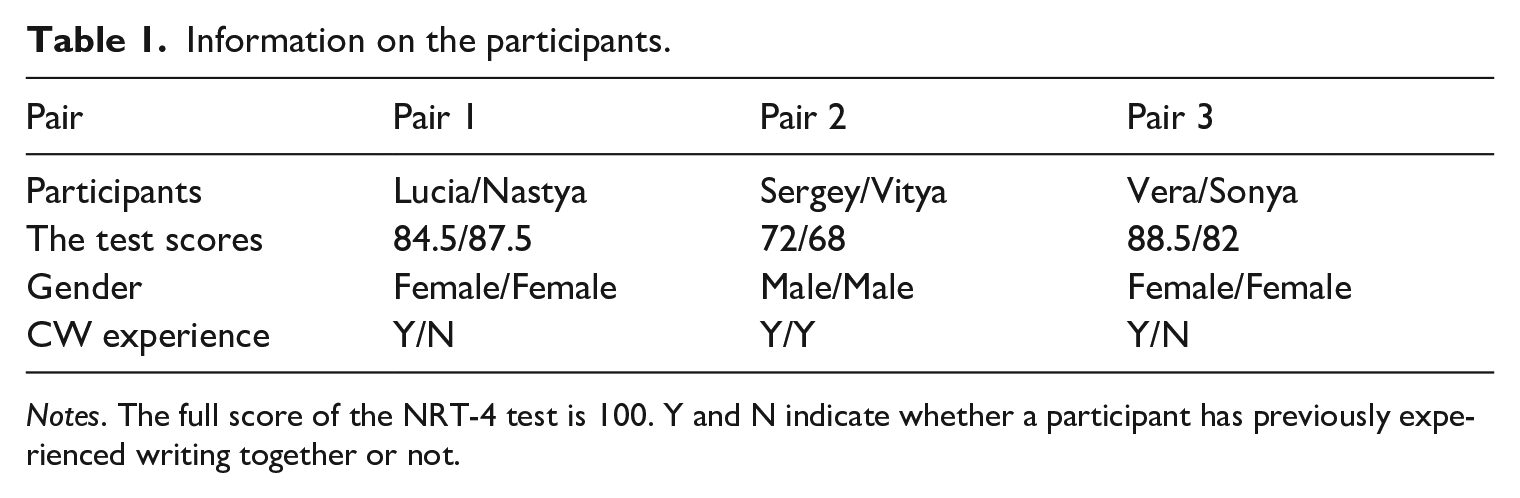
Notes. The full score of the NRT-4 test is 100. Y and N indicate whether a participant has previously experienced writing together or not.
To engage the participants in the CW activity, the teacher randomly assigned them into pairs. The writing activity they completed was to write a short essay (80–100words) about Как сохранить здоровье (‘How to keep healthy’) within 35 minutes. The task topic and word limit followed the guidelines of the NRT-4’s writing assessment, which often involves writing a narrative or argumentative essay in a life-related issue with more than 80 words. During the entire CW processes, the participants audio-recorded their talk using their smartphones. These audio-recordings constituted the primary data of the study.
Immediately after the activity, a five-point Likert scale questionnaire (see Appendix 1) was distributed to the participants. The questionnaire contained 12 items about how the participants perceived CW, ranging from 1 ‘strongly disagree’ to 5 ‘strongly agree’.
3 Coding and analysis
a Coding
As explained above, the data of this study comprised of the three pairs’ audio-recordings of collaborative dialogue (73 minutes) and their responses to the questionnaire. The recordings were first transcribed in Chinese Mandarin and Russian with the transcription system adapted from Du Bois, Schuetze-Coburn, Cumming, and Paolino (1993) (see transcription conventions in Appendix 2). The transcripts were translated into English by the researcher to reproduce the general meaning of the original excerpt. The units of analysis of the transcripts were LREs, defined by Swain and Lapkin (1998) as talk segments where learners discuss their language use. The LREs can show how students are engaged with language items (Svalberg, 2018). A two-staged data coding system was then employed to identify and analyse cognitive, social, and affective engagement involved in an LRE, as shown in Figure 1.
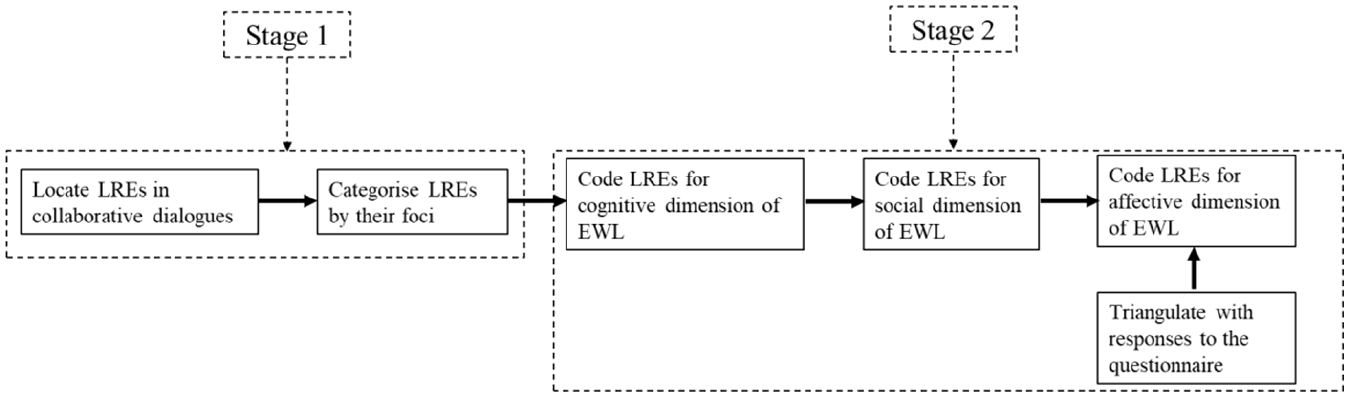
The steps of coding the collaborative dialogues.
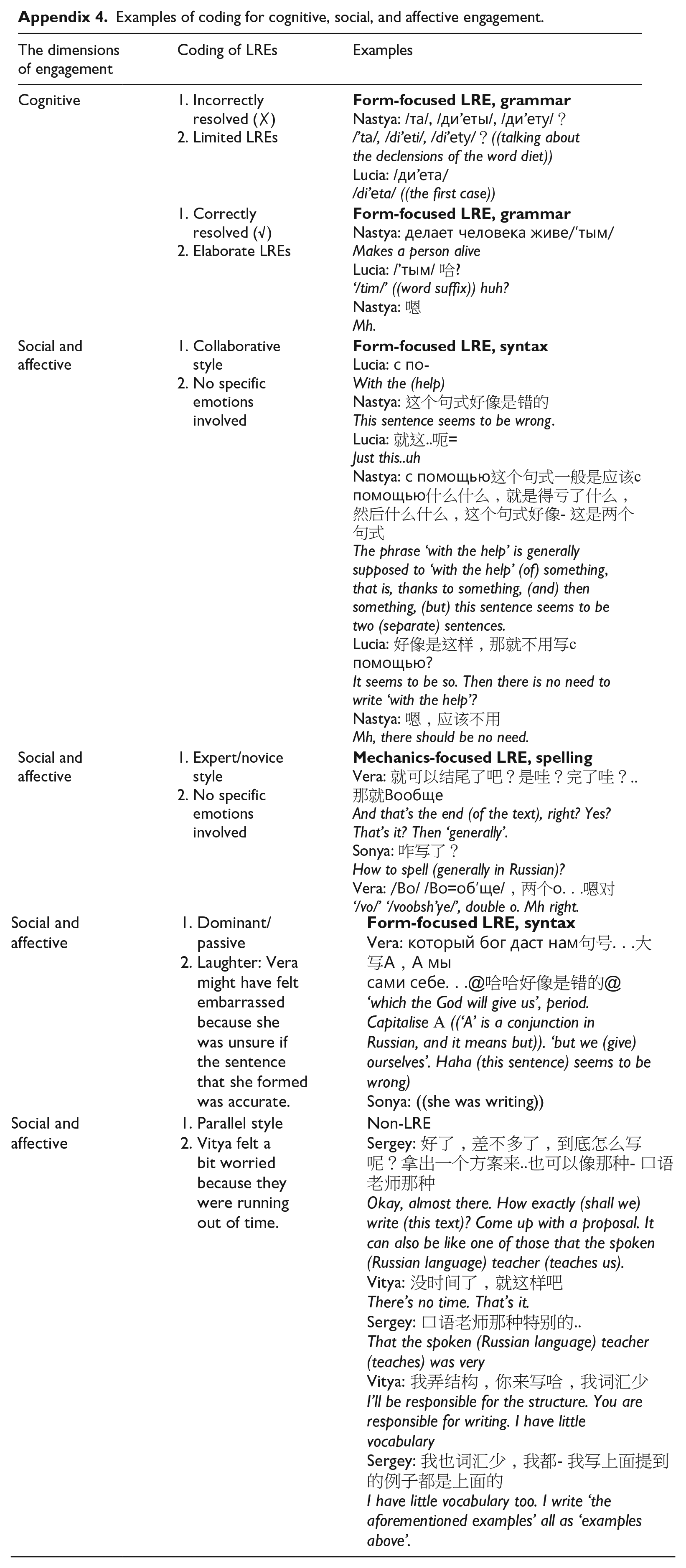
The first stage of coding was to locate and categorize LREs in the transcripts. Each LRE was categorized by its foci, being either lexis- or form- or mechanics-focused (Storch, 2007) (see examples in Appendix 3). A lexis-focused LRE involved students seeking a vocabulary or clarifying the meaning of a Russian word, while a form-focused LRE concerned an aspect of Russian grammar (e.g. cases, word inflections) or a syntactic issue (e.g. sentence construction, replacing a clause). Mechanics-focused LREs involved students focusing on spelling or pronunciation or punctuation problems. In the second stage, each LRE, regardless of its foci, was coded according to cognitive, social, and affective dimensions defined in and adapted from Svalberg’s (2009) EWL framework. The specific operating ways of these dimensions are summarized in Table 2 and illustrated in Appendix 4 with examples.
Coding of the cognitive, social and affective dimensions of engagement.
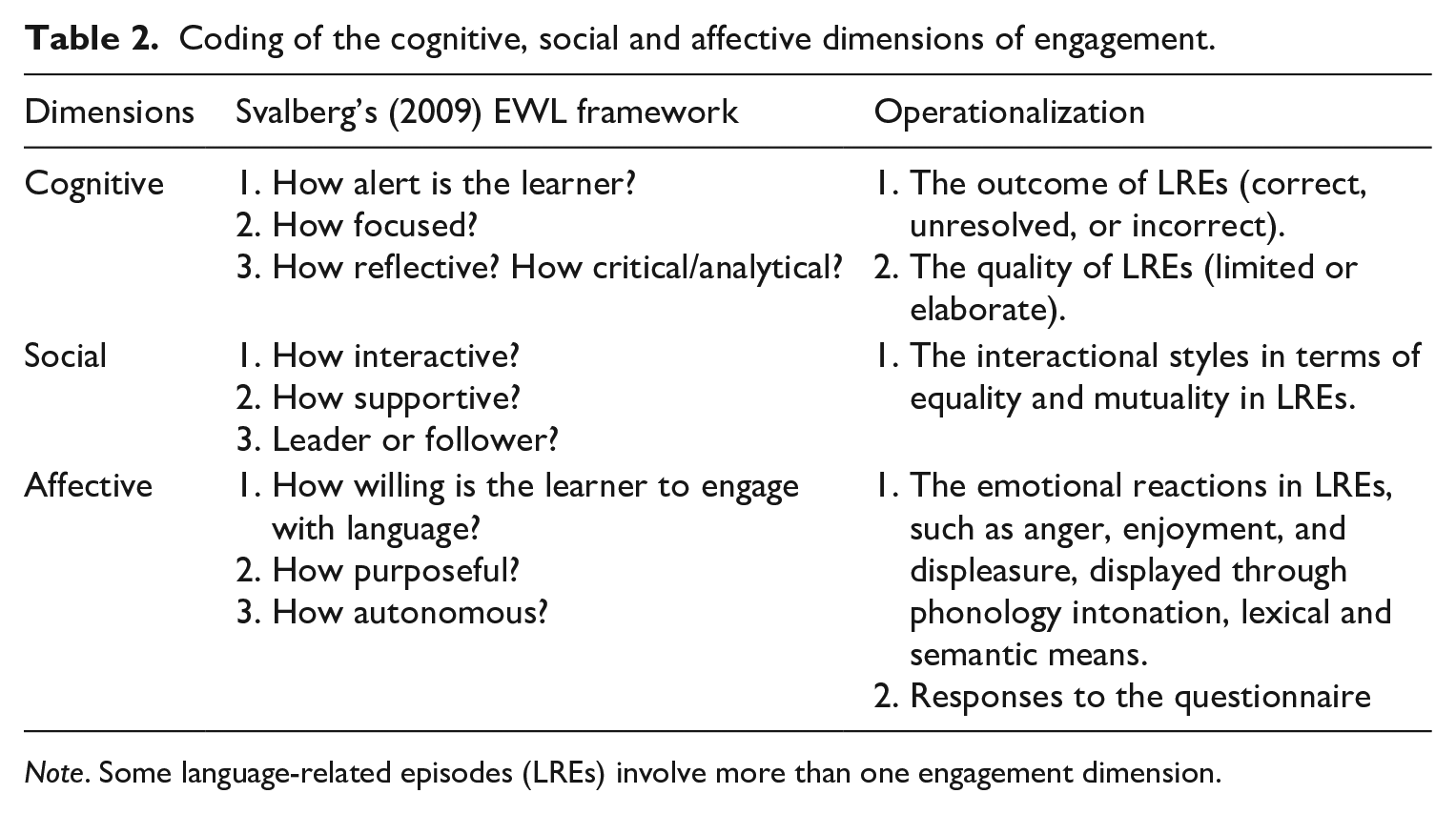
Note. Some language-related episodes (LREs) involve more than one engagement dimension.
Cognitive engagement concerns the nature of a pair’s joint focus on LREs. It was coded in terms of the outcome and the quality of LREs, based on Svalberg’s work. The outcome of LREs referred to whether the language item concerned was resolved correctly (√) or incorrectly (✗) or whether it remained unresolved (?) (Leeser, 2004). To further measure the quality of LREs, this study distinguished between elaborate and limited LREs by following Storch’s (2008) study. Specifically, elaborate LREs involved a pair deliberating over language issues such as seeking explanations, providing confirmation or alternatives. Limited LREs were characterized if a participant simply responded to a language-related issue with either a one- or two-word response to a preceding question (e.g. explaining word meaning), repetition, a phatic utterance (e.g. hmm, yeah, ok), or no response at all.
Social engagement focuses on how interactive and supportive a pair is during a language-related discussion. It was operationalized by identifying interactional styles distinguished by Storch (2002) in terms of equality and mutuality. Equality refers to an equal degree of control over a task direction, while mutuality reflects the level of engagement with each other’s contributions (Damon & Phelps, 1989). Equality and mutuality are reflected in how participants respond to each other’s ideas. For example, in high equality, both participants provide and seek suggestions on how to approach a task. In high mutuality, they share and build on each other’s suggestions through a variety of reciprocal feedback (e.g. confirmation, explanations, repetitions, repairs) (Storch, 2004). According to either low or high degrees of equality and mutuality, Storch (2002) characterized four patterns of dyadic interaction: collaborative, expert/novice, dominant/passive, and dominant/dominant. Table 3 provides examples of the four interactional styles. It should be noted that when categorizing an interactional style with high equality and low mutuality, this study used the term parallel, instead of Storch’s (2002) term dominant/dominant. This was because in the data, the participants did not dominate the task but were simply unwilling to listen to one another’s ideas (Galaczi, 2008).
Definition of the four interactional styles.
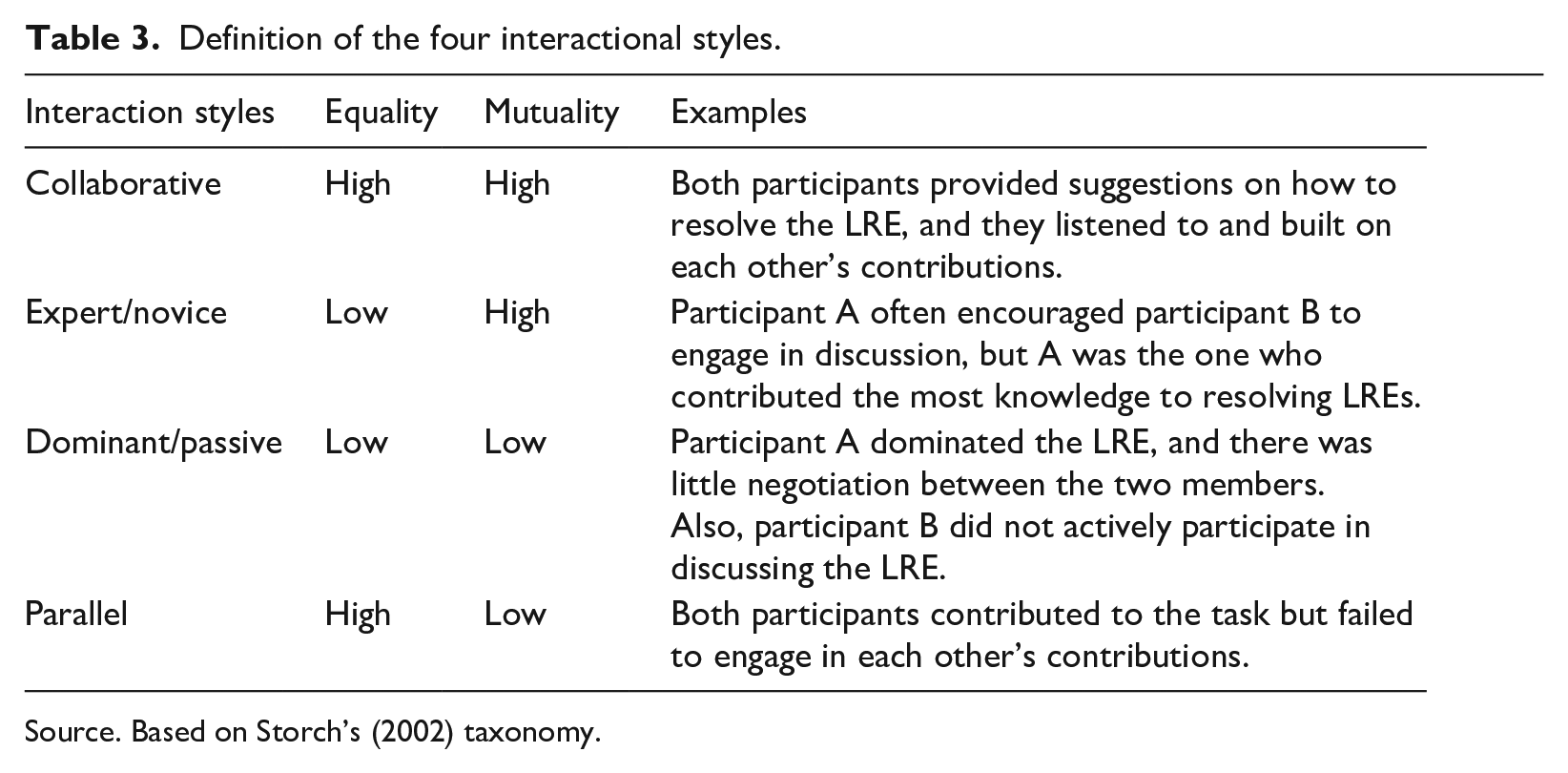
Source. Based on Storch’s (2002) taxonomy.
To analyse a pair’s social engagement with language, I assigned one of the four interactional styles to each LRE. In order to label an interactional style, the style needed to exist in at least 75% of episodes (Mozaffari, 2017). Otherwise, the transcripts were labelled as a mixed interactional style. Each pair’s interactional style is reported in Section III.
Drawing on interaction and perception data, I analysed affective engagement in terms of the participants’ emotional reactions during LREs and their perceptions of the CW experience. It is important to point out that even though emotions cannot be regarded exactly as perceptions, these two terms of emotions and perceptions ‘have been used to describe essentially how L2 learners’ affective state is related to their interactional behaviors’ (Sato, 2017, p. 256). In other words, the combined analysis of interaction and perception data helps reveal intersections between affective and other dimensions of engagement which was the aim of this study. The emotional reactions in LREs were analysed because emotions can be displayed through various means at phonological, lexicogrammatical, or discursive levels (Ochs & Schieffelin, 1989). For example, laughter may index enjoyment, while swearwords may indicate anger. Additionally, each pair’s responses to the five-point Likert scale questionnaire were analysed to illuminate their overall perceptions of the activity. The participants’ perceptions showed the helpfulness and challenges of CW and their feelings about connection with their partners, indicating their preferences for the activity. Furthermore, examining the perceptions adds a layer of precision to the qualitative analysis of interaction. For example, if a pair held negative views of CW, their views help interpret the swearwords they used in the interaction more as a sign of irritation or anger and less as an expression that index intimacy or enjoyment.
b Analysis
To examine how the three pairs were cognitively engaged in the CW task (i.e. Research question 1), different types of LREs were analysed quantitatively: (1) counting the number of correct, unresolved, and incorrect LREs, and (2) calculating the percentage of elaborate and limited LREs among the three pairs. To ensure the reliability of coding, a second coder, who is a Russian interpreter with knowledge in Linguistics, coded 20% of the dataset (i.e. one transcript). The rater agreement for identifying LREs was 81.6%, and disagreements were resolved through discussion.
To examine how social and affective factors may influence the learners’ cognitive engagement with language (i.e. Research question 2), I qualitatively analysed LREs by repeatedly reading the transcripts and labelling the interactional styles and emotional types for all LREs. These labels were correlated with the outcome of LREs (correct, incorrect, or unresolved) and the quality of LREs (limited or elaborate). However, not every LRE incorporated the three dimensions of engagement because sometimes a participant’s suggestion did not receive a response from the other participant. To ensure reliability, the second coder analysed the interactional styles in one transcript (20% of the dataset) and emotional types in the three transcripts. The rater agreement for identifying interactional styles was 83.6%, and disagreements were resolved through discussion. For the analysis of emotions, this research reported only those types that were apparent to both the second coder and the researcher.
III Results
In this section, I first report the three pairs’ cognitive engagement with language (Research question 1). To show how social and affective factors influence cognitive engagement (Research question 2), I present the three pairs in three groups in terms of interactional styles and perceptions of CW. The three groups are: 1) high mutuality and positive perceptions (Pair 1), 2) low mutuality and negative perceptions (Pair 2), and 3) low mutuality and positive perceptions (Pair 3). For each group, specific excerpts of interactional sequences are presented to illustrate intersections among the cognitive, social, and affective dimensions of engagement.
Research question 1: Cognitive engagement
The level of cognitive engagement was examined using the outcome of LREs (correct, incorrect, or unresolved) and the quality of LREs (elaborate or limited). Table 4 shows the number and the percentage of LREs resolved successfully or unsuccessfully by the three pairs. As seen in Table 4, Pair 1 correctly resolved 73.77% of the language problems encountered, but they still left some vocabulary- or form-related issues unresolved or resolved incorrectly. Pair 2 paid the least attention to language items among the three pairs. They produced only nine LREs accounting for 19.28% of total turns. However, 66.66% of the LREs Pair 2 produced were resolved correctly. Pair 3 was the group who paid the most attention to language items among the three pairs. They produced 49 LREs accounting for 66.67% of total turns and resolved more than 95% of LREs correctly.
Summary of successful and unsuccessful LREs.
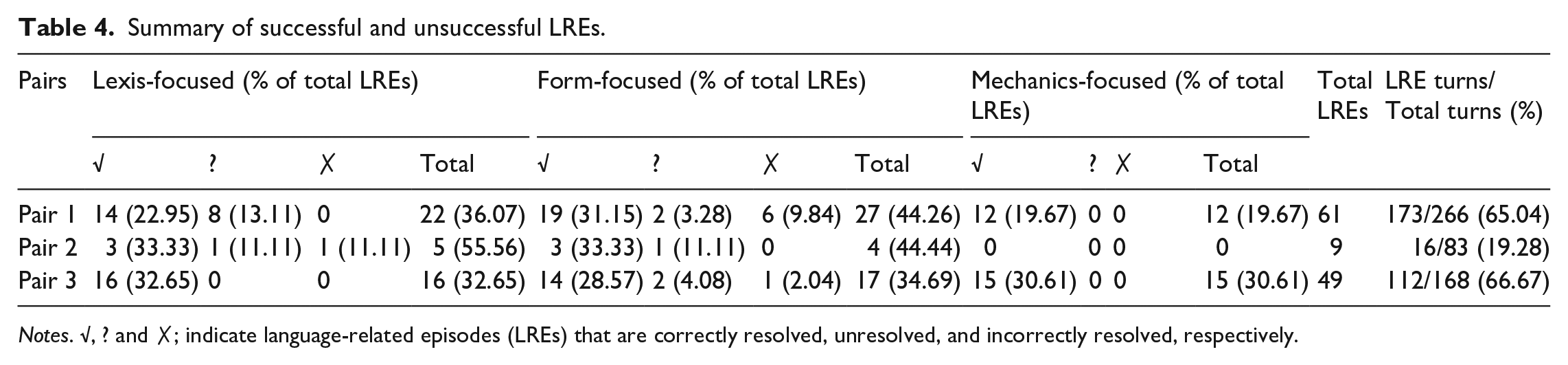
Notes. √, ? and ✗; indicate language-related episodes (LREs) that are correctly resolved, unresolved, and incorrectly resolved, respectively.
Figure 2 shows the percentages of elaborate and limited LREs out of the total number of LREs among the three pairs. Pair 1 produced many elaborate LREs, accounting for 44.80% of total LREs. This number of elaborate LREs was much greater than those produced by the other two pairs. Pair 2 elaborated on 33.34% of LREs. However, this did not mean that Pair 2 were involved elaborate engagement with linguistic choices during the task interaction, because they produced only nine LREs in total. Pair 3 generated the largest number of limited LREs (83.40% of total LREs) among the three pairs.
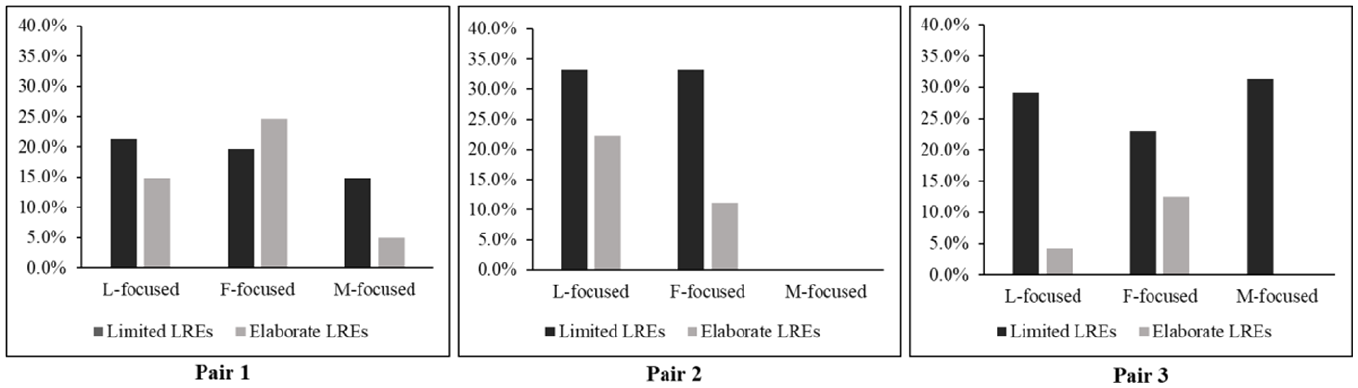
The percentage of elaborate and limited language-related episodes (LREs).
Research question 2: Intersections between cognitive, social, and affective dimensions
a High mutuality and positive perceptions
Social engagement is reflected in the interactional styles displayed by the participants during task interaction. Pair 1 (Lucia/Nastya) displayed a collaborative relationship, in which both participants interacted, listened to, and built on one another’s ideas. In general, their interactions were rich in sharing ideas.
Figure 3 presents the mean scores that the three pairs gave to the questionnaire items on their perceptions of CW which help reveal and interpret their affective state in relation to the activity participation. As the figure shows, Pair 1 had overall positive perceptions of the CW activity, as their responses indicated that they felt relaxed when writing together and viewed the activity as useful for improving writing performance and other writing-related abilities (e.g. the exchange of ideas and vocabulary knowledge).
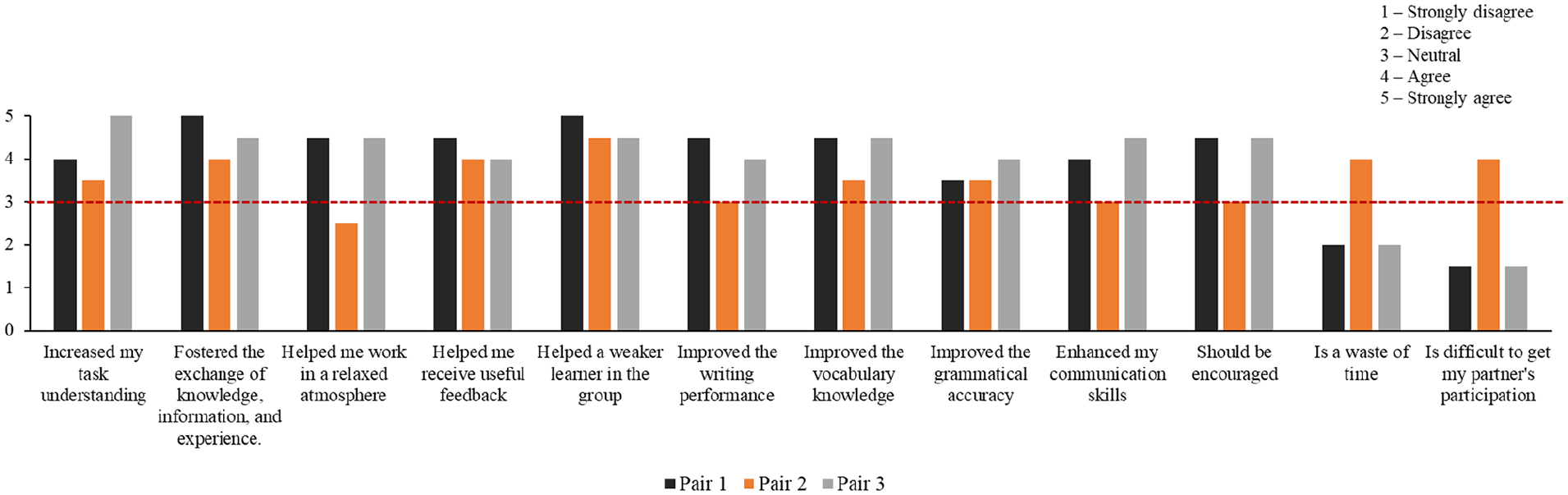
Responses of the three pairs to the five-point Likert scale questionnaire items.
The qualitative examination of LREs found that high mutuality potentially led participants to engage in the negotiation of meaning and notice many of the linguistic problems they produced. However, noticing a problem did not guarantee its accurate resolution. Excerpt 1 illustrates this point. In this episode, Nastya and Lucia made joint efforts to clarify the semantic meaning of what makes people feel better. Nevertheless, they did not resolve this issue. The final sentence 1 they formed is grammatically incorrect in Russian because it was not clear to which the pronoun который (‘which’) referred.
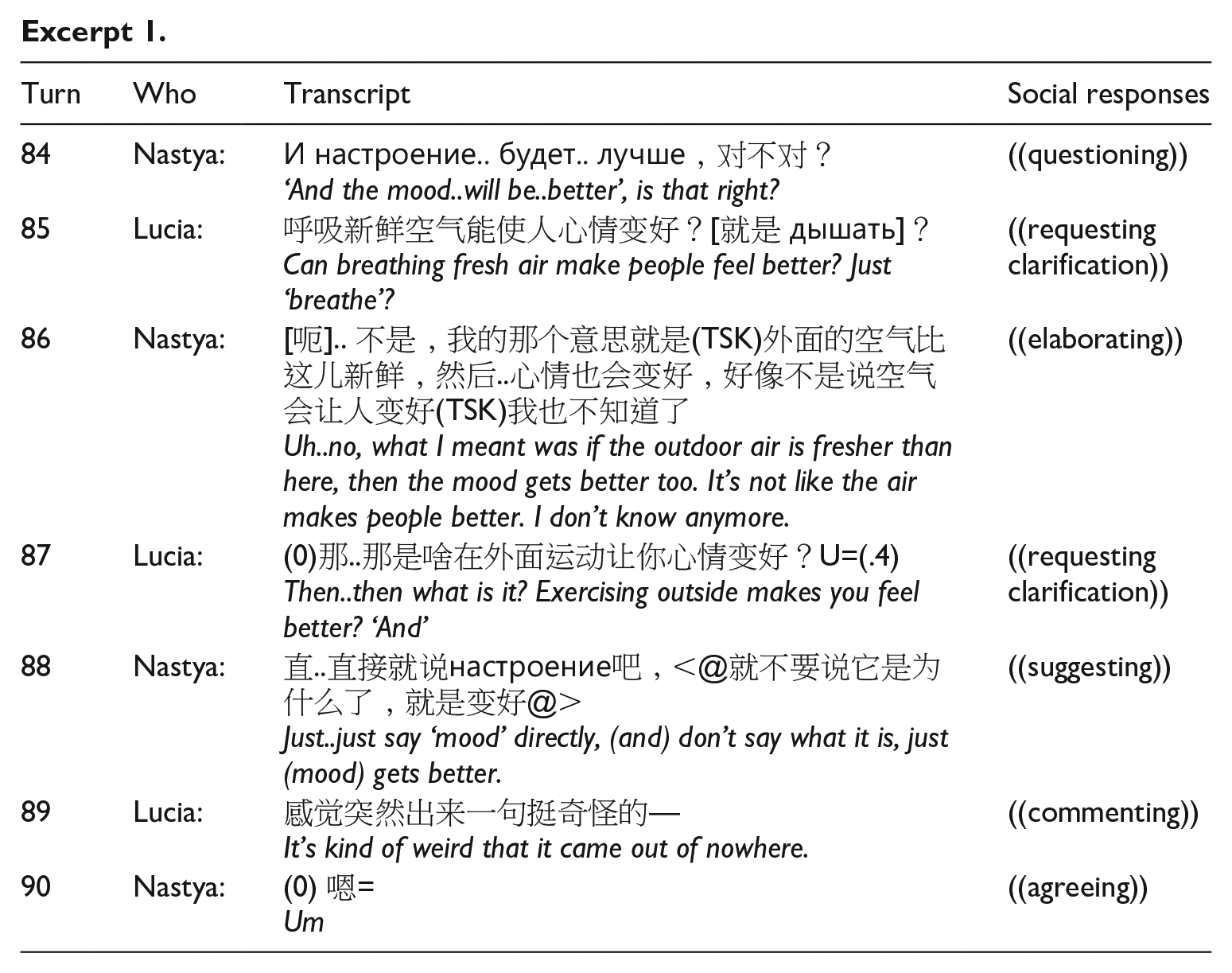
As Excerpt 1 shows, Nastya and Lucia discussed the meaning of the sentence they intended to construct through reciprocal feedback (e.g. questioning, clarification, elaboration). For example, after Nastya asked whether the sentence she formed was correct (84), Lucia prompted Nastya with questions as to whether Nastya could clarify what she wanted to convey (85, 87). These clarification requests are the evidence of negotiation of meaning (Kötter, 2003). During the negotiation, Nastya realized that there was a semantic problem with the sentence she initially constructed. More specifically, when Nastya was explaining her thought (86), there were short pauses, which indicate that she was cognitively engaged in the processing of her response (Hänni, 1980). Despite this cognitive effort, Nastya signalled her confusion (‘I don’t know anymore’) (86) and suggested an alternative expression ‘just (mood) gets better’ that was within her capacity (88).
In Excerpt 1, Lucia and Nastya actively responded to each other and took turns to exchange ideas. These instances were indicative of social engagement. With social engagement, participants negotiated over the meaning of what one participant wanted to convey, and this negotiation of meaning created an opportunity for them to notice the gap in their competence in forming an error-free and meaningful sentence. Although this noticed problem remained unresolved through negotiation, such social engagement encouraged the pair to cognitively engage in working out the meaning of the sentence.
Moreover, social engagement is linked to affective states (Philp & Duchesne, 2008). Apart from being interactive and supportive, Pair 1 also enjoyed working together which is evident in their responses to the questionnaire (see Figure 3). Excerpt 2 provides an example of how Pair 1 sought one another’s advice and invested interest in discussing language items in a pleasant environment. In this episode, Lucia and Nastya were seeking a sentence pattern (subject + auxiliary verb) to construct their third way of keeping healthy.
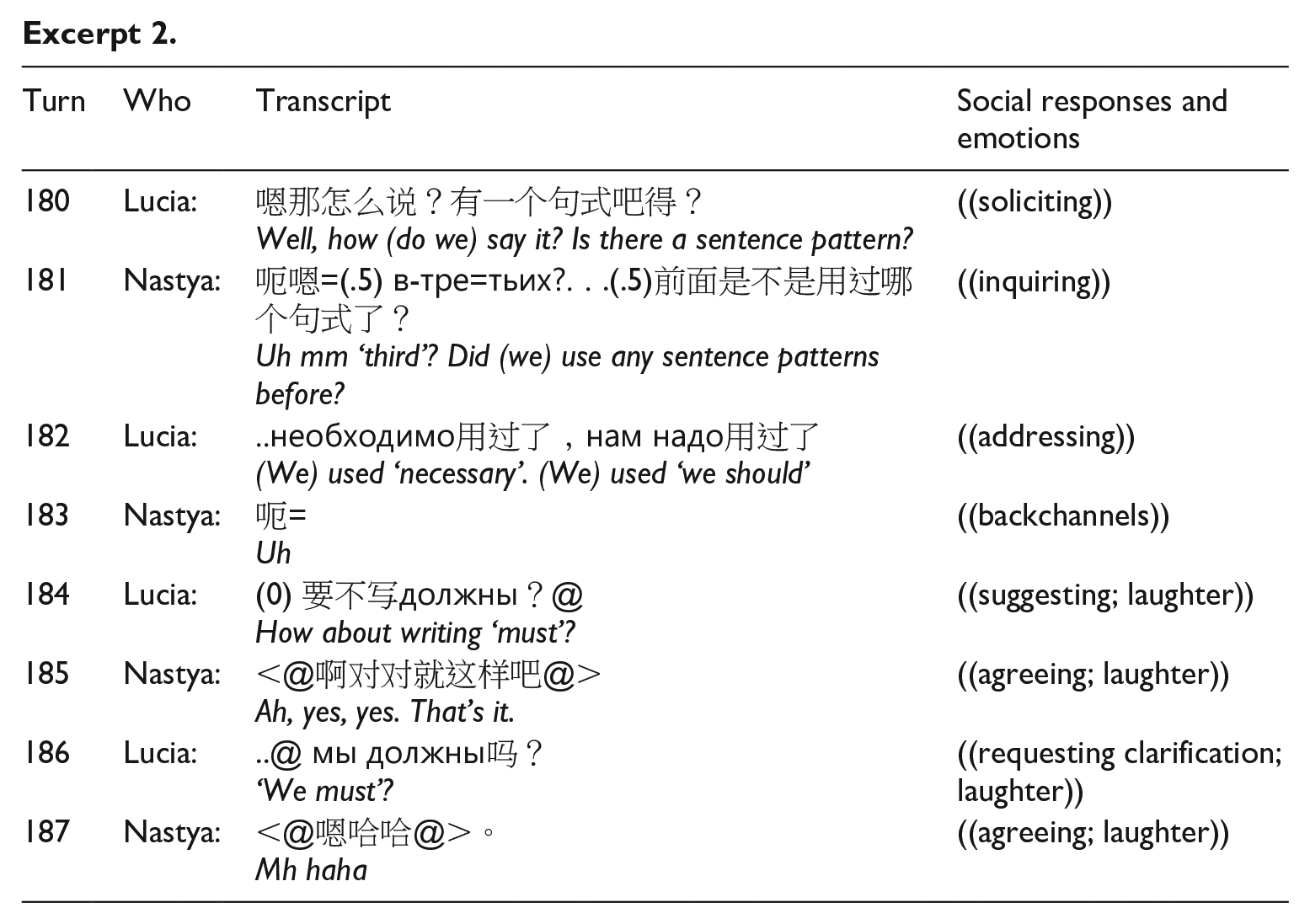
As Excerpt 2 shows, Lucia and Nastya engaged with one another’s feedback in search of an appropriate sentence pattern. To start, as indicated in the sentence-final particle ‘吧’ (180), Lucia solicited Nastya’s agreement with respect to her suggestion. Subsequently, they listened to and reflected on each other’s contributions, which is demonstrated through different types of social responses. These social responses included addressing the inquiry (182), providing backchannels to maintain continuity of the conversation (183), proposing a suggestion (184), and giving consent (185, 187). When considering a candidate option, Nastya and Lucia exchanged opinions in a cheerful tone (185–187) and extended the discussion from selecting an auxiliary (‘must’) (184) to a subject (‘we’) (186).
In terms of social and affective engagement, Lucia and Nastya worked in a socially supportive and enjoyable environment to resolve the sentence issue they encountered. Their collaborative performance maintained their focus on seeking an appropriate sentence pattern, and each member’s active participation contributed to the development of a potential solution. For example, in response to Nastya’s question (181), Lucia referred to earlier information (182) and cognitively engaged in her linguistic repertoire to search for a resolution (184). Additionally, a noteworthy case in this interaction was laughter which continued over several turns (184–187). The laughter occurred after the participants agreed with one another’s suggestions ‘mh’ (187), thereby demonstrating their enjoyment of working together.
b Low mutuality and negative perceptions
In contrast, Pair 2 (Sergey/Vitya) had a low level of mutuality during CW. They displayed a dominant/passive pattern in seven out of nine LREs, where Sergey exclusively took control over choosing between words or revising grammar errors and did not involve Vitya in discussion. A parallel relationship was also evident in their discussions about text content and structure. In this relationship, they often insisted on their own stances and resisted each other’s suggestions. Moreover, Pair 2 expressed negative views toward CW (see Figure 3). They not only considered the writing environment to be unenjoyable but also felt it challenging to explain ideas to each other and to actively involve their partner in the task.
The qualitative analysis of LREs revealed that the lack of mutuality and negative disposition made Pair 2 withdraw attention from or interest in resolving language problems. Excerpt 3 illustrates how Sergey and Vitya became cognitively disengaged with each other’s ideas during a discussion about a phrasal construction. The phrase they attempted to construct was ‘combining work with leisure’ in Russian.
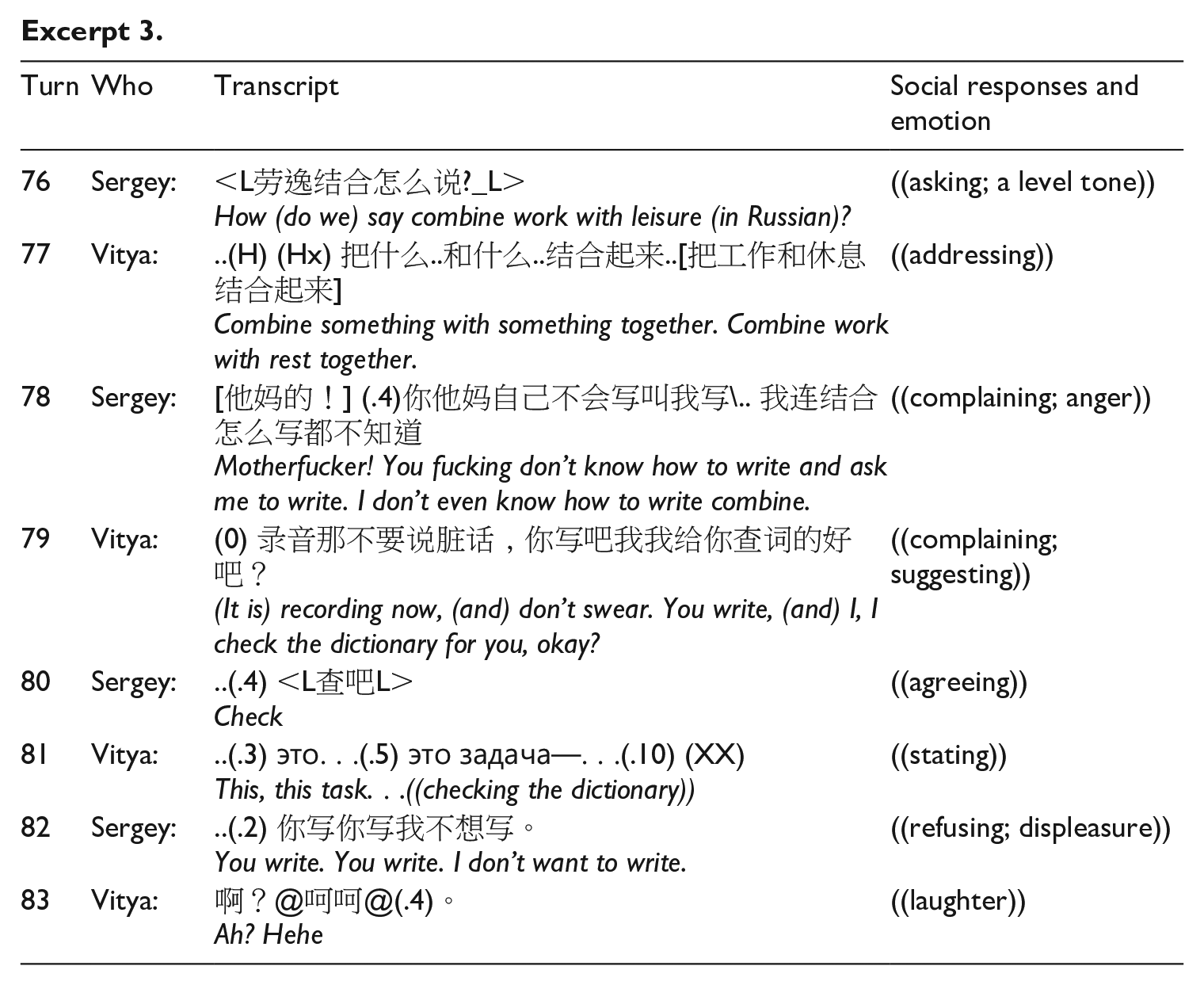
In Excerpt 3, there was little evidence that Sergey and Vitya built on each other’s ideas and enjoyed writing together. Sergey initiated his question in a low volume (76). Although this was a question, he uttered the speech in a general level tone without having a rising intonation. This may indicate that Sergey directed this question to himself without inviting Vitya’s feedback. Although Vitya addressed his question by providing an alternative (77), Sergey expressed his anger through expletives (78). When Vitya was forming the phrase with the help of a dictionary, Sergey uttered ‘You write. I don’t want to write’ (82). This utterance indicates his disengagement in the task and attempts to distance himself from the task. Similarly, Vitya’s utterance that ‘it is recording now’ momentarily underscored his participation in this research rather than continuing the engagement in the task. Although Vitya laughed (83), this laughter was provoked by Sergey’s non-cooperation and preceded by a question particle ‘ah’ in a rising intonation. As such, the laughter is more likely to index embarrassment or an attempt to mitigate tension.
It is evident in this episode that Sergey gradually withdrew from the task. For example, Sergey constantly distanced himself from the task (78, 82) regardless of the possible solutions Vitya offered (i.e. an alternative linguistic suggestion and checking the dictionary). Moreover, when interacting with each other, Sergey expressed his negative emotions such as anger and displeasure (78) and unwillingness to engage with his partner’s suggestion (78). Willingness is an affective state of the EWL framework and influences one’s participation in the task (Svalberg, 2012). Due to this unwillingness, Sergey decreased his cognitive engagement with language and completely switched off from the task (82). His negative emotions were also seen to affect Vitya whose participation was confined to making the recording for the research study (‘It is recording now’), rather than engaging in the task. In general, the negative attitudes, plus unsupportive behaviours, ultimately led both participants to lose interest in advancing their discussion.
c Low mutuality and positive perceptions
Pair 3 (Vera/Sonya) also had a relatively low level of mutuality while writing together. They displayed both dominant/passive and expert/novice relationships, with the former relationship occupying 60% of LREs. In this mixed interactional style, although Vera took an authoritative stance, she also made some effort to enlist Sonya’s participation. Regarding affective engagement, as shown in Figure 3 earlier, Pair 3 believed CW to be useful because it brought many benefits to their Russian writing and learning, such as increasing task understanding, exchanging ideas, improving vocabulary knowledge, and improving grammatical accuracy. They also disagreed that CW made it challenging to explain things to each other.
The qualitative analysis of Pair 3’s dialogical data found that the dominance orientation might play a role in causing limited attention to language issues. Excerpt 4 is an example of how a dominant participant controlled a discussion about language use without negotiation with her partner. In this episode, Vera wanted Sonya to find an appropriate transitional word that could connect their three ways of keeping healthy.
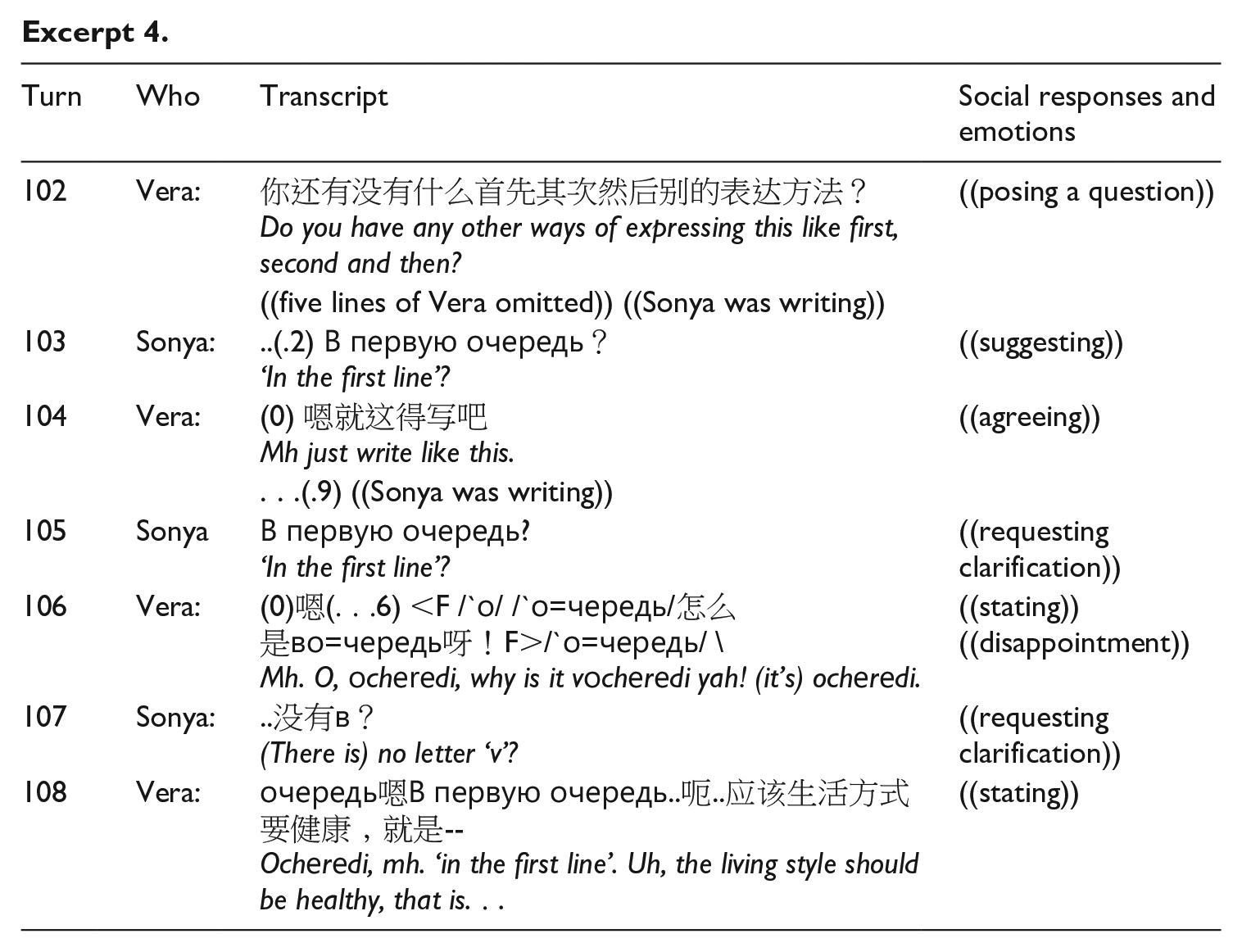
In Excerpt 4, Vera positioned herself as the dominant by taking charge of speaking and directing Sonya what to write. When Vera asked ‘do you have any other ways of expressing this’ (102), she did not wait for Sonya’s immediate answer and turned to identifying punctuation errors that Sonya made in writing. Subsequently, Sonya suggested ‘in the first line’ (103) and then resumed writing after Vera accepted the suggestion (104). In these turns, Vera’s utterances indicate that she mainly viewed herself as in control of Sonya’s writing and did not try to involve Sonya in discussion. Particularly when Sonya made a spelling mistake, Vera specified it by increasing the volume of her speech and using a strong falling intonation (106). The tone of voice is an important semiotic resource in displaying one’s social stance to others (Bourne & Jewitt, 2003). By employing a more emphatic speech contour, Vera added further strength to her claim.
In terms of social engagement, Vera and Sonya showed little evidence of sharing ideas or negotiating for meaning. Their interaction pattern was typically structured as follows: Vera initiated a topic (102, 106, 108), and Sonya addressed it in writing. In this process, Vera’s role was to demonstrate her power in influencing Sonya’ writing, and she carefully examined the words and phrases written by Sonya, which results in her correcting many linguistic issues (e.g. spelling and punctuation). More specifically, Vera’s use of imperative directives (104) limited their attention to the language issues, not negotiating meaning.
In terms of affective engagement, Vera expressed her disappointment (‘why is it vоchеrеdi’) through the emphatic speech contour because Sonya did not meet her expectations again. However, Vera’s attitude did not result in Sonya’s unwillingness to process this spelling error. Instead, Sonya sought further clarification (107) and corrected it in writing. In her questionnaire, Sonya viewed Vera’s suggestions as opportunities for improving the accuracy of their writing and expanding her vocabulary knowledge. As such, Sonya was cognitively engaged in Vera’s corrective feedback.
IV Discussion
By adapting Svalberg’s (2009) EWL framework, this study explored how the cognitive, social and affective dimensions of engagement interacted with one another to influence Russian learners’ attention to language use during the CW activity. Specifically, when learners interacted and were supportive to each other and viewed the activity as beneficial and enjoyable, they noticed and elaborated on many linguistic problems (Excerpt 1 and 2). In contrast, when learners demonstrated reluctance to engage with one another’s suggestions and perceived disadvantages from CW, they were likely to withdraw attention from language items and even from the task itself (Excerpt 3). Moreover, in a dominant/passive relationship involving relatively low social engagement (Excerpt 4), little negotiation resulted in many limited LREs where there was no extensive discussion about language use. However, most of these LREs were resolved correctly not only because the dominant member continued to pay attention to language problems throughout the task and provided linguistic suggestions, but also because the passive member was willing to accept these suggestions. Such a relationship helped them to be aware of CW benefits. For example, the passive member regarded these linguistic suggestions as useful feedback, while the dominant member enjoyed not having to explain things to her partner. In sum, these findings indicate an interrelated, interdependent relationship among the cognitive, social, and affective dimensions of engagement, which is in line with previous research findings (e.g. Ahn, 2016; Baralt et al., 2016; Philp & Duchesne, 2016; Svalberg, 2009, 2018).
1 Cognitive engagement
The findings of this study indicate that the three pairs displayed different levels of cognitive engagement with language. Two pairs (Pair 1 and 3) paid considerable attention to their language choices during LREs, while Pair 2 paid the least attention to language items with only nine LREs. However, all the pairs correctly resolved more than 65% of language problems encountered (see Table 3). The finding of many correctly resolved LREs concurs with previous research findings which suggest that CW pushes learners to pool knowledge and resources to address language problems and consequently results in higher accuracy of LRE resolution (e.g. Dobao, 2012; Li & Zhu, 2013; Stell, 2018; Storch, 2005; Zeng & Takatsuka, 2009). As Swain and Watanabe (2013) argued, talking about the language drew students’ attention to linguistic forms and their meanings in use and allowed reflection on their language use. By doing so, students can articulate their thinking and are empowered to regulate their own learning (Kowal & Swain, 1994).
Additionally, the findings show a variation in the number of elaborate LREs produced by the three pairs (see Figure 2). In particular, more instances of elaborate LREs were found in Pair 1 than in the other two pairs. This variation could be attributed to their different interactional styles in terms of equality (i.e. equal contributions to the task direction) and mutuality (i.e. engagement with each other’s ideas). Pair 1 formed a collaborative relationship that was rich in the exchange of ideas, while Pair 2 and 3 lacked mutual support. This association was evident in M. Zhang’s (2019) study, in which the author found that a collaborative relationship led to relatively more elaborate discussions about language use. A possible explanation for this association is that high mutuality can lead to more instances of knowledge exchange (Storch, 2002) and, thus, result in a deeper reflection on language choices.
2 Social engagement
The findings of this study have illustrated that social engagement plays a role in maintaining cognitive attention to L2 use. As shown in Excerpt 1, Nastya and Lucia actively built on each other’s ideas in a collaborative relationship, and their social engagement affected how they negotiated meaning and collaborated to solve a semantic issue they noticed. In particular, the two participants reflected on one another’s suggestions through the choice of providing reciprocal feedback, for instance, by questioning, clarifying, and providing an alternative, which helped them maintain their attention to understanding the meaning of a particular sentence. This interaction demonstrates the role of social engagement in helping them develop their ideas and seek possible solutions, which is also confirmed in previous studies (e.g. Li & Zhu, 2017; Storch, 2002).
Social engagement is crucial for maintaining a positive interpersonal relationship, where learners support each other’s thinking (Svalberg, 2012). An opposite example is illustrated in Excerpt 3, where Sergey showed reluctance to engage with his partner’s linguistic suggestions and ended up completely switching off from the task. This does not imply that a lack of social engagement means the absence of cognitive engagement. For example, Sergey was still able to self-correct a few LREs without negotiation with Vitya. Similarly, Pair 3 also correctly resolved many language issues, particularly all the spelling and punctuation issues (see Table 4), even though their interaction lacked extensive discussion and exchange of ideas. These two cases show that social engagement is not the sole factor in determining whether a linguistic problem can be resolved.
3 Affective engagement
It was found that the participants communicated different emotions during the task interaction, and these emotions were intertwined with their attention to language use. This finding supports Swain’s (2013) claim that cognition and emotion are inseparable in L2 learning. As seen in Excerpt 3, Pair 2’s negative feelings not only undermined an interpersonal relationship but also hindered knowledge co-construction. In contrast, as evident in Excerpt 2, Pair 1 showed that a positive orientation towards CW facilitated the successful incorporation of each other’s suggestions. These findings are in line with Chen and Yu’s (2019) study which discovered that positive attitudes towards CW might increase the number of discussions about L2 use.
Additionally, this study provides a more nuanced view of the role of emotions in mediating cognition. For example, in Pair 3, although Vera and Sonya generally felt positive about CW, they displayed a more complex affective background to the task interaction. As evident in Excerpt 4, even though Vera verbally expressed disappointment when her partner Sonya made a spelling error, she was still willing to help Sonya clarify any confusion. In contrast, Excerpt 3 illustrates how a lack of emotional regulation could be responsible for inhibiting the participants from making efforts in L2 use. In this case, Sergey showed a range of negative emotions such as swearing, anger, and displeasure, which reflect ‘a certain amount of loss of control over one’s emotions’ (Dewaele, 2010, p. 107). His emotional outburst might result from being unable to engage with his partner’s ideas. During the entire interaction, the two participants often insisted on their own stances and resisted each other’s suggestions, which upset the harmony of peer interaction and eventually elicited irritable reactions from Sergey.
4 Pedagogical implications
This study suggests that social and affective aspects are evident in task interactions, and they play a critical role in generating or impeding students’ cognitive attention to language use. For that reason, L2 teachers need to note how to develop a CW activity that is socially engaging and personally interesting to students, thereby increasing students’ cognitive engagement with L2 use. Clearly-articulated guidelines may be useful. First, teachers should explain the benefits of CW in pre-task training sessions in an attempt to arouse students’ interests in doing CW. Second, they can outline ground rules on creating a friendly and harmonious interactional style. These rules may include seeking agreement before making decisions, asking each other for opinions, providing reasons for their views if necessary, and respecting and appreciating each other’s ideas (Mercer, 2004).
However, this study reveals that students may encounter challenges of regulating their behaviours during a collaborative activity. This finding provides empirical support for L2 teachers to monitor their students’ social and affective engagement during CW. During the practice, students should be afforded the opportunity to ask questions or seek help from teachers if necessary. After the activity, teachers should make sure students will receive feedback on their task engagement so that they can understand what adjustments need to be made in subsequent tasks. Teachers can invite students to share their CW experiences with the class, for example about particularly helpful member actions, their concerns, confusion, or positive beliefs (Yu, 2015). Thereby, teachers can understand where students have difficulty and intervene appropriately, such as adjusting tasks appropriately or providing support to help students overcome emotional struggles.
V Conclusions
This study advances previous research on CW by adapting Svalberg’s (2009) EWL framework to explore the cognitive, social, and affective dimensions of engagement in task interaction. It corroborates previous findings on the interrelated and interdependent characteristics of the three engagement dimensions. Specifically, social engagement can draw students’ attention to language use by motivating the provision of feedback, while positive orientation is likely to trigger students’ willingness to incorporate each other’s suggestions in writing (Philp & Duchesne, 2016; Swain, 2013). However, considering the complex and dynamic nature of engagement, this study did not seek a golden rule to the kinds of engagement that definitely result in a heightened focus on L2 use. Instead, it aimed to document the participants’ discussions about language use during CW and investigate how social and affective factors can contribute to or impair cognitive engagement with language. Observations on the interdependent nature between cognitive, social, and affective conditions are critical for instructing L2 learning because they help teachers better understand how to engage learners actively and, thus, drive the learning process (Christenson, Reschly, & Wylie, 2012).
One limitation of the study is its small sample size: three pairs. Although the detailed analysis of these pairs reveals the interrelated characteristics among the three dimensions of engagement, it is hard to establish a cause-and-effect relationship among these engagement dimensions in an L2 class. Future studies could increase the sample size (e.g. a whole class) so that the correlations between the three variables of engagement can be investigated or even established. Currently, some researchers such as Dao (2019) and Storch (2008) have developed methods to quantify different dimensions of task engagement. By employing these methods, quantitative studies can determine to what extent social and affective factors can affect students’ attention to L2 forms. This information would help teachers understand how they can draw their students’ attention to L2 forms when using collaborative work in class. Furthermore, future studies can collect video-recordings of interactions, which contain facial expressions or gestures, to help identify and illustrate students’ emotions. Some studies have used cameras to capture students’ embodied behaviours in classroom interaction and drawn on multimodal resources (e.g. language, gestures) to illuminate how learner-learner or teacher-learner interaction unfolds to support affective L2 learning; as an example, see Jacknick’s (2018) study.
Footnotes
Appendix
Examples of coding for cognitive, social, and affective engagement.
| The dimensions of engagement | Coding of LREs | Examples |
|---|---|---|
| Cognitive | 1. Incorrectly resolved (✗) 2. Limited LREs |
Nastya: /та/, /ди’еты/, /ди’ету/? /’tа/, /di’еti/, /di’еtу/?((talking about the declensions of the word diet)) Lucia: /ди’ета/ /di’еta/ ((the first case)) |
| 1. Correctly resolved (√) 2. Elaborate LREs |
Nastya: делает человека живе/’тым/ Makes a person alive Lucia: /’тым/ 哈? ‘/tim/’ ((word suffix)) huh? Nastya: 嗯 Mh. |
|
| Social and affective | 1. Collaborative style 2. No specific emotions involved |
Lucia: с по- With the (help) Nastya: 这个句式好像是错的 This sentence seems to be wrong. Lucia: 就这..呃= Just this..uh Nastya: с помощью这个句式一般是应该с помощью什么什么,就是得亏了什么, 然后什么什么,这个句式好像- 这是两个 句式 The phrase ‘with the help’ is generally supposed to ‘with the help’ (of) something, that is, thanks to something, (and) then something, (but) this sentence seems to be two (separate) sentences. Lucia: 好像是这样,那就不用写с помощью? It seems to be so. Then there is no need to write ‘with the help’? Nastya: 嗯,应该不用 Mh, there should be no need. |
| Social and affective | 1. Expert/novice style 2. No specific emotions involved |
Vera: 就可以结尾了吧?是哇?完了哇?..那就 Вообще And that’s the end (of the text), right? Yes? That’s it? Then ‘generally’. Sonya: 咋写了? How to spell (generally in Russian)? Vera: /Во/ /Во=об’ще/,两个о. . .嗯对 ‘/vo/’ ‘/voobsh’ye/’, double o. Mh right. |
| Social and affective | 1. Dominant/passive 2. Laughter: Vera might have felt embarrassed because she was unsure if the sentence that she formed was accurate. |
Vera: который бог даст нам句号. . .大写А,А мы сами себе. . .@哈哈好像是错的@ ‘which the God will give us’, period. Capitalise А ((‘A’ is a conjunction in Russian, and it means but)). ‘but we (give) ourselves’. Haha (this sentence) seems to be wrong) Sonya: ((she was writing)) |
| Social and affective | 1. Parallel style 2. Vitya felt a bit worried because they were running out of time. |
Non-LRE Sergey: 好了,差不多了,到底怎么写呢?拿出一 个方案来..也可以像那种- 口语老师那种 Okay, almost there. How exactly (shall we) write (this text)? Come up with a proposal. It can also be like one of those that the spoken (Russian language) teacher (teaches us). Vitya: 没时间了,就这样吧 There’s no time. That’s it. Sergey: 口语老师那种特别的.. That the spoken (Russian language) teacher (teaches) was very Vitya: 我弄结构,你来写哈,我词汇少 I’ll be responsible for the structure. You are responsible for writing. I have little vocabulary Sergey: 我也词汇少,我都- 我写上面提到的例子 都是上面的 I have little vocabulary too. I write ‘the aforementioned examples’ all as ‘examples above’. |
Acknowledgements
I gratefully thank my supervisors Noriko Iwashita and Sheng-hsun Lee for their assistance and invaluable comments and suggestions throughout the course of this manuscript. I am also grateful to Annita Stell and Songyan Yu for many helpful and insightful comments on the earlier drafts of this paper. We would like to thank all participant learners and the instructor who joined this study. I also thank the editors for handling my submitted manuscript, and two anonymous reviewers for their comments and suggestions that much improved the final manuscript. I acknowledge the University of Queensland for providing me with a doctoral scholarship, without which this work could have never begun.
Funding
The author received no financial support for the research, authorship, and/or publication of this article.
