







Abstract
This study investigates whether linguistic outcomes of second language (L2) learners’ performance are consistent across oral and written modalities and, if so, whether the consistency remains across proficiency levels. The study also explores whether the linguistic outcomes of speaking, writing, or both are related to working memory capacity. Eighty-six L2 learners, from beginner to advanced, described a series of pictures within time constraints in speech and in writing, and completed two working memory tests. The study found greater syntactic complexity and lexical sophistication in the written than in the oral modality. However, the oral task elicited more lexical diversity, and the advanced learners produced more subordinate clauses in the oral task than in the written task. Learners with more working memory capacity produced marginally more complex structures in the oral task than learners with less working memory capacity. These findings have implications for the effective implementation of speaking and writing activities in L2 learning.
I Introduction
Second language (L2) learners can produce the target language in two different ways: speaking and writing. These two modalities have distinctive characteristics and entail some different cognitive processes (e.g. Gilabert, Manchón & Vasylets, 2016; Ravid & Tolchinsky, 2002). For instance, the oral modality requires the production of spontaneous responses, whereas the written modality allows time for monitoring and revising. While second language acquisition (SLA) researchers have often assumed that the two modalities’ characteristics affect L2 linguistic outcomes (e.g. Kormos, 2014), investigation of their differences (and similarities) have remained inconclusive (e.g. Kuiken & Vedder, 2011; Zalbidea, 2017). Moreover, few studies have examined whether any modality effects are consistent across proficiency levels.
In addition, although theoretical models of speaking (e.g. Levelt, 1989) and writing (e.g. Kellogg, 1996) suggest that L2 learners’ working memory capacity (WMC) may play an important role in their oral and written performance, there is limited evidence for the role of WMC in speaking and writing and the relationship between WMC and task modality (Cho, 2018; Kormos & Sáfár, 2008; Kormos & Trebits, 2011; Zalbidea, 2017).
The present study addresses the role of modality and WMC in L2 learners’ performance by examining the linguistic outcomes of a series of oral and written picture description tasks with comparable experimental settings. It also compares the outcomes across four different proficiency levels, from beginner to advanced. Using a within-group design and a large sample size of varied proficiency-level learners, this study explores the role of modality, the role of WMC, and the relationship between WMC and modality.
II Literature review
1 Task modality
Speaking and writing place different constraints on online processing in three dimensions: existence of an audience, stability of the language signal, and availability of control (Ravid & Tolchinsky, 2002). L2 learners usually produce speech in mutual interactions and provide nonverbal cues to support understanding. However, oral production is transient and difficult to control. In contrast, learners usually do not get immediate responses to their writing, except for a few occasions (e.g. online chatting). The lack of immediate interaction and the stability of production allow writers to determine their own pace, as well as to revise and edit (Gilabert et al., 2016; Granfeldt, 2007). In other words, the written modality lets language learners exercise more control over their attentional resources and pay more attention to their production than the oral modality (Byrnes & Manchón, 2014; Polio, 2017; Williams, 2012).
While most theoretical models posit differences between the cognitive processes involved in speaking and writing, they vary regarding the extent of such differences. Some theoretical models suggest distinctive cognitive processes involved in speaking and writing. According to Levelt (1989), oral production includes three stages: conceptualization, formulation, and articulation. Speakers first plan their message and formulate a conceptual structure for it (conceptualization); then, they generate a temporary linguistic output (formulation). Finally, they start to utter the form generated in the formulation stage (articulation). This model proposes that language processing for oral production is incremental and that speech production is linear. Therefore, language processing for the following component begins while surface morphosyntactic forms are still being constructed, and immediate morphosyntactic forms must be temporarily stored until the current form is completely uttered.
Kellogg’s (1996) model for written production also posits three stages: formulation, execution, and monitoring. The basic processes within each stage are planning and translating in the formulation stage, programming and executing in the execution stage, and reading and editing in the monitoring stage. Writers plan what they are producing, generate acceptable sentences based on their ideas, and produce inner speech (formulation). Then, writers actually type or write words (execution). Finally, they go through and edit their writing (monitoring). Compared to the stages of the speaking process, the stages of the writing process are more interactive and recursive (Kellogg, 2001; McCutchen, 1996). The later stages of the writing process may be positively or negatively affected by the earlier stages, and writers can go back and forth among these stages until they complete their production.
Other studies suggest that speaking and writing might use the same cognitive processes, but in distinct ways. For instance, Bourdin and Fayol (1994) suggested that each modality draws on different amounts of the same cognitive processes, and Brown et al. (1988) considered each modality to require different subsets of the same cognitive processes.
Such distinctions suggest the possibility of differences in L2 speaking and writing performance, which led Kormos (2014) to propose that modality should be considered one of the elements that affect task performance. Kormos argued that documented differences in L2 learners’ oral and written accuracy and lexical diversity were due to the different natures and psycholinguistic processes of each modality. In spite of this intriguing possibility, only a few studies have touched on whether L2 learners’ performance differs depending on task modality as measured by complexity, accuracy, and fluency (CAF); moreover, they have had mixed results (Cho, 2018; Granfeldt, 2007; Hwang, Jung & Kim, 2020; Kormos & Trebits, 2012; Kuiken & Vedder, 2011; Tavakoli, 2014; Vasylets, Gilabert & Manchon, 2017; Yu, 2010; Zalbidea, 2017; see Table 1). For instance, Kuiken and Vedder (2011) reported that written tasks generated more syntactic complexity than oral tasks, whereas Zalbidea (2017) found the opposite, and other studies observed no significant difference in syntactic complexity between oral and written tasks (Granfeldt, 2007; Kormos, 2014; Vasylets et al., 2017).
Summary of the effects of task modality on syntactic and lexical complexity in previous research.
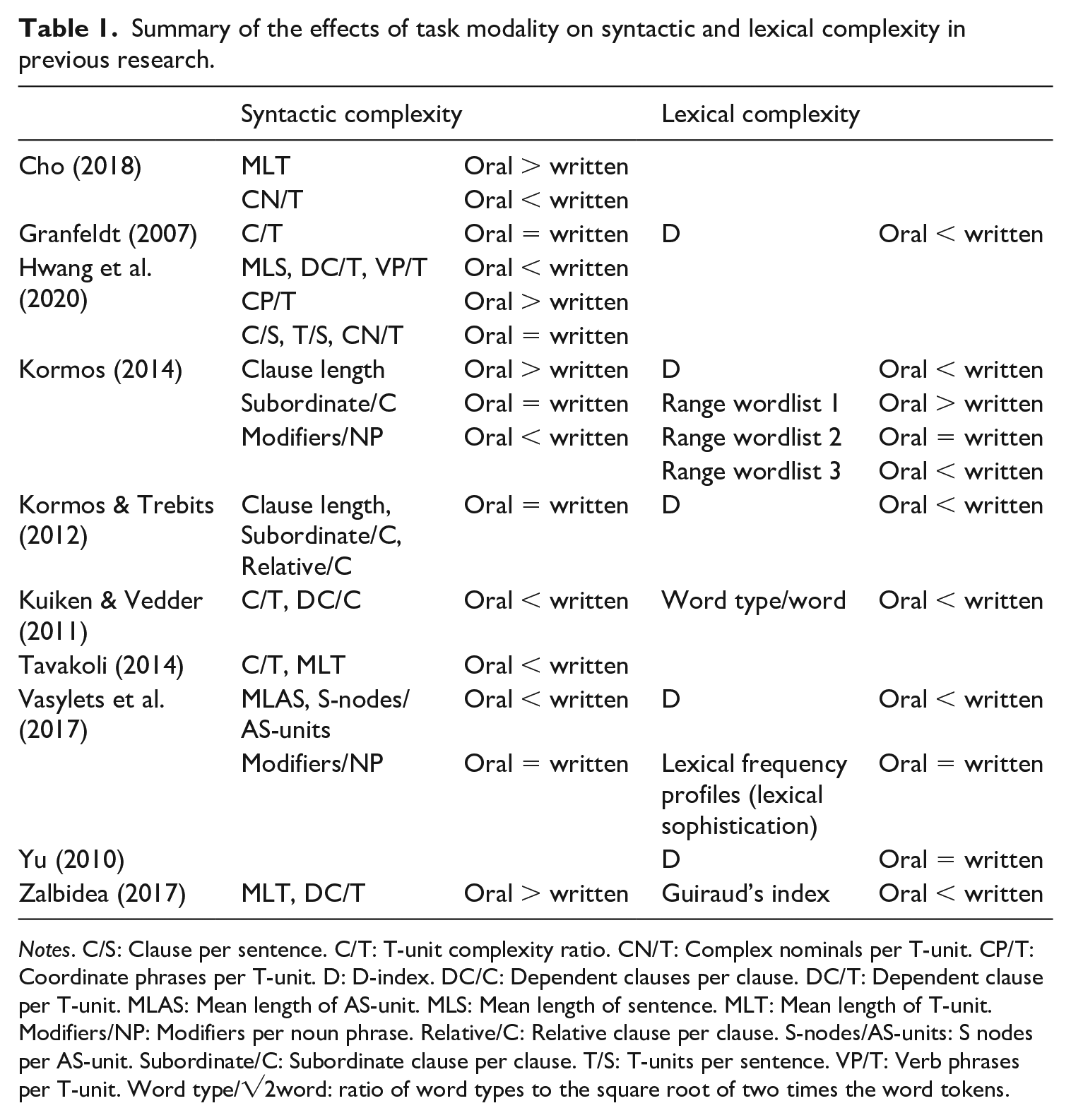
Notes. C/S: Clause per sentence. C/T: T-unit complexity ratio. CN/T: Complex nominals per T-unit. CP/T: Coordinate phrases per T-unit. D: D-index. DC/C: Dependent clauses per clause. DC/T: Dependent clause per T-unit. MLAS: Mean length of AS-unit. MLS: Mean length of sentence. MLT: Mean length of T-unit. Modifiers/NP: Modifiers per noun phrase. Relative/C: Relative clause per clause. S-nodes/AS-units: S nodes per AS-unit. Subordinate/C: Subordinate clause per clause. T/S: T-units per sentence. VP/T: Verb phrases per T-unit. Word type/√2word: ratio of word types to the square root of two times the word tokens.
Kuiken and Vedder’s (2011) and Zalbidea’s (2017) studies both had a between-participants design, in which half of the L2 participants completed an oral task and half completed a written task. Kuiken and Vedder required the participants to advise a friend in choosing a holiday destination by leaving a voice message in the oral task and writing a letter in the written task. The study found that syntactic complexity, measured by clauses per T-unit and dependent clauses per clause was greater in the written task. Zalbidea’s study used similar tasks. Participants were instructed to imagine planning a trip with a friend, and they were told the friend’s requirements for accommodation. They then either described their choice of accommodation aloud (i.e. oral task) or wrote an email about it (i.e. written task). Zalbidea’s results, however, showed that the learners produced more complex output in the oral task, measured by mean length of unit and dependent clauses per unit.
In addition, a few studies have compared changes in CAF of L2 learners’ production between oral and written modalities, also with inconsistent results (Bulté & Housen, 2009; Serrano, Tragant & Llanes, 2012; Weissberg, 2000). For example, Weissberg (2000) conducted a case study to examine whether development of L2 syntactic knowledge differs across speaking and writing. The study analysed longitudinal change in accuracy rates by measuring the percentage of error-free T-units at the beginning and the end of one semester. While the participants’ accuracy increased in both modalities, their gains were greater in writing than in speaking. Weissberg suggested that the differences in development of accuracy may be due to the participants’ preference to writing based on the amount of efforts to develop, previous medical history of speech, hearing or language processing disorders, and successful prior experience in L1 writing. Likewise, Serrano et al.’s (2012) longitudinal study examined L2 learners’ development by using oral narrative tasks and descriptive essay tasks. Although the participants’ speaking and writing both developed over one year, the time and speed at which each CAF construct developed differed; for instance, fluency and lexical diversity in speaking developed earlier, while accuracy in both modalities developed later.
In sum, whether L2 learners’ performance differs depending on task modality is an underresearched and controversial matter. According to empirical studies, some constructs of L2 learners’ spoken and written production may or may not differ in a single task and/or in gradual changes over time. Further investigation is required to gain a more precise picture of how or if modality affects certain aspects of L2 learners’ production.
2 Working memory and task performance
Working memory (WM) refers to a cognitive system responsible for temporary maintenance and storage of information while ongoing processing occurs, which enables processing to occur in the presence of distractions (Baddeley, 2003; Conway et al., 2007). Baddeley and Hitch (1974) proposed a multicomponent system with a central executive system that manipulates information between long-term memory (a processing component) and two slave systems in which phonological or visual information is temporarily maintained (a storage component): a phonological loop and a visuo-spatial sketchpad (Baddeley, 2003; Linck et al., 2014).
Both processing and storage components of WM are utilized in speaking and writing processes according to Levelt’s (1989) speaking model and Kellogg’s (1996) writing model. Specifically, because speaking is linear and cannot be recursive, both processing and storage components of WM are simultaneously involved in oral production. In contrast, given that the later stages of the writing process may be positively or negatively affected by the earlier stages, WM capacity (WMC) is relevant not only to the extent to which writers can go through several writing processes but also to the number of writing processes that can be activated at the same time (McCutchen, 1996). In addition, most writing processes require the processing component of WM (Kellogg, 2001). Considering the general features of the speaking and the writing processes, the role and importance of each component of WM are likely to differ between the two modalities (Cho, 2018); however, these models suggest that, overall, greater WMC enables better ability to manage and to store linguistic information appropriately in the production of both spoken and written language.
Given the role of WM in speaking and writing, L2 learners’ WMC may have impacts on their oral and written production; however, inconsistent results have been reported in empirical studies of the relationship between WMC and speaking and writing (Cho, 2018; Kormos & Sáfár, 2008; Kormos & Trebits, 2011; Zalbidea, 2017). On the one hand, WMC is relevant to L2 learners’ oral and written production (Kormos & Sáfár, 2008; Kormos & Trebits, 2011; Zalbidea, 2017). Kormos and Sáfár (2008) explored the extent to which L2 proficiency in different skills is relevant to learners’ WMC. The results indicated that speaking proficiency had a significant correlation with WMC: The participants with more WMC performed better in the speaking tasks than did those with less WMC. In addition, Kormos and Trebits (2011) found limited effects of WMC, only on the mean length of clauses and the subordination ratio, in a narrative task, suggesting that while higher WMC may allow for more complex oral production, its role may be negligible. Likewise, Zalbidea (2017) also observed correlations between L2 learners’ WMC and their production of subordinating conjunctions in a complex speaking task and their accuracy with gender agreement in a complex writing task.
On the other hand, Cho (2018) found no impacts of WMC on the outcomes of spoken and written tests. Cho investigated whether participants’ WM was related to their performance and whether WM mediated the effects of task complexity and modality. Thirty-nine participants completed speaking and writing tasks that were either simple or complex based on the task requirements (e.g. +/– few elements in Robinson, 2001). The study found no significant relationship between WMC and any of the linguistic variables assessed in the participants’ task performance. Nor did it find interaction effects between task complexity or task modality and WM test scores, suggesting that WMC did not influence task performance.
All in all, theoretically, some amount of WM must be needed for linguistic production processes in both modalities. However, empirical research has not convincingly shown whether WMC is relevant to speaking or writing production, nor whether the relationship between WMC and production is identical across the two modalities, motivating further investigation.
3 Research questions
Research question 1: Do syntactic complexity and lexical complexity of Korean undergraduate EFL learners’ performance differ between oral and written modalities?
Hypothesis 1: The opportunity to revise and monitor performance will lead to better syntactic complexity and lexical complexity in the written modality.
Research question 2: Do syntactic complexity and lexical complexity between oral and written modalities differ regardless of the learners’ proficiency levels?
Hypothesis 2: All proficiency groups will show differences in syntactic complexity and lexical complexity between the two modalities, with the advanced learners showing the greatest differences.
Research question 3: Is learners’ working memory capacity related to the syntactic complexity and lexical complexity of their speaking and writing?
Hypothesis 3: Because WMC is involved in language production processes, WMC will be relevant to the syntactic complexity and lexical complexity in both spoken and written modalities.
III Method
1 Participants
The participants were 86 Korean undergraduate English as a foreign language (EFL) learners (age: M = 22.97, SD = 2.53) at three large universities in South Korea. All of them had learned English in instructional settings, 1 and 30 had lived in English-speaking countries for short periods in study-abroad, exchange student, working holiday programs, or internships at the certain moment of their life-time before this experiment (years: M = .31, SD = .76). 2 Based on standardized test scores (TOEFL, IELTS, TOEIC), this study recruited participants at four levels of proficiency – high beginner (n = 21), low intermediate (n = 22), high intermediate (n = 21), and advanced (n = 22) in the Common European Framework of Reference for Languages (CEFR) – at almost balanced numbers, allowing for cross-sectional analysis (Papageorgiou et al., 2015).
2 Materials
a Picture description task
In each modality, the task consisted of 19 sets of a picture and oral prompt (Please describe the following picture), and the learners were asked to describe each picture, in speech or in writing, within a designated period of time. The picture description task is one of the usual pedagogic tasks in the EFL setting that simulates real tasks such as describing someone or something. The time constraint for the oral task, based on that for a picture description task in a standardized test (TOEIC speaking), was one minute for each picture. Considering the different speeds of speaking and typing, the time constraint was doubled to two minutes for each picture for the written task. The task was adopted from Son (2021).
All of the pictures were copyrighted color images from Pixabay (https://pixabay.com), Open Clip Art (https://openclipart.org/), Libreshot (https://libreshot.com/), Flickr (https://www.flickr.com/), and Pexels (https://www.pexels.com/). As in similar tasks in standardized tests, the pictures included a variety of entities, such as people and objects, whose actions and characteristics can be easily described. Each picture was discrete: The entities and their actions and characteristics were not repeated from picture to picture, to encourage the learners to use diverse vocabulary.
The results of a pilot study with five intermediate students showed the designated time constraints to be appropriate. In addition, the length of responses was comparable across the 19 pictures in each modality.
b Working memory test
Because different working memory test types reflect different abilities, Conway et al. (2005) suggested using multiple tests and averaging the scores. Following this suggestion, the current study administered an operation span test (Ospan), which is a language-independent working memory tests, and a reading span test (Rspan), which reflects language comprehension (Daneman & Green, 1986) to assess individual participants’ cognitive capacity (Oswald et al., 2015). The Georgia Institute of Technology’s shortened versions of these two tests (http://englelab.gatech.edu) were translated into the learners’ L1, Korean, to avoid any impact of L2 processing on the results (Gass & Lee, 2011).
Each test consists of a storage and a processing component (Draheim et al., 2018). The participants were asked to recall letters (the storage component) in the middle of judging either the correctness of arithmetic problems in the Ospan or the acceptability of sentences in the Rspan (the processing component). The storage component appears for two seconds, and the processing component appears for six seconds. Before the main session, there was a practice session to help the participants become familiar with the tests. In the main session, a total of 32 arithmetic problems (or sentences) was randomly divided into sets of four, five, or six arithmetic problems (or sentences). The sets were presented in a randomized order. Right after solving each problem, one alphabet letter was presented; the participants were asked to recall the alphabet letters and type them in the correct order at the end of each set.
3 Procedure
The researcher conducted the experiment one-on-one with each participant in a laboratory room. The order of the speaking task and the writing task was counterbalanced; thus, half of the participants completed the speaking task on the first day and the other half completed the writing task on the first day. On the first day the participants completed either the speaking task or the writing task. After the task, the participants completed the Ospan and Rspan, also in counterbalanced order. On the second day they completed the task in the other modality, and an exit questionnaire was administered using Qualtrics (www.qualtrics.com).
The participants were informed of the time constraint to describe each picture and were provided with an automatic stopwatch; thus, they were able to check the remaining time during the task. For the most part, the duration of the responses was close to the time limit; however, if a response was too short, the researcher asked further questions about some part of the picture the participant had not yet touched on to encourage additional production. The 19 pictures were divided into two sets of 10 and nine pictures; within each set, the pictures were presented pseudo-randomly, and the order in which participants saw the two sets was also pseudo-random. The participants had a short break between the main task and the working memory tests, and additional short breaks were given if requested. A Sony ICD-UX560F recorder and Microsoft Word were used to complete the speaking and the writing task, respectively. Before the writing task, the spelling and grammar check function in Microsoft Word was blocked. The entire experiment took approximately two hours, and the participants were given $30 as compensation for their participation.
4 Data analyses
Each participant’s 19 responses in each modality were combined. Mispronunciations/typos and grammatical errors were not corrected. The data from both tasks were analysed using Lu’s (2010, 2012) syntactic complexity and lexical complexity analysers (https://aihaiyang.com/software/). The syntactic complexity analyser includes 14 syntactic complexity measures (Table 2). Each measure could have a different predictive value for the participants depending on their proficiency (Norris & Ortega, 2009). Likewise, as Lu (2011) pointed out, using multiple measures allows for exploring multiple dimensions of syntactic complexity, possibly providing information on proficiency as well as task performance quality. Because L2 learners with a wide range of proficiency level completed speaking and writing tasks in this study, some dimensions of syntactic complexity may differ depending on modality as well as proficiency. Moreover, previous studies exploring modality effects have used diverse syntactic measures with mixed results. Therefore, this study’s use of as many measures as possible is motivated by its interest in the interaction of proficiency and modality as well as how diverse dimensions of syntactic complexity might be affected by modality. Based on the results of a correlation analysis, dependent clauses per T-unit (DC/T), complex T-unit ratio (CT/T), coordinate phrases per T-unit (CP/T), and verb phrases per T-unit (VP/T) were removed from the main analyses.
Syntactic and lexical complexity measures.
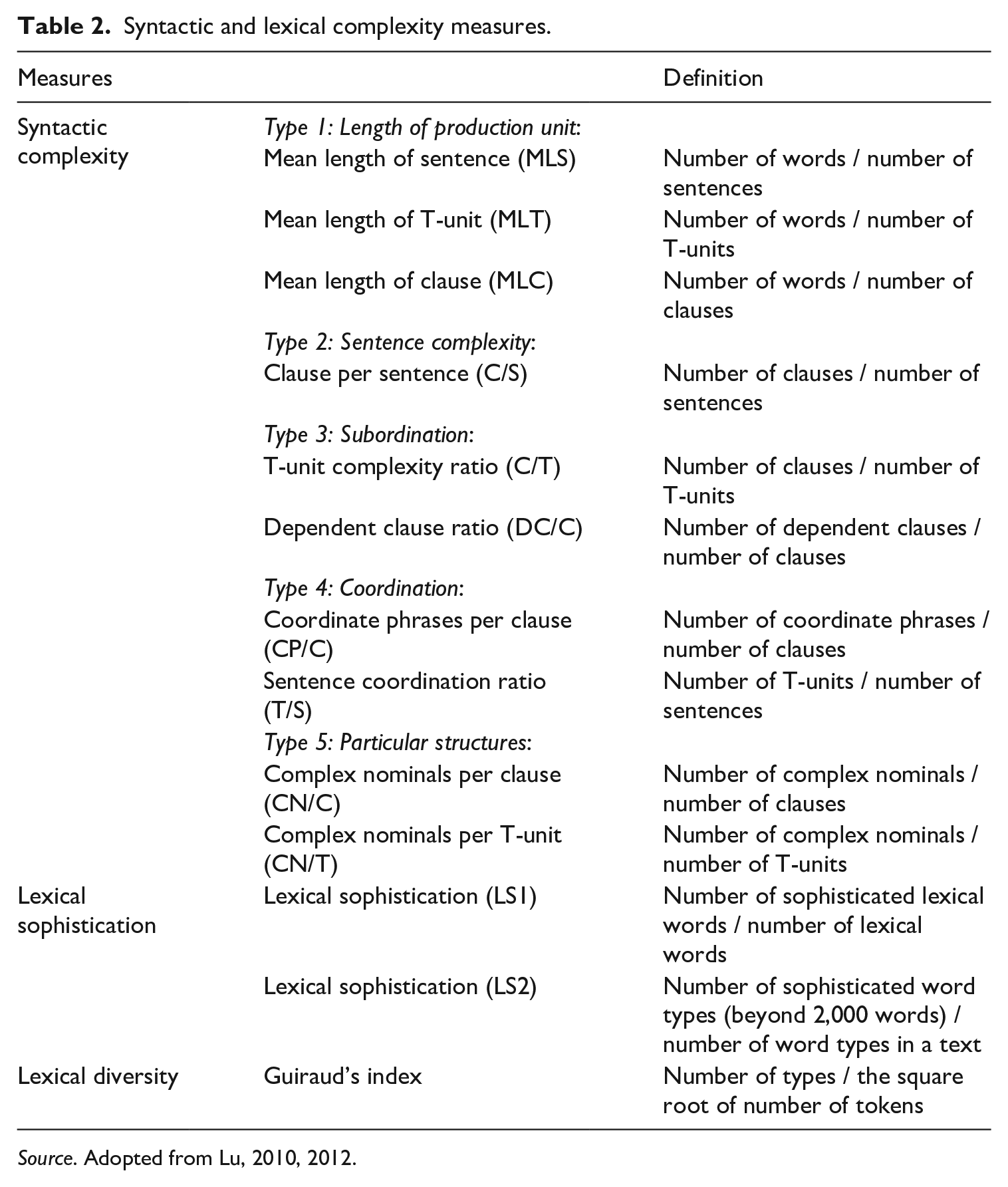
Lexical complexity is divided into lexical sophistication and lexical diversity; the measures used in this study are presented in Table 2. According to Lu (2012), LS1 indicates ‘the ratio of the number of sophisticated lexical words to the total number of lexical words in a text’ and LS2 indicates ‘the ratio of the number of sophisticated word types (beyond 2,000 words) to the total number of word types in a text’. Guiraud’s index was calculated with root of type–token ratio.
All participants’ accuracy in the processing component of the Ospan and Rspan was greater than 80%. These tests were assessed using partial span scoring, which is based on the exact number of items recalled in the correct order. This method of scoring provides a finer picture of variation in WMC among participants (Conway et al., 2005). For each test result, storage and processing scores were transformed to z-scores, which were combined to create a composite score (Cho, 2018; Kozan, Erçetin & Richardson, 2015). Following Conway et al. (2005), an average of the two composite scores was used in the statistical analyses.
A series of linear mixed models (LMM) was performed for each measure to explore the extent to which syntactic complexity and lexical complexity differ depending on task modality and proficiency (research questions 1 and 2). LMMs have considerable advantages over ANOVAs, as they show greater reliability (Baayen, Davidson & Bates, 2008), include random effects (Barr et al., 2013), and can be used with incomplete and unbalanced data (Judd, Westfall & Kenny, 2012). Modality (oral, written), proficiency (A2, B1, B2, C1), and interaction between modality and proficiency were fixed effects, and participant was a random effect in all of the models. Oral and A2 were referential levels in the models. When the interaction between modality and proficiency was not significant in a model for a particular measure, the interaction was removed and a new model in which modality and proficiency were only included as fixed effects was created. Spearman’s rank correlation was performed to explore relationships between participants’ working memory capacity and their performance (research question 3). All the statistical analyses were completed using R (R Core Team, 2018).
IV Results
Participants produced 7,925 sentences (M = 92.15, SD = 21.07) in the oral modality and 4,762 sentences (M = 55.37, SD = 13.30) in the written modality. 3 Descriptive statistics (Table 3) showed that the written production mostly includes more complex structures and sophisticated words than the oral production; in addition, participants produced more complex structures as their proficiency increased. However, participants produced a greater variety of words in the oral modality than in the written modality.
Descriptive statistics of syntactic and lexical complexity measures.
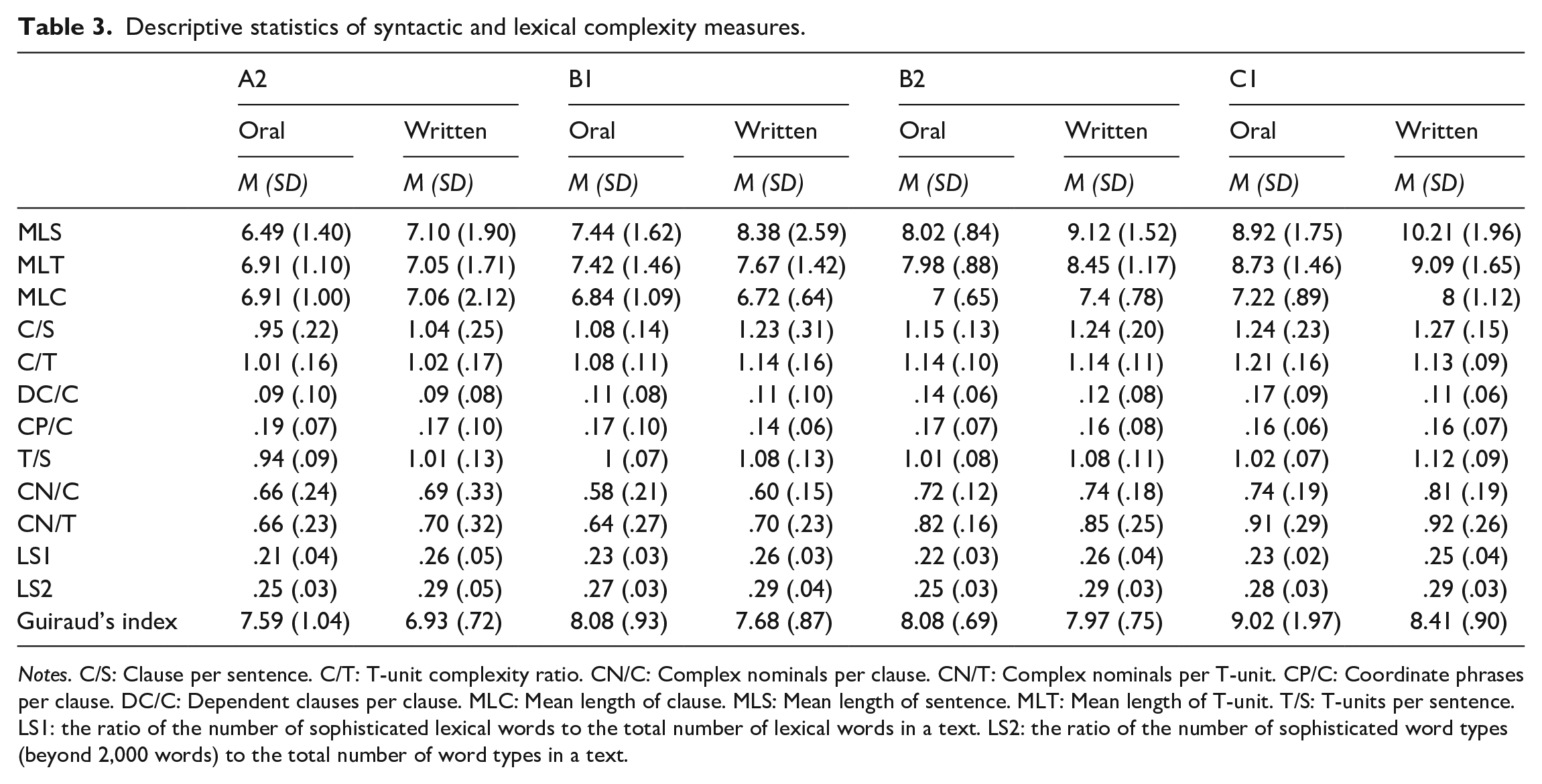
Notes. C/S: Clause per sentence. C/T: T-unit complexity ratio. CN/C: Complex nominals per clause. CN/T: Complex nominals per T-unit. CP/C: Coordinate phrases per clause. DC/C: Dependent clauses per clause. MLC: Mean length of clause. MLS: Mean length of sentence. MLT: Mean length of T-unit. T/S: T-units per sentence. LS1: the ratio of the number of sophisticated lexical words to the total number of lexical words in a text. LS2: the ratio of the number of sophisticated word types (beyond 2,000 words) to the total number of word types in a text.
Linear mixed models (Table 4) showed that the L2 learners produced more complex structures in writing in terms of MLS (β = .99, SE = .20, t = 5.03, p < .001), MLT (β = .31, SE = .15, t = 2.11, p = .04), MLC (β = .31, SE = .15, t = 2.08, p = .04), C/S (β = .09, SE = .03, t = 3.36, p < .001) and T/S (β = .08, SE = .01, t = 5.78, p < .001), indicating that the learners produced longer sentences, longer T-units, longer clauses, larger number of clauses, and larger number of T-units in the writing task, regardless of proficiency. Participants with higher proficiency produced more complex structures in terms of MLS, MLT, MLC, C/S, T/S, CN/T, and CN/C than those of lower proficiency; however, the extent to which syntactic complexity differed across groups was different depending on measure. For instance, all other groups produced significantly longer sentences than the A2 group – e.g. B1 (β = 1.11, SE = .45, t = 2.48, p = .01) – whereas the only significant difference in MLC was between the A2 group and the C1 group (β = .63, SE = .27, t = 2.34, p = .02). Linear mixed models for C/T (β = –.09, SE = .04, t = –2.14, p = .04) and DC/C (β = –.06, SE = .03, t = –2.14, p = .04) showed a significant interaction between modality and the C1 group, indicating that only the advanced learners produced larger numbers of clauses and dependent clauses (i.e. subordination) in the speaking task.
Results of linear mixed models of syntactic and lexical complexity.
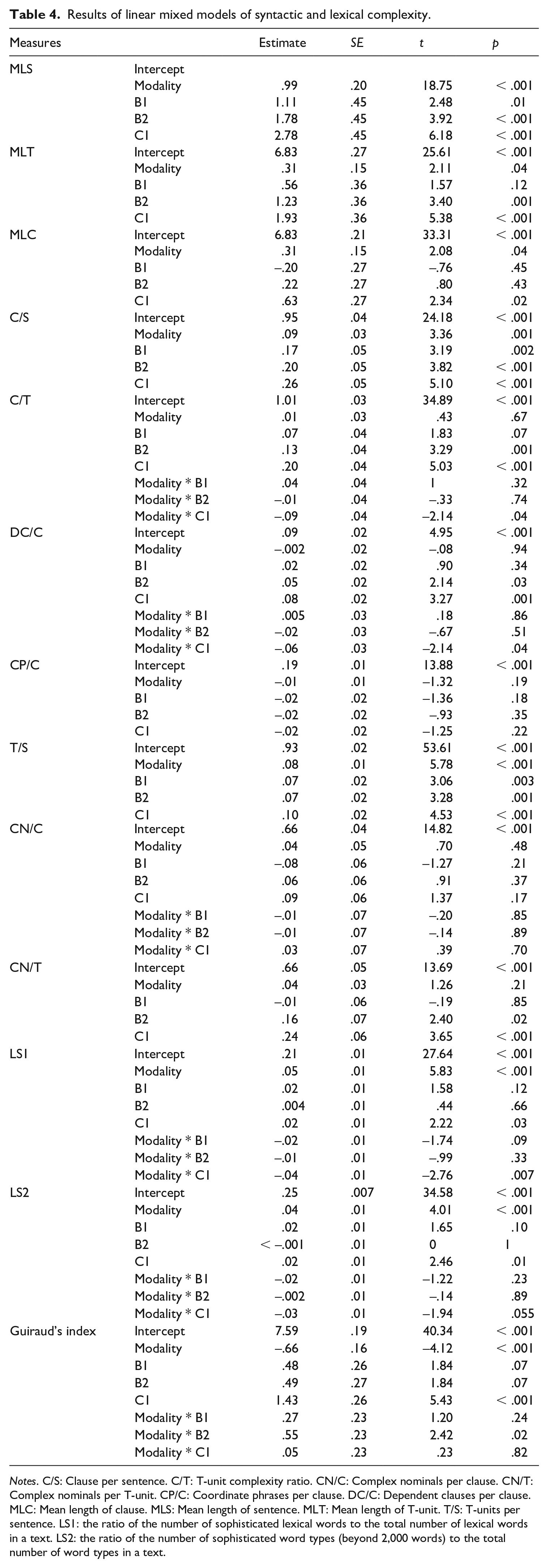
Notes. C/S: Clause per sentence. C/T: T-unit complexity ratio. CN/C: Complex nominals per clause. CN/T: Complex nominals per T-unit. CP/C: Coordinate phrases per clause. DC/C: Dependent clauses per clause. MLC: Mean length of clause. MLS: Mean length of sentence. MLT: Mean length of T-unit. T/S: T-units per sentence. LS1: the ratio of the number of sophisticated lexical words to the total number of lexical words in a text. LS2: the ratio of the number of sophisticated word types (beyond 2,000 words) to the total number of word types in a text.
The learners’ lexical sophistication and diversity differed depending on modality. Specifically, they produced more sophisticated words in the writing task (LS1: β = .05, SE = .01, t = 5.83, p < .001; LS2: β < .001, SE < .001, t = 4.01, p < .001) but a greater variety of words in the oral task (β = –.66, SE = .16, t = –4.12, p < .001). In addition, the models indicate effects of proficiency on lexical diversity. C1-level learners produced significantly more sophisticated words and various words than A2-level and B1-level learners. An interaction between modality and C1 level was found for lexical sophistication (LS1: β = –.04, SE = .01, t = –2.76, p = .007; LS2: β < .001, SE < .001, t = –1.94, p = .055), indicating that the advanced learners’ use of sophisticated words differed significantly between the two different modalities.
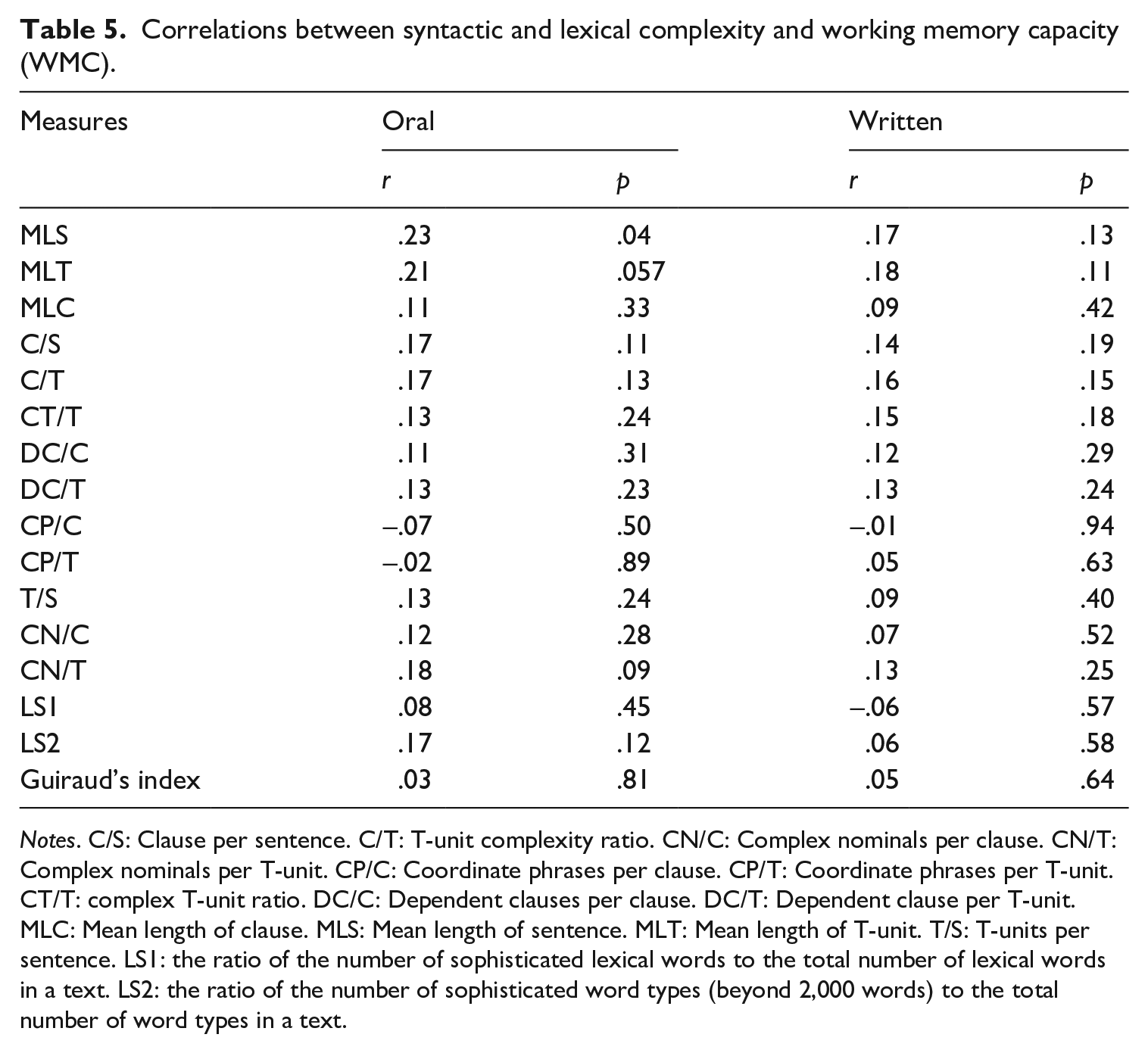
Correlations between syntactic complexity and lexical complexity and the participants’ WMC are shown in Table 5. WMC had significant correlations with MLS (r = .23, p = .04) and MLT (r = .21, p = .057) in the oral task only. This result suggests that participants with greater WMC produced longer sentences and T-units in the speaking task. In contrast, the participants’ WMC had no effect on their written production.
Correlations between syntactic and lexical complexity and working memory capacity (WMC).
Notes. C/S: Clause per sentence. C/T: T-unit complexity ratio. CN/C: Complex nominals per clause. CN/T: Complex nominals per T-unit. CP/C: Coordinate phrases per clause. CP/T: Coordinate phrases per T-unit. CT/T: complex T-unit ratio. DC/C: Dependent clauses per clause. DC/T: Dependent clause per T-unit. MLC: Mean length of clause. MLS: Mean length of sentence. MLT: Mean length of T-unit. T/S: T-units per sentence. LS1: the ratio of the number of sophisticated lexical words to the total number of lexical words in a text. LS2: the ratio of the number of sophisticated word types (beyond 2,000 words) to the total number of word types in a text.
V Discussion
The aim of this study is to investigate whether the syntactic and lexical complexity of L2 learners’ oral and written performance are different and, if so, whether the difference is consistent regardless of proficiency and whether the learners’ WMC is related to their oral and written performance. The results indicate that overall, syntactic complexity and lexical complexity were greater in learners’ writing than in their speaking. As L2 learners’ proficiency develops, they produce more complex sentences and more sophisticated vocabulary in both modalities, but only the advanced learners showed greater syntactic complexity, and only by two measures (C/T and DC/C), in speaking than in writing. In addition, L2 learners’ WMC is positively correlated with the mean length of sentence and T-units in their oral production only.
1 Task modality
This study assessed the syntactic complexity of the learners’ speaking and writing using 10 measures; greater syntactic complexity was found in the written modality based on five of these measures (i.e. MLS, MLT, MLC, C/S, and T/S). The results support previous studies that showed greater syntactic complexity in writing tasks than in speaking tasks, at least in some measures (Hwang et al., 2020; Kuiken & Vedder, 2011; Tavakoli, 2014; Vasylets et al., 2017), but counter the results of other previous studies (Granfeldt, 2007; Kormos, 2014; Kormos & Trebits, 2012; Zalbidea, 2017).
The reason for the differences in syntactic complexity may be related to the cognitive processes involved in speaking and writing. As discussed, language processing for speaking is linear and incremental (Levelt, 1989); in other words, planning and formulating upcoming forms, storing temporary forms, and articulating a current form are simultaneous. In contrast, writing processes are more interactive and recursive (Kellogg, 2001; McCutchen, 1996), which allows for more online planning and monitoring. With access to greater attentional and processing resources in writing, learners may attend to linguistic dimensions more effectively (Hwang et al., 2020). All of these aspects of the cognitive processes involved in speaking and writing may have led this study’s learners to produce more complex structures in the writing task. For instance, although the picture description task was comparable in the two modalities, an A2-level participant tended to produce simple sentences in the oral task (e.g. There are two different teams), but attempted more complex sentences with present participles in the written task (e.g. There are four people standing and holding something together).
The differences in syntactic complexity between the two modalities could also be related to the time constraints for the writing task. A time constraint was used for the writing task to design comparable experimental settings between the two modalities; in addition, it encouraged the participants to pay attention to the tasks. Knoch and Elder (2010) found that shorter time constraints led to greater syntactic complexity in L2 writing, while Wu and Erlam (2016) did not find any difference in number of clauses per T-unit. In contrast, Lu’s (2011) analysis of corpus data of college-level English as a second language (ESL) learners’ essays found essays written in an untimed condition to have greater syntactic complexity on 11 out of 14 measures (all except C/S, C/T, and T/S) than those written in a timed condition. This study’s results along with those of the previous studies suggest that syntactic complexity in writing is affected by time availability. Further investigation is required to learn more about how different time constraints might affect similarities or differences between the outcomes of comparable speaking and writing tasks.
Higher proficiency learners, not surprisingly, were better able than lower proficiency learners to produce more complex structures regardless of modality, although the degree of difference differed depending on measure. These results are partially aligned with previous studies that showed effects of proficiency on syntactic complexity (e.g. Hwang et al., 2020; Kuiken & Vedder, 2011; Lu, 2011). However, different proficiency levels showed different distinctions in the linguistic outcomes between the two modalities. In particular, while all groups produced overall greater syntactic complexity in the writing task, the C1 (advanced) group produced a larger number of clauses (C/T) and dependent clauses (DC/C) in the speaking task than in the writing task. Norris and Ortega (2009) demonstrated that advanced learners used less subordination even when the overall complexity of their production increased. The current findings partly echo Norris and Ortega’s in that the advanced group’s use of subordination (as measured by C/T and DC/C) was similar to or lower than that of the lower-level participants in the writing task, but significantly greater than the lower-level participants’ in the oral task. While the current study cannot explain this finding, it seems possible that it is related to the differences in the processes involved in speaking and writing: If higher proficiency learners can manage their time better and make better use of the chance that writing offers for monitoring and revising, they might be able to intentionally avoid overusing subordination in their writing.
The differences in lexical complexity across the two modalities might also be partially explained by the distinction between speaking and writing processes, as well as proficiency. All of the participants produced more lexical sophistication in their writing, possibly because they utilized the longer time available for the writing task to select lexical items and to retrieve and incorporate diverse vocabulary (see Kormos, 2014). The advanced group, which showed more lexical sophistication than the lower proficiency groups in their writing, may have been better able to use that extra time in addition to simply having greater vocabulary knowledge.
However, the availability of more time in the writing task did not yield greater lexical diversity. In contrast to previous studies (Granfeldt, 2007; Kormos, 2014; Kormos & Trebits, 2012; Vasylets et al., 2017; Zalbidea, 2017), the current study’s participants produced more lexical diversity in the speaking task. A possible reason for this finding is that the amount of time given for the writing task was not sufficient for retrieving a wide range of vocabulary or monitoring repetition. Another possibility, suggested by Yu (2010), is that L2 learners produce more lexical diversity in speaking than writing because of the spontaneity of speaking. In other words, if learners feel less pressure to produce grammatically perfect sentences and no need to worry about spelling, they may stretch their vocabulary and attempt to use a wider range of words in a speaking task. In the current study, some students’ reflections on the writing task seem to indirectly support this speculation, such as I felt difficulty in using a particular word that I would like to use due to its spelling and I felt confused, because I did not know accurate spelling of some words. Further empirical research is needed to understand how the different dimensions of lexical sophistication play out in learners’ oral and written production.
2 Working memory
Participants with higher WMC produced longer sentences and T-units in the speaking task than participants with lower WMC. While these results partially support the argument that greater WMC leads to better L2 performance (e.g. Kim, Payant & Pearson, 2015), the correlation was only found in the speaking task, suggesting minimal WMC effects (Kormos & Sáfár, 2008; Kormos & Trebits, 2011; Zalbidea, 2017). Nevertheless, this finding supports the claim that L2 learners’ WMC matters more in speaking than in writing, in accord with Kormos and Sáfár (2008) and Kormos and Trebits (2011), but contra Cho (2018) and Zalbidea (2017). This study provided further evidence for the relationship between WMC and speaking.
The fundamental differences in speaking and writing may lead to each component of WM having different roles and importance in the two modalities (Cho, 2018). In particular, because speaking is linear and cannot be recursive, it simultaneously involves both processing and storage components of working memory (Payne & Ross, 2005; Payne & Whitney, 2002). Speakers rely on the phonological loop and the central executive functions to store immediate utterances while they conceptualize and formulate their utterances, at the same time manipulating and judging the lexical information in the phonological loop and comparing it with that in long-term memory. Thus, greater WM helps to coordinate storage and processing functions and to produce appropriate speech more fluently and accurately (Daneman, 1991). On the other hand, although the storage component of WM supports some of the writing processes, such as the visuo-spatial sketchpad for planning, most writing processes require the central executive system, which is the processing component of WM (Kellogg, 2001). Therefore, learners’ WMC may be more important in their oral performance.
VI Conclusions
The study’s findings suggest that linguistic outcomes of L2 learners’ performance do differ depending on modality and proficiency. The participants produced more complex structures and more sophisticated words in the writing task, whereas they used more various words in the speaking task. Advanced learners showed significantly greater differences in subordination between the two modalities. In addition, the learners’ WMC was positively correlated with some linguistic outcomes in the speaking task.
These findings shed light on the effects of modality on L2 learners’ performance in the field of SLA. Only scarce SLA research has investigated modality, and with mixed results. Adding to the previous studies, this study provides clearer evidence for the modality effects on L2 learners’ production with its within-participant design and wide range of proficiency levels among the learner participants. Learners may utilize their prior L2 knowledge in production differently depending on modality, and/or different amount of time may be required to develop their L2 knowledge and make them emerge in their production. As Kormos (2014) pointed out, differences in L2 learners’ performance depending on modality suggest that modality should be considered as one of the important factors that influence learners’ production. Fundamental differences between the two modalities, such as cognitive processes and availability of planning and revising, may lead to some differences in linguistic outcomes. In addition, based on this study’s findings, the differences in linguistic outcomes between modalities remain consistent across different proficiency levels, with the exception of subordination, for which differences between the two modalities depended on learners’ proficiency. These results demonstrate that the effects of modality may be interwoven with the effects of proficiency to some extent. Finally, the findings indicate that learners with greater WMC show marginally better linguistic outcomes in speaking only. This result may be due to the spontaneity of speaking, which requires more simultaneous cognitive processes utilizing both storage and processing components of WM.
The results have pedagogical implications. First, the differences in linguistic outcomes between the oral modality and the written modality have implications for the most effective order and frequency of speaking and writing tasks in the classroom. In particular, the order of speaking and writing tasks may affect performance, given that L2 learners produce more complex structures and words in the written modality. Thus, if L2 learners complete a writing activity prior to a speaking task, the writing activity may function as a self-guidance tool to check their ability to use particular structures and vocabulary and encourage them to produce more complex forms in their oral performance. In addition, more frequent speaking activities may be needed for learners to develop the complexity of their oral production.
The study’s findings regarding the role of WMC also have practical implications for teachers in the classroom. Teachers will be better placed to support learners if they can recognize difficulties in oral production that are due to WMC. Based on their observations, teachers guide learners to produce more familiar and simpler expressions that create less memory burden in a speaking task while learners become accustomed to the task type. In addition, teachers can encourage learners to develop strategies to overcome WM constraints in speaking tasks, such as note-taking and rehearsal (see also Gathercole, Lamont & Alloway, 2006).
Some methodological limitations of this study call for future research. For one, the time constraints may have led to the inconsistencies with the results of previous studies. Differences in linguistic outcomes between the oral and written modalities may vary with longer time constraints or in an untimed experimental setting. Therefore, future research should manipulate time constraints to gain a better understanding of the similarities and differences in linguistic outcomes of L2 learners’ performance across oral and written modalities. In addition, this study only conducted picture description tasks. Other types and/or genres of tasks might reveal other differences between the modalities as well as different relationships between task performance and WMC. For instance, L2 learners tend to produce shorter sentences in narratives than in the argumentative genre (Lu, 2011); therefore, WMC might affect their performance more in an argumentative task. Future research utilizing diverse tasks and genres will provide a more complete picture of the roles of modality and WMC in L2 learners’ production.
