







Abstract
This study investigated the effectiveness of cognitive linguistics-based instruction (CLI), as compared to that of traditional instruction (TI), in classrooms where English present and past tenses were taught to Chinese learners of English as a foreign language (EFL). Seventy-nine non-English major freshmen at CEFR B1 level from a Taiwan university were divided into two groups: the CLI group (N = 41) and the TI group (N = 38). In CLI, the cognitive notion of immediacy/non-immediacy for the present/past tenses and how prototypical and peripheral senses of the English tenses are tackled in cognitive linguistics were introduced, and then interpretation tasks were given for familiarizing learners with the previously learned information. In TI, language facts were explained through grammatical taxonomies, such as generics encoded with simple present, and past events encoded with simple past, followed by interpretation tasks. To measure learning outcomes, a pretest, a posttest, and a delayed posttest were conducted one week before, one week after, and five weeks after the teaching intervention. A questionnaire was also given to explore learners’ learning awareness about English tense teaching. Results revealed that CLI could be a more efficient teaching method for tense selection than TI in both short- and long-term learning outcomes. In addition, learners receiving CLI, provided with tools for prospective autonomous learning, may make consistent progress, construct an ability to observe pragmatic contexts, and build better cross-linguistic awareness. These findings suggest positive implications for EFL teachers and researchers in integrating cognitive linguistics with grammar teaching.
I Introduction
Research on second language learning has suggested that second language (L2) learners of English often find tense selection difficult (e.g. Graham, 1997; Riddle, 1986). Among existing research investigating how diverse instructions help tense learning, studies on processing instruction (VanPatten, 2002) demonstrated the effectiveness of making connections between forms and meanings (Benati, 2005; Benati & Angelovska, 2015; Benati & Lee, 2008; Chan, 2019; Modirkhamene et al., 2018). Insightful as the studies may appear, it is not clear how processing instruction assists learners to manage certain tense forms that convey different messages, including non-temporal uses. On the other hand, a cognitive linguistics (CL) approach, also centered on form–meaning mappings, offers explicit semantic descriptions on grammatical constructions in terms of human cognitions, and may provide a promising linguistic paradigm for research on second language acquisition (Kermer, 2020).
Over the last two decades, there has been growing research investigating how a CL approach might benefit learners of English as a foreign language (EFL) to master English tense–aspect constructions (Bielak & Pawlak, 2011, 2013; Fazilatfar et al., 2017; Gánem-Gutiérrez & Harun, 2011; Infante & Poehner, 2021; Jacobsen, 2016; Kermer, 2016; Poehner & Infante, 2017, 2019; Reif, 2011; Wijaya and Hidarto, 2018). With mixed results, these studies focused on diverse tense–aspect combinations but did not probe into the effectiveness offered by CL in learning different non-temporal uses of tenses. The non-temporal tense usages are pedagogically noteworthy because English present tense typically cannot be employed for events occurring at the time of speaking (Langacker, 2001), and past tense does not invariably indicate past time (Langacker, 1991; Taylor, 1989). They may confuse learners, especially Chinese learners of English, whose native language is tenseless (C.N. Li and Thompson, 1981). Additionally, a CL approach is based on the idea that lexico-grammatical meanings that are grounded in bodily experience. Unlike traditional instruction (TI) which introduces tense uses in a piecemeal fashion, a CL approach allows us to use the cognitive relationship between time and space to conceptualize time in terms of physical location and distance. The approach naturally connects each English tense form with its temporal and non-temporal uses through proximal–distal content (Tyler & Evans, 2001), which might further reduce learning difficulties.
In light of these concerns, the current study aims to explore whether a CL approach may better motivate Chinese learners to learn diverse uses of English simple present/past tenses 1 than traditional instruction. It also examines learners’ awareness of learning toward the two treatment conditions (i.e. their feedback about what they have learned and whether they are interested in the teaching methods) in order to understand their feelings, changes, and growth in the learning process. In so doing it seeks to contribute to our growing understanding of how and to what extent a CL approach helps learners master English tenses.
II Literature review
1 Chinese learners’ problems with the target tenses
To help students capture English tense forms, teachers of Chinese EFL learners adopted standard pedagogical descriptions used in most English education programs, which are regarded as structuralist-traditional (Bielak & Pawlak, 2011, 2013). The traditional descriptions mainly describe language facts rather than explain their meaning-oriented characteristics, and present numerous taxonomies, such as states, generics, timeless truths, and habituals encoded with simple present, as well as past events encoded with simple past (Achard, 2008; Bielak & Pawlak, 2013; Kermer, 2016). Since traditional accounts are based on descriptive grammars, the non-temporal uses of a tense seem unrelated and some are often viewed as exceptional, resulting in vagueness and imprecision. Examples of the exceptions are simple present used for hypothetical future events (Langacker, 2001) and simple past used for linguistic politeness phenomena (Langacker, 1991; Taylor, 1989), arising from the fact that the tense system does not always indicate the time of a described event. The arbitrariness of traditional descriptions thus confounds learners and brings about an extra burden (Lai, 2011).
The outcome of the traditional pedagogy explored by some empirical studies disclosed that high school students, undergraduates, and even graduate students in Taiwan have difficulties dealing with non-temporal tense uses although they are able to manage the temporal uses of simple present/past tenses (S.J. Chang, 2012; Chiu, 2009; Chou & Wu, 2007; Huang, 1994; Liang, 2006; Yu, 1997). In addition, several studies have noted that when selecting English tenses Chinese learners depend on temporal adverbials, such as today and yesterday (Hinkle, 1997; I.C. Li, 1996; Yang & Lai, 2011), which might result in incorrect tense choices; for instance, taking today as a clue to use the present tense. Other research concerning cross-linguistic differences suggested that Chinese learners might experience a positive transfer effect on the tense marking of simple past in English since there is the perfective marking -le in Chinese (Teng, 2017); nevertheless, they might have great trouble with the tense marking in the simple present as it is not morphologically marked in Chinese (Yao & Chen, 2017).
Observing the ordeal for Chinese learners, researchers have conducted quasi-experimental studies and recommended certain pedagogies that benefit learners in tense selection, including grammar instruction (Lee & Wang, 2002), the communicative approach (Wang, 2012), the consciousness-raising task (H. Chang & Lin, 2013), processing instruction (Chan, 2019), and explicit form–meaning pairing instruction (Wu, 2014, 2015). Of all the suggested pedagogies, processing instruction and explicit form–meaning pairing instruction strengthen the connection between forms and their intended meanings, tackling the major challenge for L2 learners (i.e. the form–meaning mapping) (Chan, 2013). Although they are certainly steps in the right direction, the form–meaning connections are not held together as a system since some of the non-temporal uses are still handled in a taxonomic way, inevitably leading to the burden of rote learning. Contrariwise, the CL approach provides a system of form–meaning mapping in a structured and principled way.
2 The CL approach to teaching tense distinction
The CL approach regards all linguistic units as meaning-bearing elements, including grammatical constructions (Boers & Lindstromberg, 2006; Niemeier, 2005). With the notion that each grammatical marker is related to a semantic network of distinct but related senses, the CL approach offers detailed analyses of grammatical meanings and provides overarching principles uniting diverse uses of a grammatical item, allowing learners to understand how language works and to grasp grammar in a coherent and systematic way (Tyler, 2008, 2012).
In English, a tense morpheme not only canonically signals time reference but also implicates non-temporal uses, which are related to its time-reference function (Tyler & Evans, 2001). The time reference is experienced in terms of the conceptual metaphor TIME IS SPACE, where the present is conceived of as the location of the speaker, and the past is conceived of as being behind the speaker as we normally walk forward (Lakoff & Johnson, 1999). Accordingly, on the time axis, the location where the time of speaking occurs is perceived as proximal or immediate, thus present time, whereas the time location prior to the moment of speech is regarded as distal or non-immediate, thus past time (Langacker, 1987, 1991). When a tense morpheme signals the time reference of a described event, it is a temporal use. According to Langacker (1991, 2001), the temporal use of the present tense is adopted to indicate an event that occurs within the period of an utterance (i.e. performatives), like Sentence (1) in Table 1, or an event whose full and stable process extends through the time of speaking, like Sentence (2). As to the past tense, the temporal use refers to a past event, like Sentence (7).
Example sentences of temporal and non-temporal uses of the present and past tenses (compiled and modified from Langacker, 1991, 2001; Taylor, 1989).
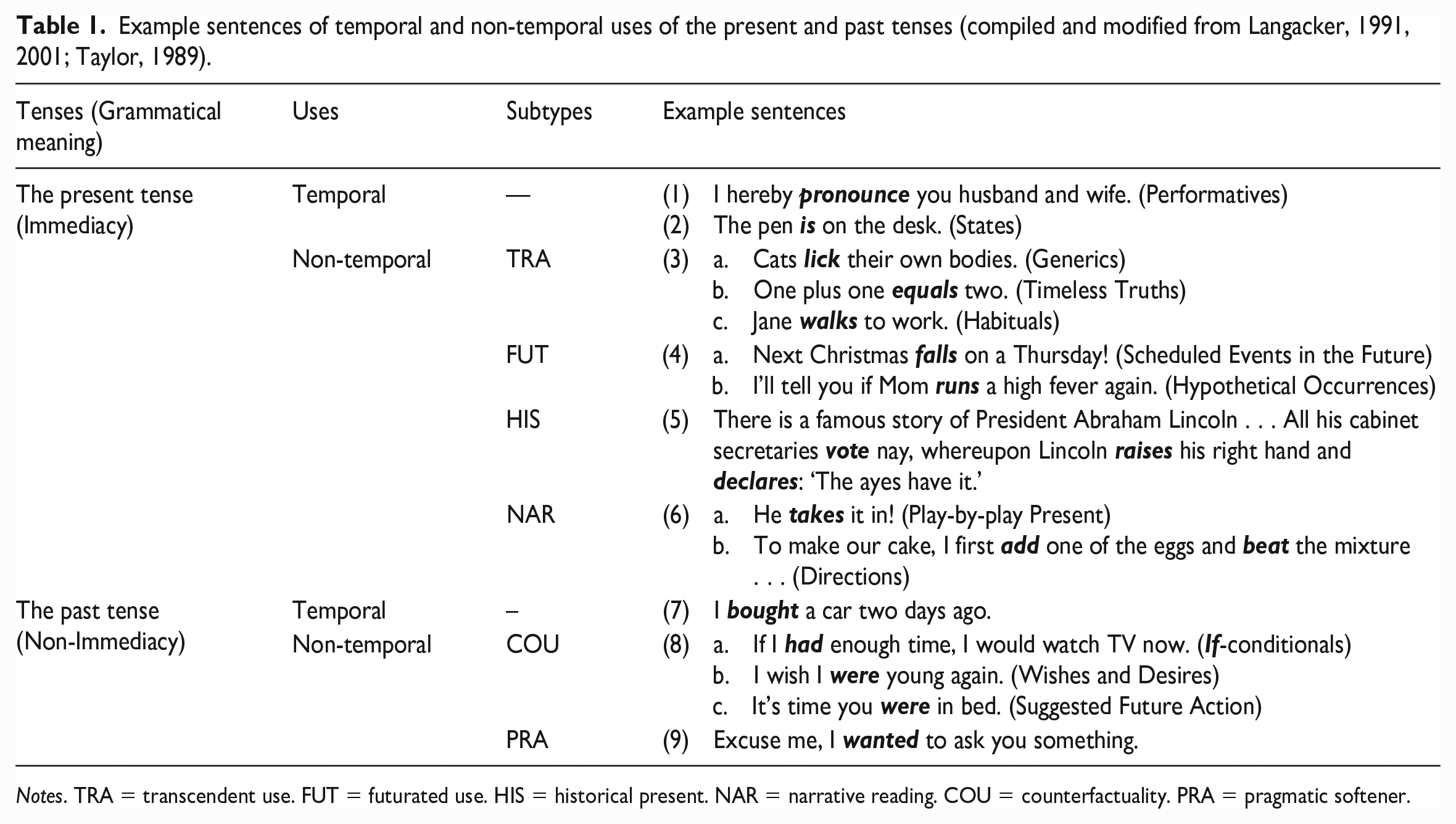
Notes. TRA = transcendent use. FUT = futurated use. HIS = historical present. NAR = narrative reading. COU = counterfactuality. PRA = pragmatic softener.
Like temporal uses, non-temporal uses are elaborated in terms of the notion of ‘immediacy/non-immediacy’. According to Langacker (1991, 2001) and Noyau et al. (1995), the non-temporal uses of the present tense include transcendent use (TRA), futurated use (FUT), historical present (HIS), and narrative reading (NAR), and the non-temporal uses of the past tense, as suggested by Langacker (1991) and Taylor (1989), incorporate counterfactuality (COU), and pragmatic softener (PRA), exemplified by sentences in Table 1. These non-temporal uses are related with the proximal–distal relations and can be illustrated by actuality, salience, and attenuation (Tyler & Evans, 2001).
According to Tyler and Evans (2001), the actuality of an event correlates with our physical proximity and distance. When something is physically proximal to us, our senses perceive it more acutely. Therefore, if a speaker believes that a described event matches the current or actual world state, as in Sentences (3a–c), the present tense, signaling immediacy, is used. By contrast, when a speaker lacks belief in the actuality of described events, such as counterfactual conditionals, hypothetical states, and uncertainty of future events, as in Sentences (8a–c), the past tense, signaling non-immediacy, is employed. In addition, things that are closer to us are more salient than those that are physically distant due to the ability of our eyes. Accordingly, when referring to the relative salience of information, such as expected and actual events in the future or events with anticipated outcomes contained in documents that can be read at present, as in Sentences (4a) and (6b), we use the present tense, viz. immediacy, to indicate foreground status. Other examples of foregrounding invoke mental transfer proposed by Fauconnier (1997), where we shift our attention from the actual speech event to another location of the time axis, depending on our viewpoint. We may shift our viewpoint to a hypothetical space built by subordinators, such as if, when, before, and after, as in Sentence (4b), direct our attention onto a historical mental space, as in Sentence (5), and regard an event that shortly precedes the time of speaking as if they occurred simultaneously, as in Sentence (6a), to make the mental space more real and salient. As to attenuation, proximal–distal relations refer to the mental distance between the speaker and the hearer. In our experience, we can easily affect an entity that is physically closer to us than an entity that is far away from us and, hence, ‘very close proximity can be perceived as being overly assertive and/or aggressive’ (Tyler & Evans, 2001, p. 95). Therefore, when making requests, invitations, suggestions, etc., in order to avoid the confrontation of the hearer’s wills, the speaker is prone to mentally lengthen the distance between the two along the time axis, as if the moment of speaking represents the speaker and the described event represents the hearer. Sentence (9) demonstrates that by using the past tense, viz. non-immediacy, the speaker is not mentally proximal to the hearer and shows politeness.
Since the CL approach provides learners with insights into the systematicity of language, it is suggested that it can bring about a deeper understanding of grammar, higher pragmatic awareness, a lesser burden on learners’ memory, and better retention (Bielak & Pawlak, 2011; Boers & Lindstromberg, 2006). Nevertheless, in the past decade, numerous empirical studies designed to compare the relative merits of the CL approach with the traditional approach in teaching English tense–aspect combinations reported mixed results (summarized in Table 2). Some researchers found that pedagogy with CL insights was not more effective than traditional pedagogy (e.g. Bielak & Pawlak, 2011, 2013; Reif, 2011). Nonetheless, some reported a few cases where the CL approach outperformed the traditional approach but only with small effect sizes (e.g. Kermer, 2016). Others discovered that learners benefited more from CL approach when it was used in task-supported/task-based instruction (e.g. Jacobsen, 2016; Wijaya & Hidarto, 2018) or in concept-based instruction (e.g. Fazilatfar et al., 2017). There were also reports on tense–aspect learning with small sample sizes that favor CL-based concepts in concept-based instruction (Gánem-Gutiérrez & Harun, 2011; Infante & Poehner, 2021; Poehner & Infante, 2017, 2019). The slightly better efficacy of the CL approach over the traditional approach may result from the relatively high degree of complexities underlying the CL theory, revealing that the descriptions in the CL approach need to be simplified (Bielak et al., 2013; Tyler, 2008). One way to simplify CL renditions, as suggested by Niemeier (2004, 2005), is to raise learners’ awareness of the conceptualizations in L2 that differ from first language (L1). An additional way is to extensively use pictorial representations of the semantics of a target grammar since the connection between figurative thought and a mental image helps students remember meanings (Boers & Lindstromberg, 2006; Clark & Paivio, 1991).
A brief summary of empirical studies on English tense–aspect learning under the instruction based on cognitive linguistics (CL).
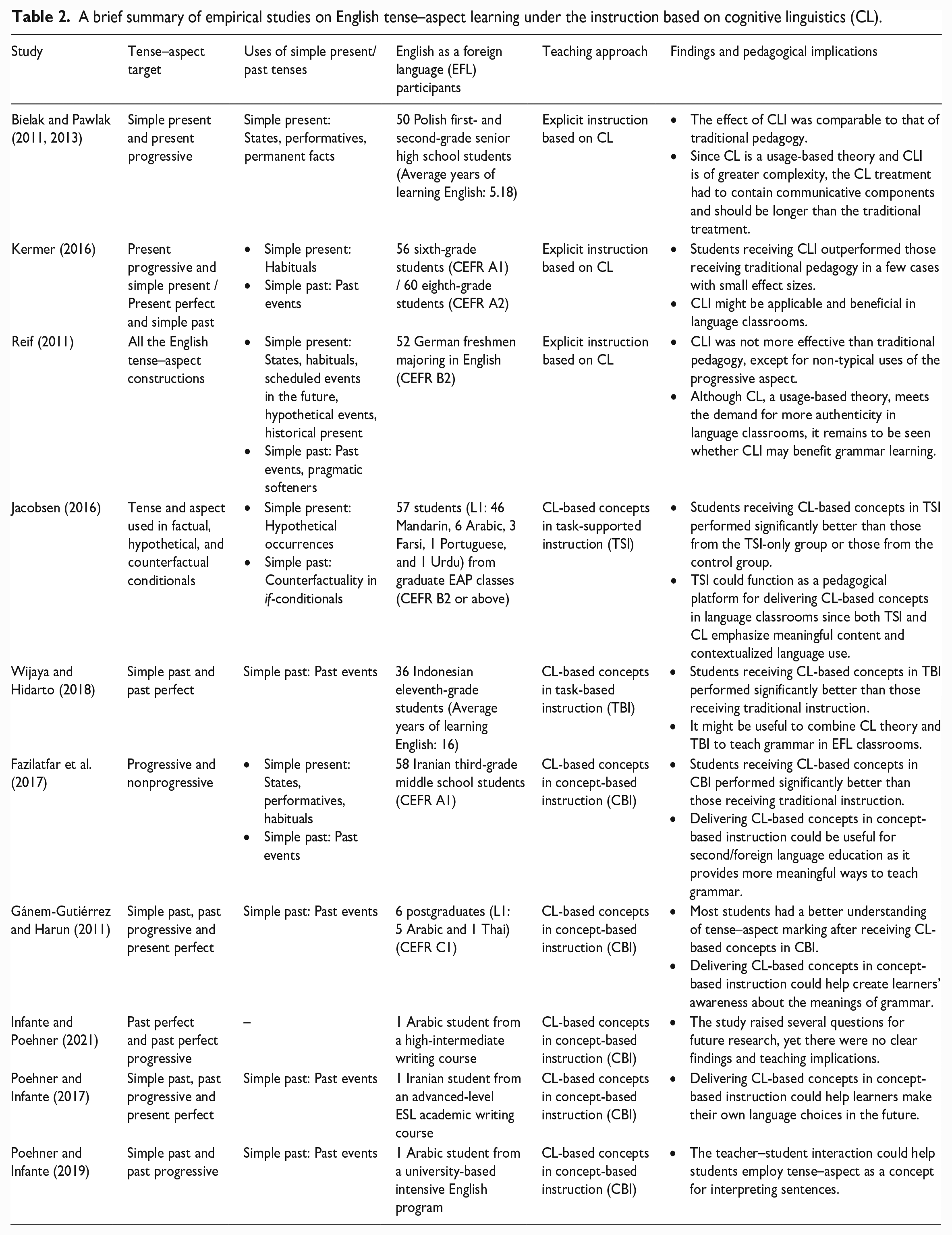
To fill the research gap, the main purpose of our study is to investigate the short- and long-term effects of the CL approach on college students’ learning various usages of the present/past tenses, with simplified CL renditions by raising their cross-linguistic awareness as well as using schematic-realistic pictures. Students’ learning awareness about the CL approach, including their perception of the course content, cross-linguistic knowledge, as well as learning attitudes and interests, is also explored so as to understand students’ feedback on the CL approach. Through the exploration of their knowledge attainment and their feelings, a clearer picture of learning outcomes may be established (Bloom, 1956). The research questions to be addressed are as follows:
Research question 1: Is CL instruction (CLI) with simplified CL renditions by raising students’ cross-linguistic awareness as well as using schematic-realistic pictures a more efficient teaching method to help students with their English tense learning than traditional instruction (TI)?
Research question 2: Are there differences between students’ learning awareness about CLI and learning awareness about TI?
III Method
This study is a quantitative and qualitative study, in which the primary instruments included tests on English tense selections as well as a questionnaire on learning awareness about English tense teaching. Before the main study was conducted, a pilot study was carried out for evaluating and revising the tests and the content of CLI.
1 The pilot study
Forty non-English majors from two freshman English reading classes of CEFR B1 level 2 at a university in Taiwan participated in the pilot study. One class (N = 20) received a 200-minute CLI, in which the present and past tenses were introduced with the CL notion of immediacy/non-immediacy by demonstrating the metaphoric mapping between TIME and SPACE and with pictorial aids to visualize the analogy of the proximity/distance in space in relation to the immediacy/non-immediacy between the described event and the time of speaking. The other class (N = 20) received a 200-minute TI, in which the present and past tenses were introduced by using grammatical taxonomies. A pretest and a posttest were given for examining the effect of pedagogic interventions. Each test was divided into a productive part and a receptive part, each of which contained 32 experimental items and 8 filler items. The result showed no better performance in CLI than TI, in line with some previous studies (Bielak and Pawlak, 2011, 2013; Reif, 2011).
The pilot study suggested that the CL renditions need to be further simplified, and more effort needs to be made on raising students’ awareness of how metaphorical extensions are determined. It also revealed the necessity of revising some test items, enlarging sample sizes, adding a delayed posttest and evaluating students’ learning awareness for a better understanding of the effect of CLI. After the adjustment was made, the main study was conducted.
2 The main study
a Participants
Because of practical constraints, this study adopted convenience sampling to recruit 79 non-English majors from two freshman English reading classes of CEFR B1 level from the same university in the following year, with one class receiving CLI (N = 41) and the other receiving TI (N = 38). The participants spoke Mandarin Chinese as their native language and previously studied English in high school where their grammar textbooks did not cover all the uses of the present and past tenses, and the high school teachers adopted traditional instruction, as explicated in Table 3. The instructor for both CLI and TI groups was the investigator.
The uses of the simple present/past tenses introduced in high school and the instruction listed in teachers’ manuals.
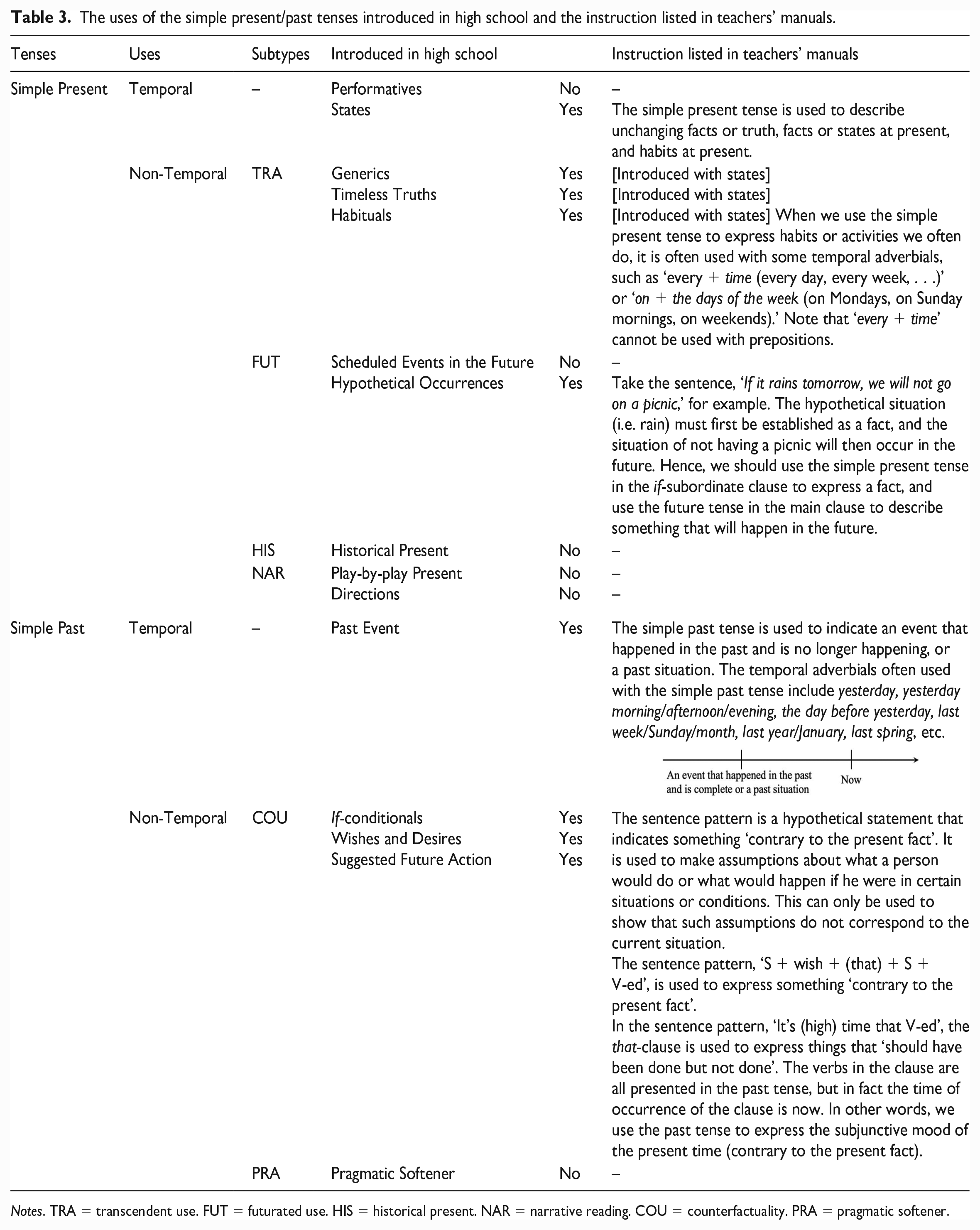
Notes. TRA = transcendent use. FUT = futurated use. HIS = historical present. NAR = narrative reading. COU = counterfactuality. PRA = pragmatic softener.
b Pedagogic intervention: CLI
The lesson plan lasted for 250 minutes and comprised four phases, including two for the present tense and two for the past tense accompanied by an introduction to the future tense (for details, see Appendix 1). 3 In Phase I, temporal and non-temporal uses of the present tense were the focus. When introducing the CL notion of immediacy, the instructor first pointed out the metaphoric mapping between concrete concepts and abstract concepts in daily life (e.g. ‘Time is money’). Then, the instructor raised students’ cross-linguistic awareness of the similar metaphoric mapping between TIME and SPACE in Mandarin and English by showing the fact that we normally walk forward and by giving example sentences that interpret things in front of us as future and those behind us as past in both languages. Finally, the instructor presented Figure 1 to show the proximity in space in relation to immediacy between the described event, as illustrated by the rectangle, and the time of speaking, as illustrated by the person/speaker, on the time axis. The students were told that unlike Mandarin, in which temporal adverbials are often used to judge when a described event occurs, English values the view of a speaker: when a speaker can observe a described event at the time of speaking, as illustrated by the overlap between the rectangle and the person, s/he uses the present tense.
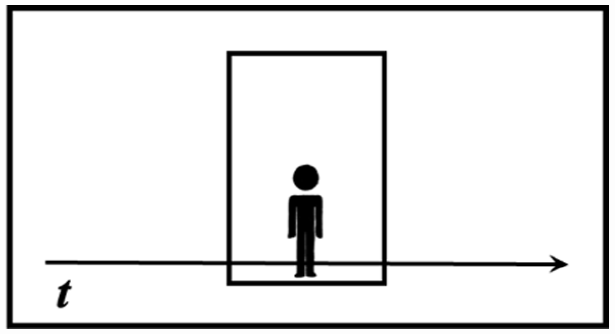
The essence of the present tense: Immediacy.
Then, the instructor explained temporal uses of the present tense by emphasizing the coincidence between described events and the time of speaking (i.e. immediacy) no matter when the events start and end, as shown in Figure 2.
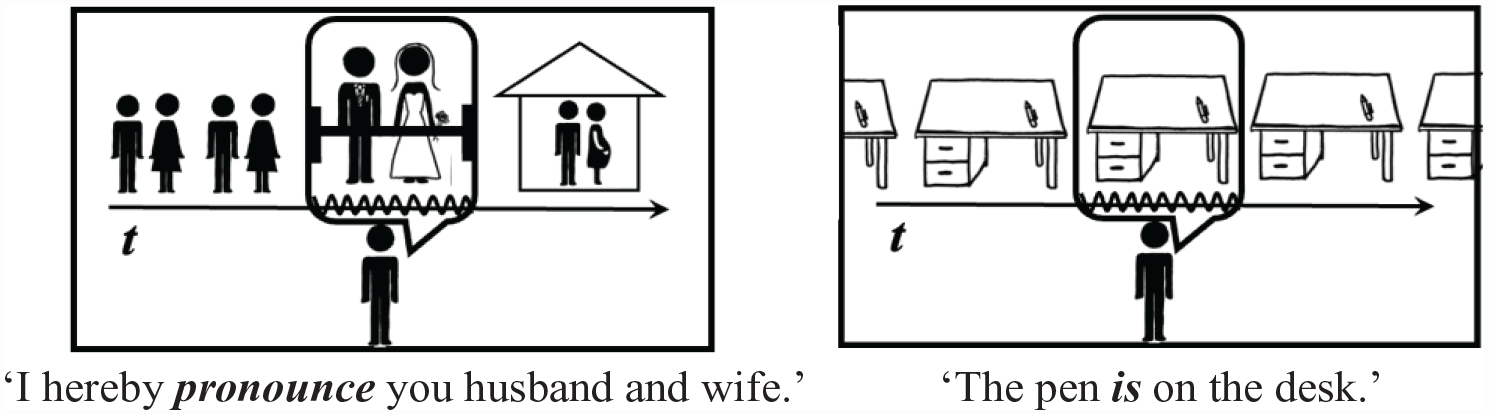
Temporal uses of the present tense.
Following the temporal uses, non-temporal uses were introduced via actuality and salience. First, the instructor explained that people tend to believe something is real if they perceive it with their own eyes or ears; therefore, when a described event matches the current or actual world state, a speaker uses the present tense as if s/he perceived it at the time of speaking (i.e. immediacy), as shown in Figure 3.
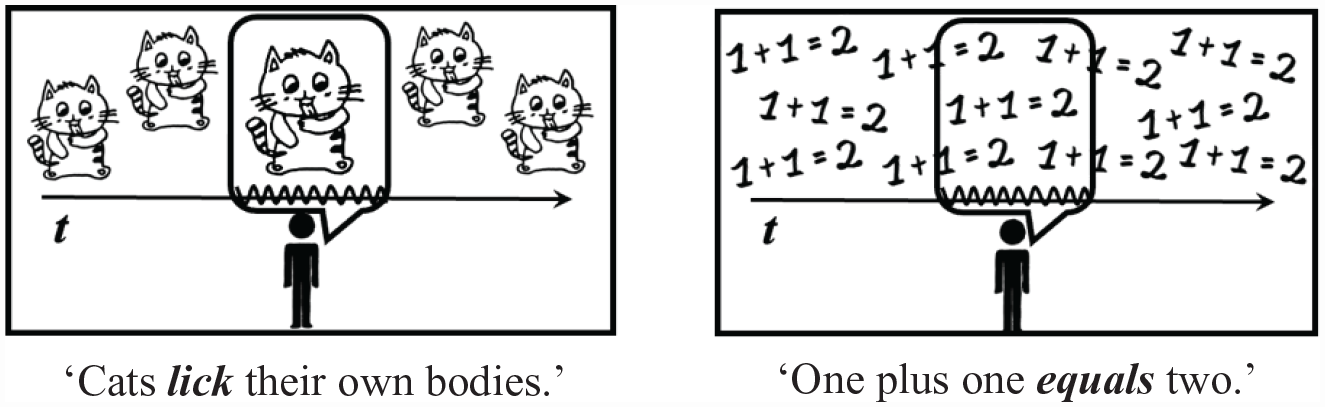
Non-temporal uses of the present tense (via actuality).
Second, the instructor told the students that things that are closer to us are more salient and will get our instant attention; therefore, when a speaker holds certainty of something because it is close at hand, s/he uses the present tense. Figure 4 illustrates that the described events can be proved to be true by checking calendars or reading from recipes at any time, including the time of speaking (i.e. immediacy).
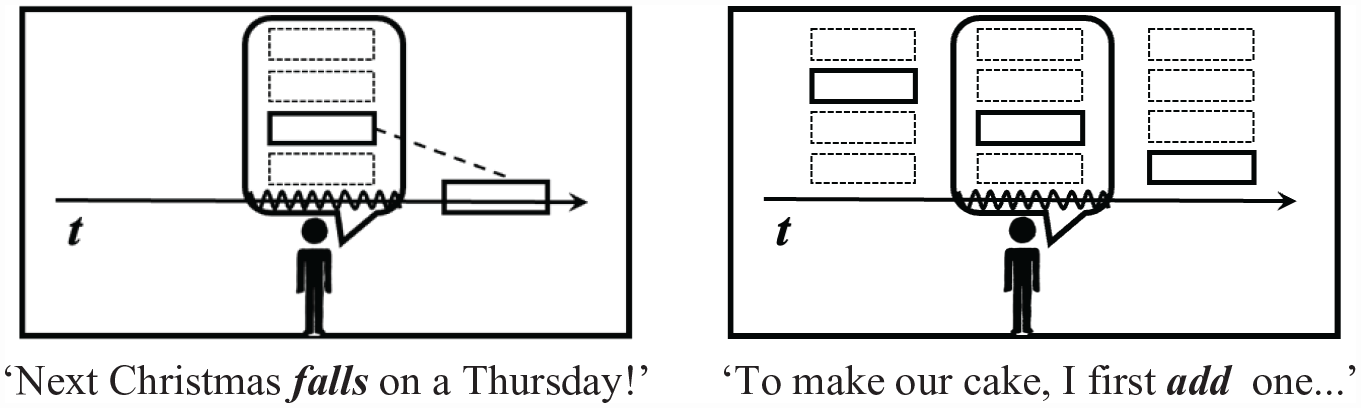
Non-temporal uses of the present tense (via salience).
Then, the instructor talked about time travel in some famous movies and comics, and asked the students to think about the possibility of going back to the past and traveling to the future in language use. After a short discussion, the instructor concluded that people may shift attention from the time of speaking to somewhere on the time axis according to their viewpoint. When they mentally transfer their attention to the time of the described event, they have relatively salient information about the event and hence use the present tense (i.e. immediacy) to indicate foreground status. Therefore, when a speaker believes that a future event might happen, wants to show the vividness of a past event, or reports an event that shortly precedes the time of speaking, s/he uses the present tense, as shown in Figure 5. Finally, the temporal and non-temporal uses of the present tense were reviewed. Phase I took 90 minutes.
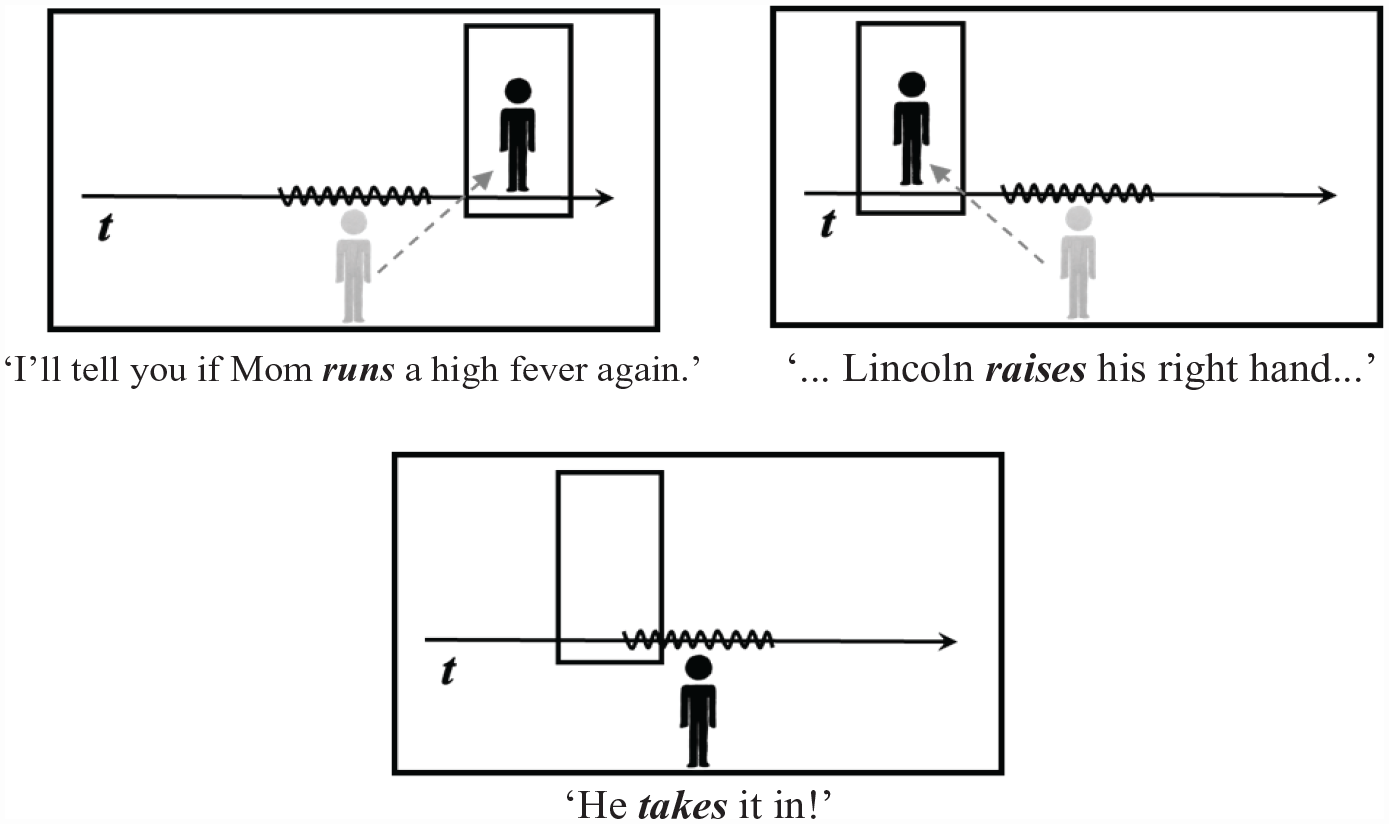
Non-temporal uses of the present tense (via salience and mental transfer).
In Phase II, the students were individually engaged in an interpretation task in relation to the present tense as a practice, in which they chose appropriate tense forms according to contexts. For each option they chose, they must explain the speaker’s viewpoint, the grammatical meaning of the tense, and how the tense fit the context as well as draw a picture to show the mapping between time and space. After checking the answers, the instructor helped the students to review all the uses of the present tense with the CL notion of immediacy. Phase II took 60 minutes.
In Phase III, the temporal and non-temporal uses of the past tense were the focus. The instructor invited the students to think about possible functions of the past tense used in example sentences by drawing inferences from the concept of immediacy learned in Phase I. After the guided discussion, the instructor first repeated the metaphoric mapping between TIME and SPACE and then presented Figure 6 to show the remoteness in space in relation to the non-immediacy between the described event and the time of speaking. The students were told that when a speaker cannot observe a described event at the time of speaking, as illustrated by the distance between the rectangle and the person, s/he uses the past tense. Then, the instructor gave the sentence, ‘I bought a car two days ago,’ as an example of the temporal use of the past tense.
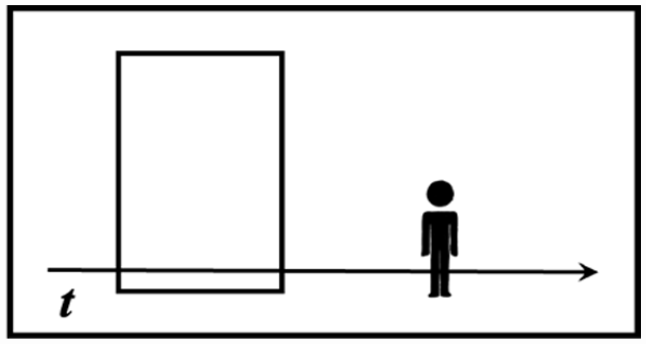
The essence of the past tense: Non-immediacy.
Following the temporal use, non-temporal uses were introduced via actuality and attenuation. First, the instructor explained that people have more doubt about the actuality of something if it is distant and hardly perceived; therefore, when a speaker lacks belief in the actuality of a described event, the past tense (i.e. non-immediacy) is used. Figure 7 illustrates that the speakers know that the described events do not exist or the suggested future action can be possibly rejected.
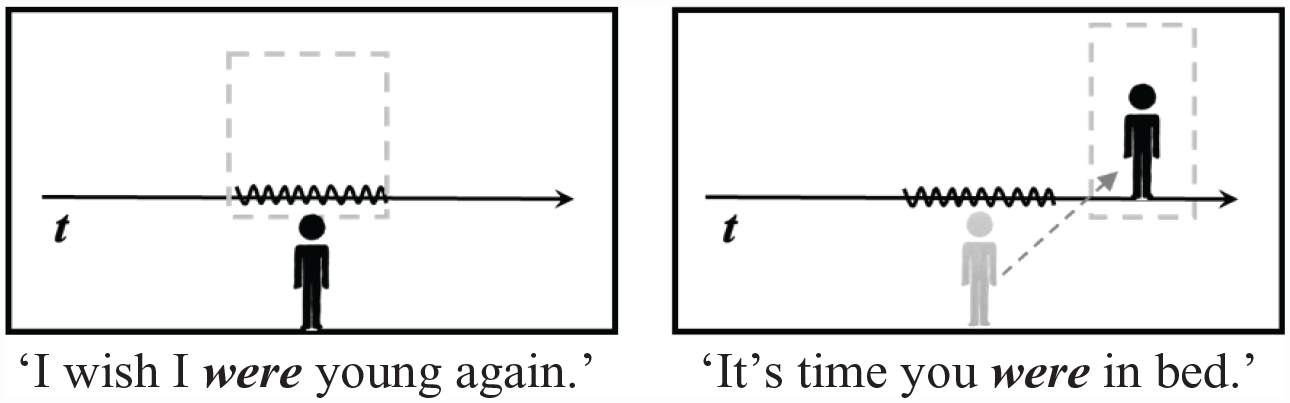
Non-temporal uses of the past tense (via actuality).
Second, the instructor pointed out that it is easier to affect things that are close to us and asked the students how they felt if a stranger or someone they were not familiar with stood quite close to them. Then, the instructor explained how the appropriate physical distance can be kept in Mandarin and English to show politeness when people are making requests, invitations, suggestions, etc. Figure 8 was given to illustrate that in English the distance between the hearer and the speaker can be lengthened by pushing the described event away from the time of speaking (i.e. non-immediacy) so as to avoid being assertive or aggressive. Finally, the futurity was briefly introduced. Phase III took 40 minutes.
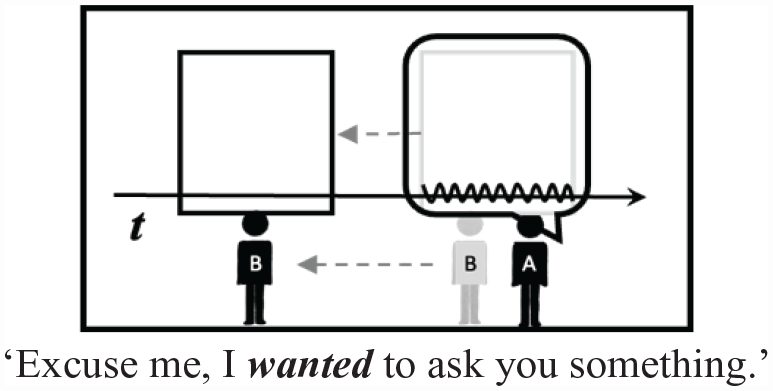
Non-temporal uses of the past tense (via attenuation).
In Phase IV, the students were individually engaged in an interpretation task in relation to the present tense, the past tense, and the futurity. The task pattern was the same as what they did in Phase II. In the end, the instructor helped the students to review all the uses of the present and past tenses with the CL notion of immediacy/non-immediacy. Phase IV took 60 minutes.
c Pedagogic intervention: TI
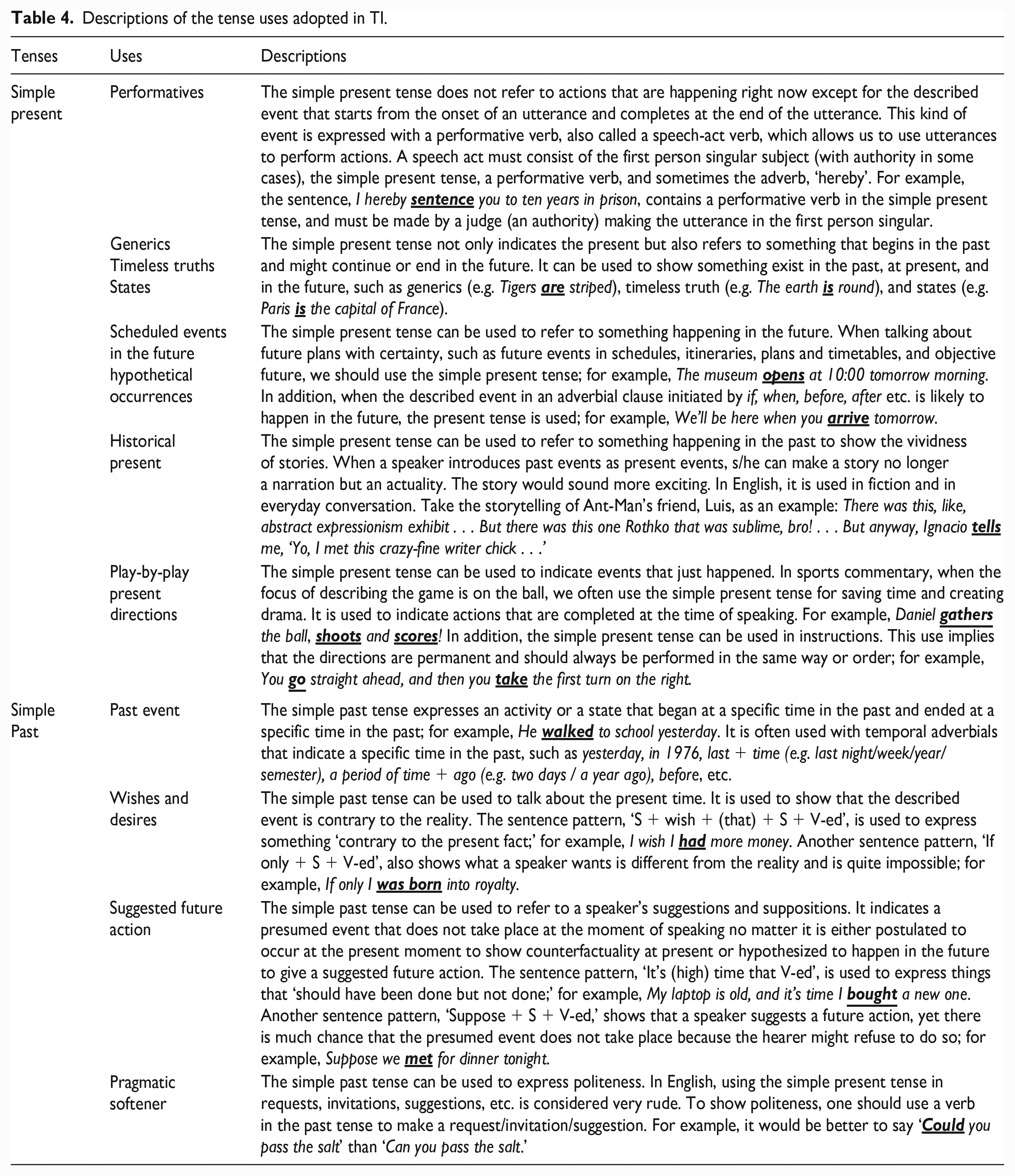
The time duration and procedure of TI were the same as those of CLI, yet TI focused on the grammatical taxonomies of the verb tenses (see Appendix 2). Table 4 presents the descriptions used as a basis of TI, compiled from grammar books sold at bookstores (e.g. Azar & Hagen, 2010).
Descriptions of the tense uses adopted in TI.
d Tests and scoring
A pretest, a posttest, and a delayed posttest were conducted one week before, one week after, and five weeks after the teaching intervention. Each test incorporated a productive part followed by a receptive part, and the receptive part was given only after the productive part was handed in. Each part consisted of 20 test items, where linguistic contexts were provided: 10 for the present tense, 6 for the past tense, and 4 for the futurity as filler items. The test items for the present tense were evenly divided into the temporal use – TRA, FUT, HIS, and NAR – and those for the past tense were evenly divided into the temporal use: COU, and PRA. The test items in the pretest and the posttests differed, yet the reliability of the tests was confirmed (r = .76) in a pilot study, where 23 bachelor’s degree holders of English who spoke Mandarin as their native language participated. All the test items were proofread by nine native English speakers.
In each test, the test items in the productive part and the receptive part were identical. In the productive part, the slot-filling task was adopted. Each target verb was replaced by a blank with an original verb form in parentheses as a clue for students to write down the verb with an appropriate tense. In the receptive part, the multiple-choice task was adopted. Each target verb was presented with the present tense, the past tense, and the futurity for students to choose. For each option they chose, they had to explain their reasons in an open section. The students were given 50 minutes to complete each test (see Appendix 3).
To obtain the scores of the tests, the scores of the identical test items in the productive and receptive parts were averaged. In the productive part, each response with a correct tense was scored as 1 point, while any response with a wrong tense or without a tense (e.g. a verb with the -ing marker but no tense) was given 0 points. Omitting tense marker -s for a third person singular subject, wrongly using the tense marker -s for a subject that is not a third person singular, adopting wrong aspects, misspelling verbs and erroneously choosing an active/passive voice were given 0.5 points. In the receptive part, each response that matched the target tense was regarded as a correct answer and was given 1 point, while a response that did not match the target tense was viewed as a wrong answer and was given 0 points.
e The learning awareness questionnaire
To understand the differences between students’ learning awareness about CLI and learning awareness about TI, a questionnaire survey was conducted. The learner awareness questionnaire was developed by the investigator, examined by three experts, and revised according to experts’ suggestions. After the revision, the original questionnaire included 24 questions with Likert five-point scale as well as two open questions on how the students feel about the English tense course and what affects them most profoundly in this course.
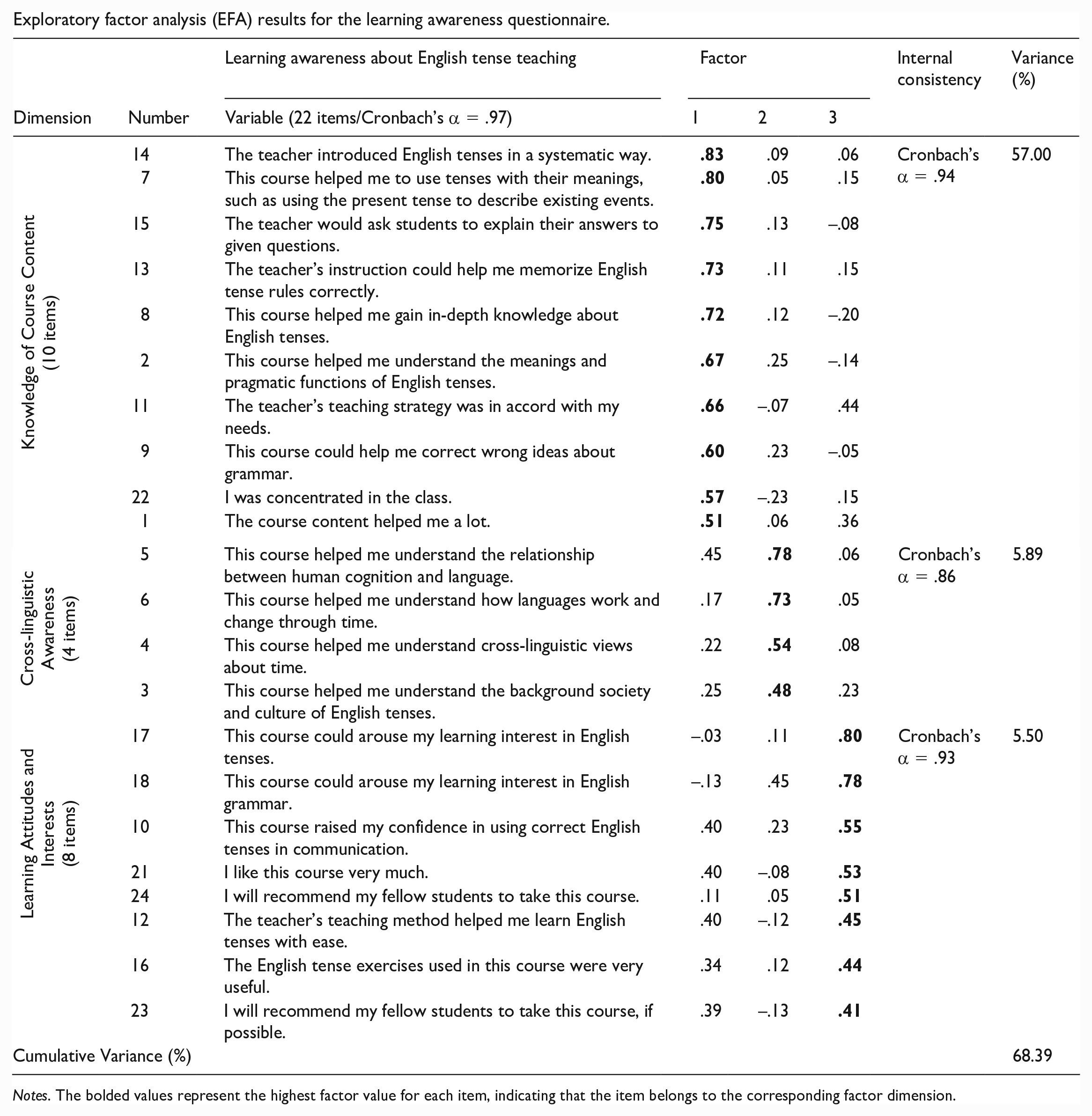
The questionnaire was given after the posttest. The number of retrieved questionnaires was 76, including 37 from the TI group and 39 from the CLI group. After the exploratory factor analysis (EFA), the questionnaire finally contained 22 questions, including 10 questions for ‘knowledge of course content’, 4 questions for ‘cross-linguistic awareness’, and 8 questions for ‘learning attitudes and interests.’ The cumulative variance contribution rate was 68.35%, and internal consistency was high (Cronbach’s α = .97) (see Appendix 4). The CR of each question was higher than 3.0, indicating that all questions have good discriminatory power.
As to the open questions, there were 152 retrieved responses, which were analysed via content analysis (Patton, 2002) by two raters. The data were coded into ‘knowledge of course content’, ‘cross-linguistic awareness’, and ‘learning attitudes and interests’. Responses that did not belong to the three dimensions were classified into ‘others’. The interrater reliability was high (Cohen’s kappa = .98).
IV Results
1 The differences between CLI and TI on English tense learning
One-way ANCOVAs revealed statistically significant differences between CLI and TI on the posttest with a large effect size and on the delayed posttest with an effect size that was close to being medium after controlling for the pretest. Figure 9 visualizes that the CLI group outperformed the TI group in both posttest and delayed posttest. 4
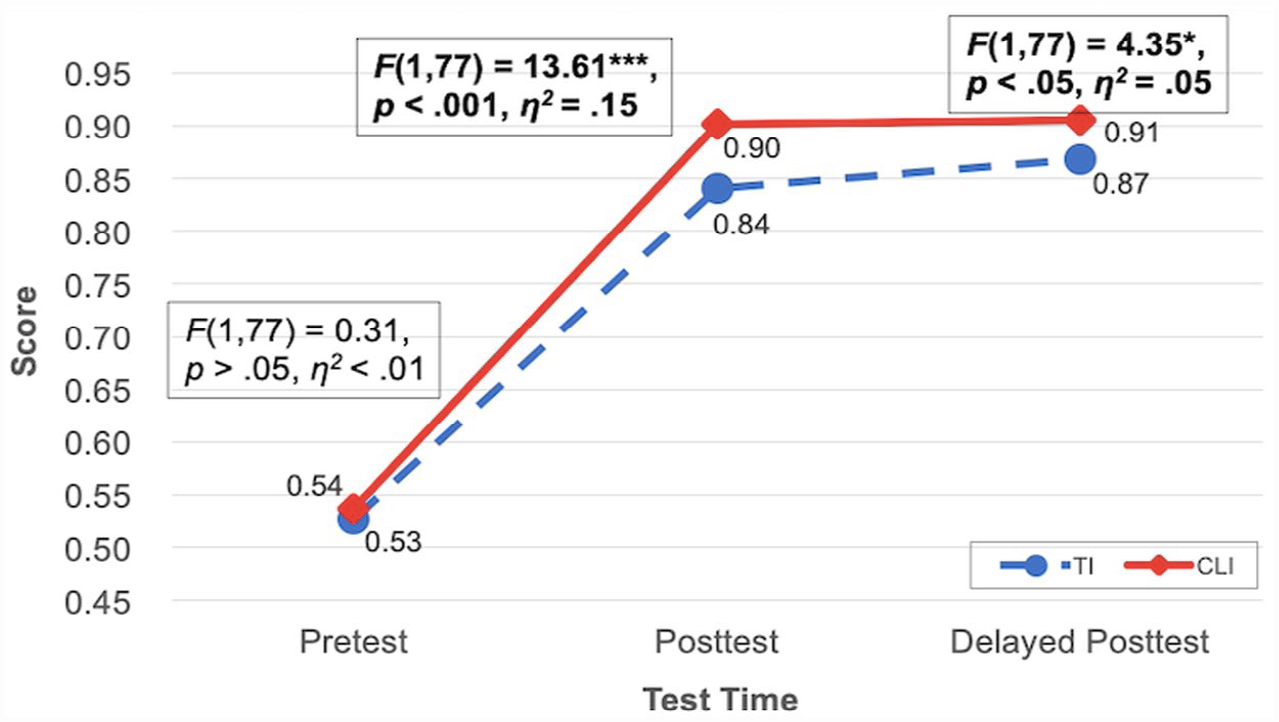
Mean scores of the tense tests.
The box-and-whisker plots in Figure 10 suggest that CLI brings about homogeneity in tense learning. At the outset of the study, the CLI group showed greater heterogeneity in that the overall range of the scores was wider in the CLI group than in the TI group. Besides, a mild outlier lay in the CLI group, while there was no outlier in the TI group. However, after the teaching interventions, the heterogeneity disappeared in the CLI group but was found in the TI group as shown by the wider interquartile range and overall range of the scores in the TI group than in the CLI group.
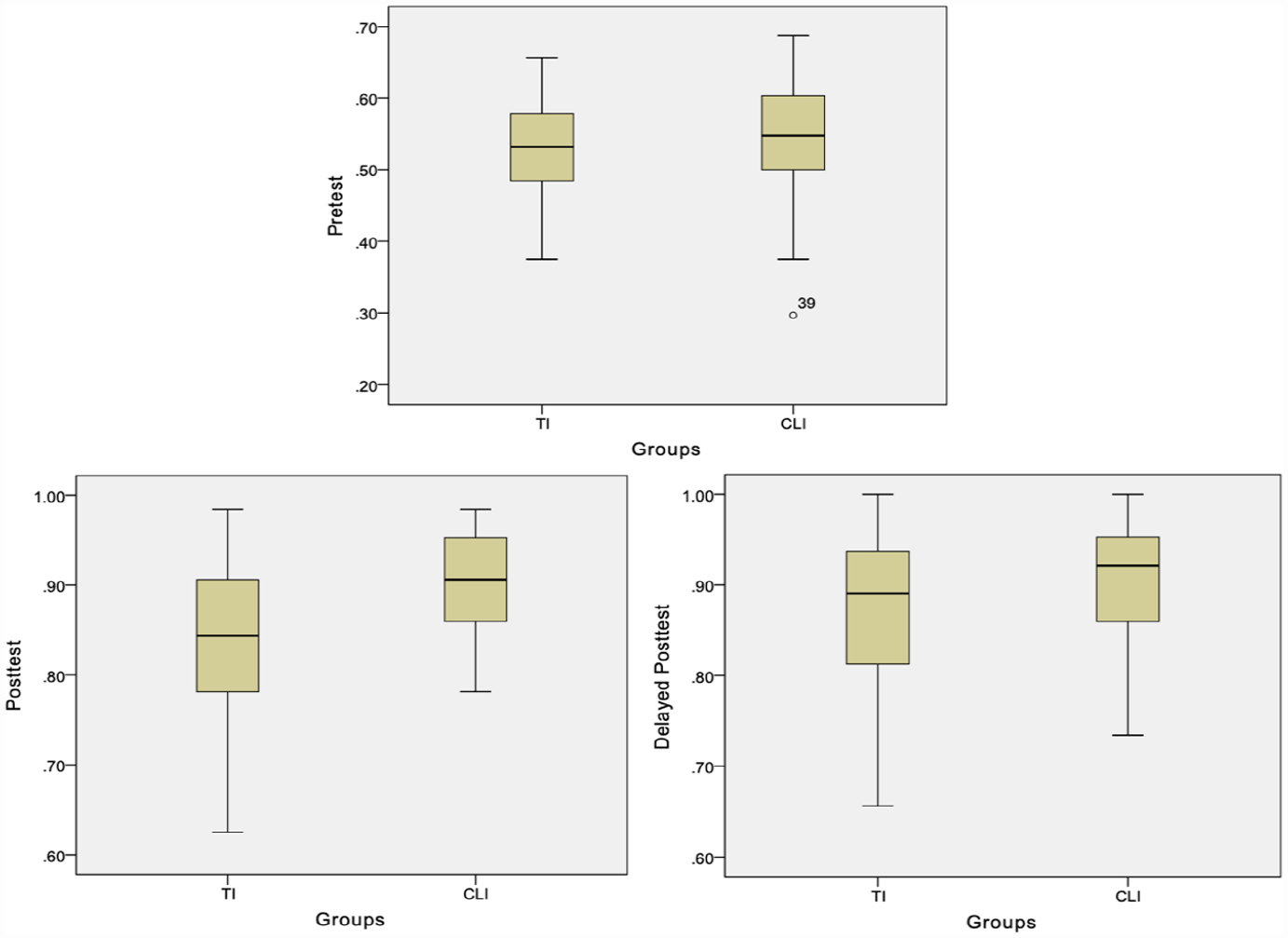
Distributions of mean scores of the tense tests.
To examine CLI and TI differences in temporal and non-temporal uses, one-way ANCOVAs were conducted with the pretest as the covariant. Table 5 reports statistically significant differences between CLI and TI on non-temporal uses of the present tense in the posttest with a medium effect size, as well as on non-temporal uses of the past tense in the posttest and the delayed posttest with medium effect sizes. Regarding each type of non-temporal uses, one-way ANCOVAs showed significantly better performance of the CLI group than the TI group in COU and PRA in the posttest as well as in FUT and PRA in the delayed posttest, controlling for the pretest, as shown in Figure 11.
Means and standard deviations of temporal and non-temporal uses.
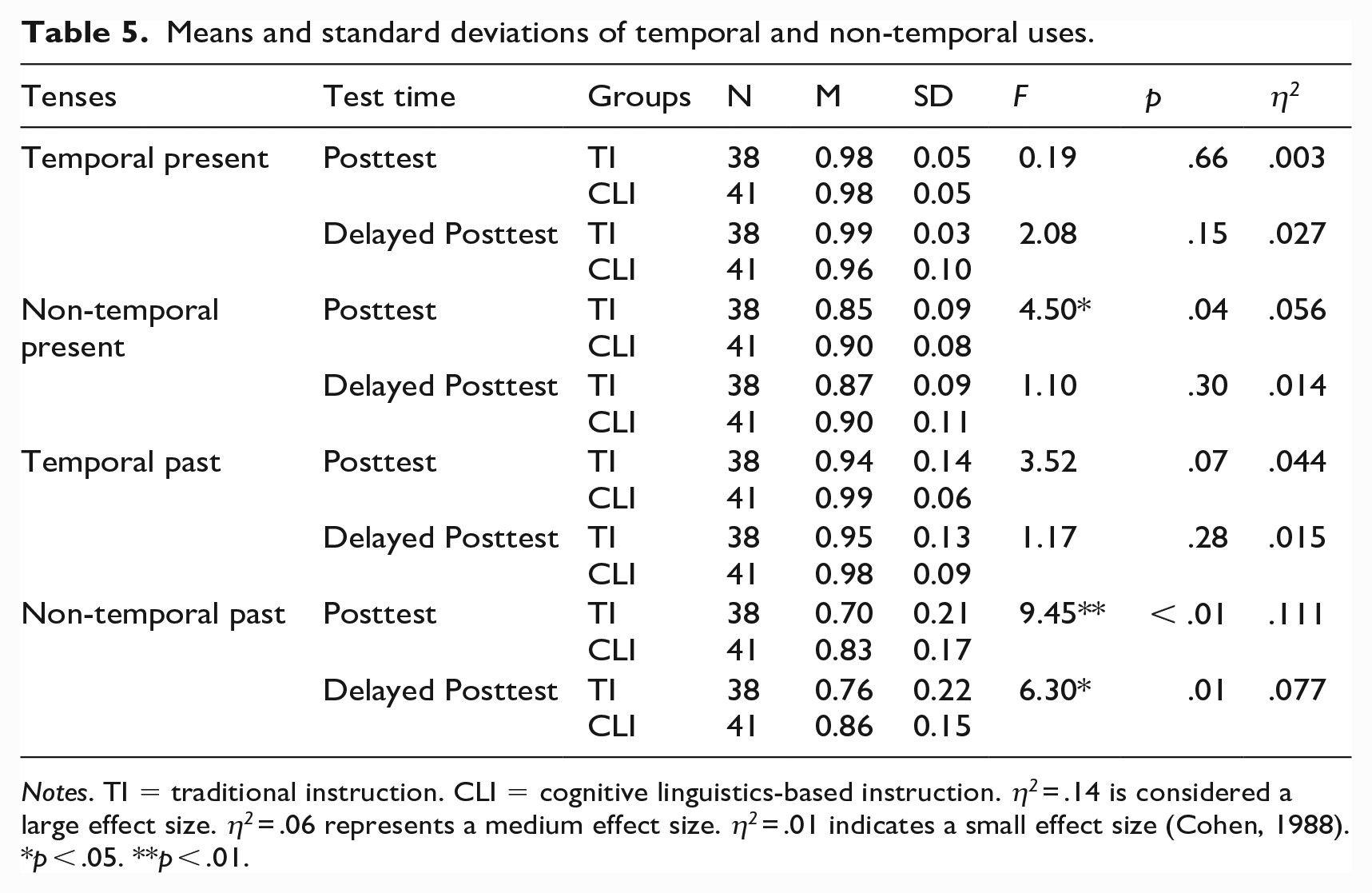
Notes. TI = traditional instruction. CLI = cognitive linguistics-based instruction. η2 = .14 is considered a large effect size. η2 = .06 represents a medium effect size. η2 = .01 indicates a small effect size (Cohen, 1988). *p < .05.
p < .01.
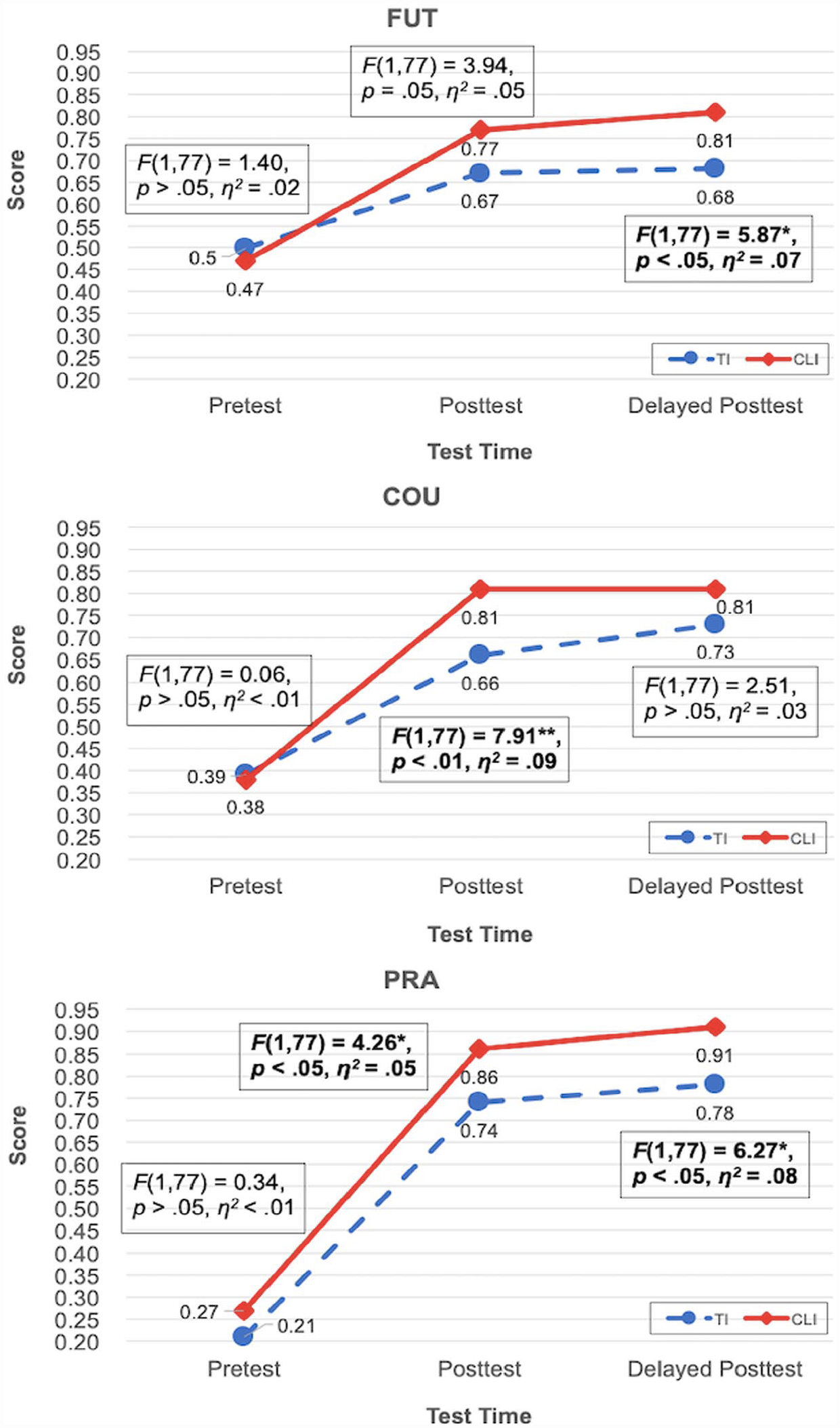
Mean scores of the tense tests on FUT, COU, and PRA.
2 The differences between students’ learning awareness about CLI and TI
T-tests indicated no significant differences between students’ learning awareness about CLI and TI, as shown in Table 6. However, the mean of cross-linguistic awareness toward CLI was numerically higher than that toward TI, yet the standard deviations of the two teaching methods were very close. In addition, the standard deviations of the CLI group were higher than those of the TI group in learning awareness about knowledge of course content as well as learning attitudes and interests. From the responses to the open questions, it was found that more students in the TI group claimed that they learned when to use which tense, while students in the CLI group were more impressed by the new teaching method and the meanings of tenses. Additionally, only students in the CLI group reported the awareness of different perceptions of time between English and Chinese and their understanding of how English tenses work (e.g. knowing the motivation behind tenses, and understanding grammar but not memorizing grammar). On the other hand, more students in the TI group thought that they could learn tenses without pressure in the course. Table 7 summarizes the results and presents some extracted responses.
Means and standard deviations of learning awareness.
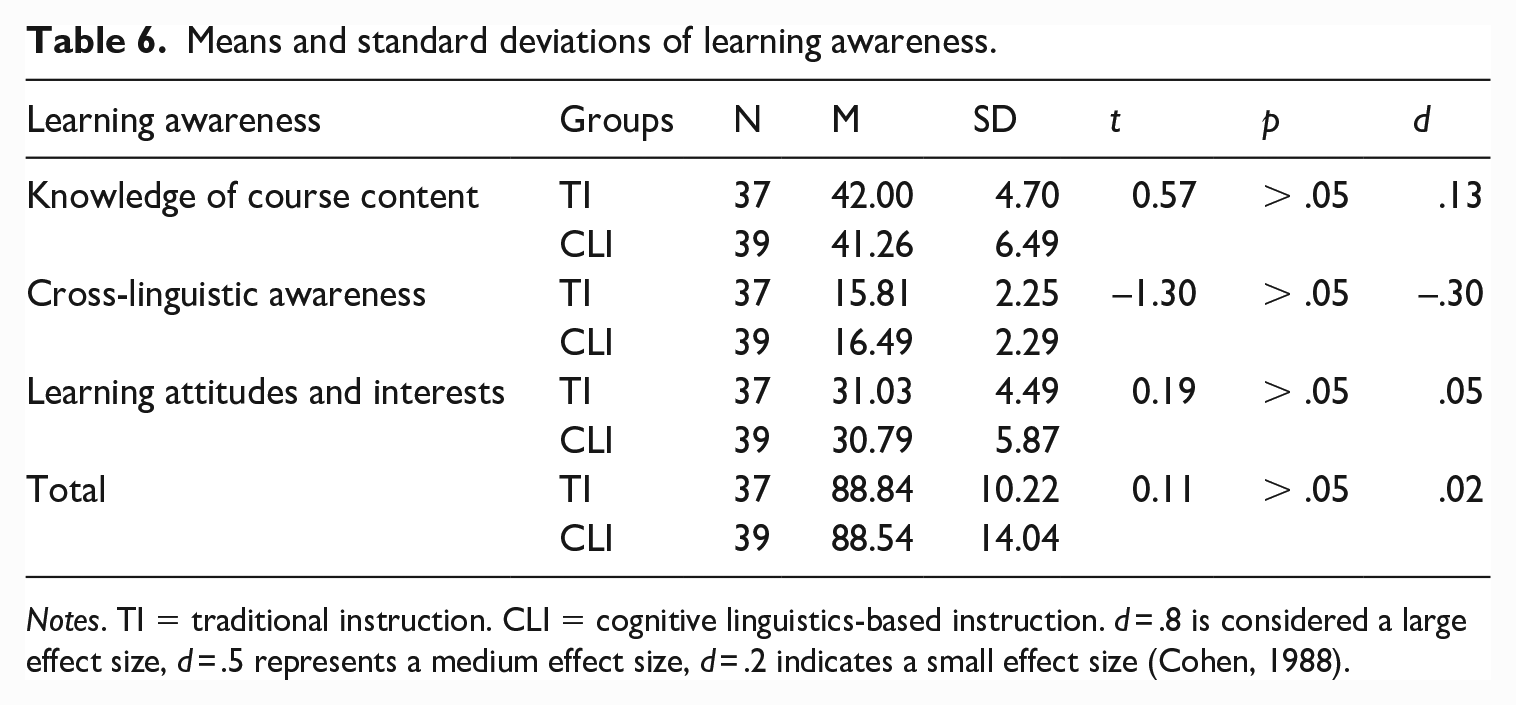
Notes. TI = traditional instruction. CLI = cognitive linguistics-based instruction. d = .8 is considered a large effect size, d = .5 represents a medium effect size, d = .2 indicates a small effect size (Cohen, 1988).
The qualitative analysis of TI students’ and CLI students’ responses to the open questions.
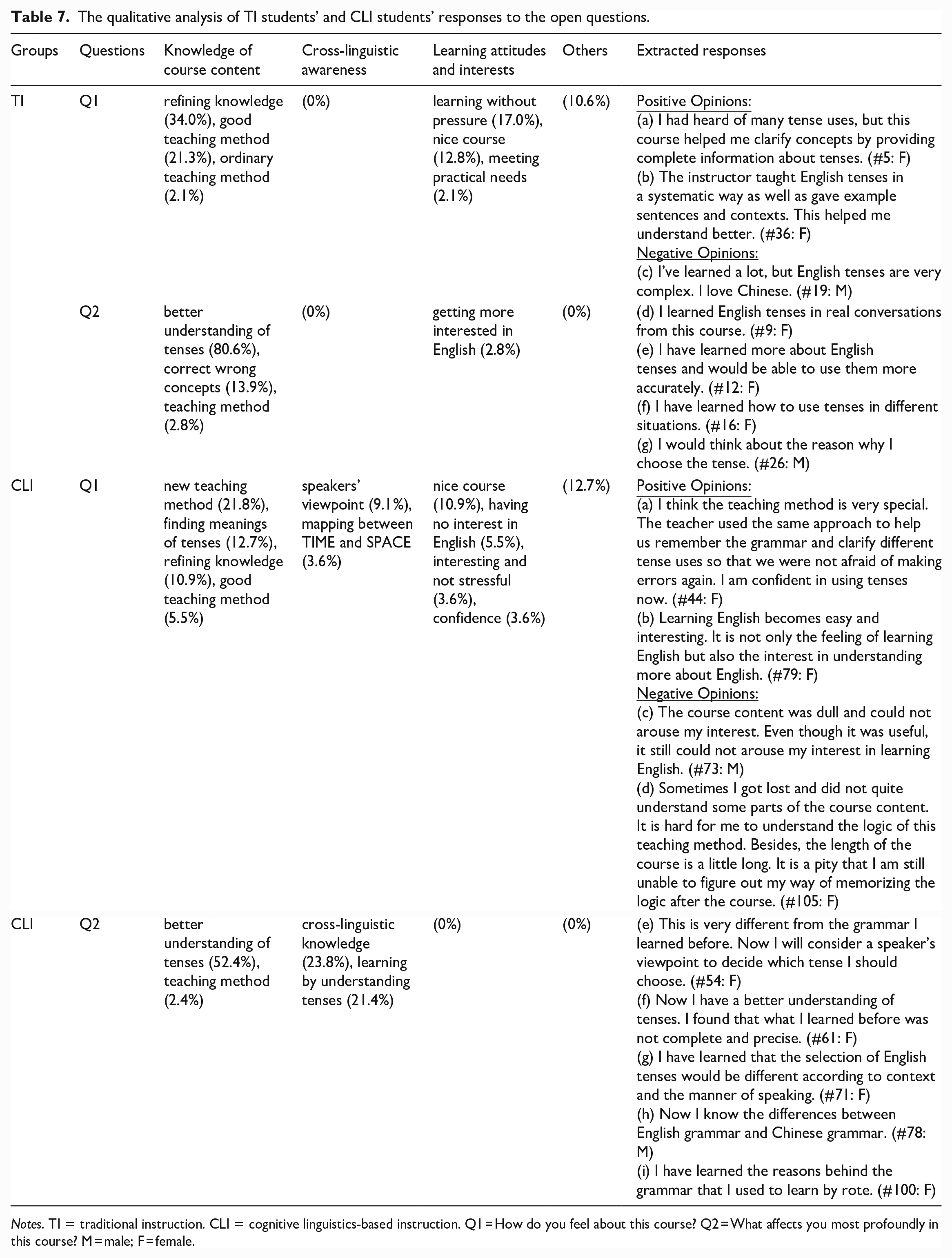
Notes. TI = traditional instruction. CLI = cognitive linguistics-based instruction. Q1 = How do you feel about this course? Q2 = What affects you most profoundly in this course? M = male; F = female.
V Discussion
1 CLI could be a more efficient teaching method for tense selection than TI
Results seem to warrant the conclusion: CLI may be a more efficient teaching method for tense selection than TI in both short- and long-term learning outcomes. The finding of the homogeneity in CLI suggests that learners receiving CLI may make consistent progress, which echoes Reif’s (2011) study on English tense–aspect combinations and Jacobsen’s (2016) study on comprehension of tenses in English conditionals. In addition, the better outcome of learning non-temporal uses in CLI than in TI, especially PRA, which allows the present and past tenses in different contexts, may indicate that CLI helps learners construct an ability to observe pragmatic contexts in a target language. A likely explanation for the results rests in the fact that the CL approach permits learners to deal with a foreign language on their own in a more meaningful way. Armed with more systematic, precise semantic analyses of grammar constructions, learners not only develop their emergent grammar based on deep processing and understanding of linguistic structures but also make language choice that represents their conceptualization at their disposal (Achard, 2004, 2008). By contrast, TI, where grammar is often arbitrary, urges learners to memorize grammatical taxonomies in a piecemeal fashion, which may lead to a heavy memory load. With different learning engagements, TI learners would show greater heterogeneity in learning achievement (Aydin et al., 2015).
Compared with previous studies, the present study provides more explicit evidence for the importance of CLI in verifying the assumption that grammatical constructions can be learned better in a structured and natural situation. Probably the major reason for the larger effect sizes obtained in this study is that we adopted several ways to simplify CL renditions to make learners aware of the motivation behind tenses. First, raising learners’ cross-linguistic awareness may help them acquire the situatedness of language usage, which is inseparably intertwined with its culture (Byram, 2012; Niemeier, 2004, 2005). Since metaphors develop within a culture, it is inevitable to introduce metaphors in a target language along with its culture. An instructor may start with pointing out the metaphoric mapping between concrete concepts and abstract concepts in daily life and then demonstrate the similarities and differences of the time and space mapping between learners’ mother tongue and the target language with example sentences. The introduction to cross-lingual variations in metaphor is to ensure that learners would be prepared to decipher hidden meanings of tenses.
Second, using pictorial aids to enhance figurative thought could be beneficial to retention (Boers & Lindstromberg, 2006; Clark & Paivio, 1991). Although peripheral senses (e.g. non-temporal uses) are extended from and semantically associated with a prototypical sense (e.g. the temporal use), they are usually a lot in number and need more elaborations in teaching. When explaining how the meaning of English tenses (i.e. immediacy/non-immediacy) can apply to non-temporal uses, an instructor may employ pictorial illustrations to clarify verbal explanations and help learners reach a deeper understanding of the usages, which in turn may result in longer retention in memory.
Finally, encouraging learners to associate the meaning of English tenses with how they perceive the world may help them recognize that the target grammar actually makes sense. Simply pointing out the metaphoric mapping between time and space does not necessarily provide a perspicuous explanation for non-temporal functions of tenses. Nevertheless, it would be helpful if an instructor helps learners see the motivation behind the tenses by virtue of experiential correlation, that is, showing how the meaning of tenses is grounded in the way people experience actuality, salience and politeness in terms of proximal–distal spatial relations (Tyler and Evans, 2001).
2 Learners of both groups perceive progress in tense learning, but learners in the CLI group may not equally prefer the new teaching method
Quantitative results of learning awareness seem to indicate that students receiving either CLI or TI hold the same belief in making progress in tense learning. There are a number of possible explanations for this finding. First, both teaching interventions of the study introduced non-temporal uses that were not included in high school textbooks. Moreover, all the uses of the same tense were taught together, unlike those in high school textbooks, which were scattered in different units. The claims that they gained in-depth knowledge about English tenses found in the responses to open questions in the questionnaire give support to this inference (for details, see the TI group’s Responses (a) and the CLI group’s Response (f) in Table 7). Second, both CLI and TI were carried out with the same activities and agenda, in which the investigator asked the students to formulate their own hypotheses toward a set of example sentences that covered all the uses of the same tense, explored temporal uses followed by non-temporal uses with detailed examples, and assigned interpretation tasks where the students were asked to explain why the past or present tense was used in each case. Third, in both groups, the target tenses were introduced in contexts in which language use shows cultural variation. For instance, the politeness practices in English example sentences (i.e. the past tense in affirmative sentences) do not connect with students’ understanding of the politeness expressions in their own culture, where interrogative sentences with words such as please, consult, and bother are often used in making requests. In addition, pragmatic differences conveyed by the same sentence with different tenses, such as those exemplified in PRA and HIS, were also explained. Since pragmatics plays a role in mediating learners’ own cultural understandings and those of the target culture (Liddicoat, 2014), it is feasible that students receiving TI perceived that they learned cross-linguistic knowledge to the extent that they made no difference from students receiving CLI (for details, see the TI group’s Responses (b), (d), and (f) in Table 7).
From the numerically higher mean of cross-linguistic awareness in the CLI group, however, we can observe the tendency that CLI may help learners build better cross-linguistic awareness. The cross-linguistic knowledge, which equips learners with the capability to learn grammar through the understanding of cultural differences and similarities, may be one of the causes that contribute to the better learning effectiveness of the CLI group. The qualitative responses also suggest better cross-linguistic awareness in CLI in that the CLI group but not the TI group mentioned the language-culture nexus, which seems to support the idea that cognitive training is directly concerned with cross-linguistic awareness (Brislin et al., 1983; Gudykunst & Hammer, 1983) (for details, see the CLI group’s Responses (e), (h), and (i) in Table 7).
Nevertheless, not all learners seemed equally responsive to CLI as the quantitative data demonstrated larger differences in viewpoints toward course content as well as in learning attitudes and interests. The responses to how they felt about CLI suggest that few students were unable to adapt to it although most students held positive opinions. One possibility is that CLI is comparatively novel in EFL classrooms and learners are presumably more accustomed to TI. Another may be relevant to students’ different cognitive-style profiles (Boers & Lindstromberg, 2006). People tend to apply various strategies to process conceptual metaphors (e.g. a mapping between a source domain and a target domain, a process of conceptual integration of domains, and a projection of stereotypical images or other metonymic models), but they may have a preference for one (Boers & Littlemore, 2000). Some may prefer thinking in mental pictures, while some may show a preference for thinking in words (Katz, 1983). Accordingly, the figurative thinking and visual scaffolding used for CLI in this study are not equally beneficial for all students (for details, see the CLI group’s Responses (a–d) in Table 7).
3 Teaching activities used in CLI may provide some ideas for grammar teaching in EFL classrooms
Various teaching activities can be used to promote the efficacy of grammar teaching. Most importantly, the instructor can point out the metaphoric mapping between concrete concepts and abstract concepts in daily life, using learners’ native language as a starting point, and then guide learners to think about possible human cognition in relation to target grammar. Films can be used to help learners explore cultural conventions in the target language that affect how people think and behave (Baker, 2012). The cross-linguistic awareness-raising activities may help learners decenter from their own cultural frame and start to perceive the target language from alternative perspectives. After the cross-linguistic understanding is built, the instructor may ask learners to figure out form–meaning mappings of the target grammar; for instance, in our study, the past tense, added with an -ed inflection, denotes distance or non-immediacy, while the present tense, marked by either zero or -s, denotes proximity or immediacy.
It is also highly recommended that the instructor offers visual scaffolding as well as explanations in terms of learners’ visual perception of the world. Visual aids not only can be used to foster learners’ awareness of the meaning of a form but also can make verbal explanations easier to understand (Castro & Cuadrado, 2021). Explanations based on learners’ experiences (e.g. presenting example sentences relevant to actuality, salience and attenuation, or discussing movies and comics that talk about time travel for introducing ‘mental transfer’ in tense teaching) can also scaffold their understanding of form–meaning mappings, helping them build conceptual networks and learn the target grammar in a unified manner.
Other teaching suggestions derived from the study, in which these teaching activities were adopted for both CLI and TI approaches, are as follows. First, rather than introducing tense uses in different units, the instructor can provide a complete picture of the temporal and non-temporal uses of the same tense for the sake of clarity. Second, the instructor can use excerpts from texts that take into account native speaker norms since the grammar of a language is usage based, and it provides speakers with options to show their viewpoints (Radden & Dirven, 2007). Third, the instructor can ask learners to formulate their own hypotheses on how the language works from given examples so that their language awareness can be raised, and they will be prepared for following tense learning (Riddle, 1986; Svalberg, 2019). Last but not least, the instructor can give learners interpretation tasks, in which they explain why they choose a certain usage in each case. By asking learners to illustrate their language choice, the instructor can enhance their comprehension of the course content and promote their cognitive levels from simple knowledge to the application of previously-learned information in new situations (Hunkins, 1972).
Students’ qualitative reports in the questionnaire showed that the foregoing teaching activities should prove quite beneficial. Both CLI and TI groups claimed that they have learned more about tenses and are able to think about which tense should be used instead of guessing. On top of that, students receiving CLI even noticed the importance of context, reported learner autonomy, and showed more confidence in tense selection (for details, see the TI group’s Responses (e) and (g) as well as the CLI group’s Responses (a) and (g) in Table 7).
VI Conclusions and pedagogical implications
This study is a classroom intervention study that investigates the effectiveness and practicality of cognitive linguistics-based language teaching. The findings suggest that CLI, where different uses of one form are related to each other, could be a more efficient teaching method for tense selection than TI, where diverse uses of one form are presented in a disjointed manner, in both short- and long-term learning outcomes. Learners receiving CLI, provided with tools for prospective autonomous learning, may make consistent progress, construct an ability to observe pragmatic contexts, and build better cross-linguistic awareness. Although not all learners seemed equally responsive to CLI as the approach is relatively new and learners have different cognitive-style profiles (Boers & Lindstromberg, 2006), most learners in the CLI group hold positive attitudes toward the new teaching method.
Several pedagogical implications can be drawn from this study. First, the CL notion of immediacy for the present tense and non-immediacy for the past tense may be of practical value to English tense teaching since the CL approach sets up a stable and robust network where prototypical and peripheral senses of the English tenses are tackled in a unified manner. Second, in line with Izumi (2003), we suggest that tense teaching may involve three stages:
providing learners with CL explanations by presenting example sentences in context, raising their cross-linguistic awareness, offering visual scaffolding, and explaining form–meaning mappings based on their experiences;
presenting learners with example sentences where different tenses are allowed for contrasting pragmatic differences;
giving learners interpretation tasks in which they develop better form–meaning connections via explaining why they choose an answer in each case.
Lastly, as learners are not familiar with the CL approach, the teaching sessions for English tenses should last longer than four hours, during which the introduction of the motivation behind tenses, discussions on example sentences, and consciousness-raising practices are highly recommended.
Although the current research may offer some insights into tense teaching, the conclusions of this study should be treated with caution because the sample size was relatively small and the educational background of the participants was limited to Taiwan. While this study has its limitations, it is hoped that it can serve as a basis for further study in establishing a clear and complete picture of tense learning.
Footnotes
Appendix 1
Appendix 2
Appendix 3
Appendix 4
Exploratory factor analysis (EFA) results for the learning awareness questionnaire.
| Learning awareness about English tense teaching | Factor | Internal consistency | Variance (%) | ||||
|---|---|---|---|---|---|---|---|
| Dimension | Number | Variable (22 items/Cronbach’s α = .97) | 1 | 2 | 3 | ||
| Knowledge of Course Content (10 items) |
14 | The teacher introduced English tenses in a systematic way. |
|
.09 | .06 | Cronbach’s α = .94 | 57.00 |
| 7 | This course helped me to use tenses with their meanings, such as using the present tense to describe existing events. |
|
.05 | .15 | |||
| 15 | The teacher would ask students to explain their answers to given questions. |
|
.13 | –.08 | |||
| 13 | The teacher’s instruction could help me memorize English tense rules correctly. |
|
.11 | .15 | |||
| 8 | This course helped me gain in-depth knowledge about English tenses. |
|
.12 | –.20 | |||
| 2 | This course helped me understand the meanings and pragmatic functions of English tenses. |
|
.25 | –.14 | |||
| 11 | The teacher’s teaching strategy was in accord with my needs. |
|
–.07 | .44 | |||
| 9 | This course could help me correct wrong ideas about grammar. |
|
.23 | –.05 | |||
| 22 | I was concentrated in the class. |
|
–.23 | .15 | |||
| 1 | The course content helped me a lot. |
|
.06 | .36 | |||
| Cross-linguistic Awareness (4 items) |
5 | This course helped me understand the relationship between human cognition and language. | .45 |
|
.06 | Cronbach’s α = .86 | 5.89 |
| 6 | This course helped me understand how languages work and change through time. | .17 |
|
.05 | |||
| 4 | This course helped me understand cross-linguistic views about time. | .22 |
|
.08 | |||
| 3 | This course helped me understand the background society and culture of English tenses. | .25 |
|
.23 | |||
| Learning Attitudes and Interests (8 items) |
17 | This course could arouse my learning interest in English tenses. | –.03 | .11 |
|
Cronbach’s α = .93 | 5.50 |
| 18 | This course could arouse my learning interest in English grammar. | –.13 | .45 |
|
|||
| 10 | This course raised my confidence in using correct English tenses in communication. | .40 | .23 |
|
|||
| 21 | I like this course very much. | .40 | –.08 |
|
|||
| 24 | I will recommend my fellow students to take this course. | .11 | .05 |
|
|||
| 12 | The teacher’s teaching method helped me learn English tenses with ease. | .40 | –.12 |
|
|||
| 16 | The English tense exercises used in this course were very useful. | .34 | .12 |
|
|||
| 23 | I will recommend my fellow students to take this course, if possible. | .39 | –.13 |
|
|||
| Cumulative Variance (%) | 68.39 | ||||||
Notes. The bolded values represent the highest factor value for each item, indicating that the item belongs to the corresponding factor dimension.
Acknowledgements
The author would like to express her heartfelt gratitude to the reviewers, for their valuable suggestions and guidance throughout the entire review process. She would also like to thank Professor Zuway-R Hong, Professor Yu-da Lai, and Professor Andrew Ian du Boulay for their helpful feedback and support. Finally, she is also grateful to the students and the research assistants who made this study possible.
Funding
The author(s) disclosed receipt of the following financial support for the research, authorship, and/or publication of this article: This work was supported by the Ministry of Science and Technology in Taiwan (MOST106-2410-H-037-005-).
