







Abstract
Along with the evolution of positive psychology, research in noncognitive factors (e.g. enjoyment and boredom) has gradually flourished in second language (L2) education in recent years. However, previous studies have not examined how enjoyment, boredom, and motivational intensity concurrently predict the self-perceived L2 language proficiency (SPL2P) of younger L2 learners in the Chinese language learning context. To fill the gap, this study investigated 251 (N = 251) L2 Chinese students from 13 elementary and secondary schools in New Zealand, a population that has scarcely been featured. Embracing the PROCESS macro software, the results of the moderated mediation model indicated that L2 motivational intensity significantly predicted SPL2P, and L2 enjoyment positively mediated the association between L2 motivational intensity and SPL2P. Yet, L2 boredom negatively moderated the relationship between L2 motivational intensity and L2 enjoyment, and the strength of the mediated effect decreased along with the increasing level of L2 boredom. Theoretically, this study extended and validated the existing emotion measurements and theories from English language learning to L2 Chinese learning. Pedagogical implications are provided for L2 Chinese educators.
Keywords
I Introduction
Second language (L2) learning is a complex psychological activity that is significantly influenced by a variety of noncognitive affective factors such as motivation, emotions, attitudes, and personality traits (Derakhshan et al., 2021). The way L2 learners cope with academic and psychological issues, as well as their possibility of achieving outstanding L2 proficiency, largely depends on their exploration of those affective factors in the learning process (Lan et al., 2021; P.D. MacIntyre & Vincze, 2017). However, in recent years, driven by the progress of positive psychology, an expanding body of research has begun to focus on the integration of motivation and a constellation of emotions (Alrabai, 2022; Liu et al., 2022).
L2 motivation has been empirically confirmed as a key predictor of emotions and L2 proficiency across various contexts (Lee & Drajati, 2019; Nikitina et al., 2022; Zhang et al., 2020). For example, the ideal L2 self was positively correlated with enjoyment and language proficiency reported by Chinese high school English learners (Liu et al., 2022). In a similar vein, a higher level of motivation was associated with a lower perception of anxiety and boredom for Polish university English learners (Kruk, 2022). There is also some robust evidence showing the merit of motivation in Turkish first language (L1) learning, and Italian and Chinese foreign language (FL) learning (Dewaele & Proietti Ergün, 2020; Feng & Papi, 2020).
Interconnected with motivation, emotion is no doubt a significant factor that learners will inevitably experience in L2 learning (Zhao & Wang, 2023), yet the focus has been predominantly on negative emotions such as anxiety and anger in L2 learning in the past (Fredrickson, 2001; Li & Dewaele, 2021). However, the groundbreaking research by P. MacIntyre and Gregersen (2012) opened a new chapter for increasing attention to both positive and negative emotions from a holistic perspective on their merit or debilitating effect on language proficiency. Against this wave, foreign language enjoyment (FLE) has been the widely researched positive emotion in language learning, with a long list of merits promoting psychological well-being and catalysing academic flourishing (Dewaele, 2022; Li, 2022). Boredom, a frequently experienced but under-explored negative emotion, is commonly associated with FLE in the learning progress. Its appearance is indubitably accompanied by aversion indications (e.g. disengagement, dragging, distracting, and daydreaming), leading to unsatisfactory learning attainments (Li & Wei, 2023; Li et al., 2023). Given this, integrating and further exploring the role of motivation and emotion (i.e. FLE and boredom) is necessary for enhancing language proficiency.
This study differs from previous research in two main facets. First, very little attention has been paid to integrating FLE (mediator) and boredom (moderator) in the model of English language proficiency, not to mention in L2 Chinese learning. Another innovation is that no previous research has dealt with how younger Chinese L2 learners from New Zealand can achieve their language growth from a positive psychology perspective, although they are at the golden age of L2 learning. These paucities might lead to an incomplete understanding of the role of emotion and motivation and inappropriate pedagogical suggestions in Chinese education.
To bridge these gaps, this study aims to offer insight into the complex association between motivational intensity, enjoyment, boredom, and self-perceived second language proficiency (SPL2P) based on 251 L2 Chinese learners in New Zealand, using statistical analysis software (PROCESS macro). We anticipate that this study will serve as an inspiration to draw more attention to languages other than English to enhance learners’ success from a positive psychological perspective.
II Literature review
1 Motivation and language proficiency
Motivation is a psychological process that inspires, guides, and sustains learners’ learning behaviour. It not only acts as the key to success in learning but also plays a significant role in the perception of emotions (Liu et al., 2022). L2 motivation is a ‘combination of effort plus the desire to achieve the goal of learning the [target] language plus favourable attitudes toward learning the language’ (Gardner, 1985, p. 10). Dörnyei (2009) restructured a popularized ‘L2 Motivational Self System’, which is rooted in positive psychology and L2 acquisition (p. 9) and considered motivation an essential behaviour in L2 learning.
An exponential body of study has substantiated the merit of motivation in language learning across various contexts. For example, Yashima (2002) revealed that L2 learning motivation significantly predicted self-perceived English proficiency among 297 Japanese English as a foreign language (EFL) learners, which is highly germane to the present study. In the same manner, Lee and Drajati (2019) identified that grit and motivation were significant positive predictors of L2 willingness to communicate (WTC) among 176 Indonesian university students. In other words, the likelihood of success for L2 learners might be maximized if their learning behaviour could be induced, sustained and, most importantly, linked with specific learning goals. His later study also verified this result among 261 Taiwanese foreign language learners (Lee & Hsieh, 2019). Recent studies by Alrabai (2022), Lan et al. (2021), and Nikitina et al. (2022) also confirmed a positive correlation between motivation and L2 WTC in the Saudi and Chinese EFL contexts. For Iranian EFL learners, Teimouri et al. (2022) suggested that both grit components were positively associated with the motivational variables and English learning achievements among 191 university students. Based on 624 Chinese university students, Wu et al. (2022) reported that grit and motivation significantly and positively predicted their English learning performance. In L2 Chinese learning, Feng and Papi (2020) indicated that L2 motivational intensity was positively correlated with Chinese proficiency in the U.S. context among 94 students.
It is evident that the merit of motivation has been confirmed mostly in English language learning. However, it was unknown whether this pattern could be consistently observed in L2 Chinese learning in the New Zealand context, especially taking into account the interference of both positive and negative emotional factors. Given this, we proposed the following hypothesis:
Hypothesis 1: L2 motivational intensity predicts SPL2P in L2 Chinese learning.
2 Enjoyment, motivation, and language proficiency
Previous studies have focused excessive attention on the debilitating effect of classroom anxiety on an individual’s academic success (Dewaele, 2022; Li, 2022). In recent years, a substantial study concerning the merit of FLE has expanded rapidly in L2 learning with the growth of positive psychology due to its strength in stimulating motivation and fostering the development of language proficiency (Teimouri, 2017; Zhang et al., 2020; Zhao & Wang, 2023). According to the three-dimensional taxonomy of the control-value theory (Pekrun, 2006), FLE has been defined as a positive (from the perspective of valence), activating (the degree of physiological arousal), and activity-related (activity or outcome related) emotion.
In fact, the intercorrelation of emotion, motivation, and language proficiency has long been recognized. The control-value theory stresses the complex network among emotions, motivations, and academic achievement (Pekrun, 2006). Moreover, the well-known ‘EMPATHICS’ model (E: emotion and empathy; M: meaning and motivation; P: perseverance; A: agency and autonomy; T: time; H: habits of mind; I: intelligence; C: character strengths; and S: self-factors) introduces critical psychological factors in seeding L2 learners’ success, theoretically laying a solid foundation for associating emotion and motivation (E and M) in this study (Oxford, 2016, p. 26). Zhang et al. (2020) empirically substantiated the mediating effect of FLE on the relationship between EFL learning motivation and language proficiency among 589 Chinese learners.
The positive correlation between motivation and FLE has also been empirically documented across languages and contexts (e.g. Alrabai, 2022; Liu et al., 2022; Sadoughi & Hejazi, 2023). P.D. MacIntyre and Vincze (2017) detected a strong correlation between positive emotions and motivation based on 182 Italian secondary school German learners. Teimouri (2017) found that self-guides have the power to spark L2 learners’ positive emotions, such as enjoyment and happiness. Similarly, Dewaele and Proietti Ergün (2020) aimed to explore the complex relationship between motivation, anxiety, and FLE based on pupils in Istanbul. The results indicated that motivation significantly predicted FLE in L1 and FL learning. Pawlak et al. (2022) identified that enjoyment was a significant facilitator of motivated learning behaviour among 238 Iranian students. In the Saudi Arabian context, Alrabai (2022) also confirmed that motivation was a strong predictor of enjoyment and WTC among 328 Saudi university EFL learners. Further, Sadoughi and Hejazi (2023) demonstrated the significant predictive effect of the ideal self and ought-to self on the WTC in the Iranian EFL learners.
In addition, FLE has been shown to contribute positively to language proficiency. Liu and Wang (2021) and Liu et al. (2022) reported that high school English students’ FLE significantly predicted their actual or self-perceived language proficiency (SPLP). Botes et al. (2022a) reported a moderate positive correlation between FLE and SPLP among 1,039 foreign language learners, and they found that FLE has a strong association with L2 WTC and a moderate positive correlation with SPLP in a large-scale meta-analysis (N = 28,166; Botes et al., 2022b). For Chinese ethnic-minority L2 learners, Zhao and Wang (2023) unearthed that FLE significantly predicted actual English proficiency among 504 younger learners. In the online learning context, Dewaele and Li (2022) also reflected the significant correlation between actual and SPLP in general and domain-specific English tasks (reading, grammar, and speaking). Further, the SPLP and domain tasks jointly predicted FLE among 1,415 Chinese middle school students. In a similar context, Li and Han (2022) found that FLE predicted SPLP, and anxiety predicted actual language proficiency among 348 Chinese university students.
Although these findings offered evidence of the positive loop among motivation, enjoyment, and English language proficiency, little is known about whether this pattern could be extended to the L2 Chinese learning context. In light of this, we proposed the following hypotheses.
Hypothesis 2: L2 motivational intensity significantly predicts L2 enjoyment in L2 Chinese learning.
Hypothesis 3: L2 enjoyment significantly predicts SPL2P in L2 Chinese learning.
Hypothesis 4: L2 enjoyment positively mediates the relationship between L2 motivational intensity and SPL2P in L2 Chinese learning.
3 Boredom, motivation, and enjoyment
A glance at existing studies indicated a recent surge in interest in FLE and anxiety in language learning (Dewaele, 2022; Li, 2022). Yet, the expansion of positive psychology has increased the exploration of under-explored, frequently experienced emotions in recent years, specifically language learning boredom. Conceptually, boredom is an unpleasant, deactivating, and activity-related emotion that appears during the learning process (Pekrun, 2006). Li et al. (2023) concluded that seven various dimensions (e.g. classroom boredom, task boredom, PowerPoint boredom, homework boredom, teacher dislike boredom, and trait boredom) could lead to the perception of boredom, thus further influencing students’ learning achievements. Derakhshan et al. (2021) articulated that boredom was a silent and multifaceted vicious emotion, and teacher-related, computer-related, task-related, and student-related factors were the four main antecedents of boredom.
The study of boredom has just begun in recent years (Li et al., 2023), and increasing literature has provided empirical insights into the inverse relationship between boredom, motivation, enjoyment, and language learning achievements. For instance, Pawlak et al. (2022) showed that L2 boredom negatively predicted motivated behaviour and language learning competence. Embracing the complex dynamic system, Alrabai (2022) found that boredom was negatively correlated with motivation, enjoyment, and WTC in the Saudi EFL learning context. In an investigation of 348 Chinese university learners, Li and Han (2022) found that boredom was significantly and negatively related to FLE, actual English proficiency, and self-perceived English proficiency. Further, FLE and boredom had a stronger predictive effect on language proficiency than anxiety. Conversely, Li and Wei (2022) discovered that the predictive effect of FLE and anxiety was more robust than boredom based on 954 Chinese junior secondary school learners. The key strength of their study was to reiterate, in a longitudinal study, the merit of positive emotions rather than unfavourable emotions (e.g. anxiety and boredom) in language learning.
Based on previous evidence, we could conclude that although most empirical studies have demonstrated the negative impact of boredom on language performance, inconsistent findings still exist with the changes in participants, languages, and contexts. Moreover, the moderating effect of boredom between motivation and FLE, as well as its further impact on L2 Chinese proficiency in the complex nexus, has been understudied. To advance the understanding of boredom’s mediated moderation role on SPL2P in L2 Chinese learning, this study proposed the following hypothesis:
Hypothesis 5: L2 boredom moderates the relationship between L2 motivational intensity and L2 enjoyment, such that the moderating effect will be mediated to SPL2P in L2 Chinese learning.
III The present study
To bridge these gaps, this study addresses four research questions by validating the following hypothesized model (see Figure 1).
Research question 1: What is the profile of participants’ L2 motivational intensity, L2 enjoyment, L2 boredom, and SPL2P?
Research question 2: Does L2 motivational intensity significantly predict SPL2P?
Research question 3: a. Does L2 motivational intensity significantly predict L2 enjoyment? b. Does L2 enjoyment significantly predict SPL2P? c. Does L2 enjoyment positively mediate the relationship between L2 motivational intensity and SPL2P?
Research question 4: Does L2 boredom negatively moderate the relationship between L2 motivational intensity and L2 enjoyment, and further indirectly influence SPL2P?
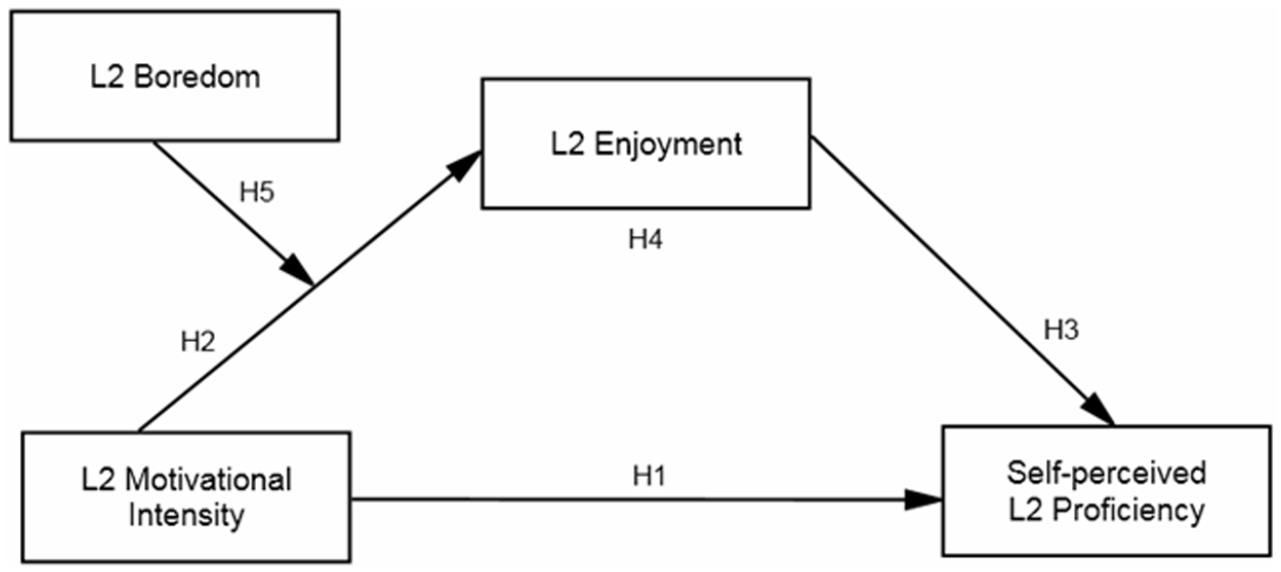
Hypothesized model.
IV Methodology
1 Participants
Due to the scattered and widespread nature of the target population, this study was conducted with a convenience sampling of 251 students from 13 elementary and secondary schools in New Zealand, including 128 (51%) males and 123 (49%) females. The participants studied Chinese as a second/L2 or foreign language/FL in North Shore, Auckland, and were aged between 10 and 20 years old (M = 12.01, SD = 2.08). Among them, 120 (47.81%) were enrolled in elementary-level classes, 83 (33.07%) attended junior high schools, and the remaining 48 (19.12%) studied in senior high schools at the time of the survey. The majority of them (n = 113, 45.02%) assessed their Chinese proficiency as intermediate level, followed by the beginner-intermediate (n = 82, 32.67%) and advanced (n = 43, 17.13%) levels. A small cohort of the respondents (n = 13, 5.18%) rated their Chinese proficiency as beginner level. The participants had been learning Chinese for more than 5 years on average, ranging from 2 to 15 years (M = 5.72, SD = 2.28). Of note, over 90% of them were Chinese-descendant students.
2 Instruments
A composite questionnaire, comprising Likert-type scales and a section seeking information about the participants (e.g. age, gender, educational background, and language background), was adapted in the present study. The questionnaire items were constructed bilingually in both Chinese and English language for better accessibility and comprehension. Two experts in the area of second language acquisition were invited to examine the face validity of the questionnaire (Creswell & Poth, 2018). Only those items endorsed by both experts were retained in the final version of the questionnaire. In this study, we adopted a 7-point response category as scale validity is maximized with 7-point options (Taherdoost, 2019, p. 5). The items of these four scales are as follows (see details in Table 1).
Result of exploratory factor analysis.
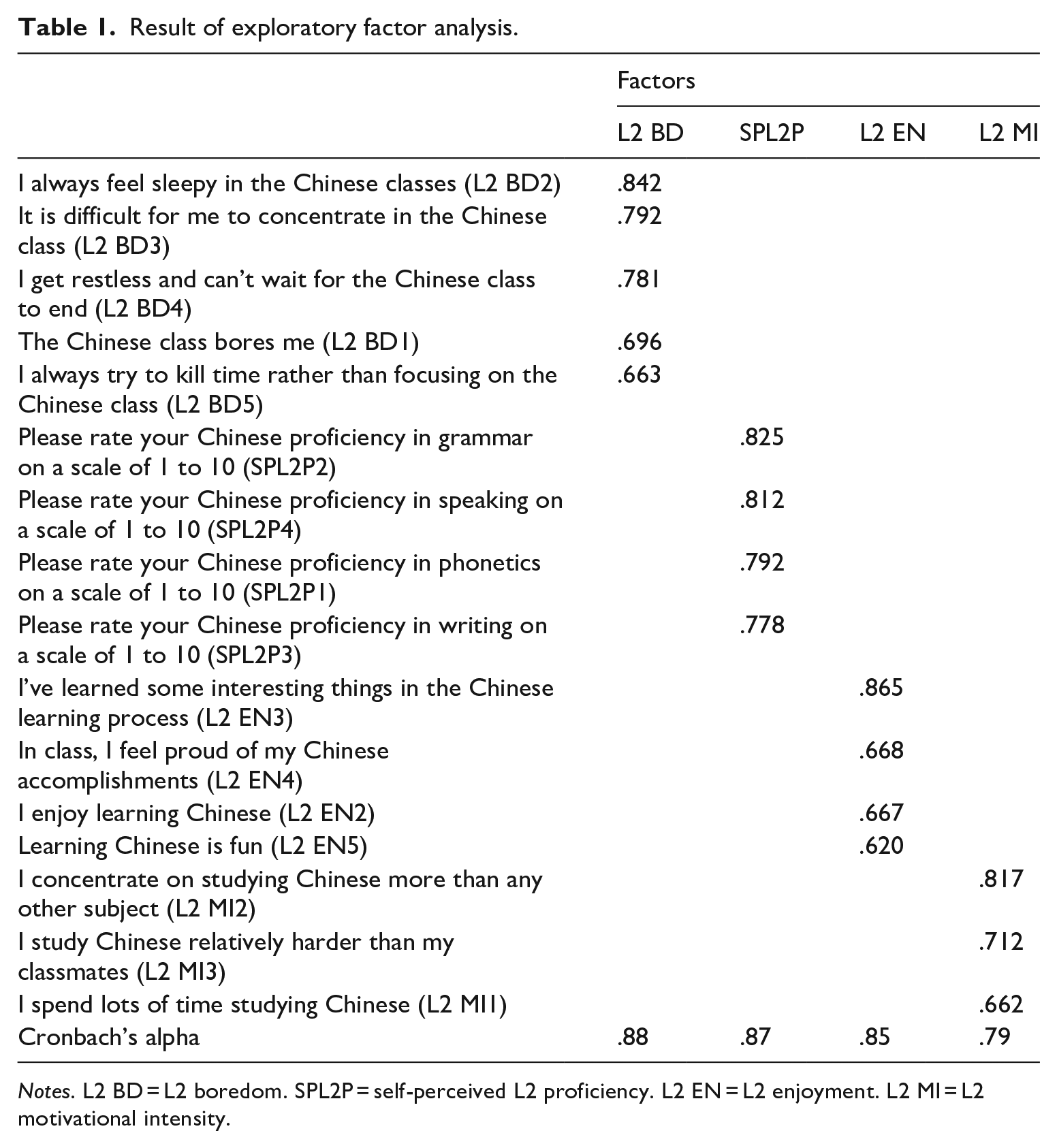
Notes. L2 BD = L2 boredom. SPL2P = self-perceived L2 proficiency. L2 EN = L2 enjoyment. L2 MI = L2 motivational intensity.
a L2 motivational intensity scale
The student’s motivational intensity in learning the Chinese language was measured by a scale comprising five items adapted from Feng and Papi (2020) and Yashima (2002). All the items were rated on a scale of 1, totally not like me, to 7, totally like me. A higher score on this scale indicates a higher level of motivation in learning the L2.
b L2 enjoyment scale
The L2 enjoyment scale consisted of 5 items, which were developed by Li et al. (2018). It measured the students’ level of enjoyment in learning an L2 on a scale of 1, strongly disagree, to 7, strongly agree. A higher score on this scale suggests that the respondent enjoys learning Chinese more.
c L2 boredom scale
Adapted from Li et al. (2023), this scale contained 5 items tapping into the affective and behavioural aspects of the negative emotion of boredom in L2 learning. The participants marked their responses on a scale from 1, strongly disagree, to 7, strongly agree, to show different levels of classroom learning boredom. A higher score on this scale reveals a higher perception of boredom in L2 learning.
d Self-perceived L2 proficiency scale
Given the wide range of schools involved in the current study and the participants’ various levels of Chinese proficiency, all the students were asked to self-evaluate their Chinese proficiency in writing, speaking, grammar, and phonetics on a scale of 1–10. In the present study, we do not consider SL2LP as an equivalent or proxy of actual L2 proficiency but rather as the subjective perception of the participants’ proficiency. The same scale has been frequently used in previous studies (e.g. Bensalem, 2018; Botes et al., 2022a; Dewaele & Li, 2022; Dewaele et al., 2008; Santos et al., 2015).
3 Procedure
Before collecting data, the study was submitted to the Ethics Committee of the university for ethical clearance. After obtaining approval, we contacted the school principals for their agreement to participate in the present study and asked the Chinese language instructors to cooperate in administering the questionnaires. As most of the participants were under the age of 18 years, we also sent text messages to their parents for consent before conducting the survey. After that, a photocopy of the questionnaire was administered to the students during their Chinese language classes. They were informed of the research objectives and assured that their responses would be treated confidentially. All the students were willing to participate in the study and signed the consent form before responding to the questionnaire.
4 Data analysis
After collecting the questionnaires, we scrutinized them individually and found that seven (2.71%) of the 258 questionnaires had missing data. Given the sufficient sample size, these unqualified questionnaires were discarded. Consequently, 251 questionnaires were considered valid and used for further analysis.
After importing the questionnaire responses into the computer software SPSS version 25, we performed frequency analysis to identify any unusual values that could be indicative of data input errors. Following this, descriptive statistical analysis was conducted to identify the mean, standard deviation, normality, and possible outliers of the data. Then, an independent sample t-test assessed the discriminant power of the questionnaire items, evaluating whether any item was ambiguously worded or measured the same thing as the other items on the scale (Quaigrain & Arhin, 2017). Next, exploratory factor analysis (EFA) was performed to assess the psychometric properties of the questionnaire. After that, we examined the convergent and discriminant validity of the variables using the methods recommended by Fornell and Larcker (1981). After establishing all the assumptions for subsequent analysis, we investigated the hypotheses using the computer software PROCESS macro version 4.1 with bootstrapping technique, as this software is one of the most effective programs in testing mediation, moderation, and moderated mediation (Hayes, 2022).
V Results
Before addressing the target research questions, we carried out a series of preliminary data analyses. Given that the questionnaire was developed based on different studies, normal tests were performed to assess the suitability of the EFA. Results indicated that the skewness (−.980 – .762) and kurtosis (−1.074 – .284) of all the items were within the recommended levels in the literature (George & Mallery, 2020). Bartlett’s test of sphericity was statistically significant (χ2 = 2283.39, p < .001), and the Kaiser-Meyer-Olkin (KMO) value was .91, indicating the necessity of EFA for the questionnaire items. Then EFA was performed with principal component factoring (PCF) analysis and varimax rotation based on the fixed number (4) of factors. Items with factor loadings less than .60 or cross-loading more than .40 were removed.
As reported in Table 1, the EFA identified 4 factors for the questionnaire items, interpreting 70.71% of the total variance. The four extracted factors included L2 boredom (α = .88), SPL2P (α = .87), L2 enjoyment (α = .85), and L2 motivational intensity (α = .79). This result aligned well with the factors initially designed in this questionnaire (Hair et al., 2019).
Although L2 motivational intensity Item 5 had a factor loading above .60, it was discarded due to displacement. Additionally, L2 enjoyment Item 1 and L2 motivational intensity Item 4 were removed due to factor loading less than .60 (Hair et al., 2019). As shown in Table 1, the Cronbach α of all the factors was greater than .70, suggesting good internal consistency of the items within each factor (Hair et al., 2019).
After examining the EFA, we evaluated the convergent and discriminant validity of the variables following the approach recommended by Hair et al. (2019). As shown in Table 2, the results of the confirmatory factor analysis (CFA) showed that the composite reliabilities (CR) of the variables ranged between .785 and .878, which was greater than the suggested level of .70. All the values of the average variance extracted (AVE) of the constructs were above the meritorious level of .50, suggesting good convergent validity of all the variables.
Convergent and discriminant validity of the constructs.
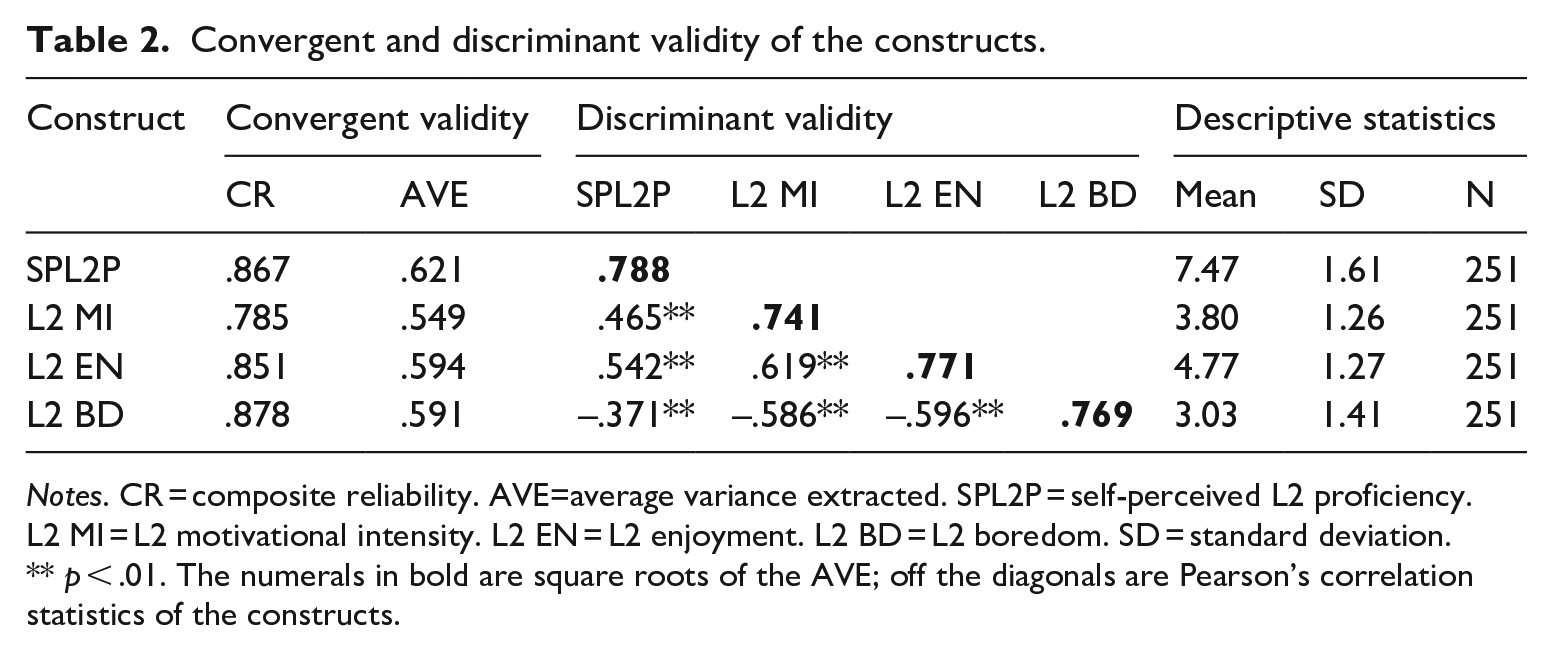
Notes. CR = composite reliability. AVE=average variance extracted. SPL2P = self-perceived L2 proficiency. L2 MI = L2 motivational intensity. L2 EN = L2 enjoyment. L2 BD = L2 boredom. SD = standard deviation.
p < .01. The numerals in bold are square roots of the AVE; off the diagonals are Pearson’s correlation statistics of the constructs.
The discriminant validity of the variables was assessed following the approach recommended by Fornell and Larcker (1981). The results indicated that the square roots of AVE were all bigger than their corresponding Pearson’s correlation coefficients (Table 2), suggesting that all the variables had excellent discriminant validity (Hair et al., 2019).
The correlations between the variables were also evaluated. The results indicated that the students’ SPL2P was positively correlated with their L2 motivational intensity (r = .465, p < .01) and L2 enjoyment (r = .542, p < .01), and L2 motivational intensity was positively correlated with L2 enjoyment (r = .649, p < .01). In contrast, L2 boredom was negatively associated with SPL2P (r = −.371, p < .01), L2 motivational intensity (r = −.586, p < .01), and L2 enjoyment (r = −.596, p < .01). The following sections show the results of the four research questions of the current study.
1 General profile of the students’ responses
Descriptive statistical analysis indicated that over half of the students had a moderate–high level of L2 enjoyment (n = 132, 52.59%) and SPL2P (n = 165, 65.74%). Of the others, 76 (30.28%) demonstrated a low level of L2 enjoyment, and the remaining 43 (17.13%) reported a high level. Similarly, 54 (21.51%) rated their SPL2P as low or low–moderate, and 32 (12.75%) rated their proficiency as high. By contrast, more than half of the participants reported low or low–moderate levels of L2 motivational intensity (n = 158, 62.95%) and L2 boredom (n = 192, 76.49%). Finally, 93 (37.05%) participants rated their L2 motivational intensity to be moderate–high or high, and 59 (23.51%) categorized their L2 boredom as moderate–high or high. These results answered the first research question.
Another finding from descriptive statistical analysis was that the number of the students who reported moderate–high and high levels of L2 boredom was much smaller than the number of those who reported moderate–high and high levels on the other three scales. This implies that L2 boredom may be in divergent correlation with L2 enjoyment, L2 motivational intensity, and SPL2P.
To understand whether there were significantly different ratings on SPL2P, we analysed the responses of different cohorts of participants. As shown in Table 3, the mean score of the elementary group (7.57) was slightly higher than that of the secondary group (7.38). However, the difference between the two groups was not statistically significant (p = .349), suggesting that the ratings of these two groups on SPL2P were not virtually different. A similar pattern was found in the male and female groups. Although the mean score of the female group (7.59) was a bit higher than that of the male group (7.35), the difference did not reach a significant level (p = .247).
Statistics of the self-perceived second language (L2) proficiency by different groups.
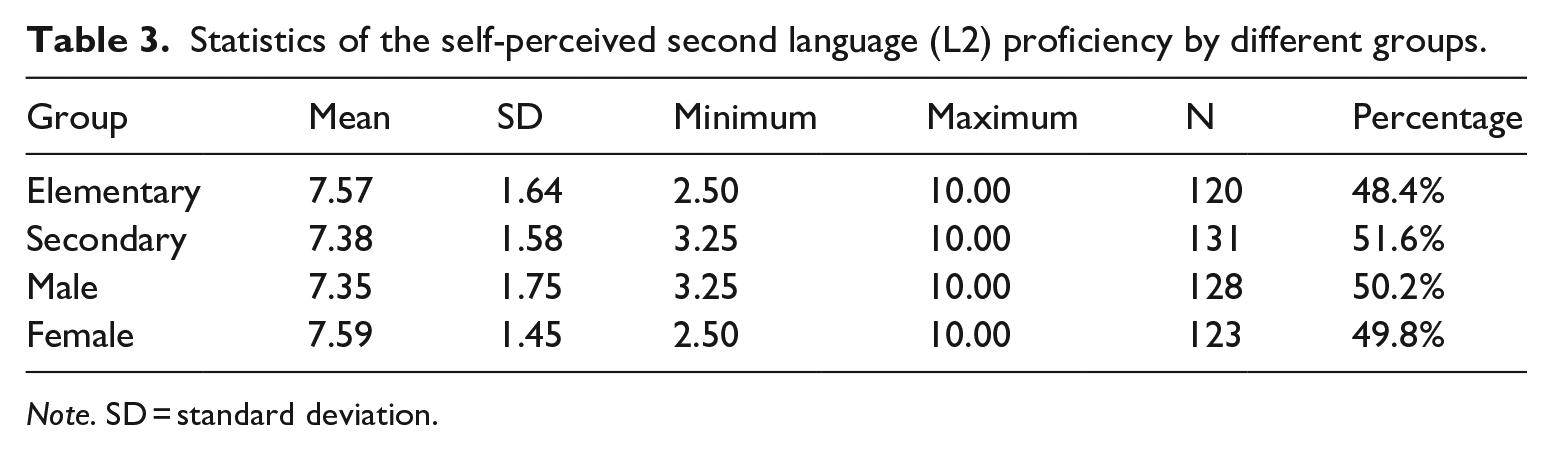
Note. SD = standard deviation.
2 The relationship between L2 motivational intensity and SPL2P
After all the assumptions for statistical analysis were established, we examined the hypotheses with the software PROCESS macro version 4.1 (Hayes, 2022) with bootstrapping samples. As shown in Table 4, the direct effect of L2 motivational intensity on SPL2P was statistically significant (β = .269, p < .01; 95% CI = .101–.437). Therefore, hypothesis 1 was supported. In other words, the students’ L2 motivational intensity was positively associated with their SPL2P. This finding provided the answer to research question 2.
Results of mediation.
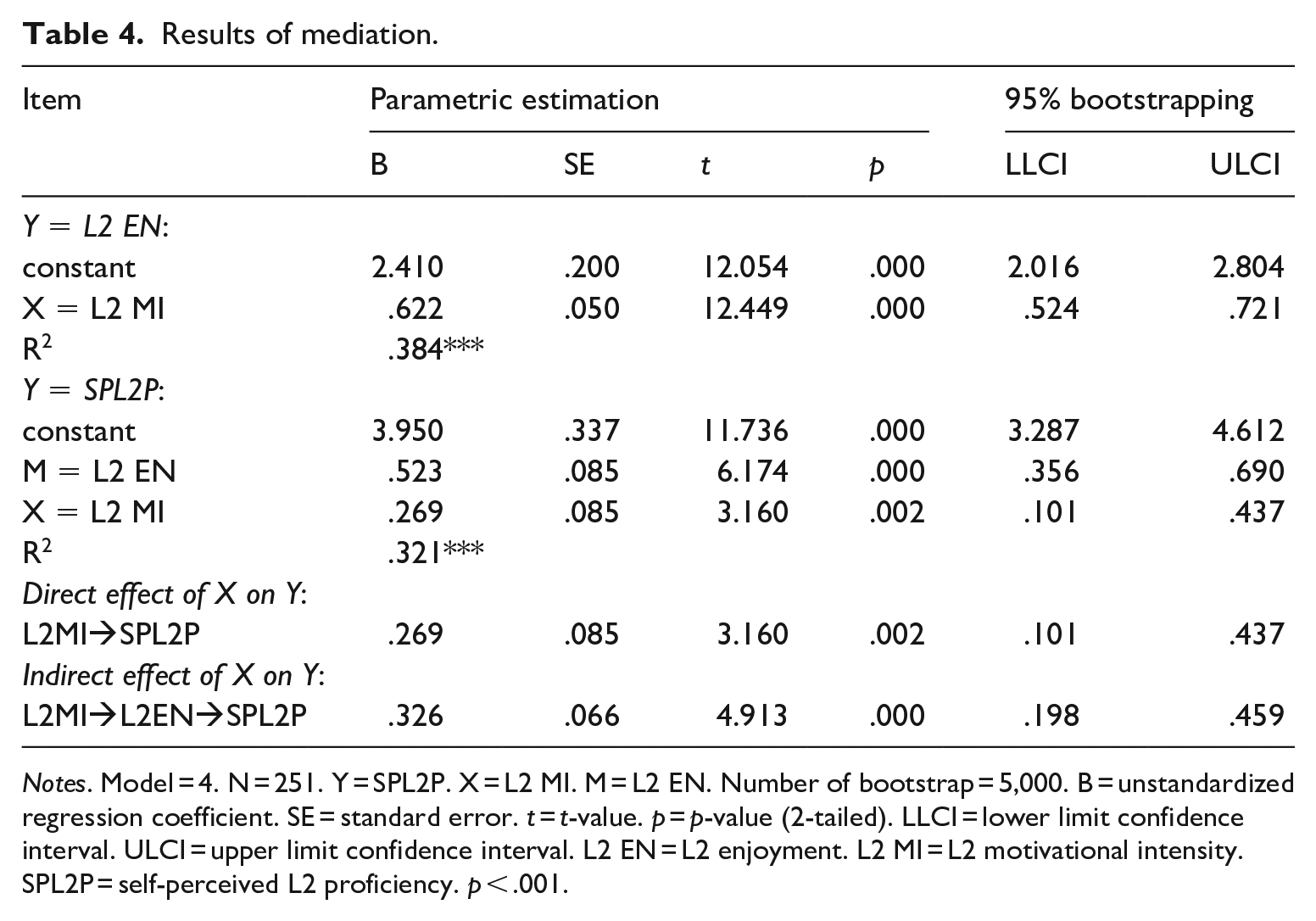
Notes. Model = 4. N = 251. Y = SPL2P. X = L2 MI. M = L2 EN. Number of bootstrap = 5,000. B = unstandardized regression coefficient. SE = standard error. t = t-value. p = p-value (2-tailed). LLCI = lower limit confidence interval. ULCI = upper limit confidence interval. L2 EN = L2 enjoyment. L2 MI = L2 motivational intensity. SPL2P = self-perceived L2 proficiency. p < .001.
3 The relationships among L2 motivational intensity, L2 enjoyment, and SPL2P
Table 4 also showed that the paths from L2 motivational intensity to L2 enjoyment (β = .622, p < .001) and from L2 enjoyment to SPL2P (β = .523, p < .001) were significant, indicating that L2 motivational intensity was positively related to L2 enjoyment, and L2 enjoyment was positively linked to SPL2P, supporting hypothesis 2 and hypothesis 3 of research question 3a and research question 3b. Furthermore, the indirect effect of the mediated link L2MI→L2EN→SPL2P was statistically significant (β = .326, p < .001; 95% CI = .198–.459), suggesting that L2 enjoyment mediated the slope between L2 motivational intensity and SPL2P, which substantiated hypothesis 4 of research question 3c.
After finding the mediating effect of L2 enjoyment, we further examined whether it performed as a full or partial mediator; thus, the coefficient of the direct effect was observed. As the direct effect of L2 motivational intensity on SPL2P was significantly different from zero, we could conclude that L2 enjoyment functions as a partial mediator (Hayes, 2022; MacKinnon, 2008).
4 The moderated mediation effect of L2 boredom
This study also explored the moderating effect of L2 boredom on the mediated nexus L2MI→L2EN→SPL2P. Figure 2 and Table 5 show the results of the statistical analysis. As displayed in Table 5, the interaction of the product term of L2MI × L2BD on L2 enjoyment was statistically significant (β = −.066, p < .05; △R2 = .011, p < .05). This result suggested that the L2 boredom moderated the slope between the L2 motivational intensity and L2 enjoyment. Therefore, hypothesis 5 was substantiated, and the last research question was answered. Figure 3 depicts the pattern of interaction of these three variables.
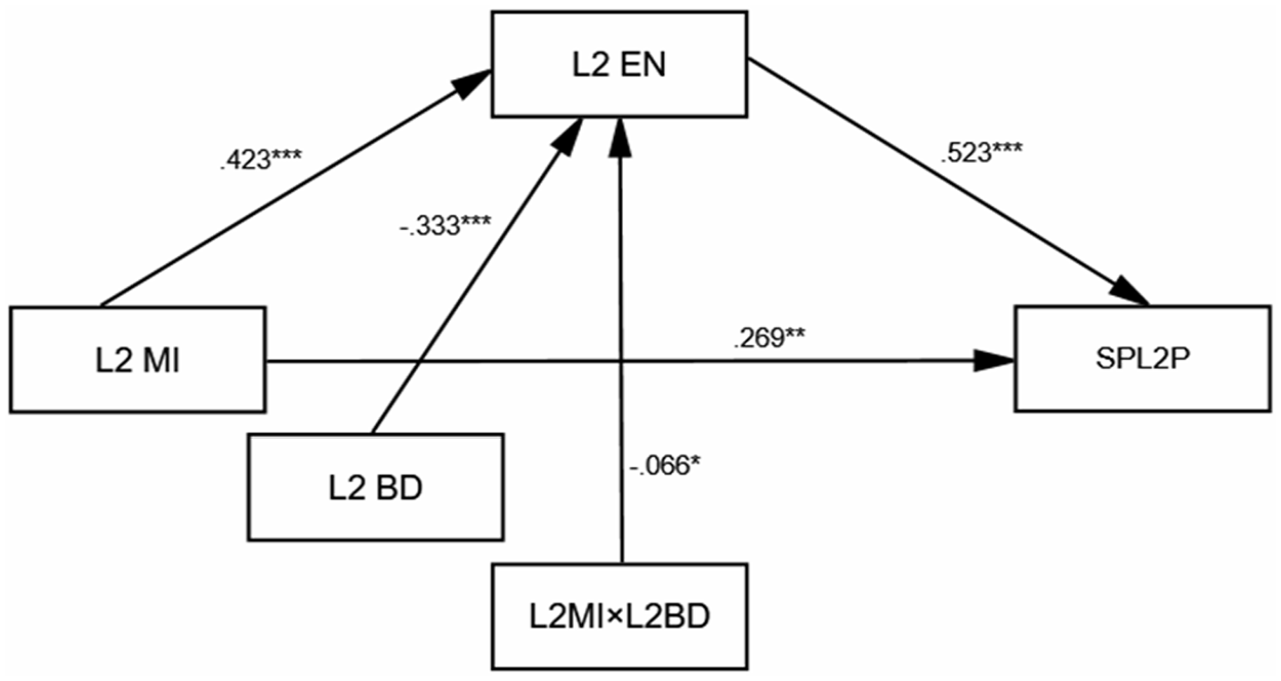
Statistical diagram of the hypothesized model.
Regression results of moderated mediation.
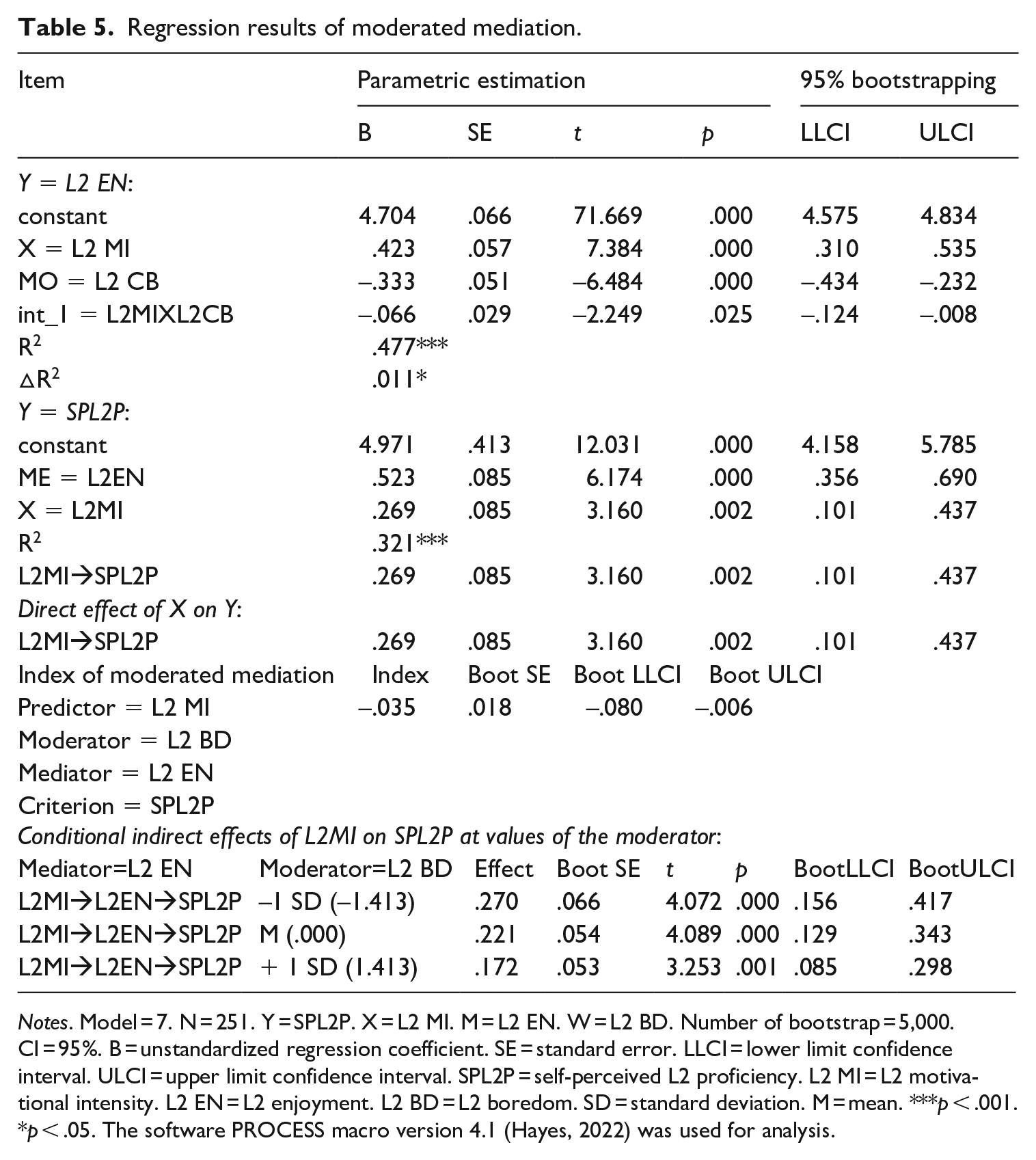
Notes. Model = 7. N = 251. Y = SPL2P. X = L2 MI. M = L2 EN. W = L2 BD. Number of bootstrap = 5,000. CI = 95%. B = unstandardized regression coefficient. SE = standard error. LLCI = lower limit confidence interval. ULCI = upper limit confidence interval. SPL2P = self-perceived L2 proficiency. L2 MI = L2 motivational intensity. L2 EN = L2 enjoyment. L2 BD = L2 boredom. SD = standard deviation. M = mean. ***p < .001. *p < .05. The software PROCESS macro version 4.1 (Hayes, 2022) was used for analysis.
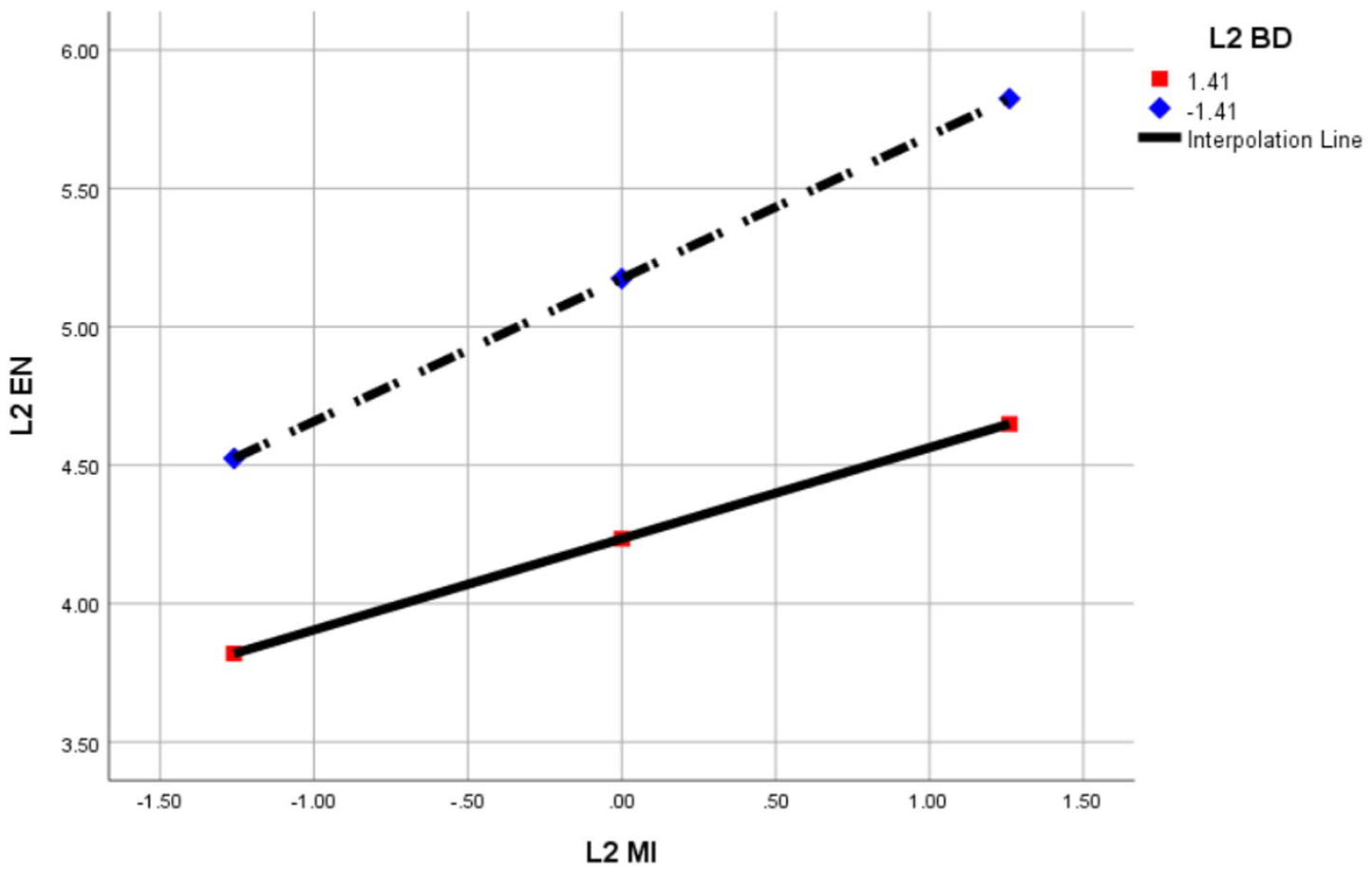
L2 BD as moderator of the association between L2 MI and L2 EN.
Another intriguing finding in the present study was that the moderating effect of L2 boredom was mediated by L2 enjoyment to the SPL2P (β = −.035, CI = −.080 to −.006). This implied that the indirect effect of the mediated link L2MI→L2EN→SPL2P was conditioned upon various levels of L2 boredom, leading to the occurrence of moderated mediation.
In order to determine the strength of the conditional indirect effects at different values of the moderator variable, further probed the mediated effect of the link L2MI→L2EN→SPL2P at three different values of the moderator variable L2 boredom: one standard deviation (SD) below the mean (−1.413), the mean (.000), and one SD above the mean (1.413). As shown in Table 5, the conditional indirect effects were significantly different from zero at the low (β = .270, p < .001; 95% CI = .156−.417), the mean (β = .221, p < .001; 95% CI = .129–.343), and the high (β = .172, p < .01; 95% CI = .085–.298) levels of the moderator variable L2 boredom. It was apparent that the strength of the mediated effect decreased along with the increasing level of L2 boredom. The following section discusses the findings.
VI Discussion and pedagogical implications
1 Students’ L2 emotion and L2 motivation intensity level
Concerning research question 1, most students reported a general tendency of a moderate–high level of enjoyment and SPL2P but a low or low–moderate level of boredom in L2 Chinese learning. The results strongly corroborated with previous empirical studies by Botes et al. (2022a), Dewaele and Proietti Ergün (2020), Liu and Wang (2021), and Liu et al. (2022), which found that language learners typically experience a higher level of FLE but a lower level of negative emotions during the language learning process. The results further expand the literature that enjoyment and boredom are twins with reverse natures that co-exist in the language learning class (Li & Wei, 2022; Zhao & Wang, 2023).
Unexpectedly, only nearly 40% of learners indicated a moderate or high level of L2 motivational intensity, which might be attributed to the uniqueness of the contexts of this study. Specifically, over 90% of the participants were Chinese New Zealanders learning Chinese in the Chinese schools and living close to the Chinese community. Thus, easy access to Chinese knowledge and resources might maximize the likelihood of feeling less motivated and challenged to learn Chinese in class.
However, it does not mean that their Chinese class was terrible. Quite the contrary, the Chinese class was well evaluated by the students. Those who reported moderate–high and high degrees of classroom boredom in L2 were substantially fewer than those who reported similar levels of enjoyment, motivation, and SPL2P. Therefore, there is no need for educators to be excessively anxious about the existence of negative emotions during the teaching process. Educators are suggestive of inspiring L2 Chinese learners’ internal and external learning motivation by implementing effective measures, for example, inspiring their inner learning zest, setting a good learning model, carrying out appropriate rewards, and assisting students in finding specific learning goals.
2 The relationship between L2 motivation intensity and SPL2P
Speaking of the path from L2 motivation to SPL2P, the findings showed that the former significantly predicted the latter; that is, motivated L2 learners were likely to evaluate their competence higher and tended to express extra confidence than their peers, which supported hypothesis 1 and answered research question 2. Previous studies by Alrabai (2022), Lan et al. (2021), Lee and Drajati (2019), Nikitina et al. (2022) and Wu et al. (2022) have found the importance of motivation in English language learning for Chinese, Indonesian, and Saudi university learners. Highly pertinent to this study, Feng and Papi (2020) found that the L2 self significantly predicted L2 WTC in the context of Chinese as FL learning. Of significant note, the discovery in the current study that motivation contributes to language learning in the Chinese L2 learning context adds to the body of literature on positive psychology with an expanded participant scope of younger language learners in the southern hemisphere.
Therefore, researchers are advised to shift focus from over-dominating English language learning to languages other than English and from the frequently featured university learners to the under-explored younger learner to obtain a fuller picture of the role of motivation in L2/FL learning.
3 The loop among L2 motivational intensity, L2 enjoyment, and SPL2P
In terms of the path analysis, the results indicated that L2 motivational intensity was a significant positive predictor of L2 enjoyment, and L2 enjoyment was a significant contributor to SPL2P, confirming hypothesis 2 and hypothesis 3. Additionally, L2 enjoyment partially mediated the relationship between L2 motivational intensity and SPL2P, supporting the mediated path: L2MI→L2EN→SPL2P in Chinese language learning (hypothesis 4). Given this, research question 3 was answered.
That is to say, students who have more incentive to learn a language are more likely to enjoy the learning process, which is in line with the finding of Teimouri (2017), as well as Dewaele and Proietti Ergün (2020) that motivation has the power to spark learners’ enjoyment and happiness in foreign language learning. Similarly, those who perceive a higher level of enjoyment in the learning progress might achieve language success, which is expectedly consistent with a great deal of prior work in different contexts. For example, Liu and Wang (2021), Liu et al. (2022), and Zhao and Wang (2023) found that enjoyment significantly predicted Chinese students’ actual or SPL2P in EFL learning. Botes et al. (2022a) identified a moderately positive association between FLE and SPL2P based on a large international sample size. This result empirically echoed the radical spirit of positive psychology to catalyse individuals’ flourishing by building their positive strength instead of merely focusing on the reduction of unfavourable ingredients (Dewaele, 2022; Fredrickson, 2001).
Therefore, language educators should pay close attention to the level of classroom enjoyment in light of its direct and indirect positive influence on language proficiency. Taking measures to create a pleasant and lively learning atmosphere in education is paramount for language success. Thus, some key pedagogical implications are offered to enrich the process of L2 Chinese learning, such as teaching with great passion and enthusiasm, frequently making a joke, always being friendly to students, selecting real-life teaching materials, embracing the IT technology to scaffold the course, adopting interesting and engaging teaching activities, and increasing the frequency of interaction (Li et al., 2018).
4 The moderating role of L2 boredom
Findings from the present study also highlight the moderating and hampering effect of boredom on L2 Chinese learning. On the one hand, L2 boredom negatively moderated the relationship between L2 motivational intensity and L2 enjoyment, which supported hypothesis 5 and answered the last research question. In other words, increasing L2 boredom will weaken the positive association between L2 motivational intensity and L2 enjoyment. Some previous studies have documented the destructive effect of boredom on motivated behaviour, language learning competence, and enjoyment in English language learning (Alrabai, 2022; Pawlak et al., 2022). Conceptually, boredom is a negative and deactivating emotion (Pekrun, 2006) that may trigger a series of aversive behaviours, for instance, frequent fatigue, insufficient attention, and indifferent attitudes towards learning activities in L2 learning (Li et al., 2023; Li & Wei, 2022). Thus, the perception of boredom may impair L2 learning motivation and further decrease the L2 learners’ enjoyment experience.
On the other hand, boredom also exerted an indirect effect on SPL2P through the mediation of L2 enjoyment in the model, with the mediated path L2MI→L2EN→SPL2P fluctuating with various levels of boredom. In fact, as a multifaceted unconstructive emotion in language learning (Pekrun, 2006), boredom has been recognized as having a negative association with enjoyment and actual and SPL2P (Li & Han, 2022) in the EFL learning context. However, in the present study, such a direct/indirect downside function of boredom has first been explored in a complex moderated mediation model, particularly in the L2 Chinese learning context. Theoretically, this finding echoed the counteract relationship between boredom and enjoyment and the merit of emotions from different valence on Chinese language achievement. To ward off the harmful consequences of boredom in language education, educators are suggested to boost students’ classroom engagement, create a harmonious learning atmosphere, increase the frequency of classroom interaction, and, most importantly, elevate the enjoyment level to dissimilate negative emotions.
Taken together, the empirical results of this study have validated and extended the broaden-and-build theory (Fredrickson, 2001) and the control-value theory (Pekrun, 2006) in the Chinese language sphere as the debilitative and facilitative roles of boredom and enjoyment in academic learning. Moreover, grounded on the EMPATHICS model, which was built to catalyse the prosperity of learners’ language education (Oxford, 2016), this study validated and broadened its utility in the scope of Chinese learning by confirming the integrative roles of emotion and motivation for L2 Chinese learners. We expect that this study could serve to attract more attention to the commonly experienced but under-explored noncognitive factors in English and languages other than English to boost classroom success and the growth of positive psychology.
VII Conclusions and limitations
This study is an initial attempt to provide quantitative results surrounding the complex correlation between boredom, enjoyment, motivational intensity, and SPL2P in an L2 moderated mediation model. L2 Chinese learners of the current study revealed an intricate emotion pattern, as most of them reported a higher level of L2 enjoyment and SPL2P but a lower level of L2 boredom and learning motivation. L2 motivational intensity and L2 enjoyment were identified as direct and significant predictors of language proficiency; additionally, L2 motivational intensity also indirectly influenced language proficiency under the mediation of L2 enjoyment. Of note, L2 boredom moderated the association between L2 motivational intensity and L2 enjoyment and thus further influenced SPL2P. Therefore, focusing on and further exploring students’ diverse emotions in the language experience will positively impact students’ language achievement.
Despite the fact that our study provided a fuller picture of the possible function of emotions in L2 learning, we are aware of several restrictions that might confine its generalization. First, although we adopted the same scale used previously (Bensalem, 2018; Dewaele et al., 2008; Santos et al., 2015), it may still lead to measurement error due to the bias of the subjective evaluation. Therefore, it may be more accurate and fruitful for future research to explore the complex relationship between emotion, motivation, and actual L2 Chinese learning proficiency across different contexts. Second, to mitigate the weakness of this pure quantitative research, future studies are advised to embrace a mixed-methods or qualitative study to gain an in-depth understanding of the reasons and antecedents of enjoyment and boredom underneath the data, which may provide more practical and tailored pedagogical suggestions for L2 practitioners. Third, emotions might dynamically change during language learning, but the cross-sectional data have a weakness when examining the growth and changes over time. Therefore, it would be more interesting if future researchers could conduct a longitudinal study, specifically adopting latent growth curve modelling, to investigate the endurability of emotions in language education and move the field forward (Dewaele, 2022; Li & Han, 2022).
Footnotes
Acknowledgements
We would like to thank the editors of Language Teaching Research, Hossein Nassaji and Maria del Pilar Garcia Mayo, and the two anonymous reviewers for their precious time and constructive suggestions for this manuscript. We also thank the participants of this study.
Ethical Consideration
This project was endorsed by the Minzu University of China (ethical number ECMUC2022007CO).
Funding
The author(s) disclosed receipt of the following financial support for the research, authorship, and/or publication of this article: This study was supported by the National Social Science Foundation of China (grant number 22BYY162).
