







Abstract
This study investigates the engagement of young people in foreign language learning. Specifically, engagement is defined as a metaconstruct consisting of the following components: cognitive, emotional, and social. An attempt was made to quantify these individual engagement components within task-based and communicative-oriented lessons. We employed electrocardiographic and accelerometric measurements to monitor learners’ physiological responses to engagement during regular German classes. The second part of the project was a questionnaire-based study measuring the subjective opinions of learners about their engagement. The results of the research support the adoption of a task-based approach. We observed the highest level of engagement during productive tasks, which can serve as a rationale for teachers to increase the number of productive tasks compared to receptive ones. Moreover, including the peer-learning component in the activities appeared to be of considerable importance due to its role in building intrinsic motivation to learn and in stimulating the growth of social competences.
Keywords
I Introduction
Learner engagement has been paid significant attention in recent years as a potential predictor of achievement (Dotterer & Lowe, 2011; Fredricks et al., 2004, 2019). Determining which foreign language teaching method triggers the most learner engagement is crucial for teachers when making instructional decisions. This study investigates learner engagement within the context of two methods: the task-based approach and the communicative approach.
There are many models by which engagement is defined. We adopt Fredricks et al.’s (2004) definition that learner engagement is a metaconstruct encompassing social, emotional, and cognitive components. Recognizing that these components are interdependent and interconnected, this study investigates them concurrently, as isolated examination may not provide a comprehensive understanding. While research on foreign language learner engagement exists, most studies have focused on quantitative, qualitative, mixed, and cross-sectional designs (Hiver et al., 2021). These investigations have primarily measured, for example, total counts of talk or interaction (Bygate & Samuda, 2009; Dörnyei & Kormos, 2000) or explored the quality of involvement in task-related behaviour (Henry & Thorsen, 2018; Lambert et al., 2017). Notably, limited works have examined engagement in a foreign language lesson (Sulis & Philp, 2021), particularly regarding teaching methods. A gap can also be seen in experimental research recording real-time engagement during the language learning process.
This study aims to provide insight into short-term changes in learner engagement by employing a physiological approach. While outward expressions (such as listening to each other, talking to each other in a foreign language, and participating in some activity) may stem from engagement, they do not always indicate genuine learning involvement and may remain unrelated to the learning process. Conversely, cognitive engagement without external manifestations may go unnoticed through on-site observations but can be detected by physiological monitoring. Therefore, we employed electrocardiography (ECG) to record learners’ heart rate (HR), which may serve as an indirect but objective measure of engagement. ECG enables the assessment of the body’s response to an ongoing situation, thus capturing engagement even in the absence of external signs (Ladino Nocua et al., 2021; Myrtek, 2004). Its objectivity stems from the fact that the heart rate and its variations are beyond the students’ conscious control. Biosignal measurements may complement the subjective opinions obtained through questionnaires, an instrument commonly used in engagement research, to reinforce the evaluation of foreign language learners’ involvement. Furthermore, while existing studies that employed physiological measurements dealt with recording engagement in various contexts, they have not specifically examined in-person language learning settings considering the teaching methods. We include this essential factor to complete the context and provide practising teachers and researchers with information about the emergence of engagement with respect to the chosen method.
Therefore, the primary objective of this study was to record and evaluate learner engagement in real-world classes in both task-based and communicative approaches, taking into account its three dimensions: cognitive, emotional, and social. To quantify engagement, we employed both heart rate measurements using ECG and a questionnaire-based approach. A research hypothesis has been formulated with regard to the presented context: in a task-based lesson, learners are more emotionally, socially, and cognitively involved than in a communication-oriented lesson.
II Literature review
1 Defining engagement in the language classroom
Engagement is considered in four contexts: in relation to school, classroom, pro-social institutions, and the learning process (Skinner & Pitzer, 2012). Engagement can therefore be triggered by the person, the topic, the situation, and the activity within the task. It is also a highly dynamic construct that corresponds with time, as it can be shown from moment to moment as task engagement (Philp & Duchesne, 2016; Platt & Brooks, 2002) or, in the longer term, as a process-oriented concept (Sang & Hiver, 2021). Perhaps, owing to its dynamics, it has been dubbed ‘energy in action’ (Ainley, 2012; Skinner & Pitzer, 2012). Some researchers highlight how context influences the individual needs to increase engagement (Connell, 1990; Skinner & Belmont, 1993), while others examine the impact of classroom interactions and tasks performed to improve learner engagement (Newmann, 1992; Newmann et al., 1992). In Newmann’s (1992) model, engagement is understood as the learner’s mental contributions and efforts to understand and master knowledge, a skill, or a profession; in other words, engagement reflects what learners do, think, feel, and how they interact with each other to achieve their goal (Fredricks et al., 2004). Reschly and Christenson (2012) define learner engagement as a multidimensional construct involving emotional, social, and cognitive aspects. They see it as a facilitator between the environmental influence and the goals that the student is pursuing, emotional, social, and academic alike. In contrast, Fredricks et al. (2004) define engagement as a metaconstruct, encompassing behavioural, emotional, and cognitive engagement.
Engagement is considered in conjunction with other positive variables, such as self-efficacy (Schunk & Mullen, 2012), emotion (Pekrun & Linnenbrink-Garcia, 2012), interest (Ainley, 2012) or flourishing (Reschly et al., 2008) and flow as high-quality engagement (Czikszentmihalyi, 1996).
In the context of language learning and teaching, Hiver et al. (2021) define engagement as a dynamic, multidimensional construct encompassing the notion of cognition, affect, and behaviour concerning social interactions of which action is a necessary component.
Cognitive engagement refers to the amount of energy a learner has to expend in order to understand complex ideas (Finn & Zimmer, 2012). Helme and Clarke (2001) define it as sustaining attention and intellectual effort. Behaviours in the foreign language classroom that indicate cognitive engagement include: asking questions in order to understand ideas, not giving up when difficulties arise while solving tasks, reading more than the school requirements, reviewing and recalling the previously developed material, and studying additional information resources. Cognitive engagement also includes the use of cognitive strategies to facilitate the mastery of the material (Philp & Duchesne, 2016). In the context of language learning, cognitive engagement is reflected in the phrases: I think . . ., because . . ., and in posing questions (Philp & Duchesne, 2016).
Emotional engagement refers to the emotional response in the context of school as a place where students acquire knowledge. It encompasses different emotional reactions, e.g. interest, joy, boredom, fear, sadness, etc. In relation to the classroom and tasks, Skinner et al. (2009) identified enthusiasm, interest, and joy as key indicators of emotional engagement. At the other end of the scale, they placed anxiety, frustration, and boredom as indicators of negative emotional engagement. According to Philp and Duchesne (2016), engagement can also include the learner’s relationship with their co-learners, in particular partners, during group work and interlocutor language tasks. Positive emotional engagement with teachers, the school, and co-learners has a significant impact on the willingness to learn (Fredricks et al., 2004). Early and Marshall (2008, p. 388) noted that, for the most part, group work also had a strong affective component and led to task engagement.
Behavioural engagement refers to the learner’s participation in classroom and school activities and the time invested in the activity (Reschly & Christenson, 2012). Some researchers define it as adherence to written and unwritten school rules and not displaying unsocial behaviour (Finn, 1993; Finn & Rock, 1997). This definition overlaps with the definition of social engagement according to Finn and Zimmer (2012), who also refer to written and unwritten rules and avoidance of socially unacceptable behaviour. Others see behavioural engagement as involvement in learning and task performance, i.e. it includes activities such as making an effort, perseverance, concentration, attention, and questioning (Finn et al., 1995). The above activities also overlap with activities characteristic of cognitive engagement, as Philp and Duchesne (2016) emphasize by defining this behavioural engagement as being on task. Therefore, in our study, we decided to focus only on emotional, cognitive, and social engagement due to the specific conditions in the course of foreign language learning, as discussed by A. Svalberg (2009), who emphasized the important role of the co-learner, group, student–teacher relationship and interaction. In foreign language learning, this social nature of engagement is one of the most important factors for success. A. Svalberg (2009) paid particular attention to the social dimension of the foreign language learning process, referring to the interaction between learners and their active participation, e.g. producing dialogues in the foreign language. The emphasis on social engagement as opposed to behavioural engagement is specific to language learning engagement and, to a large extent, reflects the specificity of the language learning process (Hiver et al., 2020). Therefore, social engagement is the third component of engagement considered in our study.
In the field of language research, Svalberg was the first to define the concepts of engagement in the context of language learning by referring to engagement with language. The researcher defines engagement as a cognitive, affective, and/or social process in which the learner is the agent and language is the object (sometimes the tool) (A. Svalberg, 2009). The learner is engaged cognitively when they are attentive and construct knowledge; emotionally when they are positively disposed towards the language and its representatives; and socially when they are oriented towards interacting and taking the initiative (A. Svalberg, 2009).
Engagement in the foreign language classroom is expressed, according to Oga-Baldwin (2019), in attentive reading and listening to texts, memorizing vocabulary and grammatical structures, writing correct texts, and actively conversing with the co-learner. Many researchers consider social engagement a priority component of learner engagement in a foreign language (Philp & Duchesne, 2016; A. Svalberg, 2009). A growing number of researchers (Moranski & Toth, 2016; Sato & Ballinger, 2012; Storch, 2008; Toth et al., 2013) suggest that learners are likely to learn a foreign language more effectively when they are socially engaged: that is, when they listen to each other, draw on each other’s knowledge and ideas, and provide feedback. Engaged students receive better grades and perform better on tests (Fredricks et al., 2004). The aforementioned components make up learner engagement, but they cannot really be separated.
2 Task-based and communicative approaches in foreign language learning and teaching
We aim to contrast task-based and communicative approaches to language teaching and learning, thus contributing to the discussion among didacticians about their effectiveness. In our study, this contrast refers to the comparison of learner engagement in lessons in both approaches.
The communicative approach is currently the dominant method of foreign language teaching in educational institutions in Poland. The main goal of this approach is to develop the learner’s communicative competence (Dörnyei, 2009, p. 33). The PPP lesson model (presentation, practice, production) is its typical example. It first shows the target language forms, this is followed by the second phase involving practice, and then the forms are applied during the third phase (Willis, 1996). The purpose of the PPP lesson model is to familiarize the learner with new language structures and to apply them in practice, which is often limited to performing receptive and half-productive language exercises.
The task-based approach in foreign language learning is seen as the next step in the development of communication methods or even as an extension of the communicative approach (Janowska, 2011). One of its features is social learning, defined as the integration of communication and social activities in a foreign language (Barrot, 2017; Van den Branden, 2006). In this way, the differences between learning activities and using a language become blurred in the minds of learners (Janowska, 2011). The aim of task-based learning is not to receive and communicate information, as is the case with the communicative approach, but to work together in a group, where language is both a means of communication and an instrument of action enabling the pursuit of a common goal expressed in a foreign language.
The main problem while implementing the communicative method in institutional teaching is withdrawal from the conversation, i.e. language production, due to the tight syllabus and time limitations. Communicative approaches assume that everyone follows the same course of thought and learns at the same pace based on the teacher’s instructions. In contrast to this concept, the task-based approach is characterized by constructivism. It is not the teacher who conveys knowledge, but the learners themselves who construct an understanding of what they are to learn in their minds, at their own pace, and according to their individual abilities. The main focus of this approach is communication in a foreign language and action. Learners are given a language task or tasks to work on in pairs or groups, and the results of these tasks are presented at the end of the lesson. This approach stands out because of the active role of the learner, who takes the initiative and responsibility for the learning process and gains many more opportunities to use the language freely. Teachers act as facilitators during the whole lesson (Van den Branden, 2016).
Researchers contrast the two approaches to deliver a method that is more effective and more engaging for the learners (Manta, 2013). Research confirms significant development of communicative competence following the deployment of a task-based approach (Ahmed, 2020; Aliakbari & Jamalvandi, 2010). However, most studies are concerned with the analysis and implementation of the task-based approach (Al Asmari, 2015; Carless, 2003; Dörnyei, 2009; Dos Santos, 2020; Ju, 2013; Sholeh, 2020; Zheng & Borg, 2014), while few are comparing the effects of the two methods (A. M. Svalberg, 2021).
3 Heart rate as a measure of engagement
Attempts to conclude about learning processes using heart rate (HR) and derived parameters may be found in the literature. Myrtek (2004) states that any emotional engagement is accompanied by an increased heart rate. Mayer (2011) examined the emotional involvement of the students during school and leisure time, observing an HR increase (with correction taking into account physical activity) during co-studying in pairs. Wagner (2012) examined the effects of emotional, cognitive, and behavioural involvement on the heart rate of learners. Ladino Nocua et al. (2021) found a significant difference in heart rate during active learning: the HR increased when the student engaged and made a mental effort and decreased in an immersive environment when the student got focused on the activity. Darnell and Krieg (2019) used HR and its fluctuations for the assessment of students’ attention, showing the tendency of HR to rise during periods of active learning. In a review of engagement metrics, Castiblanco Jimenez et al. (2022) stated that a person’s engagement depends on the variation of the HR with respect to the baseline, even though no numerical scale exists to classify engagement based on such a measurement. Senthil and Wong (2017) measured students’ engagement using wireless pulse sensors and found that the changes in HR during the lecture course constitute patterns that correlate with the learners’ academic performance.
III Materials and methods
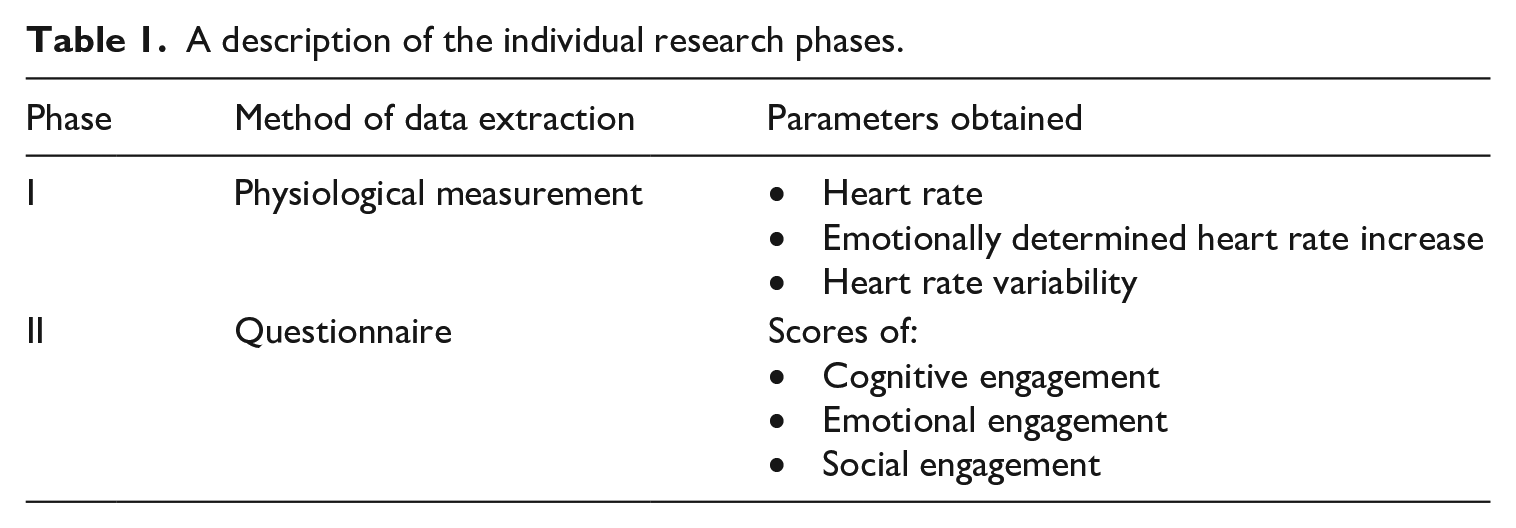
The first phase of our study included obtaining the following physiological measures: heart rate (HR), emotionally determined heart rate increase, and heart rate variability (HRV). These parameters formed the basis for our conclusions about learners’ engagement. In the second phase, a quantitative study was conducted in the form of a questionnaire to determine cognitive, emotional, and social engagement. A description of the individual research phases and the parameters obtained is presented in Table 1.
A description of the individual research phases.
1 Physiological measurements
The heart rate is an indicator of autonomic nervous system activity. Increased workloads, both mental and physical, are accompanied by an HR increase. Therefore, this parameter and its derivatives may be considered suitable for the assessment of engagement (Castiblanco Jimenez et al., 2022; Darnell & Krieg, 2019; Fahrenberg, 2001; Fahrenberg & Myrtek, 2001, 2005; Ladino Nocua et al., 2021; Scrimin et al., 2018). HR depends on physical activity, thermoregulation, breathing, emotions, and cognitive load (Wagner, 2012). An increased HR accompanies almost all emotions (except disgust), including cognitive activity, psychosocial stress, thirst and hunger, physical activity, movement and changes in body position, physical changes in the environment (e.g. changes in ambient temperature), and symptoms of diseases (e.g. fever, blood loss, arrhythmia, anaemia, hyperthyroidism) (Myrtek, 2004). In this study, HR has been measured with ECG, employing a procedure previously used to assess engagement (Eilers, 1999; Fahrenberg, 2001; Fahrenberg & Myrtek, 2001; Fahrenberg et al., 1979; Myrtek, 2004; Myrtek et al., 2001). It should be noted that other non-invasive techniques for acquiring HR, such as photoplethysmography (Scrimin et al., 2018), could be introduced as well.
Non-metabolic increase in HR, i.e. not caused by physical activity, has been called the additional heart rate (AHR) or an emotionally determined heart rate increase (Fahrenberg, 2001; Fahrenberg & Myrtek, 2001, 2005; Myrtek, 2004; Myrtek et al., 2001). According to Bohn (2012), its rise accompanies cognitive and/or emotional engagement. Studies by Myrtek et al. (2005) and Wagner (2012) showed correlations between emotion and heart. The AHR calculation is a part of the Freiburger Monitoring System (FMS) method (Myrtek & Foerster, 2003; Myrtek et al., 2001). FMS permits the recording of physiological, psychological, and behavioural data in ambulatory conditions. The details of the AHR calculation were derived from studies by Streb et al. (2015) and Brouwer et al. (2018). The referenced method requires two accelerometric measurements of physical activity with two acceleration sensors: the first placed near the participant’s sternum and the second on the thigh above the knee. In our study, the learners’ activity was only measured in the sternum area. The thigh measurement was assumed to be zero because the students remained seated during lessons of both types, and their thighs were immobile.
The HR variations that reflect the heart’s ability to adapt to rapid changes in physical effort are called heart rate variability (HRV) (Bohn, 2012). A large increase in HRV reflects cognitive engagement, while a medium increase in HRV is a sign of relaxation. A decreasing HRV indicates fatigue (Wagner, 2012). One of the possible HRV metrics is an Mean square of the successive differences (MQSD) parameter (Myrtek & Foerster, 2003; Myrtek et al., 2001). MQSD is equal to the mean square root of successive differences between instantaneous HRs (Momentanfrequenzen, MF). The parameter is determined according to the following equation:
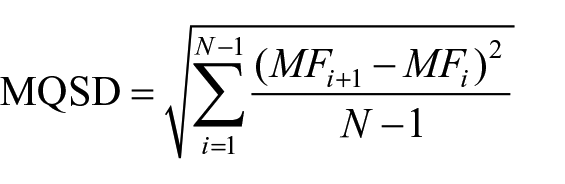
where: MF i+1 , MF i are the instantaneous heart rates (beats per minute or bpm), calculated for the subsequent R–R intervals from the ECG signal, i+1-th and i-th, respectively; the MF i is equal to 60/TR–Ri (TR–Ri – i-th R–R interval, in seconds); and N is the number of R–R intervals in the analysed segment.
In this study, biomedical measurements were introduced to provide parameters affected by the learners’ engagement, including AHR, which quantifies the emotionally induced heart rate increase, and MQSD, a heart rate variability metric. All ECG and accelerometric recordings were made using portable ekgMove sensors (movisens GmBH, Germany). During the examination, a sensor was attached to the learner’s chest by means of a belt with dry electrodes. The sensor was handled with the use of SensorManager and UnisensViewer software (movisens GmBH, Germany). The acquired data were processed and analysed in LabVIEW 2018 (National Instruments, USA) and R environment, base version 3.4.4 (R Foundation for Statistical Computing, Austria). The data preprocessing included removing the ECG segments with significant noise interference or other artefacts (e.g. apparent problems with the electrode contact), which usually occurred during the first five minutes of the recording. Heartbeats (specifically R peaks) in the ECG signal were detected by means of a method described by Benitez et al. (2000). All detections were subsequently verified manually and corrected if obvious errors were identified.
We followed the conclusions from the study by Wagner (2012), who found that hand movement did not increase the pulse rate and that the HR recording should not be started immediately after fitting the measuring device, particularly with a first-time participant, as the learner needs to become accustomed to the experiment setting. Therefore, to minimize the impact of physical activity on HR, we chose to seat students while allowing them to move their hands. To suppress the effect of the disturbances in the initial data on the results, we did not include the measurements from the first 5 minutes of a lesson.
2 A quantitative survey of learner engagement
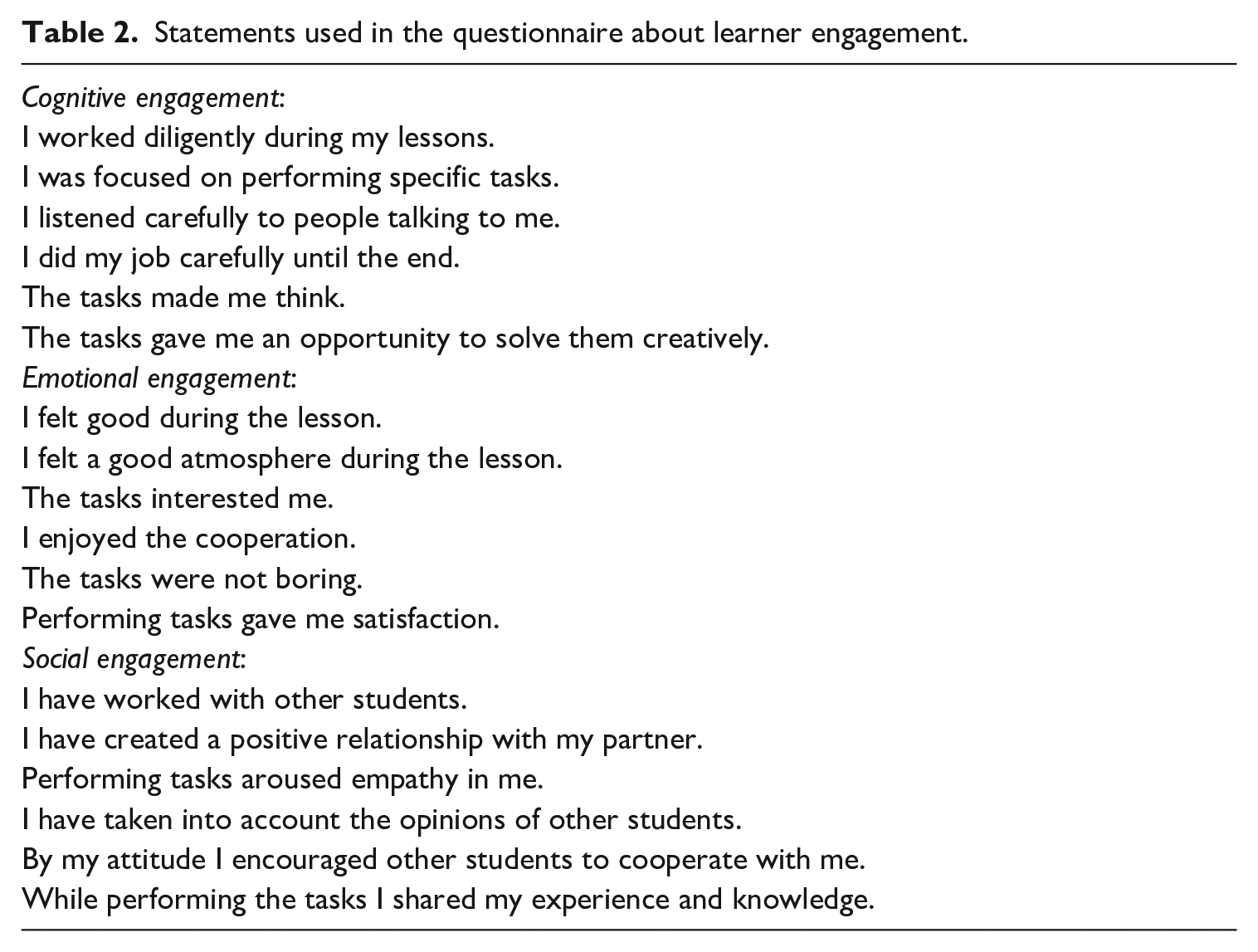
A quantitative survey of the engagement of learners in German task-based and communication-oriented lessons was conducted with a questionnaire. It consisted of 18 statements relating to cognitive, emotional, and social engagement. The form was based on the School Engagement Scale questionnaire (Fredricks et al., 2005), adapted to the specific conditions in place during the language lessons. The questionnaire is based on a five-point scale, where ‘yes’ scores 5 points, ‘no’ scores 1 point, and ‘don’t know’ scores 3 points. The highest score expresses engagement, the lowest expresses lack of engagement, while the middle score of ‘don’t know’ means that the student is unable to determine their condition, i.e. they are neither engaged nor do they think that they lack any engagement. Table 2 shows the statements grouped according to the above scheme.
Statements used in the questionnaire about learner engagement.
The questionnaire handed over to the students included the previously mentioned statements, which were randomly arranged to prevent the structure itself from biasing the learners’ responses. The validation of the proposed instrument was performed through confirmatory factor analysis (CFA), and its reliability was assessed by calculating composite reliability. The quality of the CFA model was assessed according to L.-t. Hu and Bentler (1999), considering N ⩽ 250. The expected coefficient values for an acceptable model were: the root mean squared error of approximation (RMSEA) lower than 0.08, the comparative fit index (CFI) and the Tucker–Lewis index (TLI) higher than 0.9, and the standardized root mean squared residual (SRMR) lower than 0.09. The metrics were evaluated within the R environment, utilizing the lavaan and compRelSEM packages.
3 Participants
The research project involved 96 students chosen based on a number of conditions. They included young people between the ages of 12 and 17 years who were studying German at A2 level according to the Common European Framework of Reference for Languages. They were primary school students in the sixth, seventh or eighth grades, or general secondary school students in the second grade. The selection of the subject was also influenced by which classes were available for distribution of the survey, especially since two comparable lessons on the same subject were necessary in each age group. Both the task-based lessons and the communication-oriented lessons were taught in each grade by the same teacher to avoid the impact of a different teacher’s personality traits and behaviours on students’ performance. Students and their parents were notified of the objectives, procedures, and expected outcomes of the study. Participation in the study required the student’s consent as well as written consent of the parents or guardians, permitting the use of their child’s data to the extent necessary for the study, subject to anonymity. A chronic heart disease diagnosis precluded participation in the study as it could cause abnormal ECG results.
There were six series of studies with two lessons each: one using a task-based approach and the other using a communicative approach in classes of a comparable language level. Up to six voluntary participants underwent ECG testing during each lesson. The number of students in which ECG was measured was limited due to the number of available sensors. Ultimately, 66 records from individual students were collected, consisting of 34 records during communicative approach lessons and 32 during task-based lessons. After each lesson, all willing students participated in a quantitative study in which they completed a questionnaire about their engagement in the lesson.
4 Lesson scenarios in both approaches
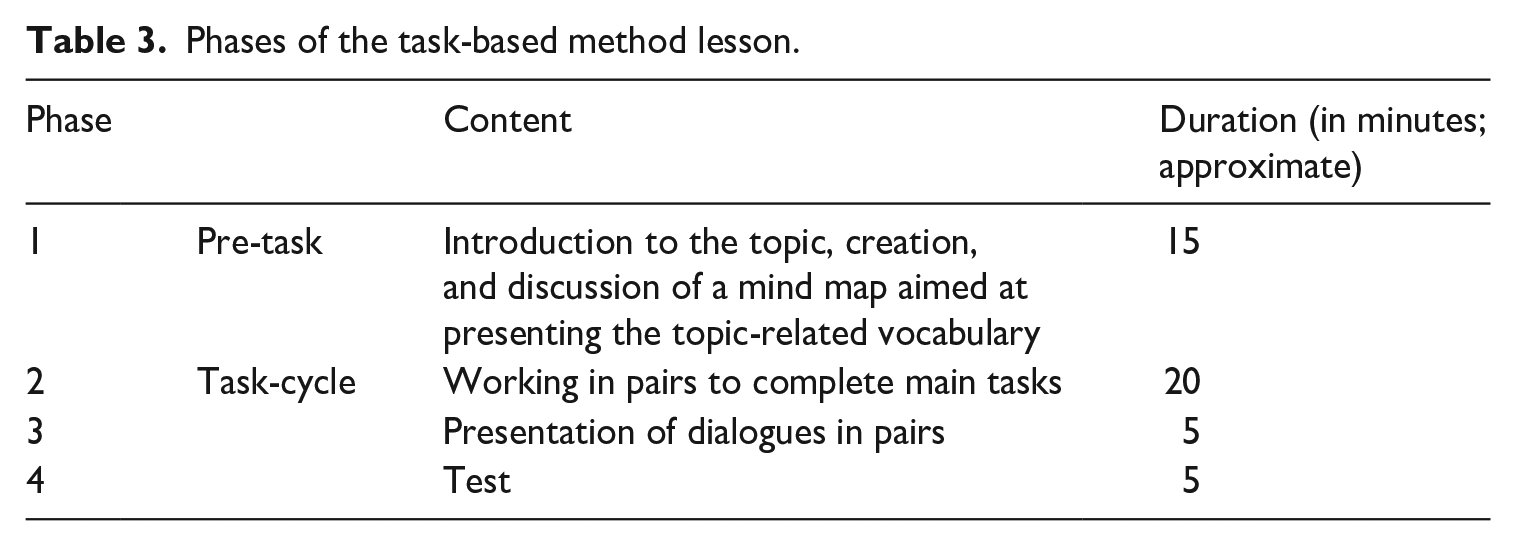
Both the task-based lesson and the communicative-oriented lesson were focused on the same topic Ich suche meine Traumwohnung and contained vocabulary and lexical structures that had not been included in the standard curriculum of primary and secondary schools. Hence, it was possible to offer lessons with the same subject matter and language level in different classes. Table 3 shows the phases of the task-based method lesson, while Table 4 shows the phases of the communicative approach lesson.
Phases of the task-based method lesson.
Phases of the communicative method lesson.
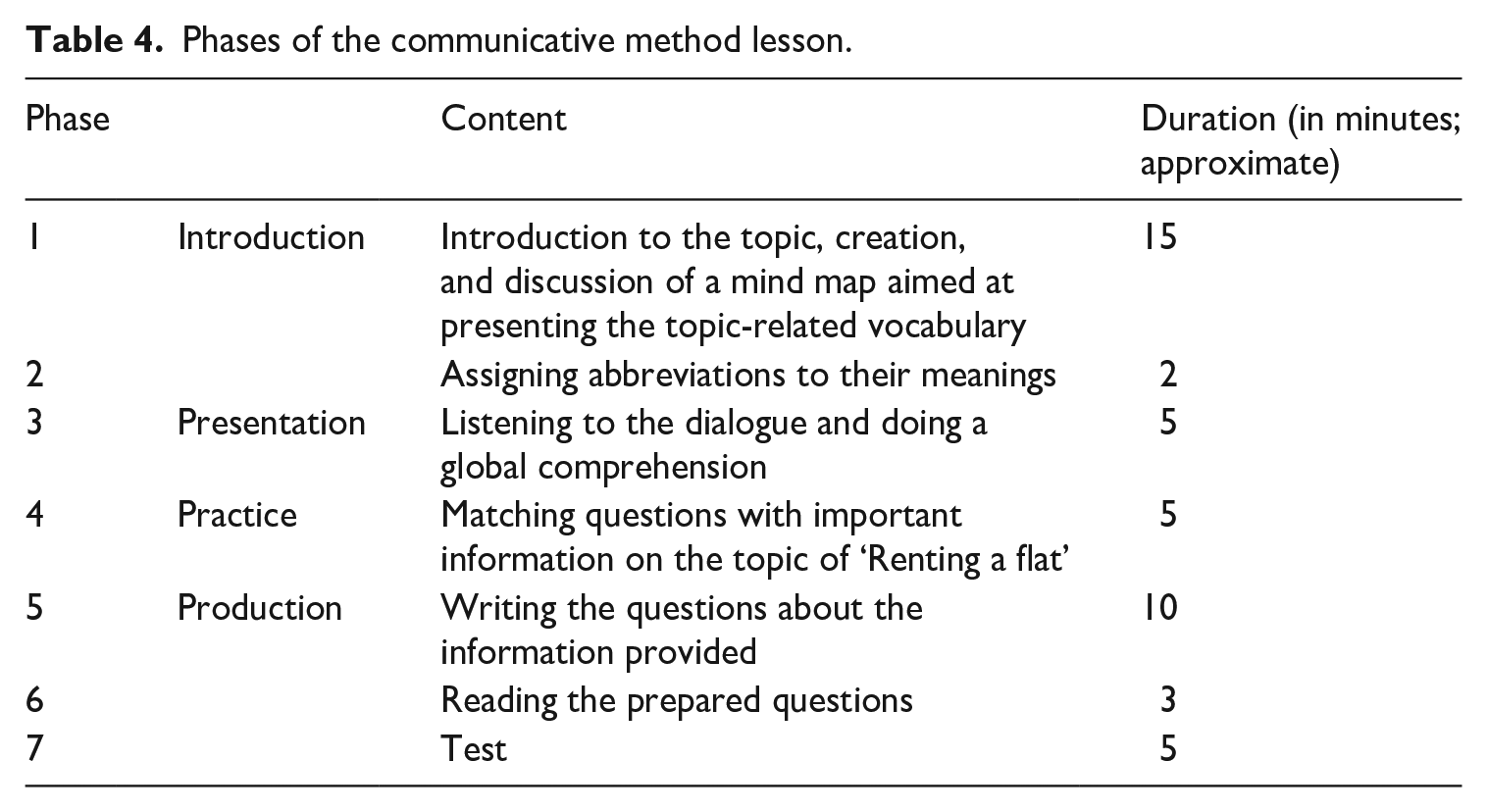
The biggest differences between the two methods were the levels and types of the learners’ activities. The first phase (the presentation of the topic and related vocabulary) was the same in both approaches. However, in communication-oriented lessons, students followed the teacher’s reasoning and carried out the instructions. The teacher presented the new material in the form of a dialogue. Then the learners performed a series of exercises dedicated to, among other things, general comprehension and the use of new language structures according to the PPP (present, practice, produce) lesson model (Byrne, 1976; Harmer, 2007). The entire lesson was conducted in a completely instructional manner. The task-based approach was characterized by a constructivist approach. The main objective of the lesson was to prepare and present a landlord–tenant interview for a rental apartment. After the introductory phase, learners independently performed the tasks, autonomously modelling how to perform them and adjusting to the conditions in pairs. The teacher no longer played a dominant role but instead acted as a mentor (Nunan, 2004; Willis, 1996). Completing the tasks in a task-based approach requires more autonomy and creativity from the learners.
IV Results
Phase I: Experiment
The normality of distributions of the obtained parameters (HR, AHR, and MQSD) was tested (with Shapiro–Wilk test), leading to the following conclusions:
HR distribution may be assumed normal in both approaches (C: p = 0.95, T: p = 0.89), where C is communicative and T is task-based;
AHR distribution may be assumed normal in the communicative approach; however, it deviates from normal in the task-based approach (C: p = 0.85, T: p = 0.10); and
MQSD distribution deviates from normal in both approaches (C: p < 0.0001, T: p = 0.08).
Therefore, in the case of AHR and MQSD parameters, we consider it more relevant to evaluate their central tendencies using a median rather than a mean value.
a HR parameter
A summary of heart-rate (HR) results is shown in Appendix 1, where it is cross-referenced with the resting HR (RHR) of young people aged 11 and 17 years (Sarganas et al., 2017). The highest HR values in our experiment exceeded the 95th percentile of RHR in both approaches, regardless of the participants’ age and gender. However, males in the task-based approach showed a difference of less than 1 bpm (beats per minute). The lowest HR values were higher than the 5th percentile of RHR in both approaches, regardless of the age and gender of the participants, and the minimum difference was 7.5 bpm for females and 9.7 bpm for males. In both approaches, the mean HR was significantly higher than the mean RHR (p < 0.0001; for test details, see Appendix 1).
The HR distributions are shown in a simplified form with box plots (Figure 1a). A tendency towards reaching a higher HR in the communicative approach can be observed, and a comparison of mean HR yields 1.7 bpm higher values in the communicative-oriented approach than in the task-based approach (Table 5). Nevertheless, the difference is insignificant (α = 0.1; one-tailed Welch’s test, t = 0.834, df = 62.4, p = 0.203, H1:C > T).
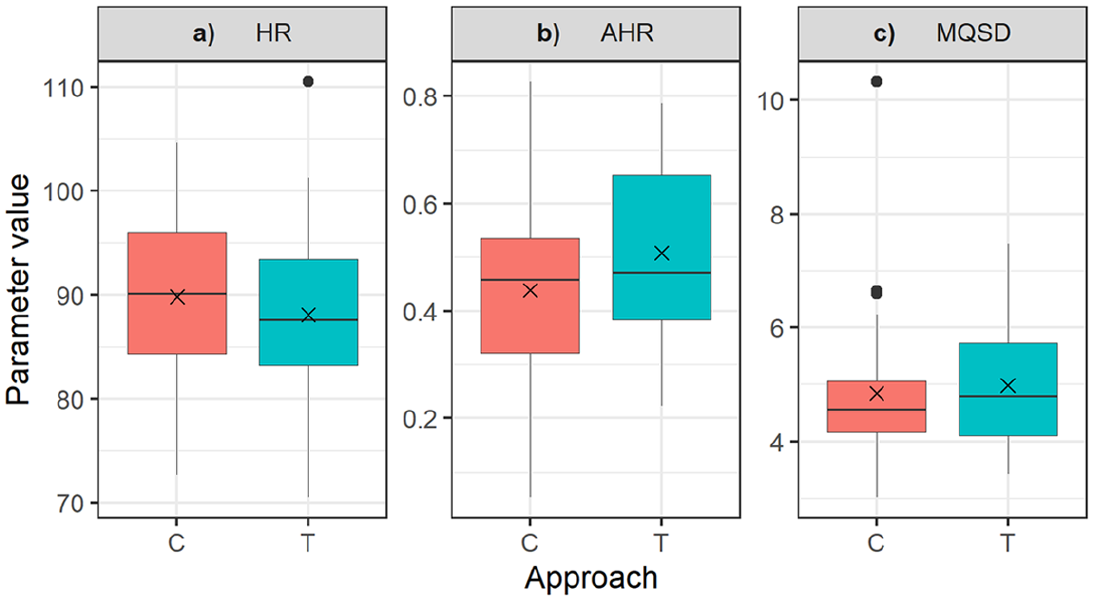
Values of (a) heart rate (HR), (b) additional heart rate (AHR), and (c) MQSD parameter, a heart rate variability metric.
Results for both approaches, summarized by mean and median values of the parameters.
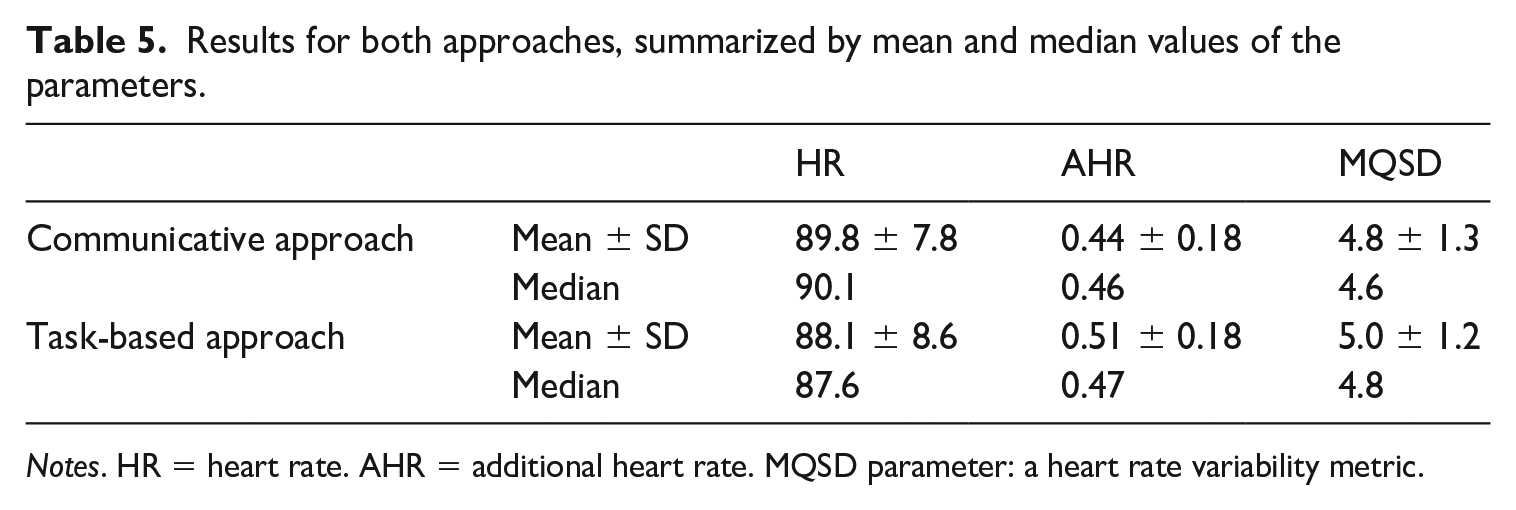
Notes. HR = heart rate. AHR = additional heart rate. MQSD parameter: a heart rate variability metric.
b AHR parameter
AHR values span from 0.05 to 0.83 units/minute in the communicative approach. In the task-based approach, the values range from 0.22 to 0.79 units/minute. The span of AHR values is greater in the communicative approach. The distributions differ in shape (see Figure 1b), showing opposite types of skewness (negative in the communicative approach and positive in the task-based approach).
Even though the mean and median values of AHR are higher in the task-based approach (by 0.07 and 0.01, respectively), there is no significant difference between distributions (α = 0.1; Mann–Whitney test, U = 447, p = 0.109, H1: C > T). Thus, as expressed by AHR, the average learners’ engagement was similar in both approaches.
c MQSD parameter
In the communicative approach, MQSD values span from 3.0 to 10.3 bpm. If the three outlying learners are left out, the difference drops to 3.2 bpm (as the values span from 3.0 to 6.2 bpm). In the case of the task-based approach, the values span from 3.4 to 7.5 bpm, with a difference of 4.1 bpm. The distributions differ in shape (see Figure 1c), as the communicative approach distribution is more compressed with a more prominent shift towards the lowest values (positive skewness).
The mean and median values of MQSD are higher for the task-based approach (by 0.2 for both metrics). However, there is no significant difference between distributions (α = 0.1; Mann–Whitney test, U = 494, p = 0.264, H1: C > T). Both approaches were characterized by a similar average learners’ engagement throughout the lesson, as expressed by MQSD.
We hypothesized that the learners’ activity would increase during certain parts of the lesson. All the previously reported values are based on recordings from almost a complete 45-minute lesson (excluding the first 5 minutes), and it was found that the various assigned tasks were not equally engaging. In both approaches, teachers were the most active people in the classroom during the first part of the lesson. They introduced and explained the lesson topic and presented associograms, keywords, and the necessary vocabulary. This part of the lesson was directed toward all learners, who listened passively. Therefore, their activity was reduced while they were preparing for the upcoming tasks. An increase in learner activity levels was expected to occur after approximately 15 minutes when they started performing tasks or exercises on their own or in pairs. The division of lessons into parts comprising specific learners’ activities and measuring engagement in different time periods is an important part of the study, as pointed out by Bohn (2012).
The parts of the lessons that took place between minutes 15 and 35 included the learners’ most intensive work and activity. Hence, this period is of particular importance to our research. An inter-approach comparison of aggregated 5-minute MQSD means from minutes 15–35 of the lessons revealed that the values obtained for task-based approaches were significantly higher (α = 0.1; Mann–Whitney test, U = 7,736, p = 0.059, H1:T > C). An analogous comparison of all 5-minute AHR values did not yield significant differences between the approaches (α = 0.1; Mann–Whitney test, U = 9,408, p = 0.877, H1:T > C). It should be noted that the 5-minute time segment seems too short for the estimation of an averaged AHR in our setting, as out of the 264 obtained values, 34% (90 values) were equal to zero (i.e. no emotional events were detected).
Figure 2 presents the 5-minute MQSD values for both approaches. The most important segments for the assessment of engagement correspond to the periods of the most intensive learner work, i.e. from minutes 15 to 35 of the lessons (labelled C/T.3 to C/T.6 in the plot). Lesson segments from about minute 35 (labelled C/T.7 in the plot) were devoted to presentations of the learners’ work, so the single student who presented the task results was the most active person. During this time, other learners became observers and thus remained less active. Therefore, the group-averaged MQSD is not an adequate metric of engagement for this period. It follows from these findings that in the task-based approach, the momentary values of MQSD indicate a greater short-term cognitive engagement of the learners during the most intensive work and activity than in the communicative approach during an equivalent period.
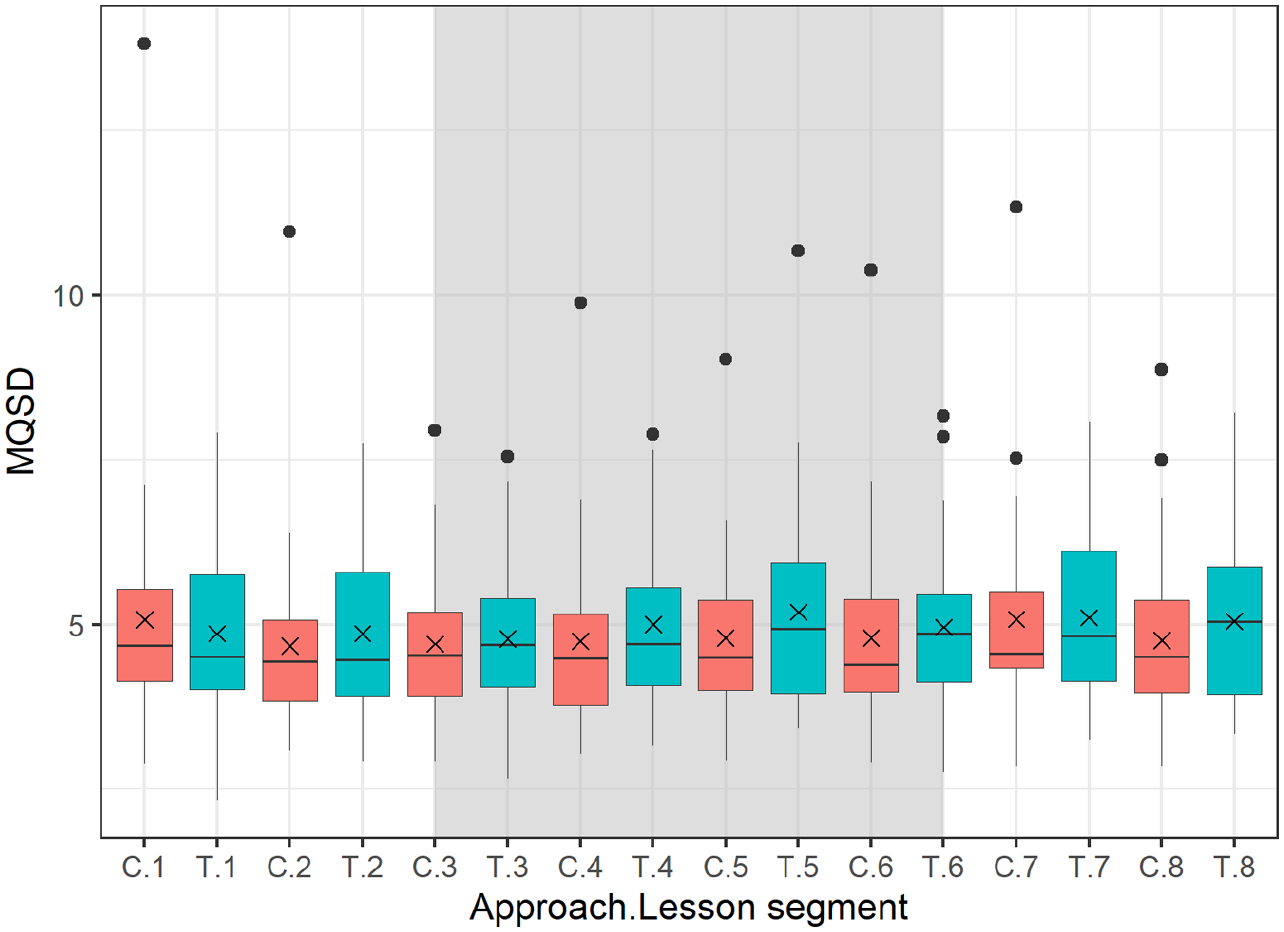
Values of MQSD parameter (a heart rate variability metric) in 5-minute lesson segments.
The momentary values of MQSD differed between the approaches. Therefore, a deeper analysis of the intra- and inter-approach relationships within this parameter was conducted for the subsequent 5-minute lesson segments. The results, displayed within selected lesson segments, are shown in Figure 3. In each segment, the task-based approach yielded higher median and upper quartile values of MQSD. The greatest differences in median values between the approaches were apparent during minutes 25–30 and 30–35, the segments correlating with the increased learner workload. However, the Mann–Whitney tests conducted within separate lesson segments did not support the hypothesis that there was a significant difference between the approaches (p ≈ 0.6 for all comparisons after a Holm correction).
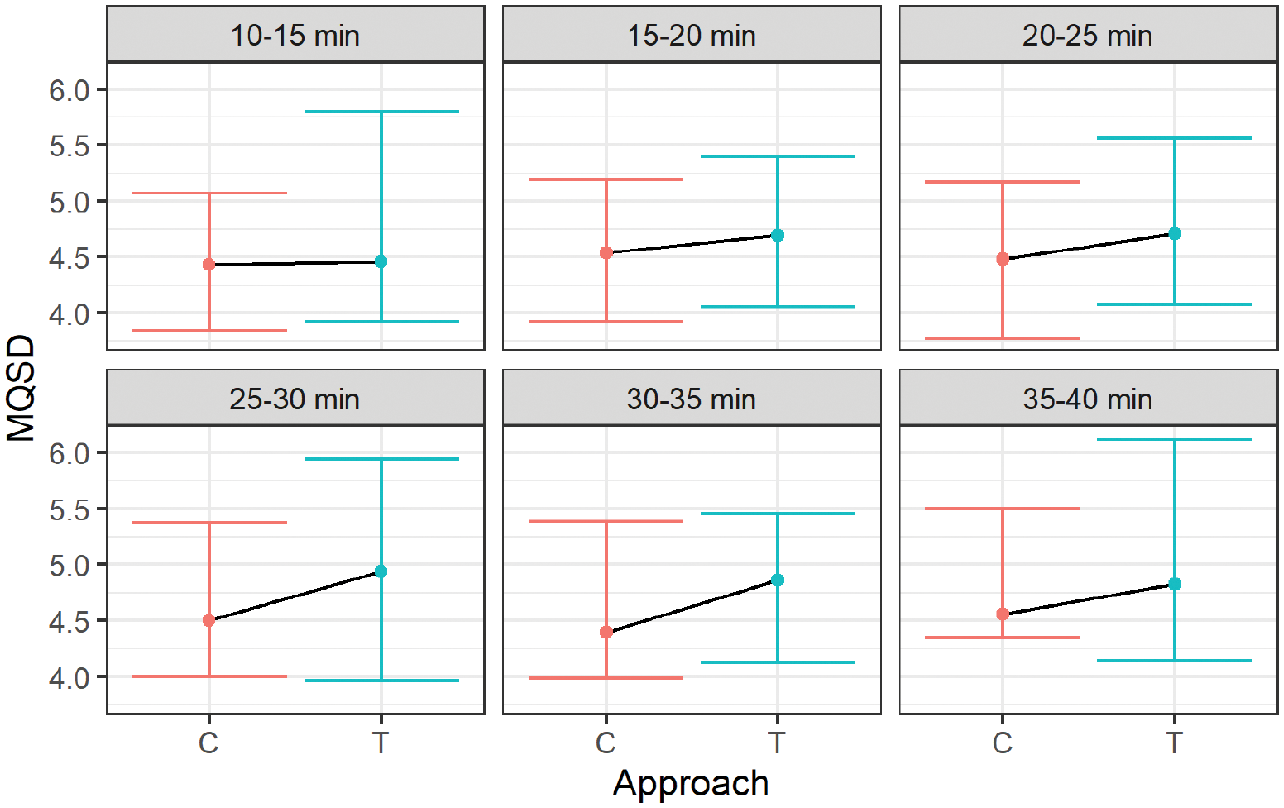
An inter-approach comparison of MQSD parameter values in selected 5-minute lesson segments.
Comparisons of the 5-minute MQSD values grouped by the approach in use are shown in Figure 4. The MQSD median remained relatively stable for the communicative approach, while a slight increase in the upper quartiles was seen after 25 minutes of instruction. Such a change may be linked to a slowly growing engagement that was limited to a subgroup of learners who delved into their tasks. An increase in MQSD occurred during minutes 35–40, i.e. the presentation phase (presentation of dialogues in pairs). In the task-based approach, the largest MQSD median is observed during minutes 25–30, when the learners prepared their dialogues. Moreover, the median MQSD steadily increased from 10 to 30 minutes. This shows that even though the greatest cognitive engagement of the learners is focused on a particular part of the lesson, it constantly evolves towards this key point from the first minutes, embracing most students. A similar effect was not observed in the communicative approach. However, in both approaches, the lower quartiles of MQSD values are comparable during the lesson, which indicates the presence of a subgroup of non-engaged learners.
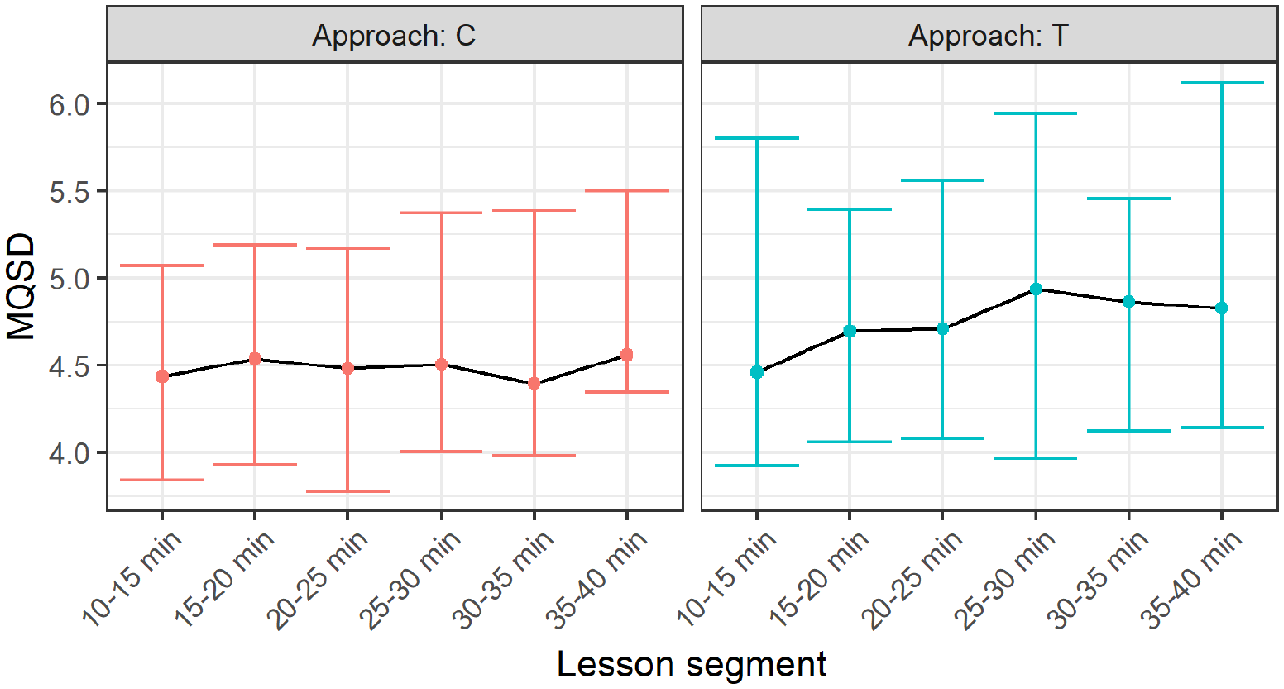
An intra-approach comparison of MQSD parameter values in selected 5-minute lesson segments.
Phase II: Questionnaire
The reliability and validity of the learner’s engagement construct as a second-order factor derived from the emotional, social, and cognitive subfactors, defined using the set of the 18 priorly given statements, were evaluated based on the acquired data. The composite reliability (CR) was good, with coefficients of 0.774, 0.796, 0.804, and 0.800 for the emotional, social, cognitive, and total engagement factors, respectively. However, the model fit for the questionnaire was not satisfactory (χ2 (40) = 287.6; RMSEA = 0.111; CFI = 0.77; TLI = 0.73; SRMR = 0.098). Therefore, a post-hoc adjustment of the model was proposed, in which the following items were removed from the questionnaire due to their high correlations with some of the other items or factor loadings less than 0.5:
• for the emotional engagement latent variable:
‘I felt good during the lesson.’
‘The tasks were not boring.’
• for the social engagement latent variable:
‘I have created a positive relationship with my partner.’
‘I have taken into account the opinions of other students.’
The adjusted model showed good fit (χ2 (74) = 109.0; RMSEA = 0.070; CFI = 0.919; TLI = 0.901; SRMR = 0.069) and good internal consistency (per-factor CR coefficients were 0.727, 0.741, 0.810, and 0.819 for the emotional, social, cognitive, and total engagement, respectively).
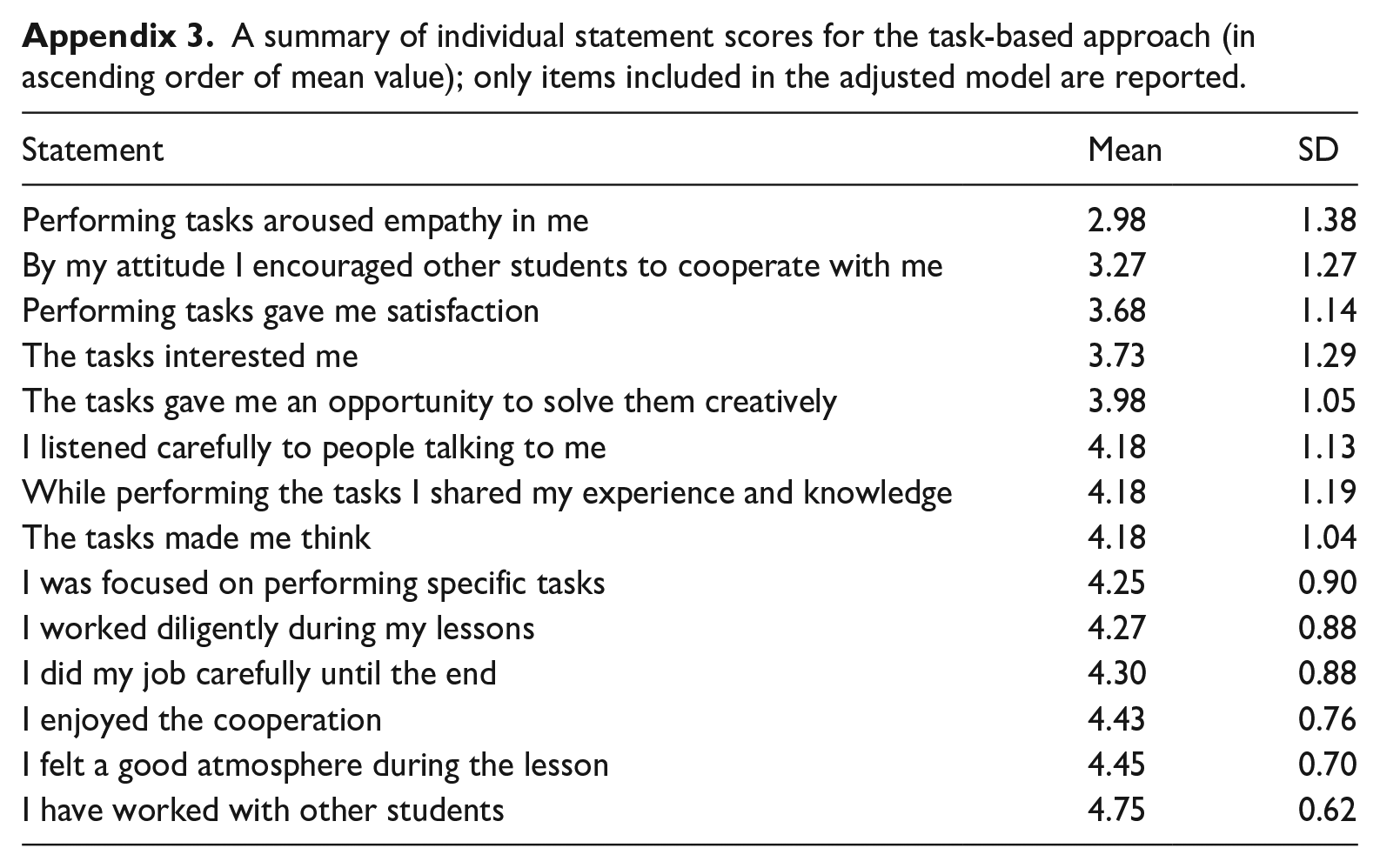
The average scores for the learners’ assessments of their levels of engagement for different aspects of the communicative approach lesson are summarized in Appendix 2. The statement with the lowest score in the communicative approach was ‘Performing tasks aroused empathy in me’ (2.71), and the statement with the highest score was ‘I listened carefully to people talking to me’ (4.15). When comparing the scores of the individual statements in the task-based lessons (summarized in Appendix 3), it can be seen that likewise, the lowest score was given to the statement ‘Performing tasks aroused empathy in me’, but the score itself was higher and equal to 2.98. This suggests more pronounced social engagement within the task-based classroom. The statement ‘I have worked with other students’ achieved the highest score (4.75), supporting the conclusion that in a task-based lesson, most learners cooperated with each other in solving tasks.
The distributions of the engagement scores organized by type are shown in Figure 5. The distributions deviate from the normal, mostly showing a negative skewness with a predominance of higher-than-average scores. Nevertheless, the relationship between the mean and median scores showed a better outcome in the task-based than in the communicative approach when all types of engagement are considered. The hypothesis that a task-based approach scored higher than the communicative approach is supported by the following Mann–Whitney test results (α = 0.1; H1: C < T):
cognitive engagement: U = 919.5, p = 0.049
emotional engagement: U = 860.5, p = 0.019
social engagement: U = 618.5, p < 0.0001
total averaged engagement: U = 740.5, p = 0.002
Based on Figure 5 and Table 6, there is more scoring variation in engagement with the use of a communicative approach than with a task-based approach, with the greatest variation occurring in the assessment of social engagement (largest SD relative to the maximum applicable score).
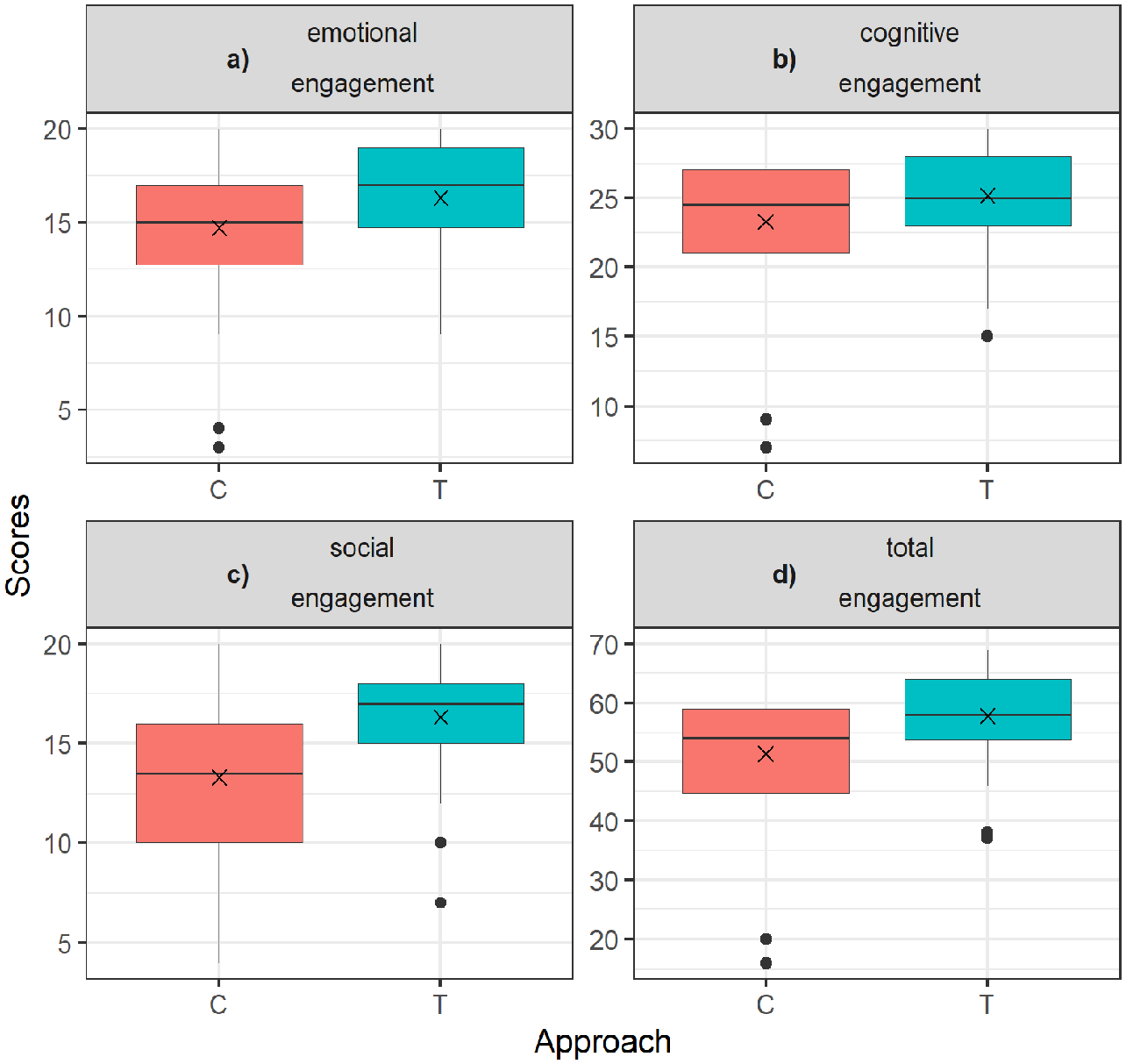
Summarized distributions of the engagement scores as reported in the learners’ surveys: (a) Emotional engagement, (b) Cognitive engagement, (c) Social engagement, (d) Total engagement.
Summary of the total scores for cognitive, emotional, and social engagements and total learners’ engagement for both approaches.
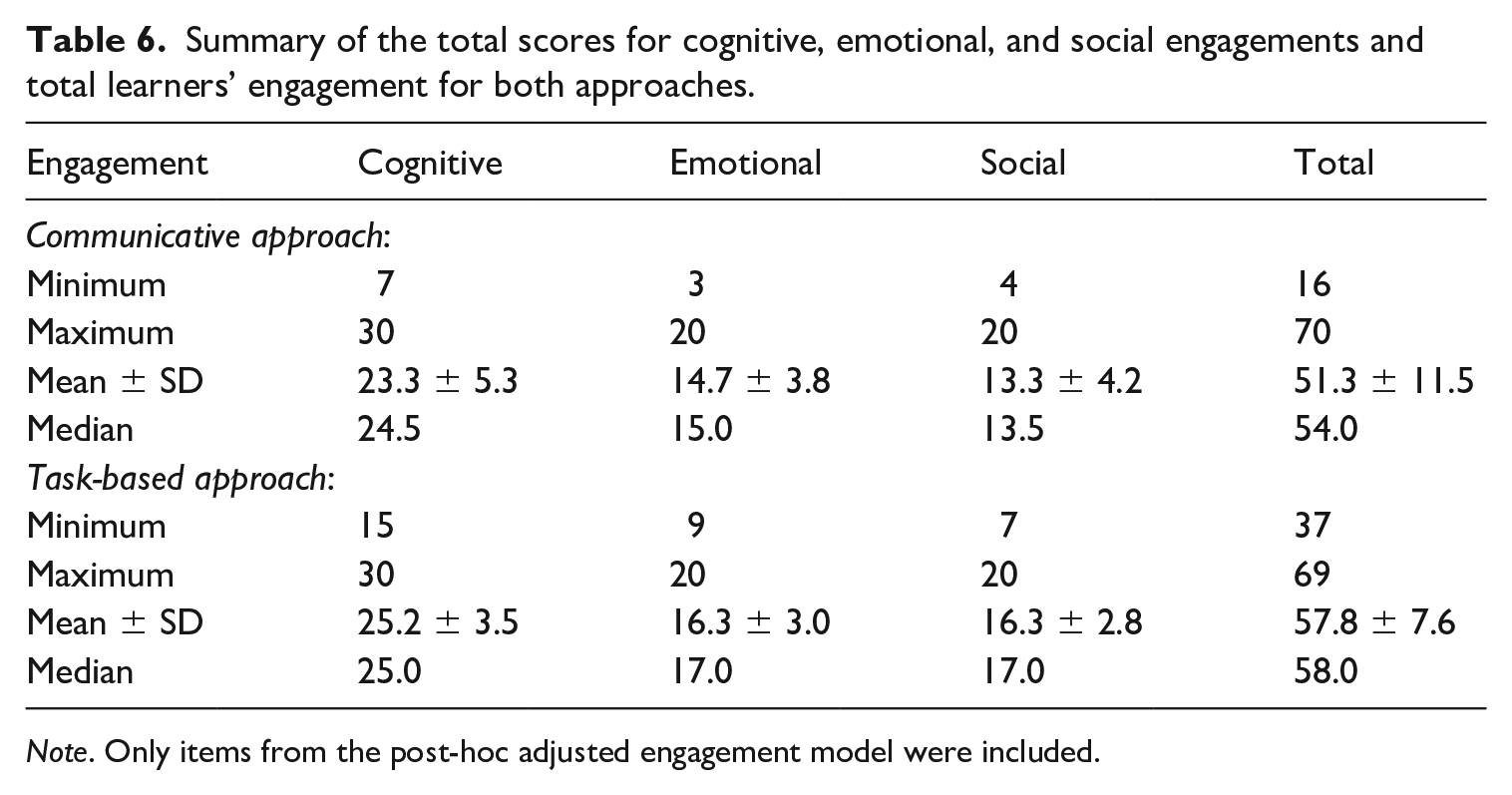
Note. Only items from the post-hoc adjusted engagement model were included.
The absolute differences between the mean values of cognitive, emotional, and social engagement scores are not high, ranging from 1.6 to 3.0 points in means and 0.5 to 3.5 points in medians, but each engagement component shows the advantage of the task-based approach. The students appreciated foreign language learning using this method, which they perceived somewhat better than the communicative approach. The statements related to cognitive engagement received the highest relative scores in both approaches (when given as the percentage of the maximum possible score, i.e. 77% and 84% for the communicative and task-based approaches, respectively). This suggests that in both types of lessons, cognitive processes were more pronounced than social (mean scores: 66.5% and 81.5%) or emotional ones (mean scores: 73.5% and 81.5%). The biggest difference between the approaches lies in the social engagement component, which scored 15 percentage points higher for a task-based approach. The results show that learners feel more socially active during task-based lessons than during communicative-oriented ones.
V Discussion
The goal of this study was to record and evaluate the engagement of learners in communicative-oriented and task-based lessons of the German language. An experiment consisting of physiological measurements and a questionnaire was conducted. The combination of the above-mentioned methods was meant to increase the reliability of the research and reduce the uncertainty resulting from their individual disadvantages. Such a mixture of techniques in didactics helps tackle the multiplicity of factors in the teaching process that make it inherently difficult to quantify. It also allows us to examine the research subject from different perspectives and provides a more comprehensive picture of the studied issue.
The physiological parameters in their aggregated form, employed to quantify learners’ reactions to the challenges throughout the lesson, did not demonstrate a lesson-wide dominance of the task-based approach (Figure 1). By carrying out a fine-grained analysis (based on the short-term parameters from the lesson segments), we found a statistically significant increase in HRV (measured with the MQSD parameter) during the periods of highest learner activity of the task-based classes (minutes 15–35). This implies that the productive tasks are the most engaging for the learners, as they fall into the timeframe mentioned above: when learners work together in pairs, discussing their positions and arriving at a solution. It turns out that the presentation of the final solution no longer results in such a high cognitive involvement. The induced engagement remains considerably higher throughout the lesson than in the communicative method classes (Figure 3). In the communicative approach, a slight increase in engagement was observed during the task performed at the end of the lesson between minutes 35 and 40. In this segment, learners came up with questions independently and presented them. However, the respective values of HRV were lower than the maximum ones observed in the task-based approach. We found that the students’ cognitive engagement was less homogenous in task-based lessons, with the metrics showing more dispersion, suggesting the emergence of two groups, i.e. more and less engaged learners. Such patterns of increased attention during the active phases of learning show agreement with the results of studies by Darnell and Krieg (2019) and Ladino Nocua et al. (2021). An interesting aspect is that in our results the most prominent changes were related to the HRV, less to the HR itself. Unfortunately, a direct comparison of measurements with the previous research seems not feasible due to differences in the experiment design (type and timeline of activities) and lack of universal engagement scales (Castiblanco Jimenez et al., 2022).
Considering studies with similar designs and aims, which included physiological measurements, we refer to works by Bohn (2012), Mayer (2011), and Wagner (2012). Bohn (2012) measured learners’ pulse during a technology lesson taught using the jigsaw (Aronson & Patnoe, 2011) and frontal (traditional, whole group instruction) methods). When comparing the ECG-based parameters with the results obtained in the questionnaire and the knowledge test during specific lesson situations, Bohn did not achieve significant correlations, which hindered the evaluation of the effectiveness of the tested methods. In our study, results show a limited, however significant, relationship between the HR-based parameter and learning activities specific to the evaluated approaches. Another important aspect of our study was the examination of the emotional involvement of the students. Mayer (2011) investigated this issue during classroom activities and students’ free time. The learners’ pulse was recorded during different school subjects, with results depending on the class type. The comparison of the subjective emotional load with the objective one obtained from the HR showed a significant increase in AHR when working in lessons with a partner. Our data show a similar effect, as when students communicate and collaborate intensively on language tasks, their HRV tends to increase. Finally, in Wagner’s (2012) study of the effect of engagement on students’ HR, the highest HRV values reflected the increased learners’ concentration when solving mathematical tasks. The researcher concluded that the pulse increases with cognitive, physical, and emotional load. What follows is that the HRV rise we observed can be similarly attributed to the increased involvement of the learners, specifically as they perform language tasks.
The above-mentioned estimates of engagement obtained from the physiological experiment were juxtaposed with the questionnaire results. In self-reported evaluations, the average emotional engagement in the task-based approach is higher than in the communicative approach, indicating an agreement between the physiological observations and the survey. Yet, the difference between the teaching methods is relatively small, which is quite interesting as we expected the intense interaction and co-operation between learners to trigger a more pronounced emotional response. Similar conclusions might be drawn about the part of the questionnaire containing statements related to cognitive engagement, where the difference between the two approaches is also not substantial. This means that despite the lower interaction and co-operation of learners in the communicative approach, this often criticized method induces a considerable level of emotional and cognitive involvement in the learners, which shall contribute to its teaching effectiveness. Conclusions regarding social engagement can only be based on the learners' self-reported social activity, as the comparison with physiological measurements is not viable. The study confirmed the higher and more homogenous social engagement in the task-based classes, which is quite apparent, as these are related to a more cooperative learning experience than their communicative counterparts. Concurrently, the questionnaire scores demonstrated a greater variation of the social component in the communicative-oriented lesson, showing that this approach involves learners unevenly, resulting in less predictable development of relevant competences.
The results may be reviewed in the context of educational neuroscience, which, among others, emphasizes the social dimension of the learning process (Clark & Dumas, 2015; Lucas-Oliva et al., 2022; Sousa, 2021) and its correlation with the learner’s cognitive development, as underpinned by the social and emotional learning (SEL) frameworks (Corcoran et al., 2018). It was reported that the act of peer-learning, the agency during peer interaction, and even the expectation of co-operation could reinforce the engagement of learners and their positive learning experiences (Clark & Dumas, 2015). Peer-learning activities that involve problem-solving have been shown to drive intrinsic motivation, an important motor of efficient learning and school success. Moreover, the more interactive the activity is – i.e. the more the knowledge is constructed in the course of co-operation and partner’s contribution – the greater the expected achievement of the learner (Chi, 2009; Menekse et al., 2013). From a broader perspective, the inherently rewarding nature of reciprocal co-operation with non-kin individuals is considered to be rooted in the human brain and presents itself during the completion of various tasks (Krill & Platek, 2012; Sakaiya et al., 2013). Our questionnaire outcomes indicate that students scored the item ‘I enjoyed the co-operation’ high in both approaches, thus admitting their appreciation for this type of activity. However, while in the communicative approach they focused on listening (the item ‘I listened carefully to people talking to me’ got the highest score), within the task-based classes they took the chance to act (the item ‘I have worked with other students’ scored highest). While the increase of HRV in the task-based classes may be attributed to the peer-learning itself, its rise during the final segment of the communicative lesson can be ascribed to the emerging sense of agency within the class associated with the presentation of the prepared questions.
The issue of developing high-quality classroom engagement that boosts in-course motivation and learners’ achievements was raised in various studies from the field of educational psychology (Eren & Rakıcıoğlu-Söylemez, 2020; Feng & Hong, 2022; Khajavy, 2021; Reeve & Lee, 2014). For example, recently Feng and Hong (2022) focused on the role of engagement in the achievement of learners of English as a foreign language. One of the reported implications was that establishing a positive learning environment and giving learners more flexibility in their learning activities choices would be beneficial for their achievements. The task-based course curriculum may be used for implementing such conditions, as it gives learners more initiative and responsibility compared to the communicative approach and, according to our results, stimulates the increase of engagement. Because positive emotions leverage the learning process and second language acquisition (Ansari et al., 2017; Dewaele, 2015; Lucas-Oliva et al., 2022; Oxford, 2015), it is worth noting that in the task-based approach the item ‘I felt a good atmosphere during the lesson’ scored higher than in the communicative one (mean score of 4.45 vs. 3.96).
In future research, it would be desirable to employ the physiological measurement and investigate how peer-learning influences students’ engagement in foreign language classes in real-time. Indeed, do more frequent interaction and co-operation with other learners consistently increase their momentary engagement and, ultimately, achievement during second language acquisition, or are there limits to this effect? How does the design of the task-based activity and the amount of expected social interaction shape the motivation toward learning? Can we monitor the student’s cognitive withdrawal to identify and support non-engaged individuals during the lesson in a proactive manner? Can we deepen insight into the details of the interaction during peer-learning? For example, as the inter-brain activity patterns show increased synchrony during tasks set for co-operation (Dikker et al., 2017; Y. Hu et al., 2018; Szymanski et al., 2017), a similar phenomenon may be looked for in the HR variations. Supplementing the measurements with the timeline of observed inter-learner interactions would be required to facilitate such a study of HRV correlation within the student pairs. Expanding the physiological measurement to evaluate teachers engagement and establish its relationship to learners’ engagement is also worth considering.
Based on the research results, the task-based approach was at least as effective as the communicative approach in stimulating engagement in foreign language classes. Moreover, the former elicited the most positive impact on the social component of engagement. According to our observations and referred literature, establishing a learning environment that enables acting during peer interaction is an essential engagement-driving factor.
Multiple confounding factors may disturb research conducted within a real-world classroom. Regarding the methodology of the study group composition, the following aspects need to be discussed: the gender and age of respondents and their individual language learning experience.
Considering gender, during the physiological recordings, the division was made equally, i.e. during one lesson, three girls and three boys had their ECG measured, while the questionnaire included all willing learners present in the lessons regardless of gender. Excluding the opinions of students not involved in the HR recording would have been unnatural and could have caused negative emotions; we wanted to avoid an additional emotional stimulus. As far as the age of the learners is concerned, it covers a relatively narrow range from 12 to 17 years; in this age group, the pulse is approximately at the same level, in contrast to adults or seniors (Myrtek, 2004). It would be beneficial to carry out the study for the other age groups.
Another important demographical factor is the prior experience in learning a foreign language. In our study, outside the experimental protocol, we observed that students who had previously been learning the language using the task-based method were better at co-operating and more engaged in cooperative learning than students who had never worked this way and were not familiar with the principles of co-operation in a foreign language lesson. It is an additional component impacting the effectiveness of learning, yet once mastered it could greatly facilitate language acquisition. In future research, it would be advisable to include (e.g. in the survey) information on the previous methods of learning a foreign language and analyse this factor.
The factors potentially influencing the physiological measurements include, e.g. alcohol, cigarettes (Fahrenberg, 2001), lifestyle, and illness (Hottenrott, 2009). We excluded participants with a heart disease diagnosis in the interview, yet we did not consider the respondents’ lifestyle, as we decided that this influence was negligible and would not be relevant for this age group.
The impact of biosignal measuring devices on the lesson’s course might also be concerning. However, the sensors proved to be inobtrusive, their handling was not time-demanding, and we have not observed their influence on how learners participated in the lesson. Therefore, the lesson’s course closely resembled a regular one.
VI Limitations of the study
The number of respondents in our HR study is different from the number of respondents in the questionnaire due to the limited access to ECG sensors (there were six sensors at our disposal). Hence only six people could be given an ECG test during a single lesson. As a result, fewer data are available from the experiment than from the questionnaire.
The scope of this research was limited to a group of primary school students. To obtain a complete picture of the physiological responses during task-based lessons and to thoroughly evaluate this approach to language teaching, it would be necessary to observe children, university students, adults, and seniors alike. It would complement the analysis and enable the presentation of learners’ engagement with both approaches across all age groups of foreign language learners. As lifelong learning processes have become a significant part of the development of knowledge societies, it is desirable to continue investigations in this direction and extend them with new instruments like psychophysiological measurements.
VII Conclusions
This study yields a positive evaluation of task-based German lessons in the context of learner engagement. Both objective and subjective assessments showed that students were more or at least equally engaged in classes taught with a task-based approach compared to a communicative approach. Moreover, subjective emotional, social, and cognitive engagement ratings demonstrate that learners favour the task-based approach. The highest level of engagement during the experiment was achieved with productive tasks, which is an important finding because these are considered to foster better language acquisition. This conclusion can serve as a rationale for teachers to increase the number of productive tasks compared to receptive ones. Moreover, including a peer-learning component in the activities appears to be of considerable importance due to its role in building intrinsic motivation to learn and in stimulating the growth of social competences.
The experiment was conducted in a natural school setting. The lessons in which the research was carried out closely resembled the regular ones. The only non-standard assets were the sensors and the test at the end of the lesson. We have shown that the data can be obtained in an inobtrusive way in the process of second language acquisition, not in laboratory conditions.
In our research, we adopted a synergistic approach, enhancing language teaching studies with biomedical engineering and demonstrating how incorporating physiological observations can deepen the insight into the language learning processes.
Footnotes
Appendix
A summary of individual statement scores for the task-based approach (in ascending order of mean value); only items included in the adjusted model are reported.
| Statement | Mean | SD |
|---|---|---|
| Performing tasks aroused empathy in me | 2.98 | 1.38 |
| By my attitude I encouraged other students to cooperate with me | 3.27 | 1.27 |
| Performing tasks gave me satisfaction | 3.68 | 1.14 |
| The tasks interested me | 3.73 | 1.29 |
| The tasks gave me an opportunity to solve them creatively | 3.98 | 1.05 |
| I listened carefully to people talking to me | 4.18 | 1.13 |
| While performing the tasks I shared my experience and knowledge | 4.18 | 1.19 |
| The tasks made me think | 4.18 | 1.04 |
| I was focused on performing specific tasks | 4.25 | 0.90 |
| I worked diligently during my lessons | 4.27 | 0.88 |
| I did my job carefully until the end | 4.30 | 0.88 |
| I enjoyed the cooperation | 4.43 | 0.76 |
| I felt a good atmosphere during the lesson | 4.45 | 0.70 |
| I have worked with other students | 4.75 | 0.62 |
Acknowledgements
We would like to thank movisens GmbH (Germany) for providing the sensors used in our experiments.
Funding
The author(s) received no financial support for the research, authorship, and/or publication of this article.
