







Abstract
Based on the self-determination theory, the current study took a multilevel structural equation modeling approach to explore the relations between teacher–student relationship quality (TSRQ), students’ emotional engagement in English as a foreign language (EFL) lessons and writing performance. Furthermore, gender and socioeconomic status (SES) differences were examined in relation to the three constructs. The sample comprised of 952 students from 67 French secondary schools. The results indicated that TSRQ was positively related to students’ emotional engagement at both the student and school levels, although the link between TSRQ and students’ writing performance was non-significant at both levels. The positive association between emotional engagement in EFL lessons and writing performance was significant at the student level but non-significant at the school level. In addition, female students were more likely to perform better in writing than their male counterparts. The positive associations between SES and writing performance were significant at both the student and school levels.
I Introduction
Writing proficiency has long-lasting implications for students’ academic success, career opportunities, and lifelong learning (Lew & Tang, 2017). Unfortunately, learning to write in a foreign or second language (FL/L2) can be particularly challenging for students (Warschauer, 2010), as FL/L2 writers commonly have difficulties in generating ideas and thoughts, using sufficient vocabulary and accurate grammar, and mastering adequate writing strategies (Lei, 2008). For instance, over 20% of students in France failed to attain A1 of the Common European Framework of Reference for Languages (CEFR) in English as a foreign or second language (EFL/ESL) writing, while 40% achieved A1, 20% reached A2, and less than 20% obtained B1 or higher (European Commission, 2012a).
A robust body of FL/L2 writing literature has emphasized the prominent roles of linguistic skills (e.g. orthographic knowledge, morphological awareness, and grammatical knowledge) and cognitive variables (e.g. working memory) in predicting L2 writing performance (e.g. Mavrou, 2020; Michel et al., 2019; Orcasitas-Vicandi, 2020; Schoonen et al., 2003). Emerging theories on writing, such as Y.-S. G. Kim & Graham’s (2022) Direct and Indirect Effects Model of Writing and Graham’s (2018) Writer(s)-Within-Community Model of Writing, incorporate cognitive and sociocultural perspectives. They propose that both an individual writer’s growth in writing ability and engagement in writing communities influence writing development, which is interrelated with biological, neurological, and environmental characteristics (Graham, 2018). Multiple social contexts of students’ lives in school, including teacher–student relationships and peer relationships, influence students’ academic performance, cognitive development, and social-emotional competence (Hamre & Pianta, 2001; Lecce et al., 2020; Roorda et al., 2011). The self-determination theory (SDT) provides a theoretical framework for the links between teacher–student relationship quality (TSRQ) and students’ academic and motivational outcomes. In EFL contexts, limited empirical evidence has demonstrated that students who experience close and warm relationships with teachers tend to exhibit higher levels of self-efficacy, use more learning strategies, and perform better in overall English assessments (Ma et al., 2018). In EFL writing classrooms, the relationships established between teachers and students play an important role, as students rely more on the language input and feedback that teachers provide. However, few studies exist regarding the associations between TSRQ, emotional engagement, and writing performance among EFL populations. In France, the use of English terms and the use of English in public life are limited according to language policies (Devine, 2019). The national curriculum in secondary school is prescriptive in the content and method of English language teaching (French Ministry of National Education, 2018). Teachers in France play a significant role in English teaching and rely on systematic teaching based on the curriculum and coursebooks (Schurz & Coumel, 2022). Teacher–student relationships in France are more aloof relative to those in the USA (Roach et al., 2005). Based on these characteristics, we argue that teachers and their relationships with students are important for students’ EFL learning. Therefore, the main purpose of this study was to investigate the relationship between TSRQ, emotional engagement in EFL lessons, and writing performance in the French context. A better understanding of these associations can shed light on the joint contributions of TSRQ and emotional engagement to students’ writing performance, as well as the mechanism by which TSRQ predicts such performance in the EFL context. This insight can assist in designing and developing FL/L2 writing interventions and training programs.
Prior research has documented well that gender and socio-economic status (SES) are robust predictors of student outcomes (e.g. Mullis et al., 2017; OECD, 2019; Saeed et al., 2011). In general, female students are more likely than their male peers to establish supportive relationships and experience positive relationships with teachers (Hajovsky et al., 2017; Hamre & Pianta, 2001; McFarland et al., 2016). Additionally, female students are more likely to engage emotionally in foreign language learning (Dewaele & MacIntyre, 2014; Dewaele et al., 2016) and tend to perform better in writing (Huang, 2022; National Center for Education Statistics, 2012). Similarly, compared to students from low-SES backgrounds, socioeconomically advantaged students are more likely to have positive relationships with teachers (Hajovsky et al., 2017; Murray & Zvoch, 2011), exhibit higher levels of emotional engagement and enjoyment in FL/L2 learning (C. Li & Li, 2023), and achieve higher levels of language performance (Huang, 2022; Zou & Zhang, 2011). However, some studies have presented conflicting evidence on gender and SES differences in these study constructs. For example, Garner & Waajid (2008) found no SES differences in teacher–student relationships, and Bru et al. (2021) showed no differences in FL anxiety and boredom (C. Li & Li, 2023). Considering the mixed findings, it is crucial to examine the potential influence of gender and SES on TSRQ, emotional engagement, and writing performance among FL/L2 students. Such an investigation could provide insights into developing effective intervention strategies and programs that are customized for specific gender and SES groups. Thus, a secondary aim of the current study was to examine possible gender and SES differences in TSRQ, emotional engagement in EFL lessons, and writing performance among EFL students.
1 Self-determination theory in EFL
Students’ psychological needs have received considerable attention in motivational psychology (e.g. Deci & Ryan, 2002) and school psychology (e.g. C.K.J. Lee & Huang, 2021; Leversen et al., 2012). SDT posits that basic psychological needs are ‘those nutrients that must be procured by a living entity to maintain its growth, integrity, and health’ (Deci & Ryan, 2000, p. 326). There exist three basic psychological needs: the need for autonomy, the need for relatedness, and the need for competence (Deci & Ryan, 2000, 2002). The need for autonomy is defined as an individual’s strivings to experience a sense of volition and full willingness, and feelings of self-endorsement in determining behavior and carrying out activities (Deci & Ryan, 2000). The need for relatedness refers to an individual’s inherent desire to experience close, warm, and open relationships, and to feel a sense of belonging and connection (Baumeister & Leary, 1995). The need for competence is defined as an individual’s inclination to feel capable of interacting with the environment and managing challenging tasks (Deci & Ryan, 2000). These psychological needs are innate and fundamental propensities, regardless of gender, ethnicity, culture, and SES background (Deci & Ryan, 2002).
SDT’s organismic-dialectical meta-theory maintains that human beings are equipped with a natural integrative tendency to orient themselves to active growth in an environment where the basic needs are supported and satisfied. However, humans are at risk of malfunctioning under circumstances where the innate needs are frustrated (Deci & Vansteenkiste, 2004). Therefore, the fulfillment of the three basic psychological needs is beneficial for human thriving, whereas the thwarting of the three needs results in non-optimal functioning (Ryan & Deci, 2000). Specifically, autonomy satisfaction involves feelings of volition and self-governance in thoughts and behaviors. On the contrary, the need for autonomy becomes frustrated as an individual experiences a feeling of external enforcement and a sense of self-imposed pressure in an undesirable direction (Deci & Ryan, 2002; Ryan & Deci, 2017). The need for relatedness is fulfilled when an individual feels a sense of belonging and establishes intimate and positive relationships with significant others. When frustrated, an individual experiences a sense of relational exclusion, rejection, and loneliness (Deci & Ryan, 2000). Competence fulfillment comes with a sense of effectiveness in using skills and expertise when mastering the environment and completing various challenges. The need for competence is frustrated when an individual feels incapable of achieving desired outcomes and experiences feelings of failure and helplessness (Ryan & Deci, 2017). Adolescence is the phase of life characterized by biological maturation and social role transitions (Blakemore & Mills, 2014). Given the increasing disconformity to parents, establishing positive interpersonal relationships with peers and other adults is of particular importance for adolescents’ cognitive development and psychological well-being (Leversen et al., 2012). In the school setting, social-contextual factors such as the quality of interpersonal relationships, school connectedness, and leadership either satisfy or thwart students’ basic needs for relatedness and, in turn, lead to optimal functioning and well-being, or non-optimal functioning and ill-being (Deci & Ryan, 2002; M. T. Wang & Degol, 2016).
In the EFL context, the way in which EFL teachers interact with learners is associated with their motivation, engagement, and performance. Basic needs for relatedness can be satisfied through TSRQ, in which EFL teachers establish positive and open relationships with learners, providing a context where EFL learners are motivated to engage in language learning. EFL learners who have positive and warm relationships with teachers experience a range of positive outcomes, including higher levels of motivation, engagement, and positive emotionality. Therefore, it is reasonable to assume that TSRQ is associated with EFL learners’ emotional engagement and writing performance, as TSRQ satisfies EFL learners’ basic needs for relatedness. Positive TSRQ enhances intrinsic and self-determined orientations of motivation in EFL learners within writing classrooms. SDT-based research in EFL/ESL has provided evidence of how basic needs satisfaction for relatedness is positively related to language engagement and performance (e.g. Jang et al., 2016). Based on the theoretical framework provided by SDT, the current study attempted to identify a pathway to EFL learners’ emotional engagement and writing performance, a phenomenon that has received little attention in the existing literature of EFL education.
2 Roles of supportive teacher–student relationships
The roles and functions of TSRQ have been widely conceptualized from the perspectives of SDT and extended attachment theory (Roorda et al., 2011). Under the framework of extended attachment theory, supportive and open teacher–student relationships provide a secure base on which students are motivated to explore the school environment, leading to the cognitive and social development of students (J. N. Hughes & Cao, 2018). This line of research has identified two distinct dimensions (i.e. closeness and conflict) of TSRQ, which are typically measured using teachers’ self-reports (e.g. Hajovsky et al., 2017; Hamre & Pianta, 2001). Another line of studies adopts SDT to understand the roles of TSRQ in students’ engagement and achievement. Students who experience positive and close relationships with teachers are more likely to have their needs for relatedness satisfied than students who experience relational exclusion, neglect, and loneliness in the classroom.
By having their needs for relatedness fulfilled, students are motivated to engage in learning activities and tasks with teachers’ support, which contributes to their academic performance (Furrer et al., 2014). This line of research primarily relies on students’ perceptions of TSRQ (e.g. Wu et al., 2010). Some scholars argue that student and teacher self-reported measures of TSRQ represent different constructs due to the small magnitude of the correlation between the two measures (Hughes et al., 2012). Moreover, peer nominations of teacher–student support have been found to be more highly correlated with teacher ratings of TSRQ than student ratings (Y. Li et al., 2012). Therefore, the predictive validity of student self-reported measures of TSRQ may differ from that of teacher self-reported measures (Y. Li et al., 2012). For instance, C. Murray et al. (2008) found that teacher ratings of TSRQ only predicted teachers’ ratings of students’ school liking and avoidance, while student ratings of TSRQ only predicted outcome variables measured by student ratings. Additionally, some research on social support argues that the effect of one’s perceptions of social support on adjustment is stronger than the effect of the actual level of support received (Komproe et al., 1997). Thus, the current study adopted students’ perceptions to measure TSRQ within the SDT framework.
Consistent with SDT, previous literature has empirically documented positive relationships between supportive teacher–student relationships and students’ engagement and achievement (e.g. Hamre & Pianta, 2001; McCormick et al., 2013). The quality of teacher–student relationships is an aspect of school climate that contributes to students’ academic engagement and achievement (Roorda et al., 2011; M. T. Wang & Degol, 2016). Teachers who have positive relationships with students are more likely to provide instructional, emotional, and organizational support (Pianta & Hamre, 2009). Students who establish positive relationships with their teachers tend to be more emotionally and behaviorally engaged in learning, which, in turn, contributes to their academic performance (J. Hughes et al., 2008). In elementary school, students who experience supportive relationships with their teachers tend to exhibit higher levels of effort and persistence in learning, liking for learning, sense of belongingness, and achievement at higher levels (J. Hughes & Kwok, 2007). In secondary school, students who form positive relationships with teachers are more likely to show higher levels of academic participation, enjoyment, and aspirations, as well as increased self-regulated learning (Engels et al., 2016; Martin & Collie, 2019).
Despite evidence supporting the associations between TSRQ and students’ engagement and achievement, the majority of studies have focused on various academic domains such as reading, math, and science (e.g. J. Hughes et al., 2008; Wu et al., 2010). As students’ internal and external experiences differ across academic subjects, empirical evidence is needed to further examine whether TSRQ contributes to students’ emotional engagement and writing performance in the FL/L2 context. In EFL contexts, learners are not provided with various language input and feedback, and they heavily rely on their teachers to learn how to write. In EFL writing classrooms, TSRQ influences students’ writing and revising processes. It affects how teachers provide feedback to help learners enhance their writing ability and how learners respond to and make sense of teachers’ comments. For example, G. Lee and Schallert (2008) demonstrated that students with supportive and positive relationships with their teachers tended to respond positively to teachers’ written comments during revision, whereas students who had negative relationships with teachers were less likely to react positively to teachers’ feedback. Therefore, the current study aimed to investigate the links between TSRQ, students’ emotional engagement in EFL lessons, and writing performance.
3 Emotional engagement and writing performance
Academic engagement is a salient predictor of academic performance in schools (Froiland & Worrell, 2016) and encompasses cognitive devotion to academic work, emotional attachment to learning, and behavioral participation in academic activities (Christenson et al., 2012). Academic engagement is considered a multifaceted construct that includes cognitive, behavioral, and emotional dimensions (Fredericks et al., 2004). The emotional dimension of academic engagement relates to affective reactions in the classroom, such as enjoyment, boredom, hope, anger, and frustration (Fredricks et al., 2016), as well as emotional reactions towards school, such as identification with school and a sense of school belonging (Fredericks et al., 2004). Language learning scholars, including Philp and Duchesne (2016), define emotional engagement as the affective aspects of involvement in language tasks. It’s important to note that the current study specifically focused on the emotions experienced by students in FL classrooms.
Positive and negative emotions in the classroom have been found to influence FL learning processes and outcomes (Jin & Zhang, 2021). Students experiencing positive emotions are more likely to enhance awareness of language input (MacIntyre & Gregersen, 2012), engage in the target language (Saito et al., 2018), demonstrate willingness to communicate (Khajavy et al., 2018), and show progress in writing performance (Uzun, 2022). Enjoyment is widely recognized as a significant determinant of FL/L2 learning (Pavelescu & Petric, 2018). For instance, Saito et al. (2018) found a positive association between enjoyment and both short- and long-term L2 performance. In contrast to the positive emotions that facilitate FL/L2 language learning, negative emotions limit learners’ experiences and decrease their confidence in engaging with classroom tasks (Y. Wang et al., 2021; Zarrinabadi & Rahimi, 2022). Anxiety, one of the most studied emotions in FL/L2 research, has been found to have a negative association with L2 performance (e.g. Dewaele et al., 2018; Shao et al., 2013). Additionally, shame has been shown to be negatively related to L2 performance (Teimouri, 2018).
Despite the acknowledged role of emotions in language learning and performance (e.g. Dewaele et al., 2018; Saito et al., 2018), little research has investigated the link between emotional engagement and FL writing performance. FL/L2 writing is a challenging and time-consuming task, and emotions can influence learners’ engagement in writing tasks and activities, their attention to written comments from teachers, and their subsequent engagement in revisions (Shafiee Rad & Jafarpour, 2023). Some studies have demonstrated a negative association between L2 writing anxiety and writing performance (S. Y. Lee & Krashen, 2002; Tahmouresi & Papi, 2021). However, Tahmouresi and Papi (2021) also found a non-significant link between L2 writing enjoyment and writing performance. These mixed findings warrant further investigation into the associations between emotional engagement and writing performance. Furthermore, knowledge of how emotional engagement contributes to writing performance in EFL contexts is still limited. Therefore, the current study aimed to examine the relationship between emotional engagement in EFL lessons and writing performance.
4 Gender and SES differences
It has been widely reported that gender and SES are significant predictors of student academic-related outcomes (e.g. Mullis et al., 2017; OECD, 2019). Female students consistently have more positive relationships and experience fewer conflicts with teachers compared to male students, as reported by both teachers (e.g. Hajovsky et al., 2017; Hamre & Pianta, 2001) and students (e.g. Mantzicopoulos & Neuharth-Pritchett, 2003; McFarland et al., 2016).
The gender difference in TSRQ may stem from the fact that female students tend to be more conforming and self-regulated (J. Hughes & Kwok, 2007) and have fewer conduct problems (Hamre et al., 2008). Furthermore, teachers tend to pay more attention to male students than their female peers (Morgan & Dunn, 1988). However, Leflot et al. (2010) found no difference in teacher reports of TSRQ across gender groups among Grade 2 students. Regarding gender differences in emotional engagement, female students generally exhibit higher levels of emotional engagement in learning than male students across different grade levels (e.g. Park et al., 2012; Wang et al., 2015). However, some studies have shown no gender difference in emotional engagement (e.g. Bru et al., 2021; M. Wang & Eccles, 2013). In FL classrooms, female students demonstrate higher levels of both enjoyment and anxiety compared to male students, indicating greater emotional engagement in FL learning (Dewaele & MacIntyre, 2014; Dewaele et al., 2016). Furthermore, research suggests that female students are more likely to experience higher levels of enjoyment in reading and writing (e.g. Zumbrunn et al., 2019). The literature consistently reports a gender difference in writing performance favoring female students across various age groups (J. Lee, 2013; National Center for Education Statistics, 2012; Reynolds et al., 2015). Female students also outperform male students in different dimensions of writing ability, including writing quality, writing productivity, compositional fluency, persuasive elements (e.g. reasons, elaborations, coherence, tone, and audience engagement), and written vocabulary (Babayiğit, 2015; Y.-S. Kim et al., 2015; Midgette et al., 2008). The advantage for female students in writing performance tends to increase during childhood (Scheiber et al., 2015). Similarly, female students exhibit higher levels of FL/L2 writing performance (Huang, 2022), make fewer errors in writing (Saeed et al., 2011), and perform better in writing fluency and quality (Al-Saadi, 2020).
Limited existing research has investigated whether there are differences in TSRQ among students with different SES backgrounds. Some evidence indicates that all students can benefit from supportive teacher–student relationships, regardless of their SES backgrounds (J. Hughes & Kwok, 2007; Garner & Waajid, 2008). School average SES does not predict TSRQ (Xuan et al., 2019). However, limited evidence suggests that socioeconomically disadvantaged students are more likely to be at greater risk for poor-quality relationships with teachers (McCormick et al., 2017; Murray & Zvoch, 2011). Students from higher SES families are less likely to experience conflictual relationships with teachers (Hajovsky et al., 2017). Among female students, socioeconomically advantaged students are more likely to establish close relationships with teachers (Hajovsky et al., 2017). In terms of SES differences in emotional engagement, limited literature suggests that low levels of emotional engagement are more prevalent among socioeconomically disadvantaged students (C. Li & Li, 2023). Specifically, students from lower SES backgrounds are less likely to enjoy L2 learning compared to those from higher SES families. However, SES is not significantly associated with L2 anxiety and boredom (C. Li & Li, 2023). Additionally, Dewaele (2002) found that parental education is negatively related to Flemish students’ communication anxiety in French (as an L2) but not related to communication anxiety in English (as an L3). The positive association between SES and students’ language performance has been well established in FL/L2 contexts (e.g. Huang, 2022; Zou & Zhang, 2011). For example, Butler and Le (2018) indicated that SES significantly predicts parental factors (e.g. parental involvement in children’s English learning, parenting styles, and parental beliefs and expectations toward children’s English learning abilities) and children’s English performance. Huang (2022) demonstrated that students with higher SES backgrounds typically have higher scores in FL writing performance. Furthermore, SES at the school level has been shown to influence student achievement (Palardy, 2013). When students with higher SES backgrounds are grouped in a school characterized by a high mean SES, they tend to demonstrate higher levels of average academic achievement (Rumberger & Palardy, 2005). Moreover, the relationship between school-mean SES and students’ academic achievement is stronger than that between individual SES and academic achievement (Perry & McConney, 2010). Given the inconclusive findings on gender and SES disparities in TSRQ, students’ emotional engagement, and academic achievement, the current study aimed to further examine possible gender and SES differences in TSRQ, students’ emotional engagement in EFL lessons, and writing performance.
II The current study
This study expands the existing literature by utilizing student-report measures of TSRQ and emotional engagement, as well as a standardized writing test, to shed new light on the relationships between TSRQ, students’ emotional engagement, and writing performance in the FL context. Guided by SDT, employing multilevel structural equation modeling (ML-SEM) with a large sample of French secondary school students, the present study aimed to test a set of hypotheses (see Figure 1 illustrating the hypothesized model):
• Hypothesis 1 (H1): (a) Supportive teacher–student relationships at the student level and (b) supportive teacher–student relationships at the school level are positively related to students’ writing performance.
• Hypothesis 2 (H2): (a) Supportive teacher–student relationships at the student level and (b) supportive teacher–student relationships at the school level are positively associated with students’ emotional engagement in EFL lessons.
• Hypothesis 3 (H3): (a) Emotional engagement in EFL lessons at the student level and (b) emotional engagement in EFL lessons at the school level are positively linked to students’ writing performance.
• Hypothesis 4 (H4): Female students are more likely to (a) have positive relationships with teachers, (b) be more emotionally engaged in EFL lessons, and (c) have better writing performance.
• Hypothesis 5 (H5): Students with higher SES backgrounds are more likely to (a) have positive relationships with teachers, (b) be more emotionally engaged in EFL lessons, and (c) demonstrate better writing performance.
• Hypothesis 6 (H6): Schools characterized by higher levels of average SES tend to (a) have higher levels of supportive teacher–student relationships, (b) exhibit higher levels of emotional engagement in EFL lessons, and (c) demonstrate higher levels of writing performance.
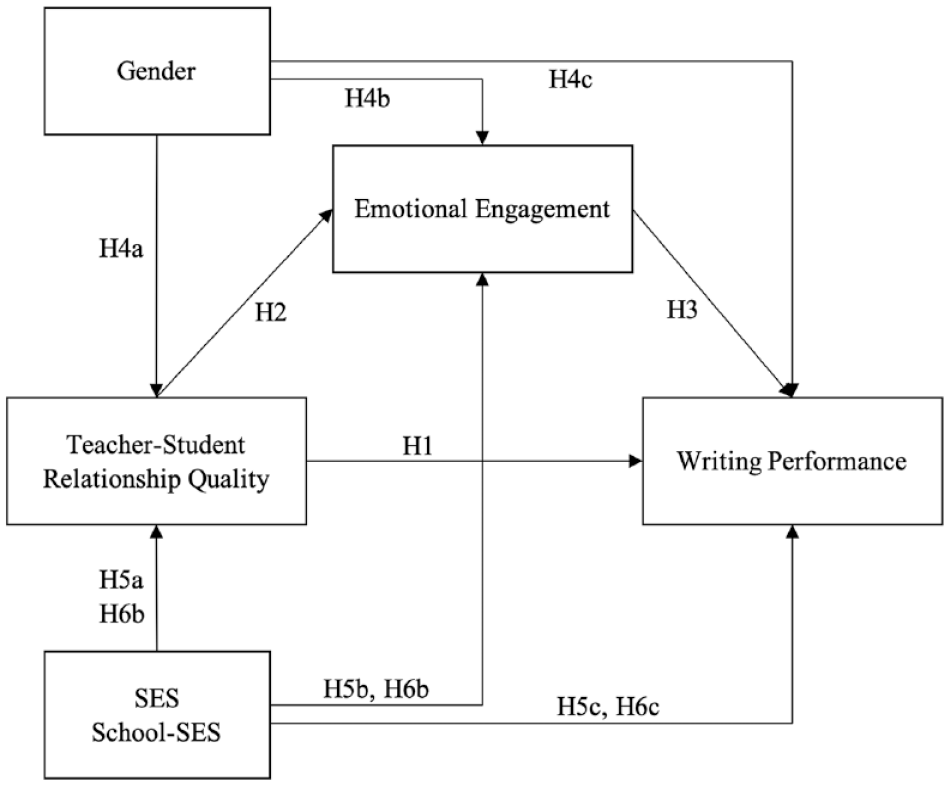
The conceptual model.
III Method
1 Sample
The French sample of the European Survey on Language Competences (ESLC) was utilized in the present study. The ESLC constituted an international comparison of foreign language proficiency among secondary students, with approximately 53,000 students from 16 educational systems participating (European Commission, 2012a). In France, English, as the most commonly taught language, served as the primary target language in the ESLC. To gather contextual information, the ESLC administered questionnaires to students, teachers, and principals, requesting responses on students’ beliefs and behaviors regarding language learning, family background, language instruction, and school characteristics (European Commission, 2012a). This allowed for investigations into the associations between contextual factors and students’ engagement and achievement in the current study. The analysis included 952 students from 67 secondary schools in France. Nearly half of the French sample consisted of female students (49.9%). The mean age of the students was 14.37 years.
2 Measures
a Teacher–student relationship quality
Students were asked to rate their level of agreement with five items that measured their current positive relationships with their teachers. All items were scored on a 4-point Likert-type scale (0 = disagree, 1 = slightly disagree, 2 = slightly agree, 3 = agree). Example items included ‘I get along with my teacher of English,’ ‘I like my teacher of English,’ and ‘My teacher of English is helpful.’ The internal consistency coefficient for the scale was 0.917.
b Emotional engagement in EFL lessons
Each participant was required to indicate the extent to which statements applied to their enjoyment and perceived value of English lessons. The scale comprised three items on a 4-point scale, ranging from 0 (disagree) to 3 (agree). Example items included ‘My English lessons are enjoyable,’ and ‘My English lessons are interesting.’ The scale demonstrated good internal reliability (α = 0.902).
c Writing performance
The writing test in the ESLC consisted of eight writing tasks grouped into three levels. To mitigate fatigue effects, the ESLC employed a balanced incomplete block (BIB) design, where the eight writing tasks were distributed across booklets. Each booklet contained two or three writing tasks, and the tasks were linked across booklets and participants to enable comparison on a common scale using item response theory (IRT). The low-level test (i.e. A1–A2) included two A1 tasks and one A2 task, or vice versa. The middle-level test (i.e. A2–B1) included one A2 task and one B1 task. The high-level test (i.e. B1–B2) comprised one B1 task and one B2 task. The writing task types encompassed writing a postcard, email, or letter, as well as composing a referential or conative article, essay, report, or review. Participants were randomly assigned a booklet. Each booklet had a testing duration of 30–45 minutes. The ESLC employed two criteria, namely language and communication, to assess writing outcomes. Language encompassed vocabulary, cohesion, coherence, and accuracy, while communication referred to task fulfillment, content points, and style appropriateness. Writing performance in the ESLC was reported using a set of five plausible values (PVs), which were random values drawn from posterior distributions and represented the range of writing abilities a learner might reasonably possess. This technique facilitated inferences about writing abilities for all sampled participants and accounted for measurement error (European Commission, 2012b).
d Gender
Each student self-reported gender, which was measured using a dichotomous variable. Female students were coded as 0, and male students were coded as 1.
e SES
SES was assessed using the economic, social, and cultural status (ESCS) index of the ESLC. The index was calculated based on a principal component analysis of three indicators: parental educational status, parental occupational level, and home possessions. Parental educational status was determined by the highest level of education attained by the student’s father, mother, or guardian(s). Parental occupational level was measured using the highest score of the student’s parents’ or guardians’ occupational status. Home possessions were assessed through items related to cultural possessions, educational resources, and family wealth.
3 Analytical approach
The current study employed a quantitative design. The hierarchical structure of the data and the need to examine the hypothesized relationships between the study constructs led to the selection of ML-SEM as the superior method for testing the conceptual model, as compared to conventional multilevel regression modeling and single-level structural equation modeling (SEM). ML-SEM combines the measurement model and structural model across each level of analysis, providing control for sampling error and measurement error, thereby producing unbiased results (Marsh et al., 2012).
The data analysis in this study consisted of several steps. First, following guidelines from prior literature (e.g. Morin et al., 2014), intraclass correlation coefficients (ICCs) were calculated to support the use of ML-SEM. ICC1 was utilized to determine the amount of variance explained by mean differences between schools, while ICC2 indicated the reliability of the group mean. Conventionally, ICC1 should exceed 0.05, and ICC2 should be above 0.70 (Marsh et al., 2009).
Second, the factorial structures and validity of the study constructs were tested using multilevel confirmatory factor analysis (ML-CFA). Measurement invariance across levels was also established by comparing models where factor loadings were freely estimated with models where factor loadings were constrained to be equal across levels. This procedure ensures cross-level comparability of the study constructs and reduces model complexity (Morin et al., 2014).
Third, ML-SEM was employed to simultaneously examine the hypothesized associations between the study constructs across levels of analysis. In ML-SEM, TSRQ, emotional engagement in EFL lessons, writing performance, and SES constructs were modeled at both levels, while gender was only modeled at the student level. Ratings of students from the same school were aggregated to create school-level constructs, including school-average TSRQ, school-average emotional engagement, school-average writing performance, and school-average SES. Figure 2 illustrates the final ML-SEM model.
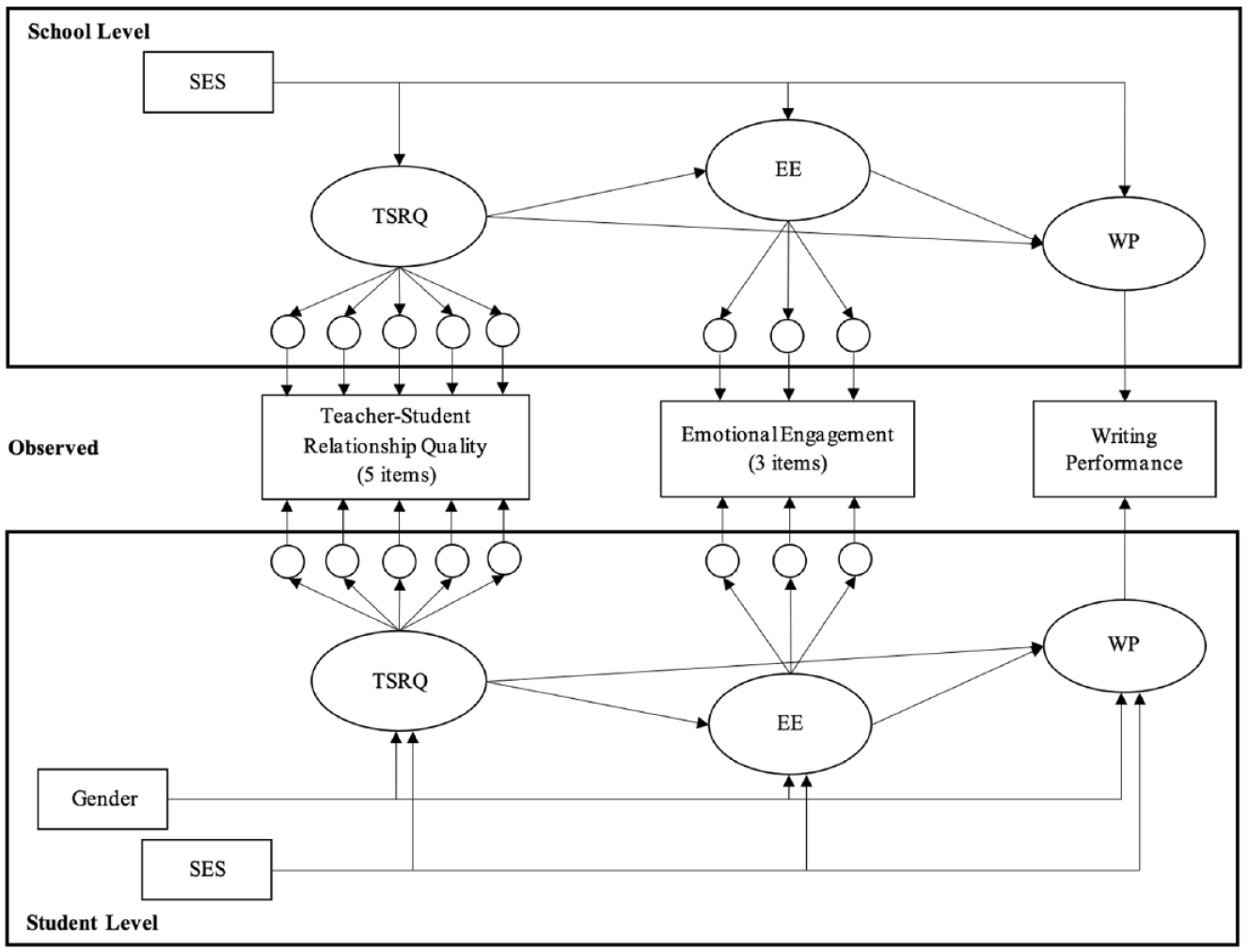
Multilevel structural equation modeling (ML-SEM) model tested in the current study.
Multiple fit indices were reported for model evaluation, including the chi-square statistic (χ2), Comparative Fit Index (CFI), Tucker–Lewis Index (TLI), and root mean square error of approximation (RMSEA). A good-fitting model should have a nonsignificant χ2, CFI and TLI values of .900 or above, and an RMSEA value well below .06. However, it is important to note that the model misfit tends to be overestimated with increasing sample size due to the sensitivity of χ2 to misfit. For comparisons between nested models, several incremental fit indices (i.e. Δχ2, ΔCFI, ΔTLI, and ΔRMSEA) were utilized. A nonsignificant Δχ2 indicates that the more constrained model provides a better fit. If ΔCFI, ΔTLI, and ΔRMSEA values exceed 0.01, the more constrained model should be rejected (Chen, 2007).
To handle missing data, full information maximum likelihood (FIML) estimations were employed. The FIML approach is superior to other methods assuming missing data are completely random, as it generates unbiased results without compromising power (Peugh & Enders, 2004). There were no missing data for writing performance, and the rates of missing data for other variables ranged from 1.3% to 3.6%. Preliminary analyses were conducted using SPSS 26, and Mplus 8.0 was used to estimate all models (Muthén & Muthén, 1998–2017).
IV Results
1 Preliminary analyses
The ICC1 and ICC2 were calculated to determine the proportion of total variance attributed to the school level and to assess group-mean reliability. The ICC1 values for TSRQ, emotional engagement in EFL lessons, writing performance, and SES were 0.132, 0.098, 0.247, and 0.177, respectively, indicating significant variability between schools. The ICC2 values were satisfactory for writing performance (0.823) and SES (0.753), indicating reliable differentiation between schools for these measures. Although the ICC2 values for TSRQ (0.684) and emotional engagement (0.607) were slightly below the desired threshold of 0.70, the latent aggregation process involved in ML-SEM controlled for the source of measurement error and sampling error (Arens et al., 2015).
Table 1 summarizes the fit statistics for the ML-CFA and ML-SEM models. Model A, with freely estimated factor loadings, demonstrated a good fit to the data (χ2 = 149.173, df = 50, CFI = 0.981, TLI = 0.973, RMSEA = 0.046). At the student level, the factor loadings for TSRQ ranged from 0.727 to 0.854, and for emotional engagement in EFL lessons they ranged from 0.825 to 0.875, indicating acceptable values. Similarly, at the school level, the factor loadings were within the satisfactory range for all constructs (0.942 – 0.998 for TSRQ and 0.977 – 1.000 for emotional engagement in EFL lessons). Model B, with constrained factor loadings across levels, also showed a good fit (χ2 = 150.286, df = 56, CFI = 0.982, TLI = 0.977, RMSEA = 0.042). The non-significant change in χ2 between Model A and Model B (Δχ2 (6) = 1.113, p > .05) and the small values of ΔCFI (0.001), ΔTLI (0.004), and ΔRMSEA (0.004) supported the assumption of factor loading invariance across levels.
Goodness-of-fit indices for the ML-CFA and ML-SEM models.
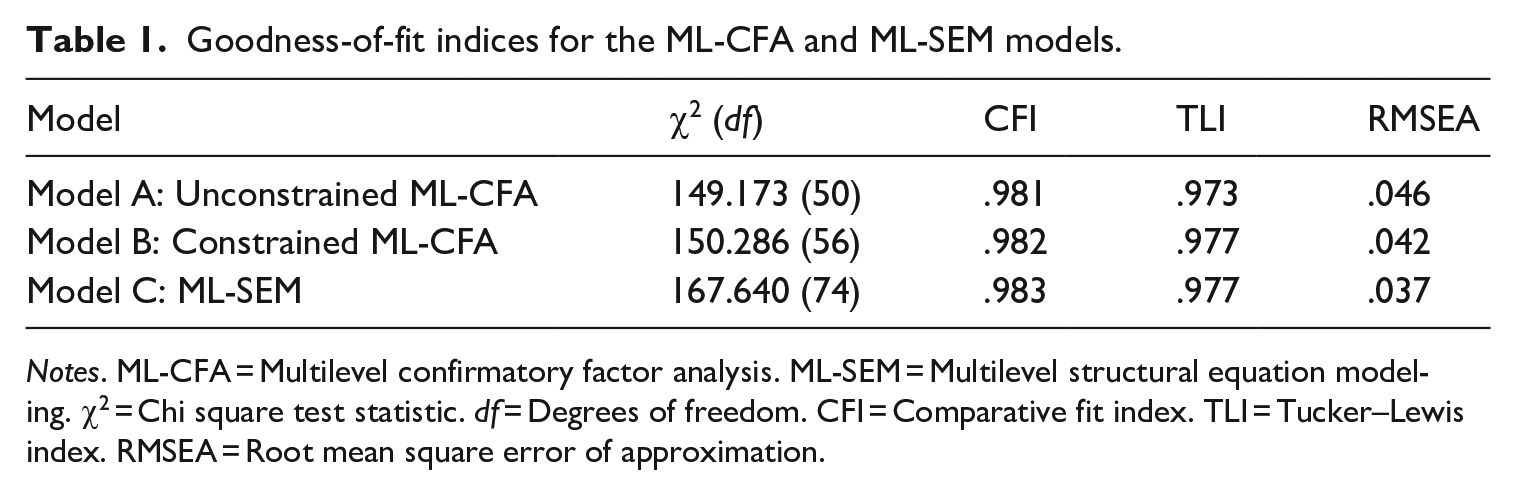
Notes. ML-CFA = Multilevel confirmatory factor analysis. ML-SEM = Multilevel structural equation modeling. χ2 = Chi square test statistic. df = Degrees of freedom. CFI = Comparative fit index. TLI = Tucker–Lewis index. RMSEA = Root mean square error of approximation.
2 The ML-SEM
The final ML-SEM model demonstrated an excellent fit (see Table 1; Model C: χ2 = 167.640, df = 74, CFI = 0.983, TLI = 0.977, RMSEA = 0.037). Path coefficients for Model C are presented in Table 2, and the results of hypothesis testing are summarized in Table 3. Regarding the relationships between TSRQ, emotional engagement in EFL lessons, and writing performance, the results indicated a non-significant association between TSRQ and writing performance at both the student and school levels (β = −0.143, p > .05, and β = 0.225, p > .05, respectively), thereby not supporting Hypotheses 1a and 1b. In line with Hypotheses 2a and 2b, TSRQ was positively related to students’ emotional engagement in EFL lessons at both levels (β = 0.872, p < .001, and β = 0.928, p < .001, respectively). This means that students who had stronger positive relationships with their teachers exhibited higher levels of emotional engagement in EFL lessons. Similarly, schools characterized by higher levels of positive teacher–student relationship quality had greater levels of emotional engagement. Furthermore, students’ emotional engagement in EFL lessons was positively associated with their writing performance at the student level (β = 0.303, p < .01), supporting Hypothesis 3a. Put another way, students engaging more emotionally in EFL lessons were more likely to perform better in writing. However, the expected positive relationship between emotional engagement in EFL lessons and writing performance at the school level was not significant (β = −0.174, p > .05), contradicting Hypothesis 3b.
Effect of each path for the hypothesized multilevel structural equation modeling (ML-SEM) model.
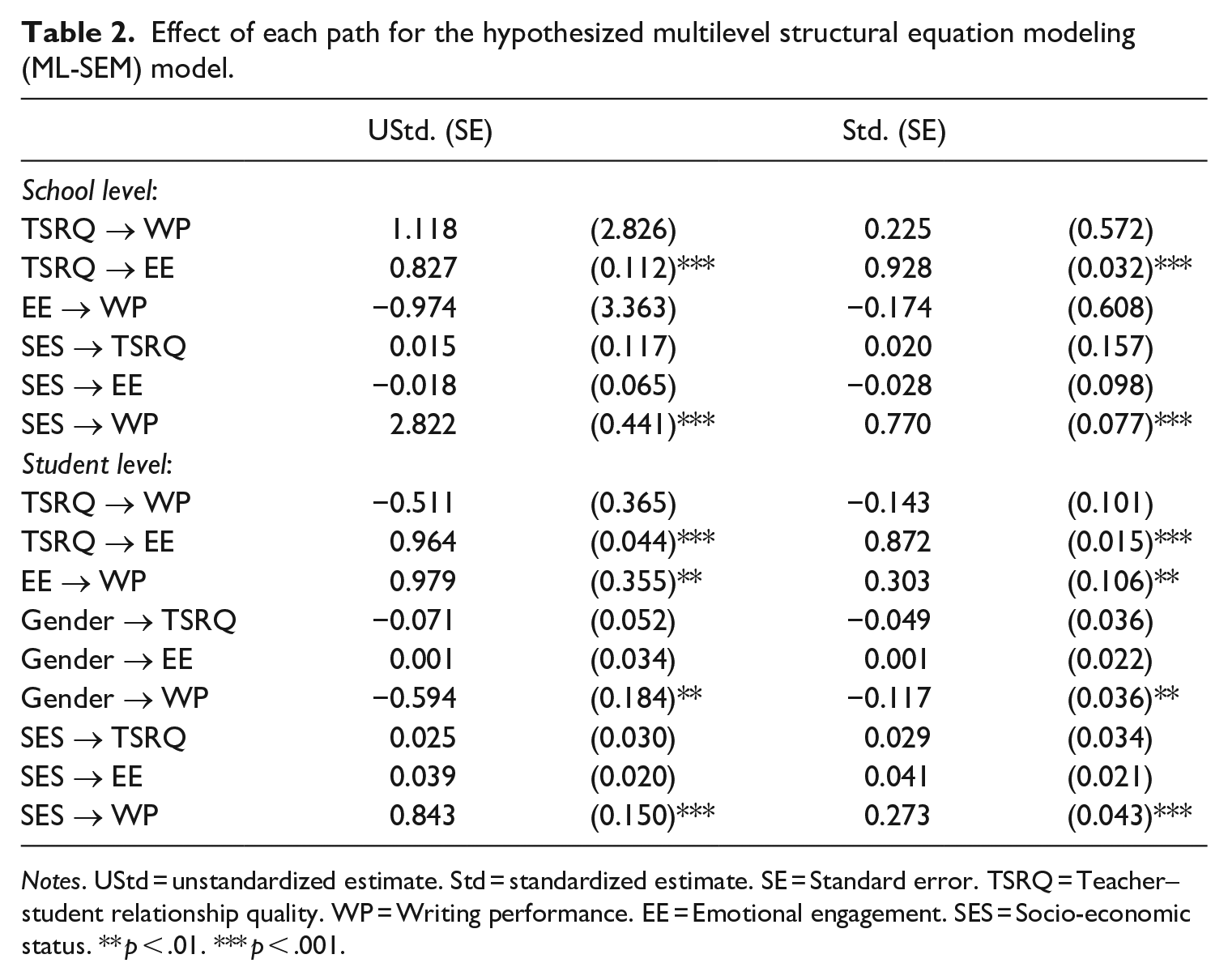
Notes. UStd = unstandardized estimate. Std = standardized estimate. SE = Standard error. TSRQ = Teacher–student relationship quality. WP = Writing performance. EE = Emotional engagement. SES = Socio-economic status. ** p < .01. *** p < .001.
Summary of hypothesis testings.
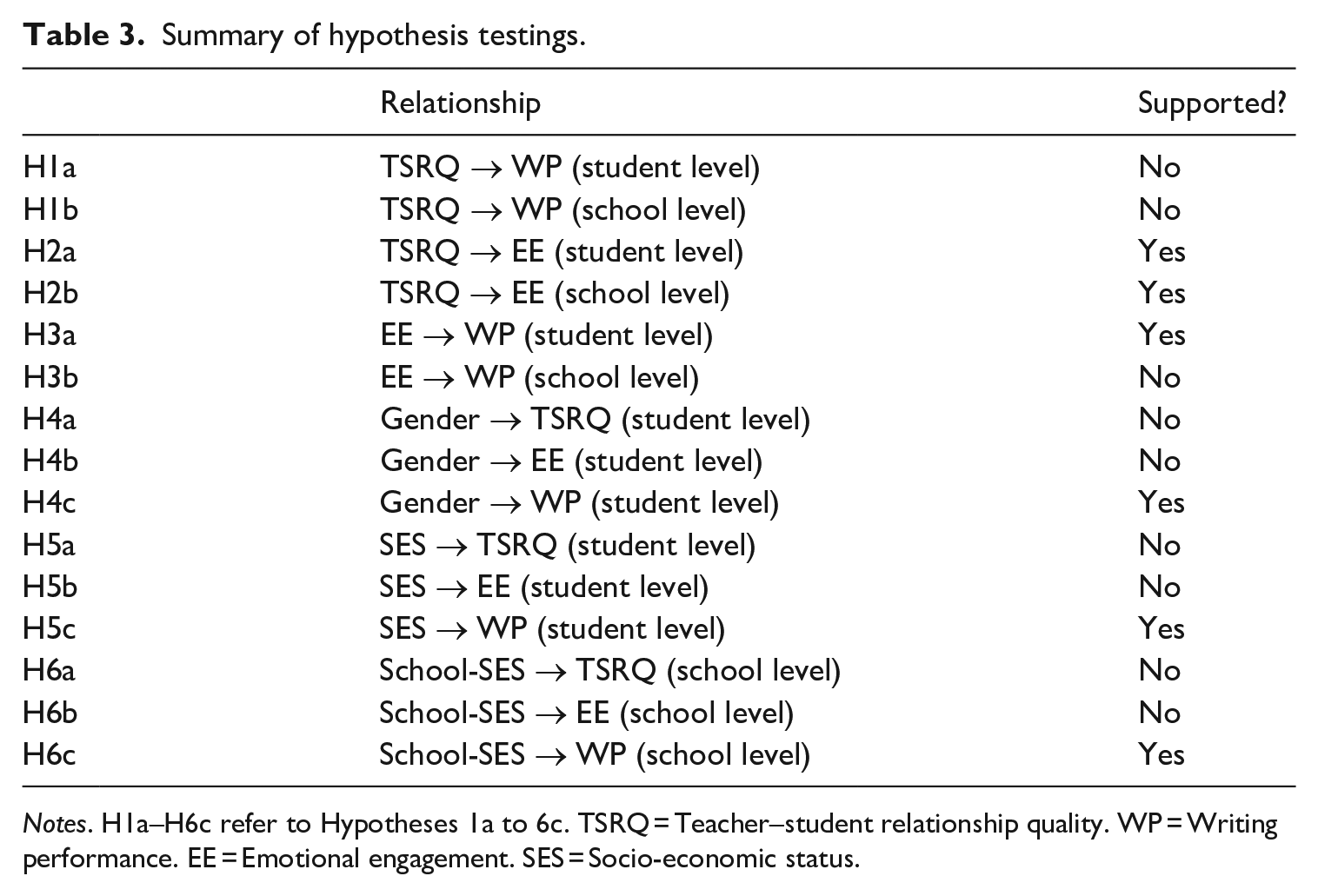
Notes. H1a–H6c refer to Hypotheses 1a to 6c. TSRQ = Teacher–student relationship quality. WP = Writing performance. EE = Emotional engagement. SES = Socio-economic status.
Regarding gender differences, female students exhibited higher levels of writing performance (β = −0.117, p < .01), supporting Hypothesis 4c. However, no gender differences were found in TSRQ and emotional engagement in EFL lessons (β = −0.049, p > .05, and β = 0.001, p > .05, respectively), thus not supporting Hypotheses 4a and 4b.
In terms of SES differences, socioeconomically advantaged students had better writing performance at the student level (β = 0.273, p < .001), in line with Hypothesis 5c. However, no significant associations were found between SES and TSRQ (β = −0.029, p > .05) or between SES and emotional engagement in EFL lessons (β = 0.041, p > .05), thus not supporting Hypotheses 5a and 5b. At the school level, schools with higher average SES demonstrated better writing performance (β = 0.770, p < .001), supporting Hypothesis 6c. However, the relationships between school-SES and TSRQ (β = 0.020, p > .05) and between school-SES and emotional engagement (β = −0.028, p > .05) were not significant, failing to confirm Hypotheses 6a and 6b.
V Discussion
TSRQ shapes a developmental context that plays a prominent role in students’ cognitive development and social-emotional competence (Cornelius-White, 2007). Prior literature, to the best of our knowledge, has not paid enough attention to the focus of the study on the contextual predictor (i.e. TSRQ) of students’ emotional engagement and writing performance in the FL/L2 context. Furthermore, gender and SES differences in the study constructs have not been clarified. Thus, this study applied an ML-SEM approach to explore the associations between TSRQ, emotional engagement in EFL lessons, and writing performance among French adolescents, and to examine the possible gender and SES differences in the three study constructs.
The results of this study provide clear evidence of the positive link between TSRQ and emotional engagement in EFL lessons at both the student and school levels, which is consistent with our hypotheses. Specifically, at the individual level, students with greater positive TSRQ were more likely to engage emotionally in EFL lessons. At the school level, schools characterized by higher levels of supportive teacher–student relationships tended to have higher levels of emotional engagement. These findings contribute to the cumulative evidence demonstrating the prominent role of TSRQ in students’ academic engagement (e.g. Engels et al., 2016; Martin & Collie, 2019; Wu et al., 2010). For instance, Martin and Collie (2019) showed that students’ engagement was immediately sensitive to a shift from positive teacher–student relationships to negative teacher–student relationships. It should be noted that student engagement was measured as a domain-general construct. Martin and colleagues also suggested that further investigations are needed to examine the associations between TSRQ and engagement in each of the school subjects. However, limited evidence has been presented to support this link in the FL context. The findings of the current study filled this research gap and highlighted the roles of TSRQ in students’ writing performance. Consistent with SDT, teachers play an important role in satisfying students’ needs for relatedness, which is beneficial for optimal learning (Deci & Ryan, 2002; Ryan & Deci, 2000). Furthermore, experiencing a teacher–student relationship characterized by closeness, warmth, and trust motivates teachers to dedicate extra time and resources to students, thereby motivating students to be more behaviorally and emotionally engaged in specific curricula and classroom pedagogy that support learning (Hamre & Pianta, 2001). The findings also emphasize the significance of helping students and teachers establish close and warm relationships, which is important for improving students’ writing performance in school and for schools to enhance overall writing performance.
Furthermore, another finding of this study is in line with prior research indicating that emotional engagement is an essential factor in influencing students’ language performance (e.g. Dewaele et al., 2018; Saito et al., 2018). In the current study, the results confirmed the expected positive relationship between emotional engagement and writing performance at the student level, demonstrating that students who were highly emotionally engaged in EFL lessons were more likely to perform better in writing. This evidence extends previous work indicating the positive relationship between positive emotions and writing performance in the FL/L2 contexts (e.g. Huang, 2022). This finding is essential because it has implications for theories of writing, highlights the importance of emotional engagement in EFL classrooms among students, and suggests that school practitioners should seek to promote students’ positive emotions such as enjoyment, hope, and pride through effective interventions in schools. The results also indicated that the link between students’ emotional engagement and writing performance at the school level was non-significant, which is inconsistent with our assumption. One possible explanation is that each learner had individual experiences in emotional engagement and writing performance. The school climate established by emotional engagement may not contribute to the differences in writing performance across schools.
Notable findings from the current study are the nonsignificant relationships between TSRQ and students’ writing performance at both the student and school levels. This lack of significant links is inconsistent with prior research demonstrating that TSRQ matters to academic performance (e.g. McCormick et al., 2013; Roorda et al., 2011). One possible explanation may concern content areas. Prior research has shown that TSRQ was associated with students’ academic performance in different ways across school subjects. For example, McCormick et al. (2013) examined the links between TSRQ and students’ reading and math achievement simultaneously and only found a positive association between TSRQ and students’ achievement in math. Based on the results of the current study and McCormick et al.’s (2013) investigation, TSRQ may not be directly linked to students’ language performance (e.g. reading and writing). Thus, further investigations are needed to examine the relationship between TSRQ and language performance in different domains (e.g. listening and speaking), and to compare the relations across language skills. Another possible explanation is the mediating role of emotional engagement. Some longitudinal evidence has suggested that student engagement fully mediates the link between TSRQ and students’ academic achievement (J. Hughes & Kwok, 2007; J. Hughes et al., 2008). Although this study found positive associations between TSRQ and emotional engagement, and between emotional engagement and writing performance, the cross-sectional nature of this study does not allow for claims of mediation effects. Future studies with a longitudinal design are needed to explore whether emotional engagement serves as a full mediator in the current model. Regarding the non-significant link between TSRQ and students’ writing performance at the school level, one possible explanation is that TSRQ at the school level was created by aggregating students’ ratings at the individual level, which may not accurately reflect the climate of teacher–student relationships in schools. Future research could use other measures that originate from the school level (e.g. teachers’ ratings of TSRQ and classroom observations) to further investigate this link.
Another purpose of the current study was to examine gender and SES differences in TSRQ, emotional engagement in EFL lessons, and writing performance. Consistent with prior compelling empirical evidence in the L1 context (e.g. Babayiğit, 2015; Y.-S. Kim et al., 2015; J. Lee, 2013; Midgette et al., 2008; Reynolds et al., 2015), the results demonstrated a female advantage in writing performance. Specifically, as expected, female students were more likely to perform better in writing compared to male students. Therefore, writing training and intervention programs should pay more attention to male students who are at a greater risk of writing failure compared to their female peers.
As expected, SES emerged as a significant predictor of students’ writing performance at both the student and school levels. Specifically, students from higher SES families were more likely to have higher scores on writing tests. The grouping of socioeconomically advantaged students into a school appears to establish an environment where these students’ writing performance could be higher than what would be expected from their individual SES alone. These findings extend prior investigations indicating that students with higher SES backgrounds tend to perform better in language performance (e.g. Huang, 2022; Zou & Zhang, 2011) and that schools with higher mean SES are more likely to exhibit higher levels of academic achievement (e.g. Palardy, 2013; Rumberger & Palardy, 2005). Furthermore, the results demonstrated a much stronger relationship between school-SES and students’ writing performance compared to the relationship between student-SES and writing performance, aligning with prior empirical evidence (Perry & McConney, 2010). This finding is of great value for school psychologists and practitioners, as it raises awareness of SES differences and has implications for developing specific interventions and programs targeted toward students from low SES backgrounds who are at risk for writing difficulties and failure.
VI Limitations, and suggestions for future research
In spite of the rigorous methods utilized in the current study, several limitations should be noted. First, one limitation concerns the cross-sectional nature of the data, which makes it difficult to determine the causal effects of TSRQ on FL emotional engagement and writing performance, as well as to draw causal inferences about the mediating role of emotional engagement in the relationship between TSRQ and students’ writing performance. To address this limitation, future studies should consider employing a longitudinal design to examine the directionality of the link between TSRQ and emotional engagement or writing performance.
Second, the current study relied solely on students’ self-reported measures of TSRQ. While students’ perceptions provide valuable insights into their relationship experiences with teachers, collecting data from multiple sources, such as teachers’ perceptions and observational data, would offer more comprehensive information about the associations between the study constructs and reduce the potential effects of methodological factors (e.g. shared source variance) on the study results. Comparing results based on different data sources would enhance the interpretation of the findings.
Third, the multidimensionality of engagement has been well established (e.g. Fredericks et al., 2004). Since the current study focused exclusively on emotional engagement, it remains unknown how TSRQ is associated with students’ cognitive and behavioral engagement in EFL lessons, the relationships between cognitive and behavioral engagement and writing performance, and the potential interaction effects of the three engagement components on writing performance. Future research should investigate the mediating roles of cognitive and behavioral engagement in the association between TSRQ and students’ writing performance. Considering the motivational frameworks and empirical evidence highlighting the significant effects of emotional engagement on behavioral and cognitive engagement (Deci & Ryan, 1985; Skinner et al., 2008), it is important for future studies to examine the mediating and moderating roles of cognitive and behavioral engagement in the link between emotional engagement and writing performance.
VII Conclusions
To summarize, despite its limitations, this study makes significant contributions to the literature on writing in several ways. The utilization of ML-SEM allows for the examination of the associations between TSRQ, emotional engagement in EFL lessons, and writing performance. The results clearly demonstrate the positive associations between TSRQ and students’ emotional engagement at both the student and school levels. It is evident that emotionally engaged students were more likely to exhibit higher levels of writing performance. Additionally, the findings indicate that female students outperformed their male peers in writing. The significant links observed between SES and students’ writing performance at both the student and school levels further emphasize the importance of language educators and practitioners conducting interventions to enhance supportive teacher–student relationships, thereby effectively improving students’ emotional engagement and writing performance. Furthermore, the findings highlight the need for the development of specific FL/L2 interventions and training programs targeted towards at-risk students, such as male students and those from low-SES backgrounds, within schools.
Footnotes
Funding
The author disclosed receipt of the following financial support for the research, authorship, and/or publication of this article: The study reported in this article was supported by the Faculty Research Grant (grant number 105105) and the Research Seed Fund (grant number 102254) from Lingnan University, Hong Kong. I would like to express my gratitude to the editors and anonymous reviewers for their valuable comments on an earlier draft of this article.
