







Abstract
Past studies have shown gender differences among English as a foreign language (EFL) learners. However, most of these studies have focused on mean-level differences using variable-centered analyses. Studies have seldom explored similarities and differences in motivational profiles using person-centered approaches. To bridge this gap, we examined the motivational profiles of boys and girls and explored how these profiles were associated with basic psychological needs support, and academic achievement. A total of 582 Chinese EFL learners participated in the study. Profiles were created based on students’ scores on autonomous and controlled motivation. Results indicated that four distinct profiles emerged for both boys and girls: ‘low quantity motivation’ (low autonomous and controlled motivation), ‘poor quality motivation’ (low autonomous but high controlled motivation), ‘moderate motivation’ (moderate autonomous and controlled motivation), and ‘high quantity motivation’ (high autonomous and controlled motivation) EFL learners. Specifically, the ‘moderate motivation’ group had different levels of autonomous and controlled motivation, with boys exhibiting a higher controlled motivation and girls scoring higher in autonomous motivation. There was also a higher prevalence of ‘poor quality’ motivation among boys. Predictors of profile membership varied across genders. Competence was a stronger predictor of profile membership for boys but autonomy and relatedness were stronger predictors for girls. Theoretical and practical implications are discussed.
I Introduction
Gender differences in English as a foreign language (EFL) learning have been widely documented, with girls generally outperforming boys (e.g. Główka, 2014; Guo et al., 2023; Oga-Baldwin & Nakata, 2017). Some researchers claimed that gender differences in EFL learning might result from students’ varying levels of motivation (Vonkova et al., 2021). Motivation, the driving force behind one’s actions, is among the most important determinants of EFL learners’ effort, persistence, and academic achievement (e.g. Chen et al., 2023; Oga-Baldwin & Fryer, 2020a, 2020b). According to self-determination theory (SDT), motivation is multidimensional, as individuals might have different underlying reasons for performing tasks (Ryan & Deci, 2020). SDT distinguishes between autonomous and controlled types of motivation. For example, some students learn a foreign language out of pure interest or because they recognize its value (i.e. autonomous motivation), and some other students learn a language because of external stimuli such as pursuing rewards or avoiding losing face (i.e. controlled motivation).
However, such diversity in motivation has not been given enough attention in explaining the gender differences in EFL learning. Most researchers explored boys’ and girls’ autonomous motivation and controlled motivation by relying on variable-centered approaches such as correlational analysis, linear regression analysis, and structural equation modeling (e.g. Alamer & Alrabai, 2023; Haw & King, 2022; Joe et al., 2017; Oga-Baldwin & Nakata, 2017; Oga-Baldwin et al., 2017). Despite the rich amount of knowledge that has been obtained, variable-centered approaches focus on the average level of girls’ and boys’ motivation and overlook the heterogeneity of students’ motivation (M. Liu & Oga-Baldwin, 2022). Hence, not much is known about possible differences in motivational profiles across gender. For example, the motivational patterns among boys and girls might vary. Person-centered approaches allow for different configurations of autonomous and controlled motivation within each gender group. In addition, according to self-determination theory, basic psychological needs and academic achievement are typically considered antecedent and outcome factors closely related to motivation (e.g. Al-Hoorie et al., 2022; Noels et al., 2019). However, to the best of our knowledge, the generalizability of motivational profiles and the extent to which the motivational profiles are similarly associated with basic psychological needs and academic achievement across genders remains underexplored.
In this study, we focused on unpacking the variations in foreign language learning motivation among boys and girls. We used the multigroup latent profile analysis (MG-LPA) method to gain an in-depth understanding of configurations of autonomous and controlled motivation among Chinese EFL learners and examined whether profile memberships and their associations with basic psychological needs and academic achievement were similar or different across genders.
II Literature review
1 Self-determination theory
Self-determination theory (SDT), as one of the most established frameworks for understanding human motivation, has been widely applied in prior research. It differentiates autonomous motivation from controlled motivation (Ryan & Deci, 2020). Autonomous motivation occurs when the student engages in activities out of enjoyment and inherent satisfaction (i.e. intrinsic motivation) or because one recognizes the importance and relevance of the activities (i.e. identified regulation). Controlled motivation denotes student engagement in activities because they are afraid of losing face in front of others such as friends, teachers, or parents (i.e. introjected regulation) or compelled by external punishments and rewards (i.e. external regulation) (Ryan & Deci, 2020). Prior investigations have documented that students benefit more from autonomous motivation in EFL learning as it could facilitate positive outcomes such as engagement, enjoyment, well-being, persistence, and academic achievement, whereas controlled motivation could lead to maladaptive outcomes (Al-Hoorie et al., 2022; McEown & Oga-Baldwin, 2019).
The basic psychological needs mini-theory of SDT posits that motivation is dependent on the fulfillment of basic needs for autonomy, competence, and relatedness (Ryan & Deci, 2020). Autonomy pertains to the desire to exhibit behaviors that are self-endorsed or have a clear rationale; competence refers to the need for a sense of ability to effectively engage in desired tasks; and relatedness concerns the need for a close connection with others (Vansteenkiste et al., 2020). The positive relationship between EFL learners’ basic psychological needs and motivation has been supported in prior studies (e.g. Alamer, 2022; Alamer et al., 2023; Noels, 2023; Shirvan & Alamer, 2022; Zhou et al., 2021).
In recent years, researchers have noted gender variations in motivation. Some of them found that girls tend to exhibit higher levels of autonomous motivation, while boys are more likely to show higher levels of controlled motivation in EFL learning (Oga-Baldwin & Fryer, 2020b). Nonetheless, various combinations of autonomous and controlled motivation might exist in different gender groups. Boys and girls might have different configurations of basic psychological needs and academic achievement. A more holistic understanding of the generalizability of motivational profiles across genders and their relationships with antecedents and outcomes is needed, especially in the context of EFL learning. Such an investigation could provide more nuanced information on gender differences from the perspective of SDT.
2 Previous research investigating motivational profiles
In recent years, emerging research grounded on the SDT has probed motivational profiles (e.g. Al-Hoorie et al., 2022; Baars & Wijnia, 2018; Denault et al., 2022). Previous empirical studies commonly found four theoretically consistent profiles. These four profiles are well aligned with prior research conducted by Vansteenkiste et al. (2009). The first profile is characterized by low levels of autonomous and controlled motivation, which is named ‘low quantity’ motivation. The second profile, ‘poor quality’ motivation, is characterized by low autonomous but high controlled motivation. The third type is ‘high quantity’ motivation, which is represented by high scores on both autonomous and controlled motivation. The last type is ‘good quality’ motivation, featuring high scores on autonomous but low scores on controlled motivation.
In the realm of foreign language learning, Oga-Baldwin and Fryer (2020a) explored the profiles of motivation for learning Japanese and English among Japanese learners. Aside from four common profiles, there was a group of students who exhibited moderate quantity motivation for both languages. They concluded that a strong overlap between profiles for one’s first (i.e., Japanese) and second (i.e., English) language. In a similar vein, M. Liu and Oga-Baldwin (2022) looked into the different configurations of motivational beliefs among EFL learners and learners of multiple foreign languages with Chinese university students. They concurrently studied English and a language other than English. Results showed that students were categorized into four profiles (i.e. amotivated, poor quality, moderate quality, and high quantity motivation) based on their English motivation and were categorized into three profiles (i.e., amotivated, medial, and high quantity) according to their motivation for learning a language other than English. Their study demonstrated high between-person (the existence of subgroups) and between-language heterogeneity (the differences in motivational profiles) in identified profiles.
To date, Oga-Baldwin and Fryer’s (2020b) paper is the only study that identified the configurations of motivational beliefs of boys and girls. Drawing on a sample from Japanese EFL learners in elementary school, both boys and girls were categorized into three groups: ‘poor quality motivation’, ‘good quality motivation’ and ‘high quantity motivation’ EFL learners. They found that boys were more likely to be externally motivated, while girls tended to show higher intrinsic motivation. However, the study conducted by Oga-Baldwin and Fryer (2020b) only focused on a small facet of SDT theory. Though motivational profiles across gender were identified, they did not explore the linkage between these profiles, antecedents, and outcomes. Part of the theoretical consideration of SDT is that motivation is a multidimensional construct and is predicted by basic psychological needs. Therefore, the scope of SDT theory was not fully reflected in their study. Furthermore, their research focused on Japanese students and these findings might not necessarily generalize to Chinese learners.
Some studies have found that controlled motivation is not always maladaptive in collectivistic countries such as China, Japan, and Singapore, where students might regard learning as a family obligation and be comfortable with external forces (e.g. Caleon et al., 2015; King & McInerney, 2014, 2019; Li et al., 2022; Y. Liu et al., 2020). Some researchers have claimed that controlled motivation is more normative in Eastern cultures and might result in desirable outcomes in some conditions (e.g. Zhu & Leung, 2011). Although the Japanese and Chinese share certain attributes, students might exhibit different motivational patterns (King et al., 2019; Li et al., 2023; Markus, 2016). Given past studies, our hypotheses are as follows:
• Hypothesis 1: Boys and girls will have similar motivational profiles.
• Hypothesis 2: Boys’ and girls’ motivational profiles will differ in terms of mean levels, dispersion, and distribution.
3 Basic psychological needs satisfaction as a predictor of motivation
Autonomy, competence, and relatedness are three basic psychological needs according to the SDT. The need for autonomy is pertinent to the desire to feel volitional while engaging in actions. The need for competence refers to the desire to feel in control of tasks at hand. And the need for relatedness is related to the feeling of belonging and connectedness with others (Ryan & Deci, 2020). Ryan and Deci (2020) posited that students flourish when these needs are satisfied, otherwise academic achievement would be thwarted. In the EFL context, studies have provided empirical evidence for the positive relationship between basic psychological needs support and motivation (e.g. Alamer & Lee, 2019; Shelton-Strong, 2022; Shirvan & Alamer, 2022; Xu & Qiu, 2022). For example, Al-Hoorie et al. (2022) systematically reviewed past studies using SDT in second language research, and they found that satisfying basic psychological needs is expected to build students’ motivation. In the same vein, Noels et al. (2019) revealed the reciprocal interplay between basic psychological needs and motivation in the EFL context. Some other researchers elucidated that those three basic psychological needs were not equally important, though much of this work was not in the context of EFL learning (e.g. Bureau et al., 2022; Lin & Reinders, 2019). For example, Bureau et al. (2022) meta-analysed 144 studies and concluded that competence is the strongest positive predictor of self-determined motivation, followed by autonomy and relatedness. Despite a substantial volume of evidence for the facilitating role of basic psychological needs on academic achievement, how the relationship between basic psychological needs and motivation varies by gender remains unclear. Given evidence of the positive association between basic psychological needs satisfaction and motivation, we posited the following hypothesis:
• Hypothesis 3: Profile membership will be positively associated with basic psychological needs satisfaction in both genders.
4 Academic achievement as an outcome of motivation
Motivation is a critical precursor of academic achievement. Motivated students are willing to devote more energy and time to tasks and thereby obtain high academic achievement (e.g. Alamer & Alrabai, 2023; Dunn & Iwaniec, 2022; Oga-Baldwin & Nakata, 2017; X. Wang, 2022; Yu et al., 2022). This applies to both boys and girls. Nonetheless, girls normally have higher autonomous motivation and better academic achievement relative to their counterparts (e.g. Bonneville-Roussy et al., 2017; Carreira, 2011; Główka, 2014; Oga-Baldwin & Fryer, 2020b). However, very little attention has been dedicated to unpacking gender differences in the relationship between motivation and academic achievement. In line with the previous evidence concerning the positive associations between motivation and academic achievement, the following hypothesis was put forward:
• Hypothesis 4: Profile membership will be positively associated with academic achievement in both genders.
5 Multi-group latent comparisons of profile solutions
Multigroup latent profile analysis (MG-LPA; Morin et al., 2016) is a comprehensive framework to conduct systematic and thorough comparisons of profile solutions. Six steps were put forward to detect the similarity of profile solutions across samples, including the configural (number of profiles), structural (within-profile means), dispersion (within-profile variance), distributional (profile size), predictive (the relationship with predictors), and explanatory (the relationship with outcomes) similarity.
In the first step, the number of profile solutions for each sample was compared. Second, a test for structural similarity is performed, and it aims to determine to what extent the within-profile means are similar across groups. Third, the dispersion similarity is conducted, which assesses whether the within-profile variability can be viewed as similar across subgroups. In the fourth step, distributional similarity is tested, and it explores the extent to which the profile sizes are similar across subgroups. The fifth and sixth steps which is about predictive and explanatory similarity aims to determine whether the profiles are similarly related to their key predictors and outcomes.
As noted by Morin et al. (2016), it is critical to systematically compare person-centered solutions to ascertain that the extracted profiles are generalizable across samples. MG-LPA has grown in popularity in various domains, such as general education (Litalien et al., 2017a, 2017b, 2019), mathematics (Fan et al., 2019), language learning (L. Ma et al., 2021), but has been less applied in the EFL learning field. Using MG-LPA in the EFL context might also yield rich findings.
6 The Chinese EFL context
English is highly valued and is one of the compulsory courses in schools. Most Chinese students have to learn English starting at primary three. Some even start learning English from primary one (Ministry of Education of the People’s Republic of China, 2001). English accounts for the largest proportion of total scores together with Chinese and mathematics. However, since the medium of instruction for most English classes is Chinese, it is not surprising that students get limited exposure opportunities for English learning.
A large proportion of Chinese EFL learners scored high on controlled motivation as they regard learning as not only a family obligation but also a social responsibility (e.g. Cheng & Lam, 2013; King, 2022; Y. Liu et al., 2020; L. Ma et al., 2021). Many of them study for the sake of others. They are taught to contribute to their families and society from an early age. Thus, they tend to internalize some extrinsic values such as the expectations of others and society. Their learning might not be purely out of interest or enjoyment (e.g. Cheng et al., 2016; Li et al., 2022; Y. Liu et al., 2020; M.T. Wang et al., 2020).
III Method
1 Participants and procedures
Convenience sampling was used in recruiting students. A total of 582 Chinese junior secondary school students were recruited, with 293 boys and 289 girls. Their age ranged from 11 to 14 years (Mage = 12.78, SD = .66). They were from four schools located in a northwest province in China. Two schools were public and the remaining two were private schools.
Approval was obtained from the research ethics committee of the first author’s university. Upon the approval of the school principals, the informed consent form was collected from participating schools, students’ guardians, and students. The aims and duration were announced before the study. Students and their guardians were informed of the voluntary nature of the study. They were also informed that the data collected would be only used for research purposes and kept confidential. The questionnaires were distributed before the test.
2 Measures
a Motivation
Students’ motivation was assessed using 12 items derived from the Self-regulation Questionnaire – Academic by Ryan and Connell (1989), the Language Learning Orientation Scale by Noels (2001), and the Japanese version of the Self-Regulation Questionnaire (Oga-Baldwin & Nakata, 2017). Four components were included: intrinsic motivation, identified regulation, introjected regulation, and extrinsic motivation. Each subscale has three items. Intrinsic motivation refers to studying English for the sake of enjoyment or out of pure interest (e.g. ‘Learning English is interesting’). Identified regulation for learning pertains to learners self-endorsing the importance of learning English (e.g. ‘Learning English is good for my personal development’). Introjected regulation for learning English concerns studying to maintain one’s self-worth (e.g. ‘I would feel guilty if I don’t know English’). External regulation for learning English is related to students driven by external factors such as getting good grades or avoiding reprimands (e.g. ‘So my English teacher would not get mad at me’). 1 Students rated from 1 (‘strongly disagree’) to 7 (‘strongly agree’). The reliabilities of students’ responses to intrinsic motivation, identified regulation, introjected regulation, and extrinsic motivation were .89, .91, .82, and .87, respectively.
b Predictor: Basic psychological needs satisfaction
The Basic Psychological Needs of Second Language Scale by Alamer (2022) was employed to assess students’ psychological needs satisfaction. It is comprised of three dimensions, entailing autonomy, competence, and relatedness support. Twelve items were employed with each dimension having three items. An example item for autonomy is ‘I am able to freely decide my own pace of learning in English’, an example item for competence is ‘I feel I am capable of learning English’, and an item measuring relatedness is ‘My English teacher is friendly and cordial with me.’ Students were required to respond to these items with 1 (strongly disagree) to 7 (strongly agree). The Cronbach’s alpha coefficient for autonomy, competence, and relatedness were .78, .89, and .91, respectively.
c Outcome: Academic achievement
Students’ academic achievement was measured with the practice version of the TOEFL Junior Standard Test which was developed by the Educational Teaching Service (ETS, 2022a, 2022b). TOEFL Junior Standard Test is particularly designed for students aged 11+ years (ETS, 2022c). The reliability and validity of the test have been widely tested (e.g. Eberharter et al., 2023; Kim, 2023; Wallace, 2022). Students’ reading and listening comprehension were tested by adopting four passages and four sets of listening comprehension. They were asked to choose the most appropriate expressions among the four choices. There are 20 items in each part, and each correct response was awarded one point and no punishment for the wrong answer. The total score was 40 which was transformed into 100. Sample questions for reading and listening comprehension are shown in the supplemental materials (section two).
3 Data analysis
The proportion of missing values ranged from 0% to 1.2% (academic achievement). Full information maximum likelihood was used to deal with missing data, which is an extensively adopted method to yield parameter estimates similar to imputation via using full information (Graham, 2012; Little & Rubin, 2019). Multi-group confirmatory factor analysis (MG-CFA) was employed to provide evidence for the measurement invariance of a two-factor model (autonomous and controlled motivation). Three steps were involved, including configural, metric, and scalar invariance tests. The configural model is the baseline model, which aims to examine whether the overall factor structure was equivalent across gender. Then, constraints on factor loadings and intercepts were added to the model step by step. Therefore, the metric and scalar invariance model was tested. Only when the invariant of factor loadings and intercepts were established can we make meaningful comparisons across gender (van de Vijver & Leung, 2021). No change larger than 0.01 in CFI evidences the invariance of the measurement model (Cheung & Rensvold, 2002).
Next, single latent profile analyses were carried out to explore the distinct configurations of autonomous and controlled motivation among boys and girls. In classifying latent profiles, we used the composite score of intrinsic motivation and identified regulation to represent autonomous motivation, while we employed the composite score of introjected regulation and extrinsic motivation to indicate controlled motivation. Multiple indicators helped with identifying the most appropriate profiles for each gender group, including Akaike Information Criterion (AIC), the Bayesian Information Criterion (BIC), the Sample size Adjusted BIC (SALBIC), the Likelihood Ratio Test (LRT), Bootstrap Likelihood Ratio Test (BLRT) and entropy. To be specific, lower values on AIC, BIC, and SABIC suggest a better-fitting model (B. Muthén & Asparouhov, 2012; Nylund et al., 2007). LRT and BLRT concern the comparison between a k and k–1 model. When there is a significant p-value regarding LRT and BLRT, the k-1 profile model outperformed the k-profile model. Moreover, the entropy value ranges from 0 to 1, with a higher value indicating accurate classification. The theoretical interpretability of profiles should also be taken into account when selecting the optimal number of profiles (Marsh et al., 2009). The interpretation and representativeness of each profile were also considered, with the condition that the sample size of the smallest cluster should be above 5% of the total sample (Ferguson et al., 2020).
To assess the similarity of profile solutions across gender, multigroup LPA using the KNOWNCLASS command was performed with Mplus 8.3 (L.K. Muthén & Muthén, 2019). Following the six steps proposed by Morin et al. (2016), we systematically compared the means, variance, and profile composition of profile solutions for each gender, as well as their relationship with predictors and outcomes. The configural, structural, dispersion, distribution, predictive, and explanatory similarity of profiles across gender were evaluated in sequence. MG-LPA involves comparing the less constrained model with the equality-constrained model by using a set of indices, involving AIC, BIC, and aBIC. At least two of three values lower than the less constrained model means that similarity across gender was supported by data (Morin & Wang, 2016). The syntax for the MG-LPA is displayed in the supplemental materials (section three). The MODEL CONSTRAINT function was used to test the predictive similarity and explanatory similarity of profiles. By constraining the logistic regressions to be equal, predictors (i.e. psychological needs support) were incorporated into the model to check the predictive similarity of profiles. Finally, we proceed to the explanatory similarity analysis which constrained the equality of outcomes (i.e. academic achievement) across gender.
IV Result
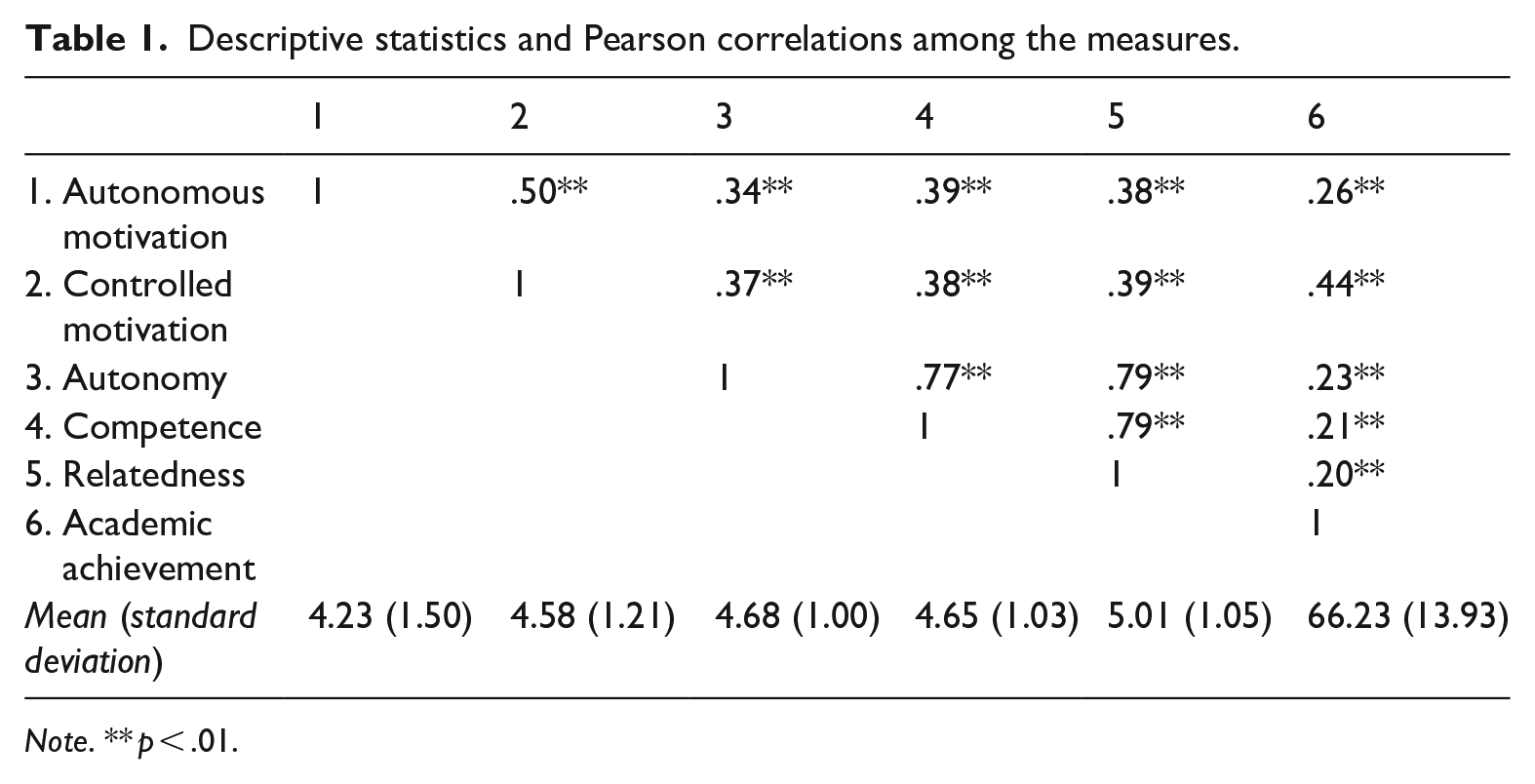
Table 1 depicts the correlations among variables. All variables were significantly related to each other. Results of MG-CFA illustrated students’ responses to the motivation questionnaires are comparable. First, the configural invariance model suggested a good fit (CFI = .978, TLI = .970, RMSEA = .060 [048, .072], SRMR = .037). Then, we tested for the metric and scalar invariance of the model. Results suggested that both metric and scalar invariance were supported as no change larger than the suggested threshold .001, wherein, metric invariance test: CFI = .979, TLI = .973, RMSEA = .058 [.046, .069], SRMR = .040, △CFI = .001; and scalar invariance test: CFI = .979, TLI = .975, RMSEA = .055 [.044, .067], SRMR = .041, △CFI < .001. Therefore, the comparison in motivation across gender is reasonable.
Descriptive statistics and Pearson correlations among the measures.
Note. ** p < .01.
1 Motivational profiles
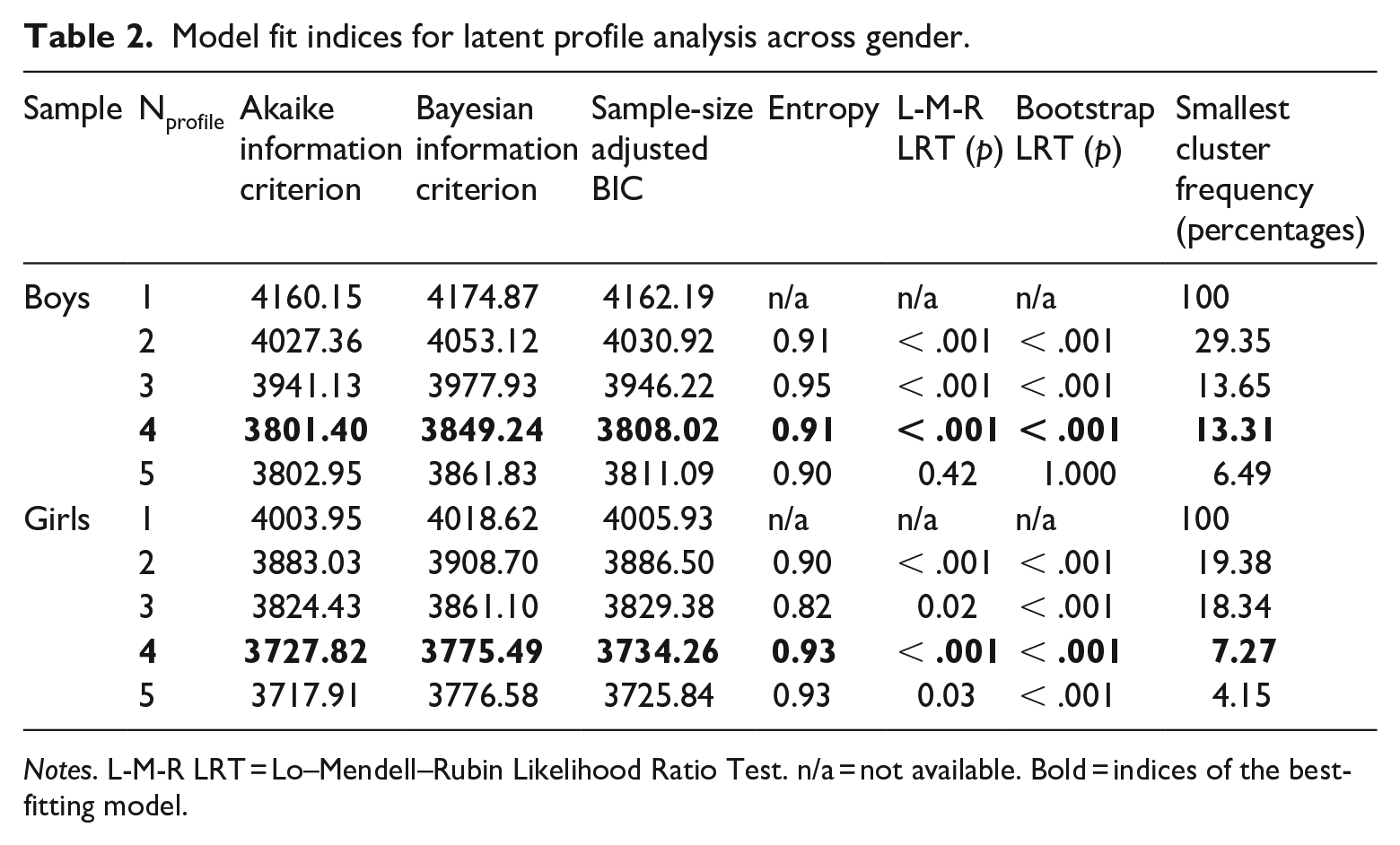
The goodness-of-fit indices for 1- to 5-profile solutions estimated for each gender group are displayed in Table 2. AIC, BIC, and SABIC kept on declining with the addition of latent profiles but tended to flatten around 5 profiles for both genders. To make it clearer, elbow plots are reported in supplemental materials (section four). Meanwhile, nonsignificant L-M-R LRT added evidence that a 4-profile solution is sufficient for boys. As for girls, the L-M-R LRT for the 5-profile solution is significant, suggesting the 5-profile differs from the 4-profile solution. The smallest sample size for the subgroups of the 5-profile solution is less than 5% of the total sample. After taking theoretical and empirical interpretability into account, the 4-profile solution was retained for both genders.
Model fit indices for latent profile analysis across gender.
Notes. L-M-R LRT = Lo–Mendell–Rubin Likelihood Ratio Test. n/a = not available. Bold = indices of the best-fitting model.
The 4-profile solution provides a good classification accuracy, with an entropy of .91 for boys and .93 for girls. We named four groups as ‘low quantity’ (low autonomous and controlled, nboy = 39, 13.31%; ngirl = 32, 11.07%), ‘poor quality’ (low autonomous, high controlled, nboy = 42, 14.33%; ngirl = 21, 7.27%), ‘moderate motivation’ (medium autonomous and controlled, nboy = 129, 44.03%; ngirl = 162, 56.06%) and ‘high quantity’ (high autonomous and controlled, nboy = 83, 28.33%; ngirl = 74, 25.61%).
2 Similarity of the profiles across gender
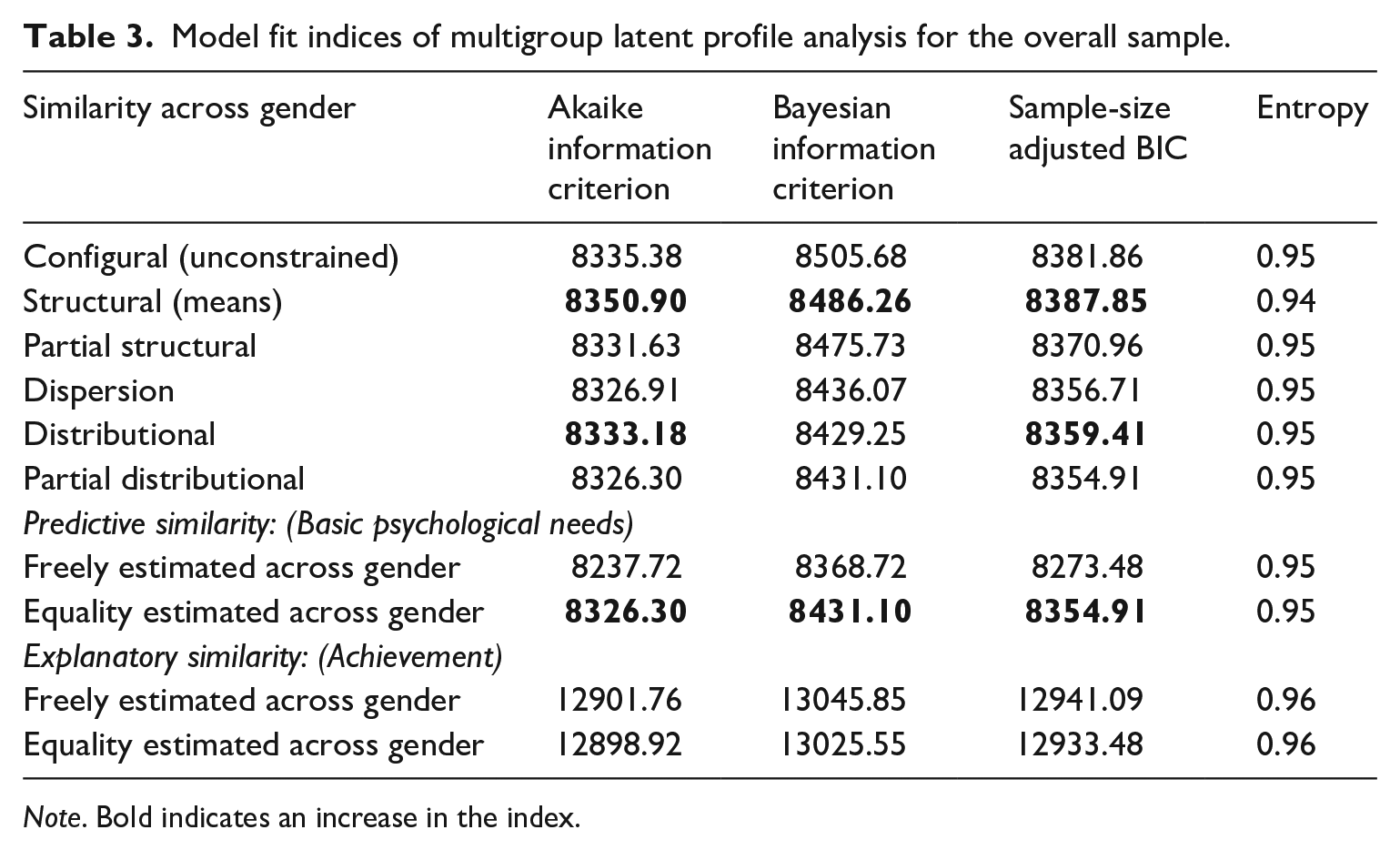
The fit indices for the gender similarity model are reported in Table 3. The configural (unconstrained) model was first estimated which serves as the baseline model for further comparison. Then, we proceeded to test the structural similarity wherein the means of profiles were constrained to be equal. Results showed that AIC, BIC, and SABIC saw increases relative to the configural model, meaning that the structure of profiles was not fully invariant across genders. Hence, we tested partial structural similarity with one out of four profiles differing across gender. This model resulted in lower values on the AIC, BIC, and SABIC when compared to the configural similarity model. Thus, it was retained for the following steps.
Model fit indices of multigroup latent profile analysis for the overall sample.
Note. Bold indicates an increase in the index.
Dispersion similarity was also supported as lower values were obtained on all indices relative to the indices in the partial structural model, meaning that the profiles identified were homogeneous across gender groups. In other words, this indicates that the within-profile variability of boys and girls is equivalent. In the last step, the distributional similarity across gender was estimated. Higher values on AIC and SABIC were observed, thereby the distributional (relative sizes or class probabilities) similarity was not established. This implies that the relative sizes of profiles differed across gender. To dig into the proportion of students assigned to each profile, we estimated the partial distributional similarity model, in which one of the profiles was allowed to differ across gender. Results showed lower values compared with the model of dispersion similarity.
Figure 1 presents the profiles. Profile 1 features low autonomous and controlled motivation, which corresponds to the ‘low quantity motivation’ profile; Profile 2 is characterized by low autonomous but high controlled motivation and is labeled as the ‘poor quality motivation’ group; Profile 3, which had average levels of motivation, was named as ‘moderate motivation’ group; Profile 4 scored high on both the autonomous and controlled motivation, so it was labeled as ‘high quantity motivation’.
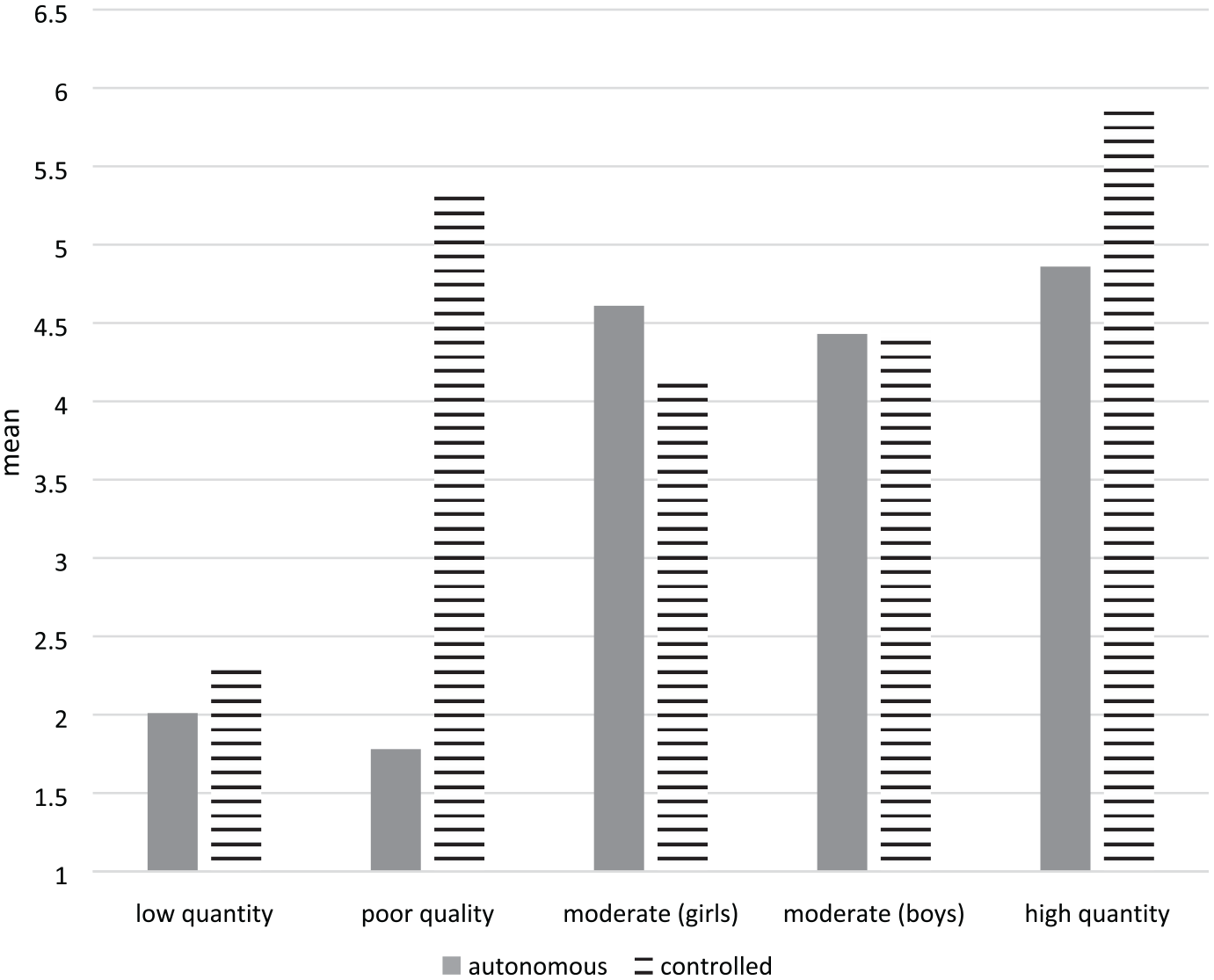
Profile composition.
The structure (i.e., means) of three out of four profiles (i.e., low quantity, poor quality, and high quality) were equivalent with only one exception. The nature of the ‘moderate motivation’ EFL learners differ across genders. Girls exhibited higher autonomous motivation relative to controlled motivation. Meanwhile, our study did not identify significant within-profile variability, denoting boys and girls were homogeneous within each profile. The ‘low quantity motivation’, ‘moderate motivation’, and ‘high quantity’ groups accounted for similar proportions but the ‘poor quality motivation’ group was more prevalent among boys.
3 Predictors of profile membership
Starting from the retained model, basic psychological needs support entailing autonomy, competence, and relatedness supports were added as predictors. All information indices increased after posing equality constraints to the model. This demonstrates that a divergent pattern emerged concerning the associations between basic psychological needs and students’ motivational profiles. Given that the dependent variable (i.e. profile membership) is categorical, the multinomial logistic regression was employed. Odds ratios (OR), as a key indicator, reflect the probability of belonging to a particular profile as opposed to a referent profile for each unit increase in the predictors. Table 4 shows the results of the multinomial logistic regression. Boys who received more competence support showed a higher likelihood to be members of ‘high quantity motivation’ relative to ‘low quantity motivation’ (OR = .78) and ‘low quality motivation’ (OR = .80).
Logistic regression explaining the probabilities of profile membership.
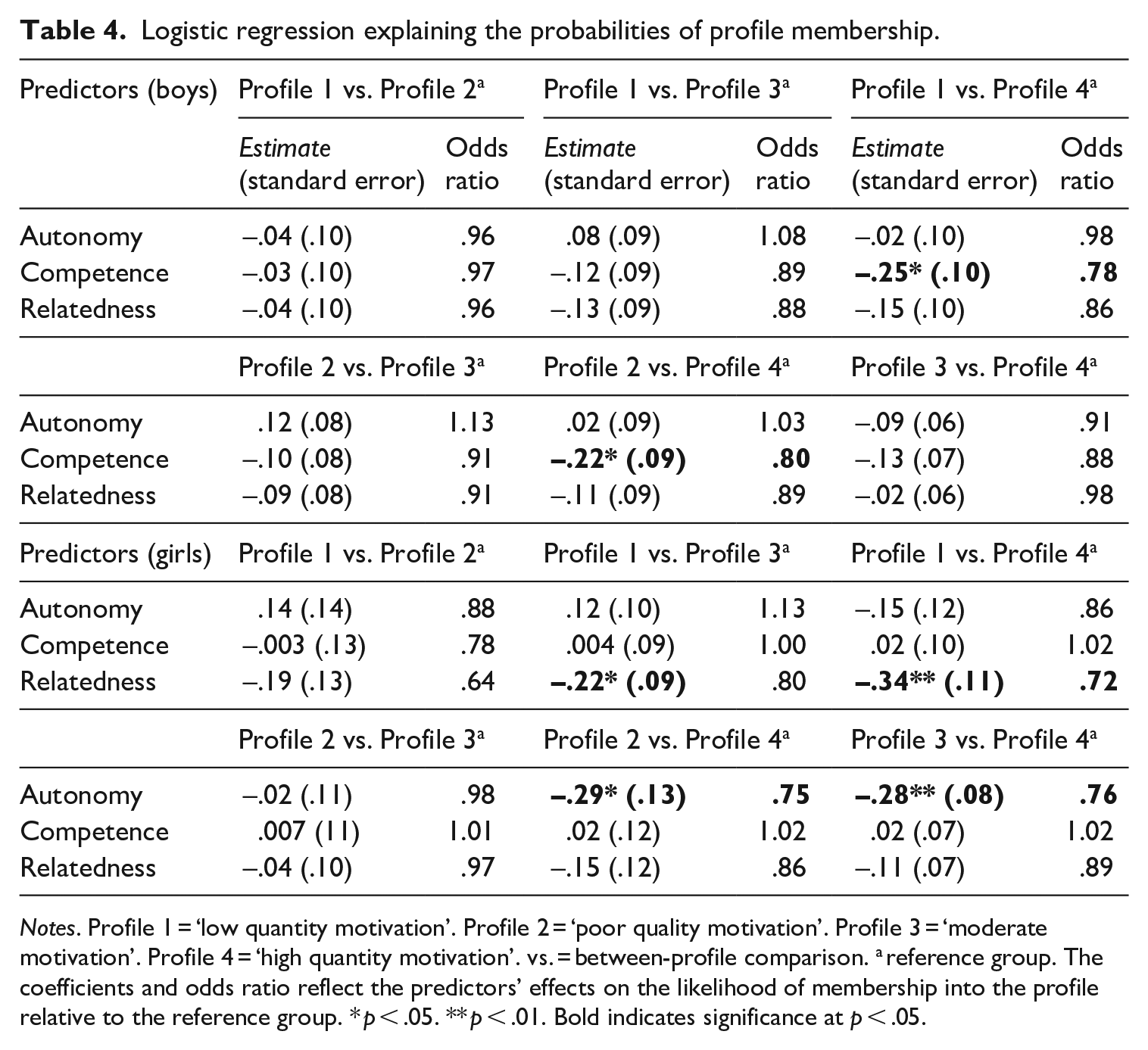
Notes. Profile 1 = ‘low quantity motivation’. Profile 2 = ‘poor quality motivation’. Profile 3 = ‘moderate motivation’. Profile 4 = ‘high quantity motivation’. vs. = between-profile comparison. a reference group. The coefficients and odds ratio reflect the predictors’ effects on the likelihood of membership into the profile relative to the reference group. * p < .05. ** p < .01. Bold indicates significance at p < .05.
Girls’ motivation was significantly linked to autonomy and relatedness support. Those who received more autonomy support exhibited a higher probability for membership in ‘high quantity motivation’ versus ‘poor quality motivation’ (OR = .75) and ‘moderate motivation’ (OR = .76). Those who got more relatedness support presented a higher likelihood of being in the ‘high quantity motivation’ and ‘moderate motivation’ than the ‘low quantity motivation’ group (OR = .72 and .80 respectively).
4 Outcomes of profile membership
Academic achievement was added as an outcome for the retained model. The model in which the outcome variables were estimated to be invariant was tested. Results showed that AIC, BIC, and SABIC dropped from the unconstrained to the equality-constrained model for academic achievement. This reveals that the girls and boys did not exhibit significant gender differences in the relationship between profile membership and academic achievement. Table 5 illustrates a summary of associations between profile membership and academic achievement. As for boys, results indicated that the ‘high quantity motivation’ EFL learners significantly outperformed the ‘poor quality motivation’, ‘moderate motivation’ and ‘low quantity motivation’ groups. Nevertheless, the academic achievement for the ‘poor quality motivation’ and ‘moderate quality motivation’ groups was nonsignificant. For girls, students in the ‘high quantity motivation’ and ‘poor quality motivation’ groups had the highest academic achievement, followed by ‘moderate motivation’ and ‘low quantity motivation’ groups. There was no significant difference in academic achievement between the ‘high quantity motivation’ and ‘poor quality motivation’ groups. The psychological needs satisfaction and academic achievement for each profile are depicted in Figure 2.
Associations between profile membership and academic achievement.
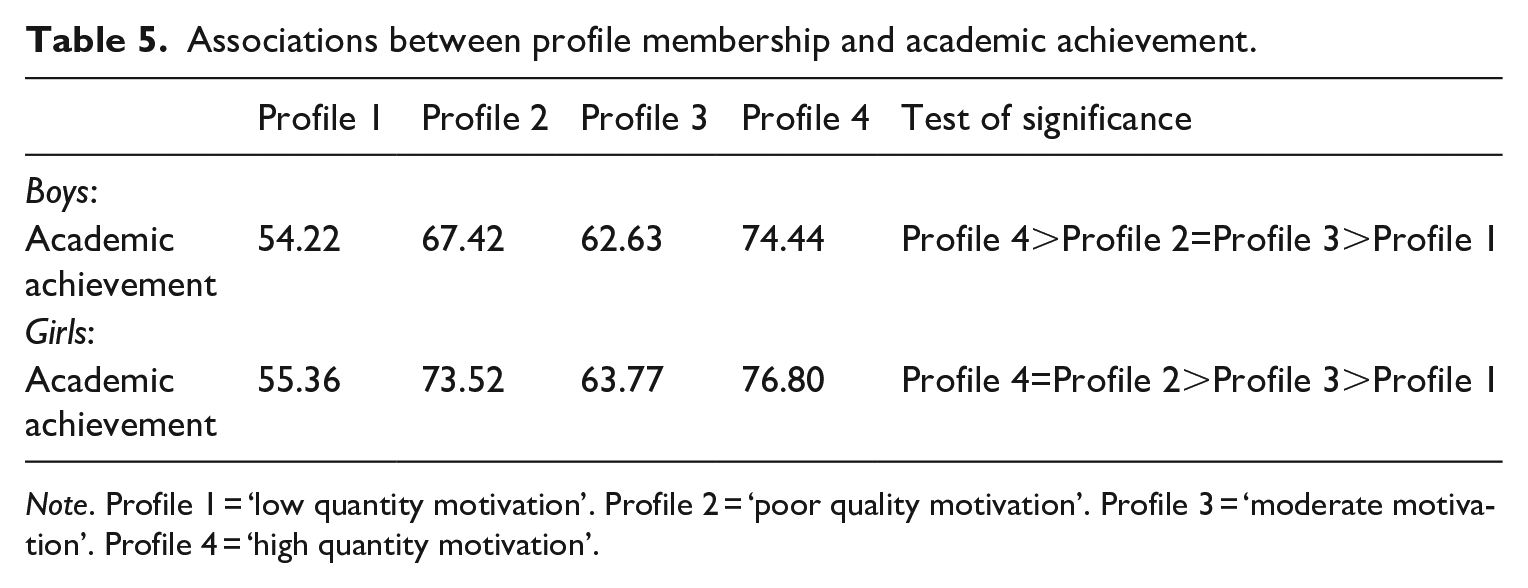
Note. Profile 1 = ‘low quantity motivation’. Profile 2 = ‘poor quality motivation’. Profile 3 = ‘moderate motivation’. Profile 4 = ‘high quantity motivation’.
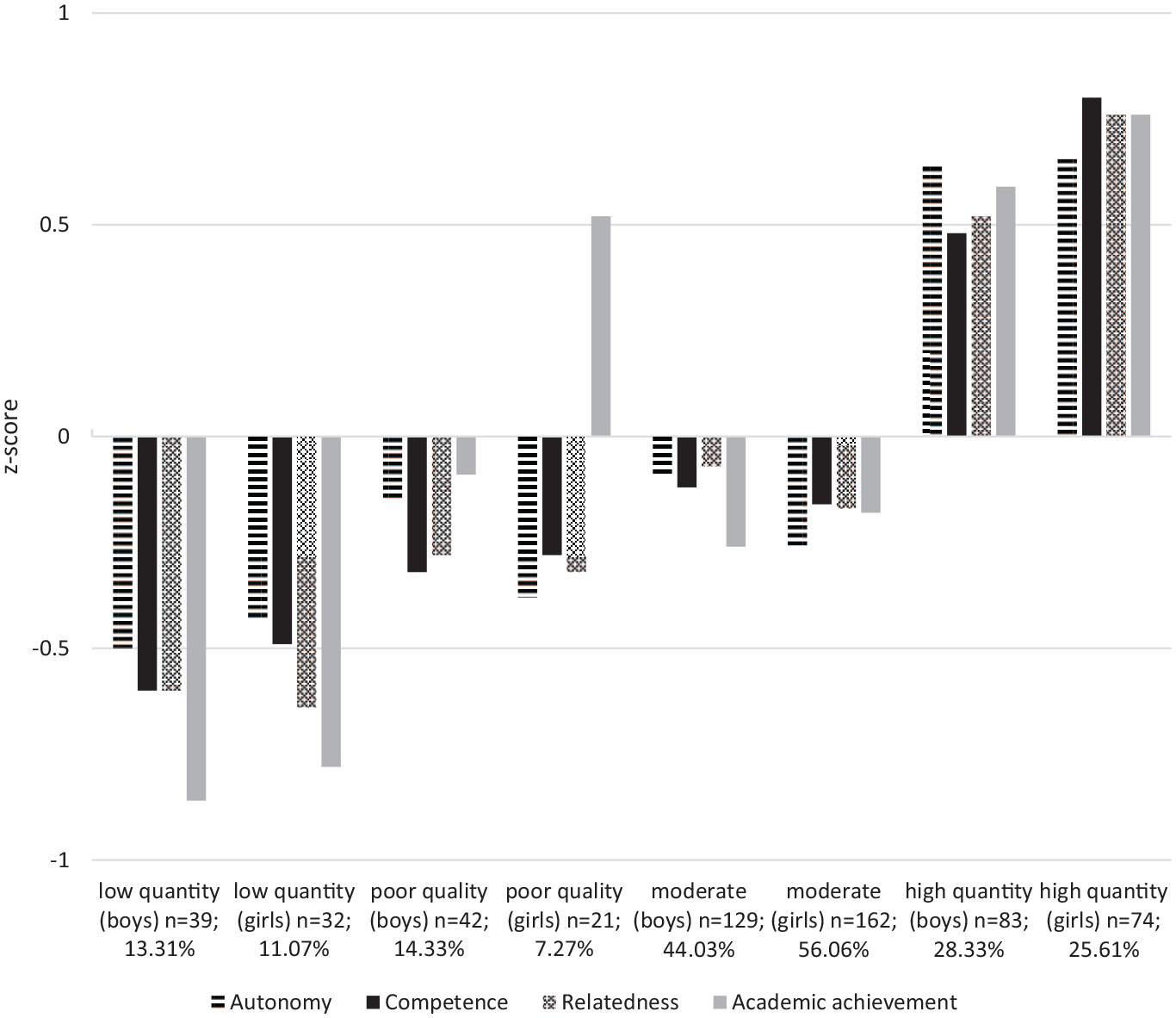
Levels of basic psychological needs satisfaction and academic achievement among students from different profiles.
V Discussion
This study explored the motivational profiles of Chinese EFL learners and whether these profiles were similar or different across genders. Results revealed four profiles for both boys and girls. They were ‘low quantity motivation’, ‘poor quality motivation’, ‘moderate motivation’, and ‘high quantity motivation’ EFL learners. Aside from the ‘moderate motivation’ group, the structure of the other three profiles are similar. Moreover, the within-profile variance similarity was achieved, indicating that the four profiles in each gender were simlar. The relative size of profiles was largely similar with one exception: the ‘low-quality motivation’ group, which was more prevalent among boys. The universality was also reinforced by the fact that the profile membership demonstrated similar relationships with the predictors and outcome.
1 Motivational profiles
Supporting hypothesis 1, our results identified four distinct profiles of autonomous and controlled motivation in each gender group, which were largely similar. This finding provides preliminary evidence for the generalizability of motivational profiles, which partially aligns with previous studies that have observed either no or small gender differences in learners’ English learning motivation (e.g. Alamer & Alrabai, 2023; Denies et al., 2022; Guo et al., 2023). Three of the profiles showed similar structure (within profile means) and dispersion (within profile variance). They were characterized as having low autonomous and controlled motivation (profile 1: low quantity motivation), low autonomous but high controlled motivation (profile 2: poor quality motivation), and high autonomous and controlled motivation (profile 4: high quantity motivation). Those with moderate autonomous and controlled motivation (profile 3: moderate autonomous and controlled motivation) appeared to have distinct structures across genders.
For boys, students in the moderate motivation group were more driven by controlled motivation (partially supporting hypothesis 2). This finding is quite informative as one potential implication is that boys may need more support for developing autonomous motivation. In terms of the distribution of motivational profiles, we found that the relative sizes of four profiles in each gender were also similar with only one exception. The ‘poor quality motivation’ group was more frequent among boys, corroborating the finding that boys are more likely to be driven by external motivates (e.g. Bonneville-Roussy et al., 2017; Carreira, 2011; Główka, 2014; King, 2016). This highlights the need to cultivate autonomous motivation, especially for boys in English class.
An interesting finding is that the ‘good quality’ profile, characterized by high levels of autonomous motivation and low levels of controlled motivation was not detected in both gender groups. This somewhat replicates findings in past literature on Eastern cultures (e.g. M. Liu & Oga-Baldwin, 2022; Oga-Baldwin & Fryer, 2020b), but contradicts the findings in past literature on Western cultures (e.g. Hayenga & Corpus, 2010; Vansteenkiste et al., 2009). We attribute the lack of the ‘good quality’ profile to the vertical hierarchies (i.e. high-power distance) in collectivistic settings wherein respecting and adhering to authority figures, such as parents and teachers, are emphasized (King & McInerney, 2014; Yu et al., 2018; Zusho & King, 2023). Additionally, teachers in collectivistic countries are likely to exhibit a more controlling style (e.g. Jang et al., 2009; Reeve et al., 2014; N. Zhou et al., 2012). Therefore, a sense of external control and reliance on external validation (controlled motivation) is reinforced in such environments. In studies on motivation in Asian cultures, the relationships between more autonomous forms of motivation and more controlled types are typically high. This might denote that Asian learners may be prone to simultaneously demonstrate similar levels of autonomous and controlled motivation (e.g. Caleon et al., 2015). Taken together, the vertical hierarchies, controlling styles of teachers, and close relationships between autonomous forms of motivation and more controlled types inhibit the probability of a ‘good quality’ profile emerging. Such a finding contributes to localizing SDT in Chinese culture. It suggests that the motivational profiles that are typical in Western cultures may not be universal and that cultural context plays an essential role in shaping the motivation of individuals. This finding also highlights the importance of considering cultural factors when applying motivational theories to diverse populations.
2 Motivational profiles and supports for basic psychological needs
The results of multigroup LPA indicate that the provision of three basic needs was positively linked to motivational profiles. This applied to both gender groups, attesting to the robustness of findings across genders. The finding supports hypothesis 3 and is consistent with the theoretical proposition of the SDT and in line with previous variable-centered research which reported the significant contributions of basic psychological needs on motivation in EFL learning (e.g. Alamer, 2022; Bureau et al., 2022; Shirvan & Alamer, 2022). However, autonomy, competence, and relatedness supports are not equally important for boys and girls. This is an important contribution to prior work on SDT which mostly examined need satisfaction from a univeralist perspective and have not explored potential individual differences especially between boys and girls (Haw & King, 2022; Wang et al., 2021). Particularly, autonomy and relatedness support were more salient for girls, stressing the need for autonomy- and relatedness-supportive teaching for girls. The motivational profile membership of males was more determined by competence. In other words, boys’ motivation in EFL learning was more influenced by competence need satisfaction, and girls’ motivation relied more on autonomy and relatedness support. Perhaps this can be interpreted in terms of girls valuing personal volition (autonomy) and the relevance of language learning tasks (relatedness) (Alivernini et al., 2019). They value opportunities to make decisions on the way they approach and engage with language learning activities. Having choice empowers girls to personalize their learning experience, cater to their individual interests and preferences, and take ownership of their progress (Razeq, 2014; Varol & Yilmaz, 2010). Therefore, the freedom to choose language learning tasks that are related to their interests might be more beneficial. Boys might be more likely to prioritize success and strive to outperform others (competence; e.g. King et al., 2019; Koul et al., 2012; Skaalvik & Skaalvik, 2004). These findings shed light on the value of fulfilling psychological needs and spotlight the gender differences in the perceived satisfaction of psychological needs. More importantly, the theoretical utility of SDT in the EFL context was expanded and an interesting line for further investigation was warranted.
3 Motivational profiles and academic achievement
Though slight differences were found concerning the relationships between profile memberships and support for basic psychological needs, the study unveiled that the relations between profile memberships and academic achievement could generalize across genders (supports hypothesis 4). Consistent with findings from past literature, our results showed that those with high autonomous and controlled motivation (‘high quantity motivation’ group) are associated with the most adaptive outcome than students in the other three profiles (e.g. M. Liu & Oga-Baldwin, 2022; Oga-Baldwin & Fryer, 2020a, 2020b). Students who were in the low-quantity motivation group had the lowest academic achievement. Moreover, for boys, those in the ‘poor quality motivation’ and ‘moderate motivation’ groups did not show a significant difference in academic achievement. For girls, those in the ‘poor quality motivation’ and ‘high quantity motivation’ groups did not show a significant difference in academic achievement. These echo the assertion that controlled motivation is not always maladaptive, especially for Eastern learners. We attribute this finding to the Confucius culture wherein social and family obligations were valued.
Both boys and girls might be driven by extrinsic types of motivation and study for the sake of pleasing their parents or teachers (e.g. Hau & Ho, 2010; King & McInerney, 2014; Y. Liu et al., 2020). This is especially salient among girls who may feel a heightened sense of duty and responsibility to fulfill their familial obligations and honor their families by achieving success. They might also be more motivated to seek teacher approval. The external pressure to meet societal expectations can serve as a driving force for their success. Another potential explanation for the underperformance of boys and over-representation in the ‘poor quality’ motivation group is the influence of gender stereotypes. Foreign language learning is generally perceived as a female domain (Kutuk et al., 2022). This societal perception may create additional pressure and expectations for girls to excel in language learning, leading to higher academic achievement. Conversely, it might make boys disengage from EFL learning as language might be perceived as something that is more for girls. The findings also fleshed out the proposition of SDT by adding evidence of the internalized controlled motivation among Chinese students.
VI Implications
The present study has theoretical, methodological, and pedagogical implications. Theoretically, the study testifies to the robustness of the SDT in the Chinese EFL context. This is one of the few studies that separately investigated the motivation profiles among boys and girls based on SDT and unraveled the applicability of SDT across genders. Furthermore, our study extends the SDT by going beyond the prevalent focus on autonomous and controlled motivation and integrating the other elements of SDT in exploring the need satisfaction–motivation–performance link.
Methodologically, the study introduced a newly developed method to the EFL research, i.e. MG-LPA, and conducted meaningful and systematic comparisons on the motivation of students in different gender groups. This study could serve as a paradigm for exploring profile variations among students.
Pedagogically, this study illustrated that boys and girls had more similarities than differences in English learning motivation. Teachers should be attentive to the ‘low quantity motivation’ group for both gender groups since those students performed worst in the language proficiency test. This study also shed light on the necessity for tailoring intervention targets for Chinese EFL learners from different gender groups. Our study unveiled that boys could be more supported through the provision of competence support. As for girls, autonomy and relatedness might be more important. It is suggested that teachers provide clear guidance, constructive feedback, and frequent encouragement to increase boys’ perception of competence in EFL learning. They are also recommended to offer autonomy support via engaging girls in language learning activities and providing relatedness-supportive teaching by devoting time, resources, and affection to the teacher–student relationship to satisfy girls’ emotional needs (e.g. Affuso et al., 2023; Stroet et al., 2015).
VII Limitations and directions for future research
This study has some key limitations. First, this study was cross-sectional in nature, and we were unable to trace trajectories in students’ motivational beliefs. Hence, we suggest future researchers collect longitudinal data and use more advanced methods such as the latent growth mixture modeling approach to capture the trajectories of motivational profiles and explore their linkages with predictors and outcomes (e.g. Alamer & Alrabai, 2023; Alamer et al., 2023; Kikuchi, 2019).
Second, this study relied heavily on the quantitative approaches without digging into the qualitative differences between diverse profiles of students. Future research could triangulate findings from the current study by including qualitative approaches such as interviews, and classroom observations (Noels, 2023).
Third, the sample of the study was taken from schools in a certain area of China, a more representative sample might be needed to enhance the generalizability of findings.
VIII Conclusions
Responding to the limited understanding of gender differences in EFL learners’ motivation, this study investigated the similarities and differences in motivational profiles and their associations with support for basic psychological needs and academic achievement. There were similarities (i.e. the same dispersion, profile distribution, associations with academic achievement) and differences (i.e. within-profile means, associations with basic psychological needs support) in motivational profiles across boys and girls. This study emphasizes the importance of recognizing both similarities and differences across genders in the context of EFL learning.
Supplemental Material
sj-docx-1-ltr-10.1177_13621688231213030 – Supplemental material for Motivational profiles of EFL learners: A person-centered approach to uncovering gender differences
Supplemental material, sj-docx-1-ltr-10.1177_13621688231213030 for Motivational profiles of EFL learners: A person-centered approach to uncovering gender differences by Jiajing Li, Ronnel B. King and Chuang Wang in Language Teaching Research
Footnotes
Acknowledgements
We would like to acknowledge the editor and two anonymous reviewers who have offered valuable suggestions to this article.
Declaration of conflicting interests
The author(s) declared no potential conflicts of interest with respect to the research, authorship, and/or publication of this article.
Funding
The author(s) received no financial support for the research, authorship, and/or publication of this article.

Supplemental material
Supplemental material for this article is available online.
Notes
References
Supplementary Material
Please find the following supplemental material available below.
For Open Access articles published under a Creative Commons License, all supplemental material carries the same license as the article it is associated with.
For non-Open Access articles published, all supplemental material carries a non-exclusive license, and permission requests for re-use of supplemental material or any part of supplemental material shall be sent directly to the copyright owner as specified in the copyright notice associated with the article.
