







Abstract
We are three members of a Special Interest Group (SIG) of teachers in Japan that has long been committed to writing and publishing for inclusive practitioner research about learner development. In the last several years, we have worked together with others on initiating, promoting, and sustaining the Learner Development Journal (LDJ), a new journal of practitioner research (PR) that explores different issues and themes to do with learner development. In this article, we initially consider the relationships between PR, writing, and publishing. Because PR differs fundamentally from academic research, writing about PR entails not only a rejection of traditional forms of academic writing, but also a quest for different forms of writing that prioritize the practitioner’s voice and experience, and include the voices and experiences of learners. We then re-examine the evolving practices and processes of the LDJ and reflect on how PR writing has developed in our local context so that practitioner-researchers can write about their practices and inquiries in alternative, practitioner-friendly ways. We conclude with a proposal for the importance of personalized, reflective writing for PR before raising some of the broader, unresolved questions we continue to face in writing about and publishing inclusive practitioner research.
I Introduction
In this article, we draw on our experiences of helping to set up and maintain a new online learner development journal to discuss how we think new genres of writing need to be developed and validated for writing and publishing for inclusive practitioner research about learner development. We have long been concerned with how reverting to a default standard academic style of writing pushes writers to use objectivist and generalizing language that stymies the expression of individual, local realities in writing about practitioner research (PR). With the new journal we seek to foster inclusivity by enabling contributors to participate in creative and supportive writing communities in which they are encouraged to share their practitioner research and write in personalized, narrative, and multi-voiced ways about their local explorations of teaching and learning.
We take the position that the terms ‘practitioner research’ and ‘practitioner-researcher’ give primacy to practitioners and practice rather than research and researchers. Within the practitioner research paradigm, practitioners focus their inquiries on their practices with learners in specific local contexts. In so far as practitioner research is necessarily personal and localized, this puts it very much at odds with the technical, universalizing rationality of academic research and the disciplinary conventions that academic researchers work by. Recognizing the distance between practitioner research and academic research is, in our view, an important initial step in acknowledging that what matters to practitioners as they develop (and write about) their reflective practices and personal and professional expertise as teachers is different in kind from what academic researchers espouse and value in scholarly writing.
We believe that it is also important to acknowledge that a mode of writing that we call the ‘third-party academic paradigm’ is dominant in many journals ostensibly focused on teachers’ research and practices. In this paradigm, writers distance themselves from the writing through adopting an objectivist, universalizing stance. As they depersonalize their texts, they remove themselves and their learners from their accounts and from the everyday puzzles and problems that they face in learning together. This way of writing not only puts practitioner writers at a distance from how they represent their learners and others that they work with in their local contexts; it also alienates authors from ‘practitioner’ readers and serves to prioritize academic disciplinary knowledge over practitioner knowledge in understanding questions of practice. Rather than focusing on particular puzzles embedded within practitioners’ own local contexts, such writing tends to reproduce general realities of learning and situate practices within an academic frame of universal reference. In the face of such pressures to write academically about their own practices, what can practitioner-researchers do in response? How might they resist the third-party academic paradigm?
Confronting the divide between ‘practitioner research-writing’ and ‘academic research-writing’ raises a number of other questions about writing and publishing practitioner research. How might practitioner-researchers represent their inquiries to wider audiences beyond their immediate local context? Should they relate their inquiries to work in the wider field so that they may claim legitimacy for their work? These are some of the other questions that we explore in this article.
On this basis, we then consider certain challenges and contradictions that different contributors, reviewers, and editors have faced in working on the first several issues of a new journal for practitioner research about learner development. We also highlight the importance of personalized, reflective writing for practitioner research before identifying, in the final part of this article, some entrenched questions running through our local experiences and wider debates about writing and publishing for inclusive practitioner research.
First, however, we need to explain what connections we see between PR, writing for and about PR, and publishing, and what tensions and challenges practitioner-researchers may face.
II Questioning the relationships between PR, writing, and publishing
Practitioner research is a distinct type of research. It stands in contrast to ‘academic research’ or ‘scientific research’, and the relationships between practitioner research (PR), writing for or about PR, and making PR writing public, are complex. We address some of these complexities by considering the following questions:
• Who are the practitioners in practitioner research?
• What is meant by ‘research’ when we engage in or discuss PR and what is the object of that research?
• What reasons might there be for writing for or about PR?
• And, if we are to write about PR and make our thoughts public, how might we write and who are our imagined audiences?
These questions have been addressed historically, certainly since the early 1900s. In his writings about schools, learners, and teachers within a rapidly changing industrial society, John Dewey first articulated the need for teachers to inquire actively into their practices as a central part of reforming and developing school-based education. The work of Donald Schön on reflective practice subsequently built on Dewey’s ideas, and paved the way for the emergence of different approaches to practitioner research within second language education. These two thinkers remain of critical importance to us in shaping our understanding of PR.
Discussing the relationship between educational research carried out following scientific principles and methods, and a wider conception of educational science in which teachers play a central role, Dewey wrote:
… educational practices provide the data, the subject-matter, which form the problems of inquiry. They are the sole source of the ultimate problems to be investigated. These educational practices are also the final test of value of the conclusion of all researches. (Dewey, 2013/1929, p. 27)
Importantly, Dewey saw teachers not only as the mediators of outside (scientific) research – the people who interpret and evaluate the science and potentially use it in their practice – but also as active participants in research:
… it is impossible to see how there can be an adequate flow of subject-matter to set and control the problems investigators deal with, unless there is active participation on the part of those directly engaged in teaching. (Dewey, 2013/1929, p. 40)
He furthermore recognized the need for teachers to exercise their own agency in inquiring into their practices, and this is one reason why his work resonates so strongly with contemporary perspectives and discourses about PR.
The reflexive development and application of practitioner knowledge is now seen as an essential requirement across different professions, including second language teaching. Particularly influential has been the work of Donald Schön. Inquiring into how practitioners in fields such as architecture, nursing, and teaching know and perform their jobs, Schön not only proposed the concept of ‘knowledge-in-action’ (Schön, 1983) to clarify what forms of knowledge practitioners draw on, but also challenged whether ‘technical rationality’ (or positivism) can or should be the prime means for understanding this knowledge. According to Schön, practitioners have always reflected on what they do. In this informal sense, there has always been practitioner research, as practitioners inquire into their own practice. Schön (1983) argues that practitioners are often ‘(s)timulated by surprise’ and ‘turn thought back on action and on the knowing that is implicit in action’ (p. 50), succinctly capturing the puzzling process of reflection-in-action:
There is some puzzling, or troubling, or interesting phenomenon with which the individual is trying to deal. As he tries to make sense of it, he also reflects on the understandings which have been implicit in his action, understandings which he surfaces, criticizes, restructures, and embodies in further action. It is this entire process of reflection-in-action which is central to the ‘art’ by which practitioners sometimes deal well with situations of uncertainty, instability, uniqueness, and value conflict. (Schön, 1983, p. 50)
Thus, for Schön, requiring practitioners to apply a dominant epistemology (i.e. technical rationality) to the understanding of knowledge-in-action is misguided and inappropriate.
Other advocates of practitioner research have made similar arguments. Clandinin and Connelly (2000) emphasize the ‘shifting ground’ (p. 126) of uncertainty that teachers experience in exploring their practices and developing practitioner inquiries, whereas Jarvis (1999) highlights the dynamic relationship between action and reflection in the development of practice and practical knowledge: ‘(W)e can claim with confidence that practice and practical knowledge are individual, personal, subjective, and dynamic’ (Jarvis, 1999, p. 133). In line with these perspectives, the particular definition of PR that we identify with closely is based on principles outlined by Allwright and Hanks (2009) in which ‘practitioners (teachers, teacher educators, learners, etc.) conduct purposeful, systematic, ethical, and critical enquiries into their own practices, in their own contexts, with the aim of extending understanding(s) of educational processes and human behaviour’ (Hanks, 2017, p. 41).
It is important to acknowledge, however, that the term ‘practitioner research’ subsumes a wide range of approaches. Hanks (2017) herself considers that PR includes several traditions such as Action Research, Exploratory Practice, Reflective Practice, Narrative Inquiry, Teacher Research, and Classroom Research (p. 30). Similarly, Zeichner and Noffke (2001) see PR as ‘an emergent form of educational science’ (p. 299) springing from five traditions: Action Research, the British Teacher-as-Researcher movement, the North American Teacher Researcher movement, Self-study Research, and Participatory (Emancipatory) Research. The common thrust of all these diverse perspectives on PR is towards empowering classroom teachers to carry out their own inquiries into their practice so that, as Richard Smith suggested in an interview with Daniel Xerri, they do not get ‘sold out’ (Xerri, 2018). The emphasis on the self-study of local practice, not necessarily to answer tightly delineated research questions or to generalize beyond the local context, but rather to understand practice and why the people in our classrooms behave in the ways they do, also captures for us the central purpose of practitioner research.
1 Tensions surrounding PR
Notwithstanding this broad agreement about what PR involves, for some, research remains something that researchers do, and, as teachers are not researchers, they are not qualified to do research. Although this separatist perspective is far from our own position, we recognize that teachers may face other strictures from within academia (which we have come to call ‘the academic imperative’) about what qualifies their inquiries as research or not. Particularly pertinent to the theme of this article is the idea that PR cannot be called ‘research’ unless it is made public, which Borg (2013) refers to as the ‘foundationalist position’ about research (p. 20). The sense is that private inquiry of the kind that many teachers engage in as a normal part of their practice does not amount to ‘research’ if it is not written about and disseminated.
In reaction, there has been a movement towards reconceptualizing what research means as part of PR. This has sought, among other things, to establish alternative criteria by which to judge the validity of the research carried out by teachers. For example, Connelly and Clandinin (1990) proposed such criteria as verisimilitude, plausibility, transferability, and the invitational quality of a study, while Zeichner and Noffke (2001) put forward the notion of trustworthiness for PR as an alternative to validity. Again, particularly relevant to our focus is the notion that the quality of the PR writing itself, its authenticity when presented as a narrative, may also be an appropriate alternative criterion (O’Dea, 1994).
However, questions surrounding the research-practice divide remain (Rose, 2019; Roulston et al., 2005), not least in the reservations that some have about the quality of the research that practitioners can conduct, and the interest-value of the writing that is produced and made public. For readers of Language Teaching Research, and perhaps especially the special sub-section for Practitioner Research, it may seem strange to raise questions about writing and publishing for PR when around 50 articles have successfully reached publication since 2003 in the pages of Language Teaching Research alone, with many more in other collections (e.g. Bullock & Smith, 2015; Dikilitaş & Hanks, 2018; Elliott, 2023; Rio de Janeiro Exploratory Practice Group, 2021; Slimani-Rolls & Kiely, 2019; Smith, 2015; Smith et al., 2014). We suggest, however, that, partly because PR encompasses diverse approaches and stretches to provide research findings that are valuable to teachers and researchers alike, there are recurrent tensions for practitioners who wish to engage in PR and disseminate their understandings beyond their local contexts.
The cause of the apparent fault line here may stem from the use of the term ‘research’. This may be no more than a trivial issue of definition, but it may point to something deeper about who is taking control of the spaces in which teachers inquire into their own practices. Are we looking at an appropriation of the spaces open to teacher inquiry? As Bartels (2003) has argued, teachers may be more interested in building their own ‘private’ knowledge base, rather than contributing to a ‘public’ knowledge base; there is also the danger that teacher education programs lead novice teachers to value academic practices like literature reviews, and that these may supplant, even colonize, the discourse of teachers’ knowledge of practice (Bartels, 2003, p. 750).
While we acknowledge that in some parts of the world primary and secondary school teachers are now contractually required to carry out PR (see, for example, Gao et al., 2011), there are numerous other practical issues, barriers, and tensions that dissuade many teachers from engaging in and writing about PR. Teachers may not regard themselves as researchers (Borg, 2013; Crookes, 1998). If doing PR involves research design, collecting and analysing data, and publishing findings, then many feel they are not qualified to do this. Although this may often be based on a misconception, it partly explains why PR is generally carried out by university-based teachers or teachers taking professional courses, often as part of a master’s or doctoral degree.
2 The push to publish and disseminate
It is also open to question whether practitioner-researchers need to share their PR through writing and publishing. Burns (1999) suggests that because of its collaborative, practical, and local nature, disseminating the outcomes of action research should involve ‘people-oriented strategies’ (p. 182) through networks in the teaching community. She emphasizes that dissemination needs to focus on social and participatory modes of communication and that transformation and change rather than transmission of information should be the ultimate goals.
While PR outcomes are often shared informally through conversation, discussion, and other oral modes such as posters, podcasts, presentation slides, and so forth (Bullock & Smith, 2015; JALT Teacher Development SIG, n.d.; Smith et al., 2022), the benefits of putting reflections, observations, and understandings into writing have also been promoted. Burns (1999) suggests that writing is a way to make a record of the research and can act as a basis for reflection and discussion with others. Writing also makes inquiries more widely available and open to feedback from others (Burns, 1999, p. 183). We agree with Burns that there are many potential benefits in writing about PR, particularly within collaborative teacher networks or collectivities and communities of practice (Bury, 2023). Rather more contentious, in our view, is Burns’s (1999) claim that ‘writing opens up the research to public commentary and evaluation by others, which is a significant part of the peer review process in research’ (p. 183). It is noteworthy here that the perceived benefits of writing about PR have moved from local, teacher communities into the world of academia where the sanction of peer review is sought for quite different purposes than individual professional development. This seems to be straddling an uncomfortable and contradictory divide between the academic imperative to publish or perish, part of researchers’ ‘publication culture’ (Sato & Loewen, 2022, p. 514), and another world in which teachers pursue PR mainly for private purposes. In the one world, publication is a key to entry, a way to maintain and enhance one’s position, and a route to career advancement. Research evaluation, metrics, productivity, and accountability mean that the sanction of peer review is sought. There is job pressure and a competitive job market to consider, too. However, these concerns about publication are completely alien to the vast majority of practising teachers working outside universities.
Even for those directly advocating PR, the concern for publishing can be strong. In relation to Exploratory Practice, Allwright and Hanks (2009) put forward four reasons for disseminating findings and questions:
Reporting findings makes them available to contribute to educational decision-making.
It also makes them available to contribute to theory-building.
Reporting research processes can help researchers avoid unproductive ‘dead-ends’.
Reporting findings may encourage others to join in the debate and the search for yet deeper understandings. (Allwright & Hanks, 2009, pp. 238–239)
There is, therefore, a strong set of assumptions which support writing and publishing for PR. However, the imperatives that drive these assumptions may be at odds with the needs of classroom teachers who are unlikely to frame their work in terms of ‘findings., ‘theory-building’, and ‘debate’. While such terms may be fundamental to academic researchers, practitioners commonly put their inquiries in terms of puzzles, challenges, relationships, daily incidents, and struggles. More often than not, they are concerned with the emotional texture of their everyday work and care for their learners (Ahmed, 2022; Benesch, 2018; Benesch & Prior, 2023; Hargreaves, 2001). This does not mean, of course, that teachers should not attempt to write about the PR they are engaged in. While many will be required to write about PR because it is part of job promotion criteria, we contend that pressure to publish and the difficulties associated with publishing in recognized journals present intimidating barriers for practitioner-researchers.
3 In search of new genres for PR
If teachers are to be encouraged to write for PR, questions naturally arise about what styles and genres might be appropriate and conducive for PR and what support teachers may need in developing their writing. Further considerations touch on where teachers should publish their reports, who will read them, and how much other teachers may benefit from the dissemination of PR carried out by teachers in other local contexts. Ultimately, we should also ask how substantial the benefits are for teachers and their students in writing about PR.
Precisely how teachers can (and should) work outside academic writing norms and how common (mis)conceptions of ‘research’ may need to be addressed has been acknowledged for some time, while justifications for dissemination of their work, as well as likely hindrances, have also been discussed (e.g. Borg, 2013; Hanks, 2017; Nunn & Adamson, 2009). Already in the late 1990s Freeman highlighted the fact that teacher-research had ‘not yet been established as a genre’ (Freeman, 1998, p. 153) and argued for ‘the possibility of using new forms to express our understandings’ (Freeman, 1998, p. 157). In parallel, innovative work in reflective practice (e.g. Freeman & Johnson, 1998), cooperative development (Edge, 2002), and learner autonomy (e.g. Benson & Voller, 1997; Dam, 1995; Kohonen, 1992; Little, 1991) provided exciting new teacher and learner directions for practitioner research – and for re-imagining the centrality of dialogue in inclusive inquiries stemming from original pioneering work in experiential learning (Dewey, 1938; Kolb, 1984) and critical pedagogy (Freire, 1970). Echoing Freeman, Allwright and Hanks (2009) proposed some years later that ‘sharing needs to be seen as a process that is an integral part of … research as a social enterprise, from the beginning’ (pp. 239–240) – as ‘situated social practice’ (Hanks, 2019, p. 168) whereby different, practitioner-voiced and learner-voiced forms of writing may be co-constructed to represent appropriately the puzzles and understandings that they explore (Hanks, 2017).
But what forms might such writing take and how might they differ from dominant academic paradigms? What processes and practices might they involve? These are key questions that we explore next as we shift our focus to reflect critically on our experiences of establishing and sustaining a journal for PR writing.
III Evolving local processes and practices: The case of the LDJ
Based in Japan, the Learner Development SIG (LD SIG) has, at the time of writing, about 160 members. In 2014 LD SIG members started discussing the creation of a new publication, which in time came to be called the Learner Development Journal (LDJ). Rather than one major anthology every few years (Ashwell et al., 2014; Barfield & Minematsu, 2014; Barfield & Nix, 2003; Irie & Stewart, 2012; Kohyama & Skier, 2006), the main idea behind launching the LDJ was to publish a special-themed issue annually. Each issue would focus on a theme proposed by a pair or group of editors, who would invite contributions from LD SIG members and other interested practitioner-researchers. Editors and contributors would collaborate and develop their research and writing over an 18-month period for each issue. With an explicit commitment to group-based professional development and shared exploration, the first issue, on the theme of visualizing learner development, was published in 2017.
Each new issue of the LDJ brings together two new groups of participants – editors and writers. While the editors work primarily with the writers, they are also supported by members of the Journal Steering Group who meet regularly with the editors to monitor the practice, process, and production of each issue. Writers interact in small ‘response communities’ to share and discuss their work as it develops. Later they receive feedback from at least two reviewers who are part of the LDJ review network, when contributors have a choice over blind or open review. Figure 1 highlights the different groups that interact in the development of an issue of the LDJ.
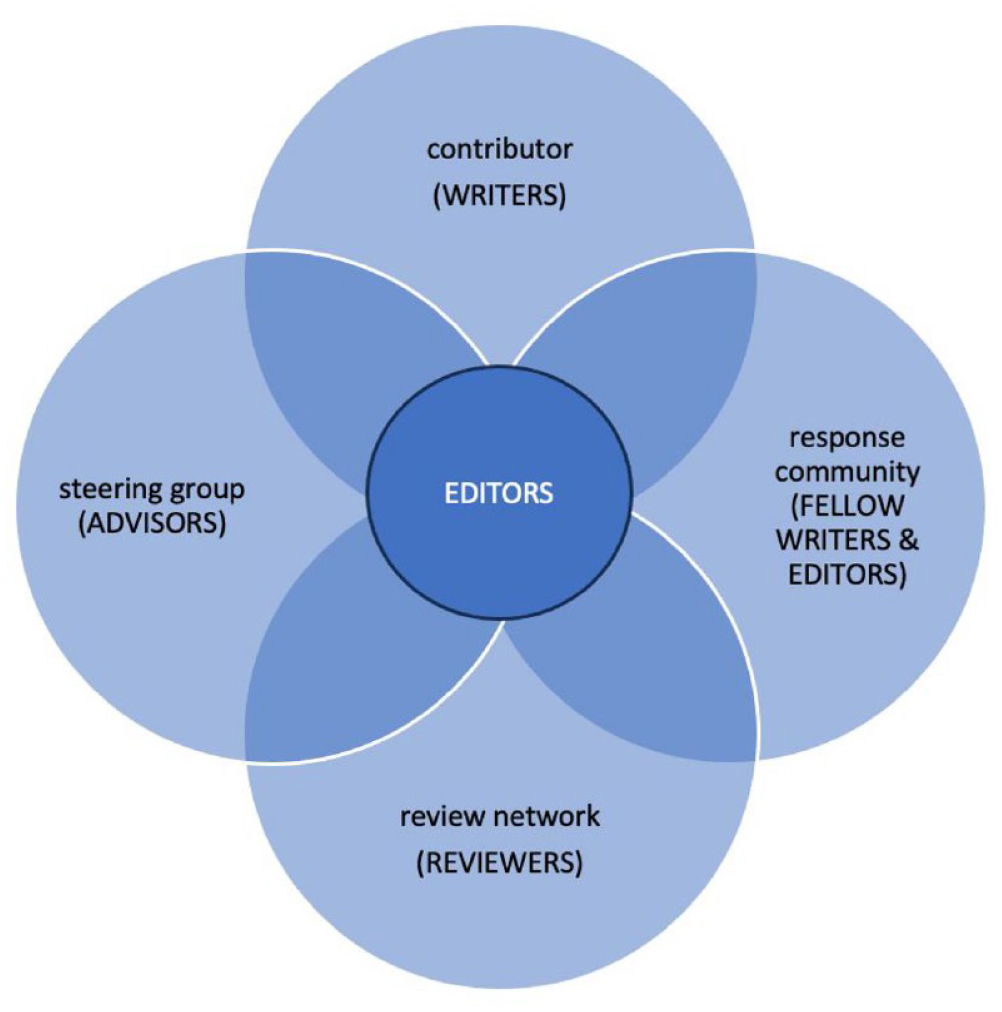
Learner Development Journal (LDJ) participants and groups.
We (the three authors of this article) formed the initial journal steering group and have since taken part in different issues in a monitoring role, or contributed as reviewers, writers, or editors, so we draw here on our insider perspectives about the multiple interactions involved in the development of an issue of the LDJ.
Personalized, reflective writing in a wide variety of genres and of different lengths has long been an established writing practice within the SIG’s publications (Barfield, 2014), so we initially presumed that writers would want to write in a style that prioritized and included the ‘voices’ of the participants – their own as well as their learners’. We also hoped that editors and writers would experiment with different kinds of writing that would allow for such multivocality in original ways. However, despite the rich and innovative work produced, we were nevertheless surprised at how closely some writers, reviewers, and editors adhered to certain conventional academic writing practices that we were hoping the LDJ would move beyond. These include a depersonalization of researcher-writer identity through the use of the third person; a strict adherence to the style guidelines laid down by the American Psychological Association (2020); a lack of problematization of how things are or how they appear; and, a tendency to generalize and adopt a universalizing stance, rather than viewing practices as situated in specific contexts.
We continue by highlighting four features of the LDJ that have developed over the first five issues and that attempt to address some of the knots that we have just highlighted. In particular, we focus on the procedures and practices of Issue 5 (LDJ5) which involved a deliberate push for more personalized writing.
1 Values and hopes: The reviewer guidelines
An important part of the initial concept of the LDJ was for writers to have access to a network of supportive reviewers and review processes. We wanted to offer writers the choice of either blind or open review as a way of responding to contributors’ professional and institutional needs. Blind reviews were intended for writers needing to fulfill publishing requirements for their institutions so that their work would be recognized as fully ‘refereed’. Open reviews were made available for those who wanted the opportunity to enter a dialogue with their reviewers. This also meant encouraging reviewers and writers to see the review process in a different way.
Over time, a set of guidelines was developed (see Table 1) to encourage reviewers, and consequently writers, to strive towards writing that:
Learner Development Journal reviewer guidelines.
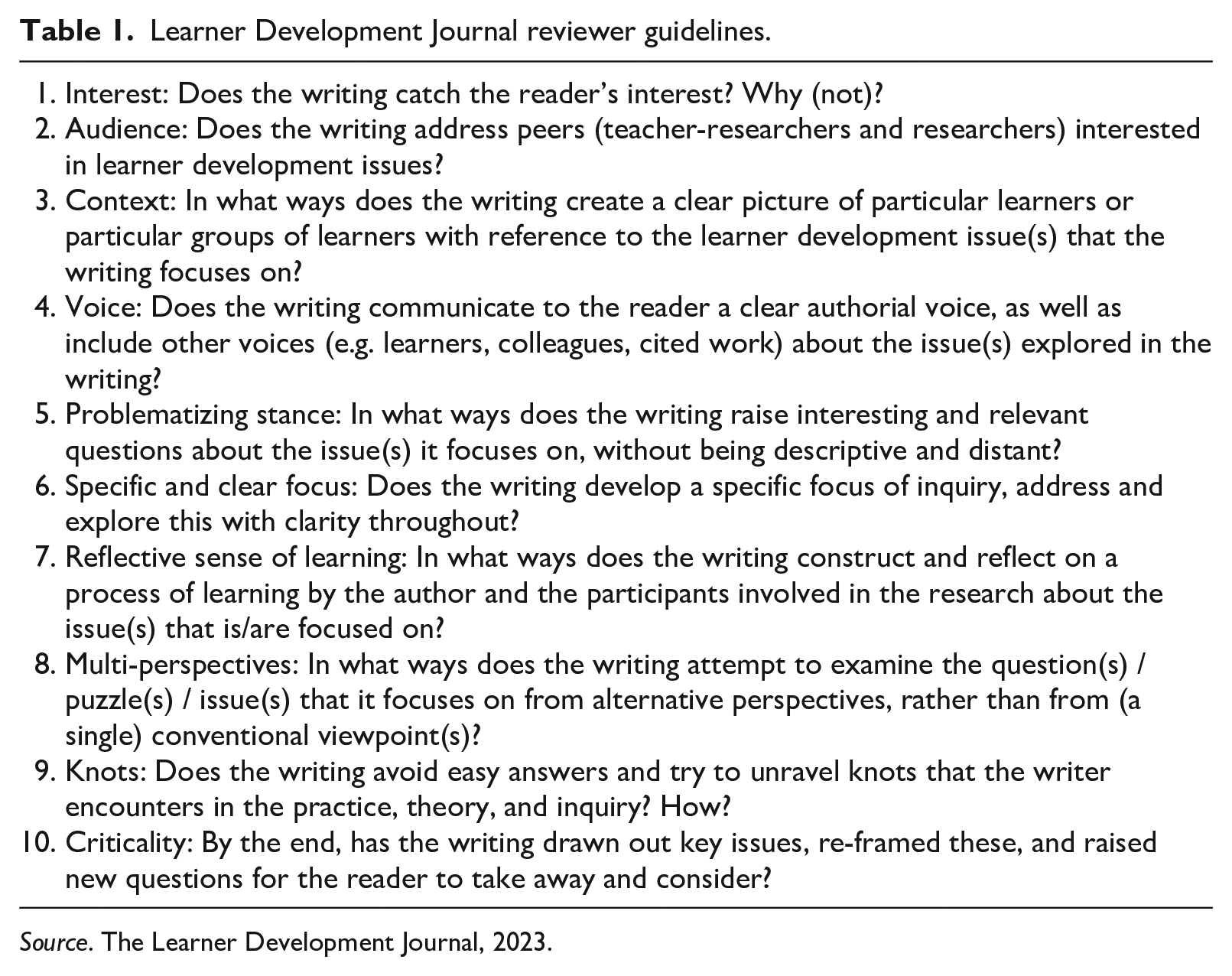
• particularizes and localizes;
• makes the writer and other participants evident in the writing;
• makes the research process both transparent and reflective; and
• ends with questions and possibilities rather than with hard and fast conclusions and answers.
Reviewers are expected to follow these same guidelines whether for blind or open review so that they stand alongside writers, encouraging them to explore their ideas in greater depth and develop their reflective personalized writing in ever clearer ways.
Communicating these principles to reviewers, editors, and contributors has not always been easy. This became clear to us again when we conducted interviews with those involved in Issue 5 of the LDJ whose words are reproduced here with permission. As the two following quotes from LDJ5 participants illustrate, this way of reviewing was an extension of normal reviewing practices for some:
I find the process to be a very friendly and inspirational one. Being able to directly communicate with the authors gives this process a feel of connectedness and interactivity. (Reviewer 1)
However, for others it seems to have been a difficult process to engage in, as Contributor 1 commented:
I have received feedback on my piece of writing, but I must say it has left me wondering. It seems somehow going in the opposite direction to the conversations we have had in our group … I receive the feedback as orienting me towards a more ‘conventional/less narratively-oriented’ journal approach. (Contributor 1)
This person clearly received feedback she found confusing and not in keeping with other feedback from her response community.
Despite such bumps, one advantage we have found with open review is that reviewers’ comments can become incorporated into the final published texts, thus making the reviewers part of the ‘voiced’/‘visible’ group of people in dialogue around a particular piece of writing. The example in Figure 2 shows how a writer included perspectives that his reviewers, Erzsebet Bekes and Paul Collet, shared.
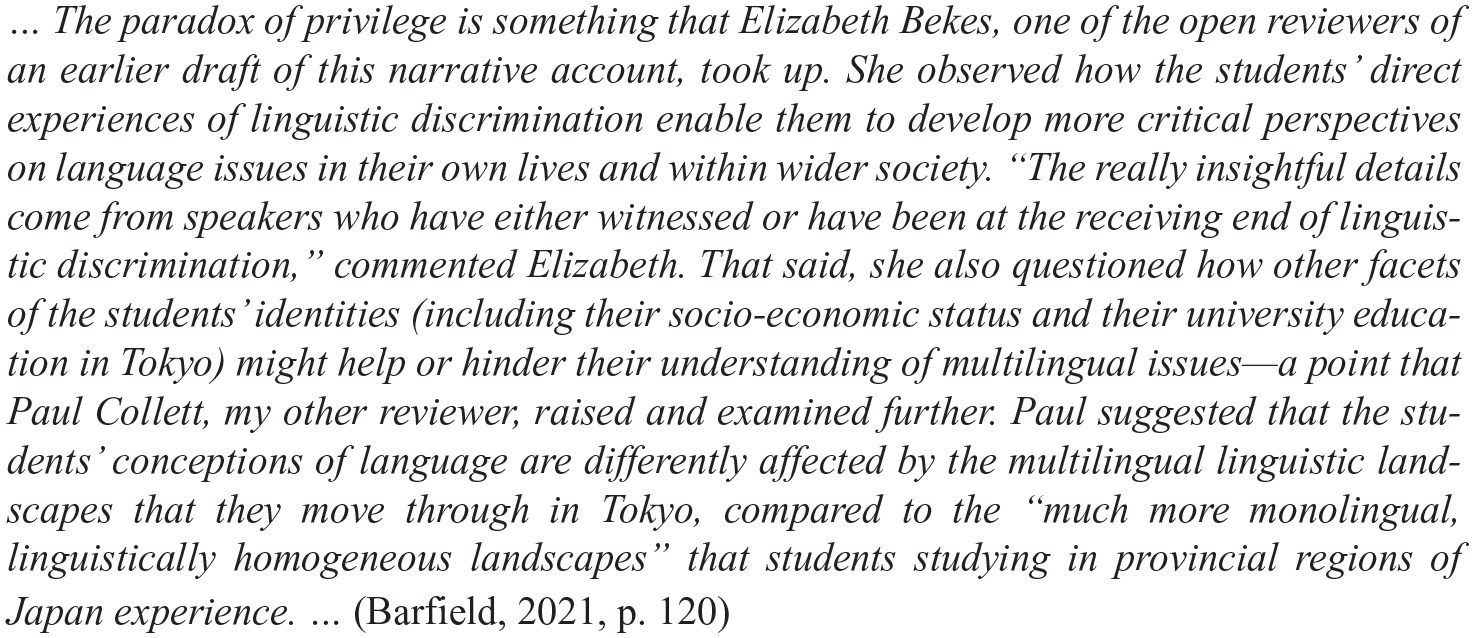
Incorporating reviewer comments in the writing.
Incorporating reviewers’ comments in the final text serves to open out the writing and make it multi-vocalic and multi-perspectival. This not only acknowledges the direct contribution that the reviewers have made to the writing, but also allows the writer to bring in other interpretations that may differ from their own. The writing displays greater reflexivity, and the ideas expressed also become more open to questioning by readers as a result. Including reviewers’ voices in the writing allows a writer to express complex, multi-layered ideas from several angles.
2 Response communities
Another feature of the LDJ has been peer response groups to provide mutual support among fellow contributors. The response communities typically have three or four contributors and meet regularly to videoconference and discuss their research and writing with each other. For LDJ5, contributors were allocated to response communities with explicit guidelines about writing responses. For example, the instructions for responding to the first piece of writing (contributors’ original proposals) asked authors to write a response of at least 300 words about what they found interesting in others’ proposals, and how the areas of focus connected with their own experiences and practices to do with learner development. Contributors were also asked to include any questions they had for the other authors in their response communities. As the LDJ5 editors were all contributors as well, they also participated in the response communities.
The discussions in these communities had the effect of helping writers to write in their authentic voices, rather than adopting a distanced and distancing stance as the ‘researcher’. The exchanges of views also made their way into some of the final published writing. Lorraine de Beaufort, for example, drew on her response community as part of her research methodology:
I asked my two LDJ5 colleagues – our team of three making up one of the response communities as part of the LDJ5 project – to read IC’s final research text in the doctoral study (click on PDF1 [https://ldjournal.ld-sig.org/wp-content/uploads/2023/07/LDJ5-7-PDF1.pdf]) and to answer three questions. The questions and the responses from Reader A and Reader B are presented below in verbatim form so that the readers of this paper can ‘hear’ the comments without interference from me. I then discuss the comments in the following section … (de Beaufort, 2021, pp. 95–96)
Although not all the contributors welcomed the response communities or found them to be beneficial for their writing, many appreciated the support they provided, particularly one individual writing in English for the first time:
these experiences made me realize what is necessary to be comfortable when you are using a second language. I mean, at least in my case, it is not enough to use language in home with my husband to develop a language user identity. In the other word, it is necessary to have a community you use the language with a full membership in couple of different domains to develop a language user identity. (Interview with LDJ contributor, May 6, 2021)
For novice and second-language writers, the fact that everyone started from the same point as peers meant that they had as much right to ‘full membership’ as anyone else and could gain a sense of ownership, confidence, and acceptance in their writing.
3 Editing: Roles and stance
A third feature has been for LDJ editors to often double as contributors. Editing has thus involved much more than working with authors individually on final complete drafts. We hoped that this kind of participant involvement would allow for a more equal relationship between editors and contributors and help editors figure out, alongside the other participants, how new forms of writing could be developed. By sharing questions, puzzles, and concerns about this in response communities and meetings between the editors, editors were able to gain a better understanding of how contributors were developing their texts over different drafts, and how they might best be supported. The editors were thus trying to make practices and processes as collaborative and inclusive as possible.
Because we were aiming for a different review stance than that normally adopted by academic publications, the LDJ5 editors provided explicit guidelines to reviewers to puzzle over the writing and consider what they wanted to understand better, rather than evaluating the quality of the incomplete texts in the review stage. (These are shown in Figure 3 and are different from the general guidelines in Table 1.) Reviewers are invited to adopt a reflective approach, mull over the writing, and appreciate the life and practice of the person behind the writing, so that they respond to contributors as peers rather than as gatekeepers of academic convention and style.
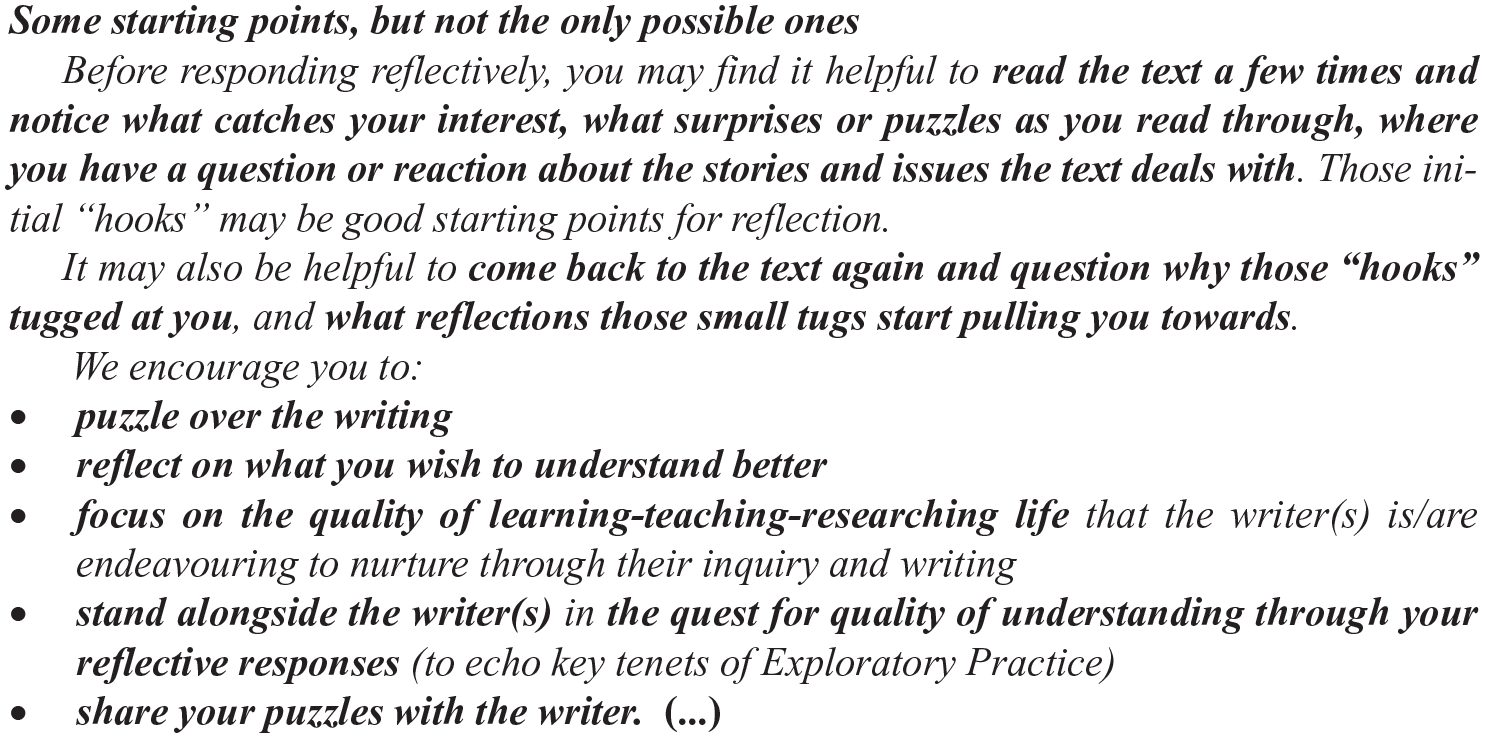
Guidelines for reviewers for Learner Development Journal 5 (LDJ5) (extract).
A good deal of the editorial work for LDJ5 involved communicating with writers and re-interpreting their writing, and puzzling with them too about what the editors came to call the ‘central narrative thread’ in their narrative accounts and practice-related reviews. (For an explanation of these genres, see below.) The thread metaphor captures the struggle that they and different writers were experiencing in making connections between the many disparate elements of the texts that they were crafting. Grasping the central narrative thread in each text became a key part in, first, understanding the deeper coherence of what writers were concerned with, and then seeing how to respond to each writer according to where the editors understood them to be in the process of threading their texts together. In this process, each writer’s ‘participant signature’ (Clandinin & Connelly, 2000, p. 148) – or the way a writer decides to ‘be in a text’ and assume ‘author identity’ – grew and took shape. Importantly, within the complex interaction of practices that the LDJ involves, a writer’s participant signature is in many ways co-constructed and negotiated, as Clandinin and Connelly (2000) note, between the writer and other participants through multiple interactions in the overall process of researching and writing.
4 New genres
A fourth significant feature of the LDJ has involved encouraging writers and editors to experiment with alternative genres such as written dialogue to see how this may facilitate communicating their PR work. The LDJ5 editors decided to take this one stage further by introducing two alternative types of writing: narrative accounts and practice-related reviews. For a narrative account, each contributor was encouraged to focus on an issue arising in their own personal and/or professional lives and adopt a particular position (or positions) from which to start narrating their accounts. For practice-related reviews, writers were asked to review a book or article related to the theme of LDJ5 (the multilingual turn in learner development) and relate their reading to their own local practices and to the particular concerns that they had about the issue theme. Individual stories of practice and reflection thus featured strongly in both the narrative accounts and the practice-related reviews and seemed likely to engender a personalized style of writing in which different voices (learners’, teachers’, and other participants’), perspectives, and points of reflection might form part of the narrativized writing, which we discuss in more detail in Section IV.
As contributors developed their writing in search of their own narrative paths, the LDJ5 editors realized that two particular moves figured prominently in these searches: first, adopting a narrative orientation at the start of the writing, and, second, moving from a local perspective to engaging with the wider field, thereby managing transitions between localized practices and broader, more generalizing academic work. Examining such moves can help us understand how practitioners may come to embody and narrate their own voiced perspectives as they write, and how they can realize a quality of ‘story-like-ness’ or ‘narrativity’ (Goodson & Gill, 2011; see also Barkhuizen & Consoli, 2021) in their writing.
a Adopting a narrative orientation
Contributors to LDJ5 opened their narrative accounts with a personal story (or stories) that took the reader into the writer’s experiences and practices and led to questions which the writer would explore in the rest of the text. The example narrative orientation shown in Figure 4 appears at the beginning of a narrative account by Riitta Kelly and Jussi Jussila (Kelly & Jussila, 2021, p. 58), who open with a reconstructed narrative episode of co-teaching a course multilingually. They focus on their feelings about teaching in different languages and indicate that they will continue their account by reflecting further on their experiences.
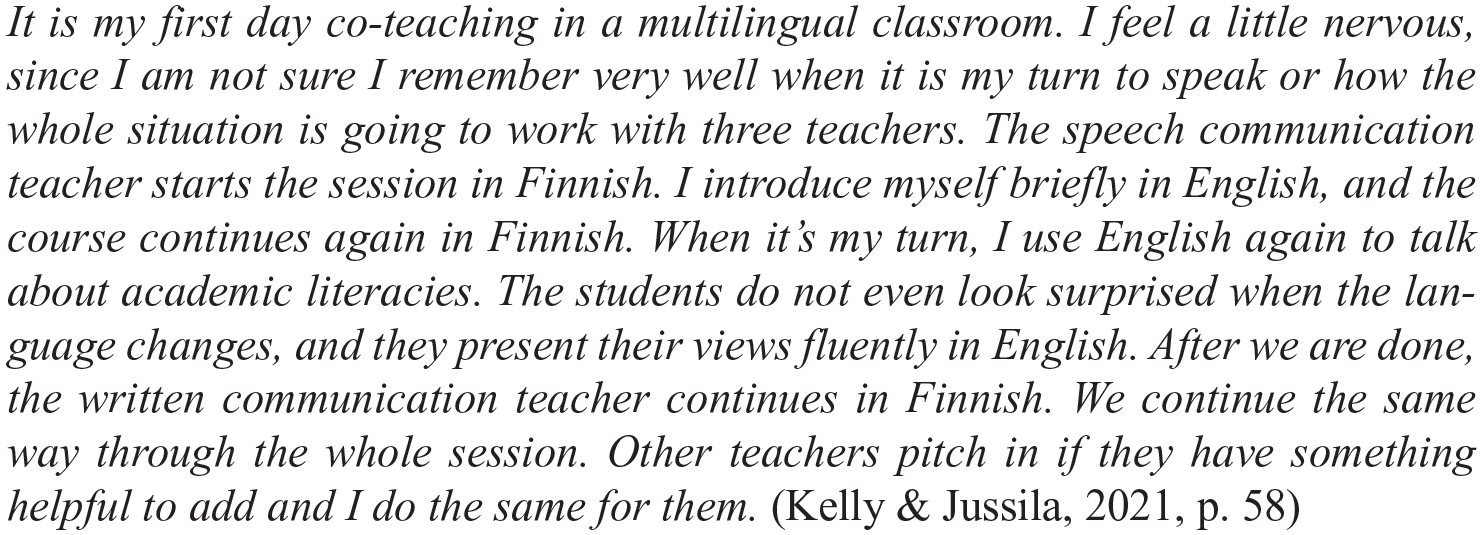
Narrative orientation.
Kelly and Jussila look reflectively both ‘backward’ at their own professional and personal lives and ‘inward’ to particular feelings or moments of awareness that they have in relation to conditions that they face ‘outward’ in their external worlds. In doing so, they start to assume a questioning, reflective stance by pointing ‘forward’ to what they will focus on in the rest of their narrative accounts. Proposed by Clandinin and Connelly (2000, pp. 48–62) from their work on narrative inquiry, the directions of ‘inward/outward’ and ‘backward/forward’ provide a useful model for thinking about how writers can take and develop a personalized reflective narrative stance in writing about their practices as they move away from the linear, general-specific, universalizing direction that much conventional academic writing follows.
b Moving from a local perspective to engaging with the wider field
Writing in a personalized, reflective, and narrativized way does not obviate the need to relate practice to theory and other work in the field at different points in a practitioner research text. Contributors to LDJ5 often found this a challenge as if ‘practitioner’ and ‘researcher’ identities clash as an author tries to decide how to relate their practice and research to the wider field, and represent this relationship in their writing. In mediating local practices and disciplinary knowledge, writers may well feel pressured to perform academic expertise and/or project a researcher identity. Such dilemmas can put authors at odds with adopting a personalized stance in their writing, suggesting that a good part of such writing involves navigating ‘dilemmas among conflicting identities’ (Aoki, 2010, p. 37), and/or transforming our identities through writing, to paraphrase Aoki.
In response to such dilemmas, the LDJ5 editors believed that dialogue between writers and others could help contributors address such quandaries and find their own paths in writing. Along the narrative lines that each contributor journeyed, there were many twists and turns as writers reflected inward/outward and backward/forward, brought in the voices of other participants in their practices and research, made connections to work in the wider field, and tried to interconnect different meanings that particular experiences, persons, identities, events, texts, and phenomena held for them. The term ‘negotiated dialogic re-interpretation’ may go some way to capturing these multifaceted interactions between writers and response communities, then reviewers, and, finally, editors.
IV Raising issues around practitioner research writing
Looking beyond our experiences with the LDJ, we recognize that different publication possibilities exist, each with their own conventions, processes, and expectations. Are questions of what kind of PR writing is published, where, by whom, and for whom, merely a case of ‘let a hundred flowers blossom’, or should those with a commitment to practitioner research be concerned that writing by classroom practitioners for classroom practitioners is not more widespread or more widely supported? Is it just a simple matter of distinct communities having different expectations about writing and the research they want to read about? Or could this have much more to do with competing conceptions of what is legitimate/legitimized research?
In closing, we would like to respond to some questions posed by an anonymous reviewer of an earlier draft of this article. These are to do with the modes and means for PR writing.
1 Modes: What do we mean by narrativized writing, how is it beneficial, and what are the challenges?
There is already a large body of published PR that represents for us the kind of writing we think is conducive to the practice of PR and is accessible to the widest range of practitioners (e.g. Clandinin et al., 2015; de Almeida Soares, 2008; Hayashi, 2012; Hooper, 2022; Miller, 2003; Mullen et al., 2014; Pinner, 2016; Vye et al., 2014; Wu, 2004; Zhang, 2004). In our view, these texts embody the values expressed in the LDJ reviewer guidelines: The writing starts with a narrative, often including a critical incident in which the practitioner-researcher identifies a puzzle within their local context; it describes that context as fully as possible; it makes the writer and the other local actors evident in the writing; it displays reflexivity, multivocality, and criticality; and it takes a problematizing stance. Much of the writing also displays a complex hybridity, whereby it integrates these features with elements of a more objectivist style when the writer wishes to convey a more authoritative voice, align themselves with work done by others, draw on theory, or appeal for support and validation through reference to other practitioners and researchers. Equally, there is plenty of published PR writing, including some in the LDJ, that does not display the features of personal, narrativized writing.
The dilemma in advocating for a particular style of writing for practitioner-researcher writing is that PR covers a range of approaches, so it is to be expected that writers will use a variety of styles and genres for PR writing. Our position is that an objectivist, universalizing style does not help the classroom practitioner to inhabit their own research space so that they can develop their own understandings of their practice from the inside. Although writing in a personal, narrativized style is no easier than writing in an objectivist, scientific style, it can help the practitioner to focus on their own practice without the need to situate their local practices within the wider field. Simply put, this means starting from an episode, an event, a knot, or a story which puzzles the practitioner, rather than from a literature review.
We further contend that this subjective and interpersonal form of writing is closer to the ways in which teachers often talk about their teaching and their learners with each other – not through abstractions, but through concrete experiences, actual examples, and different incidents in their daily practices. Additionally, personal, narrativized writing may have greater appeal for practitioner readers and allow for wider dissemination of practice-related understandings.
2 Means: How to make sure that practitioners’ needs are served?
The admission that a narrativized, personal style is no easier to write in than an objectivist, scientific style represents a major challenge. How can classroom practitioners best be encouraged to engage in PR and writing about PR? How can classroom practitioners be supported as they write? In what ways might writing up and dissemination contribute to practical communities of inquiry and the establishment of new practitioner networks?
Our local practice with the LDJ has assumed that practitioner-researchers should work collaboratively in a PR project to support each other and engage in focused discussion around their research and writing. However, the use of response communities with different issues of the LDJ is not in any way new. Teachers’ groups often work collaboratively on professional development activities. What is different is the explicit emphasis on writers developing their writing organically through dialogue and discussion with other contributors, editors, and reviewers. These intersecting collaborations allow for close peer support in ways that are, as far as we know, unusual for a publication aspiring to present engaging and substantive PR work.
Many involved in supporting PR would probably agree that PR and PR writing need to be nurtured in a safe, caring environment if it is to begin to more inclusively represent the members of our profession and the students they teach. Do practitioner-oriented and researcher-oriented publications like journals need to lead the way with forming new relationships and networks? Should journals, for example, implement different editorial and production practices and structures that support collaborative PR? Would it be possible for established publications to partner new projects that primarily serve classroom practitioners, as opposed to principally serving the aims and needs of academic publishing? Various networks already exist, of course, but for regular classroom teachers and their students to enter and take part in the discussion in a more consistent way, we propose that leading second language education publications initiate new outreach projects with local teacher organizations. These partnership projects would promote local practitioner research initiatives and, importantly, publish PR work under different criteria and in different forms from those of academic research.
What other changes in editorial practices might make publishing less daunting and more inclusive for practitioner-researchers? Following the lead of scientific journals such as the British Medical Journal in implementing open peer review (Smith, 1999), in the last 20 years, many other journals have introduced this practice (Ross-Hellauer & Görögh, 2019). Open peer review helps to ensure that review processes are dialogic, collaborative, and supportive. Reviewers could, for example, be explicitly re-positioned as ‘peer reader responders’ whereby their reviews are included as ‘peer reader responses’ in the final published work (Barfield & Nix, 2003). This kind of inclusive, transparent, and egalitarian way of reviewing illustrates just one possibility for supporting and producing original practitioner research writing. Leading publications in second language education could follow suit – and go further by creating Diversity, Equity, and Inclusion (DEI) guidelines to bolster opportunities for a wider range of practitioner perspectives, work, and voices to be disseminated.
Of course, it is not the sole responsibility of journal editorial boards to change opaque, out-dated, and anti-democratic practices such as blind peer review. Many other initiatives can support new ways of writing about PR, e.g. local teaching associations, Electronic Villages Online (EVOs), online PR writing forums, Special Interest Groups (SIGs), and workplace teacher projects. Nevertheless, introducing outreach projects for local practitioner research, seeing these through to publication under new, practitioner-inclusive arrangements, and changing review practices would not only send a hugely encouraging message to those practitioners who currently regard publishing as ‘off limits’, but also work to legitimize new forms of writing and make writing about PR far more accessible to practitioners.
Writing for and about PR raises questions about who gets to tell the story (Zeichner & Noffke, 2001), who gets or remains silenced, and, ultimately, what the purpose of PR is. In this article, we have reflected on how these questions have been addressed in our own local context and in the case of one particular issue of the LDJ, how and why we have endeavored to create alternative inclusive practices. However, our specific solutions may be impractical in other situations. It is up to each new community of writers, reviewers, and editors to question and explore what kinds of writing and feedback will be of most benefit and support to classroom practitioners.
