







Abstract
This multiple case study explores how and to what extent Chinese English-major students engage affectively, behaviorally, and cognitively with supervisory feedback on their English-as-a-foreign-language (EFL) undergraduate theses, as well as how motivation and second language (L2) proficiency may mediate their engagement. Data were collected from three students through stimulated recalls, interviews, thesis drafts with supervisors’ feedback comments, and audio recordings of supervisor–student conferences. Qualitative data analyses revealed that the three participants differed markedly in their engagement with supervisory feedback on their undergraduate theses. Driven by different motivations and mediated by their levels of English proficiency, the students took different stances and employed different cognitive strategies in their responses to the supervisory feedback. Based on these findings, pedagogical suggestions are proposed for enhancing student engagement with supervisory feedback in the Chinese context of higher education.
Keywords
I Introduction
The English-as-a-foreign-language (EFL) undergraduate thesis offers the last academic credits that an English-major undergraduate needs to obtain a bachelor’s degree in China, and it is the final major and compulsory assessment in the undergraduate study (National Advisory Committee on Tertiary Foreign Language Specializations, 2000). To scaffold undergraduate students’ thesis writing, supervisors are expected to provide formative feedback at different stages of thesis supervision. Recent literature on feedback has paid special attention to student engagement, stressing that without students’ engagement with the feedback received, even the most learning-rich feedback will remain ineffectual (Carless, 2020; Price et al., 2011). High-quality supervisory feedback and student engagement with it throughout thesis writing can enhance the quality of the final thesis and the fruitfulness of the thesis writing experience (Basturkmen et al., 2014). Previous research has also shown that student engagement with feedback is a multi-dimensional construct that can be mediated by students’ motivation and proficiency in the target language (Ellis, 2010). Unlike coursework assignments, students are given the freedom to choose research topics of interest and keep an ongoing dialogue with their thesis supervisors. Thus, these two factors can substantially influence the way they interact with feedback and learning outcomes (Han & Hyland, 2015). Although previous studies have examined student engagement with supervisory feedback on master’s theses (e.g. Neupane Bastola & Hu, 2021a, 2021b; Yu et al., 2019), there is a lack of such research at the undergraduate level. The present study is an attempt to explore Chinese English-major undergraduate students’ engagement with supervisory feedback on their undergraduate theses and how motivation and second language (L2) proficiency may influence their engagement.
II Literature review
In their review of educational research on school engagement, Fredricks et al. (2004) defined engagement as a multidimensional construct manifested in affective, behavioral, and cognitive terms. These three dimensions of engagement are conceptually separate, though they are inherently related. Affective engagement concerns a student’s emotional reactions to learning activities. It reflects students’ attitudes towards school, peers, and teachers (Ford, 1992; Värlander, 2008). Behavioral engagement refers to students’ self-directed academic behaviors such as ‘effort, persistence, concentration, attention, asking questions, and contributing to class discussion’ (Fredricks et al., 2004, p. 62). Cognitive engagement is manifested in ‘the extent to which one is thinking about the learning activity or attending and focusing on the task’ (Ben-Eliyahu et al., 2018, p. 53). In other words, cognitive engagement involves personal goals, the use of learning and meta-cognitive strategies (e.g. understanding and processing of feedback, revision planning, self-directed learning), and self-regulation in learning activities. More recently, agentic engagement has been proposed as the fourth dimension of student engagement, which refers to students’ ‘constructive contribution to the instruction they receive’ (Reeve & Tseng, 2011, p. 258). In our study, we adopted the affective, behavioral and cognitive dimensions of student engagement because most manifestations of agentic engagement (e.g. making suggestions, expressing preferences, and demonstrating personal initiatives) can also reflect behavioral and cognitive engagement, hence the conceptual and operational difficulty in distinguishing agentic engagement from other types of engagement (Reeve & Shin, 2020).
Perhaps the most widely discussed construct in relation to engagement is motivation. Motivation is the driving force that initiates, directs, and sustains behavior toward the attainment of specific goals (Pintrich & Schunk, 2002). It plays a crucial role in shaping the achievement goals that students set for themselves. A mastery goal reflects a student’s strong desire to learn from the task, while a performance goal indicates a desire to showcase their abilities (Leenknecht et al., 2019; Urdan & Kaplan, 2020). For example, students with a mastery goal orientation recognize the affordances of supervisory feedback for learning/development and actively seek external resources to improve thesis writing skills. In contrast, students with a performance goal are only interested in obtaining higher grades for their undergraduate theses and see supervisory feedback as a means of achieving that goal. Even though motivation and engagement are linked to each other in some previous work, they are two distinct constructs in the engagement literature. According to Skinner et al. (2009), motivation is the underlying source of purpose and durability, whereas engagement is the outcome of motivation. In other words, ‘engagement is the outward manifestation of a motivated student’ (p. 494). The present study conceptualizes engagement as being distinct from motivation by adopting the view of Ben-Eliyahu et al. (2018) that motivation is a driving force for engagement.
Another conceptual issue concerns the distinction between facilitators and indicators of student engagement. Indicators of student engagement refer to certain characteristics that demonstrate student engagement; for example, students’ efforts and enthusiasm for school tasks. Facilitators are contextual factors that could potentially enhance students’ engagement, e.g. teacher and peer support in schoolwork (Lam et al., 2012). Therefore, indicators manifest the construct of student engagement per se, whereas facilitators are factors that might impact on engagement but fall outside of the construct. For example, a student’s efforts to employ strategies to plan the revision and incorporate feedback into subsequent thesis drafts are indicators of his/her engagement. Facilitators are contextual influences on students’ engagement, for example, supervisors’ constructive feedback and support during thesis supervision.
In line with the multi-dimensional conceptualization of engagement (Fredricks et al., 2004), Ellis (2010) defined engagement with feedback in affective, cognitive, and behavioral terms. In feedback research on second language (L2) learning, engagement generally refers to how L2 learners act and respond to the corrective feedback that they receive (Ellis, 2010). Affective engagement with feedback refers to how learners respond emotionally to such feedback. Behavioral engagement concerns whether learners incorporate oral corrections by others or revise their written text based on the corrective feedback received. Cognitive engagement focuses on how learners pay attention to and process the corrective feedback. Ellis (2010) suggested that engagement with corrective feedback could be influenced by various individual and contextual factors. Therefore, this framework is in line with a sociocultural perspective on corrective feedback and highlights the importance of student agency during learning activities (Lantolf & Pavlenko, 2001).
Previous research has indicated that individual factors such as students’ L2 proficiency, learning motivation, and language learning beliefs can mediate engagement. It is well established in the literature that L2 proficiency is one of the most significant contributors to students’ uptake of feedback (Hyland, 2003; Zhang & Hyland, 2018; Zheng & Yu, 2018). For instance, Zhang and Hyland’s (2018) case study of two Chinese university students’ engagement with teacher written feedback and automated feedback on their L2 writing revealed that, although they engaged with both types of feedback, the depth of their engagement varied. The student with lower English proficiency had more difficulty understanding and incorporating feedback into his revisions.
Another key learner difference is learning motivation, namely a learner’s willingness to dedicate time and effort to a learning activity and their persistence in doing so (Dörnyei, 2001; Han & Hyland, 2015; Kormos, 2012; Ryan & Deci, 2017; Zhang & Hyland, 2018). Previous studies have examined the relationship between students’ individual learning goals as part of their learning motivation and their utilization of feedback. Hyland (2011), for example, investigated L2 students’ motivations and goals for learning from teachers’ form-focused written feedback in a tertiary context. She reported that students’ different learning goals influenced their engagement with form-focused feedback, leading to varying improvement of their writing. Similarly, Han and Hyland (2015) examined how four students at a Chinese university engaged with teacher written feedback. They found that the students displayed dynamic engagement with teacher feedback, and that their learning motivation and beliefs played a significant role in their behavioral and cognitive engagement with the feedback. Han and Hyland (2015) concluded that ‘learners are active agents of their own learning who can decide what and how they learn from teacher feedback’ (p. 41).
In the context of engagement with supervisory feedback, research has examined how supervisory relationships may influence students’ perceptions of the value of the supervisory feedback received and their engagement with such feedback (de Kleijn et al., 2014; Neupane Bastola & Hu, 2021b). This line of research suggests that fostering a friendly teacher–student relationship during supervision is crucial for enhancing students’ engagement and learning in thesis writing. Another strand of research has examined how different approaches to thesis supervision could influence students’ learning. For instance, Dysthe et al. (2006) advocated the ‘multi-voiced supervision’ that involved various forms of supervision such as colloquia, group, or individual meetings to maximize support for students’ learning effort and cater to the different needs of individual students. Still another line of research has focused on how students may experience research projects (e.g. Malcolm, 2012; Seymour et al., 2004; Todd et al., 2004). This body of research suggests that although students can benefit from the support of their thesis supervisors and research staff, they may encounter various problems in the conduct of their research projects. For instance, limited supervisory time was found to have a negative impact on the supervisory feedback available and students’ engagement with whatever feedback they received (Neupane Bastola & Hu, 2021a, 2021b). Furthermore, the nature and types of supervisory feedback have been investigated with a view to enhancing supervision effectiveness. Previous studies revealed that constructive, informative, and realistic feedback can play a critical role in scaffolding students’ learning and thesis writing (Neupane Bastola, 2020; Xu, 2017). Finally, research on supervisory feedback has also explored how students’ achievement orientations, goals of thesis supervision, supervisory responsibilities, and institutional support could mediate the effectiveness of supervision (Derounian, 2011) and enhance student learning in the thesis writing and revision process (Healey et al., 2010).
The literature review presented above reveals several gaps in extant research. To begin with, previous research on student engagement with feedback was mostly conducted to understand student engagement with corrective feedback on language output or peer feedback. There is a paucity of research on engagement with supervisory feedback on L2 academic writing. Supervisory feedback is different from corrective feedback on language performance because it usually goes beyond linguistic accuracy to involve academic literacy and genre knowledge as well (Hyland, 2010). Therefore, the findings from the previous studies on corrective feedback may not be applicable to supervisory feedback on L2 academic writing. Second, extant studies on thesis supervision and supervisory feedback focused on master’s (Basturkmen et al., 2014; Belcher, 1994; Bitchener et al., 2010; Dysthe et al., 2006) or doctoral students (Wang & Li, 2011; Wei et al., 2019; Wisker et al., 2003; Xu, 2017), with little attention to thesis supervision at the undergraduate level (Ashwin et al., 2017; Rowley & Slack, 2004). However, it can be argued that undergraduate students writing their theses need more supervisory support and feedback because of their limited experience with extended academic writing. Finally, while previous studies investigated the effects of student-related individual differences on engagement with corrective feedback and revision behaviors, research is thin on the ground that explores how such individual differences may influence undergraduates’ engagement with supervisory feedback. This research gap hampers our understanding of how the affordances of supervisory feedback can be actualized. Therefore, the present study aims to address the following two research questions:
• Research question 1: To what extent do English-major students effectively engage with supervisory feedback on their undergraduate theses in affective, behavioral, and cognitive terms?
• Research question 2: How do their motivation levels and language proficiency specifically influence their responsiveness to supervisory feedback on their undergraduate theses?
III Method
1 Context and participants
The study was conducted in the School of Foreign Language Studies of a major university in eastern China. Participants in this study were students majoring in English. In Chinese universities, students taking English courses fall into two groups: non-English majors and English majors (Zhao, 2010). Non-English majors typically take English courses during the first three semesters of their studies, and these courses do not usually include an academic writing component. English majors are required to write an academic thesis in English during the last semester of their fourth academic year. At the university where the study took place, students are expected to submit their thesis proposals before the first semester of their fourth academic year ends between December and January. They must then submit their first draft to their supervisors between March and April, and their second draft in May. By the end of May, the theses need to be submitted to the School of Foreign Language Studies. Throughout this process, students are required to submit multiple drafts to their supervisors and make revisions based on the supervisory feedback received. Thesis supervision usually occurs on a one-on-one basis. Some supervisors may also hold collective meetings with their supervisees to discuss their work and provide feedback.
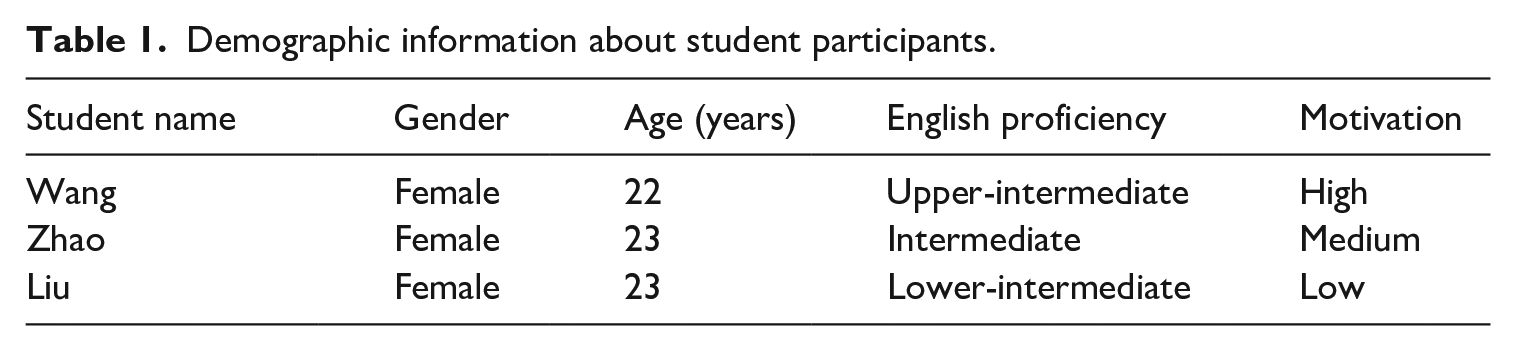
Three students (i.e. Wang, Zhao, and Liu, all pseudo-names) were recruited for this study through purposive sampling (Yin, 2017). They were selected from a group of senior English-major students based on their different levels of motivation to finish their undergraduate theses and their English proficiency. Because previous studies suggested that a student’s language abilities and motivation could influence his/her feedback uptake (Han & Hyland, 2015), the present study aimed to examine how these individual differences would mediate the focal participants’ engagement with supervisory feedback. Specifically, their motivation to complete the undergraduate thesis was evaluated based on their self-reported motivation level, ranging from not motivated at all to very motivated. Their English proficiency was evaluated based on self-reported test scores from TEM-4 (Test for English-majors Band 4, a national language proficiency test for English-major students) and previous English courses. The students’ self-reported language proficiency and motivation were then verified with their supervisors. All three supervisors had over 10 years of supervisory experience and similar expertise in supervising undergraduate research projects. The focal students underwent three rounds of feedback and revisions. Each of the three drafts was thoroughly reviewed, with special emphasis placed on their first thesis drafts. This is because the supervisory feedback on the first drafts typically addressed research methods, content, genre, and academic conventions. Thus, more and diverse information could be elicited from the participants. Demographic information of the student participants is presented in Table 1.
Demographic information about student participants.
2 Data collection and analysis
Data collected for this study include stimulated recalls and semi-structured interviews with the focal students, recordings of supervisor–student conferences, as well as their thesis drafts with supervisory feedback. Supervisory feedback points were employed as the stimuli in the stimulated recalls. The students were asked to recall their thoughts and emotions while reading the supervisory comments, including their understanding of specific feedback points and whether and how they would incorporate the feedback points into their work for improvement. The stimulated recalls lasted 30–60 minutes depending on the number of supervisory feedback points received. The semi-structured interviews were conducted with the focal students shortly after the stimulated recalls. Each student was interviewed three times after receiving three rounds of supervisory feedback, respectively. The interviews were intended to gather information regarding the students’ perspectives on and experiences with writing a thesis, as well as their approach to revising their work. Each interview lasted 50–60 minutes. All the interviews and stimulated recalls were conducted in Mandarin by the first author, audio recorded, and transcribed for subsequent analysis.
The focal students’ multiple thesis drafts were also collected for an analysis of the supervisory feedback and the subsequent revisions that they made in response to the feedback. In addition, supervisor–student conferences were also recorded. These conferences captured interactions between the supervisors and their supervisees, provided information on a supervisor’s specific feedback points, and were used as stimuli during students’ stimulated recalls. For some second and third thesis drafts, the supervisors did not hold conferences but provided on-script feedback because of the greatly reduced number of issues calling for feedback. Each pair of supervisor and student in this study held two or three conferences to discuss revision. The conferences lasted 30–50 minutes depending on the number of feedback points discussed. The conferences were conducted in Mandarin, the participants’ mother language, and transcribed for further analysis. The first author was present as a non-participant observer to ensure that the conferences were appropriately recorded. In our study, we adopted non-participant observation because it afforded flexibility in the use of observational strategies to capture different perspectives and interactions, thus facilitating the collection of rich and detailed data (Creswell & Creswell, 2017). Several efforts were made to minimize possible reactive effects of the observer on the conferences. For example, the first author as the observer had developed much familiarity with the participants before the observations were conducted. As was the case on other occasions, the teacher–student conferences to be observed were held in a common room, with other people (i.e. teachers and/or students) being present. As a result, the non-participant observer remained indistinct from the other individuals in the background in the common room, and the participants were asked to do business as usual (Neuman, 2013).
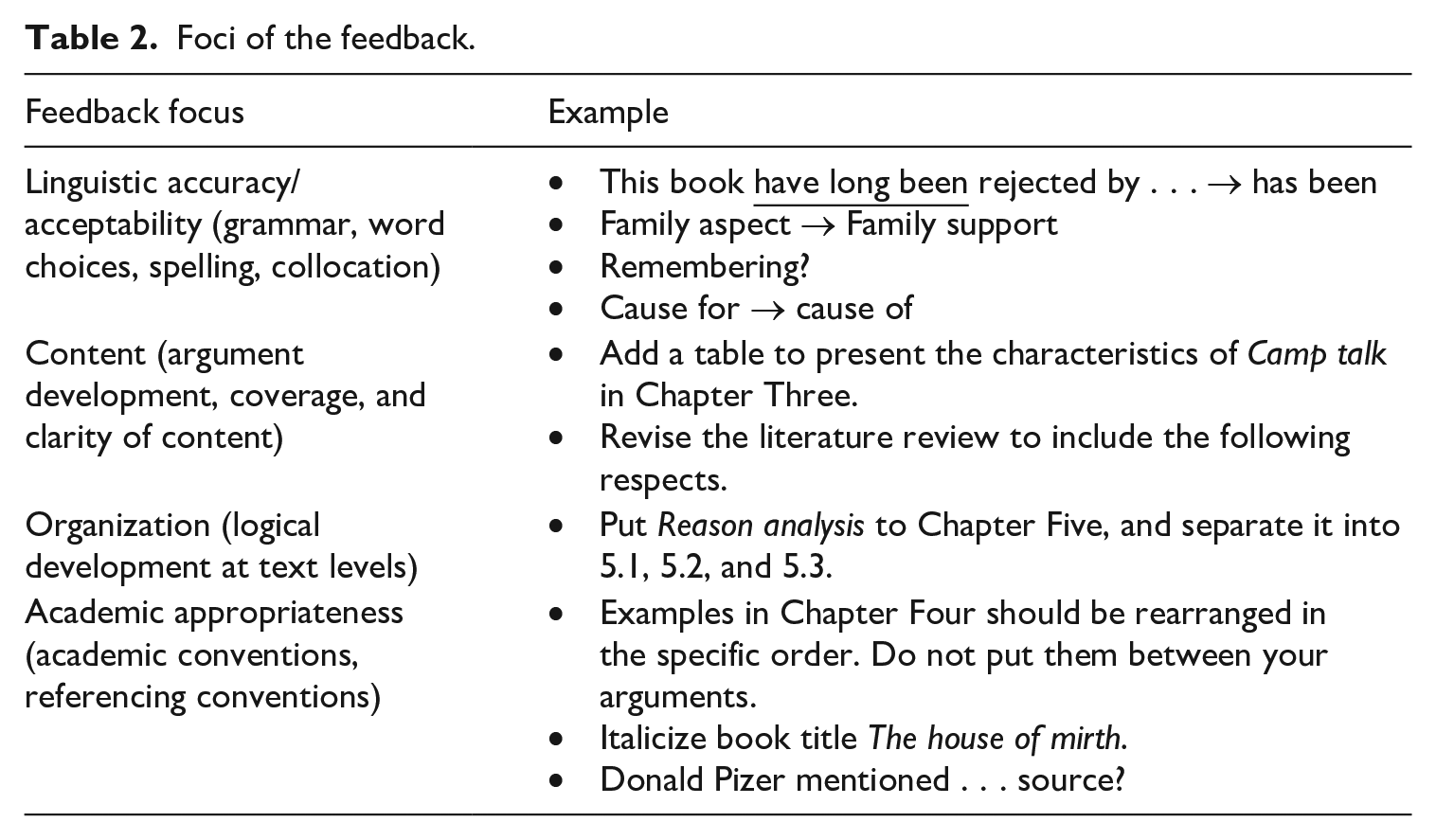
A content analysis was conducted on the supervisors’ feedback and the students’ revisions made in response to the feedback. Following Xu’s (2017) analytical scheme, the supervisors’ feedback on the students’ first, second, and third drafts was coded to generate a comprehensive inventory of supervisory feedback. The unit of coding was a feedback point. As defined by Hyland (1998, p. 261), feedback points consisted of ‘symbols and marks in the margins, underlining of problems, and complete corrections, as well as more detailed comments and suggestions’. As illustrations, the underlined phrase in ‘
Foci of the feedback.
To ensure the reliability of the content analysis, a master’s student who majored in applied linguistics was trained to identify feedback points and calculate take-up rates. Then the coder and the first author independently coded three drafts by one student. The identification of feedback points and the classification of supervisory feedback into different categories showed high levels of inter-rater agreement (i.e. 96% and 93%, respectively). All the disagreements were resolved through discussion. Given the good coding reliability, the first author coded the remaining data.
An iterative content analysis (Neuendorf, 2017; Weber, 1990) was conducted on the stimulated recalls, recorded conferences, and semi-structured interviews. Fredricks et al.’s (2004) conceptual framework of student engagement was used as a guide to identify categories for the students’ affective, behavioral, and cognitive engagement with supervisory feedback. Segments of the transcripts were first tagged with overarching codes (i.e. affective engagement, behavioral engagement, cognitive engagement). Subsequent recursive reading of the transcripts, inductive open coding (Ezzy, 2002, p. 83), and constant comparison led to the incorporation of sub-categories under the main categories (e.g. emotions, emotional changes, and appreciation subsumed under affective engagement). These sub-categories were iteratively revised and refined until they captured the full dataset well (for the finalized coding scheme, see the Appendix in supplemental material). Based on the deductive and inductive coding, we generated a narrative of each focal participant’s engagement with supervisory feedback and factors influencing their engagement. In the process, the stimulated recalls, recorded conferences and semi-structured interviews were triangulated with each other and with the students’ thesis drafts and their supervisors’ written commentary on them to determine the various manifestations of affective, behavioral, and cognitive engagement with supervisory feedback.
IV Findings
1 Wang: Deep engagement with understanding
Having been admitted to a top-tier university in northern China to continue her master’s study, Wang aspired to write an undergraduate thesis that would excel in quality and prepare her well for her academic career. With this motivation at work, Wang decided to write a thesis to analyse the English translation of a Chinese novel titled Crystal boys. This thesis topic was chosen because of her interest in Chinese novels and translation studies. Given her keen interest in the thesis topic and her ambition to produce an excellent thesis, it was not surprising that her attitude toward supervisory feedback on her first thesis draft was positive and proactive. She expressed a deep trust in her thesis supervisor: When I saw the feedback points, I was somewhat disappointed because I would need to revise a lot. Then I realized that it was also a precious learning opportunity because I could learn thesis writing skills from my supervisor. I knew my supervisor was a specialist in translation studies, so it was lucky for me to have her as my thesis supervisor. (Wang, Stimulated recall)
A closer look at the supervisor’s feedback on her first draft revealed that it focused predominantly on content development and thesis organization. Understandably, addressing feedback on content development would require more mental effort and cognitive engagement during the revision process. Indeed, Wang exhibited intensive cognitive engagement with the supervisory feedback, as manifested in her thorough understanding of each feedback point. In the stimulated recall, Wang provided very detailed explanations of all the feedback points received. She also employed a range of metacognitive operations such as revision planning, prioritizing the issues identified in the supervisory feedback, and self-directed learning. For instance, she had a clear plan for revising her thesis draft: I plan to restructure my thesis to address the logic development problem first. Then, I will revise the thesis according to the feedback points concerning argument development. I will also need to look for more references to support these arguments. (Wang, Stimulated recall)
Wang’s deep engagement was promoted by the supervision conferences, during which her supervisor and she exchanged their opinions and discussed thesis revisions. The excerpt below exemplifies their dialogue during these conferences. At the first conference, her supervisor talked Wang through the logic development problem in a paragraph that defined key terms in her thesis: Supervisor: All right, this paragraph beginning with ‘camp talk, in other words, gay speeches . . .’ This is the first time you mentioned it in your thesis. In your previous paragraphs, you gave some introductory information about the novel. Such a shift is too abrupt. What do you mean by Crystal boys? Do you mean the Chinese version or the English one? Wang: Emm, yes, right. I see what you mean, Professor. It is too ambiguous. Supervisor: A more logical sequence should be that there are gay conversations or gay speeches in the Chinese version of the novel defined by some scholars as camp talk. This is a natural linkage. Then, you should stress that such talk is instrumental in shaping their images. The translator has then dealt with the translation of camp talk in various ways, so the images may also be reconstructed. Thus, your study aims to discover the differences arising from the methods of translation used. What do you think? Wang: It is more coherent and flows well! I get it.
The discussion on logical and content development deepened Wang’s understanding of how content could be organized more coherently in her thesis. Because of the discussion, Wang was able to provide a thorough explanation of each feedback point at the level of noticing and understanding. She also employed such metacognitive operations as revision planning, evaluation of revision effectiveness, and self-directed learning when revising her first draft. For example, she recalled that she could picture how her thesis could be expanded to improve its logical development in response to the supervisory feedback. Emotionally, she found that this approach to thesis supervision was ‘deeply trustful’ and ‘down-to-earth’ because both sides participated in discussions that facilitated her understanding and engagement. Cognitively, she was also actively engaged: I thought about revising my thesis through reading and re-reading my supervisor’s feedback points. Though she provided me with clear, logical chains of ideas to restructure my thesis, I still needed to include some new content when revising. (Wang, Stimulated recall)
Wang’s behavioral engagement with the feedback was also intensive. She acted on every feedback point in the revision of her first draft. To respond to the feedback points, she read additional publications and consulted dictionaries as well.
To sum up, Wang had a positive attitude toward, and was proactive about, the supervisory feedback received. She treated her supervisor’s feedback as a valuable source for effective learning and the improvement of her thesis. Wang was also highly engaged behaviorally, endeavoring to follow up on the supervisory feedback, reading relevant journal articles, and having discussions with her supervisor so that she could revise her thesis effectively. The take-up rates for the feedback on linguistic accuracy, content, organization and academic appropriateness were all 100%. Wang also attained a high level of cognitive engagement with the supervisory feedback because her revision and self-reports demonstrated a clear understanding of the feedback points and an effective use of various metacognitive strategies to revise her thesis drafts. Consequently, the feedback that she received greatly enhanced her competence in English academic writing.
2 Zhao: Superficial engagement with limited understanding
Initially, we expected Zhao to engage intensively with supervisory feedback because of her relatively good English proficiency. However, it turned out that in her opinion, writing an undergraduate thesis was merely a required chore to complete before graduation. Her target was to get 60 marks out of 100 for her thesis. Her thesis topic fell in the area of English and American literature and was a literary analysis of the causes of Lily Bart’s tragedy in the novel The house of mirth. She ended up with this topic because she initially had no idea about what to work on and her supervisor suggested the topic.
Upon receiving her supervisor’s feedback on her first draft, Zhao described her emotion as calm. ‘I experienced no mood swing. Revising the thesis is a normal thing. As long as I don’t receive too many feedback points on my final thesis draft, I can accept it’ (Zhao, Stimulated recall). After seeing the feedback received by her roommates, she acknowledged her supervisor’s effort to read her draft closely and was grateful to her supervisor for the feedback that she received. In her words, ‘My supervisor provided detailed feedback punctually and in a practical way. I felt that working with my supervisor, I could graduate with a passable thesis’ (Zhao, Interview).
A detailed examination of the feedback on Zhao’s first draft showed that her supervisor provided comments on each chapter, mostly content-focused suggestions about the expansion of key chapters and the development of stronger arguments in some chapters. For example, in the theoretical framework chapter, the supervisor made such comments: ‘Your study should focus on feminist theory rather than other theories. You’ve listed too many previous studies without synthesizing and commenting critically on the work you’ve cited.’ Zhao tried to make sense of this feedback without achieving a full understanding. She was unsure about why her study should adopt feminist theory: I’m not sure why my thesis should be approached from a feminist perspective. There were many studies adopting other theoretical perspectives. So, I had sort of put down whatever seemed feasible in my thesis. Based on her feedback, I deleted those paragraphs discussing the novel from other perspectives. Then, I added some sentences at the end of each paragraph. Those discourse markers or transitional sentences would help my supervisor notice that I did something about the feedback. (Zhao, Interview)
As evidenced by the interview excerpt above, Zhao did not fully understand why her thesis should take a feminist perspective and how it could illuminate her literary analysis. Although she failed to see the conceptual affordances of such a perspective, she managed to revise her thesis to meet the supervisor’s requirements by removing some paragraphs and adding superficial comments on the synthesized literature. Because of her lack of understanding of the adopted theoretical perspective, it was not surprising that she also had difficulty pinpointing the significance of her thesis project when her supervisor suggested that she do so. Zhao did not see real value in her thesis: I feel that I’m exaggerating its significance. I never thought that my research would have real significance. I don’t have a clear idea about the novel’s details either. As result, it was difficult to revise the draft. I have to read and find out how other people have discussed the significance of their work. (Zhao, Stimulated recall)
Another example illustrating Zhao’s superficial engagement with the supervisory feedback was how she responded to feedback points on academic writing conventions. For instance, her supervisor asked her to provide a source citation for a statement found in the literature review section: ‘In the 1990s, Donald Pizer further studied The house of mirth from the perspective of naturalism.’ She responded to the feedback by deleting the sentence discussing Donald Pizer’s work because she could not find the relevant source. Patching information from different publications into the literature review section, she could not trace a particular piece of information to its source. She confided, When I was drafting the literature review section, some sentences were pulled from one place or another. Now it is impossible to find where I took those sentences. So, I decided to delete this sentence because it won’t affect the overall picture of my thesis. (Zhao, Stimulated recall)
As indicated in the excerpt, one strategy Zhao employed frequently was to lift sentences from different sources to produce her paragraphs without reading the original works concerned. As a result, it was difficult to identify where a sentence came from at a later stage. Thus, she did not locate more references to follow up on the feedback. When she thought that doing nothing about a feedback point would not affect the overall quality of the thesis and her chance to pass the oral examination, she simply did not act on the feedback.
In summary, Zhao thought that receiving supervisory feedback was a standard procedure. Such affective reactions stemmed from her belief that supervisory feedback should be directive to improve the thesis. As a result, she was more willing to accept such feedback. In terms of behavioral engagement, she would choose not to make a revision suggested by her supervisor if she thought that doing so would not risk her goal of producing a ‘passable’ thesis. To secure a pass for her thesis, she had to respond to most of the feedback points. The take-up rates were 81.8% for feedback on content, 100% for feedback on linguistic accuracy, and 66.7% for feedback on academic appropriateness. Her unfamiliarity with the novel that she was supposed to analyse and her lack of motivation to excel at her thesis writing impeded her cognitive engagement with her supervisor’s feedback. Consequently, Zhao engaged with supervisory feedback in a seemingly active but superficial way.
3 Liu: Going through the motions
Liu was the least motivated of the three focal students to work on her thesis. As she confided in the first interview, ‘I intend to start a career using English as a communication tool, rather than developing academic writing skills. I don’t have any interest in English academic writing’ (Liu, Interview). She treated thesis writing as a necessary evil to graduate, and getting the chore out of the way was her primary motivation. Liu’s English proficiency was lower in comparison with that of the other two focal students. Her thesis analysed female characters in the novel The sound and the fury from a feminist perspective. The topic was suggested by her supervisor because she did not have a clue about what topic she could work on in her thesis.
Upon receiving her supervisor’s feedback on her first draft, Liu experienced a strong mood swing. She was ‘disappointed with herself’ and ‘guilty for having not worked hard enough’ because her supervisor said that her first draft had many major problems. Because of the extensive revision required by the feedback, Liu was in low spirits: I felt disappointed with myself. I felt that all my effort in writing the first draft was wasted! There were so many major problems with it. I became bored with it and wanted to escape from the revision work. (Liu, Interview)
A content analysis of the supervisory feedback on Liu’s first thesis identified feedback points that were mostly related to thesis content. Although she said that she ‘turned to other master’s and doctoral theses to check how they structured their thesis’ (Liu, Stimulated recall), she was not sufficiently engaged cognitively to consider how she could draw on these new references to revise her thesis draft. For instance, her supervisor provided the following comment on Chapters Four and Five, two key chapters in her thesis: ‘Chapter Four forms the analytical basis for Chapter Five, and the two chapters should be logically connected rather than separate.’ Liu did not know how to enact this suggestion. She borrowed some stuff from several master’s theses without truly understanding it and combined the two chapters into a single one titled ‘Men’s Attitude Toward Women’, which strayed from the focus of her thesis. When asked why she revised the chapters in this way, Liu said: To revise Chapters Four and Five, I found some relevant master’s theses on feminist ideology. The structures of those theses seemed good, and I decided to imitate one of the theses. So I combined Chapter Four and Chapter Five into a single chapter. (Liu, Interview)
It is clear from the excerpt above that when revising her draft, Liu did try to identify relevant materials. Nevertheless, her strategy was to copy from the identified sources without deep processing and appropriate understanding. She had a low level of cognitive engagement and did not understand the structural problems in her thesis, which led to a misinterpretation of the supervisory feedback and unsuccessful revision. Interestingly, Liu’s take-up rate for feedback on content was high: She responded to all the content problems identified by her supervisor. Her perception of the undergraduate thesis as a graduation requirement could have caused her considerable behavioral engagement with the content-related feedback. As she explained in an interview, ‘I know that this thesis is important for me to graduate without a hitch. I have to revise those major problems until the thesis is acceptable to my supervisor’ (Liu, Interview).
Liu’s lower English proficiency impeded her revisions based on some language-related feedback, thus detracting from her behavioral engagement with the supervisory feedback. For instance, her supervisor pointed out that there were grammatical errors and asked her to re-write the following sentence in her draft: ‘Except for her past breaking the rules and making mistakes, her grandmother always repeated Katie’s rebuke, Bad words against Kaite have become everyday.’ Liu admitted that she could not spot the errors and therefore ignored the feedback: I’m unable to identify and correct grammatical errors on my own. My previous experience with English writing was limited to writing short compositions. Managing the length of the thesis is a challenge for me. I would greatly appreciate more feedback on grammar. (Liu, Interview)
Paradoxically, although Liu’s supervisor did provide feedback on linguistic accuracy as she desired, the feedback was not correctly interpreted or proactively acted upon. Her take-up rate for feedback on linguistic accuracy was a low 40%. When asked why she did not act on such feedback, she replied that she was aware of the greater effect of inappropriate content and needed to prioritize content-related revisions. Thus, she chose to address feedback that she thought ‘important’. Her low take-up rate was also attributable to her inability to understand and implement the language-related feedback.
To conclude, Liu experienced mostly negative emotions throughout the thesis revising process. The negative emotions stemmed from her lack of appreciation for the value of the undergraduate thesis and, consequently, her lack of motivation to produce a good thesis. While she skimmed through a few master’s and doctoral theses, she hardly took the time to think about how these sources were connected to her own thesis. Although her supervisor provided actionable feedback on her thesis, she often failed to interpret it correctly or engage actively with it. Her motivational stance and inadequate English proficiency impeded her affective, behavioral, and cognitive engagement with the supervisory feedback, leading to unsuccessful revisions most of the time. In the end, she did not value the process of writing her thesis.
V Discussion
With respect to affective engagement, all three focal students were thankful for their supervisors’ effort to carefully read and provide detailed feedback on their thesis drafts. In line with previous findings (e.g. de Kleijn et al., 2014; Han & Hyland, 2015; Neupane Bastola & Hu, 2021b; Zheng & Yu, 2018), the focal students knew that the supervisory feedback received could improve the quality of their theses and enhance their academic skills. In contrast to previous findings about the tension between student expectations of individual oral feedback and the availability of such feedback (Han & Hyland, 2015; Yu et al., 2019), the students in our study held a positive attitude toward both electronic on-script comments and face-to-face oral feedback provided during the supervisor–student conferences. This favorable perception could be attributed to the students’ prioritization of the content of the feedback over the method of delivery. Thus, the focal students believed that as long as the supervisory feedback was clear and easy to understand, it would facilitate their revision process regardless of whether it was provided orally or in a written form.
The focal students all demonstrated high levels of behavioral engagement with the supervisory feedback that they received. In the stimulated recalls and interviews, they reported their extensive effort made to revise their thesis drafts. Consistent with findings reported in Neupane Bastola and Hu (2021b), students in our study also worked long hours to revise their drafts before sending them to their supervisors. Notably, different from Yu et al.’s (2019) finding that students tended to act mainly on feedback on language and mechanics, the students in our study placed a greater emphasis on addressing supervisory feedback on thesis structure and content. This discrepancy could be explained by the students’ perceptions of the importance of such feedback in helping them produce an acceptable piece of academic work. However, it should be noted that their active behavioral engagement in the revision process did not necessarily guarantee successful revisions or reflect deep cognitive engagement with the feedback.
As regards cognitive engagement, the three students differed markedly from each other, mainly in their deployment of metacognitive strategies to process, comprehend, and apply supervisory feedback. Clearly, addressing supervisory feedback on various aspects of a thesis requires much greater cognitive effort than taking up corrective feedback, as the former typically involves academic literacy and discipline-specific genre knowledge (Hyland, 2010). To complete their theses, students need to develop a solid understanding of methodology, choose suitable research methods, conduct appropriate data analyses, and draw well-supported conclusions. Therefore, producing a high-quality thesis requires students to engage in self-directed learning and deep cognitive processing. Wang’s revision demonstrated the highest level of cognitive engagement. She self-regulated her revision efforts by making extensive use of the supervisory feedback received and initiating negotiation and discussion with her supervisor. Zhao’s unfamiliarity with the novel analysed in her thesis impeded her cognitive engagement considerably because she lacked a deep understanding of the subject matter of her thesis. In response to her supervisor’s feedback on thesis content and organization, Liu merely imitated a master’s thesis without a clear understanding of the copied information.
Our study has provided new empirical evidence of the role that students’ individual differences can play in feedback engagement. In line with previous studies (Han & Hyland, 2015; Zhang & Hyland, 2018, 2022), our findings indicated that the deployment and effectiveness of particular metacognitive and cognitive operations depended on a student’s motivation. While the students’ emotional fluctuations usually arose from the feedback received, as reported in previous studies (Han & Hyland, 2015; Ford, 1992; Värlander, 2008; Zheng & Yu, 2018), our study revealed that the students’ motivation concerning thesis writing mediated their affective engagement with supervisory feedback. Wang, the student with the strongest motivation, displayed an enhanced level of positive affective engagement with supervisory feedback and was more willing to turn negative emotions (e.g. frustration and disappointment) into further actions. She also showed greater behavioral and cognitive engagement by reading up on relevant literature, incorporating all feedback points into her revised drafts, and evaluating the effectiveness of her revisions. By contrast, Liu, the student with the lowest motivation, merely went through the motions in responding to her supervisor’s feedback without genuine cognitive engagement.
In addition to motivational intensity, the nature of motivation also seemed to mediate the students’ feedback engagement. Ryan and Deci (2017) distinguished motivated behaviors into controlled motivation and autonomous motivation. While controlled motivation underlies participation in learning activities because of the perceived pressure, autonomous motivation supports learning behaviors resulting from willingness, interest, and passion. Controlled motivation could readily explain why Liu continued to revise her thesis despite her unwillingness. As passing the thesis requirement was a precondition for graduation, students like her would revise their thesis, albeit reluctantly, to meet their supervisors’ requirements so that they could receive a pass. Zhao ignored some of her supervisor’s feedback because she thought that she did enough to survive the examination. Thus, unlike the previous finding that students’ behavioral engagement with peer feedback on master’s theses was contingent on their judgements on the value of the feedback (Yu et al., 2019), our findings suggest that controlled motivation would drive students to revise their theses regardless of the perceived value of the supervisory feedback. It must be pointed out, however, that the resultant revisions would be much more superficial and reactive than those powered by autonomous motivation.
The students’ engagement with supervisory feedback was also found to be influenced by their L2 proficiency. Consistent with the findings reported in previous studies (Han & Hyland, 2015; Kormos, 2012; Zhang & Hyland, 2018), our study also found inadequate English proficiency an impediment to student engagement with supervisory feedback. For instance, Liu experienced negative emotions and doubted her competence to complete her thesis due to her insufficient proficiency in the language of writing. Her inadequate English proficiency constrained her behavioral engagement as reflected in locating, comprehending, and integrating relevant sources in English. Because of her language constraints, she also seemed to value feedback on linguistic accuracy and academic writing conventions more than her counterparts did (Neupane Bastola & Hu, 2021a). These findings suggest that students with limited language proficiency may face difficulties in finding relevant literature, understanding what they read, and expressing themselves in English. This can ultimately impede their ability to structure their thesis and organize their ideas (Ashwin et al., 2017). As a result, their overall engagement may be negatively influenced.
VI Conclusions and implications
In this study, we explored three Chinese English-major students’ engagement with supervisory feedback on their undergraduate theses and examined how motivation and L2 proficiency mediated their engagement. With regard to our first research question, we found that the three focal students demonstrated different levels of affective, behavioral, and cognitive engagement with their supervisors’ feedback. As for the second research question, the students’ English proficiency as well as the intensity and nature of their motivation regarding thesis writing were crucial factors that mediated their feedback engagement.
Several implications can be derived from the findings of the present study. To begin with, to enhance students’ engagement with supervisory feedback, it is necessary to promote and/or transform their motivation for undergraduate thesis writing because they are unlikely to engage with and benefit from writing a thesis if they lack clear goals and interest. Supervisors play a pivotal role in motivating their students by developing positive attitudes toward thesis writing and guiding them to find workable thesis topics. Second, because the undergraduate thesis is the first extended piece of academic writing for undergraduates to complete, they may be unclear about expectations and standards. Therefore, supervisors can greatly facilitate the thesis writing process by providing their students with necessary academic support and external resources. For example, supervisors can direct their supervisees to relevant academic resources and materials (e.g. journals, books, and reference lists) and socialize them into disciplinary knowledge-making practice. Furthermore, supervisors should also be cognizant of the importance of adapting their feedback to students’ language ability levels, diverse learning needs, and personal traits (Neupane Bastola & Hu, 2021a).
Third, as revealed in our study, students’ inadequate language abilities can negatively influence their engagement with feedback; consequently, it is imperative to enhance students’ L2 writing competence so that they can actualize the learning affordances of supervisory feedback. Effective L2 writing instruction is crucial to equipping students with necessary skills to read and write in academic English before they proceed to thesis writing. Finally, a support system can be established to enhance students’ understanding of supervisory feedback. This can take various forms, for example, teacher–student meetings, open discussions with peers, and workshops tailored to students’ needs. By engaging in such academic dialogues, both students and supervisors can clarify their expectations and develop a better understanding of how supervisory feedback can maximize its potential. This dialogic process, as opposed to the one-way transmission of feedback, facilitates deep engagement with supervisory feedback (Carless, 2020). Only through such engagement can the intended learning outcomes of thesis writing and the potential of supervisory feedback be achieved.
The findings of the present study should be interpreted along with its limitations, which also call for further research. First, the sample of participants in this case study was small, involving only three students. Such a sample size would not allow any meaningful statistical generalization, though qualitative, in-depth data collected from a small sample is capable of producing analytic generalizations (Yin, 2017). Therefore, future research should involve a much larger sample of participants to verify whether the patterns of engagement with supervisory feedback and the influencing factors observed in this study are generalizable to the target population of students. Second, to examine the effects of motivation and L2 proficiency on engagement with supervisory feedback, three participants were chosen whose levels of motivation matched their L2 proficiency (i.e. high motivation with upper-intermediate proficiency, medium motivation with intermediate proficiency, and low motivation with lower-intermediate proficiency). This did not allow us to examine engagement in circumstances where students’ motivation and L2 proficiency were incongruent. Further research needs to address this limitation by employing a larger sample that represents all nine (3 motivation levels × 3 proficiency levels) possible combinations of motivation and L2 proficiency. Third, our study focused only on motivation and L2 proficiency as two key mediating influences on student engagement. Other individual factors (e.g. students’ previous learning experiences and teachers’ supervisory experience and research expertise) could also shape student engagement with supervisory feedback and therefore should be examined in future research to develop a more comprehensive understanding of what factors may influence student engagement with supervisory feedback across various educational contexts.
Supplemental Material
sj-docx-1-ltr-10.1177_13621688241263904 – Supplemental material for ‘All my effort in writing the first draft was wasted!’: Engagement with supervisory feedback on undergraduate theses
Supplemental material, sj-docx-1-ltr-10.1177_13621688241263904 for ‘All my effort in writing the first draft was wasted!’: Engagement with supervisory feedback on undergraduate theses by Yuehan Luo and Guangwei Hu in Language Teaching Research
Footnotes
Data availability statement
The data that support the findings of this study are available from the corresponding author upon reasonable request.
Funding
The author(s) disclosed receipt of the following financial support for the research, authorship, and/or publication of this article: This research is supported by Anhui Provincial Department of Education’s Key Projects in Social Sciences Funding Program (grant number 2023AH050956).
Compliance with Ethical Standards
This study was approved by the Institutional Review Board of The Hong Kong Polytechnic University (approval number HSEARS20190311002).

Supplemental material
Supplemental material for this article is available online.
References
Supplementary Material
Please find the following supplemental material available below.
For Open Access articles published under a Creative Commons License, all supplemental material carries the same license as the article it is associated with.
For non-Open Access articles published, all supplemental material carries a non-exclusive license, and permission requests for re-use of supplemental material or any part of supplemental material shall be sent directly to the copyright owner as specified in the copyright notice associated with the article.
