







Abstract
This study explored how to promote incidental collocation learning from task-based reading. In this study, 101 Cantonese speakers read three English texts that contained 12 target collocations. Playing a role as an editor of a magazine, participants were asked to determine if the three texts were acceptable to be published in the next issue. While half of the participants (– Guidance, n = 50) were asked to simply accept or reject the texts after reading, the other half (+ Guidance, n = 51) received task guidance that contained a list of specific reviewing criteria. Participants’ eye-movements were recorded during the editor task, and 10 participants from each condition were asked to produce stimulated recalls while viewing their eye-movements. The rest of the participants’ (n = 81) knowledge about the target collocations was measured with form recall and recognition tests immediately and two weeks after the task. The results revealed that task guidance led to greater fixation durations and counts on the target collocations, as well as improved performances in the immediate posttest. The stimulated recalls further indicated that task guidance encouraged more goal-oriented reading. The findings underscore the importance of careful task design to promote incidental collocation learning from reading.
I Introduction
The present study attempted to explore how to design reading tasks to effectively facilitate incidental learning of second language (L2) collocations. Thus far, many studies have explored incidental learning of new collocations from meaningful exposure to L2 input, particularly through reading (Webb & Chang, 2022). Previous findings have generally indicated the feasibility of incidental L2 collocation learning through meaningful reading experiences, while the efficacy may be moderated by many factors such as frequency of input (Peters et al., 2023; Szudarski & Carter, 2016; Webb et al., 2013), congruency or semantic transparency of target collocations (Barghamadi et al., 2023; Sonbul et al., 2023), or input modality (Dang et al., 2022a, 2022b; Vu & Peters, 2022a, 2022b; Webb & Chang, 2022). To facilitate L2 collocation learning, some studies have further incorporated focus-on-form techniques such as input enhancement (Choi, 2017; Szudarski & Carter, 2016; Toomer et al., 2024) or glossing (Peters, 2012; Toomer & Elgort, 2019).
It is worth noting that previous studies, regardless of their specific research focus, have typically concentrated on reading in a contextual vacuum (Weir et al., 2001). This tendency can be attributed to the emphasis on reading in academic settings, where the focus is primarily on complete text comprehension without a clear communicative goal rather than on reading in authentic and task-oriented contexts. Consequently, this approach overlooks the diverse purposes for which we read in real-world situations, which significantly influence the entire reading process (Khalifa & Weir, 2009). Addressing this gap is crucial, as understanding how L2 learning is influenced by various task factors – such as task instruction, pre-task planning, external or internal support, task structure or procedure, post-task reflection, and task repetition – can provide valuable insights into creating pedagogically effective and real-world relevant reading tasks (Ellis et al., 2019; Skehan, 2018).
In light of this context, the primary aim of this study was to make a meaningful contribution to our understanding of the impact of task design features on incidental L2 collocation learning. To achieve this objective, a meaning-focused and goal-oriented reading task was designed employing a realistic scenario, which was manipulated in terms of the availability of task guidance. Additionally, this study adopted a mixed-method approach by triangulating eye-movement data with participants’ retrospective verbal reflections to obtain a comprehensive and nuanced understanding of the incidental L2 collocation learning during task-based reading. In the following section, we review previous studies on L2 collocation learning from reading and the potential task effects on L2 reading processes and subsequent L2 learning, highlighting the limited attention paid to L2 collocation learning from task-based reading. By addressing this gap, this study is expected to shed light on the need for more research into impact of task manipulation on L2 learning through engaging in L2 reading tasks and generate pedagogical insights for language teachers in terms of how to design and implement L2 reading tasks to promote the learning of L2 collocations.
II Literature review
1 L2 collocation learning from reading
Improving L2 collocational competence poses a challenge, particularly for L2 learners in foreign language learning contexts (Boers et al., 2006, 2014). These learners often lack sufficient exposure to authentic input, which is crucial for developing collocation knowledge. Furthermore, even when L2 learners possess knowledge of individual words that form collocations, recognizing the phraseological connection between the words and perceiving them as collocational units is not a straightforward task (Conklin & Schmitt, 2008; Stengers et al., 2011). To generate pedagogical implications on how to better assist L2 collocation learning, researchers have explored the feasibility of acquiring new collocational features from exposure to L2 input (Webb et al., 2013).
As collocation learning begins with exposure to an extensive amount of input to develop statistical sensitivity on the repeated co-occurrences of lexical items (Carrol & Conklin, 2015; Northbrook & Conklin, 2019), input frequency has received much attention in this line of research (e.g. Dang et al., 2022a, 2022b; Pellicer-Sánchez, 2017; Pellicer-Sánchez et al., 2022; Peters et al., 2023; Webb et al., 2013). For example, Webb et al. (2013) conducted seminal research on incidental collocation learning, examining the impact of repeated encounters with 18 target collocations through reading and listening to a graded reader. The results of this study demonstrated significant learning gains, with increased encounters up to 15 times enhancing acquisition. Peters et al. (2023) replicated this finding using a counterbalanced within-participants design, although smaller effect sizes were observed. It should be noted, however, that input frequency does not consistently emerge as a determining factor in incidental L2 collocation learning. In studies by Pellicer-Sánchez (2017) and Pellicer-Sánchez et al. (2022), manipulating frequency (4 vs. 8 times) did not influence the processing speed or learning of target collocations significantly. Similarly, in Dang et al.’s (2022a, 2022b) research on incidental L2 collocation learning from lectures, the frequency of occurrences influenced the learning of single words but not collocations. These mixed findings suggest that the relationship between incidental L2 collocation learning and input frequency may be further moderated by other factors, including input modes (Vu & Peters, 2022a, 2022b; Webb & Chang, 2022), the degree of elaboration, vocabulary type (Dang et al., 2022a, 2022b), and congruency or semantic transparency (Barghamadi et al., 2023; Sonbul et al., 2023; Vu & Peters, 2022a, 2022b).
To facilitate incidental L2 collocation learning, researchers have extensively explored the pedagogical efficacy of focus-on-form techniques such as input enhancement (Choi, 2017; Szudarski & Carter, 2016; Toomer et al., 2024) or glossing (Peters, 2012; Toomer & Elgort, 2019). These techniques aim to promote learners’ attention to the enhanced collocations, as reflected in learners’ eye movements (Choi, 2017; Jung et al., 2022; Majuddin et al., 2021; Puimѐge et al., 2023) and learning gains (Sonbul & Schmitt, 2013; Szudarski & Carter, 2016; Toomer & Elgort, 2019; Vu & Peters, 2022a, 2022b). However, it is important to note that the nature of learning in these studies may not always be classified as incidental and meaning-oriented. For instance, Choi’s (2017) study involved participants receiving a small amount of input saturated with bolded collocations, resulting in a trade-off effect where participants focused on the highlighted collocations at the expense of retaining the content of the reading material. This suggests that input enhancement or glossing may increase learners’ attention at a higher level of awareness (Leow, 2015), warranting further empirical evidence regarding the nature of the learning process and outcomes in L2 collocation learning.
As briefly reviewed above, significant progress has been made in the understanding of incidental L2 collocation learning. However, a notable research gap exists regarding the exploration of this topic within the context of task-based reading. This research gap holds particular significance as the findings in this area can generate meaningful and useful pedagogical implications for language teachers aiming to foster their students’ development of collocational competence. By investigating the impact of different task features on the incidental learning of new L2 collocational features during task-based reading, researchers can identify effective strategies to optimize the learning experience and promote more effective L2 collocation learning from reading.
2 L2 reading and L2 learning in different tasks
In the field of first language (L1) reading, it is well documented that readers process the same text in distinct manners depending on the goal of the reading task (e.g. Kaakinen & Hyönä, 2005, 2007; McCrudden et al., 2011). Kaakinen and Hyönä (2005), for instance, found that task-relevant sentences elicited more extensive processing of the text, as evidenced by longer reading times during the initial reading. Additionally, the task-relevant sentences led to better retention of the text information, as indicated by higher scores on both oral and written recall assessments. To explain the different reading processes as influenced by task goals and structures, McCrudden and Schraw (2007) proposed the Goal-Focusing Model of Relevance. According to this model, pre-reading instruction plays a crucial role in shaping readers’ intention and coherence standards, which influences their prioritization of information that supports the successful completion of the reading task. As a result, task-relevant information is processed more extensively, leading to distinct mental representations of the text and varying levels of learning from the identical text. Similarly, Christianson (2016; Christianson et al., 2010) put forward the concept of a good-enough, underspecified, and shallow language processing framework. Christianson suggests that readers often employ heuristics-oriented and frugal text-processing strategies that provide them with the most efficient approach to achieving the task goal. Thus, readers tend to prioritize plausible interpretations over a complete understanding of the text.
When the issue turns to L2 reading, however, little attention has been paid to the task effects on text processing, comprehension outcome, and learning gains with the same text. Instead, most studies addressed reading to achieve complete text understanding through careful reading (Weir et al., 2001), while L2 learners’ task-based approach has remained largely unattended. There are a few studies, however, that have directly or indirectly revealed that reading purposes may influence L2 reading processes (Bax, 2013; Bax & Weir, 2012; Brunfaut & McCray, 2015; Horiba, 2000, 2013; Jung & Révész, 2018; Taillefer, 1996; Yoshimura, 2006). For example, Brunfaut and McCray (2015) analysed test-takers’ eye movements during an Aptis test, revealing that gap-filling items promoted localized text processing, while sentence-reordering and title-matching items increased global processing. These findings demonstrate that distinct reading requirements elicit different text processing patterns. It has also been found that the task effects seem to surface more clearly in the reading processes rather than reading comprehension scores, partially due to the limitations in assessing reading comprehension accurately and sensitively (Horiba, 2000, 2013; Jung & Révész, 2018).
Whether L2 learning from reading could be influenced by task features has been addressed in Jung and Révész (2018). They compared L2 learners’ eye movements during reading tasks with different characteristics: one requiring participants to arrange two text segments and the other three to four segments into a coherent order. The findings revealed that participants who had to reorder more segments exhibited longer and more frequent eye movements on the texts, indicating more attentive and careful reading. In a follow-up study by Jung (2022) that utilized the same text-reordering task, it was discovered that including a greater number of text segments facilitated the learning of target English unaccusative verbs. In another study (Jung, 2020), it was examined if content support during an integrated reading–writing task would affect learners’ incidental learning of vocabulary items that were contained in the prompt reading material. The integrated reading–writing task was manipulated in terms of the provision of content support, which was operationalized as useful ideas that could be utilized in the writing. The results showed that those who had to write on their own without the content support tended to better remember the target word forms, implying that they processed the reading material more intensively than those who could rely on the content support during writing.
These studies underscore the significance of task characteristics, such as task instructions, goals, and internal or external support, in shaping readers’ text-processing strategies and the subsequent learning outcomes derived from engaging in the reading task. That said, exploring this topic will yield valuable insights into how readers strategically allocate their attention and resources under different task conditions, and its subsequent influence on learning of new L2 features. This knowledge, in turn, can inform the development of more effective task-based approaches for facilitating L2 learning from reading.
III The present study
The overview of the literature suggests that promoting incidental collocation learning through meaning-based reading is feasible, with diverse factors moderating the learning processes and outcomes. However, it remains unclear whether this feasibility extends to task-based and goal-oriented reading, and if different task features, structures, or objectives would have an impact on the amount of learning gains from engaging in the reading task. Against this background, the present study attempted to explore if manipulating task features can influence incidental collocation learning from the same reading materials. More specifically, the primary objective of this project was to address the following research questions:
• Research question 1: To what extent does task guidance affect L2 learners’ attention to target collocations during task-based reading?
• Research question 2: To what extent does task guidance affect L2 learners’ knowledge about the target collocation forms from engaging in task-based reading?
• Research question 3: To what extent does L2 learners’ knowledge about the target collocation forms correlate with their attention to the target collocations?
IV Method
1 Design
The data for this study came from a larger-scale research project on incidental L2 lexical learning from task-based reading. As presented in Figure 1, the present study adopted a between-participant design to avoid carryover effects between different task conditions. The independent variable was the presence or the absence of task guidance, which was operationalized as the criteria that should be considered for evaluating and reviewing articles. The major dependent variables were participants’ attention to the target collocations, as reflected in their eye-movements, and their knowledge about the target collocations, as measured with the posttest form recall and recognition tests.
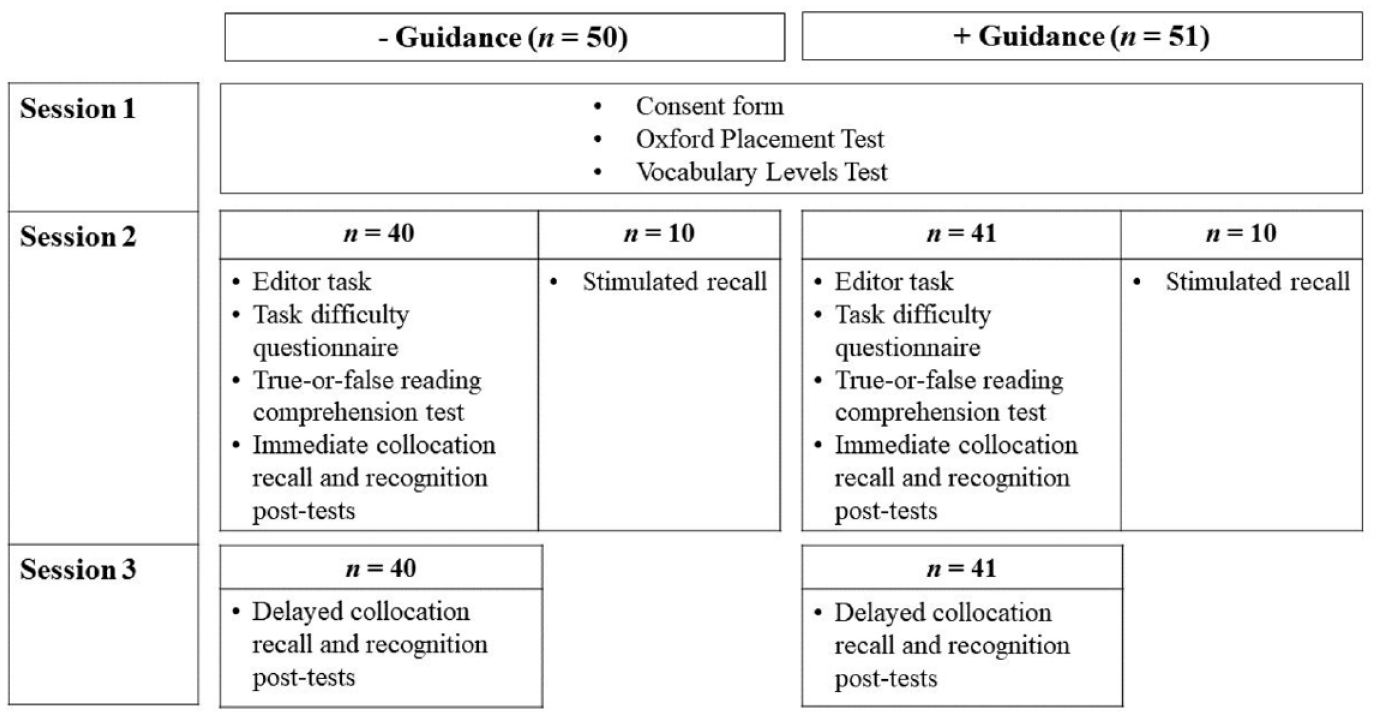
Overall study design.
2 Participants
The participants of this study consisted of 101 undergraduate students in Hong Kong, with ages ranging from 17 to 24 years (M = 19.70, SD = 1.56). Their L1 was Cantonese, and English was their L2. Their onset ages of English learning also differed, spanning from 2 to 10 years old (M = 4.69, SD = 1.68). Their IELTS scores ranged from 6.0 to 7.5 (M = 6.58, SD = 0.46). Their English vocabulary knowledge was measured with the updated Vocabulary Levels Test (VLT; Schmitt et al., 2001) (Cronbach’s alpha = .730). They scored on average 26.76 out of 30 (SD = 2.96) on the 3,000-word band. The 101 participants were randomly assigned to either of the task conditions, i.e. without task guidance (n = 50, henceforth – Guidance) and with task guidance (n = 51, henceforth + Guidance), to be elaborated below. The two groups were equivalent in terms of onset age (t = .766, p = .982, d = .153), IELTS score (t = .147, p = .870, d = .029), and VLT score (t = .018, p = .690, d = .004). Lastly, to facilitate the eye-tracking procedure, all participants were required to have normal or corrected-to-normal vision. For those who wore glasses, it was required that the glasses were within 6.0 diopters. All participants needed not have any prior eye surgery or eye movement with alignment abnormalities.
3 Texts and target collocations
Three English texts, which were developed for a previous study on incidental collocation learning (Jung et al., under review), were used in the present study. The three texts introduced different topics of new economic trends such as inflation and supply disruption, blockchain money and generative art, and eco-friendly consumptions respectively. Each text was approximately 765 words long, and the results of English vocabulary profile analysis revealed that 97.9% of the words were within the C1 level based on the Common European Framework of Reference, confirming that the texts were appropriate and comprehensible for the participants of this study. Each text contained four target collocations (see Table 1), which were operationalized as conventionalized word strings that frequently appear in economic texts. The 12 target collocations were carefully selected and piloted to ensure that they were unfamiliar with the L1 Cantonese speakers with similar English learning profiles. Considering the frequency effects on collocation learning (Peters et al., 2023; Webb et al., 2013), the frequency of each target collocation in the text was controlled for three times.
Target collocations.
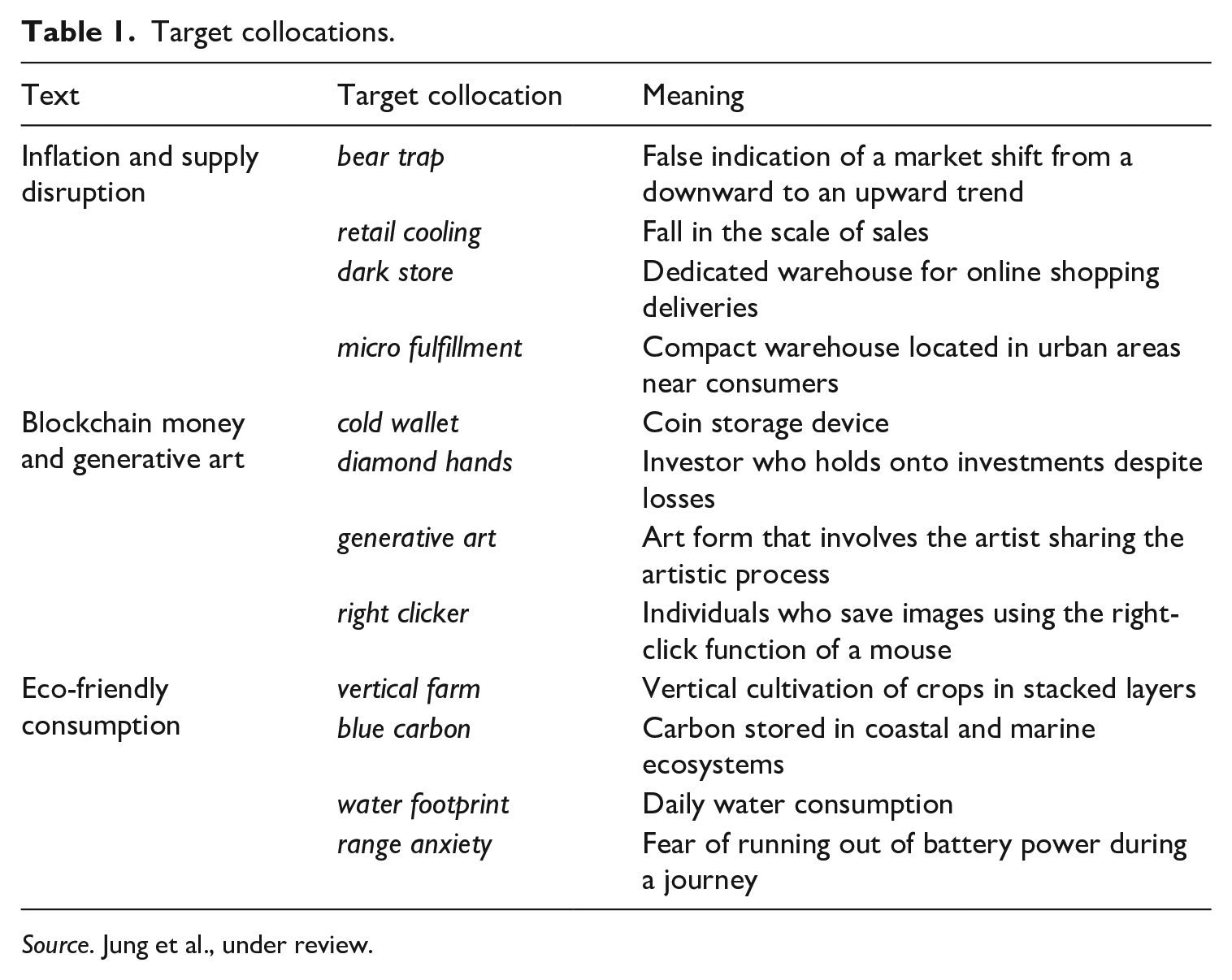
Source. Jung et al., under review.
4 The reading task
In this task, participants were instructed to read the treatment texts with a clear task goal. They received a scenario in which they played the role of an editor of a magazine, and their responsibility was to determine if the articles (i.e. treatment texts) were acceptable for publication in the next issue. The following shows the instruction delivered to the participants.
We invite you to become an editor of our lifestyle magazine! This magazine is issued monthly and covers a wide range of topics. One of the topics for the next issue is ‘Economic Trends in 2023’, and three writers submitted their articles on this topic. As an editor, please review each article and make a publication decision. Depending on your evaluation, the articles may or may not be published in the next issue. The publishing company will also check if you understand each article after you fill out the feedback form. You have 15 minutes to evaluate each article.
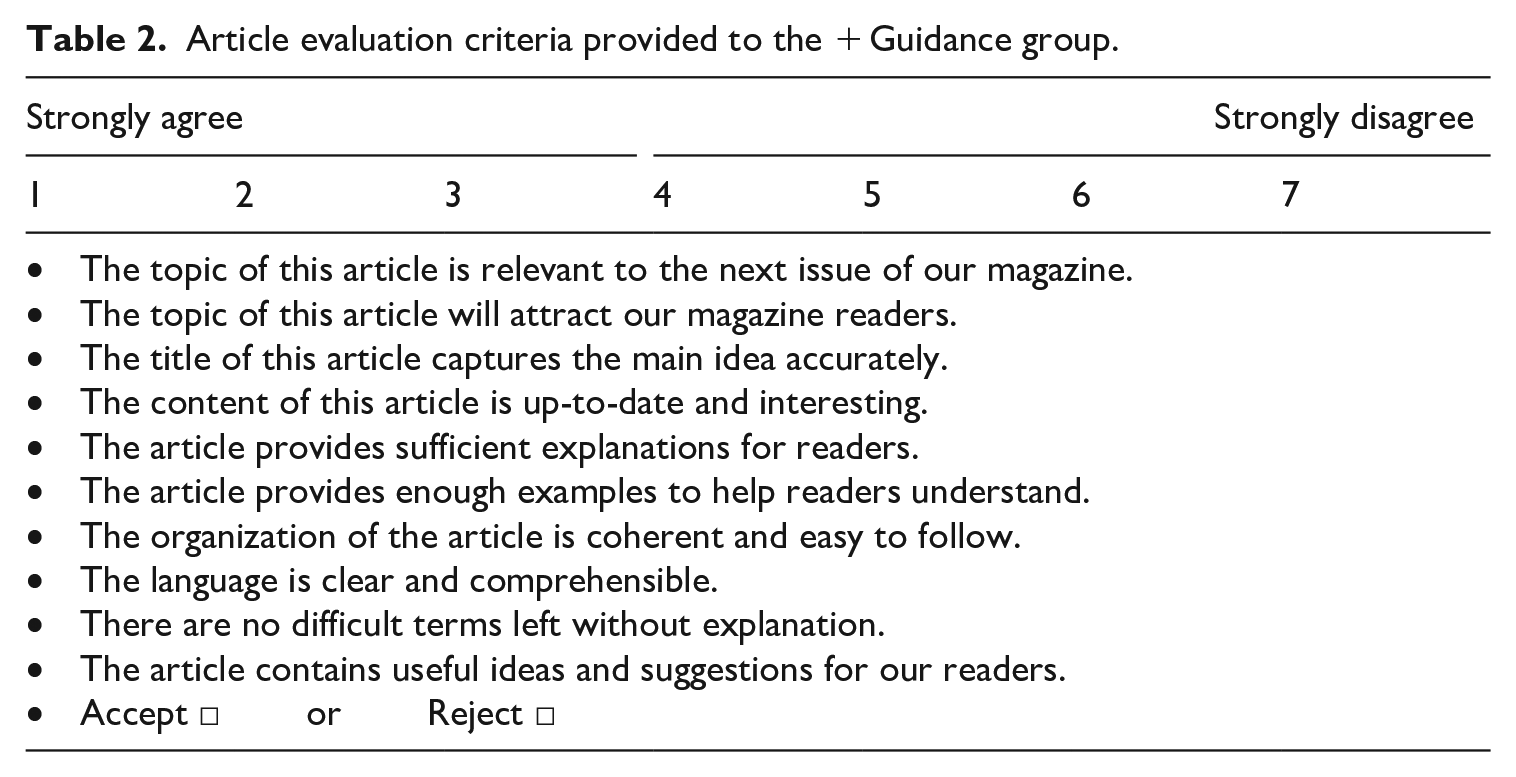
The – Guidance group (n = 50) was simply asked to make publication decisions (Accept or Reject). The + Guidance group (n = 51), on the other hand, received a list of criteria (see Table 2) for evaluating each article, such as topic relevance, suitability for the target magazine audience, content and organization, and comprehensible language. Notably, participants were asked to examine the criteria thoroughly before beginning the reading task so that they could bear the criteria in their minds during reading. They were also reminded that they would not be allowed to refer back to the article when filling out the feedback form and, hence, it was important to remember the criteria while reading each treatment text. Participants were also instructed to finish reviewing each article within 15 minutes, which was determined based on a pilot study.
Article evaluation criteria provided to the + Guidance group.
5 Post-reading questionnaire and reading comprehension test
Evaluation of each article was immediately followed by a subjective task difficulty questionnaire. The questionnaire consisted of eight 7-point Likert scale items (Cronbach’s alpha = .890, maximum value = 168 for the three articles). This questionnaire aimed to investigate whether the presence of task guidance had any influence on participants’ perception of task difficulty (Robinson, 2001). The questionnaire was then followed by a reading comprehension test which consisted of 10 true-or-false statements. To maintain the authentic and task-based reading condition, this test was framed as the publishing company double-checking if the editor understood the text and reviewed the texts sincerely. For each of the statements, participants were instructed to circle ‘True’ and ‘False’. To discourage random guessing, participants were explicitly encouraged to check ‘I don’t know’ in case they were unsure about the statement (Cronbach’s alpha = .675, maximum score = 30). There was no time limit when participants completed the task difficulty questionnaire and the reading comprehension test. Participants were not allowed to refer back to the text when completing these tests.
6 Equipment and eye-tracking procedure
Using the landscape mode, 14-size Courier font was used with double-spacing and left text alignment. Plus, given the target collocations consisted of two component words, it was ensured that they appeared in the same line. It was also confirmed that none of the target collocations appeared at the beginning or end of a sentence or next to a punctuation mark (Sagarra & Hanson, 2011). Participants read the treatment texts while their eye-movements were recorded monocularly at 2,000 Hz with an EyeLink 1000 Plus system. Participants sat in front of a 21-inch (c.53 cm) monitor with a viewing distance of 60 cm, which had one degree of visual angle covering approximately four letters. Each reading began with a nine-point calibration and validation procedure. To ensure the reliability of the data, a threshold of 80% sample recording was required (Conklin et al., 2018). The interest areas (IAs) were defined around each target collocation using the SR Experiment Builder. During each trial, the experimenter could observe, via another computer, the location of the fixation of the participant relative to the location of the words of the trial. In the present study, participants’ attention to the target collocations was assessed by their total duration (the combined duration of all fixations) and total counts of the eye fixations (the number of all fixations) made on the target collocations. These measures were expected to indicate participants’ attention to the target collocations during the word-to-text integration processes during reading (Pellicer-Sánchez et al., 2022). These target measures captured for each IA were extracted using the SR Data Viewer. Fixation data that had a duration shorter than 50 ms, which accounted for approximately 9.81% of the total data, were identified as outliers and excluded from the dataset (Conklin et al., 2018; Godfroid, 2019).
7 The learning assessment
The collocation recall and recognition tests, which were modeled after a previous study (Jung et al., under review), were conducted immediately after and two weeks after the reading task to assess the gains in knowledge about the target collocation forms. As we have noted in Figure 1, only the 81 participants (– Guidance: 40, + Guidance: 41), who did not join the stimulated recall session, completed the assessment. The collocation form recall test (12 items in total) was designed as a cloze task that consisted of sentences taken from the treatment text, each containing one target collocation. In each sentence, the first word of the collocation was replaced with a blank, and participants were instructed to write down a word that could be inserted in the blank based on their memory of reading the text. The sentences were carefully selected so that there was sufficient contextual information on the meaning of the target collocation (e.g. Coin money can be securely saved in a ______ wallet that comes with an address and a password). Next, the participants also took a collocation form recognition test that was constructed as a multiple-choice test (12 items in total). The same sentences were used for this test, with six options in each item, i.e. one correct option (e.g. cold), four distractors that were semantically plausible in similar length (e.g. coin, code, cool, and firm), and I don’t know to discourage random guessing. To avoid practice effects, the order of the items was randomized in all tests.
8 Stimulated recall protocol
Also as noted in Figure 1, the stimulated recall protocols were collected from the 20 participants (– Guidance: 10, + Guidance: 10) who were led to a stimulated recall session immediately after the reading task. The main purpose was to gain further insights into the qualitative information on the nature and the type of cognitive processes involved while engaging in the reading task. This allows us to triangulate the eye-movement data, which is primarily quantitative and lower-level attentional processes, with participants’ retrospective comments that reveal verbalizable and higher-level processes (Jung & Révész, 2018; Wang & Pellicer-Sánchez, 2023). Ten participants from each task group (n = 20) were invited to recall what they were thinking at the moment of reading the texts, prompted by their own eye-movement recordings. Participants were instructed to stop the recordings whenever they could remember any thoughts at the time of reading and recall freely in their first language, Cantonese. The researchers also interrupted the recordings if they observed any noticeable eye-movements such as longer or frequent fixations on specific parts of the text or slow, fast, or regressive eye-movements. The recall protocols were audio-recorded for later transcription. As recalling processes might have a reactive impact on their subsequent reading processes, the participants in the stimulated recall session read two randomly selected texts and produced recall comments after reviewing both texts. They did not take any posttests afterward.
9 Procedure
The study consisted of three sessions. In Session 1, participants signed the consent form, and their L2 English vocabulary level was assessed by the updated Vocabulary Levels Test. In Session 2, all participants performed the editor task at an eye-tracking lab where their eye-movements were recorded while performing the reading task. Among the total of 101 participants, 81 participants (– Guidance: 40, + Guidance: 41), upon completing reviewing each article, completed a task difficulty questionnaire and a true-or-false reading comprehension test. The editor task was followed by the immediate collocation form recall and recognition posttests. The remaining 20 participants (– Guidance: 10, + Guidance: 10) were asked to produce stimulated recall protocols instead of taking the posttests. Session 3 was held two weeks later and was conducted only on those who were not assigned in the stimulated recall session (n = 81). All sessions were conducted individually at the eye-tracking lab, and each session took around 60 to 75 minutes.
V Analysis
1 Statistical analysis
The data were analysed by constructing mixed-effects models using the package lme4 (Bates et al., 2015) with R (R Core Team, 2022). The random effects included Participant, Item, Text, and IA (interest area), and the fixed effect was different task conditions (– Guidance vs. + Guidance). In addition, participants’ scores on the Vocabulary Levels Test were added as a nested fixed effect (VLT) to account for its confounding impact. For the continuous data such as eye movements, linear mixed-effects models were developed using the function lmer. The binary data that consisted of 0 and 1 were analysed using logistic generalized mixed-effects models with the function glmer in combination with the argument family = binomial (Linck & Cunnings, 2015). For each analysis, maximal models were made by including the fixed effects as random slopes for all of the random effects (Barr et al., 2013). As maximal models often had overly complex structures and thus failed to converge, random effect parameters that accounted for the least variance were moved one by one until the models converged (Cunnings & Sturt, 2014). For linear mixed-effects models, the absolute t-values at or above 2.0 were considered as the significance benchmark (Gelman & Hill, 2007), whereas an alpha level of p < .05 was used for generalized models that produced z-statistics. The effect sizes of the linear models were estimated with R2 using the function r.squaredGLMM of the package MuMln (Barton, 2015), and the benchmarks were set at .06, .16, and .36 for small, medium, and large effect sizes (Plonsky & Oswald, 2014). The effect sizes of the logit models were assessed with odds ratios (Szumilas, 2010).
2 Stimulated recall comments
The audio recordings of the stimulated recall comments were transcribed verbatim and qualitatively analysed using MAXQDA. Codes emerged from the data in a bottom-up manner, and annotations were done to identify any noticeable patterns across the task conditions. In total, seven meta-codes were created: Task management, Target collocations, Pausing, Re-reading, Slow reading, Fast reading and No memory/reason. Task management pertained to participants’ recollections on how they felt about their task engagement in terms of the level of task concentration and task difficulty. Next, target collocations were annotated when the comments were related to noticing, inferring, ignoring, or recognizing the target collocations. Pausing was associated with participants’ recalls about their thought processes while they paused in the middle of reading, which was attributed to unfamiliar words or phrases, trying to concentrate, trying to comprehend, or reviewing in-progress comprehension. Re-reading included codes that were connected to repeated reading behaviours, which were to improve or strengthen comprehension, understand unfamiliar words or phrases, or pay closer attention to the content. Slow reading included codes such as habitual slow reading or trying to comprehend, whereas fast reading subsumed codes such as skimming, reading unimportant, familiar, or easy content. Participants sometimes could not remember the underlying reason for their reading behaviours, i.e. No memory, or recalled that there were no special reasons, i.e. No reason. A subset of the transcripts (10%) was double-coded by a Cantonese speaker who was an applied linguist, and the agreement between the coders was evaluated as sufficiently high (Cohen’s kappa = .895, p < .001).
VI Results
Prior to answering the research questions, it was important to ensure that the two groups shared equivalent English vocabulary levels. Indeed, as presented in Table 3, participants in the two groups obtained statistically similar scores in the updated Vocabulary Levels Test, confirming that the two conditions shared the same English vocabulary levels.
The descriptive statistics of the Vocabulary Levels Test (VLT), perceived task difficulty, and true-or-false reading comprehension scores.
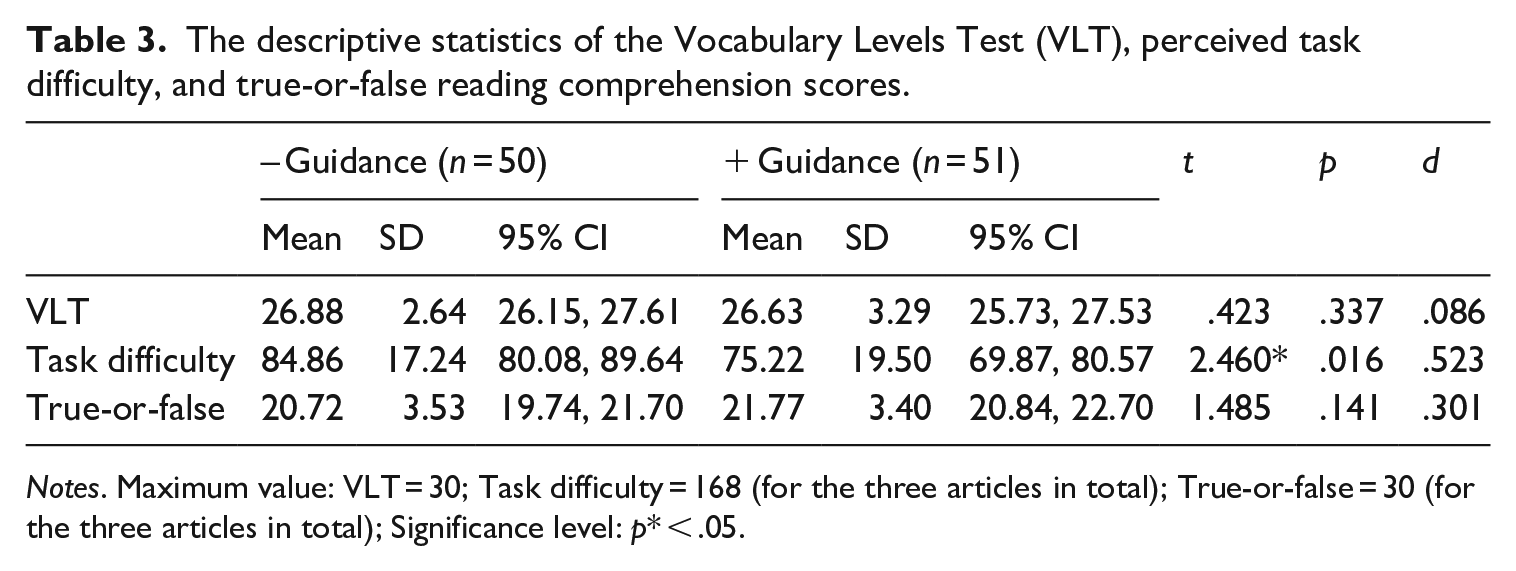
Notes. Maximum value: VLT = 30; Task difficulty = 168 (for the three articles in total); True-or-false = 30 (for the three articles in total); Significance level: p* < .05.
Next, we examined if the presence of task guidance induced significantly differential levels of perceived task demands on learners. As noted, the perceived task difficulty was assessed with post-task questionnaires after reviewing each article, and the responses were compared between the conditions. The result showed that the task version without task guidance was perceived to be more difficult for the participants, compared to the version with task guidance.
Lastly, considering that the goal of the present study was to explore how to facilitate incidental collocation learning from engaging in L2 reading tasks, it was, thus, necessary to confirm that the presence or the absence of the task guidance did not affect participants’ text understanding. To this end, we examined if the task manipulation had any significant impact on participants’ comprehension of the articles, which was assessed by the true-or-false reading comprehension test as aforementioned. As shown in Table 2, the task manipulation (– Guidance vs. + Guidance) did not significantly affect participants’ comprehension of the articles.
1 To what extent does task guidance affect L2 learners’ attention to target collocations during task-based reading?
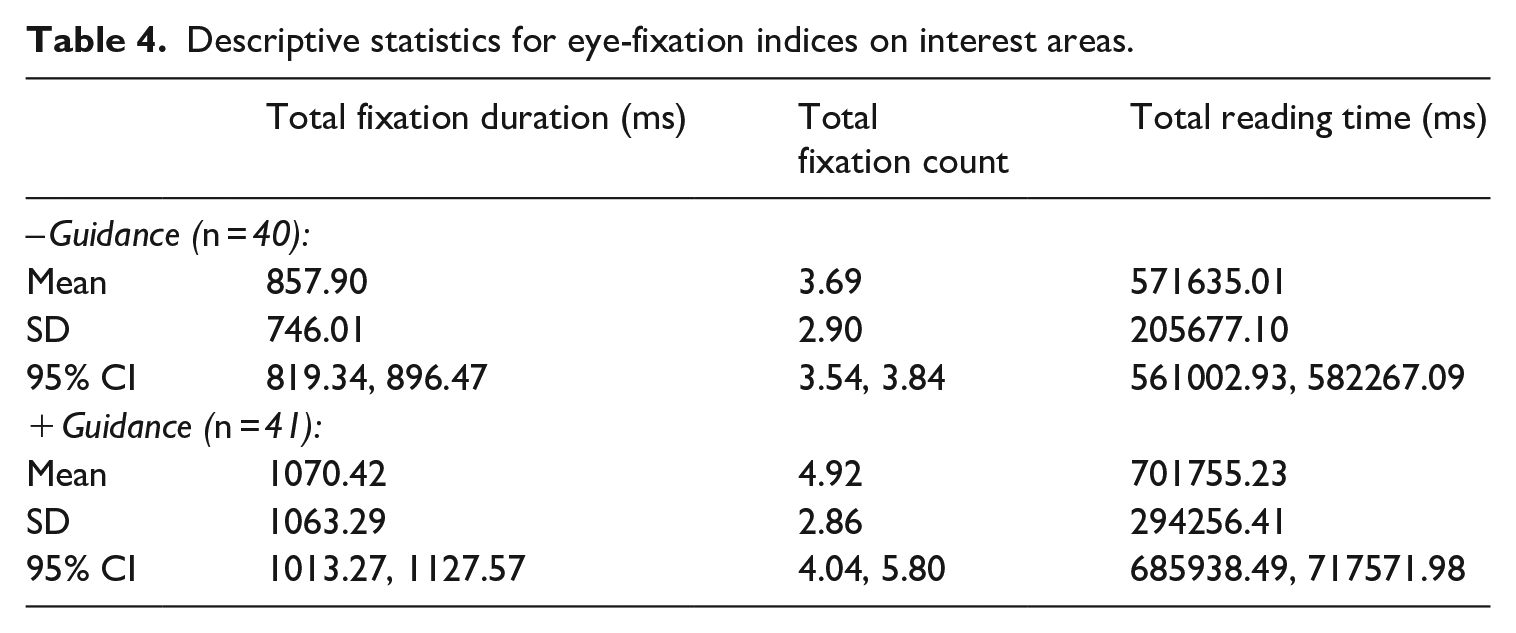
To answer research question 1, participants’ eye fixations on the target collocations were analysed. Table 4 shows the extracted eye-movement indices, i.e. the total fixation durations in milliseconds and the total fixation counts captured on the target collocations. In general, the descriptive statistics showed that the indices were larger in the + Guidance condition compared to the – Guidance condition. The total reading time also showed that participants spent more time completing the editor task when they received the task guidance.
Descriptive statistics for eye-fixation indices on interest areas.
Next, we ran a series of linear mixed-effects models to examine if the observed differences of extracted eye-movement indices between the two task conditions were statistically reliable, and the results were displayed in Table 5. As shown, the best-fit maximal models indicated that both the total fixation durations and total fixation counts were significantly greater for the + Guidance condition compared to the – Guidance condition, with medium to large effect sizes (R2: Total fixation duration = .234, Total fixation count = .038, Total reading time = .881). This suggests that the provision of task guidance led to more attention to the target collocations.
Summary of the best-fit maximal models for fixation indices.
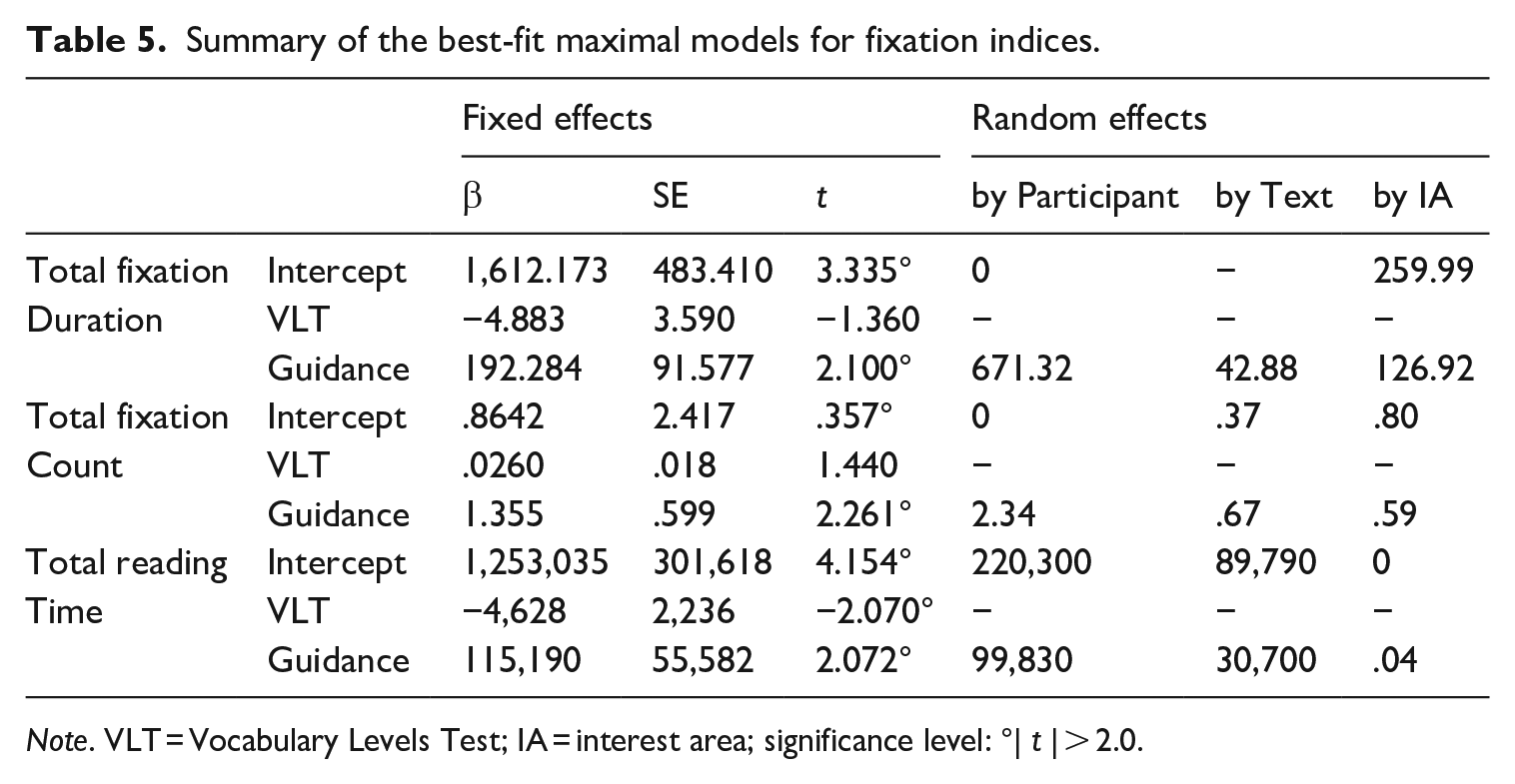
Note. VLT = Vocabulary Levels Test; IA = interest area; significance level: °| t | > 2.0.
2 To what extent does task guidance affect L2 learners’ knowledge about the target collocation forms from engaging in task-based reading?
Research question 2 was answered by examining the posttest scores, which varied between the immediate and the delayed condition. As presented in Table 6, the scores tended to be larger on the collocation form recognition tests than in the recall tests in both the immediate and the delayed posttests, and participants scored less in the delayed posttests than in the immediate posttests. It was also found that scores were overall higher in the + Guidance condition than in the – Guidance condition.
Descriptive statistics for target collocation posttest scores.
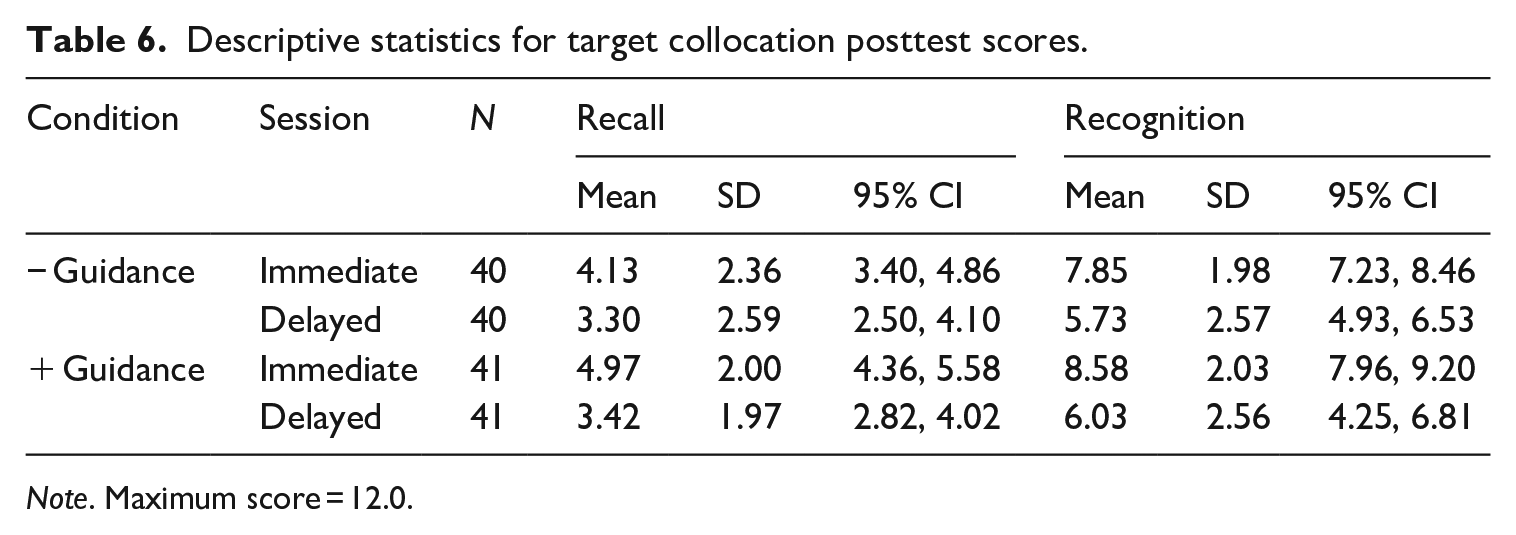
Note. Maximum score = 12.0.
We ran logistic generalized mixed-effects models to assess whether the above-observed score differences between the task conditions were statistically reliable. As summarized in Table 7, the differences between – Guidance and + Guidance conditions were significant for both collocation recall and recognition tests in the immediate posttest, but not in the delayed posttest. The odds ratio for the immediate recall scores was 1.581 with confidence intervals 1.006 and 2.485, and that for the delayed recall scores was 1.354 with confidence intervals .894 and 2.097. In brief, the task guidance was shown to promote stronger retention of knowledge about the target collocation forms in terms of both recall and recognition abilities, while such an effect did not last in the delayed posttest.
Summary of the best-fit maximal models for posttest scores.
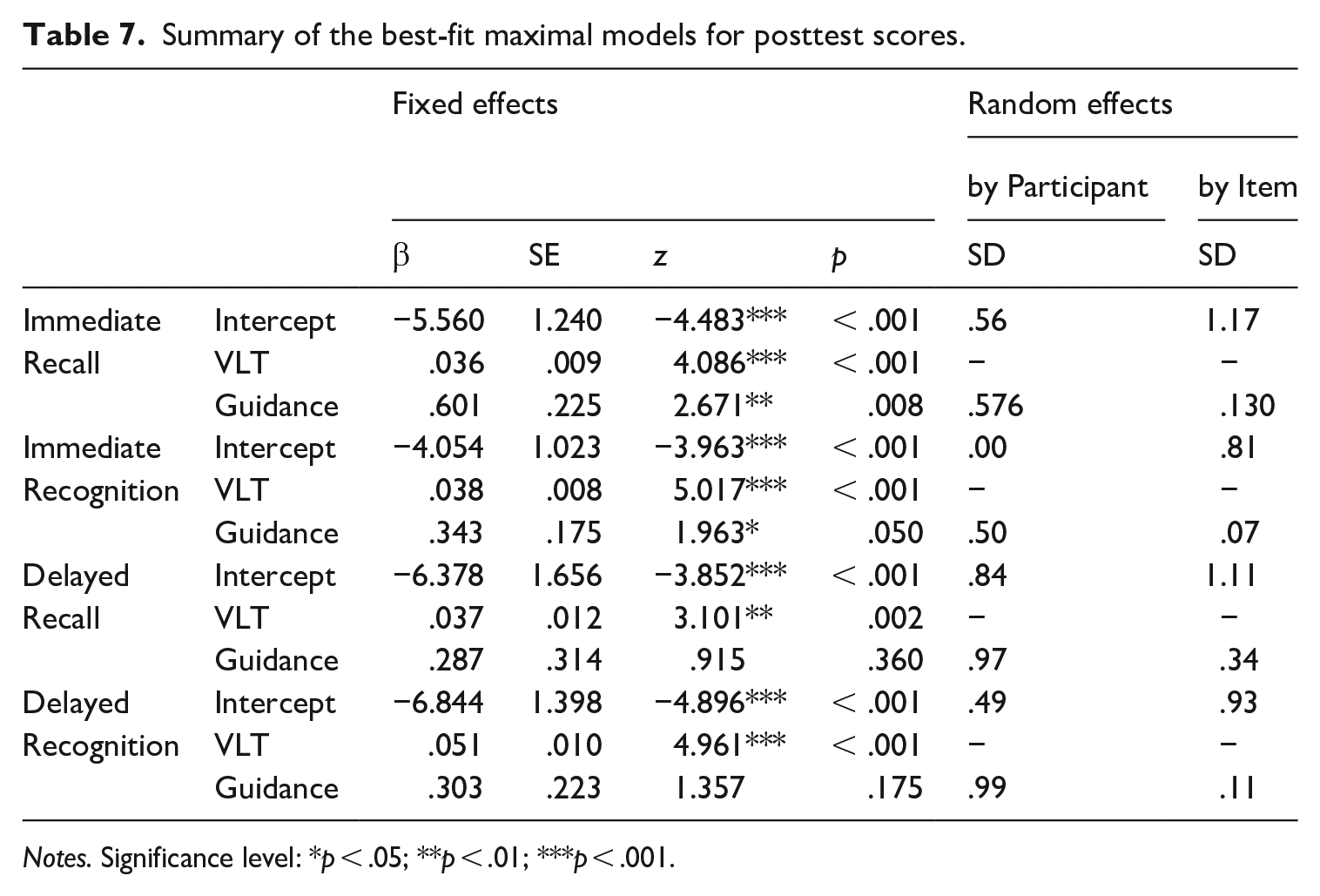
Notes. Significance level: *p < .05; **p < .01; ***p < .001.
3 To what extent does L2 learners’ knowledge about the target collocation forms correlate with their attention to the target collocations?
To examine the relationship between the participants’ eye movements on the target collocations and their acquisition, we conducted mixed-effects modeling with eye-fixation indices as the independent variables and posttest scores as the dependent variable, first for both groups and then each group separately (for summaries for all models, see Appendix S1 in supplemental material). We found a significant relationship between total fixation duration and immediate recognition scores for both groups (Β = .213, SE = .101, z = 2.18, p = .035, odd ratio = 1.238 with 95%CI 1.509, 4.254) as well as for the + Guidance condition (Β = .213, SE = .101, z = 2.18, p = .035, odd ratio = 2.216 with 95%CI 2.226, 2.949). In other words, participants’ fixation durations on the target collocations were more likely to predict their immediate collocation recognition scores in the + Guidance condition than in the – Guidance condition.
4 Stimulated recall comments
As noted, following the completion of the editor task, 10 participants from each task condition were asked to recall their thought processes while engaging in the task, prompted by their eye-movement recordings. Table 8 presents the seven meta-codes and their sub-codes along with the frequency of annotations and sample comments.
Summary of the coding results.
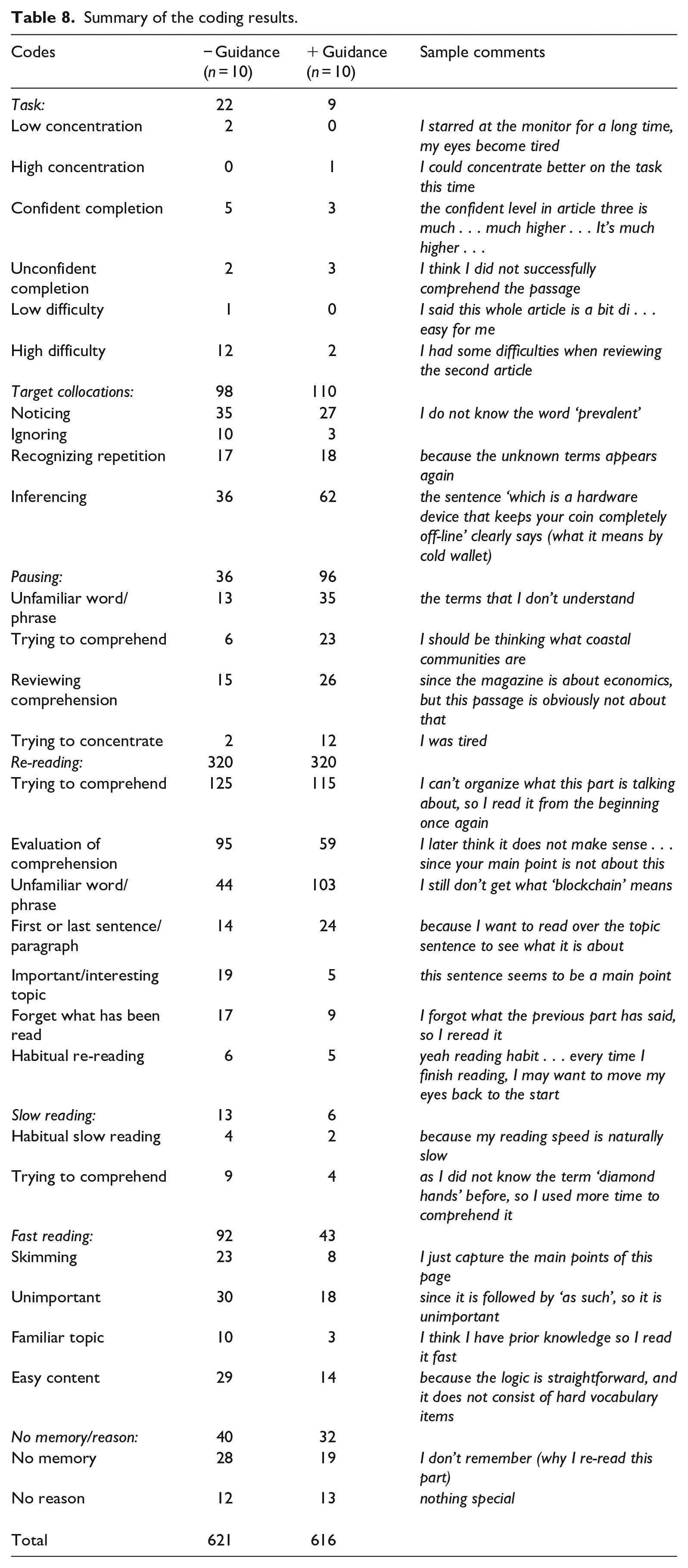
One noticeable trend was that the – Guidance group tended to make more comments on their task management than the + Guidance group. There were, in particular, more comments on having difficulty in performing the reviewing task for the – Guidance group. In addition, while the – Guidance group mentioned more on noticing the target collocations than the + Guidance group, they also commented more on ignoring them. This was clearly different from the + Guidance group in that they reported that they were trying to infer the meanings of the target collocations.
Another noticeable difference is that the + Guidance group made more comments on their pausing behaviours than the – Guidance group. In specific, according to their recalls, the pauses were to infer the meanings of new words or phrases, trying to consolidate their text understanding, or trying to focus on the task. There was also a noteworthy difference in participants’ comments on re-reading behaviours, with underlying reasons varied by the task conditions. The – Guidance group tended to re-read text parts mostly to consolidate their text understanding. The + Guidance group, on the other hand, tended to re-read when they noticed new words or phrases, or to process the first or the last sentence or paragraph again. In particular, both slow and fast reading tended to be commented on more often by the – Guidance group than by the + Guidance group, and the reasons were related to general comprehension or familiar or interesting topics of the articles.
VII Discussion
This study explored the feasibility of incidental collocation learning from engaging in task-based reading, i.e. accepting or rejecting articles, and if this would be moderated by the provision of task guidance that was operationalized as a list of reviewing criteria. Participants’ attention was measured with their eye-fixations made on the target collocations in terms of both durations and counts, and their learning gains were assessed with collocation form recall and recognition tests. To obtain deeper insights into the thought processes under different task conditions, stimulated recall comments were collected from a subset of participants.
Prior to answering the research questions, it was first examined if the task manipulation conducted in this study incurred significantly different perceived task difficulty. The results indicated that participants who had to make publication decisions without task guidance perceived the editor task as significantly more demanding. In a similar vein, stimulated recalls revealed that participants in the – Guidance condition frequently commented on perceiving the task as difficult. It is noteworthy that simply accepting or rejecting given articles was perceived as more demanding than a seemingly more complex task, that is, understanding a list of reviewing criteria before reading, remembering them during reading, and completing a longer feedback form. This finding highlights that a clearer task structure, despite additional elements to be considered and steps to be taken, may enable learners to take a more strategic approach to the task and perceive the task as more manageable, fostering a sense of competence and confidence in their task performance.
1 To what extent does task guidance affect L2 learners’ attention to target collocations during task-based reading?
When provided with task guidance, participants were shown to spend significantly longer time on the editor task. It seems possible to assume that having more concrete and specific criteria in mind, they tended to process each article more intensively and attentively. In the stimulated recall session, those in the + Guidance condition tended to comment more frequently on pausing, which was attributed to encountering unfamiliar words or phrases, monitoring their in-progress comprehension, and trying to concentrate on the task. On the other hand, in the – Guidance condition, more comments were produced on fast reading behaviors, which was ascribed to engaging in skimming or processing unimportant, familiar, or easy content, implying more superficial reading. Overall, the data support McCrudden and Schraw’s (2007) Goal-Focusing Model of Relevance, showing that readers process texts differently depending on their interpretation of the required procedures and goals of the reading. In other words, readers tend to engage in heuristically-driven text processing in such a way as to complete the reading task in an efficient manner, which may not always require reading for constructing complete textual representations (Christianson, 2016; Christianson et al., 2010).
In addition, under the + Guidance condition, participants exhibited significantly longer and more frequent eye-fixations on the target collocations. This finding aligns well with the stimulated recall data that indicated detailed criteria promoted attentive reading behaviors. Specifically, participants in the – Guidance condition made more comments on noticing the target collocations but were also more likely to ignore them. In contrast, those in the + Guidance condition provided substantially more comments on engaging in the inference process, suggesting their efforts to process the articles more deeply. Additionally, while a comparable number of comments were made on re-reading behaviors, those in the – Guidance condition attributed it to remedying incomplete comprehension, whereas those in the + Guidance condition reported it as a strategy to process unfamiliar words or phrases. That said, the findings seem to indicate that the provision of task guidance in the editor task encouraged goal-oriented processing of the texts during reading tasks, which further led to greater chances for noticing and processing the target collocations. It should be remembered that the reading comprehension scores between the two conditions did not differ significantly from each other, showing that the task guidance did not incur trade-off effects. In other words, improving the clarity of task structures and procedures has pedagogical potential to promote incidental L2 learning without interrupting the meaningful processing of task input.
2 To what extent does task guidance affect L2 learners’ knowledge about the target collocation forms from engaging in task-based reading?
The logistic generalized mixed-effects regression analyses revealed that the participants in the + Guidance condition scored significantly higher in the immediate collocation form recall and recognition tests than those in the – Guidance condition. The result demonstrates that the promoted noticing due to the provision of task guidance helped the participants retain the target collocation forms more securely, and thereby enabled them to later recall and recognize the correct forms in the immediate posttest. This adds further credence to the important role of careful task design, explicit task instruction, and clear task structure promoting attentive and careful processing of the given L2 input. The finding also aligns well with previous studies that found a significant relationship between task characteristics and incidental L2 learning (Jung, 2020, 2022), confirming the need for more research along this vein.
The positive effects of task guidance, however, did not emerge in the delayed posttest. The editor task employed in this study was designed along with a realistic scenario to enact meaning-oriented, authentic, and communicative reading behaviours, but this could have been limited to promote form-focused attention to the target collocations for durable and long-term learning. In addition, the participants were exposed to the target collocations only during the reading task, without having a chance to encounter them repeatedly before or after the task. Therefore, the memory trace about the target collocation forms established during the reading task could not be rehearsed or consolidated. That said, pre- or post-reading activities where learners can process and use the target collocations in a meaningful way may be recommended for more robust learning of L2 collocations (Sonbul & Schmitt, 2013).
3 To what extent does L2 learners’ knowledge about the target collocation forms correlate with their attention to the target collocations?
We also examined if participants’ visual attention, as reflected in their eye-movements, could affect their learning gains as measured with collocation form recall and recognition tests. The results revealed a significant relationship between total fixation durations and immediate collocation recognition scores when both groups were considered together as well as for the + Guidance condition separately. This finding seems compatible with previous studies that showed significant associations between eye-movement measurements and learning scores (e.g. Godfroid & Uggen, 2013; Indrarathne & Kormos, 2017; Révész et al., 2023; see, however, Lee & Révész, 2018). The findings also provide further support to the significance of attention in L2 learning during reading tasks that prioritize meaning (Leow, 2015; Long & Robinson, 1998). In general, the stronger relationship between the total fixation duration and immediate recognition scores in the + Guidance condition than in the – Guidance condition suggests that the task guidance facilitated participants to form more durable and more robust memory traces of the target collocation forms. Consequently, this enhanced memory representation contributed to their improved ability to recognize the correct forms in the immediate posttest (Indrarathne & Kormos, 2017).
VIII Conclusions
The present study investigated the feasibility of incidental L2 collocation learning through task-based reading and examined the impact of task guidance. The results indicated that task guidance encouraged attentive processing of the texts, thereby noticing and learning of the target collocation forms contained in the texts even in the meaning-focused and goal-oriented reading contexts. Notably, participants who did not receive detailed reviewing criteria perceived the task as more demanding, despite having fewer task elements and steps, and spent less time on the task. Overall, these findings underscore the importance of a clear task structure and detailed guidance, as they can enhance incidental learning of new L2 features as a by-product of engaging in the reading task as well as foster learners’ confidence in their task performance.
This study has several limitations that should be acknowledged. First, despite carefully selecting the target collocations based on a pilot study with learners of similar English learning profiles, participants may have differed in their prior knowledge of these collocations at the beginning of the study. Additionally, this study did not control for the inherent characteristics of the target collocations, such as semantic transparency, L1–L2 congruency, and vocabulary type. Furthermore, the assessment tool used in this study, namely collocation form recall and recognition tests, may not have been sensitive enough to capture the nature of the acquired knowledge. Another limitation is that this study exclusively utilized explanatory texts focused on economic topics. Future research should include diverse text genres with different rhetorical structures and various topics as treatment texts to enhance the generalizability of the findings.
Despite the limitations, this study holds significant pedagogical implications for addressing a crucial gap in the field, which is the lack of attention to task-based reading that closely aligns with real-life language use. Investigating how learners process input differently and achieve varying levels of learning through task engagement can yield meaningful and useful pedagogical implications. Further research along this line will not only offer practical guidance for designing and implementing L2 reading tasks but also deepen our understanding of goal-oriented and task-based input processing and its subsequent impact on incidental L2 learning. Moreover, this study demonstrates the methodological strength achieved by combining and triangulating data from multiple sources, such as eye-movements, stimulated recall protocols, and post-treatment tests.
Supplemental Material
sj-docx-1-ltr-10.1177_13621688241270840 – Supplemental material for The impact of task guidance on incidental collocation learning from task-based reading
Supplemental material, sj-docx-1-ltr-10.1177_13621688241270840 for The impact of task guidance on incidental collocation learning from task-based reading by Jookyoung Jung and Chin Lung Yang in Language Teaching Research
Footnotes
Funding
The author(s) disclosed receipt of the following financial support for the research, authorship, and/or publication of this article: The work reported in this paper was fully supported by a Direct Research Grant from the Faculty of Arts, The Chinese University of Hong Kong.

Supplemental material
Supplemental material for this article is available online.
References
Supplementary Material
Please find the following supplemental material available below.
For Open Access articles published under a Creative Commons License, all supplemental material carries the same license as the article it is associated with.
For non-Open Access articles published, all supplemental material carries a non-exclusive license, and permission requests for re-use of supplemental material or any part of supplemental material shall be sent directly to the copyright owner as specified in the copyright notice associated with the article.
