







Abstract
This mixed-methods study examined how learners’ competence-based and affect-based trust in their teachers predicted their feedback-seeking behaviors both directly and indirectly through their internal cost–value analyses. Questionnaire data were collected from 207 foreign language learners at a North American university, and interviews were conducted with seven participants with high vs. low levels of trust in their teachers. Multiple regression results showed that competence-based and affect-based trust predicted learners’ feedback-seeking behaviors (both monitoring and inquiry), and these relationships were mostly mediated either positively by feedback value or negatively by the self-presentation cost of feedback-seeking. Analysis of the qualitative data supported the quantitative findings, highlighting radically different concerns for students with high vs. low levels of teacher trust. Overall, the findings confirm that students’ trust in their teacher shapes students’ cognitions about the costs and benefits of feedback-seeking behavior, thereby influencing their engagement in this behavior. Theoretical and pedagogical implications have been discussed.
Keywords
I Introduction
Feedback-seeking behavior (FSB) is a new topic of research that has recently been introduced to the field of second language acquisition (SLA) by Papi et al. (2019, 2020) in a developing research trend that puts the focus on the agentic role of the learner in the feedback process (see Boggs & Manchón, 2023; Papi, 2021). Currently, theorized under the umbrella theory of proactive language learning (Papi & Hiver, 2025), FSB is defined as learners’ strategic attempts to gather and use feedback information on their second language (L2) performance (Papi et al., 2020). Papi et al. (2019) classified FSB in language learning into two types: feedback monitoring and feedback inquiry. Feedback monitoring involves paying attention to feedback, trying to learn from it, and incorporating it in one’s L2 use. In contrast, feedback inquiry refers to explicitly asking the teacher or others for feedback on one’s L2 performance.
Several research studies have been conducted over the last five years to explore different aspects of learners’ FSB in SLA. Some studies have examined the effects of FSB on L2 outcomes, providing evidence for the predictive validity of FSB. Zhan et al. (2023) showed that students’ FSB positively predicted their performance on a story writing task for mid- and high-achieving students. In a recent study by Papi et al. (2024), learners’ feedback monitoring was found to be a stronger predictor of students’ L2 revision quality than the quantity of written corrective feedback (WCF) they received on their written essays. Other studies have established that FSB in L2 learning is influenced by a host of individual and contextual variables. More specifically, learner variables such as mindsets and achievement goals (Kessler, 2023; Papi et al., 2019, 2020; Waller & Papi, 2017; G. Zhang, 2023), self-efficacy, academic buoyancy and ideal selves (Bondarenko, 2020; Xu & Wang, 2023;Y. Zhang, 2025), self-regulation (Xu, 2021), shyness (Xu & Wang, 2024), and L2 competence and proficiency (Yao & Zhu, 2024; Zhan et al., 2023) have been shown to be associated with learners’ FSB. A few studies have provided evidence for the role of contextual variables, such as peer pressure and teachers’ feedback and assessment practices (Xu & Wang, 2023), and teachers’ support in student FSB (Y. Zhang, 2025; Y. Zhang & Jiang, 2025) in learners’ quality and quantity of engagement in FSB.
These studies have contributed to our understanding of FSB, its effects and the motivational, affective and contextual variables that predict FSB. Nonetheless, studies on the contextual factors that influence such proactive learning behaviors have remained rare, and many questions remain unanswered. The few studies reviewed above have focused on the role of teacher support and practice in learners’ FSB (Xu & Wang, 2023;Y. Zhang, 2025; Y. Zhang & Jiang, 2025). However, context is a multifaceted and complex phenomenon that shapes learning behaviors. In fact, ‘the quality and quantity of proactive L2 learning can depend on the accessibility of desirable contextual affordances (e.g. L2 input and information, among other things)’ (Papi & Hiver, 2025, p. 18). Therefore, contextual dimensions of L2 learning need extensive exploration in order to provide a more comprehensive understanding of learners’ proactive behaviors, such as FSB.
The teacher is considered one of the key contextual and relational elements in student learning (Hattie, 2009). Students’ relationship with their teacher is, in fact, considered ‘the most important relationship in the school context’ (Gkonou, 2022, p. 275). This relationship can thus have important implications for students’ learning behavior. However, research on this topic is lacking, with many questions yet to be answered. For instance, it is not clear how students’ trust in their teachers (hereafter ‘teacher trust’) can shape learners’ FSB. Whereas teacher support, which has been found to influence FSB positively (Y. Zhang, 2025;Y. Zhang & Jiang, 2025), can foster a trusting relationship between teachers and students, such an outcome is not guaranteed. This is because teacher trust can be influenced by various other factors, such as learners’ personalities and dispositions, cultural expectations, and teachers’ quality and consistency of support, among other things. Exploring teacher trust, therefore, can provide novel insights into L2 learners’ quality and quantity of engagement in FSB.
According to McAllister (1995), individuals seek feedback from sources they can trust emotionally and cognitively. That is, they need to feel they can trust that the source would not hurt them and that the source is competent enough to provide valuable feedback. In this study, the former is referred to as ‘affect-based trust’, and the latter as ‘competence-based trust’ (also known as ‘cognition-based trust’). Studies in the field of organizational psychology have provided evidence that employees’ competence-based and affect-based trust in the feedback source led to more feedback-seeking (Choi et al., 2014; McAllister, 1995). However, the connection in relation to FSB in language learning remains unexplored. To bridge this gap, the present study explores how teacher trust can influence learners’ FSB.
According to Papi et al. (2019), different contextual and individual variables, such as learners’ relationships with their teachers, can affect learners’ FSB by changing their underlying cognitions about the costs and benefits associated with the behavior. Such cost–value cognitions have been found to mediate the relationship between learners’ motivational characteristics and their FSB (e.g. Papi et al., 2020). To explore how such thought processes underlie the relationship between learners’ teacher trust and FSB, the present study examines how the self-presentation cost of FSB – that is, the fear of embarrassment and judgment associated with FSB, as well as the learning value of FSB, that is how much students feel they can benefit from the feedback – can influence their engagement in FSB.
II Literature review
1 Feedback-seeking behavior in SLA
Corrective feedback (CF) has long been a central focus in the field of SLA. Extensive research over the last few decades has shown CF’s variable but generally positive effects on vocabulary (e.g. Ellis & He, 1999), grammar (e.g. Sato & Loewen, 2018), phonology (e.g. Saito & Lyster, 2012), and pragmatics (e.g. Takimoto, 2006). Whereas the importance of CF is no longer an issue of controversy, ‘researchers still debate ways in which it should be supplied and the various factors that may impact its effectiveness’ (Nassaji & Kartchava, 2020, p. 151). To highlight the role of the learner as one of these factors, Papi et al. (2019) argued that focusing only on the techniques for providing CF will not give a holistic picture of the feedback process and often depicts learners as passive recipients of CF. By introducing the topic of FSB to the field, Papi et al. (2019) proposed a shift in perspective with the learner and their FSB at the center (see also Boggs & Manchón, 2023). Over the last few years, several studies have been published on the topic of FSB in SLA. These studies can be generally categorized into three groups: studies that (1) focus on learner factors predicting their FSB, (2) explore the contextual factors shaping students’ FSB, and (3) examine the L2 outcomes of FSB.
Studies on the role of individual factors associated with learners’ FSB have been dominated by a focus on the motivational predictors of this learning behavior. Multiple studies have explored the role of mindsets (learner beliefs about the malleability of their L2 learning intelligence) and achievement goals. The first of these studies was a survey study conducted by Waller and Papi (2017) in the field of English as a second language (ESL) writing. The researchers investigated the relationship between ESL writers’ L2 writing mindsets and their L2 writing motivation and feedback-seeking orientation in the context of the United States. The results of their study showed that a growth L2 writing mindset (the belief that L2 writing talent can grow through experience) positively predicted their L2 writing motivation and feedback-seeking orientation, representing a preference to receive feedback, whereas a fixed mindset (the belief that one’s L2 writing talent is fixed and cannot change) predicted a feedback-avoiding orientation, reflecting the desire to avoid receiving WCF. This study was the first in the field to introduce the notion of feedback-seeking as an orientation and inspired more research by Papi et al. (2019, 2020, 2024) on feedback-seeking as behavior.
Papi et al. (2019) defined feedback-seeking behavior (FSB) as the learner’s intentional and strategic efforts to actively seek and use corrective feedback for the purpose of developing their L2 knowledge or competence. In two empirical studies, Papi et al. (2019, 2020) examined the relationship between different motivational constructs and various types of FSB. Using data collected from 287 learners of foreign languages in the context of the US, Papi et al. (2019) various found that learners with a growth L2 mindset and development-approach goals (those who aimed to develop their L2 competence) sought feedback using various feedback-seeking strategies and sources. On the other hand, learners with a fixed language mindset (who believed that language learning capacity is a fixed talent) and demonstration approach goals (those who were focused on demonstrating superior competence) used the feedback inquiry strategy to ask for feedback from their teachers, and those with a fixed mindset and demonstration avoidance goals (focused on avoiding the display of incompetence) used safer sources (family members, peers, etc.) for feedback inquiry. The authors argued that learners with a growth mindset and development goals use different strategies and sources to seek feedback becuase they are generally focused on the value of feedback in their L2 development; by contrast, those with a fixed mindset and performance goals engage in feedback inquiry because they are more concerned with the self-presentation cost of feedback-seeking. These hypotheses were confirmed by Papi et al. (2020).
More specifically, Papi et al. (2020) examined how the perceived cost and value of FSB mediated the relationship between learners’ mindsets and FSB in L2 writing contexts among 128 foreign language learners enrolled in writing classes in the US. Their results confirmed their predictions: a growth mindset predicted the perceived value of feedback, which itself strongly predicted both feedback monitoring and feedback inquiry, whereas the fixed mindset predicted the self-presentation cost (fear of embarrassment) of FSB, which in turn negatively predicted the learners’ feedback monitoring. Similar results regarding the relationship between a growth mindset and FSB have been found in a few other studies (Papi et al., 2021; Sun & Huang, 2023; Xu & Wang, 2023; Yao & Zhu, 2024).
Future L2 selves have also been examined in relation to FSB. In a mixed-methods study of 341 learners of Spanish as a foreign language in the US, Bondarenko (2020) showed that learners’ ideal L2 selves (the ideal image of the L2 speaker that learners want or others want them to be in the future) predicted their feedback monitoring, feedback inquiry, whereas the ought-to L2 selves (representing obligations and duties) did not predict any of the FSB strategies. Similarly, Xu and Wang (2023) found that the ideal L2 writing self positively predicted learners’ feedback monitoring and inquiry (see also Zhan et al., 2023) whereas the ought-to L2 writing self did not predict either behavior. These results were further confirmed by the interview data.
Self-regulation and self-regulatory strategies are among the other factors that have been examined in relation to FSB. Using data collected from 311 Chinese university students, Xu (2022) found that a feedback-seeking orientation positively correlated with the learners’ cognitive (r = .61), metacognitive (r = .55), social (r = .31), and motivational (r = .59) self-regulation strategies for online writing whereas a feedback-avoiding orientation showed no correlation with these self-regulation strategies. In addition, feedback-seeking mediated the relationship between a growth mindset and self-regulation writing strategies (see also Xu, 2021). Finally, Xu and Wang (2024) found that self-regulatory self-efficacy positively predicted feedback monitoring and inquiry.
Learners’ competence-related factors have also been examined in relation to FSB. Yao and Zhu (2024) found that L2 competence plays a moderating role in how their mindsets and achievement goals predict their FSB. Particularly, the researchers found that learners with a growth mindset engaged in feedback monitoring and inquiry regardless of their competence. Surprisingly, highly proficient learners with a fixed mindset pursued performance-approach goals and used both monitoring and inquiry to seek feedback, whereas those with a low proficiency level did not engage in feedback-seeking. Among other competence-related factors are learners’ self-efficacy beliefs, which have also been examined in relation to FSB. For instance, Bondarenko (2020) found L2 speaking self-efficacy beliefs to positively predict different types of FSB. Xu and Wang (2024) showed that self-regulatory self-efficacy positively predicted feedback monitoring and inquiry, performance self-efficacy positively predicted feedback inquiry, and linguistic self-efficacy was a negative predictor of feedback inquiry. In addition, shyness positively predicted feedback monitoring.
Two studies have explored the L2 performance outcomes of FSB. Papi et al. (2024) was the first study of this type in the context of ESL writing in the US. The researchers collected questionnaire data from 76 students enrolled in writing classes in the US. They asked them to write an essay on a memorable cultural experience they had in the past. The following week, the researchers provided WCF on the students’ essays and gave them the entire class time to revise. The results of the study showed that all the students’ revised essays improved significantly compared with the original essay. More importantly, they found feedback monitoring to positively predict improvements in L2 writing performance in terms of vocabulary, organization, mechanics, language use, and overall essay quality. In contrast, the quantity of WCF provided on the essays only predicted gains in one writing quality measure, which was language use. According to the authors, these results indicate that the quality of students’ FSB plays an essential role in the effectiveness of the WCF. Another study by Zhan et al. (2023) showed that the mediational effects of FSB on L2 writing performance might vary as a function of learners’ proficiency level. For the low-achieving group, FSB subcomponents did not correlate with L2 writing performance, but feedback monitoring showed a positive correlation with L2 writing performance for the mid-achieving group (r = .13) and a negative correlation for the high-achieving group (r = -.35). The authors attributed these results to the teachers’ tendency to give feedback to mid-achieving students or the lack of high achievers’ need for feedback.
Qualitative studies have also confirmed the importance of feedback-seeking in the process of L2 learning. For instance, using interview and focus-group data collected from Chinese ESL writing students in an Australian university, Zhou et al. (2023) showed that at different stages of L2 writing, students employed both inquiry and monitoring strategies to seek feedback from different sources such as teachers, peers, private tutors, and the university’s writing assistants. In a four-month ethnographic study in an online asynchronous forum (Word Reference) where English learners interacted with native speakers of English, Kessler (2023) found that learners in this online forum invested many hours per week proactively and frequently seeking different types of corrective feedback. In addition, he found that the students’ quality of feedback-seeking (e.g. clarification request, confirmation check) depended on their personal goals (e.g. entertainment, taking a standardized test), confirming the findings of the quantitative studies.
The studies reviewed above have created a strong foundation for the study of FSB, which has recently been framed within an overarching theory of proactive language learning (Papi & Hiver, 2025). However, the studies have mainly focused on how specific learner factors predict FSB, how students engage in FSB, or how FSB predicts L2 performance. To the best of our knowledge, few studies have explored how contextual factors influence learners’ FSB, and none have examined how the quality of students’ relationships with their teachers can influence their FSB. The present study aims to bridge this gap and examine how students’ affect-based and competence-based trust in their teachers, can influence their FSB through the mediation of the cost and value of FSB.
2 Teacher–student relationships in L2 learning and FSB
The benefits of positive relationships between teachers and students in general have been well established in the field of education. In a seminal meta-analysis of aspects impacting learner achievement, Hattie (2009) discovered that teacher–learner relationships were among the key elements that positively shape learning outcomes and rated even more highly than learner motivation. Wubbels et al. (2014) define teacher–student relationships as ‘the generalized interpersonal meaning students and teachers attach to their interactions with each other’ (p. 364). With the introduction of positive psychology to the field of language teaching and research (e.g. Dewaele et al., 2019; MacIntyre et al., 2019), the positive relationship between teachers and students has been gaining increased scholarly attention in the field of SLA.
For instance, Gkonou and Mercer’s (2017) observations and stimulated recall interviews with socio-emotionally competent teachers in the UK and Austria showed that teachers strived to improve classroom interpersonal relationships by exercising empathy, mutual respect, trust (personal), and responsiveness. More specifically, these teachers used techniques such as learning students’ names, learning about learners’ backgrounds and prior experiences, engaging in non-verbal communication, using humor (and welcoming student humor), and allowing first language (L1) use for personal reasons. In another study, Gkonou and Mercer (2018) found that these same teachers’ relationships with their students improved the quality of classroom instruction, interactions, and problem-solving. Similarly, in a study by Miller and Gkonou (2018), teachers in the UK and the US expressed that the quality of their relationships with their students enhanced their positive feelings about teaching and improved their teaching competence. Mercer and Gkonou’s (2020) interviews with two secondary school teachers in Austria revealed that even though the teachers recognized that establishing good interpersonal relationships with their students and teaching students to develop such interpersonal skills required plenty of time and effort, they nevertheless considered the experience to be fulfilling and contributing to their job satisfaction. Other studies in East Asian EFL contexts revealed that a friendly rapport between teacher and students could enhance affective learning (Sun & Shi, 2022), improved language enjoyment and classroom engagement (H. Li, 2023), and reduced learner burnout (Y. Li & Zhang, 2024). A positive learning climate, and particularly the quality of students’ relationships with their teachers, is also believed to contribute to the learner’s FSB (Anseel et al., 2015; Carless & Boud, 2018).
Learners’ engagement in seeking feedback from a teacher can have roots in their cost–value calculations. In other words, students’ cognitions about the self-presentation cost of FSB and the learning value of feedback can determine if and how they seek feedback from a teacher (Papi et al., 2020, 2021). For example, Papi et al. (2019) found that learners with certain motivational profiles did not seek feedback from their teachers because they believed their teachers might perceive them as incompetent, underscoring the importance of self-presentation cost in FSB. Similarly, Sato (2013) found that some learners prefer to receive peer feedback because they ‘are afraid of making errors with the teacher but that this filter is lowered when they interact with their peers’ (p. 619). Studies have shown that teacher factors such as their style, rapport with students (Xu & Wang, 2023), constructive feedback-related interactions with teachers (Xu, 2021), and learners’ desire to avoid burdening teachers (Xu & Wang, 2024) are among the teacher-related predictors of learners’ FSB in L2 learning. Such factors can be argued to influence learners’ FSB by shaping learners’ cognitions about the different costs and benefits associated with FSB.
Papi et al. (2020) argued that if the students do not have trust in their teacher’s competence (competence-based trust), this may naturally lead to their belief in the low value of the feedback they receive from their teachers and ignoring it as a result. In addition, teacher support has been found to facilitate learners’ FSB, highlighting the importance of the lower self-presentation cost associated with seeking feedback from supportive teachers (Y. Zhang, 2025; Y. Zhang & Jiang, 2025). The importance of students’ competence-based trust in feedback sources was also confirmed in a study by Leki (1991), who found that 93% of participants valued their teacher’s feedback whereas only 58% believed in the utility of peer feedback.
However, trust in the competence of the source of feedback may not always lead to more FSB. In the study by Zhou et al. (2023), students were found to believe in the value of their instructor’s feedback; however, they showed a preference for seeking feedback from their peers, private tutors, or other sources due to its self-presentation cost. Most participants mentioned that they did not dare or want to bother the teacher, yet others preferred asking for feedback on an online discussion over an in-person meeting. These results suggest that trusting teachers’ competence is not the only teacher factor that influences students’ FSB, and the emotional closeness with the teacher, that is, affect-based trust, could also be a determining factor. In other words, students who experience negative emotional reactions to their teacher’s feedback may not engage with and process the feedback information (Gass, 1988). According to Papi et al. (2020), seeking feedback from sources they can trust may reduce L2 learners’ perceived cost of feedback-seeking, resulting in a perception of seeking feedback from trusted others as a behavior with high-performance value and low self-presentation costs. However, these were only speculations, and students’ FSB has not been investigated in relation to their emotional and cognitive perceptions of their teachers. This study aims to bridge this gap, which can potentially lead to the development of ideas for promoting FSB through improving teacher–student relationships.
III Research questions
Based on the literature reviewed above, the following research questions will be examined.
Research question 1: What is the relationship between students’ competence-based and affect-based trust in their teachers and their FSB?
Research question 2: Is the relationship between students’ trust in their teachers and their FSB mediated by their perceived cost and value of FSB?
Research question 3: How do learners perceive and describe their teacher’s role of the teacher i their FSB?
IV Methods
In the present study, we used a sequential mixed-methods design (Mackey & Gass, 2022). The main phase of our study consisted of a quantitative survey of students’ FSB, self-presentation cost of FSB, feedback value, and teacher trust. This was followed by an explanatory qualitative phase where we collected interview data to enrich the quantitative data and offer a deeper understanding of the quantitative results of the study.
1 Participants
For the quantitative study, the participants included 207 (126 females) learners of foreign languages at a North American university. The participants’ ages ranged from 18 to 45 years, with a mean of 20.49 (SD = 2.68). They were enrolled in different foreign language classes, including Spanish (n = 55), Italian (n = 53), German (n = 31), French (n = 30), Japanese (n = 22), Chinese (n = 10), and Russian (n = 6). Most participants (n = 195) spoke English as their first language. The sample included freshmen (n = 42), sophomores (n = 70), juniors (n = 55), and seniors (n = 27). More than half of the participants were from the 100-level classes (n = 107) and the remainder were from 200-level (n = 100) classes.
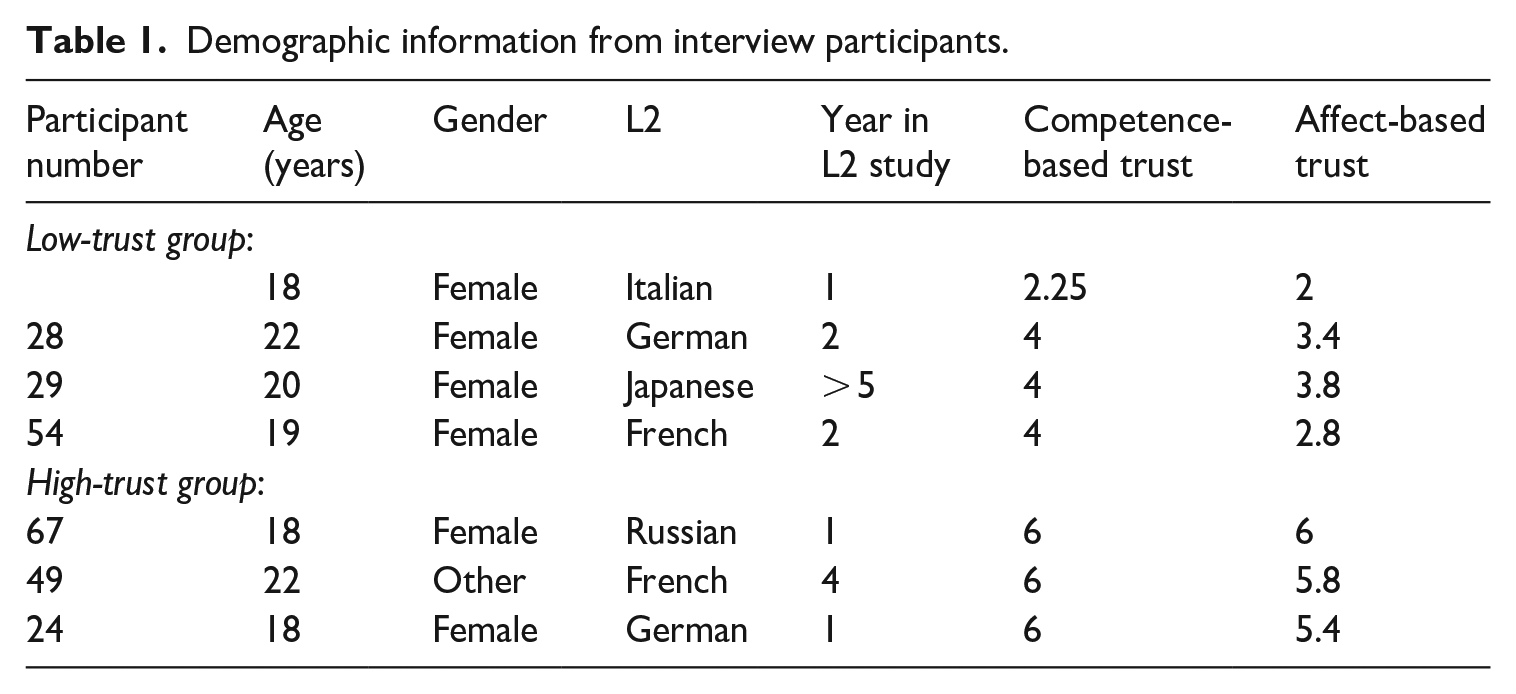
Out of the numerous participants who had expressed interest in partaking in the qualitative phase of the study, seven were purposefully selected for semi-structured interviews based on their mean competence-based and affect-based trust scores from the questionnaire. As seen in Table 1, four participants with relatively lower scores in both scales (sum < 8 on a 2–12 range) and three with relatively high scores in both scales (sum > 11 on a 2–12 range) were chosen for this phase of the study. In addition, the participants were mostly females, ranging in age from 18 to 22 years, and were mostly in their first or second year of studying different foreign languages.
Demographic information from interview participants.
2 Instruments
The FSB questionnaire from Papi et al. (2019) and the cost and value questionnaire from Papi et al. (2020) were utilized in this study. In addition, McAllister’s (1995) questionnaire was used as a basis for developing new items measuring learners’ competence-based trust and affect-based trust. All the items in the three questionnaires were responded to on a 6-point Likert scale, with 1 showing ‘strongly disagree’ and 6 showing ‘strongly agree’. In addition, the demographic information from the participants was collected using another questionnaire, which includes questions about the participants’ age, gender, major of study, length of residence in the US, length of English studies, university status, and self-reported performance.
For the qualitative phase of the study, an interview guide was developed with seven questions that aligned with the objectives of this study and addressed the stated research questions. More specifically, the questions asked about the students’ attitudes toward receiving feedback from teachers or peers, their views of supportive teachers, their feelings when asking for or receiving feedback, and the traits they preferred their teachers possessed to make feedback-seeking more comfortable. All the instruments are available in the supplemental material.
3 Procedures
The Institutional Review Board approval at the university was secured first. Then, foreign language teachers at the university were asked for collaboration. The teachers of the foreign languages were contacted first and asked for their permission to collect data from their students. With their permission, data was collected from their students in person. During the researcher’s visit to the classes, the students were provided with a consent form with information about the purpose of the study, research expectations, and their rights to voluntary participation, confidentiality, and discontinuation of the study at any point without any consequences. It took the students 10–15 minutes on average to complete the questionnaire. The teachers and the students were finally thanked for their collaboration.
4 Data analysis
a Quantitative data analysis
The questionnaire data were analysed using SPSS 27 (IBM) in a few steps. First, the data were entered into SPSS datasheets and were inspected for inaccuracies. Since the instruments were being used in a new instructional context, the data were submitted to three Exploratory Factor Analyses with a maximum likelihood method of extraction and direct oblimin method of rotation to examine the factors underlying learners’ (1) affect-based and competence-based trust, (2) self-presentation cost and feedback value, and (3) FSB items from the questionnaire. Eigenvalues above 1.00, scree plots, and the underlying theoretical dimensions of the scales were used for determining the number of factors; in addition, the Kaiser–Meyer–Olkin was used to examine the adequacy of sampling, and Bartlett’s test of sphericity was employed to assess whether the data were suitable for factor analysis. The results of these EFA confirmed the factor structure expected with two factors emerging for each set of items, that is, teacher trust, FSB, and cost and value (for details, see supplemental material). Next, reliability analyses were run to ensure the scales were reliable using Cronbach’s alpha, and descriptive statistics were obtained to get an overall picture of the data. Finally, to answer the research questions, correlations, hierarchical multiple regression analyses, and the Sobel Test of Mediation (https://www.danielsoper.com/statcalc/calculator.aspx?id=31) were used.
b Qualitative data analysis
The interview data were analysed using thematic analysis (Braun & Clarke, 2012), a ‘flexible method that allows the researcher to [analyse] meaning across the entire data set, or [to] examine one particular aspect of a phenomenon in depth’ (p. 58). Initially, one of the co-authors and their graduate assistant coded the participants’ answers separately, focusing on whether responses related to the constructs of interest in the quantitative phase of the study (cognitive and affective trust, self-presentation cost, and value of FSB, and FSB). In the few cases of disagreement, both raters collaborated to reassess them until they reached an agreement.
V Results
In alignment with the study’s sequential explanatory design, in this section the quantitative results are presented first, followed by the qualitative findings. We will then present an integrated discussion of the quantitative and qualitative results to offer a holistic and concrete understanding of the findings.
1 Quantitative results
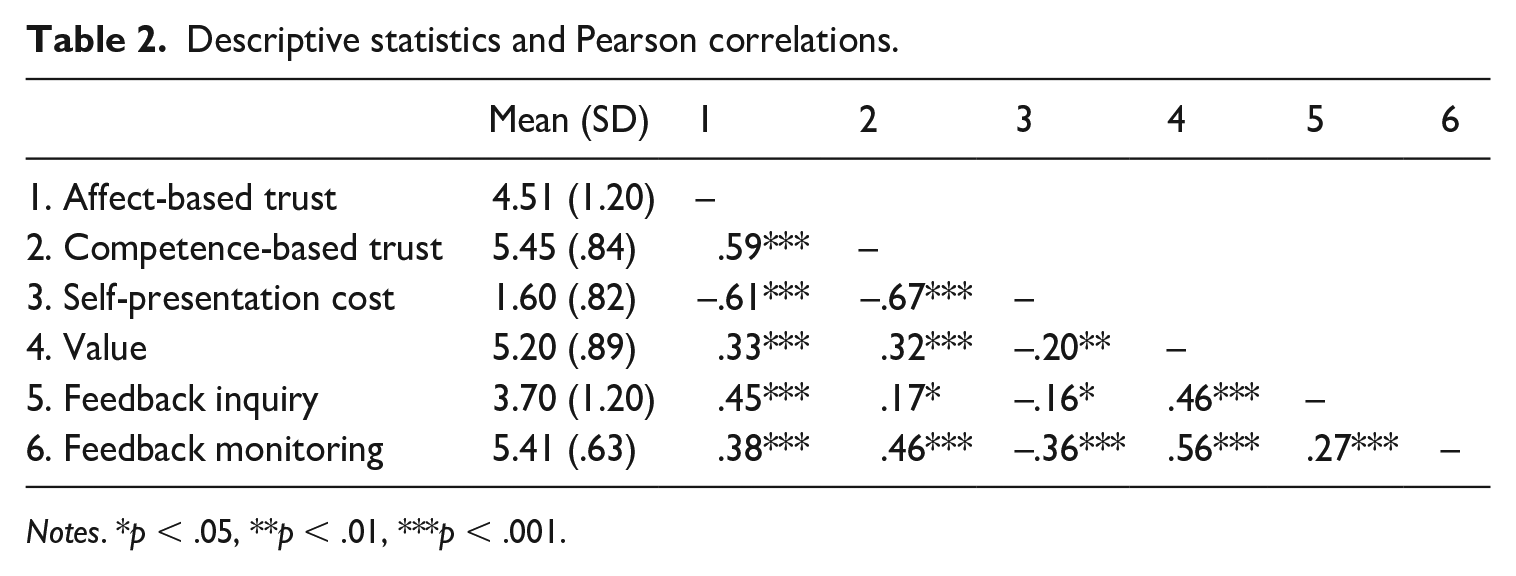
As shown in Table 1, the students had relatively high mean scores in Competence-Based Trust (Mean = 4.51, SD = 1.20), Affect-Based Trust (Mean = 5.45, SD = .85), Feedback Value (Mean = 5.20, SD = .90), and Feedback Monitoring (Mean = 5.41, SD = .64), a medium mean score in Feedback Inquiry (Mean = 3.70, SD = .1.20), and a low score in Self-Presentation Cost (Mean = 1.60, SD = .82). These descriptive analyses suggest that the students have a fair amount of trust in their teachers (both cognitively and emotionally), value feedback highly, seek it, especially through monitoring, and have less fear of feedback-seeking due to its potential for embarrassment and looking incompetent. In addition, Cronbach’s alpha values were all larger than .70, confirming the internal consistency of the scales (see supplemental material).
Table 2 presents the results of the Pearson product-moment correlation analyses, which show that all the variables positively correlated with one another except Self-Presentation Cost, which negatively correlated with every other variable. The correlations ranged from small (r = –.16) to large (r = –.67). More notably, Affect-Based Trust and Competence-Based Trust strongly correlated (r = .59, p < .001), suggesting the two trust variables are closely related.
Descriptive statistics and Pearson correlations.
Notes. *p < .05, **p < .01, ***p < .001.
a Multiple regression analyses
Two hierarchical multiple regression analyses with the standard entry method were conducted (see Table 6 below) to answer the research questions of this study. For these analyses, the VIF and Tolerance values showed that multicollinearity was not an issue. In addition, the data were normally distributed and linearly related for all the variables, and no serious multicollinearity was observed (VIF < 5; Tolerance > .2) in the regression analyses.
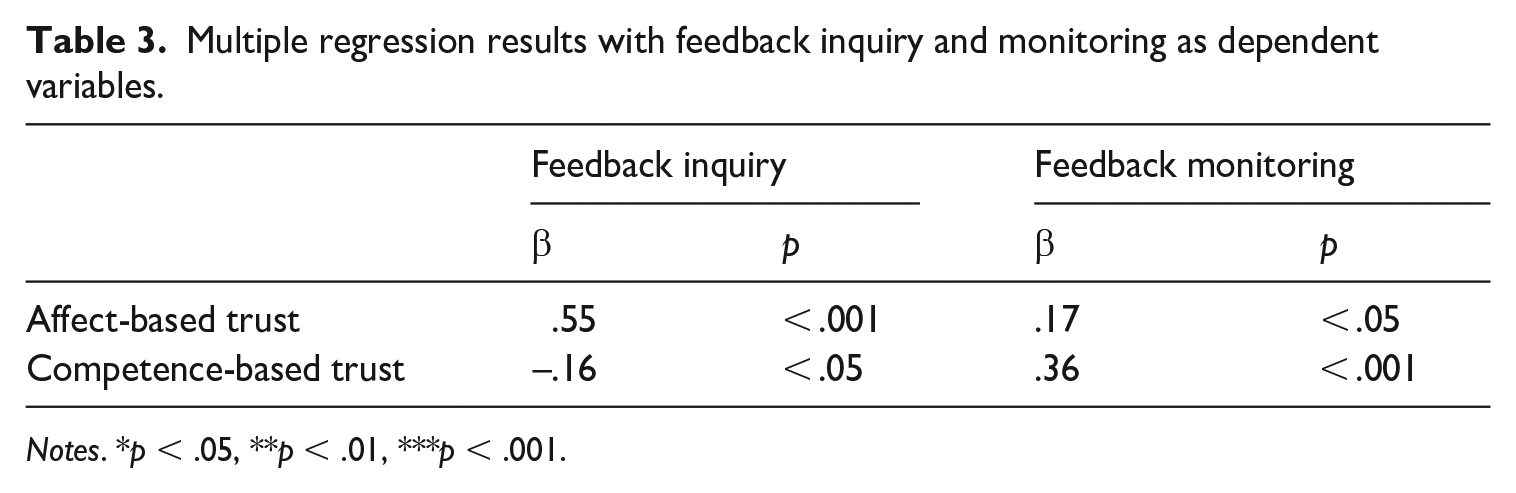
To answer research question 1 (‘What is the relationship between students’ competence-based and affect-based trust in their teachers and their FSB?’), two multiple regression analyses were conducted with Affect-Based Trust and Competence-Based Trust as independent variables and Feedback Inquiry and Monitoring as dependent variables, respectively (Table 3).
Multiple regression results with feedback inquiry and monitoring as dependent variables.
Notes. *p < .05, **p < .01, ***p < .001.
With Feedback Monitoring as the dependent variable, the model was significant (F(2,204) = 29.99, R2 = .23, p < .001), explaining 23 percent of the variance. In addition, both Affect-Based Trust (β = .17, p < .05) and Competence-Based Trust (β = .36, p < .001) emerged as statistically significant positive predictors of Feedback Monitoring. These results suggest that an increase of one unit in Affect-Based Trust will increase Feedback Monitoring by .17 units, and an increase of one unit in Competence-Based Trust will increase Feedback Monitoring by .36 units.
The model with Feedback Inquiry as the dependent variable was also statistically significant (F(2,204) = 29.02, R2 = .22, p < .001) and explained 22 percent of the variance in the dependent variable. In addition, Affect-Based Trust (β = .55, p < .001) and Competence-Based Trust (β = .16, p < .05) emerged as positive and negative predictors, respectively. These results suggest that a one-unit increase in Affect-Based Trust predicts a .55-unit increase in Feedback Inquiry but a one-unit increase in Competence-Based Trust predicts a .16-unit decrease in Feedback Inquiry.
b Mediation analysis
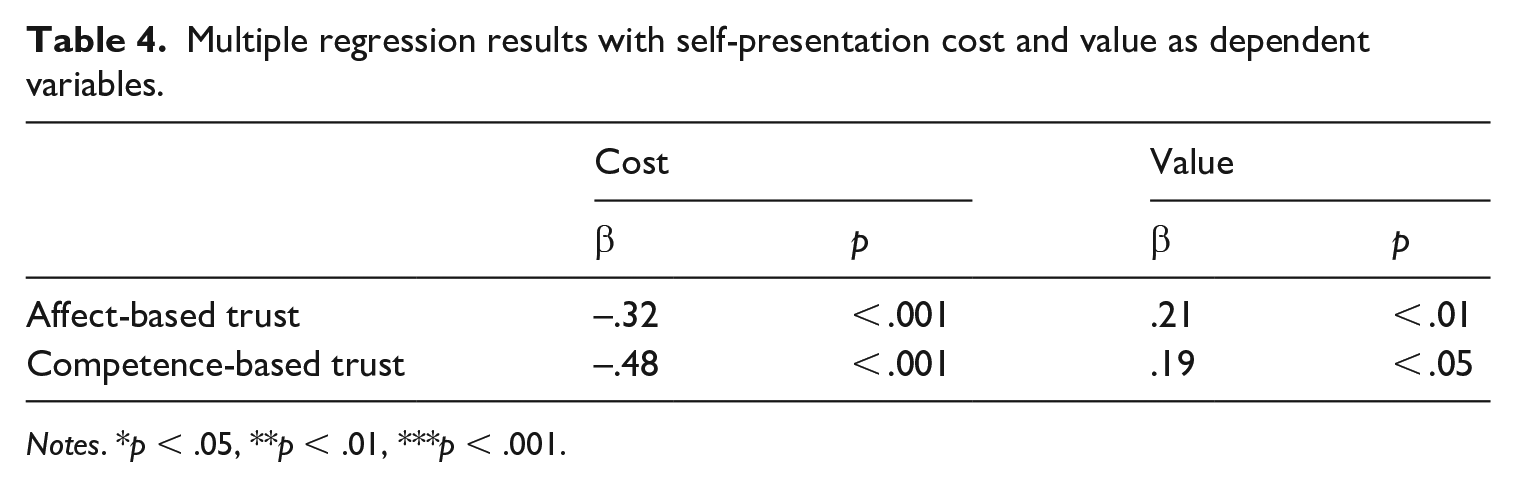
To answer research question 2 (‘Is the relationship between students’ trust in their teachers and their FSB mediated by their perceived cost and value of FSB?’), multiple regression analyses and the online Sobel Test of Mediation were used. According to Baron and Kenny (1986), ‘a given variable may be said to function as a mediator to the extent that it accounts for the relation between the predictor and the criterion’ (p. 1176). In the case of this study, variables (Cost & Value) can function as mediators between independent variables (Competence-Based & Affect-Based Trust) and dependent variables (Feedback Monitoring & Inquiry) if they are predicted by independent variables and predict the dependent variables. To test if Cost and Value qualify as potential mediators and find the direction of the mediation (negative vs. positive), we first ran two multiple regression analyses with Competence-Based and Affect-Based Trust as independent variables and Cost and Value as dependent variables, followed by two additional analyses with Cost and Value as independent variables and Feedback Monitoring and Inquiry as dependent variables.
As presented in Table 4, the results showed that both Affect-Based Trust (β = –.32, p < .001) and Competence-Based Trust (β = –.48, p < .001) were negative predictors of Cost (F(2,204) = 108.80, R2 = .52, p < .001); by contrast, with Value as the dependent variable (F(2,204) = 15.24, R2 = .13, p < .001), both Affect-Based (β = –.21, p < .01) and Competence-Based Trust (β = .19, p < .05) were positive predictors.
Multiple regression results with self-presentation cost and value as dependent variables.
Notes. *p < .05, **p < .01, ***p < .001.
As presented in Table 5, the regression analysis with Cost and Value as independent variables and Feedback Inquiry as the dependent variable (F(2,204) = 27.31, R2 = .21, p < .001) showed that Cost was not a predictor (β = –.07, p = .28), but Value was a significant and positive predictor of Feedback Inquiry (β = .44, p < .001). With Feedback Monitoring as the dependent variable (F(2,204) = 62.21, R2 = .38, p < .001), Cost was a negative (β = –.26, p < .001) and Value was a positive predictor (β = .51, p < .001).
Multiple regression results with feedback inquiry and monitoring as dependent variables.
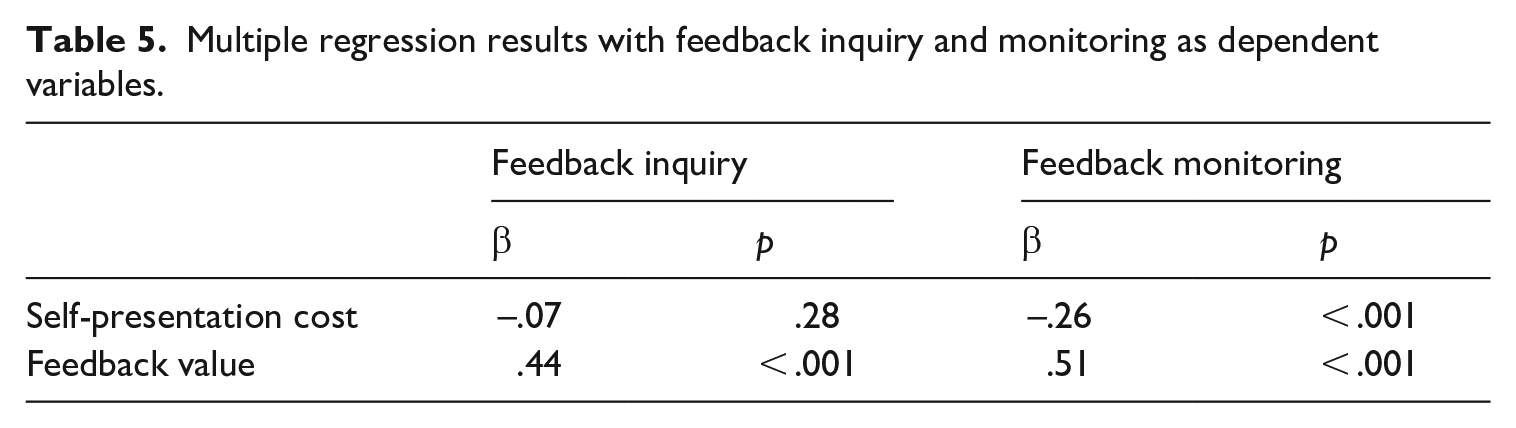
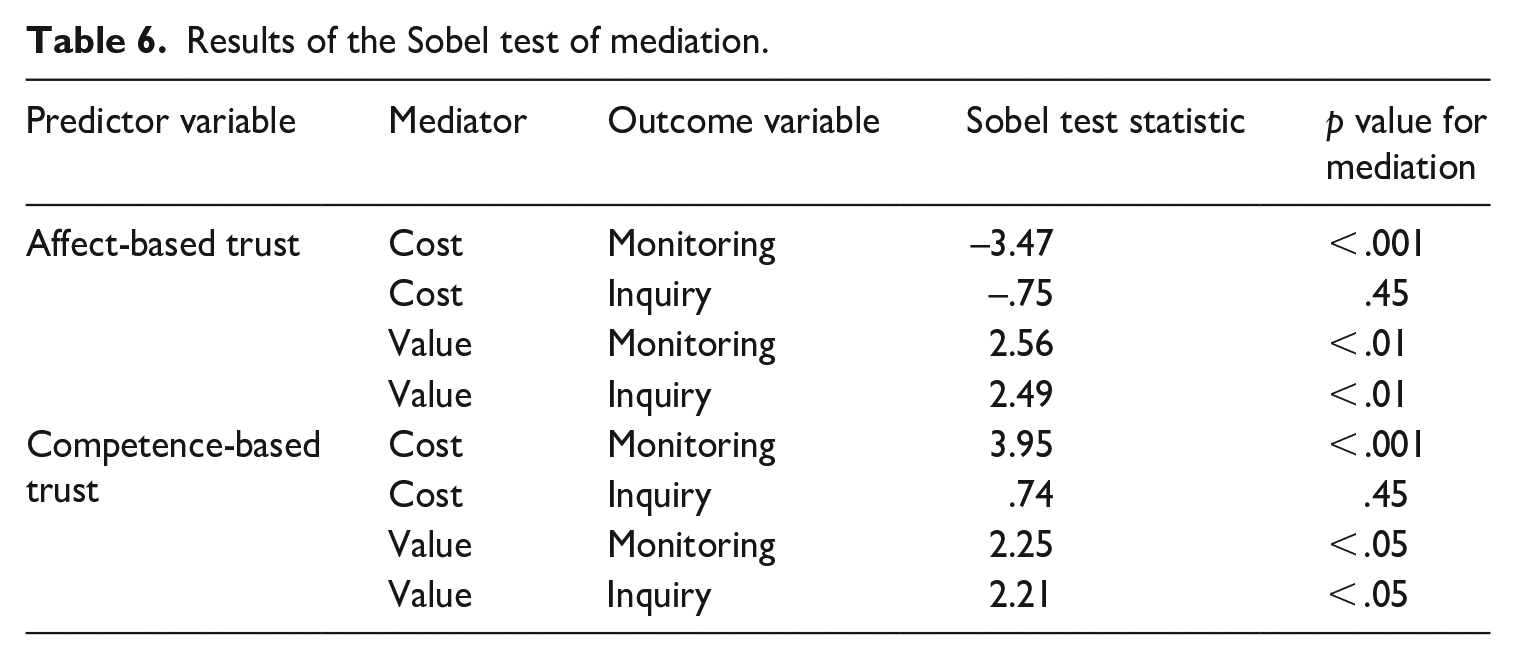
Based on Baron and Kenny (1986) guidelines, these results suggest that the relationships between Competence-Based and Affect-Based Trust, on the one side, and Feedback Monitoring and Inquiry, on the other side, can be mediated by Value. Conversely, Cost can mediate the relationship between Competence-Based and Affect-Based Trust, on the one side, and Feedback Monitoring on the other side. These predictions were confirmed by the results of the Sobel Test of Mediation, which are summarized in Table 6.
Results of the Sobel test of mediation.
2 Qualitative results
Given the sequential explanatory design of the study, the interview data were analysed to gain a deeper understanding of the relationship between learners’ perceived trust in their teacher, the cost and value of feedback-seeking, and feedback-seeking strategies. As a result of the thematic analysis of the data, a clearer picture emerged concerning the different participants’ views on the self-presentation cost of feedback-seeking behavior. The students with low levels of competence-based and affect-based trust frequently expressed concerns about the self-presentation costs of feedback-seeking, which made them reluctant to seek feedback, even though some also appreciated and valued feedback.
Out of the four participants with low levels of teacher trust, only Participant 28 and Participant 29 (P28, P29) commented on teachers’ competence and knowledge as important teacher characteristics, and only one student mentioned their preference for helpful and specific feedback (P28). The remaining topics discussed by this group fell under the affective dimension, representing an occupation with the self-presentation cost of FSB. These included students feeling insecure about their L2 competence (P9, P54), fear of embarrassment and teacher’s judgment (P9, P28, P29), preference for patient, friendly, approachable, supportive and understanding teachers (P9, P28, P54), the desire to be treated as human beings rather than language learners (P28, P54), the importance of creating a safe classroom environment (P9, P54), preference to ask questions to their teachers after class (P9, P29), and preference for peer feedback (P9).
Among the three participants showing high levels of affect-based and competence-based trust in their teachers, themes emerged that were different from the low-trust group. These students showed a preference for quality instruction and feedback, and the affective factors were less prominent in their descriptions. Although two participants mentioned the importance of teachers being understanding, friendly and treating students as inividuals (P67, P24), the rest of the comments focused on teachers’ competence (P67, P49), teacher support for student learning (P67, P24), honest constructive feedback without sugarcoating (P67, P24), actively engaging with students to enhance learning (P67, P49, P24), and preference for teacher feedback over peer feedback (P67, P24). All of the participants in this group also reported having no fear of embarrassment when asking questions (P67, P49, P24).
In the following section, an integrated discussion of the quantitative and qualitative results is presented to provide a more holistic and comprehensible interpretation of the findings of this study.
VI Integrated discussion
This study examined whether teacher trust predicted student FSB and whether the self-presentation cost and the value of corrective feedback mediated the relationship. Our quantitative results confirmed the general assumption in the present study that learners’ trust in their teachers influences the cost and value associated with feedback, and thereby learners’ engagement with feedback, that is, their FSB. Below, an integrated discussion of the quantitative and qualitative results is presented.
1 Affect-based trust: A deal breaker?
As presented in Figures 1 and 2, affect-based trust positively predicted feedback monitoring and feedback inquiry, and these relationships were mediated by feedback value. In addition, self-presentation cost negatively mediated the relationship between affect-based trust and feedback monitoring. These findings suggest that students who can personally and emotionally trust their teachers value feedback more and are less concerned about appearing incompetent and judged by their teachers. Thus, these learners engage in seeking feedback using both monitoring and inquiry methods. That is, they tend to approach teachers to ask for it; they also pay attention and use the feedback to improve their L2 skills when they receive it. These results are supported by studies in organizational psychology, which have shown that employees’ affect-based trust in their employers positively influenced their FSB (Choi et al., 2014; McAllister, 1995). In the field of SLA, Y. Zhang and Jiang (2025) found that teachers’ emotional support, as a component of general teacher support, positively predicted both feedback inquiry and monitoring among university students in the EFL context of China.
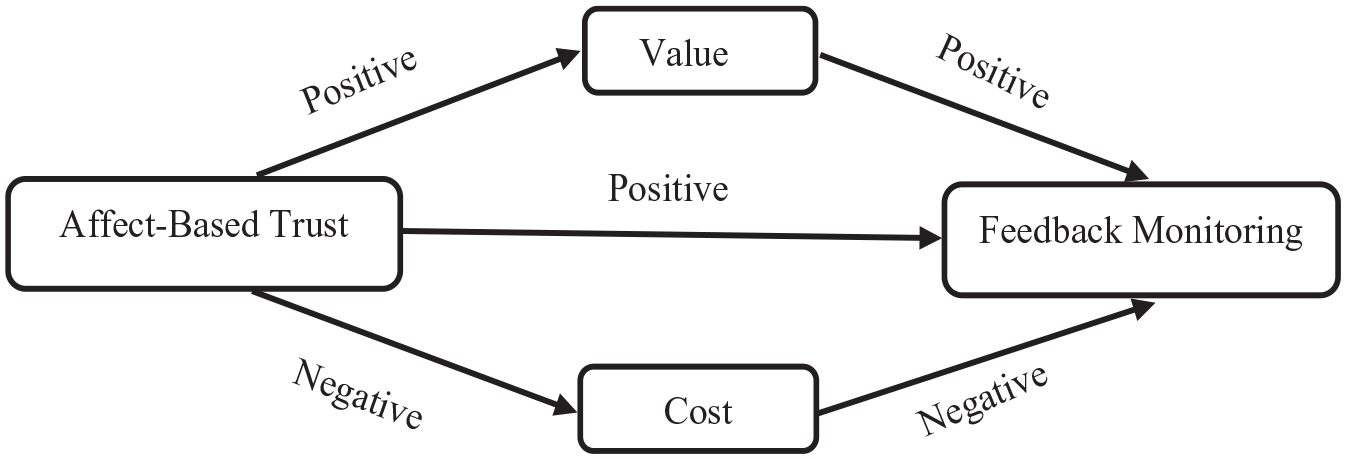
Mediation model of affect-based trust, cost/value and feedback monitoring.
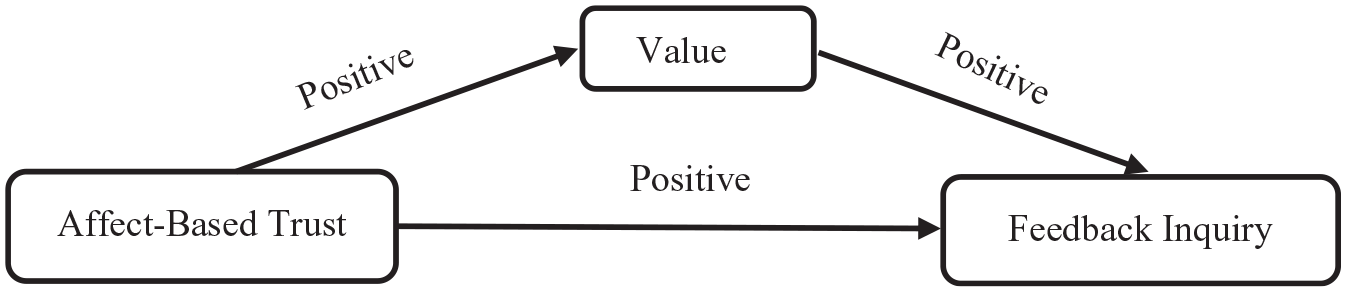
Mediation model of affect-based trust, cost/value and feedback inquiry.
Affect-based trust’s positive associations with feedback value and feedback monitoring were surprising because the former concerns the emotional aspect of the teacher–student relationship, which is not logically expected to affect the value of the corrective feedback that teachers provide and how much learners pay attention to and use the feedback. A possible explanation could be that if the students do not perceive their teachers to be emotionally trustworthy, they may not feel comfortable being corrected by them, which can negatively affect their quality of engagement with the feedback, and, consequently, its perceived value. Negative emotions such as embarrassment and anxiety have been found to have harmful effects on L2 learning, achievement and FSB (Abi-Karam & Papi, in revision; Khajavy et al., 2025; Teimouri et al., 2019). Conversely, positive emotions associated with a trusting relationship with the teacher have been shown to lead to higher student motivation and achievement (Papi & Khajavy, 2021; Tahmouresi & Papi, 2021). As argued by Dewaele et al. (2018), learners who experience positive emotions such as enjoyment ‘may have developed a stronger motivation to master the FL and a more burning desire to invest the time and effort needed to reach that goal’ (Dewaele et al., 2018, p. 691), highlighting the connection between positive emotions and student motivation. This explanation is supported by the strong positive correlation between affect-based and competence-based trust (r = .59, p < .001) and negative relationships between trust variables and self-presentation cost, which itself negatively predicted feedback monitoring. In other words, lack of affect-based trust results in students’ fear of negative evaluation or embarrassment, which in turn negatively affects their quality of engagement with it. Similarly, strong affect-based trust enhances positive emotions, which in turn increase learners’ perceived value of teacher feedback and their FSB.
These results are supported by the data from interviews with low-trust participants who provided insights on how their concerns about the cost of feedback-seeking shaped their FSB. These students were primarily concerned with the negative consequences of feedback-seeking, such as fear of embarrassment, insecurity, and judgment, and a preference for more supportive and reliable teachers, concerns which dissuaded them from active engagement in FSB.
For instance, Participant 9 mentioned that she does not ask questions immediately and waits to ask them later ‘because I maybe just get embarrassed if I feel like I’m just gonna sound a little dumb asking it’.
Speaking about his past favorite language teachers, Participant 28 expressed similar views about what made her want to seek more feedback from those particular teachers: I felt like they cared about me as a person before they cared about me as like their student, you know. Like they obviously cared about my grades but like, I found them approachable because I didn’t fear them thinking I was like stupid or feared them thinking I was like a bad student if I trusted that they cared about me as a person first and a student second.
Participant 54 stated that she preferred approachable teachers because ‘you weren’t like walking on eggshells, and if you messed up, it was sort of like ok, whatever, she isn’t like a hard ass about it.’ She expressed similar sentiments about the importance of treating students as individuals and not reducing them to ‘just a student’: It’s always nice when professors don’t see you as just a student. They’re like, this is kind of a cool person; this is another human I can interact with. It doesn’t feel as stressful. So, when I talk to my professor, it doesn’t always feel like I’m talking to a professor. It just feels like I’m talking to another adult.
The interviewees’ statements align well with the study’s quantitative results, suggesting that socioemotional trust in a teacher is essential for these students’ cognitive and behavioral engagement with corrective feedback. This brings to mind the saying, ‘No one cares how much you know until they know how much you care,’ often attributed to Theodore Roosevelt. Aligned with this saying, one of the interviewees mentioned that teachers who do not have a friendly relationship with their students ‘make it very difficult to learn because they are very cold or generally dismissive if a student has a question’ (Participant 29). Therefore, it seems to be the case, at least in the context of the US, that when students associate negative emotions with a teacher, it can hinder their ability to mobilize cognitive resources, limiting their access to and effective use of the feedback provided. Supporting this argument, Zhou et al. (2023) reported that some students who trusted their teacher’s competence and quality of feedback preferred to ask others for feedback because they did not dare or want to bother the teacher, highlighting how a lack of affect-based trust can override competence-based trust.
2 Competence-based trust
As illustrated in Figures 3 and 4, Competence-Based Trust positively predicted Feedback Value and Monitoring and negatively predicted the Self-Presentation Cost and Feedback Inquiry. In addition, the relationship between Competence-Based Trust and Feedback Monitoring was mediated by Feedback Value. These results confirm that students who trust their teacher’s instructional competence value the feedback the teacher provides. The feedback value, in turn, motivates the students to pay more attention to and try to learn from the feedback. The connection between Competence-Based Trust and Feedback Monitoring has been confirmed in previous studies in the field of organizational psychology. For instance, studies by McAllister (1995) and Choi et al. (2014) found that employees sought feedback from sources whom they perceived to be competent. In the field of SLA, the connection between competence-based trust and the value of feedback is implicit in the studies comparing teacher and peer feedback. For instance, Leki (1991) found that 93% of her participants valued teacher feedback, whereas only 58% believed in the usefulness of peer feedback. Such a difference in the value attached to feedback from different sources has been found by Papi et al. (2020) to contribute to students’ FSB. Similarly, Y. Zhang (2025) and Y. Zhang and Jiang (2025) found positive associations between teachers’ support and students’ FSB. In an FSB study in the field of SLA, Papi et al. (2021) found that students with a growth mindset and development approach goal valued feedback more than others and engaged in more feedback monitoring. In sum, these results confirm that if students believe that their teacher is competent in their teaching practice, they value the feedback they receive from their teacher more highly, which, in turn, can lead to more frequent FSB (Papi et al., 2019, 2020).
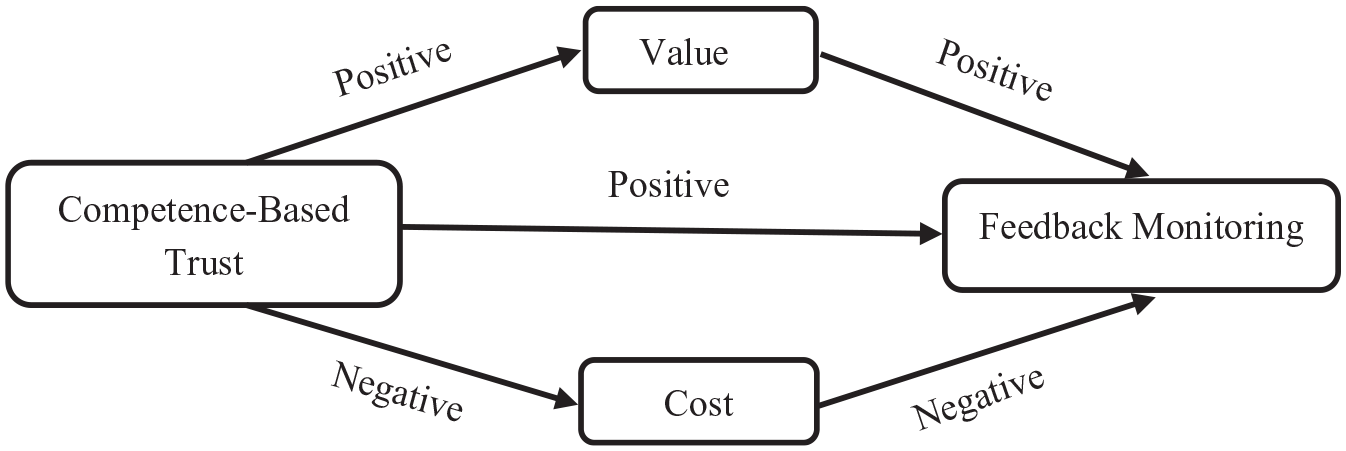
Mediation model of competence-based trust, cost/value and feedback monitoring.
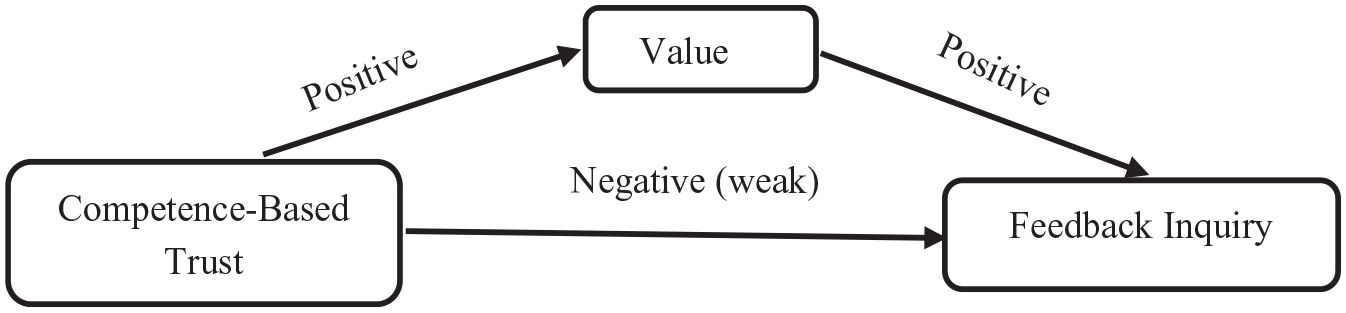
Mediation model of competence-based trust, cost/value and feedback inquiry.
Competence-based trust, however, negatively predicted feedback inquiry, and value positively mediated the relationship. These results suggest that students who believe their teacher to be competent may not see a need to ask for more feedback because they may view the feedback received as sufficient for their needs. Providing timely corrective feedback may be one of the students’ criteria for perceiving a teacher as competent. Therefore, if students already trust a teacher due to the timely provision of quality CF, that may minimize their desire to approach a teacher and ask for more feedback. In addition, previous studies have shown that feedback inquiry may not always be employed as a strategy for receiving CF and may serve as an impression-management strategy (Papi et al., 2020) that may not improve L2 performance (Papi et al., 2024). Therefore, it might be the case that after controlling for Affect-Based Trust (Table 3), learners with high levels of Competence-Based Trust may be less interested in making a positive impression or improving their relationship with their teachers. The impression management function of feedback inquiry is supported by the lack of a relationship between self-presentation cost and feedback inquiry in this study. If learners’ fear of embarrassment from evaluation does not dissuade them from engaging in feedback inquiry, the latter may have a different function.
Similarly, the negative relationship between Competence-Based Trust and Self-Presentation Cost was not expected. This result could probably be because when the students believe in the teaching skills of their teachers, they grow more confident that the teacher will not evaluate them negatively due to their errors. Competent teachers are generally expected to support rather than judge learners. In the study by Y. Zhang and Jiang (2025), emotional support was measured as a component of general EFL teacher support, which also included instrumental and academic support, suggesting that a teacher’s emotional and instructional qualities may often be viewed as intertwined. As discussed above, this argument is supported by the strong correlation between the Affect-Based and Competence-Based trust (r = .59, p < .001). Alternatively, it is possible that the specific teachers who taught the participants of this study were perceived as both competent (Mean = 5.45, SD = .84) and reliable (Mean = 4.51, SD = 1.20), although the two qualities can be theoretically different.
Insights from our interviews with high-trust participants align with the quantitative results of this study, suggesting that high-trust participants are less concerned about the negative consequences of FSB or their relationship with their teachers. Instead, they are more focused on the quality of feedback they receive from their teachers. It seems that the high level of emotional trust established with the teacher has released these learners from concerns and pressures that might have distracted them from engagement in the classroom. At the same time, their high level of trust in their teachers’ competence has motivated them to mobilize their cognitive and attentional resources to engage in quality feedback monitoring.
In responding to the question about her feedback preferences, for instance, Participant 67 stated that she preferred to receive expert, honest, and constructive feedback over the kind of feedback that is only meant to make her feel good, even though she also appreciates the friendliness of her Chinese teacher: I think when [teachers] are honest, there’s this one thing when I’m asking for feedback I cannot stand when I ask for feedback from someone, and they’re like ‘oh you’re doing great!’ or stuff like that and I’m like: No! I want to know what I’m doing wrong and how I can improve. Don’t tell me I’m perfect; I know I’m not! So honest is great. My current Chinese teacher is really really cool in that she is very kind with it. She doesn’t sugarcoat things, but she also brings stuff up in a very constructive, really friendly manner.
Participant 49 showed a similar lack of concern with looking incompetent or embarrassed due to receiving corrective feedback from their teacher or classmates.
I don’t find most teachers intimidating, so I don’t mind when they give me feedback; in fact, I enjoy it. I like it. I want to be able to improve; so, unless, of course, they are aggressive and trying to tear me down, I don’t care. But the same thing for my fellow students; as long as they aren’t being malicious about it, then of course, I mean, there’s nothing wrong with that. I’ve never been bad about taking feedback, so I don’t care where it comes from.
In response to the question about teacher characteristics, Participant 49 emphasized the value of the teacher’s competence and confidence and described such teachers as those who engage with students, give them a say, and actively support their language learning.
They wanted us to engage with them, to ask them questions, to understand what we didn’t understand, and because they were willing to do that. It had a layer of comfort, if you will, where you felt like you were able to express yourself and be real and honest and say this: I don’t get this; what’s going on? So they created that opportunity, if you will, rather than other teachers where it’s almost like: ‘Don’t ask . . .’ not even ‘don’t ask questions’ but you feel less comfortable because they don’t actively try to engage you that way because there can be a little bit of a disconnect between a teacher and a student and it’s almost up to the teacher to bridge that gap.
Highlighting their focus on the value of feedback, a few participants from this group were suspicious of the learning value of peer feedback. For instance, Participant 24 expressed that she would take feedback from his peers and friends with a grain of salt because ‘they aren’t trained professionals’.
3 Summary of discussion
In sum, the results of this study underscore the importance of teacher trust in students’ FSB. These findings confirm that students with high levels of affect-based and competence-based trust were less concerned about the fear of negative evaluationand could thus focus on engaging with the teacher’s feedback. By contrast, those with low levels of trust did not optimally seek or benefit from their teacher’s feedback due to their fear of judgment or embarassment.
These findings suggest the students who have a positive and trusting emotional relationship with their teacher can fully allocate their cognitive resources to the CF their receive from their teachers because they are less likely to experience negative emotions such as shame, guilt, and anxiety that may distract them from the task of paying attention to and trying to learn from feedback (Papi & Khajavy, 2023; Teimouri, 2018). Conversely, the students who do not emotionally trust their teachers may create an affective block that stops them from paying attention and engaging with their CF. When corrected, these students may feel negative emotions such as shame and anxiety, which can, in turn, harm their allocation of attentional resources to the feedback (Abi-Karam & Papi, in revision; Gass, 1988).
In line with this conclusion, Sato (2013) reported that some learners showed a preference for receiving peer feedback because they were afraid of their teacher’s judgments. Similarly, Papi et al. (2019) found that learners with maladaptive motivation preferred receiving feedback only from people other than their teachers. Papi et al. (2019, 2021) reported that due to their preoccupation with the cost of being corrected, these learners preferred to receive either no CF or CF from people other than their teachers (peers, native speakers, etc.). Similarly, Zhou et al. (2023) found that L2 learners preferred to seek feedback from their peers, private tutors, or other sources because they feared their teacher’s negative evaluation. Therefore, students’ lack of affect-based trust in their teachers may serve as an affective block that hinders their cognitive engagement with the teacher’s CF.
VII Conclusions
Merging the insights from the quantitative and qualitative findings, it can be concluded that students’ socioemotional relationship with their teachers directly shapes how much they value and seek CF from them. A positive and trusting relationship enhances learners’ perceived value and quality of engagement with a teacher’s CF whereas a negative relationship increases the self-presentation cost of feedback-seeking and reduces their engagement.
More specifically, the students who have a good emotional relationship with their teacher and believe in their teaching competence value their feedback more than others. They are less concerned about getting embarrassed and looking incompetent to others due to being corrected and are more willing to engage in feedback monitoring. By contrast, those who lack a trusting relationship with their teachers are less willing to seek feedback from their teachers, regardless of their teachers’ competence and quality of CF. Without a trusting socioemotional relationship with their teachers, students may experience a host of negative thoughts and emotions that would hinder them from seeking, engaging with, or using CF to improve their L2 knowledge and skills. While research on different types of CF often yields varied results, this study emphasizes the importance of teacher trust in shaping students’ FSB: Without a good personal relationship between the learner and their teachers, the quality or quantity of CF may take a backseat, effectively neutralizing potential learning effects of CF (Papi & Hiver, 2025; Papi et al., 2024).
‘Research on corrective feedback (CF) has developed from its original focus on identifying which type of CF is most effective for developing L2 language learners’ grammatical accuracy to focusing on how learners use CF’ (Boggs & Manchón, 2023, p. 1). In response to learners’ inconsistent and suboptimal engagement and use of the feedback provided (Bitchener, 2017), the centrality of the learner has been gaining momentum in the field (e.g. Han, 2017; Papi et al., 2019, 2020; Rummel & Bitchener, 2015; Storch & Wigglesworth, 2010). The results of this study reaffirm the importance of centering the learners in the feedback process and viewing them as proactive agents responsible for seeking and learning from CF (Papi & Hiver, 2025).
1 Limitations and future research directions
The results of this study relate to the specific population of college-level foreign language learners in the United States. They may not be extended to other populations and cultural contexts until further evidence is provided. Questionnaire and interview data were collected to explore the relationship between teacher trust and learners’ FSB. In future studies, longitudinal designs could examine how the evolution of learners’ relationships with their teachers could influence their FSB and learning outcomes. Employing learning outcome measures in future studies could also contribute to a more comprehensive understanding of the antecedents and outcomes of FSB (see Papi et al., 2024). In this study, we did not compare FSB across different foreign languages. Considering that the instructional system and quality influence learners’ FSB, future studies can explore such cross-linguistic differences. The newly developed scales for measuring competence-based trust and affect-based trust each included only three items with some overlap. Longer and more distinct scales could be used in future studies to increase the reliability and discriminant validity of the scales. In the qualitative phase of the study, only students with high or low scores in both trust scales were recruited. Future studies can examine how students with high scores in one type of trust and low scores in the other view CF and FSB. Students’ perceptions of teacher competence-based and affect-based trust are only two contextual factors investigated here. Other factors, such as classroom climate, teaching and management style, curriculum, and group cohesion, could be among the different contributing factors in the learning environment. This study conceptualized teacher trust as a contextual independent variable. However, teacher trust can be influenced by learner characteristics such as their mindset, grit, ideal self, achievement goals, or even their cultural background. The importance of learner characteristics in their teacher trust was apparent in one of our high-trust participants – Participant 67 – who confidently stated that ‘I’ll be honest, I don’t feel a lot of embarrassment ever. I’m very Italian; I got a lot of hubris there.’
2 Educational implications
Teachers are recommended to improve the quality of their teaching and feedback practices and to create a positive and trusting emotional relationship with their students. Such a relationship can increase students’ quantity and quality of FSB, which can, in turn, improve their learning experience and outcomes. According to Gkonou (2022), teachers can use various techniques in the service of three broad strategies to foster quality relationships with students. These include putting effort into knowing their students, showing care about students’ success by providing clear and realistic expectations and constructive feedback on their performance, and creating a positive classroom environment. Zhou et al. (2023) recommended using low-cost opportunities such as session breaks and online discussion boards to help improve the teacher’s understanding of students’ educational identity and epistemological beliefs, which can, in turn, enhance their feedback-seeking behaviors. Y. Zhang (2025) recommended that teachers improve their academic support of the students, enhance their feedback literacy and quality of interactions, and encourage students’ active engagement in feedback-seeking.
A key instructional implication of this study is teachers’ enhancement of their feedback literacy and employment of differentiated feedback strategies (Boggs & Manchón, 2023; Carless & Boud, 2018). Interviews with the low-trust participants highlighted the importance of taking students’ sense of insecurity seriously and minimizing their fear of embarrassment and negative evaluation. This can be achieved partly by focusing on each learner’s developmental process rather than the normative assessment of their L2 performance. The students reported a preference for teachers who take the time to create a safe classroom environment where they can freely make mistakes and ask questions without the fear of reprisal, negative judgment, or embarrassment. They preferred teachers who are patient, friendly, approachable, supportive, and understanding and treat students as human beings rather than solely as language learners. Perhaps employing the more implicit and less threatening types of corrective feedback can also help avoid exacerbating certain students’ feelings of insecurity due to getting corrected (Papi et al., 2021). Finally, teachers can benefit from teacher training programs that integrate relational pedagogy and skills to foster trust, promote proactive learning behaviors, and ultimately enhance student success.
Supplemental Material
sj-docx-1-ltr-10.1177_13621688251352268 – Supplemental material for How learners’ trust in teachers shapes their feedback-seeking behaviors: A mixed-methods study
Supplemental material, sj-docx-1-ltr-10.1177_13621688251352268 for How learners’ trust in teachers shapes their feedback-seeking behaviors: A mixed-methods study by Mahshid Mahbodi, Mostafa Papi and Dominik Wolff in Language Teaching Research
Footnotes

References
Supplementary Material
Please find the following supplemental material available below.
For Open Access articles published under a Creative Commons License, all supplemental material carries the same license as the article it is associated with.
For non-Open Access articles published, all supplemental material carries a non-exclusive license, and permission requests for re-use of supplemental material or any part of supplemental material shall be sent directly to the copyright owner as specified in the copyright notice associated with the article.
