







Abstract
Using multimodal conversation analysis, this study examines how assessments function as interactional resources for managing second language (L2) discussion topics in conversation for learning (CFL) contexts. Drawing on nine hours of video-recorded discussions, we analyse how students initiate and expand topics through assessments directed at either the primary speaker or third parties. Our guiding research question is: How do first-position assessments in CFL discussions shape participation, topic progression, and the management of interactional contingencies? The analysis reveals that assessments directed at the primary speaker, whether positive or negative, prompt elaboration or justification, leading to extended participation. In contrast, assessments of third parties produce different interactional outcomes: positive assessments foster shared alignment without necessitating further elaboration, while negative assessments invoke moral accountability, prompting participants to justify or defend the assessed third party. Overall, this analysis highlights students’ collaborative efforts in managing assessments to create opportunities to practice L2. Furthermore, the assessment trajectories reflect the participants’ concern with managing social relationships. This study advances research on assessment-in-interaction and CFL while providing valuable insights for designing L2 speaking tasks that foster more dynamic and participatory discussions.
Keywords
I Introduction
While students can plan and practice presentations in advance, the inherent unpredictability of discussions makes them particularly challenging for students, especially when conducted in a foreign language (El Majidi et al., 2018; Yang, 2010). In such discussions, students are expected to provide feedback on presentations, ask questions, and possibly offer critiques or suggestions. For presenters, responding to these comments can involve face-threatening situations that may limit participation (Duff, 2010; Zappa-Hollman, 2007). Despite these challenges, discussions remain widely used in second and foreign language learning contexts (Loewen & Sato, 2018). Typically, a discussion begins with a leader presenting a topic, followed by group members engaging in a discussion to respond to and evaluate the presentation. Discussions are particularly valuable for developing second language (L2) speaking skills because they encourage interactive communication, critical thinking, and the ability to negotiate meaning: key components of communicative competence in real-world settings (El Majidi et al., 2021, 2024).
This study focuses on discussions that occur in a particular setting: conversation-for-learning (CFL) (Kasper, 2004). CFL refers to conversational exchanges designed to provide L2 learners with opportunities to practice the target language beyond the classroom, such as in tutoring sessions, peer exchanges, language cafés, and tandem learning programs. Its aim is to create socially situated contexts where language learning becomes an active, collaborative process. Responding to the need for research regarding how learners manage topics and create interactional spaces for L2 practice in such contexts (Al Masaeed, 2024; Kim, 2017), this study focuses on assessment, and, specifically, on the participation possibilities that assessments provide for initiating, expanding, and managing CFL discussions.
Assessments, broadly defined, are evaluative statements that express a speaker’s stance toward a referent, such as an event, person, or object (Pomerantz, 1984). While extensive research has examined assessments in institutional L2 learning contexts such as classrooms (Tomasine, 2024; Waring, 2008) and tutorials (Park, 2018), assessments in nonformal, peer-based interactions remain underexplored. CFL settings offer unique interactional environments in which assessments serve as both evaluative acts and key interactional resources that invite elaboration, alignment, or resistance from recipients; in other words, they involve managing various opportunities for participation and affiliation. Examinations of assessments in CFL discussions can shed light on how L2 learners structure and sustain discourse, negotiate interactional sensitivities, and co-construct opportunities for learning. To gain such insights, assessment cannot be treated as a quantifiable variable but a conversational action that is collaboratively accomplished by the participants themselves. We therefore adopt conversation analysis as a framework that enables us to produce fine-grained qualitative analyses of assessments and their consequential interactional trajectories. The resulting analyses reveal how the sensitivities associated with different types of assessments present distinct contingencies, through which participants maintain conversations and establish solidarity. Given the expanding use of CFL formats, examining how assessments function in these settings have implications for L2 speaking pedagogy and task design.
In this study, we examine two types of assessments – those directed at the speaker and those about a third party – focusing on first assessments that launch discussions rather than second-turn assessments that respond to prior evaluations. We subcategorize these two assessment types into positive and negative assessments, which allows us to analyse in detail how different assessment types shape discussions. The research questions that guide our analysis are as follows:
Research question 1: What actions does each assessment perform?
Research question 2: How do first-position assessments in CFL discussions shape participation, topic progression, and the management of interactional contingencies?
This analysis demonstrates how students orient to different types of first assessments and manage the resulting contingencies to sustain topics and build social affiliation. The following sections review relevant CFL literature and conversation analytic research on assessment in interaction and describe the data and methods used in this study.
1 Conversation-for-learning
While traditional classroom instruction typically follows a structured curriculum, enforces specific conversational norms, and includes performance-based assessment, CFL neither imposes such constraints nor assesses students on their performance. By situating learners in real-time exchanges without a teacher’s direct presence, CFL encourages spontaneous, unstructured interaction, allowing students to engage in natural conversation (but see Nao, 2013) and co-construct meaning with their interlocutors (Kasper & Kim, 2015). As a result, learners engage in implicit learning that fosters the development of L2 comprehension and speaking abilities (Krashen, 1981).
Research has shown that this approach plays a pivotal role in assisting learning and cultivating interactional competence, with practices like turn-taking, sequence organization, repair, and membership categorization serving as key mechanisms for maintaining mutual understanding and achieving progressivity. In this regard, Kim (2019) demonstrates how participants navigate epistemic asymmetries by collaboratively constructing definition sequences and engaging in knowledge checks, highlighting repair practices as key sites for learning. Likewise, Al Masaeed (2023) underscores the role of collaborative repair, showing how participants treat lexical items as ‘learnables’ and ‘teachables’, which facilitate vocabulary acquisition over time, while Hauser (2017) highlights the role of repetition and repair in language uptake by longitudinally tracking interactional learning behaviors and demonstrating how learners adopt and continue using new vocabulary items that prove interactionally useful. Zimmerman (2020) further examines how language alternation in study abroad contexts creates opportunities for learning, and Leyland and Riley (2021) show how deferred correction sequences, facilitated through written notes, help learners incorporate feedback while maintaining conversational flow. These studies show that CFL fosters learning through repair, repetition, and topic negotiation, helping learners manage epistemic asymmetries, integrate new vocabulary, and sustain interaction.
Although CFL research has predominantly focused on repair sequences as sites for learning, studies of topic management offer additional insights into the ways learners navigate and sustain interactional engagement, facilitating opportunities for L2 practice. Kim (2017), for instance, identifies various ways in which L2 learners introduce topics in CFL settings, highlighting the role of epistemic stance and mutual knowledge in determining the effectiveness of topic initiation; the analysis shows that, over time, learners shift from abrupt topic introductions to more seamless transitions, suggesting developmental progress in their interactional competence. Similarly, Al Masaeed (2024) examines how learners co-manage repair practices and topical talk in L2 Arabic CFL, finding that telling questions from the first language (L1) speaker initiate topical talk, leading to expanded learner responses that often involve repair sequences using embodied and multilingual resources. While these repairs momentarily delay topic progression, they create learning opportunities by reinforcing participants’ orientations toward their roles as a language expert and learners, while also engaging in extended topical talk. Meanwhile, Nao (2013) examines topic management in an English conversation lounge at a Japanese university, where students are preallocated the role of topic nominators. The study finds that this institutional practice does not fully deinstitutionalize discourse, as students often struggle with topic initiation, attempt to defer it to teachers, or adopt structured, classroom-like approaches. Thus, rather than fostering spontaneous conversation, topic management remains shaped by ‘negotiated compliance’, with teachers withholding topic nomination and students conforming to institutional expectations.
In addition to identifying topic management as a learning resource, research has highlighted its role in relationship-building within CFL. Examining how CFL participants navigate topic generation procedures and categorization practices that contribute to ‘doing being friends’, Kim (2023) finds that the need to continuously generate mutually relevant topics leads to shifts in how participants position one another, demonstrating the reflexive relationship between talk and interpersonal relationships. Features such as referencing past interactions and adjusting topic selection over time illustrate how CFL participants co-construct relational stances through interaction. Kim and Carlin (2022) similarly examine storytelling practices in CFL, focusing on topic generation and collaborative story construction. The study highlights that membership categorization plays a key role in topic management, as topics emerge through shared identity categories (e.g. teenage interests like cars and video games). The authors also find that story appreciation points are not static but are collaboratively built and negotiated through recipient responses, scaffolding inquiries, and second stories. Ultimately, these findings suggest that storytelling in L2 learning contexts is an interactional achievement, shaped dynamically by participants’ contributions rather than predetermined structures.
Together, these studies highlight the complexities of repair practices and topic management in CFL, demonstrating how participants create learning opportunities and how learners strategically engage in topic initiation, maintenance, and shifts as part of their interactional development. This growing body of research suggests that CFL provides unique spaces for students to exercise agency in topic negotiation while co-constructing meaning with their interlocutors. In this study, we further explore the role of assessments as interactional resources in managing CFL discussions, focusing on how they shape participation, topic progression, and the management of interactional contingencies within peer interactions.
2 Conversation analytic research on assessment in interaction
Pomerantz’s (1984) foundational research on assessments highlights that people routinely evaluate people, events, or objects during conversations. Speakers employ various lexical, prosodic, and embodied resources to convey positive or negative evaluations of specific referents (Huhtamäki & Grahn, 2022; Lindholm, 2024). Positive and negative assessments are distinguished by their evaluative valence (Ruusuvuori, 2012). Positive assessments, such as compliments or approvals (e.g. ‘That was an insightful argument’), tend to invite affiliation and agreement, while negative assessments (e.g. ‘That part didn’t really make sense’) often create an interactional need for justification or repair. Conversation analytic research have examined assessments as a type of action through which both speakers and recipients demonstrate alignment. In this context, assessments are ‘produced as products of participation’ (Pomerantz, 1984, p. 57), allowing the speaker to claim their knowledge or understanding of the assessable.
Much of the existing scholarship on assessments has focused on their production within storytelling or news exchanges about past events (Heritage & Raymond, 2005; Lindström & Mondada, 2009; Maynard, 2007), closely examining their sequential implications. The sequential organization of assessments has been predominantly analysed in three interactional contexts: (1) assessments that initiate an evaluative sequence (i.e. first assessments), (2) assessments made in response to a prior assessment (i.e. second assessments), and (3) additional assessments that extend the exchange. This third type expands what is known as an ‘adjacency pair’ (Schegloff, 2007), a common conversational structure in which one speaker’s turn (first pair part) invites a specific type of response (second pair part) from another person. In this case, a first assessment may prompt a second assessment, forming a pair that can be extended with further contributions. Thus, the terms ‘first’ and ‘second’ refer to these sequential units within an adjacency pair (Pomerantz, 1975) rather than simply indicating the order in which assessments occur.
Among the most influential works in this area, Pomerantz (1984) examined second assessments in the context of agreement and disagreement. While a first assessment typically makes relevant a second assessment by another interlocutor, this second assessment may agree or disagree with the first. One way to agree is to upgrade the second assessment (e.g. good to excellent). Conversely, a downgraded agreement often serves as a prelude to disagreement. By taking an evaluative stance toward the speaker’s prior turn, participants not only demonstrate shared knowledge about the assessable – that they have been attentive co-participants in the activity – but also show that they affiliate with the speaker’s point of view (Stivers, 2008). Thus, assessments are not merely sequential phenomena; they are among the primary means through which participants establish social solidarity (Goodwin & Goodwin, 1992).
Other than second turn positions, assessments may also be occasioned at the end of extended talk. Participants may show that they have finished describing an event, and recipients can display their understanding that a telling has reached completion by providing assessments. In these cases, assessments often occur with summary formulations and are closing-implicative as they work to terminate, and even curtail, the preceding topic (Antaki et al., 2000; Goodwin & Goodwin, 1987). In contexts involving requests or offers, deontic assessments are frequently prefaced with ‘okay’, treating the prior turn as a proposal that is sufficient and acceptable (Seuren, 2018). These assessments function as a conversational resource that close down a sequence and facilitate a smooth transition to the next topic or activity.
Assessments in institutional and professional settings add evidence to this finding. For instance, classroom interactions often follow structured sequences such as initiation–response–evaluation (Mehan, 1979) and initiation–response–feedback (Sinclair & Coulthard, 1975) sequences. In these patterns, the teacher initiates the exchange with a question, the student responds, and the teacher provides either an evaluation or feedback in the third turn. Much discussion has centered on the third turn assessment, unveiling that the teacher’s positive feedback here is preferred. By producing an explicit positive assessment, the teacher marks the student’s answer as adequate and closes the sequence by displaying that the lesson’s objective has been achieved (Waring, 2008). Research in other contexts – including medical (Jones, 1997; Maynard, 1991), interview (Antaki et al., 2000), and editorial conference settings – has also shown that specific forms of assessments are employed to close discussions about assessable topics, thereby facilitating progress on institutional agendas. Examining car dealer exchanges, Mondada (2009) finds that customers often produce ah-prefaced assessments at points where dealer explanations appear complete, showing their understanding of the described objects. In this way, assessments not only display understanding of a prior turn but also ascribe action and accomplish the ‘architecture of intersubjectivity’ (Heritage, 1984).
In this study, we take interest in first assessments that are launched at the onset of evaluative sequences. Our aim is to investigate a unique setting of ‘nonformal institutional interaction’ (Hauser, 2008) where the absence of a teacher creates a conversational dynamic that closely resembles ordinary talk (Kasper & Kim, 2015; Kim, 2017). This analysis seeks to identify the affordances of first assessments in initiating and expanding discussion topics. While first assessments have received less scholarly attention than second and closing-implicative assessments, we recruit previous literature that have identified them as ‘expansion-relevant’ elements in conversation (Waring, 2008, p. 10). First, when a speaker proffers an assessment, it sets expectations regarding the assessable, prompting recipients to align their responses with (or challenge) those situated expectations. For example, if a boy is called a ‘sissy’, this assessment category is highly consequential in that it recruits the boy to either accept or resist the evaluative ascription (Hollander, 2018). Negative assessments, in particular, often require recipients to justify or defend against perceived violations of social norms or expectations (Stevanovic, 2023). Thus, first assessments create accountability demands, which serve as powerful mechanisms for driving interactions forward.
Meanwhile, initial positive assessments both make subsequent responses relevant as agreement or disagreement (i.e. second assessments) and introduce interactional constraints that require sensitive treatment. In the case of praise or compliments, the preference to agree with the positive assessment conflicts with the preference to minimize self-praise (Pomerantz, 1978). Thus, the recipient may employ evaluation or referent shifts so that the compliment can be implicitly accepted while redirecting the focus of praise. Alternatively, instead of providing a second assessment, the recipient may offer accounts or explanations for what is being assessed (Jones, 1997). By acknowledging and building on the assessment with additional information, this response type facilitates further sharing and alignment among participants, supporting an affiliative direction of the talk.
First assessments in CFL interaction sequences thus establish a representational field in which participants must position themselves through agreement, disagreement, or adjustment. In this sense, first position assessments are most often ‘expansion-relevant’, offering a terrain for extended turns and further action. The CFL discussions in this study are designed to elicit stance-taking regarding given presentations, constituting rich environments where assessment is occasioned as the main activity. This study focuses on these assessments as participant resources that fuel CFL discussions. We analyse how participants, by offering evaluations about the speaker and third parties, project who should respond and how the response should be constructed. In doing so, we examine how participants co-participate in discussions while managing interactional sensitivities and showing alignment and affiliation within the group. By analysing assessments in CFL discussions, this study expands research on assessment-in-interaction beyond institutional classroom settings to nonformal L2 learning environments and contributes to understanding how interactional resources, specifically assessments, shape peer learning experiences and facilitate engagement in L2 discussions.
II Data and methods
1 Data
The data for this study consists of nine hours of video recordings from a CFL context. The meetings were held over an eight-week period as an extracurricular activity at a university in Korea. The primary goal of the meetings was to provide students with opportunities to practice English as their L2. A Korean associate professor specializing in English education and language use at the same university organized and facilitated the meetings. The program included five students, all females in their early twenties majoring in English education. These students volunteered to join the program and self-reported their English proficiency levels and the time they have spent studying English (Table 1). Table 1 shows that students rated their speaking and listening proficiency between 3 and 4 on a 5-point scale. Their English study experience ranged from 12 to 16 years, with varying degrees of immersion: two students had no experience abroad, two spent one month in an English-speaking country, and one had a full year of exposure. Pseudonyms are used to maintain participant anonymity.
Self-rated English proficiency and duration of English language study.
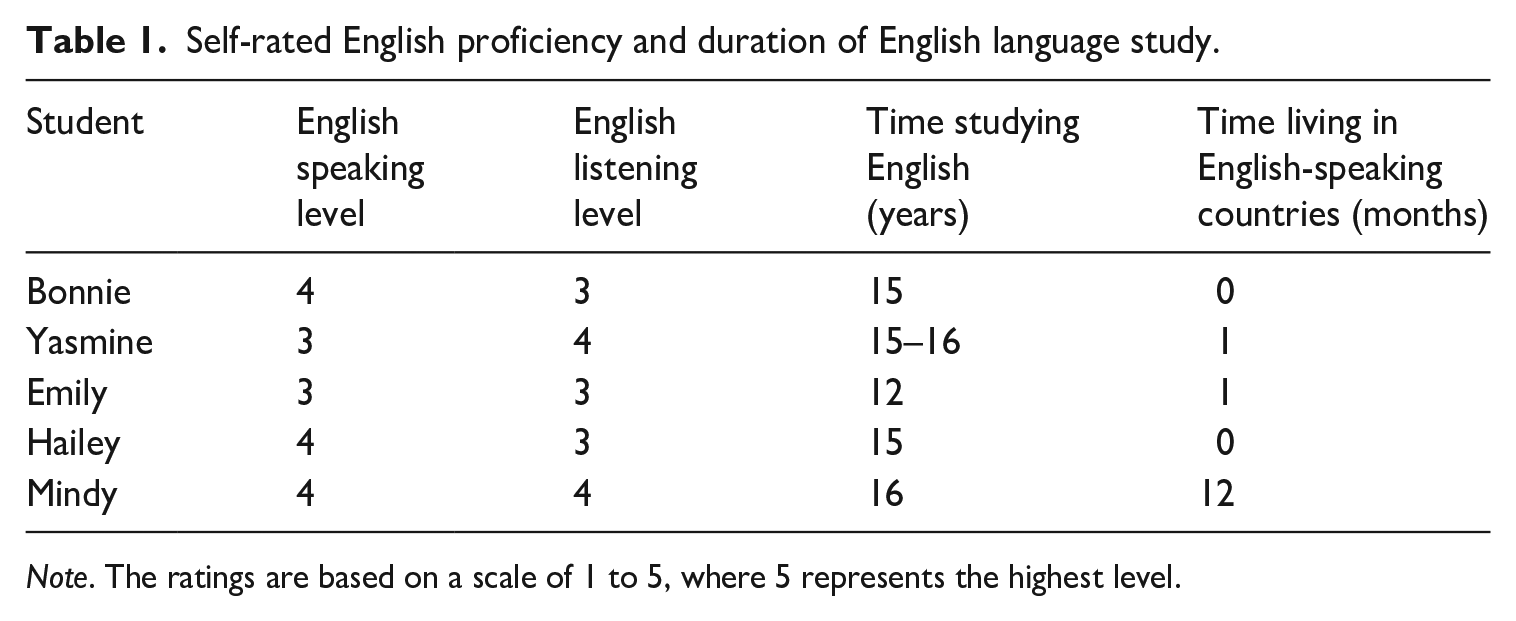
Note. The ratings are based on a scale of 1 to 5, where 5 represents the highest level.
The meeting convened once a week around midday, and participants had lunch during the meeting. The main activity was conversing in English. The activity was divided into two phases: the speech phase and the discussion phase. During the speech phase, each student in turn took the primary speaker role – a role characterized by ‘only this participant taking more than a minimal turn’ (Hauser, 2009, p. 222) – and delivered a speech on the topic of the day. Each participant, including the facilitator, was responsible for preparing a five-minute speech on the day’s topic, provided by the facilitator (except for one week when the facilitator encouraged the students to come up with a topic to discuss), before each weekly meeting. They were encouraged, but not required, to prepare a handout or visual aid for their speech. This study focuses on what happened after the primary speakers finished delivering their speeches, i.e. during the discussion phase, where they freely discuss what the primary speaker had said.
2 Methods
This study utilizes multimodal conversation analysis (CA) as its analytical framework (Deppermann & Streeck, 2018; Mondada, 2014), involving a sequential, line-by-line examination of the data. CA investigates social interactions to uncover assumed knowledge about ‘ways of doing’. The multimodal adaptation of CA extends its analytical focus on the sequential structuring of conversation to include the coordination of talk and other embodied behaviors, such as gaze, facial expression, gesture, movement, and object manipulation. Grounded in CA’s emic perspective, which prioritizes participants’ orientations, this study closely investigates how students engage in discussions within a CFL context.
Following CA principles, we conducted an initial analysis using an ‘unmotivated looking’ approach (Schegloff, 1991; i.e. exploring data without preconceived notions or an agenda) to identify what students do in creating interactional spaces that involve more than two students interacting within the discussion phase of the meeting. This analysis revealed a distinctive pattern in students’ interactions. Students asked questions and sometimes expanded on the topic by informing others about relevant matters, but they mostly contributed to expanding the topic by assessing what was previously said. Specifically, students initiated and expanded on the topic previously discussed by making assessments, and others collaboratively contributed to the talk by making affiliative remarks, occasionally working to hold the primary speaker accountable for their statements. This became the central focus of our investigation. Given that CA is a structural rather than a statistical approach, this study does not aim to generalize findings based on a large sample but instead focuses on a detailed, qualitative analysis of interactional patterns (Bilmes, 1988; Raymond et al., 2024). The goal of CA is to explicate ‘what an utterance is doing interactionally’ and discover the ‘sequential machinery’ in the speaker’s situated interaction (Schegloff, 1980, p. 150). Thus, rather than measuring the frequency of particular assessments, we investigated how assessments function as interactional resources, shaping participation and influencing conversational trajectories because they are grounded in the participants’ own orientations.
Based on these findings, we selected four excerpts that represent four distinct types of assessments – negative assessment of the speaker’s claimed action (Excerpt 1), positive assessment of the speaker’s action (Excerpt 2), negative assessment of a third party (Excerpt 3), and positive assessment of a third party (Excerpt 4) – through which students manage topics to contribute to the talk, thus practicing L2 within a multiparty CFL context. The distinction of the excerpts will be further elaborated in Section III.
The CFL sessions took place in a quiet office room, and all sessions were videotaped with two cameras: one positioned to face downwards at the participants and the other positioned opposite to the first camera. Additional data included the handouts/visual aids participants used for their speech and photographs of the whiteboard displaying weekly prompt topics. In CA, detailed transcription of all verbal, prosodic, and embodied conduct is a prerequisite to ensuring the reliability of data and increasing the robustness of the findings (Oloff & Hepburn, 2024). Thus, vocal transcriptions were made following the standard CA conventions outlined by Jefferson (2004; see Appendix A). For nonvocal features, the transcription method employed by Burch (2014; see Appendix B) was used. Participants provided informed consent; to ensure privacy, their faces have been intentionally blurred in any screenshots.
III Analysis
Adopting a multimodal CA approach, we analyse how students initiate and expand on the topic the primary speaker previously discussed by making assessments and affiliative remarks, working together to either hold or not hold the primary speaker accountable for what they have said. Our analysis primarily focuses on how students manage topics by initiating and expanding on them through assessments, which either elicit accounts from the primary speaker (Excerpts 1–3) or not (Excerpt 4).
More specifically, Excerpt 1 shows a student initiating a topic for L2 discussion by expressing surprise; this functions as a subtle form of negatively framed disagreement on the claimed action of the primary speaker, prompting the primary speaker to provide an elaboration or account. The excerpt also shows how another student expands the topic by making an affiliative response, thereby contributing to further engagement. Excerpt 2 shows a similar practice of holding the primary speaker accountable for further elaboration, achieved this time through a compliment. The primary speaker’s response, involving avoidance of self-praise, opens up interactional space, allowing another participant to make a comment and expand the topic. Excerpt 3 demonstrates a case where the students’ categorization of a third party as an ‘enemy’ serves as a negative assessment, successfully eliciting affiliation from other students and prompting the primary speaker to provide an account, leading to topic expansion. In contrast, although Excerpt 4 shows a case where a student’s positive assessment of a third party successfully elicits affiliation from other participants, it illustrates that the assessments do not prompt the primary speaker to provide an account, despite multiple opportunities for expansion. The excerpt demonstrates how positive evaluations fail to generate a need for the speaker to justify or elaborate on the third party’s behavior, highlighting a distinct interactional pattern.
Overall, the analysis demonstrates the participants’ ways of participating in L2 discussion within a multiparty CFL context and specifically shows how they collaborate in managing assessments that either elicit further accounts from the primary speaker or not. This underscores the intricate practices through which students create opportunities to practice their L2 in such settings.
1 Assessment of the speakers’ (claimed) actions
In this section, we examine how students use assessments to initiate topics that prompt primary speakers to account for their own behaviors, such as tearing test papers (Excerpt 1) and not expressing jealousy toward their friends (Excerpt 2). We also analyse how other students expand these topics in the discussion.
Excerpt 1 shows the students’ intricate ways of initiating discussion of the primary speaker tearing test papers. They make an announcement of surprise and expand the topic while managing the assessment and accountability of one’s behavior. The topic of the day was personal stressors in daily life and how to manage them. Before the excerpt, Hailey, the primary speaker, shared her stress-relief strategies. One of them, which she used in high school, was tearing up her test papers when she did not get the score she desired. The excerpt begins with Hailey, in collaboration with others, closing her talk by providing an upshot (lines 2–9).
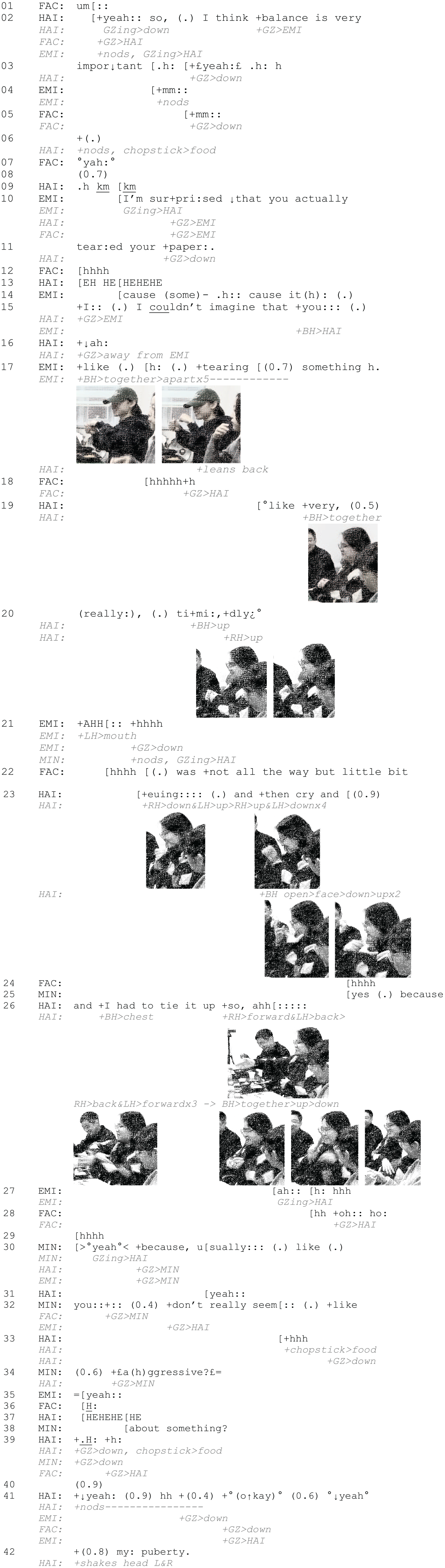
Negative assessment of the speaker’s claimed actions.
The discussion starts with Emily announcing her surprise that Hailey tore her test papers (lines 10–11). This announcement establishes the action as an assessable and puts forward an overt ‘S-side assessment’ (Edwards & Potter, 2017) that treats Hailey’s behavior as unexpected. This turn both sets the topic for the discussion and performs multiple layers of interactional work. First, Emily positions herself as entitled to make epistemic claims about Hailey’s dispositional character. The disjunctive marker actually (Clift, 2001) introduces a contrast between Emily’s knowledge of Hailey’s disposition and her paper-tearing act. Second, the S-side assessment is hearable as doing disagreement (Korobov, 2023; Potter et al., 2020), countering the fact that Hailey is someone that would tear papers. By formulating her reaction in the first person (‘I’m surprised’), however, Emily softens her disagreement as one that is subjective and experiential. She thereby defers to Hailey as possessing the primary epistemic rights to her own experience. Hailey, in other words, is mandated to account for her own behavior. Third, her stance of surprise also conveys a compliment, implying a view of Hailey as unlikely to engage in such aggressive behavior. This stance thereby addresses the negativity of the tearing action while framing Hailey’s character in a positive light.
After Hailey and the facilitator respond with laughter (lines 12–13), Emily reinstates in overlap that she cannot imagine Hailey tearing something (lines 14–17) and embodies the tearing action with both hands. This gesture, as it was repeated five times, emphasizes the aggressive nature of Hailey’s behavior and makes it accountable. The use of second-person pronoun while gazing and gesturing at Hailey also indicates that Hailey is the designed recipient of the turn-in-progress (lines 10,15). Thus, in response, Hailey prefaces her turn with a change-of-state token ah (Heritage, 1984) and says that she did it ‘timidly’ (lines 16, 19–20). Note that she says so while recycling the tearing gesture by slightly moving her right hand upward. Compared to how Emily moved both hands apart (line 17), Hailey makes an embodied referent downgrade (Bilmes, 2019), minimizing the tear to a small rip. This embodied correction (Sert, 2017) accomplishes two interactional demands. First, she adjusts the intensity of her tearing action to comply with Emily’s disagreement and confirm her knowledge of Hailey’s character. Second, this minimizing gesture is an exaggerated downgrade to the extent that it appears almost timid. This self-deprecatory embodiment orients to the compliment-implicative nature of Emily’s disagreement by accepting the compliment but mitigating against immodesty. In response, Emily shows her change of state with a loud and elongated AHH, covers her mouth with her left hand, and begins to laugh (line 21). In this way, she affiliates with Hailey’s account, while orienting to the exaggerated downgrade as a laughable matter.
Overlapping with the facilitator (line 22), Hailey elaborates by explaining that she cried and tidied up the mess (lines 23–26). She does so through an embodied enactment (Sidnell, 2006; Yagi, 2021) that corresponds to tearing papers, crying, collecting the trash, and throwing it away. Through this embodied increment, she further constructs herself as a timid person who may rip papers only slightly but cries and tidies up the mess afterward. The contrast between the slight rip and over-reaction of crying, and the immediate mending of the rip creates humor to which Emily, once again, responds with an ah and laughter (line 27). Meanwhile, Mindy adds that Hailey does not seem like an aggressive person (lines 30–38). Here, Mindy affiliates with Emily’s earlier assessment to which both Hailey (line 31) and Emily agree with a yeah (line 35). Hailey also shows her affiliation with turns of laughter (lines 33, 37, 39) and ascribes this past ‘aggression’ to puberty (line 42), a playful way to distance her act from her character by attributing it to an immature, youthful impulse. Now an adult, Hailey’s ascription serves as a form of retrospective self-deprecation, humorously accounting for her non-normative behavior and aligning everyone in a shared, light-hearted understanding of the event.
In Excerpt 1, Emily’s assessment of tearing test papers, which contrasted this negative activity with Hailey’s personality, initiated the topic. Although Emily’s first position assessment asserted her epistemic right to question the likelihood of Hailey tearing papers, it also deferred to Hailey’s epistemic primacy to account for the behavior. The assessment simultaneously had disagreeing imports and was compliment-laden. Disagreement is disjunctive and interactionally disaffiliative, but Emily’s turn was socially affiliative, aiming to distance Hailey from the negative behavior and frame her as possessing more positive traits. We thus saw Hailey deal with these multiple interactional demands. Acknowledging tearing papers as an uncharacteristic behavior for her, she used verbal and embodied downgrades to position herself in a ‘timid’ character. This self-mockery enabled her to humorously comply with the disagreement, accept the compliment, and adhere to the maxim of modesty. Overall, this excerpt illustrates how assessments serve as resources for topicalization in student discussions, demonstrating that initial assessments create opportunities for topic expansion in speaker accounts and the trajectories of interactants aligning and affiliating with each other. Collectively, the participants managed to both expand the topic and affirm Hailey’s non-aggressive nature. In doing so, they responded sensitively to self-deprecatory remarks and compliments.
While Excerpt 1 involved a disagreeing assessment of the speaker’s telling, Excerpt 2 starts with a positive assessment of the speaker. Before the excerpt, Bonnie, the primary speaker, shared a story related to the topic of the day: growth and personal development. In her talk, she discussed what participating in high school debate contests and global forums taught her. She also mentioned her respect for her friends who were very smart, kind, and had good leadership qualities; this becomes the participants’ concern in the following excerpt. The excerpt begins with the facilitator soliciting comments or questions from the students (lines 1–2).
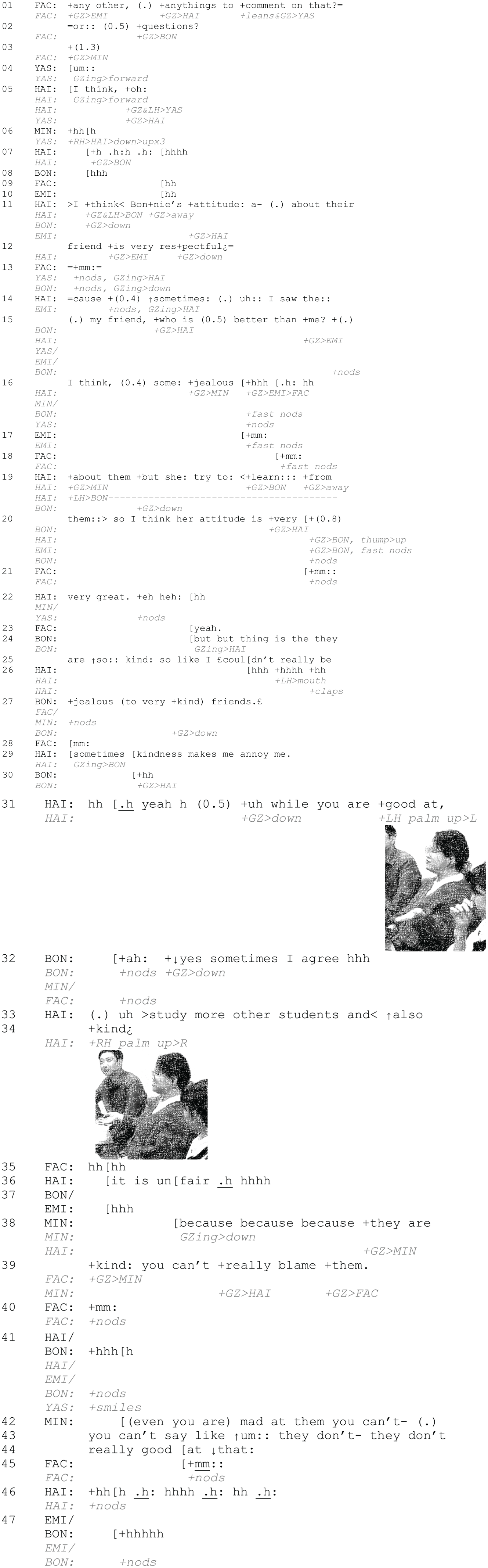
Positive assessment of the speaker.
After simultaneously attempting to take the floor (lines 4–5), Yasmine and Hailey both attempt to yield it by gazing and forwarding their hands to one another (lines 5–6). After Yasmine withdraws with repeated hand-forwarding gestures (line 6), Hailey takes the floor and compliments Bonnie’s attitude about her friend (lines 11–12). Unlike in Excerpt 1, her turn design does not indicate that it is directly addressed to the primary speaker, Bonnie, but it is designed to make a general comment to the group. Note that she refers to Bonnie’s attitude instead of your attitude, and her gaze averts Bonnie while addressing her. Other participants thereby mark their recipiency as in the facilitator’s continuer mm, and Yasmin and Bonnie’s nods (line 13).
Hailey then invokes a contrast pair that proposes a distinction between Bonnie, who learns from her friends, from Hailey herself, who would be jealous (lines 11–22). The self-deprecation in this contrast uplifts Bonnie as a respectful person. This compliment receives acknowledgment and agreement from the participants through their nods (lines 16–22), mms (lines 17, 18, 21), and a yeah (line 23). In so doing, the participants ratify the compliment as a shared understanding.
In responding to this compliment, Bonnie faces two interactional demands. First, she must manage the preference for agreeing with the compliment while avoiding self-praise (Pomerantz, 1984). Second, she must also deal with Hailey’s self-deprecation in that self-critical actions as such prefer non-alignment (Ro & Lee, 2024). Thus, Bonnie enters in overlap with a disjunctive marker but (line 24) and assesses her friends as being so kind (line 25) and inappropriate targets for jealousy (line 27). Here, she employs a referent shift to manage the competing preferences for compliment but also to delete the relevance of Hailey’s self-deprecating remark: feeling jealousy is normative. Bonnie’s remark implies that she, like Hailey, would be jealous in other instances, but that the remarkable kindness of the friends in this case obviated such feelings.
After affiliating with Bonnie’s response with laughter and a clap (line 26), Hailey, disagrees that sometimes kindness makes her annoyed (line 29). By doing so, she re-invokes the contrast pair to differentiate herself from Bonnie, who is not jealous of kind friends, from herself, who is annoyed by kindness. Bonnie hearably resists Hailey’s invoked contrast pair through agreement (line 32) and co-categorizes herself as one that is also annoyed by kindness.
Hailey, without orienting to Bonnie’s response, continues to provide an account. She does so by mobilizing her turn as a complaint, asserting that it is unfair for certain people to possess both kindness and academic ability (lines 31–36). Here, she not only unpacks the source of her annoyance – that some people have both qualities – but also praises Bonnie for not feeling jealous despite such unfairness. Mindy then enters with an increment that because they are kind, you can’t really blame them (lines 38–39). This remark upgrades the annoyance by adding that these exceptional people, although unfair, are unblameable. After receiving other participants’ acknowledgments with their mm, nods, laughter, and smiles (lines 40–41), Mindy elaborates that one cannot be mad at these friends (lines 42–44). In this way, Mindy hearably affiliates with Hailey, intensifies the normativity of envying exceptional friends, and collaboratively constructs Bonnie as a respectful character who goes against the norm. This upshot creates a moment of shared laughter (lines 46–47).
In Excerpt 2, the discussion was initiated with Hailey producing a positive assessment of Bonnie’s attitude towards her friends. This assessment was consequential in several ways. First, although formulated as a general comment (Bonnie’s attitude), the self-deprecating compliment necessitated a response from the primary speaker, Bonnie. In fact, Bonnie employed a referent shift to avoid self-praise and deflect the self-deprecation. Second, the assessment required the complimenter to provide an account. Hailey thus repeatedly invoked a contrast pair to highlight Bonnie’s respectful qualities. Third, participants other than the speaker responded to the assessment. For instance, Mindy added an increment that affiliated her with Hailey’s stance and constructed Bonnie as a unique character who does not get jealous or annoyed. This received additional acknowledgment and elicited shared laughter. Overall, the excerpt shows the students’ intricate ways of aligning and affiliating as they seek to both expand the topic and manage compliments and self-deprecating remarks.
To this point, the analysis has demonstrated that assessments directed at the primary speaker recruit the speaker as the main respondent. In what follows, Excerpts 3 and 4 illustrate how the participants launch evaluations of a third party and how these assessments contribute to expanding the topic in hand.
2 Assessments directed at a third party
In this section, we show how students initiate and expand third party-related topics to either elicit primary speaker accounts for their assessments (Excerpt 3) or not (Excerpt 4).
Excerpt 3 focuses on an episode in which the primary speaker’s friend behaved rudely. The topic of the day was human relationships and communication. Before the excerpt, Hailey, the primary speaker, talked about an incident that led her to end a friendship for the first time. In her talk, she explained that she tried to make things work but failed. She also identified her friend’s rudeness and dismissiveness about her major as a critical factor in her decision to end the relationship, saying it had no good future. This is the participants’ concern in the following excerpt. The excerpt begins with the facilitator soliciting comments or questions from students (line 1).
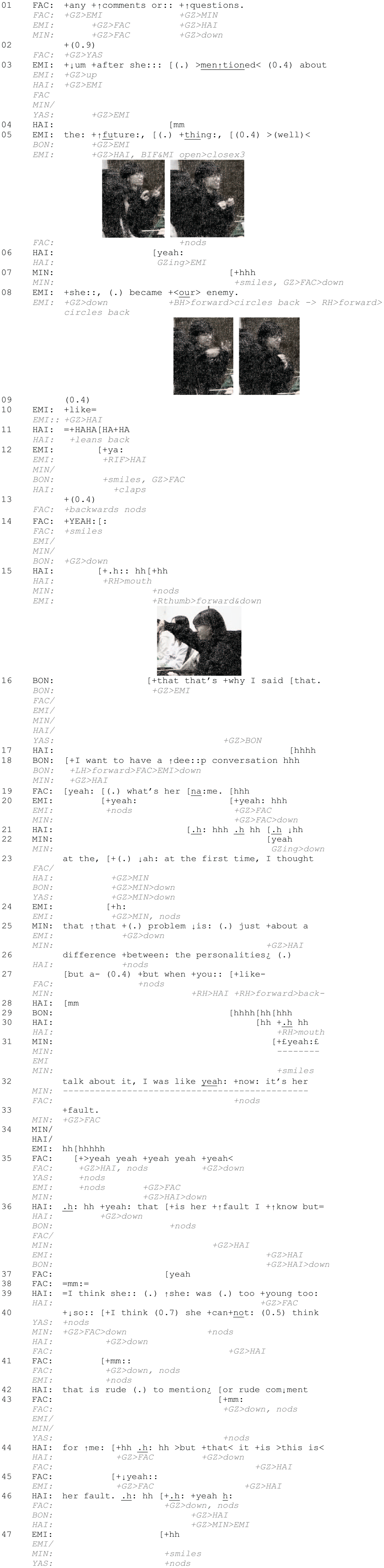
Negative assessment of a third party.
The excerpt starts with Emily criticizing Hailey’s friend. She does so by first recalling that the friend ‘mentioned about the future thing’ and curls her index and middle fingers to signal sarcasm (lines 3–5). Emily then produces an assessment category with she became our enemy, ratifying the friend’s status as an agreed-upon complainable. She also says our in a slower manner and makes hand-forwarding and circling-back gestures to highlight that the group shares this sentiment (line 8). She both displays her affiliation with Hailey’ earlier complaint, thereby doing being social or being a good friend (Kim, 2023), and frames the issue as a collective concern. In contrast to the assessments in Excerpts 1 and 2, this assessment does not project accountability solely for the primary speaker; instead, it opens the topic for further contributions from anyone. The ensuing interaction shows how the participants display their affiliation with the issue.
As Hailey latches her laughter (line 11) to Emily’s emerging turn (line 10), Emily abandons her turn and receipts Hailey’s laughter with ya and pointing gestures (line 12). Meanwhile, Mindy and Bonnie smile (line 12), and the facilitator agrees with Emily with a nod (line 13) and an elongated yeah (line 14). While Hailey continues to laugh (line 15), Emily unpacks the properties of enemy with a thumbs-down gesture, a multimodal reinforcement of her earlier criticism. This is when Bonnie enters with a S-side statement that she would like to have a deep conversation with the friend (lines 16–18). Drawing on her own shared history with this rude friend, 1 Bonnie invokes her deontic rights to discuss this matter in person. While the elongated and rising pitch of ↑dee::p embody an accusatory tone, this statement is highly emphatic and affiliative, personalizing Hailey’s problem as Bonnie’s, an issue that she herself should take up in the future. Bonnie’s vocalization of her vicarious anger elicits shared laughter from the participants (lines 19–21).
At this point, Mindy takes a multi-unit turn stating that she first thought the problem originated from personality differences (lines 23–26), but hearing about the insulting comment convinced her it was the friend’s fault (lines 27–33). The word fault establishes the friend as an obvious accusable, as a warrantable target for a complaint. Shared laughter (lines 29–34), yeah, and nodding (line 35) display the participants’ collective affiliation, but Hailey then produces a disjunctive marker but (line 36) to introduce an account for her friend’s behavior. Despite partially agreeing that her friend was at fault, Hailey reasons that she was too young to recognize her rudeness (lines 39–44).
While the initial assessments in Excerpts 1 and 2 made the primary speakers immediately accountable, the participants here construct a shared negative assessment of a third party. Hailey’s defense, then, works against the collaborative stance (that her friend was being rude to her) that the others took. Speaking ill of a friend is a morally accountable act, so Hailey can be seen as navigating the balance between agreeing with the group (i.e. partial agreement) and addressing the moral implications of criticizing her own friend (i.e. defense). Hailey’s account thereby highlights the social complexity of this situation.
In Excerpt 3, the topic initiation began with Emily’s negative assessment of Hailey’s friend. Unlike Excerpts 1 and 2, the topical assessment did not demand the primary speaker’s immediate participation; instead, it led other participants to collaboratively expand the discussion. For instance, Bonnie and Mindy jointly accused Hailey’s friend using category assessments (‘enemy’), emphatic claims (‘I want to have a deep conversation’), and public blame (‘it’s her fault’). Only after multiple topic expansions did the primary speaker, Hailey, provide an account for her friend’s behavior to balance her social alignment with the group and her defense of the friend. Overall, the excerpt demonstrates that negative third-party assessments create pathways for participants in accusatory interactions, with the speaker working to manage their moral consequences afterwards.
Excerpt 4 features another discussion that starts with an assessment of a third party; this time, however, the assessment is positive. Before the excerpt, Yasmin, the primary speaker, shared how she became close friends with her high school roommate. She recounted how resolving some initial conflicts that arose while living together strengthened their friendship. Yasmin also mentioned that after saying she missed her friend during a phone call, the friend traveled a long distance to visit her in Busan the next day. This becomes an interest for the participants in the upcoming excerpt. Moreover, before Yasmin spoke, Mindy shared a story from a soap drama in which unkindness within a couple with different personalities eventually led them to breakup; this story also becomes relevant in the subsequent interaction. The excerpt begins with the facilitator soliciting comments or questions from the students (line 1).
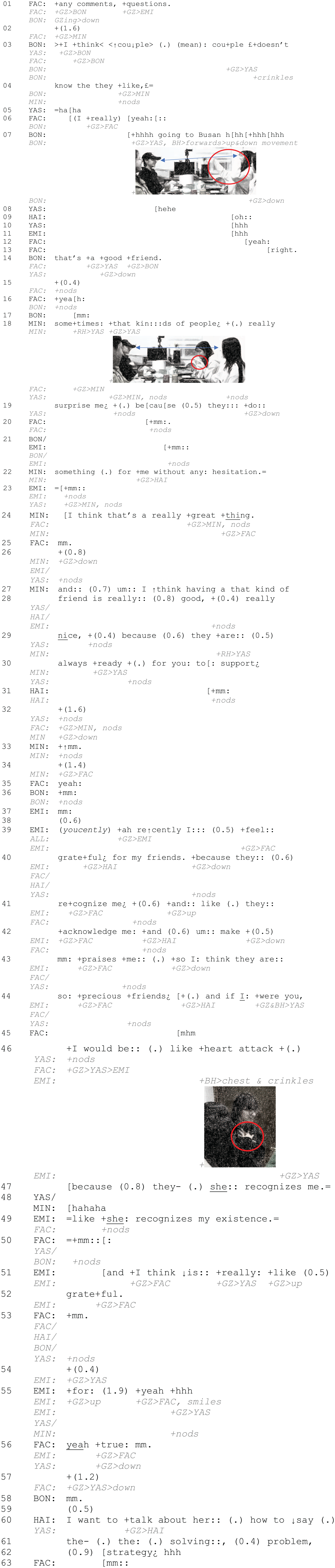
Positive assessment of a third party.
Bonnie takes the floor and produces a positive O-assessment of Yasmin’s friend, that’s a good friend, while recalling what Mindy shared about the separated couple (lines 3–14). Bonnie accounts for her evaluation by contrasting the ‘mean’ couple that did not know how to behave and Yasmin’s friend who traveled a long distance to comfort her friend. Importantly, as Bonnie provides her positive assessment, Yasmin shifts her gaze to the table (line 14) and makes no incipient action to take the floor to expand on the topic. Meanwhile, the facilitator and Bonnie respond with receipt tokens (lines 15–17). Unlike in the other excerpts, here the primary speaker does not self-select as a respondent to the assessment.
In lines 18–22, Mindy occasions a general category, those kinds of people, and ascribes to them the affective stance of surprising because they do things without hesitation. The participants, including Yasmin, show their aligning stances with minimal response tokens mm and nodding throughout Mindy’s turn. As Emily and Yasmin acknowledge Mindy’s assessment (line 23), Mindy proffers an upgrade with a S-side I think that’s a really great thing (line 24), which the facilitator registers with a receipt token, mm (line 25). With no incipient action forthcoming (line 26), Mindy retakes the floor, foregrounds having that kind of friend (lines 27–29), and attaches another S-side assessment really good, really nice (line 28). The stretched word ending and repairing of good to nice highlights the upgraded nature of this stance. Mindy continues to provide an account by invoking category-bound activities of that kind of friend, claiming they are always ready to support you (lines 29–30). She clarifies whom she is referring to by shifting her gaze and pointing at Yasmin, while using the extreme case formulation term always to justify and seek agreement for her assessment (Pomerantz, 1986). In response, Yasmin, Hailey, and the facilitator align with Mindy’s stance by acknowledging her with nods and minimal response tokens (lines 31–32). Yasmin, the primary speaker, once again does not expand on Mindy’s positive assessment. Mindy then indicates the termination of her turn through a falling mm, accompanied by a nod and a gaze shift towards the facilitator (lines 33–34). The facilitator, along with Bonnie and Emily, acknowledges this with yeah and mm (lines 35–37), leaving the floor open for a possible speaker transition.
After a 0.6-second of silence (line 38), Emily takes the floor and recycles the topic of being thankful to friends. She produces a S-side assessment grateful and unpacks the category-bound attributes of her friends, indicating they recognize, acknowledge, and praise her (lines 39–44). Based on these terms, she concludes with another upgraded S-assessment I think they are so precious friends, establishing a cause-result understanding. She then pivots her talk to indicate how she would feel if she were in Yasmin’s shoes (lines 44–46), using the word heart attack to metaphorically express a strong, overwhelming emotional reaction. She emphasizes this by placing both hands on her chest and crinkling her face, visually illustrating intense feelings. She thus ties her talk back to positive impressions of Yasmin’s friend, and her emotive affiliation elicits laughter from Yasmin and Mindy (line 48). Emily continues to provide an account of her assessment with my-side first person pronouns – recognizes me (line 47) and recognizes my existence (line 49) – that empathize with Yasmin’s grateful feelings. As the facilitator, Yasmin, and Bonnie respond with acknowledgements (line 50), she produces a closing-implicative positive assessment (lines 51–52), which the participants receipt with nods and mm (lines 53). In lines 54–59, the floor is open, but Yasmin only nods in acknowledgment and shifts her gaze downward, signaling her unwillingness to participate (Sert, 2015). With no incipient action forthcoming, Hailey takes the floor and shifts to Yasmin’s ‘problem-solving strategy’ as a new topic (lines 60–62).
Excerpt 4 was the only case in which the primary speaker did not take a turn. The excerpt included several transition relevance places, but it was the other participants that made efforts of recycling the initial positive assessment and reinstated it with upgrades, emotional escalation, and accounts. Although Yasmin, the primary speaker, had several opportunities to expand on what others said, she did not take those chances. For instance, when Bonnie positively assessed Yasmin’s friend in line 14, Yasmin shifted her gaze to the table and made no effort to take the floor, even though no self-selecting actions were forthcoming from others. Similarly, when Mindy expanded the topic and positively assessed Yasmin’s friend (lines 27–30), Yasmin aligned by nodding but did not elaborate or offer additional accounts. This pattern of non-expansion continued when Emily produced vicarious emotional claims as in ‘heart attack’ and ‘recognize my existence.’ Despite these opportunities, Yasmin’s contributions remained minimal, as she signaled alignment through non-verbal cues (nodding) rather than extending the conversation. Overall, the excerpt demonstrates how a positive assessment of a third party was consequential in participants pursuing and expanding the topic while the primary speaker remains non-participatory, even when given multiple opportunities to reengage.
IV Discussion
Exploring student practices of topic management in L2 discussions in a CFL context, this study focused on how students used assessments and (dis)affiliative responses to initiate and expand on topics previously presented by primary speakers. Specifically, when initiating topics, students employed various assessments to expand discussions and hold primary speakers accountable. For instance, one student’s expression of surprise functioned as a subtle form of negatively framed disagreement with the primary speaker’s claimed behavior, prompting the primary speaker to explain further (Excerpt 1). Another student contributed an affiliative remark, further expanding the discussion. Similarly, a student held the primary speaker accountable by complimenting her behavior, leading the primary speaker to elaborate and another student to add an affiliative response (Excerpt 2). Furthermore, students collaboratively constructed negative assessments of the primary speaker’s friend’s behavior via multiple post-expansions. This collaboration led the primary speaker to defend her friend’s actions (Excerpt 3). In contrast, in Excerpt 4, a positive assessment of a third party did not prompt the primary speaker to provide an account, despite multiple opportunities for expansion.
This non-expansion can be understood through the lens of Pomerantz’s (1984) work on assessments, which suggests that positive evaluations often encourage simple alignment rather than elaboration or justification. A positive assessment of someone other than the primary speaker presents little threat to the primary speaker’s face (Goffman, 1967), mitigating the need for accountability. In Excerpt 4, by nodding, Yasmin, the primary speaker, demonstrates her aligning stance without needing to provide an account for her friend’s behavior. By contrast, the positive assessment in Excerpt 2 was directed at the speaker and involved self-deprecation, thereby mandating a response from the speaker; in that case, Bonnie sensitized the interactional expectations of accepting the compliment but also downplaying self-praise and the compliment-provider’s self-criticism through a referent shift and partial agreement (Jones, 1997; Pomerantz, 1978).
Meanwhile, the negative assessment in Excerpt 3 compelled Hailey, the primary speaker, to offer an account to balance agreement with the group’s critique while defending the evaluated person. Here, the notion of accountability becomes crucial (Stevanovic, 2023). In cases of negative assessments, speakers are often called upon to justify or defend the actions of critiqued individuals. This explains why Hailey in Excerpt 1 provided an account for tearing her test papers. As the speaker, she held primary epistemic rights to her own experience and was therefore held accountable for justifying her behavior. In Excerpt 3, however, Hailey was accountable under moral grounds; she had a relational obligation to protect her friend. To publicly side with people accusing her non-present friend would have been a morally unfaithful act.
Overall, this analysis highlights how students engage in L2 discussions in a multiparty CFL context, demonstrating their collaborative efforts to manage assessments in a manner that creates opportunities for L2 practice. The study highlights the students’ intricate practices in initiating and expanding topics, constructing shared understandings, and managing social dynamics. It also sheds light on the interactional and social consequentiality of assessment, showing that when accountability becomes an issue, assessments project the next speaker and the topic requiring expansion. When the speaker is not an accountable next-speaker, others self-select to sustain the discussion, often by providing affiliative second assessments (Pomerantz, 1984; Stivers, 2008). The sensitivities involved in positive and negative assessments also present contingencies that need to be managed, and again, these interactional demands fuel the participants to take additional turns. In this sense, assessment serves as a powerful resource for topic initiation and expansion. By demonstrating the critical role of assessments in managing participation in CFL contexts, these findings align with previous CA research, which shows how topic relevance and recipient alignment shape conversational trajectories (Al Masaeed, 2024; Kim, 2017, 2023; Kim & Carlin, 2022). This study builds on these insights by identifying assessments as a key resource in CFL discussions, highlighting their role in eliciting elaboration, managing accountability, and structuring participation. Furthermore, assessment trajectories reflect participants’ concern with managing social relationships (Goodwin & Goodwin, 1992). Here, participants orient to language both as an object for learning and as a medium through which they establish social affiliation (Kim, 2023; Kim & Carlin, 2022). This finding deepens our understanding of the complex interplay between language learning and social interaction, as students focus simultaneously on language use and maintaining solidarity and intersubjectivity.
These analytic findings not only help us understand the stance-taking and subjectivity in second language conversations, but it also propels us to see assessment as a powerhouse for expanding the topic at hand. Despite the vital role evaluative language plays in everyday communication (Biber, 2006; Kärkkäinen, 2006), related analyses have mainly focused on L2 written language (Man & Chau, 2019; Morton & Llinares, 2018; Myskow & Ono, 2018) and given minimal attention to L2 spoken production (Gablasova et al., 2017). This study, however, shows that assessment is a useful resource for initiating discussion topics and sustaining conversational activity in CFL contexts. The findings indicate that assessments, whether positive or negative, play a critical role in driving conversations forward and determining who becomes accountable for subsequent steps in discussions.
These insights have important pedagogical implications for designing speaking tasks. First, given that assessments serve as a powerful topic initiation and expansion mechanism indicates that instructors can promote active student participation by structuring discussions to encourage the use of evaluative language. Specifically, they can encourage students to use both positive and negative assessments to strategically create opportunities for extended discourse. Negative assessments, as seen in the data, often prompt speakers to justify or defend positions, leading to deeper engagement and more complex language use. Instructors can design activities that ask students to evaluate events, behaviors, or opinions, ensuring that assessments require accountability from recipients. Conversely, positive assessments tend to elicit simple alignment rather than expansion, unless directed at the speaker in a way that requires self-reflection or negotiation. Understanding these dynamics can help educators scaffold classroom discussions to facilitate richer, more interactive language practice.
Additionally, these findings highlight the importance of balancing topic management strategies to distribute participation among students. Instructors seeking to engage the primary speaker can encourage students to frame assessments in ways that hold the speaker accountable and prompt elaboration. For example, asking students to evaluate their peers’ past experiences or choices can foster personal narratives and justification sequences. On the other hand, instructors seeking to encourage broader group participation can guide students to assess a third party, particularly with positive remarks, allowing multiple voices to contribute without placing direct accountability on any one individual. This understanding of assessment-based topic expansion provides a practical foundation for designing more dynamic and socially engaging L2 speaking tasks. Ultimately, by leveraging assessment as a conversational tool, instructors can help students develop both their linguistic skills and their abilities to manage interactional contingencies and social relationships in the target language.
This study is by no means an exhaustive account of all instances where assessment is used in CFL. The analysis is based on a single setting and a limited number of participants. A larger collection with different CFL settings, languages, and participants will allow access to a more comprehensive understanding of assessment and its workings for CFL. Additionally, future research should examine how assessments function in different institutional and non-institutional learning environments, including classrooms, study abroad programs, and online conversation exchanges. Comparative studies across various L2 proficiency levels and cultural contexts would also provide deeper insights into how assessments facilitate or constrain interaction. Despite its limitations, this study extends existing research on assessment in interaction as well as student participation practices in L2 CFL. By carefully considering how assessments are directed and how accountability is constructed, educators can enhance students’ opportunities for active participation and meaningful dialogue in L2 discussions. It is hoped that this study serves as a springboard for future research, building on the growing efforts to expand L2 conversation opportunities outside the classroom.
Footnotes
Appendix A
Conventions for the transcription of vocal conduct
Source. Based on the system developed by Jefferson, 2004.
′ continuing intonation
. falling intonation
? rising intonation
¿ slightly rising intonation
↓ lowered pitch
↑ raised pitch
wo:rd lengthening of the previous sound
= latching (no space between sound before and after)
[ overlap
0.7 pause timed in tenths of seconds
(.) micropause, shorter than 0.4 seconds
°word° speech which is quieter than the surrounding talk
WORD speech which is louder than the surrounding talk
Under
(word) transcription is not certain
(13621688251352274) cannot be guessed
hhh aspiration (out-breaths)
.hhh inspiration (in-breaths)
>he said< quicker than surrounding talk
<he said> slower than surrounding talk
heh heh voiced laughter
sto(h)p laughter within speech
£ £ laughing voice
(( )) other details
Appendix B
Conventions for the transcription of embodied conduct
Source. Adapted from Burch, 2014.
H hand(s)
F finger
R right
IF index finger
L left
B both
C center
GZ gaze (starting at the point of the time)
-- holding embodied actions in place
+ place where action begins, description of action
> ‘to’ (direction of gaze shift or movement)
italics embodiments
↑↓ up and down movement
⇆ right and left movement
Data availability statement
Not applicable
Funding
The author(s) received no financial support for the research, authorship, and/or publication of this article.
Ethical approval and informed consent statements
Informed consent for publication was provided by all participants, and the written consent forms are held by the first author.
