







Abstract
This study examines how novice female English language teachers who are LX (non-native) speakers construct their professional identities within the context of a Saudi Arabian university. The dichotomy of the ‘native’ and ‘LX practitioner’, which is often power-driven rather than skill-based, persistently leads to the marginalization of teachers who are LX speakers of English. Drawing on the narratives of four female instructors, this qualitative study explores how these teachers navigate institutional exclusion and position themselves within their professional communities. Framed by the concept of individual agency management, the findings reveal how participants employ various forms of agency – resistance, participation, and refusal – to assert and sustain a positive self-image. Despite feeling disempowered by the context, the participants each maintained a strong self-image as English teachers, which stems from various socio-cultural factors.
I Introduction
This study focuses on TESOL (teaching English to speakers of other languages) teachers whose own first language is not English. As LX speakers (Dewaele, 2018), rather than simply ‘non-native’ English teachers, they often face job market discrimination due to persistent negative stereotypes about their language proficiency, which can harm their professional self-image (Alshammari, 2022). One lens for addressing this challenge is the concept of individual agency management (Clance, 1985; Goffman, 1963, 1974; Lave & Wenger, 1991; Selvi, 2025; Wenger, 1998; Yazan & Lindahl, 2020). This perspective combines the theory of impression management, introduced by Goffman (1959), with the concept of agency. Goffman argued that, in their social interactions, individuals deliberately manage their publicly presented image while agency refers to an individual’s capacity to choose and act in accordance with personal values and goals (Duff, 2012; Kayi-Aydar et al., 2019). Thus, individual agency management explains how individuals can deliberately and strategically construct their self-image to align with their personal values and objectives while simultaneously interacting within, and meeting the expectations of their society. A key site for managing self-image is the workplace or wider professional community, specifically the TESOL community in this study, which is characterized by structural stigmatization and discriminatory power dynamics (Alshammari, 2021; Karas, 2015; E. Lee, 2015; Mahboob & Golden, 2013). It is therefore crucial to understand how language teachers’ professional identities are formed within these specific social contexts, especially for LX speakers (Kanno & Norton, 2003; Pavlenko, 2003).
LX teachers continue to face challenges in the job market, including stereotyping of their abilities and discrimination in hiring, which can negatively impact the teachers’ self-perception (Geiger & Morse, 2024; Geiger et al., 2023; Selvi et al., 2024). Individual agency management perspective refers to an individual’s ability to construct and project a positive self-image deliberately and strategically based upon choices that align with their personal values and objectives. This study investigates how novice female LX English teachers perceive themselves and how they are treated in their professional roles (J.W. Lee & Kim, 2021; Morita, 2004; Norton, 2001; Toohey, 1998). This research builds upon existing studies which address structural stigmatization and power dynamics within TESOL. It offers insights into the experiences of teachers and their strategies for navigating their community of practice. It is crucial to better comprehend how professional identities are formed within specific social contexts, especially for LX speakers (Kanno & Norton, 2003; Pavlenko, 2003). The communities these women join can empower them through acknowledgment and inclusion, reinforcing their sense of belonging within the professional community. Nevertheless, they often experience exclusionary practices in their professional lives (Amin, 1999; Kamhi-Stein, 2013; J.W. Lee & Kim, 2021; Ruecker & Ives, 2015; Selvi et al., 2024; Von Esch et al., 2020).
The present study draws on the experiences of four female TESOL teachers at a large urban EMI (English medium of instruction) university in Saudi Arabia to show how the challenges outlined above can be addressed from an individual agency management perspective. More specifically, the study explores the participants’ self-image as novice female LX TESOL practitioners in relation to how others in their community treat women in their professional roles as language teachers. This includes how they are positioned within institutional structures, the extent to which they are acknowledged by colleagues and administrators, and their access to professional opportunities for growth and recognition. Gaining insight into these experiences is essential for developing inclusive hiring practices and professional development frameworks that support the meaningful participation of LX teachers. Despite ongoing discussions in TESOL scholarship, current policies and teacher education programs often fail to account for how gender, linguistic background, and employment status intersect to shape the professional realities of these educators.
II Literature review
1 Social structures and identities
This study adopts a sociocultural perspective to explore professional teacher identity, emphasizing its dynamic and multifaceted nature (Day et al., 2006; Kumaravadivelu, 2012). It highlights how teacher identity integrates personal beliefs, professional knowledge, values, and lived experiences, continually shaped by socio-cultural, educational, and institutional contexts (Bronfenbrenner, 2000; Miller, 2009). Understanding professional teacher identity is essential within educational practice, as teachers’ professional experiences are influenced by a range of factors, including their values, beliefs, and interactions in educational settings (Solari & Martín Ortega, 2020). Instead of examining teacher identity through psychological lenses alone, this approach draws on contextualized and sociocultural perspectives. This perspective helps connect individual experiences to broader identity frameworks, providing clarity in understanding identity formation.
The basics of identity help us explore the multifaceted and dynamic nature of professional identity, especially within the context of language education. Pennington and Richards (2016) define identity as ‘the sense which a person has of the self as an individual, including the person’s self-image and self-awareness’ (p. 7). Norton (2013) expands this by describing identity as ‘how a person understands his or her relationship to the world, how that relationship is structured across time and space, and how the person understands possibilities for the future’ (p. 45). These perspectives align with sociocultural models of teaching, which emphasize that teachers’ identities are shaped through their interactions and experiences within specific contexts (Johnson & Golombek, 2020; Varghese et al., 2005).
The connection between teachers’ personal and professional identities plays a key role in shaping how they behave and teach in the classroom (Kumaravadivelu, 2012). When teachers understand their roles and recognize their ability to shape their professional practices, it can lead to meaningful improvements in their teaching (Fogle & Moser, 2017; Pickford, 2014). Fogle and Moser (2017) describe teachers as change agents who help shape education policies and practices, which in turn positively impact their students. Recognizing the sociocultural factors that influence teachers’ identities and their ability to act with agency is crucial (Ruohotie-Lyhty & Moate, 2016). By bridging the gap between theoretical ideas about identity and their real-world application in classrooms, we can improve teaching practices, support professional growth, and create fairer, more supportive work environments.
Language teachers in English as a second language (ESL) and English as a foreign language (EFL) contexts, including LX practitioners, often face challenges rooted in biases and the dominance of native-speaker ideologies in their workplaces. These challenges manifest in stereotypes about linguistic competence and discriminatory hiring practices (Ahmad et al., 2017; De Costa & Norton, 2016; Selvi et al., 2024). Ahmad et al. (2017) emphasize that LX teachers’ professional identities are shaped significantly by their work environments and interactions with colleagues. Similarly, Inbar-Lourie (2005) highlights a common disconnect between how teachers perceive their own linguistic abilities and how students view them, further complicating the formation of professional identities. These disparities reveal the nuanced and often challenging nature of linguistic identity in educational settings.
Gender adds another layer to the challenges faced by LX TESOL teachers, as women often encounter exclusionary practices rooted in structural inequities (Amin, 1999; Kamhi-Stein, 2013; Von Esch et al., 2020). Simon-Maeda’s (2004) study reveals how gender intersects with cultural and institutional contexts, shaping professional identities and influencing access to leadership roles. Research shows women of color face multiple academic barriers due to gender and racial power differences across higher education (Ruecker & Ives, 2015; Yphantides, 2019).
In Saudi Arabia, educational institutions are segregated by gender due to religious and cultural norms. The institutional policies are designed to apply equally to both the men’s and women’s sections. However, deeper cultural and structural factors often create significant imbalances in power and influence. Male educators tend to hold more authority because of long-standing social norms, administrative systems, and biases that favor men in leadership and decision-making roles (Al-Jarf, 2024; Al-Jarf & Albakr, 2013). In societies where socio-religious norms play a major role, women often face more restrictions on their mobility and professional opportunities than men. These norms can limit their participation in activities like conferences, collaborations across departments, and leadership training, even when policies technically allow equal access. As a result, the power imbalance between male and female educators continues to grow, reinforcing systemic inequality (Abalkhail, 2017; Baki, 2004).
Addressing these challenges requires a focus on agency. Duff (2012) defines agency as the capacity to make deliberate, strategic choices aligned with personal goals and values. For novice TESOL teachers, agency can involve navigating power dynamics, securing resources, and reshaping self-perceptions within communities of practice. In this study, exercising power is understood as the ways individuals assert authority or control – particularly through language corrections or judgments that reinforce professional hierarchies – which can affect novice teachers’ ability to access resources and shape their professional identities. Through these identity negotiations and professional interactions, women language teachers demonstrate resilience and agency, challenging stereotypes and advocating for inclusive practices. Researchers J.W. Lee and Kim (2021) examine how language teachers navigate identity conflicts to position themselves favorably, while Morita (2004) highlights strategies for negotiating competence and legitimacy within hierarchical academic contexts. Norton’s (2001) concept of imagined communities highlights how teachers, despite being marginalized, invest in professional development by envisioning future career paths that align with their goals. Toohey (1998) highlights the stratification within learning communities and its impact on participants’ access to resources and opportunities. In this study, access to material and symbolic resources is defined as the ability to obtain practical supports such as teaching materials, mentoring, or inclusion in decision-making processes (Bourdieu, 1977). This directly relates to the participants’ experiences of exclusion from critical professional practices and their efforts to navigate these barriers. By situating the participants’ narratives within these frameworks, the manuscript establishes a robust theoretical foundation for analysing their perceptions as English practitioners.
Identity is constructed within communities, often through daily interactions (Clance, 1985). Goffman (1959) described this in terms of theatrical performances in face-to-face interactions, which illustrates the need for validation and recognition from the audience. His analogy helps explain shifts in identity seen in everyday conversations, or narratives in interaction (Georgakopoulou, 2007) in which teachers narrate ‘small stories’ through their daily interactions. Together, these frameworks help explain how LX TESOL teachers navigate professional spaces by managing their self-presentation through storytelling, impression management, and agency. It suggests that LX TESOL teachers can, despite the challenges of constructing their professional identity in the face of inequalities, can shape and project a positive self-image through their behavior, performance, and self-presentation. However, as D. Liu (1999) notes, achieving this requires an awareness of the ideologies prevalent in a community, as this awareness is crucial to understanding the professional identity that some LX teachers assume in their efforts to navigate and integrate into their professional environment. According to Wenger, developing a practice requires the formation of a community whose members can engage with one another and thus acknowledge each other as participants. As a consequence, practice entails the negotiation of ways of being a person in that context . . . In this sense, the formation of a community of practice is also the negotiation of identities. (1998, p. 149)
When novice LX TESOL teachers gain experience, they do so within a community of practice (CoP) (Wenger, 1998). Given that the way in which individuals see the world is shaped by their membership in communities of practice, professional learning can be perceived as a process of identity development (Lave & Wenger, 1991). In this context, the concept of investment (Norton, 2000, 2013) becomes crucial, as it allows novice teachers to gain access to both symbolic and material resources (Bourdieu, 1977). The more they invest in their community of practice, the more opportunities they have to develop their professional identity and deepen their involvement. From her study of TESOL teachers, Varghese and her colleagues found that teachers were not merely absorbing rules but also internalizing a way of existing in the world (Varghese, 2000; Varghese et al., 2005). Varghese (2000) revealed that bilingual teachers navigate complex professional identities shaped by many discourses, personal histories, and institutional support. Additionally, she emphasized the need for teacher education programs to focus on what teachers may become, rather than solely what they may know, to better address their evolving professional roles. Furthermore, this depended on access to resources, authority over tasks, and involvement in meetings, which signify inclusion in the community of practice and allow novice teachers to embrace the ‘bilingual teacher’ identity. Without such access, novice teachers may feel marginalized. In understanding social practices within these communities, it is also important to recognize the power dynamics that shape interactions and relationships (Wenger, 2010), and cross multiple levels of the environment (Bronfenbrenner, 2000; Y. Liu & Xu, 2013; Tavakoli, 2015).
2 Challenges, stigma, and impression management
Despite the many advantages that XL language teachers bring to instruction, persistent native-speaker ideologies continue to hinder the development of XL teachers’ professional identity and experience, while also imposing obstacles in the job market (Alshammari, 2021; Hodgson, 2014). More specifically, XL teachers may be negatively stereotyped as inferior educators unless administrators, colleagues, and students recognize them as being as professionally competent as their first language (L1) colleagues (Amin, 1999; Kamhi-Stein, 2013; Kubota & Lin, 2006; J.W. Lee & Kim, 2021; Ruecker & Ives, 2015; Selvi et al., 2024; Von Esch et al., 2020).
LX language teachers face a further danger of being racialized. Flores and Rosa (2015) introduced the term raciolinguistics to emphasize the need to examine language and race concurrently in order to comprehend systems of oppression where perceived deficiencies are tied to racialized individuals. This affects employment opportunities, professional status, and development (Alim, 2016). Raciolinguistics can be related to Goffman’s (1963) conceptualization of stigma, which has been more recently developed by Whelan (2021). He questions where Goffman’s approach remains relevant to current issues in terms of its primary applicability to micro-level analysis, which only offered limited insights into the structural and systemic nature of oppression. Contemporary research contextualizes experiences involving stigma within a larger societal landscape (Link & Phelan, 2014; Paton, 2018; Tyler & Slater, 2018). Here, Goffman’s approach has been criticized for having inadequate empirical anchoring and being micro-sociological, thus lacking the explanatory power to reveal the workings of stigma on a broader societal level (Paton, 2018; Whelan, 2021). When studying the professional experiences of novice LX language practitioners in the Gulf states, a macro-perspective is required, as issues of race/ethnicity, class, gender, and linguistic profile are intersectionally related (Ali, 2009).
The concept of ‘stigma power’ (Link & Phelan, 2014) illustrates how systemic inequalities manifest in hiring practices, where Western-born candidates are often favored, limiting career advancement for LX teachers. Novice LX teachers in EFL contexts, other teachers, committee members, administrators, and school officials collectively hold stigma power by controlling access to employment, which sometimes involves favoring Western-born job applicants (Alshammari, 2021). The hiring system shows this imbalance because Western-born candidates get preference as reported by Alshammari (2021). Established practices keep LX teachers from advancing their careers because the system prevents them from climbing its ranks. In a study of 450 EFL instructors Rajagopalan (2005) discovered that 52 percent of teachers believed they faced disadvantages in career advancement (as cited in Bernat, 2009, p. 9). These professional encounters show how stigma power works as both an exclusion tool and an inequality booster within workplace ranks. Practitioners need to work proactively at the structural level to eliminate these barriers so they can take back control of their professional paths.
Goffman’s theory of stigma includes ‘deviance’, one form of which is deviance in presentation of the self in social interaction (Barmaki, 2021). To counterbalance deviance, Goffman (1959) introduced the idea of impression management. When individuals engage in any community of practice, they attempt to construct and project a positive image of themselves through impression management by evaluating how they want others to perceive them and how they want to belong in the world. They then adjust their behaviors accordingly. Regarding EFL teachers, one extensively used strategy among researchers is to challenge assumptions about language proficiency by offering alternative labels to NNESTs (non-native-English-speaking teachers), such as multicompetent speaker (Cook, 1999), multilingual English teachers (Kirkpatrick, 2008), and international TESOL teachers (Phan & Barnawi, 2022). However, although this might aid non-native English teachers in their daily work, it will not grant them equal status with L1 teachers or address their challenges. Further research is required to explore how LX English teachers can navigate stigmatization (Kamhi-Stein, 2016; Selvi et al., 2024). Ellis (2013) argues that the NEST/NNEST division reduces teachers’ identity complexity while ignoring their multiple languages as teaching tools. She calls for valuing teachers’ linguistic diversity over nativeness, thereby offering a more inclusive approach to TESOL and reducing the emphasis on native language status in Studies reveal that linguistic discrimination, driven by English-only policies (Brown, 2007) and a preference for hiring native English speakers (Alshammari, 2021; Karas, 2015; Mahboob & Golden, 2013), undermines the legitimacy of LX teachers. This discrimination often results in feelings of impostor syndrome, leaving LX teachers grappling with self-doubt and a sense of inauthenticity in their roles (Bernat, 2009; Yates & Chandler, 1998). Karas (2015) found that LX teachers are perceived as inauthentic English speakers, which then affects salaries, allocation of teaching duties, and hiring practices. Impostorhood presupposes that practitioners strive to achieve unattainable goals while the alternative, acceptance of the advantages of negotiating the target language as a second language (L2) coupled with the knowledge gained through teacher education, is all but ignored. Note here that this can also include downplaying the advantages of having the same L1 as the learners (Cook, 2001; Selvi et al., 2024). The stigmatization of LX teachers is exacerbated if their communities of practice share a belief that LX English teachers are categorically less qualified than L1 teachers even if they have greater formal training and experience than their L1 colleagues (Kubota & Lin, 2009; Medgyes, 1994). Addressing why such beliefs still exist, despite clear evidence of LX teachers’ qualifications and training, could provide further insight into this issue.
The pejorative use of the non-native speaker label reinforces unproductive hierarchies, affecting how these teachers perceive themselves (Reiss, 2011; Selvi, 2014). It also diminishes and obscures the skill sets, ways of knowing, and knowledge gained through teacher education (Selvi et al., 2024). Discrimination against LX teachers and self-discrimination has been widely discussed. Pioneering work by Reves and Medgyes (1994) revealed how LX practitioners misinterpret students’ assessments of their proficiency, leading to self-discrimination, disruptions in language performance, feelings of inadequacy, and self-doubt. Therefore, discussions have emerged regarding the advantages and disadvantages of having English as a first language (L1) or an LX (Amin, 1999; Brutt-Griffler & Samimy, 1999; Modiano, 2005; Moussu, 2002; Orlova, 2014).
To conclude, although many studies have examined the challenges faced by LX teachers there is still little research that focuses on how these issues are experienced by novice female teachers in Gulf university settings. This study addresses that gap by exploring how four Saudi female LX TESOL instructors navigate power dynamics, access resources, and construct their professional identities. By focusing on their day-to-day experiences within a gender-segregated and structurally complex institutional context, the study highlights how identity, agency, and institutional power are deeply interconnected. In doing so, it offers a more grounded understanding of how teacher identity is shaped and negotiated in contexts that are often overlooked in mainstream TESOL research. By focusing on how novice LX teachers navigate power dynamics, access resources, and construct self-image, the study contributes new insights to the field and directly addresses the research question: How do LX novice instructors within a university-level EFL context navigate power dynamics, access to resources, and perceptions of professional identity? This research question addresses three general themes: agency, the exercise of power, and access to material resources.
III Methodology
1 Context of study
The study context was conceptualized in terms of Kachru’s (1985, 1992) three concentric circles to represent global English usage. The inner circle includes those countries using English as the first language (e.g. United States, Australia). The outer circle includes countries using English as an official language (e.g. India, Singapore). The expanding circle includes countries using English as a foreign language (e.g. China, the Kingdom of Saudi Arabia [KSA]).
KSA provides the context for this study, which aims to bridge the gap in understanding the challenges that novice female LX teachers face in an EFL context, specifically the Arabian Gulf (Selvi et al., 2024). Qualitative research was conducted at the English Language Institute of a well-established English-medium university in KSA. The Institute serves students enrolled in a Preparatory Year English Language Program before integrating them into undergraduate programs. The study exclusively involved female Saudi teachers due to gender segregation policies in Saudi Arabian educational institutions, rooted in religion-based cultural norms. In this EFL professional community, policies play a key role in shaping teachers’ roles, work environments, and professional interactions. These policies are enforced across the university and its departments to ensure that both men’s and women’s sections share equal authority and responsibilities.
The two researchers had different roles, balancing both insider and outsider perspectives. One researcher was an insider, working in the same professional context and sharing the participants’ language and cultural background. This made it easier to build trust, understand the challenges participants faced, and gather more detailed insights into how they navigated these challenges. The other researcher, as an outsider, didn’t collect the data directly but brought a more objective perspective, allowing for a critical analysis of the institution’s dynamics and power structures. Recognizing the influence of researchers’ roles is essential in qualitative studies. Recognizing these roles was crucial for ensuring reflection and awareness throughout the qualitative study. The shared linguistic background likely encouraged participants to share more openly, while the outsider perspective provided insights into broader systemic issues and power structures.
2 Participants
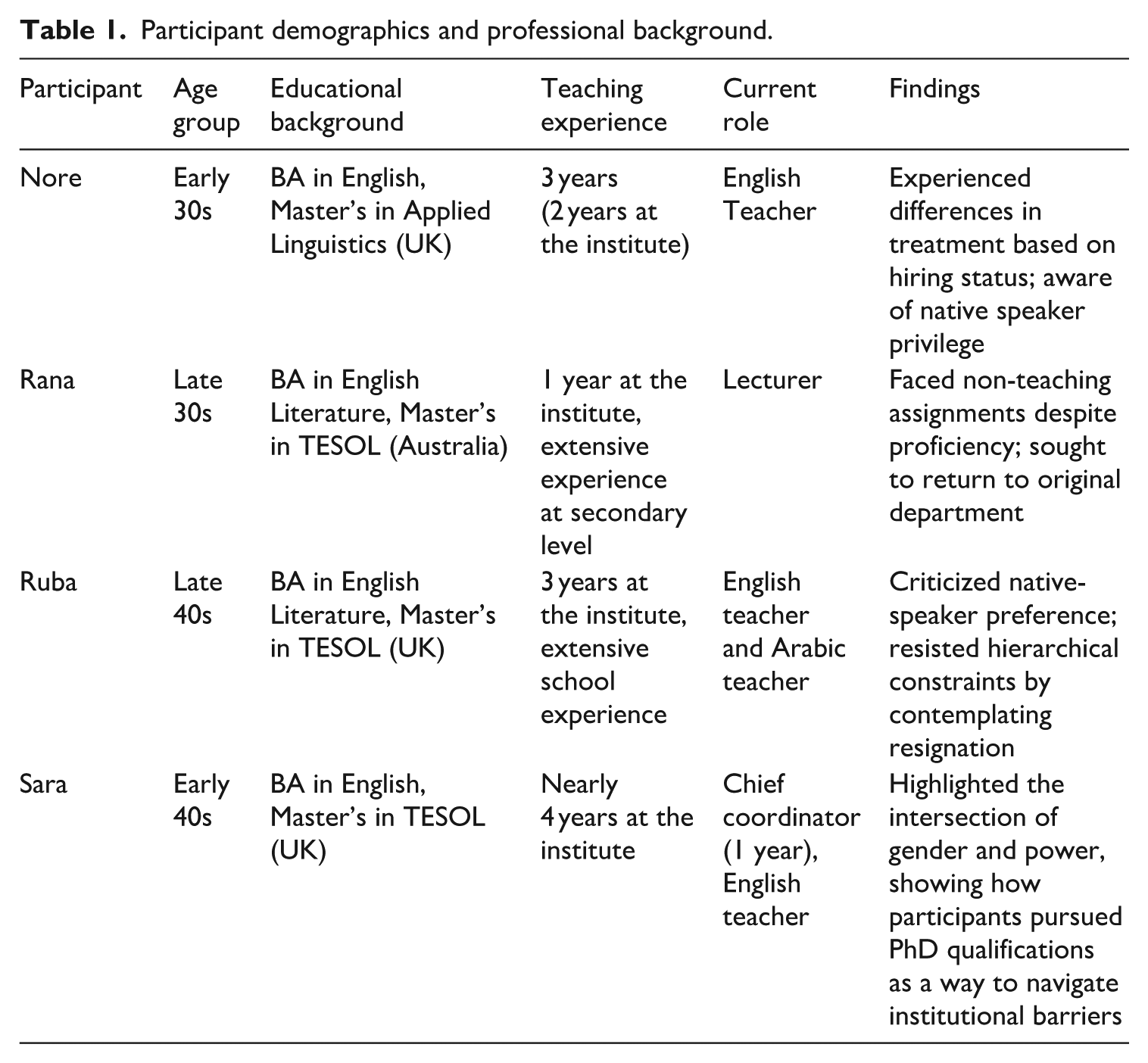
One of the aims of this research is to describe how the informants construct professional identities. To recruit participants, I reached out to potential candidates via email, providing information about the study and inviting them to participate. The study focuses on four novice female LX TESOL teachers at a large urban university in Saudi Arabia (see Table 1). J. Kim (2016) notes that qualitative research is useful when the participants’ own information is critical for telling their stories. In such cases, a small purposeful sample can be used. The names of the informants have been changed to protect their privacy. The common characteristics required of the participants were their status as novice teachers and that they were educated women with degrees such as a master’s in TESOL or applied linguistics. Novice teachers have less than five years of teaching experience (K. Kim & Roth, 2011). Only novice teachers were interviewed. This facilitated the attempt made in this study to capture how novice teachers establish their legitimacy as part of a community of practice and as teachers in the classroom (Hawkins & Norton, 2009; Norton, 2013; Pennycook, 2004).
Participant demographics and professional background.
a Nore
Nore has a BA in English and a master’s degree in applied linguistics from a university in the UK, which was awarded three years before participating in the study. She is in her early 30s and has been teaching in the English Language Institute for three years. She taught for one year as a contractor and resigned for one year while looking for a job and then returned when she was hired directly by the university.
b Rana
Rana received her master’s degree in TESOL from a university in Australia. Her undergraduate degree is in English literature. She is in her late 30s and is in her first year of teaching in the English Language Institute. She is a faculty member of the English Department as a Lecturer. After she taught in the English Language Institute for two years, she decided to return to the English Department. She had extensive experience in teaching English at the secondary school level before working as Lecturer.
c Ruba
Ruba received her master’s degree in TESOL from a university in the UK. Her undergraduate degree is in English literature. She is in her late 40s. This was her third year teaching in the English Language Institute. At the time of the interview, she was contemplating leaving the Institute. She has extensive experience teaching English in schools. She also has experience teaching Arabic to L1 users of English in the Institute.
d Sara
She received her master’s degree in TESOL in the United Kingdom. Her undergraduate studies were in English. She is in her early 40s. At the time of the interviews, she had completed nearly 4 years of teaching at the Institute.
3 Data collection
The primary methods of data collection used in the study were semi-structured interviews, conducted in English, and researcher field notes. To ensure the reliability of the study, consistent protocols were followed throughout the data collection and analysis process. Davey’s (2013) framework of a teacher’s professional identity questionnaire guided the interviews, covering participants’ educational backgrounds, professional experiences, and teaching interactions. Follow-up questions were developed during the interviews to lead further discussion through supplementary questions. The interviews were conducted in an open office area where each teacher had her own cubicle. The participants chose to conduct the interviews in their own cubicles because it was more familiar and convenient for them. Although private offices were available, they preferred their own spaces. The shared office areas were often quiet due to differing schedules, reducing the chances of interruptions or being overheard. In the original study design, we conducted interviews and observations, but here, only the interviews are included because of restrictions in space. Each participant was interviewed twice for approximately 30 minutes each. The interviews were audio-recorded and transcribed. After each interview member checking was conducted. Each participant had the opportunity to review the interpretations and themes derived from their interviews (Creswell, 2007).
IV Data analysis
The data analysis followed Braun and Clarke’s (2006) six-phase framework for thematic analysis, integrating thematic analysis with a narrative method to examine participants’ perspectives and experiences. This approach provided a detailed exploration of complex topics by analysing individual experiences within the broader themes identified in the data (Braun & Clarke, 2019). Thematic analysis was conducted manually, with repeated readings of the data to identify patterns and themes. The data analysis process started with transcripts of the interviews conducted in English. Grammar mistakes made by participants were not corrected in the transcriptions unless they significantly changed the meaning or content. Transcriptions of the interviews were completed prior to analysis to facilitate immersion in the data, allowing for a deeper understanding of the participants’ experiences and perspectives.
The first level of analysis involved printing each transcript and highlighting words that were interesting, important, or potentially relevant to the study. The second level of analysis was thematic. An effort was made to find and record initial codes on the participant’s transcript. This level specifically emphasized the interviewers’ most noteworthy thoughts. The third level of analysis involved building on the data collected from the interviews to understand themes arrived at through the first two levels of analysis. In level three, the potential themes were critically evaluated and refined using a thematic map developed based on the research questions and the theoretical and conceptual framework. Data saturation was achieved after interviewing participants, as no new codes or significant information were identified in subsequent interviews. Through a systematic and interpretive analysis of the data, three major themes were constructed: agency, access to resources, and the exercising of power. These themes were carefully developed to represent the key patterns and insights derived from the participants’ narratives. In this study, individual agency management was operationalized as participants’ strategic efforts to manage their professional self-image in response to social expectations and institutional norms. Agency was defined as participants’ capacity to make intentional choices aligned with their values and goals, especially in navigating professional challenges. Exercising power referred to acts of asserting control or authority within professional interactions, such as language correction or decision-making. Access to material and symbolic resources was defined as participants’ ability to obtain support such as teaching materials, mentoring, recognition, and participation in decision-making processes.
V Findings
This section discusses the findings from the interviews, providing insights into the experiences and perspectives of Rana, Sara, Ruba, and Nore within the English Language Institute. Through systematic analysis and interpretation of the data, three key themes were identified: agency, access to material resources, and the ways in which the teachers exercised power to shape their professional lives. These themes reflect the complexities of the participants’ narratives and their strategies for navigating the challenges within their professional contexts.
1 Agency
All of the participants were aware of the negative perceptions by others in the academic environment, including stereotypes from society of them but that did not affect their opinion of themselves as professional language teachers. They used individual agency management in different ways based on the two-way interaction between the teacher and the environment. Rana, for example, was really surprised that she was not able to teach for eleven months in the English Language Institute. When agreeing to work at the English Institute, Rana was unaware of the fact that her employer did not intend her to teach, but instead wanted her to work with administrative duties. She stated: One of the reasons that I accepted to be transferred to the English Institute is because I wanted to experience multiple cultures and teach the preliminary year. Our coordinator allowed me and a friend from another department to take on non-teaching tasks like copying and data entry. Despite our teaching skills and English proficiency, we had to take the TOEFL test before teaching. I will finish this month and request her to transfer me back to the English Department. I forgot how to teach and how to deliver the information to the students.
Rana was involved in teaching students, including paper correction and exam preparation. She felt disempowered by a new TOEFL requirement that prevented her from teaching at the English Institute because she didn’t come there to do administrative work. This disappointment didn’t change her view of her teaching skills and language proficiency. Rana responded by returning to the English Department.
Sara’s situation was similar when she was chief coordinator for only one year in the English Institute. After this year, she was motivated to think about her future. Being chief coordinator for one year helped her to build a strong relationship in that CoP. Sara used her relationships to help win her battle to get a scholarship. Because she was working as an English teacher at the English Institute, she was not able to secure a fellowship to get a Ph.D. She expressed agency when she met with the university Dean to try to explain that the rule and policy changes should not affect her scholarship situation because when she was hired, English teachers were permitted to receive scholarships to complete their degrees. Sara was motivated to regain power by earning a Ph.D. As she described, this would open the doors to many positions. She stated that having the advanced degree would alleviate some of the stigma and label of being an LX English user, which would help her participate more effectively in this community of practice. During that time, Sara stopped participating in the community of practice after she became a full member of it. She invested in the community of practice and thereby acquired access to a wide range of symbolic and material resources. However, through her participation, she realized that she needed to invest in her future by earning a degree that would help her hold more power and utilize more resources. She stated: I do not see myself as a teacher for the next three years. For me, I’m good at teaching, but it’s not the career that I’m looking for . . . I wish, of course, if I manage to have my Ph.D., to have a position like a vice dean or a dean or anything like this, someone influential.
Regarding issues with her scholarship, Sara stated that she has stopped communicating with the female section in the English Institute. She had instead started to communicate with the male section regarding changing policies on scholarships for English teachers. Sara stated: For us as a working university, we are headed by men, so they do not need our approval in making decisions like we do, okay? We are not independent. We don’t work solely, so we can manage our decisions and policies, and I can get my scholarship papers done quickly. And they have the final word, and it has to go back to men. And sometimes it is really hard just to check my papers, progression, and things like that. And men are involved a lot in our work.
This situation highlights the intersectional influences at play, as discussed in the Literature Review. Sara’s experience is not solely shaped by her status as NNEST, but is also significantly impacted by her gender. The hierarchical structure of the institution, predominantly led by men, adds another layer of complexity to her professional identity and agency.
Ruba also resisted participating in the community by quitting her job, but her situation is different. She noted: I tried many times to apply for work at the university and they always refused me because of my age . . . I do believe that the English Institute appreciates the native speakers more and they are the ones who are supposed to be here . . . You are still being judged as an Arab which means that you are learning language yourself and you cannot be as good as native speakers. They [native speakers] always feel that they are superior, which is not true, not true at all . . . She [native speaker] was the team leader and did not have a master’s degree, but she is the head of all of us . . . They do not feel the students’ struggle. They always point out that the subject is so easy, even the writing which is the hardest skill. I used to argue with them because they think that our students are not working hard, lazy, and cannot pick up the language.
Nore recognized the perception of others, that they prefer native English speakers, and she started to compare herself with other teachers: The thing that I still wonder about is that there were some coordinators who were native and have some experience in teaching, but they did not have a degree like us and they have a higher position . . . Many researchers ask this question: are the non-native English teachers’ good teachers? If you are not good enough that means you cannot teach because you are still in the learning process? . . . The English Institute asked me to correct one of the students’ papers that had received a zero mark [from a native-speaking teacher]. To be honest, I changed the grade because I think she deserved more than the given mark. I can gather more information from the students’ papers than native English speakers do.
Nore’s quote above shows how the context affected her perception of native English speakers because they have a higher position. Nore is also aware of the perception of LX English users as teachers in journals and published material in general. All four teachers gave examples of personal experiences related to discrimination or unfair practice based on their status as NNESTs. Despite the poor perception of, and treatment by, other members of the university, the teachers asserted their rights and defended their strengths and contributions.
2 Access to material resources
Being refused access to material and symbolic power (Bourdieu, 1977) is a critical point highlighted by all of the participants. As an example, both physical resources like offices or supplies, as well as symbolic power, such as recognition and authority within the academic community, were noted as significant barriers. Nore and Ruba worked as contractors while Rana was considered an outsider because she came from a different department. Nore was hired by an external company for her first year, then she left for a year and was subsequently hired by the university. She stated: If you are hired by the company, there is a good chance that you will not receive an office and you will have a full load schedule. Then if you are [a native-English speaker], you will have administration as coordinator. As [a native English speaker] coordinator you have to have an office and maybe be treated differently. I felt that I was disempowered because during my first year I was not hired by the university. During the first year some of the facilities were not provided to us. Also, the worst schedule, long hours and afternoons. It was really too much for me because I had to be quiet. Then again, I was hired through the university. I did feel more safe and more productive where I can participate more in [the] English Institute. Also, in terms of exercise in our classroom, we cannot introduce anything in our class without taking their permission. We need to share everything with our coordinator. That was not ok with me. I know my students and their struggle. I should be able to help them, and I need to have some freedom in terms of what I should focus on.
Ruba, whose hiring status was as a contractor, stated on many occasions that she felt LX English users like her did not have access to equitable materials and symbolic resources. She notes: ‘In terms of the access to copy printers, we do not have this access. When the copy printer broke, the native speakers were given access to their coordinator’s copy printers.’ Access to positions and power was also distributed differently between NESTs and NNESTs. Ruba commented: In terms of the position, even if you find a Saudi coordinator that is because the native English speakers refused to take that position. They keep asking for the native speakers first, then [they] will ask the Saudi to be their coordinator. They will come to you not because you are good, or you deserve it . . . [but] as an act of desperation to fill this position.
Rana was considered an outsider and she talked about the meetings she was not allowed to attend; ‘Even if these meetings involve some decisions that are related to my work, I was not invited to come, not only me but all other Saudi.’
It is important to observe the power hierarchy that teachers represent and its relation to access to material resources and symbolic power. There is more than one power dynamic between native English speakers and LX English users, which the literature has anticipated. Two of these power hierarchies were highlighted by Nore, Sara, and Ruba. The first power hierarchy, which was highlighted by Nore and Ruba, is between contractors hired through private companies and individuals hired directly by the university. An individual hired directly by the university has more power and access to more symbolic and material resources. The second layer, which was highlighted by Sara, between the Saudi instructors and their job title. Saudi university instructors can either have the title Lecturer, which is typically granted to Ph.D. holders, or English Teacher, which requires only a master’s degree. Recently, the English Language Institute changed its policy, resulting in inferior working conditions for English Teachers compared to Lecturers. Under the new conditions, Lecturers have more opportunities to pursue Ph.D. degrees abroad than those with the title of English Teacher. Additionally, English Teachers have more teaching hours.
3 Exercising power
Three of the participants in the study noted that both native and LX teachers at the Institute had corrected the participants’ own errors in speaking and writing. The act of correcting someone else’s English can be characterized as an exercise of their power in relation to language. Rana told of a situation that affected her: The native English teacher which is my direct coordinator told the chief coordinator that I have some grammar mistakes in my email. She confronted me in front of my colleagues that I need to study English or, as she stated, go and learn better English.
During the interview in the office area, Nore asked to reflect on having her English proficiency questioned by a colleague who is a native speaker of English. She stated that she felt the intended message was that LX English practitioners ‘have bad English’ and that they ‘only memorize certain sentences and keep using them.’
Later, Sara reflected on a similar situation where she presented to her students an activity which had been written by one of the native English-speaking teachers. She found two mistakes in that text and told the students that she was not the author and that another teacher had written the text. After class, she was asked to reflect on the situation. She stated, ‘I received this activity from my coordinator [who is a native speaker], and they did not review the [text] . . . because they are native, and they assume they did not make mistakes.’ In both instances, the native as well as the LX teacher were exercising power. The instances described by the participants highlight how the act of correcting language errors can serve as an exercise of power within the professional environment. When native speakers correct them, it reinforces the idea that native speakers are more authoritative and knowledgeable. These power dynamics are important to this study because they highlight the ongoing challenges NNESTs face in being recognized in CoP.
VI Discussion
The interviews with the four participants directly illustrate how female LX teachers construct their professional identities by exercising agency, managing limited access to resources, and navigating power structures. They demonstrated how the teachers navigated barriers by employing various strategies and asserting their professional identities. The findings show that participants actively demonstrated agency through their actions and decisions to assert their professional identities, showcasing their ability to navigate and act within a constrained environment (Duff, 2012; Lantolf & Pavlenko, 2001; Morita, 2004; Norton, 2000, 2001; Pavlenko & Lantolf, 2000). Serving as new teachers at the English Institute enabled them to take actions that helped them navigate their roles and integrate into their new CoP. In this specific community of practice, the participants displayed many forms of agency, such as resistance, participation, and refusal toward many social and work-related practices. They thus could assert what Ahearn (2001) called the ‘socioculturally mediated capacity to act’ (p. 112). In constructing their identities, the participants demonstrated an awareness of power relations in their community of practice. They strategically exercised their right to participate – or to refuse participation – in ways that increased their social capital and affirmed their positions as competent TESOL professionals.
Ruba, Rana, Sara, and Nore are not only thinking about themselves but also expressing a wider socio-cultural understanding, both in relation to the educational context and personally, in respect to their day-to-day lives. They view themselves as compassionate teachers who deeply relate to students’ challenges with language learning, particularly as these struggles connect to self-image (Varghese et al., 2005). This empathy shapes their teaching practices, motivating them to develop strategies that address students’ unique needs and provide a supportive learning environment. By drawing on their own experiences as LX English users, they are able to better understand and validate students’ struggles, positioning themselves as relatable and effective educators. This focus on student challenges also informs their professional identities, as they see themselves not only as educators but also as advocates for their students. The informants were motivated to present an identity as multilingual teachers who understand students’ experiences.
Their personal experiences as LX teachers not only deepen their understanding of students’ challenges but also empower them to take control of their professional roles within the CoP. Ruba’s narrative offers a compelling example of identity construction through resistance. Her initial investment in the CoP, followed by her conscious decision to withdraw, reflects the use of agency to reshape her professional identity on her own terms, highlighting how identity construction sometimes involves rejecting imposed roles rather than adapting to them. After that, she stopped participating because she realized that the layers of power in that community were preventing her from procuring long-term employment. At first, Ruba invested in many ways to achieve the idea of legitimacy. After being called a ‘careless teacher’, she decided to resist and resign, disputing the relationships which were imposed upon her. Nore was a contractor for one year and experienced the impact of limited resources, such as access to office space despite a full teaching load. As a result, she withdrew from that context. Afterwards, she was offered a new opportunity at the same university with long-term job security and a better salary. Subsequently, she started to use individual agency management and participated more in the community. Sara refused social practice opportunities and believed her PhD would make others respect her professional status.
As they navigated the CoP, the participants actively shaped their professional identities by resisting institutional power struggles and linguistic bias. Their ability to challenge stigma and negotiate professional recognition supports the study’s central aim of exploring identity formation under constrained conditions (Goffman, 1974; Tyler & Slater, 2018). This is especially true in respect to stigma, where Ruba, Rana, Sara, and Nore resist being perceived negatively as LX and instead try to establish a positive identity with the help of the individual agency management so that others can see them authentically as bilingual teachers who can easily meet students’ language needs. Once they understand the rules, guidelines, and power structures, they resist, in various ways, participating if doing so is detrimental to their self-image (Duff, 2012; Lave & Wenger, 1991). This is demonstrated by the fact that two of the participants resigned from work, of which one was subsequently hired directly by the university. Related to theory or data, their ability to refuse to participate by resigning shows that they are strong women. There were many reasons why they were able to refuse to participate, including a sense of self-worth, membership in a strong social network, a sense of pride, social support from the community, and participation in training programs that helped them improve their self-perception. Their cases and positionality cannot be generalized. While much of the literature focuses on how the LX English practitioners resist the context in different ways, the informants in other studies rarely resemble the participants in this study, who resisted by quitting their jobs. Professional stigma in the Gulf state context has unique characteristics which can be differentiated from many developing world settings, as well as from the experiences which women and members of ethnic minorities have in first world contexts. This is because of the relative economic security many professional women have in the Gulf region. Those working in developing-world contexts who are socioeconomically disadvantaged are more dependent on employment and may for this reason be more prone to tolerate marginalization in the workplace.
Stigma surrounding LX teachers remains a persistent challenge in foreign language teaching contexts (Geiger & Morse, 2024; Paton, 2018; Selvi et al., 2024; Wang & Fang, 2020). Nore and Ruba feel that native English speakers are valued more highly in this context, and they are often judged as inferior due to their LX status. Their experiences highlight how deeply rooted stereotypes and power dynamics in the English language teaching profession reinforce the perception that native English speakers are inherently superior, regardless of qualifications. This binary framing of linguistic identities (native vs. LX English users) oversimplifies the complex reality of language proficiency. Nore in particular is constrained in her ability to introduce new material without permission from her native English-speaking coordinator, which suggests the exercising of power and/or a lack of trust in her judgment. Ruba echoes this sentiment, stating that no matter how much effort she puts in, she is still judged as a native speaker of Arabic and for this reason cannot be considered as proficient as a native English speaker. Ruba’s narrative illustrates how these biases are embedded in institutional structures, where native English speakers are favored for leadership roles despite not always possessing advanced qualifications. This preference not only reinforces inequities but also disregards the valuable perspectives and skills that educators like Ruba bring to their work.
Each woman’s identity work involved negotiating others’ perceptions while asserting personal values: an essential part of how they constructed their professional selves, as the study aims to illuminate. These findings highlight the complex interplay between individual agency and socio-cultural context. They reveal the participants’ resilience and strategic actions in asserting their professional identities. This highlights the need to understand the specific challenges that LX teachers face and the strategies they use to navigate their professional environments successfully (see Figure 1). The study shows the importance of examining how LX teachers handle their work conditions and achieve success in their roles.
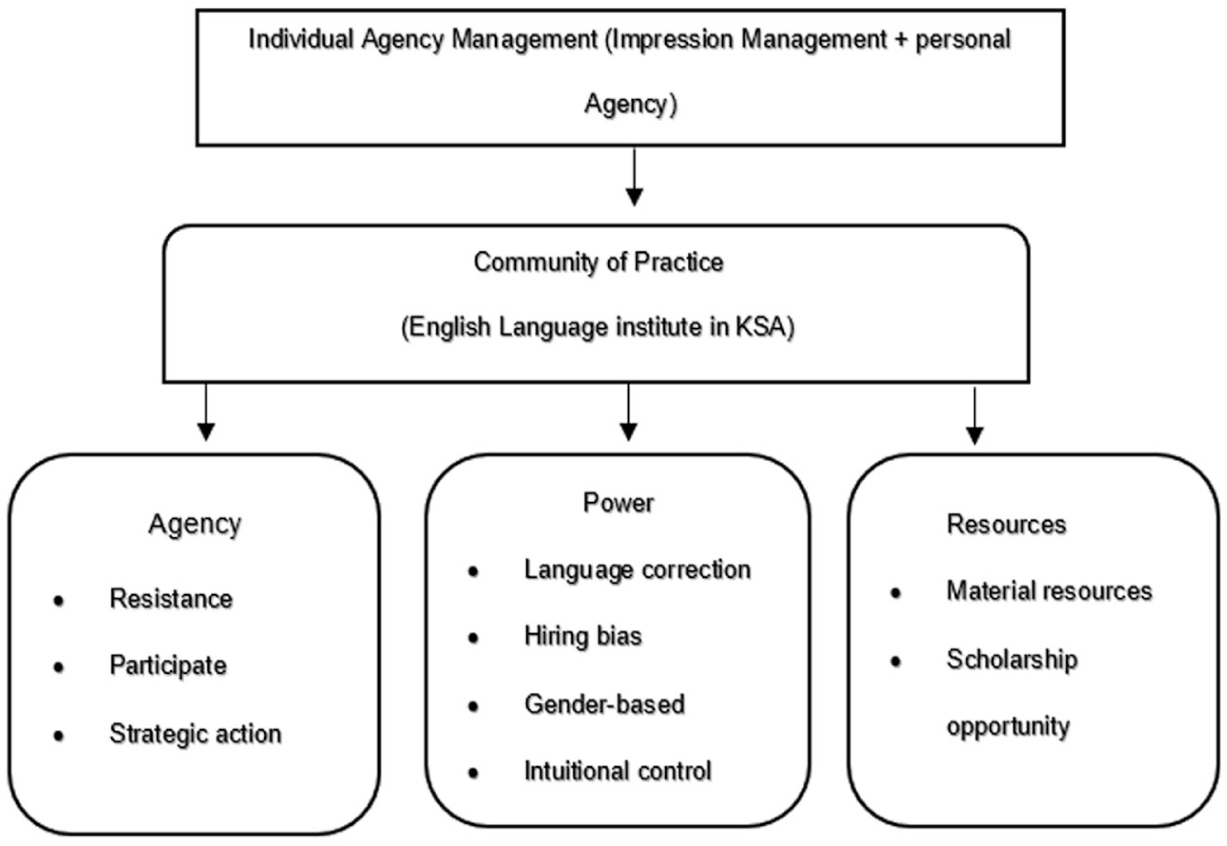
Conceptual model illustrating the interaction of individual agency, power, and resources within a community of practice.
VII Conclusions
Native-speakerism and linguistic discrimination not merely individual biases but systemic challenges. The issue of native-speakerism must be understood as a systemic and structural problem, rather than one limited to individual acts of discrimination. These systemic hierarchies are embedded in institutional policies, hiring practices, and professional norms, which privilege L1 teachers and marginalize LX practitioners. Additionally, both native and LX teachers can also continue these hierarchies through their behavior as well as the acceptance of these norms. L1 English speakers often exercise stigma power over LX teachers by publicly correcting their written or spoken English. Furthermore, restrictions of access to resources increases novice LX teachers’ stigmatization, as they become more aware of how others question their language ability (Canh & Renandya, 2017; Kamhi-Stein, 2013; Tsang, 2017).
Teacher training programs must move beyond skill-based instruction to integrate critical pedagogy (Pennycook, 1990), which empowers novice LX teachers to analyse and resist imposed identities. It helps LX teachers take control of their identities and be recognized as capable bilingual educators who bring valuable resources to the classroom. One way to counter these feelings is through training programs that help novice teachers critically challenge native-speakerism (Lopriore & Vettorel, 2018; Schreiber, 2019). This can raise their awareness and prepare them to navigate these challenges, both inside and outside the classroom. These programs can also foster peer support, allowing novice LX teachers to collaborate and reflect on their identities, easing the challenges of professional transition. Reading or hearing about others’ experiences helps novice practitioners develop awareness and improve their self-perception (Brannan & Bleistein, 2012). As demonstrated by the actions of Ruba, Rana, Sara and Nore, individual teachers can also use a variety of strategies to manage their agency and construct their identities in their new environment.
In some contexts, teachers must resist an imposed identity and try to establish both identity and impression management in which others see a highly competent bilingual teacher with resources that students need (Goffman, 1963). Although the participants in this study felt disempowered, that did not affect their self-image as skilled confident teachers. It is possible that this ability on their part to resist native speakerism and systematic marginalization of LX speaker teachers derives from their sense of self-worth as educated women living in and working in the Arabian Gulf. These participants were able to develop their voice, build a positive identity, and bring a unique perspective to the field of English language teaching and learning.
In settings similar to KSA, several policy changes can be made to help eliminate native speaker bias when selecting and preparing teachers. Employment selections need to focus on professional competence teaching history and language expertise not birthplace or nationality. Training programs should educate teachers on the impacts of native-speakerism and provide strategies to navigate these challenges in their professional work.
Gender equity in education must be addressed explicitly. In gender-segregated contexts such as KSA, institutions should guarantee equal access to mentorship, professional development, and leadership roles. Policies must also acknowledge how socio-religious norms shape gendered power dynamics in the workplace and provide structural support to ensure fair treatment across genders. Empowering LX teachers in this way enables them to navigate systemic barriers and assert their value in the field. Additionally, institutions should foster collaboration between LX and L1 teachers by creating shared spaces through communities of practice. Addressing native-speakerism requires systemic change rather than individual strategies. These hierarchies are deeply rooted in institutional policies, hiring practices, and professional norms, privileging L1 teachers while marginalizing LX practitioners. Through inclusive policies and collaborative professional environments, institutions can begin dismantling native-speaker hierarchies and build a more equitable future for all teachers.
