







Abstract
This study examines teacher–student verbal interactions in Taiwan’s Teaching English through English (TETE) vocational high school classrooms under the national Bilingual 2030 initiative. We aimed to characterize teacher questioning and initiation–response–feedback (IRF) interaction patterns, focusing on question types, cognitive demands, and student responses. Fourteen TETE lessons (totaling 684 minutes) taught by vocational teachers in a national bilingual education competition were video-recorded. We manually transcribed the recordings and coded all teacher questions (n = 430) using Sánchez-García’s taxonomy and Anderson & Krathwohl’s revised Bloom’s taxonomy. IRF sequences were identified, and student responses were coded by language (Chinese vs. English). Descriptive and inferential statistics (correlations, ANOVA via SPSS) were applied. Inter-rater agreement on coding was 90%–92%. Quantitative results revealed that teachers’ questions were mostly procedural (28.4%), display (26.0%), or off-task (13.0%). Referential (content-focused) questions were significantly more common among higher-performing teachers. By cognitive level, 62% of questions targeted recall (Bloom’s lowest level), 28% application, and 10% analysis. Question lexical complexity aligned with basic-user proficiency (CEFR A1–A2). In 197 IRF sequences, students responded more often in Chinese (202 instances) than English (176 instances). Teachers’ question frequency was positively correlated with teaching performance (R = .585, p = .028). ANOVA indicated significant grade-level differences in questioning frequency (F(2, 11) = 4.619, p = .035), with ninth-grade teachers asking significantly fewer questions. These findings indicate that current TETE classroom discourse is dominated by lower-order, procedural questions and frequent first language (L1) use, posing challenges for English-immersion goals. We discuss implications for Taiwan’s bilingual education policy and practice, including the need for targeted teacher development to promote higher-order questioning and balanced L1/L2 interaction to better support bilingual instruction. These results highlight the need for classroom practices and policies aligned with Taiwan’s bilingual goals.
I Introduction
In response to Taiwan’s ‘2030 Bilingual Policy’, proposed in 2018, different educational levels have adopted various approaches. The content and language integrated learning (CLIL) approach has been implemented in the non-testing domains of primary and secondary schools (e.g. PE, Arts, Counselling, or Life). CLIL allows for the contextual negotiation of varying degrees of use of the second language (L2) in language-oriented and content-based models. At the tertiary level, English is expected to be used in at least 70% of classrooms, and English medium instruction (EMI) is used across various disciplines. The primary objective of both approaches is to instruct students in the target language, English. The authorities do not accord equal consideration to English language courses taught at varying educational levels.
Following a 7-year trial starting in 2018, Taiwan’s bilingual education policy transitioned to a focus on teaching English through English (TETE) in primary and secondary schools, largely due to teachers’ resistance to CLIL. As a result, fewer schools are adopting the CLIL education, but the TETE approach, which is integral to the post-2024 bilingual policy, has caused anxiety and uncertainty among English teachers who are accustomed to using students’ first language (L1) in their instruction. Challenges with TETE echo those faced in CLIL and EMI classrooms, particularly in terms of teacher preparedness, students’ English proficiency, and low classroom interaction – especially due to teacher-dominated discourse and limited student participation (An et al., 2021; An & Thomas, 2021).
In bilingual classrooms, interaction issues often stem from how teachers ask questions, typically using text-based or closed-ended formats, which restrict student output (An & Childs, 2023; Genc & Yuksel, 2021; Lasagabaster & Doiz, 2022; Pun, 2021). Although some bilingual settings are anxiety-free (Kopinska & Fernández-Costales, 2023), learning in a foreign language can still cause stress and hinder interaction. Therefore, code-switching is perceived as a communicative strategy that prioritizes efficacy over conformity to monolingual norms (Sahan, 2020). Student engagement may be improved by training bilingual educators in classroom discourse competence (Genc & Yuksel, 2021).
It is estimated that at present, 2,679 primary and secondary schools in Taiwan, 70% of the total number, have adopted TETE (Lin, 2025), and the number is expected to increase. It is expected that TETE will completely replace the CLIL approach as the mainstream approach to implementing bilingual education at the secondary level in Taiwan. Before this happens, it is important to understand whether a lack of classroom interaction will occur in future TETE classrooms, resulting in negative feedback, resistance and a barrier to the wide adoption of TETE, as was experienced in the case of CLIL. Our study therefore aimed to examine how teachers and students verbally interact in TETE lessons, and to critically discuss how these scenarios could impact TETE’s widespread implementation in Taiwan secondary school classrooms.
II Literature review
1 Teaching English in the Learners’ L1
Whether English should be taught in students’ L1 or in the target language (i.e. English in this case) or a mix of both has long been an issue. Educators have debated the validity and efficacy of incorporating the learners’ L1 into English language teaching (ELT). Although some conventional language teaching methods advocate for the exclusive use of the target language (TL) in the classroom, recent research indicates that the L1 can be beneficial in both English as a foreign language (EFL) and English as a second language (ESL) settings. This is especially true for novices and lower-level learners, as the L1 functions as a scaffold to assist students in navigating intricate concepts and establishing a foundation for language acquisition (Rahmawati, 2015). The L1 can be effective in terms of helping alleviate learners’ cognitive load and reducing their anxiety, and thus proper use of the L1 can positively and supportively impact their L2 learning (Al Hariri, 2015; Halasa & Al-Manaseer, 2012; Zulfikar, 2019). Thus, many educators strategically deploy the L1 during the teaching phase to introduce challenging L2 vocabulary, elucidate difficult grammatical structures, and clarify abstract concepts (Perdani, 2021). It has been evidenced that using the L1 can improve students’ comprehension of the L2 and conserve valuable classroom time that would otherwise be allocated to extended explanations that could lead to misunderstandings (Cianflone, 2009; Karafil & İlbay, 2024). Nevertheless, a significant disparity still exists in perspectives regarding the use of the L1. Some educators advocate for minimal to no use, while others take a ‘maximal’ approach, allowing for significant reliance on students’ native languages. Yet, others adopt a ‘virtual’ position. A middle-ground or ‘optimal’ stance implies that the L1 should be employed cautiously, functioning as a support without obscuring the primary focus on English immersion (Nanda, 2021).
In general, research indicates that the strategic application of the L1 can be advantageous for both instructors and students, as it facilitates the efficient comprehension of intricate concepts, and enhances the learners’ proficiency in the English language (Perdani, 2021). In multilingual classrooms where students’ linguistic backgrounds are diverse, teachers can benefit from the strengths of the L1 by strategically integrating it to improve the language learning process.
2 Teaching English Through English
An ‘English only’ approach in the classroom has been regarded as legitimate by some scholars and language teachers. The potential to immerse students in the target language and to improve both their language proficiency and communicative competence has led to the widespread adoption of the TETE method in language education. Research has demonstrated that TETE can enhance student achievement by increasing exposure to the target language, which is essential for developing fluency and accuracy (Pyo, 2009; Richards, 2017), whereas using the L1 can have a negative impact on English language learners (Almoayidi, 2018). In TETE, teachers use English exclusively or primarily in their instruction, compelling learners to think and communicate directly in English, which results in more rapid development of their skills than bilingual instruction could provide.
However, factors such as their education level, language proficiency, and the amount of English they routinely use in their classrooms can significantly influence teachers’ attitudes towards TETE. Teachers at higher educational institutions, such as universities, may, for instance, feel more at ease using TETE. In contrast, those teaching younger students or novices may have reservations about its efficacy, particularly for students with lower English proficiency (Kim, 2008). Furthermore, some teachers experience anxiety when conducting lessons wholly in English, especially if their own proficiency is insufficient to provide clear instruction. For example, teachers may use the students’ L1 to ensure comprehension. Still, low student proficiency can cause difficulties in the classroom when learners cannot comprehend instructions or critical concepts (Reed, 2020).
Hence, some scholars have proposed combining curriculum development and targeted pedagogical strategies to surmount these obstacles. Teachers must modify their lesson plans and materials to accommodate the linguistic requirements of their students, guaranteeing that the tasks are both appropriately challenging and accessible (Ghafar & Sawalmeh, 2023). Different classroom contexts have implemented a variety of language teaching methodologies, including the grammar-translation method, the direct method, and communicative language teaching (CLT), to facilitate TETE. Traditional methods, such as the Grammar-Translation Method, significantly rely on the students’ native language, whereas the Direct Method prioritizes the exclusive use of English for teaching (Reddy, 2012). Also, incorporating literature into TETE classrooms has been proven beneficial, as it can provide learners with rich linguistic input and expose them to various language forms, cultures, and contexts. Students can improve their comprehension of English while also honing their critical thinking and cultural awareness skills by reading and discussing authentic texts (Marasini, 2019).
Yet, Littlewood (2008) and Ruan (2023) proposed that both the L1 and L2 can be employed as a strategy to balance and justify English teaching, and that language choices can optimize target language learning. Indeed, the mother tongue’s role has been proven helpful, such as for codeswitching or translanguaging, and has thus been recognized as supportive in bilingual teaching (Gallagher & Colohan, 2017). Therefore, using TETE at secondary schools as one approach to complement Taiwan’s bilingual policy contrasts with the recent bilingual education pedagogy.
3 Dynamics of classroom interaction and contextual influences
The central role that structured interactions play in facilitating language acquisition is demonstrated by research on interactive verbal patterns in English language classrooms. The initiation–response–feedback (IRF) structure is one of the most frequently recognized patterns. According to IRF, the teacher initiates an exchange, the student responds, and the teacher provides feedback. This pattern enables teachers to control classroom discourse while offering chances for assessment and scaffolding (Galegane, 2021; Tjalla et al., 2023). Initiation–response (IR) and initiation–response–response (IRR) are two variations of this pattern. In the former, feedback is omitted, while in the latter, students participate in extended turns (Galegane, 2021). IRF interactions come from many situations, such as teacher-student dialogues, student-student exchanges, and whole-class discussions. Changes in these patterns are contingent upon the instructional objective and the nature of the classroom activity. For example, teachers typically lead discussions during whole-class interactions, whereas group work and student-student interactions are more likely to foster independent problem-solving and peer collaboration (Saleh, 2016; Sundari, 2017). Furthermore, to encourage engagement and reinforce learning, choral responses, group work, and individual work – in which students respond in unison – are frequently implemented (Julana, 2018; Rohmah, 2017).
Several studies have underscored the fact that contextual factors can significantly influence the interaction patterns in a classroom. These factors encompass the teacher’s pedagogical style, the class size, and the students’ language proficiency (Julana, 2018; Lu et al., 2009). For example, in smaller classes or environments where students possess a higher level of language proficiency, more student-centered and open-ended discussions may occur, enabling learners to participate more actively. However, in larger or lower-proficiency groups, teachers may rely more on structured, teacher-centered interactions to assure comprehension and maintain order (Ma, 2012). In many classrooms, teacher-centered interactions continue to prevail and thus restrict student participation, despite the current trend of promoting more communicative, informal, and student-centered approaches in modern language teaching (Tjalla et al., 2023).
In Taiwan, English is traditionally taught in the mother tongue in secondary English classrooms. Hence, code-switching between Mandarin and English is a prevalent practice for various pedagogical purposes (Tien, 2009). The IR model is predominant in classroom discourse structure, and repetition exercises are frequently implemented (Luo, 2013). Students primarily employ English to imitate and repeat, while teachers employ it to request information or action (Luo, 2013). In addition, the willingness of students to speak English is closely correlated with the verbal immediacy behaviors of their teachers (Hsu, 2006). Usually, teacher conversations constitute a substantial portion of classroom discourse, with asking questions being a prominent feature (Charisma & Defalni, 2019); however, the interactive patterns may still be unknown in some EFL contexts when English is taught in English, a language that learners are in the process of learning and are still unfamiliar with.
Thus, selecting an interaction pattern in the classroom is crucial because it can substantially impact student engagement and language learning outcomes. Learners are likelier to participate, think critically, and use language in interactive, student-centered discussions. However, teacher-led patterns, which are beneficial for maintaining control and delivering explicit instruction, may restrict student talk time and diminish opportunities for spontaneous language use (Lu et al., 2009; Rohmah, 2017). Therefore, achieving a balanced equilibrium between student-centered and teacher-led interactions would be essential to optimize L2 learning in the classroom, in particular, in some EFL contexts where English is taught in English.
III Research methodology
1 Background
Since the launch of the Taiwan 2030 bilingual policy, different designated initiatives have been implemented across various educational levels. For instance, the CLIL approach is promoted in the non-testing subjects at primary and secondary schools, TETE is being experimented with in selected senior schools, and EMI is encouraged at the tertiary level. The main objectives of implementing the TETE project are to increase the proportion of classes taught in English by promoting the teaching philosophy and practical methods of delivering the English curriculum exclusively in English, and to ensure that the quality of English curriculum instruction is improved by establishing a mechanism for teachers to implement and evaluate English-only instruction.
Following the above aims, schools that applied for the project and were approved can start experimenting with TETE by following specific procedures. They should designate English teachers to complete an English Teaching Plan Form, and instruct students to follow its content. The form should explicitly declare the application plan’s emphasis on ‘oral teaching’ to align with the bilingual policy’s development objectives. Most importantly, the teaching staff should adopt ‘English only’ instruction in the designated courses, and each course must offer at least one TETE session every 2 weeks. These schools should support teachers in establishing cross-school professional communities, which involve regular lesson preparation and discussion, as well as training sessions related to teaching materials and methods. Furthermore, the participating teachers should complete at least one lesson plan for an all-English lesson, along with a teaching video for public observation. Then, the invited bilingual teaching experts would visit each participating school at least once to offer consultation and guidance each academic year. Finally, the participating schools must take part in the English language teaching plan selection competition. Hence, the researcher, as an expert in a polytechnic university and internal consultant, was able to observe the TETE courses and evaluate the teachers’ performance.
2 Corpus and analysis
In this study, we collected 14 video-recorded TETE sessions submitted to a TETE contest (with CC 3.0 copyright license for academic use) delivered by 14 English teachers from 14 vocational high schools and focused on examining how teachers designed their questions to initiate or close interaction. Although students in Taiwan’s vocational high schools may generally have lower English ability (a majority with CEFR A2 level and a few with B1 level) and lower motivation to learn English than those in regular high schools (Liu, 2008; Wu & Chen, 2017), teachers participating in the competition from both regular and vocational high schools were expected to follow the same designated teaching procedures and to meet the evaluation criteria in their TETE teaching plans and videos. In addition, most language teachers in Taiwan have had very similar TESOL training; thus, it was assumed that the corpus collected for the present study could still represent the TETE landscape in Taiwanese high schools, at least to some extent.
Each of the 14 teaching sessions lasted about 45 to 50 minutes, with a total of 684 minutes. In each session, the instructors were expected to accommodate the lesson design concerns, quantity of English delivery, appropriacy of English use, teaching effectiveness, and the employment of multimodalities. Also, the instructors were reminded to offer verbal, procedural, and instructional scaffolding during their teaching (Echevarría et al., 2017). In particular, they had to elicit more language and information from students to achieve mutual communication instead of a teacher-dominant delivery.
Once the 14 sessions were collected, we started transcribing the video files into text. Rather than relying on generative AI tools for transcription, as is increasingly common nowadays, we conducted manual transcription. One research assistant with English proficiency at the CEFR B2 level, who had been well trained and had experience of categorizing question types in previous research, helped transcribe all the files. Then, the assistant and the researcher worked together to identify the scenarios where verbal interaction occurred between instructors and students in the classroom. First, we analysed how the teachers started the interaction by asking questions. The questions were mainly asked in English, with a few asked in Chinese. We first used Sánchez-García’s (2016, 2020) categorization of teacher-led questions to record the question types. Then, we adopted Anderson and Krathwohl’s (2001) and Lo and Fung’s (2020) frameworks to code linguistic and cognitive demands in the questions in our corpus. The counts and classification of the questions were also completed manually, with an inter-rater reliability of 90% and 92% (in coding 10% of the corpus), respectively, between the two coders. Any disagreements in coding were discussed to reach a consensus. Finally, we focused on how the learners responded to teachers’ inquiries. We attended to the students’ verbal responses and examined how teachers closed or followed up to enrich the verbal interactions. In other words, we analysed how the interactive IRF (initiation, response, follow-up) patterns were carried out, and if verbal interaction was facilitated or impeded by L1 and L2 use. In total, we identified 430 questions and 197 occurrences of an IRF pattern. In our study, EXCEL was used to count the occurrences of question types, and SPSS was used for further statistical analysis. ANOVA was applied to examine whether there are significant differences among grade levels in the frequency of asking questions, and Pearson correlation was used to investigate the relationships between teachers’ evaluative scores and the frequency of questions.
3 Researcher positionality
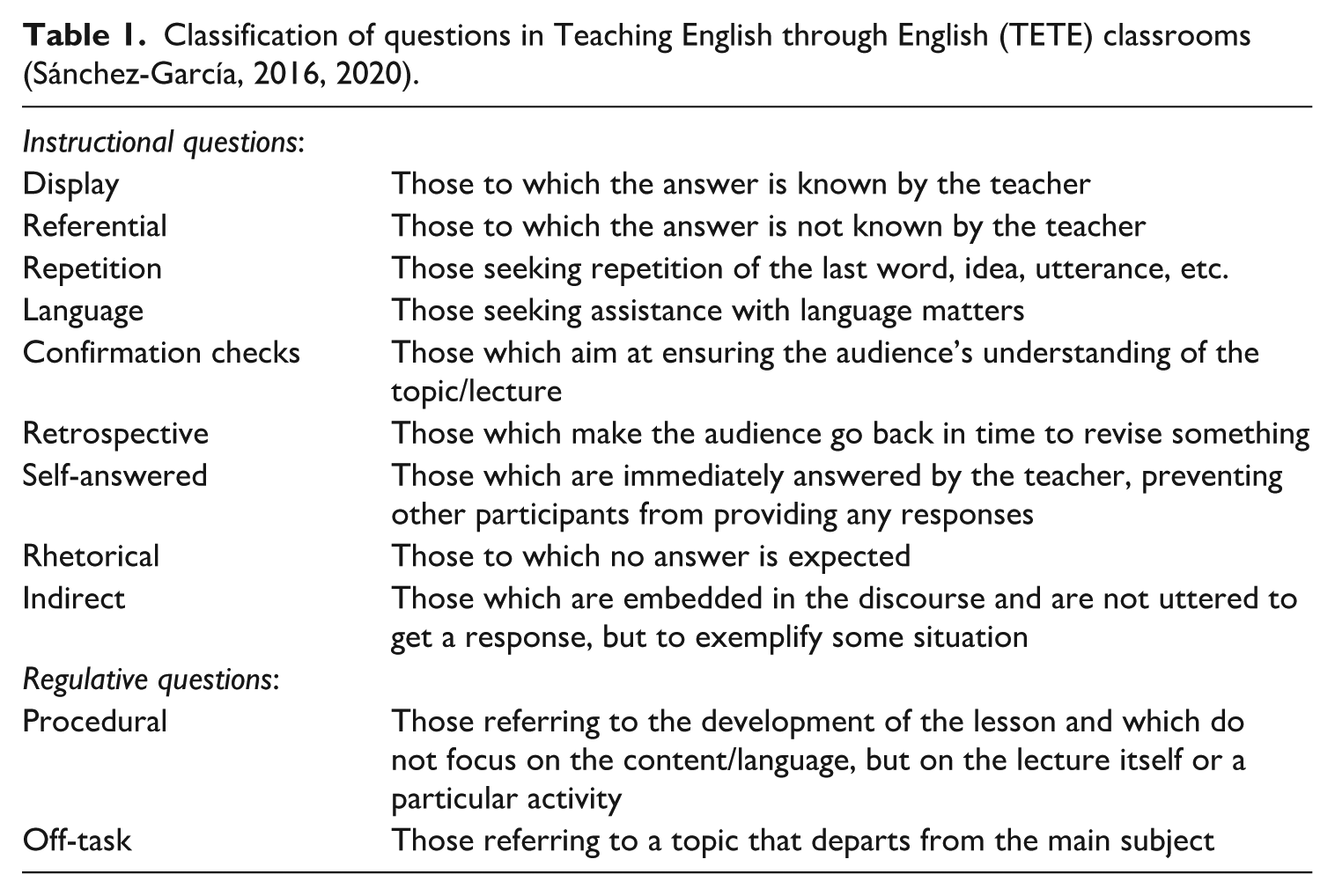
As a bilingual expert, a TETE Project consultant, and a contest judge, the researcher positioned himself as an ‘inside outsider’ in the current study, that is, an internal consultant and participant in the Project, but one with an objective stance regarding each participating school and the observed classes. As a researcher who has worked on the Project, I know that my dual role as both observer and interpreter could affect how the classroom interaction works and how the data are understood. Such an external insider role also had essential benefits, as it offered me a better understanding of the cultures and how to teach, helped me build trust with the participating teachers, and made it easier for me to objectively observe how the teachers performed in the classroom. We used systematic coding methods to reduce the chance of bias, checked data from different sources, and kept reflexive notes throughout the study process. These steps ensured that interpretations were based on facts, and the data were looked at critically to avoid possible bias (Table 1).
Classification of questions in Teaching English through English (TETE) classrooms (Sánchez-García, 2016, 2020).
IV Results and discussion
1 Teachers’ question types in TETE classrooms
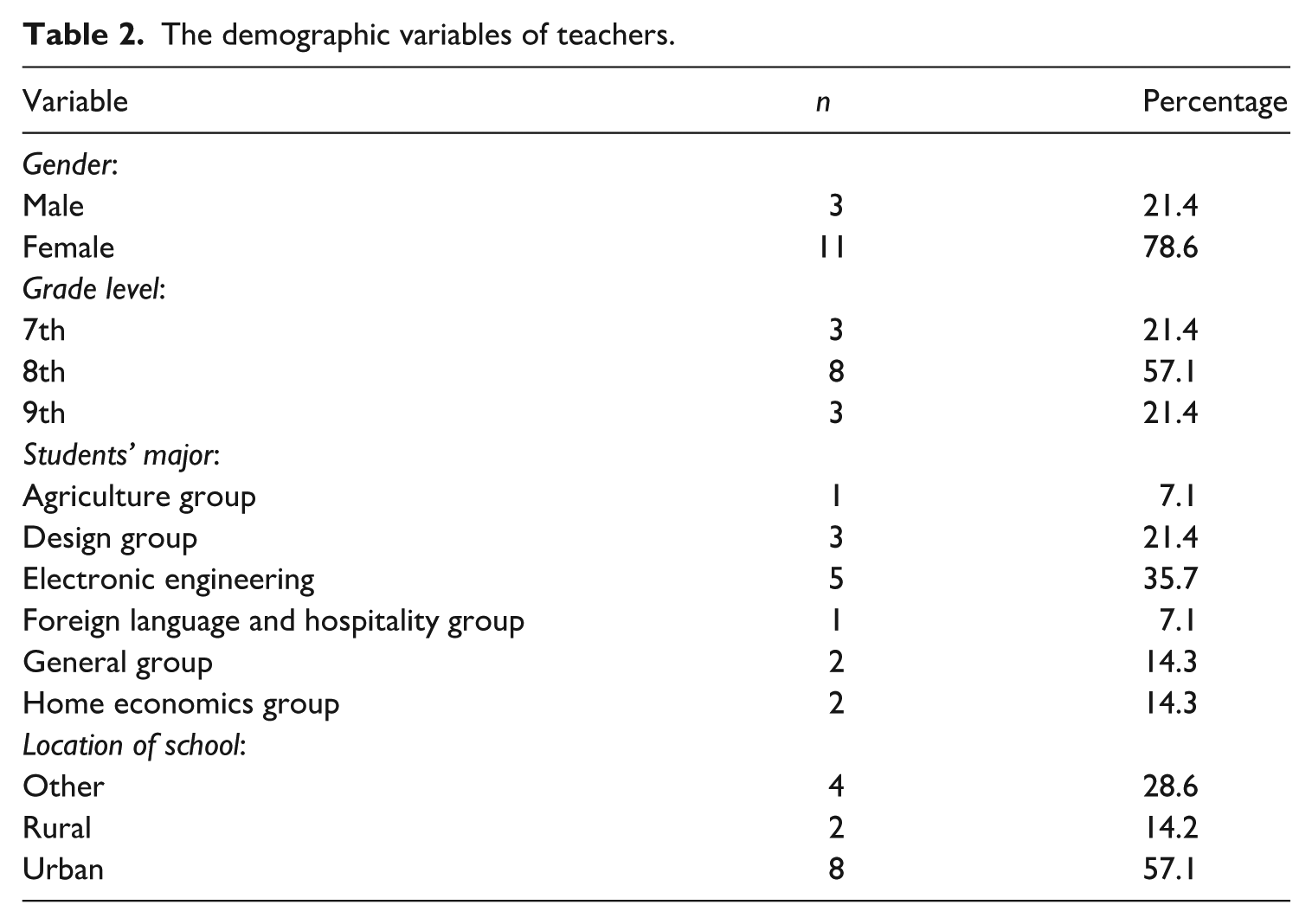
The demographic variables of the 14 teachers are shown in Table 2. There were 11 female (78.6%) and three male (21.4%) teachers; 57% of teachers taught eighth grade; five courses (35.7%) were related to Electronic Engineering; and 57% of schools were in urban areas.
The demographic variables of teachers.
The question types in these 14 videos were analysed and are presented in Table 3, which shows the teachers’ scores, as evaluated by the bilingual education experts with a scoring rubric of 20% for lesson design, 20% for English use percentage, 10% for language appropriateness, 30% for teaching effectiveness, and 20% for multimodality application. The results showed that procedural was the dominant question type preferred by teachers (all 14 teachers), accounting for approximately 28.4% (n = 122) of all questions. The second most common type was off-task (13 teachers), making up 13% (n = 58). Display was used by a total of 12 teachers, making it the third most frequently used, while the proportion of usage by each teacher was higher (26%, n = 112) than that of off-task questions. The next question types, in order, were repetition (15%) and referential (11%). The other six types combined accounted for only 5.6%.
The scores and frequency of question types employed by the 14 teachers.
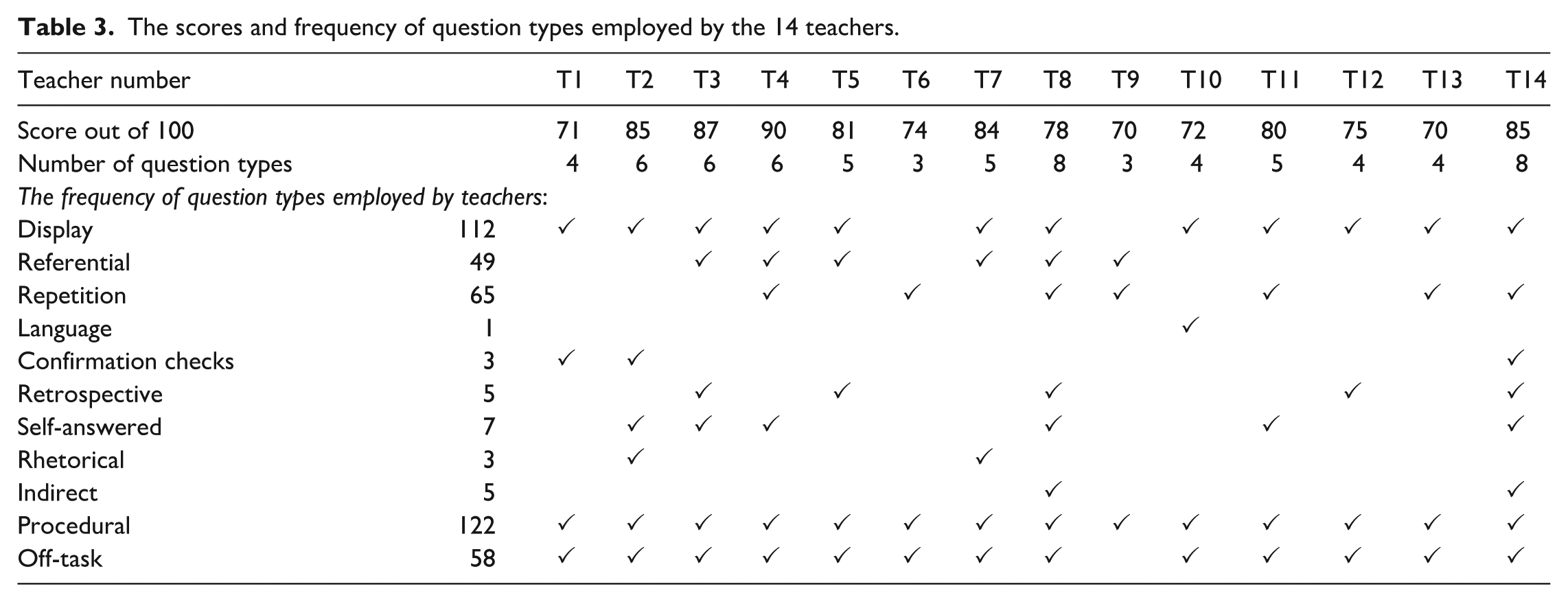
The teachers were categorized into high (above 85), middle (from 75 to 84) and low (below 75) score groups. The scores of the 14 teachers ranged from 70 to 90. Teacher 4 scored the highest, and used referential and display question types more frequently. As shown in Table 4, the high-score group employed the referential question type more than the other two groups did. The middle-score group tended to use a combination of display and procedural questions more frequently, whereas the low-score group relied predominantly on procedural questions. It could be assumed that the referential question type, which has genuine answers and is often open-ended, helps students promote real communication and deeper thinking, and fosters higher-order thinking skills such as application, analysis, evaluation, and creation. In contrast, the display questions mainly trigger the ‘remember’ and ‘understand’ aspects of lower-order thinking, as the teacher already knows the answer and uses the question to assess students’ knowledge or understanding. Procedural questions are related to classroom routines or instructions, and are often used to manage tasks rather than to promote content learning (Anderson & Krathwohl, 2001; Bloom, 1956). Furthermore, among the two most frequent question types (Table 4), display questions were the most commonly employed (11 out of 28), echoing the findings of Serna-Bermejo and Lasagabaster (2024), Lasagabaster and Doiz (2023) and Doiz and Lasagabaster (2021). In addition, within Taiwan’s bilingual education context, teachers often spend more time on procedural questions, largely due to students being in the early stages of TETE instruction and having limited English proficiency. This also supports the conclusions of studies (Öztürk, 2016; Yuksel & Yu, 2008) which suggested that questioning practices reflect sociocultural perspectives and emphasize the importance of context, content, and power dynamics in classroom discourse.
The scores and percentages of question types asked by the 14 teachers.
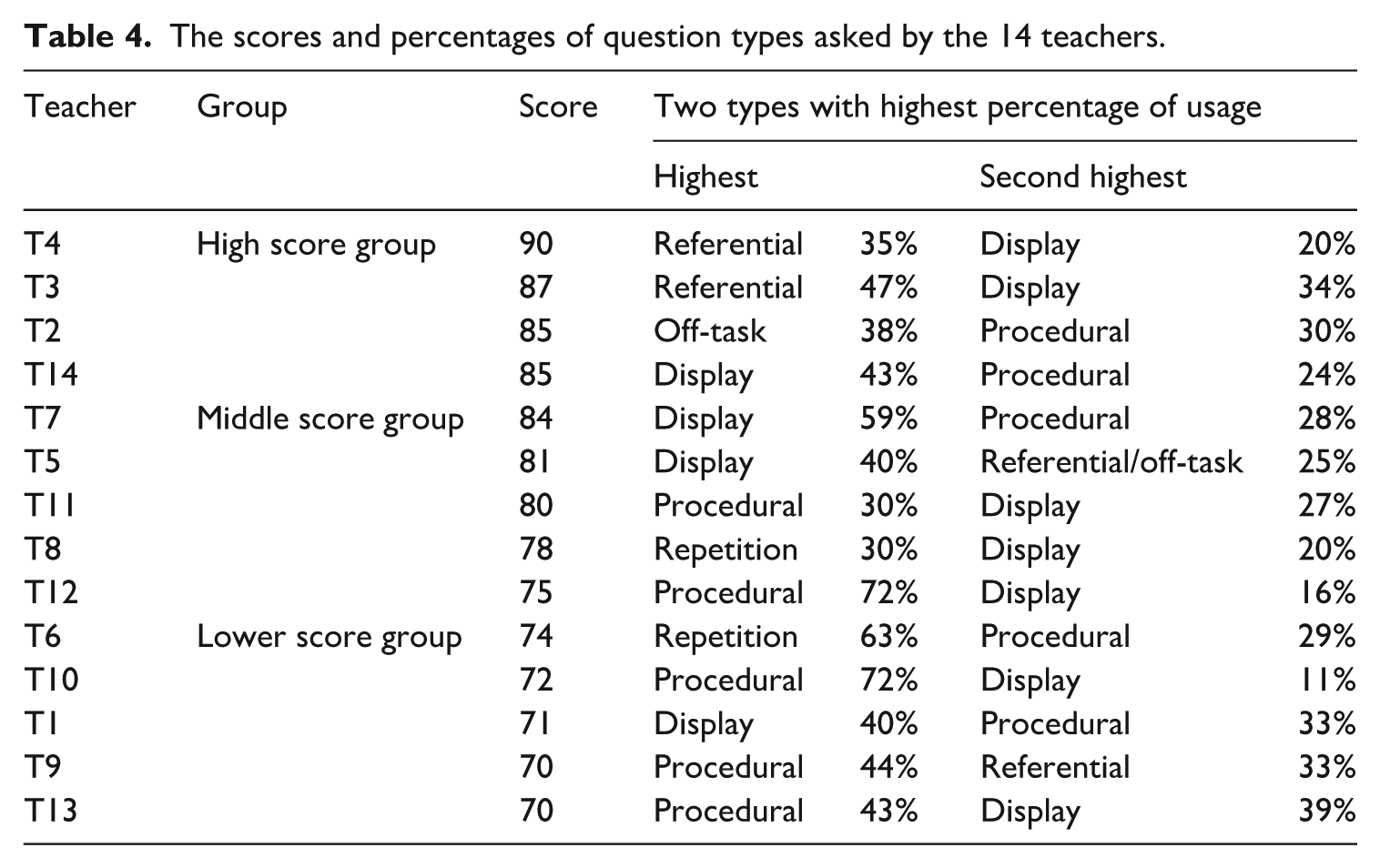
This pattern suggests that teachers who frequently employ referential questions might have higher-order cognitive teaching objectives, aiming to deliver content and develop students’ communicative competence, critical thinking, and problem-solving abilities. Such objectives align with student-centered and constructivist teaching approaches, where learners are encouraged to explore, justify, and extend their ideas. As a result, these teachers might create richer classroom interactions and deeper learning experiences; these are elements often reflected in higher performance evaluations. On the other hand, teachers in the low-score group might emphasize classroom control and task completion, such as checking whether students understand instructions or are ready to move on. While these questions are important for managing lessons and checking understanding, they might reflect limited instructional goals, such as maintaining order or ensuring basic comprehension. Therefore, the types of questions teachers use in the classroom might influence the quality of student learning and indicate the teachers’ instructional priorities and expectations.
The mean score of the 14 teachers was 78.71, the average number of questions they asked was 31, and 5 types of questions were asked. The Pearson correlation of the scores and the frequency of questions asked was significant (R = .585, p = .028 < .05). The higher the frequency of questions the teacher asked, the higher their score. Additionally, we conducted a one-way ANOVA to examine whether the grade level taught by teachers affected the frequency of asking questions. The findings indicated a statistically significant difference in the frequency of questions based on grade level, F (2, 11) = 4.619, p = .035 < .05. The frequency of questions asked in seventh-grade classes was 20 times higher than that in ninth-grade classes (p = .041); and the frequency in eighth-grade classes was approximately 22 times higher than that in ninth-grade classes (p = .013). The results suggest that grade level significantly influences the frequency of teacher questioning, with seventh- and eighth-grade teachers asking significantly more questions than ninth-grade teachers. A possible explanation for this pattern is the instructional focus at different grade levels. In the seventh and eighth grades, teachers might use questioning more to support learning, check comprehension, and keep students engaged, as they are still building foundational skills. In contrast, ninth-grade instruction often shifts toward review and test preparation, particularly due to the pressure of the upcoming high school entrance exams. Without introducing new content, teachers might reduce the frequency of questions and instead focus on repetition, accuracy, and consolidation of previously taught material. This could result in fewer opportunities for open-ended or exploratory questioning. The findings, in line with Erdogan and Campbell (2008), highlight how curricular goals and assessment pressures can shape classroom interaction patterns, and suggest that teaching strategies, including questioning practices, should be evaluated in light of student needs and instructional contexts.
2 Linguistic and cognitive demands in teachers’ questions
Recent research in second language acquisition and bilingual education has underscored the importance of designing classroom tasks that challenge learners cognitively while being sensitive to their linguistic development (Cummins, 2000; Krashen, 1982). We analysed 430 English language questions from Taiwanese high school English classrooms, and categorized them according to linguistic demands and cognitive complexity using Lo and Fung’s (2020) and Bloom’s Taxonomy frameworks. The corpus presents a limited array of English questions that the Taiwanese high school teachers used, as discussed in Section IV.1. The classification revealed a predominance of lower-order thinking questions with limited opportunities for critical analysis, highlighting both linguistic and pedagogical challenges in Taiwan’s bilingual education contexts.
These questions were presented as both simple, structured sentences (69.6%, with a main verb at least but no complete or compound sentences) and word/phrase (30.4%) formats, and ranged from simple instructions to more complex, cognitively challenging tasks. Upon further analysis, the word levels in both formats demonstrated relatively beginning levels (CEFR A1 and A2), which were compatible with the Taiwanese high school learners’ English proficiency level. Figures 1 and 2 present the distributions of word levels in both formats. Judging from the word difficulty and question structures, the teachers did not impose too many linguistic demands on their students with their questions, as the lexical density, syntactic complexity, and pragmatics demands fell within what the learners could cope with. Many questions required students to have a strong command of vocabulary and to understand syntactical structures. For example, questions like ‘What does read out loud mean?’ test both the literal meaning and the contextual usage of phrases. A few exceptions required extended responses, such as discussing the pros and cons of using e-money or sharing personal experiences, where learners must organize their thoughts coherently. Thus, it is assumed that the students linguistically ‘understood’ most of the questions raised by the teachers.
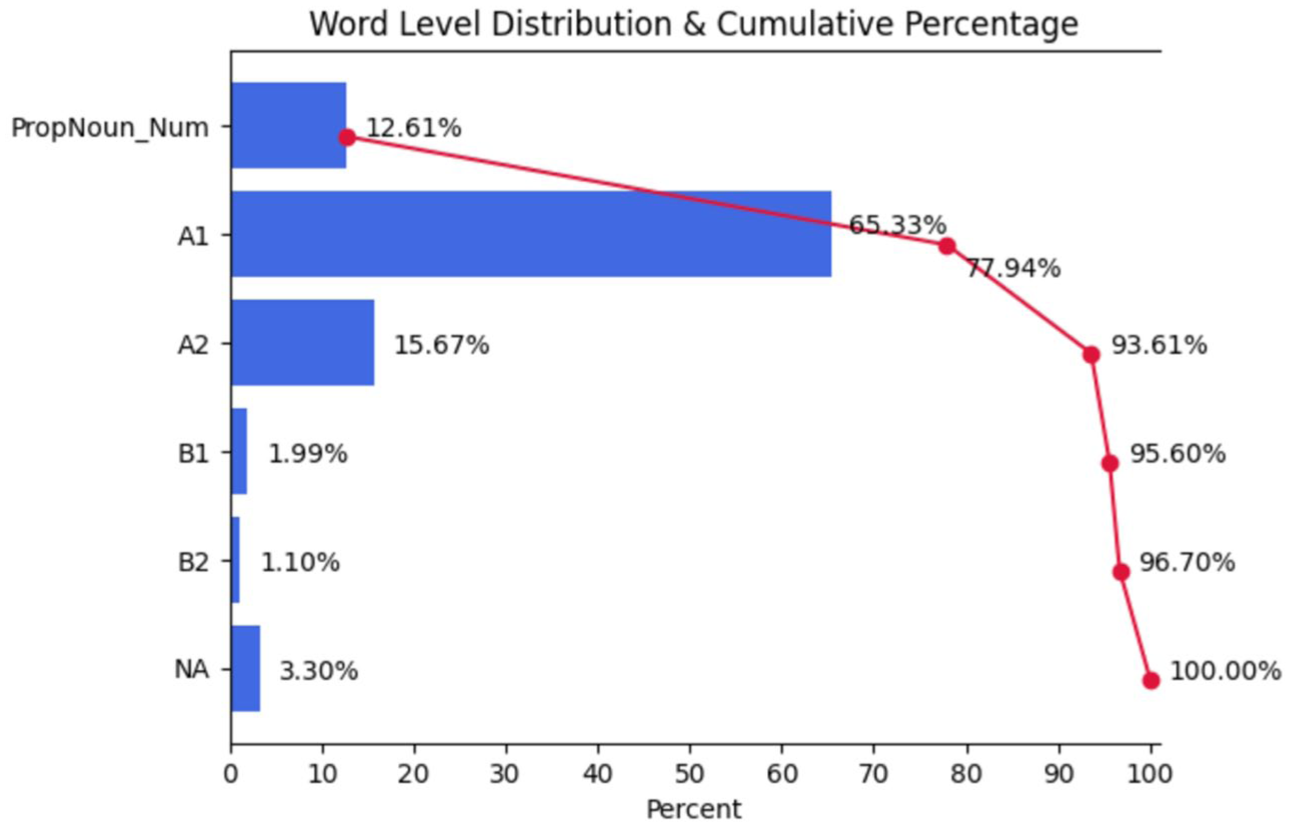
Word-level distribution in questions asked in sentence format.
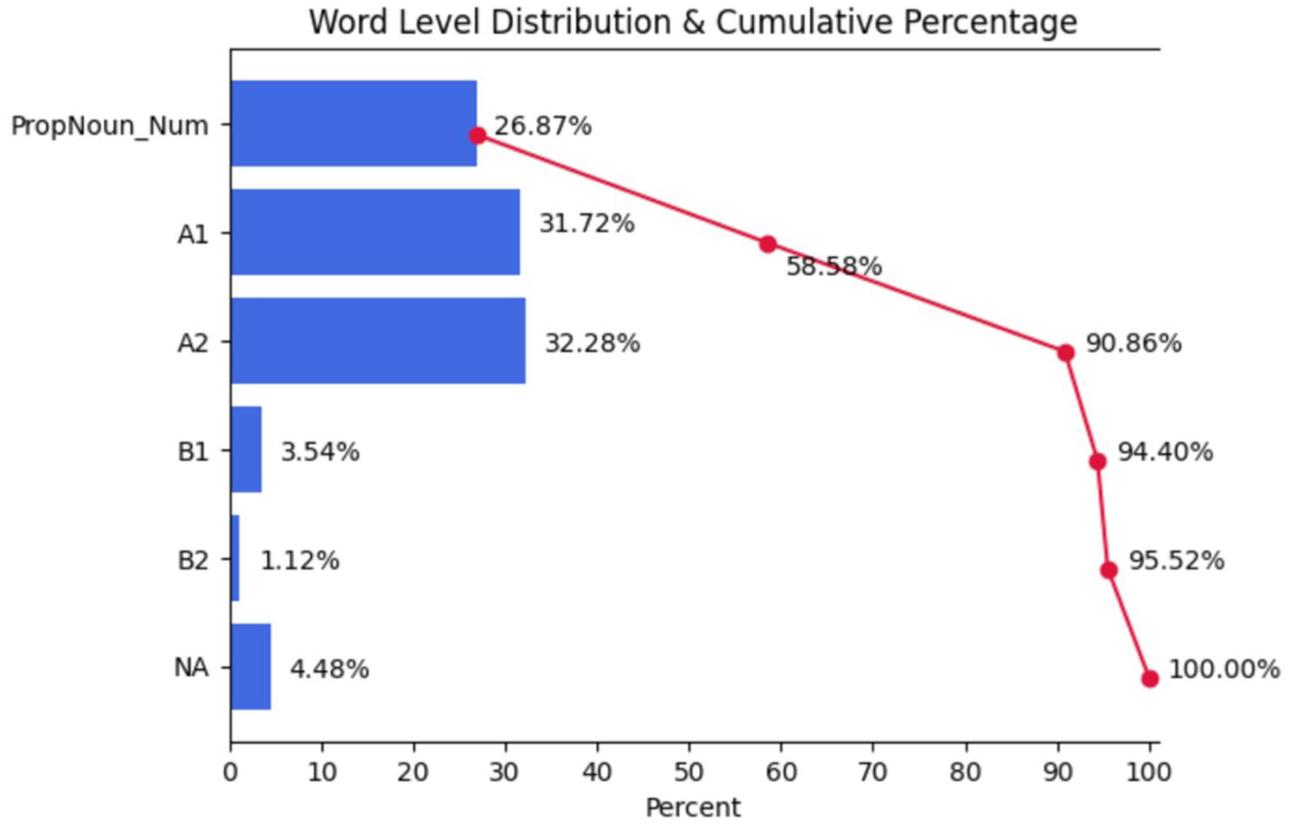
Word-level distribution in questions asked in word/phrase format.
However, whether learners can accurately respond to questions largely relies on how the questions challenge their cognitive thinking and their actual English oral proficiency. Hence, the questions were categorized into three groups: recall, application, and analysis (Anderson & Krathwohl, 2001; Lo & Fung, 2020), representing the cognitive process from low to high.
Recall questions encourage students to recall knowledge from memory. They require students to recall information, word definitions, and specifics of essential text or oral instruction. Essential for developing a knowledge base, they usually depend on surface-level processing. Recall activities in bilingual environments also strengthen language-specific vocabulary and grammatical structures required for the next language growth (Krashen, 1982). Such memory questions measuring fundamental knowledge retrieval and recognition and accounting for 62% of our corpus can be further categorized as follows. First, factual recall questions ask directly for information (e.g. ‘Who is the writer, a Taiwanese or a foreigner?’ #31), verify text (e.g. Which factor is the main cause of disappearance? #3), and check vocabulary (e.g. Does anyone know this word? #91). Second, procedural recall questions request instruction compliance (e.g. ‘Please take out your textbook’ #233), routine repetitions (e.g. ‘Repeat after me, “conscious” ’ #92) and, finally, cultural recall questions (e.g. ‘Where is the 辦桌? (“roadside banquet”)’ #35) require understanding of Taiwanese culture.
Relatively, application questions requiring the use of knowledge in new contexts comprised 28% of the corpus. Such questions can be further grouped into three different domains. First, contextual application questions demand predictive reasoning (e.g. ‘What would happen if Bee vanished?’ #4) and personal responses (e.g. ‘What would you want to say to Rezwan?’ #191). Second, linguistic application questions involve translation tasks (e.g. ‘Can you explain what a peaceful world means?’ #149) and register adaptation (‘If Rezwan came to Taiwan, what would you ask him?’ #190), requiring formal language. Finally, cultural application questions require cross-cultural comparisons (e.g. ‘How does Ban-Doh compare to Western banquets?’ #234). These questions go beyond memorization by asking students to apply their understanding to hypothetical or real-life scenarios. Application tasks in language classrooms encourage learners to practice language skills in problem-solving contexts and enhance their communicative competence. The cognitive demand here is higher because learners must bridge the gap between knowing and doing – transforming theoretical knowledge into practical use (Anderson & Krathwohl, 2001).
The fewest questions teachers asked in our corpus were analysis questions, which demand evaluation and critical thinking from learners; they accounted for 10% only of all questions. Although there were not many of these questions, they could still be classified into three types. The first type is textual analysis questions, which demand inferencing (e.g. ‘How can we know things are getting more exciting?’ #97) and comparative analysis (e.g. ‘What do Rezwan and Malala have in common?’ #199). The second type is sociocultural analysis questions, involving ethical evaluation (e.g. ‘Why is it unfriendly to the poor/elderly?’ #48) of the impacts of e-money and emotional interpretation (e.g. ‘How did Sara feel?’ #68), requiring empathy and textual evidence. The last type is metacognitive analysis questions, which demand learning process reflection (e.g. ‘What was most difficult aspect of your report?’ #224). These items demand that learners not only recall and apply their knowledge, but also analyse and evaluate the content. They encourage critical thinking by requiring learners to justify their answers or explain underlying reasons and relationships. Such questions are particularly challenging in bilingual classrooms because they require a deeper understanding of language nuances, cultural contexts, and abstract reasoning (Vygotsky, 1978).
The above analysis of linguistic and cognitive demands illustrates that in bilingual contexts (e.g. TETE), teachers have to progressively develop questions requiring higher-order thinking skills to ensure that language learners can progress from basic memory recall to more complex cognitive operations without language barriers (Anderson & Krathwohl, 2001). Questions needing significant cognitive processing – such as analysis – may, however, need to be scaffolded with more language help to guarantee that unnecessary cognitive demands do not overburden students (Sweller, 1988). Several questions in the corpus also demand student idea sharing or group discussion, which can be viewed as chances for social interaction, and are particularly important in bilingual environments since students can negotiate meaning and build on one another’s knowledge, thus lowering the individual cognitive load and promoting language development (Vygotsky, 1978). Hence, teachers must support bilingual learners in navigating the linguistic and cognitive challenges inherent in different question targets, providing scaffolding, integrating language and content instruction, and fostering collaborative learning environments. This balanced approach enhances learners’ academic performance, contributes to developing cognitive skills, and, at the same time, highlights the need for professional development (PD) training to help teachers design cognitively engaging questions while managing linguistic complexity, a crucial step toward developing bilingual critical thinkers.
3 IRF patterns in teacher-and-student verbal communication
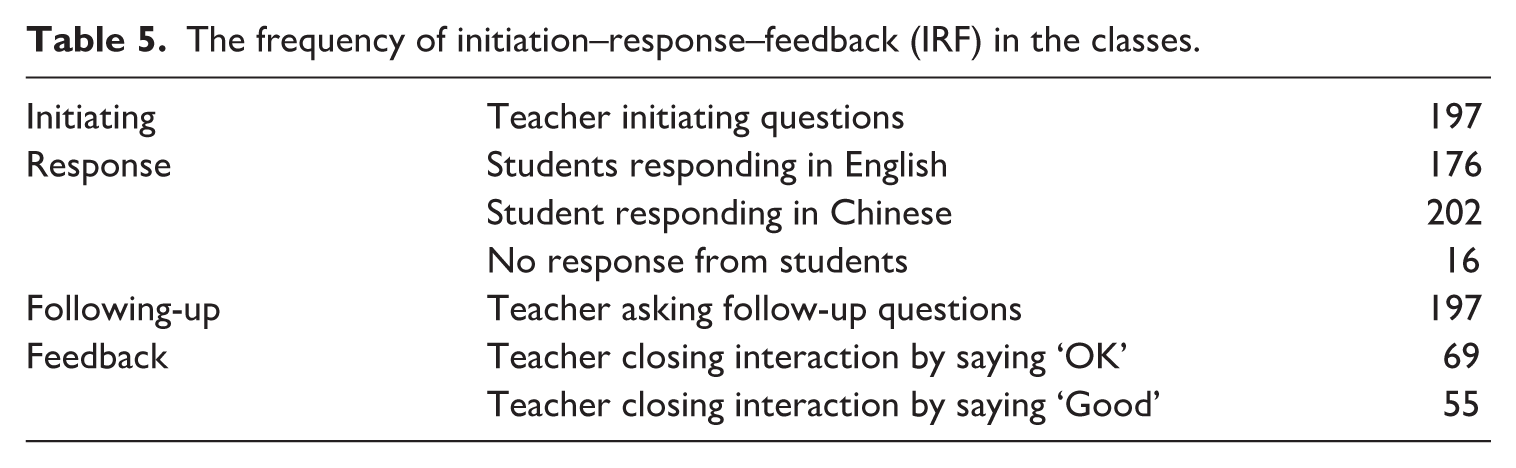
The teachers asked a total of 430 questions, 197 of which were to initiate interaction (see Table 5), while another 197 were asked as follow-up questions. Students responded 176 times in English and 202 times in Chinese. There were 16 silent responses and 36 teachers’ self-answered and off-task responses, which did not involve a complete IRF pattern. Moreover, 197 follow-up inquiries were of the type whereby the teacher provides further questions or asks for clarification based on the students’ responses, and guides deeper thinking, while 69 times were signals of ‘I heard your answer’ with responses such as ‘OK’, and 55 instances of feedback acknowledging ‘good’ or ‘perfect’ answers. Such feedback affirms and rewards the students for providing correct, high-quality answers.
The frequency of initiation–response–feedback (IRF) in the classes.
In the classroom observations, teachers primarily used English to ask questions. This aligns with the TETE methodology, which encourages immersion in the target language. The IRF model is evident in our study, which enables the teacher to guide the conversation, assess understanding, and provide immediate feedback. Take the following excerpt as an example: Initiation Teacher: What do you see in the picture? Response Student: Three girls. Feedback Teacher: Yes. And? Response Student: The face looks different than others. Feedback Teacher: Perfect.
In this excerpt, the teacher creates an IRFRF pattern in a more interactive and engaging learning interaction, enhancing student participation and language acquisition.
However, some students struggled to understand questions or respond appropriately in English. Half of the student responses were in Chinese.
Initiation Teacher: Does anyone know this word? Response Student: (No answer) Feedback Teacher: Ok, please repeat after me, conscious. Initiation Teacher: What is emoji? Response Student: 表情符號 (‘emoji’) Feedback Teacher: Yes, very good.
This suggests possible gaps in the students’ language proficiency that might be harder to address in an English-only setting. Teachers might need to use the students’ L1 to ensure comprehension. Moreover, most excerpts showed that the interactions were mainly teacher-led, with students providing brief answers or repeating information. For example, in the above dialogue, the teacher maintained control of the discourse with a series of questions and brief answers.
Teacher: Does anyone know this word? Student: (No answer) Teacher: Ok, please repeat after me, conscious. Student: (repeat) conscious. Teacher: Look at the picture and guess the meaning. Student: 焦慮 (‘anxious’) Teacher: She is anxious. Very good. What else? Student: She is nervous. Teacher: Yes, she is anxious and nervous. What else? Student: They made fun of her. Teacher: Excellent.
According to the literature, higher proficiency students allow for more student-centered interactions, encouraging more student participation. In contrast, lower-proficiency students often result in more teacher-centered interactions (Tjalla et al., 2023). We can see that the teachers tried to direct students’ responses with follow-up questions or encouragement (Very good, Perfect) despite students’ limited opportunities to contribute beyond brief answers.
The classroom observations demonstrated a dynamic environment in which student responses (in English and Chinese) were regularly engaged and followed up by the teacher’s inquiries and feedback. TETE is a relatively new teaching approach in Taiwan, aimed at enhancing immersion in the target language, English. However, more teacher-centered interactions were observed in the classroom dynamics, and half of the responses were in the students’ native language. Teachers seemed to make few efforts to guide students to use more English when their language proficiency might be lacking. Reed (2020) highlighted that while TETE intends to enhance English language acquisition, teachers’ ability to use English exclusively in class significantly influences its effectiveness. Even in an English immersion environment, teachers might find it necessary to strategically use the students’ L1 to help them understand complex concepts. As noted by Liu and Yeung (2023), using the L1 in planning improved syntactic complexity, accuracy, and fluency in speaking, with stronger effects on less proficient learners. Thus, it is possible that the use of students’ L1 in this study supported comprehension and provided essential scaffolding for lower-proficiency learners.
Comparing our study to other Asian EFL contexts, such as Japan (Reed, 2020) and Turkey (Genc & Yuksel, 2021), both similarities and divergencies were identified. Japan and Taiwan emphasize TETE at the secondary level, with a strong policy push and teacher-centered classrooms. However, while the Japanese study explored the teacher’s reflective perspective and the effect of L1 use, our study in Taiwan investigated interactional patterns within a broader systemic shift from CLIL to TETE. In contrast, the Turkish study was conducted in the higher education space, where it examined how lecturer questioning techniques in EMI contexts shape classroom discourse. In addition to the above differences, a consistent theme emerged, namely limited student engagement due to teacher- or lecturer-dominated talk. All three studies call for adequate teacher training and context-sensitive instructional models – whether it is improving TETE delivery in Japan and Taiwan or enhancing EMI question use in Turkey – to foster more interactive, student-centered learning environments.
V Conclusions and implications
TETE is a rapidly emerging teaching practice implemented in response to the great challenges and complaints which arose from the implementation of the CLIL approach in Taiwan bilingual education, which was launched in 2018 (Lin, 2025). Our study aimed to describe the verbal interactive patterns in Taiwan TETE classrooms. In our corpus, we analysed 430 teacher-led questions and 197 IRF patterns. The results show that the instructional context and pedagogical intent influenced teachers’ questioning behavior in the TETE classrooms. Effective practices of TETE in Taiwan seem to be associated not only with the use of EMI, but also with the strategic implementation of cognitively engaging and communicative questions that encourage student participation and promote higher-order thinking. A further analysis of the linguistic and cognitive demands of the questions showed that teachers asked many more sentence-level than word-level questions (69.6% vs. 30.4%), and the lexical difficulty of their questions mainly ranged between the CEFR A1 and A2 levels, which was consistent with the learners’ English proficiency. Yet, there was a huge difference in the proportion of how these questions challenged students’ cognitive skills, with 62% of the questions checking memorization skills, 28% application skills, and 10% evaluation skills. Although the classroom observations revealed frequent use of the IRF patterns, and teachers primarily used English as the language of instruction, nearly half of the student responses were in Chinese, indicating challenges for students to respond in English even if they knew the answers. Teachers often used follow-up questions to guide thinking, although interactions remained mostly teacher-centered.
The study offers important theoretical insights into IRF in TETE education by highlighting the role of dialogic pedagogy, questioning practices, and translanguaging in shaping classroom interaction. Our findings challenge traditional, form-focused instruction and display questioning, emphasizing instead the value of co-constructed dialogue where student contributions are treated as meaningful and legitimate. The purposeful use of different questioning strategies fostered elaborated responses and deeper engagement. Another key theoretical contribution is the application of translanguaging theory. From a translanguaging perspective, learners draw on their full linguistic repertoires and strategically use their L1 to make sense of content, participate in discourse, and negotiate meaning even when they understand L2 inputs (García & Li, 2015). Creating a translanguaging space can also increase students’ learning motivation in L2 and promote their transition to a new TETE environment (Tai, 2025). Therefore, the study findings call for a reconceptualization of TETE, moving beyond rigid language boundaries toward a more dynamic, fluid, multilingual understanding of TETE practice. Translanguaging theory provides a lens to understand how interactive practices support learner agency and equitable participation.
Several pedagogical implications are also derived from analysing the teacher-led questions, which can be used to inform bilingual education practices in Taiwan. First, educators should implement a differentiated instructional strategy, considering diverse cognitive and linguistic requirements. The students’ proficiency levels can determine the task design or adaptation. For instance, learners who are still developing their academic English abilities may be provided with supplementary language support, such as vocabulary lists and sentence starters, in conjunction with application and analysis questions. Simultaneously, analysis questions may be proposed with minimal language scaffolding for more advanced learners, but teachers must still offer explicit guidance on approaching these questions. This may entail the simulation of deconstructing a question, identifying critical components, and establishing connections between concepts. The process can be demystified to foster confidence among bilingual learners through graphic organizers, think-aloud protocols, and peer collaboration (Cummins, 2000; Vygotsky, 1978).
Next, in bilingual education, conducting ongoing formative assessments to monitor language development and content comprehension, and to target distinct cognitive levels by posing questions is essential. According to Anderson and Krathwohl (2001), immediate and constructive feedback promotes learners’ cognitive and linguistic development, enabling them to identify areas where they prosper and require additional assistance. Furthermore, whether the practices of students’ translingual responses should be code-switched, tolerated or recognized depends on the purpose of asking questions and the teaching objectives. Thus, proper teacher PD training is crucial to better support the TETE approach while accommodating students’ linguistic needs and content comprehension, and refining teachers’ questioning skills.
Finally, the significance of collaborative learning could be promoted by the interactive nature of asking numerous questions, such as ‘Can anyone share the answers?’ and ‘How about your group?’ Not only does establishing a classroom environment that encourages peer discussion facilitate language practice, but it also fosters the development of critical thinking skills. This is consistent with sociocultural learning theories and confirms that knowledge is co-constructed through social interaction (Vygotsky, 1978).
This study extends bilingual interaction research by demonstrating how TETE practices reshape classroom dynamics beyond traditional IRF models. Findings suggest that bilingual scenarios foster more fluid turn-taking and collaborative meaning-making, which aligns with sociocultural theory by emphasizing mediation and scaffolding. In this way, the study not only illustrates theoretical frameworks but also shows how bilingual instructional practices challenge and enrich existing perspectives on classroom interaction. It is therefore suggested that future research further explore these practices across different bilingual contexts to validate and expand the theoretical implications presented here.
Footnotes
Acknowledgements
The authors would like to express their gratitude to the teachers who joined the TETE competition and were observed and evaluated. One author was grateful for being invited to serve as the consultant and judge for the project.
Funding
The authors disclosed receipt of the following financial support for the research, authorship, and/or publication of this article: National Science and Technology Council, Taiwan (112-2410-H-328-001-MY2).
