







Abstract
This qualitative study explored how pre-service English language teaching (ELT) trainees negotiated professional agency and emotional wellbeing and how these two processes interacted during practicum experiences in artificial intelligence (AI) and digitally enriched practicum. Guided by the ecological model of teacher agency (EMTA) and the job demands–resources (JD-R) framework, the study examined how technological affordances and institutional constraints shaped decision-making, identity, and affective experiences. Twelve final-year ELT trainees from a Turkish university undertook a 10-week practicum involving varying degrees of AI integration. Data were gathered through semi-structured interviews, reflective journals, and artefact analysis, and analysed thematically. Findings highlighted three forms of agency – iterational, practical-evaluative, and projective – manifested in adapting AI-generated content, making real-time pedagogical adjustments, and envisioning professional futures. Emotional wellbeing fluctuated depending on perceived control over AI use, mentor guidance, and alignment with teaching values. A key finding was that agency and wellbeing were mutually shaping rather than independent, with opportunities to adapt AI outputs strengthening confidence and engagement, and mandated or inflexible AI use contributing to frustration and diminished professional ownership. The study shows how AI-infused practicum contexts magnify tensions between innovation and conformity, while identifying the contextual conditions that may weaken or support the agency–wellbeing relationship. Implications stress the need for teacher education to embed critical digital agency, provide emotional support, and allow contextual adaptation of AI tools to build resilient and autonomous future practitioners.
Keywords
I Introduction
The rapid integration of digital technologies and artificial intelligence (AI) into teacher education is reshaping how pre-service teachers plan, deliver, and reflect on instruction. Emerging research on generative AI highlights its affordances for lesson planning, materials development, and administrative efficiency, while also warning that algorithmic recommendations may constrain pedagogical judgment and diminish perceptions of professional autonomy (S. Lee & Song, 2024; Ma & Zhang, 2025; Zhai & Chen, 2025). Parallel research on practicum experiences underscores that pre-service English language teaching (ELT) teachers frequently encounter heightened stress, reduced self-efficacy, and emotional strain – particularly when practicum expectations conflict with classroom realities or when teaching occurs in remote or hybrid formats (Hubbard & Schulze, 2025; Lian et al., 2025; Pozo-Rico et al., 2023).
As digital and AI tools become more embedded in practicum contexts, a growing body of international research illustrates how technological affordances interact with pre-service teachers’ pedagogical and emotional experiences. Studies across varied settings demonstrate that trainees often appreciate the creative, organizational, and instructional support offered by AI and digital platforms, yet they simultaneously face challenges related to workload intensification, misalignment of AI outputs with local teaching contexts, and institutional constraints (C. Lu et al., 2025; Zou et al., 2020). For instance, pre-service teachers in Hong Kong expressed optimism toward digital tools but struggled with policy-driven workload demands, whereas Indonesian trainees recognized AI’s value for idea generation but noted risks such as fabricated content and overreliance. Rather than serving as isolated contextual anecdotes, these studies collectively illustrate a broader pattern: practicum has become a multifaceted space where technological, pedagogical, and emotional pressures converge, requiring trainees to make ongoing decisions about how, when, and why to use AI-mediated tools.
Despite these insights, current literature tends to treat teacher agency and emotional wellbeing as separate lines of inquiry. Research on AI integration primarily focuses on pedagogical benefits, technological competencies, and constraints on autonomy, while studies on practicum-related wellbeing emphasize emotional vulnerabilities, stressors, and sources of support (Hubbard & Schulze, 2025). As a result, we have a limited understanding of how agency and emotional wellbeing unfold together in AI-mediated practicum environments. Specifically, little is known about how ELT trainee teachers sustain autonomy, make context-sensitive decisions, and regulate emotional responses while engaging with AI-supported teaching tasks (J. Lu & Zhang, 2025; Ma & Zhang, 2025). This fragmentation leaves a theoretical and empirical gap in explaining how action-oriented and emotion-oriented processes co-develop when digital tools form an integral part of instructional practice.
This study addresses these gaps by examining how Turkish ELT pre-service teachers negotiate their professional agency and emotional wellbeing during practicum experiences involving AI-supported or digitally enhanced teaching. Drawing on participants’ lived experiences, adaptive strategies, and reflective accounts, the research provides an integrated understanding of how trainees navigate the demands and opportunities introduced by AI. By foregrounding the interplay between agency and wellbeing, the study contributes to ongoing discussions on preparing future language teachers for increasingly digitalized educational environments.
II Literature review
1 Teacher agency in language teacher education
Teacher agency refers to teachers’ capacity to act purposefully and constructively to shape their professional trajectories and influence their teaching contexts (Eteläpelto et al., 2013; Lee, Mun et al., 2025; Sulis et al., 2024). In teacher education, agency is conceptualized as a situated and dynamic accomplishment rather than a fixed attribute, emerging through interactions among individual dispositions, contextual affordances, and sociocultural influences (Priestley et al., 2015). This view is particularly relevant in practicum settings, where pre-service teachers negotiate tensions between personal pedagogical beliefs, mentor expectations, institutional norms, and technology-rich classroom realities.
a Conceptualizing teacher agency
Scholarship consistently characterizes agency as something teachers enact through everyday pedagogical decisions, negotiations, and long-term professional aspirations rather than something they merely possess (Lee, Mun et al., 2025; Sulis et al., 2024; Toom et al., 2015; Weng & Fu, 2025). For pre-service teachers, these enactments occur during practicum decision-making, where individuals draw on prior experiences, interpret contextual constraints, and plan future teaching trajectories (Bütün Ikwuegbu & Harris, 2024).
Research highlights that these decisions are relational and situated within the broader ecology of practicum contexts (Eteläpelto et al., 2013; Kayi-Aydar, 2019). However, previous literature often blends definitions, identity processes, relational factors, and technological influences, which can obscure analytic clarity (Lee, Mun et al., 2025; Weng & Fu, 2025). To maintain conceptual precision, this study adopts an ecological perspective that distinguishes iterational, practical-evaluative, and projective dimensions of agency. This framing allows clearer theorization of how each dimension is shaped in digitally and AI-mediated practicum settings.
Emerging technologies further complicate agency enactment by offering new opportunities while also imposing constraints (Bütün Ikwuegbu & Harris, 2024; Kalaja, 2016). AI-supported tools can influence what trainees perceive as pedagogically possible or permissible (Lee, Mun et al., 2025; J. Lu & Zhang, 2025; Weng & Fu, 2025), making practical-evaluative judgments particularly prominent. Recognizing agency as collective and contextual – as the interpretation of what is possible, permitted, and professionally desirable in a given moment (Lipponen & Kumpulainen, 2011; Sulis et al., 2024; Vähäsantanen, 2015) – positions later sections to more coherently examine its relationship with emotional wellbeing.
b Teacher agency in technology-rich or AI-enhanced contexts
The rapid integration of digital and AI-based tools has added new layers to agency enactment. Such tools may expand pedagogical possibilities by offering immediate access to materials, differentiated content, and data-driven insights (Hubbard & Schulze, 2025; Kessler, 2018; Lee, Mun et al., 2025). At the same time, institutional mandates, interface constraints, and algorithmic limitations can narrow decision-making possibilities and challenge teacher autonomy (Knox, 2020).
In AI-mediated practicum, the practical-evaluative dimension becomes especially salient. Trainees must decide when to adopt, adapt, or reject AI-generated suggestions, considering pedagogical appropriateness, cultural relevance, and ethical implications (Crompton et al., 2024). Research in ELT contexts demonstrates varied responses: some trainees integrate AI creatively, while others express uncertainty about legitimacy, fairness, or overreliance (Karaduman, 2025; Karataş & Yüce, 2024; J. Lu & Zhang, 2025). Recent studies also raise concerns about fabricated content, algorithmic bias, and tensions between efficiency and originality (Fokkens-Bruinsma et al., 2024; S. Lee & Song, 2024; Zhai & Chen, 2025). These patterns underscore the need for cultivating critical digital agency – the ability to evaluate and use technology judiciously and context-sensitively (Lai & Morrison, 2013; Weng & Fu, 2025). In practicum contexts where AI is encouraged or required, such criticality becomes essential to prevent passive reliance on technological outputs.
c Teacher agency and professional identity in practicum
Teacher agency has been shown to be closely intertwined with professional identity formation, particularly during practicum when pre-service teachers transition from learners to practitioners. Professional identity includes beliefs, values, and emerging self-perceptions about one’s place in the profession (Beijaard et al., 2004). Agency allows trainees to make pedagogical decisions that affirm or reshape these identities (Hubbard & Schulze, 2025).
Mentors and institutional structures significantly shape the space within which agency can be enacted. Supportive mentorship and flexibility in lesson design encourage initiative and experimentation (Toom et al., 2015), whereas prescriptive cultures or rigid assessment frameworks can narrow agentic possibilities (J. Xu, 2025). Digital and AI tools add identity-related complexity: for some trainees they signify professionalism and creativity (Crompton et al., 2024; Lee, Jeon et al., 2025; Sulis et al., 2024), while for others they generate anxiety or self-doubt, especially when technological self-efficacy is low (Karaduman, 2025; Karataş & Yüce, 2024).
AI tools can also trigger tensions around authenticity and authorship. Trainees may question whether AI-supported materials align with their values or challenge their self-concept as creative educators (Karaduman, 2025). Navigating these dilemmas requires practical-evaluative agency, linking identity development to emotional and pedagogical experiences in technology-rich practicum.
2 Emotional wellbeing in ELT practicum
a Defining and theorizing emotional wellbeing
Emotional wellbeing in teacher education involves managing work-related stressors, sustaining positive affective engagement, and deriving fulfilment from teaching-related activities (Acton & Glasgow, 2015; Cabaroğlu & Öz, 2025). It encompasses hedonic (e.g. enjoyment) and eudaimonic (e.g. sense of purpose) elements (Ryan & Deci, 2001). For ELT trainees, wellbeing is shaped by interpersonal relationships, pedagogical challenges, and adaptation to new environments (Li & Peng, 2024; Mercer & Kostoulas, 2018).
The job demands–resources (JD-R) model (Bakker & Demerouti, 2017) offers a lens for understanding how demands such as workload, performance pressure, and technological challenges can deplete emotional resources, while supports such as mentor guidance, peer collaboration, and access to tools can foster resilience (Chen & Tang, 2024). In a digitally enhanced practicum, these demands and resources increasingly incorporate AI-specific factors, including learning curves, accuracy issues, and the extent of institutional support.
b Emotional challenges in practicum settings
Practicum is widely recognized as an emotionally demanding period (Hastings, 2004; Hobson, 2021). ELT trainees face pressures related to classroom management, mismatches in expectations, linguistic concerns, and cultural adjustment (Cabaroğlu & Öz, 2025; Erten, 2022; Yuan & Lee, 2016). These challenges intensify when high-stakes evaluation intersects with dynamic classroom realities (Mercer et al., 2016; Tsui, 2007).
Mentorship quality plays a central role in mitigating or exacerbating these challenges. Supportive mentors help trainees regulate emotions and experiment pedagogically (Izadinia, 2016), while restrictive or unsupportive mentorship can heighten anxiety and discourage risk-taking (Valencia et al., 2009; J. Xu, 2025). Peer collaboration also acts as an emotional resource, providing solidarity and shared problem-solving (Farrell, 2016; Li & Peng, 2024).
c Technology, AI, and emotional wellbeing
Digital and AI-enhanced tools introduce new emotional dynamics into practicum. Technology can act as a resource by improving efficiency, supporting lesson design, or enabling adaptive materials (Cutrim Schmid et al., 2023; Lee, Jeon et al., 2025; Ma & Zhang, 2025). AI-powered tools can reduce workload by generating prompts, analysing language, or offering feedback (Karataş & Yüce, 2024; Kessler, 2018; J. Lu & Zhang, 2025).
However, technology may also become a source of emotional demand. Steep learning curves, technical unreliability, and unclear expectations about AI use can increase stress (Fokkens-Bruinsma et al., 2024; Hubbard & Schulze, 2025; Karaduman, 2025; Zawacki-Richter et al., 2019). Emerging concerns include AI inaccuracy, hallucinations, ethical ambiguity, and pressure to demonstrate digital competence (S. Lee & Song, 2024). These tensions can exacerbate practicum-related strain, especially when trainees are required to use AI without sufficient training.
3 Intersections of agency and wellbeing in AI-infused practicum
Teacher agency and emotional wellbeing are mutually influential processes rather than isolated constructs (Pyhältö, et al., 2012; Vähäsantanen, 2015; Y. Xu & Tao, 2025). Agency supports wellbeing by enabling trainees to align actions with values, negotiate constraints, and respond flexibly to challenges (Lai & Morrison, 2013; Montgomery et al., 2024; Priestley et al., 2015). Wellbeing, in turn, provides the emotional and cognitive resources necessary for reflective practice and adaptive decision-making (Mercer et al., 2016; Y. Xu & Tao, 2025).
In AI-mediated practicum, these reciprocal dynamics become more pronounced. AI may function simultaneously as a resource (e.g. enhancing creativity, efficiency) and a demand (e.g. increasing cognitive load, ethical dilemmas, institutional pressure) (Knox, 2020; Zawacki-Richter et al., 2019). How trainees interpret these affordances depends on their agency, while their emotional responses shape how confidently or critically agency can be enacted (Toker-Bradshaw & Tezgiden-Cakcak, 2025).
III Theoretical framework
This study draws on the ecological model of teacher agency (EMTA) (Biesta et al., 2015) and the job demands–resources (JD-R) model (Bakker & Demerouti, 2017). EMTA conceptualizes agency as a temporally situated process shaped by iterational (past experiences), practical-evaluative (present decisions), and projective (future aspirations) elements. JD-R explains wellbeing as the balance between job demands (e.g. workload, technological complexity) and job resources (e.g. mentoring, training opportunities).
Integrating EMTA and JD-R enables a holistic examination of action (agency) and emotion (wellbeing) in AI-enhanced practicum. The practical-evaluative dimension aligns with JD-R’s focus on balancing demands and resources, while iterational and projective dimensions help explain how past experiences and future goals influence emotional reactions to technological challenges.
IV Research gap
Research demonstrates that agency is central to navigating practicum demands and shaping professional identity (Toker-Bradshaw & Tezgiden-Cakcak, 2025), while emotional wellbeing supports resilience, motivation, and reflective capacity (Hobson, 2021; Li & Peng, 2024; Mercer & Kostoulas, 2018; Y. Xu & Tao, 2025). In AI-enhanced contexts, technology offers both affordances (e.g. efficiency, creativity) and constraints (e.g. workload intensification, ethical concerns) (Karaduman, 2025; Karataş & Yüce, 2024). However, the intersection of agency and wellbeing in AI-infused ELT practicum remains underexplored. Existing research typically examines agency and wellbeing separately, overlooking how they interact to shape trainees’ lived experiences. There is also limited qualitative research in contexts where AI adoption is emergent and where trainees must integrate these tools during practicum.
This study addresses these gaps by examining how Turkish ELT trainee teachers negotiate their professional agency and emotional wellbeing in a digitally or AI-enhanced practicum context. It foregrounds trainees’ lived experiences, strategies, and reflections through the following research questions:
Research question 1: How do ELT trainee teachers negotiate their professional agency during practicum experiences involving digital and AI-based tools?
Research question 2: How do ELT trainee teachers experience and manage their emotional wellbeing in technology-rich or AI-infused practicum contexts?
Research question 3: How do professional agency and emotional wellbeing interact to shape ELT trainee teachers’ experiences in AI- or digitally enhanced practicum settings?
V Methodology
1 Research design
This study adopted a qualitative exploratory design, and a qualitative approach was chosen because it allowed for a nuanced examination of participants’ lived experiences, meanings, and interpretations, which would not have been fully captured through purely quantitative measures (Poth, 2023). The decision to use an exploratory design was informed by the limited empirical research on the intersection of agency, wellbeing, and AI use in practicum contexts, as highlighted in the literature review. The study was explicitly guided by the EMTA and the JD-R framework, which informed both the formulation of the three research questions and the structure of the data collection instruments. The integration of these two frameworks ensured that analytic attention was given to how contextual affordances, constraints, demands, and resources shaped participants’ actions, emotional responses, and the interaction between agency and wellbeing.
2 Research context and participants
The research was conducted within a university-based English Language Teacher Education (ELTE) programme where practicum experiences incorporated digital and AI-based tools. These tools included: (1) specific AI-assisted lesson planning platforms such as ChatGPT-based educational planners; (2) adaptive language learning applications like Duolingo Classroom and Grammarly; and (3) learning management systems with integrated AI functionalities such as automated feedback analytics in Moodle. The inclusion of specific tools provides greater replicability and clarifies the technological affordances available to participants.
Participants were selected through purposive sampling (Bryman, 2016) to ensure that they met three criteria: they were enrolled in the final practicum semester of the ELTE programme; they actively engaged with digital or AI tools during practicum; and they were willing to take part in interviews and maintain reflective journals. The final sample comprised 12 trainee teachers whose demographic details included: age (21–24 years), gender (eight female, four male), prior teaching experience (ranging from none to limited private tutoring), and self-reported technological/AI proficiency (low, medium, or high). All participants completed their practicum in face-to-face instructional settings, as the partner schools did not offer hybrid or online placement options. This sample size was sufficient to allow for in-depth exploration of individual experiences while providing diversity of perspectives.
3 Data collection
Data were collected over a 12-week practicum period using three complementary methods: semi-structured interviews, reflective journals, and the collection of practicum artefacts. This multi-source approach allowed for triangulation and facilitated a holistic understanding of the phenomenon.
Semi-structured interviews were conducted individually with each participant at two points during the practicum: once at approximately the mid-point (week 6) and again at the end (week 12). The mid-point interview focused on participants’ initial experiences of integrating AI and digital tools, the affordances and constraints they had encountered, and their perceptions of how these influenced their professional agency and emotional wellbeing. The final interview explored participants’ evolving perspectives, coping strategies, and reflections on the overall impact of AI and digital tools on their practicum experience. Interviews lasted between 45 and 60 minutes and were conducted either face-to-face or via secure video conferencing platforms, depending on participant availability and placement location. The interview guide was informed by EMTA (iterational, practical-evaluative, and projective dimensions) and the JD-R model (demands and resources). Sample interview questions can be seen in Appendix A.
In addition to interviews, participants kept weekly reflective journals throughout the practicum. These journals served as a space to record significant events, feelings, and decisions related to their use of AI or digital tools. Prompts were provided at the start of the practicum to guide their entries (Appendix B).
Participants were also invited to submit practicum artefacts, defined as any instructional materials or products created or adapted with the support of digital or AI tools. These included lesson plans generated or co-edited with AI, teaching slides incorporating AI-suggested visuals or explanations, AI-generated activities (e.g. vocabulary worksheets, reading tasks), and automated feedback reports from AI-enabled learning management systems. During interviews, these artefacts were used as prompts to elicit richer narratives and to contextualize the decisions and emotional responses associated with their creation or use.
VI Data analysis
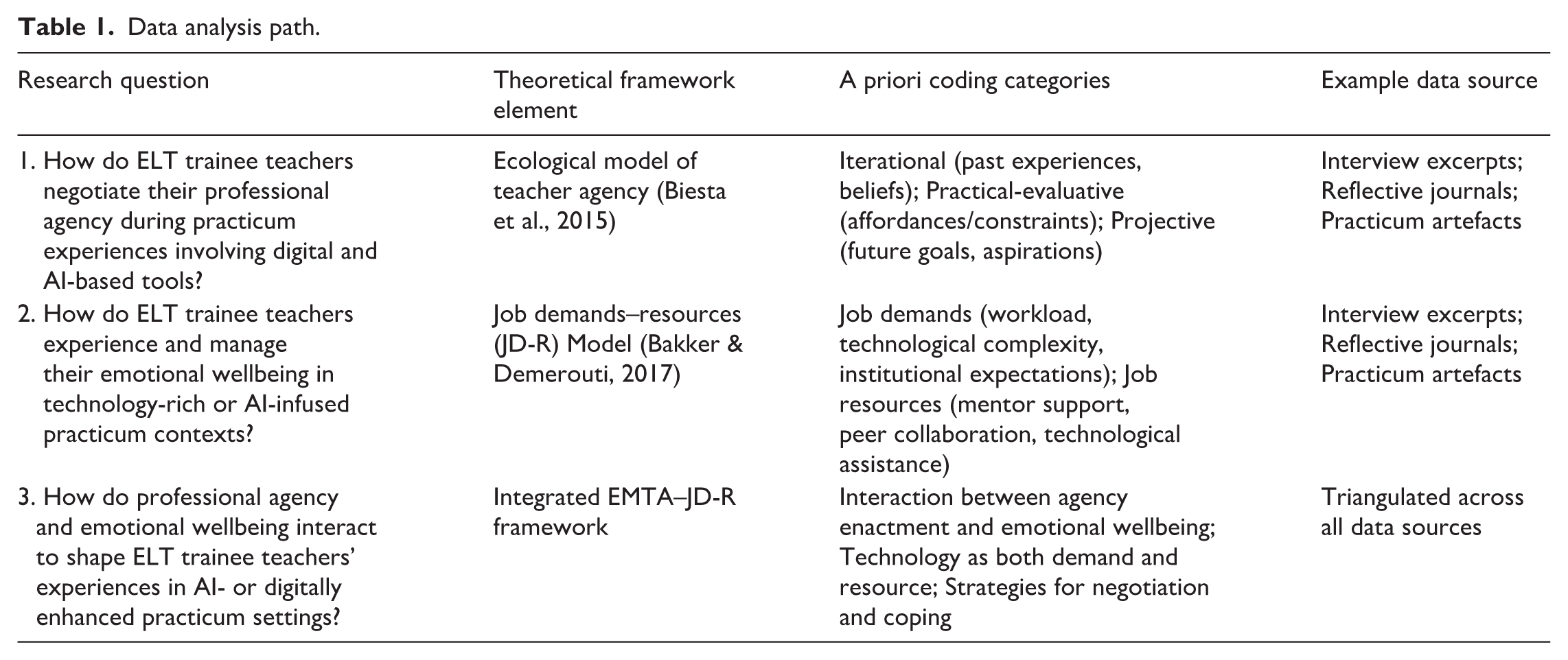
The data were analysed thematically following the six-phase process outlined by Braun and Clarke (2021). The analysis began with repeated reading of interview transcripts, journal entries, and artefacts to achieve familiarization. Initial coding was then undertaken using a combination of deductive codes derived from the EMTA (iterational, practical-evaluative, projective) and the JD-R model (demands, resources), as well as inductive codes emerging from the data.
Codes were subsequently collated into potential themes that captured patterns in how agency and wellbeing were negotiated in AI-rich practicum contexts (see Table 1). These themes were then reviewed and refined to ensure they were coherent and distinct, while also reflecting the dataset as a whole.
Data analysis path.
The study employed several strategies to enhance trustworthiness, following Guba and Lincoln (1994). Credibility was strengthened through member checking, whereby participants were provided with summaries of preliminary themes and invited to comment on their accuracy. Dependability was supported by maintaining a reflexive research journal documenting methodological decisions and analytic reflections. Transferability was enhanced by providing rich descriptions of the research context, participant characteristics, and practicum settings, enabling readers to judge applicability to their own contexts. Confirmability was achieved by triangulating across interviews, journals, and artefacts, thereby reducing researcher bias.
Ethical approval for the study was obtained from the relevant institutional review board prior to data collection. Informed consent was obtained from all participants, who were assured that participation was voluntary and that they could withdraw at any time without penalty. Pseudonyms were used in transcripts and reporting to protect anonymity.
VII Findings
The analysis produced six interrelated themes. Themes one to three address dimensions of agency, themes four and five examine emotional wellbeing, and theme six captures their intersection.
1 Negotiating agency through iterational resources
Participants frequently drew on prior experiences, personal beliefs, and role models when deciding how to incorporate AI and digital tools into their practicum teaching. For some, past exposure to educational technologies served as a confidence anchor.
When I was a language learner, my teacher used digital flashcards, but always adapted them to fit our class needs. I think that’s why I never accept AI output ‘as is’ – it has to reflect my style. (Aylin, Interview 1)
Several reflective journal entries revealed that participants relied on their accumulated pedagogical values to filter AI suggestions. In week 4, Levent noted: I used an AI writing prompt generator, but its topics were very Western-focused. Remembering my own experiences as a learner, I changed the prompts to include local culture. Students immediately engaged more. (Reflective Journal, Week 4)
These accounts highlight a consistent pattern of iterational agency, where teachers drew upon past experiences and professional values to assess the appropriateness of AI-generated materials. Instead of accepting technological output uncritically, they adapted and reshaped it to align with their learners’ cultural and linguistic contexts.
To illustrate this process, an artefact from Derya’s practicum showed an AI-generated idiom activity containing culturally distant expressions such as ‘kick the bucket’ and ‘hit the sack’. In the margins of the printed activity, Derya wrote notes including ‘change to Turkish equivalent’ and ‘add contextual explanation’, signalling her decision to revise the vocabulary to ensure cultural accessibility and learner comprehension. These annotations reflect how she retained the structural outline of the AI-generated task but reshaped its content based on her pedagogical values and prior learning experiences.
This blended descriptive–analytic evidence demonstrates the enactment of iterational agency: participants’ past experiences served as interpretive filters that guided their decisions about when to accept, reject, or adapt AI suggestions in culturally responsive ways. Such actions align with research question 1 by showing how agency is anchored in teachers’ accumulated experiential resources.
2 Practical-evaluative agency in real-time decisions
Participants frequently described moments in which pedagogical judgment had to be exercised instantly – often mid-lesson – when confronted with AI-generated materials that did not fully align with learners’ needs. These ‘on the spot’ adaptations reveal a form of practical-evaluative agency in which decisions were guided not only by the affordances and limitations of AI, but also by an acute reading of classroom dynamics and institutional expectations.
Murat’s account illustrates this responsiveness: ChatGPT gave me an explanation of the past perfect tense, but I could see my students’ eyes glazing over. I scrapped it mid-lesson and drew a timeline on the board instead. Sometimes low-tech just works better. (Interview 2)
Here, the decision to abandon AI-generated content was not rooted in a rejection of the tool’s accuracy but in an awareness of its ineffectiveness in the immediate moment. Murat’s pivot to a hand-drawn timeline demonstrates how embodied teaching knowledge can override digital preparation when student engagement is at stake.
Similarly, Esra’s reflective journal reveals an equally rapid yet different mode of intervention: The AI quiz had too many multiple-choice items. During the lesson, I turned some into open-ended questions to get more speaking practice. It was a split-second choice, but it felt right. (Reflective Journal, Week 7)
Esra’s shift from closed to open-ended questioning reframed the activity’s cognitive and interactional demands, promoting spontaneous speech production over recognition-based responses.
In a related practicum artefact, Esra transformed an AI-generated quiz that originally consisted of generic multiple-choice vocabulary items into a more communicative task. She replaced culturally abstract examples with locally relevant terms and added handwritten notes such as ‘increase speaking time’ and ‘connect to local context’. These edits reveal how practical–evaluative agency operates under temporal pressure: teachers recalibrate AI-generated tasks in real time to align with pedagogical goals and learner needs.
Together, these examples show how participants’ moment-to-moment judgments – guided by professional values, contextual sensitivity, and learner feedback – constituted a key mechanism through which agency was enacted in AI-rich environments, directly addressing research question 1.
3 Projective agency and future-oriented aspirations
Many participants reflected on how their practicum experiences shaped their long-term visions of teaching practice, often framing these reflections in terms of boundaries, conditions, and evolving expectations. These narratives revealed that AI was rarely perceived as an all-or-nothing presence in their future classrooms; instead, participants positioned it along a spectrum of utility negotiated according to their personal pedagogical identities, anticipated classroom realities, and trust in the technology’s cultural and linguistic alignment.
For some, AI emerged as an indispensable partner for specific, targeted purposes – particularly in supporting differentiation, stimulating creativity, and generating supplementary materials. In these cases, AI was envisioned not as a replacement for teacher expertise, but as an auxiliary resource that could be selectively integrated to enhance instruction without encroaching on what participants described as their ‘core professional space’. Ece articulated this clearly: In the future, I’ll probably use AI for brainstorming lesson ideas and creating supplementary materials. But I won’t let it touch my main teaching sequence – that’s my professional space. (Ece, Interview 2)
Other participants expressed a form of conditional optimism, with future adoption contingent upon improvements in contextualization and cultural responsiveness.
If the AI tools become better at understanding language learning contexts, I’d use them more. Right now, they still feel a bit ‘foreign’ to my students’ needs. (Hakan, Interview 1)
These reflections demonstrate the projective dimension of agency, where teachers use their practicum experiences to articulate future teaching identities and technological boundaries. Participants positioned themselves as gatekeepers who would integrate AI selectively and critically – reinforcing their professional autonomy while anticipating technological evolution.
By highlighting how teachers imagine future uses of AI while safeguarding autonomy, this theme contributes to research question 1 and lays conceptual groundwork for understanding the agency–wellbeing relationship explored in research question 3.
4 Emotional highs: Technology as a resource
For many participants, AI and digital tools were more than functional aids; they were energizing forces that reshaped both workflow and emotional engagement. Positive emotional states often emerged when technology reduced workload, enhanced creativity, or enabled more meaningful instructional design.
Selin’s account illustrates how efficiency gains could translate into renewed enthusiasm. By using an AI grammar checker, she reclaimed valuable preparation time and reinvested it in designing role-plays – activities she found both rewarding and pedagogically meaningful. This shift left her feeling ‘energized rather than drained’.
For others, emotional uplift came from moments of mastery, where participants felt they had unlocked new pedagogical possibilities. Can described learning how to train a chatbot to suggest CEFR-level activities, calling it ‘unlocking a secret tool’.
These narratives reveal how AI functioned as a job resource within the JD-R framework, reducing cognitive load and increasing teachers’ sense of competence, autonomy, and creative engagement. Such emotional highs directly address research question 2 by demonstrating how wellbeing is enhanced when teachers experience control, mastery, and alignment between technological tools and their pedagogical intentions.
5 Emotional lows: Technology as a demand
Alongside positive experiences, participants also reported emotional challenges associated with technology integration. These emotional lows were triggered when AI tools failed, added complexity, or misaligned with lesson goals.
Elif’s experience highlights vulnerability resulting from technological dependence. When an internet outage disrupted her AI-based lesson plan moments before class, she was forced to improvise, leaving her feeling the setback undermined her preparation and confidence.
Similarly, Deniz encountered frustration when AI-generated materials contained culturally irrelevant examples that required extensive correction under time pressure.
These accounts show how technology can function as a job demand, heightening stress and emotional strain when tools are unreliable, culturally misaligned, or institutionally mandated without adequate support. This theme advances research question 2 by illustrating how emotional wellbeing is shaped by the tension between technological expectations and classroom realities.
6 Interplay between agency and wellbeing
The findings suggest a strong reciprocal relationship between teachers’ sense of agency and their emotional wellbeing during practicum experiences. High levels of agency – defined as the ability to critically evaluate, adapt, and enact pedagogical decisions – were frequently linked to feelings of satisfaction, accomplishment, and engagement. Conversely, moments of constrained agency coincided with frustration, diminished motivation, and emotional fatigue.
Burak’s vignette demonstrates this synergy. By adjusting an AI-generated listening task to match students’ needs, he strengthened both the activity’s effectiveness and his own sense of professional competence, generating a positive emotional feedback loop.
In contrast, Aylin described feeling disengaged when required to use an AI-generated reading activity without modifications. Her comment about ‘just going through the motions’ reflects reduced autonomy and corresponding emotional depletion.
These examples directly address research question 3 by illustrating how agency and wellbeing interact: agency acts as a protective factor that supports emotional resilience, while diminished agency undermines teachers’ affective investment and instructional presence.
7 Cross-theme synthesis: Agency as the core mediator of teacher–technology interactions
Across the thematic analysis, a clear pattern emerged: participants’ experiences with AI, their emotional responses, and their professional growth.
In iterational contexts, participants drew on prior experiences and cultural knowledge to adapt AI materials. In practical–evaluative moments, on-the-spot decisions demonstrated how agency stabilized instructional practice under pressure. In projective reflections, teachers imagined futures where AI’s role remained subordinate to professional judgment.
The emotional themes further reinforced that agency was the central mechanism mediating teacher–technology interactions. Positive emotional states typically arose when teachers exercised agency in adapting AI tools, whereas emotional lows were common when agency was restricted by institutional mandates or technological limitations.
This synthesis addresses research question 3 by demonstrating that professional agency is not simply parallel to wellbeing but actively shapes and is shaped by it. Agency enables teachers to transform AI from a potential demand into a resource, thereby sustaining emotional resilience and pedagogical effectiveness.
VIII Discussion
Interpreted through the EMTA and the JD–R model, the findings illustrate that agency and emotional wellbeing in AI-mediated practicum settings function as reciprocally shaping processes. Rather than operating as separate constructs, the two domains interact dynamically as trainees navigate technological affordances, classroom contingencies, and evolving professional identities. The following discussion elaborates on each research question before synthesizing the broader implications for teacher development in AI-enhanced practicum environments.
1 Negotiating professional agency in AI-mediated practicum contexts
Participants’ professional agency manifested through interconnected iterational, practical-evaluative, and projective dimensions, consistent with EMTA (Eteläpelto et al., 2013; Toom et al., 2015). However, the findings indicate that these dimensions take on distinctive qualities in AI-mediated settings.
Iterational agency was evident in how trainees filtered AI-generated content through past pedagogical experiences, internalized teaching models, and personal values. This aligns with Toom et al. (2015), who emphasize the role of professional histories in present pedagogical judgement. Yet, in contrast to earlier work suggesting that past experiences often reinforce conventional practices (e.g. Ma & Zhang, 2025; J. Xu, 2025; Zhai & Chen, 2025), several participants used their prior knowledge to critically interrogate AI outputs. When trainees modified culturally inappropriate prompts or rejected generic algorithmic suggestions, the iterational dimension functioned as an active safeguard, preventing uncritical adoption of AI-generated materials. This reflects Lai and Morrison’s (2013) call for critical digital agency, demonstrating that iterational resources can empower teachers to resist algorithmic determinism.
Practical-evaluative agency emerged prominently in real-time instructional decisions, particularly when trainees adapted, combined, or rejected AI outputs to meet immediate classroom needs. These patterns resonate with Knox’s (2020) argument that contemporary teachers must continually weigh pedagogical affordances against contextual constraints. However, unlike Knox’s cautionary framing of algorithmic influence, this study shows that technological disruptions – such as malfunctioning devices or irrelevant AI suggestions – sometimes activated adaptive expertise. As in Vähäsantanen (2015), constraints did not uniformly diminish agency; instead, they served as catalysts for creative problem-solving, fostering a stronger sense of pedagogical authorship.
Projective agency was characterized by future-oriented aspirations shaped by both positive and negative experiences with AI. While some trainees envisioned using AI for differentiation and idea generation, others foregrounded maintaining authenticity and authorship in future teaching – an ambivalent stance similar to that observed by Karaduman (2025). Notably, several trainees articulated precautionary projective agency, where future professional aims were shaped not by enthusiasm for AI but by concerns about dependency, loss of originality, or institutional pressure. This extends current understandings of projective agency by illustrating that aspirational trajectories may be protective rather than purely innovative.
These findings suggest that agency in AI-mediated practicum contexts involves active negotiation rather than binary acceptance or resistance. The iterational dimension functions as a normative filter, the practical-evaluative dimension mediates contextual demands, and the projective dimension frames future teaching identities in ways that may be aspirational or precautionary. These patterns indicate that EMTA remains analytically valuable but must be expanded to account for the critical filtering and protective functions of agency in the era of generative AI.
2 Emotional wellbeing as a dynamic response to AI-related demands and resources
Analysed through the JD–R framework, trainees’ emotional wellbeing was shaped by whether AI and digital tools were experienced as resources or demands (Bakker & Demerouti, 2007). Yet the findings reveal a more nuanced picture than is commonly reported in research on teacher emotions.
When AI tools served as resources, participants reported positive affective states such as relief, satisfaction, and increased motivation. These emotional benefits often arose when trainees successfully mastered technological tools, customized AI outputs, or received supportive guidance from mentors. This corresponds with prior findings on positive emotions associated with effective technology integration (Cutrim Schmid et al., 2023; Lee, Mun et al., 2025; Sulis et al., 2024). Notably, the present study extends these insights by demonstrating that positive wellbeing was tied not to passive use of AI but to agentic mastery, echoing the critical digital engagement highlighted in research question 1.
When AI tools functioned as demands, participants described frustration, anxiety, and cognitive overload – experiences consistent with documented emotional challenges in digital teaching contexts (S. Lee & Song, 2024; Sun et al., 2024; Zawacki-Richter et al., 2019). However, emotional strain was particularly acute when technological demands coincided with diminished agency, such as institutional mandates requiring unmodified use of AI-generated materials. In these situations, wellbeing was undermined not only by the complexity of the tools but by the loss of autonomy in responding to them. These findings support Pyhältö et al.’s (2012) claim that agency can serve as a protective factor in challenging teaching contexts. Yet the present study refines this notion by showing that agency does not uniformly buffer emotional strain. When cognitive demands were high but participants retained autonomy, emotional experiences resembled eustress – a productive challenge aligned with Sonnentag and Fritz’s (2015) conceptualization of beneficial stress. Conversely, when both technological complexity and agency constraints were high, trainees entered a cycle of emotional depletion that eroded motivation and instructional confidence.
The findings further reveal a mismatch between traditional practicum support structures and trainees’ emotional needs in AI-mediated contexts. While mentors provided general pedagogical assistance, few offered strategies for managing the emotional dimensions of AI use, highlighting an emerging gap in teacher education.
Overall, emotional wellbeing in AI-enhanced practicum settings was not a static state but a dynamic product of demands, resources, and the degree of agency trainees could mobilize.
3 The reciprocal relationship between agency and emotional wellbeing
To illustrate this reciprocal relationship and the moderating role of AI affordances and demands identified in this study, Figure 1 presents a conceptual model synthesizing the dynamic interaction between agency, wellbeing, and AI-mediated practicum conditions. As shown in Figure 1, trainees’ practical-evaluative judgements play a central role in transforming AI-related demands into pedagogical resources, while emotional wellbeing both shapes and is shaped by the degree of agency they can exercise.
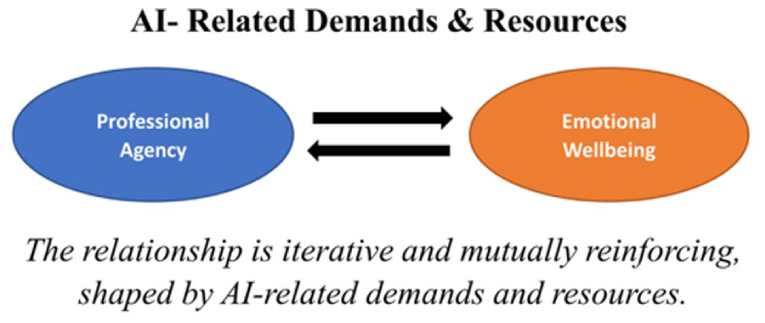
The Mediated Interaction Model of Professional Agency and Emotional Wellbeing in AI-Infused Practicum.
Across cases, practical-evaluative agency served as a central mechanism through which trainees interpreted and responded to AI-related demands. When trainees adapted or reshaped AI outputs, they effectively converted potential demands into resources, reducing emotional strain and increasing confidence. This conversion was shaped by iterational histories and projective aspirations, indicating that agency and wellbeing interact across temporal dimensions.
Positive emotional states tended to coincide with moments of high perceived agency, suggesting that autonomy provides an affective anchor during technologically complex tasks. Conversely, technological stressors that limited agency – such as rigid institutional policies – precipitated negative emotional cycles that depleted cognitive and motivational resources. These patterns reinforce Pyhältö et al.’s (2012) view of agency as a resilience mechanism while extending it by identifying conditions under which this buffering effect collapses.
A key contribution of this study is the identification of threshold points at which the agency–wellbeing relationship becomes unstable. When cognitive load exceeded participants’ adaptive capacity and opportunities for agentic action were restricted, wellbeing deteriorated, triggering downward spirals that further weakened agency. This suggests that the relationship between agency and wellbeing is nonlinear, with critical tipping points beyond which additional support becomes essential. Thus, findings highlight that AI-mediated practicum environments require teacher education programs to consider agency and wellbeing as mutually shaping components of professional learning. Understanding their interaction provides a more holistic account of how trainees navigate technological complexity and form emerging professional identities.
IX Conclusions and implications
This study examined how pre-service ELT teachers negotiated their professional agency and emotional wellbeing during practicum experiences in AI- and digitally enhanced contexts. The findings revealed that agency and wellbeing were not separate constructs but dynamically intertwined processes, shaped by the ways in which participants interacted with technology, institutional structures, and their own pedagogical values. The study showed how agency was enacted across iterational, practical-evaluative, and projective dimensions (research question 1), how wellbeing fluctuated in response to technology’s role as a resource or a demand (research question 2), and how these two constructs intersected to shape trainees’ overall practicum experiences (research question 3).
The findings confirmed that AI integration in practicum contexts could act as both an enabler and a constraint. AI tools expanded pedagogical possibilities when trainees retained the capacity to adapt content to local contexts, align it with personal teaching beliefs, and embed it into their identity as developing educators. However, when AI use was mandated without flexibility, or when technical and cognitive demands outstripped available resources, both agency and wellbeing suffered. These patterns support existing literature on the empowering potential and risks of AI in education (Knox, 2020; Lee, jeon et al., 2025; Weng & Fu, 2025) while extending it by identifying the threshold conditions under which the agency–wellbeing relationship either flourishes or deteriorates. Importantly, the study highlights that trainees did not respond to AI passively; rather, their emotional experiences were contingent upon the degree of control they exercised over technological inputs, reinforcing the centrality of agency in mediating emotional outcomes without implying direct causality.
From a theoretical perspective, the study demonstrated the value of integrating the EMTA with the JD-R model, showing how the practical-evaluative dimension of agency is closely tied to the demands–resources balance. The combined use of these models offers a more granular understanding of how teacher–technology interactions unfold, illustrating that the same AI-generated task can be experienced as empowering or burdensome depending on how trainee teachers mobilize their past experiences, real-time judgments, and future aspirations. This integration not only clarifies how technological tools impact teachers’ professional autonomy but also explains why such impacts are often accompanied by parallel shifts in emotional states. The study therefore contributes a theoretically grounded account of the agency–wellbeing intersection that moves beyond descriptive accounts of technology-related stress or enthusiasm.
From a practical standpoint, the study offers three key implications. First, teacher education curricula should incorporate explicit opportunities for trainees to develop critical digital agency, including the ability to evaluate, adapt, and selectively use AI-generated materials. This could include microteaching activities involving AI outputs, structured reflection tasks, or modelling by teacher educators of how to critically interrogate algorithmic suggestions.
Second, practicum mentorship should address the emotional dimensions of technology integration, equipping mentors to guide trainees not just in technical competence but also in maintaining wellbeing under conditions of technological change. Mentor training could incorporate case scenarios illustrating common emotional challenges related to AI use, such as technological breakdowns or culturally irrelevant AI content, and provide strategies for supporting trainees during these moments.
Third, institutional policies should ensure that AI adoption enhances rather than diminishes professional autonomy, avoiding one-size-fits-all mandates and providing flexibility for contextual adaptation. Clear guidelines that permit modification of AI-generated content, alongside reliable infrastructure and optional – not compulsory – technology use, can help prevent the erosion of both agency and wellbeing.
While this study offers nuanced insights into the interplay between professional agency and emotional wellbeing in AI-mediated practicum settings, several limitations should be acknowledged. First, the study draws on a relatively small sample of ELT trainee teachers from a single institutional and national context, which constrains the transferability of the findings to broader teacher education settings. Second, although rich qualitative data were collected, the study relied primarily on self-reported accounts; future research could incorporate classroom observations or multimodal artefacts to triangulate trainees’ agentic and emotional experiences. Third, the rapidly evolving nature of AI tools means that participants’ interactions reflect a particular moment in technological development; subsequent versions of AI platforms may introduce new affordances and challenges not captured here. Finally, while the study examined how trainees interpreted and navigated AI-supported tasks, it did not systematically analyse variations across different AI tools, proficiency levels, or institutional policy environments. These limitations point to the need for longitudinal, multi-site, and mixed-methods research to deepen understanding of how agency and wellbeing co-develop as AI becomes increasingly embedded in teacher education.
Footnotes
Appendix A
Appendix B
Funding
The author received no financial support for the research, authorship, and/or publication of this article.

Declaration of Generative AI and AI-assisted Technologies in the Writing Process
During the preparation of this work the author used Grammarly in order to edit and revise the language. After using this tool, the author reviewed and edited the content as needed and take full responsibility for the content of the published article.