






Abstract
This study investigated the role of accountable talk (AT) in fostering deeper learning and critical thinking in an English-medium instruction (EMI) classroom in Taiwan. Given the challenges students face in EMI settings, such as the cultural factors of face-preserving and the linguistic factors of varying English proficiency levels and difficulties with verbal communication, this research explored how AT can enhance discourse interactions and improve students’ engagement. Using a mixed-methods approach, the study examined students’ discoursal interactions, perceptions, and attitudes toward AT through discourse analysis, surveys, and interviews. Findings revealed that AT effectively promoted student engagement, encouraged verbal exchanges, and supported cognitive and linguistic development. The study identified key types of verbal interactions in AT activities and highlighted shifts toward inquiry-driven discourse. The integration of generative artificial intelligence (GenAI) for question generation was also analyzed, revealing its benefits for enhancing structured questioning and its limitations in maintaining contextual relevance and spontaneity. The study concluded that AT provides a valuable framework for improving student participation in EMI contexts, although the role of AI in facilitating these discussions remains an area for further exploration. Pedagogical implications emphasize the importance of structured scaffolding and instructor support to sustain AT practices in East Asian EMI classrooms.
I Introduction
English-medium instruction (EMI) has been widely adopted as a means of enhancing students’ English language proficiency and promoting internationalization, in line with global trends in higher education. Through EMI, universities seek to equip students with the skills required for participation in the global workforce and to foster international academic collaboration (Ibrahim, 2001; Wu, 2006). The growing prevalence of EMI worldwide, particularly in Asia, reflects these objectives. In Taiwan, the implementation of EMI forms part of a broader national strategy to internationalize higher education, with the aim of strengthening students’ English proficiency and global competitiveness.
Despite these goals, participation in classroom communication within EMI settings has been reported as challenging for many Chinese-speaking learners (e.g., Chou, 2023; Jiang et al., 2019; Tsou & Kao, 2017). One major difficulty lies in the use of academic language, which often requires students to articulate complex, discipline-specific concepts while operating in a second language (L2). This challenge is frequently compounded by difficulties in content comprehension (Lo & Fung, 2020), particularly when students have limited prior experience learning subject matter through English. Such challenges may affect students’ academic self-efficacy, or their confidence in performing academic tasks, which in turn can reduce their willingness to participate in verbal interaction. Previous research suggests that lower confidence is associated with decreased classroom engagement, thereby intensifying learning difficulties in EMI contexts (Thompson et al., 2022; C. Zhang & Dai, 2024).
In addition to linguistic demands, a range of contextual factors commonly reported in East Asian EMI settings may further influence students’ classroom participation. These include anxiety, concerns about face, instructional practices, and varying levels of language confidence. Studies have shown that Taiwanese EMI students often experience anxiety about speaking English and may be hesitant to contribute verbally due to fear of making mistakes or negative peer evaluation. Research from other East Asian contexts similarly indicates that limited teacher–student interaction and lecture-dominated instructional styles may constrain opportunities for student talk in EMI classrooms (Byun et al., 2010; Yeh, 2014). Moreover, students in contexts such as China, Japan, and Hong Kong have been described as less accustomed to interactive classroom discourse, which has been linked to limited emphasis on spoken communication and assessment-oriented learning environments. Cultural orientations toward group harmony and sensitivity to public evaluation may also shape students’ participation patterns, resulting in fewer voluntary contributions or reduced public verbal engagement (An et al., 2021; Feng, 2007; Kang et al., 2023; Wen & Clément, 2003). Collectively, these factors present ongoing challenges for EMI instructors seeking to promote active verbal interaction.
In response to these challenges, this study proposes the use of accountable talk (AT) as a pedagogical approach to support verbal interaction in East Asian EMI classrooms. AT is an instructional strategy designed to promote student engagement and meaningful classroom discourse by encouraging learners to articulate their reasoning, respond to peers’ ideas, and build shared understanding (Ardasheva et al., 2016; Clarke et al., 2013). Through structured teacher-led discussions and collaborative learning activities, AT provides students with guided opportunities to participate in academic talk in supportive and interactive ways (Kühl et al., 2019). AT practices involve specific discourse moves, such as eliciting, probing, revoicing, connecting, and building on ideas, that can help scaffold students’ contributions and reduce the communicative pressure often associated with spontaneous speaking in EMI contexts (Kupor et al., 2023).
Previous studies have shown that AT can enhance the quality of classroom interaction, expand learning opportunities, and support students’ participation in academic discourse communities (Ardasheva et al., 2016; Sohmer et al., 2009). Explicit instruction in AT, potentially supported by artificial intelligence (AI)-enabled scaffolding, has been found to further facilitate student engagement (Balyan et al., 2022; Kühl et al., 2019). Across diverse educational contexts, AT has been positively associated with student engagement, satisfaction, and academic achievement (Kupor et al., 2023; Sohmer et al., 2009). By providing structured discourse moves, shared responsibility for meaning-making, and explicit norms for respectful participation, AT offers a supportive framework that can help reduce linguistic anxiety and face-related concerns while increasing opportunities for student interaction. Rather than relying on spontaneous or individual verbal performance, AT encourages collaborative reasoning and guided participation, which may lower the perceived risk of speaking in English and foster more equitable classroom engagement in EMI settings. However, empirical research on the implementation and effects of AT in Asian EMI classrooms remains limited. To address this gap, the present study investigates how AT can encourage verbal interaction in a Taiwanese EMI context by addressing the following research questions.
RQ1. What are Taiwanese EMI students’ discoursal interactions while engaging in AT in the classroom?
RQ2. What are students’ perceptions of and attitudes toward engaging in AT in EMI lessons?
II Literature review
1 Discourse and interaction in EMI classrooms
Discourse analysis provides a lens for understanding how language is used in EMI settings and for informing pedagogical practice. In EMI university classrooms, various discourse-analytical frameworks, including conversation analysis, corpus-based discourse analysis, and critical discourse analysis, have been adopted to investigate how teacher talk and student interaction affect learning. For example, corpus-based studies (Ege et al., 2022) have systematically categorized lecture discourse strategies, while conversation-analytic work highlights turn-taking and translanguaging in classroom talk. While earlier EMI research has focused predominantly on lecture discourse and lecturer strategies for ensuring comprehensibility, recent studies increasingly emphasize interactional discourse and the need to design classroom talk that actively involves students in disciplinary reasoning (Dafouz & Smit, 2020; Smit, 2010). Rather than viewing discourse features solely as lecturer-controlled input strategies, AT-oriented research conceptualizes classroom discourse as coconstructed, with carefully designed tasks, norms, and questioning sequences that invite students to explain, justify, challenge, and build on one another’s ideas. In EMI settings, such interactional accountability is particularly salient, as students must simultaneously manage content understanding and English-medium participation (Morton & Llinares, 2017).
Lecturer talk has the potential to either limit or increase opportunities for accountable student participation, as demonstrated by discourse-analytical studies. For instance, interaction-focused analyses suggest that extended teacher turns and display-type questions frequently restrict student uptake and peer engagement, whereas corpus-based analyses of EMI lectures emphasize the importance of signposting, repetition, and reformulation in facilitating comprehension (Ege et al., 2022; Molino, 2018). In contrast, dialogic inquiry practices, which include probing for reasoning, revoicing student contributions, and inviting peer responses, establish interactional spaces that are more in line with AT norms (Michaels et al., 2008; Walsh, 2011). These results indicate that EMI teachers should progress from a simple awareness of discourse features to the intentional orchestration of interaction. This approach involves using questioning sequences and turn allocation to maintain accountable dialogue, rather than dominantly lecturing.
Peer interaction constitutes another crucial domain of discourse analysis in EMI classrooms, particularly in relation to AT task design. Studies of peer-to-peer talk in EMI show that students often draw on translingual resources to coconstruct understanding. For example, recent conversation-analytic research indicates that when students switch between English and their first language (L1) in small-group discussions, they collaboratively resolve comprehension breakdowns (Bozbıyık & Balaman, 2023). Such translanguaging peer exchanges create communal spaces for meaning-making, reinforcing mutual comprehension. Thus, collaborative tasks or discussion protocols are suggested to encourage EMI learners to use their full linguistic repertoire to support active learning and reduce comprehension barriers. In short, discourse analysis research demonstrates that careful attention to classroom discourse, from lecturer talk to student interaction, can improve EMI learning outcomes significantly.
In Taiwan’s EMI classrooms, where students often report high content knowledge but limited confidence in prolonged English-medium interaction, the design of AT routines is especially important. Empirical studies in the Taiwanese EMI context have documented students’ reluctance to initiate turns and challenge peers, particularly in whole-class discussions (Chang & Tsai, 2021; Huang, 2022). Discourse-informed AT practices such as structured peer discussion, sentence stems for reasoning, and explicit norms for responding to others’ ideas, thus, offer a pedagogically grounded way to address these participation challenges while respecting local classroom cultures. Therefore, discourse analysis not only explains interactional patterns in EMI classrooms but also provides an empirical basis for implementing AT as a context-sensitive interactional pedagogy in Taiwan’s higher education EMI.
2 AT in the classroom
AT and its tasks, a structured dialogic instructional method to stimulate higher-order thinking and reflection through communication, are prescribed activities in classrooms intended to foster student accountability for their learning outcomes and performance (Ardasheva et al., 2016; Hong Kong University [HKU], 2025). These tasks are crucial for enhancing student engagement, achievement, and active participation in the learning process. Students are more likely to exert effort in their scholastic pursuits when held accountable, resulting in improved academic outcomes (Black & Wiliam, 1998; Fredricks et al., 2004; Hidi & Renninger, 2006). This correlation between accountability and learning outcomes has been extensively observed in research. For example, Gehringer and Narang (2011), Hastie (1996), and McKeown (1977) emphasized that integrating accountable tasks into classrooms results in enhanced academic performance and increased engagement in learning.
Structured discussions, rigorous activities, and meticulously designed discussions are all components of practical, accountable tasks beyond mere evaluation. While gradually introducing students to academic tools and methods, these tasks encourage them to draw on personal experiences. Sohmer et al. (2009) further argue that AT tasks are most productive when students are explicitly supported in using disciplinary tools such as conceptual language, reasoning frames, or evidence-based argumentation during discussion, thereby linking talk to the goals of content mastery.
Accountable tasks with higher-order cognitive engagement are vital to optimize learning outcomes and enhance student motivation in classrooms; in the absence of adequate cognitive challenge, accountability measures may become ineffective, failing to promote meaningful learning experiences (Ordofa, 2022). Recent studies in EMI higher education settings underscore the importance of deliberately designed accountable tasks in promoting both language acquisition and subject matter expertise. Huang (2024) demonstrates that structured accountability frameworks, such as peer feedback, varied assessment methods, and consistent performance monitoring, not only promote student perseverance and enhance academic self-efficacy but also alleviate the difficulties associated with EMI environments. Collaborative classroom models and regular, constructive feedback further promote students’ engagement, achievement, and motivation, as argued by Li (2025) and corroborated by evidence on group work in EMI settings (Ataia & Maayah, 2025). These findings reinforce the view that AT should be understood as a pedagogically designed discourse environment that balances intellectual challenge with support.
AT provides a principled framework for reshaping classroom interaction in Taiwan's EMI context, where students frequently come from exam-oriented educational backgrounds and may be unfamiliar with dialogic classroom norms. AT enables students to comprehend the process of engaging in productive academic discussions in English-medium settings by explicitly defining the expectations for listening, reasoning, and responding. Consequently, AT functions as a context-sensitive discourse pedagogy that promotes learning motivation, equal engagement, meaningful interaction, and academic success among diverse student backgrounds in EMI classrooms (Hemberg et al., 2025).
3 Integrating AT tasks in EMI classrooms
AT can offer a productive framework for promoting equitable participation and deep learning in EMI classrooms, where students often vary in linguistic proficiency and academic readiness. In EMI contexts, AT functions not only as a classroom discourse practice but also as a pedagogical stance that emphasizes accountability to knowledge, reasoning, and community (Resnick et al., 2018). These dimensions are particularly relevant in multilingual classrooms, as they encourage structured opportunities for students to articulate, justify, and refine their understanding through dialogue. When adapted to EMI, AT can support both content mastery and language development by embedding purposeful communication and scaffolding academic language (Fung & Yip, 2014; Pun & Macaro, 2019). Recent studies across various disciplines have shown that dialogic approaches grounded in AT principles enhance conceptual understanding and engagement among multilingual learners (Buston & Lee, 2023; Coyle & Meyer, 2021). Thus, AT provides a bridge between communicative competence and disciplinary thinking in EMI teaching.
AT promotes a purposeful use of verbal moves that prompt reasoning, challenge ideas, and build upon peers’ contributions. Teachers' dialogic scaffolding can help transform discussions from recall-based exchanges to substantive engagement (Murphy et al., 2022), verbal strategies which are particularly valuable in EMI classrooms because they extend students’ opportunities for output and negotiation of meaning (Tsai & Tsou, 2015). In addition, allowing adequate wait time before expecting responses enables students to organize their thoughts and produce linguistically and conceptually richer responses. Moreover, multimodal supports, such as visual representations or selective code-switching, help enhance AT implementation while maintaining accountability to reasoning. The multimodality-informed AT tasks mediate students’ referencing shared representations, sustain discussion, and thus reinforce accountability to content knowledge by anchoring talk to disciplinary concepts (Lin, 2020). Through these pedagogical moves, EMI teachers can foster inclusive and intellectually demanding classroom talk consistent with AT principles.
Explicitly teaching the structures and norms of AT discourse further supports bilingual and culturally diverse students. By making visible academic dialogue conventions such as how to justify claims, reference others’ ideas, and use evidence, teachers enable students to participate with greater confidence and precision (Ardasheva et al., 2016; Mercer & Howe, 2012). EMI teachers can deconstruct academic discourse to demonstrate how proficient L2 speakers construct arguments, use hedging, or engage in respectful disagreement, enabling learners to operate in the L2 (Evnitskaya & Llinares, 2022). Such metadiscursive awareness aligns with AT’s focus on reasoning and evidence-based communication. When EMI teachers explicitly teach these skills, students can engage in more dialogic, reasoned, and inclusive conversations (Pun & Macaro, 2019).
In addition, recognizing students’ linguistic and cultural experiences as legitimate resources for sense-making strengthens accountability to the learning community. Within the AT framework, acknowledging linguistic and cultural heritages as legitimate knowledge constructs increases equity for participation. Encouraging students to relate academic ideas to familiar cultural or linguistic frames helps bridge everyday experiences and disciplinary registers (Li, 2025; Sohmer et al., 2009). Guiding learners from vernacular expressions toward academic discourse does not replace their linguistic identities; rather, it endorses their backgrounds while advancing conceptual understanding. This practice models how AT can be operated as a culturally responsive pedagogy within diverse EMI settings.
Ultimately, translanguaging practices can be strategically integrated into AT to foster accountability, critical thinking, and community engagement in EMI settings. In AT-oriented EMI classrooms, translanguaging functions as an interactional resource, allowing students to draw upon their entire linguistic repertoires and enabling them to engage more deeply in collaborative reasoning and express complex ideas beyond the limits of a single language (Durán & Palmer, 2014). Translanguaging-informed AT can foster metalinguistic awareness and empower students to take ownership of their learning (Tai & Li, 2022). Both AT and translanguaging share the pedagogical aim of creating dialogic spaces in which disciplinary reasoning becomes linguistically accessible and intellectually rigorous in EMI contexts. Hence, integrating AT principles into EMI contexts helps ensure that conversations are accountable and advance both linguistic development and content mastery.
In summary, integrating AT tasks into EMI classrooms requires more than adopting dialogic activities; instead, it entails the intentional alignment of scaffolding, multimodality, cultural resources, and translanguaging with AT’s accountability principles. When these pedagogical elements are framed explicitly as mechanisms for continuing accountable discourse, EMI classrooms can encourage inclusive participation, deeper engagement, and the simultaneous development of language and disciplinary understanding, and these interwoven concepts ground our current study.
III Research method
1 Research context and participants
The study was conducted at a national polytechnic’s English-medium international college, where most content courses are taught in English. Participants were second-year English majors (with expected CEFR B2 proficiency) enrolled in a required 3-hour seminar, Seminar on Hospitality, which aimed to bridge academic learning and industry practice. The course included expert lectures on hospitality-related topics and structured postlecture activities designed to promote active engagement with disciplinary knowledge. This context offered an appropriate setting for implementing AT, which emphasizes shared responsibility for knowledge construction, reasoning, and active participation within a learning community (Michaels et al., 2008). At the beginning of the semester, students were introduced to the principles of AT, with particular emphasis on disciplined reasoning, evidence-based responses, and collaborative sense-making. A self-developed workbook (Appendix A) outlined AT norms and provided sentence stems to support questioning and probing. These prompts were used consistently throughout the course and structured all postlecture activities, ensuring that discussion moved beyond passive listening to sustained engagement with lecture content.
Following each guest lecture, students engaged in a structured postlecture AT activity. Students first individually generated a set of content-based questions for which they already knew the answers, positioning themselves as knowledge holders and reinforcing accountability to content understanding. These questions were then refined collaboratively in small groups, where students evaluated wording, clarity, and cognitive demand, thus supporting accountability to reasoning and to the learning community. After refinement, students participated in paired, role-rotating dialogues. One student posed their questions while the partner responded, and each response was immediately followed by a probing follow-up question intended to elicit justification, elaboration, or connections to the lecture content, using sentence stems provided in the workbook. This two-stage questioning structure ensured that responses were not merely produced but were examined through disciplined reasoning, in line with the principles of AT (Michaels et al., 2008). Students then exchanged roles and repeated the process. All questions and responses were documented in students’ workbooks to make reasoning visible and to support accountability, and the classroom language lab system (SANACO) audio-recorded the dialogues to provide a complementary record of interaction. Although students were allowed to ask questions of the guest speakers, the primary locus of engagement was the postlecture AT activity, where students collaboratively built on peers’ ideas, justified responses with evidence, and listened attentively: practices central to AT (Michaels et al., 2008). Documenting responses in the workbook served to make reasoning visible and to reinforce accountability, while also generating a record for discourse analysis. We acknowledge that simultaneous writing and speaking may have constrained conversational fluency for some students; however, this limitation was mitigated through complementary audio recordings and instructional emphasis on the quality of reasoning rather than the quantity of written responses.
Beginning in Week 10, generative AI (GenAI) was selectively incorporated to examine its potential role in supporting students’ question generation within AT. AI tools (e.g., ChatGPT) were permitted only during the collaborative refinement of first-round questions, allowing students to draw on AI suggestions while critically evaluating and adapting them for relevance and accuracy. To preserve students’ responsibility for dialogic reasoning, all second-round probing questions which are central to AT were generated without AI assistance. This constrained integration of AI aligned with the study’s aim of investigating whether AI-assisted initial questions would influence the depth and quality of subsequent peer discussion, rather than replacing students’ reasoning processes. Throughout the activity, English was used as the primary medium of interaction, with minimal L1 use allowed for clarification.
2 Instruments and procedures to collect data
Data were collected through surveys, interviews, and transcription of classroom dialogues. Two rounds of questionnaires were administered online (via Google Forms) at mid-semester (Week 9) and semester end (Week 18) to capture learners’ perceptions over time. The first, self-developed survey (Appendix B) included two demographic items, 10 Likert-scale statements (rated 1 = “strongly agree” to 5 = “strongly disagree”), and two open-ended questions. These items were aligned with core dimensions of AT, focusing on students’ perceived engagement in evidence-based justification, attentive listening, and building on peers’ ideas: key indicators of accountability to knowledge, reasoning, and the learning community (Talmy & Mashal, 2024). The first survey focused on students’ initial experience using AT and its perceived effects on content understanding and peer interaction. The instrument was piloted for clarity with a comparable group, refined and demonstrated high internal consistency (Cronbach’s α = .962).
The second questionnaire retained the core AT items to allow longitudinal comparison and added items addressing students’ experiences with AI-assisted question generation. Five additional Likert statements and one open-ended question asked students to compare AI-generated and human-generated questions in terms of perceived quality and discussion value. This survey also showed strong reliability (Cronbach’s α = .957). Both surveys were analyzed in SPSS using descriptive statistics to summarize overall trends. We conducted exploratory t-tests and analyses of variance (ANOVAs) to check for differences by gender or English proficiency, although no significant differences were found, these analyses served to rule out potential demographic or proficiency-related confounds and to ensure that observed patterns were not attributable to subgroup variation.
To further contextualize the survey findings, in-depth semi-structured interviews were conducted in Week 18 with six volunteer students (conducted in Mandarin to maximize the richness of responses). The interview protocol was informed by key patterns and ambiguities emerging from the survey data, with prompts designed to elicit students’ explanations of how AT activities and AI-assisted questioning shaped peer interaction and follow-up questioning. Each interview lasted approximately 1 hour and was audio-recorded. Transcripts were generated using a commercial transcription tool and manually checked for accuracy, capturing students’ reflective accounts of their experiences with AT and AI-supported questioning.
3 Data analysis
The interview transcripts were inductively analyzed by employing grounded theory methods. One researcher and one assistant independently conducted open coding, examining each transcript line by line to label key concepts related to students’ AT experiences and perceptions of AI assistance. We employed a constant-comparative approach: as codes were generated from each interview, they were continually compared across interviews and were refined (Möller et al., 2021). Through iterative discussion, initial codes were grouped into broader categories (axial coding) and were ultimately distilled into core themes (selective coding). For example, codes related to “using more L2” and “listening attentively” were merged under the theme of “Increased L2 usage and class engagement.” Throughout this process, the researchers noted ideas and hypotheses. Disagreements in coding were discussed until a consensus was reached, ensuring that the final themes accurately reflected the data. This systematic coding process is consistent with Birks and Mills’s (2015) and Tie et al.’s (2019) practical guidelines for conducting grounded theory research.
Verbal data from the classroom AT activities were analyzed to examine question usage in practice. After each session, students submitted the worksheet transcripts of their discussions; the instructor also provided the SANACO audio files to cross-check. Each question asked during the paired dialogues was coded by type and function (e.g., factual check, inferential, connection-making, and explanation) according to AT discourse analysis conventions. Two coders (the first author and an experienced assistant) independently coded all questions. One coder identified and labeled questions in 100% of the transcripts, and the other coded a 10% random sample. The coders achieved 95% agreement on this subset, indicating high reliability. All coding discrepancies were discussed and resolved. We then compared the distribution of question types in the pre-AI period (Weeks 1–9, when all questions were student-generated) with that in the AI period (Weeks 10–18, when first-round questions could be AI-assisted). This allowed us to determine how the introduction of GenAI tools influenced the nature and function of students’ questioning skills during AT.
Throughout data analysis, we adhered to rigorous qualitative standards. For example, noting and constant comparison ensured that emerging interpretations were grounded in the data (Tie et al., 2019). The high Cronbach’s α values and consistent coding practices lend confidence to the reliability of the survey and interview findings. In short, our mixed-methods analysis combined quantitative survey insights with in-depth qualitative analysis of student talk, adhering to best practices in classroom discourse and grounded theory research.
IV Results and discussion
1 Types of verbal exchanges in the AT activities
Regarding the first research question regarding Taiwan EMI students’ discoursal interactions while engaging in AT in the classroom, Table 1 lists the types of verbal exchange percentages in the AT activities before and after Week 9.
Types of verbal exchange percentages and occurrences in the AT activities.
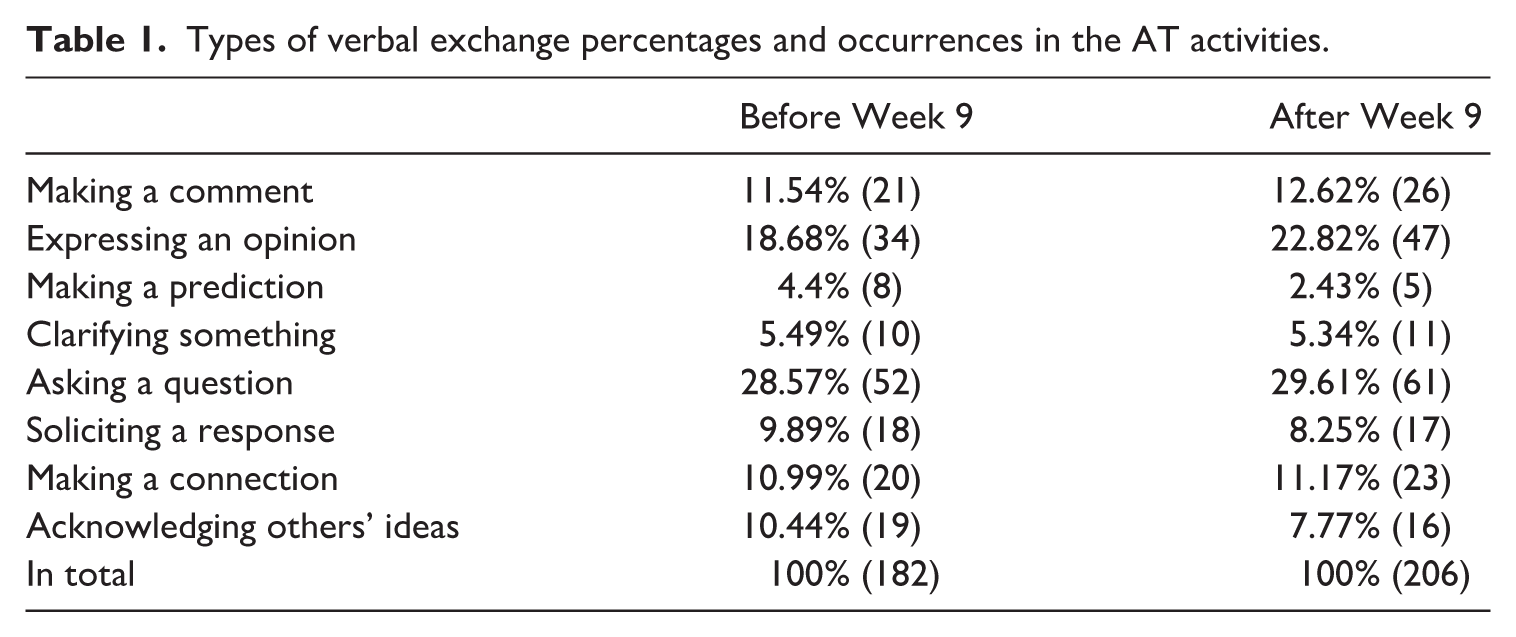
Table 1 provides the types of verbal exchange percentages in the AT activities before and after Week 9. Although the differences might not be very conspicuous, the results still show that there were increases in making a comment (from 11.54% to 12.62%), expressing an opinion (18.68% to 22.82%), asking a question (28.57% to 29.61%), and making a connection (10.99% to 11.17%). On the other hand, there were decreases in making a prediction (4.4% to 2.43%), soliciting a response (9.89% to 8.25%), acknowledging others’ ideas (10.44% to 7.77%), and clarifying something (5.49% to 5.34%). Moreover, the percentages of the increased categories were higher than those of the decreased categories both before and after Week 9. It appears that more focus was placed on contributing new ideas and questions than on reacting to others.
As participants became more comfortable, they demonstrated increased confidence in sharing personal views and posing questions. The observed upward trend in questioning reflects cognitive engagement, defined as the degree to which learners invest mental effort and apply deep learning strategies to comprehend, process, and master academic content (Barlow et al., 2020; Fredricks et al., 2004). In addition, the modest increases in making a connection and making a comment indicate that participants were attempting to link new information to their prior knowledge and to provide constructive feedback. On the other hand, the decreases in behaviors such as making a prediction, soliciting a response, and acknowledging others’ ideas may indicate a shift in classroom interactions. Students prioritized generating new ideas and asking questions rather than focusing on reactive or supportive responses, as evidenced by the higher percentages in these categories.
Take the following excerpt for example:
Can you tell me which animal you think you are?
I think I’m owl’s type person.
Tell me more about owl’s type person.
Then let me give an example. Rather than using feelings to recognize the truth of things, I prefer analyzing logic and data to understand the full extent of things.
Indeed.
This excerpt illustrates a productive verbal exchange facilitated through questioning and acknowledgement. Speaker A demonstrated active engagement by posing a follow-up question to encourage Speaker B to elaborate on his initial response. When Speaker B provided a detailed explanation, Speaker A acknowledged it with validation (“Indeed”), promoting a sense of mutual respect and continuity in the dialogue.
The results support previous studies that emphasized the role of active teaching of AT practices in fostering engagement and interaction. The observed increases in behaviors such as expressing opinions, asking questions, and making connections support findings that AT encourages active participation, cognitive engagement, and sharing ideas (Kupor et al., 2023; Sohmer et al., 2009). In addition, the trend of participants contributing new ideas rather than merely responding to others suggests a shift toward deeper, inquiry-driven learning, which previous research has linked to well-designed interactive activities.
Here is another example:
What do you think the importance of listen, especially in our hospitality industry?
Must be make customers more satisfied, people come here to relax themselves so we have to be a GOOD listener!!
That’s true! But how to lead the customer to express their thought?
Well, leading a person to talk and express their own idea is not an easy thing. But you can using open-ended question and summarize their thought at the same time did work.
This interaction demonstrates how effective questioning and active listening are essential for fostering meaningful communication in the hospitality industry. Speaker C began by prompting a discussion on the importance of listening, and Speaker D responded by emphasizing customer satisfaction and the need to be attentive. When Speaker C followed up with a more specific question on encouraging customers to express their thoughts, Speaker D provided a practical strategy, suggesting using open-ended questions and summarizing customers’ responses to facilitate expression.
These patterns align with research highlighting the role of AT practices, eliciting, probing, revoicing, and connecting, in deepening academic engagement and promoting richer classroom dialogue (Kupor et al., 2023). The rise in question-asking, in particular, reflects AT’s potential to cultivate students’ cognitive engagement, encourage curiosity, and stimulate critical thinking by prompting them to seek clarification, explore alternatives, and extend lines of reasoning (Kühl et al., 2019; Truxaw, 2020). This shift toward more inquiry-driven participation suggests that students were not only responding to prompts but actively shaping the direction of the discussion. Furthermore, the increased generative moves indicate a growing willingness to contribute original ideas and make meaningful connections. Overall, the findings strengthen the claim that AT enhances verbal interaction, deepens intellectual engagement, and supports more robust academic discourse in EMI classrooms.
Regarding the instructional design, in the beginning, sentence patterns helping learners increase AT were provided as structured ways for students to express their ideas, participate in discussions, and build their confidence in academic discourse. This reduced the mental burden of figuring out how to phrase ideas, and helped learners focus on the EMI course content. For EFL university students, integrating these sentence patterns into classroom activities can improve their AT skills while building their confidence and fluency in English. Over time, the students master these patterns and produce academic language structures. In other words, the instructional design provided scaffolding learning environments by breaking complex communication into manageable patterns so that they could practice the AT skills in academic contexts. The results showed that by effectively integrating various accountability measures, educators can help students maintain their motivation and enhance their academic performance (Frederiksen & White, 2004; Tinning & Siedentop, 1985).
2 Students’ perceptions of using AT in EMI courses
The results of the questionnaire can answer RQ2: “What are students’ perceptions of and attitudes toward engaging in AT in EMI lessons.”
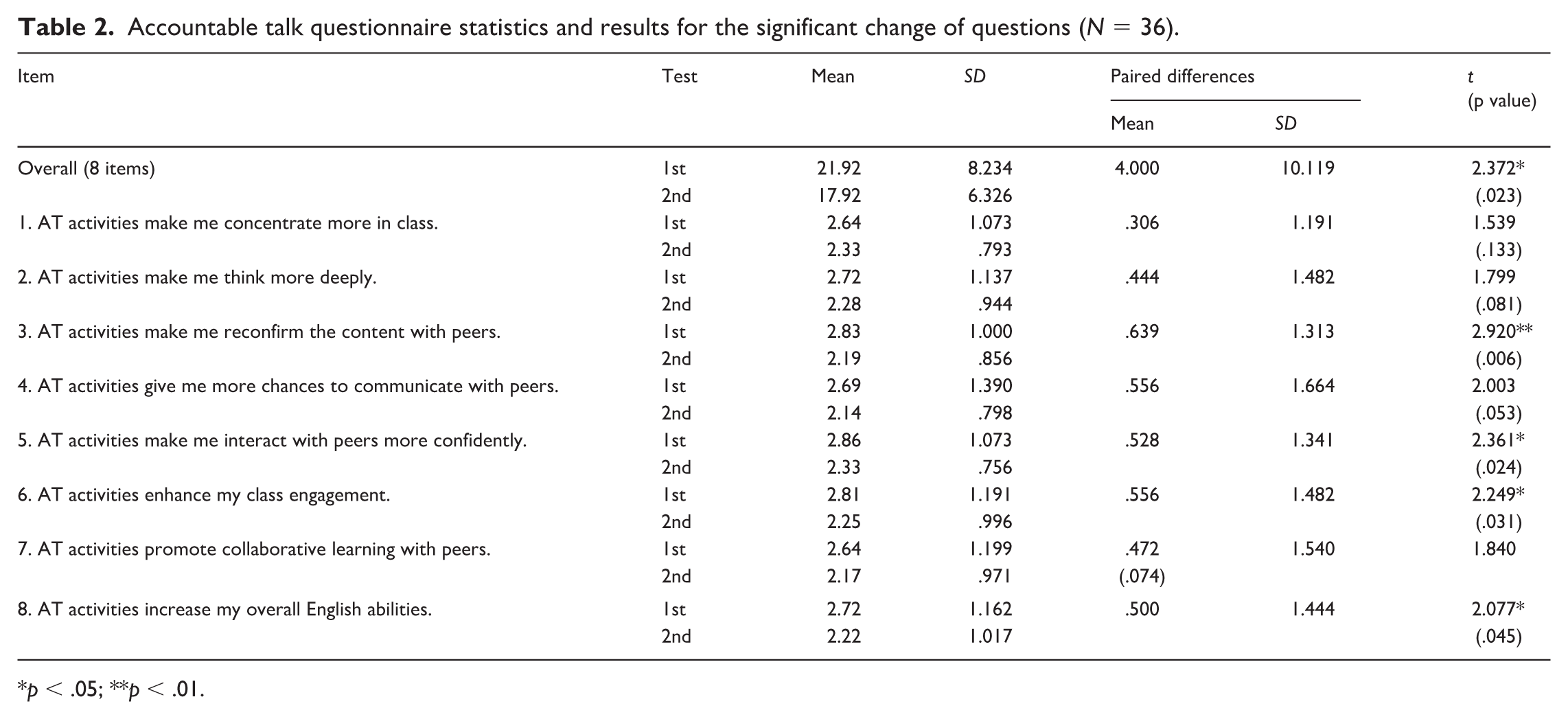
The reliability of the AT questionnaire achieved a Cronbach's alpha of .96 for the first test and .96 for the second test, indicating high reliability (Gliem & Gliem, 2003) and high internal consistency in the dataset. We explored differences in the students’ perceptions of and attitudes toward AT expressed in the first and second surveys. As indicated by Table 2, the repeated measures t-test revealed a significant difference in students’ perceptions of and attitudes toward AT between the two surveys (t = 2.372, p = .023 < .05). The mean score (21.92) for the first survey was 4.00 points higher than that of the second survey (17.92). It appeared that in the early stages of the course, students were introduced to the concepts of AT and found it novel and intriguing. They were motivated and invested more effort in understanding and mastering this teaching approach to discussion. Over time, the continuous use of AT seemed to help students internalize its procedures and employ them more routinely, possibly making it a familiar scaffold for their learning. The consistent use of this method appeared to enhance abilities such as active listening and critical thinking, promote communication, and refine reasoning, effects aligned with findings from previous studies (Ardasheva et al., 2016; Bailey, 2020; Kupor et al., 2023). However, as students became more accustomed to AT, the novelty may have diminished, producing a pattern similar to the “ceiling effect” described in earlier research (Almudibry, 2022). This reduction in novelty and stimulation might have contributed to smaller gains in later stages (Han, 2022; Lee et al., 2025). Future implementations could encourage students to design a wider variety of question types to sustain engagement and cognitive challenge.
Accountable talk questionnaire statistics and results for the significant change of questions (N = 36).
p < .05; **p < .01.
We then explored the difference between the first and second test item by item. The results showed that the mean scores of all items in the first test were higher than those in the second. As Table 2 indicates, Items 3, 5, 6, and 8 showed significant differences. For example, Item 3 showed a significant difference between the first test (mean = 2.83) and the second test (mean = 2.19). The D-score was .639, and the t-value was 2.920 (p = .006 < .05). It could be assumed that students verified the accuracy of their understanding of the subject content with their classmates through accountable tasks. In addition, Item 5 indicated that embedding AT in the course helped students communicate more confidently, especially in the first test, where the score was significantly higher by .528 points compared with the second test. It also differed substantially for Item 6, with a D-score of .556, and for Item 8, with a D-score of .50. Overall, these patterns suggest that AT had a strong initial positive influence on students’ participation and engagement. Consistent with findings from previous research (Ardasheva et al., 2016; Bailey, 2020; Kupor et al., 2023; Sohmer et al., 2009), students may have been particularly motivated early on to apply AT for verifying content, building communication confidence, and enhancing English proficiency. Nevertheless, as noted in the literature on the “novelty effect” in technology-mediated and language-learning interventions (Peng et al., 2021; Rodrigues et al., 2022; Y. Zhang & MacWhinney, 2023), the decreased scores in the second test might reflect a gradual reduction in enthusiasm once the activity became more familiar.
Furthermore, the open-ended questions show that before Week 9, the students’ major feedback centered on their concern about English deficiency in designing grammatical and proper questions due to their limited vocabulary. In addition, they expressed their worries about speaking fluently and comprehending their peers’ questions during the activities. However, they appreciated the chances to talk in English, practice speaking, respond to questions, think deeply and critically, listen to the guest’s talk and classmates’ questions attentively, and reflect on their content learning while engaging with AT, which evidenced the benefits of empowering learners to be accountable for their learning community, knowledge and rigorous thinking (Victorian Department of Education and Training [VDET], 2017). In contrast, in the second survey, students reported that AT activities increased their English-speaking ability and confidence in using English, and enriched their knowledge of the operations of different jobs in the hospitality industry. Yet, they also revealed the concern that AI was not as helpful as they had assumed in assisting them in designing questions, as most of the questions were very decontextualized and culture-insensitive, meaning their peers could not understand or answer the questions. They wrote that these limitations of using GenAI might come from their improper prompts or the AI’s lack of contextual clues of the speech content. Worry about overreliance on GenAI was not found in their responses; instead, they showed their learner agency and accountability to make learning and engagement happen. The additional five questions about the effects of AI-assisted learning asked in the second survey also support the students’ open-ended answers in that they held a relatively neutral or hesitant attitude toward using GenAI to assist in designing questions while engaging in AT activities. Compared with the first 10 questions, these five AI-related questions have lower agreement with the respective means: 2.73, 2.41, 2.51, 2.84, and 2.57. Again, their significant doubts (Q.11) came from whether the questions designed by GenAI can appropriately fit their contexts and needs, and whether they need extra training on how to prompt effectively to elicit better responses from GenAI (Q.14). These opinions were consistent across gender and English proficiency variables, demonstrating students’ reflexive attitude toward the cautious use of GenAI.
This ambivalent stance aligns with broader research on student perceptions of GenAI in higher education. While students acknowledged its benefits for efficiency and idea generation, they remained cautious about its reliability, contextual fit, and academic integrity (Almassaad et al., 2024; Cheng et al., 2025). Studies show that attitudes toward GenAI are shaped by learners’ AI competence: those with greater confidence and literacy report more positive experiences (Huynh & Khoa, 2025; Yan et al., 2025). In language learning, GenAI is valued for enhancing feedback and writing fluency, yet concerns persist about overreliance and transparency (Compagnoni et al., 2025). Overall, students’ hesitancy reflects critical awareness rather than resistance, underscoring the need for guided instruction and AI literacy to ensure responsible and effective use.
In summary, the results revealed that students initially responded positively to the AT approach, finding it novel, motivating, and beneficial for enhancing communication, critical thinking, and English proficiency. Over time, however, their enthusiasm slightly declined as AT became a familiar learning routine. When GenAI tools were introduced to assist in question design, students demonstrated a reflective but cautious attitude, acknowledging both the potential and limitations of AI-assisted learning. Their responses highlight a strong sense of learner agency, balanced with critical awareness of contextual and ethical challenges, suggesting that future implementations should integrate explicit training in AI literacy and prompt design to maximize both engagement and learning outcomes.
3 Interviews with the EMI learners
In addition to the two surveys, we interviewed six students about their perceptions of and attitudes toward AT, all of whom reported that the AT activity was a first-time learning experience in EMI courses. We identified three major themes, which are discussed in the following.
a Enhanced deep thinking and collaborative learning
AT fosters an environment where students engage in unscripted, meaningful dialogues, enhancing their ability to think deeply and evaluate information effectively. This approach moves beyond rote memorization, encouraging learners to process content profoundly and articulate their understanding coherently. Ardasheva et al. (2016) found that structured, discourse-intensive instructional approaches such as AT improve classroom interactions and expand learning opportunities for English learners. Students reported that such practices enabled them to participate more equally in classroom dialogues, enhancing their deep thinking skills and student agency (Alexander, 2008). One student noted the necessity for quick thinking:
“I think this requires more spontaneous responses because you never know what the other person will ask.”
Another student remarked, “Compared to English conversation classes, it’s more natural and free-flowing” and “We need to think more about the answers because most questions are not yes/no questions. My peers tended to ask the situational if-questions which I have never thought about before but they triggered my deep thinking. Perhaps I’ll face the same situation in the future.”
In addition, AT emphasizes collaborative learning, where peer interaction is essential. The success of using this approach relies heavily on the active and equitable participation of all group members, fostering a supportive learning environment. As Lantolf and Throne (2006) argued, peer-mediated interaction in L2 learning can facilitate deeper processing and retention. In AT activities, students must help their team members understand the discussed content by paraphrasing, rephrasing, using examples, engaging in active listening, and building upon each other’s contributions. This collaborative effort enhances the learning experience for all students (VDET, 2017). Highlighting the effect of peer engagement, one student observed: “If both students take the class seriously, the communication will be smoother”; another reported, “Some classmates aren’t really engaging in the process. This makes the talk and interaction very awkward because they seemed to be lukewarm about the activity. Indeed, who you work with really matters. However, personally I enjoyed the activities and talking with classmates. We seldom had to talk in English for such a long time in any other class.”
b Increased English usage and class engagement
Engagement in AT compels students to use the target language more frequently and contextually, thereby improving their language proficiency. This consistent practice and interactional scaffolding from peers or instructors enhance vocabulary, grammatical accuracy, fluency, complexity, and overall communicative competence (Gibbons, 2006). AT moves learning forward by ensuring students are accountable to the learning community and have accurate knowledge and rigorous thinking; thus, it can promote active listening and the use of precise language (VDET, 2017), which are crucial for language development. Reflecting on language improvement, one student shared: “Compared to before, my accuracy in using English has definitely improved,” and another student commented, “My English usage has increased significantly.”
Formulating well-structured questions in English can be demanding for EMI students, but ChatGPT offers a helpful scaffold for refining sentence structures and vocabulary at a deeper level. The interviewees emphasized that ChatGPT helped them structure their questions more clearly and improve their grammatical accuracy. These similar affordances for scaffolding sentence formation and language-focused practices are also found in the works of Ali et al. (2024) and Wang and Dang (2024). In addition, some students appreciated that ChatGPT offered alternative ways of asking questions they might not have considered, broadening the depth of discussion and, at times, prompting higher-order thinking through varied question framings (Mutanga, 2025). They made comments such as “If my sentence is too short, I’ll use ChatGPT to refine it and see how it can be improved,” “ChatGPT generates different types of questions based on the topic we input, and I can choose the most suitable ones,” “It generates different categories. For example, when I entered ‘luxury goods’, it gave me questions about jewelry, branding, and other aspects. AI can offer more options which I may not consider.”
Student engagement in AT was found to be significantly affected by the relevance of discussion topics to their personal experiences. When topics resonated with their lives, students were more motivated to participate actively, leading to deeper learning and retention. Students’ intrinsic motivation increases when they find tasks relevant to their personal lives (Ryan & Deci, 2000). Thus, when adopting AT in the classroom, teachers are encouraged to value students’ own rights and life experiences, which will help enhance their engagement and learning outcomes in classroom interaction. As one student mentioned: “If the topic isn’t related to our experiences, the questions we ask tend to be more superficial. For instance, the topic of technology feels a bit distant from our daily lives, and thus, when the guest speaker talked about the algorithm in AI, I was totally lost and couldn’t ask my classmates any questions. So, we simply kept silent.”
c Challenge of using GenAI to generate questions
Despite the benefits, the interviewees expressed one common concern with GenAI tools: the generated questions sometimes lacked relevance or were too detached from the specific classroom context, leading to off‑topic discussions or contextually inappropriate questions for peer discussions. Recent evaluations of the behavior of large language models (LLMs) show that models can generate plausible‑sounding but decontextualized prompts that do not reliably align with situated classroom needs (Chen et al., 2024; Slamet & Basthomi, 2025). Another criticism is that ChatGPT often generates structured or complex questions, which can make conversations less dynamic and more predictable to respond to. Unlike human discoursal interaction, which is rich in unpredictability, adaptation, and spontaneous topic shifts, LLM responses frequently follow recognizable patterns and may struggle to reproduce the interactive contingencies of human-to-human discourse (Ribeiro-Flucht, 2025). For example, the GenAI-generated questions such as “What are the challenges faced by the luxury industry in today’s market?” or “How does digital transformation affect customer experiences in the luxury industry?” which seem to be more complex and challenging for students to respond to than the human-designed questions, such as “How to search chatting topics with customers?” or “How to create more money than the majority of people?” In the scenarios of answering GenAI-initiated questions, students either kept silent or verbally produced single phrases such as “economic instability, counterfeit goods or changing customer behaviors” without giving complete sentences; in contrast, students gave longer and more engaging answers to human-designed questions, for example: “Yes, having insurance not only protects yourself but also gives your family a sense of security” or “Yes, I have the experiences of talking to Fu-ban’s salesman and he made a chat like this to me.” Apparently, GenAI tends to create grammatically accurate but decontextualized questions, which may not consider users’ language proficiency, familiarity with the topic, the perceived relevance of the questions, or personal and contextual differences, thus negatively impacting the engagement of AT and response quality.
Another concern students highlighted was that GenAI’s effectiveness relied on how well they formulated prompts, but many of them struggled to clearly prompt, leading to responses that were too generic or misaligned with their needs or expectations. Some of their comments are as follows: “ChatGPT sometimes generates questions that are too advanced—even I don’t understand them, let alone my classmates. Sometimes, it goes off-topic and doesn’t align with what we intended to discuss’; ‘ChatGPT’s questions are very structured, and its answers are often predictable, unlike the flexibility of student-designed questions. Besides, we haven’t learned how to give precise prompts, so sometimes its questions are too technical or abstract’; and ‘ChatGPT is useful, but we can’t fully rely on it—we still need to filter and adjust its questions ourselves.”
The students’ responses show that good outputs depend on precise inputs, and unfamiliarity with creating effective prompts would burden learners with cognitive demands (Murray & Pérez, 2022).
Overall, it can be briefly concluded that our interview data generally corresponded to the findings of the two surveys. The students held positive attitudes toward engaging in AT in EMI classrooms as it allowed them to speak English more frequently than usual and to develop critical thinking skills through interactive exchanges, making them accountable for their learning (Kühl et al., 2019). However, introducing a GenAI tool did not significantly affect their interactions when it was used to generate questions instead of answers.
V Conclusion and implications
The present study has examined the discoursal exchanges, perceptions, and attitudes of Taiwanese university students who engaged in AT activities in an EMI course over one semester. The findings suggest that AT may support critical thinking, collaborative learning, and English language development. Classroom discourse analyses indicated that students tended to move from more reactive verbal behaviors, such as acknowledgment and clarification, toward more goal-oriented exchanges, including expressing opinions, posing questions, and making connections. This shift points to increased cognitive engagement and greater confidence in academic English use, although these developments should be interpreted cautiously given the study’s scope.
Quantitative results from the AT questionnaire showed relatively high levels of initial engagement, with a slight decline over time, possibly reflecting a ceiling or novelty effect (Almudibry, 2022). Patterns in the data indicate that higher-proficiency students appeared to demonstrate more immediate gains in fluency, accuracy, and participation, whereas lower-proficiency learners benefited from increased exposure to structured interaction and scaffolded practice. However, these trends do not imply fixed proficiency-based differences, as individual factors, such as self-efficacy, learning strategies, and group dynamics, also shaped students’ interactional engagement. Student reflections further highlighted the importance of peer collaboration in promoting participation, whereas uneven involvement within groups occasionally constrained the depth and continuity of discussion.
With regard to the role of GenAI, the findings suggest that AI tools can offer limited but useful support in EMI classrooms. Students valued GenAI for assisting with grammatical accuracy, question formulation, and exposure to alternative questioning strategies that could prompt higher-order thinking. At the same time, participants noted that AI-generated questions were sometimes perceived as overly complex, insufficiently contextualized, or misaligned with classroom discourse, which limited their usefulness for spontaneous interaction during AT activities. These perceptions help explain why students did not view GenAI as a primary resource for question generation during collaborative discussions.
Several limitations should be considered when interpreting the findings. The study involved a small sample, which restricts generalizability. The one-semester duration may not capture longer-term effects of AT or GenAI on language development and engagement. In addition, the use of self-reported questionnaires and interviews may introduce response bias, and observational data were limited in scope. These constraints underscore the exploratory nature of the study and point to the need for cautious interpretation of the results.
Building on these limitations, future research could adopt longitudinal and multisite designs to examine the sustained effect of AT on discourse development, critical thinking, and language proficiency. Further studies may also explore pedagogically grounded approaches to integrating GenAI into discourse-oriented EMI classrooms, with particular attention to interactional competence and learner agency. Cross-cultural investigations could additionally examine how AT functions across diverse EMI contexts, taking into account local educational traditions and learner expectations.
In terms of pedagogical implications, the findings suggest that effective implementation of AT requires sensitivity to learner proficiency, motivation, and individual learning strategies. Designing varied and contextually meaningful tasks may help sustain engagement and reduce potential novelty effects. While GenAI tools can support language accuracy and question design, their use should be carefully mediated by instructors to ensure contextual relevance and to preserve opportunities for authentic, student-driven interaction.
In summary, this study contributes to a growing body of research by illustrating how AT can facilitate structured and meaningful classroom interaction in an East Asian EMI context. Although the findings are exploratory, they highlight the potential of AT to support collaborative inquiry and academic discourse, while underscoring the continued importance of human facilitation in technology-enhanced learning environments. By situating AT within the realities of EMI instruction, the study offers practical insights for educators and directions for future research.
Footnotes
Appendix A: Academic discussion sentence starters
Making a Comment:
Expressing an Opinion:
Making a Prediction:
Clarifying Something:
because. . .
because. . .
Asking a Question:
Soliciting a Response:
Making a Connection:
Paraphrasing what someone else said:
Acknowledging others ideas:
*Sources: Adapted from https://dl.icdst.org/pdfs/(a52770b4dbfb0e0b3810f84874234f24)
Appendix B: The survey
Funding
The authors disclosed receipt of the following financial support for the research, authorship, and/or publication of this article: National Science and Technology Council, Taiwan (112-2410-H-328-001-MY2).
