







Abstract
Community-based learning has become a popular approach in teacher education because it provides direct teaching experiences with English learners (ELs) and promotes theory-to-practice connections. However, little is known about how community-based learning differs from standard seminar learning, particularly regarding the development of self-efficacy among mainstream teachers who are increasingly working with ELs but often feel underprepared. Using a sequential explanatory design, this mixed-methods study examined how the two learning approaches (community-based learning and university-based seminars) influence self-efficacy among mainstream teachers. A total of 51 mainstream teachers (22 preservice and 29 in-service) in Texas, where ELs represent over 20% of the public school student population in the United States, participated in a year-long study aimed at enhancing their ability to integrate content and language instruction for ELs. They were assigned to either a community-based learning program or university-based seminars. Responses to presurveys and postsurveys were analyzed using multivariate regression to measure changes in self-efficacy. Interview transcripts were analyzed via three-sequence causation pathway coding to identify themes reflecting the development of self-efficacy at different time points. Teachers in the community group reported significantly greater growth in self-efficacy. Different developmental trajectories for self-efficacy emerged for preservice and in-service teachers, each reflecting distinct assets and needs, as they learned about teaching ELs in the context of community-based learning. Direct teaching experiences with ELs may promote greater self-efficacy among teachers than seminar learning experiences do. Community-based learning promotes different trajectories of self-efficacy development, with preservice teachers appearing to show more receptivity than in-service teachers to new teaching strategies.
Keywords
I Introduction
In US public schools, the population of English learners (ELs) from diverse multicultural and multilingual backgrounds has grown steadily, exceeding 5.3 million students (10.6%): an increase from 9.4% in 2011 (National Center for Education Statistics [NCES], 2024). This demographic shift is particularly pronounced in Texas, the setting of the current study, which hosts the nation’s largest EL population, approximately 1.3 million students, accounting for 20.2% of the state’s total enrollment (NCES, 2024). Furthermore, EL students tend to underperform compared with their non-EL peers in core areas such as reading and mathematics, highlighting the persist achievement gaps that require to be addressed through targeted instructional strategies and high-quality professional development (NAEP, 2024a, 2024b).
However, addressing these gaps effectively depends largely on the capacity of teachers to implement such strategies in the classroom. Unfortunately, research consistently reveals a significant gap in teacher preparation for EL instruction. Many mainstream teachers have limited access to specialized professional development and often experience low self-efficacy regarding their ability to support EL students (Gándara et al., 2005; Pasquarella et al., 2025; Villegas et al., 2018). This lack of training leaves teachers feeling underprepared to effectively integrate language development with content instruction, which can lead to exclusionary attitudes or instructional practices that restrict ELs’ educational opportunities (Lucas et al., 2015; Reeves, 2004; Stairs-Davenport, 2023). Moreover, these feelings of inadequacy often foster deficit perspectives, where educators mistakenly equate linguistic challenges with cognitive limitations, further hindering ELs’ academic potential (de Jong & Harper, 2005; Lee, 2019).
Central to improving teacher effectiveness and confidence is the concept of self-efficacy: the belief in one’s capability to execute actions that produce desired outcomes (Bandura, 1977). Teacher self-efficacy is a primary predictor of instructional quality, career commitment, and ultimately, student success (Bandura, 1977; Chesnut & Burley, 2015; Huang et al., 2025). To boost this critical attribute, many teacher educators advocate for community-based, practice-oriented learning models that involve direct engagement with EL students (Coady et al., 2011; Faez & Valeo, 2012). These models aim to bridge the theory–practice divide by situating learning within authentic classrooms and community settings, thereby fostering empathy and equipping teachers with practical instructional strategies through real-world application (Miles et al., 2020).
However, empirical evidence regarding the specific features that drive success in these models remains limited, particularly concerning their comparative impact against traditional university-based approaches (Flores et al., 2015; Polin, 2026). Furthermore, while efficacy beliefs are known to evolve, few studies have examined how these developmental trajectories differ between preservice and in-service mainstream teachers within community-based contexts (Tschannen-Moran et al., 1998; Wyatt & Dikilitaş, 2016).
To address these research gaps, the current study adopted a mixed-methods approach to compare two distinct models of teacher professional learning: a community-based model and a university-based seminar. Both were 1-year programs designed to strengthen mainstream teachers’ expertise in working with ELs. Quantitative data were used to measure changes in self-efficacy from the beginning to the end of their programs, whereas qualitative interviews provided nuanced insights into participant experiences and the evolving trajectories of their efficacy beliefs. The following research questions guided the study.
RQ1. Did teachers in the two professional learning programs differ significantly in self-efficacy gains regarding EL instruction?
RQ2. Which specific components of each program did teachers identify as the most influential sources of their self-efficacy?
RQ3. Did preservice and in-service teachers differ in reactions to the programs and in the development of self-efficacy beliefs?
II Literature review
1 Self-efficacy in teacher education
Research shows that teacher self-efficacy is critical for effective instruction and student achievements. High self-efficacy links to high-quality instruction (Tschannen-Moran et al., 1998), successful implementation of new strategies (Lakshmanan et al., 2011), and increased student engagement (Burić & Kim, 2020). Conversely, lower self-efficacy can diminish motivation (Bandura, 1977) and hinder pedagogical innovation (Chesnut & Burley, 2015; Tschannen-Moran et al., 1998). Bandura’s (1997) four sources, mastery experiences, vicarious experiences, social persuasion, and physiological/emotional states, are foundational to understanding how teachers develop efficacy beliefs. Tschannen-Moran et al. (1998) emphasize that mastery experiences, defined as teachers’ accomplishments in actual teaching contexts, are the most authentic and influential, involving direct engagement with instructional tasks that reinforce confidence and perceptions of competence. Vicarious experiences, such as observing experienced teachers or mentors, also contribute significantly, especially during practicum or community-based learning (Faez & Valeo, 2012; Phan & Locke, 2015). Social persuasion, such as verbal feedback and encouragement, can provide temporary boosts to self-efficacy, but mastery experiences generally have the most enduring effect. In addition, teachers’ perceptions of their competence are shaped by their emotional and physiological states; positive emotions bolster efficacy, whereas stress and anxiety can undermine confidence (Tschannen-Moran et al.,1998; Tschannen-Moran & Johnson, 2011).
Recent studies affirm that teacher efficacy is highly malleable and can be actively cultivated through targeted interventions. Miles et al. (2020) demonstrated that authentic, community-based experiences like diverse classroom placements foster confidence, empathy, and instructional skills. Moradi et al. (2026) found that intensive, contextually relevant graduate programs focused on multilingual learners significantly increased teachers’ self-efficacy and reduced reliance on external supports. Ganesan (2025) emphasized that supporting emergent multilingual students in high school science requires shifting from deficit-based approaches to asset-oriented, culturally sustaining pedagogies such as translanguaging and technology integration. Importantly, Ganesan highlighted that the effectiveness of these strategies hinges on teachers’ adaptability, tailoring scaffolding and instruction to students’ linguistic and cultural backgrounds, which is often limited by gaps in professional development. Together, these findings reinforce that teacher efficacy is a dynamic, context-dependent belief system that can be strengthened through deliberate, flexible, and culturally responsive practices.
While some research explores efficacy arising from university seminars (Moradkhani & Haghi, 2017; Tran, 2015), most studies in second language (L2) teacher education focus on practice-based or community-based learning, particularly student teaching and practicum (Faez & Valeo, 2012; Phan & Locke, 2015; Sevimel & Subasi, 2018). For example, Markova (2024) conducted a qualitative case study of a preservice English teacher whose efficacy beliefs grew mainly through enactive mastery experiences, actual teaching and planning, reinforced by reflection that enabled the adjustment of strategies. These findings attest to Bandura’s (1997) assertion that mastery experiences are the most authentic and powerful supports for self-efficacy. Nonetheless, the strength and effect of mastery experiences may vary depending on task type, instructional settings, and cultural context (Cabaroglu, 2014; Faez & Valeo, 2012; Moradkhani & Haghi, 2017; Phan & Locke, 2015). Research indicates that while mastery experiences are universally influential, their developmental potency may differ across cultural and contextual factors, emphasizing the need for a nuanced understanding of efficacy sources in diverse educational environments.
2 Changes in self-efficacy beliefs among preservice and in-service teachers
Research also explores how teacher self-efficacy beliefs change over time and across career stages (Cabaroglu, 2014; Hoy & Spero, 2005; Siwatu, 2007; Tschannen-Moran et al., 1998; Wyatt & Dikilitaş, 2016). For instance, Klassen and Chiu (2010) identified a curvilinear relationship between experience and self-efficacy, with teachers exhibiting lower self-efficacy early in their careers, increasing during mid-career, and declining later on. Studies highlight distinctions between preservice and in- service teachers (Hoy & Spero, 2005; Tschannen-Moran et al., 1998). For instance, Polat (2010) observed that in-service teachers reported significantly greater self-efficacy regarding instructing ELs in mainstream classrooms compared with preservice teachers. However, a recent meta-analysis by Täschner et al. (2025), encompassing 115 studies with over 11,000 teachers, found that targeted interventions significantly enhance self-efficacy regardless of career stage. The analysis also showed that features such as detailed descriptions, reflective practices, and addressing multiple sources of self-efficacy are linked to larger effects. These findings challenge earlier views that efficacy beliefs become fixed with experience (Bandura, 1997), suggesting instead that self-efficacy remains adaptable throughout teachers’ careers.
Studies also illustrate that the sources of self-efficacy differ between preservice and in-service teachers. For example, while practica often benefit preservice teachers by providing mastery experiences, in-service teachers tend to rely more on vicarious experiences and social persuasion (Atay, 2007; Cabaroglu, 2014; Wyatt & Dikilitaş, 2016). Tschannen-Moran and Hoy (2007) reported that preservice teachers’ efficacy was primarily influenced by contextual factors such as resources and support, owing to their limited teaching experience. Conversely, in-service teachers often have more stable efficacy beliefs but may be hesitant to adopt new instructional practices without targeted interventions. Täschner et al. (2025) further emphasized that interventions incorporating modeling, feedback, and reflection, elements vital for fostering self-efficacy, are particularly effective across both groups. For example, feedback on lesson plans significantly enhances preservice teachers’ self-efficacy (Mok et al., 2023), and ongoing reflection combined with feedback supports sustained efficacy development (Rushby et al., 2025).
In summary, preservice teachers tend to have more malleable self-efficacy that is susceptible to early teaching experiences and peer support, whereas in-service teachers often maintain more stable beliefs (Bandura, 1997; George et al., 2018; Tschannen-Moran et al., 1998), which can be expanded through deliberate reflection and targeted professional development. The evidence from Täschner et al. (2025) underscores the importance of designing intervention programs that address both groups’ unique needs and leverage multiple sources of self-efficacy to promote sustained growth in teaching confidence and effectiveness.
3 Community-based learning as a source of self-efficacy for mainstream teachers
Studies consistently highlight community-based, experiential learning as a crucial source of self-efficacy for mainstream teachers working with ELs (Coady et al., 2011; Flores et al., 2015; Siwatu, 2007). Polin (2026) emphasizes that the perceived quality of professional development and support received during such experiential learning critically influence self-efficacy. Recent studies by Stairs-Davenport (2023) and Pasquarella et al. (2025) further reinforce that teachers’ confidence is strongly associated with community-based experiences, which help them develop foundational knowledge and practical strategies, especially in addressing the linguistic and sociocultural complexities of EL classrooms. Overall, targeted, community-supported professional development plays a vital role in enhancing teachers’ capacity to effectively serve ELs.
For mainstream teachers, these approaches are particularly essential, as they often do not see themselves as “language teachers” and must adapt their pedagogical knowledge to diverse, multilingual environments (Anthony et al., 2015; Von Esch & Kavanagh, 2018). Since no program can anticipate every classroom scenario, assessing teachers’ adaptability and responsiveness in complex EL contexts is important for understanding their capacity for self-regulation and effective instruction (Faez & Valeo, 2012). Overall, recent research affirms that culturally responsive, community-based experiential learning is a powerful source of self-efficacy. Such models not only demonstrate teachers’ capabilities but also positively influence their attitudes toward EL instruction, fostering greater confidence and instructional effectiveness in diverse classroom settings.
Nonetheless, there are at least 2 notable gaps in the existing literature: (1) while university-based seminar and community-based learning have been investigated separately, no studies have directly compared their relative effects; and (2) few studies have examined whether preservice and in-service mainstream teachers draw on different sources of self-efficacy, or whether they differ in the development of efficacy beliefs over time.
4 The present study
We explored the development of self-efficacy among preservice and in-service teachers across two distinct learning conditions, primarily differentiated by whether teachers engaged in direct teaching experiences with ELs in a community setting. This study drew on data from a larger teacher education program aimed at preparing mainstream teachers to work effectively with ELs. Adopting a mixed-methods study approach with a sequential explanatory design (Creswell et al., 2003), we first analyzed survey data on teacher self-efficacy, followed by the collection of interview data to triangulate and contextualize the quantitative findings. Our focus regarding self-efficacy centered on teachers’ perceived knowledge of EL instruction and their teaching adaptability: both critical competencies that illustrate how pedagogical theory translates into effective practice (Collie & Martin, 2017; Faez & Valeo, 2012).
III Methods
1 Participants
We tracked 65 preservice and in-service mainstream teachers pursuing English as a second language (ESL) certification in Texas, which has the highest EL population in the United States with approximately 1.3 million ELs (NCES, 2024). In-service teachers were recruited through outreach to principals at a local school district within driving distance of our university campus; principals were asked to disseminate information about the opportunity to teachers in their school. Preservice teachers were recruited from the university’s education master’s program on campus. Interested participants from both groups completed the same enrollment process, involving an application and interview.
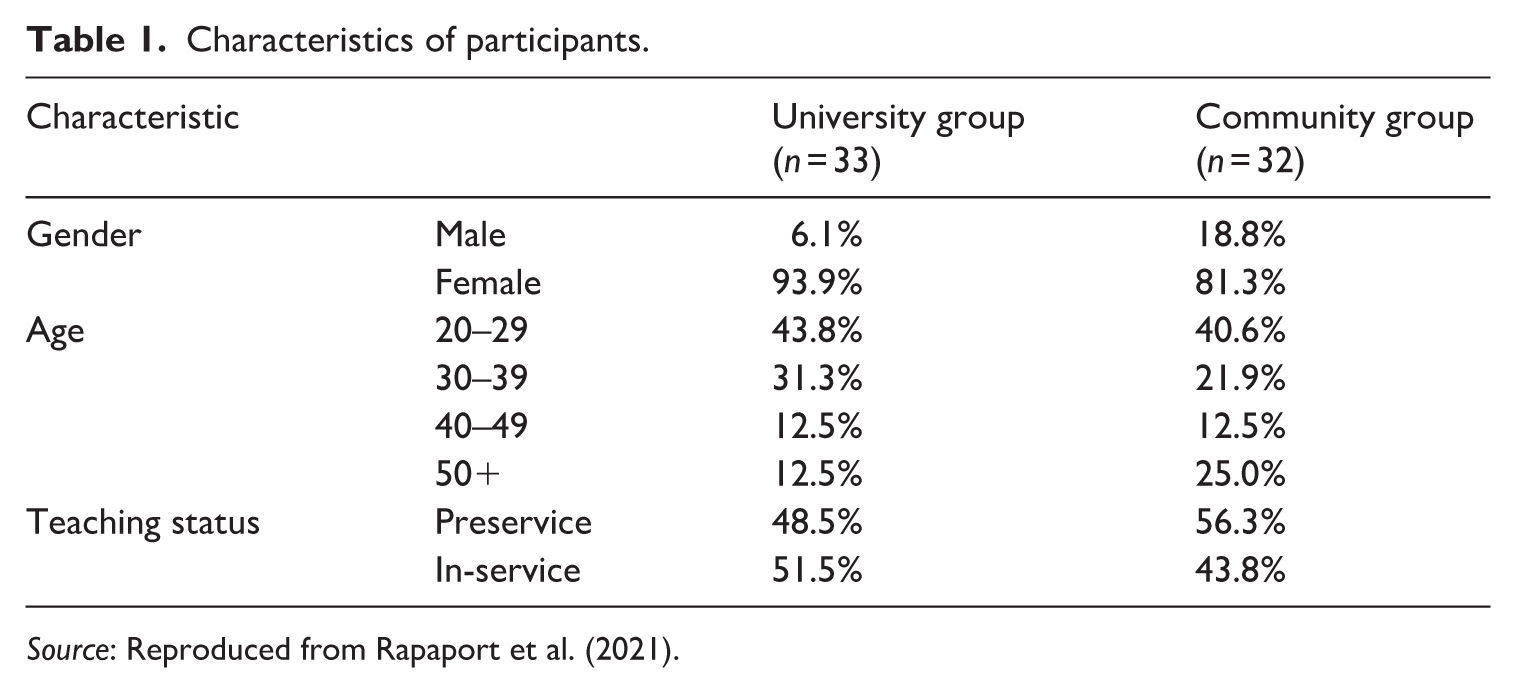
Using stratified random assignment, teachers were assigned to one of two learning conditions, either community-based or university-based, based on whether community-based tutoring was integrated. The assignments were conducted by Rapaport et al. (2021), our external program evaluation team. The demographic characteristics of the participants are listed in Table 1.
Characteristics of participants.
Source: Reproduced from Rapaport et al. (2021).
As indicated by Table 1, the majority of participants were female (88%) and most were under the age of 40 (69%). Participants across various age ranges were fairly evenly distributed between the two learning conditions and were nearly evenly divided between preservice (48%) and in-service (52%) teachers. About 85% of in-service teachers worked in elementary settings.
Sample size was determined by balancing the need for sufficient statistical power in quantitative analyses with the demands of conducting in-depth individual interviews and labor-intensive thematic analyses for the qualitative component. In addition, we anticipated some attrition, given that a small percentage of master’s students routinely withdraw from our program during this period. In total, 14 participants withdrew or dropped out: 6 from the community group and 8 from the university group, 7 of whom withdrew before the first class session. Thus, 51 participants completed the program, representing 78% of the original sample. Specifically, the final sample included 26 teachers in the community group (13 preservice and 13 in-service) and 25 teachers remained in the university group (9 preservice and 16 in-service).
2 Implementation
Both the university and community groups participated in a year-long ESL training program involving weekly contact hours, online modules, discussions, and hands-on activities. As shown in Figure 1, shared components included 3-hour weekly sessions over 28 weeks, with participants completing online modules prior to each class. These modules cover topics such as L2 acquisition, ESL instruction and assessment, cultural awareness, and community involvement. Essentially, the weekly online modules functioned as a form of conceptual mentoring in both conditions aimed at deepening participants’ understanding of EL-specific pedagogical strategies (Wu & Ware, 2022). During face-to-face sessions, both groups engaged in class discussions on a common focal topic, along with role-playing and peer application activities to practice EL-specific instructional strategies, all facilitated by regular instructor interaction and feedback. In addition, all participants prepared for the Texas TExES #154 ESL Supplemental certification exam, a high-stakes professional competency assessment required for state licensure, as part of the program.
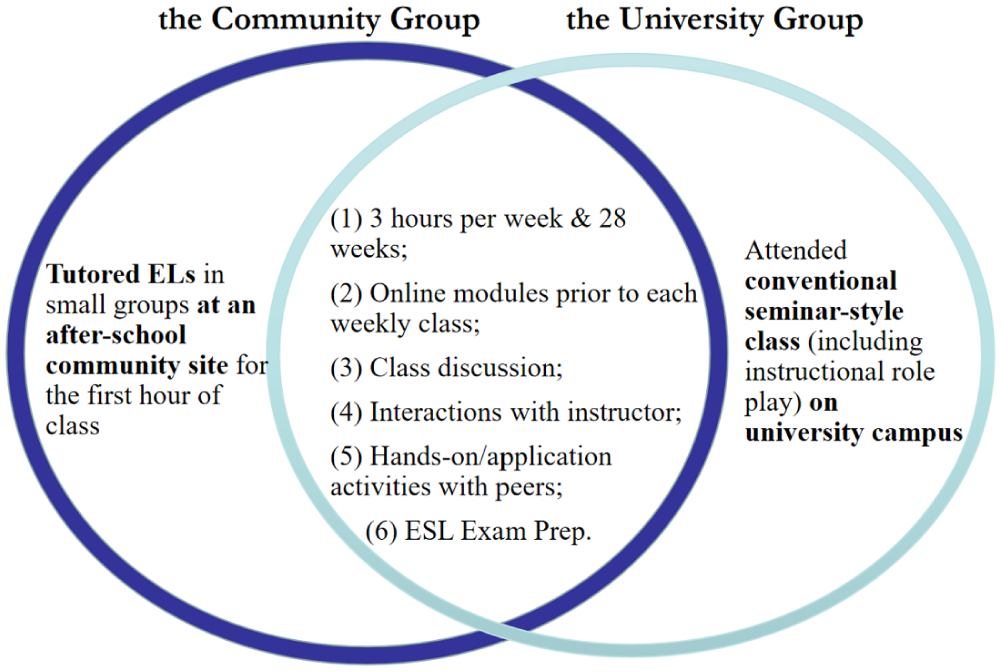
Similarities and differences in each learning model.
Despite these shared elements, the two models primarily differed in location and instructional approach. The community group met at an after-school, nonprofit site, where teachers spent the first hour tutoring small groups of ELs within socioculturally contextualized settings. This environment fostered experiential learning and practical application, with instructors providing feedback on lesson plans and enacted practices based on established best practices (Mok et al., 2023; Rushby et al., 2025). In contrast, the university group attended traditional classroom seminars featuring instructional role-plays and collaborative activities, without direct tutoring or ongoing contextualized support. Weekly collaborative planning among the research team ensured fidelity to the program and provided ongoing, scaffolded support to meet teachers’ emerging needs across both conditions. This structure allowed the community model to integrate contextualized, experiential learning with real-world EL practice, whereas the university model emphasized conventional seminar-based instruction.
3 Measures
Presurveys and postsurveys on teacher self-efficacy were administered to participants through Qualtrics Links at the beginning and end of the program. Teachers’ participation in the survey was voluntary and their responses were anonymized. A total of 102 presurvey/postsurvey (n = 51 teachers) responses were collected. All teachers participated in one-on-one, semistructured interviews at the end of the program.
a Teacher self-efficacy survey
The teacher self-efficacy survey (Appendix A) consists of 15 items adapted from Durgunoğlu and Hughes (2010) and a modified version of Collie and Martin’s (2017) Adaptability Scale. The survey, which taps into the domains of perceived knowledge about EL instruction and teaching adaptability, was created by Rapaport et al. (2021) and a panel of teaching English to speakers of other languages (TESOL) experts, then determined during a pilot year to have high internal consistency with respect to the two domains measured. In the present study, Cronbach’s alpha coefficients at pretest and post-test were .84 and .88 for perceived knowledge and .86 and .91 for adaptability, respectively.
The 5 perceived knowledge items on the survey concerned the double demand of mastering content and language simultaneously (Durgunoğlu & Hughes, 2010). High scores indicate greater confidence in navigating linguistic challenges and differentiating instruction for diverse proficiency levels. Confidence in these skills has long been considered central to teachers’ self-efficacy with respect to EL instruction (Durgunoğlu & Hughes, 2010). The 10 adaptability items measured the capacity to adjust thoughts, behaviors, and emotions in response to classroom uncertainties (Collie & Martin, 2016, 2017). Since no program can prepare teachers for every scenario, confidence in adaptability is considered vital for promoting teacher self-regulation and responsiveness in complex EL instructional environments (Collie & Martin, 2016, 2017; Faez & Valeo, 2012; Ganesan, 2025).
Participants rated their self-efficacy regarding context- and task-specific statements, such as “possess a clear understanding of the language demands of my content area,” “am knowledgeable of developmentally appropriate teaching strategies for EL students,” and “can think through multiple options to address a new situation.” A 4-point Likert scale (0 = strongly disagree to 4 = strongly agree) was used, intentionally excluding a neutral midpoint to elicit definitive responses. This method, integrating validated scales, expert input, and pilot testing, provided a reliable measure of how professional development boosted teachers’ confidence and adaptability in multilingual classrooms.
b Interviews
A follow-up interview was conducted with each teacher at the end of the program in a face-to-face, audio-recorded session. The total duration of these interviews ranged from a minimum of 15 minutes to a maximum of 45 minutes. For the purposes of this research, the relevant segment of each interview lasted between 3 and 15 minutes, with an average length of approximately 6 minutes. First, teachers rated their confidence in working with ELs both before and after the program, using a 5-point scale: 1 (“not confident at all”) to 5 (“very confident”). Subsequently, teachers received a list of key learning activities (see Appendix B) they had engaged in during the program and were asked to rank how influential each activity had been in promoting their sense of efficacy. The shared activities included completing online modules, engaging in-class hands-on or application activities with peers, participating in classroom discussions, interacting with the instructor, and practicing for the ESL exam. Teachers in the community group also evaluated a sixth activity: tutoring ELs. Finally, each teacher was prompted to identify which activity they considered the most influential source of self-efficacy in working with ELs and to explain why they considered it as most influential.
4 Data analysis
The data analysis comprised both quantitative and qualitative approaches. Quantitative analyses was conducted on 102 presurvey and postsurvey responses, whereas qualitative analysis was performed on 51 interview transcripts. No missing data or outliers were identified in the survey responses.
a Quantitative analyses
Survey responses were analyzed using multivariate regression, as conducted by Rapaport et al. (2021). Preliminary results indicated a slight but statistically significant difference in overall self-efficacy between the community (M = 2.43) and the university groups (M = 2.25). This baseline difference was statistically adjusted to accurately measure change over time. Specifically, postsurvey responses for both groups were compared within a model that adjusted for presurvey responses, teacher status (in-service versus preservice), and age. Effect sizes were calculated using Hedges’ g to quantify the magnitude of observed differences.
b Qualitative analyses
Building on this foundation, the current study further examine which program components teachers perceived as most influential in shaping their self-efficacy. This was achieved by calculating the frequency of the top-ranked learning activities within each group (community-based and seminar). Following this, we conducted inductive content analysis (Patton, 2002) on the 51 interview transcripts to identify themes that explain teachers’ choices and to explore thematic differences between preservice and in-service teachers.
To ensure both depth and reliability, as well as to capture potential dynamic changes in self-efficacy formation, we applied a two-cycle coding approach (Miles et al., 2020). In the first cycle (initial coding), we applied causation coding with three-sequence pathways to unpack the complex influences on teacher self-efficacy. This involved identifying meaningful data chunks and assigning codes that reflected key ideas, which we then linked to form causal pathways (e.g., Code 1 > Code 2 > Code 3). These pathways represented developmental stages of self-efficacy before, during, and after the program. To support this process, we used descriptive coding (summarizing core topics in words or short phrases) and in vivo coding (using teachers’ exact words). In vivo coding was prioritized to honor participants’ voices and reduce subjectivity. Symbols such as “+” indicated interrelated components, whereas “>” denoted causal relationships (“leads to”). An example of this pathway analysis for 1 in-service teacher is illustrated in Figure 2.

Coding process of three-sequence causation pathways.
In the second cycle (data condensation), we generated themes by clustering similar codes and examining how they interconnected within and across sequences. This process enabled us to interpret the dynamic changes in teachers’ self-efficacy over time. To ensure reliability, the coding team met weekly over 4 weeks to review and refine the coding scheme, discuss interpretations, and ensure consistency. Next, two team members independently coded 20% of the transcripts and compared their coding, achieving an agreement rate of 85%, which is considered reliable (Miles & Huberman, 1994). The remaining transcripts were divided for independent coding, with disagreements resolved through discussion. To enhance validity, the third author and external experts reviewed and cross-checked the interpretations and thematic categorizations.
IV Results
1 Growth of teacher self-efficacy in the two teacher learning conditions
Table 2 presents descriptive statistics for the post-test survey responses, including adjusted mean scores that account for pretest responses, teacher status, and age.
Descriptive statistics for self-efficacy post-test scores, by group.
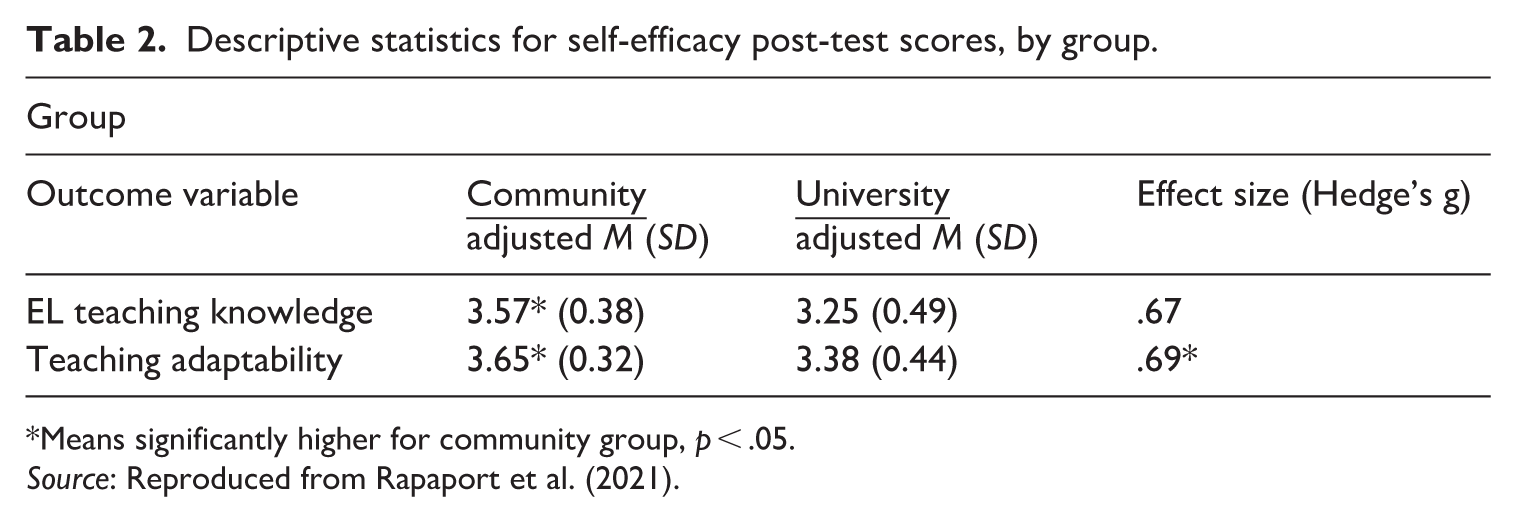
Means significantly higher for community group, p < .05.
Source: Reproduced from Rapaport et al. (2021).
Teachers in the community group showed significantly greater perceived EL teaching knowledge at post-test than teachers in the university group, F (5, 45) = 5.48, p < .05, β = .32, R2 = .37. Teachers in the community group also showed significantly greater perceived adaptability at post-test compared with their university counterparts, F(4, 40) = 1.39, p < .05, β = .27, R2 = .13. Finally, regarding confidence after program completion, teachers in the community group reported significantly higher confidence in working with ELs than teachers in the university group, t(50) = 4.94, p < .05, g = .64.
2 The most influential component of each learning condition
While the quantitative results suggest that community-based learning can strongly impact teachers’ self-efficacy for working with ELs, the surveys alone do not reveal which aspects of each program contributed most to this increase. In response to an interview question, approximately 90% of community group teachers identified tutoring ELs as the primary factor influencing their increased self-efficacy. In contrast, 58% of university group teachers highlighted the opportunity to engage in in-class hands-on and application activities with peers. Through one-on-one conversations, several themes emerged to explain these choices (Figure 3).
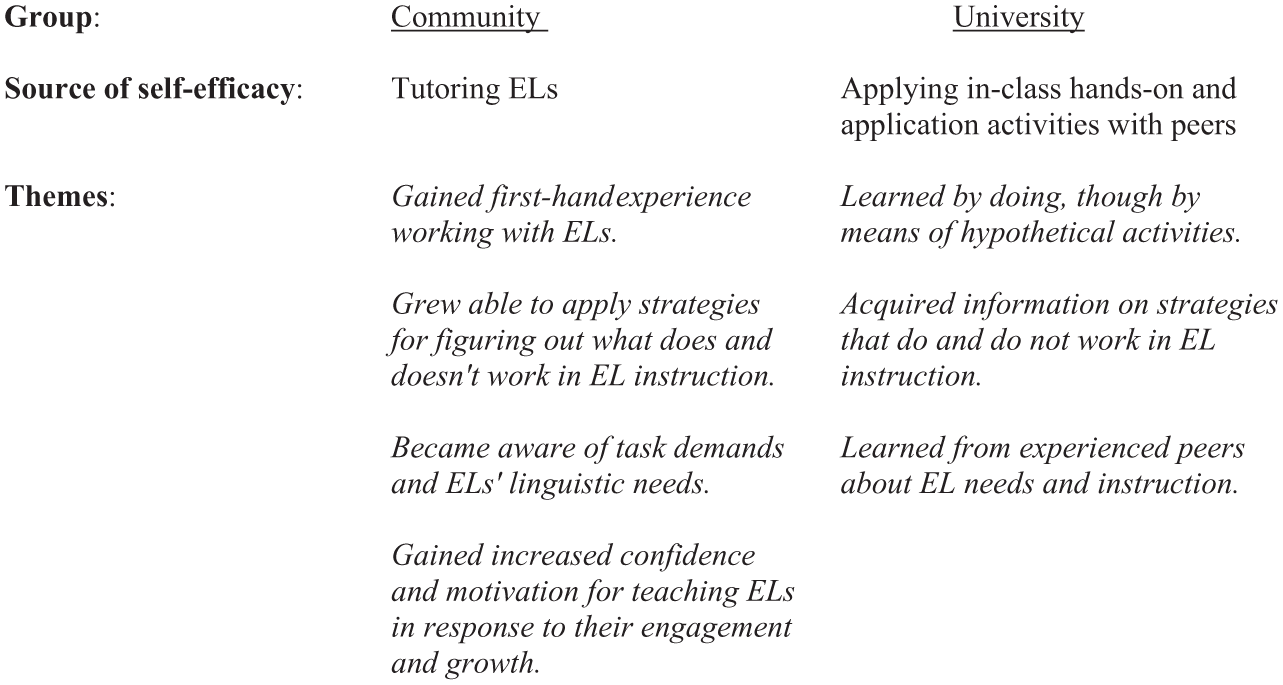
Reasons for most influential sources of self-efficacy among teachers in each group.
As Figure 3 shows, community group teachers acquired greater self-efficacy mainly through the opportunity to put theory into practice via interactions with ELs. By contrast, university group teachers primarily gained self-efficacy through the acquisition of knowledge. As Jennifer (all teacher names in this article are pseudonyms), a community group teacher, described it, “I think first, being able to do hands on with ESL [EL] students, just like builds that confidence, and really allows you to try different strategies, see what works, what doesn’t work. And you know, I think the only way to learn is to do it with students first-hand.”
The increased awareness among community group teachers of ELs’ linguistic needs and task demands also strengthened their self-efficacy, as suggested by John’s comments: “Just being able to work with someone that you can talk about this and have strategies, but then once you’re there, of actually dealing with a student that can’t put meaning to a word or things like that, you can really be able to see and know, oh, these things work with the student or these things don’t. . . I see that they do struggle. . . they’re having trouble with speaking or completing complete sentences.”
In contrast, university group teachers tended to mention hypothetical mastery experiences or “secondary” sources, such as role-playing or imagined scenarios, as Maria indicated: “Doing hands-on activities. . .has been extremely helpful, mainly because she (the instructor) poses a real-life situation, and then we get into groups and we have to solve the problem, or we have to figure out, ‘How would we best teach this?’. . .I think it just makes you think outside of the box.”
University group teachers gained insights into effective instructional strategies for ELs through less authentic activities than those experienced by community group teachers, though they noted that they enjoyed listening to and learning from more experienced peers.
3 Developmental patterns of self-efficacy within the community group
We analyzed interview transcripts for patterns in teachers’ responses using causation coding across three pathways (Miles et al., 2020). This analysis revealed notable differences within the community group, distinguishing the responses of preservice teachers (Figure 4) from those of in-service teachers (Figure 5). Preservice teachers identified the opportunity to tutor ELs as the most significant factor shaping their perceived preparedness to work with ELs. As shown in Figure 4, they typically started with positive statements about the supportive nature of the tutoring experience, citing benefits such as “actual interaction” with ELs (Margarita), “put into practice” (Ellen), “see first-hand what works and what doesn’t” (Eugenio), and “authentic ways” to learn (Brenda). These teachers then described specific experiences with ELs, reflecting on how their perceptions and knowledge evolved, often sharing success stories. For instance, Johnson recounted his use of strategies to support learning: “[I] showed them a short, simple video and they were able to see the actual pictures of different clouds and what the names of them are and the simple characteristics. . . [and] actually brought leaves from outside, and petals, and things they were able to glue them, and then for clouds.”
Johnson expressed a sense of accomplishment, viewing it as “teacher’s dream” when students showed interest in the lesson, noting that their enthusiasm was a clear indication of engagement. This theme, echoed in other teachers’ comments, contrasts with the responses of in-service teachers, who appeared to have faced some challenges working with ELs prior to participating in this program.
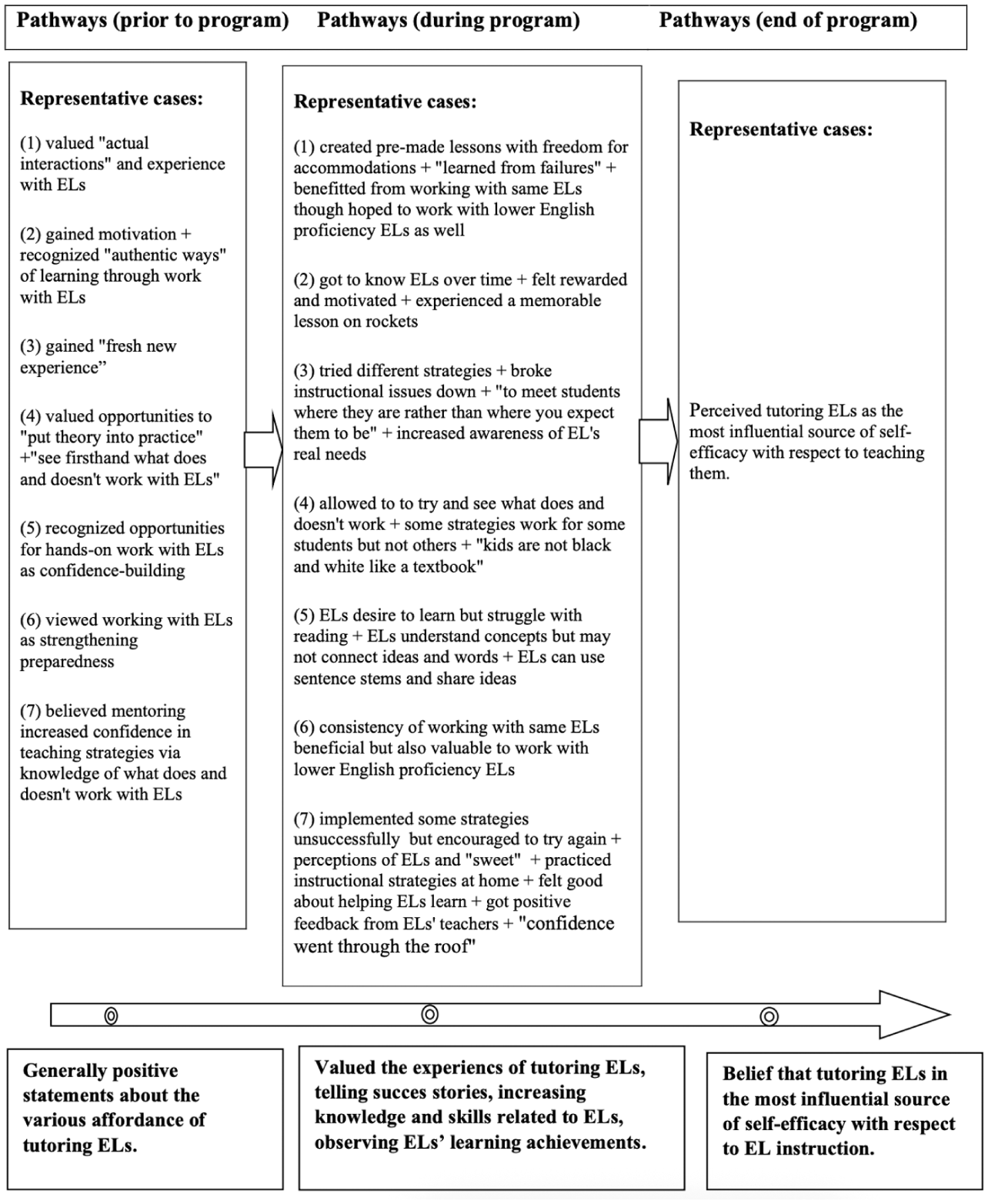
Developmental patterns of self-efficacy for preservice teachers.
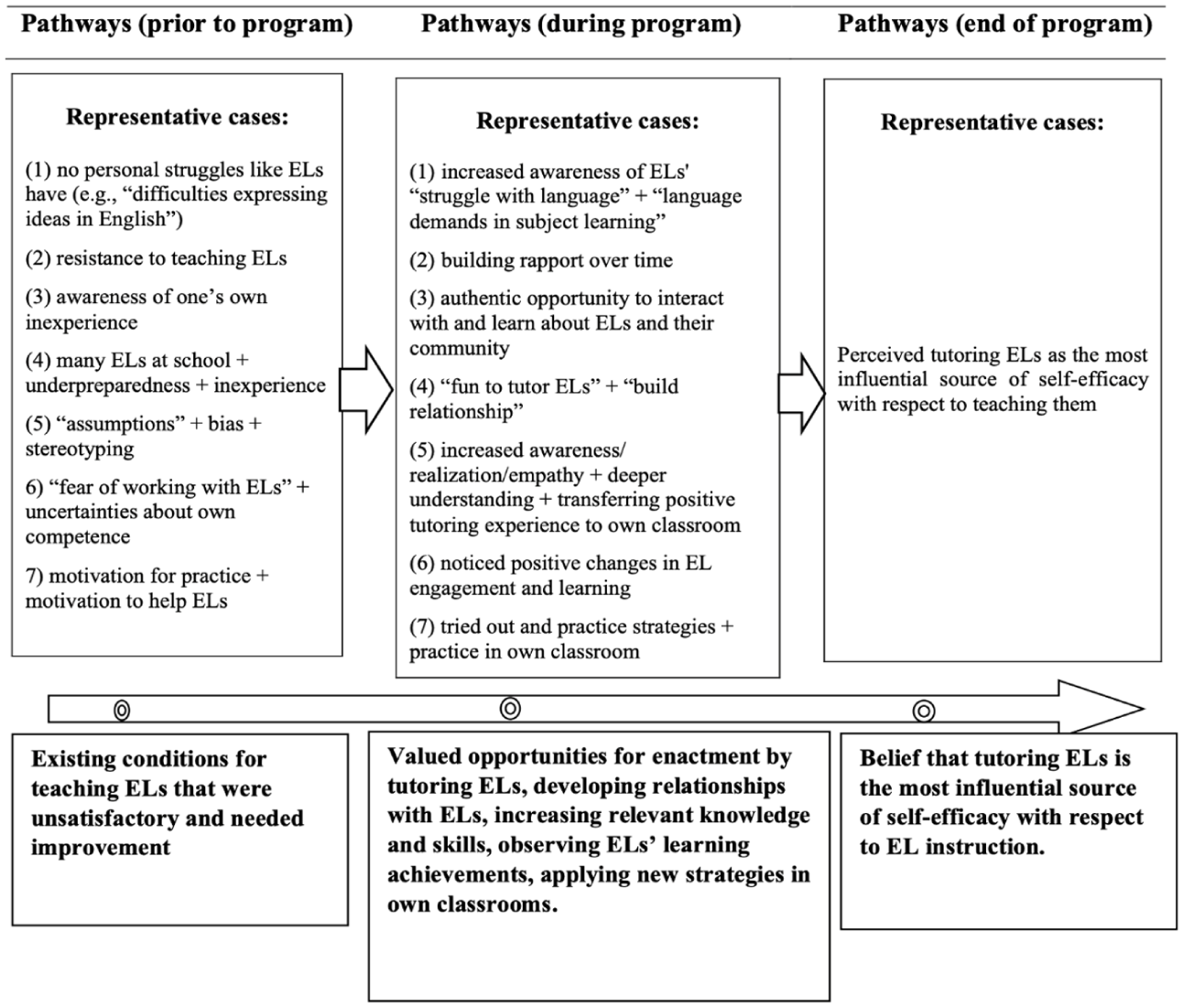
Developmental patterns of self-efficacy for in-service teachers.
In contrast, in-service teachers presented a different pattern of explanations regarding the effect of tutoring (see Figure 5). In the first phase of their pathway, they indicated that they entered the program with preexisting beliefs or skills that needed development or change. These included resistance to tutoring ELs owing to existing barriers in their classrooms, difficulties in understanding ELs’ needs due to the lack of similar experiences, mistaken assumptions and stereotypes, awareness of their own inexperience or feeling underprepared for EL instruction, and limited motivation for professional learning related to ELs.
In the second phase of their pathway, in-service teachers described how their perceptions of ELs evolved through small-group tutoring. They reflected on noticing specific features about ELs, experiencing positive changes in their awareness and understanding of ELs’ needs, and increasingly leveraging this knowledge to tailor instruction. For instance, Pamela shared that working closely with a small group of ELs made her realized that “to write a sentence is a lot,” and “five minutes to write a paragraph is incredibly demanding” for an EL—yet “for me, not an issue.” These observations consistently prompted her to consider “how can I scaffold” to help ELs “write in science and in every subject” and “explain concepts and synthesize things.” She felt she gained deeper insight into the EL community and made connections “way more than the 2 years of experience I [she] had teaching around.”
Beyond developing strategies during tutoring, in-service teachers also began applying these approaches in their own classrooms demonstrating the transferability of the skills they acquired. Their increasing self-efficacy was evident in their remarks as they recounted successful implementation of strategies learned through tutoring. For instance, teachers expressed excitement when sharing stories of how they had successfully implemented new strategies to support ELs in their classrooms. Considering their original feelings of underpreparedness or even resistance, these positive transformations could be viewed as a “turnaround,” as a participant described vividly.
V Discussion
1 Community-based learning as a catalyst for self-efficacy
The quantitative results reveal that teachers engaged in the community-based learning experienced significantly greater growth in self-efficacy related to EL instruction than their counterparts in the conventional university seminar. Although the study’s scope was limited to immediate postprogram assessments, these findings resonate with Bandura’s (1977) framework, which emphasizes mastery experiences as the most influential source of self-efficacy. The observed improvements corroborate prior research (Chesnut & Burley, 2015; Tschannen-Moran et al., 1998), linking self-efficacy to instructional competence, innovation (Lakshmanan et al., 2011), sustained commitment (Chesnut & Burley, 2015), and student achievement (Huang et al., 2025). These attributes are particularly vital in EL education, where mainstream teachers often feel underprepared (Gándara et al., 2005; Pasquarella et al., 2025).
Our findings confirm existing evidence that community-based learning promotes teacher self-efficacy (Faez & Valeo, 2012; Flores et al., 2015; Pasquarella et al., 2025; Sevimel & Subasi, 2018; Stairs-Davenport, 2023). Specifically, opportunities for teachers to work directly with ELs strengthen their confidence in teaching this population. Prior studies emphasize that field experiences with ELs influence teachers’ self-assessment of their preparedness (Coady et al., 2011; Faez & Valeo, 2012), and that authentic, hands-on experiences serve as key enactive mastery sources for boosting self-efficacy (Markova, 2024). This study is the first to directly compare such experiences within a community-based learning setting to those in a university seminar grounded in the same content and activities.
Furthermore, our research extends the literature on teacher preparation by exploring self-efficacy development in two important domains: pedagogical knowledge of teaching ELs and teaching adaptability. Effective EL instruction requires competence in both areas (Collie & Martin, 2017; Von Esch & Kavanagh, 2018), along with confidence in cultural responsiveness (Flores et al., 2015). Engaging with ELs allowed teachers to identify their students’ real needs, adapt instruction accordingly, and develop greater teaching flexibility over time (Ganesan, 2025). This includes enhancing their ability to provide contingent supports, real-time, tailored assistance based on learners’ emergent needs, beyond preplanned scaffolding (Daniel et al., 2016). Such experiential learning fosters responsiveness and flexibility, thereby enhancing teachers’ self-efficacy in supporting ELs.
2 Community-based tutoring as a significant component of professional learning
Descriptive analyses illuminated that teachers perceived tutoring ELs as the most influential source of their self-efficacy. Nearly 90% of community group teachers identified tutoring as their main confidence booster, aligning with prior research showing that direct mastery experiences with ELs boosts self-efficacy by allowing teachers to draw on successful practices (e.g., Flores et al., 2015). Conversely, a majority of university group teachers reported that observing and interacting with experienced peers contributed significantly to their self-efficacy. Vicarious experiences, such as witnessing a competent peer’s success, foster positive beliefs in one’s own capabilities (Bandura, 1997; Tschannen-Moran et al., 1998). Both groups benefitted from opportunities to enact instructional strategies; however, the more pronounced self-efficacy gains in the community learning group may stem from their direct engagement with ELs rather than peer observation alone.
Authentic EL direct teaching experiences, when combined with responsive support tailored to teachers’ emergent needs during the program, create a valuable opportunity for sustained enactive mastery experiences: critical for enhancing self-efficacy (e.g., Faez & Valeo, 2012; Flores et al., 2015; Sevimel & Subasi, 2018). Teachers in the community group gained mastery experiences through understanding students’ needs, implementing strategies successfully, and increasing their adaptability. These experiences relied on ongoing, responsive scaffolding; without such support, especially for inexperienced teachers or those unlearning ineffective practices, there is a risk of setbacks that could undermine self-efficacy (Wu & Ware, 2022). This aligns with Johnson’s (2015) emphasis on active, immediate guidance by teacher educators and Daniel et al.’s (2016) call for contingent scaffolding that adapts to teachers’ evolving needs. Beyond authentic tutoring, embedding mentoring supports, such as modeling, feedback, and reflection, as demonstrated by the community group, act as additional contingent scaffolding that can significantly boost self-efficacy in practice-based interventions (Mok et al., 2023; Rushby et al., 2025).
While both groups participated in hands-on activities, the nature and authenticity of their experiences differed. The community group encountered real-world teaching problems and addressed ELs’ actual needs, whereas the university group practiced strategies via hypothetical roleplays with peers. Although less authentic, these simulated experiences provided a safe space to refine instructional skills before working with actual students, which, as expected, positively affected self-efficacy (Kazemi et al., 2016; Lampert et al., 2013). Bandura’s (1997) theory suggests that, in the absence of mastery experiences, other sources, such as peer modeling, become more salient, which the university group expressed appreciation for, citing “theory in action” as particularly helpful.
3 Different learning pathways for preservice and in-service teachers
Qualitative interviews show that self-efficacy among preservice and in-service teachers evolved differently, consistent with prior studies (e.g., Hoy & Spero, 2005; Tschannen-Moran & Hoy, 2007; Wyatt & Dikilitaş, 2016). Preservice teachers emphasized the authenticity of tutoring ELs and increased knowledge about ELs as key to their growth. In-service teachers, initially holding beliefs, such as stereotyping and resistance, re-evaluated these through relationship-building, observing EL engagement, and implementing new strategies. Both groups acknowledged tutoring as crucial for confidence and preparedness.
These pathways reflect that preservice and in-service teachers differ in their receptivity to change (Tschannen-Moran et al., 1998). In-service teachers, with more stable self-efficacy, continue to grow through authentic experiences, supported experiences and targeted mentoring tailored to their emergent needs. Such support facilitates re-evaluating misconceptions about ELs and unlearning ineffective practices (George et al., 2018). Many reshaped their beliefs via new knowledge and skills, demonstrating ongoing professional development.
The causation coding approach uncovered that self-efficacy is dynamic, with distinct trajectories even within the same community-based learning condition (Morris et al., 2017; Polat, 2010). Both groups valued hands-on experiences, yet in-service teachers faced more challenges in unlearning old beliefs while demonstrating the capacity to transfer and adapt strategies by program’s end. Preservice teachers improved through direct engagement, showing that well-designed experiential learning fosters growth across career stages, regardless of initial self-efficacy.
These findings highlight the need for qualitative exploration of how self-efficacy develops differently across career stages (Markova, 2024; Tschannen-Moran et al., 1998). Recent research (Täschner et al., 2025) supports context-sensitive, stage-appropriate interventions, authentic experiences for novices and reflective learning for experienced teachers, that promote ongoing confidence and resilience. Together, these insights advocate for flexible, multifaceted professional development approaches tailored to teachers’ evolving needs (Daniel et al., 2016; Johnson, 2015), with future research needed to identify optimal combinations of sources and formats to maximize effect throughout their careers.
VI Limitations
Potential limitations of this study include the possibility of sampling bias, given the need to keep the sample size small to facilitate in-depth qualitative analyses, and the extent of attrition. Further, the self-report nature of the survey data introduces potential bias, since teachers were aware of their group assignments. Moreover, variations in the structure of university-based training across different contexts may influence the comparability of the two models examined. In some settings, university-based programs may include practical teaching experiences similar to those found in community-based models, which could affect the transferability and interpretation of results across different educational systems. Therefore, caution should be exercised when generalizing these findings to other cultural or institutional contexts. Finally, as with any research of this nature, caution is needed in applying these findings broadly. Research in Iran (Moradkhani & Haghi, 2017) and Vietnam (Phan & Locke, 2015), for example, suggests that verbal persuasion may be a more influential source of efficacy in collectivist cultures than the self-oriented mastery experiences found in this study. These cultural differences support Bandura’s (1997) assertion that efficacy beliefs are highly context- and task-specific.
VII Conclusion and implications
ELs face the complex challenge of acquiring a new language while simultaneously progressing in their native language and learning grade-level content. It is essential that their teachers are well prepared and confidence to support them through these multifaceted demands. The findings from this study extend existing research and underscore that teacher educators can strategically leverage multiple sources of self-efficacy to enhance teachers’ confidence and competence. While a range of enactment practices can strengthen teacher efficacy beliefs regarding EL instruction, authentic experiences working directly with ELs appear to have the greatest effect.
These insights carry important implications for the design and implementation of teacher professional development. First, community-based learning approaches should be prioritized within professional learning programs, given their demonstrated positive effect on teacher self-efficacy in this and prior studies (e.g., Coady et al., 2011; Faez & Valeo, 2012). Such models should be thoughtfully contextualized, taking into account of diverse cultural factors that influence teacher beliefs and practices (Moradkhani & Haghi, 2017; Phan & Locke, 2015).
Simultaneously, certain aspects of university-based training show promise for promoting self-efficacy, particularly those that incorporate role-playing and rehearsal with peers (Kazemi et al., 2016; Lampert et al., 2013). Tailoring development to address the unique needs of teachers at different career stages, preservice versus in-service, may also be essential, as these groups exhibit distinct patterns in the development of efficacy beliefs.
Looking ahead, future research should explore how teacher education programs can most effectively incorporate authentic teaching experiences with ELs, and peer roleplays, to promote self-efficacy. In addition, more nuanced analyses that explore differences both across and within preservice and in-service teacher groups can help teacher educators better connect theory, research, and classroom practice. Addressing these questions can lead to the development of more effective, context-sensitive models for EL teacher education, ultimately supporting teachers in meeting the diverse needs of ELs more confidently and competently.
Footnotes
Appendix A: Teacher self-efficacy survey
This survey is designed to learn about your experiences in your graduate course. Please carefully consider your responses as the results will be used to help develop future course content and instructional approaches for this course at your university. Your participation in this survey is voluntary. Responses will remain confidential and results will be reported in an aggregate manner to preserve respondent anonymity. Thank you for your time and input! By proceeding to complete this survey, you are indicating that you have read and understood this information about your participation in this survey.
Appendix B: Interview protocol
Welcome! I’m excited to hear about how your experience just went. First, I want to thank you for your time and participation in this brief snapshot of your planning, tutoring, and reflection as a teacher. We have 30 minutes together, and I will be using an audio recorder to ensure accuracy for research purposes and to help keep track of time. Is that okay with you? Wonderful—about 20 to 25 minutes in, we’ll reserve the last 5 minutes for any questions or additional comments you’d like to share.
One of the key goals of our professional development program is to help you build greater
Please rank order these activities based on how much they helped you become more confident in teaching English learners. Give a 1 to the most helpful and a 5 or 6 to the least helpful.
Acknowledgements
We would like to express our sincere gratitude to A. Rapaport, M. Garland, J. Carle, S. Cannon, and D. Osman at Gibson Consulting for their valuable contributions. Amie Rapaport and Marshall Garland are now at University of Southern California, and Jill Carle is now at Westat. As partners in this larger federally funded project, their collaboration has significantly strengthened the design and analysis of our work, including the development and implementation of the study, as well as the analysis of survey data to ensure an objective evaluation of the effects of this teacher preparation program. In particular, some quantitative findings in this study were excerpted from the original report by Rapaport et al. (2021), including the multivariate results and those reported in Table 1 and  , which are reproduced from Table 3 and Table A1 in Rapaport et al.’s publication. We also sincerely thank Dr. Ken Springer for his valuable support with revisions and proofreading.
Data availability statement
The data supporting the findings of this study are available upon reasonable request. Due to confidentiality agreements and ethical considerations, raw data cannot be shared publicly.
Funding
The authors disclosed receipt of the following financial support for the research, authorship, and/or publication of this article: This work was supported by the US Department of Education Office of English Language Acquisition (grant number #T365Z160106).
Ethical approval and informed consent statements
This study was conducted in accordance with ethical standards and received approval from the relevant institutional review board or ethics committee. All participants provided informed consent prior to their participation, ensuring they were fully aware of the purpose of the study, their rights, and any potential risks involved. Participants’ confidentiality and anonymity were maintained throughout the research process.