






Abstract
This study investigates the relationship between subjective well-being (SWB) and second language (L2) writing achievement (WA), focusing on the sequential mediating roles of L2 writing enjoyment (L2WE) and L2 writing self-efficacy (L2WS). A sample of Chinese university EFL learners (n = 322) participated in a survey measuring SWB, L2WE, L2WS, and L2WA. Structural equation modeling (SEM) was employed to test the hypothesized chain mediation model. Results revealed that SWB was positively associated with both L2WE and L2WS, which in turn significantly predicted L2WA. Although the direct effect of SWB on L2WA was non-significant, the total indirect effect via L2WE and L2WS was significant. Specifically, L2WE mediated the link between SWB and L2WA, L2WS mediated the link between SWB and L2WA, and a sequential mediation pathway (SWB → L2WE → L2WS → L2WA) was also supported. These findings highlight the crucial role of positive psychological factors in L2 writing and suggest that enhancing learners’ well-being and writing-related affective experiences may foster improved writing performance.
Keywords
1. Introduction
With the development of positive psychology, increasing attention has been paid to learners’ positive psychological states in the learning process, such as self-efficacy, emotional experiences, flow, and well-being (Li, 2021). Among these, subjective well-being (SWB), defined as individuals’ subjective evaluation of their life circumstances (Diener et al., 1999), has been shown to be closely related to academic outcomes (Ambrosetti et al., 2023; Bortes et al., 2021; Zhang & Chen, 2025), underscoring its significance in learning. Existing studies have examined SWB from two main perspectives: the external factors shaping it, such as self-compassion (Hazan-Liran & Walter, 2023), goal orientations (Li et al., 2021), and hope and optimism (Rand et al., 2020); and its effect on future anxiety (Dalmış et al., 2025), academic self-efficacy (Zhang & Chen, 2025), and academic performance (Bortes et al., 2021). More recently, research on SWB in foreign language learning has grown (Proietti Ergün & Ersöz Demirdağ, 2023). Learners with higher levels of SWB are more likely to enjoy language learning (Proietti Ergün & Ersöz Demirdağ, 2023), demonstrate stronger persistence (Altıntaş & Canbulat, 2024), and achieve better outcomes (Renshaw et al., 2024). However, foreign language writing, as one of the most demanding tasks in language learning due to its cognitive complexity and emotional sensitivity (DeCoursey, 2023), is particularly susceptible to learners’ psychological states, including emotions and beliefs about ability. Although previous studies have explored the roles of writing anxiety (Mujtaba et al., 2025) and writing self-efficacy (Chen & Zhu, 2025), empirical work incorporating SWB into writing research remains scarce.
Exploring the mechanisms through which SWB influences writing performance, with emotions and cognition as mediating variables, offers valuable insights. From an emotional pathway, SWB is typically associated with positive affect (Schimmack, 2008), which fosters favorable academic emotions such as writing enjoyment. According to control-value theory (Pekrun, 2006), positive achievement emotions enhance learners’ engagement and performance, and empirical evidence confirms the beneficial role of writing enjoyment in writing outcomes (Zhu et al., 2024). From a cognitive pathway, SWB is often accompanied by positive self-appraisals (Cini et al., 2013), which strengthen beliefs in one’s ability to accomplish tasks (i.e., self-efficacy). Bandura (1997) posits that self-efficacy is central to learners’ goal setting, strategy use, and persistence, and previous studies have consistently identified writing self-efficacy as a significant predictor of writing achievement (Sabti et al., 2019). Taken together, writing enjoyment and writing self-efficacy may function as mediators linking SWB and writing performance. Furthermore, these mediating pathways may be interconnected rather than independent. Specifically, positive emotions such as writing enjoyment not only directly promote performance but may also enhance learners’ self-efficacy (Zhang et al., 2025), thereby indirectly contributing to outcomes. This pathway highlights the reinforcing effect of emotions on cognitive beliefs, consistent with control-value theory’s view of the integrated influence of emotions on motivation and cognition (Pekrun & Stephens, 2009). Thus, writing enjoyment and writing self-efficacy may form a serial mediating mechanism in which SWB enhances writing enjoyment, which in turn strengthens self-efficacy, ultimately leading to improved writing performance.
In light of this, the present study focuses specifically on English as a foreign language (EFL) learners and proposes a model in which writing enjoyment and writing self-efficacy serve as sequential mediators to explain the mechanism through which SWB influences university students’ English writing achievement. Because a Chinese university student’s second language (L2) is typically English, L2 writing in this study can be considered equivalent to EFL writing. Accordingly, L2 writing is operationalized primarily as academic English writing produced in formal educational contexts, such as essays, reports, and other structured written tasks. This model provides a deeper understanding of the role of well-being in L2 writing processes and offers both theoretical and pedagogical implications, emphasizing the importance of fostering students’ SWB and positive emotions in foreign language writing instruction.
2. Literature Review
2.1. The Potential Relationship between SWB and L2 Writing Achievement
SWB, first conceptualized within psychology as individuals’ subjective evaluations of their life quality and overall satisfaction (Diener et al., 1999), has long been recognized as a critical indicator of mental health and positive functioning. Over the past decades, research has consistently shown that SWB is closely associated with a wide range of educational outcomes, such as motivation (Grassinger et al., 2024), and academic performance (Bortes et al., 2021). More specifically, previous studies have confirmed the positive association between SWB and university students’ academic achievement (Caballero-García & Ruiz, 2025; Moutinho et al., 2019). For instance, Caballero-García and Ruiz (2025) reported positive correlations between SWB and academic achievement among university students, with life satisfaction contributing to the prediction of academic performance. Similarly, Wang (2025) found that SWB had a direct and significant positive effect on university students’ academic performance. Furthermore, the positive effects of SWB on academic achievement have also been observed among younger learners (Ambrosetti et al., 2023; Zhang & Chen, 2025; Zhou et al., 2023). Ambrosetti et al. (2023) found that SWB was positively correlated with school performance, and that well-being at school played an even more crucial role in the academic achievement of immigrant students compared to their native peers, particularly at the lower secondary level. Zhou et al. (2023), drawing on data from 19,845 fourth-grade and 11,691 eighth-grade students in a central Chinese city, demonstrated that positive teacher–student relationships could promote academic achievement both directly and indirectly through students’ SWB. Zhang and Chen (2025), based on a survey of 1,022 children, further revealed a direct effect of SWB on children’s academic achievement. Taken together, these findings highlight the significant role of SWB in shaping students’ academic achievement.
In the field of foreign language learning, several studies have likewise emphasized the importance of SWB (Altıntaş & Canbulat, 2024; Proietti Ergün & Ersöz Demirdağ, 2023), yet few have directly examined the relationship between learners’ SWB and their foreign language achievement. To date, only one recent study employing a latent profile approach has explored this association (Ma et al., 2025). Research focusing specifically on SWB in the context of foreign language writing is even more limited. Addressing this gap, the present study examines whether EFL learners’ SWB is associated with their writing achievement. Building on prior evidence linking SWB to academic achievement, it is hypothesized that:
(
2.2. The Potential Serial Relationship between SWB, Writing Enjoyment, Writing Self-Efficacy, and L2 Writing Achievement
For L2 learners, writing enjoyment refers to “a kind of positive emotion and an important motivator when facing the ups and downs” in the writing process (Yao et al., 2024, p. 2). A growing body of research has shown that L2 writing enjoyment (L2WE) is closely associated with L2 writing achievement (L2WA; Cheong et al., 2023; Li et al., 2023; Zhu et al., 2022). Specifically, Cheong et al. (2023), drawing on data from 589 Chinese twelfth-grade students and their L2 writing tasks, investigated the relationships among growth mindset, writing-related emotions (enjoyment and anxiety), and writing performance. Their findings indicated that writing enjoyment could directly influence writing achievement. Li et al. (2023), through the development and validation of a scale to measure L2WE, further confirmed that such enjoyment exerted a positive effect on writing achievement. Zhu et al. (2022), using a sample of 239 first-year English major students from a Chinese university, likewise demonstrated a significant effect of writing enjoyment on students’ writing performance. Moreover, existing research indicates that SWB can foster learners’ positive emotional experiences in academic settings, including enjoyment (Proietti Ergün & Ersöz Demirdağ, 2023, 2024). A mixed-methods study revealed that students’ levels of SWB could enhance their positive emotions (i.e., enjoyment) in language classrooms, indicating that SWB contributes to greater foreign language enjoyment (Proietti Ergün & Ersöz Demirdağ, 2023). A quantitative study demonstrated that SWB was the strongest predictor of foreign language enjoyment. The findings further showed that SWB plays a crucial role in enhancing learners’ enjoyment in acquiring a new language (Proietti Ergün & Ersöz Demirdağ, 2024). Therefore, this study proposes that SWB not only directly affects students’ L2WA but may also exert an indirect effect by enhancing writing enjoyment. In other words, potentially:
(
Self-efficacy denotes “the belief in one’s capabilities to organize and execute the courses of action required to manage prospective situations” (Bandura,1997, p. 2). L2 writing self-efficacy (L2WS) refers specifically to “learners’ beliefs in their capabilities to execute writing tasks effectively in L2” (Tabari et al., 2025, p. 4). Multiple studies have proved that L2WS is a significant predictor of writing performance (e.g., J. Zhang & L. Zhang, 2024). Learners with higher self-efficacy are more likely to set challenging goals, employ effective writing strategies, and achieve better outcomes in L2 writing tasks (J. Zhang & L. Zhang, 2024). Sun et al. (2021), through a meta-regression analysis, confirmed the positive effect of L2 learners’ writing self-efficacy on their writing performance and emphasized the importance of raising English teachers’ awareness of fostering students’ self-efficacy in the L2 writing classroom. J. Zhang and L. Zhang (2025) further utilized a latent profile analysis and demonstrated that learners’ profiles differed in the predictive effects of writing self-efficacy on writing achievement, thereby illustrating the positive influence of writing self-efficacy on L2 writing performance. In addition, existing research suggests that SWB can positively influence learners’ self-efficacy (Chudzicka-Czupała & Zalewska-Łunkiewicz, 2020; Zhang & Chen, 2025). For instance, Chudzicka-Czupała and Zalewska-Łunkiewicz (2020), based on a study of 72 participants, found that individuals with higher levels of well-being exhibited higher levels of self-efficacy. Zhang and Chen (2025), based on a survey of 1,022 children, found that SWB positively influenced children’s self-efficacy, and that learning self-efficacy partially mediated the direct effect of SWB on academic achievement. Furthermore, Bandura’s (1986) social cognitive theory highlights that self-efficacy beliefs play a central role in translating personal characteristics and experiences into performance outcomes. As a positive personal factor, SWB may enhance learners’ L2WS, which in turn contributes to higher L2WA. In other words, probably:
(
Moreover, L2WE also exerts an influence on L2WS. Consistent with social cognitive theory (Bandura, 1986), affective states serve as an important source of self-efficacy beliefs. Therefore, learners who experience greater enjoyment during L2 writing (i.e., L2WE) are more likely to develop stronger confidence in their writing capabilities (i.e., L2WS). A recent survey study involving 374 intermediate EFL students also revealed that L2WE had a significant direct effect on L2WS (Zhang et al., 2025). Taken together, it is reasonable to hypothesize that:
(
2.3. Summary of the Proposed Model
This study investigates the relationships among SWB, L2WE, L2WS, and L2WA, with particular emphasis on the possible serial mediation of L2WE and L2WS in the pathway from SWB to writing performance. Drawing on the theoretical frameworks and prior empirical evidence discussed previously, a hypothesized model was developed to depict the relationships among these variables (see Figure 1; H1–H4).The study aims to address the following research questions.
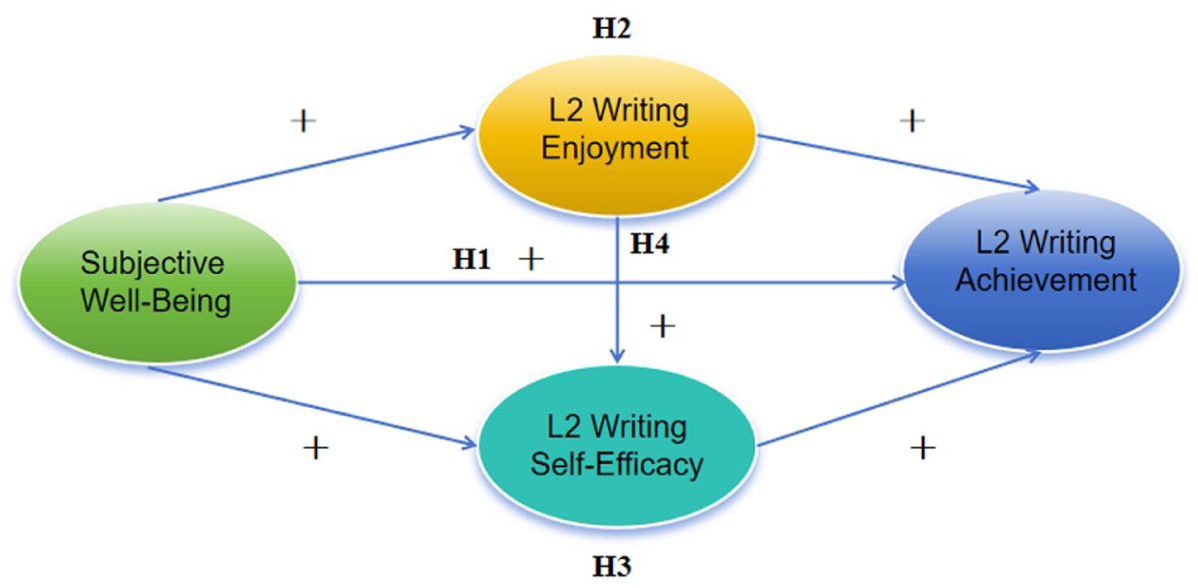
The hypothesized model.
3. Research Design
3.1. Participants
The study involved 322 Chinese undergraduates (Mage =19.84 ; SD = 1.20 years) from a public university in Jiangsu Province. Data were collected via an anonymous self-reported questionnaire using the Wenjuanxing survey platform (www.sojump.com). Initially, 354 questionnaires were returned, but 32 were removed due to missing responses or unusually short completion times, resulting in 322 valid responses. The majority of participants were second-year students, comprising 168 males and 154 females. All were non-English majors and had attended roughly two English writing classes per week. Participants were recruited from various academic disciplines, including engineering (N = 74, 23.0%), natural sciences (N = 84, 26.1%), and humanities and social sciences (N = 164, 50.9%).
3.2. Measures
All participants completed a set of self-report questionnaires, including SWB (Diener et al., 1985), L2WS (Han & Hiver, 2018), and L2WE (Tahmouresi & Papi, 2021), along with demographic information (e.g., age, gender, and major). All items were rated on a 5- to 7-point Likert scale, depending on the original instrument, with higher scores indicating greater agreement or higher levels of the construct. As the original versions were in English, a translation-back translation procedure (Tyupa, 2011) was used to develop Chinese versions. Specifically, the original English items were first translated into Chinese by a bilingual researcher, and then independently back-translated into English by another bilingual expert who was not involved in the initial translation. The two English versions were compared, and any minor discrepancies were discussed and resolved to ensure semantic consistency with the original items. Minor wording adjustments were made only to improve clarity and contextual appropriateness, without altering the conceptual meaning of the items. In addition, three experienced English teachers further reviewed the Chinese versions to confirm clarity, comprehensibility, and suitability for Chinese university students.
3.2.1. SWB Scale
EFL learners’ SWB was assessed using the five-item scale developed by Diener et al. (1985). Each item was rated on a 7-point Likert scale ranging from 1 (strongly disagree) to 7 (strongly agree). A sample item is “In most ways, my life is close to my ideal.” Higher total scores indicate greater SWB. In the current study, the scale demonstrated high reliability (Cronbach’s α = .901).
3.2.2. L2WE Scale
L2WE was measured using the five-item scale adapted from Tahmouresi and Papi (2021), designed to capture learners’ positive emotional experiences during L2 writing. Items were rated on a 6-point Likert scale from 1 (strongly disagree) to 6 (strongly agree). A sample item is “I feel happy when I am writing about a topic in English.” Higher scores reflect higher levels of enjoyment in the writing process. The internal consistency of the scale in this study was satisfactory (Cronbach’s α = .968).
3.2.3. L2WS Scale
Participants’ L2WS was evaluated using the seven-item scale developed by Han and Hiver (2018), which focuses on learners’ confidence in completing English writing tasks. Responses were rated on a 5-point Likert scale ranging from 1 (strongly disagree) to 5 (strongly agree). A sample item is “I am sure I can do well on writing courses even if they are difficult.” Higher scores indicate stronger perceived self-efficacy in L2 writing. In this study, the scale showed high internal reliability (Cronbach’s α = .951).
3.3. Research Procedure
Data were collected in two stages between May and July 2025. In the first stage, participants completed a college-level English writing task (CET-4) in class. They were asked to write a minimum 150-word essay on the topic “Is technological advancement eroding traditional culture?” within 30 minutes under teacher supervision. In the second stage, participants completed an anonymous online questionnaire via the Wenjuanxing platform (www.sojump.com) during a class break, after providing informed consent. Questionnaire responses were linked to individual essay scores using student ID numbers to ensure data traceability and confidentiality.
Moreover, three experienced university English teachers, all with extensive experience grading CET-4 writing, independently scored the essays based on the official CET-4 global scoring criteria (https://cet.neea.edu.cn/), which evaluate language accuracy, clarity of expression, coherence, and logical reasoning. Each essay was scored on a 15-point scale divided into five bands: 1–3, 4–6, 7–9, 10–12, and 13–15. During the scoring process, any large discrepancies (⩾3) among the three raters’ scores were discussed collectively to reach a consensus. The final score for each student was then calculated as the average of the three raters’ agreed-upon scores.
3.4. Data Analysis
Data analysis was conducted using SPSS 28.0 and AMOS 26.0. Prior to the main analyses, a preliminary examination of the data was conducted, including assessments of normality, computation of descriptive statistics, correlation analyses, and calculation of Cronbach’s α coefficients for all key variables.
Confirmatory factor analysis (CFA) was then carried out to evaluate the reliability and validity of the measurement model, which included four latent variables: SWB, L2WE, L2WS, and L2WA. Model fit was assessed using multiple indices, including RMSEA, SRMR, χ2/df, CFI, and TLI, following the criteria recommended by Hu and Bentler (1999). In addition, the convergent and discriminant validity of the constructs were examined by calculating the average variance extracted (AVE) and composite reliability (CR).
At the structural equation modeling (SEM) stage, hypothesized relationships among the latent variables were tested, with particular focus on the potential serial mediation effects of L2WE and L2WS between SWB and L2WA. The significance of mediation effects was evaluated using bootstrapping with 5,000 resamples to generate 95% confidence intervals (CIs). Mediation was considered significant if the CI did not include zero (Preacher et al., 2007).
4. Results
4.1. Confirmatory Factor Analysis
A CFA was conducted to validate the measurement model, ensuring that the observed indicators appropriately represented the latent constructs of SWB, L2WE, L2WS, and L2WA. Each construct was assessed using multiple indicators derived from their respective scales.
Using AMOS 26.0 with maximum likelihood estimation, the CFA supported the adequacy of the measurement model. All standardized factor loadings were significant (p < .001) and exceeded the recommended threshold of .50, confirming that the observed variables provided a robust representation of their respective latent constructs. As indicated by Table 1, the standardized factor loadings for SWB ranged from .738 to .908, for L2WE from .903 to .954, for L2WS from .822 to .888, and for L2WA from .967 to .991. Table 1 also presents the standard errors (SE) and critical ratios for the measurement model.
Confirmatory Factor Analysis.
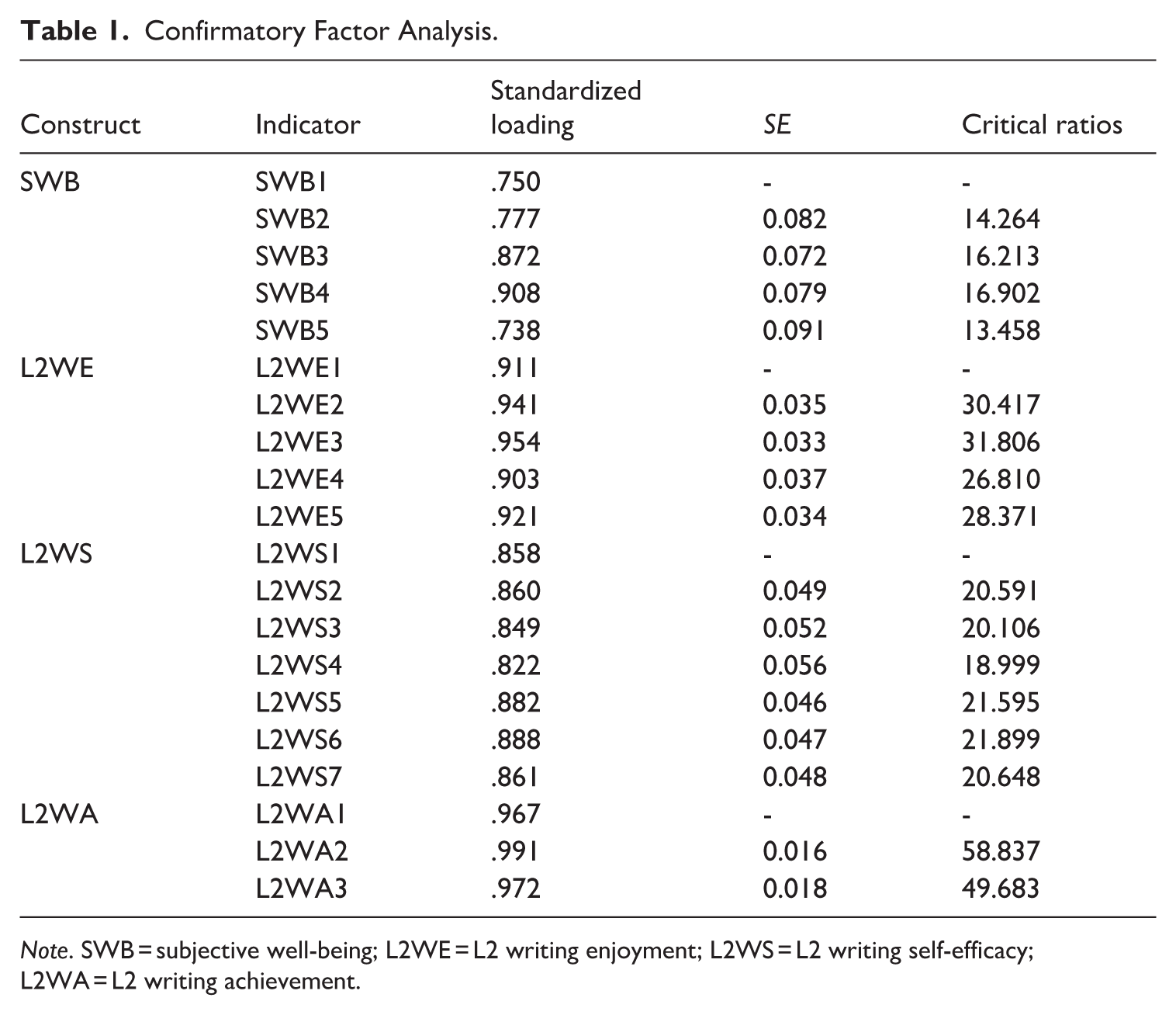
Note. SWB = subjective well-being; L2WE = L2 writing enjoyment; L2WS = L2 writing self-efficacy; L2WA = L2 writing achievement.
4.2 Convergent and Discriminant Validity
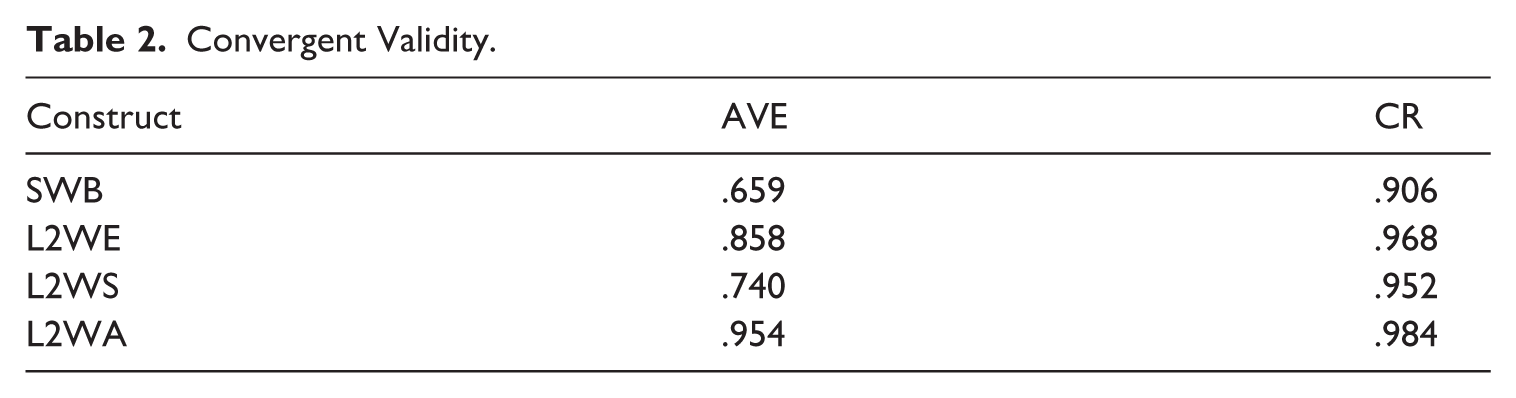
To ensure the robustness of the measurement model, both convergent and discriminant validity were examined. Convergent validity was measured based on the criteria of AVE and CR. According to Fornell and Larcker (1981), AVE values greater than .50 and CR values exceeding .70 demonstrate good convergent validity. As indicated by Table 2, all constructs demonstrated satisfactory convergent validity, with AVE values ranging from .659 to .954 and CR values ranging from .906 to .984, exceeding the recommended thresholds.
Convergent Validity.
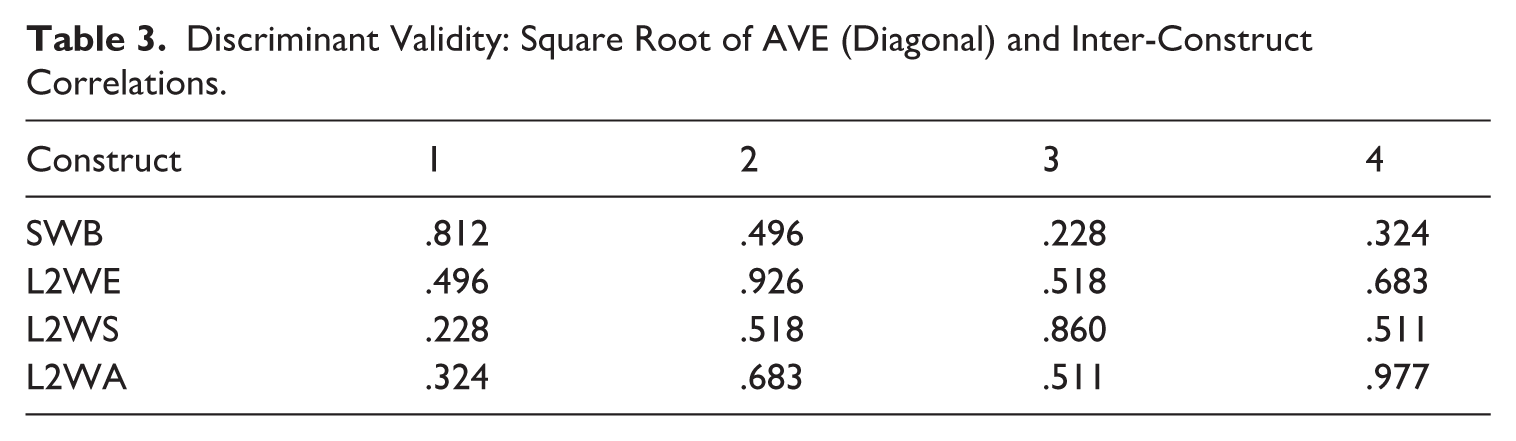
Discriminant validity was further assessed by comparing the square root of the AVE for each construct with the inter-construct correlations. Adequate discriminant validity is achieved when the square root of the AVE for each construct exceeds its correlations with other constructs (Fornell & Larcker, 1981). This criterion was met for all constructs, as the square roots of AVEs (.812 for SWB, .926 for L2WE, .860 for L2WS, and .977 for L2WA) were all greater than the corresponding inter-construct correlations, confirming satisfactory discriminant validity (see Table 3).
Discriminant Validity: Square Root of AVE (Diagonal) and Inter-Construct Correlations.
4.3 Descriptive Statistics
Descriptive statistics (see Table 4) showed that students reported relatively high levels of SWB (M = 4.380, SD = 1.202), moderate levels of L2WE (M = 3.615, SD = 0.900), and moderately high levels of L2WS (M = 3.945, SD = 0.945). The average L2WA was moderate (M = 7.303, SD = 3.001). All measures demonstrated strong internal consistency, with Cronbach’s α values ranging from .901 to .982.
Descriptive Statistics and Pearson Correlations among All Variables.
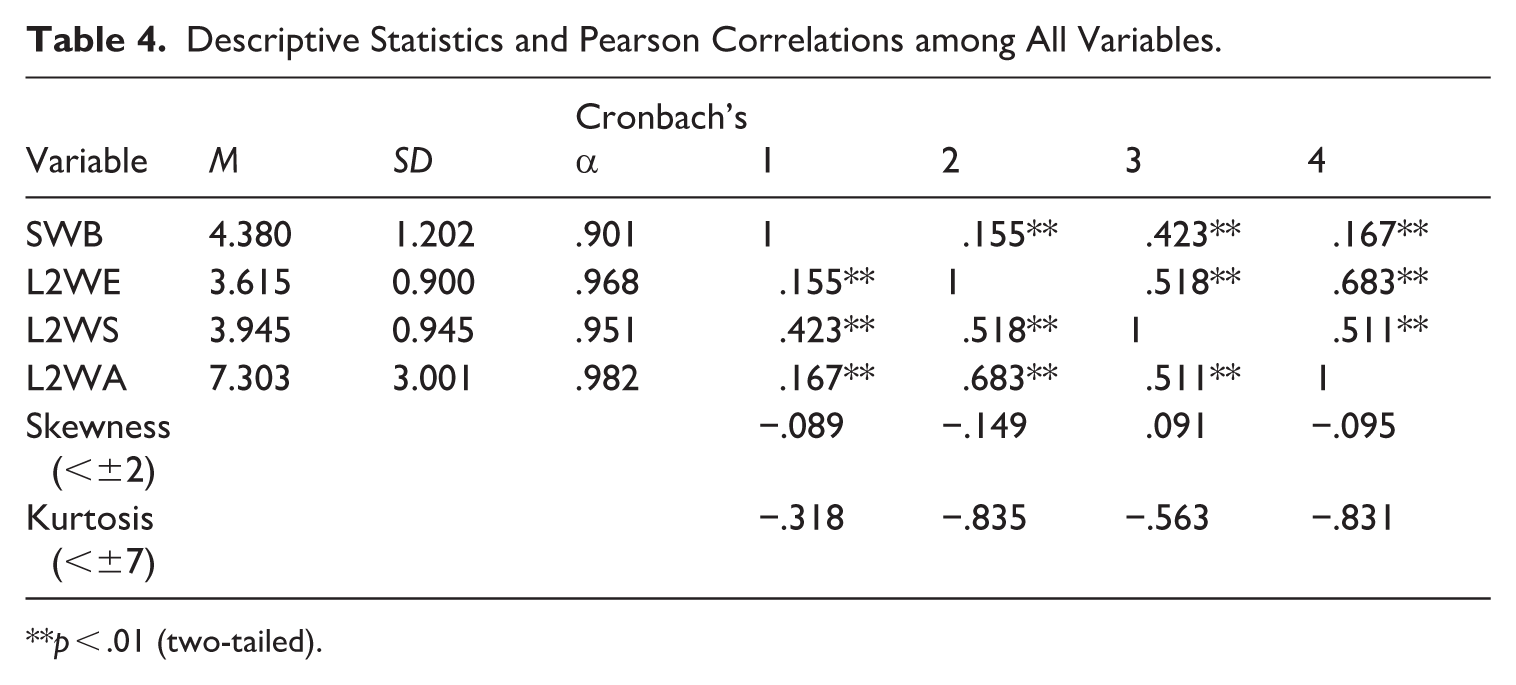
p < .01 (two-tailed).
The skewness and kurtosis values of all variables were within acceptable thresholds (±2 for skewness and ±7 for kurtosis), indicating that the data did not deviate from normality. Correlations were consistent with theoretical expectations. SWB was positively associated with both L2WE and L2WS, while L2WE and L2WS were strongly correlated with each other. In addition, L2WE, L2WS, and SWB all showed significant positive associations with L2WA, highlighting their potential contributions to students’ writing performance.
4.4. Structural Equation Modeling
SEM was conducted using AMOS 26.0 to examine the hypothesized mediation model linking SWB, L2WE, L2WS, and L2WA. The proposed model (see Figure 2) demonstrated a good fit to the data: χ2/df = 2.132, CFI = 0.933, TLI = 0.925, and SRMR = 0.05, all exceeding the recommended thresholds (Hu & Bentler, 1999). In addition, RMSEA = 0.099 (< 0.1), which is also within the acceptable range (Bagozzi & Yi, 1988).
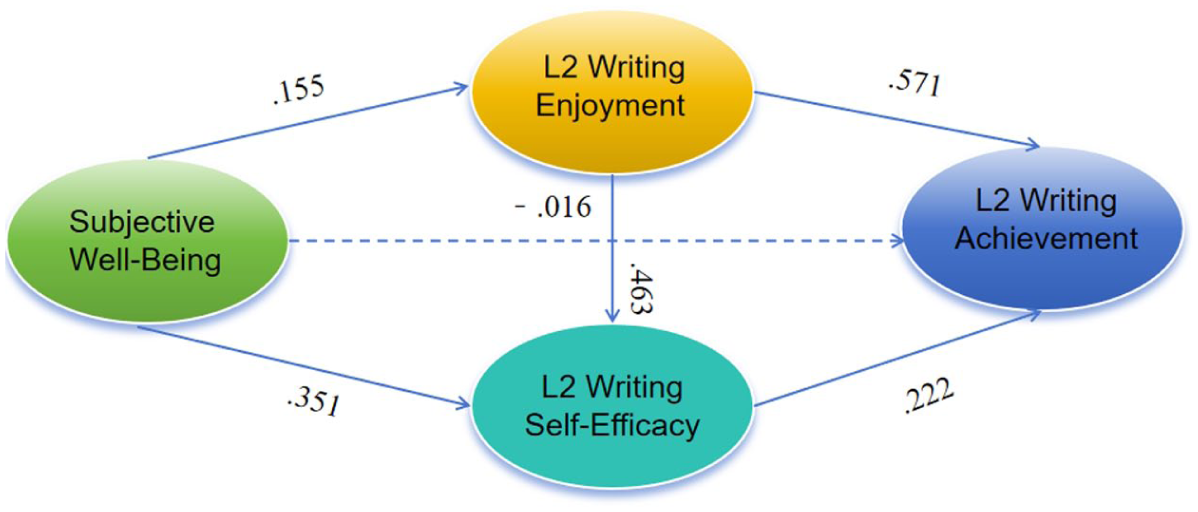
The chain mediation model.
Standardized path coefficients are reported in Table 5. Results showed that SWB significantly predicted both L2WE (β = .155, p < .05) and L2WS (β = .351, p < .001), while its direct effect on L2WA was non-significant (β = –.016, p = .715). L2WE strongly predicted L2WS (β = .463, p < .001) and exerted a robust direct effect on L2WA (β = .571, p < .001). Similarly, L2WS positively predicted L2WA (β = .222, p < .001).
Direct and Indirect Effects of SEM Analysis.
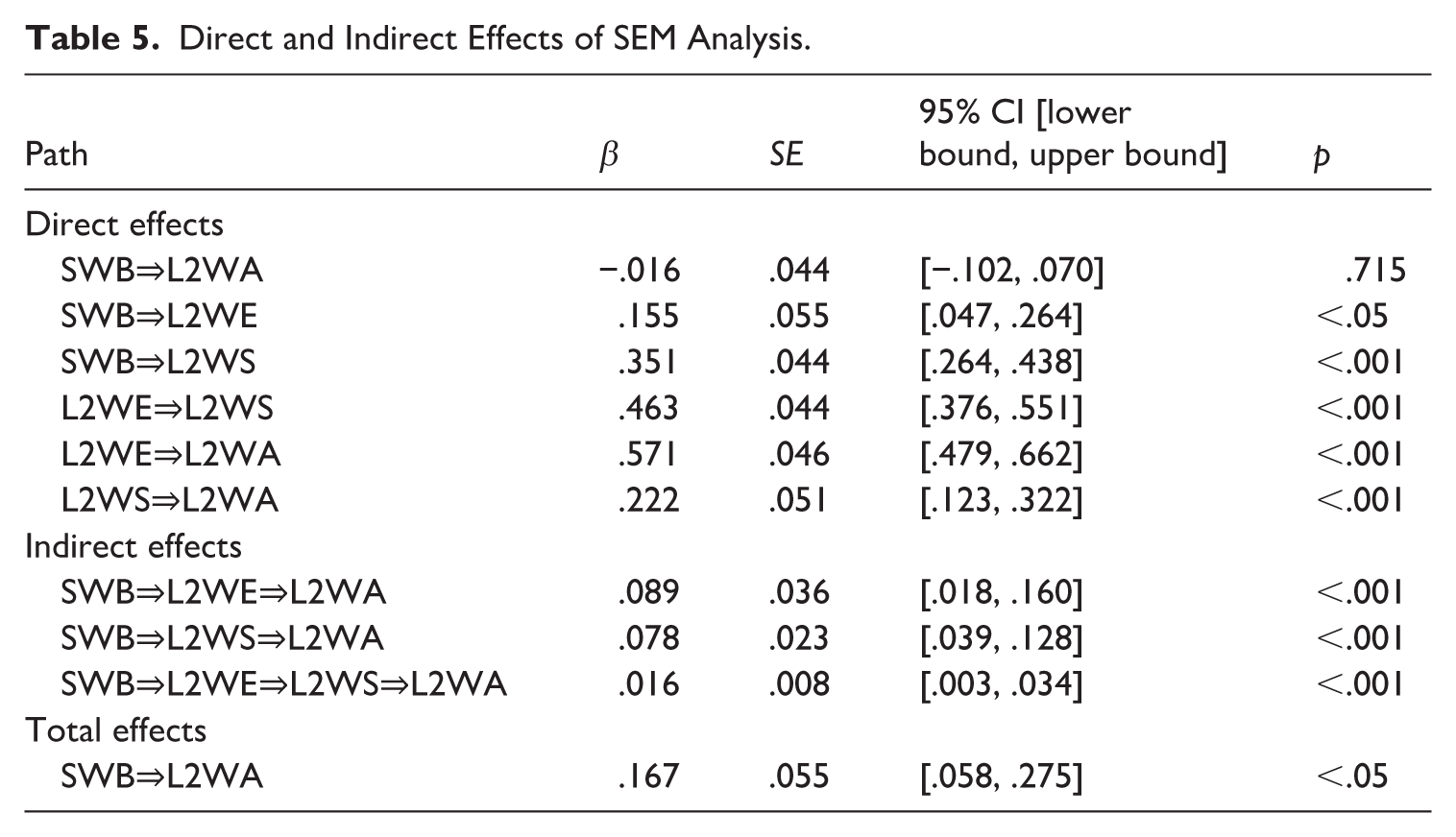
Bootstrapping analyses with 5,000 resamples confirmed the significance of indirect effects. Specifically, SWB exerted an indirect effect on L2WA via L2WE (β = .089, p < .001) and via L2WS (β = .078, p < .001). In addition, a significant serial mediation pathway was observed: SWB → L2WE → L2WS → L2WA (β = .016, p < .001). The total effects of SWB on L2WA was significant (β = .167, p < .05), indicating that although the direct path was not significant, SWB contributed to writing achievement through indirect mechanisms.
5. Discussion
Building on prior research, this study investigated the mechanisms through which SWB influences EFL learners’ L2WA, focusing specifically on the potential serial mediation of L2WE and L2WS. By analyzing these relationships, the study sheds light on how positive psychological states translate into improved writing performance, emphasizing the pivotal roles of positive emotions and self-beliefs. The following sections present a detailed discussion of the findings.
The study found that EFL learners’ SWB does not directly and significantly affect their L2WA, meaning that
L2WE was found to play a significant role in mediating the relationship between SWB and L2WA, supporting
This study further revealed that L2WS significantly mediated the relationship between SWB and L2WA, thereby supporting
The most important finding of this study lies in the identification of the serial mediation mechanism, whereby SWB influences L2WA through the sequential pathway of L2WE and L2WS, thereby supporting
6. Conclusion
This study examined the mechanisms through which SWB influences EFL learners’ L2WA, with a particular focus on the potential serial mediation of L2WE and L2WS. The findings reveal that SWB does not directly affect L2WA; rather, its influence is fully transmitted through learners’ positive emotional engagement and self-beliefs in writing. Specifically, L2WE was found to mediate the relationship between SWB and L2WA, while L2WS was also found to play a vital role mediating the relationship between SWB and L2WA. The most notable contribution of this study is the identification of a serial mediation pathway, highlighting how positive emotions (i.e., L2WE) and self-efficacy jointly facilitate the translation of general well-being into improved writing outcomes.
These findings have both theoretical and practical implications. Regarding its theoretical contributions, this study first extends the application of SWB theory to the context of EFL writing, demonstrating that learners’ overall life satisfaction and positive evaluation of personal experiences can influence domain-specific academic outcomes indirectly. Second, it provides empirical evidence for the independent mediating roles of L2WE and L2WS, as well as their combined serial mediation, highlighting how positive emotional experiences and self-beliefs serve as mechanisms through which SWB affects English writing performance. Third, the findings deepen our understanding of the psychological processes underlying L2WA, illustrating how SWB theory, the control-value theory of achievement emotions, and social cognitive theory can be jointly applied to examine the complex interplay of learners’ general well-being, emotional experiences, and self-beliefs in shaping English writing performance. Practically, the findings suggest that enhancing EFL university students’ SWB can serve as an effective pathway to improve their writing achievement, but this should be done with attention to both writing enjoyment and self-efficacy. First, instructors should foster students’ SWB by creating a supportive and motivating learning environment, which lays the foundation for positive emotional experiences in writing (e.g., L2WE). Second, supporting students’ L2WS through goal-setting, constructive feedback, and opportunities for successful writing experiences can strengthen the effect of SWB on writing outcomes. Third, integrated interventions (e.g., affective support, confidence-building exercises, and scaffolded feedback) that simultaneously enhance SWB, writing enjoyment, and self-efficacy are likely to sustain motivation, reduce writing anxiety, and maximize L2 writing performance. These implications underscore the importance of considering learners’ SWB while also targeting domain-specific emotional and cognitive factors in L2 writing instruction.
Despite its contributions, this study has several limitations. The cross-sectional design limits the ability to make causal inferences, as the observed relationships between SWB, L2WE, L2WS, and L2WA were examined at a single point in time. Future research should employ longitudinal or experimental designs to better capture the dynamic processes through which SWB influences writing outcomes over time. Second, the data were collected from a single public university in Jiangsu Province, which may constrain the generalizability of the findings. To strengthen external validity, future studies should include more diverse samples across different regions, types of institutions, and learner backgrounds (e.g., majors and proficiency levels). Comparative studies between English majors and non-English majors, or between undergraduates and postgraduates, would also provide a more nuanced understanding of individual differences. Third, the present study was conducted in an EFL context, where learners typically encounter English primarily in classroom settings. As learning environments can differ substantially, these findings should be interpreted with caution when generalized to more immersive English as a second language (ESL) contexts or to learners of other languages as a L2. Future research could replicate this model with learners in ESL or other L2 environments to examine whether similar relationships between SWB, L2WE, L2WS, and L2WA emerge under different levels of language exposure. Finally, this study focused primarily on SWB, writing enjoyment, and self-efficacy as explanatory variables of L2WA. While the model was theoretically grounded, it does not capture the full range of psychological and contextual factors that may influence writing performance, such as anxiety, resilience, teacher support, or technological affordances. Future research could incorporate these additional constructs to build a more comprehensive framework, as well as explore potential moderating variables (e.g., gender, proficiency, and learning experience) that may shape the strength of the relationships.
Footnotes
Acknowledgements
The author wishes to thank all the participants who took part in this study.

Ethical Considerations
This study was conducted in accordance with the Declaration of Helsinki and approved by the Institutional Review Board (IRB) of the School of Foreign Languages and Literature at Shandong University.
Consent to Participate
Informed consent was obtained from all participants involved in the study.
Author Contribution
The author has contributed to the whole manuscript, including methodology, data curation, formal analyses, visualization, and writing—original and final draft.
Funding
The author received no financial support for the research, authorship, and/or publication of this article.
Declaration of Conflicting Interests
The author declared no potential conflicts of interest with respect to the research, authorship, and/or publication of this article.
Data Availability Statement
The datasets generated and analyzed during the current study will be made available upon reasonable request.