







Abstract
Although research on flipped learning continues to explore ways to enhance its effectiveness, little attention has been paid to its combinations with other instructional approaches to improve alignment with diverse educational and learner needs. This study investigated the effects of the proposed Flipping Content and Language Integrated Learning approach in Asian tertiary education contexts. A quasi-experimental pilot study involved a group of low-achieving university students who learned with the Flipping Content and Language Integrated Learning approach over an academic term (i.e., a 26-week treatment period). Employing a repeated measures design, the study collected data through learning performance tests (examining both course content and language skills), a questionnaire on learning motivation and self-efficacy, and semi-structured focus-group interviews. The quantitative results demonstrate significant improvements in the participants’ subject knowledge, grammar, and writing skills, as well as in their motivation and self-efficacy. Moreover, retention effects in participants’ learning gains were observed. The qualitative accounts reveal that the participants collectively endorsed this approach, highlighting its interactive and supportive learning spaces in class and online, the value of challenging but rewarding learning tasks, and the role of the instructor. Empirically contributing to the literature, this study concludes by discussing the effectiveness of the Flipping Content and Language Integrated Learning approach for this specific cohort of low-achieving university learners and by outlining its implications for its future implementation. Its limitations and avenues for further research are also suggested.
Keywords
I. Introduction
Evolving from the concept of flipped classrooms, flipped learning has become a prominent strand in the educational community, supported by a growing body of empirical evidence (Akçayır & Akçayır, 2018; DeLozier & Rhodes, 2017; Kerr, 2020; Vitta & Al-Hoorie, 2023). Although the terms flipped classrooms and flipped learning are often used interchangeably, 1 they refer to distinct concepts. Flipped classrooms typically refer to “school work at home and home work at school” (Flipped Learning Network (FLN), 2014, p. 5), involving an inversion of instructional delivery formats. This is done by moving direct instruction outside the classroom through pre-recorded lectures and assigned readings, and reserving in-class opportunities for practice. Moving beyond, flipped learning builds on this class structural shift and places greater emphasis on active engagement for learners. Rather than simply rearranging the time and place of instruction, flipped learning creates dynamic, interactive learning environments that accommodate individual learner differences and foster higher-order thinking skills (Bergmann & Smith, 2017; Kerr, 2020).
Following this line of development, studies on flipped learning are moving from questions of whether it works to “what makes it work better” (Bergmann & Smith, 2017, p. xix) across different instructional contexts. Two critical research gaps warrant further attention. First, although many studies have demonstrated the effectiveness of flipped learning across subjects (e.g., Akçayır & Akçayır, 2018; Huang & Hong, 2016; Karabulut-Ilgu et al., 2018; J. Lee et al., 2017; Ruiz-Jiménez et al., 2024; Vitta & Al-Hoorie, 2023), relatively little research has examined how flipped learning can be integrated with other instructional approaches. This research direction is important not only for advancing the development of flipped learning but also for adapting it to fit diverse classroom-based settings (Baig & Yadegaridehkordi, 2023). Recent studies have begun exploring such integrations (e.g., Kuo & Chang, 2024; Shafiee Rad et al., 2023), but there remains a need for subject- and learner-specific investigations to determine which instructional design would be more compatible.
Second, most flipped learning studies have focused on learners of average ability or intact classes as a whole. However, far fewer have examined its effectiveness for underrepresented learner groups (Vitta & Al-Hoorie, 2023), such as low-achieving students (Chang, 2023). This lack of attention is noteworthy and should be addressed because those low-achieving cohorts often exhibit weaker self-regulation, particularly in completing tasks assigned outside the classroom (Chang, 2023; Filiz & Kurt, 2015). Moreover, in Content and Language Integrated Learning (CLIL) programs, especially in tertiary education in Asia, these learners frequently face challenges due to limited class hours and the dual demands of both content and language learning (see Section 2.1). Conditions like this may hinder such students’ learning progress.
To address these research gaps, the present study aimed to pilot and examine the proposed Flipping CLIL approach tailored for a cohort of low-achieving tertiary students. Specifically, the study had two objectives. First, it investigated the extent to which the implementation of the Flipping CLIL approach supported students’ learning outcomes, in terms of both subject content knowledge and English language development, particularly in grammar and writing. Second, it explored students’ affective responses, including motivation, self-efficacy, and perceptions of their learning experience when engaging with this approach.
To the best of the authors’ knowledge, this study would be the first empirical attempt to integrate flipped learning with CLIL to support low-achieving learners in tertiary education, responding to calls for more context-sensitive instructional models. The Flipping CLIL approach was then framed as an instructional model (see Section 3), and a mixed-methods design was adopted to implement this approach over an academic term, combining quantitative measures of learning performance and affective variables with qualitative insights into students’ learning experiences.
2. Literature Review
2.1. Conceptual Background of CLIL in Asian Higher Education
CLIL has been widely adopted as an approach to bilingual education, in contexts where the target language is used alongside learners’ first language (L1). Originally conceptualized by Marsh (2008), CLIL refers to an approach in which subject content is taught through an additional language (predominantly English in the existing literature), in turn integrating content learning with language development.
However, in tertiary education, particularly in Asian contexts, it is important to distinguish CLIL from English-medium instruction (EMI), which is more commonly implemented at this level. A key difference between CLIL and EMI lies in the presence of an explicit language-learning objective. More specifically, CLIL’s dual emphasis enables learners to develop subject knowledge while simultaneously enhancing their foreign language proficiency (Coyle et al., 2010; Hemmi & Banegas, 2021). In contrast, EMI typically involves teaching academic subjects through English without an explicit focus on language learning in contexts where English is not the L1 of the majority of the population (Macaro et al., 2018), often driven by institutional goals such as internationalization (Dearden & Macaro, 2016).
Despite these conceptual distinctions, it should be noted that the terms CLIL and EMI “are often used interchangeably” in the literature on Asian education (Gilanyi et al., 2023, p. 1; see also An & Macaro, 2025), reflecting the diversity of instructional practices across contexts. Given this complexity, the present study adopts the term CLIL to refer specifically to instructional settings in which both content and language learning are intentionally targeted, as is the case in the course examined in this study.
2.2. Key Challenges in CLIL Implementation
Empirical studies have documented the implementation and potential benefits of CLIL-related practices across a gamut of Asian contexts, including China, Hong Kong, Japan, and Taiwan (e.g., An & Macaro, 2025; Gilanyi et al., 2023; J.-Y. Lee, 2021; Sato & Hemmi, 2022; Yang, 2015). These studies also highlight considerable variation in how such programs are designed and implemented, reflecting differences in institutional goals, disciplinary contexts, and learner/teacher profiles.
However, despite its growing prominence, corresponding efforts to address the practical challenges associated with CLIL implementation have remained few and far between. Among the few studies, J.-Y. Lee (2021) reported that lecturers across several Asian universities (including China, Japan, the Philippines, Taiwan, and Thailand) expressed reservations about CLIL’s effectiveness. One major concern is learners’ English proficiency. It has been found to moderate CLIL learning outcomes (Pladevall-Ballester, 2015; Yang, 2015). Specifically, learners with lower English proficiency may struggle in class to comprehend subject content taught in English (Lopriore, 2020), limiting in-depth discussions and interactive activities (Aguilar & Rodríguez, 2012; Kung, 2018). When this occurs, instructors may be unable to cover the full range of planned course content. Instructors may thus need to balance the focus between language and subject knowledge, risking the sacrifice of one to accommodate the other in the limited class hours.
Furthermore, time constraints, often restricting the depth of learning, become another concern that poses challenges for the implementation of CLIL (Bárcena-Toyos, 2023; Hughes & Madrid, 2020). As J.-Y. Lee (2021) argued, CLIL is perceived as time-intensive, making it difficult for instructors and students to cover all the course content within fixed teaching hours. Together, these challenges above are pronounced for low-achieving students, who may require more structured scaffolding, extended time, and additional support to fully participate in CLIL classrooms. Without these, low-achieving learners are likely to risk being marginalized, possibly widening achievement gaps and undermining the inclusive potential of CLIL.
2.3. From Flipped Learning to Its Combination with Complementary Approaches
Flipped learning features the use of educational technology, interactive learning, and flexible instructional design where instructors adopt and adapt a wide range of teaching methodologies (Bergmann & Smith, 2017; FLN, 2014; Kerr, 2020). These elements jointly leverage the flexibility of learning to facilitate self-paced preparation outside class time (I. C. V. Hsiao et al., 2023); for example, pre-class language support or enhancement. Thereby, instructors can implement various teaching methodologies where appropriate; for example, maximizing in-class time by running the gamut of interactive and content-focused tasks (DeLozier & Rhodes, 2017) and/or prioritizing subject learning over extensive language instruction. Teaching interventions like this can support the development of both lower- and higher-order thinking skills (Chang, 2023) and foster long-term learning effects (C. C. Hsiao et al., 2019).
Empirical studies have reported the positive impact of flipped learning on academic outcomes across wide-ranging subjects like algebra (J. Lee et al., 2017), business (Ruiz-Jiménez et al., 2024), engineering (Karabulut-Ilgu et al., 2018), and language (Huang & Hong, 2016; Vitta & Al-Hoorie, 2023). Additionally, flipped learning has been shown to nurture learners’ affective traits, such as motivation and self-efficacy. Several studies found that the flipped approach can increase either learners’ motivation (e.g., Huang & Hong, 2016) or self-efficacy (e.g., I. C. V. Hsiao et al., 2023; Namaziandost & Çakmak, 2020). Only two studies have examined both dimensions in tandem. H. H. Chuang et al. (2018) found that learners’ motivation was positively associated with their reading performance, but self-efficacy was not at all associated. In contrast, Chang (2023) reported significant gains in both motivation and self-efficacy among low-achieving learners, who also outperformed peers in traditional learning conditions. These findings highlight the potential of flipped learning to support low-achieving learners, although more empirical evidence is required to confirm its effectiveness across varied contexts.
These foundational principles and the empirical evidence of flipped learning may provide promising support for its integration with other educational approaches, particularly those complementary in nature. However, such an enquiry has to date received only sporadic research attention (e.g., Kuo & Chang, 2024; Shafiee Rad et al., 2023), and the combined applications to low-achieving learners have received little research attention in tertiary education. Shafiee Rad et al. (2023) combined flipped learning with a Student Team Achievement Division, known as a structured cooperative learning method, over an 8-week course schedule to develop their advanced learners’ expository writing skills. Their results demonstrated that such a combined instructional model effectively improved writing performance and nurtured positive learning perceptions. Similarly, Kuo and Chang (2024) embedded the WPACQ learning model into a flipped programming course in a university’s information management department, where learners progressed through stages, namely, Watching instructional videos, Peer-summary tasks, Assessment for units, Correction of errors, and Questioning. After the four-week intervention, the findings showed that the WPACQ learning model, compared to a conventional flipped classroom, enhanced learning effectiveness, motivation, self-efficacy and reflective abilities, while reducing cognitive load.
These two studies demonstrate the feasibility of combining flipped learning with additional teaching/learning models, but the need for further investigation of certain areas continues. First, instructional models combining flipped learning with other approaches should be tailored for specific subjects “to suit the nature of the course” (Baig & Yadegaridehkordi, 2023, p. 22). Second, research on underrepresented learner cohorts is limited. Although Shafiee Rad et al. (2023) conducted their research with advanced learners, Kuo and Chang (2024) studied an intact class of programming students with an average range of abilities. Whether such integration is equally effective for underrepresented cohorts, such as low-achieving learners (Chang, 2023; Vitta & Al-Hoorie, 2023), demands further investigations. Together, addressing these is critical for advancing flipped learning research, with a particular focus on supporting low-achieving learners.
3. The Proposed Instructional Model: The Flipping CLIL Approach
Grounded in constructivist learning theory (CLT), the Flipping CLIL approach integrates Coyle et al’s (2010) CLIL 4Cs (Content, Communication, Cognition, and Culture) framework and Chang’s (2023) expanded four pillars of flipped learning from Bergmann and Smith (2017), tailored specifically for low-achieving learners.
At the core of CLT 2 is the notion that learning involves active construction of knowledge and meaning making, both individually and socially, in a learner-centered environment (Garmston & Wellman, 1994). On an individual level, learning takes place as a cognitive process where leaners actively engage in building knowledge by connecting it to the previous state of their knowledge (Smith & Ragan, 2004). On a social level, learning requires collaboration in which meaning and knowledge are co-constructed through interaction with others (Boghossian, 2006; Smith & Ragan, 2004). These individual and social aspects are equally important, which reinforces the view that knowledge is not passively transmitted but actively shaped by learners themselves. In this view, the CLT is also expected to motivate learners by promoting environments where they take control of their own learning. This in turn repositions the instructor’s role from a transmitter of knowledge into a facilitator who supports learners in the formation of the meaning of new knowledge by creating authentic learning contexts (S. Chuang, 2021; Katz & Halpern, 2015). In this way, the CLT aligns closely with the underlying principles of both flipped learning and CLIL, offering a solid theoretical foundation for the Flipping CLIL approach proposed below (see Figure 1). Both CLIL and flipped learning are conceptualized as organizational/instructional approaches that structure learning objectives and sequencing, while pedagogical strategies such as scaffolding and task-based activities are enacted within this working model.
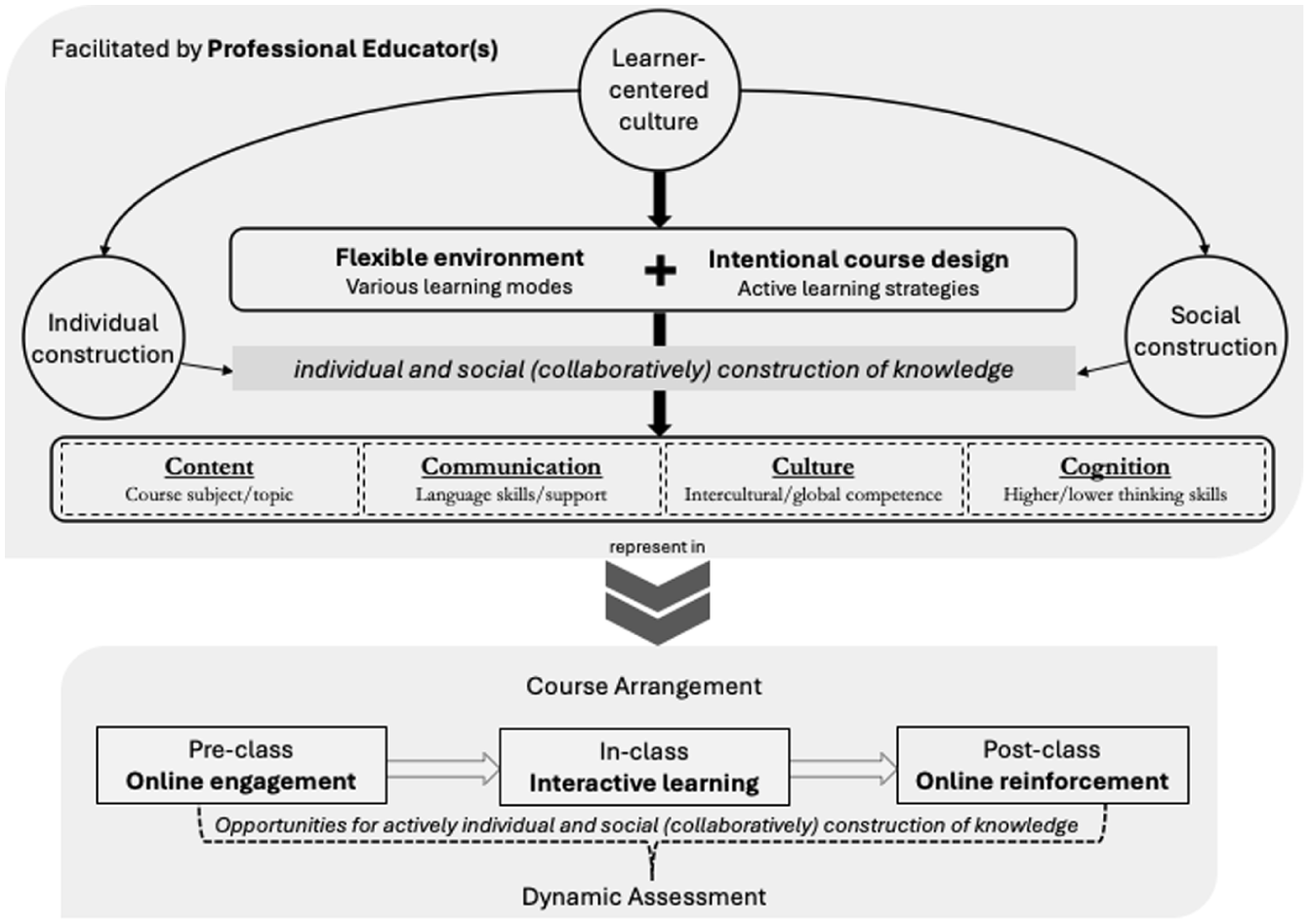
Working model of the Flipping CLIL approach.
This model is situated in a learner-centered culture and is facilitated by a professional instructor. It is founded on having a flexible learning environment and intentionally designed courses that provide adaptable spaces and timelines (e.g., online or in-class) using varied learning materials and methodologies. Such a base is built on the theoretical principles of flipped learning and CLIL, which both emphasize active, student-driven learning (Akçayır & Akçayır, 2018; Bergmann & Smith, 2017; Coyle et al., 2010; Hemmi & Banegas, 2021). Central to this model, the instructor takes a role in meticulously promoting active engagement and developing meaningful connections among all the learning/teaching elements in the targeted courses, while attentively addressing the needs of low-achieving learners (Chang, 2023). A setup like this considers learners’ attention span and accommodates their initial level of academic performance, allowing the instructor to choose whether to prioritize content or language, or to take a balanced approach (Ball et al., 2015) as student needs and course objectives determine.
The instructional process is underpinned by two interrelated dimensions of knowledge construction: individual and social (i.e., collaborative). Instructors guide learners on what, when, and how to learn, and on how to engage with learning both individually and collaboratively. This is to ensure that content (subject knowledge) is thoughtfully balanced with communication (language skills and support) so as to provide the necessary scaffolding. Yet it should be noted that instructors must retain flexibility in course arrangement; that is, whether to focus on content, language, or both equally 3 (Ball et al., 2015, Coyle et al., 2010). The culture component, which may vary based on course emphasis, demands that learners engage with content and language in ways that enhance intercultural understanding and foster global competence. Lastly, the development of learners’ cognition should contextualize what they learn (content and language), in ways that promote both lower- and higher-order thinking skills (Alsowat, 2016; Chang, 2023; Lopriore, 2020), as they work towards a mastery of course knowledge. Pedagogical strategies such as collaborative learning, reflective tasks, and student-led discussions (Arnó-Macià & Mancho-Barés, 2015; DeLozier & Rhodes, 2017) facilitate deep engagement. Activities like group projects and jigsaw reading tasks are particularly effective in supporting both content retention and language development (C. C. Hsiao et al., 2019).
The model is implemented through structured course arrangement involving three learning phases: (a) pre-class online engagement where students prepare subject content and/or have language support; (b) in-class interactive activities focused on deeper content understanding and/or language productive skills; and (c) post-class reinforcement that consolidates learning.
This sequencing allows learners to gradually develop understanding and apply course knowledge in increasingly sophisticated ways. Throughout these phases, instructors should actively promote both individual reflection and collaborative interaction to foster meaningful learning. Assessment is likewise integral to the Flipping CLIL approach. On the premise of assessment for learning principles, dynamic assessment is seamlessly embedded across the learning process (Fulcher, 2013). Rather than treating assessment as a separate or summative task, dynamic assessment integrates it into learning to support the simultaneous development of content knowledge and language proficiency. Learners are nurtured through interactive, formative, and feedback-oriented activities embodied in the nature of Flipping CLIL. These assessments, whether graded or ungraded, formal or informal, can take various forms as long as instructors provide authentic tasks and feedback for improvement (Katz & Halpern, 2015).
Overall, the Flipping CLIL approach is designed to optimize educational outcomes for low-achieving tertiary students by holistically addressing both language and content learning needs. The implementation of the Flipping CLIL approach in the present study is detailed in Section 4.3.
4. The Study
This study investigated the effects of the Flipping CLIL approach, guided by the following research questions (RQs):
In line with the study context (see Section 4.2), learning performance was operationalized as learners’ subject knowledge of the course and their English language skills, particularly grammar and writing. Motivation referred to learners’ engagement with the course under the study’s proposed approach, while self-efficacy was examined in relation to both content learning and language development.
4.1. Research Design
This study adopted a quasi-experimental, mixed-methods research design to examine the effects of the Flipping CLIL approach. Having received its institution’s ethical approval, it set aside an academic term (26 weeks) to study one group of low-achieving university students in East Asia. Further details of the procedures (see Figure 2) and treatment are elaborated below.
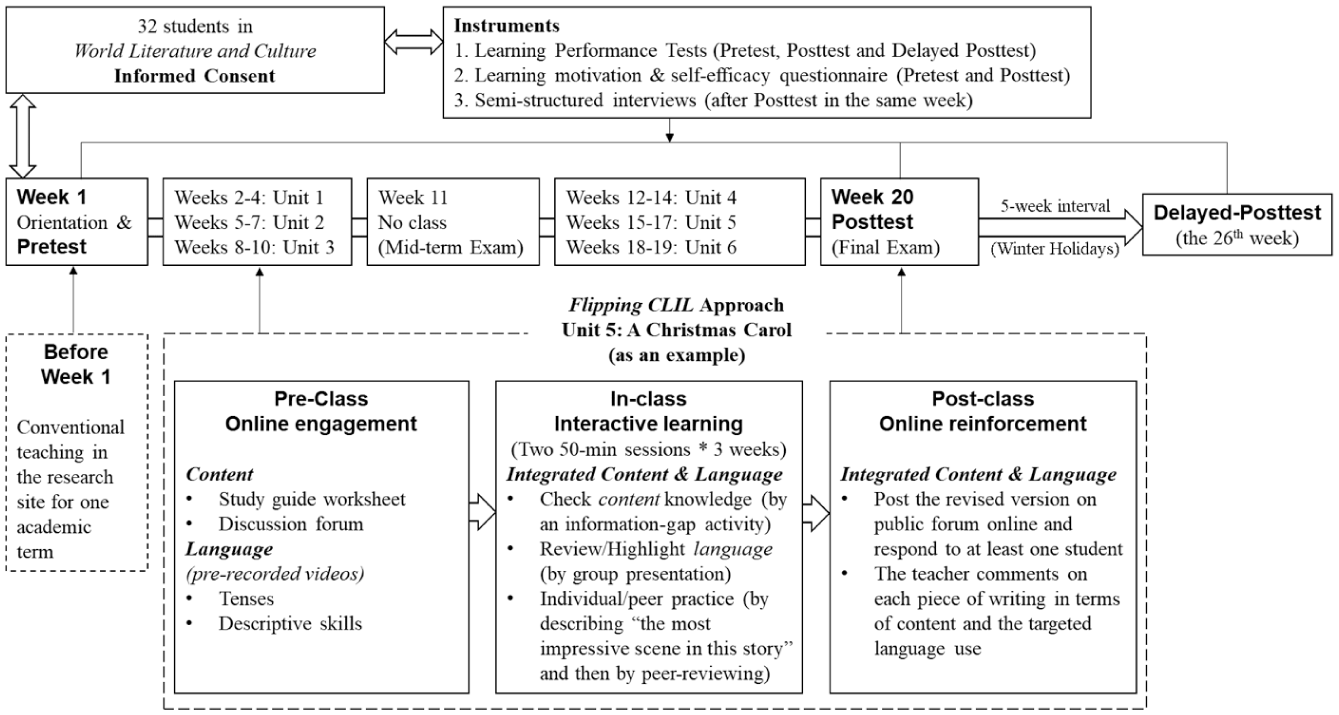
Schematic diagram of the research procedures.
It should first be explained that instead of comparing two groups, this study examined a single group, constituting a triangulation approach, to address the absence of a between-subject comparison (Creswell & Creswell, 2018). This decision was grounded in statistical and ethical considerations. First, the number of low-achieving students per academic year was relatively small, making it challenging to divide them into treatment and control groups without compromising statistical power. A between-subject comparison with very small group sizes (e.g., about 10 participants per group) would be less robust than a within-subject design with a somewhat larger sample (e.g., about 30 participants). Second, with the potential positive effects of the proposed teaching approach, as shown by the extent of the literature, it would be ethically inappropriate to divide low-achieving students into treatment and control groups. Giving the control group the conventional instruction and excluding them from the potential benefits of Flipping CLIL could be considered unethical.
To mitigate the limitations of doing without a control group, the study adopted a triangulation strategy (Creswell & Creswell, 2018), collecting data from multiple sources including both quantitative (learning performance, and motivation and self-efficacy) and qualitative (learning experiences) data. Additionally, to increase the rigor of the outcome analysis, a repeated measures analysis of covariance (RM ANCOVA) was employed for the learning performance. Alongside the pre- and post-test comparisons, a delayed post-test and a covariate (i.e., pretest performance) were added so as to enhance the statistical power of this specific scenario (Field, 2017) (further details in Section 5).
4.2. Context and Participants
This study was conducted in the College of Liberal Arts at a university in East Asia, where some subjects are taught in English. Situated in an intact enhancement course, World Literature and Culture, the study was designed to provide additional academic and language support to students. Enrollment in this course was required for students who had not met the college’s benchmark in the previous academic term and for those who, after consulting with tutors, recognized the need for further learning enhancement. Before this course, students in the same course had received conventional instruction at the research site, although using different learning content and materials.
After 35 students had consented to participate in this research, they enrolled on this course. They represented various academic majors such as history, information and library studies, and mass communication. Their average age at the time of the research was 19 and their English language proficiency was mostly at the B1 level in the Common European Framework of Reference for Languages (CEFR) (with some at upper A2 or lower B2). During the course, 1 student withdrew and 2 did not complete the delayed post-test, resulting in a final participant group of 32 students.
4.3. Treatment: The Flipping CLIL Approach
All units in the study were collaboratively designed by two instructors, one subject teacher with experience in English language teaching, and one English language teacher. Both instructors held certification in CLIL for higher education at the time of the study. The course was delivered by the subject teacher, while the English language teacher provided ongoing support and monitoring throughout the whole implementation.
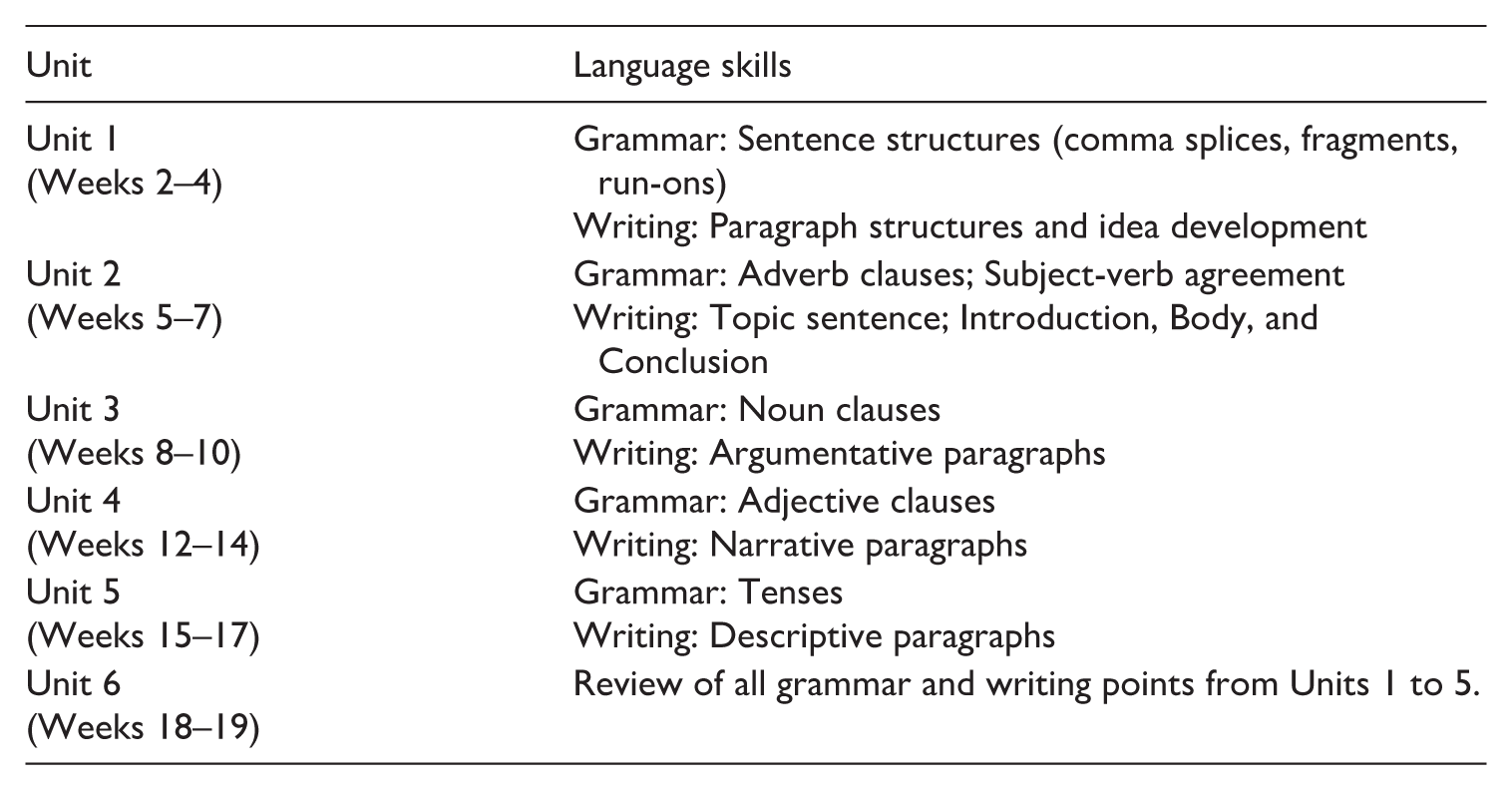
To maintain ecological validity and reflect the dual-focus nature of CLIL, the course addressed two inseparable dimensions: content knowledge of literature work and language skills. Language skills covered both grammar and writing (see Appendix A). As Chang (2023) highlighted, grammar use and writing are closely related, and the former can be demonstrated and assessed through writing. In this way, writing serves as a means of representing learners’ higher-order thinking skills, one of the intended outcomes of flipped learning. This dual focus was also reflected in the evaluation of learning performance, where both content knowledge and language skills were assessed (see Section 4.1.1).
For example, Unit 5 lasted 3 weeks, each week having a 100-minute in-class session (see Figure 2). It focused on the contexts of the Victorian age and a literary work (A Christmas Carol by Charles Dickens), with language input emphasizing tenses and descriptive skills. To accommodate the language proficiency level of the students, an adapted version of A Christmas Carol was provided (suited to B1–B2 in the CEFR), although the instructor still introduced some extracts from the original version into the course materials.
The unit began with pre-class online engagement. Through the institutional learning platform (I-class Moodle), students received preview materials 1 week prior to the in-class session. For content support, a structured study guide was provided, covering the literary work and its historical context (e.g., the Victorian era). This guide highlighted key concepts and focal points to reduce cognitive load for the low-achieving cohort. For language support, students engaged with two pre-recorded instructional videos by the instructors (approximately 15 minutes each), which focused on relevant grammatical features (e.g., tense usage) and descriptive skills for writing. These materials were accompanied by guided tasks linked to a literary worksheet, requiring students to identify specific language features (e.g., tense forms) and explain their use in context. As part of the pre-class tasks, students were required to write a summary of the literary work (minimum 80 words) and to list key features of the Victorian era in bullet-point form, with attention to appropriate language use. These tasks also worked as a means of monitoring students’ engagement with the preparatory materials.
During the in-class session, the instructor facilitated a jigsaw reading activity (Ball et al., 2015) to review the content of the literary work. Following this, students engaged in team discussions using cooperative learning and dynamic assessment strategies (Arnó-Macià & Mancho-Barés, 2015; Fulcher, 2013). Each group received a word list and sentence templates to help complete narrative stories, with emphasis on summarizing the literary work and applying tenses accurately. In addition, in terms of the cultural understanding, the instructor first provided an overview of the Victorian age. This then allowed each group member to contribute to a collective understanding of its features based on their pre-class tasks. Subsequently, each group delivered a short presentation to the class regarding their summaries of and perspectives on the Victorian age. The instructor monitored the group activities, ensuring effective discussion by managing time and intervening in groups where appropriate. These maneuvers reciprocally scaffolded the students’ language for discussion, aligning with flipped learning and CLIL’s principles of interactive learning settings.
At the end of the in-class session, the students completed a short paragraph about the most impressive scene they had found in the literary work, focusing on tenses and descriptive skills. Following completion, they exchanged their paragraphs for peer-review against a checklist provided. To reinforce learning after class, the students revised their writing on the basis of peer feedback, uploaded the final version on the online platform, and commented on at least one peer’s writing. Finally, the instructor provided overall personalized suggestions and feedback to improve both language use and content knowledge in each student’s paragraph. This kind of online reinforcement task, coupled with interaction between students and the instructor, was delivered with the aim of fostering students’ higher order thinking skills.
4.4. Instruments
Data were collected using three instruments to triangulate the findings (see Figure 2): (a) learning performance tests assessing both course content and language skills; (b) a questionnaire measuring motivation for the course and self-efficacy in both content and language; and (c) semi-structured focus-group interviews exploring learners’ experiences.
4.4.1. Learning Performance Tests
The participants took three learning performance tests: a pretest (Week 1), a post-test (Week 20) and a delayed post-test (Week 26). It should be noted that the mid-term exam in Week 10 followed the college’s predefined testing paper and format, resulting in the study’s excluding the test scores from analysis. The participants were also informed that they would retake the test after the winter holidays (a 5-week interval), requiring them to self-review the course units.
The three learning performance tests shared the same format and construct and formed three sections with a full score of 100 points. These tests were intended to assess the participants’ lower- and higher-order thinking. Overall, the content of the pretest reflected what they had learned in the last term, whereas the post-test and delayed post-test covered the targeted content and language skills delivered in the enhancement course. The first section (25 points) using four-choice multiple items tested the participants’ understanding of the content knowledge related to the selected literature/culture. The second section (25 points) employed four-choice multiple items to assess the participants’ comprehension of the targeted language concepts emphasized in the course. The third section consisted of two one-paragraph writing tasks (25 points each) for assessing the participants’ expression of ideas based on their reflection on the selected literary/cultural work learned on the course. For rating the writing tasks, the instructor administered a five-category holistic scale (e.g., the lowest category ranging from 1 to 5 points, the highest from 21 to 25 points), focusing on understanding the content knowledge and accuracy of the language skills acquired on the course.
Various measures were adopted to maintain the validity and reliability of the tests. In addition to the two instructors developing this course, one professor teaching a similar course reviewed the tests for content and construct validity. To ensure the scoring quality of two writing tasks, the two instructors discussed how to rate the students’ writing, marked five sets of essays in each test period together, and then moved onto mark the remainder independently. A strong consistency index of interrater reliability was obtained (r = .89, p < .001).
4.4.2. Learning Motivation and Self-Efficacy Questionnaire
The questionnaire was administered in the pretest (Week 1) and post-test (Week 20). This decision was made because no teaching treatment occurred between the post-test and the delayed post-test and because changes in behavioral and affective attitudes are not likely to be observed in such a short period. The 5-point Likert-scale questionnaire employed was adapted from Lin’s (2016) survey of learning motivation and self-efficacy. To ensure relevance, the questionnaire underwent adaptation while maintaining its construct, followed by a review from two professors. Then a pilot study involving other students at the research site tested the questionnaire’s overall quality, demonstrating satisfactory reliability (Cronbach’s α = .89) and construct validity (66.33% variance explained). The questionnaire had 17 items, comprising three underlying factors: Self-efficacy in learning content knowledge (Items 1–8 in Factor 1: Cronbach’s α = .90; 27.10% variance explained); Self-efficacy in learning language knowledge (Items 9–13 in Factor 2: Cronbach’s α = .89; 22.67% variance explained); and Learning motivation in this enhancement course (Items 14–17 in Factor 3: Cronbach’s α = .83; 16.56% variance explained). The full version of the questionnaire was administered before and again after the treatment as the entry and exit questionnaire respectively.
4.4.3. Semi-Structured Focus-Group Interviews
The semi-structured focus-group interviews took place in Week 20 to collect qualitative accounts of the participants’ perceptions and experiences with learning by means of the Flipping CLIL approach in this enhancement course. Sixteen participants voluntarily joined the interviews, divided into four groups of four students each. The interviews lasted approximately 45 minutes and used the same six prompts (see Appendix B).
5. Analyses and Findings
5.1. RQ1. Learning Performance in Content Knowledge and Language Development
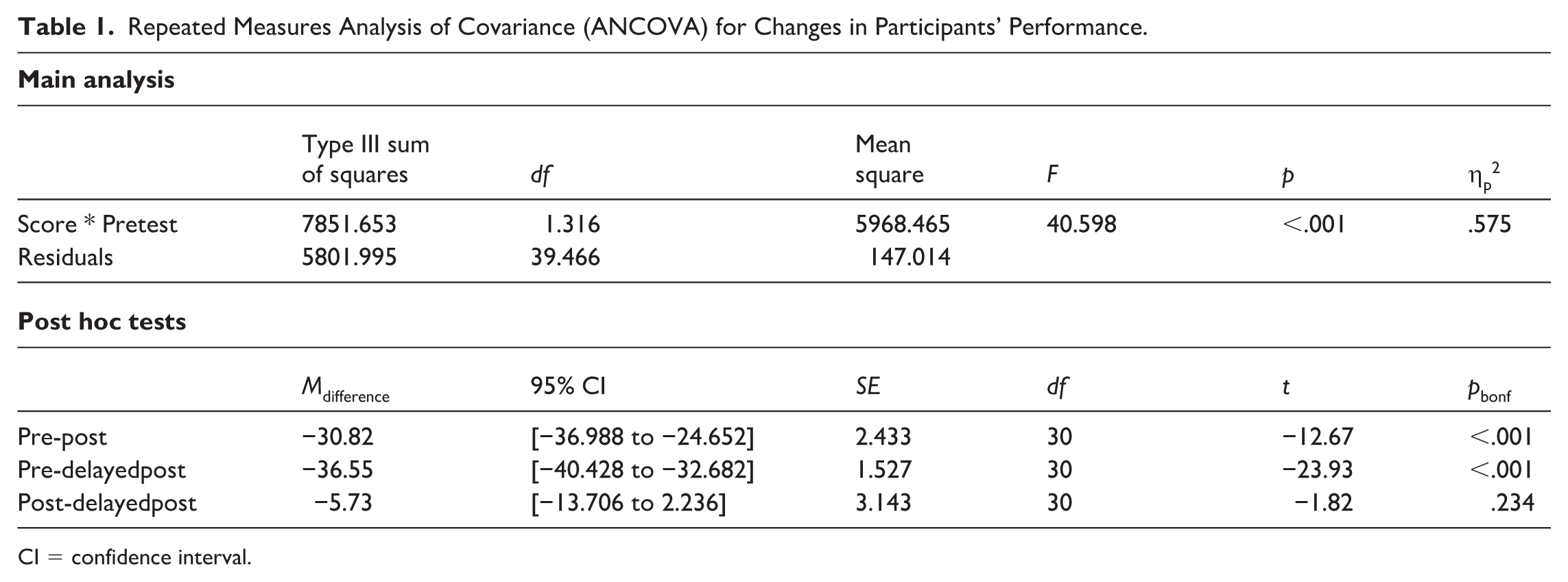
An RM ANCOVA was conducted to examine whether the participants made significant gains from the treatment and whether the effects of gains lasted, while controlling for their pretest scores. By having the pretest score as a covariate, we controlled for individual differences in baseline performance (Field, 2017). Note that Mauchly’s test revealed a violation of the assumption of sphericity (W = .48, χ2(2) = 21.30, p < .05), and as a result Greenhouse-Geisser corrected tests were adopted (ε = .658). The effect size was reported using partial eta squared (ηp2) to determine the magnitude of the treatment effect observed, where .01, .06, and .14 represent small, medium, and large effects, respectively.
Table 1 summarizes the main RM ANCOVA results along with the post hoc comparisons using the Bonferroni adjustment. Figure 3 provides a visual representation of the findings. Descriptive statistics first showed the score improvements across the three tests: pretest (M = 49.28, SD = 17.73), post-test (M = 80.10, SD = 14.15), and delayed post-test (M = 85.84, SD = 8.76). Notably, the standard deviations of these tests decreased by 9, from 17.73 to 8.76, signifying more homogenous performance distributions in this student cohort.
Repeated Measures Analysis of Covariance (ANCOVA) for Changes in Participants’ Performance.
CI = confidence interval.
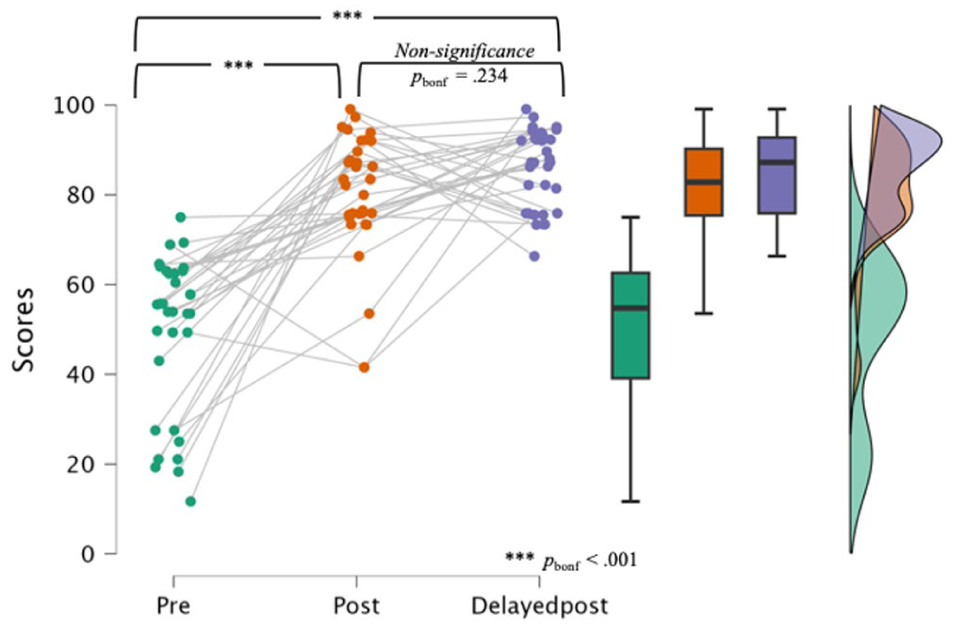
Changes in participants’ performance across the three tests.
The main RM ANCOVA results indicated a significant effect of test timepoint on scores, controlling for pretest performance, F(1.316, 39.466) = 40.598, p < .001, with a large effect size (ηp2 = .575). Post hoc comparisons showed scores significantly improved from the pretest to both the post-test (Mdifference = -30.82, t = -12.67, p < .001) and the delayed post-test (Mdifference = -36.55, t = -23.93, p < .001). Although there was a further increase from the post-test to the delayed post-test (Mdifference = -5.73), this difference was not statistically significant (t = -1.82, p = .234), meaning that the students maintained their performance after a 5-week interval of self-reviewing without additional instruction.
These results suggest a significant and positive effect of the Flipping CLIL approach on low-achieving students’ course content learning and their grammar and writing skills. These effects were retained for at least 1 month post-intervention.
5.2. RQ2. Learners’ Motivation and Self-Efficacy
Paired sample t-tests analyzed whether the participants had changed significantly in their motivation and self-efficacy before and after the treatment over the 20 weeks. To determine the magnitude of a treatment effect, effect-size r is calculated by r = √(t2 / (t2 + df)). Field-specific thresholds for second language (L2) research were applied to interpret the effect-size r, with 0.25 indicating a small effect, 0.4 a medium, and 0.6 a large one (Plonsky & Oswald, 2014).
Table 2 revealed statistically significant improvement overall in both motivation and self-efficacy among these students, with a strong effect size (the questionnaire as a whole: t = -7.864, p < .001, r = .816). The improvements were significant across the three underlying factors: Factor 1 (t = -8.856, p < .001, r = .846), Factor 2 (t = -6.243, p < .001, r = .746), and Factor 3 (t = -4.277, p < .001, r = .609), all with strong effects.
Paired Sample t-Tests for Changes in Participants’ Motivation and Self-Efficacy.
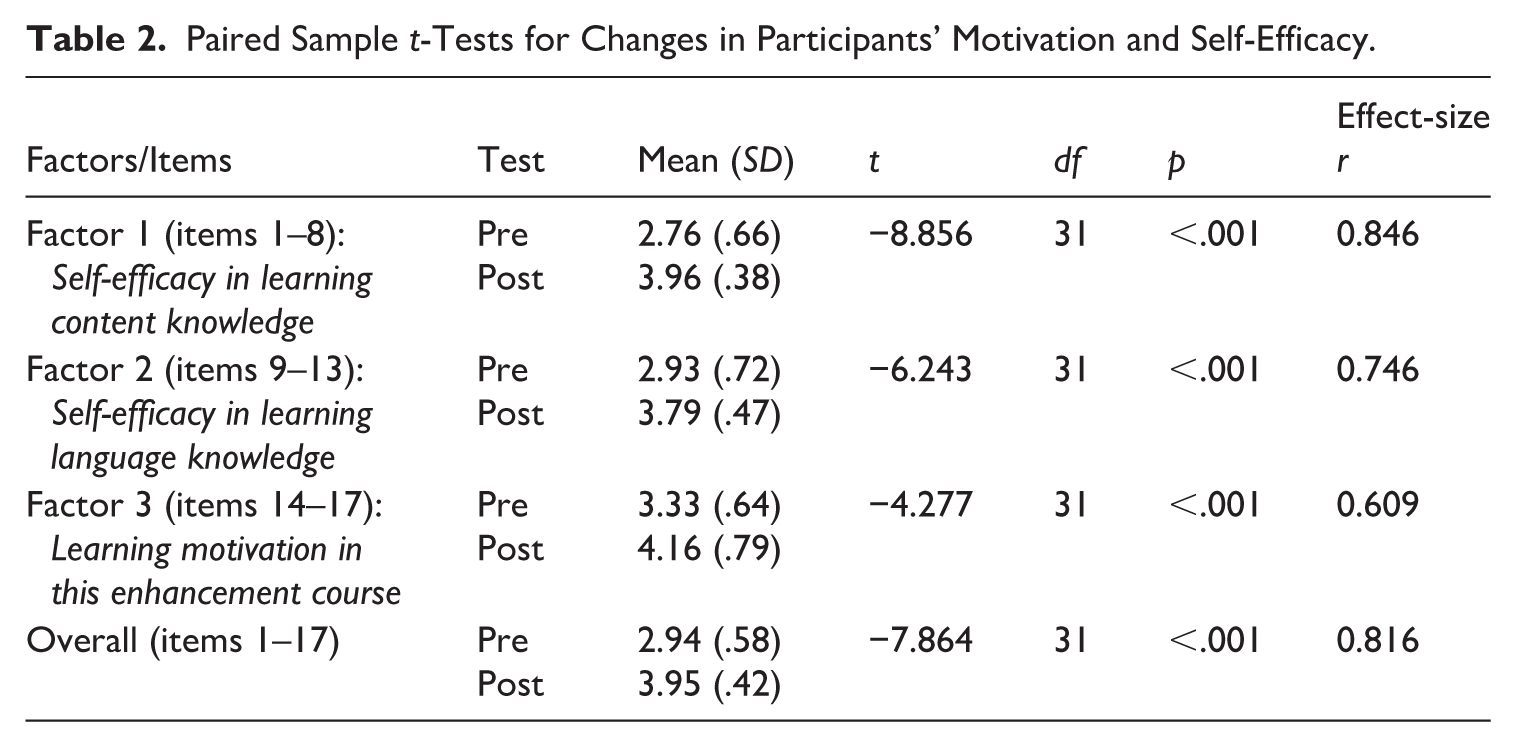
Interestingly, the standard deviations decreased largely for the overall questionnaire, Factor 1, and Factor 2, indicating increased homogeneity in these two factors. In contrast, Factor 3 saw a slight increase in standard deviation. Taken together, the findings suggest the significant effectiveness of the Flipping CLIL approach in enhancing learning motivation and self-efficacy among these low-achieving students, while also fostering a certain degree of homogeneity in these aspects within the cohort.
5.3. RQ3: Learning Experiences and Perceptions
Phenomenological analysis (Moustakas, 1994) was adopted to address RQ3, a method recognized for probing participants’ shared experiences; for example, teaching/learning experiences (Lin, 2016) and translanguaging in classrooms (Tai & Wei, 2021). To be brief, a complete list of the responses provided by the participants was first produced. The common, relevant, and unique statements were then synthesized, while ambiguous information was eliminated. The remaining statements were sorted into groups based on invariant constituents, which were further developed thematically. The last analytical step generated textual-structural descriptions for the overall learning experience of the participants engaged in the Flipping CLIL approach. The full analysis process is detailed in Appendix C.
5.3.1. Theme 1: A Ringing Endorsement of Flipping CLIL
Most participants endorsed their learning experiences and outcomes with the Flipping CLIL approach. They favorably described their learning experience this time as “innovative” (P2, P7, P11), “interesting” (P1, P4, P8), “fresh” (P12, P16), and “motivating” (P9, P13). Some further perceived their “[gradual] progresses” (P3, P15) and “increasing improvements” (P6) over this enhancement course. This sentiment was echoed collectively by P7, who specifically noted that “[the course] seems to integrate course content and English support effectively.” As P15 excitedly shared, “while grasping the course knowledge, I am also practicing the sentence patterns for expression and paragraph writing.” P10 observed that these practices were shown in “a link between pre-class, in-class and after-class activities.” P14 praised such an observation, elaborating that “the teacher put everything systematically, enabling me to apply them fully and maybe to pick up [acquire] them when the unit finished.” These joint learning experiences “really motivate [students] to learn more and even anticipate the upcoming class . . . because [they] feel the learning is improving,” according to P2.
5.3.2. Theme 2: An Interactive, Supportive Context: Online and In-Class Engagement
A number of participants attributed their positive experiences to the supportive and interactive environment grounded by the Flipping CLIL approach. Many of them felt that both online and in-class activities were “interactive” (P3, P5, P8, P12, P14, P15), “friendly” (P1, P6, P11, P16), “engaging” (P4, P10, P12), and “supportive” (P6, P7, P13). For example, such an environment encouraged students to “kindle [their] desire to take part in both in-class tasks and group discussion” (P5), “engage with the materials given” (P10), “learn through discussion” (P8), and have “productive interaction with peers” (P13). Notably, P3 found himself a new role in this learning environment, commenting that “I feel the class becoming different” because “I am now the center online and in the classroom,” while P7 shared that she felt “more absorbed [in class] when her team members explained learning tasks and detailed writing structures to [her].” P14 summed up such experiences by saying that “learning this time makes me comfortable while exchanging ideas, opinions and learning from other students and group members . . . and I even talked . . . asked the teacher questions.”
5.3.3. Theme 3: Challenging Yet Rewarding Activities and Practices
Most participants found it “challenging” but “rewarding” to complete a wide variety of activities and practices either in class or outside classroom hours (P1, P3, P4, P6, P7, P8, P12, P14, P15, P16). Several students emphasized the volume and range of tasks. P8 noted: “the course this term always includes numerous activities . . . I didn’t expect so many each week.” Some participants further explained why particular tasks were challenging. P14 reflected an “increased workload compared to the last term,” adding that “it is demanding because I need to spend a lot of time and effort in class preparation.” P16 similarly commented: “it is a must for me to have a look at the materials before the class. Otherwise, I might get lost in class because the activities are based on what we had previewed.” Despite some challenging tasks, some participants found them “worth doing” (P8, P13, P14). P9 agreed, stating “yes . . . quite challenging, but [it is] beneficial for me to preview the course unit and to have some guides for difficult language use.” Some participants further highlighted specific activities that impressed them. P15 mentioned “practicing the skill of vivid description while describing a memorable scene,” noting its “usefulness.” Others discussed the debate activity, which was perceived as both “time-consuming” (P13, P15) and “mentally demanding” (P1). P12 attributed this mental challenge to “the analytical and linguistic demands of preparing arguments.” Nevertheless, some students recognized the benefits in “enhancing persuasive skills” (P7) and in “polishing language expression” (P16). P13 commented: “through the combination of ideas from my team members and the language support from the teacher, we won over our opponents in the debate. Our efforts paid off in the end.”
5.3.4. Theme 4: The Instructor’s Role: Facilitating and Scaffolding Learning
The student-perceived positive attitudes towards their learning experience may stem from the role of the instructor. They collectively found the instructor’s teaching style “systematic” (P3, P11, P14, P15), “organized” (P5, P7), and “guiding” (P2, P6). P3 explained that “the step-by-step teaching approach helped [her] construct better understanding.” This is because “such guiding questions in the preview videos and worksheets somehow helped me think and prepare for the in-class session” (P13). Such preparations beforehand can “help [students] spend more time dealing with thinking tasks instead of keeping listening to the teacher’s lecture solely” (P6). Moreover, P14 observed that despite the numerous activities, “the teacher managed time effectively . . . I didn’t feel everything in a rush and could still catch up the units clearly.” P9 4 also “appreciated the instructor’s approach to address[ing] group discussion,” mentioning an “interesting arrangement of groups.” Highlighting the instructor’s role in “facilitating discussions and tasks,” P11 also described the way that “the teacher prompted [us] to think critically in pair discussion.” P7 finally appreciated the “well-structured course preview and review,” finding it “manageable and conducive to learning.”
6. Discussion and Conclusion
This quasi-experimental pilot study took a mixed approach to explore the effects of the Flipping CLIL approach on low-achieving learners in tertiary contexts. With the proposed approach, this study responded to the calls from Baig and Yadegaridehkordi (2023), Bergmann and Smith (2017), and Vitta and Al-Hoorie (2023) to advance flipped learning by tailoring learning settings for a certain course alongside with other organizational/instructional approaches (i.e., CLIL in this study) and by attending to underrepresented cohorts (i.e., low-achieving learners in this study). At the same time, it also addressed some major challenges of CLIL, especially in Asia where issues of learner English proficiency and limited class hours have been identified (Hughes & Madrid, 2020; Kung, 2018; J.-Y. Lee, 2021; Yang, 2015). Quantitatively, these low-achieving learners significantly improved their performance in both the content of the target subject and the targeted English language skills, as well as developed positive self-efficacy and learning motivation after engaging with the Flipping CLIL approach over the course. Qualitatively, the participants’ favorable experiences reflected that this learning approach was welcomed. Both quantitative and qualitative findings are consistent overall, meriting further discussion.
The observed improvements in course content (world literature and culture) and in English language skills (particularly grammar and writing), together with increased motivation and self-efficacy, support the effectiveness of the Flipping CLIL approach. To begin with, these low-achieving participants demonstrated significant improvements in understanding content knowledge and applying language skills, with retention effects observed even after a 5-week interval without treatment. Notably, the variations in achievement among these students diminished, suggesting by definition greater homogeneity in the cohort. Like earlier studies on the positive effects of flipped learning across varying subjects (e.g., Huang & Hong, 2016; Karabulut-Ilgu et al., 2018; J. Lee et al., 2017; Ruiz-Jiménez et al., 2024), the present findings further support the view that flipped learning benefits low-achieving learners’ lower- and higher-order thinking skills (Alsowat, 2016; Chang, 2023; I. C. V. Hsiao et al., 2023) and has a long-term effect (C. C. Hsiao et al., 2019). These findings also endorse claims approving CLIL for its capacity to develop in tandem both content knowledge and language skills (Aguilar & Rodríguez, 2012; Lahuerta, 2020; Lo & Jeong, 2018).
Similar findings, indeed, applied to the participants’ learning attitudes towards the treatment. The participants significantly demonstrated stronger motivation and self-efficacy. This first lends support to previous findings that flipped learning motivates learners in general (Baig & Yadegaridehkordi, 2023; I. C. V. Hsiao et al., 2023; Ruiz-Jiménez et al., 2024) and specifically those in the low-achieving group (Chang, 2023). The result then corresponds to several studies reporting that CLIL has the strength to enhance motivation (Mearns et al., 2020) and self-efficacy (Jaekel, 2020). However, the fact that even the low-achieving learners in the present study were motivated seems to contradict Yang’s (2015, p. 372) finding that “lower achievers showed lower agreement with CLIL motivating their content learning.” One plausible reason for this contrast is that Yang’s low achievers in the international tourism program considered the CLIL approach itself solely an “elite approach,” where low language proficiency might prevent them from learning favorably with CLIL.
Compared with Yang’s general CLIL implementation, the Flipping CLIL approach adopted in the present study provided both language and content support through pre-class engagement and post-class reinforcement. Although the quantitative results demonstrated the participants’ progress, the qualitative findings further showed that sufficient preparations before class reduced resistance to the course, even when students initially perceived it as challenging. This pre-class support reflects a core principle of flipped learning (Bergmann & Smith, 2017; Kerr, 2020). Such theoretical foundation helps explain why the present findings differ from Yang’s (2015), and, importantly, how scaffolding like this can mitigate one typical challenge faced by students with limited English proficiency in CLIL classrooms (Kung, 2018; Lopriore, 2020).
Moreover, although participants acknowledged the increased workload and cognitive demands in all learning activities, they showed increased learning motivation and self-efficacy and recognized the value in completing learning tasks. Other qualitative accounts further enrich the discussion on the effects of the proposed approach. Most participants were satisfied with the interactive and supportive engagement in the course and recognized the positive effects of those challenging tasks. Such findings echo the effective cases of flipped learning or CLIL in varying classes, such as language (e.g., Chang, 2023; C. C. Hsiao et al., 2019; Huang & Hong, 2016; Lahuerta, 2020; Lo & Jeong, 2018), business (e.g., Ruiz-Jiménez et al., 2024; Yang, 2015), and science, technology, engineering, and mathematics (STEM) subjects (e.g., Karabulut-Ilgu et al., 2018; J. Lee et al., 2017; Nikula, 2015). Several participants also emphasized how their instructor had facilitated their learning, suggesting that educators must be adept at professionally operating courses.
Taken together, the observed improvements in both learning performance (i.e., subject content, and grammar and writing skills) and learning attitudes (i.e., motivation and self-efficacy) can be interpreted in relation to the design of the Flipping CLIL approach, where a wide range of learning activities were intentionally aligned with specific instructional objectives. Pre-class activities supported initial content comprehension and language preparation, whereas in-class and post-class tasks provided opportunities for deeper engagement and language use. Embodying the constructivist principles underpinning this study, the learners actively constructed knowledge at both individual and social levels. Although participants individually enhanced their performance and attitudes through cognitive engagement, building new knowledge by connecting with prior understanding (Smith & Ragan, 2004), they also collaboratively learned and co-constructed knowledge through interaction with peers in class (Boghossian, 2006). Collectively, this reinforces the constructivist view that knowledge is not passively transmitted but actively shaped by learners (S. Chuang, 2021). Lastly, the combined evidence reflects the principles of a learner-centered environment where instructors act as facilitators who scaffold and support active learning. This integration of flipped learning (Bergmann & Smith, 2017; Kerr, 2020) with CLIL (Ball et al., 2015; Coyle et al., 2010; J.-Y. Lee, 2021) creates contexts where low-achieving learners not only achieve learning gains but also enhance their motivation and self-efficacy through meaningful and supported learning experiences.
6.1. Towards a Bespoke Flipping CLIL Approach in Diverse Contexts: Challenges and Extensions
Although the findings indicate promising outcomes for low-achieving students, the effects of the Flipping CLIL approach should be interpreted with caution. In CLIL contexts, the relationship between content learning and language development is inherently interdependent, and the extent to which each is achieved may depend on how instructional objectives are aligned with specific learning activities. As such, careful consideration is needed in designing tasks that appropriately address content and language demands, particularly for learners with lower language proficiency.
In addition, the Flipping CLIL approach should be interpreted within the specific educational context where the study was conducted. Although the present learners’ motivation increased after the treatment, the variation in their motivation also widened slightly, as indicated by a 0.15 increase in the standard deviation. This suggests that some responded to Flipping CLIL more positively whereas others may have resisted it. Such divergence may be attributed to cultural and educational factors prevalent in many Asian contexts, where students are more often accustomed to traditional, deductive methods of instruction (Tamney & Chiang, 2002). Echoing this view, Lin and Lee (2019) observed that some of their participants in Asia considered the conventional teaching methods more beneficial, likely due to their perceived “straightforward” (p. 553) delivery. Against this backdrop, the slightly widened variation in learners’ motivation in the present study, although a minor caveat, warrants attention. It reminds rigorous readers to approach the qualitative findings, 5 overwhelmingly embraced the Flipping CLIL approach, with appropriate caution. It also highlights a potential challenge that instructors seeking to implement the Flipping CLIL approach in similar contexts should anticipate and proactively address learners’ possible preference for conventional instruction.
Despite such challenges, the study contributes promising evidence of the feasibility of the Flipping CLIL approach. It can and should be further adapted to suit different educational settings and learner needs, provided that researchers and instructors meticulously design and implement courses. Flipped learning, in particular, demonstrates its capacity to synergize with other instructional approaches (Kuo & Chang, 2024; Shafiee Rad et al., 2023), in turn calling for more context-responsive instructional models to suit classroom-based settings (Baig & Yadegaridehkordi, 2023; Bergmann & Smith, 2017). Furthermore, although it may seem premature, it is still not overly optimistic to suggest that the Flipping CLIL approach could be extended to a broader range of student populations beyond the current focus on low-achieving students. For broader implementation, instructors are encouraged to employ dynamic assessment (Fulcher, 2013) while maintaining its authenticity (Katz & Halpern, 2015), regardless of whether assessments are graded. Examples include but are not limited to formative assessment, summative assessment, portfolio assessment, and even diagnostic assessment. These assessment methods can be accommodated to the individual attributes (Ng & Lam, 2025) of learners in tertiary education contexts.
6.2. Limitations and Future Studies
Although the design of the study is per se valid, some of its limitations provide opportunities for future research. The repeated measures and triangulation design addressed this study ethically and methodologically, but some rigorous researchers may find that the absence of a control group and the relatively small sample size may limit the generalizability of the results. However, it should be noted that it is challenging to recruit a sufficient number of low-achieving students to perfectly fit most research designs and it should be asked whether it is appropriate to have these students excluded from the treatment group. Given these constraints, researchers working with small and specific cohorts, such as low-achieving learners in the present study, may consider longitudinal designs to track learners’ progress across academic years, examining whether and when they transition out of remedial programs. If between-group comparisons are necessary, researchers may consider comparing cohorts across academic years (see Min et al., 2019), that is, comparing a control group from one year with an experimental group from another year. However, such designs must be accompanied by appropriate statistical methods, like multilevel modelling, to account for potential differences between cohorts over time (Heck & Thomas, 2020).
Future research could involve larger sample sizes in large-scale, longitudinal design to further validate and refine the working model of the Flipping CLIL approach. Additionally, the present study focused on the nature of the learners. A subtle yet interesting avenue would be to explore how their individual differences affect their learning outcomes/experiences; for example, their digital learning styles and strategies (Chen, 2023; J.-Y. Lee, 2023). Lastly, another line of research could investigate teaching trajectories and professional identity (Luo & Zou, 2025) from early-career and/or experienced instructors in some wider cultural-education contexts of flipped learning.
Footnotes
Appendix A. Language Skills Covered Across the Teaching Units
| Unit | Language skills |
|---|---|
| Unit 1 (Weeks 2–4) |
Grammar: Sentence structures (comma splices, fragments, run-ons) Writing: Paragraph structures and idea development |
| Unit 2 (Weeks 5–7) |
Grammar: Adverb clauses; Subject-verb agreement Writing: Topic sentence; Introduction, Body, and Conclusion |
| Unit 3 (Weeks 8–10) |
Grammar: Noun clauses Writing: Argumentative paragraphs |
| Unit 4 (Weeks 12–14) |
Grammar: Adjective clauses Writing: Narrative paragraphs |
| Unit 5 (Weeks 15–17) |
Grammar: Tenses Writing: Descriptive paragraphs |
| Unit 6 (Weeks 18–19) |
Review of all grammar and writing points from Units 1 to 5. |
Appendix B. The Interview Prompts
Appendix C. The Phenomenological Analysis
Two coders of the present study followed the phenomenological analysis in seven steps (Moustakas, 1994). Prior to the formal analysis, all interview data were transcribed verbatim. Pseudonyms were assigned to ensure participants’ confidentiality and anonymity.
Acknowledgements
We thank three anonymous reviewers and Handling Editor María del Pilar García Mayo for their insightful comments on the earlier version of this manuscript.

Ethical Considerations
This study received the ethical approvals from its institution and funding body.
Author Contributions
Funding
The authors disclosed receipt of the following financial support for the research, authorship, and/or publication of this article: This article was written with funding support from Taiwan’s Science and Technology Council (109-2410-H-032-059; 112-2410-H-032-014).
Declaration of Conflicting Interests
The authors declared no potential conflicts of interest with respect to the research, authorship, and/or publication of this article.
Data Availability Statement
The data and materials pertaining to this study are available from the corresponding author upon request.