






Abstract
Ability grouping in English as a second language (ESL) education remains contested, situated between instructional efficiency and educational equity. While existing research has largely focused on student outcomes and system-level effects, less attention has been paid to how teachers interpret and enact grouping arrangements in everyday ESL classrooms. This interpretivist comparative case study draws on semi-structured interviews with junior high school ESL teachers (N = 10) in two Israeli schools operating under contrasting organizational models: between-class ability grouping and mixed-ability instruction. A focused analysis of instructional artifacts complemented interview data. Findings suggest that ability grouping affords curricular alignment and clarity in pacing, but intensifies concerns about labeling and restricted mobility. Mixed-ability instruction promotes inclusion and peer interaction yet redistributes substantial cognitive and emotional labor onto teachers. Across contexts, teachers described recurring strategic practices (flexible regrouping, adaptive task design, and differentiated enactment of materials) that they used to navigate structural constraints. We conceptualize grouping as enacted professional mediation and show how teachers’ strategy repertoires illuminate the ways organizational arrangements are taken up and negotiated in equity-relevant classroom practice.
Keywords
1. Introduction
Ability grouping refers to the systematic organization of students into instructional groups based on perceived academic ability or prior achievement (Hallinan, 1987; Slavin, 1987). Although the practice has long been embedded in educational systems internationally, its pedagogical value and ethical implications remain the subject of sustained debate among researchers, policymakers, and practitioners. Proponents of ability grouping argue that organizing students by level facilitates instructional differentiation, enhances classroom manageability, and enables teachers to align curricular content more closely with learners’ readiness levels (Slavin, 1987). In contexts characterized by wide disparities in prior knowledge and learning pace, grouping is often framed as a pragmatic instructional response to classroom heterogeneity. Some empirical studies suggest that when grouping is implemented flexibly and supported by ongoing assessment, it may be associated with academic benefits, particularly for higher-achieving students (Anito & Gaikwad, 2025; Linchevski & Kutscher, 1998).
At the same time, a substantial body of scholarship has raised concerns regarding the longer-term consequences of ability grouping, especially when implemented in rigid or static forms. Research has demonstrated that such practices may reinforce existing social hierarchies and contribute to the reproduction of educational inequalities, disproportionately affecting students from lower socioeconomic backgrounds, ethnic minority groups, and immigrant communities (Feniger et al., 2021; Ireson et al., 2005). These students are more likely to be placed in lower-ability tracks based on narrow or potentially biased assessment criteria, which can limit their access to academically demanding curricula, experienced teachers, and opportunities for meaningful classroom interaction (Razer et al., 2018; Zuzovsky, 2004). Early academic labeling has also been linked to negative effects on learners’ self-concept, motivation, and longer-term educational trajectories (Ireson & Hallam, 2001; Roberts-Holmes, 2021). In response to such concerns, several education systems, including those in Finland, Sweden, and parts of the United Kingdom, have increasingly promoted mixed-ability instructional models that emphasize equity, formative assessment, and collaborative learning (Boaler, 2008; McGillicuddy & Devine, 2018).
Despite this extensive debate, ability grouping in English as a second language (ESL) education remains comparatively underexamined, even though ESL classrooms present distinct pedagogical and ethical challenges. Language classrooms often rely on proficiency-based assessments to inform placement decisions, yet such measures may be insufficient to capture learners’ broader communicative repertoires, sociolinguistic resources, and cultural knowledge. In Israel, English instruction reflects wider patterns of educational stratification, with grouping mechanisms frequently intersecting with socioeconomic status and ethnolinguistic background (Feniger et al., 2015). These dynamics are particularly consequential for students from marginalized communities, whose placement is often determined by narrowly defined indicators of language proficiency that may obscure heterogeneity in learning potential and classroom participation (Callahan, 2005; Cohen et al., 2022; Resh & Dar, 2012). At the same time, Israeli junior high school ESL classrooms are characterized by pronounced variation in language proficiency, home literacy practices, and sociocultural experience, placing considerable demands on teachers’ instructional judgment and decision-making.
Despite extensive debate about the distributive consequences of ability grouping, much of the scholarship continues to privilege student outcomes or system-level patterns (Hallinan, 1987; Slavin, 1987; Ireson et al., 2005; Zuzovsky, 2004), leaving the mechanisms of classroom enactment comparatively under-specified. In high-stakes language education, this gap matters because grouping is not only an organizational arrangement but a daily site of pedagogical and ethical judgment (Francis et al., 2017), where teachers must reconcile curriculum pacing, communicative opportunities, and perceived fairness under accountability pressures (Ayalon & Yogev, 2005; Blass, 2020; Resh & Dar, 2012).
What remains insufficiently understood is how ESL teachers make sense of these competing commitments and what forms of strategic mediation they develop to render grouping workable in practice (Creswell & Creswell, 2017; Snell & Lefstein, 2018). Addressing this gap, the present comparative case study examines teachers’ experiences of between-class ability grouping and mixed-ability instruction in two demographically comparable Israeli junior high schools, with particular attention to the teacher-generated strategies through which grouping structures are enacted and, at times, softened or reconfigured.
2. Literature Review
This section reviews key strands of research on ability grouping, focusing on pedagogical rationales, equity concerns, its implementation in ESL contexts, and the role of teachers as mediators of grouping practices.
2.1. Pedagogical Rationales for Ability Grouping
Ability grouping is commonly implemented either between classes through streaming into separate instructional tracks or within classes through the formation of subgroups for differentiated instruction. The pedagogical rationale underlying these models is grounded in theories of differentiated learning, which posit that aligning instruction with learners’ current levels of competence enhances engagement, efficiency, and academic progress (Francis et al., 2019). From this perspective, grouping is often framed as a pragmatic response to the complexities of classroom heterogeneity, enabling teachers to manage pacing, tailor instructional input, and provide targeted support (Khazaeenezhad et al., 2012; Tieso, 2005).
Theoretical support for this rationale is often traced to Vygotskian accounts of learning, particularly the concept of the zone of proximal development, which has been interpreted as endorsing instructional calibration to learners’ current levels of competence (Vygotsky & Cole, 1978). In practice, this interpretation has been mobilized to justify relatively homogeneous grouping as a means of optimizing task difficulty and instructional sequencing (Slavin, 1987). Within systems characterized by wide variation in prior knowledge and learning pace, ability grouping is thus framed less as a stratifying mechanism than as an efficiency-driven instructional solution to heterogeneity, foregrounding manageability and curricular alignment over questions of distributional equity.
2.2. Equity Concerns and Stratification
Alongside its pedagogical rationale, a substantial body of research has problematized ability grouping as a mechanism that may institutionalize educational inequality. Rather than functioning as a neutral instructional tool, grouping practices have been shown to systematically differentiate access to curriculum, expectations, and learning opportunities (Snell & Lefstein, 2018). Empirical research consistently demonstrates that lower-tracked students encounter reduced curricular demands, lower teacher expectations, and constrained opportunities for academic advancement (Boone & Van Houtte, 2013; Snell & Lefstein, 2018). These distributions are socially patterned rather than random, with students from lower socioeconomic and minority backgrounds disproportionately assigned to lower tracks (Oakes, 2005). Recent international evidence further indicates that such practices may reinforce socio-economic disparities in educational outcomes, particularly for disadvantaged students (Jerrim et al., 2024).
Research has further demonstrated that early academic labeling can shape learners’ self-concept, motivation, and long-term educational trajectories (Ireson & Hallam, 2001). Empirical evidence further suggests that students interpret group placement as an indicator of ability, with set allocation influencing self-confidence and potentially contributing to self-fulfilling prophecy effects (Francis et al., 2017). Once students are positioned within a particular ability category, that categorization may become self-reinforcing, narrowing access to cognitively demanding curricula and limiting mobility across tracks. Beyond these individual-level consequences, related research highlights the role of datafication and accountability systems in shaping grouping practices. Empirical studies indicate that grouping decisions are often informed by a combination of attainment data and professional judgment (Taylor et al., 2022). Neumann (2021) further shows how ability grouping is increasingly organized around performance data, institutional targets, and evaluative pressures, positioning it within a broader framework of data-driven governance rather than a purely pedagogical choice. In this way, ability grouping not only reflects existing differences in achievement but may also contribute to their reproduction over time through the differential allocation of learning opportunities and expectations (Oakes, 2005; Snell & Lefstein, 2018).
Despite these concerns documented across the literature, ability grouping remains a durable feature of schooling systems. Recent research suggests that this persistence is not simply the result of pedagogical conviction but is sustained by institutional and organizational logics, including timetabling constraints, accountability pressures, and perceptions of the manageability of homogeneous classes (Johnston et al., 2024). From this perspective, ability grouping operates as a structurally embedded practice that is difficult to displace, even in the face of well-documented equity concerns.
2.3. Ability Grouping in ESL Contexts
These equity concerns take on particular significance in ESL contexts. ESL classrooms are often characterized by substantial variation in language proficiency, literacy practices, and sociocultural background (Gibbons, 2002). Proficiency-based assessments frequently inform these placement decisions. However, such measures may inadequately capture learners’ broader communicative repertoires, multilingual resources, or academic language potential (Callahan, 2005; Shohamy, 2001) reflecting broader critiques of deficit-oriented approaches to linguistically diverse learners and increasing recognition of students’ multilingual resources as assets, including through pedagogical frameworks such as translanguaging (Erling et al., 2022; Fuster et al., 2024). Research in second language education has cautioned against equating surface-level language proficiency with general cognitive or academic ability, noting that conversational fluency and academic language development follow distinct trajectories. As a result, ESL grouping risks conflating language proficiency with general academic competence, thereby obscuring heterogeneity within groups and potentially constraining learners’ access to cognitively demanding academic language.
From a symbolic interactionist perspective, grouping may also be understood not merely as an instructional arrangement but as a socially constructed system of meaning. Huang (2025) shows that EFL students actively interpret ability grouping as a form of identity labeling, with group placement shaping learners’ self-concept, peer status, and patterns of engagement. These meanings are co-constructed through everyday classroom interaction. They are not fully mitigated by teacher intentions, suggesting that grouping operates simultaneously as a pedagogical structure and a relational process through which academic identities are negotiated.
Research in diverse national contexts has shown that ability grouping in second language education can limit students’ exposure to rich linguistic input, interactional opportunities, and higher-order language use, particularly for learners placed in lower-level groups (Gibbons, 2002; Ireson et al., 2005; Swain, 2000). Evidence from ESL contexts further suggests that the effects of ability grouping are not uniform across learners, with grouping appearing to benefit lower-proficiency students while offering limited or even negative effects for more proficient learners (Sheppard et al., 2018). In systems where English proficiency is closely tied to academic tracking and future educational opportunities, grouping decisions carry long-term consequences that extend beyond immediate instructional concerns. These challenges are particularly salient in national contexts such as Israel, where English instruction must address diverse linguistic and sociocultural student populations within a highly stratified educational system (Inbar-Lourie, 2014). These dynamics underscore the need to examine ability grouping in ESL not only as a pedagogical tool but also as an equity-relevant institutional practice.
2.4. Mixed-Ability Instruction as an Alternative
In response to critiques of tracking and stratification, mixed-ability instructional models have gained prominence across education systems. Grounded in sociocultural theories of learning, these approaches emphasize interaction, collaboration, and peer-mediated learning as central mechanisms for language development (Gibbons, 2002; Swain, 2000). From this perspective, heterogeneous classrooms are pedagogically advantageous environments in which learners can benefit from exposure to more proficient peers and engage in meaningful communicative practices (Gibbons, 2002; Swain, 2000; Vygotsky & Cole, 1978).
At the same time, research focusing on high-achieving and gifted learners complicates a uniformly critical interpretation of homogeneous grouping. Longitudinal evidence suggests that full-time ability grouping does not necessarily undermine socioemotional development and may, under certain conditions, enhance students’ engagement with school. For example, students in full-time gifted classes have been found to report higher interest in school and more positive student–teacher relationships than matched peers in mixed-ability settings, with no consistent negative effects on social self-concept (Vogl & Preckel, 2013). At the same time, research on differentiation for high-ability learners suggests that such approaches are not uniformly effective in practice, and are often insufficiently developed or unevenly implemented, particularly in mixed-ability settings (Nicholas et al., 2024). These findings indicate that intellectual peer alignment can function not only as an academic support but also as a motivational resource.
Considered alongside the big-fish–little-pond effect (Marsh, 1987; Marsh & Parker, 1984), this body of work highlights the dual psychological and instructional dimensions of grouping. While heterogeneous classrooms may protect students’ relative standing, homogeneous settings may provide more sustained cognitive challenge. These trade-offs suggest that grouping arrangements cannot be evaluated solely in terms of equity or stratification, but must also account for classroom climate, motivation, and access to appropriately demanding instruction, particularly in high-stakes subjects such as English.
2.5. Teacher Perspectives and the Interpretive Gap
Despite the centrality of teachers in enacting grouping policies, research explicitly foregrounding teachers’ perspectives remains limited, particularly in ESL contexts. Existing studies suggest that teachers often hold ambivalent or conflicting views, simultaneously recognizing the instructional affordances of grouping while expressing ethical concerns related to fairness, labeling, and student well-being (Kim, 2012). As interactionist perspectives suggest, grouping is not only structurally organized but also socially interpreted and enacted in classroom contexts (Huang, 2025), further underscoring the need to examine how teachers mediate these processes in practice. Teachers are thus positioned as key mediators between policy mandates and classroom realities, exercising professional judgment as they navigate competing pedagogical, emotional, and institutional demands.
Much of the scholarship on ability grouping has been framed through macro- and meso-level lenses, emphasizing patterns of achievement, social stratification, and institutional design (Gamoran, 2009; Hallinan, 1987). While these perspectives have generated important insights into the distributive consequences of tracking structures, they have tended to conceptualize grouping as a structural variable rather than as an enacted professional practice. In high-stakes ESL contexts, this orientation is further intensified by research foregrounding assessment regimes and their policy consequences (Chapelle, 2021; Shohamy, 2001), in which grouping decisions are examined primarily in relation to test outcomes and accountability pressures.
What remains comparatively under-theorized is the interpretive dimension of grouping: how ESL teachers themselves make sense of competing normative commitments, differentiation and equity, efficiency and inclusion, and how these commitments are negotiated within the constraints of curriculum mandates, matriculation pathways, and institutional expectations. Attending to teachers’ professional reasoning and situated decision-making shifts the analytic focus from structural effects to lived mediation, positioning grouping not only as a system-level arrangement but as a site of pedagogical and ethical judgment.
Addressing this gap requires in-depth, teacher-centered qualitative research that attends to teachers’ professional reasoning, ethical considerations, and instructional enactment within specific institutional contexts. The present study responds to this need by examining how Israeli junior high school ESL teachers experience and negotiate ability grouping and mixed-ability instruction, positioning teachers not as passive implementers of policy but as active agents shaping the lived consequences of grouping decisions.
3. The Present Study
3.1. The Israeli Context
In Israel, ability grouping is a deeply entrenched feature of the junior high school system (Grades 7–9), particularly in ESL instruction. Although national education policy has formally promoted inclusive pedagogy and differentiation since the 1960s, classroom practice continues to rely heavily on relatively rigid grouping structures, especially in English classrooms (Feniger et al., 2021; Zuzovsky, 2004). As a core subject within the national curriculum, English plays a pivotal role in academic tracking and assessment, rendering grouping decisions especially consequential.
English is a compulsory subject in Israeli junior high schools and one of the five core domains assessed in the matriculation (bagrut) examinations. Beginning in Grade 7, many schools organize students into high-, middle-, and low-proficiency groups based on prior achievement and teacher evaluation. Although ability grouping at the junior high level is formally a school-level decision rather than a centrally mandated policy, empirical research indicates that grouping remains widespread in core subjects such as English and mathematics (Feniger, at al., 2021). ESL instruction in Israel is further situated within a highly multilingual and multicultural context, in which many learners navigate multiple linguistic repertoires (e.g., Hebrew, Arabic, Russian, and Amharic), shaping both access to English learning and pedagogical practice (Aronin & Yelenevskaya, 2022). Given that Arab students study English as a third language and encounter distinct structural and sociopolitical conditions, the present study focuses on the Hebrew-speaking sector, where English is taught as a second language.
The stakes of English grouping decisions at the junior high level are therefore high, and teachers’ professional judgments play a decisive role in shaping students’ academic pathways. While previous research has examined the policy dimensions of ability grouping and its broader social consequences in Israel (Feniger et al., 2021; Razer et al., 2018), comparatively little attention has been paid to how teachers experience, interpret, and enact grouping in their everyday work. This gap is particularly salient given that early adolescence represents a critical period for linguistic development, identity formation, and academic self-concept (Blass, 2020; Feniger et al., 2021). Teachers are thus not merely implementers of grouping policy, but key mediators whose beliefs, ethical reasoning, and instructional strategies shape whether ability grouping reproduces educational inequalities or opens space for more inclusive practice (Ayalon et al., 2019; Resh & Dar, 2012).
3.2. Research Aims and Questions
This study adopts a comparative qualitative case study design to examine ESL teachers’ experiences in two Israeli junior high schools operating under contrasting organizational models: between-class ability grouping and mixed-ability instruction. Specifically, the study explores (1) how different grouping structures shape teachers’ approaches to differentiation and instructional decision-making in everyday classroom practice, (2) how teachers perceive the social and emotional implications of ability grouping and mixed-ability instruction for students’ engagement, academic identity, and peer relations, and (3) how grouping models influence teachers’ sense of professional agency, workload, and autonomy within structurally constrained instructional contexts. This analysis foregrounds teachers’ professional reasoning and ethical deliberations as they navigate the pedagogical trade-offs embedded in different organizational arrangements.
By centering teachers’ accounts of practice, the study contributes qualitative insight into the enactment of grouping policy in ESL classrooms and highlights the ethical and pedagogical tensions that emerge when teachers mediate between institutional structures, learner diversity, and equity-oriented concerns. The present study addresses this gap by examining how teachers interpret and enact grouping arrangements within contrasting instructional contexts.
4. Methodology
4.1. Research Design
We adopted a qualitative, interpretivist comparative case study design to examine how junior high school ESL teachers experience and enact ability grouping and mixed-ability instruction in everyday practice. An interpretivist orientation foregrounds participants’ situated meaning-making within institutional contexts (Schwartz-Shea & Yanow, 2012). The case study approach enabled in-depth exploration of teachers’ professional reasoning and instructional decision-making (Duff, 2008; Stake, 2006). The comparison is used to develop an interpretive account of how teachers describe, justify, and manage pedagogical and equity dilemmas under different organizational arrangements, rather than to estimate the effects of grouping structures on outcomes.
The comparative case study focuses on two contrasting instructional models, ability grouping and mixed-ability teaching, and draws on two complementary sources of data: semi-structured teacher interviews and a targeted analysis of instructional artifacts, including textbooks, worksheets, and classroom tasks used in each setting. The inclusion of instructional materials is intended to document how differentiation is enacted in practice and to examine the alignment between teachers’ reported beliefs and the pedagogical demands embedded in everyday classroom materials. This artifact analysis functions as methodological triangulation, strengthening analytic robustness without constituting additional data collection beyond the study’s original scope.
Comparison across the two cases is used analytically rather than evaluatively. The purpose is to illuminate how different organizational structures shape instructional choices, differentiation practices, and teachers’ perceptions of equity. By integrating teachers’ accounts with analysis of the materials they use, the study captures grouping as a lived, practice-based phenomenon situated at the intersection of policy, pedagogy, and professional ethics.
4.2. Participants and Sampling
Ten ESL teachers participated in the study, five from each of two state junior high schools in the Tel Aviv metropolitan area, referred to here as Oaks School and Pines School. The schools were selected through purposive sampling to enable comparison across demographically comparable contexts while differing in instructional organization. Both schools serve predominantly Jewish, middle-class student populations and draw from neighborhoods with similar socioeconomic profiles. This similarity was an important criterion in site selection, allowing the analytic focus to remain on differences in grouping structures rather than on variations in student socioeconomic composition. Oaks School employs between-class ability grouping in English, whereas Pines School uses mixed-ability instruction.
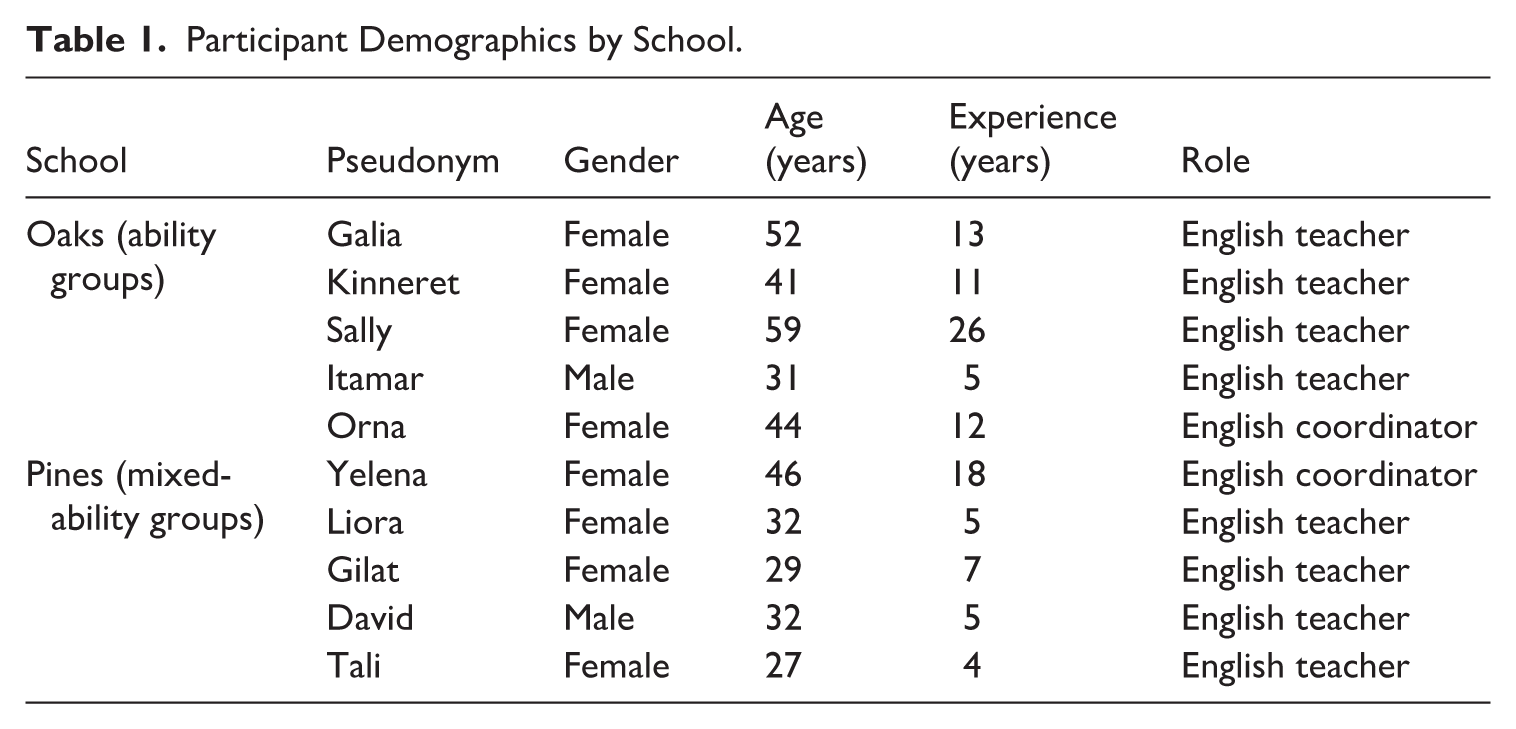
Participants (Table 1) were selected based on three criteria: (1) a minimum of 4 years’ experience teaching ESL in Israeli junior high schools; (2) direct involvement in differentiation practices; and (3) familiarity with the school’s grouping structure and English curriculum. Recruitment was facilitated through school English coordinators, and efforts were made to include teachers across grade levels and instructional roles. All participants taught linguistically and culturally diverse student populations and had prior professional development in ESL pedagogy. The sample was intended to support in-depth, context-sensitive qualitative analysis of teachers’ lived experiences within contrasting organizational models.
Participant Demographics by School.
4.3. Data Collection
Data were generated through two complementary sources: semi-structured teacher interviews and a targeted collection of instructional artifacts used in ESL classrooms at both research sites. This combination was intended to support methodological triangulation by examining teachers’ reported beliefs and practices alongside the pedagogical materials that structured everyday instruction.
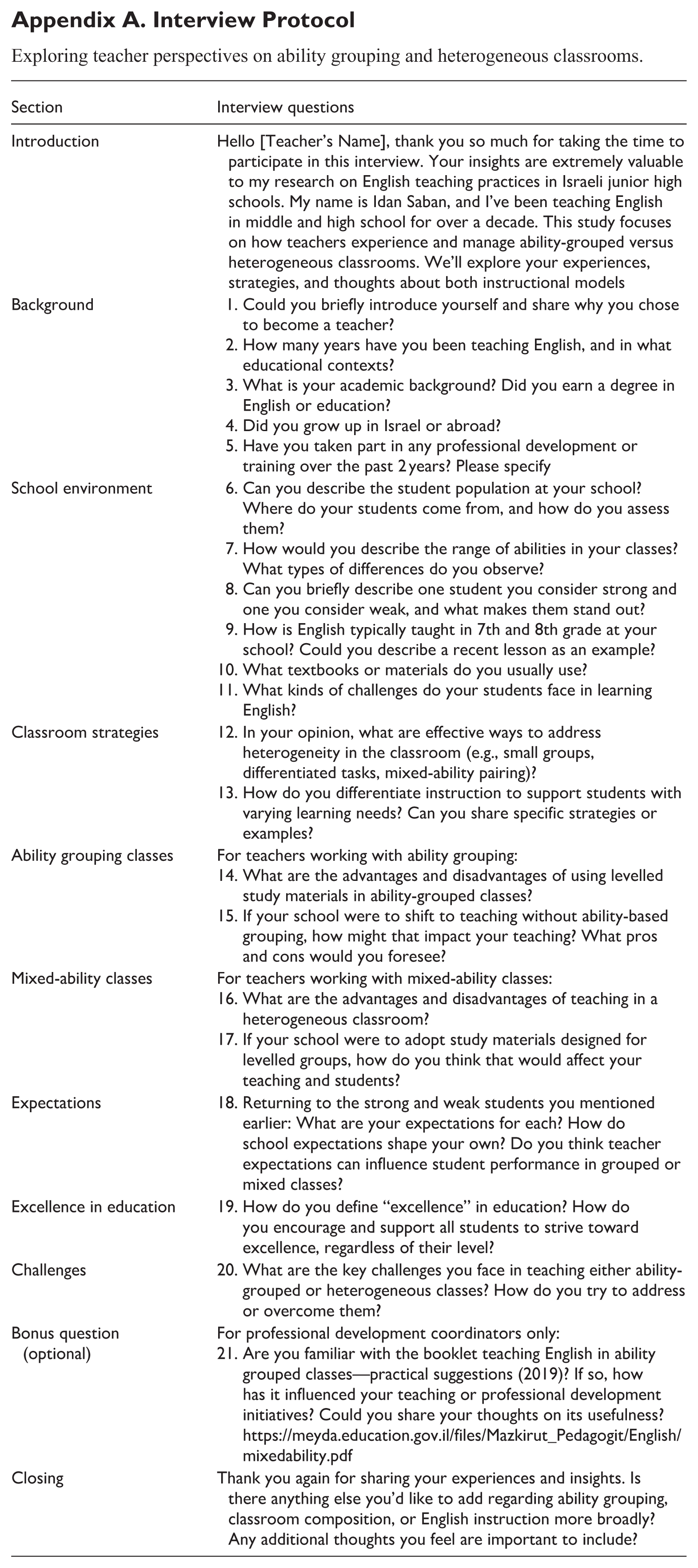
Semi-structured interviews were conducted in English at the participants’ schools, each lasting between 45 and 60 minutes. Interview prompts explored teachers’ experiences with ability grouping and mixed-ability instruction, including their approaches to differentiation, perceptions of fairness and equity, and the ethical or emotional dilemmas they encounter in their work. With participants’ informed consent, all interviews were audio-recorded, transcribed verbatim, and anonymized prior to analysis. The interview protocol is presented in Appendix A.
In addition to interview data, a small, targeted set of instructional artifacts was collected from each school to support methodological triangulation. Artifacts were read alongside interview-coded themes and summarized in analytic memos, noting task demands (e.g., linguistic load, cognitive demand, scaffolding, and differentiation options), then used to select illustrative excerpts in the Findings. At each site, artifacts consisted of (a) one core English textbook used consistently at a given instructional level and (b) one representative worksheet routinely used by participating teachers. In the ability-grouped school (Oaks), the textbook and worksheet were drawn from a lower-level English group, reflecting the instructional demands typically encountered by students placed in lower tracks. In the mixed-ability school (Pines), the textbook and worksheet reflected materials used in heterogeneous classrooms serving students across proficiency levels.
Artifacts were selected purposely rather than comprehensively. Teachers were asked to share materials that they considered typical of their everyday instructional practice and that they explicitly referenced during interviews. Artifact analysis focused on identifying patterns of task differentiation across grouping models, particularly in terms of linguistic complexity, task demands, and access to curricular content. Rather than coding artifacts inductively, the analysis was guided by analytic categories that emerged from the interview data (e.g., differentiation, pacing, access, and perceived ability boundaries), allowing artifacts to function as confirmatory or illustrative evidence alongside teachers’ verbal accounts.
4.4. Ethical Considerations
Ethical approval for the study was obtained from the Israeli Ministry of Education and the relevant institutional ethics committee. All participants provided informed consent prior to data collection and were assured that participation was voluntary and that they could withdraw at any stage without consequence. To protect confidentiality, participants and schools were assigned pseudonyms, and identifying details were removed from interview transcripts and instructional materials. All data were anonymized and securely stored in accordance with established ethical research standards.
In terms of positionality, the first author has worked as an ESL teacher in Israeli secondary education for over 15 years and is closely familiar with the organizational routines, curricular demands, and professional discourse surrounding ability grouping in English. This insider familiarity facilitated more nuanced probing of institutional references and pedagogical dilemmas during interviews. The researchers had no professional, supervisory, or collaborative relationship with the participating teachers or their schools, minimizing power asymmetries and role conflict. Reflexive memoing was used throughout the analysis to monitor how prior field knowledge shaped interpretation, with analytic decisions anchored in systematic coding and cross-case comparison.
4.5. Data Analysis
Following Braun and Clarke’s (2006) six-phase thematic analysis, this approach supported systematic identification of patterns across teacher interviews while attending to participants’ meanings and professional reasoning within an interpretivist orientation (Schwartz-Shea & Yanow, 2012).
Interview transcripts constituted the primary analytic corpus. In parallel, a targeted set of instructional artifacts (textbooks, worksheets, and classroom tasks) was examined to contextualize teachers’ accounts and to trace how reported differentiation practices were reflected in the linguistic and cognitive demands embedded in classroom materials (e.g., vocabulary range, grammatical complexity, length of texts, and degree of scaffolding), (b) cognitive demand (e.g., emphasis on recall versus interpretation, opportunities for extended language production, and presence of open-ended or higher-order tasks), and (c) differentiation features (e.g., tiered tasks, optional extensions, and fixed versus flexible task structure). Analysis proceeded iteratively through constant comparison across interview data and artifacts.
The analysis focused on how grouping models shaped instructional planning, differentiation, student engagement, and teachers’ ethical deliberations in junior high ESL classrooms. Artifact analysis served a supportive, triangulating function rather than an independent analytic strand, enabling interview-based claims to be corroborated or nuanced through material evidence of practice.
5. Findings
This section presents the findings of a comparative qualitative analysis of two Israeli junior high school ESL settings operating under contrasting instructional structures: between-class ability grouping and mixed-ability instruction. Drawing on teachers’ interviews and selected instructional artifacts, the analysis explores how grouping arrangements shape everyday pedagogical practice. The focus is on examining how teachers interpret their professional agency and negotiate instructional and ethical demands within differing organizational contexts. In the sections that follow, interpretive claims are supported by extended interview excerpts and illustrative artifacts to make visible how these dynamics are enacted in classroom practice.
Across both sites, accounts of grouping as a negotiated and context-dependent practice shaped by institutional constraints, curricular demands, and learner diversity. Cross-case comparison is used analytically to illuminate recurring tensions, trade-offs, and unintended consequences, as well as the context-sensitive strategies teachers develop in response. Artifact analysis serves to contextualize teachers’ narratives and illustrate how differentiation is operationalized through the linguistic and cognitive demands embedded in classroom materials.
Thematic analysis (Table 2) identified 5 interrelated domains structuring teachers’ experiences: (1) pedagogical differentiation in grouped and mixed settings; (2) structural affordances and constraints of ability grouping; (3) instructional and collaborative dynamics in mixed-ability classrooms; (4) social, emotional, and equity-related implications for students; and (5) the influence of grouping models on teacher agency, workload, and professional autonomy. Together, these themes capture the complexity of teachers’ lived experiences and position teachers as key mediators of grouping policy in ESL classrooms.
Analytic Summary of Teacher-Reported Thematic Patterns Associated with Grouping Models.
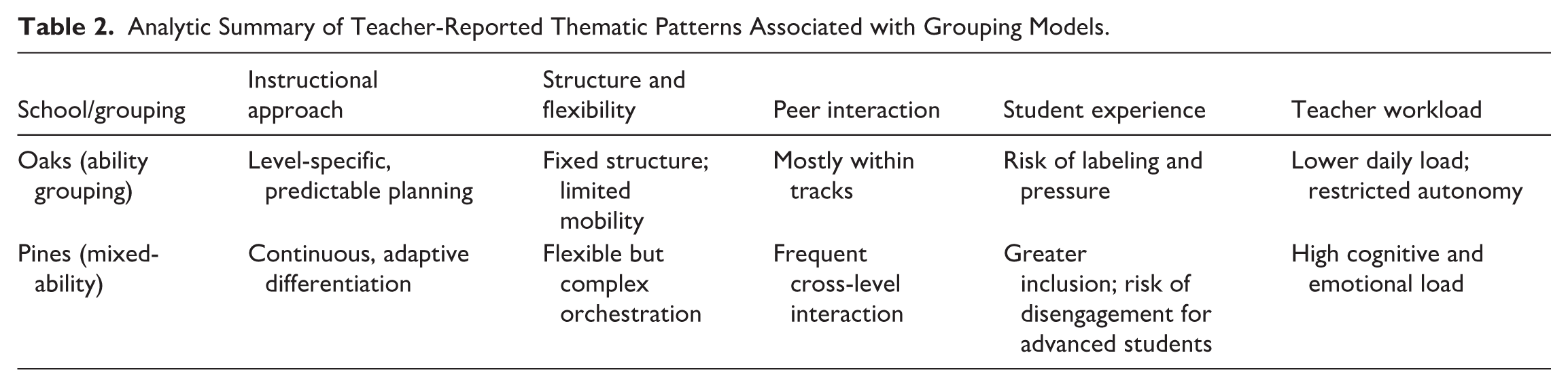
These patterns emerged inductively from teachers’ interview accounts and were supported by analysis of instructional materials used in each school. Teachers in the ability-grouped context consistently described differentiation as streamlined and level-specific, enabling focused pacing and predictable lesson planning. As Galia (Oaks) explained, “When the group is levelled, I can really focus on the syllabus and make sure everyone keeps up. Pedagogically, it works. But sometimes I feel I’m teaching the level, not the student.” While this structural clarity was perceived as pedagogically efficient, teachers also expressed concern about its longer-term implications, particularly restricted collaboration and limited upward mobility. As Orna noted, “Once a student is placed in a lower track, it’s very difficult for them to move up,” highlighting the rigidity of the grouping structure.
By contrast, teachers in the mixed-ability context emphasized adaptive instruction, peer interaction, and instructional flexibility, alongside increased cognitive and organizational demands. Liora (Pines) described how “the lesson is never finished in advance. . . you’re constantly switching while you teach,” characterizing mixed-ability instruction as “pedagogically richer, but also mentally exhausting.” Teachers highlighted the inclusive and socially integrative potential of heterogeneous classrooms, citing opportunities for peer support and collaborative learning. At the same time, they underscored the heightened responsibility and workload involved: “There’s more freedom here, but it also means more responsibility and constant adjustment” (Gilat).
Taken together, teachers described the two instructional models as shaping differentiation and decision-making in distinct and sometimes conflicting ways. Ability grouping was associated with instructional manageability and clarity, but also with concerns about labeling and the reproduction of academic hierarchies. Mixed-ability instruction was framed as more inclusive and responsive to learner diversity yet demanding sustained cognitive and emotional labor. These perceived affordances and constraints are summarized in Table 3 and elaborated through the interview excerpts that follow.
Teacher-Perceived Pedagogical Affordances and Tensions Associated with Grouping Models.
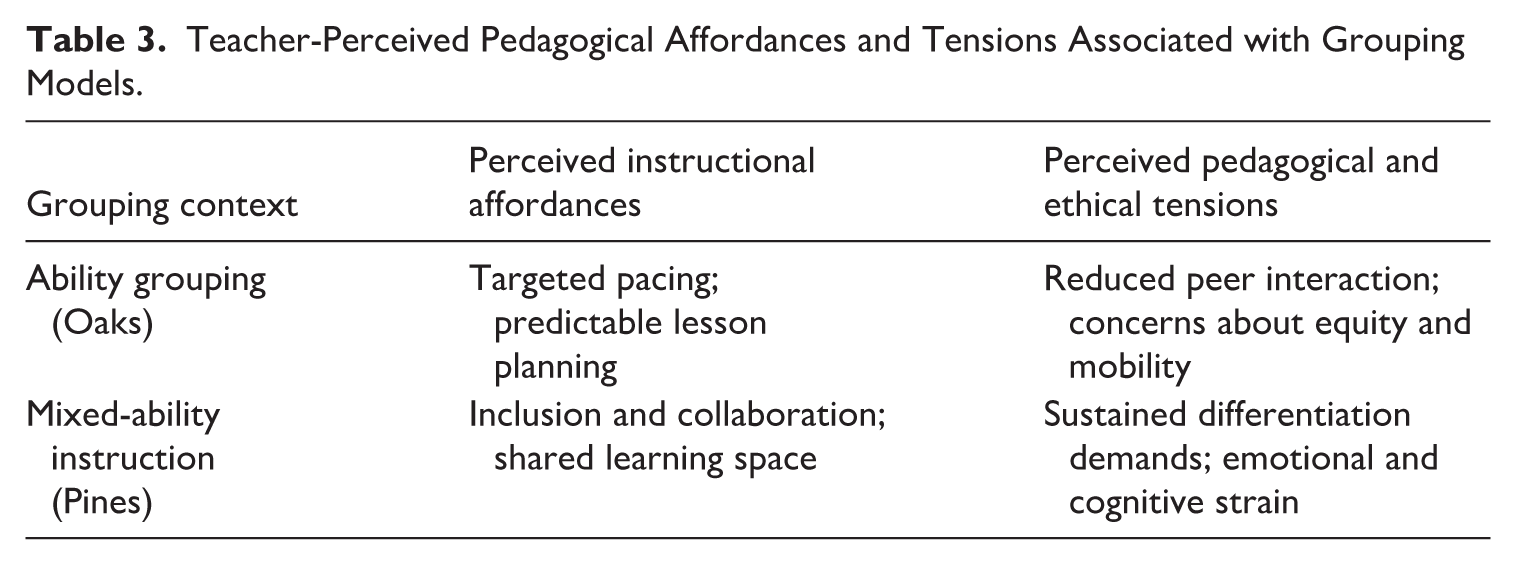
The patterns in Table 3 are grounded in teachers’ accounts and are illustrated through the excerpts that follow, which provide empirical support for the analytic distinctions presented. Teachers at Oaks linked homogeneity to manageability, while teachers at Pines emphasized inclusivity alongside increased instructional burden. Teachers at Oaks frequently described ability grouping as supporting targeted instruction and more predictable lesson planning, although these perceived efficiencies were accompanied by ethical concerns (see Table 3). These comparative patterns were grounded in teachers’ accounts of planning and pacing. In Oaks school, teachers repeatedly framed proficiency homogeneity as enabling “targeted instruction” and “manageable lesson planning” (e.g., Galia and Orna), while also describing reduced peer interaction and constrained mobility across levels. In Pines school, teachers described inclusion and peer learning as central affordances (e.g., Liora), but emphasized the constant differentiation required and the resulting workload and emotional strain (e.g., Yelena). In this sense, Table 3 summarizes recurrent themes that are evidenced in the excerpts below rather than serving as stand-alone findings.
The advantages and challenges summarized in Table 3 reflect recurring patterns across teacher narratives. For example, Oak’s teachers repeatedly linked ability grouping to manageable lesson planning and targeted pacing, while simultaneously expressing concern about reduced peer interaction and equity, whereas Pines teachers framed inclusivity and collaboration as central benefits but emphasized the sustained differentiation workload required.
5.1. Pedagogical Differentiation: Adapting Instruction to Student Needs
Differentiation was described by teachers in both schools as a central principle of effective ESL instruction, particularly in linguistically heterogeneous classrooms (Gamoran, 2009). However, the forms of differentiation took, and the challenges it entailed, varied markedly across ability-grouped and mixed-ability contexts, reflecting the distinct structural conditions under which teachers worked.
In the ability-grouped context at Oaks School, teachers emphasized the instructional efficiency afforded by working with relatively homogeneous proficiency levels. Lessons were described as aligned with a shared linguistic baseline, enabling predictable pacing and structured task progression. As Galia explained, “When I work with a levelled group, it’s much easier for me to plan. . . I can build the lesson step by step and feel that it fits them.” At the same time, teachers expressed unease that differentiation within lower-level groups often involved simplifying content rather than expanding learning opportunities. As Itamar explained, “Lower-track students sometimes feel like they are given ‘easy work’ instead of meaningful challenges,” while Sally noted that “they don’t always get the chance to try something more complex—they stay where they are.” These accounts suggest that differentiation may function as curricular reduction rather than expansion, limiting opportunities for higher-order language use and reinforcing perceptions of fixed ability.
By contrast, teachers in mixed-ability classrooms at Pines School described differentiation as an ongoing, real-time process requiring constant instructional adjustment. Rather than planning a single lesson trajectory, teachers reported juggling multiple task versions, scaffolds, and participation formats within the same class. As Liora noted, “You’re never teaching just one lesson. . . you’re constantly switching,” framing mixed-ability instruction as pedagogically rich but cognitively demanding. While teachers valued the inclusive and collaborative potential of this model, they also highlighted the sustained emotional and organizational effort required to support both struggling and advanced learners simultaneously.
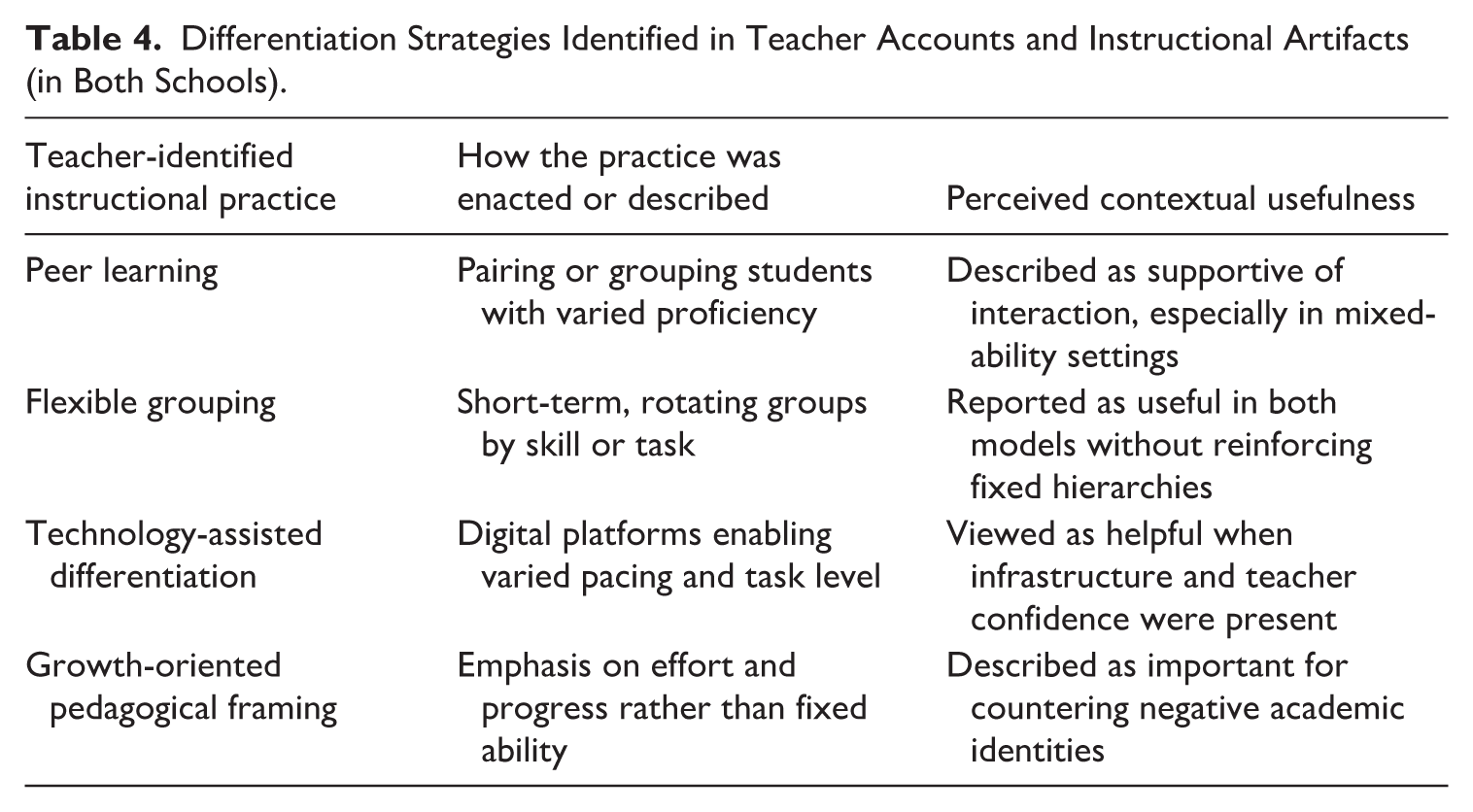
Across both contexts, teachers reported employing a shared repertoire of differentiation strategies, including peer learning, flexible grouping, technology-assisted tasks, and growth-oriented pedagogical framing. Peer learning was emphasized primarily in mixed-ability settings as a means of fostering collaboration and inclusion, whereas technology-supported differentiation was described as particularly effective in ability-grouped contexts for managing pacing within narrower proficiency ranges. In Table 4, these practices are understood not as discrete techniques but as situated professional responses shaped by institutional constraints, classroom realities, and ethical considerations related to equity and inclusion.
Differentiation Strategies Identified in Teacher Accounts and Instructional Artifacts (in Both Schools).
Artifact analysis corroborated teachers’ interview accounts by revealing systematic patterns of differentiation embedded in everyday instructional materials. Teachers’ descriptions of “adapting on the spot” and “working with levels inside the same lesson” were reflected in the design of worksheets and tasks, particularly through tiered activities, parallel task versions, and flexible grouping structures. For example, a worksheet used in a mixed-ability classroom required all students to respond to the same reading passage about environmental issues. While the base task involved identifying main ideas, extension prompts invited students to justify their opinions and connect the text to personal experience. In contrast, a lower-track worksheet in the ability-grouped setting focused primarily on sentence-level completion tasks (e.g., verb tense selection), with limited opportunity for extended written production. This contrast highlights how differentiation in mixed-ability classrooms is enacted through layered task demands, whereas in grouped settings it is often embedded in separate, level-specific materials.
In the ability-grouped school, materials varied systematically across high-, middle-, and low-proficiency groups, with clear differences in linguistic complexity and task demands. Higher-level materials emphasized extended texts and open-ended production, whereas low-proficiency groups’ materials focused on controlled practice and scaffolded tasks. Teachers described this differentiation as supporting predictable pacing and lesson flow within relatively homogeneous groups. By contrast, teachers in the mixed-ability worked largely from a shared coursebook, and artifacts showed more uniform task design. For example, a reading task assigned to all students consisted of a short informational text followed by comprehension questions of varying difficulty, with optional extension prompts requiring inference and personal response.
For instance, lower-level tasks required sentence-level completion using provided verb forms (e.g., “Yesterday I ___ (go) to school”), whereas higher-level tasks required students to construct a short argument integrating textual evidence. During a shared reading task, teachers reported assigning the same text to all students while varying follow-up tasks, with some students completing comprehension questions and others engaging in open-ended discussion or written extension. Differentiation was enacted through in-class mediation, selective extension, and optional task pathways, which teachers noted were effective but demanding when addressing diverse learner needs simultaneously.
Across both contexts, materials did not function as fixed instructional models but as flexible resources that teachers adapted in response to classroom heterogeneity. Artifact analysis thus illustrates how differentiation is institutionalized through layered task structures and optional pathways, reinforcing teachers’ central role as adaptive mediators of placement and grouping decisions rather than passive implementers of prescribed curricula.
5.2. Ability Grouping: Structure, Specialization, and the Limits of Differentiation
Teachers at Oaks School described ability grouping as enabling instructional specialization and greater control over pacing and curricular focus. Working with relatively homogeneous proficiency groups allowed teachers to align tasks, materials, and assessment demands with students’ perceived language levels. As Galia explained, “Ability grouping is essential for addressing gaps efficiently,” while Orna emphasized that it “allows the curriculum to be tailored to the pace and ability of each group,” supporting predictability in lesson planning.
At the same time, teachers identified clear limits to differentiation within the grouped structure. Several expressed concern that differentiation in lower tracks often resulted in simplification rather than expansion of learning opportunities. As Itamar observed, “Lower-track students sometimes feel like they are given ‘easy work’ instead of meaningful challenges,” while Galia reflected that “you want to help them, but sometimes it means reducing the level instead of pushing them forward.” These accounts indicate that differentiation within grouped settings may unintentionally constrain access to cognitively demanding tasks. Analysis of instructional materials reinforced this perception, with lower-level worksheets emphasizing controlled practice and discrete skills, offering fewer opportunities for extended language use or higher-order thinking. For example, a lower-track worksheet at Oaks included discrete fill-in-the-blank grammar items focused on verb tense control, while a higher-track worksheet from the same unit required students to produce a short argumentative paragraph drawing on a shared reading text.
Teachers also highlighted the restricted permeability of the grouping system. Movement between levels was described as rare and administratively difficult, even when students showed progress. As Orna observed, “Once a student is placed in a lower track, it is very difficult for them to move up.” These structural constraints limited teachers’ capacity to respond flexibly to student growth and intensified ethical concerns around fairness and opportunity.
Collectively, these accounts indicate how the organizational efficiencies of ability grouping coexist with mechanisms that may reinforce academic stratification. Consistent with previous research (Aronin & Yelenevskaya, 2022; Boaler, 2003), teachers’ accounts highlight the limits of differentiation within tightly bounded grouping structures and show how broader patterns of inequality are experienced and negotiated in everyday classroom practice.
5.3. Mixed-Ability Teaching: Collaboration, Dynamic Grouping, and Student-Centered Learning
Teachers at Pines school emphasized the pedagogical and social affordances of mixed-ability instruction, particularly its potential to promote collaboration, peer modeling, and inclusive participation. Heterogeneous classrooms were described as creating more authentic conditions for language learning, in line with sociocultural perspectives that foreground interaction as central to development (Vygotsky & Cole, 1978). As Liora explained, “Mixed-ability classrooms encourage students to learn from each other,” a process teachers associated with reduced stigmatization and stronger classroom cohesion. Similarly, David emphasized that “you’re constantly adjusting—what works for one student doesn’t work for another,” highlighting the ongoing instructional negotiation required in heterogeneous classrooms.
To manage linguistic heterogeneity, teachers reported relying on flexible grouping and technology-supported differentiation. Digital platforms were used to assign tiered tasks within a shared lesson structure, allowing variation in linguistic demand without physical separation. As David noted, “Using digital tools allows me to give different tasks to different students without separating them.” Artifact analysis supported these accounts, revealing task sets that maintained a common thematic focus while offering differentiated pathways.
At the same time, teachers were explicit about the substantial demands of mixed-ability teaching. Continuous instructional adjustment and monitoring were described as cognitively and emotionally taxing, particularly when attempting to support both struggling and advanced learners simultaneously. Yelena challenged the assumption that high-achieving students “manage anyway,” noting that without planned extension, advanced learners risk disengagement. These concerns echo research on the big-fish–little-pond effect, which highlights how insufficient challenge and recognition can undermine students’ academic self-concept (Marsh & Parker, 1984). Teachers also acknowledged performance-related pressures in higher-level settings, suggesting that challenge alone does not eliminate stress.
Despite these tensions, many teachers framed mixed-ability instruction as ethically and pedagogically preferable, particularly when supported by professional autonomy and institutional resources. As Gilat reflected, “In the real world, people of all levels work together.” Teachers’ accounts thus position mixed-ability teaching as a site of both opportunity and strain, requiring ongoing negotiation between inclusivity, challenge, and sustainability in everyday ESL practice.
5.4. Equity and Inclusion: The Psychological and Social Effect of Grouping
Teachers’ accounts across both schools underscored that grouping carries significant psychological and social consequences for students, extending beyond instructional considerations. In the ability-grouped context at Oaks school, Interview data indicate how placement into lower tracks was often internalized as a fixed label, shaping students’ academic self-concept and motivation. As Sally observed, “Once students know they’re in the lower group, it becomes part of how they see themselves,” and Orna added that “it’s very hard to change that label later on.” These reflections underscore the enduring impact of grouping on students’ academic identity. Teachers linked this labeling to reduced engagement and confidence, echoing research on the role of ability grouping in reinforcing deficit identities (Boaler, 2003; Francis et al., 2019).
Teachers also emphasized that emotional pressures were not confined to lower-tracked students. Higher-level groups were described as experiencing heightened performance anxiety, driven by expectations to justify and maintain their placement. As Galia noted, “Higher-track students often feel tremendous pressure to perform,” suggesting that ability grouping may redistribute emotional strain rather than alleviate it, intensifying stress at both ends of the achievement continuum (Ireson et al., 2005).
By contrast, teachers at Pines school highlighted the inclusive ethos of mixed-ability instruction as fostering greater social cohesion and a stronger sense of belonging. Heterogeneous classrooms were perceived as reducing the visibility of hierarchies and mitigating the stigmatizing effects of fixed labels. As Liora explained, “The differences are still there, but they’re less visible,” which teachers associated with increased participation and confidence among some learners.
At the same time, teachers acknowledged persistent equity tensions within mixed-ability settings. Several raised concerns that advanced learners could experience frustration or disengagement if instructional challenge was insufficient. As Gilat noted, “At times, the pace can feel slow for advanced students,” framing this as an ethical dilemma rather than a rejection of inclusivity. Teachers emphasized that equity in mixed-ability classrooms required sustained differentiation and constant attention.
Across cases, the data indicate that neither grouping model resolves equity concerns straightforwardly. Instead, teachers’ perspectives position equity as a relational and emotionally charged dimension of classroom life, shaped by the interaction between grouping structures, student identity, and institutional expectations. Across both contexts, teachers described themselves as ethical mediators, continually balancing inclusion, challenge, and student well-being within structurally constrained systems.
5.5. Teacher Agency: Autonomy and Institutional Constraints
Teachers’ accounts across both sites framed agency not as an individual attribute, but as a practice shaped by institutional structures and policy expectations. At Oaks school, teachers described the ability-grouping system as highly regulated, with limited flexibility to adapt curricula or alter placement decisions. Orna characterized the structure as “very fixed,” noting that while it offered clarity and predictability, it constrained pedagogical experimentation and teachers’ capacity to respond creatively to students’ changing needs.
Teachers also expressed frustration with the limited permeability of the system. Placement and progression were described as largely exam-driven, leaving little room for professional discretion. As Orna explained, “Sometimes I feel responsible for students, but without real power to move them or adjust the system around them.” This disjunction intensified ethical tensions, particularly when teachers felt that grouping decisions no longer reflected students’ current abilities.
In contrast, teachers at Pines school reported a greater sense of pedagogical autonomy within the mixed-ability model. They emphasized the freedom to adapt lessons, vary task demands, and respond dynamically to classroom interactions. As Gilat noted, “I have much more freedom to decide how to teach, but that also means more responsibility.” This autonomy, however, was accompanied by substantial cognitive, emotional, and logistical demands. Teachers highlighted the ongoing effort required to sustain differentiation across a wide range of abilities, often without sufficient institutional support or protected planning time.
Across both contexts, agency emerged as relational and constrained rather than absolute. Ability grouping limited autonomy through structural rigidity, while mixed-ability instruction expanded pedagogical freedom at the cost of increased workload and emotional strain. As summarized in Table 5, neither model resolved the tension between autonomy and accountability. Instead, teachers positioned themselves as mediators of grouping policy, exercising professional judgment within boundaries that simultaneously enabled and constrained equitable practice.
Ethical and Systemic Concerns Articulated by Teachers.
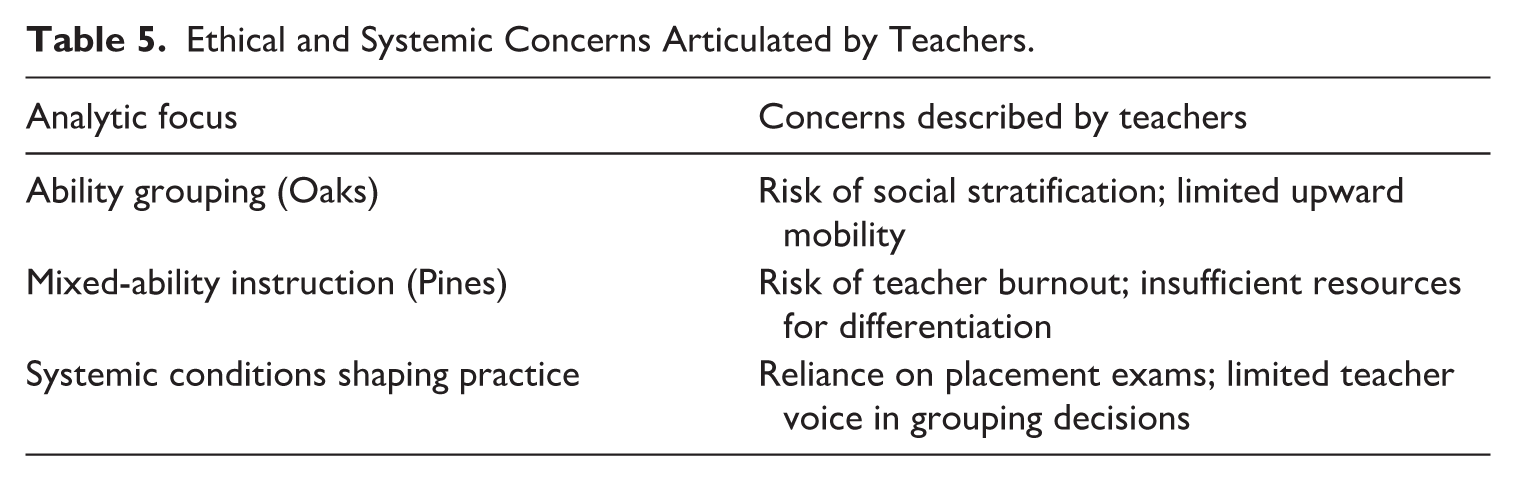
Teachers framed these tensions as structurally produced rather than as outcomes of individual pedagogical choices, locating ethical concerns in institutional constraints such as placement systems and resource allocation. Table 6 offers an analytic summary of the cross-case patterns that emerged from interview accounts, contextualized by the instructional artifacts. In Oaks, ability grouping supported instructional precision and predictable pacing but constrained flexibility and cross-level peer interaction. In Pines, mixed-ability teaching promoted inclusion and collaboration but required sustained differentiation work and increased cognitive and emotional labor. Overall, grouping practices were described as involving context-dependent trade-offs rather than a universally preferable solution.
Comparative Synthesis of Teacher-Reported Instructional and Organizational Dimensions.
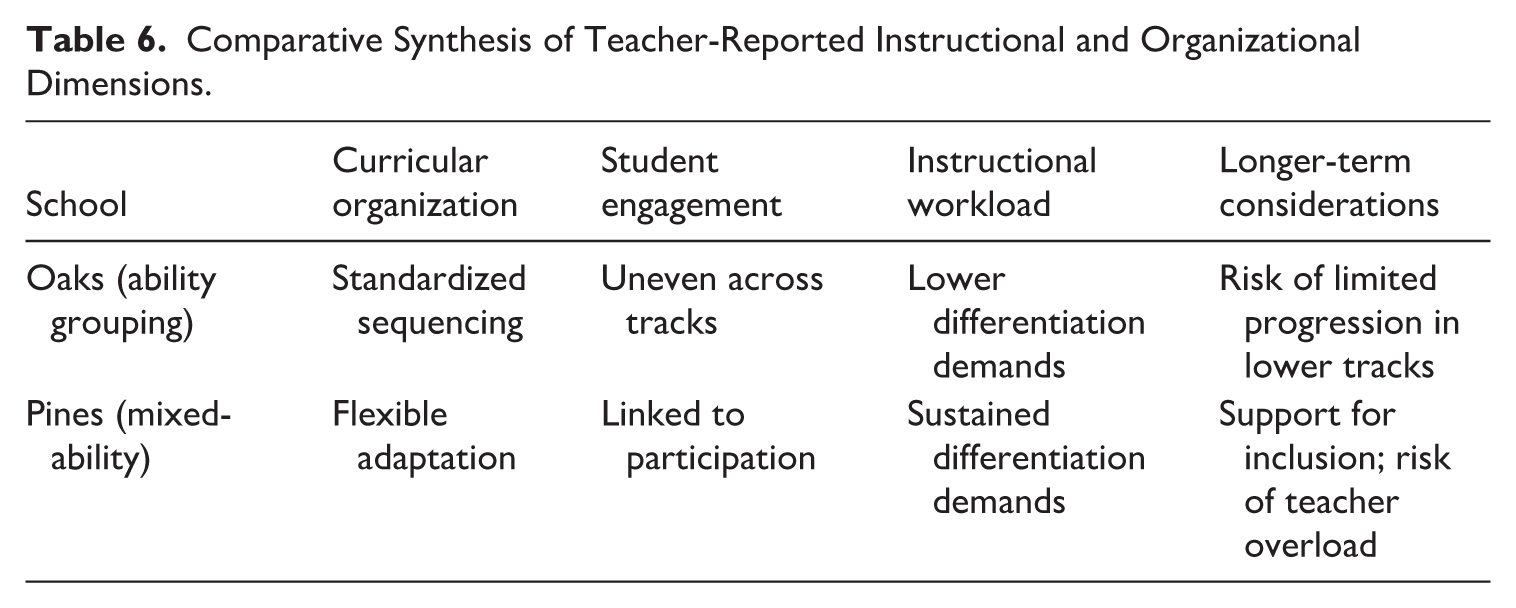
Artifact analysis reinforced contrasts in instructional enactment across contexts. At Oaks school, lower-level materials emphasized controlled practice with limited extended production (e.g., discrete grammar and vocabulary exercises), while higher-level materials foregrounded interpretive reading and open-ended writing. In contrast, Pines school materials more often involved shared content with tiered prompts and optional extensions, reflecting differentiation within a common instructional frame. These patterns aligned with teachers’ accounts of instructional precision under ability grouping and adaptive task design under mixed-ability conditions.
Table 6 synthesizes patterns across interview and artifact data rather than advancing causal claims. Taken together, the findings indicate that grouping structures do not, in themselves, determine instructional equity; rather, equity is mediated through systemic conditions shaping teacher agency, curricular flexibility, and institutional support. Ability grouping tended to provide organizational clarity while constraining flexibility, whereas mixed-ability instruction expanded pedagogical autonomy at the cost of high workload and substantial emotional labor. These trade-offs reflect broader structural dynamics rather than inherent properties of either model.
5.6. Teacher-Generated Alternative Strategies: Differentiation Practices under Constraint
Teachers in both schools described developing pragmatic, context-sensitive strategies to reconcile institutional grouping structures with the instructional and ethical demands of heterogeneous ESL classrooms. These strategies were framed not as “best practices” but as adaptive responses to constraints such as fixed placement procedures, time pressure, and wide proficiency ranges. As Itamar (Oaks) explained, “I try to break the structure a bit,” while David (Pines) described maintaining a shared topic while varying expectations for student output.
Across both contexts, flexible grouping emerged as a central strategy, enabling short-term differentiation without fully reproducing fixed hierarchies. Teachers reported rotating group composition by skill focus or task purpose, preserving a shared classroom identity while allowing targeted support or extension. Adaptive task design functioned as a second strategy: teachers maintained a common communicative goal but varied linguistic load, scaffolding, and expected output. Artifact analysis supported these accounts, revealing parallel task versions differentiated by text length, lexical support, or degree of open-ended production.
Teachers also emphasized differentiated enactment of materials. At Oaks school, leveled materials were often supplemented with communicative extensions to counter over-reliance on controlled practice, while at Pines school, shared texts were paired with tiered prompts and optional challenge tasks. Technology-assisted differentiation and growth-oriented framing further supported efforts to counter fixed academic identities.
Taken together, these practices clarify the alternative strategies referenced in the title: not a single instructional model, but a repertoire of pedagogical moves through which teachers mediate grouping structures and seek to balance differentiation with fairness under constrained conditions.
6. Discussion and Conclusion
This study contributes teacher-centered qualitative evidence to international debates in language education concerning ability grouping, differentiation, and equity. Rather than positioning between-class grouping and mixed-ability instruction as normatively opposed models, the findings suggest that each constitutes a distinct pedagogical configuration through which tensions between efficiency, inclusion, and accountability are redistributed rather than resolved.
In the grouped context, curricular alignment and level-specific pacing were structurally facilitated, particularly within a high-stakes assessment regime. However, these affordances were accompanied by reduced mobility and differentiated curricular horizons, echoing scholarship on the stratifying effects of tracking (Boaler, 2003; Feniger et al., 2021; Oakes, 2005). In the mixed-ability setting, teachers valued collaborative and communicative practices, yet sustaining differentiated cognitive challenge required sustained pedagogical labor, aligning with research on differentiation complexity and motivational reference effects (Francis et al., 2017; Gamoran, 2009; Marsh & Parker, 1984).
Crucially, the analysis extends beyond structural comparison by identifying the alternative strategies through which teachers mediate grouping arrangements in practice. Across both contexts, teachers described flexible regrouping, adaptive task design, differentiated enactment of shared materials, and selective pacing adjustments as pragmatic responses to institutional constraint. These strategies were not formal policy prescriptions but situated professional judgments aimed at balancing fairness, academic challenge, and classroom manageability. In this sense, grouping structures acquire their practical meaning through teachers’ interpretive and strategic work.
Conceptualizing grouping as enacted mediation rather than fixed design shifts the analytic lens from institutional form to professional practice. The study, therefore, contributes to language education research by foregrounding teacher agency as a central mechanism through which policy structures are translated, softened, resisted, or reconfigured in everyday ESL classrooms. Future research might further examine how such strategies evolve across policy environments and how institutional conditions shape the scope of teachers’ strategic action in high-stakes language systems.
7. Implications for Policy and Practice
The findings challenge binary framings of ability grouping versus mixed-ability instruction and caution against one-size-fits-all approaches to learner diversity. While between-class grouping may facilitate curricular alignment and instructional focus, it risks reinforcing fixed hierarchies and limiting social integration. Mixed-ability instruction, conversely, may promote inclusion and communicative engagement, yet redistributes substantial cognitive and organizational demands onto teachers. Grouping structures therefore do not resolve tensions between equity and efficiency; they reorganize them.
Rather than endorsing a single model, the findings point to adaptive, context-responsive frameworks. The findings suggest that hybrid or flexible configurations may warrant consideration, combining flexible, short-term grouping for targeted linguistic support with mixed-ability environments that sustain collaborative learning and social cohesion. Such arrangements allow responsiveness to learner variation without institutionalizing long-term stratification.
Across both models, institutional conditions emerge as decisive. Equitable ESL practice depends on sustained professional development in differentiation, structured opportunities for collaborative planning, and leadership support that recognizes teachers’ ethical and emotional labor. Policies should therefore prioritize pedagogical adaptability, resource equity, and organizational cultures that support students’ belonging and mobility. Ultimately, the effectiveness of grouping structures rests less on their formal design than on the institutional capacity to enact them reflexively and sustainably.
8. Limitations
Despite its contributions, this study has several limitations. First, it is based on a comparative case study of two Israeli junior high schools within the Hebrew-speaking sector. While this design enabled in-depth, context-sensitive analysis, it limits the transferability of the findings to other educational systems, linguistic contexts, or institutional arrangements. The study does not aim at statistical generalization, but at analytic insight into how grouping is experienced and enacted by teachers in specific settings. Future research could extend this work by examining similar dynamics across a wider range of schools, regions, and sociolinguistic contexts.
Second, although the study incorporated methodological triangulation through interviews and instructional artifact analysis, teachers’ accounts remained the primary data source. These accounts reflect participants’ interpretations and professional positioning rather than causal relationships between grouping models and student outcomes. Future studies could combine teacher-centered qualitative approaches with quantitative or mixed-methods designs to examine student trajectories, mobility, and longer-term outcomes.
In addition, the relatively small sample, consistent with the study’s interpretivist orientation, did not include the perspectives of students, school leaders, or policymakers. Incorporating these voices would provide a more comprehensive understanding of how grouping policies are negotiated and experienced across levels of the education system.
Footnotes
Appendix
Exploring teacher perspectives on ability grouping and heterogeneous classrooms.
| Section | Interview questions |
|---|---|
| Introduction | Hello [Teacher’s Name], thank you so much for taking the time to participate in this interview. Your insights are extremely valuable to my research on English teaching practices in Israeli junior high schools. My name is Idan Saban, and I’ve been teaching English in middle and high school for over a decade. This study focuses on how teachers experience and manage ability-grouped versus heterogeneous classrooms. We’ll explore your experiences, strategies, and thoughts about both instructional models |
| Background | 1. Could you briefly introduce yourself and share why you chose to become a teacher? 2. How many years have you been teaching English, and in what educational contexts? 3. What is your academic background? Did you earn a degree in English or education? 4. Did you grow up in Israel or abroad? 5. Have you taken part in any professional development or training over the past 2 years? Please specify |
| School environment | 6. Can you describe the student population at your school? Where do your students come from, and how do you assess them? 7. How would you describe the range of abilities in your classes? What types of differences do you observe? 8. Can you briefly describe one student you consider strong and one you consider weak, and what makes them stand out? 9. How is English typically taught in 7th and 8th grade at your school? Could you describe a recent lesson as an example? 10. What textbooks or materials do you usually use? 11. What kinds of challenges do your students face in learning English? |
| Classroom strategies | 12. In your opinion, what are effective ways to address heterogeneity in the classroom (e.g., small groups, differentiated tasks, mixed-ability pairing)? 13. How do you differentiate instruction to support students with varying learning needs? Can you share specific strategies or examples? |
| Ability grouping classes | For teachers working with ability grouping: 14. What are the advantages and disadvantages of using levelled study materials in ability-grouped classes? 15. If your school were to shift to teaching without ability-based grouping, how might that impact your teaching? What pros and cons would you foresee? |
| Mixed-ability classes | For teachers working with mixed-ability classes: 16. What are the advantages and disadvantages of teaching in a heterogeneous classroom? 17. If your school were to adopt study materials designed for levelled groups, how do you think that would affect your teaching and students? |
| Expectations | 18. Returning to the strong and weak students you mentioned earlier: What are your expectations for each? How do school expectations shape your own? Do you think teacher expectations can influence student performance in grouped or mixed classes? |
| Excellence in education | 19. How do you define “excellence” in education? How do you encourage and support all students to strive toward excellence, regardless of their level? |
| Challenges | 20. What are the key challenges you face in teaching either ability-grouped or heterogeneous classes? How do you try to address or overcome them? |
| Bonus question (optional) | For professional development coordinators only: 21. Are you familiar with the booklet teaching English in ability grouped classes—practical suggestions (2019)? If so, how has it influenced your teaching or professional development initiatives? Could you share your thoughts on its usefulness? https://meyda.education.gov.il/files/Mazkirut_Pedagogit/English/mixedability.pdf |
| Closing | Thank you again for sharing your experiences and insights. Is there anything else you’d like to add regarding ability grouping, classroom composition, or English instruction more broadly? Any additional thoughts you feel are important to include? |
Acknowledgements
The authors would like to thank the participating teachers for generously sharing their time, experiences, and professional perspectives throughout this study. The authors also sincerely thank the editors and reviewers of Language Teaching Research for their thoughtful feedback and constructive engagement throughout the review process.

Ethical Considerations
Ethical approval for the study was obtained from the Israeli Ministry of Education and the relevant institutional ethics committee.
Consent to Participate
All participants provided informed consent prior to data collection and were assured that participation was voluntary and that they could withdraw from the study at any stage without consequence.
Funding
The authors received no financial support for the research, authorship, and/or publication of this article.
Declaration of Conflicting Interests
The authors declared no potential conflicts of interest with respect to the research, authorship, and/or publication of this article.
Data Availability Statement
The data supporting the findings of this study are not publicly available due to ethical and confidentiality restrictions.