






Abstract
This qualitative case study explores how a transnational second language writing teacher (Author 2) developed adaptive expertise across three career stages, early career in China, mid-career in the United States, and later career back in China as an experienced second language writing teacher, through the dynamic interplay of identity, agency, and emotion. Data from reflection journals and semi-structured interviews were analyzed using a framework grounded in four constructs: identity, agency, emotion, and adaptive expertise. Findings reveal that negative emotions (e.g., anxiety, disillusionment) initially constrained agency and solidified a novice identity, whereas later emotions (e.g., resilience) became catalysts for proactive adaptation. Identity evolution guided agency, shifting from defensive (survival-focused) to proactive (innovation-focused), and agentic actions (e.g., curriculum redesign, collaboration) refined identity and built adaptive expertise. The study proposes the Adaptive Expertise Ecology model, framing the four constructs as an interdependent system shaped by context. Implications for second-language writing teacher education include integrating emotional resilience training and identity exploration to support transnational second language writing teachers’ growth from survival to thriving.
Keywords
1. Introduction
In language education, research (e.g., Christiansen et al., 2018; Lee, 2013; Lee & Yuan, 2021; Tardy et al., 2022; Weng, 2025) on second language (L2) writing teachers and writing instructions has been recently increasing but is still sporadically investigated, especially compared with interests related to L2 writers and writing (Zheng et al., 2022). Such a phenomenon has been noticed by scholars such as Hirvela and Belcher (2007), calling for more attention to the L2 writing teacher population. This professional population consists of “teachers/ tutors/ instructors/ lecturers who teach writing to L2 students” (Zheng et al., 2022, p. 1), a heterogeneous group with diverse educational backgrounds, teaching experiences, and career trajectories. Socially situated in different educational contexts and communities, L2 writing teachers’ knowledge, roles, and responsibilities are not static, but in constant flux across professional settings, entailing (re)adjustment and (re)adaptation of their instructional practices and refinement of their beliefs toward L2 writing education over time (Weng, 2024; Weng et al., 2023). In other words, adaptive instructional practices are an essential qualification for L2 writing teachers, and adaptive teaching is a successful characteristic of teaching (Athanases et al., 2015; Hirvela, 2019).
Most teacher-related research shows interest in L2 writing teacher cognition (e.g., Lee, 2013; L. Wang et al., 2020; Worden, 2019), practices (e.g., Einum, 2020; Kiss & Mizusawa, 2018), and expertise (e.g., Lee & Yuan, 2021; Weng, 2021). Among the three research foci, research on L2 writing teacher expertise has been the emerging line of inquiry recently (Zheng et al., 2022). Through their relentless endeavor, Hirvela and Belcher (2022) further advocate more sustainable research on L2 writing teacher expertise, understood as a dynamic, context-dependent form of mastery that integrates analytical, creative, and practical skills (Sternberg et al., 2001). Within current literature on L2 writing teacher expertise, most research has focused on L2 writing teachers’ adaptive expertise (e.g., Asaba, 2025; Christiansen et al., 2018; Lee & Yuan, 2021), which is adjusting in thinking and practice as new problems and situations appear and learning occurs (Hatano & Inagaki, 1986). This model has been proposed by Hirvela (2019) and has been proven a promising analytical lens for examining L2 writing teaching.
Adopting this lens of adaptive expertise, the current study employs a more integrated perspective by collectively analyzing a transnational L2 writing teacher’s professional growth and pursuit of adaptive expertise through her evolving emotional regulation, identity construction, and diverse forms of agency enactment. An integrated perspective is significant in exploring transnational L2 writing teachers’ professional growth as they advance their teaching career across cultural and social contexts, full of affordances and constraints, often leading to emotional tensions, identity crisis, and constrained agency, which could also turn into essential growth points (Hirvela, 2019) in their professional development. By unpacking this becoming and evolving process, the current inquiry could contribute to a better understanding of the professional development needs of L2 writing teachers.
The study is guided by the following research question: How does one transnational L2 writing teacher’s development of adaptive expertise intersect with her evolving identity, agency, and emotion, while advancing her career across contexts in China and the United States?
2. The Interconnection of the Constructs in Language Education
The contemporary realities of teaching in language education illustrate a complex, socially situated practice shaped by a multitude of individual and contextual factors (Crandall & Christison, 2016; Varghese et al., 2005). Among these factors, teachers’ professional sense of self and their capacity to act and negotiate in their situated teaching contexts have emerged as critical to understanding effective pedagogy (Buchanan, 2015; Weng, 2023). Teacher professional identity is defined as “what teachers themselves find important in their professional work and lives based on both their experiences in practice and their personal backgrounds” (Beijaard et al., 2004, p. 108). Its development entails different “knowledge sources, such as knowledge of affect, teaching, human relations, and subject matter” (Antonek et al., 1997, p. 24). These different sources of knowledge interact with teacher professional identity construction, and the growth of those knowledge bases, particularly knowledge of teaching and subject matter, could most directly promote the development of teachers’ expertise (Tsui, 2003; Weng, 2023, 2024). Research (e.g., Ashton, 2022; Bowen et al., 2021) has further shown the inseparable connection between teacher identity and agency. Vähäsantanen et al. (2009) defined agency as “the capability of persons to make intentional choices, and to act on these choices in ways that make a difference in their lives” (p. 396). In relation to identity, Eteläpelto et al. (2013) argued that “[a]gency is needed for reshaping and renegotiating work identities, and the subject’s sense of a professional self influences how he/she practises agency at work” (p. 57), revealing the reciprocal mediating relationship between professional identity and agency, the manifestation of which is often in discourse and teaching practices.
A core aspect of this evolving interplay is the understanding that identity is inherently emotional (Zembylas, 2003, p. 214): “the construction of teacher identity is at bottom affective, and is dependent upon power and agency [. . .] that an investigation of the emotional components of teacher identity yields a richer understanding of the teacher self” (emphases added). This understanding highlights that emotions—whether joy, frustration, anxiety, or passion—are not just individual sentiments. Instead, they are responses shaped by social contexts, power dynamics, and professional standards (Heidari & Rastegar, 2026; Karimpour & Xodabande, 2026; Weng et al., 2023), potentially serving as a catalyst for teachers’ professional growth and change (e.g., Song & Valentine, 2024).
Toker-Bradshaw and Tezgiden-Cakcak (2025), drawing on teacher identity, emotions and agency as an interrelated triangle, explored pre-service teachers’ learning to teach. Although illuminated in the teacher candidate’s trajectory of learning to teach, their study does not focus on teacher expertise. Against this backdrop, the present study examines the dynamic interplay among one transnational L2 writing teacher’s identities, agency, emotions, and expertise, and how these constructs work together to shape the L2 writing teacher’s professional life.
3. L2 Writing Teacher Identity, Agency, and Emotions
L2 writing teachers have received less attention than L2 learners in research (Hirvela, 2019). Although some scholars have begun to address this gap (e.g., Hirvela & Belcher, 2007; Lee, 2010, 2013), they have called for further investigations into L2 writing teachers and teacher education. Increasing though still scarce, research (Lee, 2013; Weng, 2023, 2024) has been dedicated to this line of inquiry and found that L2 writing teacher identity construction is cultural and contextual, shaped by local teaching dynamics (e.g., Lee, 2013). A series of studies (Weng, 2023, 2024; Weng et al., 2023) conducted by Weng present more direct focus on professional identity and agency construction among transnational L2 writing teachers. Weng’s empirical studies collectively demonstrate that L2 writing teachers’ self-positioned professional identities determine the purpose, direction, and scope of their agency, revealed in their pedagogical choices; meanwhile, agency actively constructs, negotiates, or redefines teachers’ self-perceptions. The outcomes of agentic actions either legitimize desired identities or prompt identity adjustments. In a word, L2 writing teachers’ identity and agency creates a reciprocal cycle that evolves with teaching experiences and contexts.
With the affective turn in language teaching (Bigelow, 2019; Richards, 2022), L2 writing teachers’ emotions have also been explicitly discussed, although not together with their identity and agency. This area of research explores L2 writing teachers’ emotional responses in feedback provision (e.g., Wang & Jiang, 2025) and writing instructions (e.g., Geng et al., 2023). Although the studies implicitly touch on L2 writing teachers’ ability to cope with emotional strain, such as managing workload stress and addressing student-related frustration, they do not frame this coping capacity as the teachers’ resilience or engage with resilience as a defined theoretical or analytical construct. However, teachers’ resilience is a significant aspect of teacher emotion that allows teachers to persist when facing challenges (e.g., heavy workloads) and tense emotions and sustain teachers not just to survive but also to thrive in the profession (Beltman et al., 2011). More importantly, resilience is seen a process of adaptation (Castro et al., 2009), in compliance with the overarching comprehension of language teacher identity, agency, and expertise of the study. However, this role of resilience in a transnational L2 writing teacher’s professional trajectory is largely unknown.
4. L2 Writing Teacher Adaptive Expertise
L2 writing scholars have affirmed that expertise is not static but a continuum. The pursuit of expertise in teaching L2 writing is also never linear, given teachers advancing their careers, being assigned to teach new courses, and closely interacting with diverse bodies of students and colleagues. In flux, they must be adaptive and responsive to students’ needs. Recent studies have closely examined L2 writing teachers’ adaptive expertise (e.g., Asaba, 2025; Christiansen et al., 2018; Lee & Yuan, 2021; Weng, 2025) and emphasize that adaptive expertise is a cornerstone of effective teaching in dynamic contexts (Weng, 2025). Adaptive expertise highlights the contextual and dynamic nature of teaching and encourages teachers’ ongoing development of their knowledge and skills in instructional practices. Although L2 writing research has identified the features of L2 writing expert teachers (Lee & Yuan, 2021) and explored the interplay between routine and adaptive expertise (Asaba, 2025; Christiansen et al., 2018; Weng, 2025), no study has explored how L2 writing teachers develop the adaptive expertise in intersection with their evolving identities, agency, and emotions.
5. Integration of Theoretical Strands
Based on the above literature review, this study integrates three interconnected theoretical strands as an analytical lens: adaptive expertise, the emotion–identity–agency triangle, and tensions (i.e., emotional tensions, identity crisis, and constrained agency) as the growth points. These constructs are not mutually exclusive but synergistic, forming a holistic framework that addresses the dynamic, context-dependent nature of teacher growth. This integrated framework addresses the gap in existing literature: Although prior literature has investigated the frameworks in isolation, no research has explicitly combined them to explore L2 writing teachers’ transnational development. Therefore, this study contributes to building a “corpus of expertise-related studies” (Hirvela & Belcher, 2022, p. 3) by conducting in-depth research to unpack a transnational L2 writing teacher’s professional identities, agency, emotions, and adaptive expertise across her professional trajectory from surviving to thriving as an L2 writing teacher.
6. Methodology
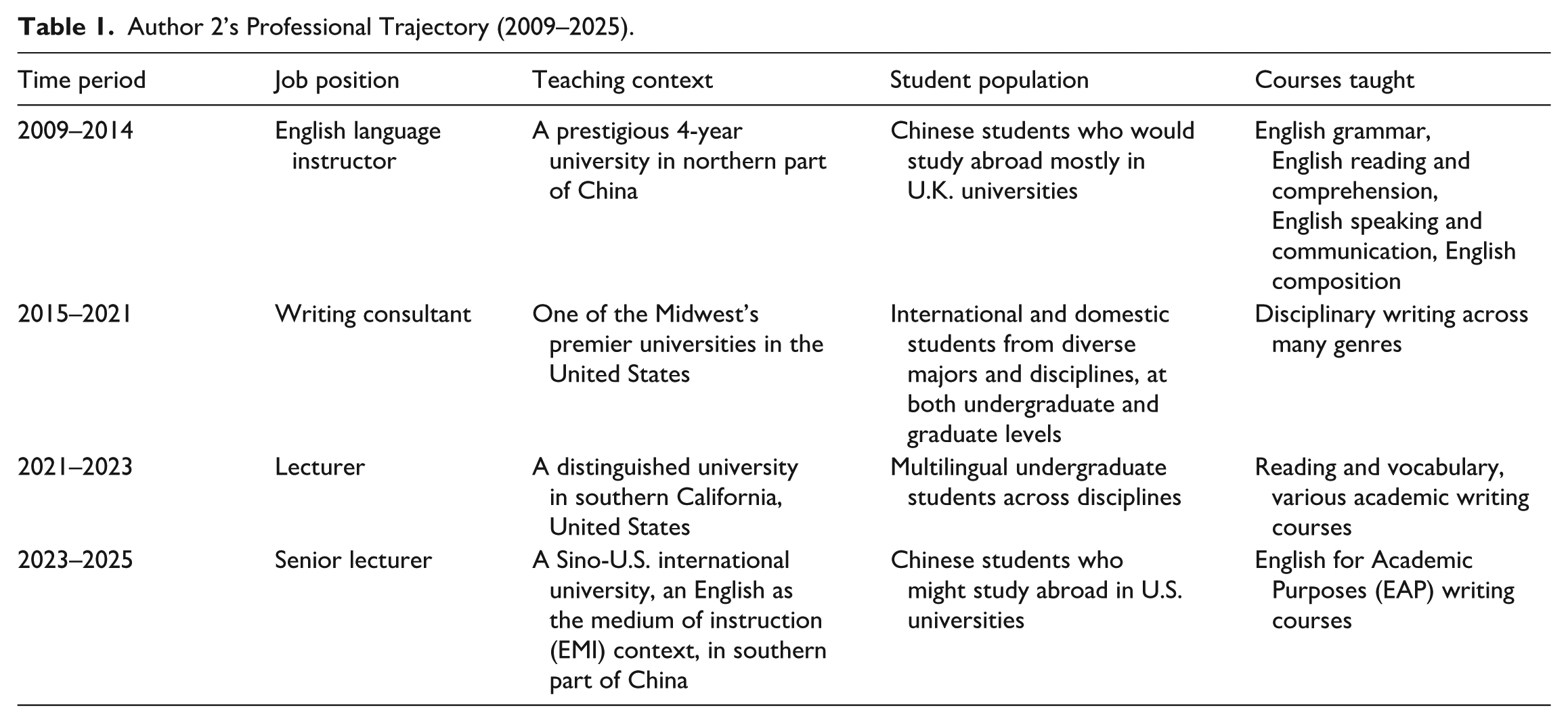
This research employs a qualitative case study (Merriam, 2009) to explore the professional growth of a transnational L2 writing teacher, who is also the second author of the paper (Author 2). At the time of this research, Author 2 was in her early 40s and had around 16 years of L2 writing teaching experience. In 2009, after earning a master’s degree in language teaching from a U.K. university, she secured a position as a college English instructor in China. Even though she was not assigned to teach English writing initially, she was given writing courses in the following years. After 5 years of teaching in the program, Author 2 left for her doctoral degree at a U.S. university where she worked as a writing consultant for 5 years through a graduate teaching assistantship. After graduating from the doctoral program, she began teaching L2 writing to both international and domestic students as an instructor at a reputable university in the western United States for 2 years. In 2023, she started to teach English for Academic Purposes (EAP) writing to Chinese students at an international university in China. See Table 1 for a more detailed description of her professional trajectory.
Author 2’s Professional Trajectory (2009–2025).
6.1. Data Collection
The study collected reflection journals and semi-structured interviews, both of which are crucial means to capture participants’ perceptions and insights into their past professional work (Weng, 2026). Eight monthly reflection journals were collected, covering topics from teaching experiences to emotions, identity construction, coping strategies, L2 writing teaching beliefs, and pedagogical choices (see Figure 1 for specific reflection prompts). Each reflection journal was written in English, ranging from 3 pages to 19 pages. In Section 8 (Findings), we identify those reflection journals as Reflection 1, Reflection 2, and so on to represent this type of data. Following the journal reflections, two semi-structured interviews were conducted, mainly to clarify and further discuss Author 2’s professional growth. One interview is approximately 3 hours, and the other is 1 hour, both in English and transcribed verbatim.
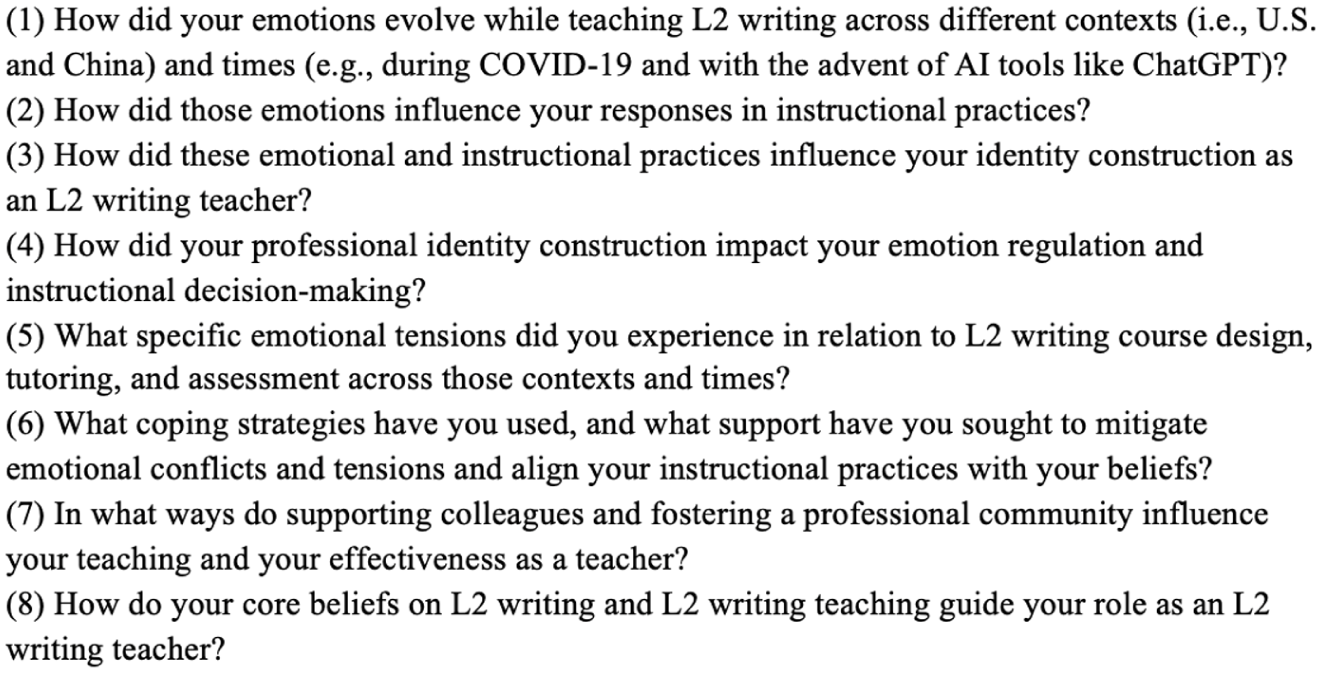
Specific writing prompts.
6.2. Data Analysis
When analyzing the data, we employed a coding procedure explicitly guided by the study’s theoretical frameworks: adaptive expertise, the emotion–identity–agency triangle, and tensions as the growth points. First, Author 1, the lead researcher, carefully reviewed and coded Author 2’s interview transcripts and reflection journals. Those data were organized chronologically (Merriam, 2009) and coded based on the four core categories: identity, agency, emotion, and adaptive expertise. As Author 1 recursively read through the data sources and codes, she took analytical notes about key moments and instances, referred to as “episodes” (Toker-Bradshaw & Tezgiden-Cakcak, 2025, p. 56), in Author 2’s trajectories of becoming an L2 writing teacher, particularly where the interplay of emotion, identity, and agency directly fostered or constrained adaptive expertise. Author 1 compared those notes across the data sources and drew connections between the episodes which were member checked (Merriam, 2009) by Author 2 to ensure alignment with the theoretical frameworks and her lived experiences. In total, five episodes were identified and further grouped into three career stages, including Early stage (Teaching in China), Mid-career stage (U.S. contexts), and Experienced stage (Back to China), reflecting Author 2’s transformation in her professional trajectory.
7. Researcher Positionality
7.1. Author 1
My research centers on language teacher identity, agency, emotion, and expertise, a thematic focus that has guided my scholarly work since my doctoral studies. During my PhD program, I overlapped with Author 2 as fellow doctoral students, but our interactions remained limited to program-wide events rather than cohort-specific or personal engagements. We belonged to different admission cohorts and had no collaborative projects or informal mentorship relationships at that stage. Our paths reconverged when we joined the same institution in China, where both of us teach EAP writing courses. Over 2 years of working together, we built a collegial rapport. We discussed shared pedagogical challenges, exchanged teaching resources, and participated in divisional meetings on L2 writing instruction. Through these interactions, I observed Author 2’s consistent commitment to student learning and her reflective stance toward her own teaching. These observations, paired with my longstanding interest in exploring L2 writing teachers’ professional lives, led me to propose the current project to Author 2 who readily agreed to share her professional trajectories.
To ensure that my prior collegial knowledge of Author 2 did not skew data analysis, I adopted transparent and systematic methods. I cross-referenced data from different sources to validate interpretations. I also shared a draft of the analysis with Author 2 for member checking, asking her to confirm whether the interpretations aligned with her experiences. This step allowed Author 2 to correct any misinterpretations and ensured that the analysis reflected her perspectives. Throughout data collection and analysis, I maintained a reflexive journal (Su & Su, 2025) to document my own assumptions and potential biases. For example, I questioned myself: “Did my assumptions of Author 2 as a Western-trained L2 writing scholar influence how I phrased interview questions?” This journaling helped me identify and set aside subjective beliefs, ensuring that my analysis remained grounded in the data rather than prior collegial knowledge.
7.2. Author 2
As both the focus of this study and a co-researcher, my positionality is central to this project. I joined the study because it offered a meaningful opportunity to examine my journey as a transnational L2 writing teacher, exploring how my professional growth, identity, emotions, and agency have evolved across contexts in China and the United States. Reflecting on my experiences—from navigating new teaching environments to developing adaptive expertise—felt both personal and scholarly. Through this work, I hoped not only to document my professional journey but also to offer insights that might resonate with other L2 writing teachers; meanwhile, I remained conscious of being a participant and researcher. I approached my reflections and experiences not as mere memories but as data to be critically analyzed. My co-author provided essential support through feedback, triangulation, and constructive questioning, helping me maintain reflexivity and ensuring that my participant perspective did not overshadow the analytical rigor of the study. Being both an insider and a researcher enriched the study by providing access to firsthand experience while requiring ongoing reflection on my assumptions and biases (Song & Nejadghanbar, 2024). Ultimately, I believe my involvement enhanced the authenticity of the research while upholding its trustworthiness.
8. Findings
8.1. Early Stage (Teaching in China, Pre-PhD Years): Misalignment between Pedagogical Goals and Actual Teaching
8.1.1. Episode 1: Novice Identity, Emotional Vulnerability, and Constrained Agency in Chinese Higher Education
Author 2’s early teaching stage in China represents a period of identity formation, during which emotional survival and limited agency constrained her ability to fully implement her professional knowledge, resulting in a pedagogy focused on safety and certainty rather than exploration and student empowerment. From the start, Author 2’s emotions—anxiety, self-doubt, and fear of being perceived as “incompetent” (Reflection 2)—were rooted in two interconnected gaps: her lack of explicit training in L2 writing pedagogy and the absence of institutional support. As she noted: “[I felt] a deep sense of
This emotional vulnerability was amplified by the department’s failure to provide structure: “complete independence but minimal guidance, no existing syllabus, materials, or mentorship” (Reflection 5). Without guidance, her anxiety manifested as a “fear of failure” (Interview 1) that turned lesson planning into an emotional, risk-averse process. These feelings led to her over-preparing, avoiding spontaneous interactions, and focusing on surface-level corrections, all of which were to maintain control and avoid confrontation: I over-prepared for every class, rehearsed my explanations in advance, and avoided giving spontaneous feedback during lessons because I was worried about saying the wrong thing. [. . .] For the same reason, I initially limited my comments on student writing to grammar and surface-level issues. Grammar felt objective—something I could point to with certainty—whereas responding to students’ ideas, structure, or rhetorical choices felt riskier. (Reflection 2)
These choices reveal how negative emotion constrained her pedagogical agency. Although she understood that effective writing instruction required engaging “students’ voices and thinking” (Reflection 2) and “fostering critical thinking” (Interview 1), her fear of misinterpreting student work or giving poor advice prevented her from acting on this knowledge. Instead, she prioritized certainty over depth, a trade-off that protected her fragile novice identity but circumscribed her students’ growth.
Even though the defensive agency “reflected [her] uncertainty about how to guide students in developing ideas, structuring arguments, or writing for academic audiences” (Reflection 6), those pedagogical choices helped her manage her anxiety as a new teacher. At this career stage as a novice L2 writing teacher, Author 2’s defensive agency further confirmed her lack of knowledge and skills in bridging the mismatch between her vision of good teaching and her ability to implement it: “Although I understood from my own academic writing experience what it meant to be a good writing teacher—supporting students as they developed content, clarity, and critical thinking—I struggled to implement this vision” (Reflection 6). Instead, she prioritized “satisfying students’ immediate needs” (Reflection 6) over her long-term pedagogical goals, a choice driven by her novice identity’s sense of responsibility to avoid appearing incompetent: Because I lacked authority and confidence, much of my pedagogy centered on satisfying students’ immediate needs: if they needed grammar fixed, I fixed it. [. . .] My novice identity made me feel responsible for meeting these immediate demands, even when they conflicted with my pedagogical goals. (Reflection 6)
Author 2’s identity as a novice teacher constrained her agency to safe, familiar practices, preventing her from experimenting with the student-centered approaches she valued.
8.1.2. Episode 2: From Confidence to Disillusion: Established Routines and Reclaimed Agency
As Author 2 gradually developed her teaching routines, her confidence grew, which she described as “not the absence of fear but the willingness to continue despite it” (Reflection 5). Initially feeling “content with [her] position” (Reflection 1), her emerging comfort clashed with a deepening disillusionment, a new emotion that signaled a shift in her identity and a re-evaluation of her teaching pedagogies. She became frustrated with the program’s overemphasis on “grammar drills and rigid essay formats” (Reflection 1), which was “embedded in the program’s teaching culture” (Reflection 4). Author 2 survived the first several years of teaching L2 writing in the program due to its emphasis on grammar and students’ attention to “passing exams and improving grammar” (Reflection 6), but she gradually realized that formulaic instruction and sentence-level corrections were not “meaningful work” (Reflection 1), against her vision of teaching, which is “supporting students as they developed content, clarity, and critical thinking” (Interview 1). As she described:
“The heavy emphasis on grammar drills and rigid essay formats left me
8.2. Mid-Career Stage (U.S. contexts): Emotional Resilience, Growing Adaptation, and Innovative Agency
8.2.1. Episode 3: Navigating Challenges, Embracing Agency, and Shaping Expertise in a New Cultural Context
After earning her doctoral degree in multilingual language education, specialized in L2 writing, Author 2 began working as a lecturer at a U.S. university, a role that marked a clear departure from her early days as a novice language teacher: “I came equipped with specialized training, research expertise, and a deeper theoretical understanding of L2 writing” (Reflection 3), and she was “ eager to put [her] knowledge into practice in a new academic context” (Reflection 1). The quote underscores how her academic specialization fueled the confidence needed to step into the lecturer position. Aligned with her original motivation for leaving her previous university, seeking more “meaningful work” (Reflection 1), she approached the new role with “a powerful mix of
Author 2 was assigned to the university’s EAP program, which she described as offering “a sequence of writing courses for [international] undergraduate students, typically labeled as 20A, 20B, and 20C” (Reflection 2). Her first semester presented immediate hurdles, starting with an overwhelming workload: “I was assigned to teach three writing courses in my first quarter—20A, 20B, and 20C—each with a different level and instructional focus” (Interview 1), an experience she characterized as “intense and emotionally
Rather than being defeated by this pressure, Author 2 demonstrated emotional resilience, channeling the challenge into motivation: “I became determined to seek out every resource I needed to succeed” (Reflection 1). She proactively built strategies and leveraged available support, starting with the program’s structured resources: During the new instructor training, I was told that the program used a core textbook, which offered consistent guidance for the writing courses I was about to teach. I was also given access to a collection of Google Docs that included writing exercises and materials developed by experienced colleagues in the program. With some modifications, I was able to adapt and incorporate some of these exercises as handouts in my own classes. (Reflection 1)
The support stood in contrast to her first teaching role in China, where such resources were unavailable. Crucially, Author 2 did not merely use the materials as they are. She tailored them to fit her students’ needs, showcasing her agency as an L2 writing teacher with accumulated knowledge and skills over the years. She also leveraged the key asset from her time as a writing center consultant during her PhD, where she has worked with students across diverse majors and disciplines (Interview 1). The background, she realized, has equipped her with transferable skills: This [writing center consultant position] exposed me to diverse academic genres and strengthened my ability to explain key writing concepts across contexts. This background became an unexpected asset. I began to realize that, although I didn’t have a large archive of ready-made teaching materials, I had the knowledge, flexibility, and experience necessary to create them from scratch. (Reflection 1)
This emotional resilience and resourcefulness allowed Author 2 to adapt quickly to the new teaching context and bridge the gap between theoretical knowledge and practical pedagogy.
8.2.2. Episode 4: Unexpected Challenges, Quick Adaptation, and Innovative Pedagogical Agency
Just as Author 2 began to settle into her role teaching the 20-series EAP courses, an unexpected challenge disrupted her momentum. She was “assigned a new and unfamiliar course: teaching a specialized writing course for upper-division STEM [science, technology, engineering, and mathematics] students” (Reflection 2). The shift caught her off guard. Beyond the unexpected course assignment, Author 2 faced a second disruption. Her professional training had prepared her to teach EAP courses, “designed specifically for multilingual students” (Interview 1). However, due to “enrollment fluctuations and sometimes administrative decisions [leading] to native English-speaking students being placed in these [EAP] classes,” she was “given a section composed of a significant number of native English speakers, even though the course wasn’t originally designed for them” (Reflection 4). She felt “uncertain about how to make the content relevant” (Reflection 8) and noted that “the sense of stability [she] had briefly felt was quickly replaced by uncertainty, pressure, and the emotional fatigue of being thrown back into improvisation mode” (Reflection 1). Despite the intense emotions, classroom dynamics “pushed [Author 2] to
Author 2’s rapid adaptation was fueled by four key factors, each reflecting her growing adaptation. First, rather than succumbing to discomfort, she reframed it as a chance to innovate: “Rather than viewing that discomfort as a barrier, I began to see it as an opportunity to reshape the course around what my students did find meaningful” (Reflection 2). She also leveraged her expertise to manage self-doubt: “My growing expertise gave me tools to regulate emotions like self-doubt and overwhelm, transforming them into motivation for innovation and deeper student engagement” (Reflection 3). Second, Author 2 challenged her own assumption that she was only equipped to teach multilingual students, drawing on her research to reframe her perspective: Eventually, I reminded myself of something core to my own research:
Further, her doctoral research became a practical tool for course redesign: “I drew on observations from my doctoral dissertation on [American] high school students’ writing challenges to design lessons, scaffold tasks, and provide targeted feedback. This research-informed approach gave me confidence, helping transform self-doubt into pedagogical innovation” (Reflection 6). Last, her time as a graduate writing consultant proved invaluable: “Thankfully, I had a wealth of experience to draw from. During my time as a graduate writing consultant, I had helped many students revise personal statements, research proposals, and other professional documents” (Reflection 2).
With all those resources she drew upon, the redesign was a resounding success: “Students became more engaged, and classroom discussions grew richer and more purposeful. Several students later emailed me to share their success in being admitted to top graduate programs, crediting our course for helping them refine their writing” (Reflection 2). Beyond student outcomes, the experience deepened Author 2’s L2 writing teacher identity. It reinforced her sense of achievement, which “became the foundation for a more student-centered pedagogy” (Interview 1). Ultimately, the challenge marked a pivotal step in Author 2’s evolution as an “inclusive, responsive, and adaptable L2 writing teacher” (Reflection 6), solidifying her adaptive expertise and capacity to turn unexpected obstacles into opportunities for growth.
8.3. Experienced Stage (Back to China): Reflective Adaptation, Culturally Responsive/Matured Expertise, and Collaborative Agency
8.3.1. Episode 5: Adaptive and Culturally Responsive Expertise with Collaborative Agency
Author 2’s return to China marked a stark contrast to her early teaching career; where she once focused on surviving her first years, she now aimed to thrive. The shift was rooted in the expertise and confidence she had built abroad, as she reflected: Completing my Ph.D. in the U.S. had equipped me with a solid theoretical foundation in writing theory and research [. . .], my teaching experience at [the university name] had helped me develop a student-centered pedagogical style and the skills to manage diverse classrooms effectively. Emotionally, intellectually, and professionally, I believed I was ready to embrace this new chapter and thrive in the Chinese academic context. (Reflection 1)
This confidence, however, was quickly tested by the unique demands of her new context; specifically, an English as the medium of instruction (EMI) setting. As she noted: “even with all the confidence I carried into the classroom, reality quickly reminded me that every new context brings its own surprises and adjustments” (Reflection 1), which “requires ongoing reflection and adaptation” (Reflection 2). This quotation underscores a key revolution in Author 2’s expertise. Unlike her early career, she now approached challenges without panic and self-doubt. Instead, she developed a reflection-first mindset, framing adaptation as a deliberate practice rather than a reactive one.
Author 2 identified three interrelated challenges that demanded her adaptive skill: “curriculum constraints, students’ unfamiliarity with interactive pedagogy” (Reflection 6), and students’ lack of knowledge on EMI academic writing norms (Reflection 2). Each challenge tested her ability to balance her student-centered values with contextual realities, and her responses reveal the depth of her culturally responsive expertise. First, the EAP writing program’s standardized design limited her pedagogical agency, a tension that created internal conflict. She explained: “While the program provided a detailed syllabus and a well-organized repository of shared materials via Google Drive, I quickly realized that there was limited room for pedagogical flexibility” (Reflection 1). This constraint clashed with her experience in the United States, where she had tailored courses to student needs. The result was an ongoing friction: “I struggled to balance the program’s expectations with what I felt my students could realistically manage in such an intense, accelerated schedule” (Reflection 1). The quotation highlights a critical adaptation. Author 2 no longer viewed flexibility as an all-or-nothing value but as a skill to negotiate within institutional boundaries, a sign of her matured expertise.
The second tension emerged between the program’s emphasis on interactive, student-centered pedagogy and her students’ prior educational experiences. Having just completed China’s highly exam-focused college entrance exam, many students lacked familiarity with collaborative or discussion-based learning: “Group projects often became silent parallel work, with students dividing tasks rather than interacting” (Reflection 8). This gap was not merely pedagogical but cultural: “their silence came from navigating unfamiliar cultural and emotional territory. Their education had trained them to follow structure and authority, not to collaborate freely” (Interview 2). This insight was pivotal. Instead of viewing student silence as resistance or her own failure, she framed it as a cultural adaptation gap, laying the groundwork for targeted and culturally responsive changes.
The last challenge centered on the fact that students were not familiar with EMI academic writing norms. Although many had strong English proficiency, they lacked exposure to western rhetorical conventions: “Students often struggled with rhetorical conventions that were unfamiliar to them, such as clearly stating claims, front-loading arguments, and supporting ideas with explicit reasoning” (Reflection 2). This quotation reveals Author 2’s refined understanding of L2 writing. She no longer reduced student struggles to language gaps but recognized them as gaps in rhetorical and critical thinking training. Emotionally, she shifted from frustration to empathy: “I felt frustrated by these gaps, but that feeling evolved into something more productive” and “I began to see these challenges as opportunities to support deeper learning” (Reflection 2). This realization is a hallmark of her experienced expertise. She now framed obstacles as catalysts for professional growth, not barriers to it.
Author 2’s responses to these challenges were strategic, drawing on her cross-cultural experience, research background, and emotional resilience. For example, to bridge the gap between student-centered pedagogy and her students’ cultural readiness, Author 2 adapted her approach rather than abandoning her values. She explained: Gradually, I adapted by adding clearer roles in group activities, allowing reflection time before speaking, and structuring participation more explicitly. Over time, small changes appeared—more eye contact, more student voices, and even moments of laughter. This confirmed my belief that teaching must be culturally responsive and attuned to students’ prior learning experiences. (Reflection 8)
These adjustments addressed the cultural root of student silence while still fostering interaction, which reflects her ability to integrate cultural awareness with pedagogical practice.
For students’ writing challenges, Author 2 leveraged her PhD research and L2 writing scholarship to reframe instruction around reading-to-write skills, addressing the underlying gap in academic literacy training. She noted: This discomfort confirmed something I have long known from L2 writing scholarship and my own Ph.D. research: many students struggle not only with writing but also with reading and comprehending complex academic texts. This moved me emotionally from frustration to empathy. I saw that their challenges were not about unwillingness, but about a lack of training in academic reading and research. In response, I redesigned my lessons to focus more on reading-to-write skills. (Reflection 2)
Author 2’s research directly informed her practice. She did not rely on intuition but on evidence of what students actually needed to succeed in writing. This research-informed adaptation is a sign of her matured pedagogical agency. She now made decisions rooted in data, not just experience.
Author 2 also explicitly used her shared cultural background with students to enhance engagement, a contrast to her more cautious approach in the United States. She reflected: Sharing students’ cultural background in China enabled me to enthusiastically support ambitious topics, such as defending Traditional Chinese Medicine or challenging foreign stereotypes, emphasizing self-expression and critical thinking. In contrast, teaching in the U.S., my cross-cultural and experienced teacher identity encourages a more cautious approach to controversial topics, balancing students’ intellectual exploration with sensitivity to academic norms and potential risks. (Reflection 6)
This quotation is critical to understanding her adaptive expertise. Author 2 no longer had a one-size-fits-all teaching style. Instead, she deliberately aligned her approach with her cultural identity in each context, using shared cultural ground in China to foster critical thinking, and prioritizing cultural sensitivity in the United States. This ability to contextualize her identity and practice is what makes her an adaptive teacher.
A key shift in Author 2’s experienced stage was her move from relying on individual capability to building collaborative agency. Unlike her early career where she may have navigated challenges alone, she now sought support and contributed to a professional community: I benefit greatly from weekly mentoring sessions, supportive colleagues, and an institutional culture that encourages collaboration. These networks provide a safe space to share frustrations, brainstorm solutions, and celebrate successes. In particular, these connections help me navigate the emotional challenges of balancing institutional expectations with my pedagogical goals, reinforcing that teaching is a collective endeavor. (Reflection 5)
This quotation highlights a key evolution. She now saw “teaching as a collective endeavor” rather than a solo one (Interview 2). Her collaborative agency not only eased her own stress but also enriched her practice. She could draw on others’ insights to refine her approach. A related note is that Author 2 has become more proactively searching for professional development. Facing unfamiliar technologies and rigid curricula, “instead of feeling defeated, [Author 2] proactively sought solutions, such as attending professional workshops on dialogic feedback, consulting tech support, watching educational tutorials, and engaging in ongoing professional development related to challenges like AI in writing” (Reflection 5). This proactive stance reflects her understanding that expertise is not static, and she viewed professional development as an ongoing practice, not a one-time requirement.
The generosity of her colleagues also shaped her own professional identity: “I now view teaching not only as delivering content but also as supporting colleagues and fostering a professional community” (Reflection 7). This shift from “teacher of students” to “contributor to the profession” is a hallmark of experienced expertise. She recognized that her growth was tied to the growth of those around her. At the end, Author 2’s experiences in this stage solidified her core beliefs about L2 writing instruction, beliefs that integrate adaptability, cultural responsiveness, and collaboration:
This synthesis of beliefs is the product of her journey. She no longer views “good teaching” as a fixed set of practices but as a dynamic process of adaptation and connection.
9. Discussion
The current study’s findings, centered on Author 2’s transnational journey from a novice to an adaptive L2 writing expert teacher, illuminate the dynamic and reciprocal relationships among the four core constructs—teacher identity, agency, emotion, and adaptive expertise—and their role in shaping L2 writing teacher professional development. By combining the four constructs, these findings further extend existing literature (Toker-Bradshaw &Tezgiden-Cakcak, 2025; Weng, 2024), particularly in transnational contexts where contextual flux amplifies the need for adaptation.
In this study, Author 2’s professional identity, agency, emotion, and adaptive expertise are intertwined across the stages in her career advancement. Separate discussions on any of the individual concepts would be a disservice to providing a holistic profile of a L2 writing teacher’s professional development; however, existing literature discussing the interaction of the four concepts is almost nonexistent. The current study addresses this research gap, and the findings of the study point to the fact that emotions, particularly emotional tensions, can serve as growth points, a concept Hirvela (2019) introduced in the discussion of L2 writing teachers’ adaptive expertise. The identified emotions played essential roles in Author 2’s professional development when paired with reflective action. In line with Zembylas (2003), teacher identity is inherently affective and shaped by contextually rooted emotions. Author 2’s early career (Episode 1) illustrates how negative emotions, such as anxiety and self-doubt, constrained her agency and solidified a fragile novice identity. Her fear of appearing incompetent led to risk-averse pedagogy, even as she recognized the limitations of this approach. As Author 2 transitioned to mid-career (Episodes 3–4), emotions shifted from constraints to catalysts. Disillusionment with formulaic instruction in China (Episode 2) drove her to reclaim agency by pursuing a PhD in the United States, a choice reflecting Eteläpelto et al.’s (2013) assertion that agency reshapes professional identities. In the United States, emotional resilience, the foundation for adaptation (Castro et al., 2009), became a cornerstone of her adaptive expertise.
Further, identity evolution directly influenced agency and, in turn, the development of adaptive expertise. In her early career, a novice identity (Episode 1) led to defensive agency, prioritizing safety over pedagogical depth, consistent with Weng’s (2023) finding that L2 writing teachers’ self-positioned identities determine the purpose and scope of their agency. As her identity matured, her agency became more proactive. She leveraged doctoral training to design culturally responsive lessons (Episode 5) and collaborated with colleagues to navigate EMI constraints in China. This reciprocal cycle, identity guiding agency, and agentic actions refining identity, mirrors Toker-Bradshaw and Tezgiden-Cakcak’s (2025) emotion–identity–agency triangle, though the current study extends this framework by linking it to adaptive expertise. Author 2’s increased adaptive expertise further strengthened her emotional regulation, identity construction, and agentic enactment, as she leveraged her growing expertise to manage self-doubt and reframe her professional identity—not solely as a writing teacher for multilingual learners (Episode 4). Crucially, Author 2’s transnational context amplified the need for this reciprocity. Moving between China and the United States required constant identity renegotiation and agentic adaptation. This renegotiation aligns with Weng et al. (2023), who emphasize that transnational L2 writing teachers must (re)adjust their identities and practices to navigate conflicting cultural and institutional expectations. Over time, these adaptive actions solidified her expertise. For instance, by her experienced stage (Episode 5), she balanced institutional constraints with student needs, a manifestation of adaptive expertise (Hatano & Inagaki, 1986; Hirvela, 2019).
9.1. The Adaptive Expertise Ecology
Despite being a single case study, this study proposes the Adaptive Expertise Ecology (AEE) model (see Figure 2), drawing on its findings and current existing literature, to theorize the interconnectedness of identity, agency, emotion, and adaptive expertise in L2 writing teacher development. This model is an extension to the current literature, focusing on emotion–identity–agency triangle, by (a) adding another dimension, adaptive expertise, to the theorization; and by (b) more straightforwardly illustrating the interconnected relationships among the concepts as a holistic unit. This model frames the four constructs as interdependent components of a dynamic system, shaped by and shaping contextual factors. To further explain, emotions act as the catalyst of the system, triggering identity and agency responses. Professional identity serves as the compass, guiding the direction of agency. Agency acts as the engine, translating emotional and identity cues into adaptive actions. Adaptive expertise is the capstone and amplifier of the system, emerging from repeated cycles of emotional regulation, identity renegotiation, and agentic action and accelerating professional growth across the system. It is characterized by three traits: (a) context responsiveness, (b) research-informed practice, and (c) collaborative innovation. The AEE model emphasizes that the four constructs operate within a contextual ecosystem. Particularly, transnational contexts introduce unique tensions that require more frequent cycles of adaptation, making the AEE model especially relevant for transnational L2 writing teachers.
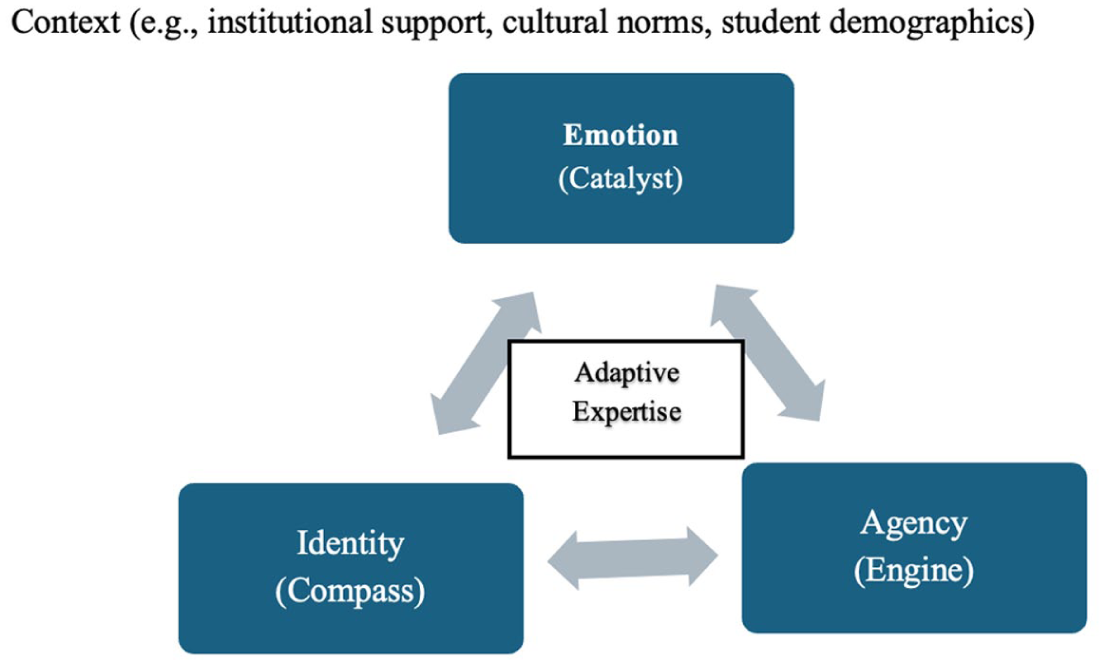
The adaptive expertise ecology.
9.2. Implications for L2 Writing Teacher Education and Professional Development
The study’s findings and the AEE model offer actionable implications for preparing and supporting L2 writing teachers, particularly those in transnational contexts. Author 2’s early career struggles highlight the need for L2 writing teacher education programs to explicitly teach emotional resilience skills. Programs can include workshops on identifying and regulating context-specific emotions. For example, role-playing exercises could help pre-service teachers practice reframing negative emotions. Programs can also incorporate reflective journaling to help teachers track emotional evolution and its impact on practice. Further, L2 writing teacher professional development programs can offer identity workshops where teachers explore how their self-perceptions shape their practice. For transnational teachers, this could include discussions on navigating conflicting cultural identities. Professional development programs can also emphasize agentic problem-solving by providing opportunities to tackle real-world challenges. Additionally, Author 2’s later career stage back in China underscores transnational L2 writing teachers face unique challenges that require specialized support. Programs can provide cultural transition training to help teachers navigate shifts between contexts and foster transnational professional communities where teachers share strategies for managing contextual tensions.
9.3. Limitations and Future Research Directions
This study’s focus on a single transnational teacher limits generalizability, though its rich methodological design offers depth into the constructs’ interplay. Future research can recruit more L2 writing teachers to validate the model, explore how the AEE model applies to non-transnational teachers, or investigate how institutional policies shape the AEE’s components. Further, research can examine the role of technology (e.g., artificial intelligence [AI], digital feedback tools) in mediating identity, agency, and emotions as these tools are increasingly shaping L2 writing instruction.
Footnotes

Funding
The authors received no financial support for the research, authorship, and/or publication of this article.
Declaration of Conflicting Interests
The authors declared no potential conflicts of interest with respect to the research, authorship, and/or publication of this article.