






Abstract
Many learners of English as a foreign language struggle to develop second language speaking fluency because of limited opportunities for authentic communication with linguistically diverse English users in English as a multilingua franca context. This study aims to address this problem by investigating the effects of communication strategy instruction, an approach believed to facilitate communication in English as a multilingua franca contexts. This study compared two approaches of communication strategy instruction, explicit and implicit, combined with low-immersion virtual reality. Over 11 weeks, 159 Vietnamese undergraduates were randomly assigned to one of three instructional conditions: Explicit + virtual reality, Explicit + non-virtual reality, and virtual reality Implicit. Data sources were video recordings of pre-, post-, and delayed speaking tests, as well as learners’ reflections. The data were analyzed using the ELSA Speech Analyzer to measure second language speaking fluency and qualitative content analysis to explore learners’ perceived affordances and challenges of virtual reality implementation. Results showed that the Explicit + virtual reality group achieved the greatest gains in second language speaking fluency, whereas both virtual reality groups (explicit and implicit) outperformed the non-virtual reality group in confidence, perceived language skills, and transcultural competence. On the delayed test, although no significant difference was found between the two virtual reality groups, all three groups showed improved second language speaking fluency, with both virtual reality groups still outperforming the non-virtual reality group. The study introduces Emergent-Dialogue Virtual Exchange, a new pedagogical model grounded in unscripted, spontaneous communication via virtual reality. Emergent-Dialogue Virtual Exchange positions low-immersion virtual reality as a scalable, contextually responsive space for English as a multilingua franca communication. These findings underscore the pedagogical potential of combining communication strategy instruction with virtual reality to support fluency, adaptability, and intercultural competence in the English as a multilingua franca context, bridging the gap between the classroom and the complex realities of global English use.
Keywords
1. Introduction
Many teachers of English as a foreign language (EFL) find it challenging to provide spontaneous, meaningful instruction for learners to use English with linguistically diverse English users. This difficulty often stems from limited access to real-life English users, exam-focused curricula, and scripted textbook dialogues. In this respect, virtual reality (VR) has emerged as a promising approach for simulating low-stakes intercultural encounters and bridging the gap between classroom instruction and the challenges posed by real-world communication demands (Hoang et al., 2023; Hu-Au & Lee, 2018). In particular, low-immersion VR (LiVR) is relatively affordable and scalable in resource-constrained EFL contexts, but it remains underexplored both empirically and theoretically in EFL education.
The need to prepare EFL learners to use English in real life is driven by the sociolinguistic reality of English use and users (Prabjandee, 2025). Nowadays, English functions as a multilingua franca (EMF), primarily used by multilingual speakers across diverse linguistic and cultural contexts (Jenkins & Panero, 2025), so most interactions occur between non-native rather than native English speakers (Marlina, 2018). Consequently, it is more relevant to prepare EFL learners for intelligible, flexible, and fluent EMF communication than to target native-like proficiency (Rose et al., 2021).
In EMF contexts, second language (L2) speaking fluency, the ability to communicate meaning effectively and spontaneously, should be prioritized. Alongside accuracy and complexity (Skehan, 2009), fluency is crucial because it reflects automatic language processing, enabling learners to interpret meaning and respond in real time (Segalowitz, 2010). In EMF settings, communication success often outweighs formal correctness (Jenkins, 2015), and interlocutors frequently tolerate linguistic errors when the speaker’s intent is clear (Cogo & Dewey, 2012). Pedagogically, a focus on fluency through repeated speaking tasks, real-time interaction, and practice of communication strategies can help teachers address learners’ difficulties with automaticity and support more spontaneous communication.
Recent Global Englishes initiatives have sought to increase learners’ exposure to meaningful global communication—for example, by curricula that highlight diverse Englishes, engage critically with standard language ideology, and employ various forms of telecollaboration and communicative exchange (Prabjandee, 2025; Rose et al., 2021). However, their wider uptake is often constrained by the need for stable institutional partnerships, time-zone coordination, and substantial resources. Consequently, many classrooms still rely on scripted dialogue and have few opportunities for spontaneous interaction (Baker, 2015; Cogo & Dewey, 2012). Classroom talk, therefore, often lacks the unpredictability and negotiation of meaning that characterize authentic EMF communication.
VR offers a means of approximating such conditions by connecting learners with diverse interlocutors in dynamic, low-stakes environments. Yet most studies treat VR as a stand-alone tool rather than embedding it in pedagogically grounded frameworks that explicitly address the communicative demands of EMF interaction. To address this gap, the present study introduces the Emergent-Dialogue Virtual Exchange (EDVE) model, which extends Helm’s (2024) typology of virtual exchanges and uses VR to support spontaneous, strategy-driven, transcultural communication that reflects the unpredictable, co-constructed nature of EMF interactions (see Section 2.6).
Within the EDVE model, and using Fondi, a LiVR platform, this study compares three instructional conditions: Explicit + VR, Explicit + non-VR, and VR Implicit to examine how different communication strategies instruction and VR-mediated interaction shape L2 speaking fluency development. Learners’ reflections further illuminate the affordances and challenges of VR for EMF communication. The findings provide empirical support for EDVE as a pedagogical model that responds to calls for a shift away from traditional, monolingual-norm English language teaching (ELT) towards more strategic, fluid, and transcultural approaches aligned with the complex realities of global English use, helping to bridge the gap between classroom English and real-world EMF communication (Rose et al., 2021). The study is guided by the following research questions (RQs):
2. Literature Review
2.1. Positioning LiVR in language education
VR has attracted growing attention in language education, with LiVR using desktop or mobile screens and high-immersion VR (HiVR) employing head-mounted displays to create 3D environments (Kaplan-Rakowski et al., 2021). Although HiVR can boost motivation, engagement, and contextual vocabulary learning (e.g., Makransky et al., 2019; Zhao et al., 2024), LiVR is a more realistic option for many EFL classrooms: it runs on existing devices, is affordable, and can still provide key affordances such as a sense of presence, contextualized interaction, sometimes with lower cognitive load (Kaplan-Rakowski et al., 2021), and enhance foreign language enjoyment (Barcomb & Iwashita, 2024). Reviews also indicate that both HiVR and LiVR can enhance communicative competence (Parmaxi, 2020). From an EMF perspective, LiVR environments connects geographically dispersed learners with emergent EMF contexts (Rose et al., 2021). However, most VR-based language studies have been conducted in well-resourced HiVR settings, so much less is known about implementing LiVR in resource-constrained EFL contexts where low-immersion solutions are more realistic and scalable.
2.2. Conceptualizing L2 Speaking Fluency and the VR Role
L2 speaking fluency refers to the smooth, efficient, and minimally disrupted production of speech, particularly in L2 contexts. P. Tavakoli and Skehan (2005) conceptualize fluency as utterance fluency, comprising speed (speech rate), breakdowns (pauses), and repairs (reformulations), thereby offering a framework for performance analysis. Segalowitz (2010) extends this view by incorporating cognitive fluency (processing efficiency) and perceived fluency (listeners’ impressions based on rhythm and flow). Although differing in terminology, both models address core aspects of utterance fluency, such as pausing, speech rate, and disfluencies, and together provide a comprehensive lens on fluency.
In L2 research, fluency is often assessed across these three dimensions (Segalowitz, 2010). Utterance fluency is typically measured using temporal metrics such as articulation rate, pause length, and self-repair frequency (Bui & Huang, 2018; P. Tavakoli & Skehan, 2005), with tools such as PRAAT facilitating acoustic analysis (Boersma & Weenink, 2023). More recently, Automatic Speech Evaluation (ASE) technologies—for example, ELSA Speech Analyzer (ELSA, 2023), ETS SpeechRater® (Educational Testing Service, 2010), EAP Talk (Zou et al., 2024), and Google Speech-to-Text API (Google Cloud, 2023), have enabled real-time tracking of speed, pausing, and disfluencies (Handley & Wang, 2024).
According to P. Tavakoli (2023), one reason fluency has not been successfully integrated into classroom practice is that teachers typically have limited access to research-informed, conceptually clear definitions of fluency. She illustrates how adopting a narrow perspective on fluency can help teachers examine its elements more systematically and achieve a more reliable understanding. In other words, Borg (2009) states that understanding the fundamentals of pedagogical concepts is essential for informed teaching practice. Building on this argument, our study takes a narrow view of L2 speaking fluency as a distinct and measurable aspect of L2 speaking performance.
From an EMF perspective, fluency is not only a matter of speed but is closely tied to interactional effectiveness. Successful EMF communication depends on interlocutors’ ability to sustain the interaction through the negotiation of meaning, accommodation, and the flexible use of communication strategy, even when accuracy is compromised (Cogo & Dewey, 2012). Fluency is thus co-constructed as speakers jointly manage turn-taking, repair, and topic development to sustain mutual intelligibility. The present study, therefore, approaches fluency as an interactional resource that enables learners to participate in EMF exchanges, rather than as a purely native-speaker-like temporal ideal (Brown et al., 2023; Chang & Windeatt, 2024; Williams, 2024).
Growing research on LiVR suggests that such environments can foster both utterance and perceived fluency by providing low-pressure, contextually relevant speaking opportunities that reduce anxiety and support real-time language processing (Yudintseva, 2023). LiVR also enables rehearsal of interactional strategies (e.g., clarification requests, discourse management) with lower cognitive demands than HiVR (Kaplan-Rakowski et al., 2021). However, most work to date has relied on learners’ self-reported gains, with limited integration of objective fluency indices (e.g., speech rate, pausing, repair) or ASE tools to track development. This highlights the need for research that combines pedagogical innovation, robust analytic measures, and learners’ subjective experiences, an approach adopted in the present study, which triangulates objective fluency measures with self-reported data.
2.3. Affordances and Challenges of Implementing VR in Language Education
VR offers immersive environments that simulate authentic communication and support experiential language learning, while boosting motivation and confidence by providing psychologically safe, avatar-mediated spaces to rehearse communication strategy and reduce speaking anxiety (Jiang & Fryer, 2023; Makransky et al., 2019; Sun Joo & Lee Jin, 2024; Taguchi, 2022; Zheng et al., 2022). Both HiVR and LiVR can enhance verbal and nonverbal communication, pragmatic awareness, and self-efficacy, with HiVR additionally supporting transfer to real-world tasks through embodied experience (Huang, 2024; Taguchi, 2022).
Despite these affordances, VR integration in language teaching is often constrained by high equipment costs, limited access to reliable devices, less realistic avatars, complex interfaces, and the lack of clear pedagogical frameworks and teacher training or support, particularly in low-resource settings (Kaplan-Rakowski et al., 2021; O’Dowd et al., 2020; Zheng et al., 2022). Evidence on long-term L2 outcomes also remains limited, as many studies rely on learners’ self-reports rather than objective performance data (Huang, 2024).
2.4. English as a (Multi)Lingua Franca
Building on Jenkins’s (2015) three-phase model, this study views English as a lingua franca (ELF) as an evolving construct: from describing global patterns of English use (ELF1), to emphasizing negotiation, accommodation, and co-construction of meaning in interaction (ELF2), and more recently to recognizing the multilingual, translanguaging nature of contemporary lingua franca communication (ELF3). In this third phase, English is regarded as one resource within speakers’ wider plurilingual repertoires, consistent with plurilingual perspectives that treat linguistic resources as fluid and interrelated (Antonello, 2023). Following recent EMF-oriented work, we treat EMF as points on a continuum foregrounding intelligibility, mutual accommodation, and multilingual resource use in global communication (Jenkins, 2015). Drawing on an EMF perspective and on Global Englishes Language Teaching (GELT), which seeks to raise awareness of English diversity and prepare learners for multilingual communication (Rose et al., 2021), the present study adopts EMF as a context to examine how learners mobilize strategic competence and L2 speaking fluency when interacting with unpredictable, linguistically diverse interlocutors in the Fondi VR environment.
2.5. Communication Strategy Instruction in the EMF Context
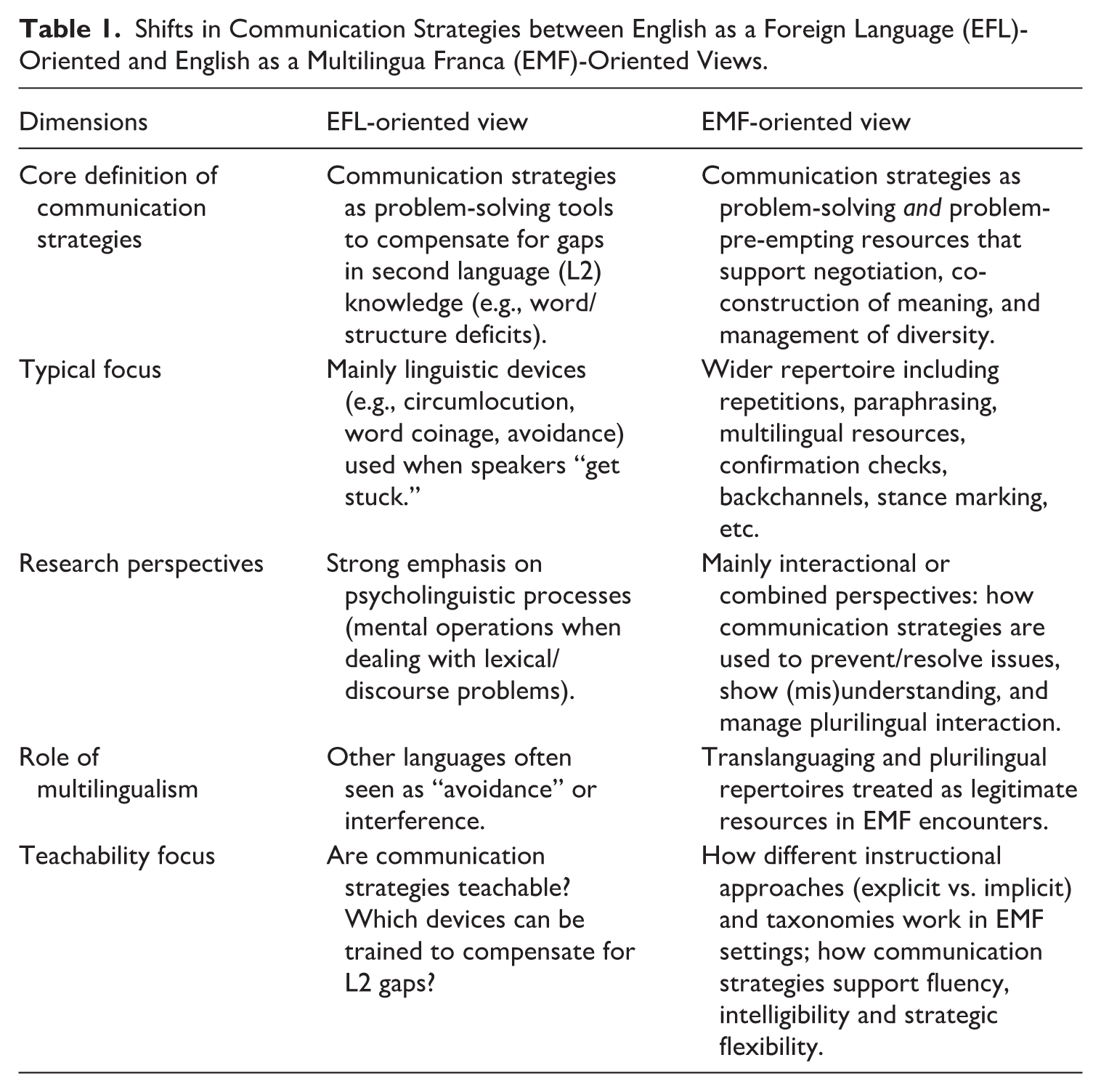
Communication strategies have traditionally been described as devices to compensate for L2 gaps, but in EMF work they are conceptualized more broadly as resources that pre-empt and solve problems, sustain negotiation and co-construction of meaning, and draw on multilingual and multimodal repertoires (Antonello, 2023; Nguyen, 2022). In this study, we adopt Antonello’s (2023) inclusive view of communication strategies as practices such as repetition, paraphrasing, lexical correction, and suggestion, as well as multilingual resources, confirmation checks, and backchannels.
This reflects a shift from compensating for L2 gaps to managing diversity, plurilingual repertoires, and emergent interactions in EMF settings, with key contrasts summarized in Table 1. Although evidence supports the teachability of communication strategies (Dörnyei, 1995; Thu & Thu, 2016), their effects on L2 speaking fluency, especially for explicit versus implicit instruction in EMF contexts, remain inconclusive (Nguyen, 2022; M. Tavakoli et al., 2011). Addressing this gap, the present study draws on a subset of communication strategies from Antonello’s (2023) taxonomy and compares explicit and implicit instruction across Explicit + VR, Explicit + non-VR, and VR Implicit conditions in a low-immersion virtual exchange EMF context.
Shifts in Communication Strategies between English as a Foreign Language (EFL)-Oriented and English as a Multilingua Franca (EMF)-Oriented Views.
2.6. Conceptual Framework: EDVE
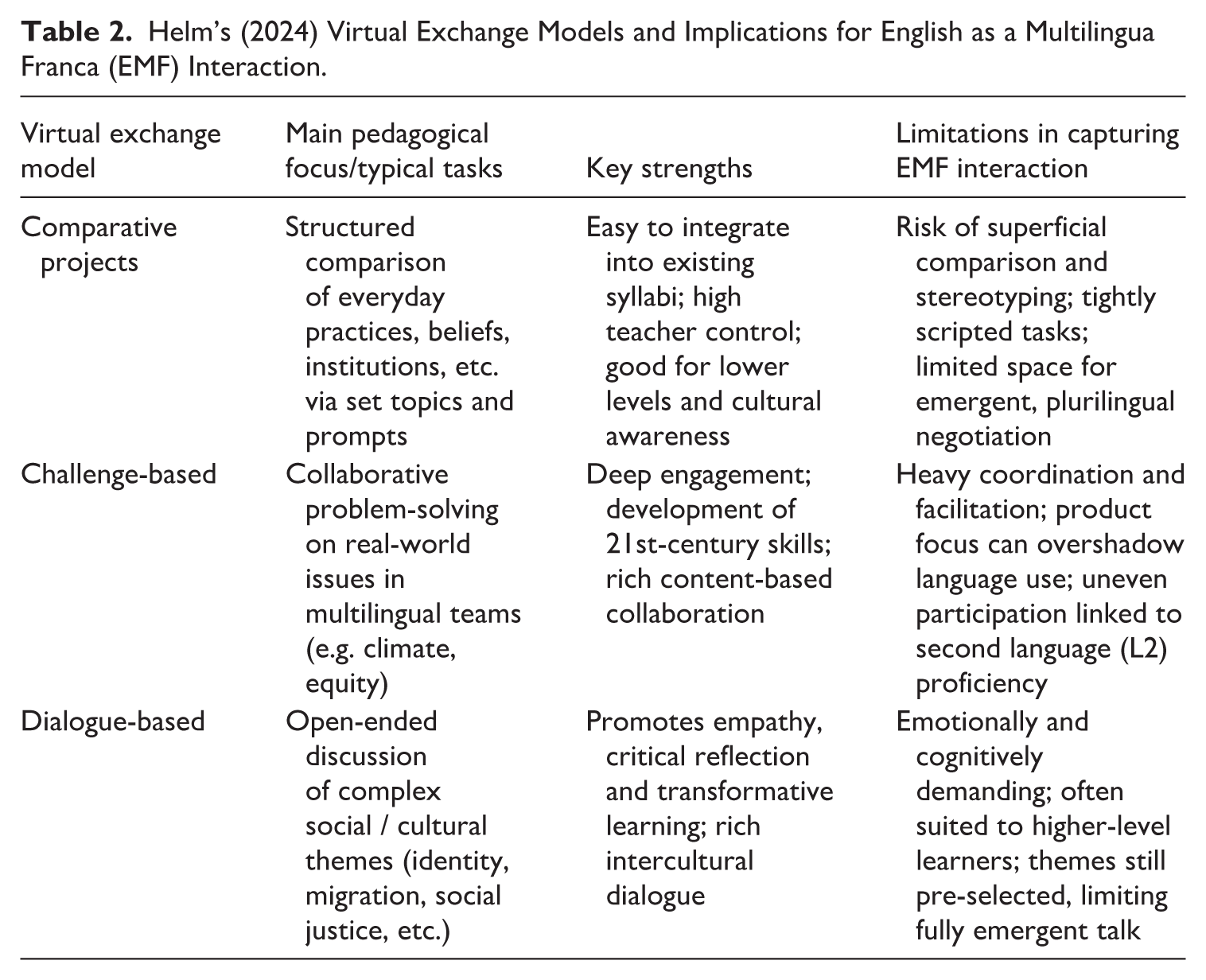
Virtual exchange has emerged as a key approach to supporting intercultural learning through online, technology-mediated communication, building on earlier work in telecollaboration, Collaborative Online International Learning (COIL), and e-tandem (O’Dowd et al., 2020; Helm, 2024) Helm’s (2024) typology distinguishes three main virtual exchange models: comparative projects, challenge-based exchanges, and dialogue-based exchanges, which differ in pedagogical focus, interactional structure, and intercultural affordances (Table 2). From an EMF perspective, however, these models remain strongly shaped by fixed partnerships, pre-defined tasks, and relatively scripted interaction, which underrepresent the fluid, unpredictable, and plurilingual nature of EMF communication.
Helm’s (2024) Virtual Exchange Models and Implications for English as a Multilingua Franca (EMF) Interaction.
Building on this typology, the present study proposes EDVE as a fourth model that uses LiVR to foster more spontaneous, learner-led interaction in EMF settings. EDVE is characterized by unscripted interaction in VR environments, where learners engage in real-time communication with diverse, unpredictable interlocutors. Unlike traditional virtual exchange, EDVE does not rely on rigid task structures or fixed pairings. Instead, it fosters emergent dialogue shaped by learners’ immediate communicative needs through real-time negotiation, co-construction of meaning, and strategic language use.
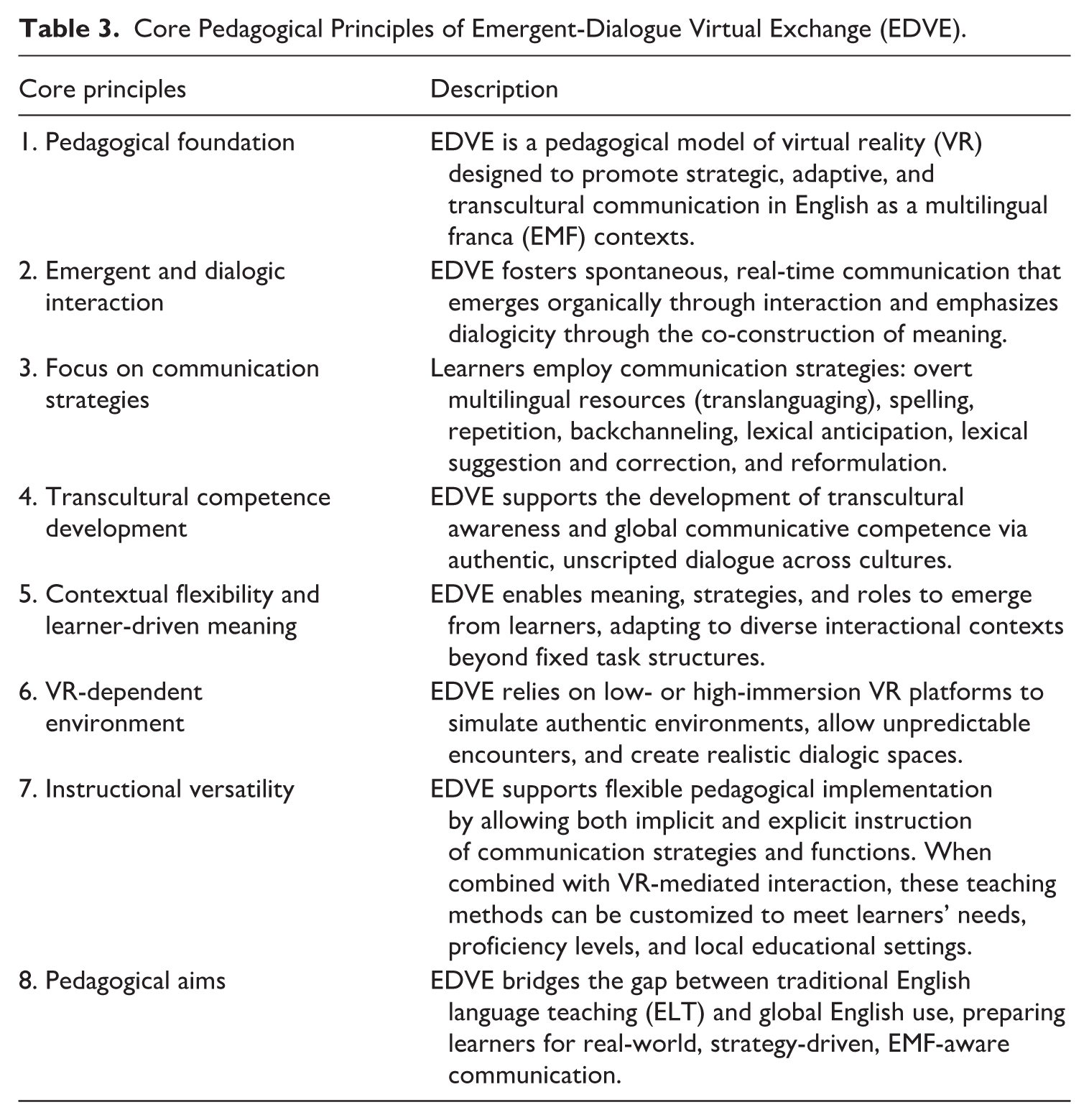
The model draws on several theoretical foundations. First, it is informed by GELT, which integrates insights from EMF and Global Englishes research into classroom practice by raising learners’ awareness of English diversity and preparing them for multilingual, intercultural communication (Rose et al., 2021). Second, complexity theory views language learning as dynamic and adaptive, thriving in non-linear, unpredictable environments (Larsen-Freeman, 2015). Third, intercultural communicative competence emphasizes the importance of authentic intercultural encounters (Barrett, 2018). Fourth, emergent interaction theory underscores the pedagogical value of unscripted, co-constructed dialogue, precisely the type of interaction that EDVE enables (Thorne, 2003). Although EDVE departs from extant virtual exchange structures, it aligns with core virtual exchange criteria (Helm, 2024; O’Dowd, 2021): technology-mediated, goal-oriented, intercultural communication. Its novelty lies in allowing interactional dynamics to emerge organically, treating unpredictability not as a challenge but as a pedagogical affordance. Crucially, EDVE is VR-dependent. LiVR or HiVR platforms simulate dynamic communicative environments that support spontaneous EMF interactions. EDVE enables instructional flexibility by implementing explicit or implicit instruction of communication strategies and communicative functions, embedded in VR practice. Table 3 presents the core principles and main characteristics of the EDVE model.
Core Pedagogical Principles of Emergent-Dialogue Virtual Exchange (EDVE).
Previous studies have demonstrated the impact of virtual exchange on learners’ motivation and willingness to communicate by offering meaningful, authentic online interaction opportunities (Freiermuth & Huang, 2012; J. S. Lee & Lee, 2020). It has also been discovered to aid with general intercultural and global citizenship development in contexts of lingua franca communication (Lenkaitis & Loranc, 2021). O’Dowd et al. (2020) showed that virtual exchange does not automatically lead to meaningful intercultural learning but requires active pedagogical mentoring to help students engage more deeply with linguistic, intercultural, and digital dimensions of online interaction.
In this study, EDVE is implemented through three instructional conditions: (a) Explicit + VR; (b) Explicit + non-VR; and (c) VR Implicit. These conditions differ in how communication strategies and communicative functions are introduced and practiced, allowing a comparison of their effects on learners’ L2 speaking fluency, transcultural competence, and strategic behavior. Learners’ qualitative self-reflections further illuminate their perceptions of EDVE’s affordances and challenges in VR-mediated EMF communication.
According to Ellis (2009), language instruction can be classified as direct or indirect intervention, depending on the level of instructional intent. Direct intervention includes both explicit instruction (e.g., overt strategy training using metalinguistic explanations) and implicit instruction (e.g., recasts or input enhancement delivered without metalinguistic terminology), all designed to shape learning outcomes. In contrast, indirect intervention involves no focus on language forms, allowing learning to occur incidentally through authentic interaction. In this study, the instructional design aligns with Ellis’s (2009) framework: the explicit and implicit teaching of communication strategies constitutes direct intervention, whereas the VR-based practice in Fondi constitutes indirect intervention, in which language development occurs incidentally through authentic, spontaneous interaction.
2.7. Research Gaps
As discussed in Sections 2.1–2.6, previous studies have documented the affordances of VR and virtual exchange for language learning, but most have conceptualized VR primarily as a medium for interaction and engagement rather than as a pedagogical space for systematically designed instruction. In particular, very few studies have examined how VR can be integrated with explicit or implicit communication strategy instruction, even though communication strategies are crucial for sustaining interactional fluency and mutual intelligibility in EMF communication. In addition, limited research has examined how VR can support the development and practice of communication strategies to enhance L2 speaking fluency. Existing VR-based studies also tend to rely on learners’ self-reported perceptions of fluency, with relatively little use of objective temporal measures such as speech rate, pause phenomena, or self-repairs. Finally, most VR research has been conducted in well-resourced educational contexts, with little attention to resource-constrained settings such as Vietnamese universities. To address these gaps, the present study, situated within the EDVE model, examines how VR, combined with different instructional approaches to communication strategies, can foster objectively measured L2 speaking fluency in EMF communication.
3. Research Methodology
3.1. Research Approach
To address the RQs, we used an embedded mixed-methods design (Creswell & Plano Clark, 2023), in which a primarily quantitative strand was complemented by qualitative data. The quantitative component examined the effects of communication strategy instructions (explicit vs. implicit) on L2 speaking fluency in an EMF setting, whereas the qualitative component explored learners’ emotional, cognitive, and strategic responses to VR-mediated interaction.
Quantitative measures tracked changes in fluency indices over time, and qualitative data consisted of classroom video recordings and post-intervention written self-reflections. Video data served dual purposes: they provided qualitative insights into learners’ strategic behavior and served as the basis for quantitative fluency scoring. Self-reflections were analyzed using qualitative content analysis (Selvi, 2020), combining thematic coding with simple frequency counts to indicate the salience of recurring themes rather than for inferential statistics.
The design comprised two strands: (a) experimental research comparing VR and non-VR communication strategy instructional conditions on L2 speaking fluency, with embedded video recordings; and (b) post-intervention self-reflections to interpret the experimental results. This combination provided insight into how learners engaged with explicit and implicit communication strategy instruction in digitally mediated, intercultural environments.
Following Creswell and Plano Clark’s (2023) guidance on integration, qualitative and quantitative data were combined at the design, data collection, analysis, and interpretation stages. Video recordings were embedded in the intervention and collected alongside pre-, post-, and delayed fluency tests, serving as both qualitative evidence and the basis for quantitative fluency scoring. Sequential self-reflections further explored learners’ perceptions of the affordances and challenges of LiVR in EMF contexts. During analysis and interpretation, video and reflection data were combined with fluency measures to provide a holistic picture of how learners applied communication strategy and developed L2 speaking fluency.
3.2. Context of the Study
This study was conducted at a private university in Ho Chi Minh City, Vietnam (pseudonym: University A), a major urban center with frequent contact with international visitors and English users. University A enrolls a diverse student body from across Vietnam, including non-English majors at Common European Framework of Reference for Languages (CEFR) A2 level studying disciplines such as accounting, public relations, tourism, and commerce. The university promotes digital learning, and most students have personal devices, which enable participation in VR tasks. Classes of 30–35 students met for English communication 3 hours per week over 12 weeks. Although VR had not previously been used in English courses, the institution’s focus on practical communication for multilingual workplaces made the intervention timely and relevant.
3.3. Sampling and Participants
The target population of this study was non-English-major undergraduates (aged 18–22, approximate A2 level) enrolled in credit-based programs at private universities in urban Vietnam, who typically study English in mixed-major classes (e.g., accounting, public relations, engineering) and have limited exposure to authentic English communication outside the classroom.
At the outset, 200 first-year students from 6 English for communication classes were recruited. The required sample size was estimated with G*Power 3.1 for a three-group F-test (α = .05, power = .80, effect size f = .25), indicating a minimum of 159 participants (Faul et al., 2007). Participants were selected and assigned via a three-stage procedure (Figure 1). First, six intact first-year classes with comparable A2 placement scores were selected via cluster random sampling. Second, all students completed a pre-test of L2 speaking; fluency scores were used to stratify learners into high-, medium-, and low-fluency bands, with extreme outliers removed. Third, students within each band were randomly allocated to one of three instructional groups (Explicit + VR, Explicit + non-VR, and VR Implicit), ensuring balanced fluency levels across conditions. Of the 200 volunteers, 180 completed the pre-test and intervention, and, after excluding cases with missing data, a final sample of 159 participants was retained for analysis.
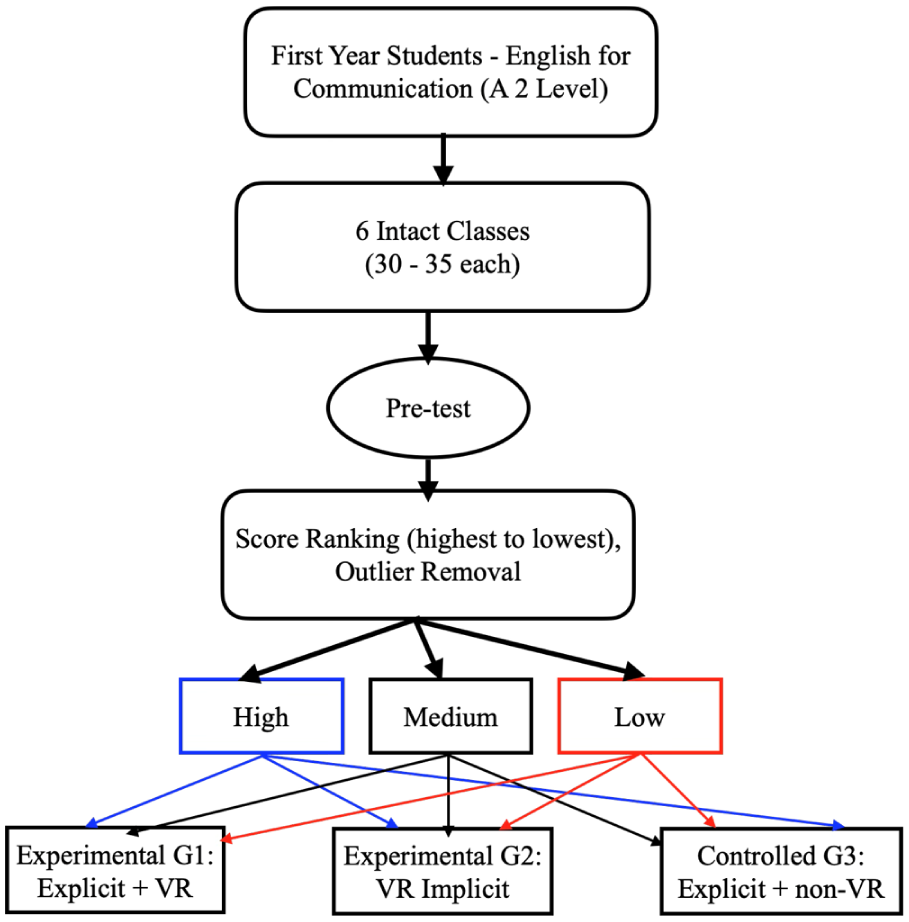
The diagram of the sampling process.
3.4. Intervention
Participants were divided into three groups: two experimental (Explicit + VR, VR Implicit) and one control (Explicit + non-VR). The study spanned 11 weeks: Week 1 (pre-test), Week 2 (random assignment), Weeks 3–8 (intervention), Week 9 (post-test), and Week 11 (delayed test) (Figure 2).
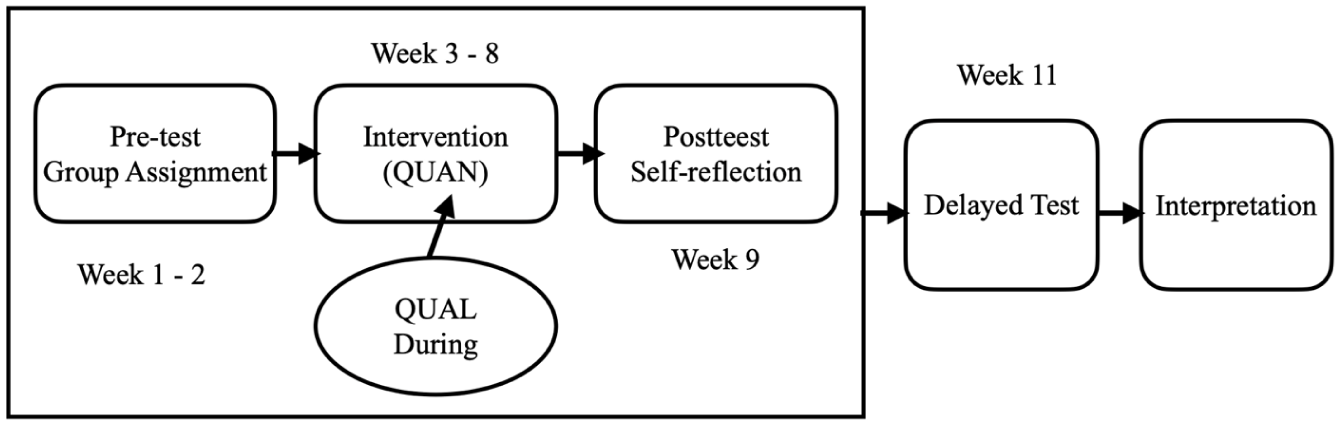
Research procedure.
The key difference among the three groups lay in how communication strategies were presented and practiced. In the two Explicit groups (with and without VR), communication strategies were taught through metalinguistic explanation of terms, forms, and functions, followed by controlled practice activities. In the Explicit + VR group, this classroom-based work was followed by free practice on the Fondi platform, which emphasizes spontaneous, real-time communication and does not focus on specific communication strategy forms or pre-scripted outcomes. In contrast, the VR Implicit group received no explicit communication strategy instruction or controlled practice; learners were immersed directly in communicative tasks with diverse interlocutors via Fondi (Figure 3).
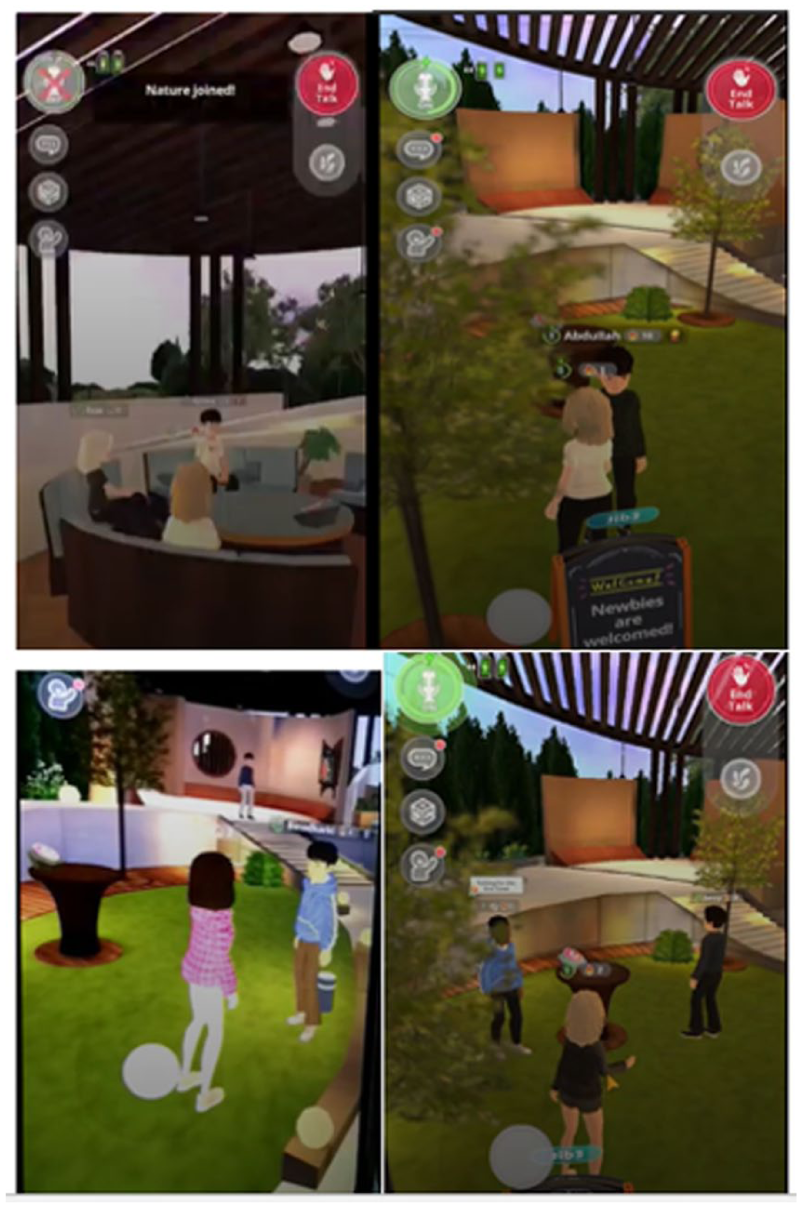
Fondi environments (extracted from participants’ video recordings).
The Fondi platform served as the primary LiVR tool. It provides a two-dimensional (2D), screen-based virtual environment in which users interact through avatars in themed spaces (e.g., a park, a bar counter, a round table) using built-in voice chat. In this way, Fondi affords avatar-mediated, synchronous communication with interlocutors from diverse linguistic and cultural backgrounds while remaining a desktop-based, accessible solution suitable for resource-constrained contexts such as Vietnamese universities. The VR conditions were thus conceived as ecologically valid EMF environments that combine LiVR with interaction with real international partners, rather than as purely technology-focused interventions.
From Weeks 3 to 8, students in the experimental groups completed weekly communication tasks to practice real-time use of communication strategies. To elaborate, they were instructed to discuss with the interlocutors they met on the Fondi platform the course content for each week (e.g., expressing food preferences, sharing what makes them happy, and discussing the pros and cons of advertisement). All sessions were recorded for subsequent fluency analysis in EMF settings. A detailed overview of the procedures for all three groups is presented in Table 4.
Procedures of the Implementation: Explicit + Virtual Reality (VR), VR Implicit, and Explicit + Non-VR.
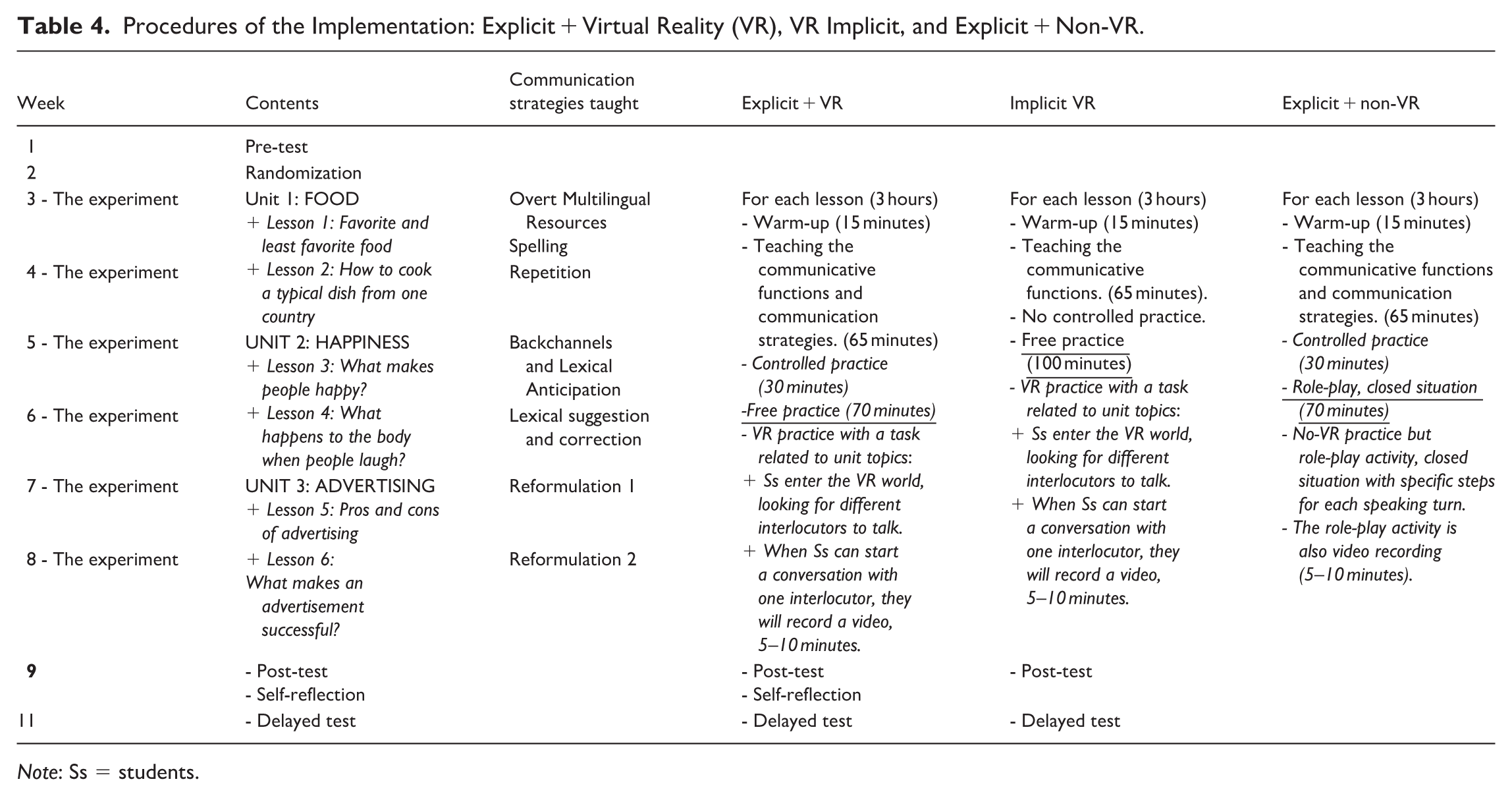
Note: Ss = students.
Across all three instructional conditions, the target communication strategies were drawn from Antonello’s (2023) taxonomy for multilingual interaction. The strategies selected as most relevant to EMF communication were overt multilingual resources, spelling, repetition, backchannels, lexical anticipation, lexical suggestion and correction, and reformulation. In the Explicit + VR and Explicit + non-VR conditions, these strategies were explicitly named, exemplified, and practiced; in the VR Implicit condition, they were modeled through teacher input and task design but were neither labeled nor discussed metalinguistically.
Under the explicit conditions, communication strategy instruction followed a three-stage sequence: brief metalinguistic explanation and teacher modeling, controlled practice, and free communicative practice. Controlled practice involved short, form-focused activities to help learners recognize and produce the target strategies before more open interaction, such as matching utterances to strategy labels and functions, completing short dialogues with appropriate strategies, and predictable substitution drills targeting reformulation and lexical correction. Free practice focused on meaning-oriented interaction: in the Explicit + non-VR group, learners performed guided role-plays in closed-ending and step-by-step scenarios (e.g., expressing food preferences, explaining how to cook a national dish), while in the Explicit + VR group, comparable practice took place on the Fondi platform through short emergent and unpredictable conversations with international interlocutors. Throughout explicit lessons, the teacher monitored interaction, prompted strategy use, provided brief recasts during whole-class wrap-up, and invited short written reflections on students’ perceived difficulties and future communication strategy use. In contrast, the VR Implicit group completed the same Fondi tasks without prior metalinguistic explanation, controlled practice, or feedback explicitly framed in terms of communication strategies. A full sample lesson outline for Lesson 1 is provided in Appendix A and is representative of the procedures used across explicit and implicit lessons.
The study protocol was reviewed and approved by the Institutional Review Board (Ethics Committee) at the authors’ affiliated university. Written informed consent was obtained from all participants, who were informed about the study’s purpose, procedures, voluntary nature, and their right to withdraw at any time without penalty. All data were kept confidential and securely stored, with access restricted to the research team.
3.5. Research Instruments
3.5.1. Pre-, Post-, and Delayed Speaking Test
The pre-, post-, and delayed speaking tests addressed RQ1 by measuring changes in L2 speaking fluency across the three instructional conditions. Each test lasted approximately 15 minutes and consisted of three interactive tasks with a Chinese-speaking interlocutor whose first language (L1) differed from the participants’ and targeted course topics on food, happiness, and advertising, mirroring the intervention lessons. Assessing learners in real-time interaction with non-shared L1 speakers provided an EMF-oriented measure of communicative competence. To ensure content validity, the tasks were reviewed by seven Teaching English to Speakers of Other Languages (TESOL) doctoral experts using the Index of Item–Objective Congruence (IOC) and then piloted with a small group of students. Revisions focused on linguistic difficulty, clarity, and alignment with A2-level course content, and parallel difficulty was maintained across the three test versions. Construct validity was supported by focusing on utterance fluency features (e.g., speech rate, breakdowns, repairs), which were assessed using the ELSA Speech Analyzer.
3.5.2. Self-Reflections
Self-reflections were collected as unobtrusive qualitative instruments, enabling participants to express their perceptions freely and reflect on their communicative experiences. In particular, summative self-reflections of approximately 500 words were gathered in Week 9 from participants in both experimental groups (Explicit VR and VR Implicit). These reflections offer insights into learners’ perceptions of the entire instructional and communicative process via the Fondi platform. Additionally, final reflections of approximately 500 words were obtained from the non-VR group to enable cross-group comparison. Together, the reflections contribute to understanding the distinct effects of the instructional approaches and support the inductive development of emerging themes regarding the affordances and challenges of LiVR implementation.
To ensure the trustworthiness of the qualitative strand, several strategies were employed. For the video recordings, the Chinese-speaking interlocutor underwent pilot testing and received procedural training to ensure consistency during all speaking tests. Self-reflections were analyzed using Selvi’s (2020) rigorous qualitative content analysis framework. Two trained coders independently coded an initial sample of 30 self-reflections to develop and refine the codebook. After establishing agreement, they continued coding independently, and intercoder reliability was calculated using the content validity ratio (CVR) method (Lawshe, 1975). An audit trail was maintained to document coding decisions and analytical steps.
3.6. Data Analysis
3.6.1. Quantitative Data Analysis
To address RQ1 on the effects of communication strategy instruction on L2 speaking fluency, 477 video-recorded speaking tests were collected at three time points (pre-, post-, and delayed tests) from the VR Implicit (n = 58, coded IV1–IV58), Explicit + VR (n = 66, coded EV1–EV66) and Explicit + non-VR groups (n = 35, coded EN1–EN35). Each participant completed all three speaking tests.
To analyze the data, we used an ASE tool, as it is a well-established approach in large-scale standardized testing (e.g., Test of English as a Foreign Language (TOEFL)) and has yielded results similar to human-only scoring (e.g., Anguera et al., 2023; Educational Testing Service, 2024). ASE operates via speech recognition, feature extraction, and machine learning trained on human-rated samples (Chuang & Yan, 2025; Handley & Wang, 2024; Wang et al., 2018). In a study that compared ASE with human-only scoring, for example, ETS reports that TOEFL iBT Speaking uses ASE in combination with human raters, with assessment reliability reported at .76 for machine-only scoring, .75 for human-only scoring, and .83 for combined human–machine scoring (Educational Testing Service, 2024). These studies suggest that using the ASE tool is appropriate for research purposes.
Among extant ASE tools (e.g., ELSA Speech Analyzer, ETS SpeechRater®, EAP Talk, and Google Speech-to-Text API), we used the ELSA Speech Analyzer because it has been validated for use with L2 speakers in previous studies (e.g., Anguera et al., 2023; Wang et al., 2018). The ELSA Speech Analyzer’s validity is supported by a strong correlation (r = .897) with expert ratings (Anguera et al., 2023), thus making it appropriate for analysis in this study. When uploading the learners’ recorded speaking responses, the ELSA Speech Analyzer assessed L2 speaking fluency in terms of speech rate, pause duration, and hesitation patterns, providing a 0–100 fluency score and emphasizing intelligibility over native-like pronunciation.
The quantitative data analysis involved the following steps. First, we used the CapCut software to isolate learner speech segments. Second, we used the ELSA Speech Analyzer to score L2 speaking fluency. Third, we compared group performance using one-way independent analyses of variance (ANOVAs) for each test phase (pre-, post-, and delayed) using JASP (version 0.19.3.0). The dependent variable was the L2 speaking fluency score, and the independent variable was the instructional condition. Despite using a true randomization design based on their pre-test L2 speaking fluency scores, a pre-test comparison was conducted between the experimental groups (Explicit + VR and VR Implicit) and the control group (Explicit + non-VR) to ensure group equivalence. After that, the post-test and the delayed test were compared between the experimental and control groups. It should be noted that before performing an inferential statistic, the assumptions of normality, homogeneity of variances, and independence of observations were thoroughly checked. When statistically significant differences were observed, the post hoc Tukey test was used to determine group differences. Effect sizes were finally calculated using both omega squared (ω²) and eta squared (η²) to determine the magnitude of differences.
3.6.2. Qualitative Data Analysis
To address RQ2 and triangulate findings from RQ1, 159 summative self-reflections from all groups were analyzed using qualitative content analysis following Selvi’s (2020) three-phase framework (preparation, organization, reporting). Sentences or meaningful ideas served as units of analysis, yielding 501 coded units for the Explicit + non-VR group, 881 for the Explicit + VR group, and 1,014 for the VR Implicit group. Two trained coders first inductively analyzed 30 reflections to develop a codebook. The remaining data were then coded mainly deductively using this codebook, with room to incorporate new themes through coder discussion. Coding was done manually in Excel with clear segmentation of units of meaning. The findings are presented as themes (Appendix B).
4. Results
4.1. Comparisons of L2 Speaking Fluency across Three Groups
4.1.1. Pre-Test ANOVA
A one-way ANOVA by JASP 0.19.3.0 was conducted to compare pre-test L2 speaking fluency scores across the three instructional groups: Explicit + VR, VR Implicit, and Explicit + non-VR. Before performing the ANOVA analysis, assumptions of normality and homogeneity of variances were met. Skewness and kurtosis values for all groups fell within commonly used cutoffs for acceptable univariate normality (|skewness| < 2; |kurtosis| < 7), as recommended in simulation studies of normal-theory test statistics (Ryu, 2011). Levene’s test confirmed equal variances, F(2, 156) = 1.31, p = .272. The ANOVA revealed no statistically significant difference in pre-test L2 speaking fluency scores among the groups, F(2, 156) = 0.99, p = .373, with a negligible effect size (η² = .013; ω² = .000). This suggests that the groups were statistically equivalent in L2 speaking fluency prior to the intervention, supporting the internal validity of subsequent comparisons (see Table 5).
Comparisons for Second Language (L2) Speaking Fluency Scores.
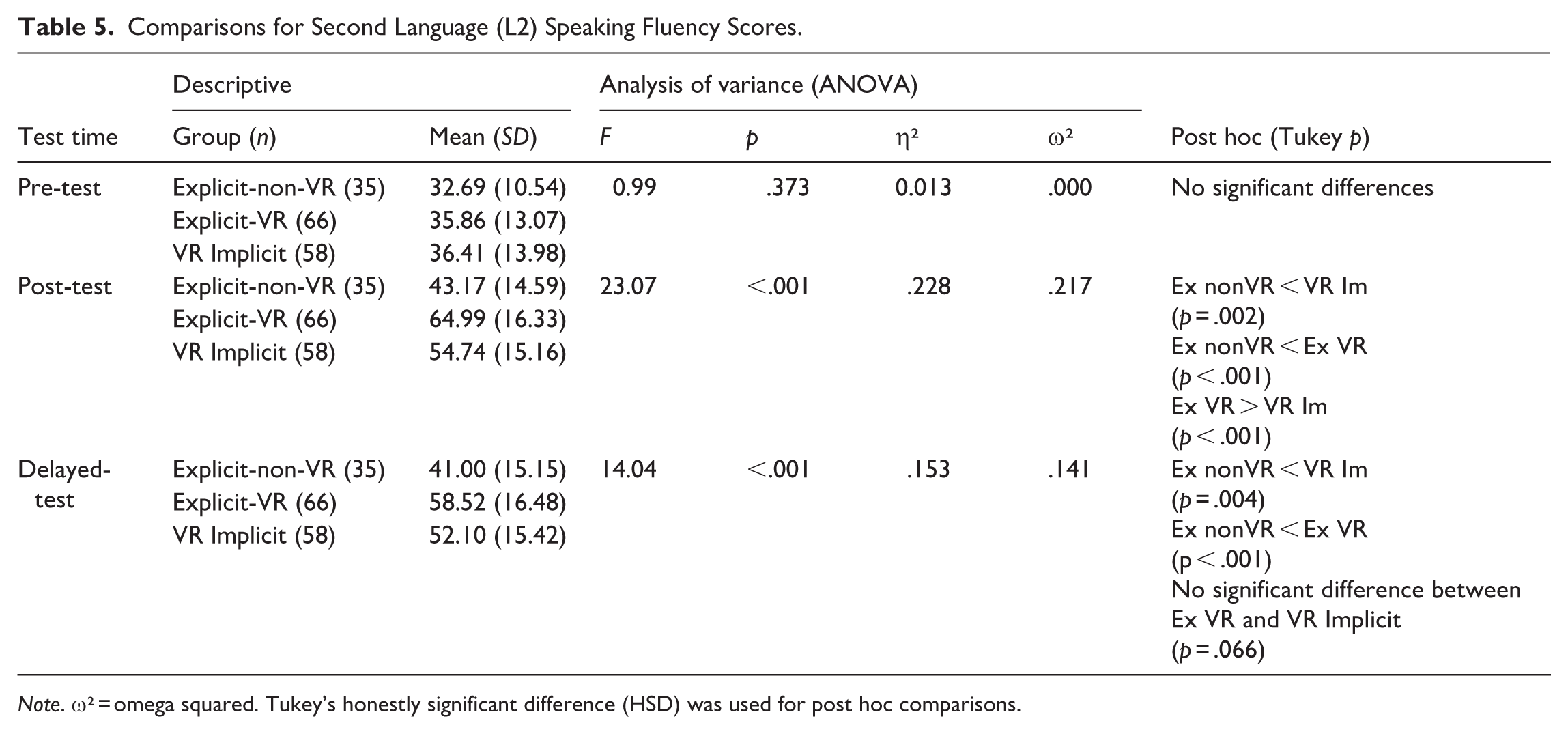
Note. ω² = omega squared. Tukey’s honestly significant difference (HSD) was used for post hoc comparisons.
4.1.2. Post-Test ANOVA
A one-way ANOVA was conducted to compare post-test L2 speaking fluency scores among three groups: Explicit + VR, VR Implicit, and Explicit + non-VR. Assumptions of normality and homogeneity of variance were met (Levene’s test: F(2, 156) = 0.44, p = .644). The analysis revealed a significant difference across groups, F(2, 156) = 23.07, p < .001, with a large effect size (η² = .228; ω² = .217), indicating that about 23% of the variance in fluency scores was attributable to instructional condition. According to Cohen (2013), eta squared (η²) values of 0.0099, 0.0588, and 0.1379 are interpreted as small, medium, and large effects, respectively; therefore, the η² value of 0.228 in this study indicates a large effect size.
Descriptive statistics showed that the Explicit + VR group (M = 64.99, SD = 16.33) outperformed both the VR Implicit group (M = 54.74, SD = 15.16) and the Explicit + non-VR group (M = 43.17, SD = 14.59). Tukey’s honestly significant difference (HSD) post hoc tests indicated that the Explicit + VR group significantly outperformed both the VR Implicit (p < .001) and non-VR groups (p < .001), and the VR Implicit group also significantly outperformed the non-VR group (p = .002). These findings underscore the effectiveness of combining explicit instruction with VR in enhancing L2 speaking fluency (see Table 5).
4.1.3. Delayed Test ANOVA
A one-way ANOVA was conducted to compare delayed post-test L2 speaking fluency scores among the three instructional groups: Explicit + VR, VR Implicit, and Explicit + non-VR. Assumptions of normality and homogeneity of variance were met (|skew| < 2; |kurtosis| < 7; Levene’s test: F(2, 156) = 0.11, p = .894). The analysis yielded a statistically significant group effect, F(2, 156) = 14.04, p < .001, with a large effect size (η² = .153; ω² = .141), indicating that approximately 15% of the variance in delayed fluency scores was attributable to instructional condition. Descriptive statistics showed that the Explicit + VR group (M = 58.52, SD = 16.48) retained the highest L2 speaking fluency levels, followed by the VR Implicit group (M = 52.10, SD = 15.42) and the Explicit + non-VR group (M = 41.00, SD = 15.15).
Post hoc Tukey HSD tests indicated that both VR groups significantly outperformed the non-VR group (p < .001 and p = .004, respectively). The difference between Explicit + VR and VR Implicit was not statistically significant (p = .066), suggesting comparable long-term retention of L2 speaking fluency across immersive conditions (Table 5).
4.2. Affordances in Low-Immersive EMF Contexts
For each instructional group, the number of participants endorsing each sub-theme was counted and converted to percentages to allow comparison across unequal group sizes. For broader categories comprising several sub-themes, we calculated and reported the average of the corresponding sub-theme percentages to provide a concise overview of their overall importance.
4.2.1. Learning Environment and Accessibility (55%)
The Fondi platform received praise from participants thanks to its user-friendly design and accessible features, which made it valuable for EMF communication. The majority of participants (77%) praised the platform’s supportive features, which enabled them to interact with speakers of different English levels (29%) and build authentic relationships (58.1%). The learners appreciated the platform’s structured design, which helped them establish connections that maintained their interest: “Its structured format made it easy to connect with diverse individuals” (IV10). The platform exceeded basic language-exchange capabilities, according to many users who valued the meaningful relationships they formed (IV19). The general positive sentiment persisted despite minor technical problems. This demonstrated how intuitive digital tools facilitate intercultural communication and learner motivation.
4.2.2. Language Skill Development (53%)
Participants across VR groups reported notable improvements in speaking-related skills through low-immersive EMF interaction via the Fondi platform. The most cited gains included listening and speaking (73%), vocabulary development (62%), fluency (47%), and accent clarity (40%). Authentic communication was noted by 43%. Fluency improvement appeared slightly higher in the Explicit + VR group (25%) than in the VR Implicit group (22%), supporting quantitative results. Additionally, 52% of participants in the EV group reported increased awareness and use of communication strategies.
Virtual exchange was framed not just as practice, but as a space for real-time adaptation and communicative growth. As IV4 reflected: “These conversations encouraged me to share and listen more naturally.” Learners also moved from textbook English to more idiomatic, context-rich expressions: “Phrases like ‘I’m worn out’ or ‘running on fumes’ add personality to my speech” (IV7). Contextualized vocabulary learning was evident: “Learning about sushi, I encountered new words like ‘seaweed’ and ‘sashimi.’ These help me understand global cuisine” (EV32). Such reflections highlight VR’s affordances for situated, communicative learning.
4.2.3. Social Connection and Interpersonal Growth (47.3%)
Participants frequently reported that low-immersive EMF exchanges fostered social connection and interpersonal growth. About 41% described the interactions as enjoyable and emotionally uplifting, while 48% highlighted the depth of intercultural dialogue. Over half (53.2%) reported forming friendships and gaining communicative confidence, particularly among introverted learners. One participant shared: “If you are shy, you can practice on the app . . . and make new friends everywhere” (IV6). Others noted the translanguaging potential of these exchanges, blending language learning with cultural expression: “We even sing songs together in Vietnamese” (IV10). These reflections suggest that VR-mediated EMF contexts support not only linguistic gains but also social bonding and intercultural empathy.
4.2.4. Transcultural Communication Competence (43%)
The participants found Fondi to be a meaningful experience because it exposed them to cultural and linguistic diversity, going beyond language skills to foster global understanding. IV37 stated that he ended up discussing everything from hobbies to cultural traditions, and he realized he could learn much more than language skills. The reflections demonstrate how EMF-based virtual exchange enables learners to develop intercultural understanding.
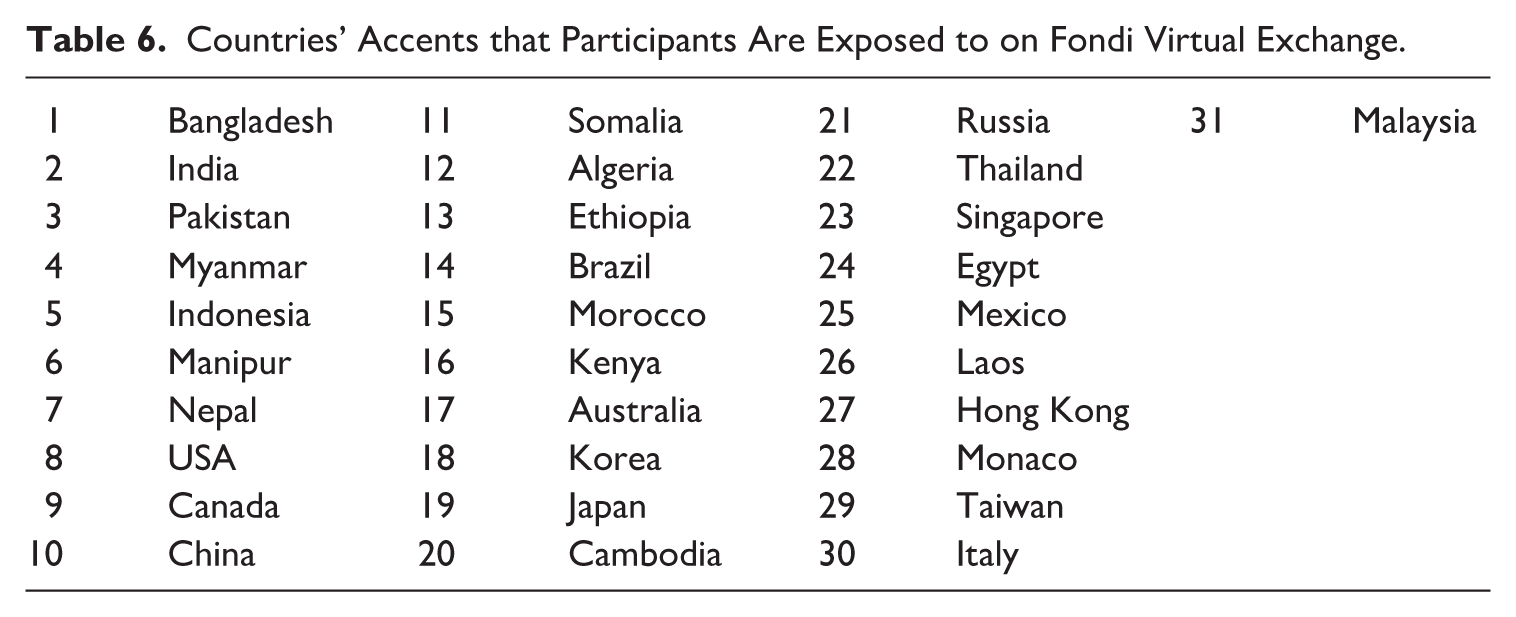
The interaction records showed that learners interacted with English users from more than 30 different countries (see Table 6), which promoted transcultural awareness (57.2%) and cultural sensitivity (25%). Learners developed a better understanding of different cultures. EV14 stated that being adaptable and understanding in cross-cultural situations became essential to him after his experience. EV19 observed that different perspectives on advertising exposed cultural differences between people because “Some liked funny ads, others meaningful ones . . . it was interesting to compare ideas across countries.” The research demonstrates that unscripted EMF-oriented virtual exchange delivers valuable intercultural benefits.
Countries’ Accents that Participants Are Exposed to on Fondi Virtual Exchange.
The participants demonstrated developing adaptability and openness (22.6%) when encountering topics or accents they had not previously experienced. A learner explained that the experience showed him the need to be patient and open-minded, as he adapted to different accents surprisingly quickly (EV41). Another learner described an enriching cultural encounter: “I spoke with a Japanese friend who explained Hanami to me,” which led him to appreciate the value of simple yet lovely life experiences (IV40). Spontaneous interactions in low-immersive VR environments foster global curiosity and meaningful intercultural learning, supporting the goals of transcultural communicative competence.
4.2.5. Affective Engagement and Confidence Building (37.3%)
Participants reported notable gains in affective engagement and confidence through exposure to diverse interlocutors and English varieties. A majority (70%) reported increased motivation to improve their English, while 65% were positively surprised by their partners’ openness and supportiveness. As a result, 22.5% reported reduced anxiety, and 20% expressed greater willingness to communicate.
Learners often described how initial fears, particularly about grammar or pronunciation, gave way to comfort and enjoyment. One participant shared: “I initially feared judgment due to my imperfect grammar or pronunciation, but most of them were supportive and understanding” (IV26). Familiar topics like food or daily life helped reduce tension: “At first, I was a bit nervous . . . but discussing food or daily activities made it easier to relax and enjoy the process” (EV57). For others, the shift was transformative: “The Fondi exchange helped me overcome my fear of speaking and provided an opportunity to practice in real-life contexts” (IV15).
The VR setting also fostered intercultural awareness. “I listened more, made new friends, and learned to be more proactive in asking questions,” one learner reflected (IV54). Another added: “Fondi brought me to different accents and speaking styles . . . it pushed me to become a better listener and taught me to adapt” (EV34). These reflections suggest that virtual exchange not only fosters confidence but also promotes cultural agility and communicative resilience.
4.3. Challenges Encountered in Low-Immersive VR
4.3.1. Emotional Obstacles (21%)
Learners’ virtual exchange experiences were strongly shaped by their emotions. Over one-third (37.9%) reported anxiety, low confidence, or hesitation, often linked to worries about making mistakes and being judged by others. Some learners are initially strongly oriented toward native-like norms, describing fear of errors, feelings of guilt when they cannot express themselves, and occasional concerns about privacy or unwanted contact. As IV27 put it: “Fear of making mistakes holds me back . . . I plan to practice more and accept that mistakes are part of the learning process.” At the same time, a number of students reported gradually becoming more willing to communicate despite inaccuracies and focusing more on being understood than on speaking “perfect” English. A small minority (4%) explicitly raised privacy and safety issues; for example, EV15 noted that the app sometimes allowed users to bother others with unsolicited personal requests.
4.3.2. Technical Barriers (19.9%)
Virtual exchange offers pedagogical benefits, but learners also encounter technical barriers. The participants reported unstable internet (13%), limited device functionality (33%), time zone mismatches (8%), and app usability concerns (25%). The microphone of one participant suddenly ran out of battery power, yet their group members agreed to wait for it to recharge (IV38). Participants experienced connectivity issues and expressed dissatisfaction with their group size, which reduced communication effectiveness (IV42). The availability of rooms created problems because some rooms were either too crowded or too empty (IV47). The issues demonstrate why it is crucial to improve both infrastructure and design aspects of future virtual exchange platforms.
4.3.3. Cognitive Difficulties (19%)
Real-time EMF communication posed several cognitive challenges, including intercultural breakdowns (32.2%), broader language barriers (25.8%), unfamiliar accents (18.5%), fast speech (11.2%), and limited vocabulary (7.2%). The problems emerged from multiple factors that combined linguistic, pragmatic, and cultural variables. A student explained that “Some people were supportive, but others told me they could not understand me” because of accent and lexical variations, which made communication difficult (EV42). Such communication challenges typically led learners to become more mindful about their communication. IV21 explained that “A casual joke or unfamiliar phrase might be misinterpreted,” thus demonstrating the need for pragmatic sensitivity. Some participants learned to develop adaptive approaches through their experiences with “awkward silences,” which taught them both resilience and creativity (EV17). The reflections demonstrate how difficult intercultural dialogue can be while showing students developing their strategic and metacognitive abilities to handle worldwide communication barriers.
In addition to the main findings, slight distinctions among the three groups were identified. For instance, the Explicit + VR group demonstrated stronger metacognitive awareness of communication strategies, whereas the Implicit VR group showed emergent strategic behavior and greater affective engagement. Two themes, taking risks and pride in one’s own cultural identity, emerged uniquely in the Implicit VR group and were not observed in the Explicit groups. These themes suggest that the absence of overt instruction may have created space for learners to assert their identities and engage more freely in spontaneous, self-directed communication. In contrast, the non-VR group mainly reflected on factual learning with fewer signs of intercultural engagement.
5. Discussion
This study compared three communication strategy instructional approaches (Explicit + VR, VR Implicit, and Explicit + non-VR) on L2 speaking fluency. Both VR conditions outperformed the non-VR condition, and Explicit + VR produced the largest immediate gains, highlighting the added value of combining explicit communication strategy instruction with immersive interaction in EMF contexts (Skehan, 2009; P. Tavakoli et al., 2016). However, in the delayed test, the two VR groups did not differ significantly, suggesting that sustained immersive interaction alone can support long-term development of L2 speaking fluency. This pattern aligns with accounts of automatization through repeated, meaningful practice (Freed et al., 2004; Hanzawa & Suzuki, 2023; Segalowitz, 2010) and with EMF views of communication strategies as resources for negotiating and co-constructing intercultural discourse rather than merely compensating for linguistic gaps (Antonello, 2023).
Qualitative findings showed how learners co-constructed meaning across linguistic and cultural boundaries through strategic adaptability, emotional engagement, and social connection (Antonello, 2023). Notably, the participants in the Implicit VR group developed strategy awareness without formal communication strategy instruction, indicating that immersive, low-pressure environments can foster incidental learning, in line with Batstone’s (2002) emphasis on context-driven engagement. The Fondi VR exchange functioned as a psychologically safe yet communicatively authentic space in which learners could notice, experiment with, and refine communication strategies, gaining L2 speaking fluency while also increasing motivation, reducing anxiety, and building confidence (Liaw, 2019). At the same time, learners reported adapting their speech to culturally diverse interlocutors, signaling growth in transcultural competence, even though some were still oriented to native-like norms or reported fear of mistakes and privacy concerns.
The findings suggest that learners developed communication strategies differently across instructional conditions. Those in the Explicit + VR group reported consciously deploying strategies such as lexical anticipation, backchanneling, and reformulation, indicating that explicit instruction combined with VR practice enhances strategic awareness. Implicit VR participants also used these strategies during real-time intercultural exchanges despite the absence of formal instruction, suggesting that immersive, contextualized interaction can itself support experiential learning of communication strategies. This aligns with Ellis’s (2009) view that both explicit teaching and meaningful exposure contribute to strategic competence and offers empirical support for the teachability and effectiveness of key communication strategies (e.g., backchannels, reformulation, lexical anticipation) in EMF communication.
Finally, the study provides empirical support for the EDVE model by illustrating how low-immersion VR platforms, such as Fondi, enable authentic, spontaneous, and culturally diverse interaction within EMF contexts. EDVE foregrounds unscripted, learner-driven exchanges that unfold in real time and require adaptive use of communication strategies, complementing existing virtual exchange models that rely more heavily on predefined tasks and fixed interlocutors (Helm, 2024). It also incorporates ASE tools, like ELSA, strengthening methodological rigor and providing a scalable way to track L2 speaking fluency development over time. By bridging classroom-based ELT with the dynamic realities of global English use, EDVE emerges as a theoretically grounded and contextually responsive framework for fostering L2 speaking fluency, strategic competence, and transcultural communication.
6. Implications and Conclusion
Translating the EDVE model into practice involves several key considerations. Teachers should select VR platforms that enable real-time, unscripted interaction with diverse interlocutors instead of fixed classroom pairings, and design open-ended, learner-led tasks in which meaning emerges through interaction rather than rigid scripts. Communication strategy instruction can be integrated explicitly or implicitly so that learners negotiate and co-construct meaning, not only repair breakdowns, and guided reflection on emergent dialogue and cultural negotiation can support EMF transcultural competence. Emotional safety is also crucial: reports of discomfort or digital harassment underline the need for pre-exchange training on etiquette and intercultural norms, clear reporting and blocking mechanisms, and teacher support for learners’ emotional resilience. LiVR should therefore be treated as a pedagogically mediated space rather than a neutral tool, requiring careful design and ongoing support.
Despite its contributions, this study has limitations. Self-reflections are subjective and may not accurately capture actual learners’ behaviors. Although the ELSA Speech Analyzer provides consistent fluency metrics, it cannot assess pragmatic or interactional nuances. Additionally, digital literacy, emotional readiness, and device quality may influence the effectiveness of VR-based learning. It should be noted that learners in the VR conditions interacted with geographically dispersed partners from more than 30 countries. Thus, the treatment combines the affordances of LiVR with real EMF interaction, and the study cannot fully disentangle the effects of the medium from the effects of engaging with international interlocutors.
Given that the participants were Vietnamese undergraduates at a single institution, the findings should be interpreted with caution. Rather than claiming universal generalizability, we understand this study as offering analytically transferable insights into how EDVE can support EMF communication. Many of the contextual features we describe (exam-oriented curricula, strong investment in English, uneven access to technology) are shared with other tertiary EFL settings, where the design principles of unscripted interaction, explicit attention to communication strategies, and guided reflection are likely to be relevant. Nonetheless, adaptations are needed in systems with different language policies, learner profiles, or technological conditions, and future cross-institutional research is required to test and refine the EDVE model.
A further limitation concerns the novelty effect of VR, which can increase learners’ engagement when an innovative technology is first presented (Miguel-Alonso et al., 2024). However, in our work, the intervention spanned 11 weeks, with VR tasks occurring between Weeks 3 and 8, and learning outcomes were measured not only immediately post-intervention (Week 9) but also at delayed testing (Week 11). The L2 speaking fluency advantages of the Explicit + VR and VR Implicit groups over the Explicit + non-VR group were sustained at both the post- and delayed tests, suggesting that the benefits were not limited to a transient spike in curiosity. Additionally, participants’ reflections in the VR conditions emphasized attributes such as a supportive learning environment, social connection, greater confidence, and a willingness to talk, rather than merely stating that VR “was fun” or “exciting.” Taken together, these patterns suggest that although novelty cannot be entirely eliminated, the gains are likely driven by more persistent pedagogical affordances of VR.
Further research is needed to investigate the longer-term development of L2 speaking fluency and intercultural competence by varying intervention duration and to compare LiVR and HiVR settings to clarify how immersion level affects outcomes. Cross-institutional studies would help test and refine the EDVE model across diverse contexts, and future work could explore how EDVE principles might be adapted to artificial intelligence (AI)-mediated environments or to more targeted instruction on specific communication strategies in EMF communication.
Supplemental Material
sj-docx-1-ltr-10.1177_13621688261457582 – Supplemental material for Embarking on Virtual Exchange for English as a Multilingua Franca Context: Comparing Virtual Reality and Non-Virtual Reality Approaches to Enhance Second Language Speaking Fluency
Supplemental material, sj-docx-1-ltr-10.1177_13621688261457582 for Embarking on Virtual Exchange for English as a Multilingua Franca Context: Comparing Virtual Reality and Non-Virtual Reality Approaches to Enhance Second Language Speaking Fluency by Van Huynh Ha Le, Denchai Prabjandee and Punwalai Kewara in Language Teaching Research
Footnotes

Funding
The authors received no financial support for the research, authorship, and/or publication of this article.
Declaration of Conflicting Interests
The authors declared no potential conflicts of interest with respect to the research, authorship, and/or publication of this article.
Supplemental Material
Supplemental material for this article is available online.
References
Supplementary Material
Please find the following supplemental material available below.
For Open Access articles published under a Creative Commons License, all supplemental material carries the same license as the article it is associated with.
For non-Open Access articles published, all supplemental material carries a non-exclusive license, and permission requests for re-use of supplemental material or any part of supplemental material shall be sent directly to the copyright owner as specified in the copyright notice associated with the article.
