






Abstract
This study examined the effectiveness of Nihongo Quest, a theory-driven role-playing game (RPG) developed for beginner learners of Japanese. Sixty undergraduate students participated in an eight-week quasi-experimental study comparing a game-based learning (GBL) condition with a traditional textbook-based condition. Results indicated that participants in the GBL group demonstrated significantly greater gains in vocabulary (d = 1.45) and grammar (d = 1.05) than those in the textbook group. In addition, the GBL group reported higher levels of intrinsic motivation (η² = .25) and lower levels of language learning anxiety (η² = .16). These outcomes are attributed to the game’s systematic alignment with core second language acquisition (SLA) frameworks, including the input–interaction–output (IIO), self-determination theory (SDT), willingness to communicate (WTC), and sociocultural theory (SCT). Through the integration of multimodal literacy tasks, interactive dialogues, and culturally situated scenarios, Nihongo Quest reduced cognitive load while supporting both linguistic and pragmatic development. The findings suggest that theory-informed RPG-based instruction can effectively enhance beginner-level Japanese language acquisition and offer a transferable instructional design model for other complex-script languages, such as Chinese and Korean.
Keywords
1. Introduction
In recent years, digital learning interventions in second language acquisition (SLA) have often been grouped together under broad labels, yet it is essential to distinguish between GBL and gamification, which represent different pedagogical approaches. GBL refers to the use of full-fledged games, often narrative, interactive, and task-based, as the primary medium through which learning occurs (Reinhardt, 2019). In GBL, the game itself constitutes the learning environment, and linguistic development arises through engagement in quests, problem-solving, and meaning-focused interaction. In contrast, gamification involves adding game-like elements, such as points, badges, leaderboards, or progress bars, to non-game contexts (Deterding et al., 2011). Gamification can enhance learner engagement through surface-level mechanics such as points, badges, and leaderboards; however, it does not inherently provide the sustained linguistic input, interactional depth, or narrative immersion characteristic of specific game genres. In particular, role-playing games (RPGs), narrative adventure games, and simulation-based games are designed around story progression, role enactment, and decision-driven interaction, all of which support rich input exposure and meaningful language use. For example, commercial RPGs such as The Sims or Final Fantasy XIV require players to interpret context-dependent dialogue, negotiate meaning through choices, and act within coherent narrative worlds, features largely absent from gamified drill-based systems.
This study focuses explicitly on game-based learning (GBL), not gamification: Nihongo Quest is a complete, narrative-driven RPG designed to operationalize SLA theories through interactive quests rather than through superficial game elements layered onto traditional teaching.
GBL has emerged as a promising pedagogical approach for SLA. GBL integrates educational objectives with interactive gameplay to enhance motivation, engagement, and learning outcomes (Gee, 2003; Prensky, 2003). When thoughtfully designed, digital games provide learners with rich opportunities to practice language skills in meaningful contexts and to engage in repeated, low-anxiety interaction that supports retention and fluency (Jolley & Maimone, 2022). Studies in SLA have demonstrated that games can encourage repeated exposure to target language forms, facilitate meaningful interaction, and lower affective barriers such as anxiety (Reinders & Wattana, 2014; Sylvén & Sundqvist, 2012).
For Japanese language learning specifically, research suggests that incorporating game-like activities, such as quest-based vocabulary acquisition, kanji recognition challenges, and role-play dialogue, can enhance learner engagement and facilitate deeper cultural understanding (Chik, 2014; Suh et al., 2010). The motivational potential of GBL can be explained through SDT, which emphasizes the importance of autonomy, competence, and relatedness in sustaining learning behavior (Deci & Ryan, 2000; Dörnyei & Ushioda, 2021). Gamification elements, such as points, leaderboards, and narrative progression, can fulfill these psychological needs while maintaining consistent learner participation (Deterding et al., 2011; Hanus & Fox, 2015).
While prior GBL research provides evidence for the motivational and cognitive benefits of digital games, much of this work offers descriptive accounts of tools rather than theory-driven analyses of how specific game mechanics promote SLA processes. Moreover, existing studies on Japanese often isolate discrete skills, kanji recognition, vocabulary drills, or pragmatic scenarios, without integrating orthographic, linguistic, motivational, and cultural dimensions into a unified learning design. Notably, De Lorenzis et al. (2025) demonstrate how gamified sequencing can support kanji retention, but the focus remains on micro-level memory effects rather than broader communicative development or pedagogical integration. The present study builds on such work by expanding the scope from isolated recognition tasks to a fully narrative-driven RPG that engages multiple SLA constructs simultaneously.
Learning Japanese presents distinct theoretical and pedagogical challenges, making it an important context for investigating game-based learning. Unlike many Indo-European languages, Japanese requires learners to develop multimodal literacy skills, simultaneously processing hiragana, katakana, and kanji, each with unique visual, phonological, and semantic properties. Research on orthographic processing shows that character-based writing systems impose a heavier cognitive load due to the need to recognize complex visual patterns, multiple readings, and context-dependent meanings (De Lorenzis et al., 2025; Mori et al., 2021). At beginner levels, this multimodal literacy burden often slows progression and contributes to high attrition rates.
Beyond orthography, learning Japanese requires sensitivity to cultural–pragmatic norms, such as honorifics, politeness levels, and context-bound meaning negotiation. Acquiring these pragmatic features demands exposure to situated interaction and culturally mediated input, conditions that traditional grammar-translation or textbook-based methods frequently fail to provide. As scholars have noted, pragmatic competence in Japanese develops most effectively when learners engage with contextualized discourse and role-based communication (Kim et al., 2023; Taguchi, 2007).
These characteristics make Japanese an ideal testbed for designing and evaluating game-based learning environments that can integrate visual, linguistic, interactional, and cultural elements into a single cohesive platform. Rather than simply filling a gap in the literature, this study addresses a deeper theoretical need: understanding how a narrative-driven RPG can reduce multimodal cognitive load, scaffold orthographic learning, and provide simulated sociocultural immersion to support both linguistic and pragmatic development. This theoretical relevance underpins the choice of Japanese and situates the study within broader discussions about complex-script language acquisition.
Thus, instead of merely extending prior GBL applications to Japanese, this study introduces a theoretically grounded model that maps RPG mechanics onto central SLA theories, including the input–interaction–output (IIO) framework (Gass & Mackey, 2006; Long, 1996), self-determination theory (SDT) (Deci & Ryan, 2012), willingness to communicate (WTC) (MacIntyre et al., 1998), and sociocultural theory (SCT) (Lantolf, 2006), which are discussed in greater detail in Section 2.2. This provides a more comprehensive understanding of how complex-script language learning can be supported through immersive role-play. By comparing this RPG-based design to traditional instruction within a controlled empirical study, the research offers both conceptual and practical advancements beyond existing GBL studies in Japanese and other foreign languages.
2. Literature Review
2.1. Game-Based Learning in Language Education
GBL environments provide learners with multimodal, interactive spaces in which gameplay itself drives linguistic development. Unlike gamification, which adds isolated motivational features such as points and rewards onto conventional instruction, GBL embeds educational objectives inside a coherent game world with characters, quests, challenges, and feedback loops (Gee, 2003; Reinhardt, 2019). The distinction is crucial: gamification modifies the learning environment, while GBL is the learning environment. GBL, therefore, affords opportunities for interpreting input, negotiating meaning, and producing output as part of gameplay tasks rather than as add-on exercises.
Many previous language-learning studies mix these concepts, labeling gamified instructional systems as game-based learning despite the absence of sustained narrative, role enactment, or interaction-driven gameplay. For example, Hanus and Fox (2015) examine the effects of points, badges, and leaderboards added to a conventional classroom setting and report motivational changes, yet the instructional activities themselves remain largely unchanged and do not constitute a game world. Similarly, De Lorenzis et al. (2025) describe gamified sequencing and reward-based tasks for kanji retention, which, while effective for memory consolidation, lack interactive narrative structure or meaning-focused communication typically associated with game-based learning environments. In both cases, the learning activities are enhanced through motivational overlays rather than transformed into gameplay-driven learning experiences.
This conceptual conflation is problematic because it obscures the mechanisms through which learning occurs. When gamification and game-based learning are treated as equivalent, it becomes difficult to determine whether observed gains stem from short-term motivational effects (e.g., rewards or competition) or from deeper cognitive and interactional processes such as sustained input exposure, negotiation of meaning, and contextualized language use. As a result, theoretical claims about how games support SLA are weakened, and the pedagogical affordances of fully developed game genres, particularly narrative-driven RPGs, remain underexplored.
GBL has gained prominence in SLA because they offer rich, multimodal contexts where learners encounter linguistic input, interact with characters or peers, and receive feedback within meaningful tasks (Reinhardt, 2019; Weng et al., 2024). Unlike traditional classroom formats, digital games create immersive spaces where learners must interpret messages, make decisions, and communicate to progress through gameplay. These affordances align closely with key SLA mechanisms, yet many studies describe these benefits without clearly linking them to theoretical principles.
Existing research demonstrates that RPGs, in particular, promote vocabulary uptake, deeper processing of linguistic input, and communicative engagement (DeHaan et al., 2010; Ranalli, 2008). However, most published studies rely on commercial entertainment games not intentionally designed for pedagogical use. Consequently, although learning gains are frequently reported, it is difficult to determine which mechanics support specific SLA processes. Other studies highlight motivational or affective outcomes (e.g., increased WTC in Reinders & Wattana, 2014), but often lack systematic incorporation of SLA theory into the game design itself.
This study builds on this emerging body of work by developing Nihongo Quest, a purpose-designed RPG created specifically to operationalize SLA theoretical principles. The design embeds cycles of input, interaction, and output within narrative quests; integrates autonomy-supportive mechanics to foster intrinsic motivation; and situates learning in Japanese cultural scenarios aligned with pragmatic and sociocultural development. By linking game mechanics directly to established frameworks, this study addresses the theoretical and methodological limitations of existing GBL research.
2.2. Theoretical Foundations of SLA Relevant to Game-Based Learning
Several SLA theories provide conceptual grounding for the use of RPGs in language learning. This section outlines four foundational frameworks and explains their relevance to GBL, establishing the theoretical basis for the game’s design.
2.2.1. Input–Interaction–Output (IIO) Framework
The IIO hypothesis proposes that acquisition is driven by cycles of comprehensible input, negotiation of meaning, and pushed output (Gass, 1997; Long, 1996). When learners encounter input slightly above their current level, interact to resolve misunderstandings, and produce language that requires attention to form, they are more likely to internalize new structures.
GBL, and RPGs in particular, naturally support these cycles. Narrative quests provide context-rich input; branching dialogue choices require learners to interpret meaning and make decisions; and task-based responses, including learner-typed written input, written selection-based responses (e.g., selecting contextually appropriate dialogue options or sentence completions), as well as oral input, constitute pushed output, as learners must attend to form–meaning relationships to progress.
2.2.2. Self-Determination Theory (SDT)
SDT posits that intrinsic motivation emerges when activities satisfy three psychological needs: autonomy, competence, and relatedness (Deci & Ryan, 2000; Ryan & Deci, 2020). RPGs are uniquely suited to supporting these needs. Open-world navigation and meaningful choices promote autonomy; progressive challenge levels reinforce competence; and character interactions foster relatedness.
Much existing research applies SDT superficially, for example, through points or leaderboards (Hanus & Fox, 2015). In contrast, this study adopts a deeper approach by embedding SDT mechanisms into narrative progression, role-play, and culturally grounded interaction.
2.2.3. Willingness to Communicate (WTC)
WTC theory identifies conditions under which learners are more likely to use the target language, emphasizing reduced anxiety, increased confidence, and meaningful communicative contexts (MacIntyre et al., 1998). Digital environments can improve WTC by providing low-pressure spaces for experimentation. Research has shown that online RPGs promote WTC by reducing fear of judgment and enabling private rehearsal (Reinders & Wattana, 2014).
Nihongo Quest adapts these insights to beginner Japanese learners through written interaction, allowing users to rehearse responses, revise errors, and practice communication in socially meaningful but low-stakes scenarios.
2.2.4. Sociocultural Theory (SCT)
SCT highlights the importance of mediation, scaffolding, and culturally situated interaction in second language (L2) development (Lantolf, 2006). Learning is viewed as participation in socially meaningful activity, often supported by tools, artifacts, and role-play.
Japanese language learning particularly benefits from SCT-informed approaches, as pragmatic forms, such as honorifics, politeness, and context-dependent expressions, are deeply embedded in cultural norms. Narrative RPGs provide a natural platform for such learning by situating communication within social and cultural encounters.
2.3. Challenges in Japanese Language Learning and the Need for Theory-Aligned Design
Learning Japanese presents significant challenges due to its mixed writing systems (hiragana, katakana, and kanji), which require learners to process multiple orthographic, phonological, and semantic mappings simultaneously (Koda, 2005; Mori et al., 2021), as well as its flexible word order and contextually driven pragmatics. Learners must simultaneously acquire orthographic decoding skills, vocabulary, grammar, and sociocultural knowledge. Many existing pedagogical tools address these components in isolation. For example, De Lorenzis et al. (2025) demonstrate that gamified ordering tasks enhance kanji retention, but this approach does not address communicative use, pragmatic abilities, or cross-skill integration.
Furthermore, traditional Japanese instruction has often emphasized rote memorization of vocabulary, grammar patterns, and kanji forms, particularly at beginner levels, a practice documented in prior research on Japanese language pedagogy (Mori et al., 2021; Saito, 2015), which conflicts with principles of IIO (negotiation-driven learning), SDT (autonomy and meaningful engagement), and SCT (situated cultural interaction). GBL offers a promising alternative by integrating input, interaction, motivation, and cultural context within a single environment.
The present study responds to these challenges by designing an RPG that unifies the demands of Japanese learning into coherent tasks grounded in SLA theory. Learners must use kana, kanji, grammar, and context-appropriate pragmatic forms to complete quests, thus addressing cognitive, linguistic, and sociocultural dimensions simultaneously.
2.4. Theory–Design Alignment in Nihongo Quest
To address the common criticism that GBL studies lack theoretical grounding, this study explicitly maps SLA constructs onto concrete game mechanics. Each theoretical principle informed specific design decisions, as summarized in Table 1.
Mapping Second Language Acquisition (SLA) Theories to Game Design in Nihongo Quest.
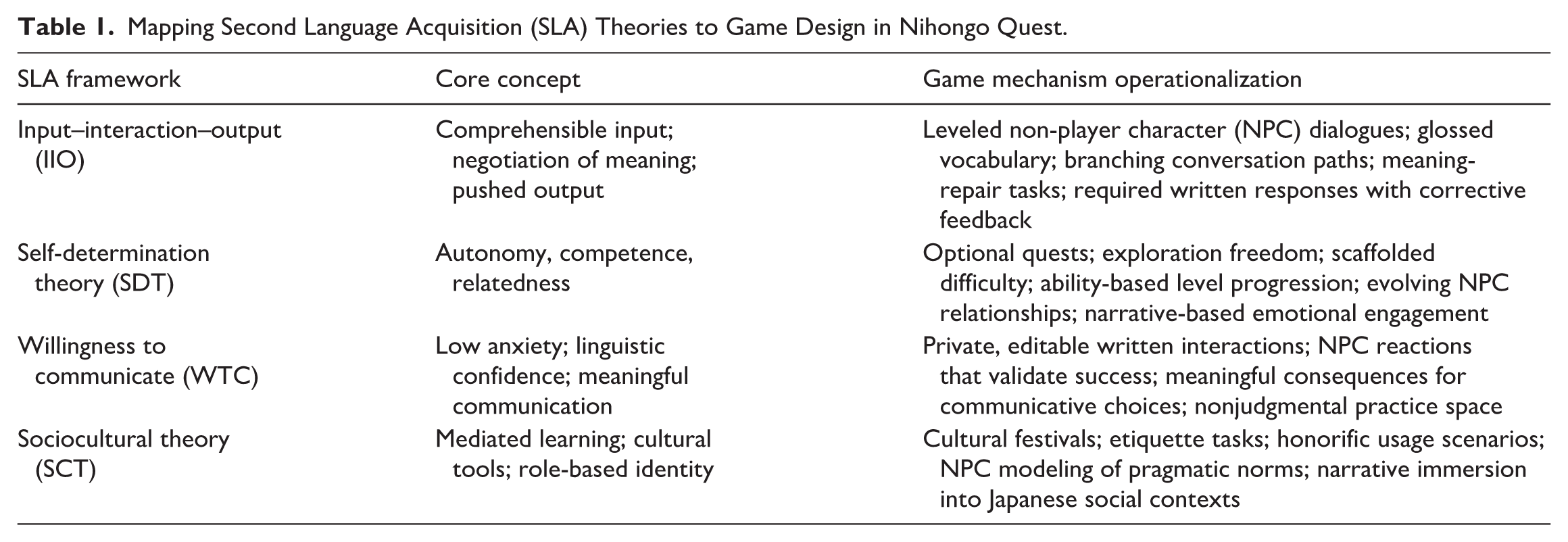
This explicit theory–design alignment differentiates Nihongo Quest from previous GBL tools and from micro-skill–focused studies such as De Lorenzis et al. (2025). The RPG does not merely incorporate game elements superficially; rather, its mechanics are deliberately structured around SLA principles to support deeper linguistic, motivational, and cultural learning.
3. Methodology
3.1. Research Design
This study adopted a quasi-experimental pre-test/post-test control group design to evaluate the effectiveness of a game-based learning environment for beginner Japanese learners. The intervention spanned eight weeks, during which both groups received four hours of instruction per week, totaling 32 instructional hours. Classes followed the university’s standard schedule of two 2-hour sessions per week, held on Tuesdays and Thursdays. The experimental group used Nihongo Quest, a custom-designed role-playing game, as their primary learning platform, while the control group received traditional textbook-based instruction. Both groups covered the same lexical and grammatical content each week to ensure equal exposure to the curriculum. Both groups were taught by the same instructor, who was also one of the authors, following standardized lesson plans to minimize instructional variability.
3.2. Participants
The participants were 60 undergraduate students (31 female, 29 male) enrolled in an introductory Japanese language course at a public university in Taiwan. All participants were aged between 18 and 23 and self-reported no prior formal Japanese learning experience.
Participants were randomly assigned to either the control group (n = 30) or the experimental group (n = 30). Random assignment occurred at the class level to avoid contamination between groups. All participants provided informed consent before the study commenced.
3.3. Learning Materials
3.3.1. Control Group Materials
The control group followed a traditional textbook-based curriculum using Minna no Nihongo I (Surīē & Kabushiki, 2020), a widely adopted resource for beginner-level Japanese instruction. Instruction was delivered through a combination of teacher explanations, drills, role-plays, and workbook exercises.
3.3.2. Experimental Group Materials: Nihongo Quest
The experimental group used Nihongo Quest, the custom-designed digital RPG developed specifically for this study by the research team in collaboration with two professional game developers from a University Educational Technology Center and an external studio. The lead author served as the project designer and collaborated with programmers and illustrators to create the game’s learning mechanics, dialog scripts, and assessment-linked tasks. The game was built using the RPG Maker MV and deployed as a browser-based application compatible with laptops and tablets.
Nihongo Quest is not currently available as a public product; however, this limited-access model enables us to maintain control over updates, data collection, and pedagogical consistency during the research phase. A simplified description of the system is provided in the supplemental material. The game incorporated principles of SLA and gamification to facilitate vocabulary learning, grammar practice, and cultural exposure. Key features included:
Vocabulary Quests: Mini-games for hiragana, katakana, and basic kanji recognition
Grammar Missions: NPC dialogues and choice-based tasks requiring accurate grammar use. A Non-Player Character (NPC) is any character in a video game not controlled by a human player, but by the game’s AI or scripted behavior.
Cultural Events: Narrative sequences incorporating festivals, social norms, and etiquette
Gamification Elements: Points, badges, levels, and branching storylines to support motivation
All linguistic content followed the unit progression of Minna no Nihongo I (Surīē & Kabushiki, 2020) to ensure comparability with the control group. For transparency and replicability, the full list of lexical items and grammatical structures targeted during the intervention is provided in Appendix A.
In Nihongo Quest, all in-game interactions can be conducted either through text or voice. Learners interact with non-player characters (NPCs) using written dialog options, short typed responses, or spoken input. Although the system is technically capable of supporting spoken input and output, spoken practice in the present implementation was primarily conducted outside the game through brief, teacher-led discussions following each gameplay session. During these discussions, the teacher reviewed selected in-game tasks and expressions and, when appropriate, facilitated oral practice in the classroom.
3.4. Procedure
The study unfolded across three phases: pre-testing, the 8-week instructional intervention, and post-testing. Prior to the intervention, all participants completed a vocabulary test, a grammar test, and a motivation/anxiety questionnaire.
During the intervention phase, both groups met twice weekly for 2-hour class sessions (4 hours/week). The control group engaged in traditional instruction for the full duration of each session, including teacher explanations, guided practice, and workbook activities. The experimental group spent approximately 3 hours per week interacting with Nihongo Quest during class time, supplemented by 1 hour per week of teacher-led debriefing and clarification (approximately 15–20 minutes at the end of each class session). These debriefings targeted linguistic forms encountered in the game, connected gameplay to course objectives, and ensured consistency in instructional pacing relative to the control group. No additional homework time or extracurricular gameplay was required or included in the analysis.
After the eight weeks, all participants completed the same vocabulary, grammar, and motivation/anxiety assessments administered during the pre-test phase. All data were anonymized and stored on a secure, password-protected server in accordance with institutional ethical guidelines.
A short, scripted orientation session was conducted for both groups to ensure that the instructor’s dual role as teacher and project lead did not influence learners’ perceptions or performance.
Pre-testing: Before the intervention, all participants completed three instruments: ○ A 50-item vocabulary test (multiple choice and fill-in-the-blank). ○ A 30-item grammar test (sentence completion and error correction). ○ A motivation questionnaire adapted from Gardner’s (2004) Attitude/Motivation Test Battery (AMTB), using a 5-point Likert scale.
Intervention: ○ Control group: Continued textbook-based lessons in a classroom environment. ○ Experimental group: spent the majority of instructional time interacting with Nihongo Quest, supplemented with short teacher-led debriefing sessions (15–20 minutes per class) to clarify linguistic points.
Post-testing: After eight weeks, all participants completed the same vocabulary, grammar, and motivation tests as in the pre-test stage.
Data collection and storage: All test results were anonymized and stored on a secure, password-protected database in accordance with university ethics guidelines.
3.5. Instruments
To evaluate vocabulary, grammar comprehension, and learner motivation, three instruments were used. Below, sample items are provided for each test, and the full versions of all instruments are included in Appendices B–D.
3.5.1. Vocabulary Test
The vocabulary test consisted of 50 items, with one point per item. Maximum score = 50. The 50-item vocabulary test assessed recognition and recall of hiragana, katakana, and 150 beginner-level lexical items aligned with Minna no Nihongo I. The test included multiple-choice items, picture–word matching, and short fill-in-the-blank questions.
Example items:
Multiple-choice recognition (hiragana):
What is the correct reading of きょう? A. asa B. kyō C. inu D. kaigi
Vocabulary meaning: Select the correct English meaning of 「りんご」. A. Banana B. Apple C. Peach D. Bread
Fill-in-the-blank:
私は______を飲みます。 (Correct answers: おちゃ / コーヒー / みず)
Internal consistency was high (Cronbach’s α = .87). The full test appears in Appendix B.
3.5.2. Grammar Test
The grammar test included 30 items, each worth one point. Maximum score = 30. The 30-item grammar test consisted of sentence-completion items, particle usage questions, and basic verb-form accuracy checks aligned with the course curriculum.
Example items:
Particle selection:
がっこう____行きます。 A. を B. に C. で D. は
Verb conjugation:
Correctly conjugate the verb たべる to the ます form: ______. (Correct answer: たべます)
Sentence completion: 「これは______です。」(Choose the correct demonstrative) A. あれ B. それ C. この D. どこ
Reliability for this measure was α = .85. The complete instrument is provided in Appendix C.
3.5.3. Motivation Questionnaire
Learner motivation and anxiety were assessed using a 20-item questionnaire adapted from Gardner’s (2004) Attitude/Motivation Test Battery (AMTB). Although the AMTB was originally developed for general L2 motivational research, it was selected for two reasons relevant to this GBL study. First, AMTB items measure core motivational orientations (intrinsic and extrinsic motivation) that remain applicable across instructional modalities, including digital and game-based environments. Second, several constructs found in GBL literature, especially autonomy, enjoyment, and engagement, map conceptually onto AMTB intrinsic items. To ensure methodological transparency and to clarify how learner motivation was operationalized in a game-based learning context, the adaptation process incorporated phrasing that reflects gameplay-related experiences (e.g. enjoyment, engagement with tasks, perceived competence), while maintaining alignment with validated AMTB subscales.
In addition to motivation, the questionnaire included a third subscale assessing language learning anxiety, which has been consistently treated as an affective variable closely related to motivation but conceptually distinct in SLA frameworks (MacIntyre et al., 1998). In this study, anxiety was treated as a separate but related construct, not as a component of motivation. This conceptualization also aligns with GBL research, which consistently identifies anxiety reduction as a key mechanism supporting learner engagement and WTC in game-mediated language learning environments (Reinhardt, 2019; Reinders & Wattana, 2014).
The final instrument consisted of three subscales measuring intrinsic motivation, extrinsic motivation, and language learning anxiety. Intrinsic motivation included seven items assessing enjoyment, interest, and willingness to continue learning, while extrinsic motivation comprised six items focusing on instrumental value and academic or career relevance. Language learning anxiety was measured using seven items. For ease of interpretation and consistency with other subscales, items were reverse-coded so that higher scores indicate lower levels of anxiety (i.e., greater comfort when using Japanese). To avoid confusion, this scoring direction is explicitly reported in all tables and analyses. All items were rated on a five-point Likert scale ranging from 1 (strongly disagree) to 5 (strongly agree). Reliability analyses were conducted separately for each subscale, yielding Cronbach’s alpha values of 0.86 for intrinsic motivation, 0.81 for extrinsic motivation, and 0.84 for language learning anxiety, indicating satisfactory internal consistency. The full adapted questionnaire is provided in Appendix D.
3.6. Data Analysis
Data analysis was conducted using SPSS 28.0. Paired-sample t-tests were employed to examine within-group changes from pre-test to post-test, while independent-sample t-tests were used to compare post-test scores between the control and experimental groups. Effect sizes were calculated using Cohen’s d and interpreted according to conventional thresholds proposed by Cohen (1988), with values of 0.20 indicating a small effect, 0.50 a medium effect, and 0.80 or above a large effect. Statistical significance was set at p < .05.
4. Results
This section presents the outcomes of the study, comparing the control group (traditional instruction) and the experimental group (Nihongo Quest) in terms of vocabulary acquisition, grammar comprehension, and learner motivation. All statistical analyses were conducted using SPSS 28.0, with significance set at p < .05.
4.1. Vocabulary Acquisition
Pre-test scores showed no statistically significant difference between the two groups, t(58) = 0.42, p = .676, indicating comparable initial vocabulary knowledge. After the 8-week intervention, the experimental group demonstrated a substantial increase in vocabulary scores (M = 43.8, SD = 3.5) compared to the control group (M = 38.1, SD = 4.2). The difference was statistically significant, t(58) = 5.64, p < .001, Cohen’s d = 1.45, representing a large effect size (see Table 2).
Vocabulary Acquisition Outcomes: Statistical Summary of Control vs. Experimental groups.
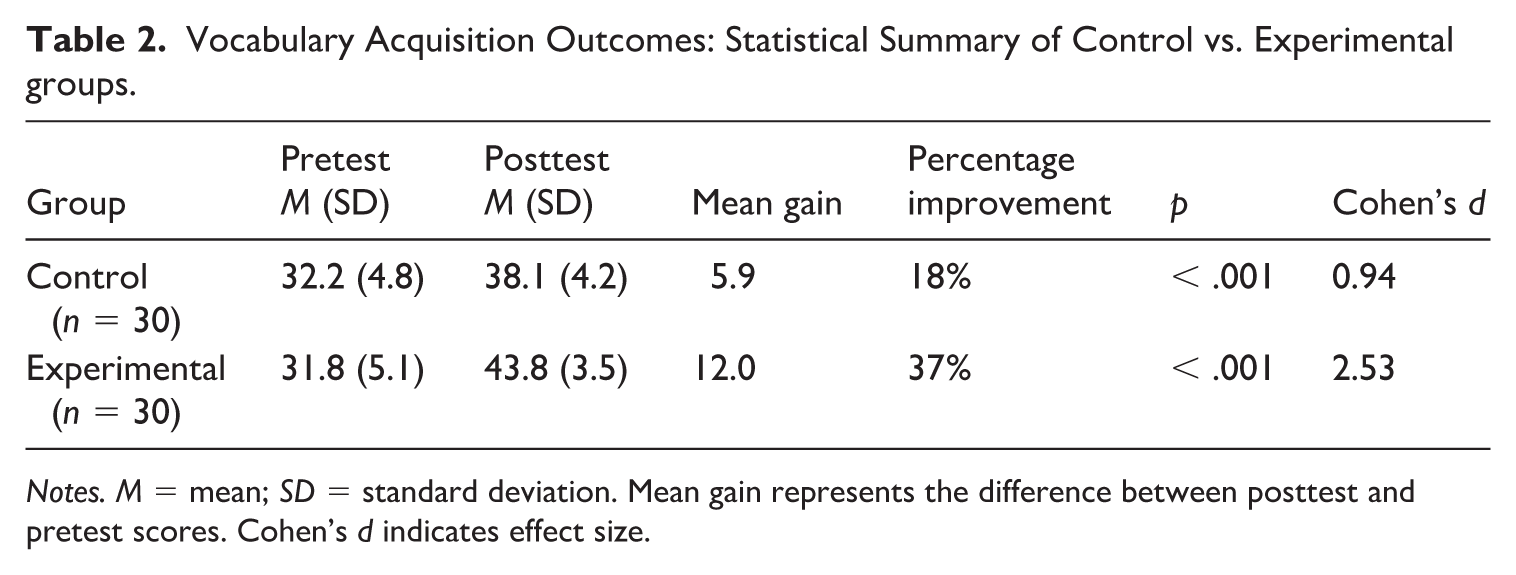
Notes. M = mean; SD = standard deviation. Mean gain represents the difference between posttest and pretest scores. Cohen’s d indicates effect size.
4.2. Grammar Comprehension
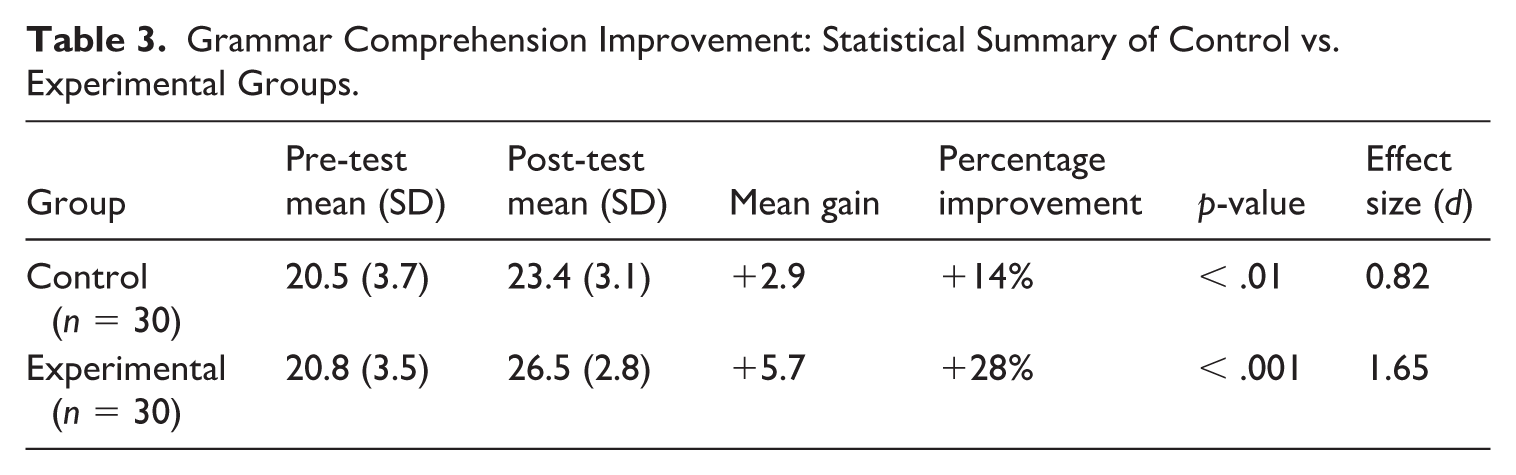
Initial grammar scores also showed no significant difference between groups (p = .588). Post-intervention, the experimental group scored higher (M = 26.5, SD = 2.8) than the control group (M = 23.4, SD = 3.1). The difference was statistically significant, t(58) = 4.09, p < .001, d = 1.05, indicating a large effect size (see Table 3).
Grammar Comprehension Improvement: Statistical Summary of Control vs. Experimental Groups.
4.3. Learner Motivation
The motivation questionnaire measured three subscales: Intrinsic Motivation, Extrinsic Motivation, and Anxiety toward Learning Japanese. A one-way ANOVA revealed significant between-group differences in post-test scores for Intrinsic Motivation (F(1,58) = 19.42, p < .001) and Anxiety (F(1,58) = 11.07, p = .002), but no significant difference for Extrinsic Motivation (p = .089) (see Table 4).
Comparison of Motivation Subscale Scores between Control and Experimental Groups.
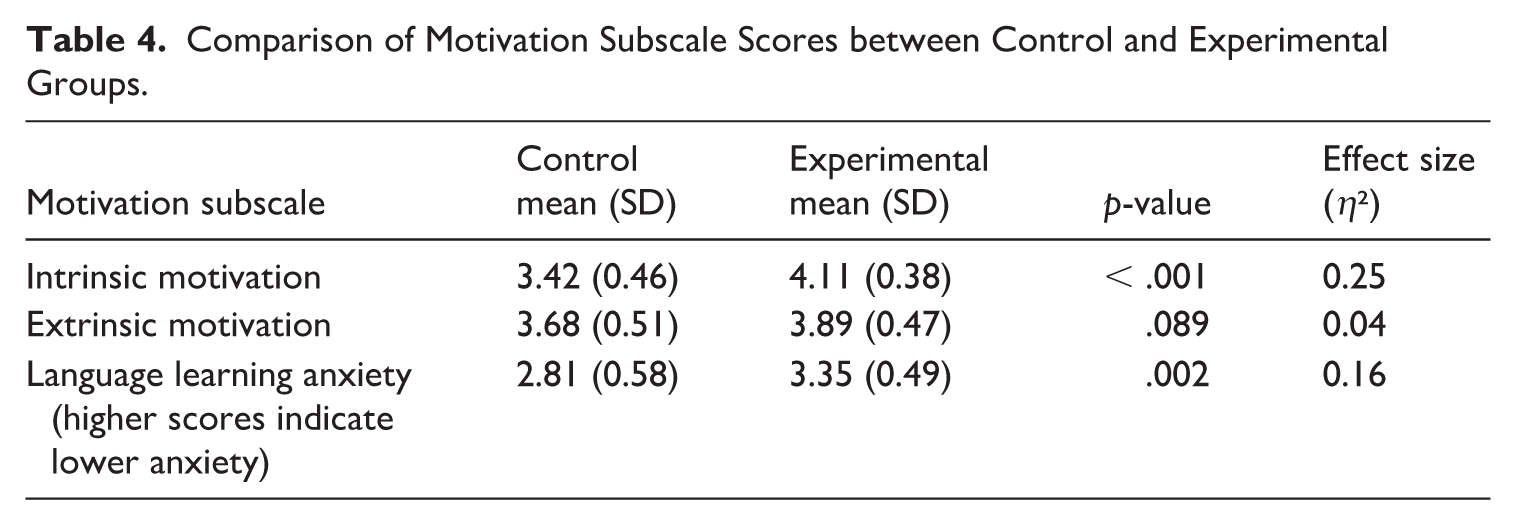
These results indicate that playing Nihongo Quest significantly enhanced intrinsic motivation and reduced anxiety, but had a more limited effect on extrinsic motivation.
The results indicate that the experimental group significantly outperformed the control group in both vocabulary and grammar post-test scores, demonstrating large effect sizes. Additionally, learners in the GBL group experienced a significant increase in intrinsic motivation alongside a notable reduction in language learning anxiety. However, gains in extrinsic motivation were not statistically significant, suggesting that the benefits of GBL are primarily associated with enhancing internal engagement rather than relying on external rewards.
5. Discussion
This study examined the impact of a theory-driven RPG, Nihongo Quest, on beginner learners of Japanese. Results showed significant gains in vocabulary and grammar knowledge, increased intrinsic motivation, and reduced anxiety compared to traditional instruction. While these findings align with prior research demonstrating the benefits of GBL for language acquisition (Reinhardt, 2019; Reinders & Wattana, 2014), a deeper theoretical and pedagogical interpretation provides insight into how and why these gains emerged.
5.1. SLA Mechanisms Underlying Cognitive Gains
The linguistic improvements can be interpreted through the IIO framework. Nihongo Quest’s leveled NPC dialogues offered comprehensible input; branching interactive choices required meaning negotiation; and written responses constituted pushed output. Immediate feedback further supported restructuring processes described by Gass (1997). Unlike studies using isolated drills or decontextualized tasks (e.g., Kandráč, 2025), the RPG embedded linguistic forms within meaningful quests, enabling functional use of vocabulary, grammar, and pragmatics.
The cultural and narrative scenarios also align with SCT by situating language in socially meaningful contexts. Learners engaged not only with grammar but with pragmatic norms such as honorifics, politeness, and role-based communication, elements central to Japanese language development.
5.2. Motivation Gains: Beyond Novelty?
A central question in GBL research is whether observed motivational gains reflect a short-term novelty effect or a more sustainable shift in learner engagement. The significant increase in intrinsic motivation observed in this study must therefore be interpreted alongside the affective changes, particularly the reduction in anxiety.
Several design features suggest that these motivational and affective gains extend beyond initial novelty. First, the game was intentionally aligned with SDT, supporting autonomy through exploration and meaningful choice, competence through structured progression and feedback, and relatedness through interaction with non-player characters. Motivation grounded in these psychological needs has been shown to sustain engagement over time rather than diminish after initial exposure.
Second, the narrative-driven structure of the RPG appears to play a critical role in shaping both motivation and emotional experience. Unlike surface-level gamification, which relies on external rewards, the story-based design fosters identity investment and emotional attachment to characters and outcomes. This deeper engagement likely contributes not only to sustained interest but also to a more supportive affective environment for language use.
Importantly, the reduction in language learning anxiety observed in the experimental group provides further evidence that the motivational gains are not purely novelty-driven. The game environment offered a private and nonjudgmental space in which learners could rehearse responses, revise errors, and experiment with language without the pressure of immediate evaluation. From the perspective of WTC, such conditions are critical, as lower anxiety and increased confidence directly facilitate learners’ readiness to use the target language.
The interaction between motivation and anxiety reduction is particularly significant. Rather than functioning as separate outcomes, these factors appear to reinforce each other: decreased anxiety supports greater participation and risk-taking, which in turn enhances feelings of competence and intrinsic motivation. This reciprocal relationship aligns with WTC theory, which conceptualizes communication as emerging from the dynamic interplay of affective and cognitive variables.
While novelty effects cannot be entirely ruled out, the combination of SDT-aligned design, narrative immersion, and anxiety reduction suggests that the observed improvements are driven by deeper psychological mechanisms. Nevertheless, longitudinal research is needed to determine whether these effects can be sustained over longer instructional periods.
5.3. From Situational Interest to Long-Term Engagement
The distinction between situational engagement (momentary excitement) and individual interest (enduring motivation) is important for understanding the nature of the motivational gains (Hidi & Renninger, 2019). Early excitement likely played a role, but the sustained rise in intrinsic motivation suggests that engagement evolved into a more stable interest. The game’s meaningful goals, escalating challenges, and culturally coherent environment may have facilitated this shift.
5.4. Pedagogical Implications for Instruction and Curriculum Design
The results offer practical guidance for integrating RPG-based tools into language teaching. Nihongo Quest can function as a supplementary learning module to support vocabulary and grammar review outside the classroom, thereby freeing class time for communicative activities. Its quest-based structure closely aligns with principles of task-based language teaching, as quests parallel TBLT cycles of input, task performance, and reflection, making the game suitable for use as pre-task warmups or post-task reinforcement. In addition, the game’s scenarios model Japanese cultural and pragmatic norms, allowing teachers to draw on gameplay experiences as a foundation for classroom discussion or explicit instruction. The autonomy-based progression system also supports differentiation and flexible pacing, enabling learners to advance at individualized speeds, while gameplay analytics can help instructors identify students who may require additional support.
5.5. Transferability of the Design Blueprint for Complex-Script Languages
A promising contribution of this study is the articulation of a design blueprint that may apply to other languages with complex writing systems, although this potential must be framed cautiously to avoid overgeneralization. The value of the blueprint does not lie in replicating Japanese-specific mechanics, but rather in its underlying design principles. These principles include the multimodal integration of form and meaning by embedding script, vocabulary, grammar, and pragmatics within narrative-driven tasks instead of treating them as isolated skills. In addition, the blueprint emphasizes close alignment between theory and mechanics, with game features derived directly from second language acquisition frameworks such as IIO, SDT, WTC, and SCT rather than added superficially. Finally, it highlights the importance of contextualized cultural and pragmatic modeling, whereby language use is situated within authentic sociocultural scenarios that reflect the social norms of the target language.
5.6. Contribution to the Sustainability Debate in GBL
By grounding the RPG in SLA theory, this study contributes to ongoing debates about the sustainability of GBL, particularly regarding whether observed motivational and learning gains reflect short-term novelty effects or can be sustained through theory-driven instructional design (Hanus & Fox, 2015; Pellas et al., 2021; Reinhardt, 2019). The findings suggest that robust learning and motivational outcomes depend less on the novelty of games and more on how systematically the design aligns with cognitive, affective, and sociocultural dimensions of SLA. This underscores the importance of theory-driven GBL development rather than reliance on superficial gamification techniques.
6. Conclusions
This study contributes to SLA research by demonstrating how a theory-informed, narrative-driven GBL approach can address the linguistic, orthographic, and motivational challenges of beginner-level Japanese instruction. Nihongo Quest operationalized the IIO, SDT, WTC, and SCT to create an immersive learning environment that produced both cognitive and affective gains.
The broader contribution of this study lies in its provision of a replicable design model for complex-script language learning that can be adapted to other languages such as Chinese and Korean. This model emphasizes close alignment with curricular objectives to ensure pedagogical validity, the use of narrative immersion to contextualize both linguistic input and output, and targeted gamification strategies designed to address learners’ core psychological needs. In addition, the model integrates cultural dimensions of language use, supporting the development of pragmatic competence alongside linguistic proficiency.
Compared to other digital learning tools, this approach offers a more holistic blend of language form, cultural meaning, and learner engagement, making it both an effective and transferable model for formal SLA contexts. By linking practical design to established theories, the study broadens the scope of GBL’s impact and positions it as a sustainable, scalable solution for diverse language education needs.
Supplemental Material
sj-docx-1-ltr-10.1177_13621688261457895 – Supplemental material for Gamified Language Learning: The Impact of Role-Playing Games on Beginner Japanese Acquisition
Supplemental material, sj-docx-1-ltr-10.1177_13621688261457895 for Gamified Language Learning: The Impact of Role-Playing Games on Beginner Japanese Acquisition by Yi-Fan Wang, Mei-Hua Hsu and Max Yue-Feng Wang in Language Teaching Research
Footnotes
Appendix A
Lexical and grammatical content covered in the study.
Appendix B
Vocabulary test (50 items).
Appendix C
Grammar test (30 items).
Appendix D
Motivation questionnaire (20 items).
Source. Adapted from Gardner’s (2004) AMTB.
Responses use a 5-point scale:1 = strongly disagree; 5 = strongly agree

Funding
The authors received no financial support for the research, authorship, and/or publication of this article.
Declaration of Conflicting Interests
The authors declared no potential conflicts of interest with respect to the research, authorship, and/or publication of this article.
Supplemental Material
Supplemental material for this article is available online.
References
Supplementary Material
Please find the following supplemental material available below.
For Open Access articles published under a Creative Commons License, all supplemental material carries the same license as the article it is associated with.
For non-Open Access articles published, all supplemental material carries a non-exclusive license, and permission requests for re-use of supplemental material or any part of supplemental material shall be sent directly to the copyright owner as specified in the copyright notice associated with the article.
