






Abstract
This mixed-methods study examined how signed literacy instruction is currently taught in United States deaf education classrooms (PreK-3) and to what extent that instruction reflects evidence-based composing instruction. Signed literacy instruction means teaching students to view, analyze, and compose texts in a signed language. A composing-forward approach treats students’ production of signed texts as the central instructional activity, with language skills taught in service of that composition. This approach is the core of Strategic and Interactive Signing Instruction (SISI), a pedagogical framework for signed literacy. Participants were 38 teachers across 11 deaf education programs. Each teacher completed a survey on their instructional practices and was observed teaching lessons selected to demonstrate support for deaf children’s signing skills. Survey and observation data were analyzed separately, then compared for agreement, complementarity, and divergence. Nine of 38 teachers included signed composition in their observed instruction. Of those 9, only 6 (16% of the full sample) met the evidence-based composing instruction threshold. These 6 teachers consistently treated signed language as the instructional target and embedded strategy, interactive, and language instruction within a composing cycle. The remaining teachers taught isolated grammatical features in signed language or used signed language to scaffold print literacy. Findings suggest that signed composition appears in a minority of classrooms, and that even when it appears, it is not consistently taught with the instructional features evidence suggests it requires.
1. Introduction
Signed literacy, the viewing and composing of texts in a signed language such as American Sign Language (ASL), is a relatively recent construct in deaf education. Interest in signed literacy has gradually grown over the past 2 decades with emerging data from teacher reports. However, little is known about how teachers actually teach viewing and composing skills. The present study takes a step toward that picture by combining classroom observation with survey data from 38 teachers in 11 deaf education programs in the United States (U.S.). Before turning to the study itself, we situate signed literacy instruction within the broader U.S. context for deaf education, the bilingual research that frames it, and the small but growing body of work on signed literacy as its own domain.
1.1. U.S. Context for Deaf Education
In the U.S., public education is regulated at the state level with no national curriculum. States adopt their own content standards, and districts and schools decide how to meet them. Teachers therefore have broad discretion over content, time, and materials within state and district requirements. Deaf students are educated in several placement types. Center schools, also called schools for the deaf, serve deaf students exclusively, and many operate as bilingual programs using ASL and English. Other placements include self-contained classrooms in public schools and fully mainstreamed classrooms with interpreter support. Language and curricular policies vary across these settings. Some center schools require ASL–English bilingual instruction; others do not mandate a specific language of instruction. State academic standards can apply to deaf students, sometimes in modified form, depending on Individualized Education Plan goals. For English, most states have adopted the Common Core State Standards or similar versions. For ASL, the K-12 ASL Content Standards (Clerc Center, 2018) is the only available grade-level benchmarks, but adoption is voluntary and varies by school. Teachers of the deaf typically assemble instruction from deaf-specific curricula, general education programs, and self-created materials. This decentralized structure is the context in which signed literacy instruction takes shape.
1.2. Importance of a Strong First Language
Bilingual development research provides a frame for the importance of a strong first language (L1). Decades of longitudinal research with language-minority children have shown that those who received sustained L1 instruction outperformed peers educated only in the second language (L2) on academic measures (Collier & Thomas, 2017; Language and Reading Research Consortium, 2015). For many deaf children, signed language is the most accessible L1 (W. C. Hall, 2017; M. L. Hall et al., 2019), while written language is typically acquired as an L2 (Hoffmeister & Caldwell-Harris, 2014; Howerton-Fox & Falk, 2019). A recent systematic review concluded that signed language skills significantly correlate with reading comprehension (Tomazin et al., 2025), a meta-analysis of 52 studies found moderate to strong correlations between signed and written language outcomes (Zhang et al., 2024), and a national sample of 368 deaf elementary students showed that signed language proficiency and fingerspelling knowledge together accounted for 55–63% of variance in print literacy outcomes (Wolbers et al., 2025). Unlike most hearing bilinguals who acquire their L1 from birth, however, many deaf children encounter signed language only after entering school. The delay in L1 acquisition can result in language deprivation that affects learning (Glickman & Hall, 2018; Hecht, 2020; Humphries et al., 2012). Deaf students’ signed language acquisition trajectories vary widely, and instruction that treats signed language as a foundation for literacy must account for these differences.
1.3. Defining Signed Literacy
The concept of signed literacy is relatively recent in deaf education (Czubek, 2006; Paul, 2006), emerging during the ASL/English bilingual movement of the 1990s and 2000s (Drasgow, 1993; Nover et al., 1998), which emphasized studying ASL as a language with its own body of literature. Current research uses signed language literacy, signed literacy, ASL literacy, and signacy interchangeably (Andrews & Nover, 2021; Gibson & Byrne, 2024; Holcomb & Eberwein, 2025; Rosenburg et al., 2020), generally describing the ability to analyze, construct, and evaluate signed texts across purposes, audiences, and discourse types. We define signed literacy as activities that explicitly involve (a) viewing and comprehending signed texts and (b) composing signed texts, aligning with critical and embodied literacy theories that treat literacy as socially situated meaning-making across languages and modalities (Burnett & Merchant, 2021; McArdle & Wright, 2014; Merchant, 2025; Meyer & Whitmore, 2020; Schmidt & Beucher, 2018).
Research shows that proficient signers organize literary discourse by type, audience, and purpose (Cormier et al., 2015; Zimmer, 1989). In narratives, they map characters and settings in space, shift perspective via role shift and constructed action, and mark time with clear transitions (Dudis, 2004; Rathmann et al., 2007; Smith & Cormier, 2014). Informational signed texts introduce topics explicitly and use spatial organization to structure content (Roy, 1989; Winston, 1995). Persuasion relies on stance marking through strategic role shift to present counter-positions (Liddell, 2003). Developmentally, deaf signers with early and rich exposure to signed language show narrative growth paralleling spoken language trajectories (Morgan, 2006; van Beijsterveldt & van Hell, 2009, 2010), while limited exposure is associated with loosely connected events, weak perspective-taking, and minimal spatial cohesion (Becker, 2009). Beyond narrative, evidence of school-age deaf students producing informational or persuasive signing is sparse.
1.4. Three Roles of Signed Language in Instruction: Medium, Target, and Product
Signed language plays multiple roles in deaf education classrooms, and differentiating these roles is helpful for studying signed literacy instruction (Gibson & Byrne, 2024). Signed language can serve as the medium of instruction (the language teachers use to deliver content), the instructional target (the skills, structures, or discourse features being developed), or the modality of the final product (the form in which student work is produced). For example, a lesson in which the teacher uses ASL to guide students to plan and produce an informational report in writing about animals uses signed language as medium, English as target, and English as product; a lesson in which the teacher uses ASL to guide students to plan and produce an informational report in signing (published on video) about animals uses signed language as medium, target, and product.
Using ASL to teach reading or writing is not the same as teaching signed literacy. The first uses signed language as medium; the second requires signed language as target (e.g. ASL vocabulary, grammar, and discourse) and product (e.g. ASL video). The role of signed language as target and product has historically been neglected, and signed language is rarely taught as its own domain of literacy, including viewing signed literature and producing signed composition (Czubek, 2006; Paul, 2006). Literature on print literacy has long argued that composition is the key indicator of whether literacy is being taught as its own domain, because composing requires students to study literature and extend their language resources rather than simply receive instruction through them (Björk et al., 2025; Graham, 2018; Rose, 2018). The same logic applies to signed literacy. Signed composition is the clearest evidence that signed language is functioning as medium, target, and product all at once. Attending to signed language as both target and product is important because signed language has value beyond just supporting print literacy. It is a language of critical thinking, creativity, and community participation, and valuing it on its own terms affirms deaf children’s right to develop fluent communication and literacy in their L1 (Scott & Dostal, 2019).
1.5. Measuring Signed Literacy Development
Researchers have developed assessments to evaluate deaf students’ signed compositions across narrative, informational, and persuasive genres (Holcomb, 2024; Wolbers et al., 2024). Students respond to open-ended prompts in signed language, with time to plan before recording their signed videos. Their texts are scored using rubrics adapted from writing research and National Assessment of Educational Progress models (Wolbers et al., 2022, 2024), with three discourse traits per genre rated on a 0–6 scale: orientation, events, and organization for narratives; topic clarity, facts, and organization for informational texts; and opinion, reasons/examples, and organization for persuasive texts. Applied with upper elementary students, this method showed growth across the year in both signing and writing (Wolbers et al., 2024). Related work with younger students but only focusing on signing captured fall-to-spring gains (Holcomb, 2024). These studies demonstrate that student-generated signed compositions across genres can be systematically evaluated, paralleling written composition-based assessments.
1.6. Resources and Frameworks for Signed Literacy Instruction
Decades of literacy research show that instruction is most effective when it centers on composition as a meaning-making process (Björk et al., 2025; Graham, 2018; Rushek, 2024). Composing requires students to plan, organize, produce, and revise texts with attention to audience and purpose, and it supports both language growth and higher-order thinking (de Almeida, 2018; Flower & Hayes, 1981; Kim, 2020). Three pedagogical approaches with strong evidence in general and special education literacy research translate this principle into classroom practice: gradual release of responsibility (Fisher & Frey, 2021; Pearson et al., 2019), strategy instruction (Harris & Graham, 2017), and genre-based pedagogy (Brisk, 2022; Rose, 2018). These approaches scaffold students’ composition skills across genres.
Two related frameworks adapt these approaches for deaf education. Strategic and Interactive Writing Instruction (SIWI) uses signed language as the medium of instruction to teach written composition and has produced statistically significant gains in deaf students’ writing (Wolbers et al., 2022; Wolbers et al., 2024; Wolbers et al., 2026). Strategic and Interactive Signing Instruction (SISI) extends SIWI by placing signed composition at the center of literacy instruction, guiding students through idea generation, organization, analysis of mentor videos, guided practice, and independent signed composition (Holcomb & Oakes, 2026). Early studies show measurable gains in signed composition across genres (Holcomb, 2024; Wolbers et al., 2023).
Frameworks like SIWI and SISI differ from traditional curricula. Frameworks supply evidence-based principles that teachers apply to their own content; traditional curricula supply lesson-by-lesson materials. Curricula designed specifically for deaf students’ signing skills are still few, and to the best of our knowledge, only two currently exist. The Bilingual Grammar Curriculum (BGC) (Czubek & Di Perri, 2021) connects ASL grammar to English learning, and Hands Land (Hands Land, n.d.) emphasizes early language play through ASL phonological awareness, rhyme, and rhythm. Both offer structured progressions but focus on specific ASL features rather than the processes of planning, drafting, revising, and presenting complete signed texts. The broader idea of a comprehensive program parallel to English Language Arts, sometimes called ASL arts or bilingual arts, is still emerging, with practitioner-led efforts, school-based video libraries, and grassroots initiatives such as the ASL Curriculum, Instruction, and Assessment coalition expanding access to signed texts and classroom-ready activities (Holcomb & Eberwein, 2025).
1.7. Current State of Practice and the Need for Observation
In nationwide survey and focus group research, teachers in U.S. deaf education programs reported that signed literacy is widely valued but unevenly enacted (Holcomb & Eberwein, 2025). Most relied on self-created materials and struggled to operationalize the K-12 ASL Content Standards without guidance. ASL arts was commonly treated as an elective or positioned as secondary to print literacy, even for younger students who are still acquiring their L1. Teachers reported engaging students in viewing and producing signed texts but rarely used evidence-based composing instruction involving the gradual release model, strategy instruction, or genre-based practices. Narratives received more instructional time than informational signing, and persuasive signing was rare. Teachers also reported lacking training, frameworks, and materials.
Self-reports, however, capture teachers’ intentions and perceptions more than their actual practice. In broader literacy and bilingual education research with hearing students, observational tools have been used to document how teachers implement frameworks and to identify variation across settings (Pianta & Hamre, 2009; Whitehurst et al., 2014). Within deaf education, no studies to date have systematically applied observational tools to signed literacy instruction. Existing classroom studies in deaf education have focused on student behavior or general classroom dynamics such as participation, access to communication, and classroom atmosphere, rather than on how teachers teach signed literacy (Alasim, 2018; Borders et al., 2010; Holcomb et al., 2024; Lissi et al., 2017; Mitchiner et al., 2018). The present study addresses this gap by combining structured observation, survey data, and qualitative coding across U.S. deaf education programs. Three research questions guide this study as follows.
2. Methods
2.1. Philosophical Grounding and Mixed-Methods Design
This study employed a convergent parallel mixed-methods design (Creswell & Plano Clark, 2018) grounded in a pragmatist stance that treats classroom instruction as socially situated practice shaped by local context, curriculum, and teacher-student interaction (Teddlie & Tashakkori, 2009). The study drew on three data sources: (a) a teacher survey, (b) structured observations applied to classroom videos, and (c) qualitative content analysis of the same videos. The quantitative and qualitative strands were developed in parallel and integrated after independent analysis. Figure 1 illustrates the design.
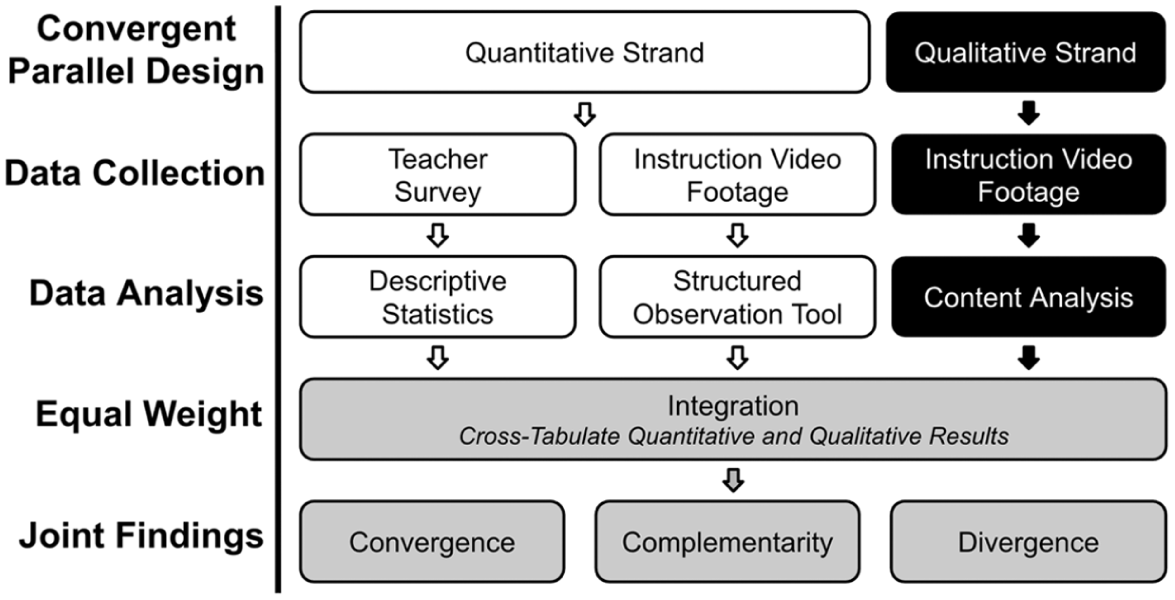
Convergent parallel mixed-methods design.
All three data sources contributed to all 3 research questions, though each carried more weight in each case. The teacher survey was the primary source for RQ1 (current implementation). The structured observation tool was the primary source for RQ2 (alignment with the framework). Qualitative content analysis, combined with survey and observational data, supported RQ3 (characteristics that distinguish aligned from non-aligned teachers). The mixed-methods integration brought these sources together to examine convergence, complementarity, and divergence (Fetters et al., 2013).
2.2. Sampling and Participants
The study was approved by the Institutional Review Board at the University of Tennessee, Knoxville. Using purposive sampling, we invited all 24 U.S. programs accredited by the Conference of Educational Administrators of Schools and Programs for the Deaf (CEASD, 2025) along with 10 self-contained public-school classrooms identified through professional networks in deaf education. Of the 34 invited programs, 11 agreed to participate (10 CEASD-accredited schools and 1 self-contained public-school program), a 32% program-level response rate. Within participating programs, program directors distributed the invitation to all teachers of prekindergarten through third-grade classrooms. Teachers chose individually whether to participate and provided written consent. Thirty-eight teachers from these 11 programs submitted video footage and completed a Qualtrics survey.
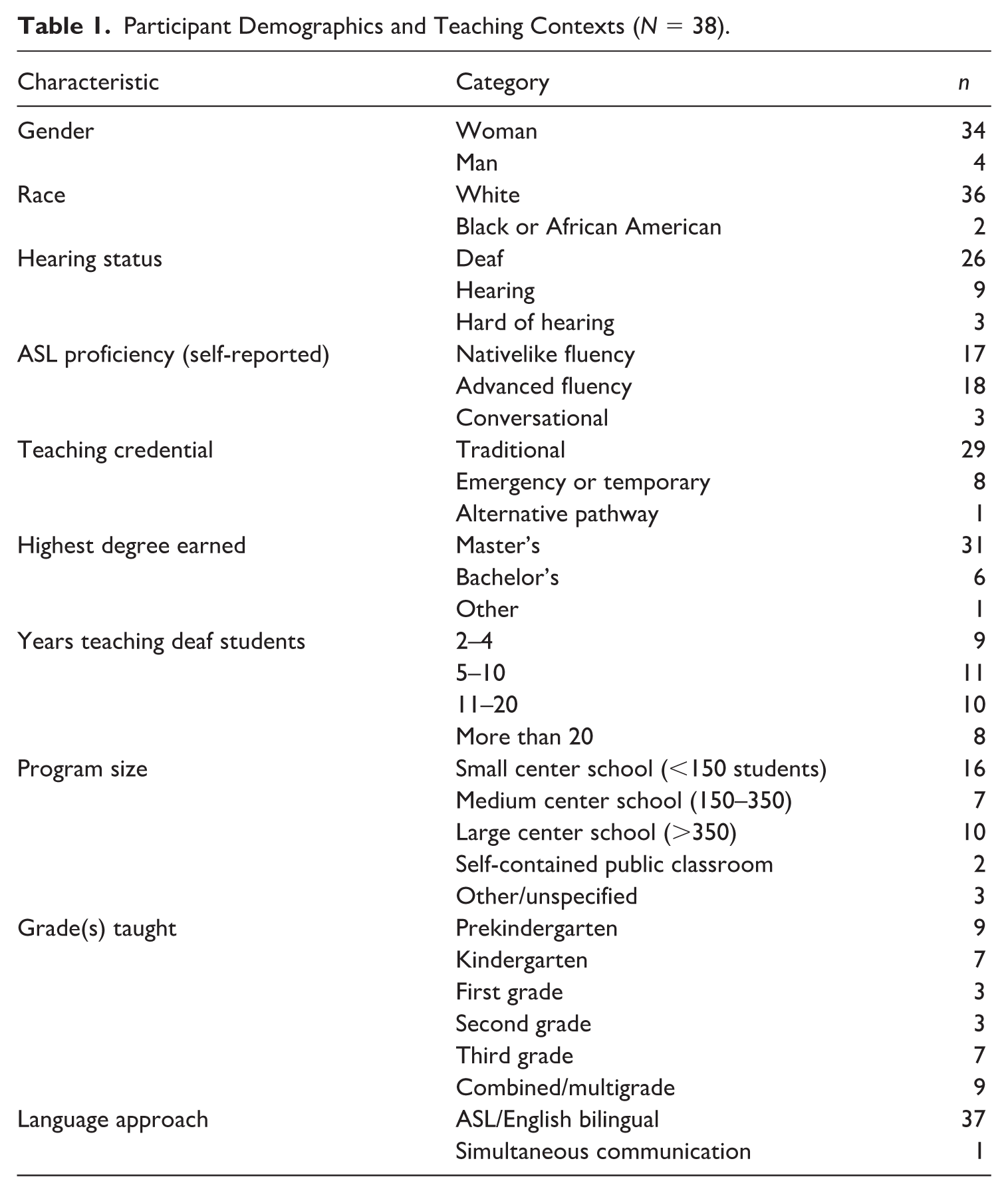
Participants taught prekindergarten through third grade in programs ranging from small center schools (under 150 students) to large center schools (over 350 students), with one self-contained public-school program represented. A 10-item demographic section used multiple-choice and checkbox formats with an open-response option on each item to allow self-identification where categorical options did not fit. Demographics and teaching contexts appear in Table 1.
Participant Demographics and Teaching Contexts (N = 38).
2.3. Quantitative Data Collection and Analysis
Quantitative data came from two instruments administered between April 2024 and June 2024: a Qualtrics survey and a structured observational tool applied to teacher-submitted classroom videos.
2.3.1. Survey of Instructional Practices
The survey gathered information on 4 key areas: (a) how signed literacy was positioned in the curriculum (stand-alone subject, integrated into language arts, elective, or embedded in daily routines), (b) estimated weekly instructional time dedicated to signed literacy, (c) use of video-based signing practice, and (d) use of specific curricula or instructional frameworks. Additional items asked teachers to allocate their ASL instructional time across 5 categories: 4 discourse genres (narrative, informational, persuasive, and poetry) and a residual nongenre category. The 5 percentages were required to total 100, yielding proportional rather than absolute time estimates and enabling comparison across teachers whose total instructional time differed.
2.3.2. Structured Observational Tool
Teachers were invited to submit up to 1.5 hours of classroom video representing their comprehensive instructional methods for supporting students’ signing skills. This phrasing was chosen deliberately to avoid conflating signed literacy with the use of ASL as a medium for teaching reading. Teachers selected lessons they considered strong examples, in single continuous lessons or shorter segments across multiple days. Teachers were informed that analyses would focus on instructional practices rather than student behavior or content accuracy.
Videos were scored using the SISI Observational Tool (Holcomb, 2025), adapted from the SIWI Observational Tool (Wolbers et al., 2022). Both draw on evidence-based composing instruction including gradual release of responsibility (Fisher & Frey, 2021; Pearson et al., 2019), strategy instruction (Harris & Graham, 2017), and genre-based pedagogy (Rose, 2018) across the composing cycle. The tool operationalizes the SISI framework through 45 indicators. Example items include the following.
The teacher guides students in brainstorming ideas of what to include in the composition.
The teacher guides students in organizing ideas to be included in the composition.
The teacher guides students in expressing complete ideas to be included in the composition through signed videos.
The teacher guides students in reviewing, evaluating, and revising their signed videos.
The teacher provides visual scaffolds to assist with navigating genre structures.
The framework centers on signed composition, so most indicators could only be scored when the observed lesson is organized around the composing process. Because most teachers in the sample had not received SISI training, the tool assessed alignment with evidence-based composing instruction rather than fidelity to training received.
Both raters were fluent in ASL and trained in SISI, and neither had access to survey responses during scoring. Prior work with four teachers showed 91% agreement and Cohen’s κ = .88 (Holcomb & Oakes, 2026). Across all 38 teachers in the present study, initial agreement before consensus was 93% (κ = .85), in line with reporting standards for observation reliability (Wilhelm et al., 2018). During consensus coding, raters explained their rationales, re-watched relevant footage, and referenced the operational definitions of each indicator until they agreed on a final score. Final scores were summed and divided by 45 to yield a percentage per teacher.
2.3.3. Statistical Analyses
Descriptive statistics (frequencies, means, standard deviations, and ranges) were computed for all survey items and SISI observation scores. Categorical responses were summarized as frequencies. ASL genre allocations were summarized as coverage (number and percentage of teachers reporting any time in each genre) and dosage (M, SD, and range of percentage of instructional time, computed only among teachers who reported teaching each genre). SISI observation scores were summarized as the distribution of teachers across score bands (0–10%, 11–30%, 31–60%, 61–80%, and 81–100%) to document the shape of the distribution given the tool’s floor effect, and as group means with standard deviations for composing-forward and non-composing-forward teachers. Analyses were conducted in SPSS.
2.4. Qualitative Analysis
The same classroom videos were also analyzed through hybrid deductive-inductive content analysis (Fereday & Muir-Cochrane, 2006; Schreier, 2012), a tradition suited to studies that both test predefined categories and remain open to emergent patterns. Coding proceeded in 2 rounds applied to all 38 videos by both researchers in a shared Google Spreadsheet, following iterative procedures (Miles et al., 2020; Saldaña, 2021). The first round used two a priori deductive codes drawn from SISI and SIWI literature: the target language of instruction (ASL, English, both, or neither) and whether instruction was contextualized within a composition task. Each researcher independently applied both codes to each video. Preconsensus agreement was 94.7% (36 of 38 videos; Cohen’s κ = .89), an acceptable level of reliability for content analysis (Krippendorff, 2019). Disagreements were resolved through joint review of relevant video segments.
The second round developed inductive codes to capture instructional practices beyond the deductive codes. Both researchers developed, applied, and refined these codes collaboratively through iterative comparison, continuing until no new codes emerged from the final videos analyzed. This process yielded 30 codes. Because inductive codes were developed iteratively rather than from a fixed a priori list, preconsensus agreement was not calculated for them.
2.5. Mixed-Methods Integration and Analysis
After completing quantitative and qualitative analyses independently, we integrated findings across the three data sources to address each research question from multiple angles. The integration was organized around 3 questions: (a) what teachers reported doing compared with what they were observed doing (RQ1); (b) what distinguished teachers who enacted composing-forward instruction from those who did not (RQ2 and RQ3); and (c) what teachers who did not enact composing-forward instruction were doing (RQ1 and RQ3). Each question was examined by comparing rates, proportions, and patterns across the three data sources (Guetterman et al., 2015). Following Fetters et al. (2013), we characterized findings as convergent when the three sources pointed in the same direction, complementary when one source filled in context the others could not provide, or divergent when sources disagreed.
2.6. Positionality
Both authors are deaf researchers and former teachers of deaf students with fluency in ASL and English. The first author created the SISI framework that anchors this study, is a researcher and teacher trainer for the SIWI framework, and is a cofounder of Hands Land, a nonprofit that produces ASL curriculum referenced here. The second author has received training in SISI. These positions give us insider knowledge of classroom dynamics, deaf-specific curricula, and sign bilingual instruction, and our work with SISI shapes how we recognize and interpret what teachers are doing. The deaf research community is small, and researchers with expertise to study signed literacy instruction often overlap with those who develop the frameworks being studied and those who provide professional development to teachers. We name this openly so readers can weigh the work accordingly.
3. Results
Findings are organized around 3 research questions: how signed literacy instruction is currently implemented (RQ1), the degree to which observed practices align with the composing-forward SISI framework (RQ2), and what teacher, curricular, and structural characteristics distinguish aligned from nonaligned teachers (RQ3). The teacher survey, SISI Observational Tool, and qualitative content analysis of classroom videos contribute to all 3, with the mixed-methods integration drawing them together.
3.1. Quantitative Results
3.1.1. Survey of Instructional Practices
Table 2 reports categorical survey responses and Table 3 reports genre allocation.
Teacher Survey of Instructional Practices: Categorical Responses (N = 38).
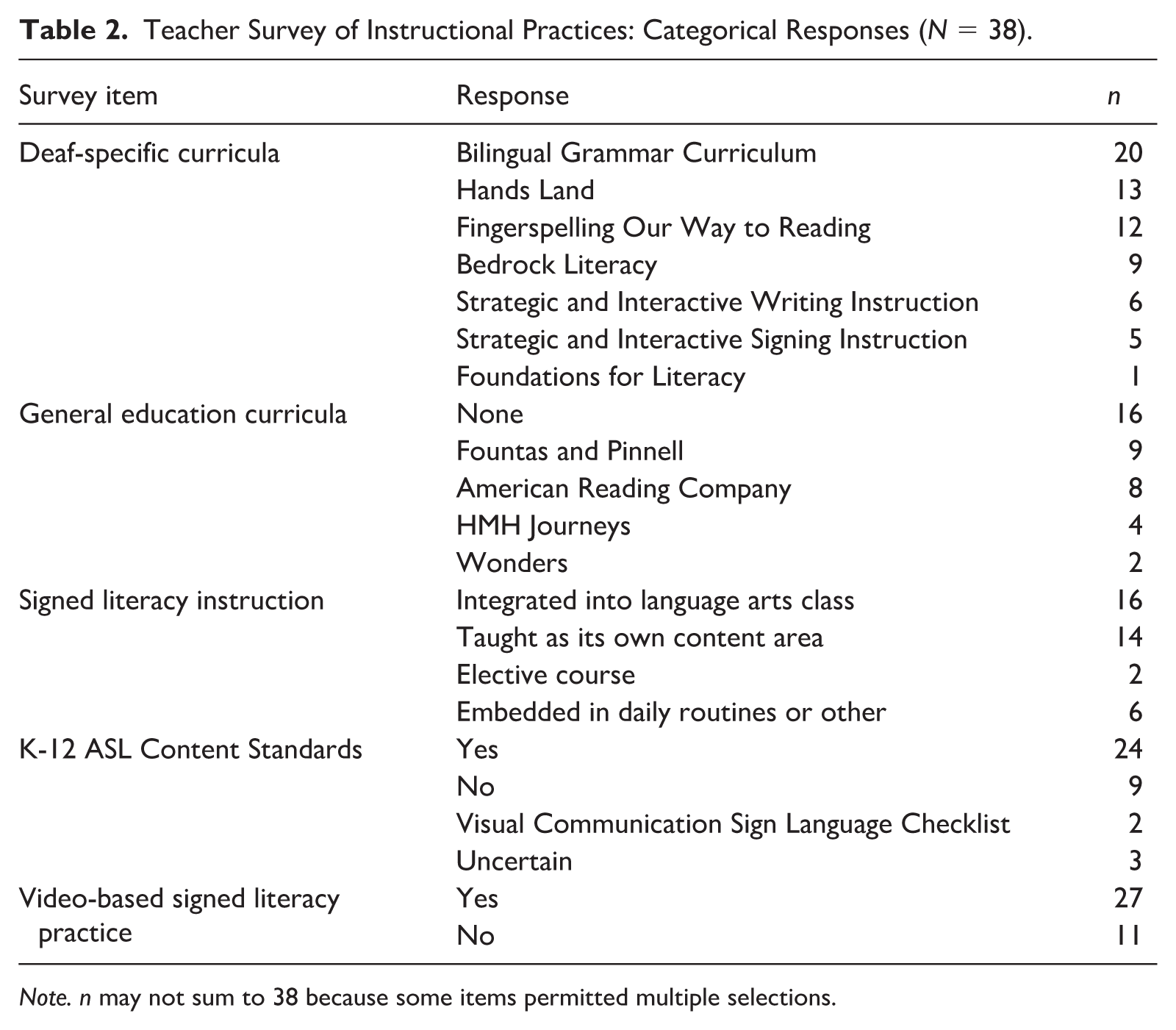
Note. n may not sum to 38 because some items permitted multiple selections.
Teacher-Reported Allocation of ASL Instructional Time Across Literacy Genres (N = 38).
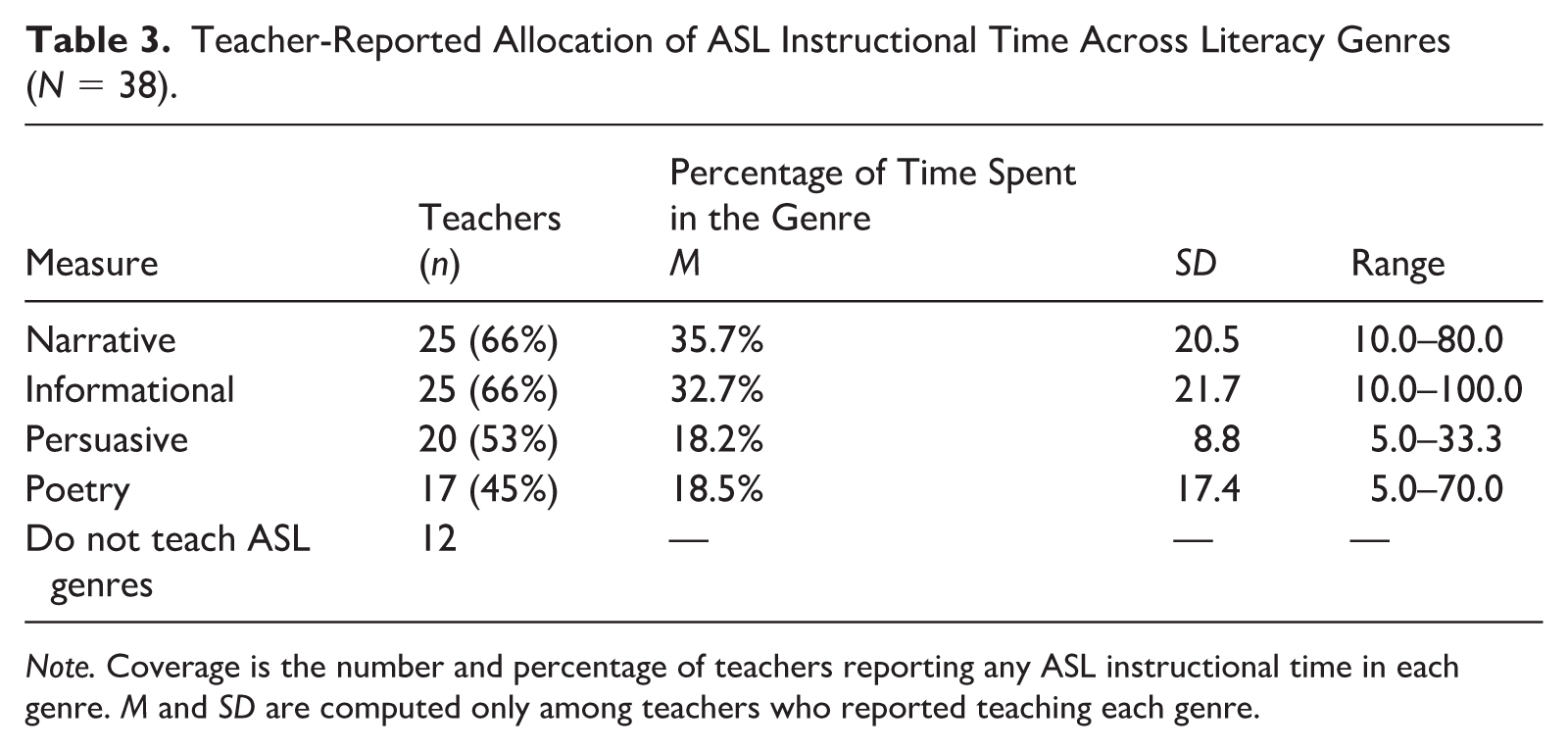
Note. Coverage is the number and percentage of teachers reporting any ASL instructional time in each genre. M and SD are computed only among teachers who reported teaching each genre.
3.1.1.1. Use of Videos for Signing Practice
Twenty-seven of 38 teachers (71%) reported engaging students in video-based signing practice both by viewing and composing. Among the 27 who engaged in this practice, weekly time clustered at the low end. Twelve reported 30 minutes per week, 11 reported 1-2 hours per week, 2 reported 3–4 hours per week, 2 reported more than 4 hours per week, and 1 indicated intermittent use.
3.1.1.2. Signed Language Curricula and Instructional Approach
The Bilingual Grammar Curriculum was the most widely used deaf-specific curriculum (20 of 38 teachers, 53%). All other deaf-specific options were used by fewer than one-third of the sample, and SISI was identified by only 5 teachers. Most teachers described signed literacy as either integrated into language arts (16, 42%) or taught as its own content area (14, 37%), with fewer positioning it as elective or embedded in routines. Twenty-four of 38 teachers (63%) reported aligning with the K-12 ASL Content Standards.
3.1.1.3. Genre Allocations
Genre coverage was uneven across the sample. Twelve of 38 teachers (32%) reported no ASL genre instruction at all. Narrative and informational were each taught by 25 of 38 teachers (66%), persuasive by 20 of 38 teachers (53%), and poetry by 17 of 38 teachers (45%). Among teachers who taught each genre, narrative and informational received roughly a third of ASL instructional time on average, while persuasive and poetry received about 18% of instructional time each(Table 3).
3.1.2. Structured Observation
The SISI Observational Tool assessed teachers’ alignment with the evidence-based composing instruction. Scores ranged from 0% to 100% but were heavily concentrated at the low end (Table 4). More than two-thirds of teachers (26 of 38, 68%) scored between 0% and 10%, while only 6 (16%) met or exceeded the 61% threshold for implementation of evidence-based composing instruction. This indicates that most observed lessons did not center on composing in signed language, making many teaching indicators structurally inapplicable. In subsequent sections, the 6 teachers who met or exceeded the 61% threshold are referred to as composing-forward (CF) teachers, and the remaining 32 as non-composing-forward (non-CF) teachers.
Distribution of SISI Observational Tool Scores Across Teachers (N = 38).
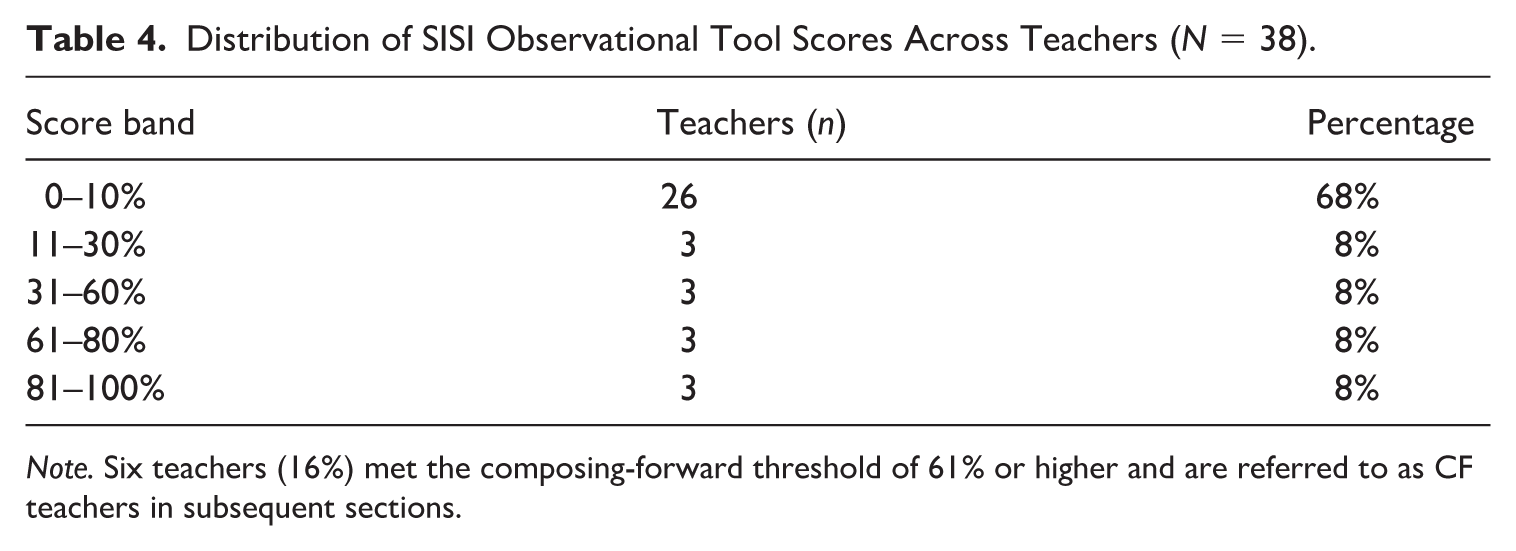
Note. Six teachers (16%) met the composing-forward threshold of 61% or higher and are referred to as CF teachers in subsequent sections.
3.2. Qualitative Results
Although teachers received identical prompts to submit classroom videos demonstrating how they support their deaf students’ signing skills, submissions varied considerably. Some submitted videos that captured extended composing cycles centered on student-generated signed or written texts. Others submitted videos that demonstrated vocabulary drills, grammar instruction, or read-alouds. This variation was itself informative, pointing to wide differences in how teachers approach instruction meant to support signing skills.
3.2.1. Deductive Coding
Submitted videos were coded into 6 instructional profiles defined by two a priori dimensions: contextualization and target language. Contextualization refers to whether instruction was grounded in authentic, real-world purposes (e.g., students developing signed narratives for families) or organized as isolated skill drills (e.g., memorizing vocabulary or practicing grammar in isolation). Target language refers to whether ASL, English, or both served as the instructional focus and product. When ASL was the target, teachers focused on developing students’ viewing and signing skills, including vocabulary, grammar, comprehension, and discourse. When English as the target, teachers focused on reading and writing skills, including vocabulary, grammar, comprehension, and discourse, while typically using ASL as the medium of instruction. A small number of teachers targeted both languages within coordinated activities, and 1 teacher submitted a math lesson outside the literacy frame. Table 5 reports profile frequencies.
Frequencies of Instructional Profiles (N = 38).
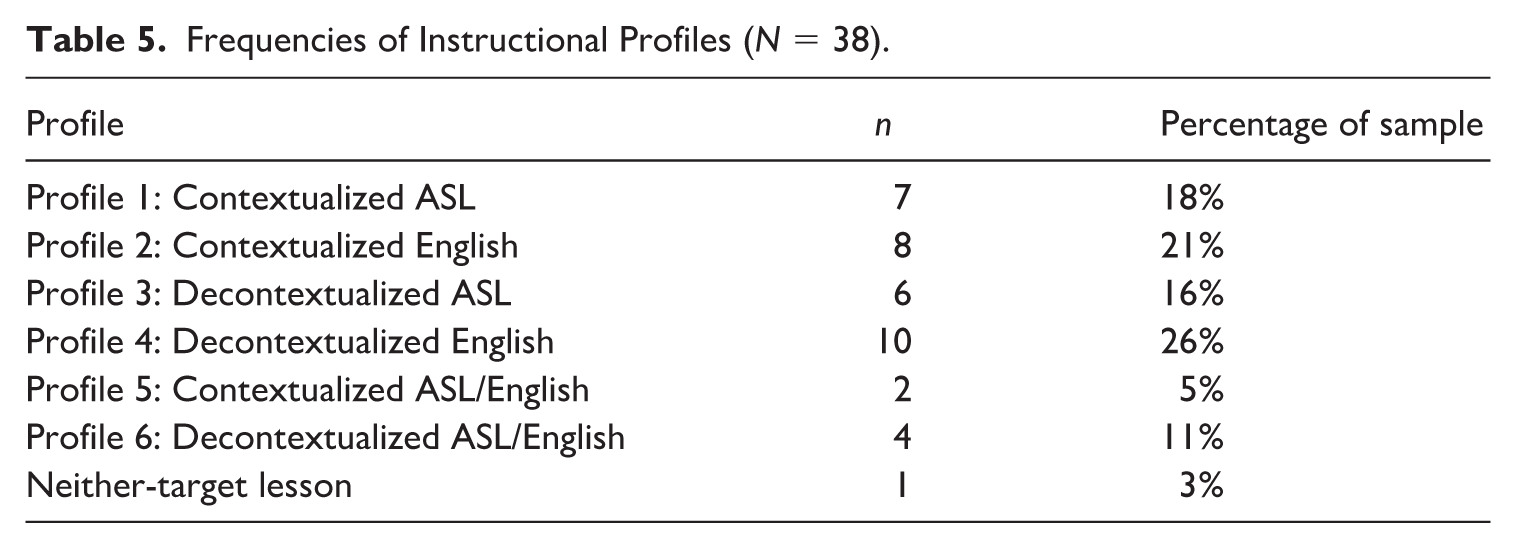
Profiles 1 and 5 represented the 9 teachers whose lessons included contextualized instruction that targeted signing or signing/writing skills. However, not all contextualized lessons showed strong alignment with evidence-based composing instruction as measured by the SISI Observational Tool. Of these 9 teachers, 6 met or exceeded the 61% threshold on the SISI Observational Tool and were classified as composing-forward teachers in subsequent analysis.
3.2.1.1. Profile 1: Contextualized ASL Instruction (n = 7)
ASL served as medium, target, and product. Teachers used ASL to teach ASL skills through the composition of signed texts for an audience. One exemplifying lesson worked through the composing process to produce an informational ASL report on a living organism. The teacher introduced the prompt and audience, used guided viewing of mentor videos to discuss text structure and grammatical features, and led students through shared signing to create, revise, and share their report.
3.2.1.2. Profile 2: Contextualized English Instruction (n = 8)
ASL served as medium while English served as target and product. Teachers used ASL to teach reading and writing skills through composition of English texts for an audience. One exemplifying lesson had students develop personal narratives about vacation experiences, beginning with drawings discussed by the whole group, then writing sentences and receiving explicit instruction on revision strategies focused on descriptive verbs in English, with peer feedback throughout.
3.2.1.3. Profile 3: Decontextualized ASL Instruction (n = 6)
ASL was the focus, but skills were taught in isolation rather than within a composition task. Common activities included vocabulary drills, classifier practice, handshape exercises, and sentence-level grammar routines without extension to connected discourse in compositions. One exemplifying lesson presented a series of ASL sentences for students to identify parts of speech (nouns, verbs, adjectives), without asking students to use these features in signed compositions.
3.2.1.4. Profile 4: Decontextualized English Instruction (n = 10)
The most common single profile. ASL served as medium while English was the target, but skills were taught through isolated drills rather than extended written composition. One exemplifying lesson on alphabetical order had the teacher use slides to teach the A–Z sequence, then had students arrange three words alphabetically and complete worksheets on missing letters and letter-order, targeting English literacy through isolated drill rather than reading or writing extended texts.
3.2.1.5. Profile 5: Contextualized ASL and English Instruction (n = 2)
A bilingual approach treating both languages as equal composition targets rather than treating one as medium and the other as target. This profile alternated ASL and English in the target and product roles within a coordinated composing cycle. One exemplifying lesson had students develop informational reports about an animal of their choice. Students first planned in ASL and then drafted their report as an ASL video The teacher later used guided writing to help students to compare ASL and written equivalences for key ideas and provided feedback on both signed and written versions.
3.2.1.6. Profile 6: Decontextualized ASL and English Instruction (n = 4)
Lessons addressed both languages separately through vocabulary drills or grammar instruction without movement toward composing signed or written texts. Attention to both languages as targets was present but stayed at the level of skill work.
3.2.2. Inductive Coding
The inductive coding identified 30 teaching practices across all observed lessons. The most widespread was use of visual prompts to elicit language (n = 20, 53%), followed by interactive group discussions (n = 17, 45%), vocabulary building (n = 16, 42%), genre instruction (n = 16, 42%), repetitive language practice (n = 14, 37%), concept/schema building (n = 13, 34%), explicit grammar instruction (n = 13, 34%), storysigning of English books (n = 11, 29%), and student-generated content (n = 11, 29%). The remaining practices appeared less often: composing process – ideas, organization, production, revision (n = 10, 26%), visual scaffolds/anchors for target skills (n = 10, 26%), guided writing (n = 8, 21%), text comprehension (n = 8, 21%), mentor text (n = 7, 18%), shared (student-to-student) signing (n = 6, 16%), translation tasks (n = 6, 16%), guided (teacher-led) signing (n = 5, 13%), and text decomposition (n = 5, 13%). Twelve practices appeared in 4 or fewer teachers’ lessons–independent writing, sign aloud what was written, editing, response to text, guided reading, phonological awareness, shared reading, alphabetic awareness, guided viewing, interpreting English video, ASL writing system, and structured play (each n ⩽ 4, 11%).
3.3. Mixed-Methods Integration
The integration is organized around 3 questions: what teachers report doing compared with what they are observed doing (RQ1), what distinguishes teachers who enact composing-forward signed literacy instruction (RQ2 and RQ3), and what teachers who do not enact composing-forward instruction are doing instead (RQ1 and RQ3). Following Fetters et al. (2013), we examined points of convergence, complementarity, and divergence across the three data sources.
3.3.1. Teacher Reports vs. Classroom Observations
On the survey, most teachers reported engaging students in signed literacy work. Twenty-seven of 38 (71%) teachers reported video-based signing practice, and 26 of 38 (68%) reported teaching at least one ASL genre. Observational and qualitative data showed substantially lower rates of composing-forward instruction. Across the 38 observed lessons, 7 (18%) teachers had students compose signed texts only, 8 (21%) teachers had students compose written texts only, and 2 (5%) teachers had students compose both signed and written texts. However, only 10 teachers (26%) were observed engaging students in a fuller composing process that included generating ideas, organizing ideas, producing sentences, and revising in either ASL or English. Only 6 (16%) teachers met the threshold for applying evidence-based composing instruction for signed texts.
Two findings emerge. The first is convergent; composing signed texts is rare across all three sources. The second is divergent; of the 27 teachers who reported video-based signing practice, only 9 engaged students in signed composition and only 6 met the evidence-based composing instruction threshold. Many of the submitted observation videos centered on vocabulary instruction, grammar routines, reading, or writing. This divergence provides evidence that the field lacks shared knowledge or skills in implementing signed literacy instruction. Teachers often blend signed language as medium with print literacy as target.
3.3.2. What Distinguishes Composing-Forward (CF) Teachers
The most clear distinguishing variable was SISI adoption. Five of the 6 CF teachers identified SISI on the curriculum survey, compared with none of the 32 non-CF teachers. The sixth CF teacher did not identify SISI but submitted a contextualized prekindergarten lesson. SISI adoption was the only curriculum identifier that separated the two groups – CF and non-CF teachers - at this magnitude. The qualitative coding extended this finding. All 6 CF teachers showed contextualized instruction, and 5 of 6 targeted ASL as their sole instructional focus (the sixth targeted both languages). The convergence of SISI adoption, observational scores of evidence-based composing instruction, and contextualized ASL-targeted lessons in the same 6 teachers across three independently analyzed data sources suggests that these not only apply evidence-based practices, but also work within structural arrangements that protect time for fuller composing cycles.
The inductive coding identified specific practices distinguishing CF teachers from the rest of the sample (Table 6). These form a coherent cluster of composing-cycle moves - anchoring target skills through visual scaffolds, viewing, analyzing, and decomposing mentor texts, jointly producing new texts through guided-to-independent signing, and translating from signing to writing along the way. CF teachers consistently enacted multiple practices from this cluster within the same lesson. Non-CF teachers rarely enacted any of them.
Instructional Practices That Distinguish CF Teachers from Non-CF Teachers.
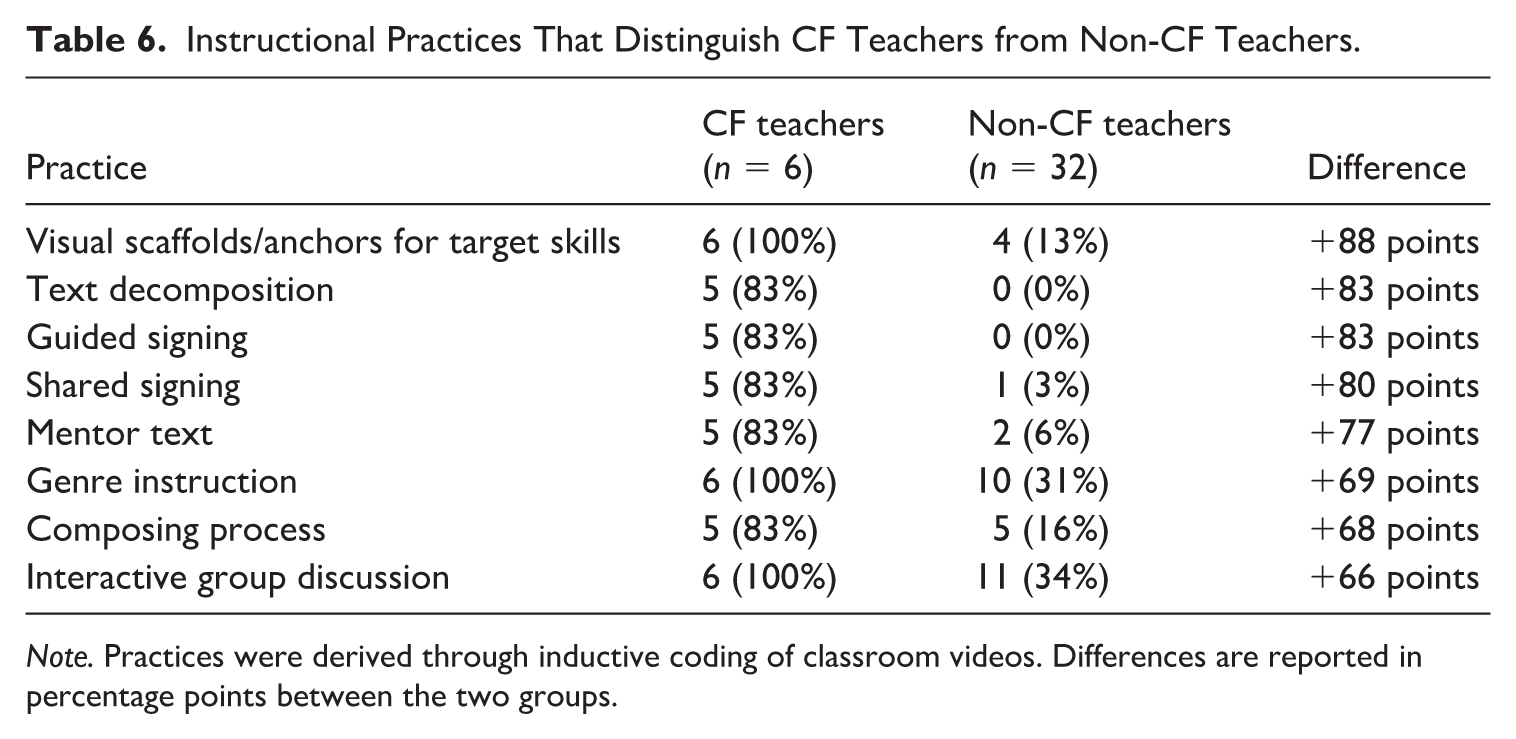
Note. Practices were derived through inductive coding of classroom videos. Differences are reported in percentage points between the two groups.
Several characteristics that might be expected to set CF teachers apart did not. Positioning of signed literacy instruction did not clearly distinguish CF and non-CF teachers. Among CF teachers, 3 of 6 (50%) positioned it as a stand-alone content area and 2 of 6 (33%) as integrated into broader language arts. Among non-CF teachers, 11 of 32 (34%) positioned it as a stand-alone content area and 14 of 32 (44%) as integrated into broader language arts. Alignment with the K-12 ASL Content Standards followed the same pattern (67% CF vs. 62% non-CF). Demographics, teaching credentials, years of experience, ASL proficiency, and use of other deaf-specific curricula also did not distinguish the groups. Five out of 6 (83%) CF teachers were deaf, but so were 20 of the 32 (62%) non-CF teachers. The cleanest reading is that SISI adoption and the evidence-based practices the framework trains are what set CF teachers apart in how signed literacy instruction is enacted.
3.3.3. What Non-CF Teachers Are Doing Instead
Most of the 32 non-CF teachers’ instructional work targeted English rather than ASL. Eighteen of these 32 (56%) non-CF teachers used ASL as medium while English served as target, 8 targeted ASL, 5 targeted both languages, and 1 submitted a math lesson. The dominant pattern in the non-CF group was instruction that used signed language to scaffold print literacy, rather than instruction that treated signed language itself as its own domain of literacy instruction.
Two deaf-specific curricula were widely used in the non-CF group: Bilingual Grammar Curriculum (18 of 32, 56%) and Hands Land (12 of 32, 38%). Neither is designed to operationalize composing-forward instruction. Among the 18 teachers who used BGC without SISI, none were labelled as composing-forward using evidence-based practices. Among the 2 who used both – BGC and SISI, both were composing-forward. Hands Land users concentrated in prekindergarten and kindergarten classrooms (10 of 13, 77%), consistent with the curriculum’s early language focus. Only 1 of the 13 Hands Land users were composing-forward. These patterns suggest that the most widely used deaf-specific curricula – BGC and Hands Land - do not reinforce evidence-based composing instruction on their own. The non-CF group using these curricula pursues different instructional goals with different curricular supports.
4. Discussion
This study set out to document how signed literacy instruction is currently enacted in U.S. deaf education classrooms, how closely observed practice aligns with the composing-forward SISI framework, and what patterns distinguish teachers across settings. The main finding, running across the 3 research questions and three data sources, is that signed language was not consistently taught as its own domain of literacy instruction in the 38 participating classrooms across 11 deaf education programs. The literature suggests that this outcome is not because teachers reject signed literacy (Holcomb & Eberwein, 2025), but because the field has not yet built the conceptual and structural supports that would let it function as a dedicated instructional domain alongside print literacy in the service of biliteracy (Holcomb & Oakes, 2026).
4.1. Signed Literacy as a Literacy Domain
Our prior survey-based work (Holcomb & Eberwein, 2025) found that teachers across the U.S. recognize signed literacy as important but report that it lacks formalized curricula, sufficient instructional time, and structured instructional approaches. The current study extends that line of work by adding direct observation. As in the previous survey, teachers again reported strong engagement with video-based signing practice, yet observation showed that only 9 of 38 teachers actually incorporated signed composition in their lessons, and only 6 met the evidence-based composing threshold in the observed lessons. This gap reflects what teachers counted as supporting students’ signing skills. Most submitted isolated vocabulary and grammar practice for reading and writing, and sometimes signing, rather than integrating those skills into broader composing projects to produce signed texts. A substantial portion of teachers described signed literacy instruction as integrated into their language arts class, which is a structural arrangement that places signed and written literacy on the same schedule and that, in our sample, typically resulted in English-targeted instruction. ASL served as the delivery mechanism while English remained the target and the product.
Recent signed literacy scholarship has argued that this interchangeability of medium, target, and product is precisely what blocks signed language from being treated as its own literacy domain (Andrews & Nover, 2021; Gibson & Byrne, 2024; Holcomb & Eberwein, 2025). Signed literacy is the development of students’ capacity to view, analyze, and compose signed texts across genres and audiences, drawing on discourse features specific to signed language such as spatial organization, role shift, constructed action, perspective marking, and cohesion through eye gaze and signing space (Cormier et al., 2015; Dudis, 2004; Smith & Cormier, 2014). Mastery of these features do not emerge automatically from using signed language as a medium of instruction to scaffold print. They must be taught, modeled, and practiced as targets and products. When the three roles collapse into a structure in which signed language is always the medium and written language is always both the target and the product, the work of signed literacy disappears from the curriculum. However, a small group of teachers demonstrates what is possible when supports are in place.
4.2. What Composing-Forward Signed Literacy Instruction Looks Like
Six teachers scored above the threshold for evidence-based composing instruction, and their characteristics form a coherent profile. All six targeted ASL or both languages, and all six showed contextualized instruction that had real-world purpose and application in language use. The inductive coding identified a cluster of teaching practices such as anchoring instruction in a target skill, mentor text use, text decomposition, guided signing, shared signing, and genre-based instruction that appeared consistently in their lessons and rarely elsewhere. These teachers aligned signed language as medium, target, and product within the literacy instruction. Five out of these six teachers were trained in SISI.
SISI is designed to work alongside SIWI as a biliteracy pairing. SIWI has decades of strong professional development (Wolbers et al., 2016) and research base showing that composing-forward, contextualized writing instruction produces gains in deaf students’ writing across vocabulary, grammar, and discourse outcomes (Bowers et al., 2016; Wolbers et al., 2012; Wolbers et al., 2022; Wolbers et al., 2026). SISI recently extends the same logic to signed language but with younger students (Holcomb, 2024; Holcomb & Oakes, 2026). For younger students, SISI is theorized to provide a developmental foundation for the written composition work SIWI targets. The cognitive work of generating, organizing, and adapting content to an audience is not language-specific, and working through the composing process first in signed language gives young deaf students access to the discourse moves of composing in the language they can most fully use. Writing then becomes a matter of translating and adapting ideas rather than generating them for the first time in a less accessible language.
In the SISI/SIWI framework, the composing cycle serves as the curricular structure, with vocabulary and grammar taught inside it. Students analyze mentor texts, co-construct new texts with teacher support, and gradually take ownership of independent composition through gradual release (Pearson et al., 2019). Vocabulary and grammar surface and are practiced within authentic discourse tasks rather than as an isolated skill to memorize and practice through drills. In this way, vocabulary and grammar become resources for extended, purposeful communication. This positioning is important because research with hearing children has consistently shown that grammar taught in isolation does not transfer to broader outcomes (S. Jones et al., 2013; Warren, 2020), while grammar embedded in composing produces stronger writing outcomes (Musa, 2021; Myhill, 2021).
The Bilingual Grammar Curriculum (Czubek & Di Perri, 2021) was used by over half of our sample (20 of 38), reflecting its availability as one of the few deaf-specific curricula for teaching signing skills. Among the 18 teachers who used BGC without SISI, none scored CF. Among the 2 who used both, both did. Thus, adopting a composing-forward framework does not require abandoning BGC. A BGC lesson on a grammatical form can serve as the starting point for signed composition, with students using that form to make meaning for an authentic audience. However, whether the SISI/SIWI pairing produces the biliteracy outcomes the theory predicts remains an open empirical question. Our study did not measure student outcomes. What our data do show is that composing-forward signed literacy instruction rooted in evidence-based practices, when it occurs, clusters tightly around SISI adoption, a pattern that motivates further empirical work on the pairing as a biliteracy framework.
Deaf students’ language histories vary too much across classrooms and within them for a single curriculum package to fit. What teachers need is an evidence-based framework general enough to apply across cohorts and specific enough to guide concrete decisions such as what the communicative task is, what signing and/or writing skill the lesson is designed to stretch, and how the composing cycle gets enacted with each particular cohort of students. SISI and SIWI, used in pairing, provide that kind of structured yet responsive literacy framework that is missing from many deaf education classrooms.
4.3. What the Field Needs
Our prior survey-based study (Holcomb & Eberwein, 2025) called for increased research, professional development, and institutional support to enhance signed literacy instruction. The current observational study reinforces these recommendations and sharpens what each looks like in practice. First, the field needs a shared operational definition of signed literacy that distinguishes it from print literacy delivered through signed language. Recent scholarship has converged on definitions centered on viewing, analysis, and composition of signed texts across genres and audiences (Andrews & Nover, 2021; Gibson & Byrne, 2024; Rosenburg et al., 2020), but these definitions have not yet translated into the instructional framework or curricula that most teachers use day to day. Until teachers have a clear understanding about treating signed language as target and product, not only as medium, the patterns documented here will likely ensue.
Second, the field needs sustained access to and training in evidence-based literacy frameworks that also include signed composition like SISI and SIWI. Variables that one might expect to predict composing-forward instruction (curricular positioning, alignment with the K-12 ASL Content Standards, years of experience, ASL proficiency, and use of other deaf-specific curricula) were similarly distributed across the two groups. SISI adoption was the clearest distinguishing variable in our analysis. Five of 6 CF teachers identified SISI, while none of the 32 non-CF teachers did. The evidence-based practices that distinguished CF teachers are the specific moves SISI trains teachers in. This suggests that broad familiarity with or support for signed literacy alone is inadequate unless paired with evidence-based practices that give teachers a structured way to organize and guide their instruction.
Third, the field needs professional preparation that equips teachers to work within an evidence-based, composing-forward literacy framework across both languages (Wolbers et al., 2016). This includes helping teachers use existing deaf-specific resources, including the ones that focus on vocabulary and grammar instruction, such as Fingerspelling Our Way to Reading and Bilingual Grammar Curriculum, to support a composing cycle rather than having them function apart from each other. These resources can be and should be complementary and more aligned. Teacher preparation that helps teachers position grammar work inside a composing cycle would let existing curricular investments do more work than they currently do. Studies of teacher learning have shown that brief but well-structured professional development can shift teachers’ approaches toward more functional, scaffolded instruction (Hamman-Ortiz et al., 2023). The same effort should apply to shifting teachers’ approach to signed literacy instruction.
4.4. Limitations
This study has several limitations. First, participation was voluntary and self-selected at both the program and teacher levels. Schools that declined to participate may differ systematically from those that joined, and findings should be interpreted as descriptive of this participating sample rather than as population-level estimates of U.S. deaf education practice. Second, the video corpus reflects teacher-selected exemplar lessons, which may over-represent polished instruction and under-represent typical day-to-day practice. Video length and quality also varied across sites, affecting the depth of analysis possible for each classroom. The lessons teachers chose were themselves informative. Most did not include targeted attention on viewing or signing skills, providing evidence about teachers’ conceptions of signed literacy instruction. Third, the SISI Observational Tool measures alignment with the evidence-based, composing-forward approaches, not instructional quality in a general sense. Lessons without composing components were structurally ineligible for many indicators in the tool, producing floor effects that reflect task misalignment with the tool rather than teaching weakness. Teachers might be using effective approaches that are different from the ones listed in the SISI Observational Tool. Our qualitative analysis was designed in part to address this constraint by describing what teachers did more broadly. Fourth, quantitative comparisons are exploratory. Small cell sizes (e.g., n = 6 for composing-forward teachers) limit statistical precision. These comparisons should be read as descriptive rather than causal. Fifth, several constructs relied on self-report, including teachers’ signing proficiency, reported instructional minutes, and reported genre coverage. As the divergence findings demonstrate, self-reports do not always align with observed practice. It is also uncertain whether teachers shared a common understanding of certain concepts, which might limit the comparability and accuracy of their responses. For example, if teachers understood signed literacy differently from how it was operationalized in this research, that mismatch could partly account for the divergence between their survey reports and their observed practices. Finally, this study does not link observed practices to student outcomes. The central remaining question, whether composing-forward, contextualized instruction predicts prekindergarten-3rd grade student growth in signed and written language, requires an experimental or longitudinal design with repeated classroom observations and parallel measures of both languages.
5. Conclusion
This study has documented signed literacy instruction as currently enacted across 38 teachers in 11 U.S. deaf education programs. Findings describe a field in an early stage of defining what signed literacy instruction means in practice. Most teachers valued signed literacy and reported engaging students in video-based signing work, but observed instruction rarely centered on composing signed texts. Instead, most teachers submitted lessons that used signed language as a medium for print literacy instruction, demonstrating that the operational distinction between signed and print literacy has not yet been sharpened in many classrooms. A small group of teachers demonstrated composing-forward instruction focused on signing skills, distinguished primarily by their adoption of the SISI framework. The broader agenda for the field is to develop shared definitions of signed literacy instruction, build out the framework and professional preparation resources that make composing-forward instruction feasible at scale, and treat signed literacy as its own domain with its own evidence-based pedagogy
Footnotes
Acknowledgements
We are deeply grateful to the teachers and schools who participated in this study for sharing their instructional practices and classroom videos.

Ethical Considerations
Ethical approval for this research was obtained from the University of Tennessee Institutional Review Board.
Consent to Participate
Written consent was obtained from all participating teachers, and schools secured parental/guardian consent for student participation in classroom video recordings.
Funding
The authors disclosed receipt of the following financial support for the research, authorship, and/or publication of this article: This study was supported by the National Institutes of Health (NIH), National Institute on Deafness and Other Communication Disorders (NIDCD), under Award No. R21DC020458. The content is solely the responsibility of the authors and does not necessarily represent the official views of the NIH.
Declaration of Conflicting Interests
The authors declared no potential conflicts of interest with respect to the research, authorship, and/or publication of this article.
Data Availability Statement
De-identified data supporting the findings of this study are available from the corresponding author upon reasonable request, consistent with institutional and IRB guidelines.