






Abstract
Phrasal verbs are a frequent and essential feature of English vocabulary. However, they pose persistent challenges for second language (L2) learners, particularly those from verb-framed languages like Japanese, due to structural and semantic differences. While their difficulty is well established, little is known about how phrasal verb usage develops across different proficiency levels in authentic learner writing. This corpus-based study examines how Japanese learners of English use phrasal verbs across different proficiency levels, focusing on overall frequency, semantic category distribution, and the frequency of phrasal verb sense usage. Drawing on the International Corpus Network of Asian Learners of English (ICNALE) Written Essays subcorpus, we analyzed 400 learner essays and compared phrasal verb usage to that of native speakers. Phrasal verbs were classified by semantic type (literal, aspectual, idiomatic) and by sense frequency, based on the Phrasal Verb Pedagogical (PHaVE) List. Proficiency had only a modest impact on phrasal verb usage patterns. Learners at higher levels used a slightly broader range of phrasal verbs, but overall usage remained well below native speaker levels, with limited shifts in semantic category or use of lower-frequency senses. The findings suggest that typological differences between Japanese and English may continue to shape phrasal verb usage patterns, with proficiency alone insufficient to drive native-like development. The study highlights the need for instruction that explicitly targets phrasal verb semantics, polysemy of phrasal verbs, and contextually appropriate usage of phrasal verbs to support L2 production that more closely resembles that of native speakers.
1. Introduction
Phrasal verbs are a central component of English vocabulary, occurring frequently in both spoken and written discourse (Biber et al., 1999; Celce-Murcia & Larsen-Freeman, 1999; Laufer & Goldstein, 2004; Wood, 2015). Their mastery is critical for second language (L2) learners seeking to develop natural-sounding and idiomatic language use (Boers, 2020; Conklin, 2020; Moon, 1998; Schmitt, 2004; Siyanova-Chanturia & Schmitt, 2007; Wray, 2002). However, phrasal verbs present persistent challenges for learners due to their semantic opacity, structural irregularity, and polysemous nature. Many phrasal verbs have meanings that cannot be directly inferred from their components. Moreover, a single phrasal verb may convey multiple distinct meanings depending on context (Celce-Murcia & Larsen-Freeman, 1999).
These challenges are particularly pronounced for learners whose first languages (L1s) differ typologically from English (Dagut & Laufer, 1985; Haugh & Takeuchi, 2022; Yasuda, 2010). In languages such as Japanese, motion and result are typically encoded within the verb itself, without the use of separate particles (Coventry & Guijarro-Fuentes, 2008; Talmy, 2008). The absence of phrasal verb-like constructions in Japanese complicates learners’ ability to interpret and produce phrasal verbs, especially those with idiomatic meanings. As a result, Japanese learners frequently avoid phrasal verbs or substitute them with simpler, single-word synonyms (Haugh & Takeuchi, 2022; Spring & Horie, 2013).
Although previous studies have explored the effects of semantic transparency and L1–L2 typological differences on phrasal verb learning (e.g., Dagut & Laufer, 1985), important gaps remain. In particular, little is known about how these factors interact with L2 proficiency over time. Questions persist regarding whether increased proficiency leads to broader and more native-like use of phrasal verbs, including ones having aspectual and idiomatic meanings, or whether patterns of avoidance and restricted usage persist even at higher levels. Furthermore, the role of polysemy in shaping learners’ phrasal verb use remains underexplored, especially for learners from verb-framed language backgrounds.
The present study addresses these gaps by analyzing the use of phrasal verbs among Japanese learners of English at different proficiency levels, using data from the International Corpus Network of Asian Learners of English (ICNALE) (Ishikawa, 2018). It examines how proficiency influences overall phrasal verb usage, the distribution of semantic types (literal, aspectual, idiomatic), and the use of multiple phrasal verb senses, providing new insights into the development of phrasal verb competence among Japanese learners of English as a foreign language (EFL).
2. Background Literature
2.1. Structural and Semantic Properties of Phrasal Verbs
Phrasal verbs are multiword constructions consisting of a lexical verb combined with an adverbial particle (e.g., pick up, take off, carry out). Structurally, many phrasal verbs are separable, allowing the object to intervene between the verb and the particle (e.g., pick the book up), while others are inseparable (e.g., look after). This distinguishes them from verb-preposition combinations, in which the preposition retains a grammatical function without significantly altering the verb’s meaning (Biber et al., 1999). Semantically, phrasal verbs vary widely in transparency. Some are relatively literal (e.g., walk away from here), others convey aspectual or resultative nuance (e.g., dance the night away), and still others are highly idiomatic (e.g., chew out ‘scold severely’).
An added layer of complexity is that many phrasal verbs are polysemous, meaning that a single verb-particle combination can convey multiple distinct senses depending on context (Gardner & Davies, 2007). For example, make up can mean ‘form a whole’ (‘Women make up more than half the class.’), ‘compensate for a loss’ (‘Can I make up the time tomorrow?’), to make a decision (‘I can’t make up my mind.’), or ‘invent a story’ (‘He made up an excuse.’). Mastery of phrasal verbs thus requires not only understanding their most frequent meanings but also recognizing and appropriately applying less frequent or context-specific senses.
Despite their structural and semantic complexity, phrasal verbs play a central role in English communication, particularly in informal and conversational registers (Garnier & Schmitt, 2016). Their high frequency and contribution to natural, idiomatic expression make them a critical component of L2 vocabulary development. For learners aiming to approximate native-like usage, developing the ability to comprehend and produce a range of phrasal verb types – and to navigate their polysemy – is essential. Given these complexities, a growing body of research has examined how semantic properties such as transparency and polysemy influence the learning and use of phrasal verbs by L2 learners.
2.2. Semantic Properties and Their Effects on Phrasal Verb Learning
The semantic properties of phrasal verbs have long been recognized as central to their learnability. Phrasal verbs differ in their degree of semantic transparency, and this property significantly affects L2 learning. Literal phrasal verbs are acquired more readily than both aspectual phrasal verbs, where the particle subtly modifies the verb’s meaning, and fully idiomatic phrasal verbs, where the combined meaning bears little relation to the individual parts. The difficulty learners face thus tends to increase along the continuum from literal to idiomatic phrasal verbs. A related continuum of difficulty is indicated by evidence that the low imageability of many particles contributes to the difficulty of learning phrasal verbs (Lindstromberg, 2022).
Empirical studies across diverse L2 contexts confirm these patterns. Dagut and Laufer (1985) found that Hebrew-speaking learners strongly favored literal phrasal verbs over figurative ones, which may reflect a reliance on semantic transparency. Similarly, Becker (2014) reported that Chinese learners consistently avoided idiomatic phrasal verbs. In corpus-based studies, such as Haugh and Takeuchi’s (2022) analysis, learner writing was dominated by phrasal verbs that express literal meanings, while aspectual and idiomatic phrasal verbs remained rare. Together, these studies suggest that learners’ phrasal verb usage is heavily influenced by semantic transparency – a pattern of usage that persists even at higher proficiency levels.
In addition to semantic transparency, polysemy poses a further challenge. Many phrasal verbs express multiple distinct meanings (Gardner & Davies, 2007), requiring learners to navigate meaning shifts depending on context. Sonbul et al. (2020) showed that semantic opacity significantly reduced learners’ ability to recognize and produce phrasal verb meanings. Although frequency of exposure improved recognition, mastery of lower-frequency senses remained limited. However, much of the existing research (e.g., Becker, 2014; Dagut & Laufer, 1985; Sonbul et al., 2020) relies on controlled tasks like multiple-choice tests, which may not capture learners’ spontaneous use of phrasal verbs. Thus, important questions remain. How does Japanese learners’ engagement with phrasal verbs develop across semantic categories as their proficiency grows? How do learners navigate polysemous phrasal verbs in authentic writing? Addressing these questions requires corpus-based analysis that distinguishes among semantic types and also examines how learners use multiple meanings over time – a gap the present study aims to fill.
2.3. L1 Typological Influence on Phrasal Verb Learning
While all L2 learners encounter challenges in learning phrasal verbs, those from non-Germanic, verb-framed languages such as Japanese, Spanish, or French face particular difficulty. This is not only because their L1 lacks verb-particle constructions, but also because their typological features constrain how learners interpret phrasal verbs across semantic types, from literal to idiomatic (Yasuda, 2010; Yoshitomi, 2008). In Japanese, motion and direction are encoded within the verb itself (e.g., ‘hairu’ enter), in contrast to English’s satellite-framed phrasal verbs (e.g., run out ‘deplete’), where meaning is distributed between the verb and the particle. Drawing on Talmy’s (1985, 2000) theory of event conflation, research suggests that in English, the verb typically conveys the manner of action while the particle expresses the main event (Spring, 2018). In verb-framed languages like Japanese, both elements are merged into a single verb, without a separate satellite to mark path or result. As a result, Japanese learners may process phrasal verbs as unanalyzed lexical chunks, leading to misinterpretation or avoidance.
Studies focusing directly on Japanese learners confirm these difficulties. Haugh and Takeuchi (2024), for example, found that learners were most accurate with directional phrasal verbs, likely due to L1–L2 semantic overlap, but that aspectual and idiomatic phrasal verbs were less accurately interpreted and often avoided. Qualitative responses further revealed that opaque phrasal verbs were frequently treated as unanalyzed chunks, suggesting limited understanding of particle meaning.
Together, these studies provide evidence that Japanese learners’ difficulties with phrasal verbs stem from the absence of verb-particle structures in their L1 and the transfer of motion-encoding patterns. These factors appear to have the potential to contribute to frequent misinterpretation or avoidance of phrasal verbs across semantic types. However, research has yet to fully examine how such L1-based tendencies shape processing across the full phrasal verb semantic spectrum. To better understand these patterns, this study uses corpus data to investigate whether Japanese learners continue to favor semantically transparent phrasal verbs across proficiency levels and gain new insights into the persistence of these typological constraints.
2.4. Effects of L2 Proficiency on Phrasal Verb Use
Prior research suggests that increased L2 proficiency generally supports greater use of phrasal verbs. For example, Liao and Fukuya (2004) found that advanced Chinese learners used phrasal verbs more frequently than intermediate learners. However, even advanced learners continued to prefer literal phrasal verbs (e.g., go away ‘to leave a place’), which suggests that semantic complexity continued to discourage use. Similarly, Siyanova-Chanturia and Schmitt (2007) found that even advanced learners tended to favor single-word synonyms over phrasal verbs in informal written contexts. Although exposure to English reduced some avoidance, phrasal verb usage remained substantially below native speaker levels, and it appears that proficiency may not fully eliminate these patterns of avoidance.
However, most prior research has focused on learners whose L1s are satellite-framed or have mixed typological backgrounds, such as Chinese. For learners from verb-framed languages like Japanese – which lacks phrasal verb analogues – the challenges may be even more pronounced. Consequently, Japanese learners may continue to avoid phrasal verbs, particularly aspectual and idiomatic types, even as their proficiency increases. This gap limits our understanding of how L1 typological distance interacts with proficiency in shaping trends in learners’ use of phrasal verbs. The present study addresses this gap by analyzing Japanese learners’ production of phrasal verbs across different proficiency stages, with attention paid to the likely importance of phrasal verb semantic category and polysemy.
3. The Present Study
This study addresses key gaps in our understanding of how Japanese learners learn and use phrasal verbs by examining usage patterns across different proficiency levels and semantic categories. It investigates not only the overall frequency of phrasal verb use but also how learners engage with semantic variation – ranging from transparent to idiomatic meanings – and the polysemy characteristic of many phrasal verbs.
Drawing on the ICNALE corpus, this study analyzes phrasal verb use among Japanese learners across four proficiency bands: A2, B1_1, B1_2, and B2. Although B1 proficiency is typically treated as a single level in the Common European Framework of Reference for Languages (CEFR) framework, the ICNALE corpus subdivides B1 into B1_1 (lower-intermediate) and B1_2 (upper-intermediate) bands, allowing for finer-grained comparisons. This subdivision enables a more detailed analysis of developmental trends across intermediate stages. The study extends prior research by employing a semantic classification framework that differentiates literal, aspectual, and idiomatic phrasal verb uses, thereby moving beyond basic frequency counts to examine learners’ engagement with phrasal verb meaning. In doing so, the study offers new insights into whether learners progress from transparent to more complex phrasal verbs as their proficiency increases.
Additionally, the study explores whether higher-proficiency learners demonstrate greater flexibility in using idiomatic and aspectual phrasal verbs, or whether avoidance persists even at higher levels. If phrasal verb development is more constrained by L1–L2 typological distance than by proficiency alone, the findings will highlight the need for explicit instruction targeting phrasal verb semantics in Japanese EFL contexts. More broadly, the study contributes to theoretical models of L2 vocabulary development and offers pedagogical guidance for improving phrasal verb instruction.
Building on these aims, the study addresses the following research questions:
Research question 1: Does proficiency level influence phrasal verb usage among Japanese learners, and how does their usage compare to that of native speakers?
Research question 2: Does proficiency affect the distribution of phrasal verb semantic types (literal, aspectual, idiomatic) among Japanese learners compared to native speakers?
Research question 3: Does proficiency level affect Japanese learners’ use of polysemous phrasal verbs, and to what extent does their usage align with the most frequent senses listed in the PHaVE List?
4. Methods
4.1. Research Design and Data
This study adopts a corpus-based approach to examine the semantic characteristics of phrasal verbs used by Japanese L2 learners across proficiency levels. Data were sourced from the ICNALE Written Essays subcorpus. Compiled between 2007 and 2013, the subcorpus comprises 5,600 essays (approximately 1.3 million words) written by 2,800 learners from diverse Asian backgrounds. For the present analysis, a subset of 400 essays written by Japanese learners was selected. These essays were categorized into four CEFR proficiency bands based on ICNALE metadata. The distribution of essays was as follows: A2 (n = 154), B1_1 (n = 179), B1_2 (n = 49), and B2 (n = 18). The average length of the essays increased with proficiency, from an average of 152 words at the A2 level to 238 words at the B2 level. Participants were asked to write 200–300-word essays on one of two topics (a part-time job for college students or non-smoking at restaurants) under standardized task conditions: use of Microsoft Word with spell-check enabled, but no external references permitted.
4.2. Data Collection and Preprocessing
Essays written by Japanese learners were extracted using ICNALE metadata. Preprocessing involved verifying file encoding, correcting non-standard characters, and removing duplicate files. Phrasal verbs were identified using AntConc (Version 4.2.4), with search parameters based on the PHaVE List (Garnier & Schmitt, 2015). The PHaVE List, developed by Garnier and Schmitt (2015), is a resource designed for pedagogical purposes. It identifies the 150 most frequent phrasal verbs in English based on large-scale corpus analysis. Crucially, the list addresses the issue of polysemy by identifying the most common meaning senses for each phrasal verb. Concordance lines were generated to preserve the immediate context for each phrasal verb occurrence and to compute raw frequency counts.
To allow comparisons across proficiency levels despite differences in subcorpus size, phrasal verb frequencies were normalized to occurrences per 1,000 words. The normalization formula was:

4.3. Phrasal Verb Classification
Extracted phrasal verbs were classified into three semantic categories – literal, aspectual, and idiomatic – based on whether the verb and particle components retained their dictionary-defined meanings. This classification followed a systematic framework to ensure transparency and consistency. Literal phrasal verbs are fully compositional, meaning that both the verb and the particle retain their literal meanings. This classification aligns with Celce-Murcia and Larsen-Freeman’s (1999) framework for transparent phrasal verbs. Examples include stand up (where stand means ‘to rise’ and up indicates ‘upward movement’), fall down (where fall means ‘to drop’ and down specifies direction), and carry out (where carry means ‘to transport’ and out denotes ‘outward movement’). Aspectual phrasal verbs exhibit partial compositionality: one component (either the verb or the particle) retains its literal meaning, while the other adopts a metaphorical or extended sense. Aspectual phrasal verbs often encode temporal or resultative shifts. For example, in ‘She looked over the documents,’ look retains its literal meaning, but over metaphorically indicates ‘reviewing.’ Similarly, in ‘He fished out his keys from his pocket,’ out retains its spatial meaning (movement from inside to outside), while fish is used metaphorically to mean ‘search.’ Idiomatic phrasal verbs are fully non-compositional, meaning that neither the verb nor the particle retains its literal meaning, and the overall phrase conveys a distinct, idiomatic interpretation. For example, in ‘He gave up after hours of negotiation,’ neither give (‘to transfer possession’) nor up (‘upward movement’) retains its original sense; instead, give up collectively means ‘to surrender.’
Unlike Sonbul et al. (2020), who operationalized phrasal verb transparency using a six-point opacity scale based on native speakers’ intuition, we adopted a more systematic binary classification approach based on Celce-Murcia and Larsen-Freeman’s (1999) componential framework. Specifically, each item was evaluated for the literalness of its two components (verb and particle) using a Yes/No judgment. This method aligned with our theoretical focus on the literal vs. figurative use of each component and allowed for clear categorization into three semantic types:
Literal (transparent): Both components used literally (e.g., sit down: sit – Yes, down – Yes)
Aspectual (semi-transparent): One component literal, one figurative (e.g., clean up: clean – Yes, up – No)
Idiomatic (figurative): Neither component literal (e.g., hang out: hang – No, out – No)
To ensure reliability, two independent raters (the second and third authors) initially coded the items, and a third rater (the first author) reviewed and verified the classifications. Any disagreements were subsequently resolved through discussion. A full list of the phrasal verbs used in the corpus, along with their frequency, semantic category (i.e., literal, aspectual, and idiomatic), and polysemy (i.e., senses), is provided in Appendix S1 in supplemental material. This list can also be accessed via the Open Science Framework at
https://osf.io/wx5zs/?view_only=98231e1e01bf4833a9dc466e6f1ab2ae
4.4. Data Analysis
Normalized phrasal verb frequencies were calculated per 1,000 words for both phrasal verb types (unique phrasal verbs) and phrasal verb tokens (total occurrences) across proficiency levels (A2, B1_1, B1_2, B2) and were compared with a native English speaker reference group from the ICNALE corpus. Descriptive statistics, including means, standard deviations, and ranges, were computed to summarize phrasal verb usage across groups, providing a baseline for subsequent inferential analyses.
To determine whether phrasal verb frequency (both types and tokens) varied significantly across proficiency levels, a chi-square test of independence was conducted. To measure the strength of association, a point estimate and 95% confidence interval (CI) for Cramér’s V were calculated. Thresholds of 0.1, 0.3, and 0.5 for Cramér’s V were interpreted as small, medium, and large effects, respectively. Following any significant chi-square result, post-hoc pairwise comparisons were conducted with Bonferroni correction applied to control for Type I error inflation. The phi coefficient (φ) was calculated as the effect size for each pairwise comparison.
To examine differences in the distribution of phrasal verb semantic categories (literal, aspectual, idiomatic) across proficiency levels, a chi-square test of independence was conducted. Given the possibility of low expected counts, statistical significance was determined using a Monte Carlo simulation with 2,000 replicates. The overall effect size was measured with Cramér’s V and its 95% CI. Post-hoc pairwise comparisons were conducted using Fisher’s exact tests with Bonferroni correction, and an associated Cramér’s V was calculated for each pair.
A third chi-square test of independence, also using a Monte Carlo simulation, examined the distribution of phrasal verb senses. The same procedure was used to calculate the overall effect size (Cramér’s V with 95% CI) and to conduct Bonferroni-corrected post-hoc pairwise comparisons with their corresponding effect sizes.
All chi-square tests were selected for their compatibility with categorical outcome variables (phrasal verb frequency, semantic type, and sense) and their ability to accommodate multiple groups. Monte Carlo simulations corrected for violations of the chi-square assumption of minimum expected frequencies. Effect sizes (Cramér’s V and the phi coefficient) provided insight into the practical significance of any differences, beyond statistical significance. Together, these analyses offered a comprehensive evaluation of phrasal verb usage, semantic categorization, and polysemous sense distribution, addressing the study’s research aims. All statistical analyses were conducted using R (Version 4.5.1; R Core Team, 2025) with the ‘stats’, ‘vcd’, ‘rcompanion’, and ‘DescTools’ packages.
5. Results
5.1. Phrasal Verb Frequency Across Proficiency Levels
Table 1 reports the absolute and normalized frequencies of unique phrasal verb types and total phrasal verb tokens across proficiency levels, expressed per 1,000 words. The number of unique phrasal verb types per 1,000 words increased steadily with proficiency, rising from 0.35 at A2 to 1.05 at B2. Notably, B2 learners exceeded native speakers in normalized phrasal verb type frequency (1.05 vs. 0.86 per 1,000 words), although the small sample size at B2 warrants cautious interpretation. These results suggest that as learners progress, they tend to diversify their phrasal verb usage, even if overall token frequency remains low. These trends are visually summarized in Figure 1, which displays the normalized frequencies of phrasal verb types and tokens across proficiency levels.
Normalized Frequencies of Phrasal Verb Types and Tokens by Proficiency Level.
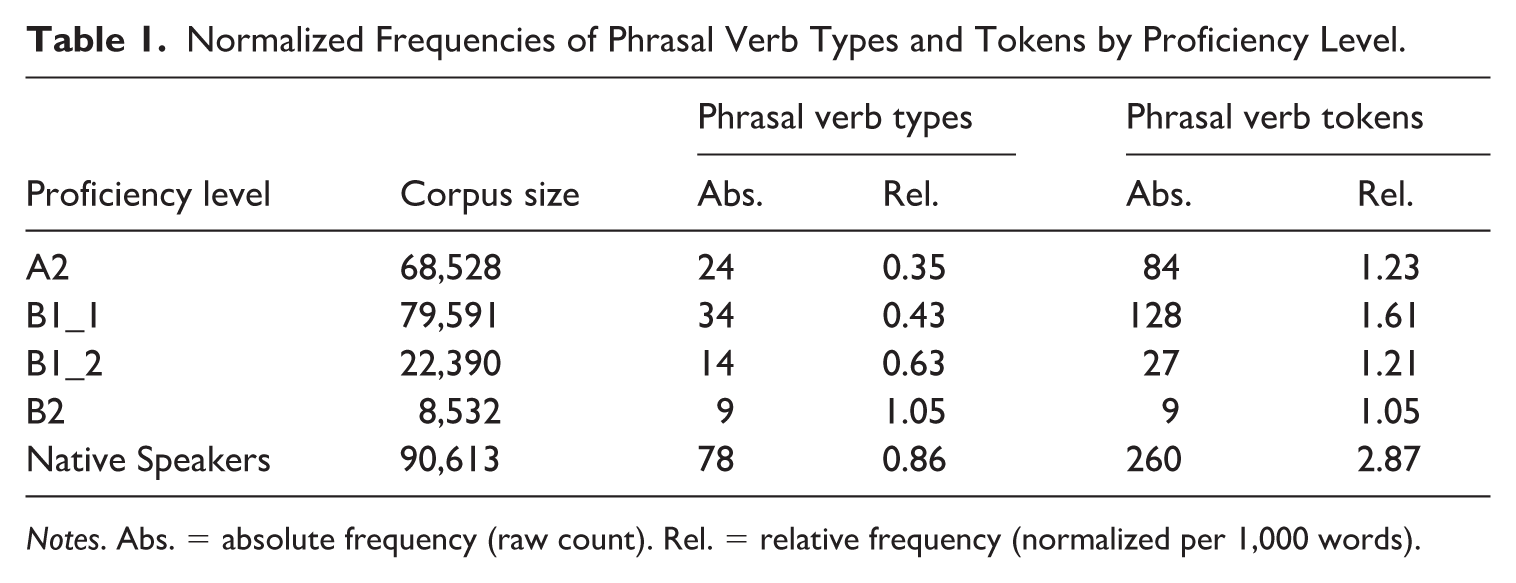
Notes. Abs. = absolute frequency (raw count). Rel. = relative frequency (normalized per 1,000 words).
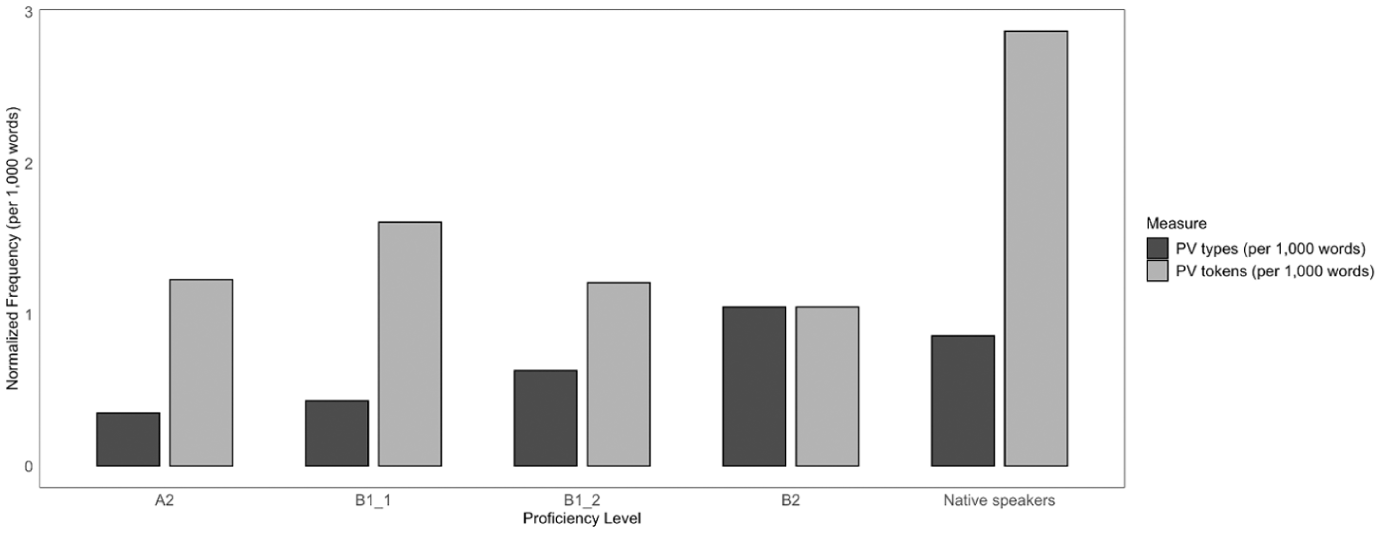
Normalized frequency of phrasal verb types and tokens across proficiency levels.
Total phrasal verb token frequency followed a less consistent pattern. Token frequency increased from 1.23 per 1,000 words at A2 to a peak of 1.61 at B1_1, but then declined to 1.21 at B1_2, and further to 1.05 at B2. By comparison, native speakers produced phrasal verbs at a substantially higher rate, averaging 2.87 tokens per 1,000 words. This non-linear trend indicates that while learners initially increase their phrasal verb usage, this growth is not maintained consistently at higher proficiency levels.
To statistically evaluate these patterns, a chi-square test of independence was conducted on phrasal verb token frequencies. The results indicated a significant association between proficiency level and phrasal verb token frequency, χ²(4, n = 512) = 77.89, p < .001, though the effect size was very small (Cramér’s V = 0.017, 95% CI [0.013, 0.020]). Post-hoc pairwise comparisons with Bonferroni correction confirmed that native speakers significantly outperformed all learner groups (p < .001 for A2, B1_1, and B1_2; p = .025 for B2). In contrast, no significant differences were observed among the learner groups themselves (all p-values ⩾ .50). Effect sizes for all comparisons were negligible, with phi coefficients (ϕ) ranging from .0002 to .018.
In summary, the results indicate that Japanese learners’ phrasal verb usage does not consistently increase with proficiency. While B1_1 learners produced more phrasal verbs than A2 learners, this trend reversed at B1_2 and B2, suggesting that phrasal verb production does not follow a linear developmental trajectory. Moreover, all learner groups substantially underused phrasal verbs compared to native speakers, regardless of proficiency level. The lack of significant differences among learner groups suggests that proficiency alone is not a strong predictor of phrasal verb token frequency. Other factors, such as avoidance strategies or L1 transfer effects, may also influence learners’ phrasal verb production patterns. Finally, the small sample size and low token counts at B2 necessitate cautious interpretation of results at this level.
5.2. Semantic Category Distribution Across Proficiency Levels
Table 2 presents the normalized frequencies of phrasal verb usage across three semantic categories – literal, aspectual, and idiomatic – by proficiency level, reported per 1,000 words, while Figure 2 provides a visual summary of these patterns. The frequency of literal phrasal verb tokens remained relatively stable across learner groups, ranging from 0.22 per 1,000 words at A2 to 0.35 at B2. These rates closely approximate the native speaker baseline of 0.33, suggesting that learners acquire and maintain the use of more transparent phrasal verbs across proficiency levels. Aspectual phrasal verb tokens were consistently infrequent among learners and declined slightly with proficiency: from 0.10 at A2 to 0.08 at B1_1, 0.04 at B1_2, and 0.00 at B2. By contrast, native speakers produced aspectual phrasal verbs at a rate of 0.34 per 1,000 words, highlighting a substantial gap between learners and native usage patterns. Idiomatic phrasal verb usage exhibited greater variation across proficiency levels. Usage rose from 0.63 per 1,000 words at A2 to a peak of 0.93 at B1_1, before declining to 0.76 at B1_2 and 0.70 at B2. Native speakers, however, produced idiomatic phrasal verbs at a much higher rate of 2.24 per 1,000 words. These results indicate that while learners engage with idiomatic phrasal verbs to some extent, their production remains substantially below native speaker norms, particularly at higher proficiency levels.
Normalized Frequencies of Phrasal Verb Usage by Semantic Category and Proficiency Level.
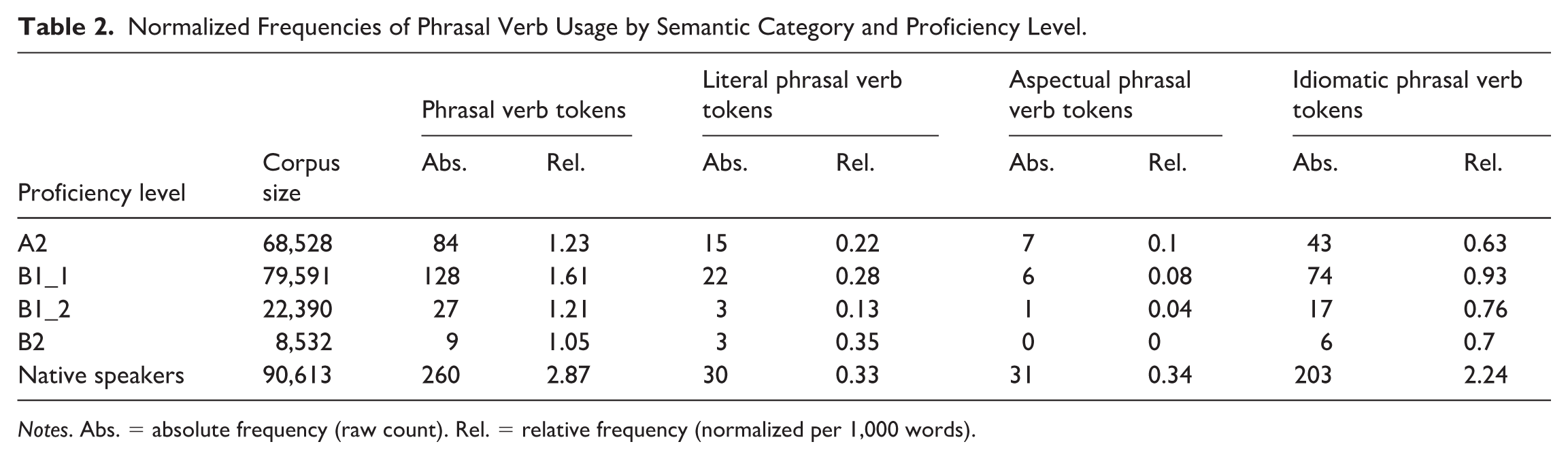
Notes. Abs. = absolute frequency (raw count). Rel. = relative frequency (normalized per 1,000 words).
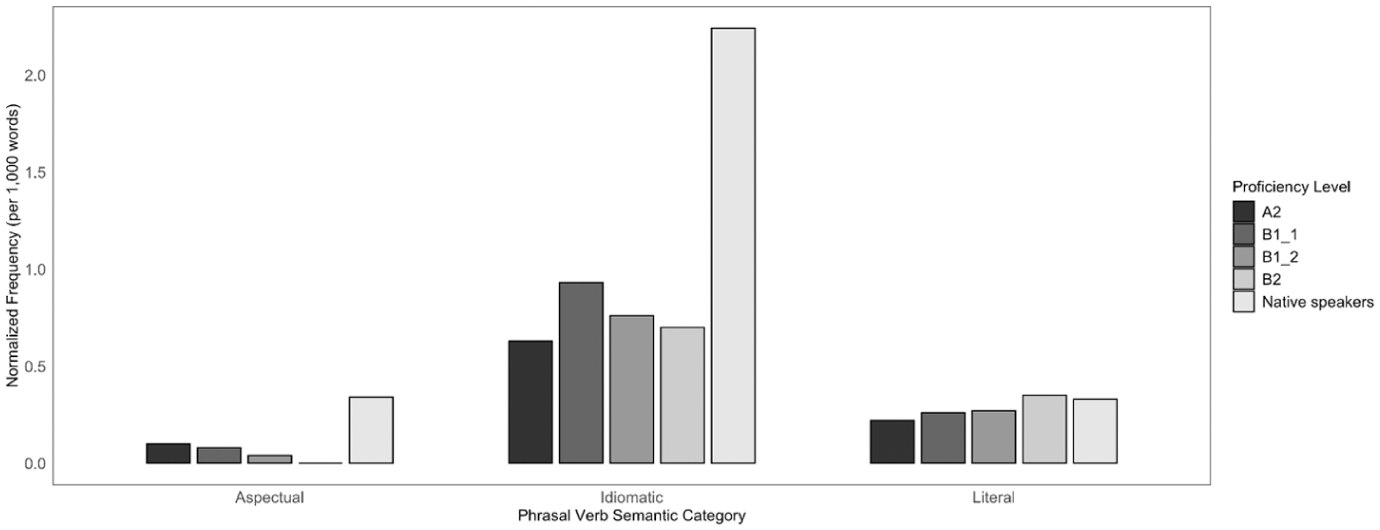
Normalized frequency of phrasal verb semantic categories across proficiency levels.
To statistically evaluate whether proficiency level influenced the distribution of phrasal verb semantic categories, a chi-square test of independence with Monte Carlo simulation (2,000 replicates) was conducted. The results revealed a marginally significant association, χ²(8, n = 512) = 14.55, p = .074, with a small effect size (Cramér’s V = 0.13, 95% CI [0.00, 0.16]), suggesting a weak relationship between proficiency level and semantic category usage. Post-hoc pairwise comparisons with Bonferroni correction revealed no significant differences among the learner groups (all adjusted p > .17).
In summary, the results indicate that proficiency level has a limited effect on the distribution of phrasal verb semantic categories among Japanese learners. Literal phrasal verb usage remains stable and near-native across levels, while aspectual phrasal verbs are rarely used. Idiomatic phrasal verb usage peaks at the intermediate level (B1_1) but declines thereafter, remaining substantially below native-speaker rates at all stages. The lack of significant differences among learner groups suggests that learners maintain a relatively stable semantic distribution across proficiency levels rather than shifting toward greater idiomaticity as proficiency increases.
5.3. Sense Distribution Across Proficiency Levels
Table 3 presents the normalized frequencies of phrasal verb sense usage across proficiency levels, while Figure 3 visually summarizes these patterns. Sense 1 – the most frequent meaning – dominated usage across all groups, increasing from 0.63 occurrences per 1,000 words at A2 to 1.81 at the native speaker level. Sense 2 appeared across groups but at much lower rates, peaking at 0.40 for native speakers and declining to 0.23 for B2 learners. In contrast, Sense 3 and Sense 4 were rarely produced by learners, with no occurrences at A2, B1_2, or B2, and only minimal usage appeared at B1_1 (0.08 and 0.05 per 1,000 words, respectively). Native speakers, however, demonstrated broader use of lower-ranked senses, with normalized frequencies of 0.17 for Sense 3 and 0.06 for Sense 4. Off-list senses – meanings not listed in the PHaVE List – followed a similar pattern, occurring most frequently in native speaker writing (0.49 per 1,000 words) but minimally in learners’ texts (0.12–0.13 at A2, B1_1, B1_2) and not at all at B2.
Normalized Frequencies of Phrasal Verb Sense Usage by Proficiency Level.
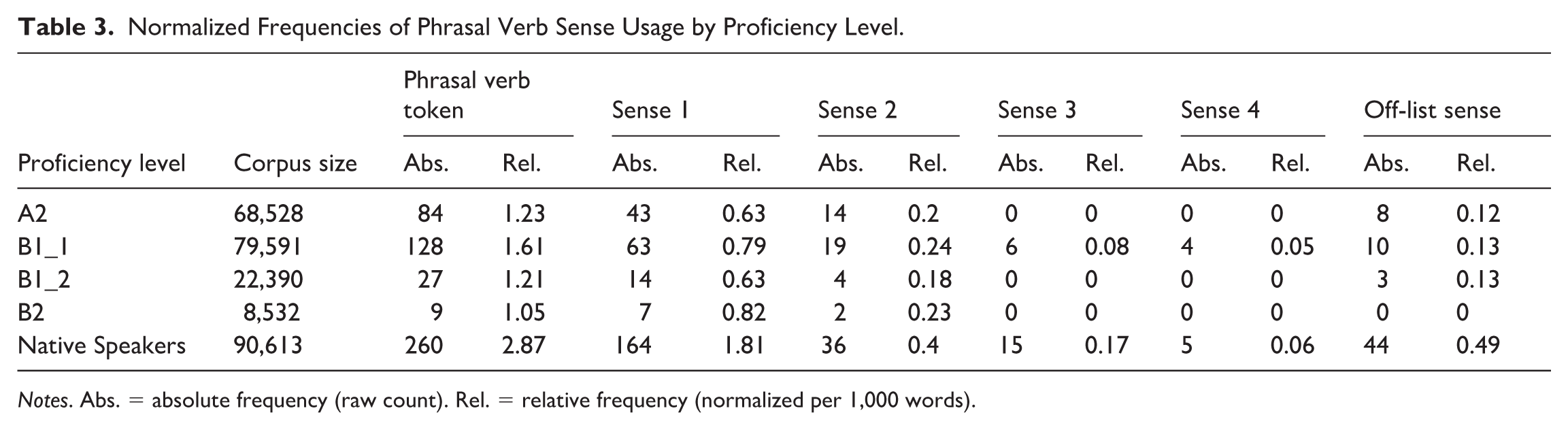
Notes. Abs. = absolute frequency (raw count). Rel. = relative frequency (normalized per 1,000 words).
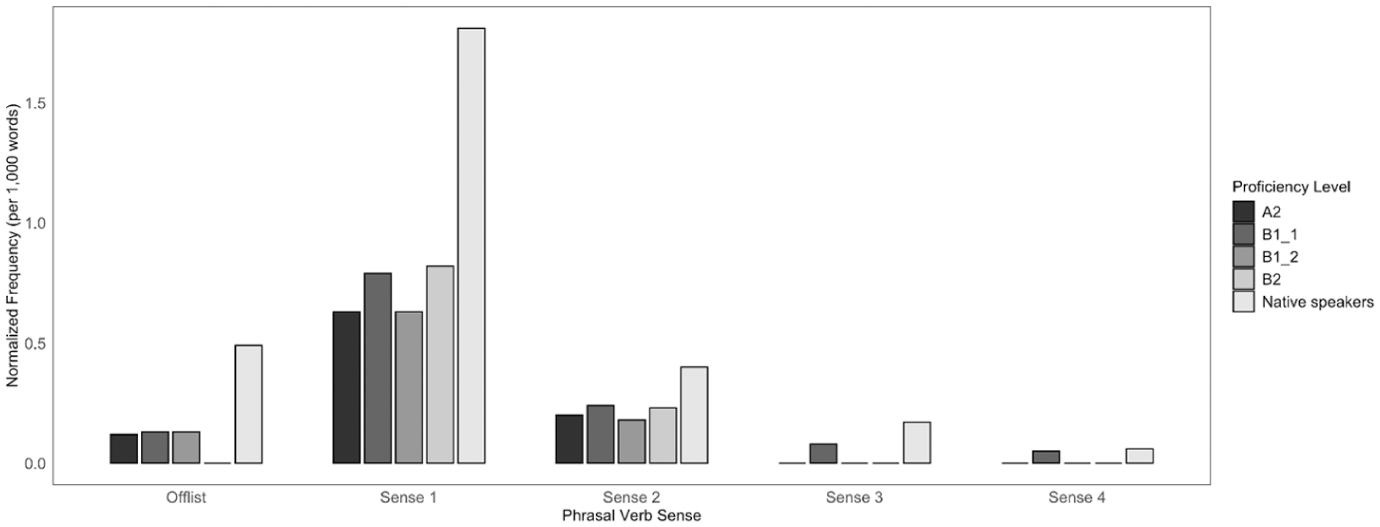
Normalized frequency of phrasal verb senses across proficiency levels.
To address research question 3 – whether proficiency level influences phrasal verb sense distribution – a chi-square test of independence with Monte Carlo simulation (2,000 replicates) was conducted. The test revealed no significant association between proficiency level and phrasal verb sense usage, χ²(16, n = 508) = 16.72, p = .378, with a small effect size (Cramér’s V = 0.01, 95% CI [0.00, 0.10]). Post-hoc pairwise Fisher’s exact tests with Bonferroni correction confirmed the absence of significant differences among any of the groups (all adjusted p > .20).
These findings indicate that proficiency level does not strongly influence how Japanese learners distribute their use of phrasal verb senses. Across all learner groups, usage overwhelmingly favored Sense 1, with limited engagement with secondary senses and near-absence of lower-ranked and off-list meanings. The stability of learner sense preferences across proficiency levels suggests that increased L2 proficiency alone may not significantly expand learners’ use of polysemous phrasal verb meanings.
6. Discussion
This study investigated how Japanese learners of English use phrasal verbs across different proficiency levels, focusing on overall frequency, semantic category distribution, and engagement with polysemous meanings. The results showed that proficiency had only a modest impact on phrasal verb usage patterns. Learners consistently underused phrasal verbs compared to native speakers, with usage concentrated on literal and idiomatic types, while aspectual phrasal verbs were largely avoided. These patterns suggest that structural challenges related to L1–L2 typology persist across proficiency levels.
6.1. The Limited Influence of Proficiency
A primary finding of this study is that L2 proficiency exerted only a limited influence on the development of phrasal verb use. While learners at higher levels used a greater variety of unique phrasal verbs, the most striking results from the post-hoc analyses are the complete lack of statistically significant development in usage frequency between any of the learner proficiency levels. The statistically significant result for the overall analysis was driven entirely by the large, persistent gap between all learner groups and the native speakers. The very small effect size for this overall comparison (Cramér’s V = 0.017) and its narrow CI [0.013, 0.020] confirm with high certainty that proficiency has a negligible influence on overall usage frequency.
This limited impact of proficiency extends beyond mere frequency to the learners’ semantic choices. The distribution of literal, aspectual, and idiomatic phrasal verbs remained relatively stable across all proficiency levels, with no significant statistical association found between proficiency and semantic category selection. Similarly, proficiency had no discernible effect on learners’ use of multiple phrasal verb meanings; learners at all levels, including B2, overwhelmingly relied on the primary, most frequent sense of a given phrasal verb.
Taken together, these results suggest that simply increasing general L2 proficiency is insufficient to drive the development of more native-like phrasal verb usage. One potential explanation for this developmental plateau is strategic avoidance. As learners’ metalinguistic awareness grows, they may consciously opt for single-word verbs to maintain accuracy and avoid the risk of misusing a complex phrasal verb. While this strategy may be effective for communication, it constrains lexical variety and contributes to the persistent gap between learner and native-speaker norms observed in this study.
6.2. Persistent L1 Typological Influence
The findings strongly suggest that the typological distance between Japanese (a verb-framed language) and English (a satellite-framed language) is a plausible explanation for the persistent challenges observed in our data. This distinction, drawn from Talmy’s (1985, 2000) theory of event conflation, is critical. In English, the verb often conveys the manner of action (the co-event) while the particle expresses the main event, such as direction or result. In contrast, verb-framed languages like Japanese merge both of these elements into a single verb, lacking a separate particle to mark the outcome (Yasuda, 2010). This fundamental structural difference makes it difficult for Japanese learners to interpret and produce phrasal verb constructions, which are absent in their L1. While our study did not include a satellite-framed L1 control group to confirm this directly, our interpretation is strongly supported by previous comparative research.
Studies have consistently shown that learners from typologically similar languages like Dutch or Swedish demonstrate less avoidance of phrasal verbs than learners from verb-framed languages like Hebrew. The current study’s finding that Japanese learners consistently underuse phrasal verbs compared to native speakers is therefore consistent with this broader body of research on typological distance. This suggests that the typological barrier is a significant and lasting obstacle for this learner group.
It is also possible that these patterns could reflect a slower pace of general lexical development. However, the specific and pronounced difficulty with this particular lexico-grammatical structure, which is absent in the learners’ L1, points towards a strong typological influence that likely compounds any general learning challenges.
6.3. Underdeveloped Semantic Knowledge: From Aspect to Polysemy
This study reveals a particular and persistent difficulty with the non-literal meanings of phrasal verbs. The near-total absence of aspectual phrasal verbs and the overwhelming reliance on the primary meaning of polysemous verbs point to a common challenge: acquiring semantic flexibility. The lack of statistically significant relations between proficiency and the use of either semantic categories or multiple meanings is underscored by the 95% CI for the effect sizes, which in both cases included zero. This indicates that, based on the current data, the possibility of there being no true association between proficiency and semantic development cannot be ruled out.
This difficulty with non-literal meanings is also evident in the learners’ handling of polysemy. The overwhelming reliance on the primary, most frequent sense of a phrasal verb indicates that learners are not developing the semantic flexibility needed to navigate multiple meanings. This aligns with studies by Sonbul et al. (2020) and Garnier and Schmitt (2015), who found that learners often rely on primary meanings due to cognitive constraints and limited exposure to less frequent senses. Managing multiple meanings increases cognitive load, likely leading learners to default to the most familiar sense to avoid ambiguity (Zhang & Wen, 2019). Together, these findings point to a broader challenge in acquiring the deep semantic knowledge required for versatile phrasal verb use.
6.4. Pedagogical Implications
The finding that proficiency gains do not correspond with statistically significant development in phrasal verb use provides a strong rationale for targeted pedagogical intervention. The conclusion that learners are unlikely to learn these forms incidentally through mere exposure is reinforced by research showing that EFL textbooks often provide insufficient and inadequate practice (Alejo-González et al., 2010; Lindstromberg, 1999, 2001; Side, 1990). Therefore, instruction should explicitly target the challenges identified in this study.
Instruction needs to move beyond literal phrasal verbs to provide contextualized examples of aspectual and idiomatic uses. A Cognitive Linguistics-inspired approach could be adopted, organizing phrasal verbs by their shared particle (e.g., up, out) to help learners recognize the particle’s systematic, metaphorical contributions to meaning (see Rudzka-Ostyn, 2003). A variety of other alternative approaches to the instruction of less transparent phrasal verbs could be implemented, such as metaphor awareness (Boers, 2000), conceptual metaphor thinking (Yasuda, 2010), especially for adverbial particles, which primarily contribute to the idiomaticity of phrasal verbs, and the use of definitions in the contextual learning of PVs (Tadayonifar et al., 2025). These approaches would make students familiar with the metaphorical nature of idiomatic and aspectual phrasal verbs. Furthermore, given their polysemous nature, instruction can explicitly address the multiple meanings of a single phrasal verb, using rich contextual examples to build semantic flexibility (Gardner & Davies, 2007; Pellicer-Sánchez, 2016; Sonbul et al., 2020). Prior research has also highlighted that frequent exposure to English-language media, such as television, films, and videos, is associated with higher levels of productive phrasal verb use (Sonbul et al., 2020). Building on these findings, it is recommended to promote extensive reading, listening, and viewing activities, which can offer learners repeated and context-rich encounters with diverse phrasal verb senses.
Finally, teaching methods should encourage deeper, more elaborative processing than what is offered by typical gap-filling or matching exercises. The literature suggests several innovative strategies, such as using non-verbal media like pictures to mitigate L1 interference, or having students draw their own interpretations to build personal, memorable connections to a phrasal verb’s metaphorical meaning (White, 2012). By shifting focus from rote learning to meaning-focused, elaborative tasks, instructors can better support the development of the deep and flexible knowledge required for the naturalistic use of this challenging lexical category.
6.5. Limitations
The present study has several limitations that offer avenues for future research. First, the analysis was confined to written essay data. As phrasal verbs are particularly frequent in spoken discourse, future research should incorporate spoken corpus data to determine if the patterns of underuse and semantic avoidance observed here persist in conversational contexts. Second, this study focused exclusively on learners from a single L1 background (Japanese). Future studies could adopt a comparative design including learners from satellite-framed L1 backgrounds (e.g., German, Dutch) to more definitively isolate the effects of L1 typology on phrasal verb learning. Finally, the specific essay topics may have constrained the range of phrasal verbs that learners could appropriately use.
A further limitation is the modest sample size, particularly for the B2 group (n = 18), which may have limited the statistical power to detect smaller effect sizes; a prospective power analysis was not conducted. Additionally, as this study did not include a control group of learners from a satellite-framed L1, the conclusion that L1–L2 typological distance is the primary driver of the observed patterns remains a strong inference rather than a direct finding. The analysis also did not quantify the number of essays containing zero phrasal verbs or examine usage distribution among individual writers.
Future research could explore these aspects to provide a more granular picture of phrasal verb development. An analysis of individual usage patterns, for instance, would be valuable to determine if phrasal verb use is consistent across learners or concentrated among a few high-frequency users within each proficiency level. Such studies will continue to build on the findings presented here and contribute to a more comprehensive understanding of this challenging area of L2 learning.
7. Conclusions
This study provides new evidence that for Japanese learners of English, structural differences between their L1 and L2 are a more powerful constraint on phrasal verb development than L2 proficiency alone. Even as learners’ general proficiency increases, their use of phrasal verbs remains quantitatively low and qualitatively limited. They demonstrate a stable reliance on a narrow range of literal and high-frequency idiomatic forms, while largely avoiding aspectual verbs and the multiple meanings of polysemous ones. These persistent patterns suggest that acquiring this central component of English vocabulary is not a natural byproduct of increased proficiency for these learners. Instead, the typological distance between Japanese and English appears to create a lasting barrier that requires targeted pedagogical intervention to overcome. Ultimately, this study highlights the need for instruction that moves beyond simple memorization to explicitly address phrasal verb semantics, the motivated nature of particles, and the contextual cues that govern polysemy. By tackling the underlying structural and semantic challenges, educators can better support learners in developing the more naturalistic and flexible use of phrasal verbs required for advanced language production.
Footnotes

Funding
The authors received no financial support for the research, authorship, and/or publication of this article.
Declaration of Conflicting Interests
The authors declared no potential conflicts of interest with respect to the research, authorship, and/or publication of this article.