







Abstract
Previous word learning studies suggest that children with autism spectrum disorder may have difficulty understanding pictorial symbols. Here we investigate the ability of children with autism spectrum disorder and language-matched typically developing children to contextualize symbolic information communicated by pictures in a search task that did not involve word learning. Out of the participant’s view, a small toy was concealed underneath one of four unique occluders that were individuated by familiar nameable objects or unfamiliar unnamable objects. Children were shown a picture of the hiding location and then searched for the toy. Over three sessions, children completed trials with color photographs, black-and-white line drawings, and abstract color pictures. The results reveal zero group differences; neither children with autism spectrum disorder nor typically developing children were influenced by occluder familiarity, and both groups’ errorless retrieval rates were above-chance with all three picture types. However, both groups made significantly more errorless retrievals in the most-iconic photograph trials, and performance was universally predicted by receptive language. Therefore, our findings indicate that children with autism spectrum disorder and young typically developing children can contextualize pictures and use them to adaptively guide their behavior in real time and space. However, this ability is significantly influenced by receptive language development and pictorial iconicity.
Some pictures inform viewers about specific objects and events in the world (they are contextualized). The ability to utilize these pictures requires the understanding that visual representations correspond to elements of reality, even if they are absent at the time of viewing. Through infancy and early childhood, typically developing (TD) children learn how pictures relate to real-world referents (e.g. DeLoache and Burns, 1994; Preissler and Carey, 2004). For many minimally verbal children with autism spectrum disorder (ASD), pictures have additional importance: they provide an alternative form of functional communication in the absence of verbal language (e.g. Anderson et al., 2007). However, despite the popularity of interventions such as the Picture Exchange Communication System (PECS; Frost and Bondy, 2002), little research has investigated the ability of children with ASD to contextualize pictures.
In their classic study, DeLoache and Burns (1994) investigated the ability of 24- and 30-month-old TD children to contextualize pictorial symbols. An experimenter concealed a toy in a room, and then communicated the location by showing children a picture of the toy in its hiding place. Children then entered the room and searched for the toy. Crucially, children never saw the depicted room and the real room concurrently—they had to rely on their internal representation of the picture to guide their searching. DeLoache and Burns (1994) found that the errorless retrieval rate of 30-month-olds was consistently above-chance, while 24-month-olds performed below-chance. The authors claimed that children fail the search task because they have yet to learn that pictures can be contextualized. However, Suddendorf (2003) proposed that poor performance could be explained by children’s inability to suppress a mental representation of a picture that was formed on a previous trial (“perseveration errors”). In an experiment that mimicked first-trial conditions in all four trials (each trial involved a different toy, a different room, and a different set of hiding locations), Suddendorf found that 24-month-olds’ errorless retrieval rate significantly exceeded chance. Thus, in conditions that inhibit perseveration, TD 24-month-olds can contextualize symbolic information communicated by photographs. Furthermore, contemporary studies employing search task paradigms should be designed to minimize perseveration, which is particularly prevalent in children with ASD (e.g. Shu et al., 2001).
Before 3 years of age, children’s ability to contextualize pictures is influenced by iconicity, language, and intentionality. Iconicity refers to the perceptual similarity between a symbol and its referent, and studies have shown that TD children are increasingly likely to contextualize highly iconic pictures (e.g. photographs) than less-iconic pictures (e.g. line drawings; Callaghan, 2000; Ganea et al., 2008; Simcock and DeLoache, 2006). Kirkham and colleagues’ finding that language predicted, but was not predicted by, picture production and symbolic play in TD children suggests that linguistic symbols are mastered earlier in development and henceforth serve as a scaffolding base for other symbolic domains (Kirkham et al., 2012). For example, if a child in DeLoache’s search task is shown a photograph of a chair, their recognition of the referent object may trigger the retrieval of the associated linguistic representation, “chair,” which can be held in mind while searching the room. The child might then recognize the referent of the memorized word and make an errorless retrieval, without being explicitly aware that the picture was intended to represent that location in the room (Callaghan and Rankin, 2002). Children’s contextualization of pictures is also mediated by their ability to infer their intended symbolic-communicative function (Salsa and Peralta de Mendoza, 2007). In a series of search tasks (see Peralta de Mendoza et al., 2012), TD children aged 2.5 years achieved above-chance retrieval rates only when instructions highlighted the intended function of pictures. Therefore, young children’s early ability to contextualize pictures is contingent on their ability to infer their intended function from others.
Despite the prevalence of picture-based communication interventions, no research has investigated whether children with ASD can contextualize pictures in a search task. Those studies that have examined picture comprehension in autism highlight fundamental differences in their understanding of how words, pictures, and objects interrelate (Allen, 2009; Hartley and Allen, 2014, in press-a, in press-b; Preissler, 2008). Impairments in the pictorial domain may stem from deficits in foundational social-cognitive skills (Baron-Cohen, 1995; Griffin, 2002; Hobson, 2002) that enable TD children to learn about pictures through interactions with symbolically experienced adults (e.g. Callaghan and Rankin, 2002; Callaghan et al., 2004). Additionally, because early picture comprehension is scaffolded by verbal symbols (Callaghan, 2000), severe linguistic impairments (Anderson et al., 2007) may impact on the ability of children with ASD to map referential picture–object relations.
In the absence of intention-reading abilities and linguistic scaffolding, picture–object mapping in minimally verbal children with ASD may be dependent on a high degree of iconicity. Hartley and Allen (in press-a) recently showed that this population is much more likely to generalize labels to objects depicted in highly iconic color pictures than less-iconic non-color pictures. These findings implicate color as an important influence on pictorial understanding in autism. However, this study tested children’s mapping and generalization of word–picture relations, and it may be that the pictorial difficulties of children with ASD relate primarily to word–picture–object–mapping rather than picture–object mapping per se. More specifically, children with ASD might be perfectly able to map relations between pictures and perceptually similar objects (for supportive evidence, see Experiment 2 of Hartley and Allen, 2014, in press-a), but due to impairments in their referential understanding of language (Baron-Cohen et al., 1997; Frith and Happé, 1994; Preissler and Carey, 2005), some children may not know intuitively what words relate to when paired with pictures (e.g. the picture itself vs the symbolized referent). Also, in Hartley and Allen (in press-a), children viewed pictures alongside their referents and perhaps this simultaneous viewing fostered symbolic understanding in the most-iconic color picture conditions. It is currently unknown whether iconicity facilitates picture comprehension in children with ASD when symbol and referent are not viewed concurrently. If their ability to contextualize mental representations of pictures benefits from a high degree of iconicity, educators and therapists would have a data-grounded rationale for selecting highly iconic symbols for picture-based communication interventions. Moreover, if children with ASD can solve the search task using non-color pictures, we can infer that their difficulties in the pictorial domain relate primarily to mapping and generalizing referential word–picture relations.
This study investigates the ability of minimally verbal children with ASD to solve a search task by contextualizing pictures. Unlike previous studies examining picture comprehension in autism, we employ a task that does not involve word learning and children could not simultaneously view depicted and real hiding locations while searching—they had to generate a mental representation of the picture and then identify the corresponding three-dimensional (3D) referent. Out of the participant’s view, a small toy was concealed underneath one of four occluders. Children were then shown a picture of the hiding location before returning to search for the toy. The experimenter’s instructions were designed to facilitate task understanding and stimuli were designed to minimize perseverative responding.
There were two independent variables: iconicity and familiarity of depicted referents. Children completed the search task using photographs, non-color line drawings, and “abstract” color pictures. We predicted that children with ASD would be most successful in photograph trials and perform poorly in line drawing trials. We also expected children with ASD to perform poorly in abstract picture trials as, in the absence of conventional shape-based resemblance, children needed to infer intended picture–referent relations from the communicative behavior of the experimenter. Referent familiarity was manipulated in photograph and line drawing trials; in some trials, the occluders were individuated by familiar nameable objects, and in other trials, the occluders were individuated by unfamiliar unnamable objects. If children with ASD explicitly employ language when decoding pictures, we expected them to perform better on familiar than unfamiliar trials. Importantly, this study advances theory by elucidating whether children with ASD can use pictures to deduce (non-linguistic) information about reality, and the cues that mediate this ability.
Method
Participants
Participants were 16 minimally verbal children with ASD (all male; M age = 9.9 years, range = 4.1–16.1 years) and 16 TD children (6 males, 11 females; M age = 3.6 years, range: 2.2–6.4 years) recruited from specialist schools, mainstream schools, nurseries, and preschools in Kendal and Preston, UK. All children with ASD received a diagnosis of autism from a qualified educational or clinical psychologist, using standardized instruments (i.e. Autism Diagnostic Observation Scale and Autism Diagnostic Interview–Revised; Lord et al., 1994, 2002) and expert judgment. Diagnosis was confirmed using the Childhood Autism Rating Scale (CARS; Schopler et al., 1980), which was completed by a class teacher (M score: 40.66; standard deviation (SD) = 7.19; range: 31.5–51.5). Groups were matched on receptive vocabulary as measured by the British Picture Vocabulary Scale (BPVS; Dunn et al., 1997). 1 Mean receptive vocabulary of children with ASD was 3.6 years (SD = 1.3 years; range: 2–6.2 years) and mean receptive vocabulary of TD children was 3.6 years (SD = 1.2 years; range: 2–5.4 years). The non-verbal intellectual abilities of each group were measured using the Leiter-R (Roid and Miller, 1997). The mean IQ of the autism group was 57.5 (SD = 19.6; range: 36–95), indicating additional learning disabilities. The non-verbal performance of TD children and children with ASD, as indicated by participants’ raw scores, was not significantly different.
All children with ASD were current PECS-users with impaired expressive language skills. The language abilities of children within the sample varied somewhat, as is expected in a minimally verbal population. 2
Materials
Stimuli were small toy figures (Buzz Lightyear, Scooby Doo, Thomas the Tank Engine, Mickey Mouse), plastic occluders and pictorial representations. Toy figures were approximately 6 cm tall and could be easily hidden underneath each occluder.
The 16 occluders were constructed from different types of upturned containers (see Figure 1). Four occluders each were cube-shaped boxes (12-cm tall, 12-cm wide), sandcastle buckets (14-cm tall, 15-cm wide), jelly molds (9.5-cm tall, 15.5-cm wide) and large plastic drinking goblets (18-cm tall, 9-cm wide). The four occluders made from the same type of container were grouped in a set. Thus, there were four occluder sets; the occluders within each set were all made from the same container (e.g. four jelly molds), but the sets were markedly different from each other, reducing the likelihood of perseveration across trials. Each occluder was painted a unique color using Plasti-kote spray paint to ensure that occluders within each set could be discriminated on color alone.
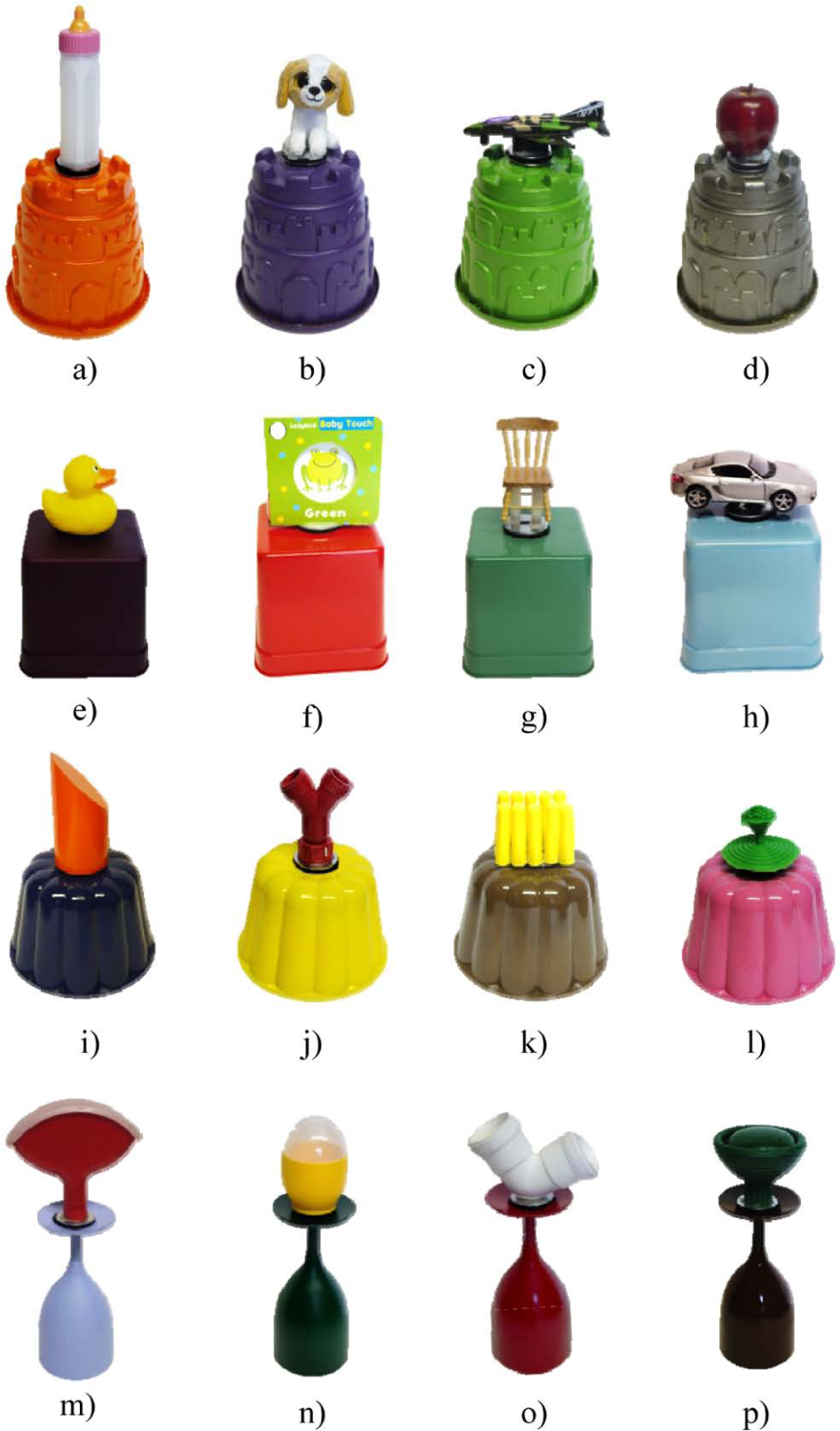
Occluders used in search task: (a–d) Set 1 (familiar individuating objects), (e–h) Set 2 (familiar individuating objects), (i–l) Set 3 (unfamiliar individuating objects), and (m–p) Set 4 (unfamiliar individuating objects).
The shapes of occluders were modified so that hiding locations in the same trial could be discriminated in line drawing trials (i.e. without color). This was achieved by attaching a unique individuating object to the top of each occluder (see Figure 1). Eight of these objects were highly familiar, and were selected on the basis that most children understand their linguistic labels by 15 months (Fensen et al., 1994). The other eight objects were unfamiliar, and were selected on the basis that children would not know their linguistic labels. Both familiar and unfamiliar objects were also divided into two groups of four, and each was attached to a set of occluders. Individuating objects were attached to occluders using self-adhesive Velcro, allowing them to be removed for abstract picture trials. By comparing performance on trials involving occluders topped with familiar nameable objects versus unfamiliar unnamable objects, we could determine whether access to a linguistic representation is necessary for picture comprehension in minimally verbal children with ASD. Moreover, the addition of individuating objects meant that the appearances of hiding locations varied on multiple dimensions between trials, increasing the probability that children would successfully map new picture–referent relations (Suddendorf, 2003).
Three pictures of each occluder were created: one color photograph, one black-and-white line drawing, and one abstract representation that only resembled its referent on the basis of color (see Figure 2). Color photographs were taken of each occluder with a digital camera and edited using Adobe Photoshop. Line drawings were created using a black “finewriter” pen and white paper. Digital copies of each drawing were created and their sizes were adjusted to match their photographic counterparts (heights: 8–10.5 cm; widths: 5–6.5 cm). Abstract pictures were created in Microsoft PowerPoint by generating 16 “cloud shapes” (height: 6 cm; width: 6.5 cm) and coloring them to match the 16 occluders. To avoid confusion, the individuating objects (which contrasted in color with their respective occluders) were removed in abstract picture trials. All pictures were printed by the same laser printer, cut out, and laminated.
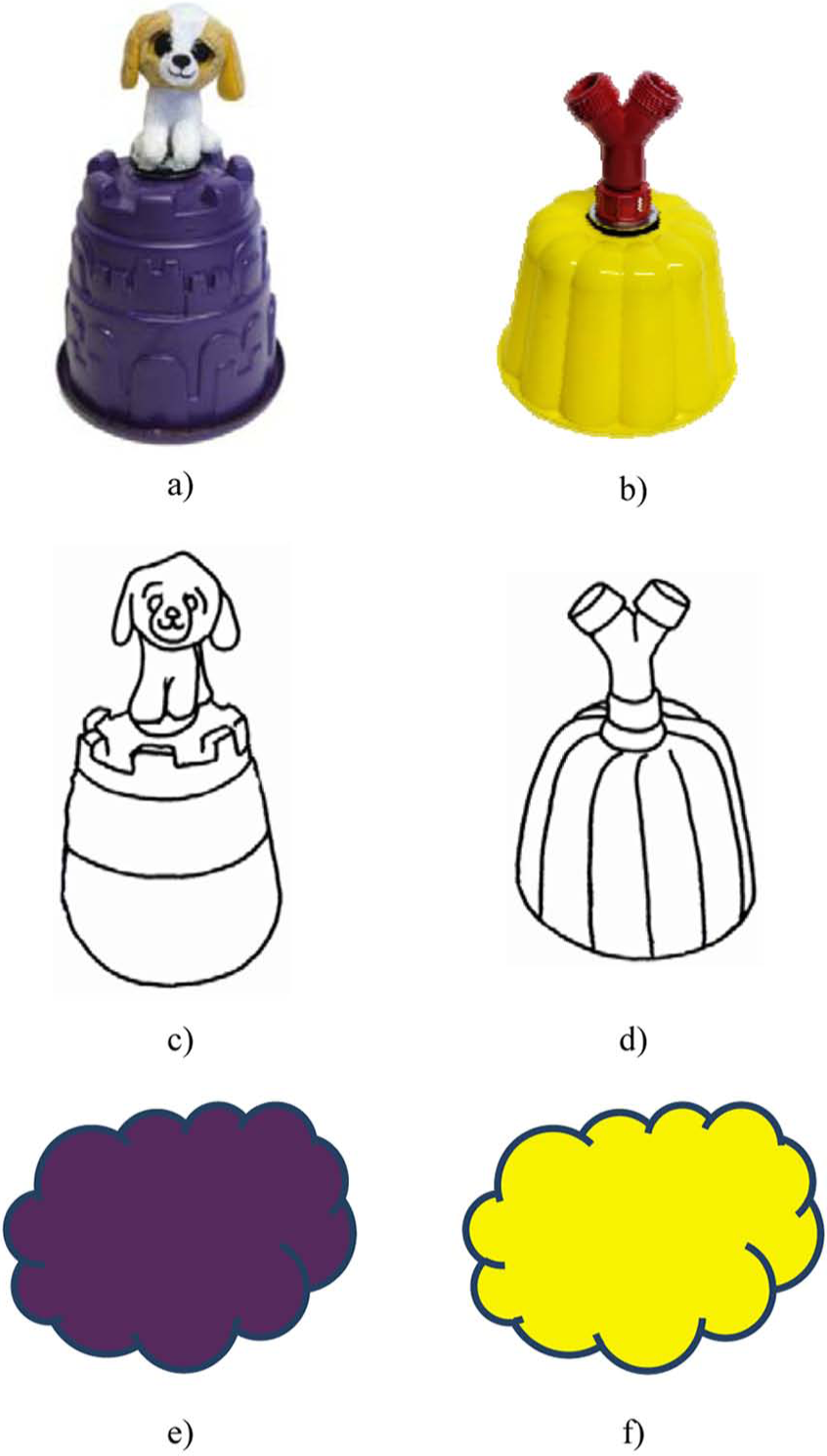
Example pictorial stimuli used in search task: (a and b) color photographs, (c and d) black-and-white line drawings, and (e and f) abstract color pictures.
Procedure
Participants were tested individually on three different days (1-week apart) in their own schools and were accompanied by a familiar adult. Children were reinforced throughout each session for attention and good behavior. Participants received one level of iconicity (photographs, line drawings, and abstract pictures), consisting of four trials, per session; order of administration was counterbalanced. Each trial involved an Orientation Stage and a Test Stage. The same toys and occluders were used in each session.
Orientation Stage
The Orientation Stage familiarized the child with the toy character, occluders, and pictures that would be used in the trial. The experimenter introduced a toy (e.g. “This is Buzz and Buzz likes to hide underneath things”), and presented a set of four occluders in a line in front of the child (e.g. “These are the things that Buzz likes to hide underneath.”). Different toys and occluder sets were used in each trial, and their order of use was counterbalanced. The relative position of individual occluders within the array was randomly determined. The experimenter then demonstrated the toy hiding underneath each occluder from left-to-right or right-to-left (counterbalanced across trials) (e.g. “See, Buzz might hide under here. Or he might hide under here. Or, he might hide under here. Or, he might hide under here”). Next, the experimenter presented the pictures of the occluders. Each picture was positioned in front of its respective occluder and the child’s attention was drawn to each picture–referent relation from left-to-right or right-to-left (opposite direction to the hiding demonstration). The experimenter explicitly stated that the pictures were intended to help the child solve the task (e.g. “Now look at these pictures! These are pictures of where Buzz likes to hide. See, this one looks like this. And this one looks like this. This one looks like this. And this one looks like this. The pictures will show you where to look for Buzz when he hides!”). Previous research has shown that this information is critical to task understanding in young TD children (Peralta de Mendoza et al., 2012), and could therefore be necessary for understanding in minimally verbal children with ASD.
Test Stage
The participant was led a short distance away from the testing location so that the occluders were not visible (e.g. “Ok, let’s play hide-and-seek with Buzz! First we need to let Buzz hide …”). The experimenter stated that he would leave to hide the toy, and that the child could search for the toy once he returned (e.g. “I’m going to help Buzz hide underneath something, and when I come back, you can go find him!”). The experimenter positioned the toy underneath one of the occluders in the array. The toy was hidden at a different location in each trial within a session (order was randomized). The experimenter returned to the child, showed them the picture of the hiding location, and informed them that the toy was hiding there (e.g. “This is where Buzz is hiding [pointing to picture]. Can you find Buzz here?”). The pictures of the other occluders were not visible while the child searched. If the participant did not make an errorless retrieval, the experimenter provided prompts until the toy was found (e.g. “Remember, Buzz is hiding in the same place as I pointed in the picture.”). The occluders and toy character were then removed from view, and the child was asked to identify the picture they had been shown in isolation (e.g. “Which picture did I show you?”). If a child failed to make an errorless retrieval and also failed to identify the correct picture, this would suggest their error was caused by poor memory. The Orientation Stage and Test Stage were repeated for each trial until the session was completed.
Results
The number of errorless retrievals (out of four) made by children in each iconicity condition was calculated. A response was coded as an errorless retrieval if the child’s first search was in the correct location and was unprompted. The frequency of perseveration errors (i.e. searching the hiding location from the preceding trial) was noted. See Figure 3 for mean rates of errorless retrievals in each condition.
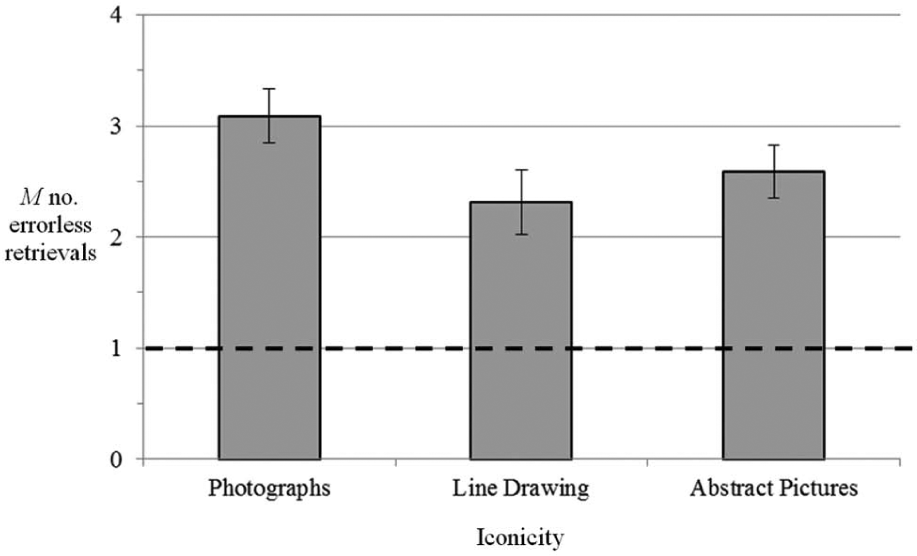
Mean errorless retrieval rates and standard error bars for each picture type (participant groups collapsed). Chance-level responding indicated by the dashed line.
To examine the influence of referent familiarity, the data from familiar and unfamiliar trials in the photograph and line drawing trials were entered into a 2(Group: ASD, TD) × 2(iconicity: photograph, line drawing) × 2(familiarity: familiar, unfamiliar) mixed analysis of variance (ANOVA). There was a significant main effect of iconicity, F(1, 30) = 14.51, mean squared error (MSE) = 0.29, p = 0.001, η2p= 0.33, but no effect of familiarity or group and no interactions. Therefore, access to linguistic representations corresponding to depicted referents had no influence on either group’s ability to contextualize pictures. To fully assess the effect of iconicity, familiar and unfamiliar trials in the photograph and line drawing conditions were collapsed, and entered into an analysis with the abstract picture data. A 2(group: ASD, TD) × 3(iconicity: photograph, line drawing, abstract picture) mixed ANOVA revealed a significant main effect of iconicity, F(2, 60) = 12.93, MSE = 0.39, p < 0.001, η2p = 0.3. Pairwise comparisons showed that both groups made significantly more errorless retrievals in photograph trials than in line drawing (p < 0.001) and abstract picture trials (p = 0.003), which were not statistically different. There was no effect of group and no interaction. Both groups performed significantly above-chance (one errorless retrieval; alpha value corrected to 0.0083 to compensate for multiple comparisons) in photograph trials (ASD: t(15) = 5.78, p < 0.001, d = 2.98; TD: t(15) = 6.71, p < 0.001, d = 3.47), line drawing trials (ASD: t(15) = 3.05, p = 0.008, d = 1.58; TD: t(15) = 3.36, p = 0.004, d = 1.74) and abstract picture trials (ASD: t(15) = 4.11, p = 0.001, d = 2.12; TD: t(15) = 5.4, p < 0.001, d = 2.79). The percentage of perseveration errors was low for both groups across iconicity conditions (17%–33%). Thus, minimally verbal children with ASD and TD children were able to contextualize all picture types; however, their performance significantly benefited from a high degree of iconicity (i.e. they were most successful in photograph trials).
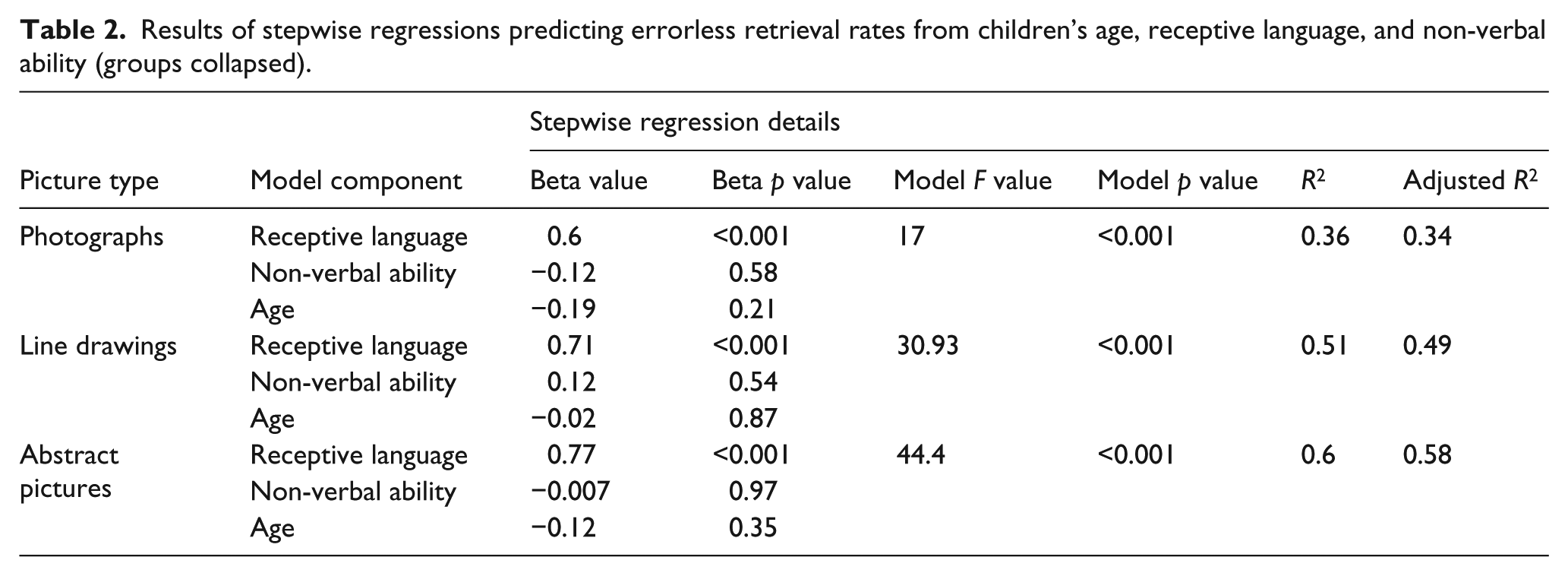
The relationships between group characteristics and performance in each iconicity condition were also assessed. As the preceding ANOVAs failed to identify any population differences, TD children and children with ASD were collapsed for the reported regressions. To establish which factors(s) significantly predicted errorless retrieval rates with each picture type, chronological age, receptive language, and non-verbal ability were entered as predictor variables into a series of stepwise regressions (see Tables 1 and 2). Each regression yielded a significant model (F = 17–44.4, p < 0.001–0.003) containing only receptive language, which accounted for 36%–60% of variation in performance. These results suggest that the significant positive correlations between non-verbal ability and errorless retrieval rates in each condition were inflated by receptive language. In support of this theory, there was an extremely high positive correlation between children’s receptive language and their non-verbal ability, r(30) = 0.74. p < 0.001. Therefore, these analyses show that children’s ability to contextualize pictures was mediated by both iconicity and receptive language. TD children and children with ASD with higher receptive language produced more errorless retrievals than their peers with low receptive language, and both groups also showed increased performance in the most-iconic photograph trials.
Correlations between errorless retrieval rates for each picture type and participant characteristics (groups collapsed).
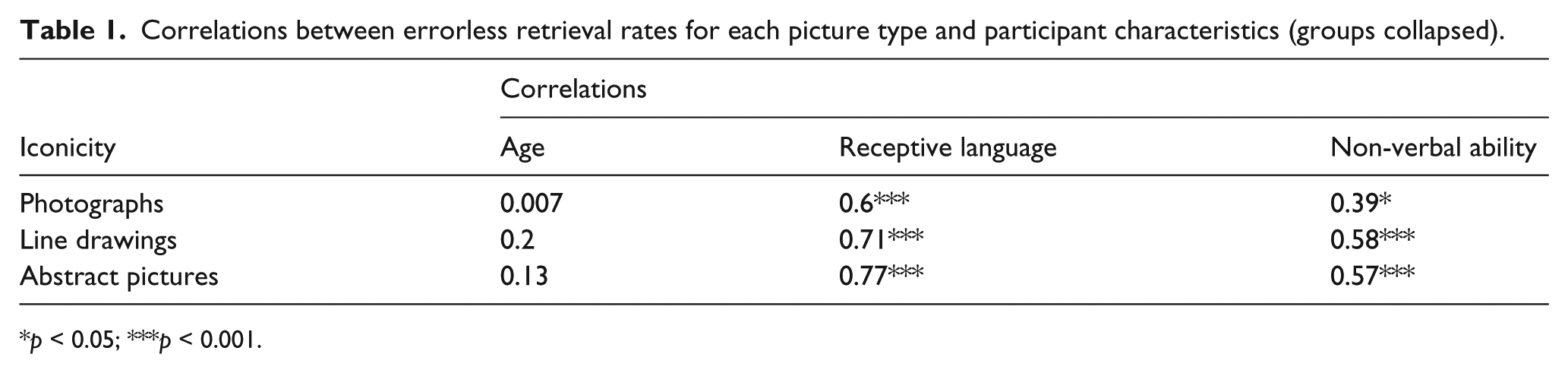
p < 0.05; ***p < 0.001.
Results of stepwise regressions predicting errorless retrieval rates from children’s age, receptive language, and non-verbal ability (groups collapsed).
A final analysis assessed the relationship between success and failure on children’s first search attempt and their memory check. Children’s responses to each trial were coded as belonging to one of four mutually exclusive categories corresponding to the possible performance combinations for these two measures. The most prevalent category in each condition was to make an errorless retrieval and pass the memory check (54.7%–74.2%), and the second most common category was to respond incorrectly on both the search and memory check (10.9%–28.12%). All other response combinations occurred infrequently across conditions. Chi square tests of independence showed that there was no relation between group (ASD, TD) and search/memory performance in any iconicity condition.
Discussion
We investigated the ability of minimally verbal children with ASD and language-matched TD children to contextualize pictorial symbols in a search task. A small toy was concealed underneath one of four occluders that were individuated by familiar nameable objects or unfamiliar unnamable objects, and the hiding location was communicated to children via pictures varying in iconicity. To succeed, children needed to construct a “mental model” of the picture, recognize that the picture related to a current situation, and use the symbolic information to guide their actions in reality (DeLoache and Burns, 1994). Surprisingly, our results revealed zero between-group differences; neither children with ASD nor TD children were influenced by referent familiarity, and both groups’ errorless retrieval rates were above-chance in all three iconicity conditions. Performance was universally predicted by receptive language ability, and both groups displayed significantly greater success rates in the most-iconic photograph trials. Therefore, minimally verbal children with ASD and young TD children can contextualize mental representations of pictures and use them to adaptively guide their behavior. However, this ability is influenced by receptive language development and perceptual similarity between picture and referent.
Importantly, we have documented the first evidence that minimally verbal children with ASD can contextualize symbolic information communicated by pictures. Our findings contrast with Preissler (2008) and Hartley and Allen (in press-a; Experiment 1), who showed that children with ASD tend to map associative word–picture relations, suggesting that they have difficulty understanding the referential nature of pictures. One reason why children with ASD may perform atypically in these word learning studies, but succeed in our search task, is that their difficulties in the pictorial domain relate primarily to word–picture–object mapping, rather than picture–object mapping per se. In typical development, linguistic symbols are mastered earlier in development and henceforth serve as a scaffolding base for other symbolic domains (Kirkham et al., 2012); once TD children learn that verbal labels refer to objects in the world, they may infer that pictures also relate to independently existing objects when they are named (see Hartley and Allen, in press-a, in press-b; Preissler and Bloom, 2007; Preissler and Carey, 2004). By contrast, minimally verbal children with ASD show profound linguistic impairments (Anderson et al., 2007) and may not understand the referential meaning of verbal labels (Baron-Cohen et al., 1997; Frith and Happé, 1994; Preissler, 2008; Preissler and Carey, 2005). Consequently, these children may not know intuitively what words relate to when paired with pictures. Indeed, there is growing evidence that children with ASD misunderstand the rules governing word–picture–object–relations; they map words onto pictures themselves when word–picture pairings are reinforced (Hartley and Allen, in press-a; Preissler, 2008) and, in conditions that foster non-associative word learning, they incorrectly generalize labels from pictures based on both shape and color (Hartley and Allen, in press-b). However, in situations that do not involve word learning, such as this search task and Experiment 2 of Hartley and Allen (in press-a), children with ASD perceive and correctly map picture–object relations.
When picture and referent are not concurrently visible, and mapping is based on a mental representation of the depicted object, comprehension in children with and without ASD is facilitated by greater iconicity. The greater degree of picture–referent resemblance in photograph trials may have increased the salience of symbolic relations, leading to an improvement in children’s ability to contextualize the depicted information. Interestingly, both groups performed equally in abstract picture trials and line drawing trials. We expected that the lack of shape-based resemblance in abstract picture trials would place increased pressure on children’s ability to infer picture–referent relations from the experimenter’s communicative intentions, leading to reduced performance in children with ASD. However, it is possible that their difficulties in intention-reading (e.g. Charman et al., 1997; Griffin, 2002; Mundy and Willoughby, 1996) were offset by their heightened attention to perceptual detail (O’Riordan et al., 2001; Plaisted et al., 1998), which may have enabled them to map picture–referent relations based purely on color. Additionally, it may be that color plays a more fundamental role in referential picture–object mapping in children with ASD (see Hartley and Allen, in press-a, in press-b).
Currently, there are no data-grounded guidelines regarding what types of pictures are best suited for picture-based communication interventions, and it not uncommon for children with ASD to receive training with black-and-white line drawings or relatively abstract symbols (see participant information; also see Hartley and Allen, in press-a). Although picture comprehension of children with ASD in this study was not contingent on a high degree of iconicity, the associated benefit was statistically significant. Moreover, previous research has shown that iconic color pictures promote the extension of verbal information to referent objects in children with ASD (Hartley and Allen, in press-a, in press-b). Thus, because color pictures facilitate both picture–object and word–picture–object mapping, we encourage their use when implementing picture-based communication training with minimally verbal children with ASD. We also recommend that future studies directly assess whether color pictures facilitate symbolic understanding within the context of the PECS training program.
Alongside iconicity, our results show that receptive language mediates children’s ability to contextualize pictures. The lack of a referent familiarity effect for either children with ASD or TD children suggests that neither group relied exclusively on labeling depicted objects as a strategy for solving the task. Therefore, it is likely that children’s general understanding of language had a passive, yet critical, impact on their ability to utilize pictures. Socio-cultural theorists argue that language, the most important and privileged symbol system, develops earliest and subsequently mediates the acquisition of other symbol systems (Callaghan, 2000; Carpenter et al., 1998; Tomasello, 1999). Indeed, studies investigating how linguistic and pictorial development interrelate have confirmed that language emerges before picture comprehension, and also predicts children’s ability to create representational drawings (Callaghan and Rankin, 2002; Kirkham et al., 2012). In the present study, those children with higher receptive language (as measured by the BPVS) may have approached our search task with a more nuanced understanding of how objects in the world can be represented through pictures. However, it is entirely possible that the children with ASD who passed this search task would perform atypically in paradigms that test the ability to map and generalize novel word–picture relations.
Of course, we must address alternative accounts of children’s responding in the present study. One explanation for the lack of a referent familiarity effect is that children may have labeled the colors of occluders, rather than their individuating objects, meaning that linguistic scaffolding was possible in both familiar and unfamiliar trials. If children were relying on this strategy, errorless retrieval rates would have been significantly lower in the non-color line drawing trials than in the two color picture conditions. As performance was equal in line drawing and abstract trials, and significantly higher in photograph trials, it is clear that children were attending to both the shape and color of depicted occluders when these cues were selectively available. Regarding the influence of language, perhaps those participants with low receptive language simply did not understand the requirements of the task. However, contrary to this reasoning, Suddendorf (2003) demonstrated that TD children aged just 24 months could perform above-chance in a more complex search task, and every participant in our sample had a receptive language age of at least 24 months.
It is likely that symbolic understanding in the minimally verbal children with ASD was facilitated by the favorable experimental conditions. It is clear from the low perseveration rates that our carefully designed stimuli effectively minimized proactive interference from prior representations of hiding locations, and encouraged children to approach each trial as if it was a novel problem. Furthermore, each trial included an extensive Orientation Stage in which the experimenter highlighted the iconic correspondence between the real and depicted occluders and clearly asserted the intended purpose of the pictures. Thus, the instructions received by participants were optimally conducive of adaptive symbolic understanding (Salsa and Peralta de Mendoza, 2007). As no previous research has assessed the ability of children with ASD to contextualize pictures using a search task, it was important that we provided the complete instructions to give them the best chance of understanding the task. Critics may argue that by highlighting each picture–referent relation and explicitly stating the purpose of the pictures, the experimenter enabled children to solve the task via a non-symbolic associative mechanism. If children formed associative picture–referent mappings, these relations may have been bidirectional; that is, experiencing either the picture or referent could activate a mental representation of the other. This contrasts with “true” symbolic mappings which are functionally unidirectional (e.g. viewing a photograph of a family member makes one think about that person in reality, whereas viewing that person does not make one think about their photograph; for a detailed definition, see Huttenlocher and Higgins, 1978). Although our data do not allow us to directly address this distinction, we would point out that the four picture–referent relations in each trial were only highlighted once, and it is unlikely that a single pairing would be sufficient to foster a strong associative relation (particularly given the lack of reinforcement). Nevertheless, future studies can advance this discussion by examining whether children with ASD mentally represent picture–referent relations associatively or symbolically, and by further investigating how the manipulation of search task features (e.g. instructions, similarity of hiding locations, explicit labeling of pictures and hiding locations) impacts on their ability to contextualize pictures.
Overall, this study has shown that minimally verbal children with ASD can contextualize pictures in favorable experimental conditions. Greater iconicity facilitated picture comprehension in both children with and without ASD when picture and referent were not viewed simultaneously, and mapping was based on a mental representation of the symbol. Regression analyses identified receptive language skills as an important predictive influence on pictorial understanding in children with ASD, as they are for TD children (Callaghan and Rankin, 2002; Kirkham et al., 2012). Together with previous research (Hartley and Allen, in press-a, in press-b), these findings provide a data-grounded rationale for utilizing iconic color pictures when delivering picture-based communication interventions, such as PECS.
Footnotes
Acknowledgements
We would like to thank the children and staff at Hillside Specialist School, Preston (UK), Sunny Brow Day Nursery, Kendal (UK), Castle Park School, Kendal (UK), and Burton Preschool, Burton-in-Kendal (UK).
Funding
This research received no specific grant from any funding agency in the public, commercial, or not-for-profit sectors.