







Abstract
We examined the relationship between characteristics associated with autism spectrum disorder and college adjustment in a sample of neurotypical college students. Using the Broad Autism Phenotype Questionnaire and the Student Adaptation to College Questionnaire, we found that higher levels of autism spectrum disorder characteristics were associated with poorer adjustment to college. One subscale of the Broad Autism Phenotype Questionnaire, pragmatic language difficulties, explained the most variance in adjustment. In addition, students who met the previously established cut-off scores for possessing the broad autism phenotype scored significantly lower on all Student Adaptation to College Questionnaire subscales. Finally, pragmatic language difficulties mediated the relationship between college major and academic adjustment. These findings underscore the need for future research to examine how pragmatic language difficulties may impede college success in students with autism spectrum disorder and in the typical population.
Between 2001 and 2009, only 32% of adults with autism spectrum disorders (ASD) analyzed in the National Longitudinal Transition Study-2 (NLTS-2) in the United States attended a postsecondary institution (Wei et al., 2012). By comparison, a similar longitudinal study tracking 17-year-old high school students from the general population until the age of 27 between 2002 and 2012 demonstrated that 84% of these adults had attended a postsecondary institution since graduating high school (Lauff and Ingels, 2013). Of the 11 major disability groups tracked by the NLTS-2, the attendance rate of students with ASD was third lowest, only behind those with intellectual disability or multiple disabilities. Even more concerning, Shattuck et al.’s (2012) analysis of the NLTS-2 found that less than 20% of students with ASD who had enrolled at a 4-year university between 2001 and 2009 completed or were on track to complete their degree requirements. The low attendance rate and low success rate of college students with ASD represent a major source of untapped potential.
As ASD is a complex neurodevelopmental disorder characterized by deficits and abnormalities in social communication and interaction, and by the presence of restricted and repetitive patterns of interests and behavior (American Psychiatric Association (APA), 2013), the task of determining the precise components of the disorder that impede success in postsecondary contexts is a challenging one. Research on adult outcomes in ASD has found that most adults on the spectrum are struggling to obtain and maintain employment, postsecondary education, and interpersonal relationships, despite normal or above average intelligence (Cederlund et al., 2008). These difficulties are compounded by a high degree of comorbid psychiatric conditions, particularly depression (Ghaziuddin et al., 2002) and anxiety (Kim et al., 2000; White et al., 2009). Unsurprisingly then, the limited research that has been conducted on college students with ASD emphasizes that the challenges they experience are often non-cognitive (i.e. not explained by differences in cognitive ability). For example, the transition from high school to college may be especially challenging for students with ASD due to heightened levels of anxiety and difficulties adjusting to change (VanBergeijk et al., 2008). White et al. (2011) found that college students with ASD reported significantly higher rates of social anxiety/phobia, and overall lower satisfaction with their college experience and life compared to their non-autistic peers. Students with ASD living away from home face heightened transitional difficulties relating to the requirements of independent living such as dressing, hygiene, housekeeping, and meal preparation (Matson et al., 2009). Academically, impediments to success often manifest from problems with motivation and lack of interest in some classes, along with organizational and planning difficulties (Adreon and Durocher, 2007; VanBergeijk et al., 2008).
Although these initial findings are suggestive, there is a critical need for research determining the specific struggles associated with ASD that may lead to poor adjustment and dropout decisions. There are several factors contributing to the difficulty of recruiting college students with ASD to participate in research. In addition to low attendance rates, many college students with ASD may be undiagnosed or choose not to disclose their diagnoses to their university (Janiga and Costenbader, 2002). Because of these challenges, an alternative approach is to measure levels of sub-clinical ASD characteristics among neurotypical college students in relation to variables of interest. As a growing body of research suggests that autistic characteristics vary along a continuum in the general (non-clinical) population (Constantino and Todd, 2005; Wainer et al., 2011), this approach provides (1) an increased understanding of how ASD-related characteristics link to a variety of areas of processes (e.g. social, cognitive) in non-clinical populations and (2) impetus for subsequent research studies utilizing participants with an ASD diagnosis (White et al., 2012).
The limited research that has examined correlates of ASD characteristics in neurotypical college students found that such characteristics are associated with more feelings of loneliness and fewer and shorter friendships (Jobe and White, 2007), depression, (White et al., 2011) as well as increased social anxiety, feelings of hostility, and aggression (White et al., 2011, 2012). Although this research provides some evidence that ASD traits are linked to interpersonal and psychosocial challenges in university students, we do not yet know (1) which specific areas of functioning within university settings are negatively impacted by having ASD traits and (2) which specific ASD traits have the strongest links with university functioning. This knowledge may inform interventions for college students with a clinical diagnosis of ASD, and for those without one who struggle with high levels of ASD-related traits.
This study extends the existing body of research by examining ASD characteristics in relation to a construct that is more specific to the college experience; college adjustment. College adjustment is a multi-faceted construct referring to a student’s success in coping with the academic, social, and emotional demands inherent to the college experience (Baker and Siryk, 1999). This construct is made up of four domains, including, academic, social, and personal-emotional adjustment as well as commitment or attachment to one’s school; the first three of which are of interest in this study. Academic adjustment can be described as success in coping with various educational demands of university, including motivation, enjoyment of coursework, and self-perceptions of academic performance. Social adjustment refers to students’ adaptation to the interpersonal and social demands of university, including satisfaction with the social activities offered on campus as well as self-perceptions of success in social functioning. And finally, personal-emotional adjustment refers to psychological health (e.g. anxious and depressive symptoms) and possible comorbid somatic symptoms associated with psychiatric problems. The validation work of Baker and colleagues has demonstrated low scores on the Student Adaptation to College Questionnaire (SACQ) to be associated with a variety of undesirable outcomes, including lower participation in on-campus activities and less success securing on-campus employment (Baker and Siryk, 1999), increased involvement in health and counseling services (Baker and Siryk, 1984) and importantly, higher dropout rates (Baker and Siryk, 1984; Gerdes, 1986; cited in Baker and Siryk, 1999). To our knowledge, no studies have specifically examined college adjustment in relation to ASD characteristics.
In contrast to previous studies that used the Autism Quotient (AQ; Baron-Cohen et al., 2001), we use the Broad Autism Phenotype Questionnaire (BAPQ; Hurley et al., 2007) to measure ASD characteristics. The broad autism phenotype (BAP) is a phenomenon observed in clinical assessments that family members of individuals with ASD often exhibit some characteristics qualitatively similar to the ASD phenotype but in milder form, including limited interest in relationships, awkward speaking styles, and rigid personalities (Hurley et al., 2007; Landa et al., 1992; Piven et al., 1997). Traditionally, the BAP has been measured using rigorous clinical assessments such as the Autism Family History Interview (AFHI; Bolton et al., 1994), the Modified Personality Assessment Schedule, Revised (MPASR) derived from the Modified Personality Assessment Schedule (MPAS) (Piven et al., 1994), and the Pragmatic Rating Scale (PRS; Landa et al., 1992; Piven et al., 1997). These instruments involve interviewing participants and their relatives about BAP characteristics described above, and also directly assess the participants’ communication style during the interviews. The BAPQ was created to provide an efficient and reliable measurement tool to assess BAP traits in large-scale research projects in which clinical assessment would be impractical (Hurley et al., 2007). The BAPQ has often been used for correlational research methods, but also offers cut-off scores for comparisons (Hurley et al., 2007; Sasson et al., 2013). In particular, meeting the cut-off score for possessing the BAP represents a clinical “best estimate” for possessing a set of behaviors and characteristics that reflect the phenotypic expression of the genetic liability of autism in non-autistic individuals (Hurley et al., 2007). The BAPQ was validated in direct comparison to gold star assessments like the MPASR and the PRS and cut-off scores have recently been updated with improved psychometric properties among a larger sample than in Hurley et al.’s original study (Sasson et al., 2013). It should be emphasized that the BAPQ was not designed as a diagnostic tool for ASD. Research using the BAPQ has demonstrated that scores are associated with individual differences in social cognitive ability (Sasson et al., 2012), success in friendships and intimate relationships, and loneliness (Wainer et al., 2013). Psychometric analysis of the BAPQ suggests it outperforms the AQ and the Social Responsiveness Scale (SRS) for assessing BAP traits in the general population due to the strong reliability of each of its subscales that together reflect a factor structure corresponding to the full nature of the BAP (Ingersoll et al., 2011; Sasson et al., 2013). Although previous validation work was conducted only in parents of children with or without ASD (Hurley et al., 2007; Sasson et al., 2013), Ingersoll et al. (2011) reported that the BAPQ exhibited sound psychometric properties in a large sample of undergraduates, suggesting the BAPQ to be a valid measure of BAP among college students with or without direct familial relationships to people with ASD.
The validation work described above has identified three personality dimensions that together make up the BAP. These dimensions include pragmatic language difficulties, aloof personality, and rigid personality, all of which are qualitatively similar to the core impairments of ASD.
Pragmatic language difficulties
Individuals with a clinical diagnosis of ASD are less adept at understanding both verbal (Hudry et al., 2010) and non-verbal (Wallace et al., 2008) forms of social communication compared to their neurotypical peers. For instance, individuals with ASD struggle to find the hidden meaning behind social cues (e.g. facial expressions, sarcasm, humor), often fail to understand the social conventions governing communication (e.g. turn-taking in conversation; entering a conversation), and find situations like small talk especially baffling (Müller et al., 2008). Limitations in these pragmatic (social) aspects of language have cascading effects on the ability of individuals with ASD to form friendships, intimate relationships, and to successfully navigate school and work environments (Sperry and Mesibov, 2005). Similarly (although milder), within the BAP, individuals with pragmatic language difficulties may fail to recognize verbal and non-verbal social cues, use a tangential speaking style, have a monotone voice, or display general awkwardness in social communication such as small talk (Landa et al., 1992). Importantly, pragmatic language difficulties should be considered independent of general language ability or verbal intelligence. Indeed, Lam and Yeung (2012) demonstrated that children with high-functioning ASD exhibited significantly worse pragmatic language abilities compared to their typically developing peers, even when matched for verbal and non-verbal intelligence.
Aloof personality
This facet of the BAP can be described as low interest or enjoyment in social interactions (Hurley et al., 2007), a feature that is a milder manifestation of the social reciprocity deficits seen in ASD (APA, 2013). Family members of individuals with ASD have lower quantity and quality of friendships (Piven et al., 1997), and recent evidence suggests that the “aloof” phenotype drives this effect (Losh and Piven, 2007). However, as is the case in ASD, an aloof personality cannot be confused with having no desire for social relationships. For example, there is a commonly recognized internal conflict among adults diagnosed with ASD in that they tend to express desire for social interactions and relationships, while at the same time expressing a preference for solitude (Müller et al., 2008).
Rigid personality
In ASD, features of a rigid personality fall under the broader category of repetitive patterns of behavior, interests, or activities (APA, 2013). At the clinical level, this category of behaviors can range from stereotyped or repetitive motor movements (body rocking, hand flapping) and echolalia, to circumscribed or unusual interests, fascination with parts of objects to extreme resistance to changes in daily routines. Within the BAP, rigid personality usually manifests itself in the form of resistance to changes in schedules, insistence on sameness, and inflexible adherence to routines (Piven et al., 1997). For example, people with rigid personality may become agitated when their normal routines deviate from their expectations, and they may be hesitant to learn new ways of doing things such as altering long-held strategies (Hurley et al., 2007).
The present study
The central goal of this study was to examine whether specific ASD characteristics are associated with reductions in specific aspects of college adjustment. We reasoned that it was important to first demonstrate dichotomous (group-level) differences in adjustment between those who score above the BAPQ cut-off criterion and those who do not. We identified the students in our sample that met the cut-off score for possessing the BAP (Sasson et al., 2013), matched those participants on sex and semesters completed to a subset of the remaining sample that fell below the BAP cut-off score, and compared the two groups on levels of college adjustment. Next, we used the entire sample to examine associations (using regression) between BAP traits and the various components of college adjustment (see White et al., 2011, for a similar approach).
A secondary goal of this study was to examine differences in ASD characteristics among distinct college majors. Baron-Cohen et al. (2001) found that, among a large sample of university students in England, those whose majors related to natural science and mathematics scored higher on the AQ than students majoring in the humanities and social sciences. Similarly, we examined how the associations between BAP and adjustment vary as a function of students’ course of study. It is expected that students with majors related to the sciences, technology, engineering, or mathematics (STEM) will score higher on BAP traits and lower on adjustment scores than their non-STEM major peers and that BAP traits will mediate the relationship between major and adjustment.
Method
Participants
Data were collected from 153 undergraduate students enrolled at the Simon Fraser University. None reported ever being diagnosed with ASD or having an immediate family member (parent, child, or sibling) with ASD. This is somewhat surprising given the size of our sample, and the current prevalence of ASD. Five participants reported having a cousin, aunt, or uncle with an ASD diagnosis, although no separate analyses were conducted for these participants given their small number. Nineteen participants were excluded from analysis due to excessive missing data, resulting in a final sample of 134 students. There were multiple sources of missing data, in part, because many participants filled out the questionnaires in large lecture halls where each person could not be individually monitored. Several participants failed to sign the consent form despite completing the other questionnaires, automatically excluding them. In addition, the SACQ is quite long (67 items), and susceptible to missed items. We followed the recommendations of Baker and Siryk (1999) who suggest excluding participants who miss more than six items. Finally, all questionnaires were double-sided and some participants failed to complete an entire side of one or more of the questionnaires.
The majority of our final sample completed the study during classes in which the instructors agreed to devote a portion of their class time to data collection including a third-year level education course (n = 19) and a first-year level criminology course (n = 80). The remaining 35 participants were recruited using flyers and completed the study in our laboratory. To maximize the heterogeneity of BAP characteristics in our sample and to explore our hypotheses about college major, our flyers explicitly stated that students with STEM majors were especially wanted for our study, but that we will also accept non-STEM majors. These flyers were posted in relevant hallways and departments around the university campus. In total, flyers yielded 26 STEM participants and nine non-STEM participants. Besides differing recruitment procedures, all participants completed the study with the same general procedure.
Demographic information for our final sample is presented in Table 1. Information regarding major or intended major was requested and coded as STEM or Non-STEM. Majors related to physics or natural sciences, technology (e.g. computing sciences or mechatronics), engineering, and mathematics were coded as STEM, while all other majors including those relating to the social sciences were coded as non-STEM.
Demographic information of entire sample (N = 134).
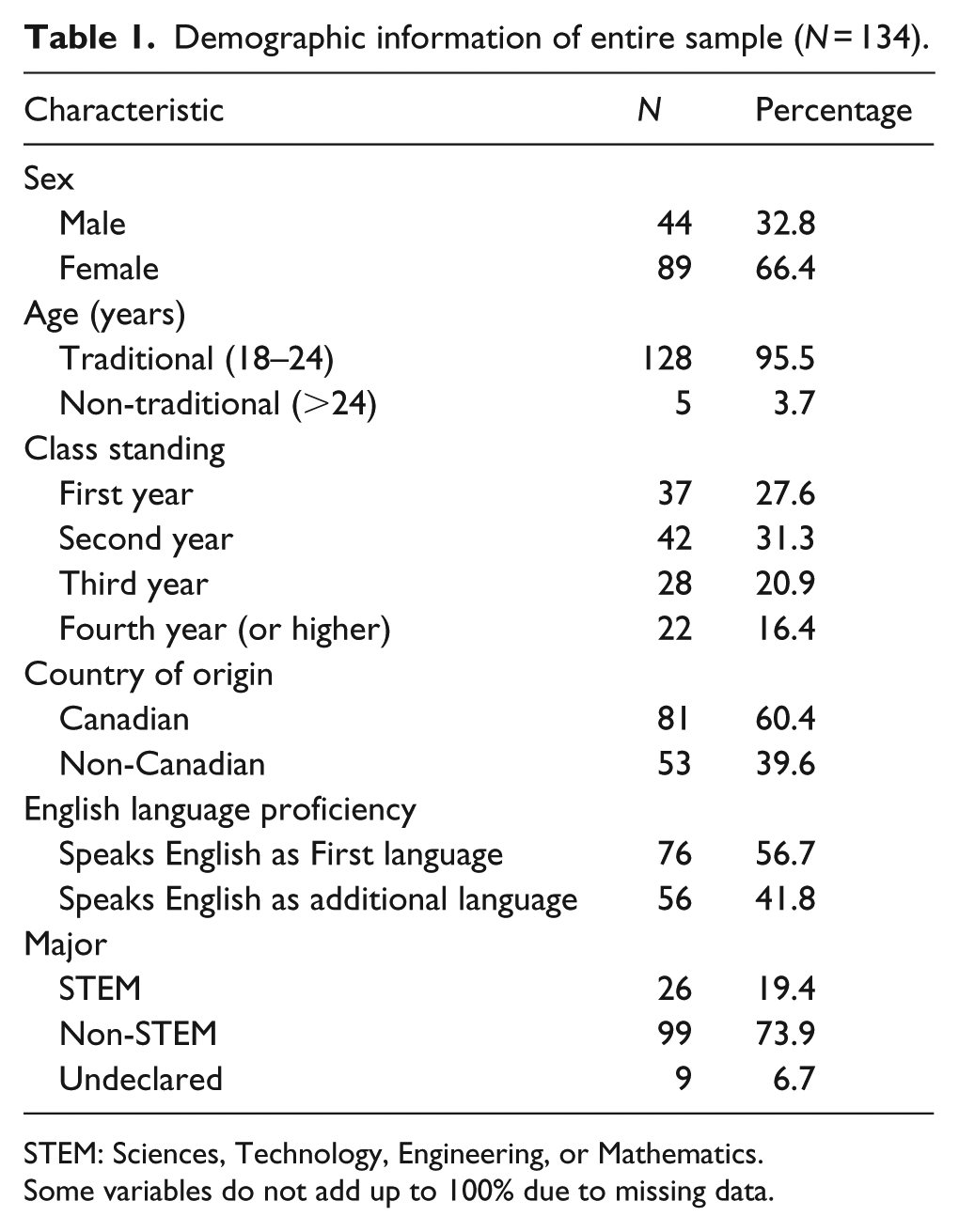
STEM: Sciences, Technology, Engineering, or Mathematics.
Some variables do not add up to 100% due to missing data.
Materials and procedure
BAPQ
The BAPQ consists of 36 questions answered on a 6-point Likert scale (Hurley et al., 2007). The BAPQ includes three subscales meant to reflect the three sub-domains of ASD diagnostic criteria which are as follows: (1) aloof personality (e.g. “I would rather talk to people to get information than to socialize”), (2) pragmatic language difficulties (e.g. “I find it hard to get my words out smoothly”), and (3) rigid personality (e.g. “I am uncomfortable with unexpected changes in plans”) (Hurley et al., 2007).
SACQ
The SACQ consists of 67 questions answered on a 9-point Likert scale (Baker and Siryk, 1999). For our purposes, three of the four subscales are analyzed, including academic adjustment (e.g. “I am enjoying my academic work at college”), social adjustment (e.g. “I am very involved with social activities in college”), and personal-emotional adjustment (e.g. “I have been getting angry too easily lately”). Extensive evidence for the validity of the SACQ is provided in the test manual (see Baker and Siryk, 1999).
Procedure
Participants completed the measures described above, first providing demographic information, and then completing the BAPQ, and finally the SACQ. All questionnaires were completed in succession during a single meeting. Data collection took place either in a laboratory or a classroom and took participants on average 25 min to complete. Participants gave written informed consent under a protocol approved by the Research Ethics Board of the Simon Fraser University.
Results
Descriptive statistics are reported in Tables 2 and 3; intercorrelations among the BAPQ and the SACQ subscales as well as internal consistency reliability coefficients are reported in Table 4.
Descriptive statistics of BAP and Non-BAP groups.
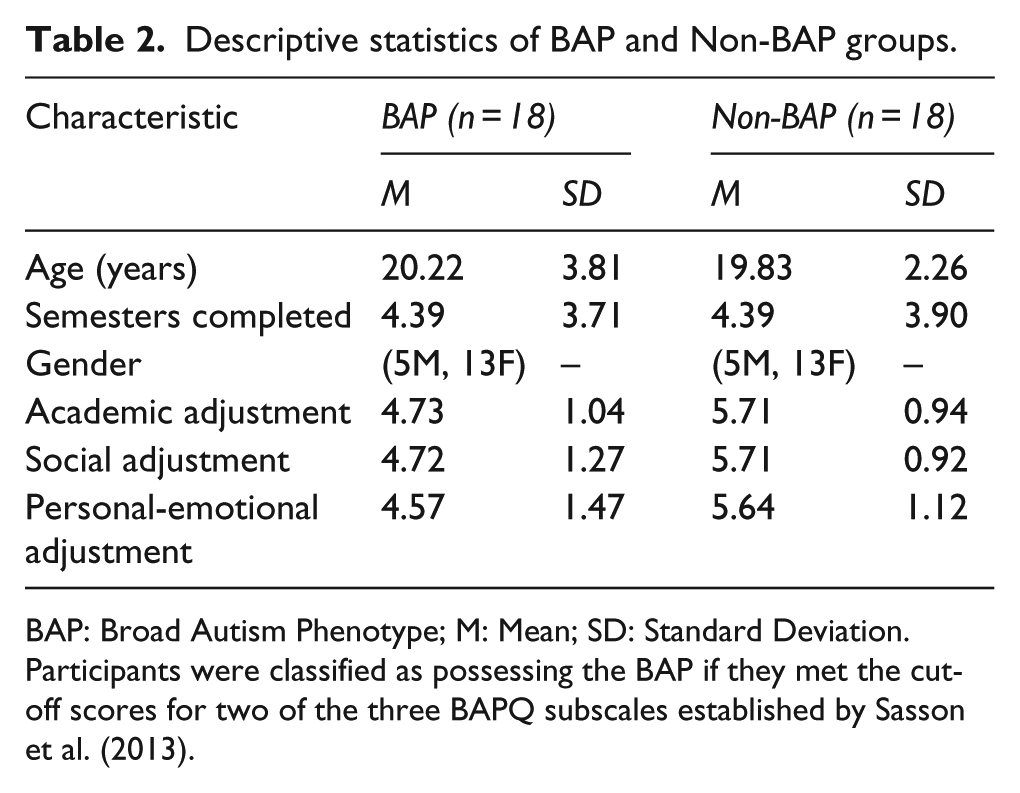
BAP: Broad Autism Phenotype; M: Mean; SD: Standard Deviation.
Participants were classified as possessing the BAP if they met the cut-off scores for two of the three BAPQ subscales established by Sasson et al. (2013).
Descriptive statistics of the BAPQ and the SACQ subscales for entire sample.
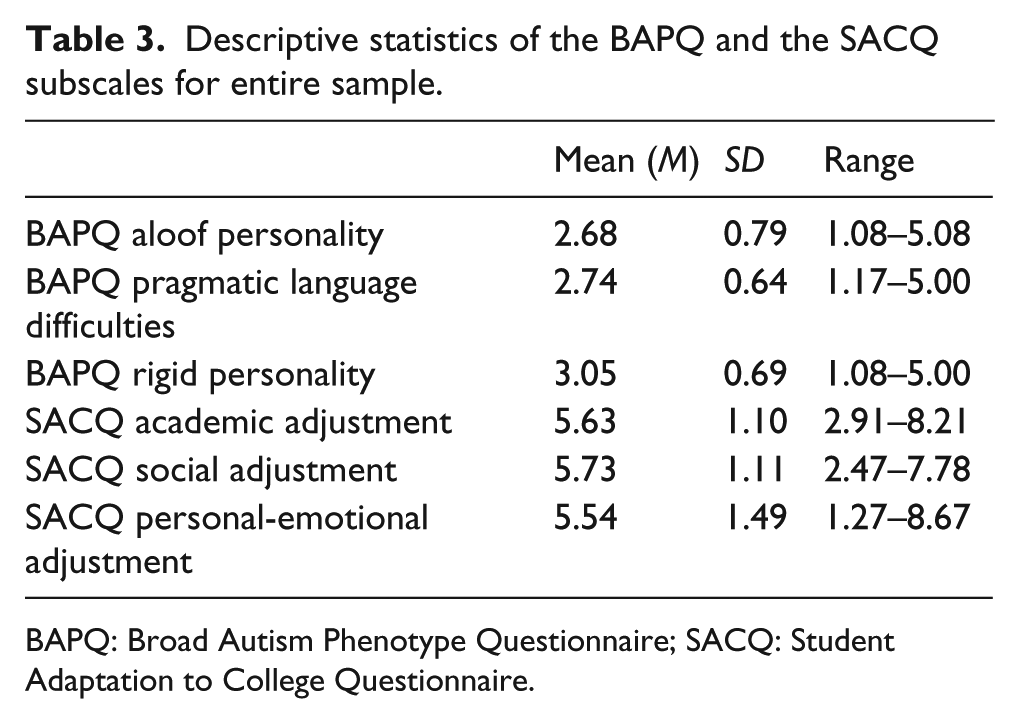
BAPQ: Broad Autism Phenotype Questionnaire; SACQ: Student Adaptation to College Questionnaire.
Intercorrelations among the BAPQ and the SACQ subscales.
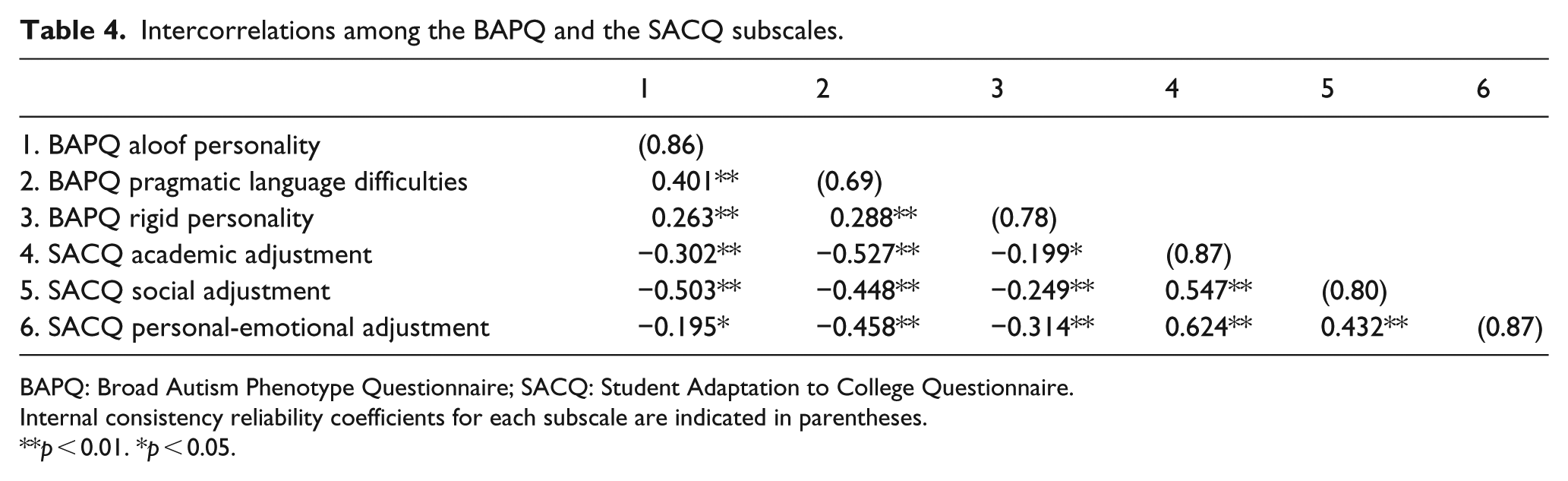
BAPQ: Broad Autism Phenotype Questionnaire; SACQ: Student Adaptation to College Questionnaire.
Internal consistency reliability coefficients for each subscale are indicated in parentheses.
p < 0.01. *p < 0.05.
First, using the cut-off scores established by Sasson et al. (2013), we grouped participants according to whether they met the criteria for possessing the BAP to see if they would score lower on SACQ subscales than a matched non-BAP comparison group. Using rather conservative criteria suggested by Sasson and colleagues, we conceptualized a clinical “best estimate” of BAP by requiring participants to meet the cut-off scores for at least two of the three BAPQ subscales. These cut-off scores are different for males and females based on Sasson et al.’s findings that men score significantly higher on the BAPQ than women. Using mean scores on a 1–6 Likert scale, participants must score at or above the following means for two of the three subscales: 4.13 for men and 3.45 for women on the aloof personality subscale, 3.23 for men and 2.94 for women on the pragmatic language difficulties subscale, and 3.91 for men and 3.70 for women on the rigid personality subscale. In total, 18 of our original 134 students (13.4%) met this criterion making up the BAP group. Next, 18 participants were selected from the remaining 116 participants who did not meet the BAP criteria making up the non-BAP comparison group. The non-BAP comparison group was carefully chosen using matching procedures to control for potential confounds. Because adjustment scores may be influenced by how long students have been enrolled in college (Baker and Siryk, 1999), the non-BAP group was matched to the BAP group on numbers of semesters completed. Additionally, the non-BAP group was matched on gender because BAP traits occur at different rates among men and women (Sasson et al., 2013). Each BAP participant was classified according to gender (m/f) and semesters completed (ranging from 1–14). We then identified all participants in the remaining pool of subjects who matched each BAP participant on gender and semesters completed. In many cases, only one participant matched any given BAP participant on gender and semesters completed; in situations where more than one participant matched the BAP participant, the selection was made at random (see Table 2, for distributions of matching variables and SACQ scores).
To examine whether the BAP and non-BAP groups differed in terms of academic, social, and personal-emotional adjustment, three t-tests were conducted, with group (BAP, non-BAP) entered as the independent variable and each of the three adjustment scores entered as dependent variables. The t-tests confirmed that the non-BAP group scored significantly higher on two of the three dependent measures, including academic adjustment, t(34) = 2.96, p = 0.006, and social adjustment, t(34) = 2.66, p = 0.012, and approached significance for personal-emotional adjustment, t(34) = 2.44, p = 0.020, after alpha levels were Bonferroni-corrected for three comparisons (new α = 0.017).
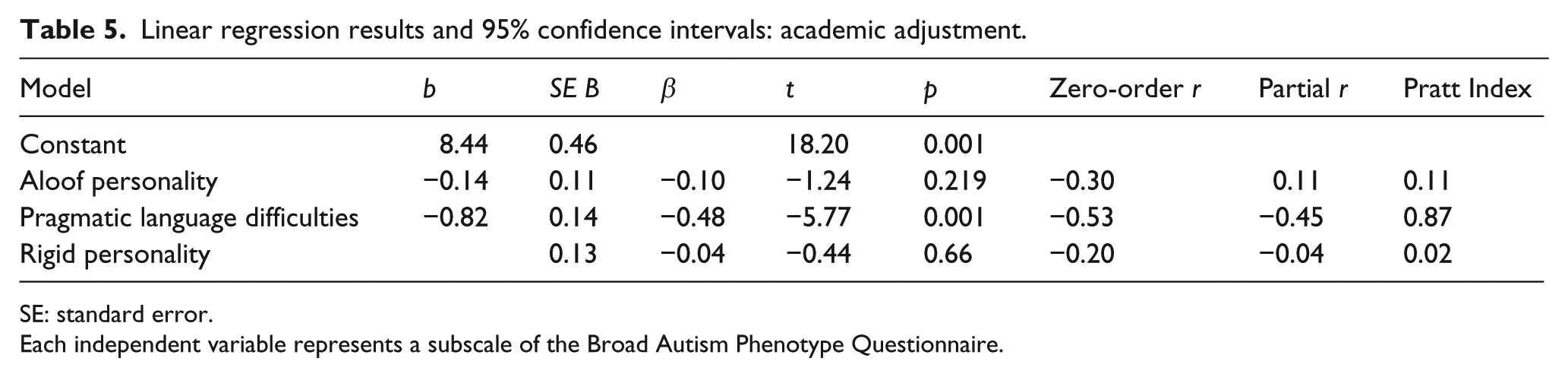
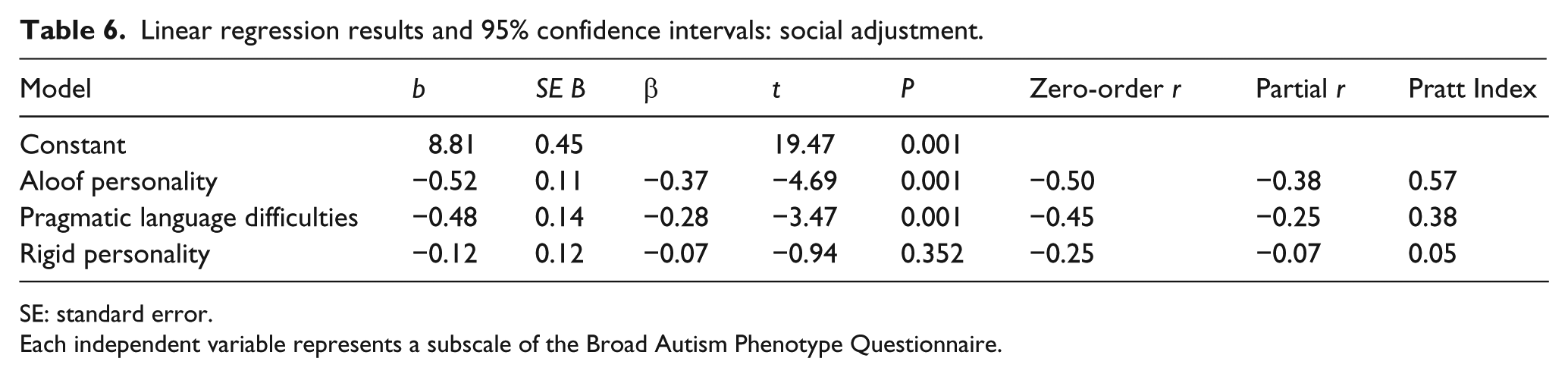
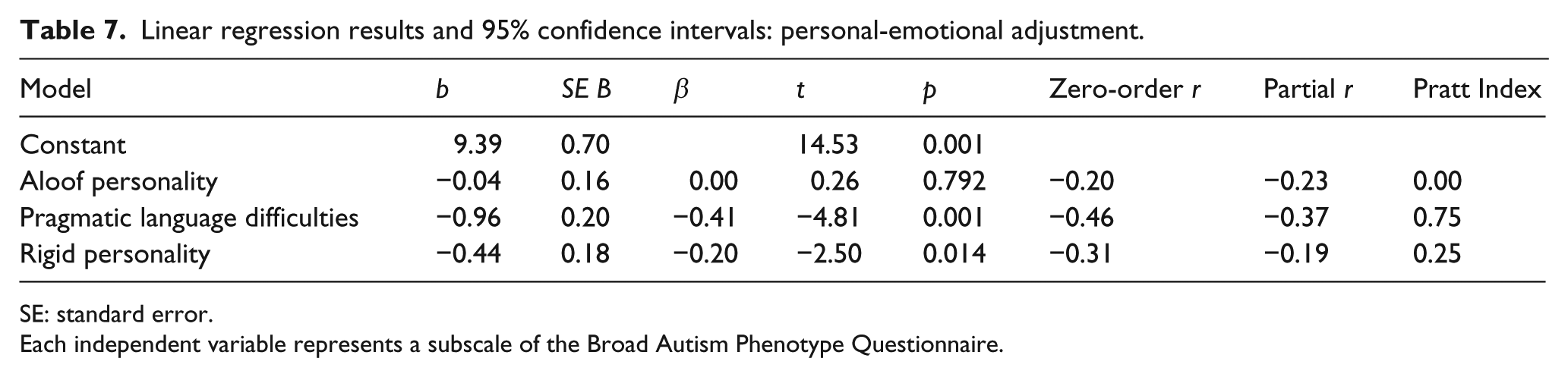
Next, to examine whether continuous relationships exist between various BAP traits and adjustment in our whole (N = 134) sample, the BAPQ scores were regressed onto each measure of adjustment. All assumptions regarding appropriate conduct of linear regression analysis were met. For each of the reported regression analyses, all three BAPQ subscales were entered simultaneously as separate variables in a forced entry method. The raw and standardized regression coefficients of the independent variables along with Pratt Indices are displayed in Tables 5 to 7. Pratt Index represents the relative importance of each independent variable (i.e. proportion of variance explained; Thomas et al., 1998). The academic adjustment model (Table 5) revealed that only one of the three independent variables, pragmatic language difficulties, explained variance in academic adjustment. The model was statistically significant, F(3, 130) = 17.57, p < 0.001, and accounted for approximately 29% of the variance in academic adjustment (R2 = 0.288). Similarly, variance in social adjustment (Table 6) was explained by two of the three independent variables, pragmatic language difficulties and aloof personality. This model was statistically significant, F(3, 130) = 21.31, p < 0.001, and accounted for 33% of the variance in social adjustment (R2 = 0.330). Finally, personal-emotional adjustment (Table 7) was explained by two of the independent variables, this time by pragmatic language difficulties and rigid personality. This model was statistically significant, F(3, 130) = 14.13, p < 0.001, and accounted for approximately 25% of the variance in personal-emotional adjustment (R2 = 0.246). In all regression models, beta coefficients were negative, indicating that higher scores on the independent variable (BAPQ subscale) predicted lower adjustment scores in the expected direction.
Linear regression results and 95% confidence intervals: academic adjustment.
SE: standard error.
Each independent variable represents a subscale of the Broad Autism Phenotype Questionnaire.
Linear regression results and 95% confidence intervals: social adjustment.
SE: standard error.
Each independent variable represents a subscale of the Broad Autism Phenotype Questionnaire.
Linear regression results and 95% confidence intervals: personal-emotional adjustment.
SE: standard error.
Each independent variable represents a subscale of the Broad Autism Phenotype Questionnaire.
BAP, major, and adjustment
To examine the impact of participants’ major (or intended major) on relationships between BAP and adjustment, student major was dummy-coded as a dichotomous variable: STEM (n = 26) versus Non-STEM (n = 99). Nine participants were removed from the analyses because they reported majors as “undeclared.” Although the respective sample sizes of the STEM and non-STEM groups were uneven, Levene’s test for Equality of Variances revealed the group’s variances were not significantly different (F = 1.852, p = 0.176), indicating the assumptions for conducting a t-test were not violated. STEM majors scored higher on two out of three BAPQ subscales; aloof personality, t(123) = 3.42, p = 0.001 and pragmatic language difficulties, t(123), = 2.55, p = 0.012, but not on rigid personality, t(123) = 0.302, p = 0.763 after alpha levels were Bonferroni-corrected for three comparisons (new α = 0.017). STEM majors scored lower on one out of three SACQ subscales; academic adjustment, t(123) = 3.36, p = 0.001, but not on social adjustment, t(123) = 1.50, p = 0.136, or personal-emotional adjustment, t(123) = 0.739, p = 0.461 after alpha levels were Bonferroni-corrected for three comparisons (new α = 0.017).
Next, given the above group difference found for academic adjustment, a linear regression was conducted to see if ASD characteristics mediate the relationship between major and academic adjustment. For the mediation model, major was entered as the only independent variable, and pragmatic language difficulties was entered as the hypothesized mediating variable because this was the only variable that significantly explained variance in academic adjustment (see Table 5). Assumptions for mediation analyses require significant associations among the independent, dependent, and hypothesized mediating variable(s). All such assumptions were satisfied (ps < 0.05). For mediation to occur, the direct effects between the independent variable (major) and the dependent variable (academic adjustment) should become smaller (partial mediation) or eliminated (total mediation) once the mediating variable is entered into the equation. Results revealed a significant indirect effect of major on academic adjustment through pragmatic language difficulties, R2 = 0.551, 95% CI [0.012, 0.135] (see Figure 1) confirming that higher levels of pragmatic language difficulties within STEM students partially explained why STEM students scored lower on academic adjustment. Figure 1 shows that the direct effect of major on academic adjustment remained significant, indicating that pragmatic language difficulties only partially mediated this relationship.
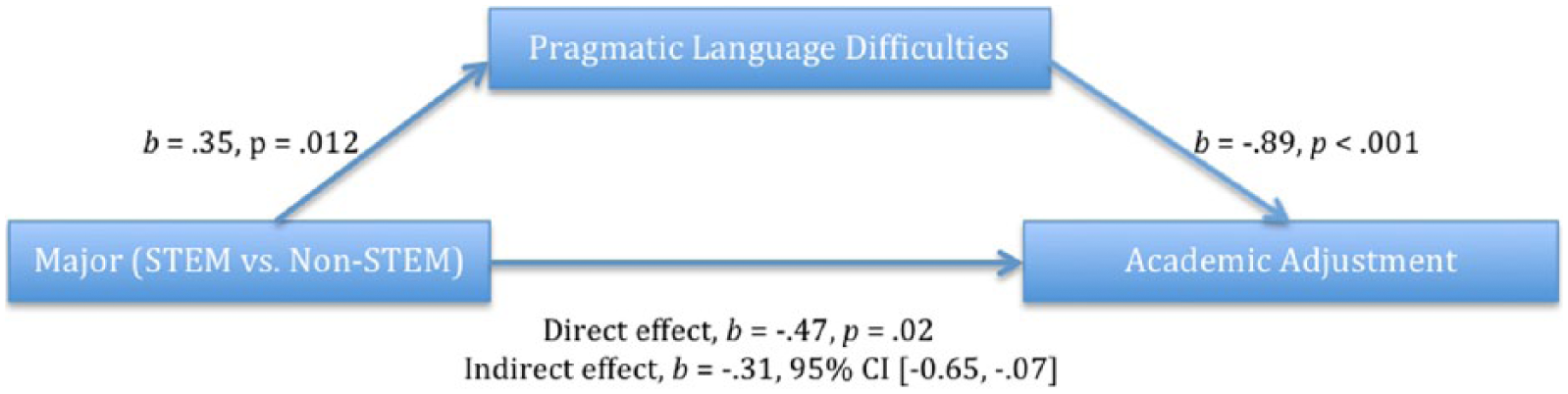
Academic adjustment mediation model.
Discussion
In this study, we found that students with the BAP in our sample (n = 18) scored significantly lower on academic and social adjustment to college, and marginally lower on personal-emotional adjustment, compared to a non-BAP comparison group (n = 18). We also discovered that one or more facets of the BAP significantly explained variance in scores in college adjustment among our entire sample (N = 134). Perhaps the most notable finding from this study is that pragmatic language difficulties emerged as the strongest correlate of lower adjustment scores, explaining variance in all three SACQ subscales of interest. The other two facets of the BAP, rigid personality and aloof personality, each explained variance in only one of the three regression models. Rigid personality significantly explained variance in personal-emotional adjustment, but not in social or academic adjustment. Aloof personality, on the other hand, significantly explained variance in social adjustment, but not in personal-emotional or academic adjustment.
While it is not possible from our data to determine exactly how these characteristics relate to adjustment, we make some suggestions here. With regard to pragmatic language difficulties, we speculate that difficulty with social communication impedes the formation and maintenance of relationships with peers, both within and outside the classroom (Sperry and Mesibov, 2005), hence impacting both academic and social adjustment. Similarly, undergraduates with poor social communication skills may be especially hesitant to approach persons of authority such as course instructors or teaching assistants, leading to help-seeking avoidance and poor academic adjustment. Finally, students who struggle to relate to others because of poor social communication would be likely to experience social rejection and isolation, contributing to difficulties in personal-emotional adjustment. These speculations are consistent with a recent study by Freeth et al. (2013), who examined the relationship between social and communication skills (as measured by the AQ) and the Liebowitz Social Anxiety Scale (LSAS; Liebowitz, 1987) among a large sample of UK college students. Grouping specific items from the LSAS that the authors deemed necessary for successful degree completion, such as participating in small group activities, talking to someone in authority, speaking in front of an audience, meeting strangers, and so on, Freeth et al. (2013) found that self-reported anxiety about these activities was moderately and positively correlated with the AQ.
With regard to rigid personality, one possibility is that aspects of this trait are linked with more challenges in personal-emotional adjustment because adjusting to college requires some degree of flexibility. College life is not a particularly regimented lifestyle—daily schedules are not fixed, assignments are not always the same, and new classes are taken each semester, along with new classmates and instructors. An individual with a more rigid personality could find these changes stressful, possibly leading to anxious and depressive symptoms. That an aloof personality is linked with low social adjustment could reflect a subdued interest in social interaction associated with this trait, leading to lower quality relationships and less involvement in social activities. These possibilities should be systematically tested in future studies.
Next, we found that students with STEM majors carried higher levels of BAP characteristics and scored lower on academic adjustment. Using mediation analysis, it was demonstrated that pragmatic language difficulties partially explained variance in academic adjustment for STEM students. While this study is not the first to show a relationship between autistic-like traits and a preference for scientific endeavor (Baron-Cohen, 2002), it was the first to examine how higher rates of autistic traits among STEM students impact college adjustment. Indeed, our findings point to a specific role of pragmatic language difficulties in explaining adjustment difficulties among STEM students. The findings of this study thus underscore the importance for universities in general, and STEM departments in particular, to be aware of the problems students may experience with social communication.
Limitations
There are several methodological limitations that must be considered when drawing conclusions from this study. First, data were taken from a small convenience sample from only one university, and it is not clear if our results will generalize to other university populations. Second, in regard to our comparisons between STEM and non-STEM participants, it is possible that group differences were confounded by selection bias because the STEM and non-STEM participants were obtained using differing recruitment procedures. Third, all of our measures were self-reported, and we did not actually observe participants’ BAP characteristics (e.g. pragmatic language abilities) in a real-world situation. Fourth, the results of our mediation analysis should be interpreted with caution as we violated the assumption of temporal causality. A longitudinal or experimental design would be needed to confirm our findings that pragmatic language difficulties intercede a causal link between college major and academic adjustment. A final important limitation is that in this study we did not collect follow-up data to see if higher levels of ASD characteristics and lower levels of adjustment predict whether or not students dropped out of college before having completed their degree requirements. Future research should use longitudinal research designs to examine if lower rates of adjustment in students with or without a clinical diagnosis of ASD actually increase the likelihood of dropout decisions.
Implications and future directions
Despite the limitations, important implications emerge from this study. Our most notable finding is that of the dimensions comprising the BAP, pragmatic language difficulties explained the greatest amount of variance in overall adjustment. Indeed, pragmatic language difficulties explained a significant amount of variance in all three of the SACQ scales. This is an important finding considering that none of the participants in this sample, including those who had met the cut-off for possessing the BAP, reported ever being diagnosed with a developmental or communication disorder. This suggests that many students in the general student body at universities may experience difficulties in social communication, inhibiting their ability to adjust to the various demands of college. Fostering social communication skills in college students may aid their ability to adjust to the college environment, and could conceivably yield benefits beyond formal education as well. Beyond technical skills, soft skills, (e.g. problem solving, self-motivation, leadership skills, communication skills, and interpersonal skills) are often rated as more important by employers (Johnston and McGregor, 2004; cited in Carter, 2011). Of these soft skills, communication skills in particular are frequently reported as the most sought-after skillset (National Association of Colleges and Employers, 2010), and yet, rarely are these type of skills included in college curricula. This may be in part due to findings that faculty over-estimates the importance of domain knowledge and research skills while under-estimating the importance of soft skills (Kabicher et al., 2009).
Although our study focused only on neurotypical university students without any family history of ASD, our results spark some initial predictions about which aspects of the autism phenotype may be particularly important to college adjustment among students with a clinical diagnosis of ASD. We note, however, that people with ASD have both quantitatively and qualitatively different characteristics from people in the general population, have a higher incidence of comorbid psychiatric conditions, and are often dealing with problems with executive function and attention. Our data thus do not speak to the unique challenges faced by university students with an autism diagnosis.
Based on the specific findings of this study, however, we predict pragmatic language difficulties to be particularly problematic for college students with ASD, especially in light of some important differences between secondary and postsecondary education. When families prepare for their children with disabilities to transition from high school to college, they are often surprised to learn about policy differences regarding how high schools and colleges accommodate disabilities (Thierfeld-Brown et al., 2012). Accommodations in colleges are meant only to “level the playing field,” and students may not receive all the accommodations they were accustomed to in high school, such as access to teaching aids to help interpret exam questions, unlimited time for exams, and so on. In college, students are left to their own devices to advocate for themselves to their instructors and to disability service centers, which is likely to be a major challenge for students with ASD who may lack the initiative or communication skills to do so (Janiga and Costenbader, 2002). Future research may benefit from examining the specific ways in which characteristics of ASD, such as pragmatic language difficulties, impact college success in students with ASD in order to develop supports that minimize barriers to accommodations.
Conclusion
In sum, results from this study suggest ASD characteristics in the college student population, particularly in the area of social communication, contribute to a substantial amount of variance in adjustment. Given the relationship we found between social communication difficulties and college adjustment, universities would be wise to explore interventions or design curricula in such a way to foster communication skills and other soft skills. In addition, the findings of this study provide ample opportunity for replication in college students with a clinical diagnosis of ASD. Future research should delineate how, and in what ways, pragmatic language difficulties are creating problems for students in various social and academic situations in order to provide faculty and college personnel more specific information on how to address these problems. Doing so will increase our understanding of how social communication difficulties impede college adjustment, which in turn will help educators, parents, disability services, and practitioners aid the difficult transition to college for young adults with ASD.
Footnotes
Acknowledgements
We would like to thank Lucy Le Mare and Phil Winne for their helpful guidance and advice throughout this project.
Funding
This work was supported by grant 13-877612 from the Social Sciences and Humanities Research Council of Canada (SSHRC).