







Abstract
Infant social-communicative behavior, such as gaze to the face of an interactive partner, is an important early developmental skill. Children with autism spectrum disorder exhibit atypicalities in social-communicative behavior, including gaze and eye contact. Behavioral differences in infancy may serve as early markers of autism spectrum disorder and help identify individuals at highest risk for developing the disorder. Researchers often assess social-communicative behavior in a single interactive context, such as during assessment with an unfamiliar examiner or play with a parent. Understanding whether infant behavior is consistent across such contexts is important for evaluating the validity of experimental paradigms and the generalizability of findings from one interactive context/partner to another. We examined infant gaze to the face of a social partner at 6, 9, and 12 months of age in infants who were later diagnosed with autism spectrum disorder, as well as low- and high-risk infants without autism spectrum disorder outcomes, across two interactive contexts: structured testing with an unfamiliar examiner and semi-structured play with a parent. By 9 months, infant gaze behavior was significantly associated between the two contexts. By 12 months, infants without autism spectrum disorder outcomes exhibited higher mean rates of gaze to faces during parent–child play than Mullen testing, while the gaze behavior of the autism spectrum disorder group did not differ by context—suggesting that infants developing autism spectrum disorder may be less sensitive to context or interactive partner. Findings support the validity of assessing infant social-communicative behavior during structured laboratory settings and suggest that infant behavior exhibits consistency across settings and interactive partners.
Introduction
Infant social-communicative behavior, such as eye gaze, during the first year of life can be an important early developmental marker, particularly in infants with an older sibling diagnosed with autism spectrum disorder (ASD), who are at elevated risk for developing ASD or related difficulties (i.e. high-risk siblings). High-risk siblings later diagnosed with ASD exhibit atypicalities in gaze-related behavior in the first year of life, including reduced frequency of eye contact (Bryson et al., 2007; Zwaigenbaum et al., 2005), joint attention (Ibañez et al., 2013), social engagement (Campbell et al., 2014), and attentiveness to a parent (Wan et al., 2013). A common scenario in research settings, in which conditions need to be standardized across participants, is to measure infant social-communication behavior with an unfamiliar examiner. Given the relevance of eye gaze to early development, it is critical to understand whether gaze behaviors are consistent across common measurement contexts and social partners.
In typically developing infants, studies document similarities in infant social-communicative behaviors with mothers and with strangers (Bigelow, 1998; Bigelow and Rochat, 2006), with mothers at home and in the laboratory (Belsky, 1980), and with mothers across different interactive contexts (Maas et al., 2013). Collectively, this research, although scant, suggests that there is individual stability in the social-communication behavior of typically developing infants across both partners and contexts.
Effects of context and social partner may play a role in the amount of social-communicative behavior exhibited by children with ASD as well. Previous studies have shown that children with ASD exhibited greater social behavior during child-preferred activities (Koegel et al., 1987) and during more structured situations (Kasari et al., 1993). Children with ASD also gazed at a social partner more often during conversation than interactive play with toys (Jones et al., 2016), as well as during conversation around topics of interest compared to general topics (Nadig et al., 2010). These studies suggest that the structure and content of an interaction may influence social-communicative behavior in children with autism as well. What the existing literature has not yet examined, however, is the relative consistency of behavior between interactive contexts (e.g. whether individuals exhibiting high levels of gaze in one context or with one partner will also demonstrate high levels of gaze in another context or with another partner).
Research on infants at risk for autism often collects data through interactions with examiners in structured settings and uses this data to make inferences about early markers of diagnosis. For example, Ozonoff et al. (2010) examined infant gaze to faces from 6 to 36 months of age in children who either developed ASD or were typically developing. Children later diagnosed with ASD exhibited declining trajectories of gaze to an examiner’s face over time, looking significantly less to the examiner’s face than typically developing children by 12 months. Nichols et al. (2014) assessed children’s eye contact during an interactive assessment with an examiner at 15 months. Children who later exhibited ASD symptomatology made less eye contact with an examiner at 15 months than children who did not exhibit later ASD symptomatology. Joint attention is also commonly assessed in high-risk infants during semi-structured interactions with examiners (e.g. Gangi et al., 2014; Ibañez et al., 2013; Rozga et al., 2011; Yirmiya et al., 2006). These measurements, made in structured settings with novel social partners, are implicitly intended to be a proxy for the child’s general interactive capacities with others in more naturalistic contexts. It is of relatively less interest to find that an infant’s gaze to an unfamiliar adult is reduced unless we know that this finding generalizes to his or her gaze with other people, in the real world. It is presumed that infant gaze behavior measured in a laboratory setting is a valid representation of general infant gaze behavior—a stable trait, rather than a transient state specific to one context and partner—but virtually no research exists to test this assumption in high-risk infants.
Current study
This study examined gaze behavior during the first year of life in a sample of infants at high and low risk for ASD studied prospectively. We investigated whether gaze behavior was associated across two different interactive contexts: structured testing with an unfamiliar examiner and a semi-structured play interaction with a parent. Because infant behavior during assessment with an examiner is frequently used in research to evaluate social-communicative abilities, a primary goal of this study was to determine whether behavior in this context does in fact predict behavior in a more naturalistic context, with familiar partners. Therefore, we examined whether infant gaze behavior during testing with an unfamiliar examiner predicted concurrent gaze behavior during play with a parent, in addition to whether mean levels of gaze behavior differed between contexts.
Methods
Participants
Participants were infant siblings of children with ASD (high-risk siblings) or without ASD (low-risk siblings), who were part of a larger longitudinal study. High-risk infants had at least one older sibling with ASD, confirmed using the ASD criteria on both the Autism Diagnostic Observation Schedule, Second Edition (ADOS-2) and the Social Communication Questionnaire (SCQ). Low-risk infants had older sibling(s) who were typically developing and no family history of ASD, confirmed by an Intake Screening Questionnaire and scores below the ASD range on the SCQ. Parents provided informed consent and the study was approved by the university’s Institutional Review Board.
At 36 months of age, ASD outcome was determined for all participants, who were classified as either ASD or no ASD. An ASD outcome required an ADOS-2 score above the ASD cutoff and meeting Diagnostic and Statistical Manual of Mental Disorders (4th ed., text rev.; DSM-IV-TR) criteria for autistic disorder or Pervasive Developmental Disorder-Not Otherwise Specified (PDD-NOS) according to an expert clinician.
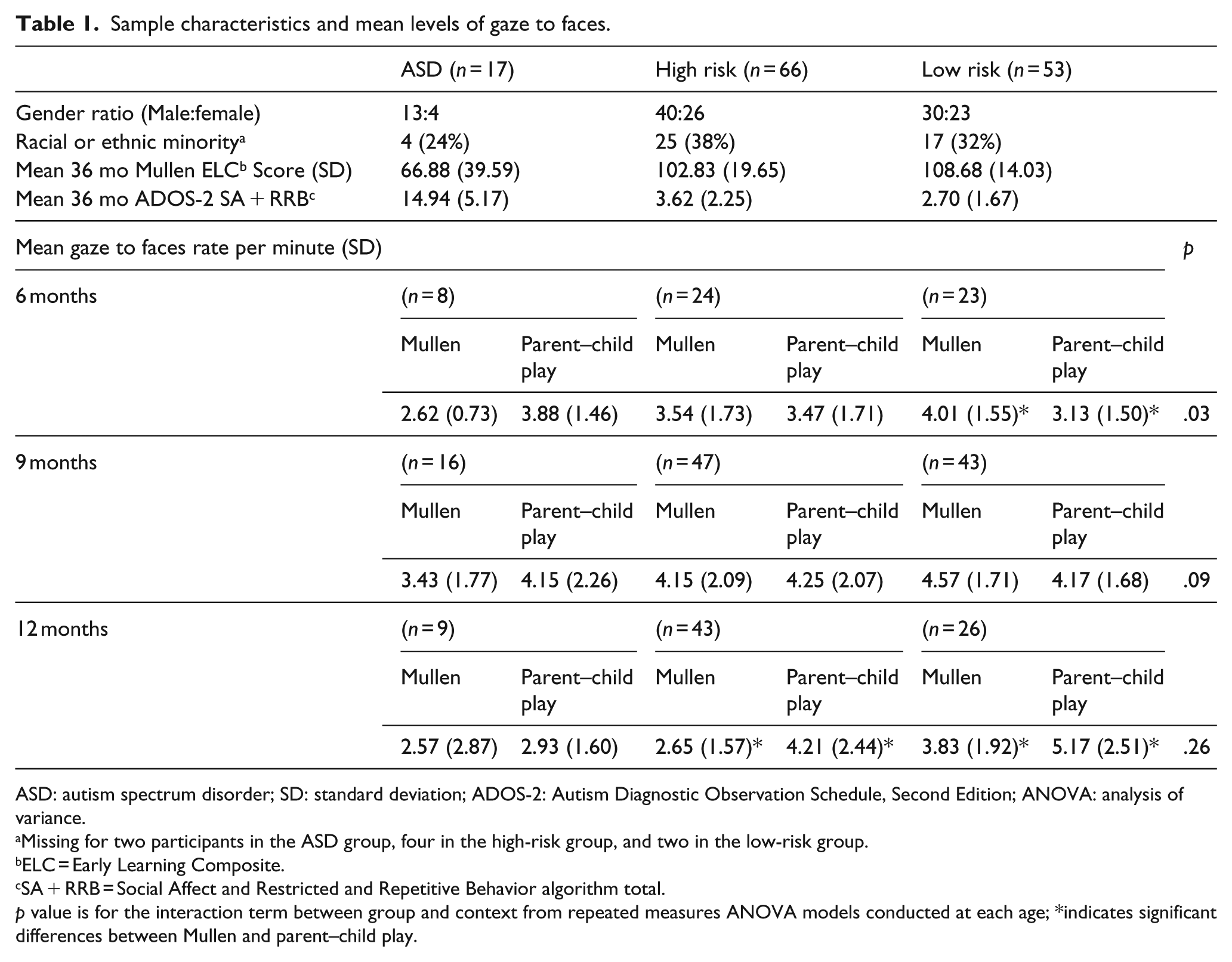
To be included in analyses at each age, participants were required to have data from both interactive contexts, in addition to 36-month outcomes. Due to the age of enrollment or fatigue/noncompliance issues, not all infants had data for all ages (see Table 1). For analyses, participants were classified into one of three groups: a low-risk non-ASD group (n = 53), a high-risk non-ASD group (n = 66), and an ASD group (n = 17, 16 high risk and 1 low risk). Sample characteristics stratified by group are presented in Table 1.
Sample characteristics and mean levels of gaze to faces.
ASD: autism spectrum disorder; SD: standard deviation; ADOS-2: Autism Diagnostic Observation Schedule, Second Edition; ANOVA: analysis of variance.
Missing for two participants in the ASD group, four in the high-risk group, and two in the low-risk group.
ELC = Early Learning Composite.
SA + RRB = Social Affect and Restricted and Repetitive Behavior algorithm total.
p value is for the interaction term between group and context from repeated measures ANOVA models conducted at each age; *indicates significant differences between Mullen and parent–child play.
Measures
Mullen Scales of Early Learning
The Mullen Scales of Early Learning, a standardized developmental test for children birth to 68 months, was administered by examiners at each visit to measure cognitive functioning.
Parent–child play interaction
Children participated in a 3-min play interaction with a parent at 6, 9, and 12 months of age. Infants were seated in a high chair fitted with a tray, with the parent seated in a chair facing the infant. Dyads were provided a set of age-appropriate toys and instructed to play as they normally would at home, with or without toys.
ADOS-2
The ADOS-2 is a semi-structured play-based interaction and observation designed to assess symptoms of ASD. The ADOS-2 was used for the determination of outcome at 36 months of age.
Behavioral coding
Social-communication behavior coding
Gaze behaviors were coded during the first 6 min of the examiner-administered Mullen Visual Reception subtest (mean coded duration = 5.88 min) and during the 3-min parent–child play interaction (mean coded duration = 3.00 min) at the 6-, 9-, and 12-month visits. The frequency of gaze to an adult’s face was coded following procedures outlined in Ozonoff et al. (2010) using Noldus: the Observer 5.0 behavioral observation software. Camera angles afforded clear views of both infant and adult partner faces. Gaze to face onset was coded when an infant’s face was oriented to the face of the social partner (visible on screen), and offset was coded when the infant’s face was no longer oriented to the face of the social partner. Coders were unaware of child risk-group status and were trained to initial reliability of intraclass correlation coefficient (ICC) > .80 (range = .84–.99), and ongoing reliability was maintained throughout the project with a master coder who double-coded 20% of videos. Frequency counts were then divided by the total duration coded to create rate per minute variables for analyses.
Analysis
Regression analyses were employed to examine the associations between rate of infant gaze to faces in unstructured play with a parent and structured testing with an examiner. Given the common research strategy of measuring infant social-communicative behavior when engaged with unfamiliar examiners (e.g. Ibañez et al., 2013; Nichols et al., 2014; Ozonoff et al., 2010; Yirmiya et al., 2006), we examined whether gaze to the examiner’s face during the Mullen testing was predictive of gaze to the parent’s face during parent–child play at each age. To control for potential effects of familial risk and diagnostic outcome on gaze behavior, the outcome groups were dummy-coded and added to the models. Variables were entered into the regression models simultaneously. Statistical analyses were implemented using PROC REG in SAS University edition.
Results
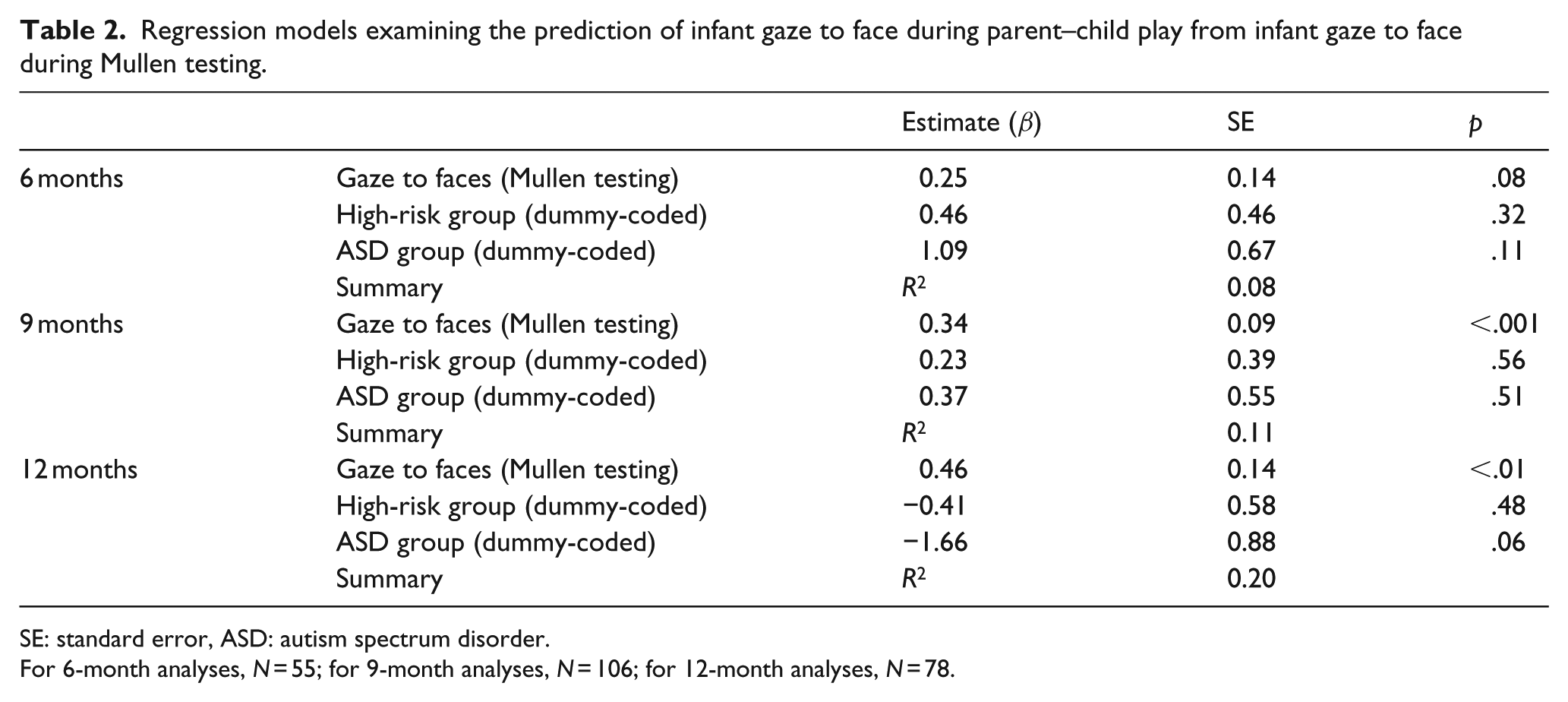
Mean levels of gaze to faces rates per minute are presented in Table 1. Model parameters for the regression analyses are presented in Table 2.
Regression models examining the prediction of infant gaze to face during parent–child play from infant gaze to face during Mullen testing.
SE: standard error, ASD: autism spectrum disorder.
For 6-month analyses, N = 55; for 9-month analyses, N = 106; for 12-month analyses, N = 78.
Infant gaze to faces during Mullen testing approached significance in predicting infant gaze to faces during parent–child play at 6 months, β = 0.25, standard error (SE) = 0.14, p = .08. At both 9 and 12 months, infant gaze during the Mullen significantly predicted gaze during parent–child play (9 months: β = 0.34, SE = 0.10, p < .001; 12 months: β = 0.46, SE = 0.14, p < .01). Outcome group variables were included in all models and were not significant at any age (see Table 2 and Figure 1).
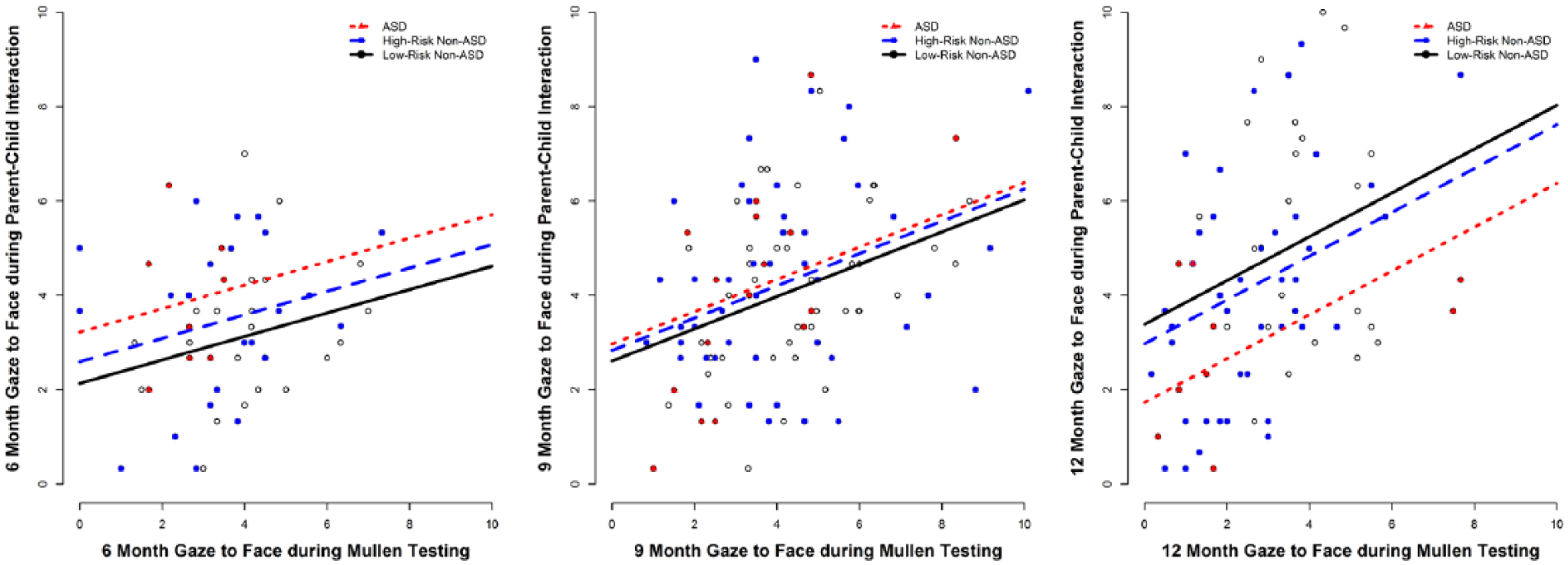
Associations between gaze to the face of the social partner in two interactive contexts at 6, 9, and 12 months.
A priori planned contrasts examining differences in gaze to faces between contexts for each group at each age were also conducted with repeated measures group by context analysis of variance (ANOVA) models. By 12 months, a pattern emerged in which low- and high-risk siblings without ASD outcomes exhibited higher rates of gaze to faces during parent–child play than during Mullen testing. However, the gaze behavior of infants with ASD outcomes did not differ between contexts at 12 months (see Table 1).
Discussion
This study examined an important, early-developing social-communicative behavior, gaze to the face of a social partner, at 6, 9, and 12 months of age in a sample of infant siblings at high and low risk for ASD in two interactive contexts: structured testing with an unfamiliar examiner and unstructured play with a parent. Infant behavior was associated between contexts, such that infants with higher levels of gaze to the face of an examiner during structured testing had higher levels of gaze to the face of the parent during a play interaction. This pattern held even when controlling for risk and outcome group, suggesting that infants in all groups exhibited this relationship.
These findings support the validity of observing social-communicative behavior with an examiner, a setting in which the gaze behavior of children with ASD or at risk for ASD is frequently tested. Several widely used assessment tools, including the Early Social Communication Scales (ESCS) and the Communication and Symbolic Behavior Scales (CSBS), measure gaze and other social-communicative behaviors through semi-structured interactions between a child and novel examiner. Diagnostic and early detection tools for ASD often assess eye contact during play-based interactions between a child and examiner, including the gold-standard diagnostic assessment for ASD, the ADOS-2, as well as the Screening Tool for Autism in Toddlers & Young Children (STAT) and the Autism Observation Scale for Infants (AOSI). This study suggests that social-communicative abilities observed in such contexts with examiners generalize to behavior in interactions with parents.
Although moderate effect sizes indicate some consistency in infant behavior across contexts by 9 months of age, it is worth noting that there is still variability in this behavioral consistency, with some infants exhibiting greater consistency than others (see Figure 1), whereas this variability was not related to outcome classification in the current sample. This variation among infants may support the utility of observing behavior with more than one social partner in future investigations of high-risk infants. Future research with larger samples may also be helpful in further evaluating whether there are associations between behavioral consistency and diagnostic outcome. Additionally, by 12 months, infants in the high- and low-risk non-ASD groups were exhibiting higher mean rates of gaze to the face of the parent during play than to the examiner during testing. However, the ASD group did not show this same differentiation across contexts and partners at 12 months. It is interesting that this group difference first became evident during the same time window in which many studies have shown that ASD symptoms begin to emerge (e.g. Gammer et al., 2015; Landa et al., 2013). Given the relatively small sample size of the ASD group, this finding should be further explored with larger samples.
While this study provides a novel look at infant behavior across two contexts, there are limitations that should be addressed in future studies. Infant behavior was examined during interaction with both a familiar (parent) and an unfamiliar (examiner) social partner. The activities completed during interaction (play vs structured testing) also differed between the two contexts in addition to the social partner, confounding the effects of interactive context and social partner. Observing infants during the same activity with different social partners or the same social partner during different activities would allow for further examination of the stability of infant social behavior. Future research might also examine other aspects of social-communicative behavior that could be affected by context, such as joint attention, gesture use, and affect sharing. Additionally, while the relatively small sample sizes at each age (particularly of infants with ASD outcomes) did not permit longitudinal analyses in this study, consistency across social partners and contexts might be explored longitudinally in future studies to determine whether developmental trends in behavioral consistency emerge in the first year of life.
The current findings suggest that structured settings and “standardized” partners (i.e. expert examiners) provide a valuable window into infant social-communicative behavior that is representative of behavior in less structured contexts with familiar people. Associations found in this study support the validity and use of structured research settings to examine infant social-communicative competence.
Supplemental Material
AUT704421_Lay_Abstract – Supplemental material for Gaze to faces across interactive contexts in infants at heightened risk for autism
Supplemental material, AUT704421_Lay_Abstract for Gaze to faces across interactive contexts in infants at heightened risk for autism by Devon N Gangi, AJ Schwichtenberg, Ana-Maria Iosif, Gregory S Young, Fam Baguio and Sally Ozonoff in Autism
Footnotes
Funding
The author(s) disclosed receipt of the following financial support for the research, authorship, and/or publication of this article: This study was supported by National Institute of Mental Health (R01 MH068398 and T32 MH073124) and National Institute of Child Health and Human Development (U54 HD079125).
References
Supplementary Material
Please find the following supplemental material available below.
For Open Access articles published under a Creative Commons License, all supplemental material carries the same license as the article it is associated with.
For non-Open Access articles published, all supplemental material carries a non-exclusive license, and permission requests for re-use of supplemental material or any part of supplemental material shall be sent directly to the copyright owner as specified in the copyright notice associated with the article.
