







Abstract
Autistic people are often described as being impaired with regard to theory of mind, though more recent literature finds flaws in the theory of mind deficit paradigm. In addition, the predominant methods for examining theory of mind often rely on “observational” modes of assessment and do not adequately reflect the dynamic process of real-life perspective taking. Thus, it is imperative that researchers continue to test the autistic theory of mind deficit paradigm and explore theory of mind experiences through more naturalistic approaches. This study qualitatively examined theory of mind in 12 autistic adolescents through a series of semi-structured interviews. Interpretive phenomenological analysis of the data revealed four core themes in participants’ theory of mind experiences and strategies, all of which highlighted how a more accurate representation of autistic theory of mind is one of difference rather than deficit. For instance, data showed that autistic heightened perceptual abilities may contribute to mentalizing strengths and that honesty in autism may be less dependent on systemizing rather than personal experience and choice. Such findings suggest that future research should reexamine autistic characteristics in light of their ability to enhance theory of mind processing. Understanding how an autistic theory of mind is uniquely functional is an imperative step toward both destigmatizing the condition and advocating for neurodiversity.
Keywords
Some of the first accounts of autism described young children struggling to adapt to change, displaying heightened sensory perceptions, and possessing atypical interaction styles (Kanner, 1943). While aspects of these original descriptions remain relevant, researchers, practitioners, and the greater public are increasingly recognizing the numerous strengths afforded to autistic people rather than relying on a deficit account (Kapp et al., 2013). One catalyst for this shift is the experiential accounts written by autistic people, which both provide a voice for describing the autistic experience and help clarify misconceptions about the populations’ capabilities (Hacking, 2009). For instance, Temple Grandin (2008), Dawn Prince-Hughes (2004), and John Elder Robison (2008), all of whom are autistic and experts within their professions, portray their autistic traits as critical to their success within their personal writings.
A more balanced discussion of autistic traits often arises when focusing on the non-social, perceptual aspects of autism, including a propensity toward areas of keen interest, and an enhanced ability to process details (Mottron et al., 2006). It is much less common, however, to learn about the advantages as well as the disadvantages autistic people may possess with regard to their unique social traits. Instead, their social styles are often characterized in stigmatizing ways, and they are portrayed as socially “mindblind” versions of neurotypicals (NTs; Yergeau, 2013). One reason that autistic social characteristics continue to be framed in ways that are stigmatizing may have its roots in theory of mind (ToM) research.
Research on ToM, or the process of mental state representation (Premack and Woodruff, 1978), is arguably one of the most prolific research areas within the field (Milton, 2014). It is also posited to be one of the key reasons that autistic social processing styles are largely framed in terms of deficits (Duffy and Dorner, 2011; Milton, 2014; Yergeau, 2013). In a landmark study, Baron-Cohen et al. (1985) found that despite matched IQ levels, autistic children were significantly impaired at mentalizing as measured by ToM batteries. This launched a significant movement in autism spectrum disorder (ASD) research exploring whether a ToM deficit could provide a “unifying” theory of the condition, though such attempts have proved largely untenable (Verhoeff, 2015).
Aside from issues of utility, there are several reasons why conceptualizing autism as stemming from a ToM deficit may be misleading. de Gelder (1987) for one was an early skeptic of the ToM deficit account. Specifically, she questioned the logic of defining autistics as deficient in ToM, as autistic participants were able to engage in the type of discussions and interactions with researchers, which allowed ToM to be tested. Happé (1994) further questioned the conclusion that autistic people do not possess a ToM as several autistic participants passed the ToM tasks in Baron-Cohen et al. (1985).
Through the creation of the Strange Stories, testing more abstract ToM constructs using short narratives, Happé (1994) demonstrated that ToM could be measured through progressively difficult constructs and that autistic ToM varied developmentally rather than being at a universal deficit. While a substantial body of literature shows that autistic people often possess developmental delays with regard to ToM acquisition (Happé, 1995; Yirmiya et al., 1998), several studies also contradict these findings, revealing no ToM impairments within autistic samples (Bowler, 1992; Larson et al., 2011; Scheeren et al., 2013; for a review see Tager-Flusberg, 2007).
Many studies also highlight the nuances in autistic peoples’ ToM development. While evidence suggests younger autistic children are on average delayed in ToM acquisition (Peterson et al., 2005), they also typically experience significant ToM gains throughout development as a function of language (Steele et al., 2003), executive functioning (Pellicano, 2010), and even social maturity (Peterson et al., 2007). By adulthood, several studies have found that among autistic adults without language delays, explicit or verbalized ToM understanding is in line with NTs (Schneider et al., 2013; Schuwerk et al., 2015). However, studies testing non-verbal ToM processing in autistic adults (Schneider et al., 2013; Schuwerk et al., 2015; Senju et al., 2009) have continued to find implicit or automatic ToM processing differences in relation to gaze tracking (Chen and Yoon, 2011) and processing of body language (Ingersoll, 2010), despite commensurate explicit ToM skills. As differences in implicit ToM have been shown to map onto subsequent difficulties with social processing, such as understanding social norms (Callenmark et al., 2014), there remains a link between impaired ToM, autism, and social functioning.
At the root of the ToM debate is the question of how to best characterize ToM and ToM in autism. Traditionally, ToM assessment has focused on the explicit understanding of ToM constructs, which is tested in laboratory settings using pre-established measures. Some argue that the static nature of such assessments fails to capture ToM processing within the context of dynamic interactions (Gallagher, 2004). As ToM in everyday life reflects a reciprocal, dynamic process and is less reflective of a single actor’s abilities, assessments of ToM that do not include a person’s online processing strategies within an interaction may limit findings (Milton, 2012). This may particularly affect autistic people, as they may perform poorly on more static ToM assessments while showing no impairments relative to NT peers in dynamic tests (Begeer et al., 2010).
Negative preconceptions about autistic people’s ToM abilities shaped by a deficit account may negatively affect their relationships with NTs. Johnson et al. (2009) demonstrated that parents of autistic children often rate them as having poorer empathy than these children rate themselves, while NT parent–child dyads closely match on ratings. Heasman and Gillespie (2017) also found this pattern in a similar study. Significantly, they also found that autistic children correctly ascertained that their parents would rate them poorly on ToM. This not only demonstrates the children’s ability to perspective take, which contradicts a ToM deficit model, but also underscores that autistic people realize that others perceive them as socially disadvantaged.
Incongruence between autistic and NT mental state representations is what Milton (2012) refers to as the “double empathy problem.” He argues that autistic individuals equally deserve to have their perspective accounted for within interactions, just as they are expected to actively consider the perspective of NTs. One way to reduce the double empathy problem is to provide a voice to the autistic ToM and better understand autistic peoples’ ToM experiences free from an NT-derived definition of normal. This more qualitative approach is particularly fitting for research aimed at advancing the neurodiversity paradigm, which critically reflects on how normativity is constructed, and values neurodiversity as a natural part of human variation (Jaarsma and Welin, 2012).
To better understand patterns in ToM processing in those with ASD, this study qualitatively explored ToM-related discourse in adolescents with the condition, which was preferable for several reasons. One research indicates that adolescents undergo a period of intensive synaptic reorganization in neural regions associated with mentalizing (Blakemore and Choudhury, 2006). This reorganization may link with the reminiscence bump, referring to the overrepresentation of autobiographical memories formed in adolescence (Janssen et al., 2011). The reminiscence bump indicates that adolescent experiences are critical to current and future self-representations, a posited underlying mechanism for ToM (Lombardo and Baron-Cohen, 2011). Research also indicates that ToM development in adolescence has a longitudinal, bidirectional association with peer relations, both of which play a reciprocal role in future social development (Banerjee et al., 2011).
The qualitative analytical approach used in this study corresponds with an interpretative phenomenological analysis (IPA) framework. Smith and Shinebourne (2012) detail the processes of IPA as stemming from a desire to understand an individual’s lived experience or the types of moments or events that remain significant and memorable to the individual in question. This approach may be particularly advantageous when exploring ToM in individuals with ASD, as it has been noted that experiential accounts of those with the condition are not easily accounted for in the dominant cognitive models of deficit (Charman et al., 2011).
In summary, the purpose of this study was to shed light on the descriptions, experiences, and observations of autistic people. This was explored in relation to the ToM constructs used in the Strange Stories (Happé, 1994) and utilized an open-ended response framework. This framework was chosen to both explore ToM in connection to the participant’s lived experiences and to nullify the “pathos of mind-blindness” perpetuated through purely researcher driven accounts (Duffy and Dorner, 2011; Milton, 2014). Patterns present in the narratives of participants fell into four overarching themes, which were found to run throughout all interviews.
Methods
Participants and design
To assess autistic individuals who possessed advanced ToM ability, the ToM battery was given to 17 adolescent students at a private school for pupils with neurological differences in the Southwestern United States (age range 13–17, mean 14.4 years). All participants had been diagnosed with ASD using the Autism Diagnostic Interview–Revised (Lord et al., 1994), Autism Diagnostic Observation Schedule (Lord et al., 1989, 2000), or the Diagnostic Interview for Social and Communication Disorders (Wing et al., 2002).
As the interview portion of this study centered upon a discussion of advanced ToM constructs, those who failed to pass less advanced measures of ToM did not participate in the Strange Stories discussion. A total of 12 participants received perfect scores on the ToM battery and progressed to the interview stage of the study, in line with recommendations by Happé (1994). A total of 12 participants (10 males and 2 females) were administered the Strange Stories test using a semi-structured format. Full-scale intelligence quotient scores (Wechsler Intelligence Scale for Children, 4th ed. (WISC-IV); Wechsler, 2003) were provided for all participants. Of the 17 total participants, the 12 who proceeded to the Strange Stories testing had IQ scores, which ranged from 78 to 128 (M = 104.17; SD = 16.28). The five participants who did not pass the ToM battery, and did not proceed to Strange Stories testing, had IQ scores below 70.
Procedure and materials
Procedure
Participants were tested individually in a quiet empty classroom at their school during an elective class period. The ToM battery (Baron-Cohen et al., 1985) was used to test participants for first- and second-order belief tasks using the script from Happé (1994). First-order beliefs allow a person to conceive of the contents of someone else’s mind or their own; second-order beliefs consist of conceiving of one mind conceiving of another mind (Mameli et al., 2016). Participants were probed throughout on their understanding of the representational aspects of the test, as is suggested in Happé (1994). All participants demonstrated this basic level of understanding. Individuals who received perfect scores on the ToM battery were then assessed on the Strange Stories 1 week later.
In the second phase of the assessment, semi-structured interviews were conducted using the Strange Stories (Happé, 1994). To reduce testing time, only 15 stories were presented to participants, one from each of the 12 constructs (see below), alongside an additional three stories involving changes within the natural world from White et al. (2009) to ascertain how well the subject could process information about physical rather than mental state changes. Examples of these physical change stories included reading a scene describing sounds heard during the late summer in an apple orchard, and correctly answering that falling, ripened apples accounted for the noise. Stories were grouped using difficulty scores from Happé (1994) as a guide, to promote equal discussion of stories previously found to be intermediate or challenging for autistic samples, ensuring a balanced discussion of constructs. Groupings were kept the same and the order of story groupings, shown in Table 1, was counterbalanced.
Groupings of the strange stories.
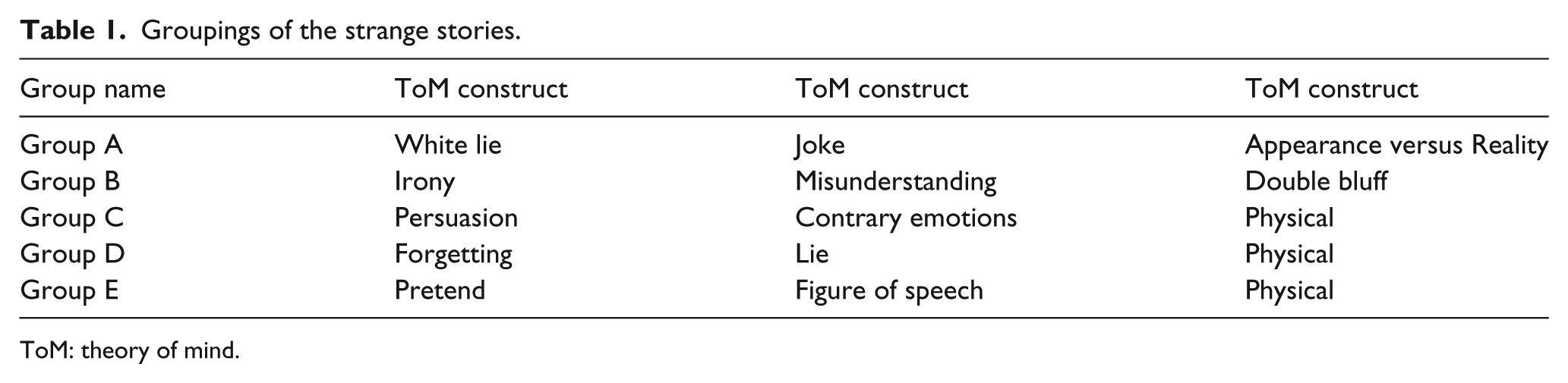
ToM: theory of mind.
The participant would listen to the researcher read one of the Stories aloud, while following along on paper. The participant would then offer their explanations for a character’s actions using the structured questions provided in Happé (1994). After reading the first story, the participant would then listen to the remaining two stories and answer the appropriate questions. Next, the participant identified their favorite of the three stories, in order to produce a more naturalistic discussion of ToM that focused on the participant’s rather than researcher’s preferences. After choosing a story of interest, participants were interviewed for approximately 10 min regarding this story. This process occurred a total of five times per participant. Discussions of the favorite stories followed a semi-structured format. Questions focused on the individual’s previous experiences with the relevant ToM construct. Example questions included “Why was this story your favorite?” and “Can you tell me about a time when something like this happened to you?” The researcher also utilized circular questioning methods, as described by Selvini et al. (1980), such as “Can you tell me about a time when you didn’t understand X?” and triadic relationships between thinking, feeling, and doing, such as “When X was happening, what were you thinking about? How did you feel?” The average interview time was 50 min; interviews were digitally recorded and transcribed verbatim.
Ethical considerations
Ethical approval was granted by the institutional review board at the University of Houston and the school. A presentation outlining the research was given to all students with a diagnosis of ASD. Those who expressed interest in participating following the presentation were given parent consent forms to return with their parent’s signature. After receiving the signed parental consent forms, participants were then individually asked for their assent to participate in research, where they were again reminded of the nature of the project and the risks and rewards.
Results
In the first stage of analysis, two independent researchers coded each transcribed interview into subthemes using guidelines outlined in Smith and Osborn (2008). To begin, researchers highlighted pieces of text within each single interview document, which stood out as significantly characterizing the participant’s experience, and condensed them into single word codes. Each researcher then independently aggregated their codes, grouping them under subthemes (i.e. “closeness to pets” or “respect for honesty”). In the second stage of analysis, researchers discussed the subthemes they had compiled for each of the interviews to create a subtheme master list for each interview (Griffith et al., 2012). Through a collaborative discussion, it would be mutually decided whether that subtheme had adequate textual support, or whether it lacked substantiating evidence and should, therefore, be omitted from the master list (Smith and Osborn, 2008). In the final stage of analysis, the primary and secondary researchers examined the master lists to assess which themes were over-arching within all 12 interviews. The goal of this final thematic aggregation was to identify themes that were consistently present within the data and central to the participant responses. All subthemes and themes can be found in Table 2.
Frequency count of subthemes within interview data.
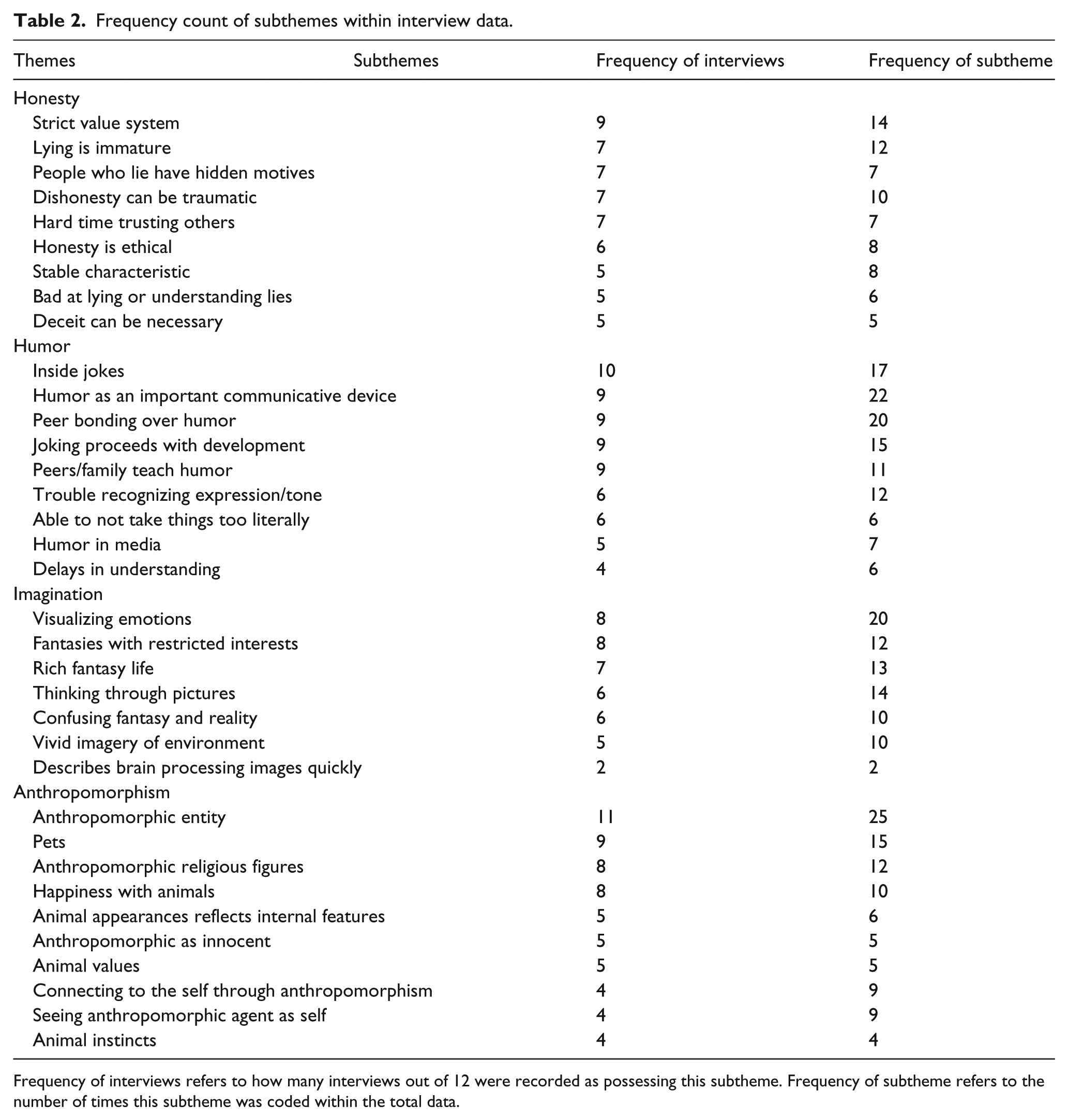
Frequency of interviews refers to how many interviews out of 12 were recorded as possessing this subtheme. Frequency of subtheme refers to the number of times this subtheme was coded within the total data.
When providing interview extracts, the following textual conventions are used:
Words omitted to shorten quote: …
Explanatory information provided by authors: [text]
Theme 1: honesty
An overarching theme in the interviews was the participants’ belief that honesty was a core component of understanding ToM and one’s own socio-cognitive processing styles: I’m kind of like a lie detector … there are times when I can’t believe anybody or I believe in them too much.
One dimension of this theme centers upon the controllability of honesty, and whether it stems from a trait or choice. For instance, one participant explained how he chooses when it is appropriate to lie: It’s just that I really don’t see the point in lying about something unless of course it’s necessary … like if you have to calm a friend down.
Yet, he also discusses how the ability to lie can be frustratingly out of reach: Let’s just say I’m a pretty terrible liar … I guess it’s my neurological different thingy-ma-bobber … I heard somewhere that those with Asperger’s are terrible liars. … Look I just don’t think up good lies, OK?
Another student stated in relation to the story concerning sarcasm that his intrinsically honest nature could separate him from others: I tried to be honest about what I said … Back then I was still very honest … But even, [my classmates] wouldn’t agree, sometimes … Because I was told, be flexible. I would say, well, if you guys would like to … but usually I try to be honest in telling them what I really think.
One participant saw his honesty as a defining characteristic that, when accepted, can even be helpful within his relationships: I’m always brutally honest with my family members. Just because I can and because they won’t care if I am brutally honest because they care about me enough to not get annoyed if I’m like “Oh Dad that suit looks stupid.” And he doesn’t care. He’s just like, OK. And he puts on a different one.
A desire for honesty could also have the opposite effect. One participant recounted a story in connection to the construct joking and the fine line between joking, lying, and teasing: Well there’s a lie that was just about to be thrown out. When I did my driver’s education … [classmates] started rumoring that I had engaged in sexual intercourse with [a girl in the class]. … And that really, really, really disgusted me.
He goes on to explain that A joke is something that you can have fun with. A lie is something that is used for plots.
He then states, Values and morals. If everyone had them then everyone would just get along just fine. Everything would all be about honesty. Everything would be true. There wouldn’t be such thing as an evil or bad thing … And I will tell you now just before the recording stops, the most manipulative people out there are those that deny that they’re even manipulative.
Such statements highlight the important role personal experiences, and painful memories, play in participants’ desire for honesty. For instance, one participant chose to discuss a story about an adult dressing up as Santa in relation to the construct pretending. Explaining his discomfort with the construct, he said that he believed that perpetuating the myth of Santa is Something representing niceness and care, but the way they do it is like a giant lie that destroys your childhood.
The participant then recounted how after finding out that his mother was hiding his presents, he experienced profound disillusionment. When asked if he would ever tell his own children about Santa, he replied that he planned To tell them the truth … there’s no Santa … from the day they start saying “Oh, what’s Santa? I’m going to be like ‘it’s a lie.”
Another participant also discussed her disillusionment within a close relationship in relation to the construct mixed emotions: My mom was talking on the phone [to my friend’s mom]. And I won an art competition [and] my friend’s mom, said that her daughter was upset about not winning. And so I got really mad at my friend … because she didn’t tell me the truth. And I thought she didn’t, but really she did … She had mixed emotions and so it was super confusing … I just avoided her. I didn’t talk to her. Kind of like the silent treatment.
In relation to the joking, pretending, and mixed emotions constructs, participants were able to connect their adherence to honesty with pertinent examples of how dishonesty had personally hurt them. As will be discussed, this adds a new complexity to understanding honesty in autism than has been previously understood.
Theme 2: humor
ToM constructs relating to humor were the most heavily discussed, showing their intrinsic importance to participants. One student remarked that the ToM construct sarcasm Works pretty well. It helps me understand people. But what’s really funny is like, if I didn’t know what sarcasm was I would probably take things more seriously.
One showed a clear differentiation between humor and lying, saying “She’s being sarcastic. It’s not really honest or dishonest.” Another said, “What would the world do without sarcasm … the world’s greatest invention.”
While appreciating humor, some also viewed their acquisition as somewhat delayed. When asked how old a person would be to understand a certain joke used in the Strange Stories, one participant replied, To understand the joke, well, my sister is four and she understands it, so I guess four.
However, when asked how old she was when she understood it, she replied, I was probably six … Probably because my autism was really bad when I was younger … I didn’t really understand that much of people’s jokes. But I still talked a lot and stuff.
One student elucidated a current example of his struggle understanding sarcasm: I still sometimes don’t understand joking if it’s with adults. Because, oh, like one time one of the teachers here said, “Oh, you just wanted to get pizza,” and she was smiling and I didn’t see the smile … And she was like “do you not notice I’m smiling?” So I have to like snap out of it to get that joking.
Some discussed challenges with the more implicit aspects of humor and how they bypassed these challenges: Online is a little easier for me because I can say things easily. It’s easier for me to think of it because I have more time to think of it, because usually in real-life people expect an answer. Well sometimes people expect an answer right away in real-life, and on the computer, people will think, oh he’s just a slow typer. Even though I’m not. It’s just me thinking.
Despite some difficulties, participants also expressed a belief that humor was an area in which they had experienced growth, in part through improved recognition of humorous cues: I know that [sarcasm] happens when they say it with a really sarcastic voice. They say it in such a situation. Yeah. Now I know how to figure that out.
Another describes sarcasm and its role in peer engagement: Usually, when me and my friends are hanging out we’ll just kind of have conversations where we’ll just give each other hints about things. We use a lot of sarcasm. A lot.
One participant described a somewhat laborious process for learning humor, though he implicitly appreciated its social value: I learn [jokes] when I go around asking other people. Because I think it’s funny and I’m thinking that maybe other people might think it’s funny because I’ve learned it from one person … I look them up and I teach them to myself and I go around and ask other people.
While participants were clear in their appreciation for humor and their desire to improve their usage, engaging in humor could also result in disappointment when their attempts were ill-received. One participant initially discussed how he is confident in his ability to use humor with peers, despite how in the past: I tried too hard … to the point where I just looked like a total fool.
Struggles executing humor are also described by this participant when discussing his tumultuous relationship with a childhood friend: He didn’t invite me to his going away party but I would have definitely been willing to go. I care about him. He’s a good friend. At times we do have our troubles. He can get a little agitated at me for making too many jokes.
As will be discussed, participants expressed a keen appreciation for humor and share an affiliation with those who enjoy joking and sarcasm. While implicit, socially appropriate usage was sometimes described as challenging, success with peers appeared to be a valuable means of motivation.
Theme 3: imagination
Within the interviews, participants displayed a keen ability to enrich story narratives through invoking sensory details. One participant described the physical story about thumps being heard in an apple orchard with significant attention to detail: I pictured not only the hot summer day but just it’s a bright sunny day and you’re in the apple orchard. And you hear a lot of sounds, maybe some birds chirping or something, or some apples or something dropping on the ground. So it’s pretty cool.
These imaginative depictions often allowed participants to add further conceptual elements, which added depth to the Strange Stories. This can be seen in this participant’s description of her process for understanding the “double bluff” story about a soldier being questioned by an enemy army: Sometimes I can really picture things really good in my head. And so I just thought about it and I did my best to get it all right, and then when I got it, I decided the answer, what I thought.
She described picturing the scene with significant detail, visualizing the prisoner seated in a chair, tied up, and with duct tape over his mouth. Importantly, she used these details to expand upon the prisoner’s method for double-bluffing his captors: He answered the truth, because he started thinking about it. And he smirked. And he said, “It’s in the mountains.” And then they let him go, but of course he thought it was funny because they actually believed him. They actually went to the sea.
When asked why she described him as having “smirked,” the participant explained, Well, because it’s easier, since he did that it made me know that he was not telling the truth. I mean, he was telling the truth. But they didn’t think he was telling the truth.
Another participant also appeared to improve his ToM understanding in the sarcasm story by adding sensory detail to describe a boy’s embarrassment after taking a date on a rained-out picnic: Well, let’s just say rain was dripping down the girl’s long hair. Not to mention in his wet pants.
When asked how that resulted in embarrassment, he replied, Hello! Wet pants! Well not to mention everything else.
Another participant had a similar creative, sensory driven process when discussing the army double bluff story: This was a really old war, because if [enemy soldiers] were smart they would have had like, not airborne, what are they called, drones to go find the tanks. Instead of like saying “we’re going to ask this dude,” why don’t they just fly over?
Such diversions could be a catalyst for participants sharing their unique interest and their considerable knowledge within a particular domain. The same student went on to provide this description of what he imagined when listening to the enemy army story: What we do is, we’re trying to set up camp. I’m trying to set up camp on a certain planet. Not Mars. … Like I want to build a space army because I have been studying a couple of incidents in this US ranging from 1947, I think it would be. I have papers on it.
After being asked what it is like when he gets interested in a topic, the participant articulated, What it looks like to me in my brain is me researching everything that I can find.
As will be discussed, these excerpts shed light on the significant talent participants displayed in relation to visualizing and expanding upon imagined narratives and how enhanced perception may be a social strength in ASD.
Theme 4: anthropomorphism
Anthropomorphism can be defined as the ascription of human features and behaviors to non-human and even non-living creatures, such as assigning human thoughts to animals or objects (Johnson et al., 2015). Anthropomorphism is often described as an extension of ToM, in that it involves processing the mental states of non-human entities. For this reason, it was of interest that participants consistently anthropomorphized.
The most commonly anthropomorphized subjects were animals, particularly pets. One participant described her dog’s almost human ability to Tell I’m upset, when I’m sad … she can tell when I’m happy, she can tell when I’m mad. She can tell all my emotions.
Another participant described an incident when he knocked over a vase and My dog found this hilarious or something; she was like going crazy.
Several participants employed a kind of “reverse” anthropomorphism, connecting themselves to animal traits. This participant for instance describes his own ToM as canine: I’m like a dog, basically. I call it a sixth sense. Because I can sense feelings basically.
Participants were not limited to anthropomorphizing animals. One participant described falling apples in an orchard as possessing human emotions: Because if you’re planting apples they’re going to fall off the tree one way or another. So it’s just like when people have a hard time … It still means you’ve got to be nice to the apple or something … I mean, it’s not the apple’s fault it fell down.
Another participant spoke at length about his anthropomorphic vision of God: I have a picture of God and Santa Claus. I believe in God more than Santa Claus. And I’ve actually heard him talk to me before … He has a robe, sandals, tall, white skin, hair and a beard.
Discussing God led to statements regarding his personal meta-representations, or the participant’s understanding of his own mental states even in times of dysregulation: I don’t want to make wrong choices or do all of those things. And if I ever do it, and I’m like, I’m making a wrong choice then I’m going to flash back. I’m either in a dream or out of control or something. But I don’t want to just do it to irritate Him or anything. Because I know that’s a wrong thing.
As previously mentioned, anthropomorphic imaginings often led to participants’ descriptions of their own ToM and moral character. One participant described his connection to the anthropomorphic characters in the television series My Little Pony: I’m always like, what would MLP do? So MLP stands for My Little Pony. I’m like, what would the character MLP do? Right before I get pissed. I’m like OK, step back, breathe, think.
As the interview progressed, his anthropomorphic descriptions became increasingly focused on how the human world can learn from the anthropomorphic world, describing a hope for a future society where We invented this form of, um, um, this gene modification thing and we turned ourselves into ponies, animated looking ponies … I would mostly feel great for the rest of the world because then there would be finally peace, in my opinion. Because animals don’t have their own mental capacity to be violent by nature. Mostly animals are violent by how they learn things.
This participant described how a more anthropomorphic society could solve many of the social injustices that he himself has experienced in the past: It would help a lot, because I have had so much trouble with, um, with, um, all of those kinds of bullying in the past … And I know other people have that issue. Um, and I feel for them, because I’ve had that issue in the past and it gets really upsetting. And you go through the suicidal stages, and the “I want to die stages,” and the attempted suicide stages and all that.
The participant delves deeply into the embedded theme of “reverse” anthropomorphism, when he describes his desire to physically transform into an anthropomorphic pony which would allow him to Looking kinder, um, being kinder, being softer to the touch I guess you would say. Because my skin is really rough and I’m kind of a gruff guy naturally.
However, he primarily believes it will deflect bullying away from potential victims who Could say well this guy probably has a worse time than me from how he looks. … It would give a big ridiculing example to show even someone who is ridiculed that much you can still make it through life.
These excerpts touch upon themes often mentioned in other autobiographies and qualitative projects that non-human entities can provide solace in a human world that stigmatizes differences.
Discussion
This study explored the experiences of individuals with ASD as they related to ToM processing. Central to this work was a desire to explore the autistic ToM free from requisite comparisons with NT samples. The themes uncovered in many ways transcend the ToM deficit account of autism; participants showed a developed understanding of ToM that goes beyond simpler measures. In the theme Honesty, participants described experiences that shaped their desire for transparency. When discussing humor, participants expressed an appreciation of humorous constructs and their role in peer relations. When describing visual aspects of the Strange Stories, participants demonstrated creativity and improved ToM in relation to the theme Imagination. Finally, in the Anthropomorphism theme, participants attributed human characteristics to non-human entities, which led to introspection about their own ToM. In contrast to the ToM deficit argument, participants here collectively revealed significant ToM strengths in relation to these themes. These findings highlight autistic adolescents’ unique social capabilities and prompt us to reconsider their current understanding of ASD and ToM.
Honesty
It has been suggested that autistic people do not lie because they cannot conceive of lies; they either lack the imagination for representing the world beyond the concrete (Oswald and Ollendick, 1989) or they cannot formulate the type of lie that could influence another’s mind (Baron-Cohen, 1992). More recent research, however, suggests that autistic people can both use and detect deception (Li et al., 2011; Rutherford and Ray, 2009). As one participant said, “It’s just that I really don’t see the point in lying about something unless of course it’s necessary,” highlighting his understanding of its utility. Another participant described herself as “a human lie detector,” revealing past problems “believing people too much, or not at all.” This hints at an autistic person’s development of an aversion toward dishonesty, as well as their heightened vigilance toward being the target of a lie, which was often echoed in these interviews.
Participants did not simply express a discomfort with deception, but rather discussed a marked prioritization of honesty, and a desire to act within a prescribed code of ethics. This has ties with the systemizing theory of autism, in which autistic people are shown to inordinately rely on pre-established or a priori rules to guide their decision-making process (Baron-Cohen, 2009). Interestingly, systemizing is often seen as a contrast to empathizing, as it uses a “cold” reasoning system to understand “hot” or implicit systems like emotions. However, participants’ justifications for being honest in many ways contradict this account. For one, participants showed an ability to consciously connect dishonesty with painful memories of betrayal, as highlighted in the excerpts discussing malicious joking, pretending, and mixed emotions. In contrast to an overreliance on established rules, participants described how they came to value honesty a posteriori or through their experiences. This was intimately tied to their ability to represent their emotional experiences of being deceived. In this way, they appeared to rely on “hot” emotions to form their “cold” systems of logic.
One example of the “cold” system being formed from an empathic understanding of pain can be found in the excerpt in which a participant describes his prior disillusionment in Santa. Despite understanding the purpose of Santa, the participant is reticent to perpetuate the myth; doing so would make him repeat the cycle that cost him his own happy memories. This connects to what Jaarsma et al. (2012) describe as an autistic person’s adoption of the categorical imperative, or the notion that it is one’s duty to behave in the way that one would expect others to behave. In this way, honesty in autism could be seen as a way to respect others, and importantly, it may be born more through an understanding of personal emotions rather than out of a “mindblind” adherence to tertiary rules.
Another important aspect of this theme is the value participants placed on character, such as the participant who chose to “tell people what I really think” even though it made him appear inflexible. His description of this group interaction highlights his understanding of ToM, in that he acknowledges how his honesty affects how he is perceived. By doing so, he also expresses that honesty is in many ways a choice, specifically a choice to stay true to his inner code of conduct rather than achieving transient popularity. This ties with research examining reputation management in autistic adolescents, who are less concerned with “being cool” and more interested in being true to themselves (Cage et al., 2016). Honesty in autism may be undeservedly characterized as a weakness stemming from poorly controlled cognitive mechanisms, rather than a strength resulting from personal experience and dependent on choice.
Humor
Humor, especially sarcasm, in part hinges upon perspective taking, as the listener must gage a speaker’s intention to communicate non-literally (Lyons and Fitzgerald, 2004). Early characterizations of autistic people such as those by Asperger (1944) depict them as humorless, which some suggest stems from a difficulty with non-literal interpretations (Baron-Cohen, 1997). However, recent research suggests that autistic people in fact demonstrate an implicit understanding and appreciation for humor early in development (Reddy et al., 2002; Weiss et al., 2013). Still, research shows that autistic children are less likely to employ forms of joking in naturalistic settings (St James and Tager-Flusberg, 1994) and are less likely to join in the laughter of others (Reddy et al., 2002).
Participants in this study demonstrated a clear appreciation for humor, particularly irony and sarcasm. However, as stated by one participant, he sometimes needed “to snap out of it to get that kind of joking.” Another participant echoed this account, describing their preference for online communication as it permitted extra processing time. Participants described difficulties producing humor appropriately, as in the past he had “tried too hard” or made others “agitated at me for making too many jokes.” In these excerpts, it appears participants may be referencing the fact that they experience difficulties with the linguistic aspects of humor, which has been suggested by several studies (Gaffrey et al., 2007; Moseley et al., 2013), including research describing autistic children’s difficulties decoding for linguistic relevance (Loukusa et al., 2007). As research suggests that language development mediates both ToM and social competencies (Peterson et al., 2016), building language skills in the context of humor may simultaneously help autistic people build relationships with peers.
Recognizing autistic peoples’ intrinsic appreciation for humor not only contradicts theories of lowered social motivation in autistic people but also presents the possibility of a pathway toward reducing the “double empathy” problem. Through humor it may be that both NTs and autistic people can come together and form a common “joking culture” (Fine and De Soucey, 2005), which participants often referenced as being intrinsic to their engagement with peers and their improved understanding of ToM. Thus, by encouraging interpersonal interactions built upon humor, both NTs and autistic people may better understand their similarities alongside their differences.
A better understanding of an autistic’s appreciation for humor may not only solidify social links in the wider community but may also help clarify misconceptions about their appreciation for honesty, as these two ideals are complementary. Specifically, participants demonstrated through their appreciation for humor, particularly subversive forms of humor like sarcasm, that, while they are often not as skilled in non-literal communication, they are not adverse to it. Thus, while both jokes and lies are “not true,” statements indicative of deception can conceal or misconstrue what is understood by one actor, while jokes are meant to be understood by both (Raskin, 2012). In this way, an appreciation for both humor and honesty reflects an autistic’s desire for transparency.
Imagination
Within participant interviews, particularly in their discussion of the Strange Stories, a heightened ability to use visual imagination was present. Visual acuity and attention to detail are considered cornerstones of the autistic phenotype, and research into the biological and neural mechanisms of ASD also provides support for its existence (Cascio et al., 2014; Rosenberg et al., 2015). These mechanisms have links with several non-social processing theories of ASD, particularly the enhanced perceptual functioning account (Mottron et al., 2006).
Enhanced perceptual discrimination abilities in ASD are thought to be linked with the population’s well-documented ability to develop expertise in specific domains (Mottron et al., 2006). This ability is thought to be driven by a heightened ability to detect patterns, which help autistic people “fill in” missing information through a process of reintegration (Mottron et al., 2009). This, paired with a keen attention to detail, may underlie the significant potential for creativity and depth of imagination evidenced here, though several other accounts instead suggest that a relative lack of imagination is indicative of an ASD cognitive style (Crespi, Leach, Dinsdale, et al., 2016; Wing and Gould, 1979).
There were many instances of heightened perceptual detection, pattern perception, and a resulting imaginative creativity within participants’ descriptions of the Strange Stories. Through a process of visualizing the details of the setting (e.g. the apple orchard, the questioning of the prisoner by the enemy troops), the participants showed an ability to “fill in” the basic structure of the plots with additional contextual details. In the case of the prisoner story, the participant demonstrated the way in which visualization can lead to a deeper understanding of ToM. As also seen in the picnic story where a participant described how “rain was dripping down the girl’s long hair, not to mention the boy’s wet pants,” filling in the details lent creativity, humor, and emotion to what were quite simple stories. This also highlights how enhanced perceptual processing can lead to an understanding of greater complexities within ToM.
Such a view may be controversial and seemingly contradictory to theories suggesting that the hyper-sensory processing patterns indicative of ASD impede empathizing (Baron-Cohen et al., 2009). Here, it appeared that the opposite happened; through a creative reimagining of sensory details, participants brought to light greater holistic meaning and depth when decoding thoughts and emotions. This process of starting with the details, and filling in a pattern, appeared to allow participants to understand a large range of emotion, such as ironic bemusement, exposure, and shame. Thus, it may be that autistic people do indeed empathize using different tools than NTs. However, rather than being indicative of their disinterest in ToM, it may instead reflect a rich cognitive style that visually produces detailed ToM representations.
It could also be argued that rather than leading to social disengagement, as is often suggested, heightened perceptual processing may be a means for social engagement. Participants were keen to share their mental state experiences and their visual processing of target stories, which drew their audience in by sharing their area of expertise. This is particularly true of the participant who spoke at length about his interest in military history and space colonization. As stated by the participant, these were topics to which he devoted a significant amount of time developing and understanding, and thus by discussing it within the interview, he was also sharing important information about himself.
Anthropomorphism
This final theme concerned participants’ penchant for attributing human characteristics to non-human stimuli. It is not unusual for people to “see human” in the non-human; indeed, it is a robust human tendency thought to underlie common religious practices and possibly the human–animal bond (Epley et al., 2008). While autistic people have been shown to perform poorly on some tests measuring anthropomorphic tendencies (Klin, 2000), a recent review on this topic highlights how autistic people may actually show an increased affinity for both anthropomorphizing and understanding anthropomorphic agents (Atherton and Cross, 2018). In particular, it is suggested that the ToM deficits sometimes found in this population might be ameliorated when mentalizing about human-like rather than human entities (Brosnan et al., 2015; Rosset et al., 2008; Whyte et al., 2016). This again highlights how a more accurate representation of ToM functioning in this population is one of difference rather than deficit.
Participants often connected the experiences or traits of anthropomorphic characters to their own cognition. Perhaps self-reflection in relation to anthropomorphism was most evident in a participant who desired to transform into a pony-like being. He expressed a desire to look like a pony to both embody what he appeared looked like a comforting agent and in order to become a symbol for those who are bullied for their differences. Aspects of this excerpt may reference the “invisible,” social aspects of ASD, which can lead to exclusion and even bullying (Davidson and Smith, 2009). Thus, by becoming a more visible target, he would be able “to give a big ridiculing example.”
One reason participants may have been increasingly drawn to anthropomorphism could stem from experiences relating to peer rejection, such as those described above. Research on anthropomorphism indicates that individuals are more likely to anthropomorphize when they are lonely (Epley et al., 2008), while reminders of close social connections can decrease anthropomorphism (Bartz et al., 2016). A significant body of research indicates that autistic people and those with the broader autism phenotype experience higher degrees of loneliness and show smaller interpersonal networks than NTs (Jobe and Williams White, 2007; Lamport and Zlomke, 2014; Mazurek, 2013; White et al., 2011). Thus, it may be that finding social connections within the non-social world is both a natural reaction to increased periods of isolation and it may also serve as a way for autistic people to engage socially without risk of rejection.
Animal engagement has also been suggested to increase social behaviors in autistic people during both structured interventions (Grigore and Rusu, 2014; Martin and Farnum, 2002) and in naturalistic social settings when interacting with NT peers (O’Haire et al., 2013). Indeed, O’Haire et al. (2013) found that animal-assisted activities within the classroom increased social reciprocity in both NT and autistic children, thereby reducing the double empathy problem. As participants often discussed their connection to animals, particularly pets, it could be that relating to animals may allow autistic people to experience pride in their social abilities and connect with NTs in animal-focused contexts.
Limitations
All participants had IQ scores within the typical range and showed functional verbal ability. A proportion of individuals in the autistic population have an IQ score below the average range (Charman et al., 2011), and thus it may be difficult to draw conclusions to the wider spectrum on this basis. This underscores the importance of devising alternative methods for exploring this topic that allow wider participation such as community-based focus groups.
All participants were sampled from a private, therapeutic school for individuals with neurological differences, in which approximately half of students have a diagnosis of ASD. Both the nature of the educational setting, which allows autistic people to learn in an environment where they are in the majority, and the integration of therapeutic support in the school, could have aided participants in their ability to communicate about ToM. It would be of some interest to perform similar research with autistic samples who were not participating in similar programs and come from more mixed classroom settings.
Conclusion
This work has several implications for the ways in which NTs and autistic people alike can improve their understanding of autistic ToM. Foremost is that the autistic individuals interviewed here demonstrated a strong understanding of ToM constructs and were able to connect these constructs to events in their lives, highlighting their interest in how and why people act and think in the ways that they do. While the individual’s interviewed here demonstrated a clear understanding of ToM constructs, they also discussed instances when their processing of ToM constructs occurred in an atypical and often more effortful way. Thus, these themes highlight the inconsistencies in the dominant ToM deficit framework often used to research and more broadly conceptualize autistic people. Moving forward, it will be important for researchers to continue to design studies that allow for an exploration of autistic ToM differences rather than deficits. The considerable ToM abilities revealed in these participant interviews also call for researchers to engage in studies that explore autistic social processing strengths and motivations in line with the neurodiversity paradigm.
Through a process of engaging autistic individuals in ways that they can express themselves, demonstrate creativity, and engage in open communication, the “double empathy” problem can be better understood and addressed. While autistic people are often described as being uninterested or incapable of ToM, this stands in stark contrast to the eloquence, creativity, and meaningful introspection observed within these interviews. Participants were particularly skilled in connecting narrative constructs to areas of personal significance. Autistic individuals have rich interpersonal lives and social styles, which are too often missed in a research culture overly focused, on categorizing the spectrum as one of the deficits. Individuals interviewed here offer fresh insights into the autistic ToM highlighting an understanding of not only their own and others minds but also their ability to imagine new, detailed social worlds.
Supplemental Material
AUT793409_Lay_Abstract – Supplemental material for What am I thinking? Perspective-taking from the perspective of adolescents with autism
Supplemental material, AUT793409_Lay_Abstract for What am I thinking? Perspective-taking from the perspective of adolescents with autism by Gray Atherton, Ben Lummis, Susan X Day and Liam Cross in Autism
Footnotes

References
Supplementary Material
Please find the following supplemental material available below.
For Open Access articles published under a Creative Commons License, all supplemental material carries the same license as the article it is associated with.
For non-Open Access articles published, all supplemental material carries a non-exclusive license, and permission requests for re-use of supplemental material or any part of supplemental material shall be sent directly to the copyright owner as specified in the copyright notice associated with the article.
