






Abstract
A significant treatment gap exists in low and middle income countries such as India for children with autism spectrum disorder. The Autism Intervention Training Program, a comprehensive 6-month program for training professionals in transdisciplinary evidence-based practices to address concerns associated with autism spectrum disorder, was piloted in India to address this gap. This study attempted to capture the perspectives of trainees on the effectiveness of andragogical approaches adopted in the Autism Intervention Training Program and the impact of this training on their work. An exploratory qualitative study was conceptualized, and in-depth interviews were conducted with 11 Autism Intervention Training Program trainees. Trainees highlighted the benefits of a blended training format, peer learning, and a responsive, reflective, experiential, and respectful approach to teaching and supervision. The impact of the program was perceived through an increase in trainees’ knowledge and skills, impact on their organizations, and positive outcomes for children with autism spectrum disorder and their families. There is a need to develop and document comprehensive, contextualized, and evidence-based training programs for autism spectrum disorder professionals in low and middle income countries. Focusing on andragogical frameworks while conceptualizing and delivering these training programs is underscored, as approaches that promote self-efficacy in learners and enable transformative learning can lead to a cascading impact in resource-constrained settings.
Keywords
Autism spectrum disorder (ASD), a complex neurodevelopmental disability characterized by challenges in communication, social interaction, and restricted behavior, has an estimated prevalence of 1%–2% across the globe (Elsabbagh et al., 2012). In low and middle income countries (LMICs), epidemiological data of ASD prevalence are limited (Baxter et al., 2015; World Health Organization (WHO), 2013); however, it has been suggested that the majority of people with ASD live in these countries (Hahler & Elsabbagh, 2015). Recent prevalence studies conducted in India have found estimates of ASD ranging from 0.15% to 1.2% (Arora et al., 2018; Arun, 2017; Poovathinal et al., 2016; Raina et al., 2017; Rudra et al., 2017).
Early, intensive, and specialized intervention has been shown to improve developmental, family and school outcomes for children with ASD (National Research Council (NRC), 2001; Seida et al., 2009). In contrast to the proliferation of evidence-based practices for autism in the developing world, India is disproportionately challenged by barriers to care (T. C. Daley, 2004; Patel, Kieling, & Maullik, 2013; Rudra et al., 2017). The dearth of trained professionals is one of the leading contributors to this treatment gap, resulting in significant psychosocial stress, burnout, and stigma among caregivers of children with ASDs (Divan, Vajaratkar, Desai, Strik-Lievers, & Patel, 2012; Gupta & Singhal, 2005; Krishnamurthy, 2008).
In developed countries, the training of professionals to work with children with ASD and their families has been the subject of significant research in the past decade. Guidelines for personnel preparation recommend training in interventions that are comprehensive, individualized, systematic, and goal-based (Barnhill, Polloway, & Sumutka, 2011; NRC, 2001). Thus far, training and professional development of ASD interventionists in LMICs in general and India in particular have been limited. Literature has also found that trained professionals in developing countries often have an inadequate understanding of autism and poor knowledge of educational and behavioral interventions (Igwe, Ahanotu, Bakare, Achor, & Igwe, 2011; Imran et al., 2011; Tiwari & John, 2017). Not surprisingly, bolstering efforts toward developing trained autism professionals in LMICs was raised as a priority issue at the 2013 World Health Organization consultation on ASDs (WHO, 2013).
At the time of writing of this study, undergoing a degree or diploma program in special education is among the chief means through which professionals in India receive grounding in basic theoretical knowledge and skills required to work with children with a host of developmental challenges, including ASD (Rehabilitation Council of India (RCI), 2014, 2015). Specialized and targeted training programs for those working with ASD are confined to short-term workshops and trainings by non-governmental organizations on specific interventions (Behavior Momentum India, 2013; Sai Connections, 2015; Society of Parents of Children with Autistic Disorders, 2016). Before the development of the present program, there have been no comprehensive training programs for ASD professionals in India, nor have there been attempts to document extant training frameworks.
Limitations in professional training in LMICs need to be addressed both through introducing training programs, as well as by exploring the evidence base of such initiatives. Evaluation of professional training programs must examine various facets such as the evidence base for interventions, content, structure, strength of teaching approaches employed, the impact of the training on professionals, and, most importantly, the benefit to children and families. This study was therefore conceptualized to bridge this need by capturing the perspectives of professionals who underwent a specialized autism intervention training program in India over a period of 6 months.
The Autism Intervention Training Program
The Autism Intervention Training Program (AITP) is a 6-month training program that was conceived and executed by a team of autism interventionists in collaboration with an autism consultant from Oregon, USA with over 40 years of experience in the field. It was piloted at Ummeed Child Development Center, a not-for-profit organization active in the field of developmental disabilities since 17 years in Mumbai, a prominent metropolis in India.
The curriculum was developed after comprehensive literature review of existing evidence-based programs (such as those detailed by Baer, Wolf, & Risley, 1987; Greenspan & Greenspan, 2010; Koegel & Koegel, 2006), consultations with experts, and an Internet-based survey of needs for training across varied professionals working with children with autism in India. The review of literature highlighted the benefits of an eclectic range of evidence-based strategies rather than just one approach (Scheuermann, Weber, Boutot, & Goodwin, 2003). However, well-documented training programs, though varied and diverse in their theoretical basis, content, and structure (e.g. programs developed by Brookman-Frazee, Drahota, & Stadnick, 2012; Corona, Christodulu, & Rinaldi, 2017; Luiselli, Bass, & Whitcomb, 2010; Maddox & Marvin, 2013), mostly focused on a single theory. There is limited evidence for effective training programs in LMICs that covered comprehensive, integrated, and evidence-based interventions for ASD (National Autism Center, 2015) or the various competency areas recommended for professionals in this field (Scheuermann et al., 2003). Recently, the role of family-centered care in facilitating good outcomes for ASD has begun to be appreciated (Gabovitch & Curtin, 2009), and training of professionals in family-centered practices has been emphasized in the literature (Beatson, 2006; Prizant, 2009). The AITP was therefore designed keeping in mind the comprehensive needs of children and families with autism in India, the strengths and limitations of existing training programs, and principles of adult learning. The overall structure and the core content of the program are highlighted in Table 1.
Content and structure.
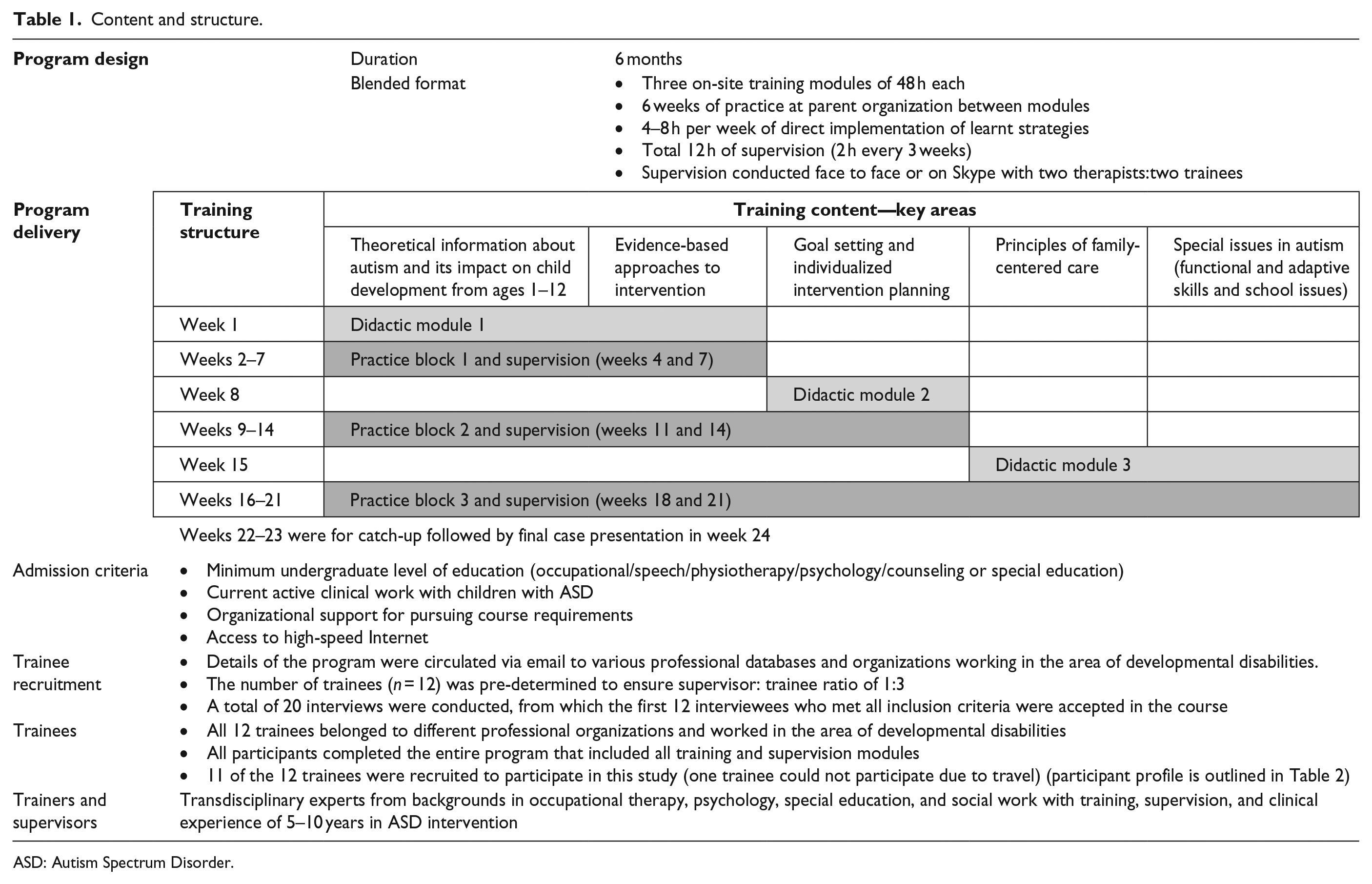
ASD: Autism Spectrum Disorder.
Training framework
The developers of the course were committed to principles of adult learning and actively wove in self-directed, collaborative, and experiential learning in the teaching framework. Keeping in mind that adult learners are driven by intrinsic motivation and the need for applicability, the andragogical framework was anchored in principles of active learning, hands-on coaching, and guided design (Dunst, Trivette, & Hamby, 2010). This was translated in practice by the use of methods such as didactic teaching modules; observation of live, video-recorded, and simulated therapy sessions conducted by instructors; role plays; problem-solving activities using clinical case scenarios; and group discussions involving application of tools for assessment and goal setting. Research among ASD professionals (Rispoli, Neely, Lang, & Ganz, 2011) and in other adult learning settings (Bonney, 2015; Cochran & Brown, 2016; Dunne & Brooks, 2007; Kiger, 2004; King, 2017; Sogunro, 2004; Stillsmoking & Murray, 2008) has consistently found that modeling, role-play, and feedback are considered common features of effective training methods. The clinical case scenarios and simulated sessions were based on children and families from Indian sub-cultural contexts and were so designed to be culturally aligned with trainee background. In addition, course requirements of practice in between modules allowed participants to link their new learning with their professional practice, thereby making it contextualized and meaningful (B. J. Daley, 2001).
Supervision of practice was emphasized throughout the course and was designed to be collaborative (Wilson & Rozzelle, 2005), supportive, and adjusted to each trainee’s professional background, experience, and cultural context. Based on shared viewing of video-recorded clips of trainees’ sessions, supervisors facilitated reflection and provided constructive feedback and hands-on coaching of trainees’ work. Rather than choosing a particular intervention approach, the focus was on helping trainees appreciate the varied needs of children with autism and applying an eclectic range of evidence-based strategies by adapting them to their context (Scheuermann et al., 2003). A distinguishing feature of the supervision process was the use of low-cost video conferencing technology, which enabled the participation of trainees from remote sites across India.
Methods
This study set out to obtain the perspectives of professionals trained in the AITP on the teaching–learning processes they found effective as adult learners and to explore their perspectives on the impact of the Autism Intervention Training Program on themselves, as well as the children, families, and organizations they were working with.
A qualitative approach to inquiry was chosen to capture the voices of the trainees themselves. Qualitative studies which privilege the reflections of stakeholders can provide critical insights on program evaluation. Such methods are increasingly being incorporated in the evaluation of ASD programs (Corkum, Bryson, Smith, Griffin, & Hume, 2014; Jones, West, & Stevens, 2006). The conceptual framework of the study was informed by training evaluation models of Kirkpatrick and Kirkpatrick (1994) and Holton (1996). In the former, training outcomes are described at four levels: immediate reactions, knowledge, behaviors, and results, while the latter proposed three primary training outcomes, namely learning, individual performance, and organizational performance.
Participants
All 12 in-service professionals from seven cities of India completed the three on-site teaching modules and all supervision sessions of the AITP and were invited to participate in the study (see Table 2 for participant profiles). In total, 11 consented for the same and were further interviewed. The multi-disciplinary cohort included 10 females and one male, and the age range of the participants was 25–55 years. Participants came from varied educational backgrounds such as occupational therapy, psychology, speech therapy, special education, and social work, and their work experience ranged from 1 to 28 years. Six of them were heading their own private therapy centers, while the other five were employed at not-for- profit organizations in the childhood disability sector. The mean number of autism cases on the participants’ caseloads was 13.5 (range: 4–30).
Participant profiles (n = 11).
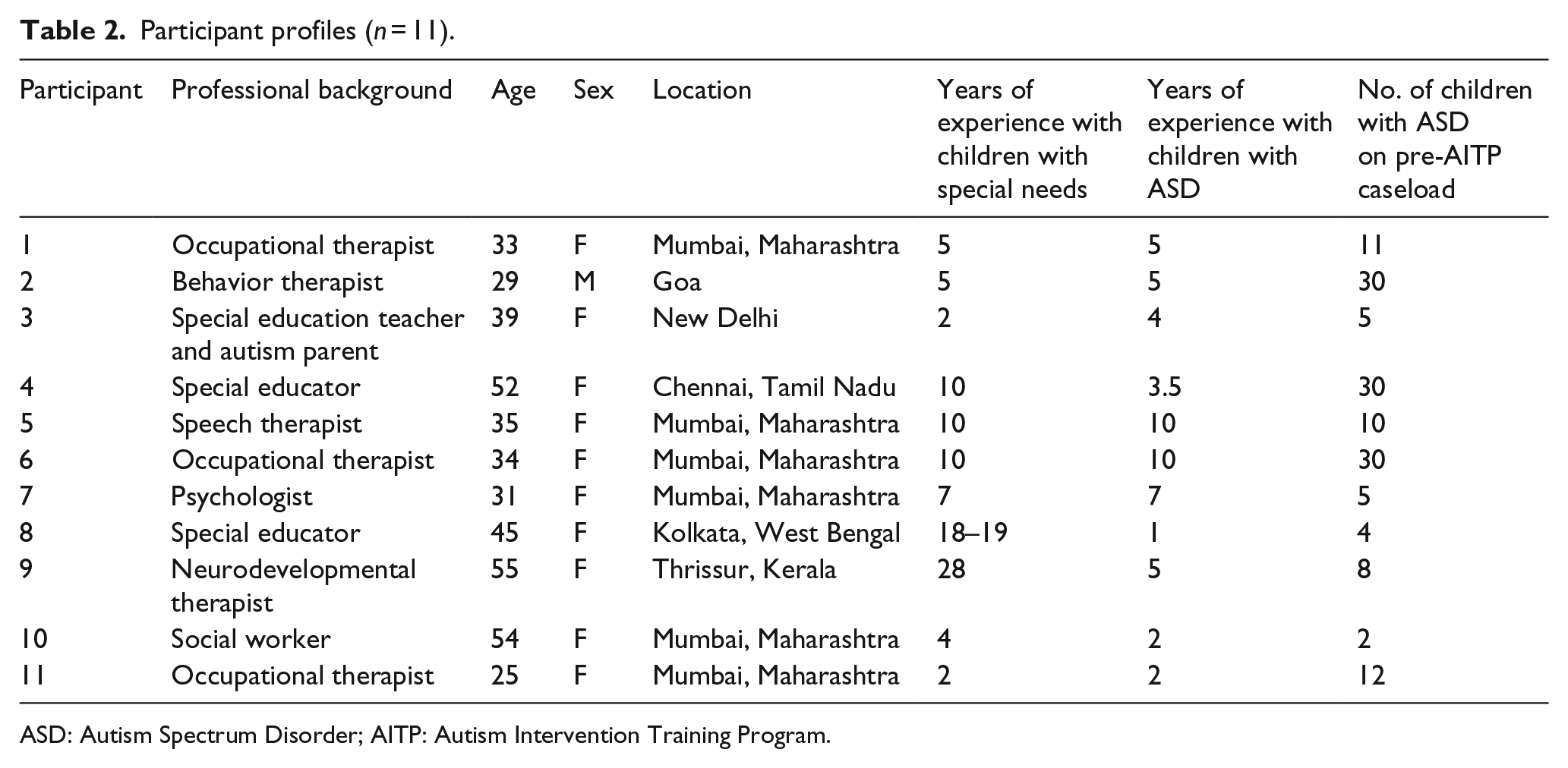
ASD: Autism Spectrum Disorder; AITP: Autism Intervention Training Program.
Procedure
The study was approved by the Ethics Review Committee of Kasturba Hospital, Mumbai. A comprehensive interview guide comprising of open-ended questions on the andragogy and impact of the AITP was developed. In-depth interviews were conducted individually with participants 3 months post completion of the program. Trainees were asked to reflect on the andragogical aspects program through questions such as, “What aspect of the training did you find most beneficial?,” “Which methods of teaching stood out for you and why?,” “How was your experience of the supervision process?” and so on. Questions pertaining to the impact of the training were based on concepts found in common evaluation models (Holton, 1996; Kirkpatrick & Kirkpatrick, 1994). These included such questions as “What difference, if any, have you found in your work post the training program?,” “In what way have you been able to use the training when you work with children with autism and their families?” and “What has been the change, if any, in the organization you work in?”
Participants provided written informed consent and audio-recorded consent prior to the start of the interview. All interviews were conducted by trained independent researchers who were not involved in the design or delivery of the program. The mean duration of the interviews was 1 h and 30 min, and they were conducted face to face or on Skype, as per the convenience of participants. The interviews were recorded and stored digitally. Participant names were changed during coding and analysis, and confidentiality was ensured throughout the process of recording and data storage.
Analysis
Each interview was transcribed verbatim by an independent transcription agency and cross-checked by trained volunteers. Principles of consensual qualitative research (CQR) outlined by Hill, Thompson, and Williams (1997) were woven into the framework of thematic analysis and followed throughout the analysis process. Initially, the transcripts were read multiple times by the coders to gain familiarity with the data. For the first level, coding was completed line-by-line and preliminary labels were assigned. This was done to ensure that analysis remained close to the data and to allow for themes to emerge inductively. Preliminary domains were identified. Next, from every participant’s narrative, core ideas under each domain were distilled. This set the stage for reviewing commonalities across data from which higher order categories and sub-themes were abstracted. Two external auditors then reviewed the original transcripts as well as the coding scheme. Discrepancies were resolved consensually, with the auditors and coders discussing the thematic framework, referring back to the original raw data and revising labels in collaboration. The final categories and sub-themes were characterized as general, typical, or variant according to Hill et al.’s (1997) criteria. Credibility and dependability of the study (Lincoln & Guba, 1985) was established by having multiple researchers (coders and auditors) code and treat the data comprehensively (Silverman, 2005).
Results
In keeping with the objectives of the study, the themes outlined below capture the andragogical aspects of the training that participants considered beneficial and the perceived impact of the program on their work.
Andragogical processes
Andragogical elements through which participants benefited from the teaching–learning climate have been organized under three sub-themes.
Training format
Trainees highlighted the benefits of a training format in which newly acquired skills could be practiced at the workplace and flexibility was ensured through a blended format.
Flexible and blended
Trainees benefited from a blended format of online and face-to-face teaching and supervision. The modular framework and opportunity for online supervision enabled full-time professionals from different parts of the country the flexibility to practice and learn simultaneously. One trainee from Goa said, To go out for three months at a stretch would have been impossible. The fact that it was for 6 days at a time … was very appealing for me. I would learn for six days and then come back and practice it … go back to supervision. Another thing that really appealed to me was the fact that there were supervision sessions … they could be video- skyping me while I work with the kid and I talked about it to my supervisor.
Immediate transfer of learning
This format of the program also allowed participants to directly implement the strategies they had learnt at their own work situations. In the words of one of the trainees, What I liked about the program is that it was planned in such a way that when we went back, we had some 2 and a half weeks to work extensively with the child and come up with some of the issues we were facing.
Participants found this structure and design helpful because it helped them identify strengths and gaps in their own learning that could then be addressed during supervision. An occupational therapist from Mumbai articulated initial challenges that were addressed through supervision: Initially when it started it was a little overwhelming … because I was a little mixed up with is this is this DTT
1
, is this PRT
2
… but gradually when I came back to my workplace and I started working is when I realized that it happens quite smoothly, and we move from this to that easily.
Peer learning
Trainees highlighted the value of group and peer learning opportunities in stimulating insights. Having colleagues from varied disciplines such as occupational therapy, psychology, special education, and social work from different parts of India fostered opportunities for in-group discussions, peer supervision, and collaborative reflection. For example, one of the trainees shared her experience of being in a peer learning environment that was open and generous: She would ask me what I should do, and she would tell me what to do, and we would have these amazing ideas that we shared with each other …
Another participant shared that access to a diverse and multi-disciplinary cohort enabled her to consider interventions from the perspectives of other specializations and appreciate the value of collaborative care: There were participants who have been working in their fields for many years, and it was structured in a way that there was always time for group discussion, group work. It was this mix, some people working in education, some people in speech, occupational therapy, behavior therapy so you always got perspectives from professionals from different areas.
Supervisor approach
Besides access to a supervision system in which professional challenges could be addressed between course modules, trainees indicated that it was the approach, manner, and demeanor of supervisors that played a key role in their feeling empowered in the learning process.
Respectful
The adult learners in the study valued a respectful stance demonstrated by their supervisors toward their prior learning, experiences, and needs. Such an approach enabled the creation of a mutually respectful relationship among equals, rather than one based on hierarchy or power. An occupational therapist shared her experience of supervision: Through the sessions there was a lot of respect given to the professionals or the fields they came from. We are not students at all … we felt like ok we are doing good work. It’s just probably little bit extra which might help us.
Non-judgmental
Trainees unanimously spoke of a supervisory approach that was flexible and non-judgmental. One of the trainees felt that this climate of acceptance in supervision allowed her to explore her own journey of learning without the fear of making mistakes, “Nobody is judging me, and I can make mistakes and it’s ok to make mistakes.” Others identified transformative experiences in supervision where moments of critical reflection were stimulated, “… (there were) places where I had aha moments, they made me re-think, re-evaluate my structure, my knowledge about what I know.”
Responsive
Supervisors were seen as accessible, approachable, and supportive. Responsiveness came up as a highly valued supervisor quality in numerous narratives. Trainees felt positively about the fact that their needs and queries were immediately addressed. One of the participants remarked, They were very proactively there, giving feedback, and we discussed everything. I was very confused whether I should do it in a way or not do it, and how do I do it and immediately she boosted my confidence up there. They would constantly keep us going, keep us motivated.
Participants were also asked to list limitations that they experienced during the program and offer suggestions for improvement. One participant felt that the modules packed in a lot of content which could often become overwhelming. Another indicated that the course did not focus enough on working with adolescents and high-functioning children on the spectrum, while one participant cited the need to shadow more senior clinicians in practice. Poor Internet connectivity was an occasional challenge to optimal supervision quality, especially for trainees who attended supervision over Skype. Three of the local trainees also commented on how it was difficult to take time off from busy professional schedules to meet supervision commitments, useful as they were.
Overall, participants’ responses suggested that teaching and supervision that were grounded in andragogical principles and responsive to the needs of adult learners translated into an empowering learning climate. This andragogical approach was experienced as transformative, and participants linked it to a significant impact on their practice.
Impact
The impact of undergoing the training program was experienced as increase in knowledge and skills, growth for organizations, along with positive outcomes for children and families.
Increase in knowledge and skills
For several participants, the primary motivation to join the program was lack of knowledge and skills to assess and intervene with children with ASD and their families. In the words of one of the participants, “I understood their needs and that they were different from those of children with other disabilities. But I didn’t know how to address these needs.” Congruent to these expectations, participants described an enhancement of knowledge and skills in three key areas, namely, clinical assessment, interventional approaches, and broad shifts in clinical approach as a major impact of the training on their work.
Clinical assessment
Participants highlighted that the program facilitated maturation in their process of assessment and gathering comprehensive information to set goals, through usage of the forms and checklists provided in the program as well as through skills in prioritizing areas of work/need with families. For example, one participant described a change as follows: If parents would come and tell me that these are the issues, I would try to work on all of them. But now I don’t do that. I pick up a specific goal, I break it down and I work according to it. So definitely that is something that has changed post AITP.
Reflecting on the impact of undergoing the training, one of the participants lucidly described, “I feel hugely empowered. I feel so equipped that I have started working with a child who is not part of [organization name] at all, on my own. That kind of confidence I have.”
Interventional approaches
A major part of the impact of AITP for participants was in increasing knowledge and skills of different evidence-based interventional approaches for ASD. According to one of the participants, When they started with DTT, PRT, developmental, I did not know the core names or theory behind it. I would just try things, from what I knew, what the parents told me. Now I have back-up knowledge of when do you use it, why do you use it.
Several participants discussed how the program taught them how to individualize an approach: … it would strike me that this same strategy is working with a particular child, but why is it not working with the second child? Then I did my AITP program, I learnt that you need to start where the child is and you have to work out what the child likes, and not what you want to do.
Shift in clinical approach
Participants described changes to their overall process of working and holistic changes in their thinking. For many of them, this specifically meant adopting a child-friendly and family-centered perspective. Some participants traced a shift from an earlier professional-directed approach that focused on “making them [children with autism] do things” to a more child-led approach that worked with the child’s interests, likes, and dislikes. A behavior therapist working at an organization in Goa traced the change in his approach post the AITP program: … the procedure was that if they could not sit on the table and do the activity, they would have to use physical prompting to force them to sit on the chair and force them to do activities … there was no messing around, that they have to come and they have to sit eventually. Learning about play was fantastic … my therapies are now child-led, family-centered. There’s no physically forcing my kids to do anything. It’s getting them engaged, getting them to play, communicate, imitate, all by just using child-led techniques.
Participants also described process changes in the way they worked with families, specifically in becoming more sensitive to their needs, involving families to a greater extent in therapy and their own movement from an expert position to a more collaborative role. As one of the participants shared, “I am okay with understanding that parents need respite, I think I have become more accepting and humble.”
Other participants discussed taking into account concerns and desires of the family in conducting an intervention rather than adopting an authoritative, expert position: Before, I would never ask them what they want to teach their child. It would always be, I feel this is what your child needs to learn, you have to go back and do it. Now I ask them what they want to teach their child.
Organizational-level impact
Having undergone an intensive training in autism interventions, participants were able to affect shifts in the organizations they were a part of. They discussed the impact of AITP at an organizational level in three major areas: transfer of knowledge to other people, a shift in approach at an organizational level, and an expansion and increased utilization of organizational services, with these impacts often being linked to one another.
Transfer of knowledge to others
Several participants described how they used their newly enhanced knowledge and skills to share learning with colleagues at their parent organizations, either informally or through formal trainings. In the words of one of the participants, “After each module I came back to my organization and had a detailed, almost a 2 hour workshop where I tried to follow the way you all have shared, and my colleagues participated.” Others described more informal ways of sharing their learning, such as through helping colleagues when they had difficulties in sessions, informal conversations, and giving them resource material. Transfer of knowledge was not merely restricted to colleagues in parent organizations but also other beneficiaries such as parent groups and teachers.
Shift in approach to service delivery of the organization
Participants unanimously described a shift in approach toward service delivery across the organization, which seemed to be facilitated by AITP. Multiple participants spoke about specific ways in which their colleagues had begun to adopt a more child-friendly and functional approach. One participant, a professional at a 150-employee wide organization, mentioned a change in her organization as follows, “I see them definitely now following the child’s lead- that is something which has happened.” Willingness to implement new strategies was noted among other colleagues. One participant, a special educator at a mainstream school, elaborated, “The most important thing is that, teachers are on board and now they come and say ‘I cannot understand this, please come to my class and show me how can I implement this strategy’, which is amazing.”
Expansion and increased utilization of organizational services
A combination of processes such as transfer of knowledge, reorganizing spaces, and approach shifts catalyzed the expansion of services offered for ASD by individuals and their organizations. One of the participants mentioned that a second unit of her center had started services for children with ASD, whom she was mentoring. Another participant, like several others, reported an increase in caseload, which she was able to take on because of increased confidence in being able to work effectively with children on the spectrum: Before AITP, I had about 4-5 kids and now it has gone to 10 … Initially also, I would get cases with autism, but I would get a little overwhelmed and I would tell them that I won’t mind if we refer the kid out. Now I am very consciously ready and well equipped to take on the kids.
The improvement in quality and expansion of services at organizations encouraged utilization of services by families. One participant, a special needs teacher at a mainstream school, described an unprecedented increase in the number of new admissions of children with special education needs: The trust of the parents, the image of the school has grown by leaps and bounds. We are now known in the circle, we are the top school spoken about in terms of inclusive education. Normally, a parent comes up and says ‘From X source, we heard that you are doing a fantastic job with the children in the school setup,’ which is a very humbling appreciation.
Impact on children and families
Professionals also described the outcomes experienced by the children and families they were working with.
Developing skills in children
Participants described how children who came to them for therapy progressed in their development of specific skills. Several participants described how parents noted improvements in speech and communication, a primary deficit area for children with ASD. As one of the participants shared, “… the parents come and say that the child looks more attentive, the child seems a lot more active, the child is sitting and doing this work for this amount of time.” Others described changes in functional skills for children, such as learning to travel independently by public transport. Some therapists also saw a decrease in the amount of time required to see a positive change, from months to weeks.
Impact on families
Participants felt better equipped to help parents acquire new knowledge and skills, such as using fewer words and waiting longer for children to respond, that in turn helped them to understand and engage with their child better. This, coupled with children’s own enhanced skills, strengthened the connection in the family. One participant described a powerful moment emerging out of teaching a specific intervention technique to a parent: During one parent teacher interaction, I did a ten minute demonstration of Dawson’s imitation with two-three parents. One of the parents came up to me and said, “My child has never imitated me. Can you teach me?” She learnt it and did it in front of me-and her 12 year old looked at her for the first time. It was a very emotional moment.
Discussion
This study presents participant perspectives about valued elements of the andragogical approach and impact of a 6-month autism intervention training program for professionals. A blended format designed to enable professionals to practice and apply skills in their work places in between teaching blocks emerged as key to participant learning and overall impact. The adoption of such a format is congruent with classical theories of adult learning and evidence from the field (Lotrecchiano, McDonald, Lyons, Long, & Zajicek-Farber, 2013; Roll-Pettersson & Ala’i-Rosales, 2010). In a country with significant cultural diversity like India, the opportunity to transfer learning from the training modules to their practice during the duration of the course allowed participants to adapt evidence-based practices to their respective settings and contexts.
The inclusion of online supervision in between contact classes was perceived among the foremost advantages of the program, as it enabled both continuity and interaction (Dewey, 1983). Our study validates that technology can indeed play a critical role in the dissemination of specialized knowledge in low-resource settings where a small cadre of trained experts is concentrated within a few urban centers (Dabbagh, 2007; Lucas & Kinsman, 2016; Scheuermann et al., 2003; Winthrop, McGivney, Williams, & Shankar, 2016). In our case, a combination of a modular format and use of technology enabled in-service professionals to benefit maximally from this training, whereas a more traditional on-site only format may have been a deterrent to participation.
Peer learning, especially from multi-disciplinary peers, emerged significant. Professional training courses often emphasize discipline-specific approaches and not comprehensive transdisciplinary ones, which is why peer learning becomes especially salient in the context of developmental disabilities, where the need for collaboration across multi-disciplinary teams in supporting children and families is well established (Krishnamurthy, 2008).
The importance of supervisor approach, which was individualized, hands-on, flexible, and encouraged reflection and collaboration, also emerged as key. While this may not be new for western readers, it highlights an aspect that is novel in our setting. In adopting such a design, the developers of the program were experimenting with a philosophy that departs radically from the traditional teaching–learning template in India, which is centered around an authoritarian “guru,” a hierarchical teacher–learner relationship in which knowledge is received, compliance expected, and theoretical mastery encouraged through rote memorization (Batra, 2013; Gupta, 2006; Heslop, 2014; Sarangapani, 2014). Our results may serve as evidence to strengthen growing calls across disciplines for a transition to learner-centered andragogy in higher education and professional courses in India (Chandra, Mehndiratta, Garg, & Puri, 2018; Goel & Kumar, 2018; Kapur, 2016; Kundra & Cherian, 2014; Mani, Danasekaran, & Ramasamy, 2014; Muduli, Kaura, & Quazi, 2018; Mundhe & Herkal, 2013; Panda, 2015; Shahi, 2016; Shitole, 2018) and similar cultures with predominantly hierarchical educational systems (Kim, 2005).
It is important to note that reflective mentoring and supervision practices have been associated with enhanced self-efficacy (Babaei & Abednia, 2016; Blume, Ford, Baldwin, & Huang, 2009; Grossman & Salas, 2011; Runhaar, Sanders, & Yang, 2010; Schonn, 1987; Yeh, 2006). In this study too, participants perceived an increase in knowledge, skills, and confidence, which translated into outcomes in practice. This in turn catalyzed a cascading impact at multiple levels. Increased self-efficacy enabled participants to increase caseloads, consult on more complex cases, and, in general, become resources within their organizations. An expansion of services followed, both through an increase in number of families seeking services as well as an increase in the kind of services provided for children with autism. But most importantly, the shift in individual approach was accompanied by a parallel shift toward child-friendly and evidence-based approaches at an organization-wide level. The shift assumes great significance in the context of LMICs, where limited professional awareness of the unique needs of families of children with ASD contributes to economic and emotional burden on families (Divan et al., 2012).
Findings from this study have implications for trainers, practitioners, and the larger field of autism intervention. A key insight from this study is that by providing a small number of professionals with intensive and comprehensive training, it is possible to affect a cascading impact on larger community of professionals, organizations, children, and families. Such innovations in personnel training are essential to bridge the treatment gap in resource-constrained contexts like LMICs. Second, the practice of inviting and incorporating feedback from key stakeholders on what facilitates better learning outcomes emerges as critical in this context. Methods anchored in andragogy that explicitly target experiential learning, active participation, peer learning, and the actual practice of key competencies are likely to facilitate transformative learning. This is extremely relevant as professionals who enter the field after basic level training in psychology, occupational therapy, or allied disciplines may be exposed to introductory theoretical grounding in such interventions, but these are by no means equivalent to the reflective and deliberate practice of skills emphasized by specialized training. In addition, trainers need to ensure that along with theoretical considerations of curriculum development, issues such as trainer approach and trainer–learner relationship are given special attention in adult learning. More importantly, documentation and evaluation of these programs are recommended to ensure that quality standards in training are subjected to scientific scrutiny and similar programs can be successfully replicated.
There are several limitations in this study. This study did not have the scope to examine long-term impact of the program and triangulate the data from other sources. Future studies in this area may integrate quantitative and qualitative methodologies to evaluate training programs with greater rigor. Future studies can also independently measure trainer and trainee fidelity and competencies as well as include outcomes for children and families along with perspectives about impact from organizational co-workers and managers. The study also had a small sample size, which in a diverse country like India may render extrapolation somewhat presumptuous. However, it is encouraging that 11 of a total of 12 professionals in this first cohort of the AITP were part of the study. The inclusion of participants from different regions across India increases the potential for the transferability of this study’s findings to other contexts. Hopefully, the findings of this study will encourage upscaling and replication of the program—a strongly felt need in the community and articulated by participants as well as program facilitators, thereby creating opportunities for evaluating outcomes for a larger number of participants.
Conclusion
To the best of our knowledge, this study is the first of its kind in India to evaluate a comprehensive autism intervention training program for professionals. In LMICs like India, the paucity of trained resources contributes to a significant treatment gap for ASD. Professional training and accreditation from institutes abroad are a restricted option that only a miniscule section of ASD interventionists can access in a resource-constrained context. Therefore, the need to innovate from the ground up and train larger numbers is critical to bridge the treatment gap. Comprehensive training programs developed by local experts that are evidence-based, context-specific, learner-centered, and robustly evaluated can prove effective in enhancing the self-efficacy of professionals and further facilitate a cascading and sustainable impact on organizations, children with ASD, and their families.
Supplemental Material
AUT856955_Lay_Abstract – Supplemental material for What works and how: Adult learner perspectives on an autism intervention training program in India
Supplemental material, AUT856955_Lay_Abstract for What works and how: Adult learner perspectives on an autism intervention training program in India by Chetna Duggal, Bakul Dua, Ritika Chokhani and Koyeli Sengupta in Autism
Footnotes
Acknowledgements
The authors are indebted to all informants for their generous time and participation in this study. They also gratefully acknowledge Dolores Scheelen and members of the Ummeed AITP team for their role in development and delivery of the program and Leela Raj for conducting the qualitative interviews.
Ethical approval
The study was approved by the ethics committee of Kasturba Hospital, Mumbai.
Funding
The author(s) disclosed receipt of the following financial support for the research, authorship, and/or publication of this article: The study was supported by the Corporate Social Responsibility grant from McKinsey and Company, India (Grant No:22-02-2016).
Notes

References
Supplementary Material
Please find the following supplemental material available below.
For Open Access articles published under a Creative Commons License, all supplemental material carries the same license as the article it is associated with.
For non-Open Access articles published, all supplemental material carries a non-exclusive license, and permission requests for re-use of supplemental material or any part of supplemental material shall be sent directly to the copyright owner as specified in the copyright notice associated with the article.
